HOA Karen Parked Her $120K Porsche Across My Farm Gate—Then My Sherman Tank Pushed It Into the Ditch and Exposed Her $5.6M Scheme
PART2:
Neither man knew it was about to become famous for something completely unrelated to military history.
West of Rhett’s ranch sat Brierstone Preserve.
It had not been there when Rhett bought his land.
At first, there were only empty lots.
Then roads.
Then stone houses.
Then a clubhouse.
Then decorative walls.
By the time the development was finished, forty-one wealthy households lived inside.
Brierstone Preserve had an HOA.
Inside its boundaries, the association regulated almost everything.
Mailbox designs.
Exterior paint.
Parking.
Holiday lights.
Fences.
Roof materials.
Landscaping.
Outside those boundaries, it had no authority.
Rhett’s ranch had never joined.
PART3:
Never signed covenants.
Never paid dues.
Never received HOA services.
The county parcel maps made the separation obvious.
Brierstone ended at the western fence.
Calderwood Ranch began on the other side.
For twenty-two years, an eighteen-foot iron gate marked the main ranch entrance.
Feed trucks used it.
Cattle trailers.
Tractors.
Veterinary trucks.
Hay deliveries.
The private gravel road beyond it curved past the hay barn and cattle pens before reaching the house and restoration shop.
Every foot belonged to Rhett.
That fact did not become controversial until Daphne Tillingast became interested in it.
Daphne was forty-nine and had served as HOA president for four years.
She enjoyed the position more than anyone probably should have.
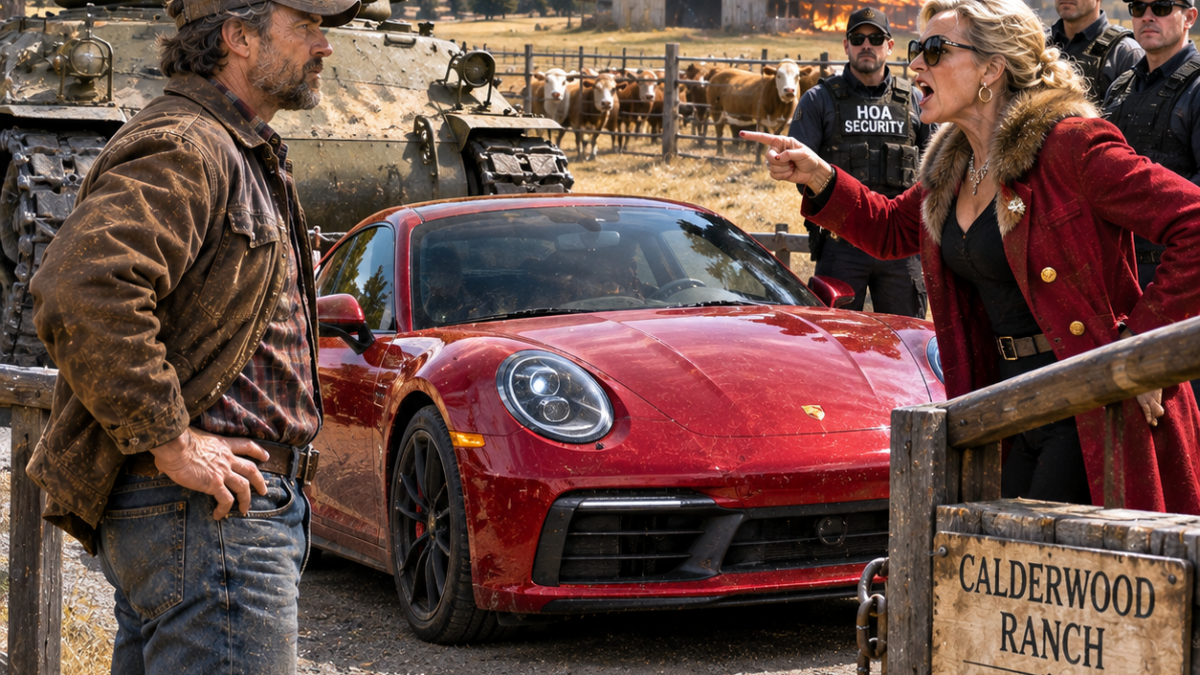
She drove a bright red Porsche 911.
She wore expensive coats.
She spoke about Brierstone as if she had personally founded the county around it.
People inside the neighborhood had learned that opposing Daphne was exhausting.
She could turn a landscaping complaint into a three-hour meeting.
A disagreement over a fence into attorney letters.
A missed payment into public humiliation.
Most residents chose peace.
Rhett did not live inside Brierstone.
That became her problem.
The conflict began on a cold Monday morning.
Rhett heard the Porsche before he saw it.
The sports car came down the county road much too fast.
It braked hard near the ranch entrance.
Then turned sideways.
And stopped directly across the gate.
The position was deliberate.
Not parked near the gate.
Not partly blocking it.
Across it.
No livestock trailer could pass.
No feed truck.
Nothing larger than a motorcycle.
Daphne stepped out.
Camel-colored coat.
Phone in one hand.
Folder in the other.
Rhett walked down from the barn.
“What can I do for you?”
She placed a glossy map on the Porsche hood.
“I need to discuss the southern access corridor.”
Rhett looked at the map.
A thick red line ran from Brierstone toward his ranch.
It passed through his iron gate.
Across his private road.
Past the hay barn.
Then continued toward a proposed development south of the neighborhood.
“That’s my road.”
Daphne tapped the map.
“It’s designated access.”
“By who?”
“Brierstone Preserve.”
“That doesn’t answer the question.”
She straightened.
“The HOA has authority to coordinate traffic through this corridor.”
“No.”
She frowned.
“No?”
“My ranch is not in your HOA.”
“This road serves the community.”
“It serves my ranch.”
“It can serve both.”
“If I agree.”
Daphne smiled.
That was when Rhett first understood she had not come to ask.
She ran one hand across the roof of the Porsche.
“Do you know what this car costs?”
Rhett looked at it.
“No.”
“One hundred twenty thousand dollars.”
“Congratulations.”
Her smile hardened.
“Probably more than every rusted machine in those sheds combined.”
Rhett looked toward the Sherman under its canvas awning.
“Probably not.”
Daphne slid a typed document across the hood.
Shared road access agreement.
Permanent access rights.
Brierstone HOA.
Commercial, emergency, and service vehicle usage.
Rhett read the first page.
Then closed it.
“I’m not signing this.”
“You should read the entire agreement.”
“I read enough.”
“You haven’t heard our offer.”
“No.”
She folded her arms.
“If you refuse, I can make running this ranch very difficult.”
That was the first threat.
Rhett did not react.
He photographed the document.
The map.
The Porsche.
Its license plate.
Its exact position across the gate.
Then he said:
“Move your car.”
Daphne looked toward the Sherman.
Her lip curled.
“You can keep your pile of scrap metal.”
Rhett waited.
“But starting tomorrow…”
She pointed toward the gate.
“…this entrance takes orders from me.”
She got into the Porsche.
Drove away.
That evening, Rhett spread the photos across his kitchen table.
Benton sat opposite him with coffee.
The red line on Daphne’s map was the important part.
It did not merely reach the farm gate.
It continued through the ranch.
Straight across the cattle yard.
Then south.
Benton studied it.
“She isn’t asking to borrow the road.”
“No.”
“She’s taking it.”
“That’s what it looks like.”
“Why?”
Rhett stared at the map.
“I don’t know yet.”
The next morning answered one question.
A metal sign had appeared beside the gate.
BRIERSTONE HOA
AUTHORIZED ACCESS ONLY
Below:
UNAUTHORIZED VEHICLES SUBJECT TO $500 FINE.
Two private security guards stood beside a patrol truck.
The weekly feed delivery arrived at 8:20.
The guards stopped it.
Recorded the license plate.
Called the HOA office.
The driver sat forty minutes.
Rhett finally walked down.
“This truck is delivering feed to my ranch.”
One guard said:
“We need association verification.”
“No, you don’t.”
“We’ve been instructed—”
“You are standing outside an HOA property line.”
“We’re enforcing access rules.”
“You have no access rules here.”
Rhett called the sheriff’s office.
A deputy documented the situation.
The guards eventually left.
The sign stayed.
By noon, Daphne returned.
Porsche first.
White SUV behind.
A young woman from Brierstone’s communications office climbed out holding a camera.
Daphne started recording immediately.
“Mr. Calderwood, do you intend to continue violating the association’s lawful access requirements?”
Rhett almost smiled.
“Good morning.”
“This is serious.”
“I know.”
“You obstructed community operations.”
“This is my private gate.”
Daphne turned toward the camera.
“Mr. Calderwood continues refusing to acknowledge historic shared-access rights.”
Rhett handed her a copy of his deed.
Then the county map.
“Show me where Brierstone owns anything inside this line.”
Daphne barely glanced.
“Ownership isn’t the issue.”
“Yesterday it sounded like it was.”
“The HOA holds usage rights.”
“Recorded where?”
“County records.”
“Recording number?”
Silence.
“Book and page?”
Nothing.
“Easement document?”
Daphne lowered the phone.
“You have seventy-two hours.”
“For what?”
“Sign.”
“No.”
“Then the association takes action.”
“What action?”
“The kind you will regret.”
She left.
Rhett called Fiona Denbrook that afternoon.
Property-rights attorney.
Forty-five.
Direct.
Careful.
Fiona pulled county planning documents connected to a project called Brierstone South.
They spread the plans across her conference table.
Eighteen luxury lodge lots.
Road improvements.
Fire routes.
Emergency access.
Service corridor.
And there it was.
Rhett’s road.
Marked in bold.
FIRE APPARATUS / SERVICE VEHICLE ACCESS.
A note in small print said:
ACCESS EASEMENT PREVIOUSLY SECURED.
Rhett stared at it.
“No.”
Fiona looked at him.
“You never signed?”
“Never.”
“Authorized?”
“No.”
“Discussed?”
“Not once.”
She tapped the plan.
“Then somebody represented rights to a public agency that may not exist.”
Rhett leaned back.
“How serious?”
“Potentially very.”
“What do we do?”
“We verify everything.”
She told him not to confront Daphne unnecessarily.
Document.
Preserve.
Record.
Let Fiona handle the county records.
Then Rhett learned why Daphne needed the road.
Inside a glass-walled conference room at the Brierstone clubhouse, Daphne had been meeting with Gavin Lockidge.
Real estate developer.
Fifty-two.
He was pursuing a luxury project south of the existing neighborhood.
Brierstone South.
Eighteen lots.
High-end lodges.
Private amenities.
The commercial agreement on the table was worth $5.6 million.
But investors had a condition.
Legal road access.
Emergency egress.
Service access.
Building a new route around the ridge would cost heavily and delay construction by almost a year.
Rhett’s gravel road solved everything.
If Daphne controlled it.
She had already represented that she did.
Gavin asked:
“The ranch owner signed?”
Daphne leaned back.
“He will.”
“That’s not what I asked.”
“We have historic rights.”
“Recorded?”
“Being finalized.”
Gavin looked at her.
“We cannot close without access.”
“I understand.”
“You’re certain?”
Daphne smiled.
“Don’t worry about the farmer.”
Then:
“He’ll sign whether he wants to or not.”
Rhett did not hear that conversation until much later.
But he saw the pressure campaign beginning almost immediately.
Brierstone residents received a letter.
NEIGHBORING PROPERTY SAFETY CONCERN.
It described Rhett’s ranch as containing “armored military vehicles” and “heavy machinery.”
It implied a safety risk.
It did not mention that the Sherman was demilitarized.
It did not mention the ranch predated Brierstone.
Then a media van began parking on the county road.
Camera pointed toward the ranch.
The crew filmed the tank.
Gate.
Barn.
Fences.
Daphne’s instructions were simple.
Make Rhett look threatening.
One afternoon Benton spotted a man measuring the gate.
“What are you doing?”
“Survey.”
“Whose?”
The man hesitated.
Then hurried back to the production van.
The next morning, an email landed in Rhett’s inbox.
Forwarded accidentally from the HOA communications office.
Attached:
Production schedule.
Internal title:
FARM OWNER CONFRONTATION.
Rhett read it twice.
Then called Benton.
“They’re trying to stage something.”
“What?”
“A confrontation.”
“Film you angry?”
“Looks that way.”
They installed more security cameras.
Gate.
Equipment barn.
Cattle lane.
Only Rhett’s property.
Twenty-four-hour recording.
That night, Rhett received an automated alert from the county recorder.
New document affecting his parcel.
He opened it.
ACCESS EASEMENT.
Grantor:
Rhett Calderwood.
Grantee:
Brierstone Preserve HOA.
Permanent road rights.
And at the bottom:
His signature.
Rhett stared.
He had never signed it.
Never seen it.
Never authorized it.
He called Fiona.
“Something just got filed.”
She read it.
Then said:
“Do not call Daphne.”
“Wasn’t planning to.”
“Do not publicly accuse anyone yet.”
“I know.”
“We preserve it.”
Three days later, Brierstone South held an investor showcase.
The lots sat near Rhett’s eastern fence.
Banners.
Catering.
Displays.
Site maps.
The promotional brochure featured Rhett’s iron gate.
That morning Fiona delivered formal notice:
No event vehicle.
No construction vehicle.
No HOA vehicle.
No commercial traffic authorized on Calderwood Ranch road.
At 10:00, the red Porsche arrived.
Daphne drove directly to the gate.
Turned sideways.
Stopped.
Locked it.
Put the keys in her coat pocket.
Then stood beside it.
“You want access?”
Rhett walked down from the barn.
“Move your car.”
“Sign the easement.”
“No.”
“Then the car stays.”
“You’re blocking my ranch entrance.”
“Yes.”
“Move it.”
“No.”
The production crew stood across the road.
Camera ready.
Daphne leaned against the Porsche.
“If you want through…”
She smiled.
“…ram it.”
Rhett stared.
“I’d love to see whether you can afford to replace a Porsche.”
The camera zoomed.
That was the trap.
A shove.
A kick.
A tractor bumper.
Anything.
She wanted footage.
Rhett took out his phone.
Recorded the time.
Called the sheriff.
“Locked vehicle blocking private farm entrance.”
Dispatcher logged it.
Then he waited.
On the Brierstone South event grounds, technicians prepared lighting and stage effects.
One system used pyrotechnic sparks.
The wind was strong.
Dry conditions.
Fire danger had been posted that morning.
The event coordinator approached Daphne.
“Wind’s getting worse.”
She barely looked at him.
“We should shut down the pyro.”
“No.”
“Fire department called.”
“Handle it.”
The man returned later.
“Seriously, we need to stop.”
Daphne pointed toward Rhett.
“Not now.”
Meanwhile, Benton was finishing mechanical checks on the Sherman.
The regional history showcase was two days away.
The tank needed repositioning for loading.
He turned the ignition.
The old engine coughed.
Then caught.
Deep rumble.
Barn windows vibrated.
Rhett heard it.
Looked toward the shed.
Then at the Porsche.
Then back toward the road.
He had no intention of touching the car.
The sheriff was coming.
Then someone screamed.
“Smoke!”
Cody Marsh came running from behind the hay barn.
Hat in his hand.
“Smoke!”
Rhett turned.
Gray plume.
Then orange flame.
Dry grass along the fence had ignited.
Sparks from the event pyrotechnics had blown across the boundary.
Wind carried them into brittle brush.
Within seconds, fire raced through the grass.
The direction was terrible.
Toward the hay barn.
The barn contained winter feed stacked nearly to the rafters.
Behind it were cattle pens.
Sixty-four mature cattle smelled smoke.
They surged.
Bellowed.
Pressed against fences.
Rhett moved.
“Cody! North gate!”
Cody ran.
“Benton! Pump!”
Rhett grabbed his phone.
“Grass fire. Calderwood Ranch. Wind-driven. Hay barn threatened. Sixty-four cattle.”
Dispatcher:
“Engines are responding.”
Rhett gave directions.
Then came the question.
“Is the main gate clear for apparatus?”
Rhett looked toward the Porsche.
“No.”
“What’s blocking it?”
“Locked unoccupied vehicle.”
“Can it be moved?”
“Owner is here refusing.”
Pause.
“Repeat that.”
“Vehicle owner refuses to move it.”
Rhett ran toward the gate.
His face already streaked with smoke.
Daphne was still there.
Still holding her phone.
“Move your car.”
She smiled.
“You’re not getting my signature by pretending—”
“There is a fire.”
“I see smoke.”
“Move the car.”
“Sign.”
Rhett stared.
Behind him black smoke thickened above the barn.
Daphne looked at it.
Then shrugged.
“That’s your farm’s problem.”
She touched the Porsche roof.
“Not my Porsche’s problem.”
Even the camera operator lowered his camera.
Rhett held out his hand.
“Keys.”
“No.”
“Drive it away.”
“No.”
“Fire engines need this gate.”
“They can use another entrance.”
“There isn’t another heavy access gate.”
“Not my problem.”
Rhett called dispatch again.
Reported the obstruction.
Timestamped.
Documented.
Then emergency lights appeared.
A rescue equipment truck stopped on the county road.
Unable to pass.
The driver leaned out.
“We need the gate!”
“Engines?”
“Three minutes!”
Rhett looked toward the ranch.
Smoke.
Cattle.
Men.
Hay.
Fire.
The back lane was too narrow and too soft for full-size engines.
A tow truck from town would take forty minutes.
Maybe more.
He looked at the Porsche.
$120,000.
Then the barn.
The calculation took seconds.
Property versus life.
Property versus animals.
Property versus emergency access.
Rhett walked around the Porsche.
Checked every window.
Empty.
He raised his voice.
“Everyone back fifty yards!”
Daphne laughed.
“You wouldn’t dare.”
Rhett faced her.
“Last chance.”
“You touch that car and I own this ranch.”
“Move it.”
“No.”
He turned.
“Benton!”
Benton ran toward him.
“Get everyone clear.”
Benton looked at Rhett.
Then the tank.
Understood immediately.
“Clear the gate!”
People moved.
Camera crew.
Event workers.
Rescue personnel.
Daphne remained near the ditch.
Benton shouted:
“Back!”
Rhett climbed into the Sherman.
The engine roared.
Thirty tons of steel rolled from the barnyard.
Slow.
Controlled.
Tracks clanking.
Daphne lifted her phone.
“He’s threatening me with a military tank!”
Rhett did not answer.
“He’s threatening me!”
The tank moved at walking speed.
Benton watched clearance.
The rescue crew stood back.
The Porsche remained sideways across the gate.
Empty.
Rhett angled the Sherman toward the rear quarter.
Steel touched red bodywork.
For one moment, nothing moved.
Then metal groaned.
The Porsche shifted.
Daphne’s smile vanished.
“STOP!”
Rhett continued slowly.
The Porsche slid sideways.
Tires scraped gravel.
Rear wheels dropped off the road.
The car tilted.
“STOP! THAT CAR IS WORTH A HUNDRED TWENTY THOUSAND DOLLARS!”
The Sherman kept pushing.
The Porsche balanced briefly at the ditch edge.
Then gravity took over.
It slid nose-first down the slope.
Carbon fiber cracked.
Glass shattered.
Mud covered the red paint.
One rear wheel remained partly suspended.
The gate was clear.
Rhett stopped immediately.
No second push.
No crushing.
No celebration.
He climbed out.
Daphne ran toward the ditch.
“You destroyed my car!”
Rhett looked at her.
“You had every chance to move it.”
“I’ll take your ranch!”
Rhett turned away.
“Bring the truck through!”
The rescue vehicle entered.
Less than a minute later, two fire engines came through the gate.
Chief Alana Reic climbed from the first.
Forty-three.
Ash-gray uniform.
Instant command.
Crews deployed hose.
Cut firebreak.
Protected the hay barn.
Rhett and his hands moved cattle north.
One gate opened.
Then another.
Animals poured into open pasture away from the smoke.
The fire fight lasted almost two hours.
Part of the hay barn burned.
Winter feed was lost.
Fence damaged.
Grass blackened.
But the main livestock building survived.
All sixty-four cattle survived.
No ranch hand injured.
No firefighter injured.
After the fire was controlled, Chief Reic spoke to Rhett.
“That entrance was our apparatus route.”
“I know.”
“The blocked gate cost us time.”
“I know.”
“If it had stayed blocked another fifteen minutes…”
She looked toward the barn.
“We’d be talking about a different fire.”
Her report documented everything.
Arrival.
Blocked gate.
Porsche.
Time gate cleared.
Method.
Fire behavior.
Emergency necessity.
Rhett thought that would be the end of the spectacle.
It was not.
That night Daphne edited her footage.
She removed her refusal to move the Porsche.
Removed the smoke.
Removed Rhett’s warnings.
Removed the rescue truck.
Removed the dispatch call.
Removed the emergency context.
What remained:
Sherman tank.
Red Porsche.
Rhett.
Thirty seconds.
She sent it to local media.
Subject:
RANCHER ATTACKS HOA PRESIDENT’S VEHICLE WITH MILITARY TANK.
By midnight, Rhett’s phone would not stop buzzing.
Headlines appeared.
Comments.
Videos.
People who knew nothing about the fire called him insane.
Dangerous.
Unstable.
Within a week, Daphne’s attorney sent a demand.
$500,000.
Porsche.
Towing.
Rental vehicle.
Legal costs.
Emotional distress.
Plus an injunction prohibiting Rhett from operating armored vehicles anywhere in the county.
At a packed HOA meeting, Daphne played the edited video on a projector.
The tank pushed the Porsche.
Guests gasped.
She waited.
Then said:
“This man does not deserve to own property next to our community.”
Rhett did not hold a press conference.
He did not post angry rebuttals.
He gave Fiona the unedited recordings.
Multiple camera angles.
Continuous.
Timestamped.
They showed:
Daphne parking sideways.
Locking the Porsche.
Removing the keys.
Demanding a signature.
Rhett repeatedly asking her to move it.
Smoke rising before the tank moved.
Emergency truck blocked.
Fire engines approaching.
Porsche empty.
People ordered clear.
Tank moving slowly.
One controlled push.
Sheriff Joel Hartwell reviewed the footage.
Forty-seven.
Not interested in social-media narratives.
He matched timestamps against:
911 logs.
Dispatch records.
Chief Reic’s report.
Rescue crew statements.
Rhett’s decision still required legal review.
But Daphne’s public version collapsed almost immediately.
Then the production crew’s camera operator called Fiona.
He wanted to talk.
He brought documents.
Emails.
Contract.
Call sheet.
FARM OWNER CONFRONTATION.
Daphne had hired them a week before the gate incident.
Objective:
Capture Rhett losing his temper.
Create footage for HOA communications and litigation.
The camera operator admitted:
“She wanted a reaction.”
“What kind?”
“Anything aggressive.”
“Did she tell you why?”
“She said he was dangerous and she wanted proof.”
“Was he?”
“No.”
He looked down.
“When the fire started, I realized what we were actually doing.”
He also remembered Daphne’s words.
That’s your farm’s problem.
Not my Porsche’s problem.
That statement had been captured.
The gate blockade was not an accident.
It was staged pressure.
The fire transformed it into something Daphne never anticipated.
A real emergency.
Residents began asking different questions.
Not:
Why did Rhett push the Porsche?
But:
Why was the HOA president blocking a private ranch gate at all?
Why was she demanding access?
Why did she hire a production crew before the confrontation?
Who was paying?
Iris Wayne wanted answers.
Fifty-four.
HOA treasurer.
Retired bank auditor.
She formally requested every expenditure connected to Brierstone South.
Daphne resisted.
Iris cited the bylaws.
Records opened.
Payments appeared.
MARKETING SERVICES.
ACCESS ASSURANCE.
DEVELOPMENT CONSULTING.
One payment path was strange.
HOA development fund.
Then intermediary consulting company.
Then luxury automobile dealership in Denver.
Iris followed the money.
Transaction details included a license plate.
She recognized it.
The Porsche.
Daphne’s Porsche.
Iris checked registration.
Titled personally to Daphne.
Then she traced invoices.
The intermediary company belonged to a distant relative.
It billed Brierstone for marketing work.
Iris found no evidence much of the billed work had occurred.
Funds moved through the company.
A substantial portion ultimately helped pay Daphne’s personal Porsche expenses.
The car she had used as a symbol of wealth and leverage had partly been purchased using homeowners’ money hidden behind questionable invoices.
Now the Porsche was evidence.
Forty-one households had contributed indirectly to a vehicle Daphne parked across someone else’s gate.
Iris contacted independent counsel.
Then Fiona.
Then investigators.
The dispute expanded again.
Meanwhile, Fiona examined the newly recorded easement.
Forensic document examiner.
Signature comparison.
Rhett’s authentic signatures.
The disputed signature appeared unnaturally identical to one from an old equipment lease.
Same stroke.
Same pressure pattern reproduced digitally.
Too perfect.
The county recorder confirmed no valid historic grant existed before the new filing.
The map attached to the easement described rights Rhett had never approved.
The document became part of an investigation into possible forgery and false filing.
The very piece of paper Daphne needed to take Rhett’s road was turning into evidence against her.
Gavin Lockidge learned about the problem from his lawyers.
Routine title review.
No legal road access.
Easement under investigation.
He called Daphne.
“Is there a valid access agreement?”
“Yes.”
“My attorneys say there isn’t.”
“They’re being overly cautious.”
“They say the document you gave us may be forged.”
“Minor technical issue.”
Gavin went silent.
“Minor?”
“A lawyer can correct it.”
“Daphne.”
“What?”
“Road access is the first condition in a $5.6 million project.”
“We’ll get it.”
“You told us you already had it.”
“We effectively do.”
“No.”
His voice stayed quiet.
“That is not the same thing.”
He froze negotiations.
Investors held funding.
Daphne called repeatedly.
Gavin stopped answering.
Then Daphne’s attorney contacted Rhett.
Offer.
She would drop the $500,000 Porsche demand.
In exchange, Rhett would keep the HOA financial matters out of the civil case.
Rhett looked at Fiona.
“What do you think?”
“I think she’s worried.”
“I don’t want her money.”
“What do you want?”
“My gate left alone.”
“Then that’s what we ask for.”
Fiona petitioned for an injunction.
No HOA signs.
No obstruction.
No trespass.
No interference.
No claimed road use without lawful recorded rights.
The financial evidence went separately to investigators.
Fiona kept the cases disciplined.
Rhett followed her lead.
The Porsche claim centered on the emergency.
The road case centered on title and access.
The financial investigation centered on money.
The forged easement went through its own process.
Do not mix what does not need mixing.
Daphne had spent months creating confusion.
Fiona answered with categories.
Then Iris called an emergency HOA meeting.
For the first time in four years, Daphne did not control the agenda.
The clubhouse was full.
Forty-one households.
Most represented.
Daphne arrived wearing a cream blazer.
Chin high.
She took her usual seat.
Iris stood at the front.
Three binders.
Projector.
Bank records.
No dramatic opening.
She simply began.
First:
Payments to intermediary company.
Then:
Invoices.
Then:
Lack of supporting work documentation.
Then:
Transfers.
Finally:
Luxury auto dealership.
Porsche license plate.
Murmurs filled the room.
Daphne interrupted.
“These are legitimate consulting expenses.”
Iris asked:
“Why did association money reach a dealership tied to your personal vehicle?”
“It didn’t.”
Iris projected the statement.
Silence.
A retired teacher stood.
“Why were we spending money on access to a road we didn’t own?”
Daphne switched topics.
“Brierstone South would have increased every home value.”
“That wasn’t the question.”
“It was an investment in the community.”
“Did Rhett sign?”
“We had an easement.”
Iris projected the county notice.
The easement was disputed and under investigation.
Someone in the rear shouted:
“Did he sign it?”
Daphne’s face flushed.
“We believed the document was valid.”
“Who gave it to you?”
No answer.
The board moved toward a vote.
Daphne stood.
“You cannot remove me because one hostile rancher destroyed my property!”
Iris said:
“This meeting is about association funds.”
Ballots.
Counted twice.
Thirty-eight of forty-one homeowners voted to remove Daphne.
Effective immediately.
Bank access revoked.
Office keys surrendered.
Independent auditor appointed.
Daphne stood trembling.
She pointed toward Iris.
“Walt.”
Security chief Walt Puit stood near the wall.
Gray-haired.
Former Marine.
“Escort her out.”
Walt did not move.
Daphne stared.
“I gave you an order.”
Walt replied:
“Mrs. Tillingast, you no longer have authority to give us orders.”
Silence.
Then somebody in the back began clapping.
A few others joined.
Daphne walked out.
Two days later, Gavin withdrew from Brierstone South.
Officially.
The $5.6 million development collapsed.
Reason:
Unreliable access record.
Material project misrepresentations.
Investor financing withdrew.
The road was not available.
It had never been available.
Daphne had built an entire multimillion-dollar project around forcing Rhett to surrender something she did not own.
Then investigators moved.
The financial trail.
The easement.
The invoices.
The Porsche.
Records preserved.
Some weeks later, detectives arrived at Daphne’s home with a court-authorized search warrant.
Laptops.
Storage drives.
Financial records.
Documents.
Collected methodically.
No spectacle.
No cheering neighbors.
Daphne stood on her front steps in a robe watching boxes leave.
She called Walt.
He saw the name.
Let it ring.
That evening Fiona called Rhett.
“Brierstone South is officially dead.”
Rhett stood beside the hay barn.
Part of the siding was still black from the fire.
“Okay.”
“That’s all?”
“What do you want me to say?”
“You could sound happier.”
“My barn still smells like smoke.”
Fair.
Rhett walked to the gate.
The illegal HOA sign had been removed.
Court order.
Only bolt marks remained on the post.
He rested both hands against the iron bars.
That mattered more than Daphne losing office.
The road was his again.
Not symbolically.
Practically.
Feed truck could enter.
Veterinarian.
Hay delivery.
Fire engines.
No guard.
No HOA fine.
No permission request.
The Porsche dispute moved more slowly.
The court reviewed everything.
Fire report.
911 logs.
Security footage.
Rescue crew statements.
Chief Reic.
Camera operator.
Daphne’s refusal.
Emergency context.
The issue was not decided based on a viral thirty-second clip.
Responsibility was evaluated against what actually happened.
Daphne never received the sweeping $500,000 result she demanded.
Separate proceedings addressed the HOA finances.
Repayment.
Penalties.
Audit findings.
The disputed easement was formally removed from the land record.
No valid HOA access remained.
The injunction prohibited Daphne from obstructing or interfering with the ranch entrance.
Her Porsche was considered heavily damaged.
Repair economics were ugly.
Bodywork.
Glass.
Suspension.
Underbody.
Electronic systems.
The car that once represented her authority became the most expensive piece of physical evidence in the entire scandal.
Yet the Porsche was not what Daphne lost that mattered most.
She lost the road.
Then the presidency.
Then Brierstone South.
Then control of the narrative.
Then the ability to make people obey simply because she spoke first.
Months later, she drove to the ranch in a rented sedan.
Parked on the county shoulder.
Did not block the gate.
That was progress.
Rhett and Benton were loading the Sherman onto a heavy flatbed for the history showcase.
The same showcase they had been preparing for before everything started.
Daphne stood outside the fence.
Watched.
The ditch had been repaired.
Only faint ruts remained where the Porsche had landed.
She spoke.
“None of this would have happened if you had cooperated.”
Rhett set down a winch strap.
Looked through the gate.
“No.”
“You made this impossible.”
“You parked across my gate.”
“You refused a reasonable access agreement.”
“You were selling a road you didn’t own.”
“I was trying to improve the community.”
“You were trying to force me to solve a problem you created.”
“You could’ve been paid.”
“I said no.”
“You didn’t even negotiate seriously.”
Rhett looked at her.
“You never wanted cooperation.”
She fell silent.
“You wanted ownership.”
Daphne’s jaw tightened.
He continued:
“You wanted to decide who used my road, when they used it, and what project it served.”
“You don’t understand development.”
“I understand property.”
She looked at the Sherman.
“That thing ruined my car.”
Rhett shook his head.
“No.”
Her expression hardened.
“You had a choice.”
“So did you.”
Silence.
“I asked you to move it.”
Daphne looked away.
“The fire changed everything.”
“No.”
Rhett paused.
“The fire revealed everything.”
She said nothing.
Then walked back to the rental car.
Drove away.
Rhett watched until she disappeared.
A few days later, he painted the ranch gate.
Fresh black.
Removed every mark left by the HOA signs.
Then installed one new sign.
Dark green steel.
Plain white letters.
PRIVATE PROPERTY
NO HOA ACCESS
No threats.
No slogans.
No mention of Daphne.
Tuesday morning, the feed truck arrived.
Driver slowed.
Looked at the sign.
Rhett opened the gate.
Truck rolled through.
No guards.
No clipboard.
No delay.
Benton stood nearby wiping grease from his hands.
“Feels normal.”
Rhett nodded.
“That’s the point.”
The Sherman sat strapped to the trailer.
Benton looked toward it.
“You ever regret pushing that Porsche?”
Rhett looked at the gate.
Thought about the fire.
The rescue truck.
Daphne refusing the keys.
The cattle.
The smoke.
Then the ditch.
“I’m sorry she didn’t move it while she still had the chance.”
Benton laughed.
Rhett smiled faintly.
But there was one detail he never found funny.
Chief Reic’s estimate.
Another fifteen minutes.
Fifteen minutes could have meant the hay barn fully involved.
Embers reaching the cattle building.
Firefighters stretching hoses from the county road.
Men trapped between panicked cattle and fire.
The Porsche was expensive.
The alternative could have been measured in lives.
That was why Rhett never accepted the story that he destroyed a car over a property dispute.
The property dispute explained why the Porsche was there.
The emergency explained why it had to move.
Those were different things.
And Daphne had tried desperately to erase that difference.
Her edited video removed context because context destroyed her argument.
That became the pattern in everything she did.
Remove context from the road.
Call it an access corridor.
Remove context from the Sherman.
Call it an armed military threat.
Remove context from the Porsche.
Call it a random attack.
Remove context from the HOA money.
Call it marketing.
Remove context from the easement.
Call it historic access.
Remove enough context and almost any lie can look plausible.
Rhett’s defense was not dramatic.
Put the context back.
Full video.
Full deed.
Full survey.
Full financial trail.
Full fire report.
Full 911 timeline.
Full access record.
Truth is often just the edited parts restored.
Months later, Brierstone elected a new board.
The replacement president contacted Rhett.
Not with demands.
With a letter.
The board wanted to discuss limited emergency access planning.
Actual emergency access.
Not commercial traffic.
Not development vehicles.
No permanent public use.
Any agreement would be written.
Reviewed by both attorneys.
Recorded properly.
Rhett agreed to talk.
Benton was surprised.
“You’d let them use the road?”
“In a real emergency?”
“Yeah.”
“Maybe.”
“After everything?”
Rhett looked at him.
“The road isn’t sacred.”
Benton laughed.
“Could’ve fooled me.”
“The right to decide is.”
That was the difference Daphne never understood.
Rhett had never opposed cooperation.
He opposed being told that cooperation had already happened.
Permission matters because it distinguishes sharing from taking.
A year after the fire, the damaged section of the hay barn had been rebuilt.
The cattle returned to the same pens.
New grass covered the burn scar.
The ditch beside the entrance was repaired.
Most drivers passing on the county road would never know a $120,000 Porsche once sat broken there.
Brierstone South remained abandoned.
The eighteen proposed lots stayed undeveloped.
Without Rhett’s road, the economics no longer worked.
Gavin eventually moved on to another project.
He never contacted Daphne again.
Iris remained active in the HOA.
She implemented controls residents once complained were excessive.
Two signatures on major transfers.
Independent contract review.
Conflict disclosures.
Vendor verification.
Recorded proof of any property right before project approval.
A resident joked at one meeting:
“Do we really need this much paperwork?”
Iris answered:
“We bought part of a Porsche last time we skipped it.”
Nobody argued.
Walt retired from private security the following year.
Benton joked that he deserved a medal for refusing Daphne’s final order.
Walt replied:
“I spent twenty years in the Marines. Being yelled at by one HOA president was not my greatest test.”
Rhett liked him.
The Sherman finally reached the history showcase.
It sat behind ropes.
Clean.
Olive drab.
Historic placard explaining its wartime origins and later restoration.
Rhett expected questions about engines.
Armor.
Transmission.
Instead, visitors kept asking:
“Is this the tank?”
He pretended not to understand.
“What tank?”
“The Porsche tank.”
Benton loved it.
Rhett hated it.
A teenager asked:
“Did you really crush the whole car?”
“No.”
“You could’ve.”
“That wasn’t the goal.”
“What was?”
“Open the gate.”
That answer usually disappointed people.
They wanted spectacle.
Rhett remembered an emergency.
The difference was important.
Later, the museum running the showcase asked whether they could include a photograph from the incident in a display about civilian preservation vehicles.
Rhett refused.
The Sherman deserved to be remembered for history, not for a neighborhood property dispute.
Benton told him:
“You know nobody else agrees with you.”
“I know.”
“It’s the most famous thing that tank ever did after the war.”
“That’s depressing.”
“Also funny.”
Rhett shook his head.
Still, the incident taught him something about machines.
A Porsche and a Sherman were built for completely different reasons.
One for speed.
One for force.
Daphne treated price as power.
She had told him her car cost more than his rusty equipment.
But money does not change physics.
And it certainly does not create legal authority.
Her Porsche was worth $120,000.
The ranch road was worth vastly more to her project.
That was why she parked there.
The car was never merely transportation.
It was leverage.
She believed Rhett would look at it and calculate:
Scratch the car, get sued.
Touch the car, lose money.
Damage the car, become the villain.
Therefore, he would surrender.
In an ordinary property dispute, maybe that leverage would have worked temporarily.
Then fire arrived.
And suddenly the question changed.
Not:
How expensive is the Porsche?
But:
How quickly can it be moved?
Daphne did not understand the change until steel touched paint.
That same failure defined the rest of her collapse.
She kept treating every problem as something status could overpower.
Survey?
Use influence.
Landowner?
Pressure him.
Residents?
Control the story.
Developer?
Promise access.
County filing?
Create paperwork.
Public criticism?
Edit video.
Treasurer?
Intimidate.
Security chief?
Order him.
At each step, she assumed confidence could substitute for authority.
It worked until independent systems entered the picture.
County records.
911 logs.
Fire reports.
Bank statements.
GPS timestamps.
Security cameras.
Courts.
Investigators.
Those systems were boring.
That was their strength.
They did not care that Daphne drove a Porsche.
They did not care about her title.
They did not care how many residents she could silence.
They asked narrow questions.
Who owns the road?
Was access granted?
Who signed?
Where did the money go?
Was the gate blocked?
Was there a fire?
Was the vehicle empty?
When was the warning given?
Those questions dismantled her power piece by piece.
Rhett eventually framed one document in his ranch office.
Not the court order.
Not a photograph of the Porsche.
Not the headline.
The county parcel map.
Calderwood Ranch outlined clearly.
Brierstone Preserve beside it.
Different property.
Different boundary.
Underneath, a small brass plate:
146 ACRES
PURCHASED 22 YEARS AGO
STILL NOT AN HOA
Benton saw it.
“You accuse Daphne of theatrics and then make this?”
“I’m allowed one.”
“Fair.”
Rhett kept the forged easement copy in a drawer.
He rarely looked at it.
That document bothered him more than the Porsche ever did.
A car could be repaired or replaced.
A false property record tried to rewrite reality.
Someone had taken his name.
Copied his signature.
Attached it to rights he had never granted.
Then attempted to use government recording systems to make the fiction look permanent.
That felt different.
Personal.
Not because the signature was beautiful.
Rhett’s handwriting was terrible.
But because consent was the entire issue.
Daphne’s strategy depended on replacing his no with a fake yes.
That was the core of everything.
The road.
The gate.
The project.
The media campaign.
The staged confrontation.
She could not accept that one neighboring landowner had the right to say no to her $5.6 million plan.
So she tried to create consent.
When that failed, she tried pressure.
When pressure failed, spectacle.
Then the fire stripped the whole performance away.
Years later, Rhett still maintained the gate.
Greased hinges.
Checked posts.
Paint when needed.
Not because he feared another HOA invasion.
Because Edith had taught him that gates deserve attention.
She had said:
“A gate is not about keeping everybody out.”
It is about deciding who comes in.
Rhett finally understood how much was contained in that sentence.
Ownership was not isolation.
It was choice.
The feed truck came in.
Veterinarian came in.
Neighbors sometimes came in.
History-club members.
School groups invited to see the restoration shop.
Firefighters during training.
People Rhett trusted.
People who asked.
The gate opened often.
Just not on Daphne’s command.
One fall afternoon, Chief Reic visited.
She had not seen the rebuilt barn.
Rhett showed her.
New siding.
Improved firebreak.
Additional water storage.
Wider emergency staging area.
“You upgraded everything.”
“Fire is persuasive.”
She smiled.
Then they walked toward the gate.
“You ever think about what would’ve happened if you waited for the tow truck?”
“Yes.”
“So do I.”
Rhett looked toward the ditch.
“Did I do the right thing?”
Chief Reic considered her answer.
“I’m a fire chief, not your lawyer.”
“I know.”
“My crews needed access.”
“I know.”
“The car was unoccupied.”
“Yes.”
“You gave warnings.”
“Yes.”
“And the fire was growing.”
“Yes.”
She shrugged.
“That is what I can tell you.”
Good answer.
Rhett had learned to appreciate people who stayed within the limits of what they actually knew.
Daphne never had.
Her entire downfall came from claiming rights, authority, and facts beyond what she possessed.
The ranch returned to routine.
Cattle.
Hay.
Repairs.
Restoration work.
Snow.
Mud.
Dry summers.
Brierstone still stood west of the fence.
People still lived there.
Most were ordinary neighbors.
Some became friendly with Rhett afterward.
One woman apologized for believing Daphne’s video.
“You didn’t owe me an apology.”
“I called you dangerous.”
“You didn’t know.”
“I should have waited.”
“That’s different.”
She looked at the gate.
“Do you hate us?”
“Why would I?”
“Because of everything.”
“Daphne did it.”
“The HOA did some of it.”
“The board fixed what it could.”
She nodded.
Then:
“I’m glad the cattle survived.”
“So am I.”
That was enough.
Rhett never wanted a war with forty-one households.
He wanted one woman to stop treating his ranch as an asset on her development spreadsheet.
Eventually that happened.
Daphne moved from Brierstone within the year.
A rented moving truck appeared early one gray morning.
No goodbye party.
No announcement.
She left quietly.
Neighbors said she sold the stone house.
Rhett did not check.
It was none of his business.
That felt appropriate.
On the morning she left, Rhett was repairing a gate latch.
Benton drove up.
“You hear?”
“No.”
“Daphne’s moving.”
“Okay.”
“That’s it?”
“What do you want?”
“I don’t know. A speech.”
Rhett tightened the bolt.
“No.”
“Something poetic?”
“No.”
“Sherman salute?”
Rhett looked at him.
Benton laughed.
“Worth asking.”
They returned to work.
The strongest ending was not Daphne leaving.
It was Tuesday.
The feed truck turned off the highway.
Approached the ranch.
Driver slowed.
Rhett opened the gate.
Truck rolled through.
No security guards.
No HOA sign.
No fine.
No camera crew.
No Porsche.
Just a private ranch road being used exactly as its owner allowed.
The Sherman sat under the awning.
Benton leaned against the fence.
“You know what’s funny?”
“What?”
“She parked that car there because she wanted everyone to know nobody went through without her permission.”
Rhett looked at the open gate.
“Yeah.”
“And now?”
Rhett thought for a moment.
Then answered:
“Now she’s the only one who isn’t allowed through.”
Benton laughed.
Rhett closed the gate after the feed truck disappeared around the bend.
The latch clicked.
Twenty-two years earlier, he had bought the land because he wanted somewhere quiet to build a life.
He never imagined he would have to defend the entrance from an HOA president using a six-figure sports car, a forged easement, an edited media campaign, and a multimillion-dollar development deal.
But Daphne’s mistake had never been underestimating the Sherman.
It was misunderstanding the gate.
She thought the gate was an obstacle.
Rhett understood it was a boundary.
The Porsche could block it.
The HOA could put signs beside it.
A developer could draw lines through it.
A forged paper could pretend somebody had surrendered it.
None of those things changed the underlying fact.
The road beyond that gate belonged to Rhett Calderwood.
And when a real emergency came, Daphne had one final chance to accept that fact and move her car.
She refused.
Thirty tons of steel answered physics.
The courts answered the paperwork.
The homeowners answered the money.
And by the time the smoke cleared, the $120,000 Porsche lying in a ditch was no longer the most expensive thing Daphne Tillingast had lost.
Her presidency was gone.
The $5.6 million Brierstone South project was gone.
The easement was gone.
The financial scheme was exposed.
The authority she had spent years building collapsed.
All because she gambled everything on forcing one quiet rancher to give her a road that had never belonged to her.
And in the end, Rhett did not have to give her anything.
Not the ranch.
Not the gate.
Not the road.
Not even the signature she had tried so hard to manufacture for herself.








