HOA Karen Paid a Crew to Cut My Live Power Line—Then My Emergency Team Arrived and Called Me “Chairman.”
PART2:
But I didn’t want it to define every conversation I had.
That becomes exhausting.
At restaurants:
“Can you lower my electric bill?”
At church:
“My transformer hums.”
At cookouts:
“Why did my power blink last Tuesday?”
Once a dentist asked me about underground distribution while my mouth was full of instruments.
So when I bought a modest brick house in Pine Ridge, I told nobody.
Not because it was secret.
My name was public.
Company website.
Board filings.
Local newspapers.
Anyone who cared enough could find it in thirty seconds.
Nobody did.
Good.
I wanted to be Ethan.
Just Ethan.
Guy with an old truck.
Mows his own yard.
Drinks bad coffee.
PART3:
Waves at neighbors.
Pine Ridge looked perfect for that.
One hundred eighty-four homes.
Tall oaks.
Matching brick mailboxes.
Sidewalks.
Community pond.
Clubhouse.
Landscaping so carefully trimmed that I once wondered whether the bushes had signed legal agreements.
My first week there, Cynthia Langford appeared at my front door.
She was sixty.
Red hair arranged so precisely it looked structural.
Pearl earrings.
Cream blazer.
Clipboard.
Gift basket.
“Welcome to Pine Ridge.”
“Thank you.”
She handed me the basket.
Coffee.
Cookies.
HOA-branded wine glasses.
And beneath everything:
A seventy-page rulebook.
I laughed.
Cynthia didn’t.
“I recommend reading it carefully.”
“I’ll do my best.”
“I run this place pretty tightly.”
That sentence should have warned me.
Instead I assumed she was joking.
She smiled.
“I’m serious.”
I looked at the rulebook.
“Seventy pages?”
“Seventy-two including appendices.”
“That’s reassuring.”
She did not understand sarcasm.
“I’ve been president six years.”
“Congratulations.”
“People appreciate consistency.”
“I’m sure.”
She pointed toward my pickup.
“Commercial vehicles aren’t allowed overnight.”
“It’s personal.”
“Good.”
Then my toolbox.
“Exterior equipment needs to remain concealed.”
“Inside the truck?”
“Preferably garage.”
I smiled.
Cynthia smiled.
Two people smiling for entirely different reasons.
That was our beginning.
My next-door neighbor was Dolores Finch.
Seventy-eight.
Widow.
Five feet two inches.
Silver hair.
Sharp sense of humor.
She baked lemon cake whenever she was angry, which meant I received a lot of lemon cake because Cynthia gave Dolores plenty to be angry about.
The first slice arrived three days after I moved in.
She stood by my fence holding a covered plate.
“You Ethan?”
“Yes.”
“You married?”
“Widowed.”
“So am I.”
She held up the plate.
“Cake.”
I took it.
“Thank you.”
“Don’t get excited. I bake when I’m irritated.”
“What happened?”
She pointed toward a yellow HOA notice taped to her mailbox.
“They fined me because my trash can was visible from the street for thirty-eight minutes after the permitted window.”
I stared.
“Thirty-eight?”
“She timed it.”
I looked toward Cynthia’s house.
Dolores said:
“Don’t worry. She’ll find something wrong with you soon.”
She was right.
First fine:
Trash can.
$25.
I had left it out overnight because I forgot.
Fair enough.
I paid.
Second:
Grass exceeding the approved height.
The inspector claimed four and a quarter inches.
Maximum four.
I paid.
Third:
Garden hose visible from public right-of-way.
I thought that one was absurd.
Still paid.
Why?
Because I could.
And because I wanted peace.
That was mistake number one.
When unreasonable people discover compliance is easier than resistance, they begin confusing cooperation with submission.
Cynthia became increasingly comfortable sending me notices.
I remained polite.
She interpreted polite as weak.
Dolores saw it.
“You know you don’t have to pay every ridiculous thing she sends.”
“I know.”
“Then why do you?”
“Because arguing over twenty-five dollars costs me more than twenty-five dollars in blood pressure.”
Dolores pointed a fork at me.
“That’s how she wins.”
I laughed.
“Wins what?”
She looked toward Cynthia’s house.
“Exactly.”
Dolores used oxygen at night.
Chronic lung disease.
Nothing she hid.
A concentrator sat beside her bedroom.
She also had backup oxygen cylinders and a battery system installed after a winter outage.
Ridgeline had medical-priority programs available, though not everyone knew about them.
I helped Dolores enroll.
Quietly.
She thought I had simply found the paperwork online.
Technically true.
I also knew the person who designed the program.
Me.
The winter after I moved in, a severe ice storm hit the county.
Trees came down everywhere.
Overhead conductors snapped.
Two substations faulted.
Pine Ridge lost power for almost forty-eight hours.
I spent most of those two days inside our emergency operations center.
Nobody in the neighborhood knew.
I told them I had “work.”
Also technically true.
Dolores’s battery lasted.
Then Ridgeline delivered a portable backup unit under the medical-priority program.
She thought it was unusually fast.
It was.
After restoration, I reviewed the neighborhood infrastructure personally.
Old poles.
Aging service lines.
Transformer loading that needed improvement.
Pine Ridge was scheduled for modernization eventually.
I moved it forward.
Not because I lived there.
Because the storm exposed real weaknesses.
We planned:
New poles.
More resilient conductor.
Updated transformers.
Improved sectionalizing.
Hardened service connections.
Better vegetation clearances.
Work would begin in spring.
The first house scheduled for the new service equipment happened to be mine because it sat at the beginning of one circuit section.
That coincidence would later make Cynthia completely lose her mind.
But before that happened, I made the mistake of attending an HOA budget meeting.
The clubhouse was full.
Not because people cared about budgets.
Because dues were increasing sixteen percent.
Cynthia stood behind the table.
Treasurer Bill Tanner sat beside her.
Mid-sixties.
Retired accountant.
Quiet man.
Always nervous around Cynthia.
She projected a spreadsheet.
Landscaping.
Pool.
Insurance.
Clubhouse maintenance.
Security cameras.
Then:
RESERVE CONTRIBUTION.
I raised my hand.
Cynthia ignored me.
I kept it raised.
Finally:
“Mr. Marlowe?”
“What happened to the reserve balance?”
Bill looked down.
Cynthia smiled.
“We’re discussing next year’s assessment.”
“I understand.”
“Then please keep questions relevant.”
“It is relevant.”
I looked at the displayed number.
“Last year’s report showed approximately $212,000 in unrestricted reserve.”
The room changed.
Tiny thing.
People shifted.
Bill stopped moving.
Cynthia said:
“Reserve expenditures are handled by the board.”
“Right.”
“So where did it go?”
Her smile remained.
Eyes changed.
“Mr. Marlowe, you’re out of order.”
“I’m asking a financial question at a budget meeting.”
“You are disrupting the presentation.”
“Then answer and I’ll stop.”
Bill’s forehead had begun sweating.
Air conditioner running full blast.
That interested me.
Cynthia said:
“Sit down or you will be removed.”
I sat.
Not because I was intimidated.
Because I had learned what I needed.
Bill knew something.
Cynthia knew I noticed.
From that night forward, every minor rule became a weapon.
Parking warning.
Landscaping violation.
Unapproved exterior fixture.
I replaced a porch bulb.
Apparently that required approval.
Then Ridgeline arrived.
Three utility trucks.
White.
Green company logo.
Crew replacing my meter base interface, service conductor, and nearby distribution equipment as the first phase of the neighborhood hardening project.
Cynthia walked outside within minutes.
She stood at the sidewalk.
Arms crossed.
Watching.
One crew member, Trevor, recognized me.
Started to say:
“Mr. Mar—”
I shook my head.
He understood.
Cynthia asked:
“Who authorized this?”
Trevor answered:
“Ridgeline engineering.”
“HOA did not approve electrical modification.”
“This is utility work.”
“You still need architectural review.”
“No, ma’am.”
She looked offended.
“Everything exterior requires review.”
Trevor looked at me.
I almost felt sorry for him.
“Utility-owned infrastructure doesn’t.”
Cynthia wrote something on her clipboard.
Three days later, pink paper appeared on my front door.
UNAUTHORIZED ELECTRICAL MODIFICATION.
IMMEDIATE CORRECTIVE ACTION REQUIRED.
FAILURE TO REMOVE UNAPPROVED EQUIPMENT MAY RESULT IN ASSOCIATION-ORDERED TERMINATION OF UTILITY SERVICE.
I read that last sentence twice.
Then laughed.
Not because it was funny.
Because sometimes people write threats so far outside their authority that your brain needs humor to process them.
I drafted a polite response.
Cynthia,
The meter, service conductor, associated seals, and distribution equipment are owned and controlled by Ridgeline Power & Light.
The installation was performed by authorized utility personnel as part of a scheduled reliability project.
The HOA does not own or control this equipment and must not interfere with it.
For safety reasons, no unauthorized individual should attempt to disconnect, alter, cut, remove, or otherwise handle energized utility equipment.
Thank you.
Ethan Marlowe.
I delivered it personally.
Cynthia stood on her porch.
Read the first paragraph.
Then tore the letter in half.
“That’s your answer?”
“Yes.”
“You think the utility company outranks the HOA?”
“In matters concerning utility infrastructure?”
“Yes.”
She smiled.
“Funny thing about power.”
I waited.
“It can go out at any time.”
Her voice was sweet.
That bothered me.
“Cynthia.”
“Yes?”
“Don’t touch electrical equipment.”
“I didn’t say I would.”
“No.”
I looked directly at her.
“But you wanted me to hear you say it.”
For the first time, her smile disappeared.
That evening, I called Angela Ruiz.
Ridgeline’s operations director.
Forty-six.
Brilliant engineer.
Spent twenty years in distribution operations.
She answered:
“Chairman.”
“Stop calling me that.”
“You called my work phone.”
“Fair.”
I explained everything.
She was silent.
Then:
“She threatened to disconnect you?”
“Indirectly.”
“You want security?”
“No.”
“Police report?”
“Not yet.”
“Legal?”
“Document everything.”
“What are you expecting?”
“I don’t know.”
“That sentence from you is alarming.”
“Keep the emergency crew available.”
“Ethan.”
“Yes?”
“If somebody tampers with energized secondary equipment, they could die.”
“I know.”
“Then why wait?”
“Because I told her in writing.”
Angela understood.
“You think she’ll show exactly how far she’s willing to go.”
“Yes.”
“I hate this.”
“So do I.”
“Call immediately.”
“I will.”
Thursday morning was bright.
Clear.
About seventy degrees.
Perfect weather for bad decisions.
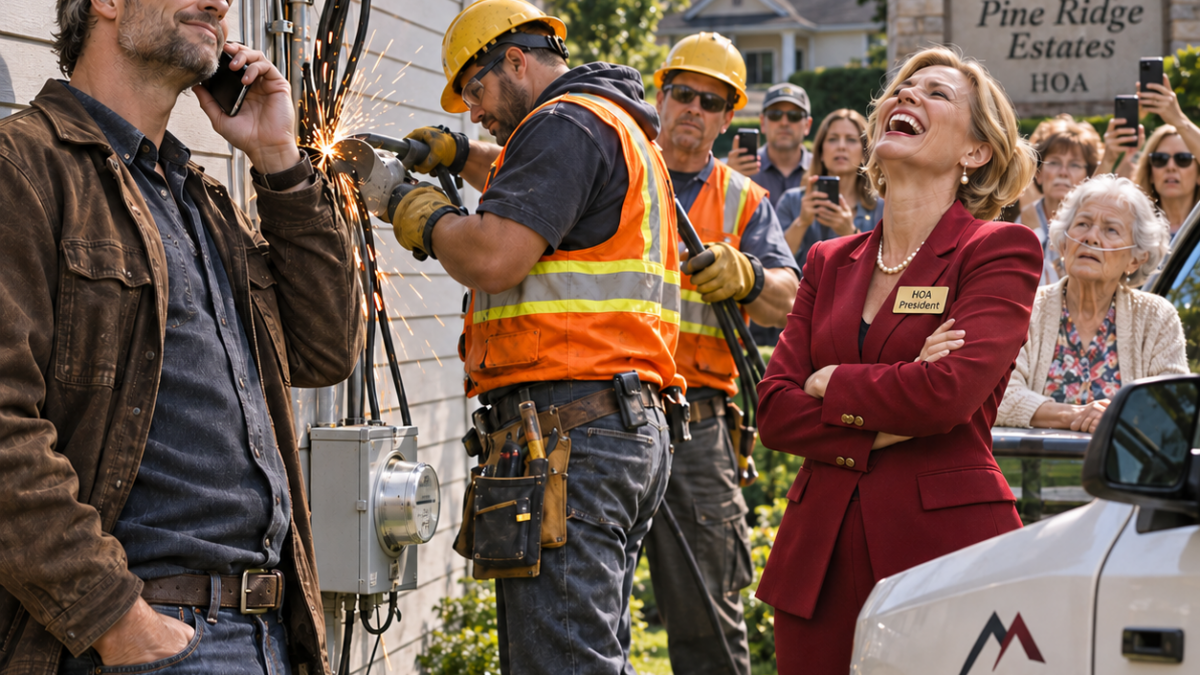
At 9:43, a white utility-style truck turned into my cul-de-sac.
I noticed immediately because it wasn’t ours.
APEX LINE SERVICES.
Never heard of them.
No utility markings.
No municipal contractor tag.
Two men inside.
They parked in front of my house.
Then Cynthia appeared.
Red suit.
Coffee cup.
Clipboard.
Phone already recording.
That told me everything.
She had planned an audience.
Doors opened along the street.
People had become accustomed to Cynthia’s conflicts.
Some were curious.
Some afraid.
Some entertained.
I stepped outside.
Hands in pockets.
The crew foreman approached.
Hector Salas.
Late thirties.
Orange vest.
Hard hat.
He handed me a paper.
“Work order.”
I read it.
PINE RIDGE HOA AUTHORIZED ELECTRICAL CORRECTION.
Disconnect unauthorized exterior service modification.
Signed:
Cynthia Langford.
No utility permit.
No Ridgeline authorization number.
No licensed electrical contractor identification.
No disconnect order.
Nothing.
I looked at Hector.
“Who told you this equipment belongs to the homeowner?”
“HOA.”
“Are you licensed for energized utility work?”
He hesitated.
“We do electrical removal.”
“That’s not what I asked.”
His partner, Dale, looked uncomfortable.
I pointed to the meter enclosure.
“See the green seal?”
Hector nodded.
“Ridgeline property.”
He looked closer.
I continued:
“The service conductor feeding this house is energized.”
His confidence started draining.
“Mrs. Langford said power was already cleared.”
“It isn’t.”
Hector turned.
“Ma’am.”
Cynthia walked closer.
“What?”
“He says line is live.”
“That’s his problem.”
“No.”
Hector shook his head.
“That’s my problem if I’m cutting it.”
She opened her purse.
Pulled out a thick envelope.
“Double.”
Hector stared.
I stared too.
Cynthia held the cash toward him.
“Finish the work.”
“Ma’am, if there’s no disconnect—”
“Double your rate.”
Dale whispered:
“Hector.”
Cynthia snapped:
“He’s bluffing.”
I took out my phone.
Called Angela.
She answered immediately.
“Ethan?”
“They’re here.”
“Who?”
“Apex Line Services.”
Pause.
“Never heard of them.”
“They’re about to cut an energized service line.”
Angela’s voice changed completely.
“Location confirmed?”
“My house.”
“People clear?”
“Yes.”
“Do not approach conductor if it falls.”
“I know.”
“Emergency crew rolling.”
“Don’t touch anything until they arrive.”
“Understood.”
Cynthia smirked.
“Calling your mommy?”
Several neighbors laughed nervously.
I looked at her.
“Something like that.”
Hector still hesitated.
Then he looked at the envelope.
That decision would cost him later.
He took it.
Dale said:
“This is a bad idea.”
Hector replied:
“Just one cut.”
That sentence still amazes me.
Electrical systems do not care whether you plan only one mistake.
Hector positioned insulated cutters.
Not rated for what he was doing.
I stepped back.
“Last warning.”
Cynthia said loudly:
“Proceed.”
The jaws closed.
Crack.
White-orange flash.
Hector jumped backward.
Dale shouted.
The cable dropped.
Sparks sprayed across the grass.
One landed near a dry patch.
A neighbor screamed.
Then the protection upstream operated.
Power dropped.
My house went dark.
And next door, I heard an alarm.
Beep.
Beep.
Beep.
Dolores.
I ran.
I jumped the low fence.
Front door unlocked because she was expecting her home aide later.
“Dolores!”
“In here!”
Bedroom.
She sat beside her oxygen concentrator.
The unit was beeping.
Backup battery active.
She was calm.
But frightened.
“What happened?”
“Power.”
“I heard something outside.”
“You’re okay.”
I checked the battery.
Healthy charge.
Backup cylinder ready.
She grabbed my wrist.
“Ethan.”
“Yes?”
“Don’t lie.”
“I’m not.”
“Am I okay?”
“Yes.”
I looked directly at her.
“You have several hours of battery and backup oxygen.”
“Then why do you look angry?”
“Because you shouldn’t need them.”
Outside, engine noise grew.
Heavy.
Fast.
Then amber warning lights flashed against Dolores’s window.
Ridgeline.
Three trucks.
Emergency response.
Angela arrived first.
White hard hat.
Navy Ridgeline polo.
Radio clipped at her waist.
She assessed the fallen conductor before anything else.
Exactly what good operators do.
No drama.
No speeches.
She established clearance.
Verified isolation.
Crew grounded and secured the damaged section.
Only after the system was safe did she turn toward me.
“Chairman.”
Hector heard it.
His face changed.
Dale whispered:
“Chairman?”
Cynthia stood near the sidewalk.
For the first time, uncertain.
I walked back across Dolores’s yard.
Angela asked:
“You hurt?”
“No.”
“Neighbor?”
“Medical backup holding.”
“We’ll restore her first.”
“Good.”
Hector removed his hard hat.
“Sir.”
I looked at him.
He pointed toward the Ridgeline logo.
“You’re…”
“Yes.”
Cynthia stepped forward.
“No.”
Nobody answered.
She looked at Angela.
Then me.
“This is ridiculous.”
I took a breath.
“I own the controlling interest in Ridgeline Power & Light.”
Her mouth opened.
I continued:
“My family founded it.”
Silence.
“Every pole feeding Pine Ridge.”
I pointed toward the transformer.
“Ridgeline.”
“Every primary conductor.”
“Ridgeline.”
“Every transformer.”
“Ridgeline.”
“Every sealed meter.”
“Ridgeline.”
Then the severed cable.
“And that service line you paid someone to cut.”
“Ridgeline.”
Hector looked ill.
“Sir.”
“Yes?”
“She told me you were stealing power.”
I turned toward Cynthia.
“What?”
Hector pulled out his phone.
“She said you were an illegal tenant who bypassed HOA electrical approval.”
Dale added:
“She said utility already disconnected authorization.”
Angela held out her hand.
“May I see the messages?”
Hector gave her the phone.
Screenshots.
Texts.
Cynthia:
HOMEOWNER REFUSES COMPLIANCE.
UTILITY MODIFICATION UNAUTHORIZED.
ASSOCIATION HAS RIGHT TO REMOVE.
Hector:
IS POWER OFF?
Cynthia:
YES.
That was important.
Very important.
Hector said:
“She paid me twenty-five hundred cash.”
Cynthia snapped:
“You took it voluntarily.”
Hector stared at her.
“You told me it was safe.”
“I am not responsible for your work methods.”
There are moments when people destroy their own defenses faster than any attorney could.
That was one.
A sheriff’s cruiser arrived.
Deputy Tom Haskell.
He knew Angela.
Ridgeline worked regularly with county emergency management.
Tom looked at the conductor.
Then the crew.
Then Cynthia.
“What happened?”
Angela answered first.
“Unauthorized third-party interference with energized utility infrastructure.”
Tom stared at Hector.
“Who ordered the work?”
Hector pointed.
Cynthia said:
“HOA enforcement matter.”
Tom looked at her.
“Ma’am, HOA enforcement does not include cutting utility cables.”
“This is a private community.”
“Still connected to an electrical grid.”
“We have architectural authority.”
“Not over utility-owned energized conductors.”
She folded her arms.
“I want him cited.”
She pointed at me.
“For?”
“Illegal modification.”
Tom looked toward Angela.
Angela almost smiled.
“Deputy, Ridgeline installed the equipment.”
Tom looked back at Cynthia.
“Then no.”
She went red.
Meanwhile, the Ridgeline crew prioritized Dolores.
Temporary safe service restoration.
Medical load verified.
Eleven minutes after arrival, her concentrator returned to line power.
Steady hum.
Alarm stopped.
I stood beside her.
Dolores took both my hands.
“Thank you for running.”
I swallowed.
“You were never in immediate danger.”
“Still.”
“I should have stopped this before.”
She squeezed harder.
“No.”
I looked at her.
“You didn’t make her cut the wire.”
That mattered.
When I returned outside, Cynthia had regained enough confidence to be angry again.
She pointed at the Ridgeline trucks.
“So what now?”
“What?”
“You cut everybody off?”
I stared.
“You’re going to retaliate.”
“No.”
She laughed bitterly.
“You expect me to believe that?”
“Yes.”
“You own the company.”
“Yes.”
“You could shut down the whole neighborhood.”
Angela’s face tightened.
I said:
“No.”
Cynthia waited.
I continued:
“Ridgeline does not shut off innocent families because I’m angry at one person.”
The street was quiet.
“That is the difference between running infrastructure and running your HOA.”
Someone clapped.
Then another.
I did not enjoy it.
Mostly.
The next morning, the state utilities commission sent Investigator Lena Park.
She photographed everything.
Cut cable.
Damaged enclosure.
Tool marks.
Apex work order.
Cash documentation.
Messages.
Ridgeline incident log.
Protective-device operation data.
She asked Hector to walk through the sequence.
He did.
Fully.
Probably because by then he understood how close he had come to killing himself.
Lena looked at him.
“You knowingly cut after the homeowner told you the conductor was energized?”
Hector swallowed.
“I believed Mrs. Langford.”
“That wasn’t the question.”
“Yes.”
“Were you qualified for energized utility-line work?”
“No.”
“Permit?”
“No.”
“Utility authorization?”
“No.”
“Why continue?”
He looked down.
“Money.”
At least he told the truth.
Then came the second investigation.
The HOA.
My attorney, Naomi Brooks, had already been looking into the reserve fund.
The electrical incident gave the board enough panic to finally cooperate.
Bill Tanner called me the night Cynthia hired Apex.
His voice shook.
“Ethan.”
“Yes.”
“I need to talk.”
“About the reserve?”
Silence.
“Bill.”
“Yes.”
“Then talk.”
“I signed things.”
“What things?”
“Payments.”
“To who?”
“I thought they were reimbursements.”
“For?”
He started crying.
That surprised me.
Bill was sixty-seven.
Very reserved.
“I should’ve stopped her.”
“Stopped what?”
“I don’t even know anymore.”
Naomi met him the next morning.
By afternoon, bank records were preserved.
Within days, the independent audit began.
The $212,000 reserve had not disappeared in one dramatic transfer.
It leaked.
That is how many real financial abuses work.
Twelve thousand.
Eight thousand.
Seventeen.
Cash reimbursement.
Vendor invoice.
Consulting fee.
Vehicle lease categorized as security operations.
Lake-house renovation paid through a contractor also billing Pine Ridge for clubhouse work.
Personal charges hidden among legitimate expenses.
Cynthia had developed a system.
No single number looked outrageous.
Together?
$212,000 gone.
Bill had signed many checks.
He insisted he did not receive money.
The evidence supported that.
He was weak.
Negligent.
Afraid of confrontation.
Not apparently part of the theft.
That does not make his role harmless.
He later said something I remember.
“She always had an explanation.”
Naomi asked:
“Did you believe all of them?”
Bill shook his head.
“Then why sign?”
He whispered:
“Because saying no meant three hours of arguing.”
That is how expensive cowardice can become.
The emergency HOA meeting happened Saturday.
I went because Dolores made me.
“I don’t want to.”
“Too bad.”
“This is their board.”
“You live here.”
“I know.”
“You started this.”
“I asked one question.”
“Exactly.”
The clubhouse filled thirty minutes before start.
Standing room only.
Cynthia arrived in red again.
Same color as the morning of the power-line incident.
Maybe coincidence.
Maybe armor.
Nobody greeted her.
She took her normal seat.
Board vice president, Karen Lowell, moved one chair away.
That told everyone something.
Bill stood.
No prepared speech.
Hands shaking.
“I failed this community.”
Silence.
“I signed payments I did not verify.”
He looked toward Cynthia.
“She told me expenditures were authorized.”
Cynthia interrupted:
“They were.”
Bill continued:
“I did not confirm that.”
“Bill.”
He ignored her.
“The reserve is depleted.”
Murmurs.
A woman behind me whispered:
“How much?”
Bill answered:
“Approximately two hundred twelve thousand dollars.”
The room erupted.
Cynthia grabbed the microphone.
“This is irresponsible.”
Someone yelled:
“Resign.”
Another voice:
“Resign.”
Then ten.
Twenty.
Cynthia shouted:
“You have no idea what you’re talking about.”
Naomi stood near the wall.
She had no role in the HOA meeting officially.
But Cynthia saw her.
Her expression changed.
She pulled out her phone.
Called someone.
Attorney, apparently.
She spoke quietly.
Listened.
Then louder:
“What do you mean?”
Silence.
“You’ve represented us six years.”
Longer silence.
Then:
“You cannot withdraw tonight.”
Everyone heard.
Her lawyer had apparently had enough.
The call ended.
Cynthia stared at the phone.
Then the clubhouse door opened.
Deputy Haskell entered.
Another deputy behind him.
Cynthia saw them.
“No.”
Tom approached.
“Cynthia Langford?”
“This is an HOA meeting.”
“Yes, ma’am.”
“You cannot interrupt board business.”
“I have a warrant.”
The room went completely silent.
She looked toward me.
I hated that.
Like I had personally ordered it.
I hadn’t.
State investigators and county prosecutors had made their own decisions based on evidence.
Tom continued:
“Please stand.”
Cynthia whispered:
“This is because of him.”
I finally spoke.
“No.”
She looked at me.
“This is because of what you did.”
There is a difference.
She was arrested.
Not for being rude.
Not for sending petty fines.
Not for arguing with me.
Charges related to the utility tampering scheme, fraudulent transactions, misuse of association funds, and conspiracy allegations.
The case took months.
Of course.
Real cases do.
Hector cooperated.
Bill cooperated.
Financial records cooperated best of all.
Cynthia eventually accepted a plea agreement.
She received incarceration.
Restitution requirements.
And restrictions preventing future service in fiduciary HOA leadership.
Hector received probation, fines, and community service after cooperating and admitting he performed unauthorized work.
His electrical contracting privileges were affected.
Then something happened I did not expect.
He called Ridgeline.
Asked about our apprenticeship program.
Angela told me.
“You know who applied?”
“Hector.”
“Yes.”
“What did you say?”
“Interview.”
“Why?”
“Because he needs training.”
I laughed.
She continued:
“He made a dangerous decision. Doesn’t mean he can’t spend the rest of his career making safer ones.”
I thought about it.
“Hire him if he’s qualified.”
“He isn’t.”
“Then apprentice him.”
She did.
Six months later, Hector was learning line safety the correct way.
De-energization.
Grounding.
Clearances.
Arc-flash hazards.
Utility ownership.
Permitting.
Every rule he had ignored on my lawn.
He became a decent apprentice.
According to Angela, annoyingly cautious.
Good.
Dolores adored that part.
“He tried to kill my oxygen machine and now he fixes electricity?”
“He didn’t know about your machine.”
“I know.”
She cut lemon cake.
“Still funny.”
The neighborhood hardening project resumed.
New poles.
Transformers.
Improved conductor.
Medical backup systems.
Ridgeline offered no special free service because I lived there.
That would have been improper.
But we did launch a broader medical resilience pilot across the service territory.
Battery support for qualified medically dependent customers.
Dolores became one of the first.
She thought it was because of her.
I told her:
“You were data.”
She hit me with a dish towel.
The program eventually reached hundreds of customers.
That became the most useful thing to come from the whole mess.
Not Cynthia’s arrest.
Not the applause.
Not the reveal that I owned Ridgeline.
A better backup system.
That is what infrastructure people care about.
What failed?
Why?
How do we prevent it again?
The cable incident showed us something beyond electrical risk.
People with medical equipment often had backup plans.
But not enough runtime.
Not enough notification.
Not always enough confidence.
We improved that.
Sometimes one stupid act exposes a useful weakness.
Pine Ridge changed too.
New board.
Open financial reports.
Dual-signature payment rules.
Independent reserve audits.
No unilateral contracts above a small threshold.
Vendor disclosures.
And one new policy nobody had needed to write before:
THE ASSOCIATION SHALL NOT AUTHORIZE, DIRECT, CONTRACT FOR, OR INTERFERE WITH ELECTRIC, GAS, WATER, TELECOMMUNICATION, OR OTHER UTILITY INFRASTRUCTURE EXCEPT THROUGH THE RESPONSIBLE UTILITY PROVIDER.
I framed that one.
Dolores saw it.
“You frame strange things.”
“I know.”
She pointed at my wall.
“Is that Cynthia’s pink electrical notice too?”
“Yes.”
“Why?”
“History.”
“You need hobbies.”
“I have utilities.”
“That is not a hobby.”
Fair.
Pine Ridge became quieter.
Without Cynthia, people realized most problems did not require warfare.
Grass half an inch high?
Neighbor got a reminder.
Not a tribunal.
Trash can out?
Friendly email.
Someone wanted a wheelchair ramp?
Approved.
Solar panels?
Reviewed.
Approved.
Life continued.
No collapse of civilization.
That is the funny thing about control.
People who use too much of it are usually convinced everything will fall apart without them.
Then they leave.
And somehow the mail arrives.
Grass grows.
Lights come on.
People manage.
Bill Tanner stayed long enough to testify.
Then sold his house.
Before moving, he came to my porch.
“I owe you an apology.”
“For?”
“You warned us.”
“I asked where the money went.”
“Yes.”
“And I knew.”
“You suspected.”
“I knew enough.”
He looked tired.
“I kept telling myself Cynthia was difficult but effective.”
“That phrase has protected a lot of bad behavior.”
Bill nodded.
“I thought the neighborhood needed her.”
“Maybe it needed a board willing to tell her no.”
He looked down.
“I wasn’t.”
“No.”
Sometimes people expect comfort.
I did not give false comfort.
Bill deserved honesty.
So did I.
But I added:
“You told the truth when it mattered.”
“Late.”
“Yes.”
“Still.”
He nodded.
“That helps.”
Then left.
I remained in Pine Ridge.
People asked why.
“You own a utility company. You could live anywhere.”
True.
But I liked my house.
Liked Dolores.
Liked the oak trees.
Liked my porch.
A bad HOA president does not get to permanently contaminate a place unless everyone allows it.
So I stayed.
For months, neighbors treated me differently.
That annoyed me.
Suddenly I was:
“Mr. Marlowe.”
“Chairman.”
“Sir.”
I hated it.
At the annual barbecue, someone tried to put me at the head table.
I moved.
Dolores shouted across the lawn:
“He’s just Ethan!”
Exactly.
That was all I wanted.
Then people started asking utility questions.
Of course.
“Ethan, my bill went up.”
“Call customer service.”
“Ethan, streetlight flickers.”
“Report it.”
“Ethan, could Ridgeline bury all the lines?”
“Do you have twelve million dollars?”
Conversation ended.
Slowly, normal returned.
One morning, a new couple moved in across from Cynthia’s old house.
Young.
Two children.
They came over.
“Are you Ethan?”
“Yes.”
“We heard you own the power company.”
I sighed.
“Part of it.”
The husband pointed toward his meter.
“Can you make ours cheaper?”
His wife elbowed him.
I laughed.
“Welcome to Pine Ridge.”
Dolores brought them lemon cake.
Tradition.
Years passed.
She grew older.
So did I.
Her lungs worsened.
The medical backup system became even more important.
One winter night, another storm knocked out power.
Tree across the feeder.
Half the neighborhood went dark.
My phone lit up.
Operations alert.
Estimated restoration:
Ninety minutes.
I immediately looked next door.
Dolores’s house still had a small lamp glowing.
Battery system.
I walked over.
She opened the door.
“No need to panic.”
“I’m not.”
“You came over in thirty seconds.”
“Neighborly.”
She smiled.
“Your company finally built something useful.”
I stared.
“My grandfather would haunt you for that.”
She laughed.
Her concentrator hummed steadily.
No alarm.
That sound was victory.
Not sirens.
Not courtroom verdicts.
A medical device continuing to work while the neighborhood was dark.
Ninety-three minutes later, power returned.
Dolores barely noticed.
Exactly how resilience should work.
She died two years later.
Eighty-three.
Peacefully.
Not during an outage.
Not in an emergency.
Her daughter was with her.
I sat alone on my porch the evening after the funeral.
Nobody brought lemon cake.
That was when I cried.
Ridgeline later renamed the medical resilience pilot internally.
Not publicly.
The Finch Program.
Angela did that without asking.
I pretended to object.
Didn’t mean it.
Today, Pine Ridge has some of the most reliable distribution infrastructure in the county.
Not because I live there anymore.
I eventually moved.
Smaller house.
Closer to my daughter.
But I drive through occasionally.
New people.
Different cars.
Same oak trees.
Cynthia’s house has changed owners twice.
Nobody remembers her red suits.
Good.
The poles we installed still stand.
Transformers still hum.
Lights still come on.
That is the thing about infrastructure.
When it works, ego disappears.
Nobody cares who owns the company.
Nobody applauds the transformer.
Nobody thanks the conductor.
They flip a switch.
Light.
That is enough.
People still tell the Cynthia story differently.
Some say she personally cut the cable.
She didn’t.
Some say I ordered the entire HOA disconnected.
Absolutely not.
Some claim I revealed my identity by pulling out a business card like some movie billionaire.
No.
Angela ruined it by calling me “Chairman.”
Some versions say police arrested Cynthia on the lawn immediately.
No.
Investigations took time.
Truth does not need embellishment.
The real story is already absurd enough.
An HOA president believed her authority extended to energized electrical infrastructure.
She paid unqualified contractors to cut a utility-owned service conductor after being warned in writing not to touch it.
They cut it.
A medically vulnerable neighbor lost normal power.
The utility responded.
Then evidence led somewhere much larger.
That is enough.
What I remember most is not Cynthia’s face when Angela called me Chairman.
It is the alarm from Dolores’s house.
Beep.
Beep.
Beep.
That changed everything.
Before that sound, Cynthia’s behavior was infuriating.
After it?
Dangerous.
Rules become serious when they touch systems people depend on to live.
Electricity is not decoration.
Neither is water.
Gas.
Emergency access.
Medical equipment.
There are reasons professionals manage those systems.
Training.
Redundancy.
Safety rules.
Licensing.
Clear authority.
Cynthia saw a cable.
She thought:
His power.
I’ll cut it.
She did not see the transformer.
Shared secondary.
Protection devices.
Neighboring loads.
Fault current.
Arc energy.
Medical dependency.
She understood none of it.
But she had confidence.
Confidence without knowledge is one of the most dangerous combinations I have encountered.
I spent forty years in power.
The older I became, the more cautious I got.
Young engineers sometimes thought that was strange.
Shouldn’t experience make you more confident?
Yes.
But good experience teaches you how many things you do not know until you check.
That is why every Ridgeline switching procedure requires verification.
Why linemen test before touch.
Why we ground.
Why we lock out.
Why we document.
The electricity does not care that you are sure.
Reality does not bend to authority.
Cynthia never learned that until the wire flashed.
One of the last times I visited Pine Ridge after moving, I stopped beside the old utility pole near my former house.
Hector happened to be on the crew.
Now a fully qualified journeyman.
White hard hat.
Ridgeline vest.
He recognized me.
“Mr. Marlowe.”
“Ethan.”
“Sorry.”
“Chairman?”
“I’ll fire you.”
“You’re retired.”
“Technicality.”
He laughed.
Then pointed toward the pole.
“Replacing cutout.”
“Why?”
“Thermal issue.”
“Verified?”
He gave me an annoyed look.
“Twice.”
“Good.”
He paused.
Then:
“I still think about that day.”
“So do I.”
“I could have died.”
“Yes.”
He looked toward Dolores’s old house.
“I could’ve hurt her.”
“Yes.”
He swallowed.
“I was stupid.”
“You were greedy.”
“Also true.”
I respected that.
He continued:
“Angela almost didn’t hire me.”
“I know.”
“She said you told her to give me a chance.”
“I said hire you if qualified.”
“Same thing.”
“No.”
He smiled.
Then became serious.
“Why?”
“What?”
“Why give me the chance?”
I looked at the Ridgeline logo on his vest.
“Because safety is learned.”
He waited.
“And because ruining your life would not restore Dolores’s power faster.”
Hector nodded.
“I don’t make that mistake anymore.”
“I know.”
That is accountability I understand.
Consequences.
Then improvement.
Not everything needs revenge.
Cynthia once asked me whether I was going to punish the entire neighborhood.
That question revealed more about her than she understood.
She assumed power existed to punish.
Because that was how she used hers.
Fine.
Threaten.
Remove.
Disconnect.
Control.
To her, owning the power company meant I had the ultimate weapon.
I could shut everything off.
But an electric utility is not a weapon.
It is a promise.
When somebody flips a switch, something happens.
When an elderly woman needs oxygen, the system supports her.
When storms come, crews restore.
When wires fall, people respond.
Power is not impressive because you can cut it.
Any idiot with bolt cutters can try that.
Power matters because you can keep it flowing safely to people who depend on it.
That was what Cynthia never understood.
And that is why, when she stood on my lawn and accused me of preparing to retaliate against everyone who lived around her, my answer came easily.
No.
Ridgeline doesn’t cut off families because somebody makes us angry.
We keep the lights on.
Even for people we dislike.
Even for people who vote against us.
Even for people who complain.
Even for people who once believed a seventy-page HOA rulebook gave them authority over a live electric grid.
That is the responsibility.
Not the privilege.
I moved into Pine Ridge because I wanted to be an ordinary neighbor.
For a while, Cynthia made that impossible.
But Dolores made it possible again.
She never cared what my title was.
Never asked about revenue.
Never called me chairman.
She called me Ethan.
She brought cake.
Asked me to fix a loose cabinet hinge.
Complained about my coffee.
That is how I prefer to remember Pine Ridge.
Not sparks.
Not police.
Not Cynthia.
A porch light glowing next door.
An oxygen machine humming steadily.
And Dolores standing in her kitchen cutting lemon cake because she was irritated about something.
The lights stayed on.
That was always the point.








