HOA Karen Padlocked Our Fire Access Gate—Then the Fire Chief Read Her “Board Approval” and the Secretary Said, “I Never Signed That”
PART2:
The following month, I received my first violation notice.
My work van had been parked in my driveway overnight.
Commercial vehicle.
Fine:
$125.
The van had been there for eight years.
Apparently it became offensive only after I asked about the budget.
That was Gloria.
She rarely threatened you directly.
She preferred paperwork.
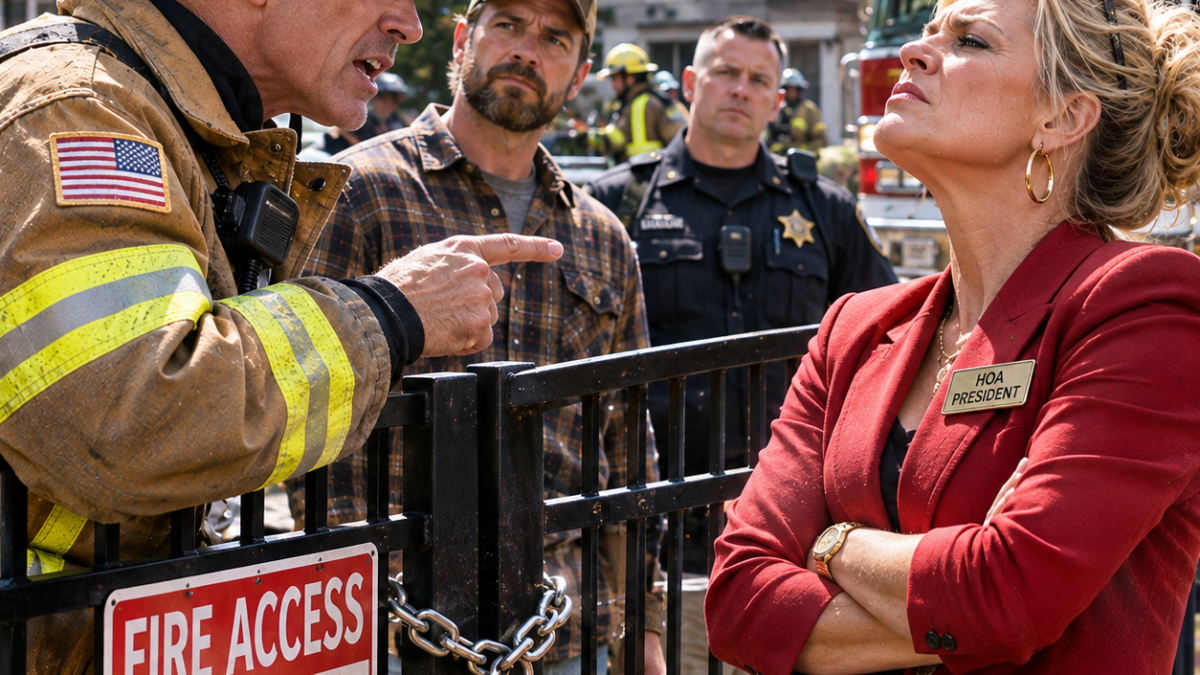
At the end of Cedar Lane, between my house and Mrs. Eleanor Whitfield’s, stood a tall steel gate.
Nothing decorative.
No stone pillars.
No keypad.
Just two heavy metal panels across a paved lane.
Above them was a red-and-white sign:
EMERGENCY FIRE ACCESS
KEEP CLEAR AT ALL TIMES
The road behind that gate connected Cedar Lane directly to Maple Court.
Normally, residents didn’t drive through it.
PART3:
Bollards and lane markings made that clear.
It existed for emergency vehicles.
Fire engines.
Ambulances.
Police.
If something happened on the back side of Willow Creek Ridge, that shortcut could save several minutes because the regular route curved around the development and came back through the southern entrance.
Everybody knew why the gate existed.
Nobody thought about it.
That changed when Sterling Bluff arrived.
Sterling Bluff Development purchased sixty acres beyond our northern boundary and announced plans for forty new homes.
Construction started in spring.
Dump trucks.
Concrete mixers.
Excavators.
Flatbeds.
Workers arriving before sunrise.
For several weeks, some construction vehicles mistakenly entered Willow Creek Ridge because navigation systems routed them through our entrance.
They would realize the road didn’t connect and turn around.
Annoying?
Absolutely.
Dangerous?
Sometimes.
Several residents complained.
I complained too after a concrete truck nearly clipped a parked car.
Gloria promised to “resolve the matter decisively.”
That phrase should have worried me.
On Tuesday, every house received a notice.
CEDAR LANE ACCESS TO BE RESTRICTED FOR COMMUNITY PROTECTION.
Temporary measure.
Construction traffic management.
Resident safety.
No dates.
No fire-department reference.
No emergency-access language.
Just “restricted.”
At Thursday’s board meeting, I raised my hand.
Gloria pretended not to see it.
I kept it up.
Finally:
“Daniel?”
“That gate is emergency fire access.”
“Yes.”
“What does restricted mean?”
“Exactly what it says.”
“Are you locking it?”
She glanced at the board.
Treasurer Walt Brennan stared down at his papers.
Secretary Helen Park avoided everyone’s eyes.
“Temporary physical restriction.”
“That isn’t an answer.”
A few people murmured.
Gloria smiled.
“Daniel, we’ve received multiple complaints regarding heavy vehicles.”
“I complained about the trucks too.”
“Then you understand.”
“No.”
I stood.
“You can block construction vehicles from entering the subdivision.”
“You can coordinate with the developer.”
“You can put up signage.”
“But that gate is marked emergency fire access.”
“You cannot padlock it because cement trucks annoy people.”
Her smile vanished for half a second.
Then returned.
“We have consulted appropriate parties.”
“Which parties?”
“Sit down, Daniel.”
“Did the fire department approve it?”
Gloria’s expression tightened.
“The board has authority over common property.”
“That doesn’t answer the question.”
A man behind me whispered:
“He’s right.”
Gloria heard.
She tapped her gavel.
“The board will handle this.”
Walt still did not look up.
Helen looked uncomfortable.
Nobody made a formal motion.
Nobody seconded anything.
Nobody raised a hand.
Yet ten minutes later, Gloria announced:
“Motion approved.”
I looked around.
Approved by who?
I walked home angry.
Then felt stupid for being angry.
Maybe there was paperwork I didn’t know about.
Maybe the fire department had approved a temporary lock with emergency access.
Maybe I was becoming the guy who assumed Gloria was wrong simply because Gloria annoyed me.
So I called the fire department’s non-emergency number.
A dispatcher answered.
I explained the gate.
Gave the street.
Then asked:
“Has Willow Creek Ridge notified you about temporarily locking the Cedar Lane emergency access?”
Keyboard sounds.
Pause.
Then:
“No, sir.”
“You’re sure?”
“I have no closure notice.”
“No alternate-access plan?”
“No.”
“Could the HOA lock it without telling you?”
Another pause.
“I can’t give you legal advice.”
“Understood.”
“But if it is designated emergency fire access, our prevention office would normally need to know about anything preventing apparatus entry.”
My stomach tightened.
“Thank you.”
I hung up.
Closing a fire gate without notifying the fire department was not just an HOA decision.
It was a gamble.
Somebody had decided the inconvenience of construction traffic mattered more than the possibility that an emergency vehicle might need that route.
Three nights later, I learned who.
I was working late at my kitchen table.
A customer had an intermittent furnace-control problem, and I was reviewing diagnostic logs before going back Monday.
Around 11:40, I heard metal scrape outside.
Clank.
Pause.
Clank.
I looked through the window.
Headlights illuminated the emergency gate.
Gloria.
Green blazer.
Even at midnight, Gloria wore clothing appropriate for a board meeting.
Beside her stood a heavyset man wearing an orange safety vest.
He had a work truck parked partly on Cedar Lane.
They were wrapping a heavy chain through the gate bars.
Then Gloria handed him something.
An envelope.
Thick.
After that:
Something small and metallic.
A key.
Maybe two.
I grabbed my phone.
By the time I reached the front window, they were leaving.
I considered going outside.
Didn’t.
Instead I checked my porch camera.
The gate was far enough away that details were poor, but the camera angle caught most of the activity.
I saved the clip.
Next morning, I walked to Gloria’s house.
She opened the door already annoyed.
“You padlocked the fire gate.”
“The board approved a temporary closure.”
“Show me the vote.”
“You attended the meeting.”
“I attended a meeting where nobody voted.”
Her jaw tightened.
“Daniel, you have become unnecessarily confrontational.”
“Did the fire department approve it?”
“The HOA owns the gate.”
“That isn’t what I asked.”
She folded her arms.
“We are protecting the neighborhood from construction traffic.”
“With a padlock on an emergency route.”
“The fire department has other access.”
“How long?”
“What?”
“How much longer does the other route take?”
She didn’t answer.
I continued.
“Who has the key?”
“Authorized personnel.”
“Who?”
“That information is not your concern.”
“It becomes my concern if somebody’s house is burning.”
Gloria smiled.
Thin.
Cold.
“Have a nice weekend, Daniel.”
Two days later, I received a violation notice.
DISRUPTIVE COMMUNICATION WITH HOA MANAGEMENT.
$200.
I read it three times.
Apparently asking who had a fire-gate key was now misconduct.
That was when I stopped believing this was about dump trucks.
Mrs. Eleanor Whitfield lived behind the gate at 14 Maple Court.
Seventy-eight.
Widow.
Five-foot-two on a good day.
She had lived there longer than I had.
Her husband, Arthur, died six years earlier.
Afterward I started mowing the strip along the side of her yard because she kept trying to do it herself with a mower that weighed almost as much as she did.
In return, she baked lemon cookies.
Terrible lemon cookies.
Dry enough to repair drywall.
I ate every batch because some lies are kindness.
Eleanor had COPD.
At night she used supplemental oxygen.
One Thursday evening, she saw me checking the gate.
“Still locked?”
“Yes.”
She frowned.
“That’s stupid.”
I smiled.
“Direct.”
“I’m old.”
“We’re allowed.”
Then she looked serious.
“Daniel.”
“Yeah?”
“If something happens back here, that gate is the fast way.”
“I know.”
“Ambulance too?”
“Yes.”
She looked at the padlock.
“I don’t like it.”
“I called the fire department.”
“What’d they say?”
“They weren’t notified.”
Her expression changed.
“You told Gloria?”
“Yes.”
“And?”
“She fined me.”
Eleanor stared.
Then laughed until she started coughing.
I waited.
When she recovered, she said:
“Arthur would’ve hated that woman.”
“I think Arthur had good instincts.”
She touched my arm.
“Promise me you’ll keep asking.”
I nodded.
“I will.”
What I should have promised was to push harder.
Saturday came clear and cold.
At 2:41 p.m., I was in my driveway replacing a capacitor in a neighbor’s outdoor AC unit.
Not because they needed cooling in October.
Because equipment problems enjoy bad timing.
I smelled smoke.
At first I thought leaves.
Then plastic.
Chemical.
Wrong.
I looked toward Maple Court.
Gray smoke rose above Eleanor’s roofline.
Then black.
I dropped everything.
Ran.
Called 911 while moving.
“House fire.”
“Fourteen Maple Court.”
“Elderly woman lives alone.”
“Possible oxygen equipment inside.”
The dispatcher started asking questions.
I answered while running.
Front door?
Unknown.
Visible flames?
Smoke from kitchen area.
Occupant location?
Unknown.
I reached the gate.
Padlocked.
For one second my mind refused to process what I was looking at.
Then I heard sirens.
Engine 12 turned onto Cedar Lane.
Fast.
Beautiful sound.
Relief.
Then the driver saw the gate.
Brakes.
Air hiss.
The engine stopped twenty feet from me.
Firefighters jumped down.
One pointed.
“Who has the key?”
Nobody.
“Key!”
Residents were coming outside.
Someone shouted:
“HOA!”
Another:
“Gloria!”
Nobody knew.
The driver radioed dispatch.
Alternate route.
The truck had to reverse.
Turn.
Go back to the main entrance.
Loop around the construction zone.
Then enter Maple Court from the south.
Later we learned the detour added just under nine minutes.
Nine minutes.
People hear nine minutes and think:
Not long.
A song.
A shower.
Microwave dinner.
In a house fire, nine minutes can be the distance between a room burning and a structure being lost.
Between smoke inhalation and cardiac arrest.
Between someone walking out and somebody being carried out.
I knew Eleanor was inside.
I also knew I was not a firefighter.
That distinction matters.
Fire scenes kill people who think courage makes them fireproof.
I went to the fence line beside the gate.
There was a drainage gap between the post and retaining wall.
Barely wide enough.
I squeezed through.
Tore my shirt.
Ran.
The kitchen window was black.
Smoke rolling from the eaves.
I tried the front door.
Locked.
The metal knob was hot.
Bad.
I moved to the side entrance.
Smoke but no visible flame.
I kicked near the latch.
Once.
Nothing.
Twice.
Frame cracked.
Third hit opened it.
Smoke came low and thick.
I dropped immediately.
Covered my mouth with my sleeve.
“Eleanor!”
Nothing.
I crawled.
Visibility almost zero.
Every instinct screamed to get out.
Then:
A cough.
Weak.
Hallway.
I followed the sound.
Found her on the floor.
Oxygen tubing tangled around one ankle.
She was conscious but disoriented.
“Daniel?”
“Yeah.”
“You came.”
“Save the touching speech for outside.”
I pulled my jacket over part of her face.
Got one arm beneath hers.
Dragged.
Slow.
Heavy.
Smoke burned my eyes.
Every few feet I thought:
This was stupid.
This was unbelievably stupid.
Then daylight.
Grass.
Cold air.
I fell backward.
Eleanor rolled beside me coughing violently.
A neighbor had followed emergency instructions and stayed outside waiting for responders.
He ran over with wet towels.
Then the ambulance arrived from the opposite route.
Paramedics took over.
Oxygen.
Monitoring.
Stretcher.
I sat on the grass.
Hands shaking.
At 2:58, Fire Engine 12 finally reached Maple Court.
Crews attacked the fire.
By then flames were moving through part of the kitchen wall.
Another engine arrived.
Then a black SUV stopped beside the locked gate.
Fire Chief Marcus Bell stepped out.
Tall.
Sixty maybe.
Close-cropped gray hair.
He walked to the gate.
Didn’t say anything.
Just looked.
Chain.
Padlock.
Red emergency-access sign.
Then he asked:
“Who authorized this?”
Nobody answered.
Two minutes later Gloria arrived.
Heels.
Phone.
Green blazer again.
She walked toward Chief Bell.
“There’s been a misunderstanding.”
He did not look at her.
“I’m Gloria Zachary.”
“HOA president.”
Still nothing.
“The gate was temporarily secured because of construction traffic.”
Chief Bell pointed at the padlock.
“Who authorized this?”
“The board.”
“Fire department?”
“The HOA board.”
“That isn’t what I asked.”
Gloria’s confidence slipped.
Just a little.
“We own the common areas.”
Chief Bell finally turned.
“Do you have written authorization to obstruct this emergency access?”
“Yes.”
She opened her bag.
Pulled out a folded document.
“Resolution 2024-17.”
She announced it like she was presenting a royal decree.
“Approved unanimously.”
Chief Bell read.
Page one.
Page two.
Turned it over.
Checked date.
Then looked at Gloria.
“Did your board notify our department?”
She opened her mouth.
Nothing.
He looked back at the document.
“Did you receive a fire-prevention permit?”
Silence.
“Did anybody from my department approve an alternative emergency-access plan?”
Still nothing.
Then someone behind us whispered:
“That’s my signature.”
We turned.
Helen Park.
HOA secretary.
Hand over her mouth.
Face white.
She walked closer.
Chief Bell held the resolution slightly outward.
“Ma’am?”
Helen pointed.
“That.”
“My name.”
Chief Bell looked at the signature.
“Helen Park?”
“Yes.”
“Is that your signature?”
Tears filled her eyes.
“It looks like mine.”
Gloria interrupted.
“Helen, think carefully.”
Helen looked at her.
Then something changed.
Fear became anger.
“I never signed this.”
The street went silent.
Gloria’s voice sharpened.
“You absolutely did.”
“No.”
“Board packet.”
“No.”
“Helen—”
“I signed blank insurance renewal sheets three weeks ago.”
People murmured.
Chief Bell’s face became unreadable.
Helen continued.
“You told me the broker needed extra signatures because the forms were being finalized.”
Gloria stepped toward her.
“You are confused.”
Helen stepped backward.
“No.”
“I never saw a fire-gate resolution.”
Chief Bell folded the document.
Slowly.
“Mrs. Zachary.”
Gloria looked at him.
“Do not alter any records related to this gate.”
Her face hardened.
“This is HOA business.”
“It stopped being only HOA business when an emergency route delayed apparatus responding to an occupied structure fire.”
That sentence landed.
Eleanor was loaded into the ambulance.
I walked toward the stretcher.
Her eyes opened.
“You look terrible.”
I laughed despite everything.
“So do you.”
She squeezed my hand.
Then paramedics took her.
Chief Bell ordered firefighters to cut the chain.
Bolt cutters.
One snap.
The padlock fell onto the pavement.
I remember the sound.
Small.
Almost disappointing.
Something that had created nine minutes of danger hit the ground with a cheap metallic clang.
The fire was controlled within an hour.
Kitchen destroyed.
Smoke damage through much of the house.
But the structure stood.
Eleanor survived.
Hospital doctors later told us smoke inhalation could have become fatal quickly.
I tried not to think about what nine more minutes inside would have meant.
Gloria was not finished.
While investigators were still working, she walked toward Fire Marshal Dana Pruitt.
Dana had arrived around four.
Early fifties.
Short hair.
No-nonsense expression.
Gloria pointed at me.
“That man was inside before firefighters arrived.”
Dana looked at me.
“I know.”
“He’s an HVAC contractor.”
My stomach tightened.
Gloria continued.
“He worked on Eleanor’s heating system recently.”
I stared at her.
“You’re blaming me?”
“I’m asking reasonable questions.”
Dana raised one hand.
“I’ll determine origin.”
Gloria said:
“If his repair caused—”
“I said I’ll determine origin.”
Dana spent hours inside.
Photographs.
Electrical panels.
Appliance cords.
Heat patterns.
Breaker positions.
Kitchen outlets.
She spoke to me.
“When were you here last?”
“Two weeks ago.”
“What work?”
“Furnace inspection.”
“Any electrical changes?”
“No.”
“Kitchen?”
“No.”
“Space heater?”
“Never touched it.”
“Documentation?”
I pulled the invoice from my business system.
She took a copy.
Then returned inside.
At 7:20 that evening, Dana came out.
“Preliminary origin is kitchen power strip.”
Gloria looked confused.
“What?”
“Multiple high-load devices.”
“Portable space heater appears involved.”
“Old branch wiring contributed.”
She looked at me.
“Nothing points to Mr. Ortiz’s HVAC work.”
I exhaled.
I had known it.
But knowing and hearing an investigator say it are different.
Gloria turned away.
I watched her.
A woman’s house had burned.
A woman she had supposedly represented.
An emergency vehicle had been delayed by the gate she ordered locked.
And her instinct was still to find someone else to blame.
That night, unable to sleep, I remembered my porch camera.
The footage.
I pulled it up.
11:42 p.m.
There was Gloria.
Clear enough.
Chain.
Gate.
Orange-vested man.
Then the envelope.
I enlarged the frame.
The man took it.
Then Gloria held up something metallic.
Two keys.
One stayed with him.
One went back into her bag.
So Gloria had a key.
Maybe still did.
Yet during the fire, while firefighters asked who could open the gate, nobody produced one.
I copied the footage.
External drive.
Cloud.
Then emailed Chief Bell and Marshal Pruitt.
The next morning Helen knocked on my door.
She looked exhausted.
“I need to tell you something.”
“Come in.”
She sat at my kitchen table.
“I’ve been going through old board packets.”
“Why?”
“Because of my signature.”
She looked ashamed.
“Gloria had us sign blank acknowledgment sheets sometimes.”
“Why?”
“She said vendors needed originals.”
“Insurance renewals.”
“Bank authorizations.”
“Routine things.”
“You signed blank documents?”
She looked down.
“Yes.”
I wanted to lecture her.
Didn’t.
She already understood.
Then she said:
“Walt found money.”
“What money?”
“Gate money.”
We went to Walt Brennan’s house.
He was sitting at the kitchen table surrounded by bank statements.
He looked twenty years older than he had at the board meeting.
Before we sat down, he said:
“Forty-one thousand five hundred dollars.”
“For what?”
He pushed an invoice toward me.
MARLOW EXCAVATION & SITE SERVICES.
GATE MAINTENANCE AND TRAFFIC CONTROL.
$41,500.
I stared.
“That gate has never had forty-one thousand dollars of work.”
Walt laughed bitterly.
“That gate barely has forty-one dollars of paint.”
“Who approved payment?”
He pointed.
Gloria Zachary.
One signature.
“What did Marlow do?”
Helen asked.
“I don’t know.”
Walt rubbed his face.
“I signed the monthly ledger because Gloria told me the road-control project had board approval.”
“Did it?”
“I never saw a vote.”
“Then why sign?”
He looked at me.
“Because I trusted her.”
There was no useful response.
Then Helen noticed another line.
Deposit.
$60,000.
Not HOA dues.
CONSULTING REVENUE.
Source:
STERLING BLUFF DEVELOPMENT.
We looked at each other.
The developer whose trucks Gloria claimed she was trying to keep out.
That did not make sense.
Not yet.
Three days later, Gloria called an emergency HOA meeting.
Her email called it:
COMMUNITY RESPONSE TO MISINFORMATION.
The clubhouse was packed.
Gloria stood at the front.
Green blazer.
Perfect hair again.
As if appearance could restore control.
“I understand there have been rumors.”
She began.
The double doors opened.
Chief Bell entered.
Dana Pruitt behind him.
County investigator.
Then another man.
Orange vest.
The same man from my camera footage.
Vince Marlow.
Gloria stopped speaking.
Her smile did not disappear.
It froze.
I walked toward the projector.
“Before anybody argues about what happened…”
I connected my laptop.
“…I think everyone should see it.”
The screen lit.
Night footage.
Gate.
Gloria.
Vince.
Chain.
Envelope.
Keys.
A hundred people watched.
Nobody moved.
The video ended.
Gloria stared at her own frozen image.
Finally:
“It was for the community.”
Someone laughed in disbelief.
She raised her voice.
“Sterling Bluff’s trucks were destroying our roads.”
Chief Bell stepped forward.
“Then you call traffic enforcement.”
“You coordinate with the developer.”
“You install lawful signage.”
“You do not obstruct emergency fire access without approval.”
Gloria snapped:
“There was another route.”
“Nine minutes.”
His voice stayed low.
“That was the delay.”
Nobody spoke.
“A seventy-eight-year-old oxygen-dependent resident was inside a burning home.”
He pointed toward the screen.
“You did not protect this community.”
“You placed a padlock between firefighters and a woman who needed them.”
Gloria’s face reddened.
“I had a resolution.”
Helen stood.
“No.”
Gloria turned.
Helen’s voice shook.
But she continued.
“You had my name.”
“Not my permission.”
Walt stood next.
“And forty-one thousand five hundred dollars left the HOA account for this.”
The room erupted.
Gloria hit the microphone.
“That payment covered broader construction mitigation!”
Then Vince Marlow spoke from the back.
“No.”
Everyone turned.
He looked sick.
“I got twelve thousand.”
Gloria stared.
Vince continued.
“She paid my company twelve thousand to chain the gate and keep Sterling Bluff’s trucks from entering Cedar Lane.”
Walt held up the invoice.
“Then why does this say forty-one five?”
Vince shook his head.
“I’ve never seen that invoice.”
Silence.
The county investigator asked:
“What about the sixty-thousand-dollar consulting payment from Sterling Bluff?”
Vince looked toward Gloria.
Gloria said:
“Don’t answer.”
The investigator stared.
“Mrs. Zachary, he can answer whatever he chooses.”
Vince swallowed.
“Sterling Bluff paid her.”
The room went dead.
A homeowner said:
“For what?”
Vince rubbed his palms against his pants.
“They wanted traffic kept away from Cedar Lane.”
“Why?”
“Because they were negotiating to buy the western service corridor.”
I looked at Gloria.
That was new.
Vince continued.
“They didn’t want construction complaints tied to the project while permits were pending.”
“So Sterling Bluff paid Gloria sixty thousand dollars…”
I said.
“…and Gloria told us she was fighting Sterling Bluff?”
Vince looked down.
“Yes.”
The room erupted.
Gloria shouted:
“That payment was a consulting arrangement unrelated to HOA operations!”
Walt said:
“You never disclosed it.”
“It was private.”
“You used HOA money to pay Marlow.”
“That was community traffic control.”
“You inflated the invoice.”
“I did not.”
Vince said quietly:
“I billed twelve.”
Everybody heard him.
The county investigator stepped forward.
“Mrs. Zachary.”
Gloria looked around.
For support.
Nobody moved.
Not one board member.
Not one resident.
Not even the people who had defended her for years.
“Mrs. Zachary, I need you to come with us for questioning regarding possible falsification of association records, misuse of association funds, and matters connected to the obstruction of the emergency access.”
Gloria laughed.
Sharp.
Almost desperate.
“You cannot arrest an HOA president for protecting her neighborhood.”
The investigator answered:
“Nobody is being questioned because of your title.”
That was the most devastating thing anyone could have said to her.
Her title no longer mattered.
Gloria looked at Helen.
Then Walt.
Then me.
“This is your fault.”
I shook my head.
“No.”
She pointed.
“You challenged everything.”
“I asked who had the key.”
“You poisoned these people against me.”
“No.”
I looked toward the screen.
“You did that yourself.”
She was escorted out.
No applause.
I was grateful.
A neighborhood should never cheer when one of its own falls apart.
Even someone like Gloria.
The investigation lasted months.
Not every accusation became a charge.
That is how real investigations work.
The forged resolution mattered.
The use of blank signature sheets mattered.
The emergency gate mattered.
The money mattered.
The inflated invoice mattered.
The undisclosed Sterling Bluff relationship mattered.
Each issue went through its own process.
The board removed Gloria immediately.
Walt became interim president.
He hated every second.
“I never wanted this.”
He told me.
“Good.”
“What does that mean?”
“People who desperately want HOA power make me nervous now.”
He laughed.
“Fair.”
Helen remained secretary.
First change she proposed:
No signature may appear on a document unless the complete final document is present at signing.
Unbelievably obvious.
Passed unanimously.
Second:
No emergency route may be altered, blocked, restricted, or modified without written approval from appropriate emergency authorities.
Passed unanimously.
Third:
Any financial relationship between a board officer and a vendor, contractor, developer, or property adjacent to Willow Creek Ridge must be disclosed.
Passed unanimously.
Fourth:
No more violation for “disruptive communication.”
Hank—different neighborhood, different story, but I would have liked him—would have approved.
Mrs. Whitfield came home three weeks after the fire.
I was there.
Her kitchen was destroyed.
Smoke damage everywhere.
Insurance covered most repairs.
Neighbors volunteered.
We painted.
Replaced drywall.
Cleaned furniture.
Somebody bought her a new oxygen machine.
I checked every heating component twice.
Then Fire Marshal Pruitt checked my work just to make me nervous.
“You enjoy this?”
I asked.
“A little.”
Eleanor sat in a folding chair supervising us.
Wrongly.
“More paint there.”
She pointed.
“There’s already paint there.”
“More.”
“Yes, ma’am.”
Chief Bell visited that afternoon.
He stood at the repaired gate.
The chain was gone.
A Knox Box had been installed.
Emergency responders had controlled access.
The gate could be opened in seconds.
He shook my hand.
“That could have been a funeral.”
I knew.
I hated hearing it.
Instead I said:
“Eleanor would’ve haunted the board.”
From her porch:
“DAMN RIGHT.”
Chief Bell laughed.
Then became serious.
“People think fire codes are bureaucracy.”
He looked at the gate.
“They’re usually written in time.”
I understood.
Seconds.
Minutes.
Distance.
Delay.
That was what the red sign meant.
Not aesthetics.
Not authority.
Time.
The new HOA board had the $200 violation against me removed.
I asked if they would frame it instead.
Helen actually did.
At Christmas she gave me a cheap frame.
Inside:
DISRUPTIVE COMMUNICATION WITH HOA MANAGEMENT.
Underneath she had added:
FOR ASKING WHY THE FIRE GATE WAS LOCKED.
I hung it in my garage.
Customers still ask about it.
The Sterling Bluff project continued.
That surprised people.
The developer itself had not ordered anyone to endanger Eleanor.
Its private consulting relationship with Gloria became part of a larger ethics investigation and contract dispute.
Construction traffic routes were revised properly.
Signs.
Flaggers.
County-approved access.
No padlocked fire lanes.
Imagine that.
The road survived.
The neighborhood survived.
Even the development survived.
Gloria’s presidency did not.
Months later I saw her once.
Grocery store.
Produce section.
She noticed me.
I considered turning away.
Didn’t.
She approached.
“You still think I’m evil?”
I stared.
“I never said you were evil.”
“You treated me like it.”
“No.”
“I treated the gate like it mattered.”
She looked down.
“I didn’t think there’d be a fire.”
That sentence stayed with me.
Not because it was cruel.
Because it was ordinary.
Nobody locking an emergency exit expects the emergency to happen that day.
Nobody blocking a hydrant expects the house beside it to burn.
Nobody disables a smoke alarm expecting to need it that night.
That is the entire point of safety systems.
They exist for the moment you do not expect.
I said:
“I know.”
Gloria looked surprised.
“You do?”
“Yeah.”
“You didn’t think there’d be a fire.”
I paused.
“That’s why the gate was supposed to stay usable.”
Her eyes filled.
Barely.
She looked away.
“I heard Eleanor is okay.”
“She is.”
“Good.”
Then she left.
I did not forgive her that afternoon.
I also did not need to hate her forever.
Those are different things.
Eleanor lived another four years.
She made lemon cookies until the end.
They never improved.
When she died, her niece gave me the old oxygen-machine cart because Eleanor had taped a note underneath it.
DANIEL — YOU SAVED MY LIFE.
THE COOKIES WERE BAD. I KNEW.
I laughed and cried at the same time.
She knew.
Four years.
She knew.
That note hangs beside my HOA violation.
Willow Creek Ridge changed slowly.
People stopped assuming the person with the gavel had the answers.
Board meetings became longer.
That was annoying.
Also healthy.
Residents asked questions.
Requested invoices.
Read minutes.
Sometimes argued for an hour over landscaping.
Democracy is less elegant when people participate.
But it is safer.
Walt served six months as interim president.
Then refused nomination.
Helen ran.
Won.
First meeting, she placed a blank page on the table.
Everyone stared.
“What’s that?”
someone asked.
She smiled.
“Nothing.”
Then tore it in half.
“No one signs these anymore.”
People laughed.
Gloria became a story told to new residents.
Unfortunately, stories get exaggerated.
Some versions said she personally started Eleanor’s fire.
False.
Some said she stole the entire sixty thousand.
Not established.
Some said the fire truck crashed into the gate.
Never happened.
Some said I carried Eleanor through flames over my shoulder.
Definitely false.
I dragged her badly, scared out of my mind, and nearly passed out on the lawn.
Truth was enough.
The truth was frightening enough without making it cinematic.
A woman locked an emergency gate.
Fire happened.
Response was delayed.
Another person nearly died.
That is enough.
Years later, a new resident suggested installing a keypad on the fire gate.
Modernization.
Reasonable idea.
At the board meeting, somebody asked:
“Fire department approval?”
Twenty hands went up pointing toward the questioner.
Everyone laughed.
The new resident looked confused.
Helen said:
“We have history.”
Chief Bell eventually retired.
At his retirement reception, I saw him.
He remembered me.
More specifically, he remembered the gate.
“Still open?”
“Yes.”
“Good.”
“Eleanor passed.”
His expression softened.
“I’m sorry.”
“She got four more years.”
“That matters.”
“It does.”
I asked him something I had wondered about.
“When you got there…”
“Yeah?”
“…were you as angry as you looked?”
He laughed.
“More.”
“You were calm.”
“Fire chiefs learn that yelling wastes oxygen.”
Then he said:
“You know what bothered me most?”
“What?”
“The sign.”
I knew immediately.
EMERGENCY FIRE ACCESS.
KEEP CLEAR.
“Everybody could read it.”
Bell said.
“No ambiguity.”
“No obscure code section.”
“No complicated engineering.”
“Just keep clear.”
He shook his head.
“Sometimes the simplest safety rules are the ones people decide don’t apply because they believe their reason is special.”
That was Gloria.
The trucks were annoying.
That was true.
Residents were angry.
Also true.
Something needed to change.
True.
But from those true things she built a false conclusion:
Therefore I may lock the fire gate.
That was the mistake.
I think about that in my HVAC work.
People sometimes bypass safety switches because a furnace keeps shutting down.
“Can’t you just make it stay on?”
Sometimes the system is shutting down because something is wrong.
A safety is annoying right until it is saving you.
I tell customers:
“If I bypass this, the furnace might run.”
They brighten.
Then:
“And your house might burn down.”
They stop brightening.
Rules need reasons.
Good rules especially.
Willow Creek Ridge still has plenty I dislike.
Mailbox colors remain absurd.
We still have arguments about grass.
One family painted their front door purple and nearly started a civil war.
But nobody touches emergency access.
Ever.
Construction crew parks nearby?
Move them.
Delivery driver blocks it?
Knock on the door.
Snowstorm?
Gate cleared first.
Tree falls?
Everybody shows up with chainsaws.
The gate became less of a piece of infrastructure and more of a neighborhood reflex.
Keep it clear.
Maybe that was the best thing to come from the worst afternoon.
Not Gloria’s removal.
Not the financial investigation.
Not my framed violation notice.
A hundred people learned why that route existed.
One autumn afternoon, years later, I was repairing my own outdoor unit when I smelled smoke again.
My whole body reacted before my brain did.
I stood.
Looked toward Maple Court.
Nothing.
Then Cedar Lane.
Nothing.
A neighbor was burning leaves outside the subdivision.
Legal.
Controlled.
Still, I walked to the gate.
Open.
No chain.
Knox Box secure.
Road clear.
I stood there longer than necessary.
A boy riding his bike stopped.
“Mr. Ortiz?”
“Yeah?”
“Why are you staring at the gate?”
“Checking something.”
“What?”
I looked at the red sign.
“Whether people remember.”
He shrugged.
Then rode away.
I smiled.
Kids do not need every old battle.
They just need the safer thing we build afterward.
That is how communities should work.
We learn.
We change.
We leave the next person fewer traps.
The most important moment in the whole story was not when Gloria was escorted from the clubhouse.
It was not when Helen said the signature was not hers.
It was not when Walt found the $41,500 invoice or when Vince admitted Sterling Bluff had paid Gloria a consulting fee.
It was 2:47 p.m.
A fire engine.
A steel gate.
A chain.
A padlock.
Firefighters asking for a key while smoke rose behind us.
Everything after that was paperwork.
Accountability.
Investigations.
Elections.
The consequence had already arrived.
The neighborhood finally understood what the argument at that board meeting had actually been about.
I had said:
“You can’t lock a fire gate.”
Gloria answered:
“Sit down.”
For days, I wondered whether I should have done more.
Called the fire marshal directly.
Sent a written complaint.
Removed the chain myself.
That last one would have created other problems.
Still, guilt is inventive.
Chief Bell eventually told me:
“You raised the concern.”
“You verified it.”
“You documented it.”
“The failure belongs to the people who ignored it.”
I needed to hear that.
But I also learned something.
When safety is involved, being right quietly is not always enough.
You keep escalating.
Properly.
In writing.
Until somebody with actual authority looks.
Because emergencies do not care about HOA politics.
Fire does not recognize board resolutions.
Smoke does not wait for a meeting.
An ambulance does not become faster because somebody meant well.
Seconds remain seconds.
That old emergency gate still stands at the end of Cedar Lane.
Fresh paint now.
Reflective sign.
Knox access.
No residential padlock.
Eleanor’s house behind it belongs to a young family with two children.
They do not know every detail.
They know an older woman once lived there.
They know there was a fire.
They know the gate matters.
That is enough.
Sometimes I see the little girl drawing chalk pictures near the driveway.
Her mother waves.
I wave back.
And every time, I remember Eleanor lying on that hallway floor.
Weak cough through black smoke.
The weight of her as I pulled.
The cold grass.
The sound of the fire engine arriving from the wrong direction because the shortest route had been chained shut.
Then I remember Chief Marcus Bell standing in front of that padlock.
He did not shout.
Did not threaten.
Did not need to.
He simply looked at the woman who claimed to run everything and asked the only question that mattered:
“Who authorized this?”
Gloria had spent years believing authority meant whatever she could get a board to accept.
That afternoon she learned there were rules above hers.
Fire codes.
County authority.
Public safety.
Truth.
And no HOA resolution—especially one built with signatures people never knowingly gave—could make nine lost minutes disappear.
In the end, Gloria did not lose her presidency because I beat her.
She lost it because the neighborhood finally saw what happened when nobody questioned her.
One padlock had turned her entire style of leadership into something everyone could understand.
Control without oversight.
Confidence without authority.
Paperwork without consent.
A decision made because she believed she could make it.
And when the smoke cleared, Willow Creek Ridge stopped asking whether Gloria had meant to protect the community.
We started asking a better question.
Did what she did actually make anyone safer?
The answer was hanging from the gate in two broken pieces.
And from that day forward, nothing was ever allowed to hang there again.








