HOA Karen Padlocked My Grandkids Out of the Lake—Then the County Clerk Pulled Up the Map and Asked Why the HOA Was Fencing Shoreline Listed in My Name
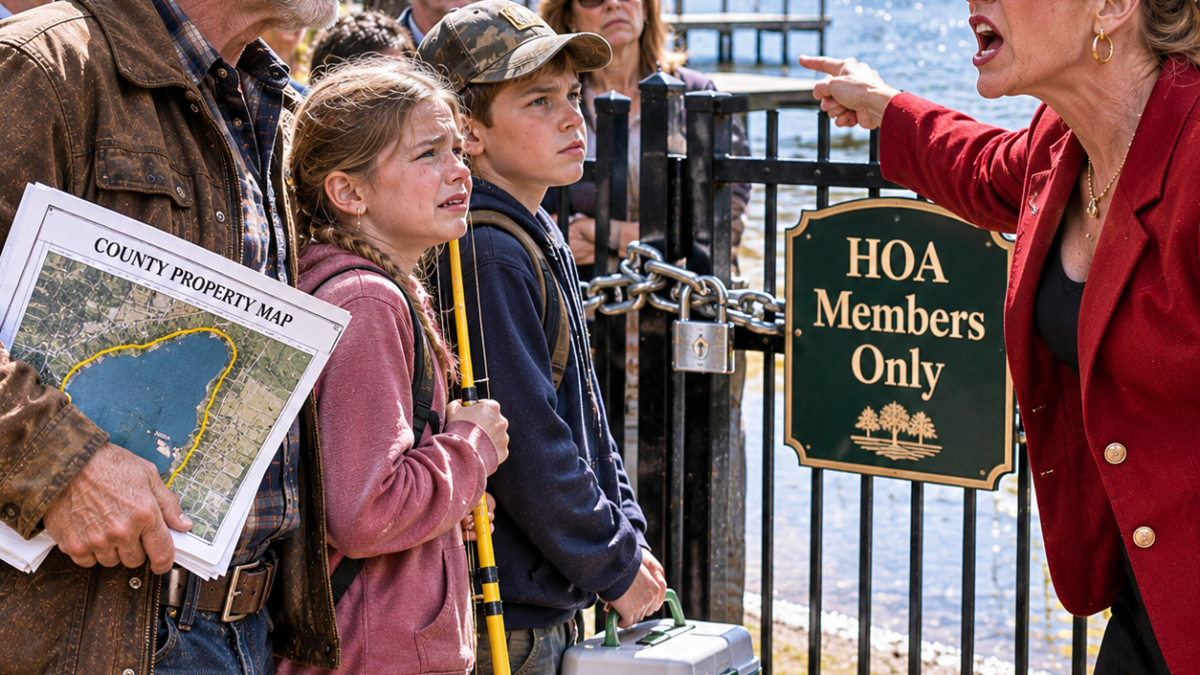
HOA Karen Padlocked My Grandkids Out of the Lake—Then the County Clerk Pulled Up the Map and Asked Why the HOA Was Fencing Shoreline Listed in My Name.
My eight-year-old granddaughter was still holding her yellow fishing pole when the HOA president snapped a new padlock through the lake gate and told her, “Resident children only”—even though I had been bringing her and her brother to that same bench for years.
Three days later, a county clerk enlarged an old parcel map on her computer and showed me something I had somehow never understood: the beach, both docks, the walking path, the gate, and every strip of ground touching the lake formed one narrow parcel that circled the water completely—and the owners listed on that parcel were my wife and me.
What made the discovery worse was the fence application sitting in the same county file, because the HOA that had just locked my grandchildren out was already asking permission to build a permanent fence across land it had falsely listed as its own.
My name is Daniel Mercer.
I spent thirty-six years maintaining school buses.
Not driving them.
Maintaining them.
That distinction probably explains more about me than anything else.
Drivers remember children.
Routes.
Weather.
Traffic.
I remember brake lines.
Battery voltage.
Coolant leaks.
The sound a wheel bearing makes two weeks before somebody else realizes it has a problem.
I like things that have clear causes.
Broken wire?
Find the break.
Bad relay?
Replace it.
Door won’t latch?
Measure the alignment.
There is comfort in mechanical problems because metal usually does not lie to you.
Paper is different.
People can make paper say almost anything if nobody bothers to read the page that came before it.
I learned that because of a fishing trip.
My wife Ellen and I lived on the south side of Alder Lake in an old white house my father had kept when most of the surrounding farmland was sold for development.
The newer neighborhood became Lakeside Oaks.
Large homes.
Stone entrances.
Decorative streetlights.
HOA.
Our house was never part of it.
Dad had sold the upland fields years earlier but retained the house, the lower ground, and certain property along the water.
After he died, Ellen and I bought out my sister’s interest and moved there permanently.
That was fourteen years before any of this happened.
We raised no livestock.
Ran no business.
Didn’t fight with neighbors.
I mowed what needed mowing.
Fixed our dock ladder when it came loose.
Helped collect trash on cleanup days.
PART2:
And most Saturdays, our grandchildren Noah and Lily came over.
Noah was eleven.
Lily eight.
Their mother—our daughter Sarah—lived twenty minutes away.
Saturday mornings became routine.
Noah carried the small red cooler.
Lily carried a yellow fishing pole she had insisted on picking herself.
We walked down the stone steps from our yard, through the shore gate, and followed the path to an old wooden bench beside the water.
Sometimes they fished.
Sometimes they fed exactly zero ducks because Ellen had trained them better.
Sometimes they spent more time arguing about bait than catching anything.
That was the point.
Not the fish.
The ritual.
My father had sat on the same shoreline with me.
I sat there with my grandchildren.
Nothing about it felt legally complicated.
That was probably why I never asked enough questions.
Eight days before everything changed, I found a clear plastic envelope clipped to our mailbox.
Inside:
PART3:
NEW LAKE ACCESS POLICY.
Existing access cards would stop working Friday.
Residents needed replacement cards.
Guests required advance registration.
Each household was limited to two guest visits per month unless additional passes were purchased.
Ellen read the notice at the kitchen table.
She was sorting medication into a blue organizer.
Knee surgery six months earlier had left her walking more slowly.
She tapped the guest limit.
“Two visits?”
“Yes.”
“That doesn’t cover the month.”
“I’ll ask.”
“Maybe family doesn’t count.”
“Probably.”
She looked at me.
“You’re optimistic.”
“Lazy.”
“That too.”
Our house had always been a strange little exception.
Not HOA.
But we had gate cards.
Years earlier, after Ellen and I took ownership, the association mailed us cards and a letter welcoming us to continue using the shoreline “under the existing arrangement.”
I remembered that phrase.
Vaguely.
I remembered the cards more.
At the time, a working gate mattered more than the language explaining why it worked.
Tuesday morning, I went to the clubhouse.
Diane Colter sat behind a folding table with a laptop.
HOA president.
Mid-fifties.
Sharp haircut.
Wire-frame glasses.
The sort of person who answered simple questions as if they were interruptions.
“Address?”
I told her.
She typed.
Her expression changed.
“Oh.”
“What?”
“Your property is a courtesy account.”
“Meaning?”
“You’re not members.”
“I know.”
“You don’t pay HOA dues.”
“I know that too.”
She turned the laptop slightly away.
“Courtesy access is being phased out.”
I frowned.
“Courtesy?”
“Yes.”
“That wasn’t the arrangement.”
Diane smiled.
“Policies change.”
She slid a form across the table.
OUTSIDE HOUSEHOLD LAKE PASS.
Annual fee:
$600.
The fee itself did not offend me.
Maintenance costs money.
I had spent thirty-six years explaining that preventative maintenance was cheaper than waiting for something to catch fire.
But below the fee was a sentence:
By accepting this pass, applicant acknowledges Lakeside Oaks Homeowners Association’s exclusive ownership and control of all lake recreational facilities and shoreline access areas.
I read it again.
Then looked at Diane.
“Why would I sign that?”
“It’s standard.”
“That doesn’t answer me.”
“Insurance.”
“Insurance requires me to say you own the shore?”
“Mr. Mercer, this is simply the new policy.”
“I’ve had access for fourteen years.”
“As a courtesy.”
“No.”
She leaned back.
“What do you mean, no?”
“I mean I don’t remember it being a courtesy.”
Diane’s tone cooled.
“You’re outside the association.”
“Yes.”
“And you don’t contribute.”
“I pay taxes.”
“Not HOA maintenance.”
“Different issue.”
She folded her hands.
“The lake fund is under pressure.”
“Then charge your members.”
“That is exactly the kind of attitude creating the problem.”
I stared at her.
“Two grandchildren and sandwiches are creating a funding crisis?”
She didn’t answer.
I took the form.
“I’ll review it.”
“You’ll need it before new cards are issued.”
“I’m not signing something that says you own land unless I know you do.”
For the first time, Diane’s expression sharpened.
“Then your access may lapse.”
I left.
At home, Ellen read the form.
Then read it again.
“Don’t sign this.”
“I wasn’t going to.”
She looked toward the spare-room cupboard.
“Your father had lake papers.”
“Receipts.”
“No.”
“Black binder.”
That stirred a memory.
Dad kept a narrow black binder labeled LAKE.
I found it in the cupboard behind old tax folders.
Inside:
Dock sketches.
Mowing receipts.
Letters from an old neighborhood committee.
Drainage notes.
A written agreement.
One page had slipped loose.
I looked through the first few sheets.
Nothing immediately obvious.
I made a mistake then.
Not a terrible one.
A normal one.
I put the binder on my desk and thought:
I’ll sort this out later.
Diane had said accounts were “under review.”
I assumed adults would behave like adults while paperwork was reviewed.
I did not expect her to use my grandchildren as leverage.
Wednesday, I emailed the board.
Explained that we were long-standing users.
Asked for documents supporting the new restriction.
Asked whether Noah and Lily could continue coming while the issue was reviewed.
Diane replied:
Uniform application of policy is necessary to avoid confusion.
I sent the children’s names.
Ages.
Address.
Asked whether the email could count as advance registration for Saturday.
Her reply:
Guest registration will be available once your household account has been brought into compliance.
That was all.
No form.
No explanation.
Just:
Sign.
Pay.
Then maybe.
Thursday evening, I found Paul Warren unloading groceries.
HOA treasurer.
Quiet man.
Early sixties.
I asked about the outside pass.
He looked surprised.
“Six hundred?”
“Yes.”
“We discussed tightening guest access.”
“Why?”
“People were bringing large groups.”
“Trash.”
“Parking.”
“That makes sense.”
“But?”
“But I’m bringing two grandchildren.”
Paul nodded.
“I know.”
“Did the board approve the form?”
“I remember a lake-access update.”
“Did you read the ownership language?”
His face changed.
“What ownership language?”
That interested me.
I showed him.
He read.
“I’ll ask Diane.”
“What about the fence?”
“What fence?”
“She mentioned maintenance project?”
Paul nodded.
“Beach fence replacement.”
“Where?”
“Main access areas.”
That sounded harmless.
Old beach fence needed work.
I went home.
Friday afternoon, my old access card still worked.
I walked down alone.
Checked our bench.
Picked up a fishing hook someone had dropped near the grass.
Ben, the maintenance worker, was replacing a rotted board near the gate.
We had known each other casually for years.
He nodded.
“New card yet?”
“No.”
He stopped hammering.
“You might want to call before bringing the kids.”
“Why?”
“Reader changes tonight.”
“All old cards?”
He looked toward clubhouse.
“Most.”
That answer bothered me.
I called Diane from the path.
Voicemail.
I left a message:
I intend to bring my grandchildren tomorrow for our usual visit. Please call if there is a problem.
No return call.
Saturday morning, Noah carried the cooler.
Lily wore a sun hat Ellen had repaired.
We reached the gate shortly after eight.
I touched my card to reader.
Red.
Again.
Red.
Lily asked:
“Did you do it wrong?”
“Possibly.”
I tried one more time.
Red.
Then Diane stepped from clubhouse.
Chain over one arm.
Padlock in her hand.
“Your card was deactivated.”
I looked at her.
“I told you they were coming.”
“Your household has not complied with the new policy.”
Noah put down the cooler.
Lily held her yellow pole.
“They’re my grandchildren.”
“I understand.”
“They’re with me.”
“Resident children only.”
“They have been coming here for years.”
“That doesn’t make them residents.”
I pointed toward the bench.
“We’re going to sit over there.”
“No.”
Lily looked at Diane.
“Can we just sit at our bench?”
Diane pulled the chain through gate.
The metallic sound stopped every conversation near the clubhouse.
She clicked the padlock.
Then turned the new sign toward us.
MEMBERS ONLY.
“No,” she said.
Lily looked at me.
That was the part I remember.
Not Diane.
Not lock.
Lily.
Confused.
Not crying.
Not yet.
Just trying to understand what rule she had broken.
I felt my face heating.
I wanted to argue.
Instead, I took out my phone.
Photographed lock.
Sign.
Gate.
Then said:
“Come on.”
Noah picked up cooler.
We walked away.
Lily asked:
“Can we come back after lunch?”
Diane answered before I could.
“After your grandfather completes the paperwork.”
I put my hand on Lily’s shoulder.
“Let’s go.”
We drove to a public fishing pond across town.
Muddy bank.
Three picnic tables.
No shade.
No familiar bench.
Noah helped Lily bait hook.
After twenty minutes he said:
“We cleaned their beach last month.”
“I know.”
“Why’d they lock us out?”
“Because adults are arguing about paperwork.”
“That’s dumb.”
“Yes.”
“Shouldn’t have picked up their trash.”
I looked at him.
“No.”
He frowned.
“Helping was still right.”
“Even if they’re mean?”
“Yes.”
“You don’t help people because they promise to be fair later.”
Noah thought about that.
“Still dumb.”
“Yes.”
On drive home I bought ice cream.
Not to erase morning.
Children remember insults anyway.
I wanted another memory sitting beside it.
Ellen waited on porch.
After kids went inside, I showed her photo.
She stared.
Then said:
“Get the binder.”
This time we read everything.
Every page.
We found tax statement.
Two parcel numbers.
I had always known there were two.
House parcel.
Shore reserve.
The second one carried tiny assessed value because no building rights.
I paid combined tax bill every year.
Never asked how large the reserve was.
That was my second mistake.
I knew what I paid.
Not what I owned.
The agreement in Dad’s binder referred repeatedly to:
SHORE RESERVE PARCEL.
Allowed original neighborhood committee to maintain:
Walking path.
Swimming beach.
Docks.
Access gates.
It also allowed residents and their accompanied guests to use those areas for ordinary recreation.
Then another paragraph:
Ownership remains with the Mercer family.
Another:
Owner, family, and accompanied guests retain access.
Another:
Permanent structures or fencing require landowner’s written permission.
Ellen read that one twice.
“Daniel.”
“Yes.”
“Diane is building a fence.”
“I know.”
“On this parcel?”
“I don’t know where parcel goes.”
“Then find out.”
Monday, I called county office.
Online map was too clumsy on my old computer.
A clerk named Susan asked me to bring deed and tax statement Tuesday.
Before then, Ben came by.
He carried the old broken board from gate.
“Thought you might want firewood.”
I laughed.
“No.”
He set it against garage.
Then lowered voice.
“That’s not why I’m here.”
“What?”
“Reader wasn’t changed for everybody.”
I looked at him.
“What do you mean?”
“Certain accounts.”
“Mine?”
“Yes.”
“Who gave list?”
“Diane.”
“Still have it?”
“Work order.”
“Keep it.”
Ben looked nervous.
“I don’t want trouble.”
“I’m not asking you to steal anything.”
“Just don’t throw it away.”
He nodded.
Tuesday morning, Susan entered parcel number.
County map filled screen.
At first I thought wrong parcel.
A thin band ran along near edge of lake.
Then around north shore.
Then behind the newer homes.
Then past swimming beach.
Both docks.
Gate.
Back toward our house.
A complete ring.
Widths varied.
Sometimes twenty feet.
Sometimes forty.
Sometimes narrower.
But continuous.
I leaned closer.
“That’s my parcel number?”
Susan checked.
“Yes.”
“Who owns it?”
She clicked.
Daniel Mercer.
Ellen Mercer.
I stared.
“Whole thing?”
She was careful.
“The map shows location.”
“We need deed and recorded references for exact legal ownership.”
“Maps are not substitute for deed.”
Good answer.
Still—
The entire shoreline.
Land beneath path.
Beach.
Docks.
Bench where Lily had been refused.
All within one reserve parcel listed under our names.
I sat back.
Then Susan said:
“There’s something else.”
“What?”
“A recent building application.”
She clicked.
FENCE PROJECT.
Applicant:
Lakeside Oaks HOA.
Owner:
Lakeside Oaks HOA.
Parcel number:
Mine.
Site drawing showed new fencing.
Following shoreline.
Crossing our old stone steps.
Beside those steps:
PRIVATE ACCESS TO BE CLOSED.
I read it again.
“Did I approve this?”
Susan looked at me.
“I’m asking you.”
“No.”
Start date:
Thursday.
Two days.
I felt anger rise.
Susan must have noticed.
She said:
“Building office is down hall.”
“Talk to them before you talk to anyone else.”
Smart woman.
Mark at building office reviewed application.
Compared tax statement.
Deed.
Parcel.
Then said:
“Our fence permit deals with code compliance.”
“It does not grant property rights.”
“So if HOA doesn’t own land?”
“They still need authority from owner.”
“Application says they are owner.”
“I see that.”
“Can you stop it?”
“I can flag ownership dispute.”
He handed me objection form.
I filled it out at counter.
Recorded owner.
No permission.
Disputed applicant authority.
Mark attached objection.
He would not declare me owner on spot.
Again, careful.
Correct.
Contractor’s name on plan.
Rachel Mason.
I called.
She listened.
Then said:
“Send me your deed, map, and county objection.”
“Crew Thursday?”
“Not until we verify authorization.”
Within an hour, she had papers.
At home, Ellen found loose page from binder.
It completed agreement.
Resident recreation rights.
Family access.
Maintenance rights.
No transfer of ownership.
Then she found old letter sent after we became owners.
Dear Mr. and Mrs. Mercer,
Following transfer of ownership of the shore reserve parcel…
It continued:
Enclosed are replacement gate cards for owner access…
Owner.
Not courtesy.
Not guest.
Owner.
I remembered envelope.
Remembered cards.
Had completely ignored meaning.
Ellen held it up.
“They knew.”
“Old board did.”
“Current office has files.”
“Maybe.”
We copied everything.
Sent short message to board.
County records identify us as owners.
Our agreement preserves resident recreation.
Family access.
No permission for fence.
Please halt project.
Restore cards.
And importantly:
We are not seeking to close lawful resident use of shoreline.
Ellen insisted on that line.
“Don’t let them scare neighbors.”
Diane replied within thirty minutes.
Tax records outdated.
Long-term HOA maintenance has established control.
Do not interfere with contractors.
No deed.
No explanation.
No response to old letter.
I forwarded to Paul.
He called.
“I’ve never seen that letter.”
“Find board’s shore-reserve file.”
He was quiet.
Then:
“I’ll look.”
Wednesday, Rachel called.
Fence paused.
No digging.
Crew reassigned.
First real relief.
Ellen called Sarah.
“Kids can come Saturday.”
I looked at her.
She added:
“But maybe no lake yet.”
Good.
We stopped promising what paper had not secured.
That afternoon, we met attorney Beth Collins.
Ellen came despite knee.
Cane.
Letter in handbag.
Beth started with deed.
Both parcel numbers.
Recorded drawing reference.
Estate transfer.
Sister buyout.
Nothing obvious missing.
Then she said the most useful sentence of entire dispute:
“The county map tells us where to look.”
“The deed tells us who owns it.”
“The agreement tells us what everyone is allowed to do there.”
That organized everything.
Owning shoreline did not erase residents’ rights.
Dad had granted use.
Possibly permanent.
Maybe binding.
We could not retaliate by closing docks.
We didn’t want to.
Beth read outside-household pass.
Stopped at ownership sentence.
“Don’t sign.”
“We weren’t.”
“And don’t pay six hundred while payment means acknowledging their ownership.”
She drafted letter.
Not dramatic.
No threat to take lake.
Demand:
Preserve records.
Pause construction.
Identify deed HOA relies upon.
Restore prior access.
Cost:
$375.
I saved receipt.
That evening, neighbor Carol stopped me.
“Is it true you’re making everyone buy shoreline back?”
“What?”
She showed board message.
NON-MEMBER CHALLENGES COMMUNITY LAKE RIGHTS.
Could affect resident access.
I showed her my email.
Line saying we would respect lawful resident use.
She read.
“That’s not what they told us.”
“No.”
“Can I show neighbors?”
“Yes.”
“Show whole paragraph.”
By next morning, residents asked questions.
That helped.
Not because they all supported me.
Because they wanted documents.
Good.
Ben returned with his work order.
Properly authorized to share by Paul.
Our address:
DISABLE BOTH ACCESS CARDS.
Note:
NO GUEST APPROVAL UNTIL NEW OWNER TERMS SIGNED.
I read slowly.
The children were not turned away because of guest-cap rule.
Our household was deliberately locked out until we signed language conceding ownership.
That was different.
Beth added it.
Thursday, special HOA meeting.
Paul invited us.
Diane said attendance was courtesy.
I carried county map.
Ellen carried owner letter.
Diane began with maintenance spending.
Mowing.
Dock repair.
Insurance.
Trash.
Real costs.
I did not dispute.
Then she said:
“Years of exclusive management establish HOA ownership.”
I unrolled map.
Placed Dad’s agreement.
“He authorized maintenance.”
“The same agreement says he retained ownership.”
Diane said:
“Outdated.”
Paul asked:
“Do we have a deed?”
Diane looked at association lawyer.
“That’s legal question.”
Then Ellen stood.
Slowly.
Cane.
Letter.
“You sent us these cards because you knew we owned reserve.”
Her voice did not shake.
“We did not come asking for a favor.”
“And our grandchildren were not bargaining with you when they came to fish.”
Silence.
A board member proposed temporary card restoration.
Diane opposed.
Vote tied.
Nothing passed.
We went home still locked out.
Friday, Beth called.
HOA had filed suit.
Not just access dispute.
Ownership.
Their argument:
Years of maintenance and control entitled HOA to shore reserve through long possession/control theories.
Beth explained carefully:
Dad’s written permission mattered because use with permission generally differs from use hostile to owner.
But court would decide.
HOA also requested temporary order keeping us out of managed shoreline during litigation.
Our steps.
Bench.
Beach path.
They wanted judge to bar recorded owners from land while arguing they had taken ownership through long use.
Ellen read filing.
“How long?”
“Temporary hearing first.”
“Full case can take longer.”
I asked Beth:
“Can I walk down my steps tonight?”
“No order yet.”
“So yes?”
“Legally maybe.”
“Strategically, don’t force locked gate.”
That irritated every mechanical instinct I had.
Chain was problem.
Bolt cutters could solve chain.
But Beth was right.
Cut chain and Diane gets photograph:
ANGRY NON-MEMBER DESTROYS HOA SECURITY.
So chain stayed.
Beth asked for history.
Cards.
Emails.
Permissions.
Maintenance requests.
We searched.
Old emails.
Four years earlier:
Fallen branch.
HOA president asked permission to bring maintenance cart through our yard.
Why ask me if they owned shore?
Another:
Life-ring post.
Committee sent drawing.
Requested approval because post would be fixed into shore reserve.
I approved.
Matching drawing in binder.
Initials.
Date.
Another:
Dock repair contractor asked where equipment could stage.
Again permission.
Paper memory.
Better than human memory.
Saturday, grandchildren came.
I hid fishing rods.
Noah noticed.
“Still can’t go?”
“Not yet.”
Lily looked disappointed.
Ellen pulled out photo albums.
Soon they were laughing.
One picture:
Cleanup day.
Noah with trash grabber.
Lily carrying juice carton.
Diane in background holding bag.
Date.
We kept it.
Not because children were evidence.
Because photo contradicted story that family had not used shore.
Later Noah asked:
“Should I stop waving at Diane?”
“No.”
“Why?”
“Polite doesn’t mean pretending she was fair.”
He thought.
Then:
“Do I still pick up trash?”
“If you want.”
“Even there?”
“Helping isn’t a fee for belonging.”
Monday, Beth hired surveyor Martin Reese.
County map alone was not enough.
He came Tuesday.
Modern equipment.
Recorded shore drawing.
Boundary monuments.
He confirmed basic picture.
Newer house lots ended above reserve.
Reserve continued uninterrupted around lake.
Beach.
Docks.
Path.
Gate.
Our steps.
All within same parcel.
I asked:
“Do we own lake water?”
He said:
“Different question.”
Good.
I appreciated refusal to overclaim.
Shoreline enough.
Survey cost $900.
Came from porch-roof fund.
We patched leak another year.
Worth it.
Then HOA produced access logs.
Ben had preserved.
Our card numbers appeared over fourteen years.
Spring.
Summer.
Fall.
Winter.
Final successful entry:
Friday before Diane locked us out.
Afterward:
ADMINISTRATIVE DISABLE.
Until owner terms signed.
Other non-resident cards remained active.
Former owners.
Maintenance accounts.
Family exceptions.
So Diane’s claim of uniform rule was false.
We did not speculate why other accounts existed.
Beth’s rule:
Prove only what evidence supports.
Then Paul called.
He had found old file.
Label:
SHORE RESERVE.
Inside:
Dad’s agreement.
Owner acknowledgment letter.
Permission requests.
The HOA had possessed same evidence all along.
“Did Diane see it?”
I asked.
Paul answered honestly:
“I can tell you file existed.”
“I can’t tell you what she read.”
I respected that.
Court hearing Thursday.
Diane sat beside HOA attorney.
Ellen and I with Beth.
I held deed envelope.
Not useful.
Comforting.
HOA lawyer described:
Long-managed community shore.
Sudden ownership challenge.
Need for centralized control.
Judge asked:
“What conduct by Mercers creates need to exclude them?”
Attorney mentioned stopped fence.
Beth answered:
“They asked contractor not to build on property they claim and county records identify as theirs.”
“No damage.”
“No threats.”
“No interference with residents.”
She gave judge my email promising lawful resident access.
Then deed.
Martin preliminary survey.
Original agreement.
Judge read.
Maintenance permission.
Resident recreation.
Owner/family access.
Permanent structures require owner approval.
HOA argued long-term control changed ownership.
Judge asked:
“When did permission end?”
Silence.
“When were Mercers notified?”
Silence.
Diane testified.
“The association has always made rules.”
Beth asked:
“Does making swimming rules equal owning land?”
“We manage the shoreline.”
“Did prior board ask Mr. Mercer’s permission to install life-ring post?”
“Yes.”
“Why?”
“Excess caution.”
“Did prior board send letter identifying Mercers as owners?”
“Yes.”
“Was that also excess caution?”
Diane hesitated.
Beth produced card logs.
“Did Mercers use lake throughout fourteen years?”
“Through association system.”
Beth placed agreement beside logs.
“The system created to administer owner’s permission?”
Diane said:
“That is not how we understand it.”
Then work order.
Beth asked:
“Why were grandchildren denied?”
“Guest rules.”
“Unsafe behavior?”
“No.”
“Unpaid damage?”
“No.”
“Overcrowding?”
“No.”
“Then what did Mr. Mercer need to do to restore access?”
Diane answered:
“Sign household agreement.”
Judge looked at form.
Read ownership sentence.
Then at old owner letter.
Asked HOA attorney:
“Identify deed conveying shore reserve to association.”
He conferred.
Could not.
“Identify document terminating original owner permission before dispute.”
Could not.
Judge looked up.
“Then what is present basis for locking recorded owners and their accompanied grandchildren off this land?”
HOA attorney said:
“Order and control while ownership is litigated.”
Judge asked:
“What danger do Mercers present?”
None.
Request denied.
Then judge granted temporary relief for us.
Cards restored by 5 p.m.
Family and accompanied guests restored to prior access.
No conditioning access on signing ownership concession.
No new fence pending case.
Resident rights continue.
Reasonable safety rules continue.
Not final ownership yet.
But gate opens.
Outside courthouse, Ellen squeezed my hand.
I realized she had been gripping cane so hard her knuckles were white.
At 3:40, Ben called.
“Cards live.”
“Both?”
“Yes.”
“Chain?”
“Removed.”
After supper, Ellen and I walked down.
She took steps slowly.
I touched card.
Green.
Latch clicked.
Such a small sound.
I held gate for her.
Our bench waited.
Wet leaf on one end.
Ellen brushed it away.
We sat.
Nothing dramatic happened.
People across lake ate dinner.
A boy pushed toy sailboat.
Someone laughed on dock.
Ordinary life resumed.
Saturday, Noah and Lily came early.
Yellow pole.
Red cooler.
Lily stopped at gate.
Looked toward clubhouse.
I did not rush her.
I opened gate.
Held out hand.
She walked through when ready.
Noah followed.
We caught almost nothing.
Perfect morning.
Case continued.
Martin completed survey.
Whole shoreline.
Unbroken reserve.
Deed chain confirmed.
Father to estate.
Estate to Ellen and me.
No deed to HOA.
Older HOA files showed maintenance under permission.
Requests for owner approval.
Acknowledgments.
Card history.
Their own records undermined claim.
Before final hearing, Beth asked:
“What do you want?”
“Ownership settled.”
“Family access protected.”
“Fence withdrawn.”
Ellen added:
“Residents’ rights written clearly too.”
I looked at her.
She shrugged.
“I don’t want next board scaring them either.”
That mattered.
We could have become Diane in reverse.
Court could confirm land ours and then anger could tempt us to punish residents who had nothing to do with lockout.
We refused.
HOA offered settlement.
We receive lifetime passes.
Grandchildren passes.
In exchange:
Acknowledge HOA broad control.
Ellen read.
“No.”
“Why?”
“We’re not trading ownership for permission to visit.”
Exactly.
Second offer removed “lifetime passes” but blurred ownership.
No.
We were tired.
Still no.
Tired is how bad agreements get signed.
Final hearing.
HOA attorney ultimately acknowledged no deed transferring parcel.
Argument rested on maintenance and control.
Beth showed why that history was permitted, not adverse.
Diane testified.
Said centralized control was best.
Beth asked:
“Did centralized control authorize you to demand owners sign away ownership before their grandchildren could enter?”
Diane said:
“Situation became more complicated than expected.”
Not an answer.
Paul testified.
Old agreement in HOA office.
Owner letters.
No purchase.
No deed.
Fence budget approved without reading full plan.
Judge asked:
“Was closing Mercers’ steps a repair?”
Paul looked at us.
“No.”
Then added:
“I should have read plan.”
I appreciated that.
Late.
But responsibility matters.
Final judgment:
Ellen and I owned shore reserve parcel described in deed and Martin survey.
Parcel covered entire shoreline around Alder Lake.
Residents retained recreational rights under existing agreement.
We could not erase them.
HOA could administer reasonable safety rules consistent with agreement.
But:
HOA could not exclude our household or accompanied family/guests contrary to owner rights.
Could not charge outside-household fee for rights already held.
Could not force ownership acknowledgment as condition of access.
Permanent shoreline structures requiring owner permission still required it.
Fence across our steps prohibited absent our approval.
Ownership judgment recorded with full parcel description.
That last part was my priority.
I wanted future clarity.
No grandchild of mine should need to discover same fact by being humiliated at gate.
There was no million-dollar damages jackpot.
Good.
We kept real bills.
Survey.
Records.
Legal fees.
Under separate settlement, HOA reimbursed documented costs.
Court settled ownership.
Agreement settled expenses.
Different things.
I kept both.
Rachel’s fence company returned unused materials where possible.
HOA paid its contractor costs.
Not us.
Board had ordered work before establishing permission.
Diane was removed as president by other board members.
She resigned seat rather than fight.
Paul stayed treasurer.
Membership adopted new rules:
Major projects require full drawings.
Ownership verification before construction.
Written spending records.
No board member approval based only on project summary.
New board sent correction to neighborhood:
Mercers own shore reserve.
Residents retain agreed use.
Mercers did not seek to close lake.
Carol brought me printed copy.
“This should travel as far as first message.”
“Yes.”
Some neighbors apologized.
Some simply waved again.
Fine.
I did not need confessions.
I wanted better records and fewer lies.
Ben kept his job.
I wrote new board explaining:
He followed work instructions.
Preserved records.
Shared only through proper approval.
Restored access when ordered.
He should not be blamed for board decisions.
That mattered to me.
Maintenance workers are easy scapegoats after executives make bad choices.
Eventually worn beach fence was replaced.
Rachel sent complete drawing.
This time she walked path with us.
No crossing our steps.
No blocking shore.
We approved.
That distinction became important.
Permission did not always mean no.
It meant ask.
I also finally learned my own property.
Martin put survey in large sleeve.
I walked shoreline in sections.
Found corners I had never noticed.
Reserve narrowed behind some gardens.
Widened near north dock.
Stone marker half buried under roots.
An old iron pin Dad once mentioned.
The whole shoreline was ours.
But many families had rights to enjoy it.
Both facts were true.
Ownership and access were not enemies.
Bad leadership had pretended they were.
First cleanup day after case ended, Noah asked:
“Are we going?”
“Your choice.”
He thought.
Then grabbed trash tool.
Lily wanted gloves.
Ellen packed sandwiches.
We walked through gate.
No one asked for fee.
No one demanded signature.
Near bench, Lily found bottle cap.
Dropped in Noah’s bag.
Then leaned yellow pole against rail.
Looked across lake.
“Grandpa?”
“Yes?”
“Do we own all this?”
I considered answer.
Children hear ownership differently.
I pointed at ground.
“We own the shoreline land.”
“Whole lake?”
“Not what court decided.”
She frowned.
“But beach?”
“Yes.”
“Bench?”
“Yes.”
“Gate?”
“On our parcel.”
“So Diane locked us out of your land?”
“Yes.”
Lily thought.
“That was mean.”
“Yes.”
Noah asked:
“Can we lock her out?”
Ellen laughed.
I shook my head.
“No.”
“Why?”
“Because neighbors have rights too.”
“But they locked us.”
“That doesn’t change agreement.”
He frowned.
“That’s not fair.”
“It is.”
“How?”
“Fair isn’t doing same wrong back.”
Noah looked unconvinced.
He was eleven.
There was time.
I sat on bench.
Ellen beside me.
Children at water.
For years I had assumed ownership meant one thing:
Pay tax.
Fix what breaks.
Don’t trespass.
Turns out ownership can also require understanding what you own well enough to protect rights without abusing them.
My father understood.
That was why he created written shoreline agreement instead of relying on handshakes.
He let neighborhood use path.
Beach.
Docks.
But kept land.
He preserved family access.
Required consent for permanent construction.
He had balanced private ownership with community use.
Then I inherited system and paid almost no attention because it worked.
That was my failure.
Not legal failure.
Stewardship failure.
I had accepted working gate card without reading why gate card existed.
Diane exploited that ignorance.
Not because she forged deed.
She did something more ordinary.
She took years of routine maintenance and started speaking as if maintenance meant ownership.
Then repeated it.
People believed.
Board spent money.
Rules changed.
Forms printed.
Cards disabled.
Eventually paperwork created appearance of authority strong enough that even I questioned memory.
That is how boundaries move socially before they ever move legally.
No survey pin shifts.
No deed changes.
People simply begin acting as though a new line exists.
Diane’s form was smartest part.
Six hundred dollars was not real prize.
Sentence beneath it was.
By signing:
I would acknowledge HOA ownership/control.
Later, if dispute arose, board could point:
See?
Mercer agreed.
Maybe not enough by itself to transfer title.
But useful evidence.
A concession.
And all I wanted was take grandchildren fishing.
Small pressure.
Big surrender hidden underneath.
That bothered me for years.
Not because Diane was criminal mastermind.
She wasn’t.
She was HOA president convinced administration had become ownership.
Once she believed that, forcing me to acknowledge it probably felt like cleaning up paperwork.
That is why dangerous overreach often comes from people who think they are organizing.
Not stealing.
The judge’s ruling mattered because it separated things Diane had merged.
Maintenance is not ownership.
Regulation is not title.
Use rights are not possession.
Paying for mower does not buy land.
A gate system does not erase deed.
And allowing neighbors to use property does not automatically mean owner has surrendered it.
Those distinctions sound obvious after somebody writes them clearly.
Before court?
They had been buried under years of habit.
I kept black binder.
Added certified judgment.
Martin survey.
Settlement.
New board correction.
Fence approval.
Everything.
On front I wrote:
SHORE RESERVE — OWNERSHIP AND USE RIGHTS.
Not LAKE.
Too vague.
No one after me should wonder.
I also gave copies to Sarah.
She groaned.
“Dad.”
“What?”
“That’s like two hundred pages.”
“Read enough.”
“Which enough?”
I tapped cover.
“Start with deed.”
She smiled.
“You learned paperwork.”
“Against my will.”
Years later, Ellen’s knee improved some.
Not enough for long walks.
We installed handrail on stone steps.
Because permanent fixture affected reserve, who approved it?
We did.
I still sent drawing to HOA.
Courtesy.
New president called.
“You know you don’t need our permission?”
“Yes.”
“Then why send?”
“Because path users might care.”
She laughed.
“That’s remarkably reasonable.”
“Don’t spread it around.”
Her name was Carol Meyers—the same neighbor who had first shown me board message.
She had not wanted presidency.
Good sign.
Under her, Lakeside Oaks became boring.
Budgets.
Mowing.
Dock repair.
Swim hours.
Trash.
Normal.
Boring governance is gift.
One summer, Diane walked shoreline.
First time I’d seen her since resignation.
She stopped near bench.
I was alone.
“Daniel.”
“Diane.”
Silence.
She looked older.
Not dramatically.
Just tired.
“I owe you apology.”
I waited.
“I thought I was protecting association.”
“I know.”
“I thought if everyone used same system, there would be fewer disputes.”
“Maybe.”
“I didn’t understand reserve ownership.”
“You had files.”
She looked down.
“Yes.”
That mattered.
She continued.
“I relied on summaries.”
“Paul found agreement.”
“I know.”
“You didn’t read it.”
“No.”
We stood quiet.
Then she said:
“I should never have locked children out.”
“No.”
“I’m sorry.”
I looked toward water.
“I accept apology.”
She seemed surprised.
That was all.
I did not need her humiliated.
She had lost presidency.
Court corrected records.
Neighbors learned.
Kids got lake.
Enough.
After she walked away, I sat on bench.
Thought about revenge.
People love revenge stories.
Someone overreaches.
Then discover victim owns everything.
Then victim locks everyone out.
Charges fees.
Tears down docks.
Makes HOA beg.
That would make dramatic ending.
It also would have violated agreement my father intentionally created.
I would have become the person saying ownership erased everyone else’s rights.
Just from opposite direction.
No.
The whole shoreline was mine.
But I was not only person whose rights mattered.
That was lesson.
Property law often sounds like one winner and one loser.
Reality layers interests.
Owner.
Easement holder.
Guest.
Maintainer.
Government regulator.
Everyone with different piece.
Problems begin when one piece pretends to be whole.
The HOA had maintenance rights.
Recreation administration.
Resident easement.
Useful responsibilities.
Diane turned those into ownership.
That was mistake.
If I had responded by turning ownership into absolute power, I would have repeated it.
So path stayed open.
Beach stayed.
Docks stayed.
Rules existed.
My grandchildren still came.
Some Saturdays crowded.
Some quiet.
Noah grew taller.
Eventually stopped needing help with knots.
Lily traded yellow pole for better one but refused let us throw old one away.
Ellen kept it in garage.
“Historic artifact.”
I called clutter.
Lost argument.
One autumn afternoon, Lily—now fourteen—found original yellow pole.
“Remember?”
“Yes.”
“Diane lock day.”
“I remember.”
“Did you know land was yours then?”
“No.”
She stared.
“How do you own something and not know?”
I laughed.
“Adult talent.”
“No seriously.”
“I knew parcel existed.”
“Didn’t know shape.”
“That’s insane.”
“Yes.”
She held pole.
“So if she hadn’t locked us out, you might never have found out?”
“Maybe.”
That thought had occurred before.
The humiliation led to map.
Map led to deed.
Deed led to agreement.
Conflict forced clarity.
I would never thank Diane for what she did.
But I was grateful I finally learned property.
Not because ownership became trophy.
Because stewardship became informed.
I started walking reserve every spring.
Check erosion.
Dock bolts.
Path drainage.
Boundary markers.
New gardens creeping downhill.
Not to police aggressively.
To prevent future confusion.
If neighbor landscaping crossed parcel, we talked.
Most surprised.
Some had no idea.
Neither had I.
We usually solved with written permission or adjustment.
No fines.
No theatrics.
Clear records.
One homeowner wanted small staircase from backyard to path.
Under agreement, permanent structure needed approval.
They asked.
I reviewed.
Martin checked.
We approved.
Homeowner said:
“That easy?”
“Yes.”
“Old board made it sound like you’d say no to everything.”
“That was useful story.”
He smiled.
Staircase built.
No lawsuit.
Asking is cheaper.
I wished more institutions understood.
Years later, Noah became twenty.
He brought girlfriend to lake.
Asked first.
I told him he did not need formal guest registration under agreement when accompanying us/family rights.
He said:
“I know.”
“Then why ask?”
“Because I don’t want to be Diane.”
I laughed hard enough Ellen complained from porch.
That was success.
Not judgment.
Not map.
A young man learning that having right does not mean treating communication as weakness.
The county map that started everything still hangs in my office.
Not because parcel colors look impressive.
Because one narrow strip taught me how much can be hidden in plain sight.
For fourteen years, I paid tax on land I walked every week.
The HOA maintained land with our family’s permission.
Residents used it lawfully.
Everyone functioned.
Then one administration confused routine with title.
All it took to unravel was:
One locked gate.
One yellow fishing pole.
One printed map.
I sometimes think about exact moment Susan turned screen.
My name.
Ellen’s.
Whole shoreline.
I expected triumph.
Instead felt embarrassment first.
How could I not know?
Susan said something I remember:
“People know where they live.”
“They don’t always know every parcel they own.”
That helped.
Then she found fence application.
That turned embarrassment into urgency.
Because ignorance is private until someone else uses it.
The HOA had listed itself as owner.
Whether mistake or assumption, effect same:
Contractor preparing fence across my steps.
Had I stayed home another week, holes might have been drilled.
Posts set.
Fence installed.
Then conflict harder.
That is why records matter before construction.
Paul learned it.
He later told me:
“I approved budget, not plan.”
I said:
“Budget is still decision.”
He nodded.
“I know.”
Boards are people.
People can’t outsource conscience to whoever presents slides.
That was another lesson.
Residents had elected Diane to handle practical matters.
They had not appointed her to redefine title.
Authority has scope.
Most abuse starts when scope becomes invisible.
At county courthouse, judge never yelled at Diane.
Never called her corrupt.
Did not need to.
She asked:
Where is deed?
When did permission end?
What danger do owners pose?
Why require ownership concession?
Simple questions.
Each stripped away one layer.
The strongest questions often sound boring.
That reminded me of bus maintenance.
Driver says:
Brake feels weird.
You don’t argue whether driver likes brakes.
You check pressure.
Lines.
Pads.
Facts.
Property conflict felt enormous until reduced to:
Who owns parcel?
What rights were granted?
Were they revoked?
What changed?
Was exclusion authorized?
Once questions became mechanical, noise faded.
Ellen liked that analogy.
She said:
“Finally you found a way to turn property law into brake job.”
I said:
“Everything is brake job eventually.”
She disagreed.
Marriage survived.
When first cleanup after judgment ended, we stayed later than usual.
Lily asked:
“Can we stay a little longer today?”
Ellen settled on bench.
I set cooler down.
Looked across lake.
For once no deadline.
No court.
No gate dispute.
No contractor starting Thursday.
No temporary order.
Just afternoon.
“Yes,” I told her.
“We’ve got time.”
That became line Ellen remembered.
Years later, after grandchildren mostly stopped needing us every Saturday, she would say:
“Remember when time was what we got back?”
She was right.
The case looked like land fight.
But what Diane had actually taken that morning was ordinary time.
Saturday fishing.
Grandchildren.
Bench.
Sandwiches.
Those hours feel small until someone decides you need permission to have them.
Court returned access.
Survey clarified land.
But real victory was ordinary life becoming ordinary again.
No one at gate deciding whether Lily belonged.
No one asking Noah for registration.
No six-hundred-dollar form requiring me to deny what deed said.
That was enough.
The whole shoreline was ours.
The lake community still enjoyed it.
Those facts coexisted.
And every Saturday after that, when the gate reader flashed green, I remembered something I should have learned long before.
Ownership is not just knowing what belongs to you.
It is knowing exactly what you have promised others, exactly what you have kept for yourself, and exactly where no board, no form, and no padlock gets to rewrite either one.








