HOA Karen Ordered My “Private” Bridge Demolished—Then the Sheriff Arrested Her for Destroying County Property
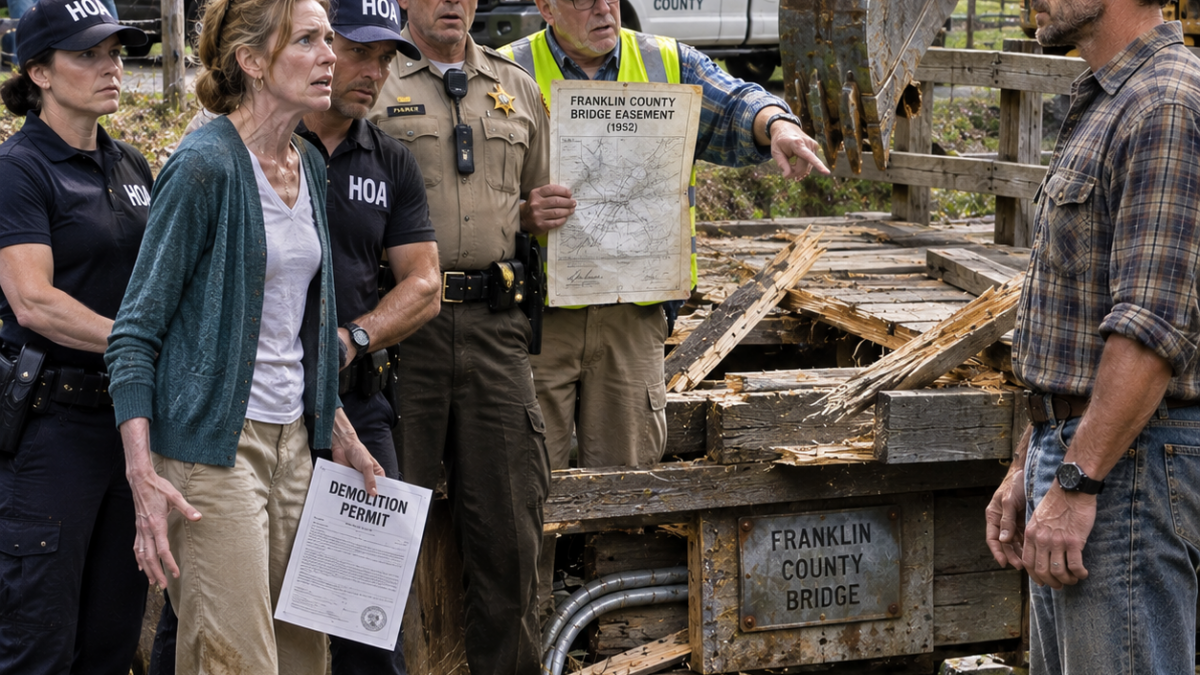
HOA Karen Ordered My “Private” Bridge Demolished—Then the Sheriff Arrested Her for Destroying County Property
**“YOU SHOULD HAVE LISTENED WHEN THE HOA GAVE YOU THE CHANCE, CALEB! THIS UNSAFE BRIDGE IS COMING DOWN TODAY WHETHER YOU LIKE IT OR NOT!” Cheryl Monroe shouted as the excavator ripped the first wooden railing from the crossing my family had called Bennett Bridge for generations.**
**I had warned Pine Hollow Estates in writing that they had no permission to enter my 58-acre farm, their first engineer had refused to participate because ownership was unclear, and even the demolition contractor asked me one last time whether I had approved the work—but Cheryl waved a county permit in the air and ordered the machines forward anyway.**
**Then Sheriff Owen Parker arrived with the county engineer, who looked at the destroyed railing, the excavator sitting on the bridge, and Cheryl’s permit before asking one question that erased the smile from her face: “Who authorized you to demolish county property?”**
My name is Caleb Bennett.
And the strangest thing about Bennett Bridge was that for most of my life, I thought it belonged to me too.
So did my father.
So did my grandfather.
Our family owned fifty-eight acres in western North Carolina, split by Mill Creek.
The creek was narrow and quick most of the year, but after mountain storms it could swell fast enough to carry branches, fence posts, and sometimes half a tree downstream.
Bennett Bridge connected the two sides of our farm.
Grandpa Raymond drove cattle across it.
Dad hauled hay and tractor parts over it.
When I was a kid, my cousins and I sat on the wooden railing dropping leaves into the water, then ran to the other side to see which leaf came through first.
Nobody ever told us the bridge belonged to anyone else.
Why would they?
Bennett land on one side.
Bennett land on the other.
Bennett Bridge in the middle.
It seemed obvious.
And obvious assumptions are often the ones nobody bothers checking.
For decades, that did not matter.
Then Pine Hollow Estates appeared.
A developer bought farmland east of us and built sixty-four homes on a wooded hillside.
Nice homes.
Large porches.
Clean roads.
Two-car garages.
Families who wanted quiet country living without the work of owning an actual farm.
For the first few years, we barely noticed one another.
Pine Hollow had its own entrance from the county highway.
My farm was west of the subdivision.
Bennett Bridge had nothing to do with their normal route.
Then somebody discovered the shortcut.
If Pine Hollow residents left through an old maintenance road behind the neighborhood, crossed the edge of my northern field, drove over Bennett Bridge, then followed another gravel track, they could reach the shopping center roughly eight minutes faster.
Eight minutes.
That was how everything started.
At first, maybe three cars a day.
I did not care.
Then navigation apps apparently discovered the route.
Traffic increased.
Delivery vans.
Contractors.
Teenagers.
People who had no idea they were driving through working farmland.
One afternoon, a delivery truck came around a bend too fast and nearly hit a calf standing beside the fence.
That ended my patience.
I put up a sign.
PART2:
PRIVATE FARM ROAD
LOCAL FARM ACCESS ONLY
PLEASE USE PINE HOLLOW MAIN ENTRANCE
Most people respected it.
Some did not.
Then Cheryl Monroe became HOA president.
Late forties.
White luxury SUV.
Perfectly organized folders.
The kind of person who did not raise her voice until she had already decided the conversation should be over.
Her first visit was polite.
That made everything later more disappointing.
She came to my front gate one afternoon.
“Mr. Bennett?”
“Yes.”
“I’m Cheryl Monroe. Pine Hollow HOA president.”
“I know.”
She smiled.
“I wanted to discuss bridge access.”
“What about it?”
“Our residents have used Bennett Bridge for years.”
“A few have.”
“We’d like to formalize that.”
That sounded reasonable.
“What does formalize mean?”
She explained that Pine Hollow wanted to maintain the shortcut road and establish permanent use of the bridge for residents.
In exchange, the HOA would contribute toward repairs.
I did not say no.
I told her I would think about it.
More traffic meant more liability.
More danger around livestock.
The gravel road was narrow.
And honestly, I had no idea what weight the bridge could safely carry.
Cheryl suggested the HOA pay for an engineering inspection.
Again:
Reasonable.
So I agreed to discuss it.
Two weeks later, a document arrived.
BENNETT BRIDGE COMMUNITY ACCESS NOTICE.
It did not ask permission.
It informed me that Pine Hollow Estates had determined Bennett Bridge formed part of a “historic neighborhood access route.”
Residents were therefore authorized to use it.
I called Cheryl.
“What is this?”
“A temporary access policy.”
“You can’t create an HOA policy for my farm.”
“The crossing has been used publicly for decades.”
“That doesn’t make my cattle field an HOA road.”
“We’re protecting existing access.”
“Existing access was informal.”
She sighed.
“Caleb, nobody is trying to take your property.”
Whenever someone says that while explaining why they need control over your property, pay attention.
I asked for the HOA attorney’s legal opinion.
It never arrived.
Instead, a Pine Hollow sign appeared near the maintenance road.
SECONDARY ACCESS.
Arrow:
Straight toward my farm.
I removed the sign because it was installed on my property.
I did not damage it.
I drove it to the clubhouse and left it beside the door with a note.
PLEASE DO NOT INSTALL HOA SIGNS ON BENNETT PROPERTY.
Three days later, another sign appeared.
This one stayed inside Pine Hollow’s boundary.
Fine.
But residents started using the shortcut more because the sign encouraged them.
So I put a chain across my farm road.
Cheryl called within an hour.
“You cannot block emergency access.”
“What emergency access?”
“The secondary route.”
“It isn’t an emergency route.”
“It could be needed.”
“Then the county emergency department can call me.”
She said Pine Hollow would review its legal options.
I said:
“Please do.”
Then things became strange.
Pine Hollow hired a bridge inspector named William Porter.
William called me before stepping onto the farm.
That immediately earned my respect.
“The HOA wants an engineering inspection because they’re considering regular community traffic across the bridge.”
“That’s fine. You can inspect it.”
William spent almost three hours under the bridge.
Measured supports.
Photographed concrete abutments.
Checked decking.
Tested old timber.
Then he found a steel plate partly hidden beneath one support.
He cleaned rust away.
Only a few letters remained visible.
FRANKLIN CO.
The rest was gone.
William frowned.
“Could be county.”
“Or manufacturer?”
“Possible.”
He needed records.
His final report said the bridge should not carry heavy regular neighborhood traffic without significant repairs.
That made sense.
I sent it to Cheryl.
Her response?
Pine Hollow declared the bridge a safety hazard.
Then the HOA sent me a demand ordering me to repair my “unsafe private bridge” within thirty days because it endangered Pine Hollow residents.
I laughed when I read it.
My attorney, Rebecca Hayes, smiled for a different reason.
“They cannot order you to repair private property for their convenience.”
“That’s what I thought.”
Then she asked:
“Are you sure the bridge is private property?”
I stopped.
“Of course.”
Rebecca gave me the look attorneys give right before adding twenty hours of work to a simple problem.
“Do you know that, or have you always assumed it?”
That question changed everything.
My deed covered acreage on both sides of Mill Creek.
It did not specifically describe the bridge.
Rebecca requested old county records.
The problem was age.
1940s.
1950s.
Old rural road systems.
Records scattered across deed books, highway files and paper archives.
Not everything had been digitized.
The county said it might take weeks.
Meanwhile, Cheryl escalated.
Second safety notice.
Orange cones.
An HOA patrol worker tried putting a temporary barrier on my side of the bridge.
I stopped him.
He apologized.
He was a young guy following instructions.
“Ms. Monroe said the HOA controls bridge safety.”
“She doesn’t.”
At least I thought she did not.
That uncertainty started bothering me.
Then Pine Hollow held a meeting.
Frank Miller, a resident I knew from the feed store, invited me.
Most people in the room were not hostile.
They wanted clarity.
One woman asked why Pine Hollow even needed the shortcut.
Cheryl said it could become an alternate route for emergency vehicles if the main entrance were ever blocked.
Another resident asked:
“Did the fire department request that?”
Cheryl avoided answering.
Frank asked:
“Do we have a recorded easement?”
Cheryl said:
“The association has historic use rights.”
I stood.
“If you have an easement, show me.”
“The absence of a modern record does not erase decades of public use.”
Rebecca leaned toward me.
“That is not an easement.”
Then Cheryl produced a photograph.
Black and white.
1960s.
A county school bus crossing Bennett Bridge.
That got my attention.
Why would a school bus use a private farm bridge?
Cheryl smiled like she had finally won something.
“This has always been a public crossing.”
Rebecca looked interested.
Not convinced.
Interested.
Because the photograph suggested the history was more complicated than either side understood.
After the meeting, Frank followed me outside.
“She’s talking about replacing the bridge.”
“Replacing?”
“She says if you won’t repair it, Pine Hollow may remove the hazard and build a safer crossing.”
“On my land?”
“That’s what I asked.”
I called Rebecca first thing the next morning.
Her advice surprised me.
“Do not threaten them.”
“They’re talking about demolishing my bridge.”
“We still don’t know for certain that it is your bridge.”
“So I do nothing?”
“No. We put everything in writing.”
She sent Pine Hollow formal notice.
No permission from Caleb Bennett to:
Enter Bennett property for demolition.
Remove the bridge.
Modify the bridge.
Repair the bridge.
Replace the bridge.
Alter the surrounding road.
If Pine Hollow claimed independent legal authority, it should provide that authority.
Cheryl replied the same day.
The HOA believed it possessed independent authority through historic crossing rights.
Fine.
Prove it.
They never did.
William Porter refused to participate in demolition while ownership remained uncertain.
That should have ended the idea.
Cheryl hired another contractor.
Ridgeway Site Services.
Supervisor:
Daniel Foster.
Daniel called me before work started.
“Mr. Bennett, Pine Hollow says they have authorization to remove the bridge.”
“I haven’t authorized anything.”
“They gave us a county permit.”
That caught my attention.
“What permit?”
“Bridge hazard removal.”
He emailed a copy.
It looked real.
County seal.
Permit number.
Engineering approval.
Location:
Mill Creek Secondary Crossing.
It never specifically said Bennett Bridge.
Rebecca contacted the county immediately.
The clerk promised to research the permit number.
Before we got an answer, Cheryl sent another notice.
DEMOLITION MONDAY
8:00 A.M.
I called her.
“You understand I am not giving you permission.”
“We don’t need your permission.”
“You’re entering my land.”
“Our crossing rights include necessary maintenance.”
“You’re demolishing the bridge.”
“We’re removing a dangerous structure.”
“And who builds the replacement?”
“Pine Hollow will determine that later.”
That answer finally told me what this was really becoming.
Cheryl did not simply want the old bridge repaired.
She wanted control over what replaced it.
A new bridge.
Designed for heavier traffic.
Possibly a paved approach.
Something Pine Hollow could then point to as permanent community infrastructure.
Rebecca agreed.
“Still don’t interfere physically.”
That was difficult.
My father would have parked a tractor sideways across the road.
Grandpa probably would have sat on the bridge until everyone left.
But Rebecca was right.
I had warned them.
The contractor had been warned.
The HOA said it possessed legal authority independent of me.
Let them stand behind that claim.
So Monday morning I moved my cattle away from the northern field.
Set up cameras.
Parked far enough from the bridge that nobody could accuse me of physically blocking the crew.
Rebecca arrived.
Frank came too.
Several Pine Hollow residents stood at a distance.
Cheryl arrived in her white SUV.
Then the excavator came.
Daniel Foster walked toward me first.
“I want this clear. You object?”
“Yes.”
“You do not authorize demolition?”
“No.”
He nodded.
“Pine Hollow says its permit overrides your objection.”
“That’s between your company and Pine Hollow.”
He did not look happy.
Neither was I.
But Cheryl had signed the work order.
His company had received official-looking county paperwork.
Everyone had made a choice.
The excavator moved onto Bennett Bridge.
Bucket lifted.
Caught the old railing.
CRACK.
For the first time in my life, I watched part of the bridge break away.
My stomach turned.
Frank looked at me.
“You’re really letting them do this?”
“I told them not to.”
“That’s it?”
“That’s it.”
Cheryl walked toward me.
“You could have avoided this.”
“Maybe.”
“You should have worked with us.”
“I tried.”
“No, Caleb. You tried controlling access.”
“It crosses my farm.”
“And now the unsafe bridge is finally coming down.”
Then the excavator caught something behind the old timber.
Metal screamed.
Daniel shouted:
“STOP!”
The bucket froze.
Behind the damaged railing ran a thick steel conduit bolted beneath the bridge.
Not ordinary wire.
Heavy infrastructure.
Then another plate appeared beneath years of dirt.
Daniel climbed down.
Frank leaned over the barrier.
“There’s writing.”
Daniel wiped the plate.
PROPERTY OF FRANKLIN COUNTY.
Nobody spoke.
Cheryl removed her sunglasses.
Rebecca’s phone rang.
She answered.
Listened.
Then looked directly at me.
“The county archive found the bridge file.”
My heart started pounding.
“What does it say?”
She looked at the broken bridge.
Then Cheryl.
“Caleb, your grandfather never owned this structure.”
Cheryl stepped closer.
“What does that mean?”
Rebecca ignored her.
“Franklin County purchased the bridge itself and the crossing easement in 1952.”
Daniel shouted from below.
“EVERYBODY BACK!”
A smaller pipe beside the steel conduit had cracked.
Water sprayed beneath the deck.
Then the larger casing began hissing.
I called 911.
Rebecca called the county.
Cheryl kept repeating:
“The permit authorizes removal.”
Sirens came fast.
Sheriff Owen Parker arrived first.
County utility truck behind him.
Then another county vehicle.
Thomas Harris, county engineer, jumped out before it fully stopped.
He looked at the broken railing.
Excavator.
Exposed conduit.
Damaged utility vault.
Then Cheryl.
“Who authorized this?”
She pointed at me.
“He owns the bridge.”
Thomas looked at her.
Then me.
“No, he doesn’t.”
Cheryl froze.
Thomas pointed to the old plate.
“Franklin County owns Bennett Bridge.”
Then he looked beneath it.
His face changed.
“And somebody just hit one of our main emergency utility crossings.”
A county worker found a concrete vault partly exposed near the eastern abutment.
Its lid had cracked.
Inside:
Heavy cables.
Utility lines.
Thomas turned.
“Tell me nobody cut these.”
Nobody answered.
Sheriff Parker asked Cheryl for the demolition permit.
She handed it over.
Thomas read the number.
Called his office.
Waited.
Then lowered the phone.
“The permit is real.”
For one second Cheryl almost smiled again.
Thomas continued.
“It’s for removal of a collapsed storm drain on County Road 18.”
Silence.
“Eight miles from here.”
He held up the page.
“Somebody changed the location and project description.”
Cheryl’s face went white.
Sheriff Parker asked:
“Who prepared this?”
Cheryl looked toward the HOA maintenance manager.
Richard Bell.
Richard had been standing near her SUV holding a blue folder.
He started backing away.
The sheriff saw him.
“Mr. Bell.”
Richard stopped.
“Come back here, please.”
He looked at Cheryl before moving.
Small glance.
Huge meaning.
Cheryl immediately said:
“Richard had nothing to do with the permit.”
Parker raised a hand.
“Let him answer.”
The folder contained emails.
Demolition plans.
Work schedules.
Maps.
Same altered county permit.
Richard said Cheryl had called him into the HOA office three weeks earlier.
She said Pine Hollow had finally received county authorization to remove the unsafe bridge.
“Did you edit the permit?” Parker asked.
“No.”
“Who gave it to you?”
“President Monroe.”
Cheryl stepped forward.
“That is not what happened. I told him to send the approved packet.”
Richard looked confused.
“You gave me the packet.”
Cheryl tightened her jaw.
“That doesn’t mean I created it.”
Rebecca whispered:
“She’s separating possession from creation.”
That did not prove Cheryl personally forged anything.
But it told us she already knew which line she wanted between herself and the document.
County workers identified the infrastructure.
The small pipe supported emergency hydrant capacity on the west side of Mill Creek.
The heavy steel conduit contained county fiber.
Not ordinary internet.
Emergency communications.
Sheriff repeater traffic.
Fire network.
Backup communications center.
The conduit had not been completely severed, but the county had to move traffic onto a backup route.
Cheryl stared beneath the bridge.
“That was under there?”
Thomas looked at her.
“Yes.”
“How was I supposed to know?”
“By not demolishing county property without a valid county permit.”
Nobody had an answer to that.
Then Thomas explained the 1952 history.
My great-grandfather, Samuel Bennett, owned land on both sides of Mill Creek.
School transportation and emergency access had become important.
So he sold Franklin County the bridge structure itself.
Price:
One dollar.
He also granted a narrow crossing easement.
County vehicles.
School transportation.
Emergency use.
Limited local public crossing.
But only across the bridge corridor.
The roads beyond it remained private Bennett land.
That explained Cheryl’s school-bus photograph.
She had been right about the bridge once serving public traffic.
She had been wrong about what that meant.
Public bridge.
Private farm road.
Pine Hollow’s shortcut required leaving the public easement and driving across my private field.
Frank stared at the old map.
“So even if the bridge is county property, our shortcut still isn’t public.”
Thomas shook his head.
“No.”
Frank looked at Cheryl.
“You knew?”
“No.”
Too fast.
Rebecca asked:
“Did Pine Hollow ever ask Caleb for a recorded road easement?”
Cheryl crossed her arms.
“We attempted to formalize access.”
“That isn’t what I asked.”
Silence.
Then:
“No.”
No farm-road easement.
No bridge ownership.
No county demolition authority.
No valid removal permit.
Yet half my family bridge railing was already gone.
Parker did not immediately arrest Cheryl.
Some residents seemed disappointed.
Rebecca was not.
“An arrest is not a prize,” she said.
She was right.
The important questions were:
Who altered the permit?
Who knew the county owned the bridge?
Why was Cheryl so desperate to remove it?
Who benefited?
County closed Bennett Bridge to all traffic.
Including me.
For the first time in my life, I had to drive thirteen miles around to move equipment between two halves of my own farm.
Frank offered to help haul feed.
That mattered.
He was a Pine Hollow resident.
The argument could easily have become:
Bennett versus Pine Hollow.
Instead, Frank kept showing up as Frank.
Another reminder:
A bad board decision does not make every homeowner bad.
Pine Hollow held an emergency meeting without Cheryl chairing it.
Her authority over construction and property matters was suspended.
The HOA told residents the shortcut through Bennett Farm was closed because no HOA access right had been established.
And then something remarkable happened.
Nothing.
Residents used the main entrance.
Children got to school.
Delivery trucks arrived.
Fire engines could reach Pine Hollow from the county highway.
Nobody’s life collapsed because their grocery trip took eight minutes longer.
Convenience had become entitlement so gradually that everybody forgot it was still convenience.
County archive sent the full 1952 file.
Sale:
$1.
Bridge structure:
Franklin County.
Crossing easement:
Narrow.
County maintenance responsibility:
Yes.
Utility rights under and beside the bridge:
Yes.
And one clause Rebecca circled.
Until the county formally abandoned the bridge, no private party could materially alter or destroy it.
Clear.
Then investigators looked at the altered permit’s metadata.
Original permit downloaded from the county portal twelve days before demolition.
Modified six hours later.
Computer name:
HOA OFFICE 03.
Pine Hollow president’s office.
User profile:
C MONROE.
Cheryl’s lawyer correctly pointed out that metadata did not prove she personally edited the file.
Somebody else could theoretically have used the computer.
Sheriff Parker kept digging.
Then he found an email.
From Cheryl.
To Richard Bell.
Subject:
FINAL BRIDGE AUTHORITY.
Attachment:
Altered permit.
Message:
USE THIS VERSION ONLY. DO NOT SEND PRIOR DRAFTS.
Richard stared at the printout.
“What prior drafts?”
He said he had never seen any.
Pine Hollow’s board gave investigators access to archived email.
Deleted messages came back from backup.
One thread was between Cheryl and her brother.
Steven Monroe.
Owner of Monroe Community Solutions.
Planning consultant.
First email:
Steven:
BRIDGE OWNERSHIP PROBLEM. COUNTY MAY STILL HOLD STRUCTURE.
Cheryl:
DOES THAT HURT ACCESS PLAN?
Steven:
YES. NEED COUNTY COOPERATION OR ABANDONMENT.
Cheryl:
COUNTY WILL TAKE FOREVER.
Steven:
THEN DON’T ASK UNTIL REPLACEMENT IS ALREADY NECESSARY.
Rebecca read that one twice.
So did I.
Another exchange:
Cheryl:
IF OLD BRIDGE IS REMOVED AS HAZARD, CAN HOA BUILD NEW CROSSING?
Steven:
POSSIBLY UNDER EMERGENCY ACCESS ARGUMENT, BUT LAND RIGHTS STILL ISSUE.
Cheryl:
CALEB WILL NEVER GRANT ROAD EASEMENT.
Steven:
THEN CREATE PRESSURE.
There it was.
Pressure.
The bridge was never the real prize.
The road easement was.
Why?
Pine Hollow already had an entrance.
Why take this much risk over eight minutes?
Then a file appeared.
PINE HOLLOW WEST EXPANSION.
Forty-eight future homes west of Mill Creek.
Developer:
Ridgeway Communities.
The new development needed a road through Pine Hollow.
Across Bennett Bridge.
Across my northern field.
Without that route, Ridgeway would need to build a longer entrance through steep terrain.
Cost difference:
About $2.6 million.
Now we had motive.
Then came the contract.
Monroe Community Solutions.
Steven’s company.
Success fee if Pine Hollow West secured permanent western bridge access:
$320,000.
Cheryl’s signature sat at the bottom.
She knew her brother would be paid if access succeeded.
No clear HOA board approval existed for the arrangement.
The old county bridge was an obstacle because the county controlled it.
Pine Hollow could not rebuild it wider.
Could not convert it into a heavy development road.
But if it disappeared as a “hazard” and a larger replacement became an emergency necessity?
Different story.
That thought made me sick.
The county fiber damage complicated everything further.
One spare channel had also been leased to a regional internet provider.
Several rural communities experienced service problems.
Bridge and utility damage estimates climbed into the hundreds of thousands.
Ridgeway Site Services notified its insurer.
The contractor argued it relied on a falsified county permit.
A fair argument.
Ordinary Pine Hollow homeowners became afraid they would receive massive assessments.
I hated that.
They had not edited anything.
They had not signed Steven’s contract.
They had not ordered demolition.
At the next community meeting, someone asked me:
“Are you suing all of us?”
“No.”
The room went quiet.
“Will I pursue any damage to my farm?”
“Yes.”
“Will Franklin County pursue bridge damage?”
“That is the county’s decision.”
“What do you want from Pine Hollow?”
I answered:
“Stop driving through my cattle field.”
A few people laughed.
Then I added:
“And repair the bridge properly.”
Another resident asked what happened if Pine Hollow ever genuinely needed a second emergency route.
“We talk.”
“With lawyers?”
“With whoever needs to be there. Engineers. County. Lawyers. Neighbors. We make a real agreement.”
Kindness did not require giving away my road.
It meant remaining willing to have an honest conversation.
Then Richard Bell approached me afterward.
“I’m sorry.”
“For?”
“I forwarded that permit.”
“You thought it was real.”
“I should’ve checked.”
“Yes.”
He nodded.
No excuse.
That mattered.
Then he told me Cheryl had asked him to move several old bridge-record boxes from HOA storage into her office two nights before demolition.
After the machines started work, the boxes disappeared.
Sheriff Parker obtained a warrant.
Hallway cameras showed Cheryl pushing three banker boxes to her SUV the night before demolition.
Her attorney said moving records was not a crime.
True.
So investigators followed the evidence.
Traffic cameras showed Cheryl near an abandoned quarry road.
Deputies searched.
Metal burn barrel.
Charred Pine Hollow documents.
Most unreadable.
Some survived.
One fragment:
BENNETT BRIDGE OWNERSHIP REVIEW.
Another:
COUNTY STRUCTURE — DO NOT MODIFY WITHOUT APPROVAL.
Then one mostly intact page.
Email from Pine Hollow’s former attorney, William Harper.
To Cheryl.
Subject:
BENNETT BRIDGE STATUS.
COUNTY RECORDS INDICATE FRANKLIN COUNTY OWNS THE BRIDGE STRUCTURE. PINE HOLLOW HAS NO AUTHORITY TO REMOVE, REBUILD, OR MATERIALLY ALTER THE CROSSING WITHOUT COUNTY APPROVAL. BENNETT LAND ACCESS REMAINS A SEPARATE PRIVATE PROPERTY ISSUE.
No ambiguity.
Cheryl knew.
An arrest warrant was approved.
When deputies went to her house, she was gone.
SUV gone.
Phone off.
Frank called.
“You think she ran?”
“I don’t know.”
Then Thomas Harris called from the bridge.
“Come down here.”
County repair crews had opened part of the eastern abutment.
Behind old concrete:
A newer conduit.
Not county.
It ran beneath my field toward Pine Hollow’s back maintenance gate.
No easement.
No permit.
Inside:
Electrical and communication lines.
Pine Hollow traffic-control equipment.
Then Susan Grant found a development invoice.
WEST ACCESS PREPARATION — PHASE ONE.
Paid two years earlier.
Before Cheryl ever asked me to formalize bridge access.
Before the safety notices.
Before demolition.
They had already begun installing infrastructure across my land for the project they did not have legal access to build.
Then another buried line appeared.
Larger.
Empty.
Future power conduit.
Same route shown on the Pine Hollow West plan.
Frank stared.
“They started the project before they had permission?”
“Looks that way.”
Then a sheriff’s cruiser came down the road.
Parker stepped out.
“We found Cheryl.”
“Where?”
He pointed toward Mill Creek.
“Here.”
Her SUV had been hidden near Quarry Road.
Footprints led through woods.
A deputy appeared beneath the far embankment.
Cheryl walked behind him.
Mud on her shoes.
Hair disheveled.
Canvas bag over one shoulder.
She did not fight.
Sheriff Parker walked toward her.
“Mrs. Monroe, you are under arrest.”
This time:
Handcuffs.
The moment everybody would later remember.
The HOA president who had ordered the demolition of what she called Caleb Bennett’s unsafe private bridge was arrested beside the same structure after investigators established that it belonged to Franklin County.
But the canvas bag mattered more.
Inside:
County survey plates.
Old easement records.
Hard drive.
Original Pine Hollow West plans.
Thomas opened one plan across his truck hood.
Four-lane bridge.
Not a neighborhood bridge.
Major entrance.
Route across my farm.
Then into the western development.
Construction sequence:
PHASE ONE — UNDERGROUND UTILITIES.
Already started.
PHASE TWO — REMOVE EXISTING COUNTY BRIDGE.
That was the demolition.
PHASE THREE — ESTABLISH EMERGENCY REPLACEMENT CROSSING.
PHASE FOUR — TRANSFER ACCESS TO PINE HOLLOW WEST.
Rebecca stared.
“They planned the demolition before they called the bridge unsafe.”
Yes.
Then Thomas read another note.
COUNTY REPLACEMENT FUNDING EXPECTED AFTER EMERGENCY LOSS.
Nobody spoke.
The plan was not only to destroy the old county bridge.
Somebody expected taxpayers to help replace it.
Sheriff Parker pulled out another agreement.
Monroe Community Solutions.
Ridgeway Communities.
Success payment:
Not $320,000.
$1.1 million.
The smaller amount had only been one component.
Full payment depended on permanent western access through a county-funded replacement bridge.
Private development.
Public bridge.
Public money.
Private profit.
Then Thomas saw another utility line on the plan.
WEST FORCE MAIN.
Frank asked:
“What’s a force main?”
Thomas answered:
“Pressurized sewer.”
My stomach dropped.
County maps showed no sewer main crossing Bennett Farm.
Utility locator came.
Beep.
Beep.
Beep.
Buried pipe under my field.
Across Mill Creek.
Toward Pine Hollow maintenance.
Inspection cap opened.
The smell answered the question before the instruments did.
Active sewage.
Regular flow.
Pine Hollow had installed an active pressurized sewer line across my farm without a recorded easement or county record I had ever seen.
County wastewater supervisor traced it.
Eighteen western Pine Hollow homes were already using it.
Residents had no idea.
Their showers.
Dishwashers.
Toilets.
Everything went into a system labeled in HOA budgets as:
WEST DRAINAGE BOOSTER.
Not sewer.
Stormwater.
Drainage.
The pumps had been serviced for four years.
Designer:
Monroe Community Solutions.
Again.
Why connect eighteen existing houses?
Because the hidden sewer route was intended eventually to serve Pine Hollow West.
The existing homes maintained steady flow and kept the system operational.
Pine Hollow had spent more than $780,000 over four years on “west drainage improvements.”
Residents thought it addressed runoff.
A large portion instead built unauthorized expansion infrastructure across my farm.
County could not simply turn it off.
Eighteen families would have sewage backing into their homes.
I owned the land around the pipe.
I could have shouted:
SHUT IT DOWN.
That would have punished people who had done nothing wrong.
Instead, I signed a sixty-day emergency access agreement.
County utility work only.
No permanent easement.
No new connections.
No expansion.
No charge.
Frank looked at me.
“After all this, you’re still letting us use the pipe?”
“I’m letting eighteen families use their bathrooms.”
He laughed.
Sometimes basic decency is less dramatic than revenge.
County designed a new lift station inside Pine Hollow property.
The eighteen homes would reconnect legally to the approved eastern sewer network.
Once completed, the secret force main across Bennett Farm would be flushed, disconnected and removed where practical.
The crossing under the creek could remain abandoned underground if digging it out would create more damage.
Everything would be recorded properly.
Finally.
Then the investigation widened again.
Documents from Cheryl’s bag included a purchase agreement.
Seller:
Caleb Bennett.
Buyer:
Ridgeway Communities.
Property:
Twenty-six acres of Bennett Farm.
Purchase price:
$350,000.
My signature appeared at the bottom.
I stared.
“I never signed this.”
Rebecca placed another document beside it.
A timber-sale agreement I had signed two years earlier.
Same signature.
Exactly.
Same ink break.
Same curve.
Copied.
Ridgeway had received the fake purchase contract from Steven Monroe.
They had used it in investor presentations and preliminary financing.
Ridgeway’s president, Daniel Grant, agreed to meet.
He looked genuinely disturbed.
“We were told you wanted the sale confidential.”
“By who?”
“Steven.”
“You never thought to call me?”
“We should have.”
“Yes.”
He did not argue.
That helped.
Ridgeway had already paid Monroe Community Solutions $275,000 in advance planning fees based partly on the fake land agreement.
Then Daniel showed us something else.
County transportation grant application.
Requested public funding:
$3.8 million.
Purpose:
Critical rural bridge replacement and emergency-access improvement.
Future homes included.
Pine Hollow West.
Nothing in the grant emphasized that the private development would save millions if taxpayers funded the bridge.
Cheryl Monroe’s signature.
Steven Monroe’s signature.
Attached letters supposedly from county officials supporting the replacement.
Thomas Harris read the one carrying his own signature.
“I never wrote this.”
Fake.
Another from sheriff emergency management.
Fake.
Transportation planner.
Fake.
One false document supporting another.
Fake purchase agreement.
Fake county support.
Altered demolition permit.
Secret utility construction.
Then remove the old bridge.
Now the replacement becomes urgent.
It almost worked because the paperwork looked boring enough that people assumed somebody else had checked it.
Sheriff Parker received another call.
Steven Monroe had been located at a storage facility outside Asheville.
Inside his truck:
Laptops.
Company records.
County seals.
Blank forms.
Portable scanner.
Inside the storage unit:
Road barriers.
Survey tools.
Orange utility conduit.
Then:
Blasting permits.
For Mill Creek.
My southern pasture.
The future road needed to cut through a rock shelf.
The permit numbers were real.
The locations had been altered from legitimate quarry projects elsewhere.
Exactly the same method.
Then Frank called me.
“Caleb, don’t come through the south road.”
“What’s happening?”
“Blasting company.”
My stomach dropped.
Workers were already drilling.
County deputies were dispatched.
Thomas and I drove toward the farm.
Frank stayed on the phone.
“They’re setting charges.”
“Get away.”
Then he shouted.
Smoke near the blasting line.
Thomas looked at me.
“They may already be armed.”
“Frank, move!”
Static.
Then a deep boom came through the phone.
The truck vibrated.
Gray dust rose above the trees.
Second explosion.
When we reached the area, part of the rock shelf had fallen toward Mill Creek.
For several horrible seconds, I could not see Frank.
Then he emerged from the dust running with two blasting workers.
Dirty.
Breathing hard.
Alive.
“I’m fine.”
The crew had pulled him back before the second charge.
Nobody seriously injured.
The blasting supervisor immediately gave Sheriff Parker the work packet.
He believed Franklin County had authorized emergency slope stabilization.
County seals.
Engineering approval.
Permit numbers.
Thomas barely glanced at it.
“Fake.”
Six holes had been drilled.
Two detonated.
Four still armed.
The supervisor had stopped the sequence after Frank shouted that the landowner had never approved the work.
That decision prevented much worse damage.
Bomb and blasting specialists made the remaining charges safe.
The slide partly blocked Mill Creek.
County needed immediate access to clear a safe channel.
I opened the pasture.
No argument.
No paperwork fight.
Water does not care who won yesterday’s property dispute.
Crews worked until normal creek flow returned.
My southern field looked terrible.
Broken rock.
Damaged trees.
Collapsed fence.
Cattle had already been moved.
Nobody hurt.
Repairable.
I started appreciating that word.
The search of Steven’s storage unit produced a folder:
PUBLIC COST STRATEGY.
The plan was simple.
Make Bennett Bridge appear unsafe.
Remove it.
Create emergency-access crisis.
Pressure Franklin County into constructing a larger replacement.
Connect that replacement to Pine Hollow West.
Extend the transportation route farther west.
Public bridge.
Public road funding.
Private development savings.
Estimated taxpayer-supported savings:
More than $4 million.
Then another map changed the scale again.
Beyond the forty-eight-home Pine Hollow West development:
MILL CREEK LOGISTICS PARK.
One hundred eighty acres.
Warehouses.
Truck yards.
Distribution buildings.
The proposed four-lane bridge would eventually become the eastern access route.
Steven Monroe had a financial interest in the logistics development too.
The $1.1 million success payment was only part of what he could gain.
A southern truck route crossed almost half a mile of my cattle pasture.
I had never approved it.
Then Rebecca found another document.
Permanent transportation easement.
Grantor:
My father, William Bennett.
Signed twelve years earlier.
Dad died nine years ago.
The signature looked real.
Because it was.
Copied from his will.
Exact loop in the W.
Exact shape.
The fake easement had never been recorded.
Attached note:
RECORD BENNETT SOUTH EASEMENT AFTER EMERGENCY BRIDGE DESIGNATION TO AVOID PREMATURE TITLE CHALLENGE.
That phrase chilled me.
They knew it could be challenged.
So the strategy was timing.
Destroy bridge.
Create emergency.
File fake easement.
Push county-funded replacement.
Build road.
Layer after layer.
Steven Monroe eventually faced the larger case.
Fake government documents.
Fraud-related development financing.
Copied signatures.
False easements.
Unauthorized utility infrastructure.
Altered permits.
Blasting documents.
Different agencies handled different pieces.
Cheryl’s responsibility remained her own.
She knew the county might own the bridge months before demolition.
She had the former attorney’s warning.
She knew Pine Hollow had no farm-road easement.
She knew her brother would benefit financially.
She signed the transportation grant.
She forwarded the altered demolition permit.
Records warning against demolition ended up burned near Quarry Road.
Steven designing the larger scheme did not erase Cheryl’s choices.
The criminal cases moved slowly.
As they should.
Evidence.
Hearings.
Lawyers.
Restitution.
Probation conditions.
Sentencing rules.
Cheryl did not disappear into prison forever after one dramatic set of handcuffs.
Real legal consequences took time.
Steven’s case was larger.
He eventually accepted responsibility for major portions after investigators linked his computers, financial interests, company records and falsified documents to the development scheme.
I attended only one significant hearing.
Cheryl stood before the judge without an HOA title.
No white SUV outside.
No clipboard.
No board behind her.
Afterward she stopped beside me in the hallway.
“Caleb.”
I waited.
“I was wrong about the bridge.”
“That part is pretty clear.”
“I thought if we got it removed, the county would have to replace it.”
“I know.”
“I told myself the new road would help Pine Hollow.”
“And your brother?”
She looked down.
“Yes.”
Then:
“I convinced myself you were the problem because you kept saying no.”
I understood that more than she expected.
Sometimes the person protecting a boundary becomes easier to hate than the person demanding that boundary disappear.
“You could have asked.”
She nodded.
“I know.”
That was enough.
No dramatic forgiveness.
No handshake.
Just the simplest truth arriving very late.
Ask.
Ridgeway Communities canceled the version of Pine Hollow West that depended on my farm.
Daniel Grant came to see me personally.
No attorneys.
“I owe you an apology.”
“You didn’t forge my signature.”
“My company accepted a land contract without ever meeting the seller.”
“That was a mistake.”
“Yes.”
He said Ridgeway might still develop the western parcels someday, but only with legal access from somewhere else.
“If we ever need anything from you, we ask.”
“Good start.”
We shook hands.
Not friends.
Not enemies.
Two people who now understood the boundary.
The Mill Creek Logistics Park collapsed in its original form.
Investors withdrew.
Without fake Bennett easements and a county-funded bridge corridor, the economics changed.
Maybe somebody will build something there someday.
That is not my decision.
But no commercial truck road will cross my cattle pasture because somebody copied my dead father’s signature out of probate records.
Rebecca recorded a formal title notice.
No Pine Hollow West road.
No commercial transportation easement.
No development utility corridor.
No other claimed access right across Bennett Farm unless properly created and recorded.
Clear paper.
Future arguments prevented before they start.
Then Franklin County addressed Bennett Bridge.
Despite everything Cheryl’s excavator had done, the main foundations were still sound.
County engineers recommended repair.
Not replacement.
Certainly not a four-lane development bridge.
Repair.
Wood railing.
Deck sections.
Support work.
Protected emergency fiber conduit.
Rebuilt utility vault.
Same narrow crossing.
The county commission held a public meeting.
Thomas explained the history.
Franklin County owned the bridge.
Bennett family owned surrounding land.
The public crossing easement remained narrow.
It did not give the public the right to drive across my private farm roads as a shortcut.
One commissioner asked whether I wanted the county to abandon the bridge.
That was not an easy question.
If the county abandoned it, perhaps the old agreement could eventually return more control to my family.
But Thomas said the crossing still had genuine public value during fires, floods or road closures.
That mattered.
I supported keeping it.
County and emergency use within the recorded easement.
Farm use coordinated with me.
No Pine Hollow shortcut traffic.
No commercial development road.
No heavy trucks.
The commission agreed.
Frank asked afterward:
“After all this, why help keep the bridge public?”
“Pine Hollow didn’t do all of this.”
He knew what I meant.
Cheryl made decisions.
Steven made decisions.
Some board members failed to ask enough questions.
But sixty-four families did not forge permits.
The fire department did not.
The county did not.
A real emergency crossing might help somebody someday.
I was not going to punish future people for yesterday’s dishonesty.
The hidden sewer system was corrected too.
Pine Hollow built a legal lift station on HOA property.
The eighteen homes were transferred back to the approved eastern sewer system without losing service.
No sewage backed into anyone’s home.
The unauthorized force main across my field was flushed and disconnected.
Accessible sections removed.
Creek crossing abandoned safely and recorded.
Hidden communications conduits were removed or legally abandoned.
My farm stopped being a secret utility corridor.
The blasting area required stabilization.
New fence.
Rock-face work.
Erosion monitoring.
Native plants.
A year later the scar was still visible.
Smaller.
Healing.
Land remembers damage.
But land also recovers when people finally stop fighting over it.
Pine Hollow changed.
Cheryl was permanently removed.
Frank became acting president.
Then residents elected him.
He hates when I remind him.
His first meeting lasted forty-five minutes.
A miracle.
He canceled the secondary-access policy.
Removed shortcut signs.
Closed the back maintenance gate to normal traffic.
Published the real bridge documents.
No more phrases like “historic community access” unless a recorded document supported them.
Major contracts now required legal review.
Family-connected vendors had to be disclosed.
County permits had to be verified directly.
No development project could hide inside a safety budget.
The HOA became boring.
That may be the nicest thing I can say about an HOA.
Ridgeway eventually developed part of its western land using another access road purchased legally from a different landowner.
Smaller project.
More expensive road.
No Bennett land.
Daniel Grant sent me the approved map before construction started.
He did not need my permission.
He wanted me to know the new road stayed clear of my boundary.
That was respect.
I wished him well.
Four months after demolition, Franklin County reopened Bennett Bridge.
No ceremony.
Thank God.
Thomas called that morning.
I drove over in my old truck.
Frank met me on the Pine Hollow side.
The restored bridge looked almost exactly like the one I remembered.
Simple deck.
Wood railing.
Same narrow crossing.
Nothing dramatic.
Then Thomas pointed toward a new metal plate.
FRANKLIN COUNTY BRIDGE
PUBLIC STRUCTURE
LIMITED ACCESS EASEMENT
“Now do you know whose bridge it is?”
I laughed.
“Apparently not mine.”
That became the joke.
People later asked why I “let” Cheryl destroy my bridge.
Why didn’t I park a tractor in front of the excavator?
Why didn’t I chain myself to the railing?
Why didn’t I physically stop the crew?
The answer is less clever than people want.
I had already said no.
In writing.
The contractor had been warned.
Pine Hollow claimed it possessed independent legal authority.
Rebecca told me not to turn a paperwork dispute into a physical confrontation.
So I let everyone stand behind their own choices.
I did not secretly know Franklin County owned Bennett Bridge.
The county archive surprised me too.
I was not setting a trap.
I was waiting for facts.
And in the end, that was better.
Cheryl was not defeated by some brilliant trick.
She was defeated by boring things she refused to respect.
Deeds.
County records.
Permits.
Boundaries.
Ownership.
Consent.
My great-grandfather understood something in 1952 that took all of us decades to remember.
He sold the bridge to Franklin County for one dollar because the community needed a safe crossing.
He helped other people.
And he protected his farm.
Those two ideas never conflicted.
That was what Cheryl failed to understand.
When I refused Pine Hollow’s shortcut, she treated my no like an attack on the neighborhood.
It wasn’t.
I simply did not want somebody turning my cattle road into infrastructure for a private development without asking.
You can help neighbors and still have boundaries.
You can support a public bridge and still protect private land.
You can be generous without giving someone ownership.
And saying no does not make you the enemy.
Today, Pine Hollow residents use their main entrance.
The extra eight minutes never ruined anybody’s life.
The back gate remains closed except for legitimate emergency and maintenance use.
The hidden sewer is gone.
County fiber beneath the bridge is protected.
The old water line works properly.
My cattle field looks like a cattle field again.
When storms raise Mill Creek, Bennett Bridge still stands exactly where it has for generations.
Sometimes I stop in the middle.
Look at the county plate.
Still strange.
My bridge that was never really mine.
Yet it taught me more about ownership than almost anything I actually own.
Using something for years does not make it yours.
Calling something “historic access” does not create an easement.
An HOA vote does not become law because somebody says it loudly enough.
A copied signature is not consent.
And confidence does not turn a fake permit into a real one.
So yes.
I stood twenty yards away and watched an HOA excavator tear apart what everyone—including me—had spent decades calling Bennett Bridge.
Then Franklin County arrived and told Cheryl Monroe she had just ordered the destruction of county property using a permit belonging to a project eight miles away.
She was eventually arrested after investigators uncovered the altered paperwork, hidden records, development contracts, unauthorized utilities and the much larger plan behind the demolition.
But the handcuffs were never the ending I cared about.
The ending came months later.
I was driving across the repaired bridge with a trailer full of feed behind my truck.
Frank came from the opposite direction.
The bridge was still too narrow for both vehicles.
We stopped in the middle.
He rolled down his window.
“Public bridge.”
I smiled.
“Private road.”
Frank laughed.
Then he backed up and let me cross.
For the first time in a very long time, everybody finally understood exactly where one ended—
and the other began.








