HOA Karen Ordered Her Husband to Sabotage My Culvert—Then the Road Collapsed and Her Only Way Home Was Across My Farm
HOA Karen Ordered Her Husband to Sabotage My Culvert—Then the Road Collapsed and Her Only Way Home Was Across My Farm
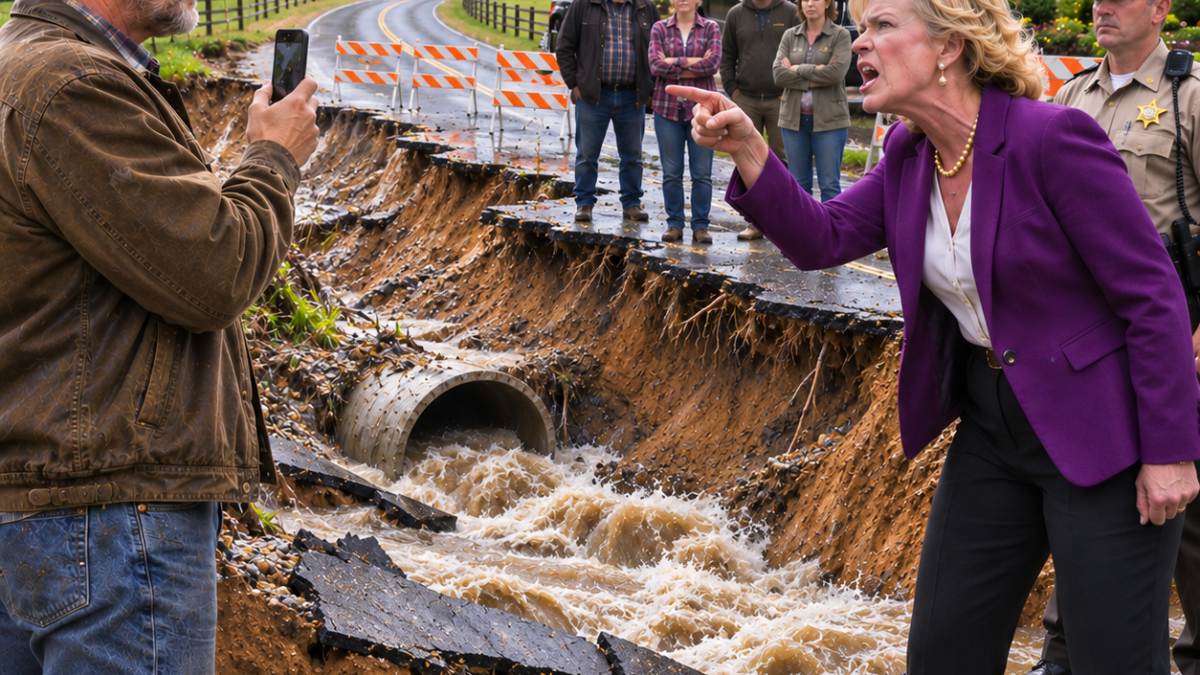
Lenora Hartsfield stood at the edge of a twelve-foot washout screaming that I had destroyed “her road,” even though I had spent eleven months warning her HOA in writing that the failing culvert beneath it was their responsibility.
Sixty families were suddenly trapped behind my farm, an ambulance had crossed the road less than half an hour before forty feet of asphalt collapsed into the creek, and the woman blaming me had refused every repair notice I ever sent her.
But five days later, when Lenora walked onto my property because my private farm lane had become her only practical way home, she said one sentence into the phone recording in my pocket that would change the entire case.
My name is Ben Howren.
My family has farmed the same land for four generations.
Corn.
Hay.
Cattle.
A little timber.
Enough mud to ruin a clean pair of boots before breakfast.
The property is not famous.
It has no dramatic mountain view, no historic mansion, and no giant sign with my family name on it.
But it has one thing that became more valuable than anyone understood.
A road.
Old Mill Brook Road.
Seven-tenths of a mile of private asphalt running through the western edge of my farm.
Every inch of it belongs to me.
The gravel shoulders.
The drainage ditches.
The strip beneath the pavement.
The culvert crossing Old Mill Brook.
All of it.
But owning a road and controlling every use of it are not always the same thing.
Back in 1958, my grandfather signed an easement.
At the time, the land behind our farm belonged to another farming family.
The easement gave that parcel the legal right to use Old Mill Brook Road to reach the county highway.
That right stayed with the land.
Decades passed.
The old farm changed hands.
Then three years before everything happened, developers bought the acreage and built Cedar Hollow Estates.
Sixty houses.
Private clubhouse.
Decorative entrance.
Uniform mailboxes.
Sidewalks that ended exactly where our fields began.
The subdivision inherited the old easement.
That meant Cedar Hollow residents could legally drive across my road.
I never had a problem with that.
People needed to get home.
School buses needed access.
Delivery vans.
Ambulances.
Families.
My grandfather had signed the paper in 1958 because he believed neighbors should have a reliable way in and out.
But Grandpa had also been careful.
PART2:
The easement document did not just say Cedar Hollow had the right to use the road.
It said the holder of the easement was responsible for the reasonable maintenance and repair required for that access.
Once Cedar Hollow Estates replaced the old farm parcel, that obligation passed with it.
The HOA had the right to drive.
The HOA had the duty to maintain the access it depended on.
Simple.
At least I thought so.
Then Lenora Hartsfield became HOA president.
Lenora had been in office maybe four months when she started sending me emails.
The first was about mud.
One of my tractors had crossed Old Mill Brook Road after rain.
A little dirt came off the tires.
I received a formal notice.
AGRICULTURAL VEHICLE CONTAMINATION OF COMMUNITY ACCESS ROAD.
I remember reading it at my kitchen counter.
Then looking out the window.
At my road.
On my land.
Used by my tractor.
I emailed her back.
The road is private property owned by Howren Farm. Agricultural use predates Cedar Hollow Estates. I will remove any excessive mud as I always have.
Her response arrived eight minutes later.
Your road serves our community and is therefore subject to HOA safety expectations.
That told me what kind of relationship we were going to have.
Later she complained about my fence color.
The fence was bare treated wood.
It had been bare treated wood since before Cedar Hollow existed.
Apparently she believed it should match the subdivision’s approved earth-tone palette.
I never lived inside Cedar Hollow.
Never signed its covenants.
Never paid HOA dues.
Never attended its social events.
But Lenora seemed to believe proximity created jurisdiction.
Most of the time, I ignored her.
Until March.
PART3:
I was driving the road early one morning when I felt the front end of my truck drop slightly near the creek.
Not much.
An inch maybe.
I stopped.
Backed up.
Got out.
There was a hairline crack across the asphalt above the main culvert.
I had seen enough road damage over the years to know what a crack over a pipe could mean.
I measured it.
Photographed it.
Marked the edge with orange paint.
Two weeks later, the dip was deeper.
Water was starting to work around one side of the culvert.
I took more photographs.
Then I hired Moreno Culvert and Drainage to inspect it.
Their foreman crawled down near the creek with a flashlight.
Came back up.
“Pipe’s failing.”
“How bad?”
“Not emergency-collapse bad today.”
“Today?”
He looked at me.
“I wouldn’t ignore it.”
“What needs doing?”
“Replace the culvert.”
He gave me an estimate.
$14,200.
Excavation.
New pipe.
Stone.
Road base.
Asphalt patch.
It was not cheap.
But for an HOA serving sixty houses, it was far cheaper than rebuilding a road after failure.
I brought everything to the next Cedar Hollow board meeting.
I did not technically need permission to attend.
They had invited neighboring property owners for the public-comment portion.
Lenora sat in the center behind a folding table.
Perfect blond hair.
Dark red jacket.
A wooden gavel beside her even though there was absolutely no reason a sixty-home HOA meeting needed one.
I handed copies of the report to every board member.
“The culvert beneath Old Mill Brook Road is deteriorating.”
Lenora looked at the first page.
Then at me.
“Your road.”
“Yes.”
She smiled.
“Then your problem.”
I kept my voice calm.
“The easement document assigns maintenance responsibility to the easement holder.”
A few board members looked down.
Lenora leaned back.
“Mr. Howren, Cedar Hollow pays dues to maintain Cedar Hollow assets.”
“And this easement is how Cedar Hollow reaches the county road.”
“The road belongs to you.”
“The easement belongs to you.”
She gave a small laugh.
“Convenient distinction.”
“It’s written in the deed.”
One board member, Neil Brandt, reached for the report.
He was the treasurer.
Quiet man.
Late sixties.
Glasses always sliding down his nose.
He started reading.
Lenora put one hand on the stack.
“We’ll review it.”
“I’m asking you to approve the repair before the pipe fails.”
“We’ll review it.”
“Moreno’s quote is $14,200.”
Lenora looked around the room.
“Fourteen thousand dollars to repair a privately owned farm road?”
“It maintains your easement.”
She smiled.
“Ben, if your private road needs work, perhaps you should maintain your property.”
A few residents shifted in their chairs.
Nobody spoke.
I looked around.
People who had to use that road every single day.
They had seen the dip.
They knew the creek.
But Lenora was their president.
And most people had not read a 1958 easement agreement.
So I did not argue further.
I gathered my copy.
“Fine.”
Lenora looked satisfied.
I stopped at the door.
“I’m putting the warning in writing.”
Her smile faded slightly.
“Do whatever makes you comfortable.”
I did.
The next morning, I sent the inspection report.
Photos.
Quote.
Relevant section of the deed.
Certified mail.
Nine days later, the envelope came back.
Unopened.
Across the front:
REFUSED.
Someone had written it by hand.
I recognized Lenora’s handwriting from the notices she had sent me.
I photographed the envelope.
Kept it sealed.
Then emailed the same documents.
No response.
Three weeks later, something changed.
Dump trucks.
Big ones.
Starting around five in the morning.
HARTSFIELD EARTHWORKS.
The name painted across the doors.
They came through Old Mill Brook Road loaded with fill.
One after another.
Sometimes six in a morning.
Sometimes ten.
They were hauling dirt and broken construction material toward a new Phase Two site beyond Cedar Hollow.
The trucks were heavy enough that I could feel them from my porch.
I looked up the company.
Owner:
Gordon Hartsfield.
Lenora’s husband.
I sent another email.
The culvert is already compromised. Heavy construction traffic increases the risk of failure. Please suspend overweight truck use until the culvert is repaired.
Lenora responded.
Hartsfield Earthworks is an authorized Cedar Hollow contractor.
That was all.
I posted weight-limit signs.
Not random homemade ones.
I had a local engineer recommend a temporary conservative limit based on the road condition.
Signs at both ends.
HEAVY VEHICLES USE AT OWN RISK.
CULVERT DAMAGE AHEAD.
Lenora called.
“You’re interfering with HOA business.”
“I’m protecting my road.”
“You cannot restrict easement access.”
“I’m not stopping passenger vehicles.”
“You’re targeting my husband’s trucks.”
“I’m targeting anything heavy enough to collapse the pipe.”
Her voice dropped.
“If one of Gordon’s drivers loses time because of your signs, we will hold you responsible.”
“Repair the culvert.”
“Your culvert.”
“Your maintenance obligation.”
She hung up.
That was when I called Priya Menon.
Priya was a property attorney in town.
She had helped me resolve an irrigation easement years earlier.
Smart.
Patient.
Never dramatic.
She read the 1958 agreement.
Then my emails.
The certified envelope.
Moreno’s report.
She tapped the easement language.
“Maintenance obligation is pretty clear.”
“That’s what I thought.”
“Your ownership is also clear.”
“So can I close the road?”
Priya shook her head.
“Not casually.”
“I own it.”
“They have a recorded access right.”
“So I have to let them destroy it?”
“No.”
“But?”
“You have to act reasonably.”
I sat back.
“What does reasonably mean when they refuse to repair anything?”
“It means you keep documenting the hazard.”
I groaned.
Priya smiled slightly.
“Everybody hates that answer.”
“I’ve already documented it.”
“Document more.”
“Fantastic.”
“Cameras.”
“What?”
“If those trucks are running at five in the morning and the road condition is changing, cameras are cheap evidence.”
That weekend I mounted trail cameras.
One near the entrance.
One near the Cedar Hollow end.
One near the creek.
Timestamped.
Motion activated.
Nothing hidden in somebody’s private yard.
All on my property.
For months, they captured exactly what I expected.
Cars.
Delivery vans.
Dogs.
Deer.
My tractor.
Hartsfield trucks.
Lots of Hartsfield trucks.
The dip over the culvert grew deeper.
I measured it every few weeks.
May.
June.
July.
August.
Another engineer looked at the drainage opening.
More photographs.
More emails.
No repair.
In June, Lenora wrote:
Cedar Hollow has no responsibility for deferred maintenance on privately owned infrastructure.
Priya responded for me.
The easement expressly assigns maintenance costs to the easement holder.
Lenora’s attorney sent a letter saying the language was “subject to interpretation.”
Priya read it at my kitchen table.
“Is it?”
“Everything is subject to interpretation when somebody wants time.”
“Meaning?”
“They don’t want to pay.”
Summer passed.
The trucks continued.
Then September brought heavy rain.
The culvert survived.
Barely.
Water backed up around the inlet.
I photographed that too.
By then I had been warning Cedar Hollow for almost eleven months.
Eleven months of:
Repair it.
Inspect it.
Limit the trucks.
Close it during major storms.
Do something.
Then October came.
The forecast showed a major weather system.
Six inches possible overnight.
I watched the county emergency briefing.
The drainage basin above Old Mill Brook was specifically mentioned.
That afternoon, I sent Lenora one final notice.
URGENT.
Forecast rainfall may overwhelm the deteriorated culvert beneath Old Mill Brook Road. Failure could cause loss of roadway. Cedar Hollow should immediately repair the culvert or close the easement route during the storm.
Her reply came less than a minute later.
Don’t threaten me, Ben. The road will be fine.
I stared at the sentence.
Saved it.
Printed it.
Forwarded it to Priya.
She called.
“Put warning cones out if conditions become unsafe.”
“I will.”
“And don’t make heroic decisions.”
“You know me.”
“Yes.”
“That sounded insulting.”
“It was intended as legal advice.”
The storm reached us after midnight.
Hard rain.
Not ordinary rain.
The kind that makes the roof sound like gravel is being thrown against it.
At two in the morning, I put on rain gear and drove toward the creek.
The water had risen fast.
Old Mill Brook was roaring.
Brown.
Full of branches.
The culvert inlet looked wrong.
Water was stacking up against the upstream side.
Not flowing through fast enough.
I shined my flashlight.
Something dark blocked part of the opening.
Could not see what.
The roadway itself was still intact.
But water was beginning to push around the shoulders.
I immediately set flares.
Orange cones.
One set on the county-road side.
One set toward Cedar Hollow.
Then I called county dispatch.
“This is Ben Howren on Old Mill Brook Road.”
“What’s the emergency?”
“Possible roadway failure at the culvert. Road is still passable right now but conditions are deteriorating.”
The dispatcher logged it.
Said a deputy would check when available.
Crews were already busy everywhere.
At 2:47 my phone rang.
Unknown number.
I answered.
“Mr. Howren?”
“Yes.”
“This is Dot Whitlock.”
I knew her.
Seventy-eight.
Lived near the back of Cedar Hollow.
“What’s wrong?”
“My husband’s oxygen concentrator stopped when the power went out.”
“Do you have backup?”
“The portable unit is almost empty.”
My stomach tightened.
“Ambulance coming?”
“My daughter called.”
“How far?”
“They said ten minutes.”
I looked at the creek.
The road was sagging.
But not yet gone.
“Dot, stay inside. Keep your husband calm. I’m at the road.”
The ambulance arrived from the county side at 3:06.
I waved them down.
One paramedic stepped out.
“How bad?”
“Culvert is failing.”
“Can we cross?”
“Right now, yes.”
“How long?”
“I don’t know.”
They crossed slowly.
I stood in the rain with my flashlight watching every tire.
Ten minutes later, they came back with Mr. Whitlock inside.
The road surface had dropped another inch.
I walked in front.
Flashlight.
Guiding the driver away from the weakened shoulder.
The ambulance cleared the culvert.
Made it past my cones.
Headed toward the highway.
I checked my phone.
3:40 a.m.
Twenty-five minutes later, I heard it.
Not a crash.
A deep groan.
Like something underground tearing apart.
I turned.
A crack opened across the pavement.
Then the asphalt folded.
Forty feet of road dropped.
Earth.
Stone.
Pipe.
Everything disappeared into rushing water.
I stood in the rain watching the road collapse into Old Mill Brook.
My stomach went cold.
If the ambulance had been five minutes later—
I still do not like finishing that thought.
I called dispatch again.
“Road is gone.”
“What do you mean gone?”
“Full collapse. Approximately forty feet.”
“Any vehicles involved?”
“No.”
“Anyone injured?”
“No.”
“Stay clear.”
I moved the cones farther back.
Then waited until daylight.
At nine that morning, Lenora arrived.
Or tried to.
Her black SUV came down from the county side and stopped hard near the barricade.
She had apparently spent the storm at a hotel in the city.
She got out wearing a purple blazer.
Heels.
No rain boots.
She walked toward the edge.
Then saw the hole.
Her face changed.
“What did you do?”
I turned on my phone.
Recording.
“Morning, Lenora.”
She pointed.
“You destroyed it.”
“Destroyed what?”
“My road!”
That word.
My.
I almost laughed.
Instead I held the phone where she could see it.
“Keep talking.”
She looked at the screen.
“You’re recording me?”
“Yes.”
“Turn that off.”
“No.”
“You deliberately let this road collapse.”
“I warned you for eleven months.”
“This is sabotage.”
“I told you the culvert was failing.”
“You own the road!”
“You maintain the easement.”
“This is criminal.”
“Then call the sheriff.”
She did.
Right there.
Standing beside the washout.
She told dispatch I had intentionally destroyed a road serving sixty homes.
Deputy Sam Eaton arrived around ten.
He stood at the edge.
Whistled once.
“That’s a hole.”
Lenora immediately started.
“He refused to maintain it.”
Sam held up a hand.
“One at a time.”
She pointed at me.
“He has been threatening this community for months.”
I opened my folder.
“You brought paperwork?”
“I’ve been dealing with Lenora for eleven months.”
Sam almost smiled.
I gave him the 1958 deed.
The easement.
Moreno’s inspection report.
$14,200 quote.
Photographs.
Emails.
Certified envelope.
REFUSED.
Lenora’s final message.
Don’t threaten me, Ben. The road will be fine.
Sam read slowly.
Then looked at Lenora.
“Did you refuse the certified letter?”
She crossed her arms.
“I don’t accept harassment.”
“It contained a repair estimate.”
“It was his responsibility.”
Sam looked at the deed again.
“I’m not deciding easement obligations roadside.”
“Exactly,” Lenora said.
He held up one finger.
“I wasn’t finished.”
She stopped.
“This looks civil.”
Her face brightened slightly.
Then Sam added:
“And based on what I’m reading, it is not looking especially good for you.”
Her expression changed.
Sam looked at me.
“Anybody hurt?”
“No.”
“Emergency vehicles?”
“One ambulance crossed before failure.”
“How close?”
“About twenty-five minutes.”
He stared at the washout.
“Jesus.”
The next morning, county engineer Ray Alcorn came out.
Ray wore chest waders.
Hard hat.
Flashlight clipped to his vest.
He climbed down toward what remained of the culvert.
I stayed above.
So did Sam.
Ray was gone maybe fifteen minutes.
Then he came back up.
Quiet.
Too quiet.
“What?”
He pulled off one glove.
“That pipe didn’t fail just because it was old.”
“What do you mean?”
“Come here.”
We moved to the edge.
Ray pointed downstream.
“The inlet was packed.”
“With what?”
“Fill dirt.”
He looked at me.
“And broken concrete.”
“Storm debris?”
“No.”
“You sure?”
“Very.”
“How?”
“Some of this material is compacted inside the approach. Large chunks.”
He looked toward the Cedar Hollow side.
“Either somebody intentionally placed it near the inlet or somebody dumped construction material where no competent operator should have dumped it.”
I suddenly thought about my cameras.
The trail camera near the creek.
I went home.
Pulled the memory card.
Opened the footage.
Rain.
Deer.
Cars.
Trucks.
Then three weeks before the storm.
12:14 a.m.
A Hartsfield Earthworks truck.
Backing toward the creek.
I froze the frame.
Hit play.
Dump bed lifted.
Fill slid out.
Right near the culvert inlet.
Another clip.
12:37.
Second load.
Dirt.
Broken concrete.
A heavyset man in a white hard hat directing the truck.
Then he turned.
Face toward the camera.
Gordon Hartsfield.
Lenora’s husband.
I called Priya.
“You’re going to like this.”
“I rarely like sentences that start that way.”
“My camera caught Gordon dumping fill into the culvert.”
Silence.
“Preserve the original card.”
“Already removed.”
“Do not edit anything.”
“I’m copying it now.”
“Make two copies.”
“Already doing that.”
Another pause.
“Ben?”
“Yes?”
“Now we stop calling this a maintenance dispute.”
By afternoon, Cedar Hollow was effectively stranded.
The washout cut the normal route.
School buses could not get in.
Workers could not drive out.
Delivery vehicles stopped.
The subdivision technically had old farm tracks around portions of the development, but none were suitable for regular passenger traffic.
The HOA called an emergency meeting.
I attended.
The clubhouse was packed.
People were angry.
Scared.
Some looked at me like I had caused the problem.
Others had started reading the documents I sent around.
Lenora sat at the front.
Gordon stood near the wall.
Neil Brandt, the treasurer, looked like he had aged ten years overnight.
A man stood during public comments.
“Why wasn’t this repaired?”
Lenora answered:
“Because Mr. Howren maintained responsibility for his privately owned roadway.”
I stood.
“You have the easement.”
She glared.
“Sit down.”
Another homeowner spoke.
“Ben warned us.”
Someone else:
“For how long?”
I answered:
“Eleven months.”
The room changed.
Neil looked down.
A woman near the center raised her voice.
“I remember the March meeting.”
“So do I,” another man said.
“You said it was his problem.”
Lenora banged her gavel.
“Order.”
Then a resident named Paul Ellis stood.
“Where is our road reserve?”
Lenora froze.
“What?”
“Our dues include infrastructure.”
“That’s not relevant.”
“It feels relevant when our only road is in a creek.”
People started talking.
I looked at Neil.
His hands were trembling.
That night, around ten-thirty, someone knocked on my porch door.
Neil Brandt.
Folder pressed against his chest.
“Can we talk?”
I let him in.
He did not sit.
“I can’t sleep.”
“You’re the second person who has said that to me this year.”
He did not smile.
He opened the folder.
“Reserve study.”
Date:
I read the page.
Old Mill Brook access culvert.
Projected replacement need.
Priority:
High.
Estimated remaining useful life:
2–4 years.
“They knew?”
Neil nodded.
“Before Cedar Hollow Phase Two.”
“How much money was in the reserve?”
“Two hundred twelve thousand.”
“Enough to fix the pipe.”
“Yes.”
“Where is it?”
His face tightened.
“Gone.”
I looked up.
“Gone where?”
“Loan.”
“To who?”
He whispered:
“Hartsfield Earthworks.”
For a second, neither of us moved.
“Gordon’s company.”
“Yes.”
“Authorized by?”
“Lenora.”
“Board vote?”
“Not properly.”
“How do you loan HOA reserve money to the president’s husband?”
“She called it temporary construction financing.”
“For Phase Two?”
“Yes.”
“How much?”
“Most of the liquid reserve.”
“Did residents know?”
“No.”
I sat back.
“Neil.”
He looked at me.
“Why didn’t you say something?”
“I kept thinking she’d put it back.”
“That’s not an answer.”
“I know.”
“She used road money to finance her husband’s company?”
“Yes.”
“And then refused a fourteen-thousand-dollar culvert repair?”
Neil closed his eyes.
“Yes.”
He slid the folder toward me.
“Copies?”
“Yes.”
“Originals?”
“At my house.”
“Keep them safe.”
He nodded.
Two days later, I was served with a lawsuit.
Lenora’s attorney claimed I had intentionally interfered with Cedar Hollow’s easement.
Negligently failed to maintain the road.
Created hazardous conditions.
And caused the collapse.
She wanted an emergency order forcing me to rebuild the road immediately at my own expense.
I called Priya.
She read the filing.
Then laughed once.
“What?”
“Nothing.”
“That sounded like something.”
“She just sued the one person who has every warning, every photograph, every refusal, and video of her husband dumping fill into the culvert.”
“Is that good?”
“It’s useful.”
“She’s asking the court to force me to rebuild.”
“And we’re going to answer.”
“What about residents?”
“What about them?”
“They’re stranded.”
Priya sighed.
“That’s the part law moves too slowly for.”
There was another route across my farm.
Not Old Mill Brook Road.
An interior farm lane.
Gravel.
Narrow.
Used by pickups, tractors, and cattle trailers.
It connected the southern edge of Cedar Hollow to the county road through a different gate.
It was not part of their easement.
I had no legal duty to open it.
For two days, residents parked cars on one side of the washout and walked or used small utility vehicles.
It was miserable.
People missed work.
Parents reorganized everything.
The county was trying to arrange temporary emergency access.
On day five, just before sunset, I was repairing a hinge near the farm lane gate when I saw someone walking toward me.
Lenora.
Purple coat this time.
Mud on her shoes.
No SUV.
She stopped in front of the gate.
“Open it.”
I looked up.
“Hello to you too.”
“My vehicle is stuck on the other side.”
“Then walk.”
“This is ridiculous.”
“Your road collapsed.”
She pointed at me.
“You let it collapse.”
I touched my phone inside my shirt pocket.
Recording.
“Did I?”
“You knew it would fail.”
“I warned you.”
“That doesn’t excuse you.”
“What do you want?”
She looked toward my farm lane.
“Access.”
“No.”
Her face tightened.
“Name your price.”
“Not for you.”
“You want money?”
“I want you to stop pretending this is my fault.”
She stepped closer.
“You could have repaired the pipe.”
“So could the HOA.”
“You own the road.”
“You hold the maintenance obligation.”
“Don’t start quoting that document again.”
“Then why are you here?”
Her jaw tightened.
“Because your lane is the only usable way into Cedar Hollow.”
I looked at her.
“My lane.”
“Yes.”
“On my farm.”
“Yes.”
“No easement.”
Her eyes narrowed.
“I said name your price.”
I did not answer.
And that was when she lost her temper.
“I told Gordon to dump that fill.”
Everything inside me went still.
Lenora kept talking.
“That pipe was supposed to fail slowly.”
I said nothing.
“So you’d have to fix it.”
I could hear my own heartbeat.
She pointed toward the washed-out road.
“We weren’t supposed to lose the whole thing in one storm.”
My phone kept recording.
I looked at her.
“You told Gordon to block the culvert?”
“I told him to put enough material there to make the problem yours.”
“Why?”
“Because you wouldn’t cooperate.”
“Cooperate with what?”
“Phase Two.”
“You wanted heavy truck access.”
“We needed the road.”
“So you weakened the culvert?”
She finally realized how much she had said.
Her face changed.
“What are you doing?”
“Listening.”
“Is your phone recording?”
I pulled it out.
Screen lit.
Recording timer running.
Lenora went pale.
“Turn that off.”
“No.”
“Delete it.”
“No.”
“You recorded me without permission.”
“We’re standing outside on my property.”
Her breathing became shallow.
“Ben.”
I saved the recording.
Backed it up.
Then said:
“The farm lane is open.”
She blinked.
“What?”
“To Cedar Hollow residents.”
She stared.
“Ten miles an hour.”
I continued.
“Passenger vehicles only.”
“No Hartsfield Earthworks trucks.”
She said nothing.
“Emergency vehicles have priority.”
“Why?”
“Why what?”
“Why are you letting them through?”
I looked toward the subdivision.
“Because sixty families didn’t dump concrete into my culvert.”
Lenora expected anger.
She expected me to lock the gate.
Make residents suffer until she surrendered.
That would have been satisfying for about ten minutes.
Then children would still miss school.
People would still miss work.
Dot Whitlock would still need emergency access.
I was not going to punish sixty families for what two people had done.
I opened the gate.
Lenora stood there.
“You can cross like everyone else.”
Her face turned red.
“I’m the HOA president.”
“That gets you the same ten-mile-an-hour speed limit.”
The next morning, cars began coming through my farm lane.
Slow line.
Headlights between the fields.
Some people waved.
Some stopped.
One man rolled down his window.
“Thank you.”
“Keep it slow.”
“We will.”
Dot Whitlock came through with her daughter.
They stopped near my porch.
“How’s your husband?”
“Better.”
She reached across the seat.
Squeezed my hand.
“If that ambulance had been later…”
“I know.”
She started crying.
I did not know what to say.
So I just stood there until she let go.
Lenora’s black SUV remained parked near the washout.
She had no way to move it across the missing section.
The first morning the farm lane opened, I saw her standing beside that SUV watching her neighbors drive a route she did not control.
Nobody stopped to ask her permission.
Nobody looked toward her for instructions.
For three years, Lenora had treated my road like HOA property.
Now the only reliable road home belonged unmistakably to the man she had been blaming.
Ten days after the collapse, we went to court.
Judge Alan Pruitt presided.
Older man.
Silver glasses.
Calm voice.
The kind of judge who seemed most dangerous when speaking softly.
Priya arrived carrying a binder so thick I joked it should have its own chair.
Lenora sat with her attorney.
Gordon behind them.
Neil was there.
Ray Alcorn.
Deputy Eaton.
Several Cedar Hollow residents.
Lenora’s lawyer started.
He described me as a hostile landowner.
Said I had neglected critical infrastructure.
Used ownership of the road as leverage against homeowners.
Created unsafe access conditions.
Allowed the easement to become unusable.
I sat beside Priya.
Did not react.
Because we had paper.
Video.
Audio.
Dates.
Eleven months of them.
When Lenora’s lawyer finished, Priya stood.
She began with 1958.
Not the storm.
Not Gordon.
Not Lenora’s recording.
The deed.
She placed the easement before Judge Pruitt.
Ownership:
Howren Farm.
Use right:
benefited parcel now occupied by Cedar Hollow Estates.
Maintenance obligation:
holder of easement.
Judge Pruitt read it.
Then Priya produced the first March photographs.
Crack.
Dip.
Date stamp.
Moreno Culvert report.
$14,200 repair quote.
The certified mail envelope.
Unopened.
REFUSED.
Judge Pruitt held it up.
“Mrs. Hartsfield, did you refuse this correspondence?”
Lenora’s attorney stood.
“My client—”
The judge looked at him.
“I asked Mrs. Hartsfield.”
Lenora answered.
“I considered it harassment.”
Judge Pruitt looked down at the envelope.
“An engineering report and repair estimate?”
“She had been receiving repeated demands from Mr. Howren.”
“He was notifying the easement holder of a maintenance concern.”
Lenora said nothing.
Then came the emails.
Heavy trucks.
Weight warnings.
Photographs.
Priya displayed Lenora’s October reply.
Don’t threaten me, Ben. The road will be fine.
Judge Pruitt read it silently.
Then Ray Alcorn testified.
He described the collapse.
The failed culvert.
The blockage.
Fill dirt.
Broken concrete.
Not natural storm debris.
Then Priya played the trail-camera footage.
Courtroom screen.
Dark road.
Timestamp.
Hartsfield Earthworks truck backing toward the creek.
Dump bed rising.
Material falling.
Second clip.
Gordon in the white hard hat.
His face visible.
Lenora’s lawyer stopped taking notes for a moment.
Then resumed.
Slower.
Priya called Gordon.
He walked to the witness stand looking like the room was twenty degrees too warm.
His shirt was dark beneath the arms.
Priya asked:
“Mr. Hartsfield, do you recognize the vehicle in this video?”
“Yes.”
“Your company?”
“Yes.”
“You own Hartsfield Earthworks?”
“Yes.”
“Is that you beside the culvert?”
He looked at Lenora.
Then the screen.
“Yes.”
“Why were you dumping material there?”
“Construction disposal.”
“At midnight?”
“We worked late.”
“Why at the culvert inlet?”
He shifted.
“It was a staging area.”
Ray shook his head from the gallery.
Priya continued.
“Did you know Mr. Howren had warned Cedar Hollow that the culvert was failing?”
“I’d heard something.”
“Did your wife discuss the culvert with you?”
Gordon looked at her again.
Judge Pruitt said:
“Answer the question.”
“Yes.”
“What did she tell you?”
Gordon swallowed.
“My wife told me to put the fill there.”
Lenora shot out of her chair.
“Gordon!”
The bailiff moved.
Judge Pruitt’s voice sharpened.
“Mrs. Hartsfield, sit down.”
“He’s lying!”
“Sit.”
She did.
Gordon stared at his hands.
Priya asked:
“Why did she tell you to place fill near the culvert?”
“I don’t know exactly.”
“You just testified that she instructed you.”
“Yes.”
“What did you understand the purpose to be?”
His voice dropped.
“To make the drainage problem worse.”
Nobody moved.
Priya returned to our table.
For a moment, I thought that was enough.
Then she looked at me.
Time.
I handed her my phone.
She introduced the recording properly.
Date.
Location.
Context.
Then played it.
My voice first.
Why are you here?
Lenora:
Because your lane is the only usable way into Cedar Hollow.
Then:
I told Gordon to dump that fill.
Silence in the courtroom.
That pipe was supposed to fail slowly.
Priya let the recording continue.
So you’d have to fix it.
Lenora covered part of her face.
On the recording I asked:
You told Gordon to block the culvert?
Her voice:
I told him to put enough material there to make the problem yours.
The audio ended.
No dramatic music.
No shouting.
Just the faint courtroom ventilation.
Judge Pruitt removed his glasses.
Placed them on the bench.
Looked at Lenora.
Then at her attorney.
Her lawyer’s pen was lying on the table.
He had stopped writing completely.
Priya was not finished.
Neil Brandt testified next.
2022 reserve study.
Culvert listed as a high-priority future replacement.
$212,000 reserve balance.
Then financial records.
Loan.
Hartsfield Earthworks.
Conflict of interest.
Missing approval.
Reserve funds that should have been available for infrastructure shifted into a business controlled by Lenora’s husband.
Lenora’s attorney objected that the finances were beyond the immediate easement dispute.
Judge Pruitt allowed enough to establish motive, responsibility, and context while noting that separate financial allegations could be referred elsewhere.
Then I testified.
Priya kept me focused.
“Did you ever refuse Cedar Hollow residents ordinary use of Old Mill Brook Road before the collapse?”
“No.”
“Did you charge them?”
“No.”
“Did you warn the HOA of the culvert condition?”
“Yes.”
“How many months before failure?”
“Approximately eleven.”
“Did you receive permission from the HOA to repair it?”
“No.”
“Why didn’t you simply pay the fourteen thousand yourself?”
I looked toward the judge.
“Because the deed assigned the maintenance obligation to the easement holder, and because the subdivision was running increasingly heavy commercial traffic over it.”
Priya asked:
“After the collapse, did you have another route you could have kept closed?”
“Yes.”
“Your farm lane?”
“Yes.”
“Was Cedar Hollow legally entitled to it?”
“No.”
“Did you open it?”
“Yes.”
“To whom?”
“Residents. Emergency vehicles. Necessary service traffic.”
“Hartsfield Earthworks?”
“No.”
“Why open it at all?”
I looked toward Dot Whitlock sitting near the back.
“Because the people living there didn’t cause this.”
That was the only time Judge Pruitt looked away from the documents and directly at me for several seconds.
The hearing lasted most of the day.
At the end, Judge Pruitt summarized the facts carefully.
The easement holder possessed the legal right of passage.
The same instrument assigned maintenance responsibility.
The HOA received repeated written warnings.
A professional repair estimate had been provided.
The warning was refused.
Heavy commercial traffic continued.
Evidence showed fill and construction debris had been placed at the culvert.
And the HOA president had made a recorded statement acknowledging she directed that action to shift repair responsibility.
Then he ruled.
Cedar Hollow HOA was responsible for restoring the easement road.
The emergency reconstruction estimate by then was no longer $14,200.
The collapse had destroyed the culvert.
Forty feet of road.
Road base.
Drainage structures.
Stream-bank stabilization.
Engineering.
Emergency access planning.
Total projected cost:
approximately $186,000.
Judge Pruitt ordered the HOA to fund the restoration.
He also entered temporary orders preventing Lenora or Gordon from interfering with my property.
As for Lenora’s office, the court did not magically rewrite the HOA bylaws from the bench.
But the evidence was forwarded to the board and state authorities, and the association immediately began the process that removed her authority.
By that evening, Cedar Hollow’s board suspended Lenora from acting as president pending a formal membership vote.
The vote followed.
She was removed.
Neil became interim president.
But the reserve money created a second problem.
The state attorney general’s office received the financial records.
Investigators came to Cedar Hollow.
Boxes left the HOA office.
Computers.
Contracts.
Bank statements.
Hartsfield Earthworks documents.
The “loan” became part of a broader financial investigation.
Gordon’s HOA contract was terminated.
The missing reserve money was traced.
Some had gone into legitimate Phase Two work.
Some into company accounts.
Some into payments the investigators said lacked proper authorization.
Lenora and Gordon were later charged over the financial misconduct and the conduct connected to the road.
The criminal process took longer than the civil hearing.
That is how these things work.
But by then, the main argument was over.
Nobody could honestly say I had destroyed Cedar Hollow’s road.
The people who had refused to maintain it had admitted what they had done.
The road reconstruction took three months.
Moreno Culvert won part of the job.
The irony was not lost on anyone.
The same contractor who had offered to replace the failing pipe for $14,200 now helped install a much larger engineered replacement as part of a $186,000 reconstruction.
New oversized culvert.
Improved headwalls.
Drainage protection.
Rebuilt road base.
Fresh asphalt.
Guard treatment near the creek.
Before work began, Neil came to my porch.
He carried the 1958 easement agreement.
“I’ve read this six times.”
“Only six?”
He almost smiled.
“I should have read it three years ago.”
“Yes.”
He nodded.
Then said:
“We need a better agreement.”
“The old one worked fine.”
“Legally.”
“What else matters?”
“Practically.”
He had a point.
The 1958 document was clear about maintenance responsibility.
Less clear about modern truck weights.
Emergency closures.
Inspection schedules.
Who approves repairs.
How quickly the HOA must respond.
So Priya drafted an updated agreement.
Not replacing the easement.
Clarifying it.
Annual inspection.
Cost allocation.
Weight restrictions when engineers identify risk.
Emergency repair procedures.
Written notice requirements.
No unilateral rule changes.
No secret contracts involving road infrastructure without board approval.
And a simple principle:
The people who depend on the easement help keep the easement safe.
Neil signed for Cedar Hollow after the board approved it.
I signed as landowner.
Priya looked at both signatures.
“Imagine what eleven months of fighting could have been avoided if everyone had read the first document.”
Neil said:
“I’d rather not imagine it.”
During construction, Cedar Hollow continued using my farm lane.
Ten miles an hour.
Residents became almost comically respectful.
People who once flew down Old Mill Brook Road at forty now crept past my barn like they were driving through church.
Children waved.
Delivery drivers stopped to ask if they were on the right lane.
One man brought me a six-pack.
I told him I barely drank.
He brought pie the next week instead.
Dot Whitlock brought two.
“You saved my husband.”
“The paramedics saved your husband.”
“You kept that road open.”
“For twenty-five extra minutes.”
“That was enough.”
I could not argue with that.
Her husband recovered.
That mattered more to me than anything Lenora lost.
Lenora avoided the farm lane whenever she could.
For a while, she parked on the county side and walked.
Then one afternoon she came through in a borrowed SUV.
Ten miles an hour exactly.
I was repairing fence.
She did not look at me.
I did not wave.
I did not need revenge.
Her own words had done enough.
The Cedar Hollow membership meeting that formally removed her as president happened while road construction was underway.
I attended because Neil asked me to.
The clubhouse was full.
No gavel in front of Lenora this time.
She sat with her attorney near the side.
Neil presented the reserve records.
The culvert study.
My warnings.
The refused envelope.
The court’s findings.
Then residents voted.
It was not close.
Lenora lost the office.
Neil was elected president.
The first thing he did after the vote was stand at the microphone.
“We owe Ben Howren an apology.”
I wished he had not said that.
Suddenly everyone looked at me.
I stood anyway.
“You don’t owe me a speech.”
Neil looked confused.
“What do we owe you?”
“Maintain the road.”
A few people laughed.
I continued.
“And read what you’re voting on.”
More laughter.
But Neil nodded.
“Fair.”
Three months after the washout, the new road opened.
They held a small ribbon-cutting ceremony.
I told Neil it was ridiculous.
“It’s an asphalt road.”
“It cost us one hundred eighty-six thousand dollars.”
“That makes it an expensive asphalt road.”
“Residents want closure.”
“Fine.”
I stood near the back.
Dot Whitlock held her husband’s hand.
Kids from Cedar Hollow waited with bikes.
Ray Alcorn attended.
Moreno’s crew stood beside their equipment.
Neil held the giant ceremonial scissors.
He asked me to come forward.
“No.”
“Ben.”
“No.”
“You’re part of this.”
“I own the ground. That’s enough participation.”
He laughed.
Then cut the ribbon.
Cars crossed slowly.
No dip.
No crack.
No creek water backing against a clogged pipe.
Fresh pavement.
For the first time in almost a year, I watched Cedar Hollow traffic move across Old Mill Brook Road without wondering whether the culvert beneath it would survive the next rain.
The financial case continued after the road reopened.
Investigators traced the $212,000 reserve account.
Some money was recovered.
Some had to be pursued through restitution and civil claims.
Gordon’s company lost the HOA contract.
Lenora and Gordon faced criminal charges related to misappropriation and the scheme involving the culvert.
They eventually resolved their cases through the court process.
I did not attend every hearing.
I had already spent enough of my life looking at them.
Neil kept me updated on anything affecting the road.
That was all I needed.
The part people always ask about is Lenora’s confession.
They want to know why she said it.
Why would somebody who had been careful enough to move reserve money, send lawyers, and file a lawsuit suddenly admit she told her husband to dump fill?
I think the answer is simpler than people expect.
She was angry.
She was tired.
Her SUV was trapped.
Her road was gone.
For five days, people had been asking questions she could no longer control.
And she walked onto my property believing she was about to negotiate with the same farmer she had spent three years bullying.
She thought I wanted money.
Or revenge.
Or an apology.
She expected a fight.
What she did not expect was silence.
Sometimes people confess because you ask the perfect question.
Sometimes they confess because nobody interrupts them.
I did not trap Lenora.
I let her talk.
Just like I had let her write emails.
Refuse certified mail.
Send heavy trucks.
File a lawsuit.
Every time I warned her, she created another record.
The strange part was that I never wanted any of that.
I wanted the $14,200 repair.
That was it.
Replace one culvert.
Keep sixty families safe.
Let me get back to farming.
Instead, Cedar Hollow spent $186,000 rebuilding a road.
Lost a president.
Lost a contractor.
Lost reserve money.
Paid lawyers.
Endured a state investigation.
And nearly lost emergency access during a storm.
All because one person decided paying for a maintenance obligation would make her look weak.
A year later, I still had the refused certified envelope in my office.
Priya once asked why I kept it.
“Case is over.”
“I know.”
“Then why is that thing still framed?”
I had put it behind glass.
REFUSED written across the front.
I looked at her.
“Reminder.”
“Of Lenora?”
“No.”
“Then what?”
“Of what fourteen thousand dollars looks like before it becomes one hundred eighty-six thousand.”
Priya laughed.
“That is annoyingly philosophical.”
“I farm.”
“That doesn’t make you philosophical.”
“It gives me long periods on tractors.”
Fair.
Neil turned out to be a decent president.
Not flashy.
He published financial statements.
Residents could see reserve balances.
Contracts above a set amount required multiple bids.
Conflict disclosures became mandatory.
If a company connected to a board member wanted HOA work, everybody knew before a vote.
Road maintenance became almost boring.
Which is exactly what road maintenance should be.
Every spring, an engineer inspected the culvert.
I received a copy.
Cedar Hollow received a copy.
If repairs were needed, we dealt with them before a storm.
No shouting.
No purple blazer.
No lawsuit.
Just maintenance.
One morning, two years after the collapse, I found Neil standing beside the new culvert.
“What’s wrong?”
“Nothing.”
“Then why are you staring at it?”
He looked down.
“I like seeing water come through.”
I laughed.
“You need a hobby.”
“I have an HOA.”
“That’s worse.”
He smiled.
Then became serious.
“I should’ve spoken up at that first meeting.”
I knew what meeting he meant.
March.
When I brought the $14,200 quote.
He had looked at the paper.
Then at the floor.
“Yes.”
He nodded.
“I knew the reserve study mentioned this culvert.”
“You didn’t know about the fill.”
“No.”
“But you knew maintenance was due.”
“Yes.”
“Then learn from it.”
He looked toward Cedar Hollow.
“I did.”
That was enough.
I never blamed every resident.
Some had believed Lenora.
Some had repeated what she said.
One woman told people I had intentionally abandoned the road because I hated the subdivision.
A man accused me online of trying to force Cedar Hollow to buy my farm.
Another claimed I had weakened the culvert myself.
Those things were irritating.
But when the evidence came out, most people corrected themselves.
Some came to my porch.
Some apologized awkwardly in the grocery store.
Some simply began waving again.
I accepted all three.
I did not need sixty formal apologies.
I needed sixty people to understand why easements come with responsibilities.
There is something people misunderstand about owning land.
They think ownership means absolute control.
It does not.
My road belongs to me.
Cedar Hollow still has the legal right to use it.
That easement matters.
I cannot wake up one morning and block sixty families because I feel like it.
Just like they cannot wake up and decide I must absorb every cost associated with their use.
Rights and duties travel together.
Lenora loved the first half.
She hated the second.
That was the entire problem.
She wanted the road when it was useful.
She wanted me responsible when it was expensive.
Then the storm came and exposed the contradiction.
The morning after the collapse, she stood beside a twelve-foot hole calling it “my road.”
Five days later, she stood at my farm gate demanding access to “your lane.”
I never forgot that.
When things worked, she claimed them.
When things failed, they belonged to somebody else.
That is not leadership.
That is bookkeeping with blame.
One fall evening, almost three years after everything happened, another major storm moved through.
Five inches of rain.
I slept through most of it.
Around two in the morning, thunder woke me.
For a second, I was back in the old storm.
Flashlight.
Roaring creek.
Ambulance.
Asphalt cracking.
I got dressed.
Drove to the culvert.
Not because I thought it would fail.
Because some memories turn into habits.
The new pipe was moving water cleanly.
No backup.
No debris.
Road surface dry enough above it.
A Cedar Hollow security truck approached from the other side.
Driver slowed.
Rolled down his window.
“Everything okay?”
“Looks good.”
“Neil told us to check after midnight.”
I almost smiled.
“Good policy.”
He drove on.
I stood there in the rain for another minute.
Then went home.
That was what I had wanted all along.
Not revenge.
Not a courtroom.
Not Lenora removed from office.
A road that could survive rain because the people responsible for maintaining it actually maintained it.
Dot Whitlock’s husband died years later.
Natural causes.
At home.
She came by after the funeral.
We sat on my porch.
She told me about the night of the washout again.
“You know he remembered that ambulance ride.”
“I’m sure he remembered the storm.”
“He remembered you standing in the rain.”
I looked away.
“I was holding a flashlight.”
“To him you were the man keeping the road open.”
I did not know what to say.
Dot smiled.
“He got three more years.”
That sentence stayed with me longer than any court ruling.
The road collapse cost money.
A lot of it.
But what almost happened that night could not have been repaired with money.
That was why I kept talking about the eleven months of warnings.
People sometimes hear the story and say:
Good thing you had cameras.
Yes.
Good thing Lenora confessed.
Absolutely.
Good thing the deed was clear.
Of course.
But none of those were the most important document.
The most important document was probably Moreno’s first $14,200 estimate.
Because that was the moment the whole disaster could still have been ordinary.
Replace pipe.
Patch road.
Done.
No stranded families.
No emergency route.
No state investigation.
No courtroom recording.
No $186,000 reconstruction.
No criminal charges.
No reserve scandal.
There is always a point before a disaster becomes a disaster.
Ours cost fourteen thousand two hundred dollars.
Lenora looked at that number and decided the problem belonged to someone else.
The farm still belongs to my family.
Old Mill Brook Road still crosses it.
Cedar Hollow still uses it every day.
School buses.
Amazon vans.
Residents.
Guests.
Ambulances.
Sometimes Hartsfield Earthworks trucks used to cross it too.
They do not anymore.
The new HOA has its own contractors.
Every now and then, somebody moving into Cedar Hollow asks Neil why the road is private if the neighborhood depends on it.
Neil sends them the updated easement summary.
One page.
Plain English.
ROAD OWNED BY HOWREN FARM.
CEDAR HOLLOW HOLDS RECORDED ACCESS EASEMENT.
CEDAR HOLLOW RESPONSIBLE FOR EASEMENT MAINTENANCE.
EMERGENCY PROCEDURES ATTACHED.
Nobody has complained about the wording yet.
I still use my farm lane.
Still private.
Still not part of Cedar Hollow’s easement.
After the main road reopened, I closed the temporary community access.
Neil asked whether I wanted a permanent agreement for the second lane.
“No.”
“Why not?”
“One road is enough.”
He laughed.
I closed the gate.
That gate still has a ten-mile-an-hour sign from the temporary access period hanging beside the barn.
I never bothered taking it down.
Sometimes people ask why.
Maybe I like the reminder.
For five days, that narrow farm lane became the only practical route home for people who lived in a neighborhood that had spent three years letting its president pretend my property belonged to her.
And when they needed it most, I opened it.
Not because Lenora deserved it.
Because they did.
That was the difference she never understood.
An easement is not power over somebody else’s land.
It is a shared obligation.
A promise.
My grandfather understood that in 1958.
He let another family cross his road because they needed a way home.
But he also wrote down who had to maintain it.
He knew something I did not fully appreciate until decades later.
Good neighbors do not rely on memory when roads, money, and property are involved.
They put the truth on paper.
Lenora ignored the paper.
Refused the warning.
Moved the reserve money.
Sent the trucks.
Blocked the culvert.
Then blamed me when the road disappeared.
And when she finally needed something from me, she came to my gate and told the truth because she thought anger gave her permission to say it.
My phone remembered every word.
People ask whether I felt satisfaction hearing her voice played back in court.
Not really.
Mostly I felt tired.
Because by then, the road was still gone.
Sixty families were still crossing my farm.
The HOA reserve was still missing.
And a woman had almost gotten her husband trapped behind a failed oxygen machine because grown adults had treated maintenance like a political argument.
The satisfaction came later.
New asphalt.
New culvert.
Clean water flowing underneath.
Cars passing over safely.
Dot waving from her passenger window.
Neil sending me inspection reports before I asked.
Ordinary things.
Reliable things.
The kind of things nobody notices when people do their jobs correctly.
That is the ending I care about.
Not Lenora standing in court.
Not Gordon sweating on the witness stand.
Not investigators carrying boxes from the HOA office.
A safe road.
One clear agreement.
No secrets.
And a gate I can close at night knowing sixty families still have a dependable way home without asking permission from me or anyone else.
One evening, after harvest, I walked down to Old Mill Brook.
The sun was low.
Cars from Cedar Hollow passed above me.
Tires humming over the rebuilt asphalt.
Water moved through the culvert underneath.
Clean.
Fast.
Unblocked.
I stood beside the creek and thought about the night the old road disappeared.
The ambulance.
The crack.
Forty feet of asphalt dropping into black water.
Then Lenora the next morning, shouting:
Fix my road.
She had been wrong about almost everything.
But there was one thing hidden inside those words.
She finally understood how much Cedar Hollow depended on that road.
She just understood it eleven months too late.
I looked up as another car crossed.
The road did not move.
Did not dip.
Did not crack.
It simply carried somebody home.
Exactly like my grandfather intended in 1958.
And that was all I had ever asked it to do.








