HOA Karen Offered Me $50,000 for My Private Road—I Refused, So She Bulldozed My Gate and Destroyed Her Neighborhood’s Only Fire Exit
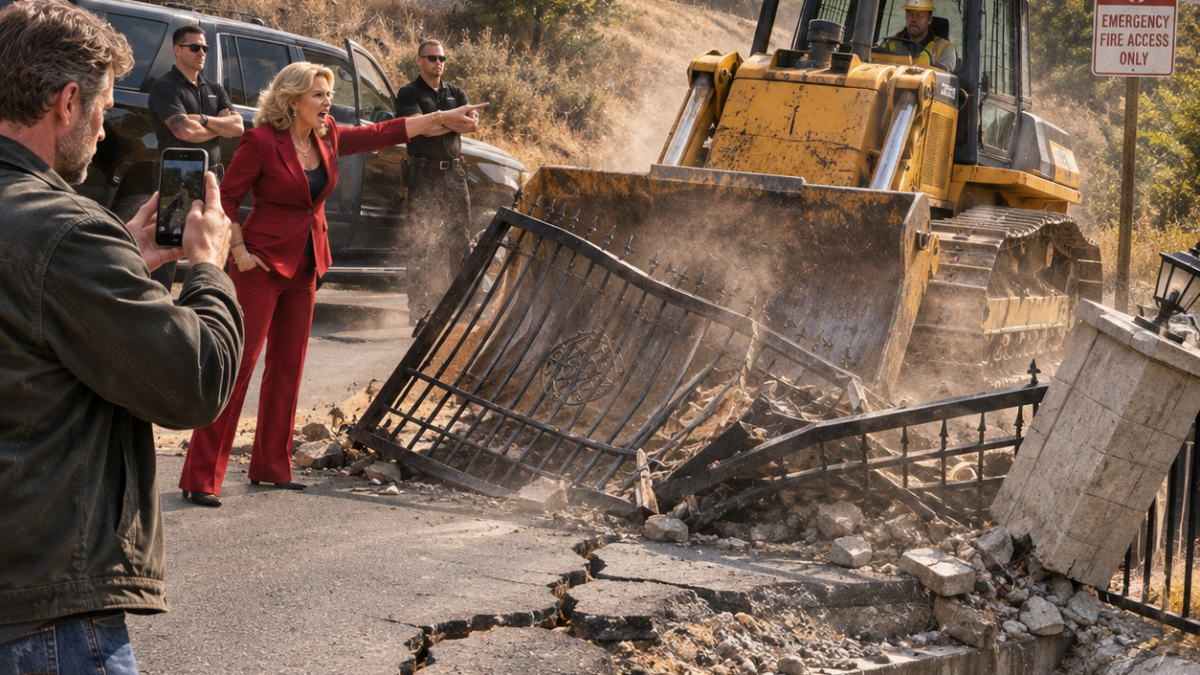
HOA Karen Offered Me $50,000 for My Private Road—I Refused, So She Bulldozed My Gate and Destroyed Her Neighborhood’s Only Fire Exit.
Graham Whitlock refused the HOA president’s $50,000 offer for a strip of land worth more than eight times that amount, and four days later she sent a bulldozer through his iron gate while her neighbors stood on the ridge cheering.
What none of them understood was that the gate sat beside the reinforced culvert carrying Blackstone Ridge’s only approved emergency escape route, and when the bulldozer tore the concrete apart, the road beneath seventy-six homes began collapsing into the creek.
Then smoke appeared beyond the northern ridge, the community’s main entrance was blocked by fire and a downed power line, and the same woman who had accused Graham of endangering everyone came running through the ash demanding that he reopen the road she had just destroyed.
Graham Whitlock was already awake when the first light reached the foothills.
He usually was.
At forty-seven, he had spent enough years managing road and drainage projects to stop trusting anyone who said, “We’ll check it later.”
Roads failed because somebody ignored water.
Retaining walls failed because somebody ignored soil.
Projects went over budget because somebody ignored measurements.
And emergencies became disasters because somebody ignored things when they were still small enough to fix.
That morning, the thing Graham was checking was an iron gate.
It stood at the eastern edge of his 3.4-acre property, where a narrow paved lane crossed a reinforced concrete box culvert before connecting to the county road below.
His father had installed the original gate decades earlier.
Graham had replaced it twelve years ago with a heavier steel frame, two concrete posts, and an emergency release approved by the fire district.
The gate was locked during ordinary days.
During an emergency, county fire crews had a key and release code.
Simple.
Legal.
Documented.
Necessary.
The lane was not a neighborhood shortcut.
It was not an HOA amenity.
It was not a private driveway for residents of Blackstone Ridge.
It was an emergency evacuation route.
If wildfire ever blocked Blackstone Ridge’s winding northern entrance, seventy-six homes could be directed south, across Graham’s land, over the reinforced culvert, and out to the county highway.
Nobody wanted to use it.
That was the point.
Emergency roads were built for days people hoped would never come.
Graham crouched beside the gate post and tested the lock.
Click.
Smooth.
He wrote the date in a small weatherproof notebook.
September 8.
Emergency release checked.
No defects.
PART2:
He had just closed the notebook when three black SUVs rolled onto the shoulder.
They stopped in a perfect line.
Graham straightened.
The first door opened.
Nadine Trowbridge stepped out wearing a tailored red suit.
She was fifty-three, president of the Blackstone Ridge Homeowners Association, and had held the position for six consecutive years.
Graham had met her twice.
Both times had been enough.
She had the calm confidence of someone who considered a conversation successful only when the other person eventually agreed with her.
Two men in gray security polos emerged from the second SUV.
A thin man with silver glasses stepped from the third carrying a leather folder.
Nadine did not say good morning.
“Mr. Whitlock.”
“Mrs. Trowbridge.”
She held out the folder.
“We have a solution.”
Graham looked at it but did not take it.
“To what?”
“The access problem.”
“There is no access problem.”
She smiled.
“Then this should be easy.”
The thin man handed Graham the folder.
Inside was a purchase agreement.
BLACKSTONE RIDGE HOMEOWNERS ASSOCIATION.
Proposed acquisition.
A narrow strip of land.
The gate.
The lane.
The culvert.
Price:
$50,000.
Graham read the number twice.
Then laughed.
Not loudly.
That somehow irritated Nadine more.
“You find something amusing?”
Graham closed the folder.
“My appraisal last year valued the full parcel at about four hundred ten thousand.”
“We’re not buying the full parcel.”
“You’re buying the only part of it you actually want.”
She folded her arms.
“Fifty thousand dollars is generous for a narrow access strip.”
“It carries an engineered crossing.”
“The crossing is already there.”
“Exactly.”
Nadine’s smile tightened.
“You would no longer be responsible for maintaining it.”
“I’m not struggling to maintain it.”
“You would never have to deal with our board again.”
“That part is almost persuasive.”
One security guard looked away to hide a smile.
Nadine noticed.
Her voice cooled.
“Take the fifty thousand.”
Graham handed the folder back.
“No.”
The assistant hesitated before accepting it.
Nadine stared at Graham.
“Think carefully.”
“I did.”
“Land is only worth what somebody is willing to pay.”
Graham nodded.
“Then I suppose you’ll have to leave without it.”
For the first time, the smile disappeared.
She looked at the gate.
“The association has maintained vegetation along this corridor for years.”
“You trim brush on your side.”
“We have established use.”
“You have emergency-use rights.”
“We have access rights.”
“During emergencies.”
“Access is access.”
“No.”
Nadine turned back toward him.
“Our attorneys disagree.”
“Good.”
Graham pointed toward the folder.
“Have them send me the recorded document giving the HOA daily control.”
She said nothing.
Graham continued.
“The easement grants emergency access to fire crews and evacuees when activated by the county.”
“I know what it says.”
“Then you know you can’t build here.”
Nadine’s eyes hardened.
“You’re making this difficult.”
“No.”
“I’m making it mine.”
She stepped toward her SUV.
Then stopped with one hand on the door.
“The road will open whether you sell or not.”
Graham watched her.
Nadine pointed at the gate.
“That won’t be standing much longer.”
Then she climbed inside.
The three SUVs pulled away.
Graham did not shout after them.
He did not threaten anyone.
He did not follow.
He opened his notebook.
9:14 a.m.
Three vehicles.
He wrote all three license plates.
Then Nadine’s exact words.
That won’t be standing much longer.
He photographed the tire impressions where one SUV had crossed several feet onto his gravel shoulder.
Then he went inside and made coffee.
At four that afternoon, he found an envelope taped to his mailbox.
Blackstone Ridge seal.
NOTICE OF VIOLATION.
Graham leaned against the mailbox and read it.
He had seventy-two hours to remove his gate because it allegedly obstructed community traffic and emergency services.
Fine for noncompliance:
$500 per day.
He read the page again.
Then looked uphill toward Blackstone Ridge.
Graham was not a member.
His father had owned the property before Blackstone Ridge existed.
Graham had never signed its covenants.
Never paid its dues.
Never voted.
Never attended a board meeting except as an invited property owner.
The HOA had exactly as much authority to fine him as it had to fine a gas station ten miles away.
He called Mara Keating.
She had handled his father’s estate and two easement disputes for local farmers.
“Tell me you’re calling about something normal.”
“I got fined by an HOA I don’t belong to.”
Pause.
“That’s not normal.”
“I know.”
“How much?”
“Five hundred a day.”
“For what?”
“Owning my gate.”
Mara sighed.
“Email me everything.”
Graham did.
Then he went to the kitchen table.
He unfolded every Blackstone Ridge planning map he had collected over the years.
Original subdivision map.
County evacuation plan.
Road-maintenance maps.
Fire-district access diagram.
Then one newer HOA planning sheet caught his attention.
The lower section had been colored pale green.
The green line started inside Blackstone Ridge.
Crossed the HOA boundary.
Ran directly through Graham’s gate.
Across his culvert.
Then connected to the county road.
Label:
FUTURE COMMUNITY ACCESS.
Graham sat back.
Emergency access was one thing.
Future community access was another.
The next morning, another envelope arrived.
Updated fine.
The HOA now accused him of:
Blocking community circulation.
Creating a landscaping hazard.
Interfering with public safety.
Generating “unnecessary vehicle noise” through gate operation.
Graham laughed at that one.
He called Mara.
“You’re going to enjoy this.”
“I already don’t.”
She drafted a formal cease-and-desist letter.
It stated plainly that Blackstone Ridge had no enforcement jurisdiction over Graham’s property.
The emergency easement did not grant the HOA possession, construction authority, daily traffic rights, or demolition rights.
Any unauthorized entry would be documented as trespass.
Any damage would be pursued.
Graham sent it certified.
Nadine responded by sending security.
Two guards parked a golf cart outside the gate.
They photographed his truck.
The propane delivery.
A utility contractor.
Even Graham walking to his mailbox.
On the third morning, he found a white metal sign zip-tied to his post.
HOA PROPERTY ACCESS PENDING.
He cut it down.
Not angrily.
Carefully.
Zip ties first.
Then sign.
He drove it to the sheriff’s office.
Sheriff Reed Mallerie turned the sign over in his hands.
Forty-nine.
Quiet.
The kind of sheriff who rarely raised his voice because people usually lowered theirs when he started speaking.
“This came off your property?”
“Yes.”
“You’re not in the HOA?”
“No.”
“They know that?”
“Yes.”
Reed stared at the sign again.
“I’ve seen a lot of property disputes.”
“Same.”
“I don’t think I’ve ever seen somebody put up a sign suggesting a man needs permission to use his own gate.”
Graham smiled.
“First time for everything.”
Reed logged the complaint.
“Keep documenting.”
“I am.”
“Don’t touch anybody.”
“I won’t.”
“Don’t block emergency personnel.”
“Never have.”
“I know.”
That evening, Blackstone Ridge held an emergency meeting.
Nadine had turned Graham’s gate into a political issue.
A large photograph filled the clubhouse projector screen.
Shot from below.
Harsh sunlight.
Iron bars.
She had chosen an angle that made the gate look less like an emergency control point and more like a prison entrance.
“There are seventy-six families in this community,” she told the room, “and one outsider believes his personal property rights are more important than their safety.”
Several residents murmured.
Graham sat in the back beside Mara.
Nadine continued.
“Imagine wildfire.”
“Imagine smoke.”
“Imagine fire engines unable to reach us.”
“Imagine families trapped because one man insists on keeping a locked gate across their only safe route.”
That was the lie.
Not a complicated one.
Just strategically incomplete.
The fire department already had access.
The route was inspected.
The key existed.
The emergency release worked.
But those details made Nadine’s anger less useful.
A homeowner near the front raised his hand.
“So why hasn’t the county forced him to remove it?”
Nadine answered:
“We’re working through that.”
Another resident said:
“He obviously wants money.”
Graham almost laughed.
He had just refused fifty thousand dollars.
Nadine finally invited him forward.
He carried three documents.
His deed.
The recorded easement.
The fire-district agreement.
He placed them on the table.
“My property is outside Blackstone Ridge.”
Noise.
He continued.
“This lane is already available during an emergency.”
More noise.
“The fire department has a key.”
Somebody called:
“Then why lock it?”
“Because the easement is for emergencies.”
“It’s a road.”
“It crosses my home.”
Nadine stepped closer.
“Mr. Whitlock, we’re discussing public safety.”
“So am I.”
He held up the fire-district document.
“The gate has an approved emergency release.”
She interrupted.
“We don’t have time for technicalities.”
Graham looked at her.
“A fire route is nothing but technicalities.”
Several residents went quiet.
He continued.
“The culvert beneath that lane was engineered for emergency vehicles.”
“The head wall supports the road fill.”
“The gate posts sit beside that structure.”
“If you intend to remove anything with heavy equipment, you need an engineer.”
Nadine’s face changed.
Not concern.
Annoyance.
“You’ve had your time.”
“I’ve had four sentences.”
“Security.”
Two guards stepped forward.
Mara stood.
“My client can leave without assistance.”
Graham gathered his papers.
As he walked toward the door, Nadine’s voice followed him.
“If the county won’t remove that gate, I will.”
Applause.
Not everyone.
Enough.
Graham stopped at the doorway.
Looked back.
Nadine stood beneath the giant image of his gate.
Half the room looked angry at him.
A few looked uncertain.
One woman raised her hand.
Felicia Briggs.
HOA treasurer.
Fifty-one.
Former bank auditor.
“Nadine.”
“What?”
“Shouldn’t we have an engineer review the crossing before we touch anything?”
Nadine barely looked at her.
“The board has reviewed everything.”
Felicia frowned.
“I haven’t.”
“We’ll discuss administrative details later.”
Then Nadine moved to the next agenda item.
Felicia lowered her hand.
She did not look convinced.
Near midnight, Graham woke to headlights moving across his bedroom ceiling.
He got up.
Walked to the window.
A contractor’s pickup sat near the gate.
A man held a flashlight and measuring wheel.
Graham did not go outside.
He photographed the truck.
Plate.
Time.
Vehicle markings.
Then went back to bed.
At sunrise, an orange construction sign had appeared on the county shoulder.
HEAVY EQUIPMENT — EMERGENCY ACCESS IMPROVEMENT — 48 HOURS.
Graham called Owen Pike.
Owen arrived at noon with a survey tripod, GPS receiver, orange flags, and coffee black enough to damage metal.
He spent four hours on the property.
Measured monuments.
Checked county records.
Compared the original plat.
By late afternoon, he stood beside Graham’s gate.
“No question.”
“About?”
“Everything this side of that boundary is yours.”
Gate.
Posts.
Head wall.
Culvert.
Most of the lane.
Graham nodded.
“That’s what the deed says.”
Owen crouched.
Ran his hand down the concrete.
“But this is what worries me.”
“What?”
“The post.”
Graham crouched beside him.
Owen pointed.
“The footing sits right beside the head wall.”
“I know.”
“Gate itself isn’t structural.”
“No.”
“But if somebody pushes that post sideways with a machine…”
Graham finished.
“Force transfers into the wall.”
“Exactly.”
Owen stood.
“If they tear it vertically, carefully, maybe you get lucky.”
“And if they hit it with a blade?”
Owen looked at him.
“Then I wouldn’t stand downhill.”
Graham knew the culvert.
He had supervised its previous inspection.
The head wall retained compacted fill supporting the pavement.
Crack the wall.
Lose fill.
Lose support.
Lose road.
Owen put it in writing.
NO DEMOLITION OR HEAVY EQUIPMENT WORK SHOULD OCCUR ADJACENT TO THE CULVERT WITHOUT ENGINEERING REVIEW AND STRUCTURAL PROTECTION.
Graham emailed it to:
Nadine.
Every HOA board member he could identify.
County engineering.
Fire Marshal Tessa Grady.
Mara.
Nadine replied nineteen minutes later.
One sentence.
Your scare tactics won’t stop progress.
Graham printed the email.
Placed it in the folder.
That night, Felicia Briggs opened the HOA budget.
She had spent thirty years auditing financial institutions.
Numbers did not frighten her.
Numbers that did not make sense irritated her.
A new line item had appeared.
EMERGENCY ROAD IMPROVEMENTS — $186,000.
Felicia stared.
Removing a gate did not cost $186,000.
She called Nadine.
“What is this?”
“What?”
“Emergency road improvements.”
“You have the budget.”
“I know the budget.”
“Then why are you calling?”
“One hundred eighty-six thousand dollars.”
“Road widening.”
“What road?”
“The emergency lane.”
Felicia sat forward.
“Graham Whitlock’s lane?”
“The access corridor.”
“Do we have engineering plans?”
“They’re being finalized.”
“Permit?”
“Pending.”
“Board authorization?”
Nadine sighed.
“Felicia, I need you to focus on treasury responsibilities.”
“This is treasury responsibility.”
“Goodnight.”
Nadine hung up.
Felicia looked at the number again.
$186,000.
Something was wrong.
Graham spent the next day preparing for court.
Mara had filed for an emergency restraining order.
Earliest hearing:
Three days.
The bulldozer was scheduled in two.
At 11:15 that night, Graham’s phone vibrated.
Unknown number.
One text.
MOVE YOUR TRUCK BEFORE SUNRISE. THEY’RE BRINGING THE BIG DOZER.
Graham read it twice.
He did not ask who.
He moved his truck.
At 5:42 the next morning, diesel woke him.
Deep.
Heavy.
Tracks clanking on steel.
He stepped onto the porch while pulling on his jacket.
Below him, a yellow bulldozer rolled off a lowboy trailer.
Two dump trucks waited behind it.
Nadine’s black SUV.
Four HOA security guards.
A contractor pickup.
Up on the ridge, residents had gathered.
Coffee mugs.
Robes.
Running clothes.
Phones held up.
Watching.
Graham walked down the lane.
Stopped behind Owen’s orange survey flags.
The bulldozer operator was Derek Sloan.
Forty-six.
Local contractor.
Graham knew the name.
Good operator.
Not reckless by reputation.
That mattered.
Derek looked uncomfortable.
Nadine did not.
She held a printed page above her shoulder.
“This work is authorized under the HOA’s emergency safety powers.”
Graham raised his voice over the engine.
“You are standing on private property.”
Nadine ignored him.
“I’m ordering all work stopped.”
She ignored that too.
Graham dialed the sheriff.
Speaker.
“Sheriff’s office.”
“This is Graham Whitlock.”
“Address?”
He gave it.
“Unauthorized heavy equipment is on my property.”
Nadine shouted:
“Tell them we have emergency authority.”
Graham looked at her.
“Which agency issued it?”
She held the page higher.
“Everything is documented.”
“That isn’t an answer.”
Derek leaned from the bulldozer cab.
“Ma’am.”
Nadine looked up.
“What?”
“Those posts are heavier than I expected.”
“So?”
“Where’s the utility locate?”
“Done.”
“Engineering?”
“Approved.”
“By who?”
Nadine stepped closer.
“You are being paid to remove a gate.”
Derek looked toward Graham.
Graham shook his head.
“Don’t touch it.”
Nadine pointed.
“Do your job.”
Derek hesitated.
Nadine said:
“You’re being paid to work, not think.”
The blade lowered.
Metal screamed.
The first impact snapped one hinge.
The iron gate bent inward.
Up on the ridge, somebody cheered.
Then another.
Derek backed up.
Graham raised both hands.
“STOP.”
Second impact.
The eastern post tore sideways.
Concrete cracked around its base.
A slab separated.
Graham shouted:
“You’re transferring force into the head wall!”
Nadine turned.
“You’ve been saying that for days.”
“Because it’s true.”
“Push it clear.”
Derek looked down.
“Ma’am, I think—”
“Push it.”
The bulldozer moved.
Broken gate.
Concrete post.
Steel frame.
All shoved toward the shoulder.
The torn footing struck the culvert head wall.
The sound was not loud at first.
Sharp.
Deep.
Like a rifle shot inside the ground.
Everyone froze.
A dark line appeared in the asphalt.
It ran from the edge of the lane.
Then widened.
Three feet.
Six.
Ten.
Derek threw the dozer into reverse.
The shoulder dropped.
Not slowly.
The pavement sank six inches.
Then another section collapsed.
Gravel and compacted fill poured into the dry creek bed below.
The cheering stopped.
One homeowner lowered his phone.
Someone whispered:
“Oh my God.”
Derek backed thirty yards.
Killed the engine.
Silence arrived hard.
Graham’s phone was still recording.
Everything.
Nadine stared at the damage.
Then said:
“Put the sign up.”
One of the guards looked at her.
“What?”
“The sign.”
The man hesitated.
Nadine snapped:
“Now.”
A white HOA ACCESS sign was hammered into the gravel beside the broken lane.
Nadine turned toward the ridge.
“The obstruction has been removed.”
As if speaking loudly enough could change the ground.
Then another section of pavement sagged.
A gap opened beneath it.
Large enough to swallow a tire.
Derek climbed from the bulldozer.
Walked toward Nadine.
His face was pale.
“Ma’am.”
She ignored him.
“Ma’am.”
“What?”
“This road won’t carry my pickup.”
She stared.
Derek looked toward the fracture.
“It damn sure won’t carry a fire engine.”
Sheriff Reed arrived eleven minutes later.
Two deputies behind him.
Nadine intercepted him before he reached Graham.
“Sheriff, this is a civil dispute.”
Reed closed his cruiser door.
“I’ll decide that.”
“The HOA was performing emergency safety improvements.”
“On whose property?”
“Our emergency corridor.”
“That wasn’t what I asked.”
Nadine opened her mouth.
Reed walked past her.
Graham handed him the folder.
Deed.
Survey.
Easement.
Engineering warning.
Photos.
HOA notices.
Nadine’s email.
Then the phone video.
Reed watched the blade hit.
Watched the post tear.
Watched the head wall crack.
Watched the pavement fall.
He watched Nadine order each step.
When the video ended, Reed handed the phone back.
“Deputies.”
Both men stepped forward.
“Tape the area.”
Then to Derek:
“Nobody moves equipment.”
Derek nodded.
“No argument.”
Twenty minutes later, Fire Marshal Tessa Grady arrived.
Forty-five.
Sun-browned face.
Lean.
Hard voice.
She brought a county engineer.
They inspected from above.
Then below.
The engineer climbed into the creek bed with a flashlight.
He called up:
“Head wall fracture is full depth.”
Tessa crouched near the asphalt.
“Void under the shoulder.”
The engineer nodded.
“Probably more underneath.”
“How much?”
“Need testing.”
“Safe for traffic?”
“No.”
“Any traffic?”
“Not even passenger vehicles.”
Tessa stood.
Nadine approached.
“The gate is gone.”
Tessa looked at her.
“What?”
“The obstruction.”
“You mean the gate?”
“Yes.”
“Fire trucks can go through now.”
Tessa stared at the collapsed pavement.
Then at Nadine.
“No.”
“The lane is open.”
“No.”
“You don’t understand.”
“I understand exactly.”
She walked to Reed’s cruiser.
Unrolled the county wildfire evacuation map across the hood.
Pinned two corners with her radio and one with a coffee cup.
Red line.
North gate.
Blackstone Ridge.
Emergency southern exit.
Graham’s lane.
Culvert.
Tessa put one finger directly on the damaged crossing.
“You didn’t open a fire exit.”
Nadine said nothing.
Tessa looked at her.
“You destroyed one.”
No one on the ridge cheered.
Tessa issued an immediate closure.
No vehicle.
No equipment.
No exception.
Full structural evaluation required.
The neighborhood now had one usable entrance.
The northern road.
During peak fire season.
Tessa looked at Graham.
“I need county access for inspection.”
“You have it.”
“Any hour.”
“Yes.”
“Emergency work?”
“Yes.”
“You’re granting permission?”
“I always have.”
She wrote it down.
That detail traveled fast.
The man Nadine had publicly accused of endangering seventy-six homes had granted emergency access without hesitation.
By noon, the county demanded every permit and engineering document connected to the demolition.
The HOA held an emergency meeting that evening.
Nadine walked in as though nothing had changed.
“The county is overreacting.”
Nobody answered.
“The culvert was obviously deficient.”
Felicia Briggs looked at her.
“Do you have a report proving that?”
“The investigation is ongoing.”
“Do you have the permit?”
Nadine looked toward Derek.
Derek stood near the back wall.
Felicia asked:
“Mr. Sloan, did you receive a permit?”
Derek swallowed.
“No.”
Noise erupted.
Nadine snapped:
“Sit down.”
Derek did not.
“I asked for one twice.”
People turned.
“He told me it was coming.”
Nadine pointed at him.
“You accepted the contract.”
“Yes.”
“And you performed the work.”
“Yes.”
Derek nodded.
“And I shouldn’t have.”
Silence.
“I saw the warning.”
Nadine’s face changed.
Derek continued.
“I let you tell me it was handled.”
He looked at the homeowners.
“That part is on me.”
Nadine moved toward the board table.
“We are not conducting a trial.”
Felicia’s eyes narrowed.
“No.”
“But we are going to see the records.”
That same evening, regional fire weather issued a red-flag warning.
Hot wind.
Low humidity.
Extreme brush conditions.
At 10:16 p.m., a fire started north of Blackstone Ridge.
Nobody knew yet how important that would become.
Felicia stayed at the HOA office after everyone left.
She opened the project file.
Invoice.
Vendor scope.
Budget amendments.
Board minutes.
$186,000.
She read the contractor scope carefully.
Demolish gate.
Widen lane.
Construct vehicle turnaround.
Prepare two-lane connection south.
Connection to what?
Felicia pulled up the map.
The planned widened road did not stop at Graham’s county-road entrance.
It continued northward through Blackstone Ridge toward an undeveloped parcel beyond the subdivision.
Sixty proposed luxury homes.
Ridgerest Estates.
Felicia searched state filings.
Developer:
Ridgerest Development LLC.
Managing partners.
She read the list.
Stopped.
Nadine Trowbridge.
Felicia leaned back.
“Jesus.”
Further down:
Option agreement.
Nadine had a private stake worth $240,000.
Condition:
Permanent legal vehicle access to the county highway.
Without it, Ridgerest’s parcel was effectively trapped behind Blackstone Ridge’s steep internal roads and easement limits.
With Graham’s lane?
Direct southern access.
Millions in development value.
Felicia understood everything at once.
The $50,000 offer.
The pressure.
The fake fines.
The phrase future community access.
The $186,000 “emergency” road project.
Safety had never been the goal.
Control was.
She kept reading.
Then found board minutes approving the project.
UNANIMOUS VOTE.
Treasurer:
Felicia Briggs.
Signature.
Her signature.
Except it wasn’t.
The loops were too smooth.
The angle wrong.
Someone had copied it.
Felicia sat perfectly still.
Then made three copies.
One for herself.
One for Mara Keating.
One for Sheriff Reed.
She placed the originals into an envelope.
At 5:50 the next morning, she was standing at the sheriff’s office.
Derek arrived twenty minutes later.
He carried his phone.
Text thread.
Nadine:
NEED IT DONE BEFORE HE GETS A JUDGE.
Another:
ONCE THE GATE IS GONE, IT’S GONE.
Another:
PERMIT IS HANDLED. STOP ASKING.
Reed looked at Derek.
“Why are you giving me this now?”
Derek stared at the floor.
“Because I should’ve walked away.”
He looked up.
“And I didn’t.”
By noon, Mara spread every document across Graham’s kitchen table.
Option agreement.
Vendor quote.
Forged minutes.
Text messages.
Maps.
Graham read the development contract twice.
Then placed it down.
“So none of this was about the gate.”
Mara shook her head.
“No.”
“Or fire access.”
“No.”
“Or emergency safety.”
“No.”
He looked toward the window.
Blackstone Ridge sat above his property.
Seventy-six households.
People who had paid dues believing their board president was spending money on them.
“She was using their money to build access for her development.”
“That’s what it looks like.”
“Through my land.”
“Yes.”
Graham sat back.
“And they cheered.”
Mara did not answer.
A siren began outside.
Long.
Rising.
Then another.
Both of their phones lit up.
EVACUATION WARNING — NORTHERN FOOTHILLS.
Graham stepped onto the porch.
Smoke.
Not the thin gray column from early morning.
Brown.
Thick.
Leaning south.
Wind pushed ash over the ridge.
Mara stepped beside him.
“How close?”
“Too close.”
Within forty-five minutes, warning became order.
Fire engines entered Blackstone Ridge.
Deputies drove the streets with loudspeakers.
EVACUATE NOW.
Residents loaded pets.
Medication.
Children.
Documents.
Photo albums.
Anything their hands found first.
Cars lined the north road.
Brake lights red through smoke.
Then, two miles ahead, a burning pine fell across the road.
It took a power line with it.
Sparks crossed the asphalt.
Utility crews stopped traffic.
Line live.
Tree burning.
Road closed.
Deputies turned the vehicles back toward the clubhouse staging area.
Seventy-six homes.
One main entrance blocked.
The southern emergency exit should have been activated immediately.
Except the southern exit was now a hole in the ground.
Tessa stood at the command post.
Radio in hand.
The battalion chief asked:
“Can we send civilian traffic south?”
Tessa stared toward the damaged culvert.
“No.”
“Any chance?”
“No.”
“Fire apparatus?”
“No.”
“How bad?”
“Road base is gone under the outer lane.”
“How long?”
“Days.”
The chief swore.
“This is exactly why that road exists.”
“I know.”
Nadine heard.
She came running.
Still wearing red.
Now covered in ash.
Hair loose.
Face streaked with sweat.
She found Graham beside the yellow closure tape.
“Open the road.”
He stared at her.
“What?”
“Open it.”
“The road is open.”
“Then move the debris.”
“You destroyed the road.”
“We need that exit.”
“You always had it.”
“Then do something.”
Graham pointed at the fractured pavement.
“That lane was yours to use during an emergency.”
He looked directly at her.
“It always was.”
Nadine’s breathing was fast.
“Then fix it.”
“In an hour?”
“You have equipment.”
“The head wall is broken.”
“You have a tractor.”
“The road fill underneath is gone.”
“Push the concrete aside.”
“That won’t put dirt back under asphalt.”
She stepped closer.
“There are families trapped.”
Graham did not smile.
Did not say I told you so.
Did not mention the fines.
Did not mention the $50,000.
He looked toward the smoke.
Then toward the bluff above his house.
He knew something the HOA maps did not show.
His father had installed two water-storage tanks high on the western portion of the property decades ago.
They held enough water for structure protection.
A narrow gravel service road reached them from the county side.
Too steep and narrow for a civilian evacuation convoy.
Perfect for brush trucks.
Graham found Tessa.
“There may be another way I can help.”
She turned.
“What?”
“Not an exit.”
He pulled a folded property map from his truck.
“Water.”
He showed her the tanks.
Service road.
Bluff.
Ravine.
The battalion chief joined them.
“How stable?”
“Bedrock under most of it.”
“Grade?”
“Steep but manageable for brush units.”
“Capacity?”
“Enough to make a difference.”
“Access?”
Graham held out keys.
“Yours.”
The chief sent a reconnaissance truck.
Ten minutes later:
“Road works.”
“Tank fittings compatible.”
“Good staging point.”
Engines moved.
Crews climbed Graham’s service road.
Hose lines unrolled.
Water flowed.
Firefighters attacked brush approaching the north corridor.
Another crew protected utility workers cutting the downed power line.
Graham stayed out of their way.
He knew enough construction to understand the value of not pretending to be a firefighter.
At the clubhouse, Nadine did the opposite.
She moved from deputy to deputy.
“My SUV needs priority.”
“No.”
“I’m HOA president.”
“No.”
“I need to coordinate outside the community.”
A deputy said:
“Everyone leaves together.”
She pushed past a paramedic.
Tessa appeared.
“Nadine.”
“I am trying to help.”
“No.”
“You can’t speak to me like—”
“If you interfere with one more responder, I’ll have a deputy put you in the back of a patrol car.”
Nadine went silent.
Graham borrowed the resident directory from Felicia.
Working under the evacuation coordinator, he walked row after row of vehicles.
House number.
Names.
Present.
Missing.
Medical conditions.
Pets.
One elderly man needed oxygen.
A woman’s wheelchair would not fit safely in her sedan.
A teenager could not find his father.
Graham passed each issue to the deputies and paramedics.
He did not make decisions beyond his role.
He simply made sure information reached the people who could.
Near the third row, an older woman in a gray cardigan caught his sleeve.
He recognized her.
Clubhouse meeting.
She had supported Nadine.
Called Graham selfish.
Now her eyes were red from smoke.
“Mr. Whitlock.”
“Yes?”
She swallowed.
“After what we said about you…”
Graham waited.
“Why are you helping us?”
He looked at the line of cars.
Children inside.
Dogs barking.
People coughing.
Then back at her.
“Because you were wrong about my land.”
She lowered her eyes.
“That doesn’t mean you deserve to die on it.”
She looked at him again.
Then squeezed his arm.
Several neighbors nearby had heard.
Nobody said anything.
The fire moved closer.
Smoke turned the sun copper.
Ash landed on windshields.
The north road remained blocked.
Forty minutes.
Fifty.
An hour.
Then the radio crackled.
UTILITY LINE DE-ENERGIZED.
Seconds later:
TREE REMOVAL IN PROGRESS.
Then:
ONE LANE CLEAR.
Fire engines positioned along the slope.
Deputies organized a controlled evacuation convoy.
First medical needs.
Then families by street.
Cars moved.
Slowly.
Steadily.
Graham watched from the staging area.
One line of brake lights disappeared into smoke.
Then another.
The fire crews on his bluff held.
Water from his father’s tanks fed the hose lines.
The flames never crossed into the residential streets.
At last, the evacuation coordinator called the final count.
Every home checked.
Every resident accounted for.
Not one life lost.
Nadine stood near the back of the emptying lot.
She looked toward the southern lane.
Twisted gate.
Yellow tape.
Collapsed asphalt.
The route she had destroyed.
For the first time since Graham had met her, she looked small.
When immediate danger passed, Sheriff Reed approached her.
“Nadine Trowbridge.”
She turned.
“You need to come to my office for an interview.”
“About what?”
“Destruction of private property.”
Her expression hardened.
“Civil matter.”
“And documents that appear to have been forged.”
Her face changed.
Felicia stood twenty feet away.
Nadine understood.
Reed continued.
“You’re not under arrest right now.”
“Then I’m leaving.”
“You can.”
He nodded toward a deputy.
“But we’ll schedule the interview before you go.”
Within twenty-four hours, the story reached county media.
HOA DESTROYS WILDFIRE EXIT DAYS BEFORE EVACUATION.
Nadine hired an attorney.
Then changed strategy.
The culvert had already been defective.
Graham had blocked community safety for years.
The gate created danger.
The road failure proved Graham had neglected maintenance.
None of it survived contact with documents.
Mara built Graham’s civil case chronologically.
Deed.
Survey.
Recorded easement.
Fire-district agreement.
County inspection from the previous spring.
Passed.
No structural defect.
Owen Pike’s written warning before demolition.
Nadine’s reply:
Your scare tactics won’t stop progress.
Video.
Bulldozer.
Impact.
Crack.
Collapse.
Nadine ordering Derek to continue.
Then financial records.
$186,000.
Development scope.
Ridgerest Estates.
$240,000 option stake.
Condition requiring permanent road access.
Forged board minutes.
Felicia’s false signature.
Derek’s texts.
Once the gate’s gone, it’s gone.
The engineering report ended the structural argument.
The culvert had been sound before the demolition.
The bulldozer’s uncontrolled lateral force damaged the head wall.
That damage caused fill loss.
The fill loss caused pavement failure.
The pavement failure eliminated the emergency route.
Simple chain.
Derek cooperated.
He did not pretend innocence.
On the witness stand, Mara asked:
“Did you have a county demolition permit?”
“No.”
“Engineering approval?”
“No.”
“Written authority from the property owner?”
“No.”
“Did you ask?”
“Yes.”
“What were you told?”
“That the HOA had emergency authority.”
“Who told you?”
“Nadine.”
“Did Mr. Whitlock tell you to stop?”
“Yes.”
“Did he warn you about the culvert?”
“Yes.”
“Why did you continue?”
Derek looked toward the jury.
“Because I let a paying client convince me paperwork existed that I had never actually seen.”
He swallowed.
“That was my mistake.”
Before the civil trial finished, Blackstone Ridge held a special election.
Nadine tried to speak.
Residents shouted her down.
Felicia demanded order.
The removal vote:
Seventy-one households in favor.
Three abstentions.
Two absent.
Nadine left before the result was formally announced.
The criminal investigation continued separately.
Forgery.
Misappropriation of association funds.
Property damage.
Potential reckless endangerment issues.
The civil judgment came first.
Five-day trial.
The court found the demolition wrongful.
The damage foreseeable.
The culvert failure directly caused by the work Nadine ordered.
Combined judgment against Nadine and Derek’s company:
$700,000.
Reconstruction.
Engineering.
Road restoration.
New gate.
Loss-of-use damages.
Legal costs where recoverable.
Other proven losses.
Derek’s insurer covered his company’s allocated portion.
The majority fell on Nadine.
Then came the HOA’s separate recovery action.
Unauthorized funds.
Improper expenditures.
Nadine had to repay them.
Her attorney argued she could not satisfy the judgments immediately.
Mara answered with enforcement.
Liens.
Rental properties.
Investment holdings.
A lakeside vacation house.
Nadine left the courthouse after the verdict.
A courier waited outside.
Envelope.
Ridgerest Estates Development Company.
Option terminated.
No legal road access.
No deal.
The $240,000 future payout she had tried to protect disappeared with one page.
Ten months later, Graham stood beside the rebuilt crossing.
The county had required everything to be reconstructed from the foundation.
New reinforced head wall.
Wing walls.
Compacted fill.
Drainage.
Stabilized shoulder.
New pavement.
The replacement gate was moved farther from the culvert structure.
Emergency release upgraded.
County engineers drove a fully loaded fire engine onto the crossing for the final load test.
Everyone watched.
The truck stopped directly above the rebuilt box culvert.
No movement.
No cracking.
No sinking.
Engineer checked readings.
Then raised a hand.
“Pass.”
Tessa smiled.
“Good.”
A new sign went onto the gate.
PRIVATE PROPERTY.
EMERGENCY ACCESS — FIRE DISTRICT AND AUTHORIZED EVACUATION USE.
Nothing else.
No HOA logo.
No vague language.
No future community access.
The new Blackstone Ridge board adopted rules requiring independent engineering review before any association-funded work near off-site property.
Felicia remained treasurer.
She ordered a full audit of Nadine’s six years.
Every contract.
Every vendor.
Every reimbursement.
Every signature.
No more assumptions.
Representatives of all seventy-six homes signed a letter thanking Graham for his help during the wildfire.
Some came personally.
Wine.
Pie.
Coffee.
One man stood awkwardly on the porch and said:
“I called you selfish.”
Graham nodded.
“I remember.”
“I was wrong.”
“Yes.”
The man looked embarrassed.
Graham took the pie.
“Thank you.”
The woman in the gray cardigan came too.
No gift.
Just herself.
“I keep thinking about what you said.”
“What?”
“That being wrong about your land didn’t mean we deserved to die.”
Graham looked toward the ridge.
“You didn’t.”
“We treated you badly.”
“Yes.”
“I’m sorry.”
He nodded.
“I appreciate that.”
He did not demand friendship.
That was never the point.
Property lines did not require friendship.
Easements did not require affection.
Safety did not require agreement.
Only respect.
On the day of the final county inspection, Tessa and Reed walked the lane with Graham.
Tessa tested the emergency release.
The gate opened cleanly.
She smiled.
“Let’s hope nobody mistakes a safety gate for a personal enemy again.”
Graham looked toward Blackstone Ridge.
“The gate was never the danger.”
Reed glanced at him.
“What was?”
“The person who couldn’t accept that it wasn’t hers.”
Reed laughed.
“That’ll do.”
A week later, a silver sedan slowed on the county road.
Graham was on his porch.
He recognized the driver.
Nadine.
Alone.
No SUVs.
No guards.
No assistant.
She stopped briefly near the entrance.
Looked up at the new gate.
Stronger than the old one.
Clean steel.
Fresh concrete.
Clear legal signage.
The lane behind it belonged to Graham exactly as it had before she arrived with her $50,000 offer.
She had tried to buy it for a fraction of its value.
When Graham refused, she tried to pressure him.
When pressure failed, she tried fines.
When fines failed, she tried intimidation.
When intimidation failed, she tried a bulldozer.
The bulldozer destroyed the gate.
Then the culvert.
Then her argument.
Then her presidency.
Then her development deal.
Then much of what she owned.
And still she never gained one legal inch of Graham’s land.
Nadine sat in the sedan for almost a minute.
Then drove away.
Graham watched the car disappear around the bend.
He went inside.
Opened the bottom drawer of his father’s old desk.
Placed the final lawsuit file inside.
Closed it.
Then returned to the porch.
The air smelled of rain and fresh-cut grass.
Downhill, the rebuilt lane crossed the creek safely.
A fire engine moved somewhere in the distance.
Low diesel rumble.
For months, that sound had made Graham look toward the gate expecting trouble.
This time he didn’t.
He remained seated.
Coffee in hand.
The road was repaired.
The gate stood.
The emergency route was open exactly the way it had always been meant to be.
For emergencies.
Nothing more.
Nothing less.
Nadine had offered him $50,000 because she believed money would make his boundary disappear.
When money failed, she believed authority would.
When authority failed, she believed steel would.
But the line had never been drawn by Graham’s stubbornness.
It was drawn by a deed.
A survey.
An easement.
Engineering.
Law.
And one fact Nadine had spent months refusing to understand:
You do not own something simply because you want it badly enough.
She learned that lesson with a bulldozer.
Seventy-six families nearly paid for it with their lives.
And in the end, the man she had called the greatest threat to their safety was the same man who handed firefighters the keys to his land, his water tanks, and everything he had that could help get those families home alive.








