HOA Karen Locked a Steel Gate Across My Disabled Veteran Wife’s Only Exit—Then Deputies Made Her Watch It Come Down
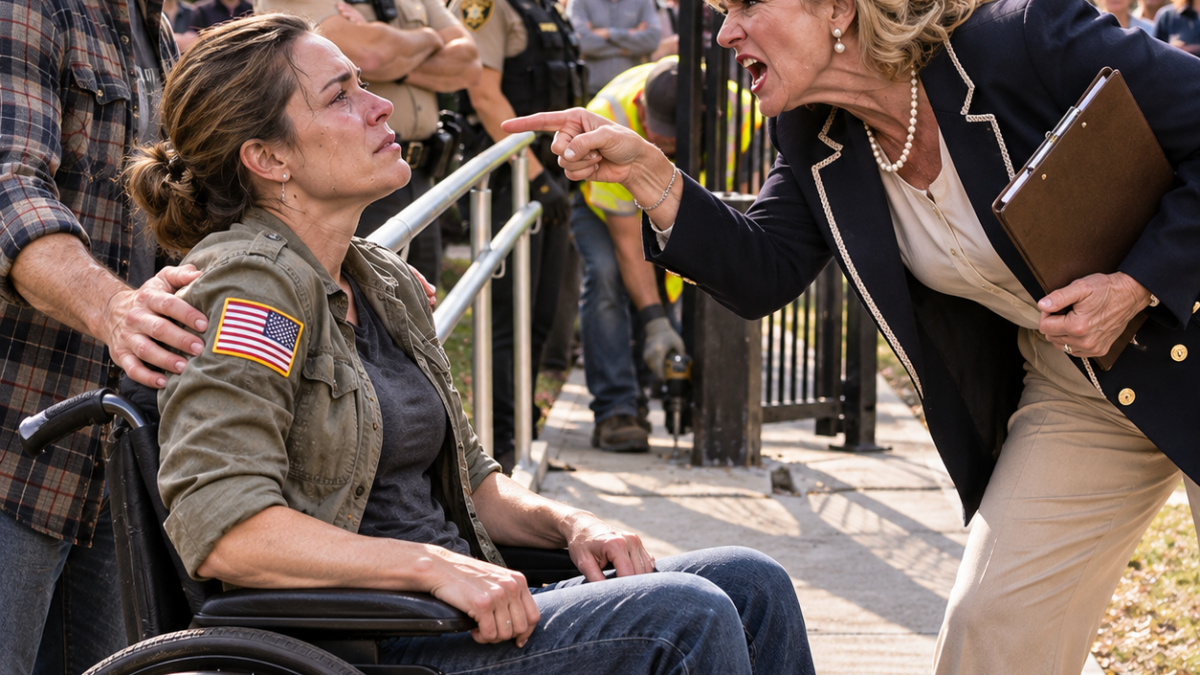
PART2:
Her dark hair was pulled back.
She looked at Gavin.
“What?”
He did not answer.
He opened the front door.
Cold morning air entered.
Laurel rolled onto the porch.
Then down the ramp.
The ramp had been built wide.
Gentle slope.
Steel handrails.
Textured concrete.
Every inch designed so she could move from house to vehicle without help.
She rolled down it as she had hundreds of times.
At the bottom, her footrest stopped four inches from black steel.
A heavy chain looped through the gate.
Industrial padlock.
Locked.
Laurel looked at it.
Then slowly lifted her eyes.
Veronica Stroud stood on the other side.
Pearl earrings.
PART3:
Cream jacket.
Clipboard.
Perfect hair.
She looked as though she had been waiting for Laurel to arrive.
“Good morning,” Veronica said.
Gavin came down behind his wife.
“What is this?”
Veronica gave him the patient smile of someone explaining a rule to a child.
“As of today, this gate controls access to a common circulation area.”
Gavin looked at the two steel posts.
They had been drilled directly into his concrete.
“What common area?”
“The side corridor.”
“This is our driveway.”
“It connects with community infrastructure.”
Laurel looked toward the van.
“I have an appointment in twenty minutes.”
Veronica glanced toward the back of the house.
“Then use another exit.”
Laurel followed her eyes.
The back door opened onto a narrow wooden staircase.
Nine steps.
No lift.
No ramp.
No landing large enough for a wheelchair.
Laurel looked back at Veronica.
“There is no other accessible exit.”
Veronica shrugged lightly.
“Then your husband can help you.”
Gavin stared at her.
“Help her do what?”
“The back steps.”
A silence fell.
Even the workers stopped moving.
Gavin took one step toward the gate.
“Open it.”
Veronica raised a finger toward the crew.
The younger worker took the chain.
Pulled it tight.
The padlock closed.
Click.
That sound stayed with Gavin for months.
Small.
Clean.
Final.
Veronica looked at him.
“Anyone who cuts that lock will receive a five-thousand-dollar HOA fine for destruction of association property.”
Gavin turned toward the garage.
His toolbox was inside.
Bolt cutters.
Reciprocating saw.
Angle grinder.
He could have that gate open in minutes.
Laurel caught his wrist.
“Don’t.”
He looked down at her.
“They locked you in.”
“I know.”
“I can remove it.”
“I know.”
“Then—”
“Don’t touch it.”
Her voice was quiet.
The voice she used when she needed him to hear the part beneath the words.
“Phone.”
Gavin stopped.
“Record everything.”
He understood.
Laurel continued.
“Truck plates. Workers. Posts. The holes. Her. Every word.”
Gavin pulled out his phone.
Pressed record.
Only then did Laurel turn back toward Veronica.
“Who authorized construction?”
“The board.”
“Show me the vote.”
Veronica’s smile tightened.
“The president is authorized to implement security measures.”
“On private land?”
“This isn’t private land.”
Gavin lifted his phone.
“You’re standing on our property.”
“This is Cedar Hollow.”
“That’s the neighborhood.”
He pointed down.
“This is Parcel 44-B.”
Veronica looked annoyed.
“You agreed to HOA authority when you purchased the property.”
Laurel replied, “Exterior standards. Common facilities. Certain covenants.”
Her eyes went to the steel post.
“Not ownership of our driveway.”
Veronica lifted the clipboard.
“I have documentation.”
She removed one sheet.
At the top:
ACCESS COMPLIANCE AGREEMENT.
“Sign this,” she said, “and the board can consider issuing your household a gate key.”
Laurel stared.
“Consider?”
“Yes.”
“A key to reach my own van?”
“To access the controlled area.”
Gavin said, “What does she have to sign?”
Veronica turned the page toward him.
“Routine acknowledgment.”
Gavin reached through the bars.
Veronica hesitated.
Then passed it over.
He read.
Page one looked exactly like she said.
Temporary gate-access permission.
Resident agrees to security procedures.
HOA retains authority over lock.
Then he turned to the second page.
Small text.
Addendum.
His eyes stopped.
“Laur.”
She looked up.
“This gives the HOA a right of passage over the entire side lane.”
Veronica said nothing.
Gavin read again.
One hundred twenty feet of concrete lane running beside their house.
The strip connected their private parking area to a service road behind Cedar Hollow.
The language said the HOA’s right of access would survive any “temporary traffic or security project.”
No automatic expiration.
No ninety-day limit.
No termination date.
No clear restriction on vehicle type.
Once signed, the association could argue that the Mercers had granted permanent access.
Gavin looked through the bars.
“Why is that in a gate-key agreement?”
Veronica did not blink.
“Your family has been occupying what the HOA considers a community circulation corridor.”
“No.”
“The board disagrees.”
“Show me a deed.”
Veronica tapped her clipboard.
“We have maps.”
“A deed.”
She pulled out a colored site diagram.
A thick red line had been drawn across the Mercer side lane.
Gavin nearly laughed.
“This?”
“It is the community circulation plan.”
“This is an office drawing.”
“It reflects board authority.”
“It reflects somebody owning a red marker.”
Veronica’s face flushed.
Laurel said, “Show me a recorded easement.”
Silence.
“A plat?”
Nothing.
“A signed agreement from us?”
Veronica’s mouth tightened.
“This is exactly why the compliance agreement exists.”
Laurel looked at Gavin.
There it was.
The gate was not securing anything.
It was leverage.
Laurel faced Veronica again.
“So if I sign away access to our side lane, you might give me a key.”
“That’s an oversimplification.”
“No.”
Laurel’s voice stayed calm.
“It’s exactly what you just offered.”
Veronica shifted.
“You’re being combative.”
“I’m sitting behind a locked gate in front of my own home.”
“You are choosing not to cooperate.”
Laurel stared at her.
Gavin saw the moment something changed in his wife.
Not anger.
Recognition.
Laurel had served fifteen years in the United States Army.
Combat medic.
Two overseas deployments.
Emergency evacuation teams.
She had treated soldiers while rounds cracked in the distance.
She had held pressure on wounds inside vehicles moving over roads bad enough to shake equipment loose.
She did not frighten easily.
But there were things she hated.
One of them was coercion disguised as procedure.
Another was being treated as though her wheelchair had made her helpless.
She looked directly at Veronica.
“You didn’t build this gate to keep people out.”
Veronica said nothing.
“You built it to keep me in until we signed your paper.”
The contractor named Roy Talbott turned his head.
Veronica’s eyes flicked toward Gavin’s phone.
The red recording light was visible.
“Turn that off.”
“No.”
“You don’t have permission to record me.”
Gavin looked around.
“You’re standing on my property.”
“This is HOA business.”
“You drilled steel posts into our driveway before sunrise.”
He raised the phone slightly.
“I’m recording.”
Veronica pointed toward him.
“I will document you as an obstructive resident.”
“Go ahead.”
“I’ll have community security issue daily violations.”
“Go ahead.”
“You can lose amenity privileges.”
Laurel almost smiled.
“We don’t use the clubhouse.”
Veronica ignored her.
“Five thousand dollars if that lock is damaged.”
Gavin said, “We’re not touching it.”
That surprised Veronica.
She had expected anger.
Expected Gavin to cut it.
Expected the Mercers to give her footage she could use.
Instead Laurel pulled out her phone.
Called the veterans rehabilitation clinic.
“Hi, this is Laurel Mercer.”
Pause.
“Yes. I’m scheduled at seven.”
She looked through the bars at Veronica while she spoke.
“I’m unable to leave my residence.”
Another pause.
“No medical emergency.”
Her voice remained steady.
“My homeowners association has installed a locked steel gate directly across my wheelchair-accessible exit.”
Even Roy looked uncomfortable now.
“Yes.”
Laurel listened.
“I’d like the appointment rescheduled.”
Then:
“And could you email me confirmation showing why I missed today’s appointment?”
She ended the call.
Gavin said quietly, “Sheriff?”
“Yes.”
Veronica laughed.
Actually laughed.
“You think deputies are going to take your side because you were in the military?”
Laurel looked up.
“No.”
She rested her hands on the rims of her chair.
“I think they’re going to ask whose land you drilled into.”
Gavin called.
While they waited, Laurel rolled back toward the porch.
She stopped beside the photograph mounted near the front door.
Gavin had taken it two years earlier.
Same ramp.
Same concrete landing.
Laurel at the bottom.
One hand raised.
Huge smile.
It had been the first day she drove herself to the veterans clinic after the ramp passed final inspection.
That ramp had cost $23,600.
Not because the Mercers wanted luxury.
Because accessibility was technical.
Slope mattered.
Landing radius mattered.
Surface traction mattered.
Drainage mattered.
Rail height.
Turning area.
Transition to vehicle.
Gavin was a construction technician.
Twenty years on job sites.
He knew enough to know what he did not know.
So they hired an accessibility designer.
Applied for county permits.
Submitted plans to Cedar Hollow’s HOA.
Received written approval from the previous board.
Built it.
Passed inspection.
Everything by the book.
Laurel had kept every document.
That habit came from the Army.
“Paperwork doesn’t stop bullets,” one of her old sergeants used to say, “but it tells everyone what happened afterward.”
Now the file sat in a fireproof cabinet in their office.
Permit.
Survey.
HOA approval.
Receipts.
Inspection.
Engineering notes.
Laurel rolled inside.
“Get the land file.”
Gavin went.
Outside, Veronica spoke quietly with Roy.
“You finish the installation.”
Roy looked at the ramp.
“Ma’am.”
“What?”
“You told me this ramp wasn’t approved.”
“It isn’t.”
“There’s an inspection tag attached to the handrail.”
“Previous board mistake.”
“That’s not what you said.”
“I’m paying your company to install a gate.”
Roy looked toward Gavin’s concrete.
“Did you get a permit for these posts?”
Veronica’s expression sharpened.
“You are not being paid to conduct legal review.”
“I’m asking because we put anchors through somebody’s slab.”
“The HOA controls the site.”
Roy looked unconvinced.
Veronica stepped closer.
“Finish your work.”
Roy went back to the truck.
But he did not restart the drill.
Inside, Gavin found the accordion file.
He opened it on the dining table.
Survey on top.
Property corners.
Lot dimensions.
Side lane.
Ramp.
Everything.
Laurel rolled beside him.
“Find the approval.”
He did.
Cedar Hollow Architectural Review Committee.
Approved.
Signed by three directors.
Date.
Permit number referenced.
“Got it.”
Laurel reached for the county inspection sheet.
“Take originals.”
“Copies?”
“Originals.”
She looked at him.
“We’re done assuming this is a normal HOA argument.”
Twenty-five minutes later, two sheriff’s vehicles turned onto Cedar Hollow Drive.
Veronica saw them first.
She walked away from the gate and toward the street before the lead cruiser stopped.
Gavin whispered:
“She wants first story.”
Laurel nodded.
“Let her talk.”
Deputy Tessa Callahan stepped out.
Mid-thirties.
Calm.
Hair tied back.
Deputy Owen Ritter followed.
Body camera visible.
Veronica started immediately.
“Deputies, thank goodness. These residents are refusing to comply with an authorized security project and have threatened to destroy association property.”
Tessa raised one hand.
“Stop.”
Veronica stopped.
“Everybody stays calm. Nobody touches the gate.”
“We have documentation—”
“I’ll look at it.”
“The homeowner has an illegal wheelchair ramp—”
Laurel’s face changed slightly.
Tessa noticed.
“Mrs. Mercer?”
“Laurel.”
“Are you able to leave the house right now?”
“No.”
“Why?”
Laurel pointed.
“That gate blocks the only accessible route from my front door to my vehicle.”
Tessa looked toward the back of the property.
“Any other wheelchair-accessible exit?”
“No.”
“Lift?”
“No.”
“Second ramp?”
“No.”
“Can you independently use the rear stairs?”
“No.”
Tessa nodded.
Then looked at Veronica.
“You said the ramp is illegal.”
“It was never authorized.”
Gavin opened the file.
“It has a county permit.”
He handed it over.
“Final inspection.”
Another page.
“And written HOA approval.”
Another.
Tessa read.
Veronica immediately produced a letter.
“Then you need this.”
She held it out.
“Mrs. Mercer later requested revocation of the ramp approval due to safety concerns.”
Laurel stared.
“What?”
Tessa took the letter.
It bore Laurel’s name.
Her address.
Typed paragraphs.
And a signature.
Laurel’s signature.
Or something very close.
“I never wrote that.”
Veronica said, “That is your signature.”
“I never wrote that.”
Tessa looked up.
“Mrs. Mercer, are you saying this document is false?”
“Yes.”
“Completely?”
“Yes.”
“I never asked to revoke anything. Why would I ask the HOA to remove approval from the only accessible route out of my house?”
Veronica said, “People change their minds.”
Laurel looked at her.
“I didn’t.”
Tessa studied the page again.
Then spoke to everyone.
“Here’s what we’re going to do.”
She pointed at the gate.
“Nobody cuts anything.”
Then at Veronica.
“Nobody adds anything.”
Then to Gavin.
“I want the original property survey.”
He handed it over.
“Ramp permits.”
Done.
“HOA approval.”
Done.
Then to Veronica.
“I want documentation authorizing this exact gate location.”
Veronica lifted the planning map.
Tessa stared at it.
“This is an HOA drawing.”
“It is our official circulation plan.”
“Is it recorded with the county?”
Veronica hesitated.
“It doesn’t have to be.”
Tessa looked at Owen.
“Owen, photograph everything.”
He started.
Gate.
Chain.
Padlock.
Anchor bolts.
Concrete damage.
Ramp.
Retaining wall.
Planter.
Stairs.
Vehicle.
He walked the site.
Then came back.
“There’s no alternate accessible route.”
Tessa nodded.
Veronica spoke again.
“Deputy, I need you to cite Mr. Mercer if he interferes with HOA property.”
Tessa looked at her.
“We don’t issue HOA citations.”
“He’s threatening to destroy the gate.”
Gavin said, “I haven’t touched it.”
His video was still running.
Tessa continued.
“HOA fines are civil association matters. Sheriff’s deputies do not enforce board penalties.”
Veronica stiffened.
“What we do care about is a locked physical obstruction across somebody’s only accessible exit.”
Tessa stepped away.
Made a call.
Twenty-five minutes later, Fire Marshal Conrad Hale arrived in a red county truck.
He carried no drama with him.
Clipboard.
Measuring tape.
Camera.
He looked at Laurel.
Then the ramp.
Then the gate.
Walked to the top.
Down the slope.
Measured the landing.
Looked at the rear stairs.
Came back.
“This needs to open.”
Veronica said, “It is a security gate.”
Conrad looked at her.
“Does Mrs. Mercer have a key?”
“She can receive one after compliance review.”
“So no.”
“She has another exit.”
“Stairs.”
“Yes.”
Conrad looked at Laurel’s wheelchair.
Then back at Veronica.
“This is a locked obstruction across an approved accessible means of egress.”
“It’s temporary.”
“How long?”
“Until the residents comply.”
Conrad’s expression changed.
“That isn’t temporary.”
He turned to Roy.
“You installed it?”
Roy nodded.
“Yes, sir.”
“You’re going to make this path passable.”
Veronica stepped forward.
“No.”
Conrad looked at her.
“Excuse me?”
“That is association property.”
“Maybe.”
He pointed at the ramp.
“But that resident needs a usable exit.”
“You cannot dismantle HOA security infrastructure.”
“I can require an immediate safety hazard to be corrected.”
Veronica turned to Tessa.
“Are you going to allow this?”
Tessa said, “I’m going to allow the fire marshal to address the safety issue.”
Veronica’s face reddened.
Roy opened his truck.
Tools came out.
He removed the chain first.
Then unbolted one gate leaf.
The steel groaned.
Two workers carried it off the landing.
The gap was barely enough.
Laurel tested it.
She could pass, but only slowly.
The remaining post still cut into the turning radius.
Concrete around the anchor bolts was cracked.
Conrad shook his head.
“This is temporary access only.”
He wrote an order.
“Full structure needs review and correction.”
Veronica argued through every turn of the wrench.
“Vandalism.”
“Unauthorized destruction.”
“Personal liability.”
Nobody stopped.
When the immediate opening was clear, Tessa returned to the document bearing Laurel’s signature.
She placed it in a clear evidence sleeve.
“Mrs. Stroud.”
“Yes?”
“Where is the original of this letter?”
“Association office.”
“How was it received?”
“Mail.”
“Date?”
“It’s printed there.”
“Who opened it?”
“Office staff.”
“Who scanned it?”
“I don’t remember.”
“Correspondence log?”
Veronica’s jaw tightened.
“I don’t personally handle mail.”
Tessa nodded.
“I’ll need the original preserved.”
“This is an internal HOA matter.”
“Not if somebody is presenting a disputed document to law enforcement as genuine.”
That shut Veronica up.
Before leaving, Tessa looked at Gavin.
“You certain where the property line is?”
“Yes.”
“Surveyor still working?”
“Yes.”
“Get it confirmed.”
Laurel said, “We will.”
The next morning, Elise Pritchard arrived.
Licensed surveyor.
Early fifties.
White SUV full of equipment.
She had surveyed the Mercer property when they bought it.
Her original field notes still existed.
She found the property irons.
Set up the total station.
Took measurements.
Two hours later, she placed a fresh sketch on the patio table.
Both gate posts were inside the Mercer lot.
Not near the line.
Not debatable.
Twenty-eight inches inside.
Elise tapped the paper.
“This post here.”
Then the second.
“Both private property.”
Gavin crouched beside the closest one.
Fine cracks radiated through the ramp landing.
“They damaged the slab.”
“Yes.”
Elise looked at the ramp design.
“And location matters.”
Laurel rolled closer.
“What do you mean?”
“The bottom landing is your wheelchair turning area.”
She traced it.
“Whoever put the gate here didn’t just put a structure on private land.”
She pointed to the exact circle.
“They put it in the location most likely to interfere with wheelchair movement.”
Laurel stared at the drawing.
“Put that in the report.”
Elise looked at her.
“Separately?”
“Yes.”
“Ownership and accessibility impact.”
Elise nodded.
“Good distinction.”
Gavin asked, “What about Veronica’s map?”
Elise gave him a dry smile.
“Easements don’t come from highlighters.”
Laurel almost laughed.
“Elise.”
“What?”
“I’m quoting you.”
That afternoon Veronica returned.
She saw the orange survey flags.
Rolled down her window.
“I don’t care where your surveyor puts little markers.”
Elise looked up from her field book.
“They’re marking recorded property boundaries.”
“This is an HOA-controlled community.”
Elise replied, “Your office doesn’t alter deed lines.”
Veronica got out.
“That gate was purchased with community funds.”
Laurel rolled to the porch edge.
“You can buy a swimming pool with community funds. That doesn’t let you install it in my bedroom.”
Gavin coughed to hide a laugh.
Veronica pointed at the lane.
“That area is required for security operations.”
Elise said, “Recorded easement?”
Nothing.
“Deed restriction?”
Nothing.
“Signed owner agreement?”
Veronica turned and got back in her car.
No answer.
An hour later, Roy came by.
Alone.
Rolled plans under one arm.
“I need to show you something.”
Gavin let him onto the patio.
Roy spread the drawings.
Original gate plan.
The first location had been farther away.
Near the shared road.
Entirely different.
Then somebody had crossed it out.
Moved both posts forward.
Directly onto the Mercer ramp landing.
Handwritten note:
FINAL PLACEMENT APPROVED BY V.S.
Laurel looked at Roy.
“Veronica?”
He nodded.
“She called me personally.”
“Why move it?”
“I asked.”
“What did she say?”
Roy looked ashamed.
“She said the original location didn’t provide enough control.”
Silence.
Gavin pointed to the bottom margin.
“What is this?”
Elise leaned closer.
Small type.
PRIVATE PROPERTY BOUNDARY—OWNER AUTHORIZATION REQUIRED.
Roy exhaled.
“I didn’t notice that until yesterday.”
Laurel read it again.
“She knew.”
Roy nodded.
“The designer knew.”
“And Veronica had these plans?”
“Yes.”
“So she knew she needed our permission.”
“Yes.”
“Did we give it?”
“No.”
Roy looked toward the damaged concrete.
“I’ve been doing this twenty-two years.”
His voice lowered.
“I don’t like being lied to.”
The Mercers hired Fiona Whitlock that afternoon.
Fiona was a property attorney.
Fifties.
No patience for theatrics.
She read everything.
Survey.
Ramp permit.
HOA approval.
Gate plans.
Fire marshal order.
Disputed letter.
Access agreement.
Then sat back.
“This gate is not the real objective.”
Laurel said, “We figured that.”
Fiona tapped the access agreement.
“This is.”
The permanent easement language.
“Why does the HOA want this lane?”
“We don’t know.”
“Find out.”
Fiona sent a preservation demand.
Every email.
Every draft.
Every board communication.
Ramp records.
Gate contract.
Traffic plans.
Vendor instructions.
Letter bearing Laurel’s signature.
That demand landed on the desk of Cedar Hollow secretary Celia Ashford.
Celia had served six years.
She knew the archive.
Knew where records lived.
Knew how decisions were supposed to enter the file.
She began with the ramp.
Approval still active.
No revocation vote.
No later amendment.
Then she searched Laurel’s alleged letter.
A scanned copy existed.
But not in normal correspondence.
No mail log.
No envelope.
No email.
No intake record.
Instead, it sat in a management folder controlled by the president’s office.
Celia looked at the signature.
Then pulled Laurel’s original homeowner acknowledgment form.
Put both side by side.
The signatures were nearly identical.
Not similar.
Identical.
Same tilt.
Same break in the L.
Same final stroke.
Celia enlarged them.
One looked copied from the other.
She did not call it forgery.
She knew enough to let experts decide that.
But she documented it.
Then she checked board minutes.
No vote to revoke the ramp.
No vote authorizing a gate across the Mercer landing.
No vote granting the president permission to spend money on such a project.
Celia called each director.
Same questions.
“Did we vote to revoke the Mercer ramp?”
No.
“Did we vote to lock a gate in front of it?”
No.
“Did we approve construction on their property?”
No.
Finally she went to Veronica.
Set the file on the desk.
“There was no board authorization.”
Veronica did not open it.
“You’re secretary.”
“Yes.”
“Your job is to maintain records.”
“That’s what I’m doing.”
“My decisions do not require you to second-guess them.”
“Projects of this size require board approval.”
“I had emergency authority.”
“For what emergency?”
Veronica stood.
“This community has security vulnerabilities.”
Celia looked at her.
“Then why is the gate sitting in front of a disabled veteran’s wheelchair ramp?”
Veronica’s eyes hardened.
“Be careful.”
“About what?”
“Your position.”
Celia understood.
“You’re threatening to remove me for preserving records.”
“I’m telling you to understand hierarchy.”
Celia picked the folder back up.
“And I’m telling you I won’t change the archive for you.”
Veronica’s mouth tightened.
“I can have you replaced.”
“Then replace me.”
Celia walked out.
That night she found the missing piece.
A traffic plan.
Not security.
Clubhouse access.
Three months earlier, an engineering firm had inspected the retaining wall and drainage system near Cedar Hollow’s clubhouse entrance.
Serious deterioration.
Repair estimate:
$214,000.
If properly fixed, the main access road near the clubhouse would close for weeks.
Maybe months.
The report had gone to Veronica.
Never to the full board.
Why?
Money.
Veronica had campaigned on reducing HOA expenses.
She repeatedly bragged that she had stabilized reserves without special assessments.
A $214,000 emergency repair destroyed that narrative.
Worse, elections were coming.
So she looked for another route.
On the map, there was only one.
Mercer side lane.
Private.
Concrete.
Connected the internal road to the service road.
If the HOA could use it, construction traffic could bypass the damaged area.
Maybe repair work could be delayed.
Maybe reduced.
Maybe moved into the next budget year.
Maybe someone else’s problem after the election.
Veronica had approached Gavin casually weeks earlier.
Called the lane an “underused asset.”
Asked whether residents might temporarily use it.
Gavin said no.
It was narrow.
Too close to the house.
Not engineered for community traffic.
Not public.
That should have ended it.
Instead Veronica created leverage.
Gate.
Locked exit.
Access agreement.
Key in exchange for easement.
Celia found an email to Roy.
Gate remains HOA-controlled until Mercer household executes access agreement.
Another internal note:
Owner authorization required prior to work on Mercer parcel.
Veronica had received it.
Read it.
Then ordered construction anyway.
Fiona arranged the documents on a conference table.
Clubhouse repair estimate.
Bypass route.
Gate placement.
Permanent easement language.
Withheld key.
Disputed letter.
Roy’s testimony.
Laurel stared at them.
“So I was the lock.”
Fiona looked at her.
“What?”
“Laurel’s voice went quiet.
“She knew Gavin could use the stairs.”
“Yes.”
“She knew I couldn’t.”
“Yes.”
“She knew blocking that ramp put the pressure on me.”
Fiona said nothing.
Laurel looked toward her chair.
“She figured the disabled woman would sign anything if you trapped her long enough.”
Gavin covered Laurel’s hand.
“She figured wrong.”
Two days later, Veronica called.
Her tone had transformed.
Warm.
Conciliatory.
“Gavin, I think everybody has gotten a little overheated.”
Gavin put the call on speaker.
Laurel listened.
Veronica continued.
“The HOA is willing to remove the remaining structure immediately.”
“What do you want?”
“Ninety days of temporary lane access.”
Laurel closed her eyes.
There it was.
“During clubhouse repairs only,” Veronica added.
Gavin said, “Send the agreement.”
She did.
Page one:
90 DAYS.
Page two:
TEMPORARY ACCESS.
Final addendum:
Association may extend access as operational necessity requires.
No new owner consent.
Same trap.
Different ribbon.
Laurel called her.
“No.”
Veronica’s friendly voice vanished.
“You’re willing to hurt the entire community over a strip of concrete?”
“You hid a $214,000 repair from your board.”
Silence.
“So you have that now.”
“Yes.”
“You don’t understand what I was trying to prevent.”
“A bill.”
“A special assessment that could hurt retirees.”
“Then tell the board.”
“You think residents understand infrastructure?”
“They understand being lied to.”
“You’re making this personal.”
Laurel looked at the black post still embedded in her landing.
“You drilled into my wheelchair ramp.”
“You’re being dramatic.”
That sentence nearly broke Gavin’s restraint.
Laurel stayed calm.
“No.”
She paused.
“I’m being exact.”
Then hung up.
Fiona filed for emergency relief.
The hearing happened quickly.
Judge Russell Halstead looked over the file and said:
“I want three things.”
Everyone quieted.
“Who owns the ground.”
He raised one finger.
“Whether the structure creates a safety problem.”
Second.
“And whether it was lawfully installed.”
Third.
“Everything else can wait.”
Fiona started with the survey.
Both posts:
Twenty-eight inches inside the Mercer parcel.
Then county permit.
Ramp approval.
Final inspection.
Fire marshal finding.
Gate plans.
Roy’s placement drawing.
Note requiring owner authorization.
Veronica’s initials.
Then Laurel testified.
She rolled to the witness table.
No dramatic speech.
No tears.
She described the accident that ended her Army career only because it explained the accessibility issue.
Fifteen years as an Army medic.
Vehicle rollover.
Spinal injury.
Wheelchair.
Then the ramp.
“It is how I leave my home independently.”
“What happened on the morning the gate was locked?”
“I rolled down the ramp for a medical rehabilitation appointment.”
“What stopped you?”
“The gate.”
“Could you use another exit independently?”
“No.”
“What was the alternative?”
“Rear staircase.”
“How many stairs?”
“Nine.”
“Can you safely descend those stairs in your wheelchair?”
“No.”
“Did the HOA offer you a key?”
“Only if we signed the access agreement.”
“What did that agreement contain?”
“A permanent right of passage over our side lane.”
Fiona placed it into evidence.
Veronica’s attorney argued that the gate was a good-faith security project.
Judge Halstead interrupted.
“Why there?”
The attorney paused.
“Your Honor?”
“Why was a security gate installed directly across a wheelchair ramp?”
“The HOA believed the landing intersected a common circulation route.”
“Based on what recorded instrument?”
The attorney looked toward Veronica.
None.
Then came the disputed letter.
Veronica claimed Laurel herself had requested the ramp approval be revoked.
Fiona produced Laurel’s sworn declaration.
Original approval.
Board confirmations.
Mail logs.
No trace of the alleged request entering the system normally.
Judge Halstead held the document.
“I am not determining authenticity today.”
Veronica shifted.
“But I am stating that there are serious questions about it.”
He looked at the rest.
“Ownership is clear.”
Then:
“Safety hazard is clear.”
Then:
“Lawful construction authority has not been demonstrated.”
Order:
Gate removed.
Both posts removed.
Anchors removed.
Accessible route fully restored.
No future structure on Mercer property without lawful authority.
Qualified contractor.
Sheriff supervision permitted.
Veronica’s face changed.
She whispered to her attorney.
He shook his head.
She whispered harder.
Judge Halstead looked over.
“Mrs. Stroud?”
She stopped.
“Yes, Your Honor?”
“This order is effective immediately.”
That afternoon, two sheriff’s cruisers returned to Cedar Hollow.
Tessa Callahan.
Owen Ritter.
Behind them:
Roy Talbott’s flatbed truck.
Crew.
Tools.
Court order.
Veronica was already waiting.
Binder against her chest.
Phone recording.
Neighbors stood outside.
People knew.
News traveled fast in an HOA.
Tessa walked up.
“Mrs. Stroud.”
She handed her the order.
“The court has ordered the entire structure removed.”
Veronica skimmed.
“This gate belongs to Cedar Hollow.”
Tessa nodded.
“The court did not say you don’t own the gate.”
“Then they can’t remove it.”
“It says you cannot keep it on the Mercers’ land.”
“I forbid the contractor from touching association property.”
Tessa looked at Roy.
“Mr. Talbott, you’re authorized to proceed under the order.”
Veronica moved toward the nearest post.
“No.”
Owen stepped in.
“Ma’am, stay on the sidewalk.”
“I’m president.”
“Stay on the sidewalk.”
“I am directing my contractor not to participate.”
Roy looked at her.
“I’m here under court direction.”
“You work for the HOA.”
“Not today.”
Veronica planted herself in front of the post.
Arms crossed.
Tessa walked closer.
“Mrs. Stroud.”
“I’m not moving.”
“This is your first instruction to move away from the work area.”
“You can arrest me if you want.”
Tessa’s face remained neutral.
“I’d prefer not to.”
“You have no authority over HOA property.”
“I have a court order and a safety work zone.”
Veronica looked around.
Neighbors.
Not one person stepped toward her.
Some had defended her before.
Not now.
Tessa continued.
“Move to the sidewalk.”
Veronica stayed.
Owen stepped forward.
“This is your final warning.”
A long silence.
Then Veronica moved.
Slowly.
Furious.
She stood at the curb.
Roy approached the gate.
Bolt cutters first.
Metal jaws closed around the padlock.
Crack.
The lock split.
Chain dropped.
Rattled across the concrete.
Laurel watched from the porch.
Gavin stood beside her.
Roy’s crew unbolted the first hinge.
The gate leaf came away.
Two men lifted it.
Carried it to the flatbed.
Iron hit steel.
Clang.
Then the second.
Then anchor bolts.
Drill whining.
Same sound as the morning it went in.
Except now running backward.
Veronica stood motionless.
Her binder pressed so hard against her chest her knuckles whitened.
The first post loosened.
Lifted.
Carried away.
Then the second.
Gavin watched Veronica watching.
This was not revenge.
That mattered.
Nobody mocked her.
Nobody applauded.
Nobody shouted.
The gate simply disappeared because it had never belonged there.
When the final post came out, Roy filled the openings temporarily.
Smoothed the surface enough for wheelchair passage.
Fire Marshal Conrad Hale arrived.
Measured.
Inspected.
Then signed the temporary restoration.
“Clear.”
Laurel rolled forward.
Gavin instinctively stepped behind her chair.
Then stopped.
She did not need him.
Laurel moved down the ramp.
Slowly.
Across the place where the gate had been.
Over patched concrete.
Onto the driveway.
For the first time in days, nothing blocked her path to the van.
Veronica stood six feet away.
“Are you satisfied?”
Laurel stopped.
Looked at her.
“You cost this neighborhood thousands of dollars.”
Laurel glanced down at the drill scars.
“No.”
Her voice was quiet.
“You cost them money when you built it.”
Veronica’s mouth tightened.
Laurel continued.
“I served fifteen years.”
The neighbors went quiet.
“I treated people who had lost arms, legs, mobility, hearing, sight.”
She rested one hand on her wheel.
“I never once thought the hardest fight after service would be convincing a neighbor that I had the right to leave my own front door.”
Veronica looked away.
Laurel rolled toward the van.
Automatic side door opened.
She positioned the chair.
Transferred herself into the driver’s seat.
Gavin stayed back.
That was important too.
The whole point was that Laurel could do it herself.
Celia Ashford stood near the curb.
Veronica turned toward her.
“The HOA is paying for this.”
Celia met her eyes.
“No.”
“You’re secretary.”
“Yes.”
“You don’t decide.”
“The board never approved the gate.”
“Emergency authority—”
“You spent association money without authorization.”
Veronica went still.
Celia raised her phone.
“I’ve called a meeting.”
“For what?”
“To discuss removing you.”
That Thursday, Cedar Hollow’s clubhouse was full.
No celebration.
No refreshments.
Residents in folding chairs.
Directors at the front.
Veronica sat alone at the far end of the board table.
Celia presented the record.
No valid gate vote.
No ramp revocation.
No permission from the Mercers.
Survey.
Court order.
Fire marshal finding.
Then the access agreement.
People read the addendum.
One homeowner raised his hand.
“This says the HOA gets indefinite rights to their side lane.”
“Yes,” Celia said.
Veronica interrupted.
“It was necessary for community operations.”
“Why?”
Celia placed the hidden engineering report on the table.
$214,000.
Retaining wall.
Drainage.
Clubhouse road closure.
The room erupted.
People began talking over one another.
Celia raised her voice.
“This report was received three months ago.”
A retired accountant named Harold Brennan stood.
“Why didn’t the board see it?”
Veronica said, “I was evaluating alternatives.”
“For three months?”
“We couldn’t afford the proposed work.”
Harold said, “Then you bring it to the homeowners.”
“A special assessment would have caused panic.”
“So instead you tried to take somebody’s driveway?”
“It was temporary.”
Celia held up the agreement.
“No.”
The room quieted.
“It was written to survive the temporary project.”
Veronica’s face reddened.
A woman in the second row asked:
“Did you intentionally block Laurel’s ramp to make them sign?”
“No.”
Roy stood near the back.
Everyone turned.
“I was told to move the gate.”
Veronica stared.
Roy continued.
“Original plan had it near the road.”
He held up the work drawing.
“She told me it didn’t create enough control.”
Murmurs.
“And she told me the ramp was unapproved.”
Laurel sat beside Gavin.
No expression.
Roy looked at her.
“I’m sorry.”
Laurel nodded once.
Celia opened another binder.
“Total cost of the unauthorized gate project: eighteen thousand nine hundred dollars.”
The room exploded again.
Harold stood.
“Who approved payment?”
Celia looked at Veronica.
“President signature.”
“Board vote?”
“No.”
“Required?”
“Yes.”
Veronica spoke over them.
“I acted to protect this community from a repair bill nobody could afford.”
Harold stared at her.
“You spent nineteen thousand dollars trapping a disabled veteran behind a gate so you could avoid telling us about a two-hundred-fourteen-thousand-dollar repair?”
“I was finding options.”
“You were hiding the problem.”
“You have no idea how difficult this position is.”
Harold sat.
“Then perhaps you shouldn’t have it.”
The motion came.
Remove Veronica as president.
Strip contract authority.
Terminate all plans involving the Mercer lane.
Independent financial audit.
Vote.
Unanimous.
Veronica did not wait for adjournment.
She stood.
Picked up her binder.
Left.
No one followed.
The civil claims continued.
Ramp damage.
Concrete repair.
Legal fees.
Survey.
Professional costs.
Unauthorized HOA spending.
The disputed signature letter was referred separately for investigation.
Fiona warned the Mercers not to make public accusations about its origin until authorities finished reviewing it.
Laurel agreed.
She did not need rumors.
The documented facts were enough.
After several weeks, Veronica’s attorney approached Fiona.
Settlement.
$44,800.
Breakdown:
$18,900 reimbursed to the HOA for the unauthorized gate expenditure.
$9,400 to repair the Mercer ramp and concrete.
$13,600 legal fees.
$2,900 additional costs and damages.
The final signing took place in Fiona’s office.
Veronica arrived without pearls.
Without clipboard.
Without board title.
For the first time Laurel had seen her, she looked tired.
Documents sat between them.
Veronica read every page slowly.
Then looked at Laurel.
“I don’t deserve to lose everything because of one gate.”
Laurel held her gaze.
“You didn’t.”
Veronica waited.
“You lost your position because you believed you had the right to lock someone inside her own home.”
“I was trying to solve a community problem.”
“You had a $214,000 repair problem.”
“Yes.”
“You could have told the board.”
“They would’ve panicked.”
“That was their decision.”
“You don’t understand what leadership requires.”
Laurel almost smiled.
“I served fifteen years in the Army.”
Veronica looked away.
Laurel continued.
“Leadership doesn’t mean hiding the problem and making someone else pay for it.”
Silence.
Then Veronica asked:
“Do you hate me?”
Gavin shifted slightly.
Laurel did not.
“No.”
That seemed to surprise Veronica.
“You don’t?”
“No.”
“Then can you forgive me?”
Laurel looked at the papers.
Then at her.
“Start by saying what you did without adding why.”
Veronica’s face tightened.
“What?”
“Say it.”
Long pause.
“I installed the gate.”
Laurel waited.
“Because—”
Laurel shook her head.
“No because.”
Veronica looked down.
A full minute passed.
Then:
“I ordered the gate installed.”
Another pause.
“On your property.”
Laurel said nothing.
“I knew you didn’t agree.”
Nothing.
“I knew it blocked your ramp.”
Gavin’s jaw tightened.
Veronica swallowed.
“And I thought you would sign if I kept it locked.”
There.
The room became completely still.
Laurel nodded.
“That’s where you start.”
Veronica signed.
A month later, Cedar Hollow’s new board sent the Mercers a formal resolution.
Accessible route protected by name.
No HOA project permitted to encroach on the Mercer parcel without lawful owner consent.
All future construction touching private property required documented authorization.
Large expenditures needed multiple approvals.
The bypass plan died permanently.
And the $214,000 retaining-wall repair?
It happened.
Properly.
Residents received the report.
Engineers answered questions.
Budget options were presented.
A special assessment was smaller than Veronica had predicted because reserves covered part of the cost.
Some residents complained.
Some voted no.
Most eventually accepted the repair because the structure actually needed it.
The world did not end.
That was perhaps the most humiliating part of Veronica’s plan.
The truth she believed the community could not handle turned out to be manageable.
The deception created the disaster.
Six weeks after the gate came down, contractors removed the damaged portion of Laurel’s ramp landing.
Fresh reinforcement.
New concrete.
Correct texture.
Drainage rechecked.
Handrails inspected.
Final accessibility verification.
When the work cured, the surface looked almost exactly as it had before.
Almost.
Gavin knew where the holes had been.
Laurel did too.
For a while, she checked every morning.
She would wake.
Roll through the kitchen.
Open the front door.
Look down the ramp.
Nothing.
No post.
No chain.
No truck.
Then go back inside.
Gavin noticed.
He did not mention it.
Trauma after military service had taught them both that fear often attaches itself to ordinary routines.
You do not always defeat it with speeches.
Sometimes you repeat normal life until your body believes normal again.
Morning.
Door.
Ramp.
Clear.
Morning.
Door.
Ramp.
Clear.
Eventually, Laurel stopped checking.
She also began volunteering more at the Veterans Center.
Not as a medic.
As herself.
Newly injured veterans often came home to a maze of paperwork.
VA modifications.
Contractors.
Permits.
Accessibility requirements.
HOA approvals.
Landlord permissions.
Insurance.
Laurel began helping.
She brought a binder to one support session.
Permits.
Photos.
Survey.
Emails.
Approvals.
The same documents that saved them.
One veteran laughed.
“You carry all that?”
“Yes.”
“Seems excessive.”
Laurel smiled.
“Paperwork doesn’t feel like armor until the day you need it.”
The phrase spread.
People began calling her before construction projects.
“Do I need this email saved?”
“Yes.
“Should I photograph the property line?”
“Yes.”
“Should I keep the invoice?”
“Yes.”
“What if the HOA says verbal approval is enough?”
“Get it in writing.”
Gavin joked that Veronica had accidentally created the most aggressive document-retention advocate in Tennessee.
Laurel agreed.
Months later, Laurel saw Veronica at the grocery store.
No confrontation.
Veronica was near produce.
Laurel rolled past.
Their eyes met.
Veronica looked down.
Laurel kept going.
She did not need an apology every time.
Consequences had already spoken.
Veronica remained a Cedar Hollow homeowner.
She had every right to.
The new board did not target her.
No revenge fines.
No selective enforcement.
No effort to drive her out.
That mattered to Laurel.
Power abused against one person does not become righteous when used against the abuser.
Veronica lost the office she misused.
Paid the settlement.
Lost control over contracts.
That was enough.
Celia stayed secretary.
Harold joined the finance committee.
Roy changed his business procedures.
Before installing gates, fences, barriers, or structures near property lines, his company required proof of owner authorization.
He also added a specific question to every job intake form:
DOES THIS WORK AFFECT AN ACCESSIBLE ROUTE OR EMERGENCY EXIT?
If yes, stop and verify.
Roy later told Gavin:
“I’ve installed hundreds of gates.”
“I know.”
“I thought paper from an HOA meant somebody checked.”
“Sometimes nobody checks.”
Roy nodded.
“Now I do.”
The sheriff’s office closed its involvement once the court order was satisfied and document issues were referred properly.
Deputy Tessa Callahan visited once afterward.
Not official.
She was in Cedar Hollow responding to an unrelated call and saw Laurel outside.
Stopped.
“How’s the ramp?”
“Clear.”
“Good.”
Laurel smiled.
“You know what part bothered me?”
Tessa leaned against the cruiser.
“What?”
“That first morning, Veronica thought you’d see my wheelchair and automatically take my side.”
Tessa nodded.
“She said that.”
“She thought my service mattered more.”
“I remember.”
Laurel looked toward the ramp.
“I never wanted special treatment.”
“I know.”
“I wanted the same thing Gavin gets.”
“What’s that?”
“To leave the house.”
Tessa smiled.
“Seems reasonable.”
Laurel looked at her.
“Thank you for not turning it into a sympathy thing.”
Tessa shrugged.
“It wasn’t complicated.”
“No?”
“Somebody built a locked gate across an exit.”
She pointed.
“Everything else was evidence.”
That simplicity stayed with Laurel.
People often made disability complicated.
Accommodation.
Policy.
Exceptions.
Special treatment.
Laurel had spent years hearing the same framing.
Sometimes the issue really was technical.
But sometimes it was brutally simple.
Was there a usable way out?
Yes or no.
Did somebody have the right to block it?
Yes or no.
Did they own the ground?
Yes or no.
Veronica had tried to bury simple answers beneath titles and paperwork.
Once stripped down, none of it survived.
One October morning, sunlight filled the kitchen.
Gavin made coffee.
Laurel rolled in wearing her Veterans Center jacket.
Keys in her lap.
“You want me to drive?”
She smiled.
“No.”
“You sure?”
“Yes.”
“I’m available.”
“That’s very heroic.”
“I try.”
She rolled toward the front door.
Gavin followed with two coffee cups.
She opened it.
Ramp.
Smooth.
Empty.
No gate.
No chain.
No black post.
She rolled down.
Gavin stood near the porch.
“Did you ever think we’d have to fight this hard over a path thirty feet long?”
Laurel stopped halfway.
Looked back.
“I spent years learning how to live independently after the accident.”
She moved one hand over the wheel.
“I wasn’t letting somebody with a clipboard decide when I could leave.”
At the bottom, she crossed the exact place where Veronica’s gate had stood.
No hesitation.
Gavin brought her coffee.
Laurel took it.
He looked toward the side lane.
“Think she really believed we’d sign?”
“Yes.”
“That quickly?”
“She thought fear would do the negotiating.”
Gavin nodded.
“She underestimated you.”
Laurel took a sip.
“No.”
She looked at him.
“She underestimated the paperwork.”
He laughed.
Then she became serious.
“And she underestimated herself.”
“What do you mean?”
“She kept choosing.”
Laurel looked toward the street.
“Everyone acts like these things happen in one big moment.”
She shook her head.
“They don’t.”
“First she hid the repair.”
“Then she asked for the lane.”
“Then we said no.”
“Then she created the gate project.”
“Then moved the posts.”
“Then withheld the key.”
“Then used the letter.”
“Every step she could’ve stopped.”
Gavin nodded.
“She didn’t.”
“No.”
“That’s why I don’t feel sorry for her.”
Laurel considered that.
“I feel sorry for what she became.”
“That’s different.”
“Yes.”
She handed him the empty cup.
Then opened the van.
The side door slid outward.
Ramp deployed.
Laurel transferred.
She settled into the driver’s seat.
Hand controls ready.
Gavin leaned against the door.
“Lunch?”
“If you’re paying.”
“I’m your husband.”
“That was not an answer.”
“I’ll pay.”
“Good.”
She smiled.
Then drove away.
Gavin stood in the driveway after the van disappeared.
He looked down at the concrete.
Nothing.
That was the point.
Freedom, when it works, often looks like nothing.
No barrier.
No permission slip.
No official standing there to approve movement.
Just a clear path.
Veronica had never understood that.
To her, everything was control.
Keys.
Gates.
Rules.
Agreements.
Easements.
Authority.
Who could pass.
Who needed permission.
Who signed.
Who obeyed.
But Laurel had learned a very different definition of freedom years earlier in a hospital rehabilitation unit.
Freedom was not doing everything you once did.
It was having enough control over your own life to choose what came next.
The ramp gave her that.
The van gave her that.
The gate took it away.
For a few days.
Then the law put it back.
Not because Laurel was a veteran.
Not because people felt sorry for her.
Not because Veronica was unpopular.
Because the ramp was lawful.
The land was private.
The exit was necessary.
The gate was not authorized.
Those facts were enough.
The HOA itself became better after the scandal.
Quieter.
Less theatrical.
The new president, Harold Brennan, rarely sent community-wide emails.
Residents loved him for it.
Contracts above a certain amount required board votes.
Infrastructure reports could not sit privately in the president’s office.
Property-line work required surveys.
Conflict complaints had to be reviewed by more than one person.
Accessibility changes required consultation before enforcement.
The clubhouse retaining wall was repaired.
It cost money.
Nobody enjoyed paying.
But it was real work.
Visible.
Inspected.
Approved.
Veronica’s $18,900 gate, by contrast, ended its short life stacked on Roy’s flatbed.
Roy stored it for several weeks pending the legal case.
Then the HOA decided it did not need the structure.
Eventually, it was sold for scrap.
Gavin heard that and laughed.
“All that.”
Laurel looked up from her book.
“What?”
“Gate.”
“What about it?”
“Scrap metal.”
She shrugged.
“Appropriate.”
But the story did not disappear.
New families moved into Cedar Hollow.
Sometimes neighbors told them about the gate.
Like neighborhood folklore.
Details grew.
Some claimed Veronica had personally welded it.
She had not.
Some said Laurel drove a military vehicle through it.
Definitely not.
One version had six deputies.
There were two.
Laurel hated exaggeration.
Whenever someone asked, she told it plainly.
“An HOA president wanted access to our lane.”
“We said no.”
“She built a gate across my wheelchair ramp.”
“She offered a key if we signed the easement.”
“We documented it.”
“The survey showed it was our land.”
“The court ordered it removed.”
“Then the board removed her.”
That was enough.
People always asked one final question.
“What did you say when the gate came down?”
Laurel usually smiled.
“Nothing important.”
Because there had been no victory speech.
She rolled down the ramp.
Passed Veronica.
Got into her van.
Drove away.
That was the only ending she wanted.
The entire fight had begun because another person believed Laurel needed permission to do exactly that.
So the most powerful thing Laurel could do when the steel finally disappeared was not celebrate.
Not insult Veronica.
Not pose for cameras.
Just leave.
Years later, Gavin still remembered the sound of the padlock closing.
Click.
He also remembered the sound of Roy’s bolt cutters breaking it.
Crack.
But Laurel remembered something else.
The silence afterward.
The space where the gate had been.
The wheels rolling across concrete without hitting steel.
No one stopping her.
No one handing her a form.
No one asking for an easement.
No one telling her to use stairs.
Just movement.
Her own.
That was what Veronica had tried to take.
And that was what no HOA title had ever given her in the first place.
Veronica Stroud believed she could lock one disabled veteran behind a gate until the woman surrendered her land.
Instead, the survey exposed the trespass, the fire marshal documented the danger, the contractor preserved the orders, the board discovered the hidden $214,000 problem, and a judge told the HOA exactly where its authority ended.
Then the deputies came back.
They did not argue with Veronica.
They did not negotiate.
They handed her the order.
Told her to stand aside.
And made sure the gate came down.
Piece by piece.
Bolt by bolt.
Post by post.
Until Laurel Mercer once again had an unobstructed path from her front door to the rest of her life.
Because freedom had never been Veronica Stroud’s to unlock.








