HOA Karen Led 5 SUVs Across My Private Pasture—Then $350,000 in Cars Sank Into My Legal Stock Ponds.
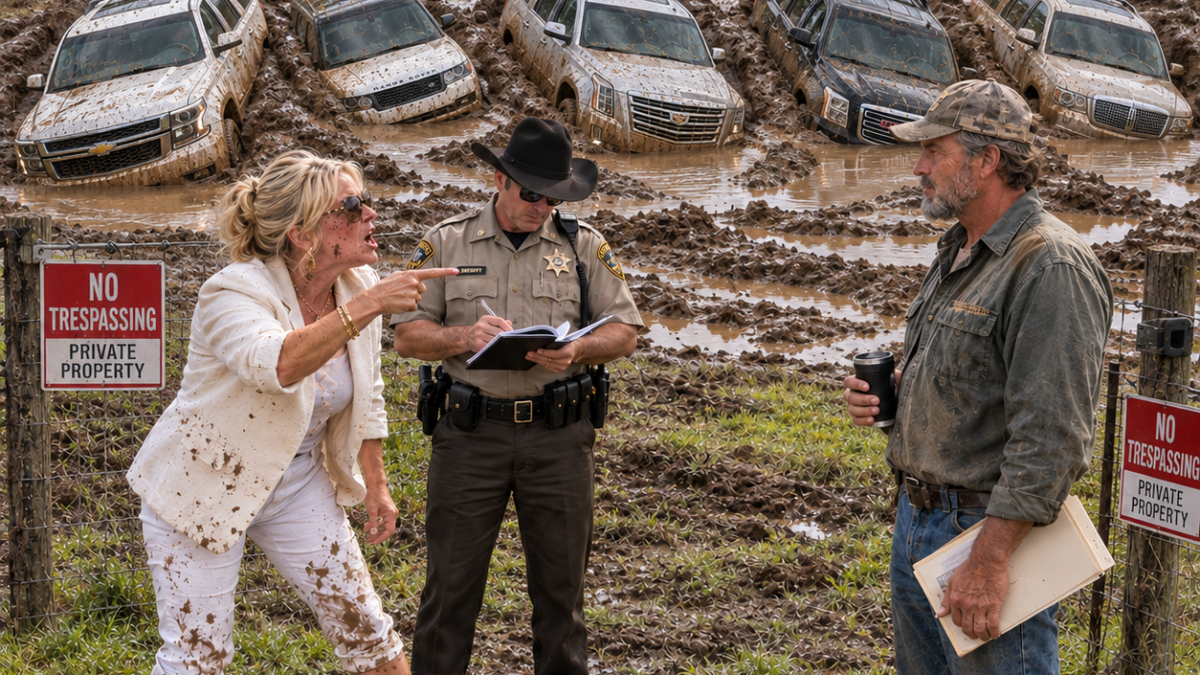
HOA Karen Led 5 SUVs Across My Private Pasture—Then $350,000 in Cars Sank Into My Legal Stock Ponds.
Five luxury SUVs worth more than $350,000 drove past six NO TRESPASSING signs and onto my cattle pasture because HOA president Tammy Prescott wanted to prove the dirt road crossing my family’s ranch belonged to her neighborhood—and less than five minutes later, every vehicle was buried axle-deep in Texas clay.
For months she had ripped down my signs, sent her husband’s workers to cut apart my steel gate, filed one false complaint after another against my cattle operation, and threatened to take permanent control of the road my father had warned me never to surrender.
But when Tammy climbed barefoot from her mud-swallowed Tahoe and screamed for the sheriff to arrest me, she still had no idea that the wet ground beneath her feet was connected to a twelve-year-old secret buried inside her own husband’s development records—and five stuck SUVs were about to become the smallest problem she had.
The first thing Sheriff Dale Compton did when he arrived was stare.
Not at me.
At the pasture.
Five SUVs were scattered across roughly two hundred yards of wet Hill Country grass like somebody had dropped a luxury dealership from the sky.
A pearl-white Chevrolet Tahoe sat nose-down in brown clay with mud nearly to the wheel wells.
Thirty yards to the right, a white Range Rover leaned sideways at an angle so ridiculous it looked like it was trying to lie down.
A silver Escalade rested half inside a drainage berm.
A black Yukon had sunk almost straight down until the frame touched the ground.
And a champagne-colored Lincoln Navigator sat diagonally across another wet depression with its front bumper pointing high enough that, from the right angle, it looked like it was asking God for help.
All five engines were off.
All five drivers were outside.
Three of the women had lost shoes.
One had mud to her thighs.
And Tammy Prescott, president of the Ridges at Copper Creek Homeowners Association for eight uninterrupted years, was standing barefoot in my pasture, waving one ruined Gucci loafer at the sheriff as if it were evidence of a felony.
“Arrest him!”
Dale closed the door of his county truck.
Tammy marched toward us.
Or attempted to.
The clay sucked at every step.
Her white pants were brown below the knees.
Her cream blazer had a streak of red-brown mud across one sleeve.
One lens of her sunglasses was smeared.
Her platinum hair, which normally survived Texas wind with the structural integrity of bridge cable, had finally surrendered.
She looked like a woman who had fought the earth and discovered the earth did not care about HOA bylaws.
“He dug traps,” she shouted.
Dale looked past her toward the pasture.
Then at me.
I was leaning against my pickup holding a coffee mug.
“Morning, Garrett.”
“Morning.”
“What happened?”
Tammy answered before I could.
“He deliberately destroyed a public road!”
Dale looked at her.
Then at me.
“Garrett?”
“I have paperwork.”
Of course I did.
I had an envelope ready.
Certified copy of my deed.
County survey.
Photographs of the posted signs.
PART2:
Trail-camera stills showing every SUV driving past those signs.
Agricultural documentation for the stock ponds and drainage improvements.
A printed copy of Tammy’s email inviting residents to participate in what she called a COMMUNITY ACCESS DRIVE.
And a letter from my attorney explaining that no recorded easement crossed the Ellison Ranch.
Dale took the envelope.
Tammy pointed at me.
“He knew those holes were there.”
“Yes,” I said.
“They’re my stock ponds.”
“They are traps!”
“They hold water.”
“They destroyed five vehicles.”
I looked toward her Tahoe.
“It looks intact.”
“IT IS UNDERGROUND.”
“Part of it.”
Dale lifted one hand.
“Everybody stop.”
Tammy stopped talking.
That alone was impressive.
Dale began reading.
I stood there drinking coffee.
Across the pasture, Denise Waverly was trying to scrape mud from a white Range Rover with a tree branch.
Brenda Faulkner stood beside her Escalade holding one bare foot off the ground because she had lost both sandals somewhere in the mud.
Sheila Colton was on the phone with what sounded like roadside assistance.
Pam Rutherford had given up entirely and was sitting on the hood of the Navigator.
I should probably tell you now that I had not dug five holes the night before hoping rich women would drive into them.
That is the version Tammy tried to sell.
It was not what happened.
The truth began almost six months earlier.
My name is Garrett Ellison.
I was fifty-two that year.
For eighteen years, I worked as a hydraulic engineer with the United States Army Corps of Engineers.
Water control.
Drainage systems.
Flood mitigation.
Channels.
Soil behavior.
Retention structures.
The kind of work nobody notices when it goes right and everybody screams about when it does not.
Two years before Tammy drove her Tahoe into one of my stock ponds, I left federal service and moved home.
Not because I hated engineering.
I loved it.
I left because my father was dying.
Ray Ellison spent the final four months of his life in a hospital room in Fredericksburg.
Lung cancer.
By the time I returned, he was thin enough that his wedding ring had been removed because it kept slipping from his finger.
For most of my childhood, Dad seemed impossible to weaken.
He had raised cattle through droughts.
Rebuilt fences after floods.
Worked through broken ribs because a bull had pinned him against a loading chute.
He once stitched his own forearm with fishing line because the nearest urgent-care clinic was forty minutes away and he did not want to leave a cow in labor.
I am not recommending that.
Ray Ellison was stubborn to the point of medical irresponsibility.
But he was my father.
The Ellison Ranch had been his world.
Two hundred eighty acres west of Austin in the Hill Country.
Cedar.
Limestone.
Live oak.
Dry grass that turned gold in August.
Creek bottom that stayed green longer than everything around it.
My grandfather bought the original tract in 1961.
Dad inherited it.
I grew up there.
Then left.
College.
Army Corps.
San Antonio.
Projects across Texas and beyond.
I told myself leaving did not mean abandoning the land.
Dad never accused me.
That made the guilt worse.
When I came home during the final months, Dad could barely speak.
One afternoon the hospital television was showing a cattle auction.
Muted.
Dad watched anyway.
He turned toward me.
“Son.”
I leaned closer.
“What?”
He swallowed.
Had to stop.
Then tried again.
“Don’t let anybody take this land.”
I looked at him.
“Nobody’s taking it.”
His fingers closed weakly around my wrist.
“It’s all we got left.”
Those were the last complete words he ever said to me.
He died nine days later.
I sold my apartment in San Antonio.
Quit the Corps.
Moved home.
Traded engineering drawings for fence stretchers, feed invoices and a tractor older than several of my former interns.
First morning back permanently, I stood on Dad’s porch drinking coffee.
Sixty Herefords moved across the south pasture.
The sun came up behind the live oaks.
For the first time in years, the ground beneath my boots felt like something more than a jobsite.
It felt like a promise.
Then Tammy Prescott showed up.
The Ridges at Copper Creek sat along the eastern boundary.
One hundred twenty-seven houses.
Terracotta roofs.
White fencing.
Stone entrance monuments.
A clubhouse with fake timber beams and a pool that always smelled faintly of sunscreen and chlorine.
The subdivision existed because twelve years earlier Dad sold forty acres on the eastern edge of the ranch to a developer named Clint Hargrove.
Dad regretted that sale later.
Not because houses were built.
Because of what came with them.
Clint Hargrove partnered with Wade Prescott.
Wade handled much of the construction management.
His wife, Tammy, became HOA president a few years later.
By the time I returned, Tammy had transformed the position into a monarchy.
Fifty-two.
Platinum hair.
Expensive sunglasses.
Linen blazers over yoga pants.
Pearl-white Tahoe with a vanity plate:
RIDGQN.
Ridge Queen.
She had actually paid the state of Texas to put that on her vehicle.
That told you everything you needed to know.
Our first meeting happened three days after I moved back.
Her Tahoe rolled up my gravel driveway without warning.
She got out.
Looked at my barn.
Then at cattle.
Then at me.
“I hope you understand this neighborhood has standards, Mr. Ellison.”
I looked behind me at the ranch house.
“This isn’t your neighborhood.”
She smiled.
“No, but your property borders it.”
“And?”
“Our residents are accustomed to certain conditions.”
“My cows bothering them?”
“It’s not only cattle.”
“What else?”
“Equipment.”
I looked toward Dad’s tractor.
“You mean the tractor on the ranch?”
She ignored that.
“Visual clutter affects property values.”
I stared.
“Tammy.”
“Yes?”
“This ranch was here before every house behind you.”
She smiled again.
“That doesn’t mean we can’t work together.”
Then she got into the Tahoe and left.
I should have understood.
When somebody like Tammy says work together, she means:
Do what I want voluntarily so I do not have to explain what happens when you don’t.
The real problem was the ranch road.
It cut across my eastern pasture.
Dirt and gravel.
Maybe three-quarters of a mile.
Dad used it for equipment.
Cattle trailers.
Feed deliveries.
Fence access.
Occasionally, when he was in a generous mood, he let a neighbor from the development cut across.
Key word:
let.
Permission.
Courtesy.
Not public access.
The county did not maintain it.
No road designation.
No easement.
No public right-of-way.
But while Dad was sick, Tammy had apparently decided permission was inefficient.
By the time I returned, five to seven vehicles a day used that road as a shortcut from the subdivision to County Road 114.
Most were SUVs.
Some pickups.
Delivery drivers.
Contractors.
It saved maybe six minutes compared with using the subdivision’s actual entrance.
Six minutes.
That was what the damage was worth to them.
The road had ruts eight inches deep.
One section had widened because drivers began passing each other.
Temporary fence had been knocked down twice.
Three cows spooked by a vehicle ended up against barbed wire.
One needed stitches.
Another developed an infection.
Vet bill:
$1,187.
I installed four signs.
PRIVATE PROPERTY.
NO TRESPASSING.
NO PUBLIC ACCESS.
STEEL POSTS.
Three days later they were gone.
I found one fifty yards away.
Bent in half.
Driven upside down into the ground.
I drove to Tammy’s house.
She opened the door barefoot.
Green drink in hand.
“Mr. Ellison.”
“Where are my signs?”
“What signs?”
“You know.”
Her face gave away nothing.
Then she said:
“They were blocking community access.”
My jaw tightened.
“You took them?”
“I had them removed.”
“From my land.”
“They were creating a safety issue.”
“No.”
“Excuse me?”
“You removed legal signs from my property because they inconvenienced people trespassing.”
She tilted her head.
“That road has been used for years.”
“With permission.”
“Access is access.”
“No.”
“We’ll see.”
Door closed.
Slowly.
Deliberately.
I stood there smelling expensive perfume and understanding for the first time that this was not neighborhood confusion.
Tammy knew where the property line was.
She simply believed enough confidence could move it.
So I built a gate.
Sixteen feet.
Heavy-gauge steel.
Black powder coat.
Two steel posts.
Concrete.
Chain.
Padlock.
I did the welding myself.
Dad kept an old MIG machine in the shop.
I spent Saturday digging post holes.
Sunday welding hinges.
By evening, the road was closed.
The gate cost me around fourteen hundred dollars.
I also installed a trail camera.
Infrared.
Motion detection.
Cloud upload.
Because I know human nature.
It took Tammy forty-seven hours.
Tuesday afternoon, my phone buzzed.
Motion alert.
I opened the live feed.
There she was.
Cream blazer.
Sunglasses.
Two men in high-visibility vests behind her.
A truck.
Angle grinder.
“Cut it.”
Camera microphone caught her clearly.
“This gate is illegal.”
One man knelt.
Grinder screamed.
Sparks.
Three minutes later, both hinges were severed.
My gate fell.
Heavy steel striking dirt.
Even through a phone speaker, the sound made my jaw clench.
Then I noticed the truck door.
PRESCOTT & HARGROVE DEVELOPMENT LLC.
Wade’s company.
Her husband’s workers.
Tammy stepped over the fallen gate.
Climbed into her Tahoe.
Drove through.
I saved the footage.
Twice.
Then drove to Tammy’s house next morning.
She opened the door.
“Your husband’s crew cut my gate.”
“I know.”
“I have video.”
“That gate obstructed community access.”
“It obstructed trespassing.”
“We disagree.”
“No. You disagree with my deed.”
She smiled.
“Then let the county decide.”
Door closed.
Again.
I sat in my truck afterward.
Hands on steering wheel.
Dad’s voice:
Don’t let anybody take this land.
I could have called the sheriff.
Should I have?
Maybe.
But at that moment, what I wanted most was not one gate complaint.
I wanted to understand why Tammy was willing to escalate.
People rarely work that hard for a six-minute shortcut unless there is something more attached to it.
Two weeks later, the HOA sent me a three-page letter.
Gold logo.
Heavy paper.
Tammy’s signature.
It claimed my ranch fell within something called the Ridges’ “extended aesthetic zone.”
I laughed aloud.
According to the letter, my cattle, equipment and fencing violated subdivision standards because residents could see them.
Article seven.
Section three.
Agricultural equipment.
Livestock containment structures.
Odor-producing operations.
I read it twice.
My grandfather bought the ranch before most of Tammy’s board members were born.
The subdivision existed because my father sold them the land.
Now the HOA was informing me cattle were visually offensive.
I placed the letter beside the coffee pot.
Some forms of insanity deserve documentation more than outrage.
Then inspectors began arriving.
Water-quality inspector.
Passed.
Livestock containment.
Passed.
Fertilizer storage.
Passed.
All within ten days.
The last inspector was named Doug.
Older guy.
Sunburned neck.
Boots worn pale at the toes.
He checked the shed.
Signed his sheet.
Then stopped beside the truck.
“Mr. Ellison.”
“Yeah?”
“Your place is clean.”
“Thanks.”
“Somebody’s filing complaints every couple days.”
I waited.
Doug could not tell me officially.
He did not have to.
Same wording.
Same source address.
Same signature pattern.
Tammy.
Then county environmental assessment.
She claimed my cattle contaminated Copper Creek.
Tests upstream.
Midstream.
Downstream.
Clean.
Animal Services came next.
Aggressive cattle.
Danger to children.
Officer met Biscuit.
Biscuit was Dad’s favorite Hereford.
Large.
Docile.
She walked over and licked the officer’s hand.
He stared at her.
Then at me.
“These are supposed to be aggressive?”
“According to the HOA.”
Biscuit leaned against him for scratches.
Officer laughed.
“I’ve handled Chihuahuas more dangerous than this cow.”
I wrote that down.
By the third week, paperwork covered Dad’s old office.
Complaints.
Inspection results.
Letters.
Gate video.
Vet bills.
Property photographs.
Cease-and-desist from an Austin law firm finally arrived.
Restore unimpeded community access within thirty days.
Or lawsuit.
They intended to pursue a prescriptive easement.
That got my attention.
Prescriptive easement arguments can become serious when land has been used openly for long periods.
I stopped assuming.
I opened county records.
Deeds.
Surveys.
Development filings.
Drainage permits.
Easements.
Dad’s sale documents from 2012.
At 11:17 that night, I found Article 4, paragraph 9.
I read it once.
Then again.
NO PUBLIC OR PRIVATE EASEMENT, WHETHER EXPRESS, IMPLIED, OR BY NECESSITY, IS GRANTED ACROSS THE REMAINING ELLISON PARCEL AS PART OF THIS TRANSACTION.
Dad.
There it was.
His attorney had anticipated the exact argument.
Hargrove signed.
Dad signed.
County recorded.
No easement.
But Tammy’s lawyers were relying on continued use afterward.
So I kept searching.
Then found photos on Dad’s old laptop.
Calving season.
Temporary gate across the road.
Chained shut.
April.
May.
June.
Three months.
Access interruption.
That mattered.
But what I found next mattered much more.
The Ridges had been approved under a stormwater drainage plan.
Standard development requirement.
One hundred twenty-seven roofs.
Driveways.
Roads.
Impervious surfaces.
Rain has to go somewhere.
Their plan required retention ponds and bioswales along the western edge.
I opened completion reports.
Then as-built drawings.
Then inspection records.
No ponds.
No bioswales.
I thought I had missed a revision.
Searched again.
Nothing.
The required drainage system existed on plans.
Not on land.
For twelve years, runoff had flowed downhill.
Where?
My ranch.
The old ranch road sat directly in one of the natural flow paths.
Suddenly years of observations aligned.
Soft soil after moderate storms.
Stock tanks filling faster than expected.
Erosion near south fence.
Ruts worsening.
My property had been receiving stormwater from one hundred twenty-seven homes because the developer did not build what its permit required.
Then I found signatures.
Clint Hargrove.
Developer.
Wade Prescott.
Project manager.
Tammy’s husband.
I leaned back.
Ceiling fan turning above me.
Coffee cold.
That was the first moment the entire fight changed shape.
Tammy had spent weeks directing attention toward me.
Cows.
Fences.
Fertilizer.
Water.
Road.
Environmental complaints.
All while the development tied to her own husband had a drainage problem hidden in public records.
Maybe she knew.
Maybe she did not know every detail.
I would not claim what I could not prove.
But Wade’s signature was on the permit.
That I could prove.
And I could prove the infrastructure was missing.
Next morning, I drove to see Hank Overstreet.
Land attorney.
Sixty-one.
Office smelled like leather and toner.
He read everything.
Twenty minutes.
No interruption.
Then removed his glasses.
“Garrett.”
“Yeah?”
“You have a much larger case than a gate.”
He tapped the drainage permit.
“This is significant.”
We built strategy.
Civil trespass.
Property damage.
Destroyed gate.
Injured cattle.
Pasture damage.
Formal environmental complaint.
Permit audit.
No theatrics.
No threats.
Then Hank said:
“Do not rush.”
“How long?”
“Long enough to let them establish what they’re willing to do.”
I thought of Dad.
The land doesn’t fight back, son.
The man who knows it can.
So I went back to engineering.
That old road had become a drainage problem.
Years of runoff.
Compacted ruts.
Erosion.
I needed stock-water improvements anyway.
I rented a Kubota KX040.
Mini excavator.
Spent five days improving the back pasture.
Four stock ponds.
Roughly twenty by thirty feet.
Four feet deep at their centers.
Two drainage berms cutting across the old road alignment.
Their purpose was agricultural.
Capture runoff.
Reduce erosion.
Provide cattle water.
I shaped slopes.
Compact where needed.
Left clay bottoms.
No state waterway impounded.
No Copper Creek blockage.
Just rainfall and runoff crossing my land.
I had spent eighteen years understanding soil.
Hill Country clay has two personalities.
Dry?
Hard.
Cracked.
Nearly concrete.
Saturated?
Grease.
Heavy vehicles sink.
That was not a secret.
Any rancher knows.
I was not hiding pits under plywood.
I was not installing spikes.
I was reshaping ground on my own ranch to manage water that should not have been pouring onto it in the first place.
I also installed six new signs.
Steel.
Bolted.
NO TRESPASSING.
PRIVATE RANCH.
NO PUBLIC ROAD.
Then six cameras.
Multiple angles.
Cloud backup.
Tammy saw the excavation.
Naturally.
She parked on County Road 114.
Took pictures.
Two days later, environmental inspector Sandra Polk arrived.
Anonymous complaint.
Illegal dumping.
Groundwater contamination.
I almost laughed.
Instead, I walked Sandra through everything.
Stock ponds.
Berms.
Flow direction.
Agricultural purpose.
Soil.
Water.
She tested.
Clean.
Then paused.
“Your place is downhill from the subdivision.”
“Yes.”
“Runoff issue?”
“Twelve years.”
I handed her the original Ridges drainage plan.
She read.
Expression changed.
“Where are these retention ponds?”
“They never built them.”
“Bioswales?”
“Never built.”
She looked toward the rooftops.
Then back.
“I’m taking this.”
“Please.”
Tammy had called an environmental inspector on me.
That inspector left with documentation relating to her husband’s development.
I will admit that felt satisfying.
Then came Nextdoor.
Tammy posted:
LOCAL RANCHER DELIBERATELY SABOTAGING COMMUNITY ACCESS ROAD.
Pits.
Trenches.
Danger.
Aggression.
People responded.
Half supported her.
Half asked:
Is it his property?
Nolan Briggs answered.
Retired electrician.
Resident of the Ridges.
Common sense.
“No recorded easement.”
Tammy deleted his comment.
Blocked him.
That told me more than the original post.
Then she organized her convoy.
Email Sunday morning plan.
COMMUNITY ACCESS DRIVE.
Five vehicles.
Drive the route.
Photograph use.
Document “public road.”
Driver list:
Tammy.
Denise.
Brenda.
Sheila.
Pam.
All board allies.
All expensive SUVs.
Nolan forwarded it.
I called Hank.
“She’s coming Sunday.”
“Good.”
That was all he said.
Saturday evening, rain arrived.
Hard.
Not forecast manipulation.
Not sprinklers.
Not me flooding anything.
Texas weather.
Steady downpour.
The ponds filled.
Drainage berms worked.
Runoff moved.
Clay softened.
By morning, the pasture looked normal.
Green.
Wet.
The path they had used for years was no longer a road.
Because it had never been a public road.
It was pasture that happened to contain tire ruts.
I moved cattle south.
Checked cameras.
Checked signs.
Made coffee.
At 7:45, the SUVs arrived.
One.
Two.
Three.
Four.
Five.
Tammy gathered them beside the county road.
Clipboard.
Instructions.
Single file.
Old track.
Take photographs.
At one point Denise asked:
“What if he calls the cops?”
Wind carried Tammy’s answer.
“Let him.”
Then:
“We have forty-seven signatures.”
“He can’t do anything.”
I called Sheriff Dale.
“Five vehicles about to trespass.”
“How soon?”
“Two minutes.”
“Be there in fifteen.”
Then I sat down.
Tammy entered first.
Past sign number one.
Camera one.
Past sign number two.
Camera two.
Tahoe hit the soft edge around fifteen miles an hour.
Front wheels dropped.
Not dramatically.
Just fast enough to surprise her.
Hood dipped.
Brake lights.
Then engine revved.
Worst move.
Spinning tires shear saturated clay.
Traction disappears.
Vehicle settled lower.
Rear tires dug.
Tahoe sank until frame resistance stopped further movement.
Denise attempted to go around.
Range Rover entered second pond edge.
Tilted.
More gas.
More sink.
Brenda braked too late.
Escalade slid into drainage berm.
Sheila tried reverse.
Yukon dug downward instead of backward.
Pam attempted U-turn.
Navigator slid sideways.
Five.
Stopped.
Within minutes.
I watched through binoculars.
I did not celebrate.
Not then.
Because accidents remain accidents until you know no one is hurt.
I called Dale again.
“Vehicles stuck.”
“Injuries?”
“None I can see.”
“I’m almost there.”
Tammy stepped from Tahoe.
One shoe disappeared immediately.
She yanked.
Foot came out.
Shoe did not.
She removed the other eventually and marched barefoot.
That was how Sheriff Dale found her.
Standing in mud.
Demanding my arrest.
Which brings us back to the envelope.
He read deed.
Survey.
Email.
Signs.
Camera stills.
Stock pond documentation.
Then looked at Tammy.
“Mrs. Prescott.”
“Yes?”
“There is no recorded easement.”
“That’s disputed.”
“Not today.”
“Our attorney—”
“Can file whatever action he believes appropriate.”
She pointed toward vehicles.
“Those holes were designed to destroy our cars.”
I said:
“They’re stock ponds.”
Dale held up a document.
“They appear documented as agricultural drainage improvements.”
Tammy stared.
“They’re in the road.”
“There is no public road.”
Her face reddened.
“We have used it for twelve years.”
“That is something attorneys can argue later.”
Dale looked toward the nearest sign.
“What I have right now are posted private-property notices.”
He pulled out citation pad.
Tammy stopped.
“You cannot be serious.”
“I am.”
Five trespass citations.
No dramatic handcuffs.
No jail convoy.
Citations.
Then towing.
That was difficult.
Standard tow trucks could not recover all five without risking damage.
A heavy wrecker came.
Winch lines.
Recovery boards.
Hours.
Around four hundred dollars each before additional service.
A reporter from the county paper arrived after hearing radio traffic.
Luanne Caldwell.
Camera.
Tammy objected.
“You can’t photograph this.”
Luanne looked around.
Then said:
“You’re standing on his private ranch.”
Pause.
“That appears to be the story.”
The photograph ran front page.
Five SUVs in mud.
Five drivers holding citations.
My truck in background.
Me leaning beside it.
Coffee.
Headline:
FIVE SUVs STRANDED ON PRIVATE RANCH AFTER HOA “ACCESS DRIVE.”
The internet made it crueler.
Memes.
RIDGE QUEEN BECOMES MUD QUEEN.
Images of Tammy’s Tahoe edited into swamp monsters.
I did not participate.
Humiliation has momentum.
I needed evidence.
Not entertainment.
The actual consequences started later.
Emergency HOA meeting.
Ninety-four votes to remove Tammy.
Seven opposed.
Eight years of uncontested control ended.
Nolan told me she walked across the parking lot afterward without a speech.
No blazer.
Gray sweatshirt.
He said:
“Should’ve used the main entrance.”
She ignored him.
That line traveled through the subdivision for months.
Then TCEQ investigation.
The missing drainage structures were confirmed.
Required retention ponds not built.
Bioswales not built.
Runoff impacts documented.
Hargrove Development faced substantial penalties and mandatory remediation.
Wade was named in the enforcement process because his signature appeared on the original drainage documentation.
County contracts disappeared.
Banks began asking questions.
That was bigger than my road dispute.
And that mattered because one thing I never wanted was the public believing five stuck SUVs somehow proved every allegation.
They did not.
The records did.
Permits.
Inspections.
Plans.
Site conditions.
Signatures.
Engineering.
Facts.
My civil case settled months later.
Gate destruction.
Fence damage.
Vet costs.
Trespass.
Pasture degradation.
Vehicle intrusion.
Settlement total:
$47,000 across defendants.
Online retellings later made it sound like a judge ordered Tammy to hand me forty-seven thousand dollars personally.
Not true.
Multiple responsible parties.
Insurance.
Settlement.
Legal process.
Less dramatic.
More accurate.
I used the money for something Dad would have understood.
Ellison Agricultural Youth Fund.
Scholarship for rural students pursuing agriculture, land management, environmental science.
The first award ceremony took place on the back pasture.
Right near the ponds.
Forty people.
FFA kids.
Neighbors.
County officials.
Luanne.
Nolan.
Biscuit.
Biscuit was technically not invited.
Cows have limited respect for ceremonial boundaries.
I stood on a small platform.
Looked over pasture.
Then said:
“My father told me two things.”
People quieted.
“He said the land doesn’t fight back.”
Pause.
“And he said the man who knows the land can.”
I pointed behind me.
“Those ponds stopped five SUVs.”
Laughter.
“They also catch runoff.”
“Water cattle.”
“Reduce erosion.”
“They’re still here because they were never traps.”
“They were ranch improvements.”
I looked toward students.
“I spent eighteen years learning how water moves and soil behaves.”
“And this entire mess reminded me that knowledge matters most when somebody else is relying on you not to use it.”
That was the message I wanted them to hear.
Not revenge.
Competence.
Know your land.
Know your records.
Know the system.
Then use that knowledge before anger uses you.
After everyone left, I sat on Dad’s porch.
Sunset.
Ponds orange with reflected sky.
Cattle moving south.
Wind through cedar.
For months, Tammy’s voice had occupied too much of that ranch.
Complaints.
Threats.
Emails.
Inspectors.
Now I heard crickets again.
That felt like winning.
Not her removal.
Not fines.
Silence.
My land sounded like my land.
The Ridges eventually built the drainage infrastructure it should have had from the beginning.
Retention ponds.
Bioswales.
Engineered outlets.
Construction disrupted the subdivision for months.
Residents complained.
I sympathized.
But after completion, runoff onto my pasture decreased dramatically.
The old road remained closed.
I installed another gate.
Heavier.
Not because I expected someone to cut it.
Because ranch gates are useful.
The county placed clearer boundary markers nearby.
No ambiguity.
People at the Ridges learned the main entrance existed for a reason.
Tammy still lived there.
At least for a while.
Her Tahoe was repaired.
Mud removed.
I heard the recovery bill was ugly.
We never became friends.
I did not expect apology.
One afternoon months later, she stopped on County Road 114 while I was repairing fence.
Window down.
“Garrett.”
I walked closer.
Not too close.
“What?”
She looked across the pasture.
New drainage construction visible behind her subdivision.
“You really think all of this was worth it?”
I almost asked what she meant.
The gate?
Lawsuits?
Environmental work?
Her presidency?
Then realized it did not matter.
I said:
“It was never mine to decide for you.”
She looked irritated.
“I was protecting property values.”
“No.”
“I was.”
“You were protecting control.”
“That’s your opinion.”
“Maybe.”
She gripped steering wheel.
Then:
“You could have just let people drive through.”
I nodded.
“And you could have asked.”
She did not answer.
That was the entire story in six words.
She could have asked.
Dad had allowed neighbors across before.
He might have allowed some afterward.
I might have created a written permission system.
Seasonal access.
Limited traffic.
Maybe.
But permission disappears when people pretend it is a right.
Generosity becomes dangerous when recipients rewrite it as ownership.
That is what happened.
Dad let neighbors cut through.
Tammy transformed courtesy into entitlement.
Then tried converting entitlement into law.
I would not help her.
That is not hostility.
It is a boundary.
Years later, the stock ponds remain.
They are better established now.
Grass around edges.
Frogs.
Birds.
Cattle drink.
After storms they fill.
During dry periods they shrink.
One of them occasionally holds bass-sized fish washed in by runoff, though how they got there is still disputed among every rancher who has an opinion.
Kids from the agricultural program visit.
I teach them drainage.
Soil.
Contour.
Water management.
I show them the old development plans.
Not to embarrass anyone.
To teach consequences.
A drawing is not infrastructure.
A permit condition matters only if someone actually builds it.
Missing drainage rarely announces itself at the property line.
Water follows gravity.
Not corporate boundaries.
Not HOA boundaries.
Not county politics.
Gravity.
There is comfort in physical laws.
They do not care who is president.
Tammy spent years believing position changed reality.
It did not.
Her title could not create an easement.
Her petition could not change a deed.
Her complaints could not make clean water dirty.
Her HOA letter could not make cattle subject to subdivision aesthetics.
Her husband’s development documents could not build retention ponds that never existed.
Her Tahoe could not float on saturated clay because forty-seven homeowners signed a petition.
Reality eventually collects its debt.
That was the deeper lesson.
But I also learned something about myself.
I had come home because Dad asked.
Don’t let anybody take this land.
For months, I heard those words like a battle order.
Fight.
Hold.
Defend.
Later I realized Dad had not said:
Destroy anyone who challenges you.
He said:
Don’t let anybody take it.
There is a difference.
Defense can be calm.
Records.
Survey.
Gate.
Attorney.
Permits.
Stock ponds.
I never needed Tammy injured.
Never needed her vehicle destroyed.
Never needed revenge.
I needed my boundary respected.
That is why I am careful when people call the ponds traps.
A trap exists primarily to catch somebody.
Those ponds existed to manage water.
Did I know a heavy vehicle would sink after rain?
Absolutely.
I was a hydraulic engineer.
Did I know Tammy intended to drive through?
Yes.
Did I remove the signs?
No.
Did I tell her the land was private?
Repeatedly.
Did she organize the convoy anyway?
In writing.
That is not the same as me setting a concealed device intended to injure her.
Words matter.
So do intentions.
So do facts.
Hank made me repeat that during the lawsuit.
Every time I tried saying:
She drove into what she deserved—
he interrupted.
“No.”
“She drove onto land she was warned not to enter.”
“Say facts.”
“Let people decide conclusions.”
He was right.
Anger loves adjectives.
Evidence prefers nouns.
Deed.
Gate.
Camera.
Email.
Sign.
Pond.
Vehicle.
Citation.
You can build a strong case from nouns.
I kept Dad’s old office almost exactly the same.
Desk.
Lamp.
Filing cabinet.
I added a framed copy of the deed clause.
Article 4.
Paragraph 9.
No easement.
Below it is a photograph of Dad.
Maybe fifty.
Sitting on tractor.
Hat crooked.
Middle finger raised at whoever took the photograph.
Probably me.
Under the frame, I wrote one line:
READ THE PAPERWORK.
Dad would have approved.
He distrusted contracts while simultaneously keeping every one.
In another drawer, I found the original sale negotiation notes with Clint Hargrove.
Dad had written in pencil:
NO ROAD ACROSS REMAINING RANCH.
Underlined twice.
He knew.
That affected me.
For years I thought his final warning came from illness.
Fear.
Old man clinging to land.
Maybe part did.
But Dad had spent more than a decade watching the subdivision pressure the ranch.
Cars.
Runoff.
Encroachment.
He was not paranoid.
He was tired.
When he said:
Don’t let anybody take this land—
he meant inches as much as acres.
One road.
One gate.
One assumption.
Property rarely disappears all at once.
First somebody borrows.
Then uses.
Then expects.
Then demands.
Then claims.
If you are not careful, courtesy becomes precedent in everyone’s mind except the person who originally granted it.
That is why records matter.
Permission should look like permission.
Boundaries should look like boundaries.
I am not against neighbors.
Nolan became a friend.
Several Ridges residents buy beef from me now.
One family brings their kids during calving season.
Another helped repair fence after a windstorm.
Most residents were not Tammy.
They were people trying to get home.
Some had used the shortcut because they were told they could.
When I understood that, anger softened.
The problem was not all one hundred twenty-seven households.
It was leadership that taught convenience was entitlement.
After Tammy left office, the new board sent me a formal letter.
Not dramatic.
Three paragraphs.
Acknowledged no easement.
Directed residents not to use ranch.
Offered to compensate for previous signage loss.
I accepted only sign cost.
Not because I wanted to be noble.
Because that was the documented loss from HOA action.
Wade’s company and others handled separate damages through settlement.
Keep categories clean.
Engineers like that.
The new board also invited me to a meeting.
I went.
First time inside clubhouse voluntarily.
Nolan introduced me.
Some people clapped.
I hated that.
I said:
“Please don’t.”
They stopped.
I told them:
“I’m not here to relive the mud.”
One woman laughed.
I continued.
“We share a boundary.”
“That means our water, roads, animals, noise and decisions affect each other.”
“You have a subdivision.”
“I have a ranch.”
“Neither one disappears.”
“Respecting the line makes living beside it easier.”
Nobody argued.
That was all I wanted.
Not friendship.
Function.
Communities do not require everyone to like one another.
They require reliable boundaries.
The first scholarship recipient from the Ellison Fund was a seventeen-year-old girl named Maria Alvarez.
FFA president.
Wanted to study watershed management.
At the award ceremony, she asked:
“Is it true your ponds swallowed five SUVs?”
I said:
“No.”
She looked disappointed.
“They sank.”
“That’s less cool.”
“Accuracy usually is.”
She laughed.
Then asked serious questions about clay.
Drainage.
Slope.
Runoff.
That mattered more.
She eventually enrolled at Texas A&M.
Sent me an email her first semester.
Subject:
YOUR MUD WAS RIGHT.
She had taken soil mechanics.
I printed it.
Hung it beside Dad.
The ranch has changed since all this.
I reduced herd slightly during drought.
Repaired south barn.
Added solar pump.
Rebuilt equipment shed roof.
Biscuit got old.
Very old.
She died under an oak tree one spring.
No drama.
Lay down.
Did not get up.
I buried her near Dad’s favorite fence line.
Somebody joked I should name a pond after her.
I did.
Pond Three is now Biscuit Pond.
No sign.
I know.
That is enough.
Sometimes people driving County Road 114 slow down and look toward the field where the SUVs sank.
Most cannot tell where it happened anymore.
Grass grew.
Wheel ruts disappeared.
Clay recovered.
That is another thing land does.
It remembers differently than people.
The soil compacts.
Erodes.
Regrows.
Human stories make permanent landmarks out of moments the earth has already absorbed.
If you stood there now without knowing, you would see pasture.
Water.
Cattle.
No battle.
Maybe that is the best outcome.
Dad did not want a monument to a property fight.
He wanted ranch.
That is what remained.
I kept one photograph from the newspaper.
Not framed.
Inside a drawer.
Five SUVs in mud.
Tammy barefoot.
Dale writing citations.
I look at it maybe once a year.
Not because it makes me proud.
Because it reminds me how ridiculous the final scene was compared with everything that led there.
People who hear the short version think the story is about mud.
It is not.
The mud was the punchline.
The story was about documents.
Land.
Runoff.
Permission.
Power.
And patience.
Tammy believed volume was authority.
Emails.
Meetings.
Petitions.
Complaints.
Lawyers.
Inspectors.
Every time one tool failed, she reached for another.
What she never did was ask the simplest question:
What does the deed say?
If she had, five SUVs would have stayed clean.
Her husband’s drainage problem still would have existed.
Eventually someone might have found it.
Maybe.
Maybe not.
But arrogance accelerated discovery.
That happens often.
People abusing systems eventually generate too much paper.
Every false complaint creates a record.
Every threat becomes evidence.
Every unnecessary inspection brings another pair of professional eyes.
Tammy aimed inspectors at me.
One of them looked uphill.
That single glance mattered more than all her speeches.
I think about Sandra Polk often.
She came looking for illegal dumping.
Found legal ponds.
Then asked:
“Has runoff been an issue?”
Professional curiosity.
That opened the investigation.
Competence beats drama.
Quietly.
One evening, years later, I sat on the porch with Hank.
He had retired.
Mostly.
Lawyers rarely truly retire.
We drank iced tea.
Watched cattle.
He said:
“You know the funniest part?”
“What?”
“She could’ve won politically.”
“How?”
“If she’d stopped before the convoy.”
I considered.
“She had signatures.”
“She had residents angry.”
“Could’ve filed easement case.”
“Lost eventually.”
“Maybe.”
“But it would’ve cost you.”
He nodded toward ponds.
“Instead she gave you five trespassers on video.”
“Plus the email organizing it.”
“Exactly.”
“People like that always make one move too many.”
I looked toward County Road 114.
“I think she believed backing down would make her look weak.”
Hank smiled.
“Most expensive emotion in America.”
Pride.
He was probably right.
I had my own.
Still do.
That is another reason Dad’s warning could have become dangerous.
Protecting land can become obsession.
I had to learn that too.
Not every disagreement is invasion.
Not every neighbor is enemy.
Not every mistake needs court.
After Tammy, I became suspicious whenever someone approached.
For a while, that hurt relationships.
One day Nolan asked if his grandson could cross a corner of the ranch to retrieve a drone that had crashed.
My first response:
“No.”
Automatic.
Then I stopped.
The boy was fourteen.
Drone visible sixty yards inside fence.
No cattle nearby.
I opened gate.
Walked with them.
They retrieved it.
Nolan said:
“Appreciate it.”
I realized something on the way back.
Dad had allowed people across because generosity mattered to him.
I did not want Tammy to turn me into someone who never allowed anything.
That would have been another kind of taking.
So I still give permission.
Written when appropriate.
Clear.
Specific.
Temporary.
But I give it.
Because boundaries should protect generosity.
Not eliminate it.
That may be the lesson Dad meant.
The scholarship fund grew beyond the settlement.
County agricultural board matched.
Local ranchers donated.
Hargrove never did.
No surprise.
Every year, students come.
We talk water.
Soil.
Property records.
Sometimes I show them the famous photograph after the serious part.
They laugh.
One asks:
“Did you know they’d sink?”
Every year.
I answer:
“I knew they should not drive there.”
They groan.
Engineer answer.
Fine.
Then I explain saturated-clay bearing capacity.
Half stop laughing.
The future engineers lean closer.
Those are my people.
On the anniversary of Dad’s death, I still sit in his chair.
Same porch.
Same view.
Subdivision lights brighter now.
Ranch darker.
Ponds catching moonlight.
I think about last conversation.
Don’t let anybody take this land.
I kept the promise.
But not exactly how younger Garrett would have.
Younger me might have confronted workers physically at the gate.
Might have shouted.
Might have blocked vehicles with tractor.
Might have made everything worse.
Eighteen years of engineering taught me another way.
Measure.
Record.
Understand forces.
Then build where load needs carrying.
It works on water.
Steel.
Conflict.
The gate failed because Tammy cut the hinges.
The paperwork did not.
The deed held.
The cameras held.
The drainage records held.
The truth held.
That is why, when people ask what stopped Tammy Prescott, I do not say mud.
Mud stopped vehicles.
Records stopped her.
Five luxury SUVs did not prove ownership.
The deed did.
Wet clay did not prove wrongdoing.
The cameras showed trespass.
My suspicions did not prove drainage violations.
Inspection did.
The best defense was never the pond.
The best defense was knowing exactly what every document, boundary and drop of water meant before the person challenging me did.
The ponds were simply where all of her bad assumptions arrived at once.
That Sunday morning, after Sheriff Dale finished reading my envelope, he walked into the pasture.
Tammy followed.
Barefoot.
Mud sucking at her feet.
He stopped beside the nearest sign.
Red letters.
NO TRESPASSING.
He pointed.
“Did you see this?”
Tammy said:
“The sign is invalid because this is a community road.”
Dale looked toward me.
Then deed.
Then her.
“Ma’am.”
His voice stayed calm.
“There is no community road.”
She tried again.
“We have signatures.”
He pulled out citation pad.
“That doesn’t change a property line.”
Tammy finally stopped talking.
For perhaps five seconds.
Then:
“This is outrageous.”
Dale began writing.
I stood near my truck.
Coffee almost gone.
Sun rising higher.
Five tow recoveries ahead.
Mud everywhere.
Tammy looked toward me.
Pure hatred.
I did not smile.
That would make the moment too simple.
Instead, I thought about Dad.
The hospital.
Parking-lot view.
His thin hand.
Don’t let anybody take this land.
I looked across all two hundred eighty acres.
Cattle safe.
Fences mine.
Road mine.
Ponds full.
Subdivision where it belonged.
Then I looked back at Tammy.
She had spent months trying to prove authority by driving farther and farther onto ground that was never hers.
In the end, the ground itself forced her to stop.
Not because I had built a trap.
Because she ignored every warning telling her where my land began.








