HOA Karen Laughed at the Crops Her Trucks Destroyed—Then My Gate Stopped Her Entire $15M Project
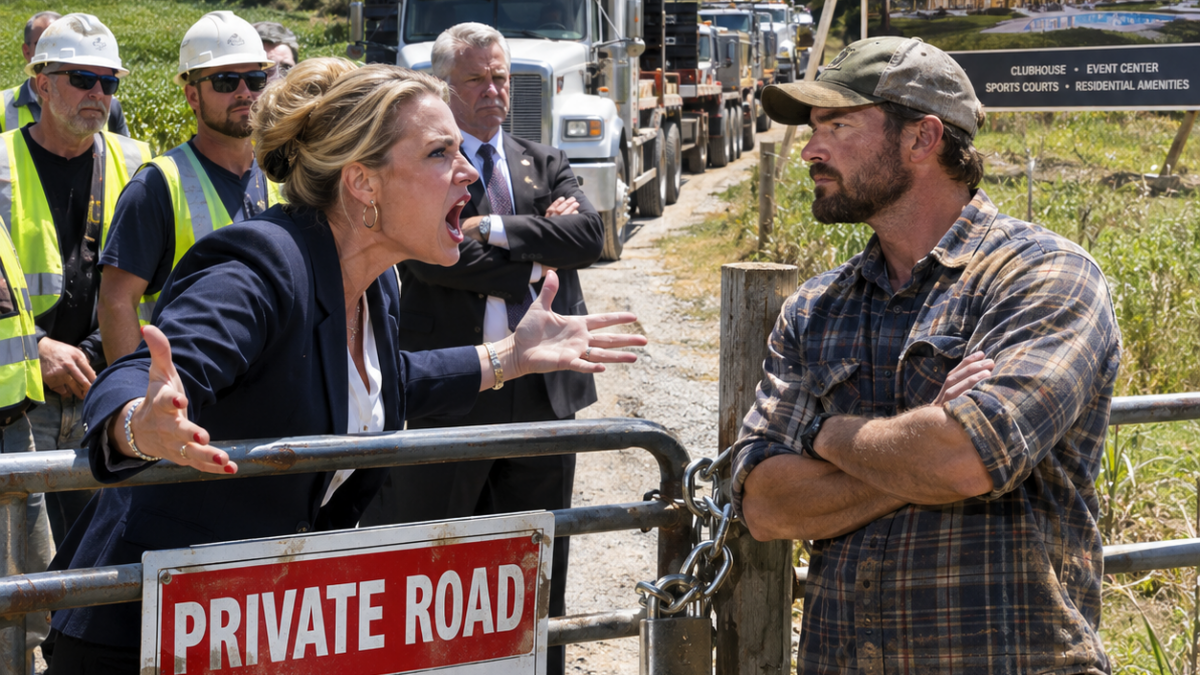
HOA Karen Laughed at the Crops Her Trucks Destroyed—Then My Gate Stopped Her Entire $15M Project.
Vanessa Whitlock laughed in front of her entire HOA board when Everett Mercer showed her photographs of construction trucks crushing his soybeans, destroying his irrigation ditch, and compacting soil his family had spent three generations making productive.
She told him a few rows of crops could never slow down her $15 million luxury development and rejected every dollar of his damage claim—without realizing the only road capable of carrying steel, concrete, and heavy equipment to her hilltop project crossed land Everett owned outright.
The next morning the first convoy reached a new steel gate, and while engines stacked up for half a mile behind her, Vanessa learned that the old easement she had built her entire project around allowed homeowners to drive home—but gave her construction trucks no right to cross Everett’s farm at all.
Everett Mercer had spent enough years around construction sites to know the difference between an accident and a decision.
An accident left one set of tire tracks.
Maybe two.
Some embarrassed driver climbing down from a cab.
A phone call.
An apology.
An insurance number.
What he found in his soybean field that Wednesday morning was not an accident.
Six parallel sets of truck tracks crossed freshly planted rows from the broken fence line all the way to Old Quarry Road.
The irrigation ditch had been crushed inward where something heavy had driven across it.
A section of wire fence lay twisted into the mud.
Three survey stakes were flat beneath deep tread marks.
And where the beans had just started pushing green shoots through the soil, there was now a strip of churned brown earth wide enough to park two dump trucks side by side.
Everett stood there before sunrise with coffee cooling in one hand.
He was fifty-six years old.
Third generation on Mercer Ridge Farm.
Not sentimental in the way people imagined farmers were supposed to be.
He did not walk around touching trees and speaking about the land like it was sacred.
He understood land more practically than that.
Soil had structure.
Drainage had direction.
Fence posts had locations.
Crops had input costs.
A field represented seed, diesel, fertilizer, machinery, weather risk, labor, debt, and months of work before a single dollar came back.
If a truck crossed it once, maybe you replanted.
If dozens of loaded construction vehicles crossed it repeatedly, you could lose more than one season.
Everett knew because before returning home to take over the farm from his father, he had spent nearly a decade managing agricultural infrastructure projects across three states.
Drainage.
Irrigation.
Access roads.
Utility corridors.
He knew easement language.
He knew what soil compaction did.
And he knew that the person who called a farmer’s field “just dirt” was usually the person who had never had to make that dirt produce anything.
He took out his phone.
Photographed the tracks.
Fence.
Ditch.
Crushed stakes.
Then walked the entire route with the GPS mapping application he used for fertilizer planning.
Coordinates.
Photographs.
Distances.
Everything.
Only after he had recorded the damage did he call Silver Crest Estates.
The subdivision sat on the hillside east of his property.
For years it had barely mattered to Mercer Ridge Farm.
Beautiful houses.
Stone entrance.
Clubhouse.
Walking paths.
PART2:
The usual HOA arguments about mailboxes, landscaping, and holiday decorations.
Everett attended none of it.
His farm was not part of Silver Crest.
Never had been.
The properties happened to touch.
That was all.
Then Vanessa Whitlock became HOA president.
Vanessa was fifty-one.
Former corporate communications executive.
Always composed.
Always prepared.
She had the unnerving ability to speak about something she wanted as though everyone else had already agreed.
Her biggest project was Silver Crest Summit.
Fifteen million dollars.
Luxury clubhouse.
Event center.
Tennis and pickleball courts.
Landscaped terraces.
Commercial-grade kitchen.
Fitness facility.
PART3:
Hilltop pavilion overlooking three counties.
Vanessa called it transformational.
Regional newspapers ran renderings.
Local real-estate agents mentioned it in listings before construction even began.
Vanessa stood at community events beside giant display boards and talked about prestige, legacy, and the future of Silver Crest.
Everett did not care.
Until the future of Silver Crest started driving through his soybeans.
Vanessa answered his call herself.
“Silver Crest Estates, Vanessa Whitlock.”
“This is Everett Mercer.”
Pause.
“The farmer?”
Everett looked at the ruined field.
“Yes.”
“What can I do for you?”
“Your construction trucks crossed my property last night.”
“They use Old Quarry Road.”
“They left Old Quarry Road.”
“That road is narrow.”
“So?”
“Large vehicles need turning clearance.”
“Then they need to find turning clearance they own.”
Her voice changed slightly.
“Mr. Mercer, that area is just farmland.”
Everett stared at the collapsed irrigation ditch.
“That farmland belongs to me.”
“Nobody is claiming otherwise.”
“Your trucks apparently are.”
“I think you’re making this more complicated than necessary.”
“I have a broken fence, damaged irrigation, and several acres of planted crop driven over.”
Vanessa sighed.
Not apologetically.
Impatiently.
“The Summit project is moving significant equipment through a restricted corridor.”
“That isn’t my problem.”
“The road easement gives Silver Crest access.”
“Send me the easement.”
“You can look it up yourself.”
“You’re the one claiming rights.”
“Send it.”
Silence.
Then:
“I’ll have someone get back to you.”
Nobody did.
Two nights later, they came again.
This time Everett’s motion cameras caught everything.
1:13 a.m.
Excavator.
Two pickups.
Six trucks.
One worker physically unhooked wire from Everett’s fence post.
Another guided the excavator blade forward.
It pushed the fence section aside.
Then the trucks drove through the field.
Not lost.
Not confused.
Directed.
Everett watched the video at five the next morning.
Once.
Then again.
He did not call Vanessa.
Not yet.
He launched his agricultural drone.
Flew the damaged area.
Mapped every rut.
Marked every crossing.
Then called soil consultant Henry Sloan.
Henry had spent thirty years evaluating compaction, drainage, and crop loss.
He walked the field for four hours.
Dug soil samples.
Measured penetration resistance.
Checked damaged irrigation.
Then shook his head.
“This isn’t just beans.”
“I know.”
“Loaded trucks?”
“Steel and construction material.”
“How many?”
“Enough.”
Henry looked toward the hill.
“Compaction’s deep.”
“How bad?”
“You’ll need ripping.”
“Maybe amendments.”
“Drainage repair.”
“And next year?”
“Depends on restoration.”
He crouched and pushed soil between his fingers.
“Could lose yield here for several seasons.”
Everett nodded.
“Put everything in writing.”
Henry did.
Lost crop.
Soil remediation.
Fence repair.
Irrigation system.
Additional tillage.
Equipment time.
Projected next-season yield loss.
Everett added drone photographs.
Camera footage.
GPS maps.
Invoices.
Seed costs.
Labor.
Then he submitted a formal claim.
He did not make the number emotional.
He made it documented.
Vanessa summoned him to a board meeting.
Not invited.
Summoned.
That was the word on the email.
Everett almost laughed.
He entered the Silver Crest clubhouse carrying one binder.
Vanessa sat at the head of a long table.
Nine board members.
Two project representatives.
A property manager.
She motioned toward a chair.
Everett stayed standing.
“I brought the claim.”
“We received it.”
“Then why am I here?”
Vanessa opened the binder.
Looked at the first photograph.
Then the second.
And laughed.
Not a polite chuckle.
She actually laughed.
Several board members glanced at each other.
Vanessa held up one photograph.
“You honestly expect us to pay this because some trucks drove over dirt?”
Everett’s jaw tightened.
“Not dirt.”
“Crop.”
“Fence.”
“Irrigation.”
“Soil.”
She pushed the binder across the table.
“If a few rows of soybeans can put Mercer Ridge Farm in financial trouble, Everett, maybe farming isn’t for you.”
Nobody laughed with her.
That almost made it worse.
Everett looked around the room.
Some board members appeared embarrassed.
Others avoided his eyes.
He said:
“I never said the damage would put me out of business.”
“Then what are we talking about?”
“Paying for what your contractor destroyed.”
Vanessa leaned back.
“We are building a fifteen-million-dollar community investment.”
“Congratulations.”
“Do you seriously believe a few crushed plants are going to slow that project down?”
Everett looked at her.
“I didn’t say anything about slowing it down.”
“Good.”
She smiled.
“Because you can’t.”
Then she formally rejected the claim.
No payment.
No investigation.
No apology.
And, more importantly, no commitment to stop using the field.
Vanessa said the HOA intended to continue using what she called the “necessary transportation corridor.”
Everett gathered his papers.
Slowly.
He reached the door.
Then Vanessa added:
“If this is becoming too difficult for you, perhaps Silver Crest should buy the farm and save everyone the headache.”
Everett stopped.
Did not turn.
“Maybe you should read the property records before you try buying anything else.”
Then he left.
That night, he opened the old metal filing cabinet in his father’s office.
The bottom drawer stuck.
He kicked it twice.
Pulled harder.
Dust.
Maps.
Tax records.
Old farm plans.
Then a rolled survey from 1987.
Everett spread it across the kitchen table.
A red line marked the Mercer boundary.
Old Quarry Road crossed it.
Not merely touched it.
A substantial stretch ran directly across Mercer land.
His father had always treated the road as private.
Everett had assumed Silver Crest had some sort of access right.
He had never needed to care exactly what.
Now he did.
The next morning he called Dean Rutledge.
Survey engineer.
Sixty-eight.
Retired once.
Came back to work because, according to him, retirement involved too many people asking him to repair things for free.
Dean pulled county plats.
Historical deeds.
Subdivision records.
Road filings.
Easements.
Expansion documents.
Two days later he called.
“Everett.”
“Yes.”
“Old Quarry Road is yours.”
“How much?”
“Enough.”
“That helpful.”
Dean laughed.
“Come in.”
He laid two maps side by side.
Mercer Ridge Farm.
Silver Crest.
The road.
Then an easement from 1989.
“There is access.”
Everett looked at him.
“So Vanessa’s right?”
“Read.”
The language allowed residential ingress and egress for owners and occupants of the original Silver Crest subdivision.
Residential.
Ingress.
Egress.
Nothing about construction.
Nothing about heavy commercial hauling.
Nothing about widening.
Nothing about excavation.
Nothing about servicing a new multi-million-dollar amenity project decades later.
Then Dean showed him something better.
Silver Crest Summit was not even located on the original beneficiary parcel.
The HOA had purchased the hilltop expansion land years later.
That new parcel had never been added to the 1989 easement.
Everett read the language twice.
“So they can drive home.”
“Yes.”
“But their Summit trucks?”
Dean shook his head.
“Not under this document.”
Everett sat back.
“Are you sure?”
Dean pushed his glasses upward.
“I bill by the hour because people pay me to be sure.”
Then he pointed toward the road widening near Everett’s damaged irrigation ditch.
“They widened this too?”
“Yes.”
“Permission?”
“No.”
“That’s another issue.”
Everett hired land-use attorney Marjorie Keene.
Marjorie was sixty.
Gray streak in dark hair.
Never raised her voice because she never needed to.
She read the easement.
Dean’s work.
Damage claim.
Camera footage.
Vanessa’s rejection.
Then looked at Everett.
“You want revenge?”
“No.”
“Good.”
“You want to shut the whole subdivision in?”
“No.”
“Good.”
“What do you want?”
“My crops paid.”
“My soil restored.”
“My fence fixed.”
“And I want construction traffic off my property until they sign something legal.”
Marjorie nodded.
“That we can work with.”
She warned him against improvisation.
No trench across the road.
No concrete barriers without signage.
No equipment parked dangerously.
No act that could interfere with residents using the valid residential easement.
“You cannot block homeowners from reaching their houses.”
“I don’t want to.”
“You can restrict uses outside the easement if the title facts support it.”
“They do.”
“Then we document before we act.”
Formal trespass notice.
Cease and desist.
Expanded damages claim.
Notice defining scope of residential easement.
Demand that commercial construction traffic stop.
Preparation for injunction.
Everything served.
Vanessa answered in three lines.
Your interpretation is rejected.
Construction will continue.
Do not interfere.
Everett read the reply at his kitchen table.
Marjorie sat across from him.
“What do you want to do?”
He folded the paper.
“Exactly what the deed allows.”
Monday morning, a fencing contractor installed a heavy steel gate across the private construction approach on Mercer land.
Not across the residential access branch.
Only the stretch leading toward Silver Crest Summit.
The gate was visible.
Reflective markers.
Large sign.
PRIVATE PROPERTY
RESIDENTIAL EASEMENT ONLY
COMMERCIAL CONSTRUCTION ACCESS PROHIBITED.
Marjorie approved the wording.
Dean verified placement.
Everett photographed everything.
The next morning, 6:12.
First tractor-trailer arrived.
Steel beams.
Driver stopped.
Read sign.
Called dispatcher.
Second truck arrived.
Concrete forms.
Third.
Heavy equipment.
Within twenty minutes, trucks lined the road.
Diesel idling.
Air brakes hissing.
Drivers walking around with phones.
At the hilltop, Grant Hollister’s schedule began collapsing.
Grant was the general contractor.
Forty-six.
Commercial builder.
No patience for legal surprises.
He called Vanessa.
She arrived in twelve minutes.
SUV door slammed.
She walked toward the gate.
“OPEN THIS.”
Everett stood on his side.
Hands in jacket pockets.
“Good morning.”
“Get this gate open.”
“No.”
“This road belongs to Silver Crest.”
“Part of it belongs to Mercer Ridge.”
“We have an easement.”
“Residential.”
“This is a community project.”
“That doesn’t turn a residential easement into a commercial one.”
She looked behind her.
Trucks.
Drivers.
Grant approaching.
“You’re obstructing a fifteen-million-dollar development.”
Everett answered:
“I’m refusing commercial use of private property without an agreement.”
“Same thing.”
“No.”
Vanessa turned toward Grant.
“Cut the lock.”
Grant stopped.
“What?”
“Cut it.”
He looked at Everett.
Then the sign.
Then Vanessa.
“No.”
Her face changed.
“You work for Silver Crest.”
“I work for the project.”
“And my insurance does not cover forcing entry onto land under documented title dispute.”
“We have legal access.”
“Then have your lawyer get an order.”
Vanessa stared.
“You’re refusing?”
“Yes.”
She called police.
Told dispatch a farmer had illegally blocked the only road serving the community.
That wording almost worked.
Until officers arrived.
Everett handed over:
Deed.
Dean’s survey.
1989 easement.
Attorney notices.
Map showing residential traffic remained open.
Vanessa had no document granting commercial construction rights.
The officers refused to cut the gate.
Civil dispute.
No arrest.
No forced entry.
Truck after truck backed down the grade.
The process took nearly two hours.
Drivers were furious.
Grant was more worried than angry.
Because the real problem became clear immediately.
There were other lines on maps.
Not real alternatives.
Northern route:
Too steep for loaded construction traffic.
Southern approach:
Protected conservation corridor.
Could not simply be widened.
Temporary route across neighboring land:
No agreement.
No bridge.
No permits.
Old Quarry Road was the only practical heavy-haul route.
And Everett controlled the section they needed.
Vanessa stood beside her SUV.
“You’ll regret this.”
Everett watched a truck reverse.
“I regretted it the first night your people drove through my field.”
That afternoon, Grant called Everett privately.
“I want you to know something.”
“What?”
“I didn’t know the road was disputed.”
“Okay.”
“Vanessa told every bidding contractor Silver Crest owned it.”
“Owned?”
“Free and clear.”
Everett became still.
“Do you have that in writing?”
“I have the access map.”
Grant sent it.
Across Old Quarry Road:
HOA CONTROLLED ACCESS.
No Mercer property line.
Dean placed that map beside the recorded county plat.
The difference was not subtle.
The Mercer boundary had disappeared.
Not shifted.
Removed.
Marjorie examined both.
“This was prepared for contractors?”
“And investors.”
“That matters.”
She began tracing versions.
Planning office.
Bid packages.
Financing presentations.
Someone had represented clean access where clean access did not exist.
Meanwhile, Vanessa sent Everett an HOA violation.
REMOVE UNAUTHORIZED GATE WITHIN 48 HOURS.
DAILY FINES TO FOLLOW.
Everett laughed.
Mercer Ridge Farm was not in the HOA.
Marjorie’s response was two paragraphs.
Please identify the recorded covenant granting Silver Crest Estates Homeowners Association enforcement jurisdiction over Mercer Ridge Farm.
Please also identify the legal authority permitting an HOA to fine a nonmember landowner for controlling his own property.
No response.
A week later, Vanessa arrived before sunrise with a work crew.
Pickup.
Tools.
Tow truck.
They planned to remove the gate.
Everett’s cameras were already running.
He drove out.
Parked.
Stepped into view.
No weapon.
No shouting.
“Morning.”
Crew leader froze.
Everett pointed toward the cameras.
“You might want your attorney to review the ownership dispute before you remove that gate.”
The crew leader turned toward Vanessa.
She said:
“You have authorization.”
“From who?”
“The HOA.”
He looked at Everett.
“Landowner?”
“Yes.”
He put his tools back in the truck.
Vanessa exploded.
Grant arrived shortly afterward.
When he learned what she had tried, he was furious.
“You hired another crew to tear down disputed access?”
“We have rights.”
“You did this without telling me?”
“I don’t need permission from my contractor.”
“No.”
Grant pointed toward the gate.
“But you do need permission from the landowner or a court.”
He told the crew:
“Leave.”
That morning, the lender sent Silver Crest a notice.
Seventy-two hours.
Resolve access.
Or the next construction-loan disbursement would be frozen.
That was when the gate stopped being an inconvenience.
It became a financial emergency.
The financing agreement required uninterrupted lawful access to the job site.
Without it:
No disbursement.
No disbursement meant unpaid contractors.
Delayed materials.
Equipment rental accumulating.
Interest.
Potential default.
Vanessa spent the afternoon searching for another road.
Northern trail.
Failed engineering review.
Too steep.
Southern path.
Environmental restrictions.
Neighboring parcel.
Possible, but expensive.
Bridge.
Grading.
Permits.
Months.
Millions.
That left Everett.
Her first offer:
$25,000.
Temporary access.
Everett declined.
Vanessa called personally.
“How much crop damage did you really have?”
“You already have the report.”
“Ten thousand?”
“No.”
“Twenty?”
“No.”
“Everett, be reasonable.”
“I was reasonable when I gave you the claim.”
“You’re holding up fifteen million dollars over beans.”
“No.”
“I’m holding up your trucks because you don’t have a commercial easement.”
“Same thing.”
“It really isn’t.”
Offer became $75,000.
He refused.
Not because seventy-five thousand was too little in isolation.
Because Vanessa wanted money to replace acknowledgment.
Pay him.
Open gate.
Drop damage issue.
No admission.
No protections.
No restoration controls.
Everett wanted something different.
Independent damage assessment.
Full soil repair.
Fence.
Irrigation.
Temporary commercial easement.
Traffic hours.
Weight restrictions.
No leaving the road.
Immediate suspension rights if terms were violated.
Construction bond.
Legal and survey costs.
Written acknowledgment that Mercer Ridge was not HOA property.
Vanessa called it extortion.
Grant called it a contract.
During a closed board meeting, Vanessa hit the table.
“One farmer cannot hold a fifteen-million-dollar project hostage.”
Grant answered:
“A farmer can’t.”
“A deed can.”
That sentence traveled through Silver Crest quickly.
For the first time, board members started asking what should have been asked before construction.
Do we actually own Old Quarry Road?
No.
Do we have commercial rights?
No.
Does the 1989 easement cover Summit?
Apparently not.
Did we know?
That question became dangerous.
Marjorie discovered an email.
Six months old.
From one of Grant’s engineers to Vanessa.
Commercial construction access over Mercer Ridge parcel will require separate negotiated rights before mobilization.
The message was clear.
No ambiguity.
No obscure legal interpretation.
Vanessa replied:
Access issue is handled.
Proceed with planning.
She had known.
Before the first truck.
Before the first crop was crushed.
Before she laughed at Everett’s damage claim.
Before the gate.
She had been warned.
Grant provided the email to the board.
That changed everything.
Vanessa could no longer credibly claim she thought the residential easement covered heavy construction.
The next special meeting was colder.
Everett attended with Marjorie.
No speech.
No anger.
Marjorie placed documents in sequence.
Deed.
1989 easement.
Dean’s survey.
Altered contractor map.
Engineer warning.
Drone photographs.
Night footage.
Damage report.
Video of tow crew preparing to remove gate.
Then Vanessa’s three-line reply:
Construction will continue.
Do not interfere.
One board member asked:
“Did you know separate access was required before we started?”
Vanessa answered:
“There were differing legal interpretations.”
Grant said:
“No.”
Everybody looked at him.
“My engineer told her separate access was needed.”
Vanessa turned.
“That was preliminary.”
“It was clear.”
Another board member asked:
“Then why did we spend millions before securing the only usable construction road?”
Vanessa said:
“Because nobody anticipated Everett would weaponize an easement technicality.”
Everett finally spoke.
“The technicality is ownership.”
Silence.
Vanessa turned toward him.
“You’re willing to let fifteen million dollars collapse because of a few rows of soybeans?”
Everett reached into his binder.
Took out the original claim.
The one she laughed at.
Placed it in front of her.
“You said this was too small to matter.”
Then he put the easement beside it.
“Apparently the road was too small to matter too.”
No one laughed.
The board voted that evening to suspend Vanessa’s authority over the Summit project pending investigation.
New negotiating committee.
New counsel.
Grant dealing directly with the committee.
Vanessa remained HOA president temporarily.
But the project was no longer hers to control.
That changed the tone immediately.
An independent agricultural specialist reassessed Mercer Ridge.
The new report came back worse than Henry Sloan’s original estimate.
Deeper compaction.
More extensive drainage impairment.
Larger restoration area.
Potential multi-year yield impact.
The final settlement required the HOA and responsible project parties to cover:
Crop loss.
Soil remediation.
Irrigation replacement.
Fence reconstruction.
Professional costs.
Legal expenses tied to access.
Survey fees.
Then the temporary commercial easement.
Detailed.
Every page.
Approved route.
No nighttime heavy traffic.
Speed limit.
No leaving paved or stabilized surface.
No turning through crop areas.
No staging on farm property.
Tire-cleaning procedures.
Weight rules.
Automatic damage payments.
Construction bond.
Everett retained immediate suspension rights for material violations.
And, in writing:
Mercer Ridge Farm is not subject to Silver Crest HOA jurisdiction.
The first time someone offered Everett real respect, the gate became negotiable.
That was the point Vanessa never understood.
He had never wanted to kill the project.
He wanted them to stop treating his land as free infrastructure.
On the morning access resumed, Everett walked to the gate before sunrise.
Grant waited on the other side.
One steel truck.
No convoy yet.
Grant handed him the delivery log.
“Seven trucks.”
“Scheduled twenty-minute intervals.”
“No nighttime return.”
Everett checked.
“Looks right.”
He unlocked the chain.
Vanessa arrived.
Uninvited.
She walked toward the gate.
The temporary board chair intercepted her.
“You’re no longer on the project committee.”
“I’m still HOA president.”
“This project is under separate oversight.”
“I have every right to observe.”
“Not on Mercer property.”
Vanessa looked toward Everett.
He said nothing.
Opened the gate.
First truck rolled through.
Slow.
Centered.
Not one tire touched the field.
Grant watched it clear the turn.
Then told Everett:
“You could’ve pushed them for more money.”
Everett closed the gate behind the next truck.
“I didn’t need to buy a victory.”
Grant nodded.
“What did you need?”
“For everyone to finally know where the line is.”
The project resumed.
Slower.
More expensive.
But legally.
Then the internal investigation finished.
Vanessa’s name appeared at the bottom of the altered access-map approval.
Not a staff member.
Not a contractor.
Vanessa Whitlock.
Investigators concluded she had:
Received the early warning that commercial rights were needed.
Failed to disclose the risk adequately to the full board.
Allowed trucks to continue crossing Mercer land after objections.
Rejected Everett’s claim without proper investigation.
Attempted to remove the gate after the dispute was formally documented.
Approved a map representing Old Quarry Road as HOA-controlled access despite county records showing otherwise.
That report destroyed what remained of her authority.
The board scheduled a removal vote.
Vanessa spoke for almost twenty minutes.
She said she acted to protect property values.
She said major projects required decisive leadership.
She said Everett exploited legal details.
She said Grant abandoned her when schedules became difficult.
She said the board lacked courage.
Then Beatrice Fallon, an eighty-year-old Silver Crest resident, stood.
She had lived there since the early years.
She asked:
“Did his trucks ever drive across our gardens?”
Vanessa stared.
“What?”
“Everett’s.”
“Did he drive tractors across our yards because it made his work easier?”
“No.”
“Then why did we think we could drive across his field?”
Nobody answered.
Vote followed.
Vanessa was removed.
No arrest.
No handcuffs.
No dramatic raid.
Just the thing she valued most being taken away by the people who once trusted her to control everything.
Her title.
Her authority.
Her project.
Silver Crest Summit survived.
The lender did not cancel the entire loan.
Once access became legally documented, disbursements resumed.
Investors required new oversight.
Grant reported to a supervisory committee.
Cost overruns grew.
Schedule slipped.
Some residents complained.
Others were simply grateful the project continued at all.
Every truck followed Everett’s agreement.
Every delivery was logged.
Grant called before large convoys.
Drivers stayed on the approved surface.
When one truck clipped a fence post during a wet morning, Grant called Everett before Everett saw it.
“Post seventeen.”
“What happened?”
“Driver cut the turn too tight.”
“Damage?”
“Post cracked.”
“Irrigation?”
“Fine.”
“Get me a photo.”
Grant did.
Replacement installed that afternoon.
Compensation triggered automatically.
No meeting.
No laughter.
No lawyers.
That was what a functioning agreement looked like.
Mercer Ridge took longer to recover.
Soil does not care about settlements.
You cannot sign a document and make compaction disappear.
Deep ripping.
Organic amendments.
Drainage reconstruction.
Careful planting.
Some affected ground produced poorly the following season.
Everett expected it.
By the second year, most had returned.
Not all.
Henry Sloan stood with him one morning.
Green soybean rows stretched across the repaired section.
Henry dug a spade into the soil.
Turned it.
“Better.”
“Back to normal?”
“Farms don’t have normal.”
Everett smiled.
“Fair.”
“Close.”
That was enough.
Vanessa met Everett once after her removal.
Late afternoon.
Old Quarry Road.
She had stopped her SUV outside the gate.
No entourage.
No board members.
No cameras.
Everett was checking fence tension.
She stood quietly for a while.
Then:
“Was this worth it?”
He looked at her.
“What?”
“All of it.”
“Delays.”
“Lawyers.”
“Money.”
“Humiliation.”
He put the pliers down.
“You laughed at me.”
Her face tightened.
“That’s what this was about?”
“No.”
“But that’s when you decided to punish me?”
“I never decided to punish you.”
“You closed the only road.”
“My road.”
“You nearly destroyed Summit.”
“No.”
He pointed toward the repaired field.
“You nearly destroyed Summit when you decided this didn’t matter.”
Vanessa looked toward the crop.
“It was a few rows.”
“That was the first day.”
“You kept doing it.”
“We were under enormous schedule pressure.”
“Not my schedule.”
“The community had already invested millions.”
“Not my land.”
She exhaled.
“Everything with you comes back to ownership.”
“Yes.”
“That simple?”
“Yes.”
She shook her head.
“You could have taken the money.”
“I did.”
“What?”
“The settlement paid the damage.”
“You know what I mean.”
“You wanted me to take money and stop asking you to admit what happened.”
Silence.
Everett continued.
“That’s different.”
Vanessa looked up the hill toward the Summit site.
“You won.”
“No.”
“I got my farm repaired.”
“That’s not winning.”
“What would winning have been?”
“You stopping when I called the first morning.”
She had no answer.
A line of trucks appeared in the distance.
They slowed outside the gate.
Exactly on schedule.
Everett’s phone rang.
Grant.
“Four steel deliveries.”
“I see them.”
“All logged.”
Everett checked the app.
“Open it.”
He unlocked the gate.
Vanessa stood outside.
The first truck passed.
Then second.
Each kept centered on the approved road.
No tires in crops.
No midnight convoy.
No broken fence.
No assumption.
Everett watched.
Vanessa said:
“You enjoy this.”
“What?”
“Making them call you.”
“No.”
“Then why require it?”
“Because when people know they have to ask, they remember the road isn’t theirs.”
She left before the fourth truck passed.
Months later, Silver Crest Summit opened.
The original press campaign had promised a flawless grand opening.
Reality was different.
Over budget.
Late.
But completed.
Everett did not attend.
Vanessa was not invited.
Grant sent Everett a photograph.
Hilltop clubhouse.
Lights.
People.
Courts.
Landscaping.
Everett looked at it for ten seconds.
Then went back to checking a planter.
His life did not revolve around the project.
That mattered.
Too many stories like this end by making the conflict the main character’s whole identity.
Everett was a farmer before Vanessa.
He remained one after her.
Soybeans.
Corn.
Equipment repairs.
Weather.
Seed prices.
Fuel.
Taxes.
Broken bearings.
Drainage.
A fifteen-million-dollar HOA project was dramatic.
A crop season did not care.
The gate remained.
Not because commercial trucks still needed access after construction ended.
Eventually traffic dropped sharply.
But Everett kept the steel gate across the private section.
The sign stayed.
PRIVATE PROPERTY.
RESIDENTIAL EASEMENT ONLY.
He could have removed it.
Did not.
Grant once asked:
“Still necessary?”
“No.”
“Then why keep it?”
“Memory.”
“For you?”
Everett looked toward Silver Crest.
“For whoever comes next.”
A few years later, Silver Crest’s new president called.
Different woman.
Janet Hollowell.
She wanted permission for utility contractors to use Old Quarry Road during a water-line repair.
Everett asked:
“Commercial?”
“Yes.”
“How many vehicles?”
“Six.”
“Weight?”
She had the specifications ready.
“Duration?”
“Two days.”
“Route?”
“Existing road only.”
Everett said:
“Send it to me and I’ll sign temporary access.”
Janet paused.
“That easy?”
Everett laughed.
“You asked.”
She laughed too.
That was the difference.
No grand principle.
No war.
No gate standoff.
Ask.
Document.
Respect.
People often assumed Everett hated Silver Crest residents afterward.
He did not.
Most had never seen the easement before the dispute.
Most believed Vanessa when she said the HOA owned the road.
Why wouldn’t they?
She was president.
Maps showed access.
Construction was already underway.
The problem was not residents trusting leadership.
The problem was leadership understanding that trust as permission to stop verifying.
At a later Silver Crest meeting, Everett was invited to speak about the final easement arrangement.
He went.
Not enthusiastically.
A man near the front asked:
“Did you ever consider blocking residents too?”
“No.”
“Why not?”
“They had a valid easement.”
“Even when you were angry?”
“Being angry doesn’t rewrite deeds.”
That line circulated afterward.
Everett found it strange people thought it profound.
To him it was obvious.
Rights apply even when inconvenient.
Especially then.
Another homeowner asked:
“Would you have allowed the construction traffic if Vanessa asked before the project started?”
Everett thought.
“Yes.”
Probably.
“For free?”
“No.”
People laughed.
He smiled.
“The road would have needed reinforcement.”
“Damage protection.”
“Insurance.”
“Crop safeguards.”
“A fair access fee.”
“But yes.”
That changed the room.
Because the project crisis had never been inevitable.
One negotiation before construction.
One temporary easement.
One bond.
One traffic plan.
The entire fight disappears.
Vanessa treated permission as something expensive.
The conflict proved ignoring permission cost much more.
The original crop-damage claim became almost symbolic over time.
Everett still kept the binder.
Photographs.
Mud.
Ruts.
Crushed seedlings.
Bent fence.
Collapsed ditch.
On the first page was Vanessa’s handwritten rejection notation from the board meeting.
DENIED.
He did not keep it as a trophy.
He kept it because that small claim caused everything afterward.
She laughed because she believed its value was insignificant compared with fifteen million dollars.
That was her central mistake.
Value and leverage are not the same.
A narrow private road may be worth little by itself.
But if it is the only practical route to a $15 million construction site, it matters.
A few acres of beans may be worth less than a luxury clubhouse.
But destroying them does not become legal because the other project is more expensive.
A farmer’s field does not lose ownership because somebody else’s deadline is important.
Everett understood that from the start.
Vanessa understood only after trucks stopped.
The altered access map bothered him longer than the crop damage.
Not because it caused more money loss.
Because it showed intent.
Somebody had looked at a real county map.
Seen the Mercer boundary.
Then removed it before contractors and investors saw the route.
That simple act explained the mentality.
If the line was inconvenient, erase it.
If the easement was too narrow, call it broader.
If the farmer objected, mock him.
If he filed damages, deny them.
If he installed a gate, call him obstructionist.
If he asked to be paid, call him extortionist.
At every stage, Vanessa changed the story except one fact.
The land never moved.
One winter, Dean Rutledge stopped by the farm.
Retired for real this time.
He brought coffee.
Bad coffee.
They stood beside the gate.
Dean tapped the post.
“Still straight.”
“Unlike your old surveys?”
Dean looked offended.
“My surveys are beautiful.”
“Your handwriting isn’t.”
“Not required.”
They walked the road.
Dean said:
“You know what people misunderstand?”
“What?”
“They think the easement saved you.”
“It did.”
“No.”
“The deed saved you.”
“The easement limited them.”
Everett nodded.
Dean continued:
“Same principle.”
“People talk like an easement is ownership.”
“It isn’t.”
“It’s a right to do specific things on somebody else’s land.”
“Specific matters.”
“Residential means residential.”
Everett smiled.
“You thinking about teaching again?”
“Absolutely not.”
They stood in silence.
Then Dean pointed toward the field.
“Looks good.”
“Mostly recovered.”
“You get full yield last season?”
“Close.”
“That’s better than court.”
Everett agreed.
He had never wanted to become a story about legal leverage.
He wanted crops.
The legal victory meant little if the soil never recovered.
That was another lesson Vanessa missed.
Land is not only a line on a map.
It is what happens after the line.
The fertility.
Water.
Compaction.
Drainage.
Crop.
The relationship between legal ownership and physical care.
She had looked at Mercer Ridge and seen empty ground around a road.
Everett saw an operating system.
When heavy trucks destroyed part of it, the loss was not visual.
It was functional.
The independent assessment forced the HOA to understand that.
The final remediation cost far more than Vanessa’s first guess.
Ten thousand?
Twenty?
No.
Soil had memory too.
Compressed layers remained after tire marks disappeared.
Repair took seasons.
That was why Everett insisted on the construction bond.
Not because he wanted money sitting somewhere.
Because he never wanted to argue again about whether fresh damage “really mattered.”
Automatic compensation removed the argument.
Damage happens.
Document.
Repair.
Pay.
Continue.
Grant loved the arrangement eventually.
“It makes drivers behave.”
“Good.”
“They know the rule.”
“Good.”
“No midnight improvisation.”
“Even better.”
Grant became one of Everett’s better professional acquaintances.
Not friends exactly.
They respected each other.
Grant had initially been part of the project that hurt the farm.
But once the dispute became clear, he refused to cut the gate.
Refused to participate in unauthorized removal.
Confirmed his engineer’s warning.
Redesigned transportation.
Then followed the new agreement.
Responsibility does not always mean permanent hostility.
Sometimes it means changing behavior when facts become clear.
Vanessa never managed that until too late.
That was why her ending differed.
One spring afternoon, Everett’s daughter Molly came home from college.
She was twenty-one.
Studying environmental engineering.
They drove the farm.
She pointed toward Silver Crest Summit.
“You still hate that place?”
“No.”
“Really?”
“I never hated the building.”
“You spent months fighting it.”
“I fought trucks on my land.”
“That’s different.”
She looked at him.
“Mom says you were impossible during that whole thing.”
“Your mother is wise.”
“Mom also says you checked that gate camera from bed.”
“Security.”
“Every twenty minutes.”
“Very secure.”
Molly laughed.
Then they stopped by the repaired ditch.
Water moving properly.
She climbed out.
Looked at soybean rows.
“Hard to tell where the damage was.”
“That’s the goal.”
“Does that bother you?”
“What?”
“That nobody can see it?”
Everett thought.
“No.”
She seemed surprised.
“Why?”
“Restoration is supposed to disappear.”
That answer stayed with her.
Years later she would repeat it in a paper.
Everett complained she should have cited him.
She said:
“You’re not an academic source.”
He told her to leave his farm.
She did not.
The sign at Old Quarry Road faded eventually.
Everett replaced it.
Same words.
PRIVATE PROPERTY.
Not because Grant needed it.
Not because Silver Crest still disputed anything.
Because clarity is cheaper than memory.
Vanessa continued living in Silver Crest for several years.
Everett saw her SUV occasionally.
They did not speak again.
Every time she drove past, she saw the gate.
Whether that bothered her, he never knew.
He told himself he did not care.
Mostly true.
The project’s $15 million number became less impressive with time.
Buildings age.
Budgets grow.
Another development opened farther north.
People stopped talking about Summit as revolutionary.
The road remained.
The farm remained.
That perspective amused Everett.
Vanessa had treated fifteen million like a number large enough to overpower everything around it.
But money does not alter geometry.
A project can be worth one million.
Fifteen million.
A billion.
The boundary remains where the deed says until somebody lawfully changes it.
Everett did eventually grant Silver Crest a more permanent limited service arrangement for certain maintenance vehicles.
Years later.
Separate contract.
Fair payment.
Clear conditions.
Because once the relationship became respectful, cooperation was useful.
A reporter who remembered the original fight heard about the later agreement.
He called.
“Doesn’t this contradict everything you fought for?”
“No.”
“You blocked them.”
“I blocked unauthorized use.”
“Now you allow it.”
“Authorized.”
The reporter paused.
“So it was never about keeping them off?”
“No.”
“It was about who decides.”
“Yes.”
That was the story in one sentence.
Who decides.
Vanessa thought a $15 million investment let her decide.
Everett thought ownership did.
The deed agreed with Everett.
The final time anyone from local media asked him about the dispute came almost five years later.
They were doing a piece on development pressure around farms.
Camera.
Microphone.
Young reporter.
She stood beside the gate.
“Mr. Mercer, people remember this as the road that stopped a $15 million HOA project.”
Everett shook his head.
“The project finished.”
“You delayed it.”
“Yes.”
“What do you remember most?”
He looked across the field.
Not the gate.
Not the truck line.
Not Vanessa.
“The board meeting.”
“When she rejected the damage claim?”
“Yes.”
“Why?”
“Because everything afterward was avoidable.”
The reporter waited.
Everett continued.
“She didn’t have to agree with my number.”
“She could have inspected.”
“Sent somebody.”
“Called the contractor.”
“Looked at the soil.”
“Asked why trucks were leaving the road.”
“She could have said, ‘We’ll fix what we damaged and negotiate access before another truck moves.’”
“That would have been the end.”
“But she laughed.”
The reporter asked:
“So the gate was revenge?”
“No.”
“What was it?”
“The first thing she couldn’t laugh through.”
He looked toward Old Quarry Road.
“A gate is simple.”
“Open.”
“Closed.”
“The deed was the same.”
“They just didn’t bother reading it until it became expensive.”
The camera shut off.
Everett went back to work.
That was where the story always returned.
Work.
Not victory.
The following fall produced one of Mercer Ridge’s best soybean yields in years.
Everett walked the repaired field before harvest.
Pods full.
Rows dense.
The section once churned by heavy trucks looked almost indistinguishable from everything around it.
Almost.
Everett knew where the damage had been.
Farmers remember.
Near the road stood the rebuilt fence.
Straight.
Strong.
Then the gate.
Silver Crest Summit visible on the hill beyond.
Lights glowing in the evening.
Fifteen million dollars worth of clubhouse, courts, landscaping, event rooms, and prestige.
Beautiful, actually.
Everett could admit that.
The project had never been the enemy.
Entitlement had.
He rested one hand on the gate.
Thought about Vanessa laughing over his photographs.
A few trucks drove over some dirt.
That sentence had aged badly.
Because the crops were never too small to matter.
The road was never too small to matter.
The fence was never too small to matter.
The easement language was never too technical to matter.
Ownership does not become less real because the thing being protected looks ordinary.
Sometimes the smallest piece of a project controls everything around it.
A bolt.
A permit.
A signature.
A road.
Vanessa had focused on the $15 million number.
Everett had focused on the line beneath the tires.
In the end, the line won.
Not because Everett shouted louder.
He never did.
Not because he sabotaged the project.
He did not.
Not because he blocked homeowners from their houses.
He never touched their residential rights.
He simply read the document.
Documented the damage.
Gave them the chance to fix it.
Then closed the one use of his land they had never been entitled to in the first place.
That steel gate cost a fraction of what one Summit delivery truck was worth.
But at 6:12 on that gray morning, it stopped an entire convoy.
By noon, the general contractor was calling lawyers.
By evening, the lender was asking questions.
Within days, the HOA board was reading the easement Vanessa should have read before construction began.
And not long after that, the same woman who had mocked a farmer because his crops seemed insignificant compared with her project had to watch every truck enter under a contract carrying Everett Mercer’s signature.
That was the part he appreciated most.
Not seeing her removed.
Not seeing the project over budget.
Not hearing residents finally challenge her.
The signature.
Because it represented the one thing she had refused to respect from the beginning.
Permission.
The trucks eventually came through.
The project eventually got built.
The farmer got compensated.
The field recovered.
Nobody had to lose everything.
All of that had been possible from day one.
Vanessa simply had to ask.
Instead, she laughed.
And that laugh ended up costing Silver Crest far more than Everett’s original damage claim ever would have.








