HOA Karen Kept Using My Private Pool Like It Was Hers—Then My Cameras Played the Evidence for the Entire HOA Board
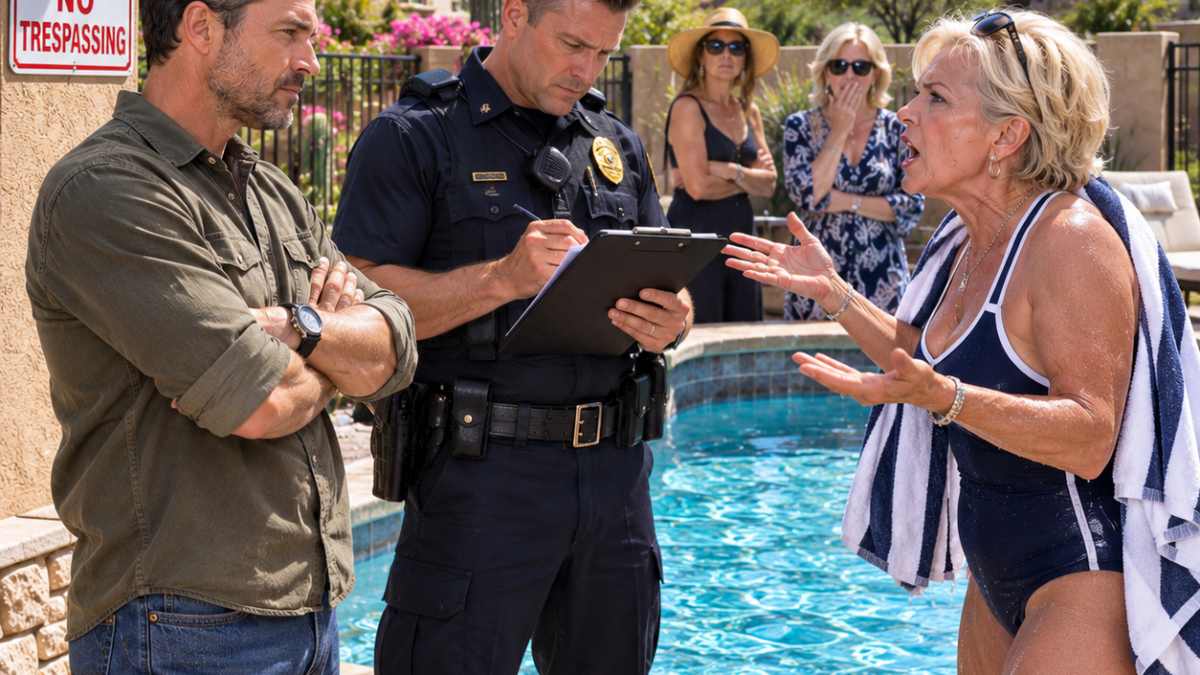
HOA Karen Kept Using My Private Pool Like It Was Hers—Then My Cameras Played the Evidence for the Entire HOA Board.
The HOA president kept letting herself into my locked backyard and using my private pool like it belonged to the neighborhood, even after I sent her the exact covenant proving she had no right to enter.
I could have confronted her, chained the gate, or turned the whole thing into a screaming match, but instead I installed legal cameras, posted clear NO TRESPASSING signs, and waited for her to make the next move herself.
And when my phone buzzed one Friday afternoon and showed Karen Baxter standing waist-deep in my pool beneath two cameras she already knew were there, I realized I finally had something stronger than an argument.
My name is Trevor Lang.
I was forty-one when this happened, and I lived in Desert Ridge Estates, a quiet HOA neighborhood on the edge of the Arizona desert.
Tan stucco houses.
Red tile roofs.
Tall saguaro cactus beyond the walls.
Mountains that turned purple in the evening.
Hot summers that made you understand why everybody who could afford a pool wanted one.
I bought my house for one reason more than any other.
The backyard.
Specifically, the pool.
It was not huge.
No waterfall.
No swim-up bar.
No fancy infinity edge.
Just a rectangular private pool behind a six-foot block wall with a shaded patio, two lounge chairs, and enough room to swim laps before the desert heat became unreasonable.
To me, it was perfect.
I worked from home as a software tester.
Most days I spent eight or nine hours staring at screens, reproducing bugs nobody else wanted to believe existed.
Click.
Document.
Repeat.
By late afternoon, my brain usually felt like static.
The pool fixed that.
Every morning around six, before the neighborhood really woke up, I swam.
Twenty laps.
Sometimes thirty.
No music.
No conversation.
Just water.
I kept the pool clean myself.
Checked chlorine.
Brushed tile.
Emptied baskets.
Covered the furniture when the monsoon wind started kicking dust over the wall.
And I kept the side gate locked.
Not because I was antisocial.
Because a pool is a liability.
PART2:
Especially in a neighborhood with children.
My homeowner’s insurance required proper fencing and a self-latching gate.
I took that seriously.
The pool was my responsibility.
Which meant access was my responsibility too.
Our HOA president, Karen Baxter, apparently had a different philosophy.
Karen was in her early sixties.
Short white-blond hair.
Bright lipstick.
Large sunglasses.
And a voice that seemed permanently set two levels above whatever volume the room required.
She had been HOA president for almost two years.
At first, I barely noticed her.
She sent newsletters.
Reminded everyone about trash-can placement.
Organized a community yard sale.
Argued about palm-tree trimming.
Standard HOA stuff.
Then I started noticing strange things around the pool.
The first was a towel.
Blue and white striped.
Folded badly across one of my lounge chairs.
Not mine.
I lived alone.
I stared at it for a minute, trying to remember whether a friend had left it.
Nobody had been over.
I assumed wind had somehow carried it.
That explanation made no sense, but it was easier than assuming somebody had entered my yard.
A few days later, I found wet footprints on the deck.
Not mine.
They led from the pool toward the side gate.
Then there was a floating toy.
A little yellow foam ring.
I had never bought it.
I thought maybe a neighborhood kid had climbed the wall.
That bothered me.
A lot.
I walked the perimeter.
No broken fence.
No damaged lock.
Nothing.
I checked the side gate.
Still latched.
For a week, nothing else happened.
Then one Wednesday afternoon, I came home from a dentist appointment and found sunscreen on the pool steps.
Half-empty bottle.
SPF 30.
Definitely not mine.
I stood there staring at it.
Then remembered the doorbell camera.
My camera did not point directly into the backyard.
It covered the driveway and part of the side walkway.
I opened the app.
Scrolled backward.
12:07 p.m.
Motion.
Karen Baxter walked into frame.
Two women followed her.
One carried towels.
The other carried a canvas tote.
Karen reached the side gate.
She opened it.
Just opened it.
I replayed the clip.
The landscaping company had serviced the yard that morning.
Apparently one of the workers had not fully latched the gate after leaving.
Karen noticed.
Instead of closing it, she walked through.
Her friends followed.
Forty-eight minutes later, they came back out.
Hair wet.
Towels over shoulders.
Laughing.
Karen shut the gate behind them.
I watched the clip twice.
Then a third time.
My first reaction was disbelief.
My second was anger.
The casualness bothered me more than anything.
They were not sneaking.
They were not looking around.
Karen walked into my backyard like she had done it before.
I saved the video.
Then walked to her house.
Karen lived three streets over in one of the larger corner homes.
I knocked.
She opened the door wearing reading glasses.
“Trevor.”
“Hi, Karen.”
“What can I do for you?”
“I saw you in my pool today.”
She did not blink.
Not even a little.
Instead, she took off the glasses.
“Yes.”
The answer caught me off guard.
“You went into my backyard.”
“I was checking the pool area.”
“With two friends?”
Her expression changed slightly.
“They’re both residents.”
“That doesn’t answer the question.”
She folded her arms.
“As HOA president, I have responsibility for community safety.”
“My pool is private.”
“All pools affect community safety.”
“Not like that.”
She sighed.
“Trevor, we periodically observe pool conditions.”
“From inside the water?”
Her face tightened.
“You’re being dramatic.”
“I have video.”
“I’m sure you do.”
“You entered without permission.”
“The gate was open.”
“That is not permission.”
Karen waved one hand.
“This neighborhood has standards. Pools need to be maintained.”
“My pool is maintained.”
“Then you have nothing to worry about.”
I looked at her.
“That is not how private property works.”
She smiled in that patronizing way people do when they think the conversation is already over.
“I’ve been doing this much longer than you’ve lived here.”
“Doing what?”
“Managing this community.”
“You don’t manage my backyard.”
Her eyes narrowed.
“Read your covenants.”
“I will.”
I went home and did exactly that.
Not skimmed.
Read.
All of them.
Declarations.
Architectural rules.
Pool requirements.
Inspection provisions.
Enforcement procedures.
The HOA had certain rights to inspect visible exterior conditions.
It could inspect portions of a lot for compliance after proper written notice.
There were procedures.
Notice periods.
Purpose statements.
No language allowed the president to let herself through a private locked gate whenever she wanted.
Nothing gave her permission to swim.
I printed the relevant sections.
The next morning, I wrote Karen a calm letter.
Not angry.
Not threatening.
I quoted the inspection language.
I stated that my pool and fenced backyard were private property.
I told her she did not have permission to enter except where legally authorized after proper notice.
I asked that she not enter again.
Certified mail.
Email copy.
Board copied.
I also checked my homeowner’s insurance policy.
The pool requirements were clear.
Secure fencing.
Self-latching gate.
Reasonable precautions against unauthorized access.
That made the situation more serious.
If Karen entered with friends and someone got hurt, I could end up dealing with an insurance nightmare involving people I had never invited.
This was not just about privacy.
It was about liability.
Karen never answered my letter.
For six days, nothing happened.
Then I came outside one evening and found two foam noodles beside the pool.
Pink and green.
A sunscreen bottle sat near the steps.
There was an empty sparkling-water can on my patio table.
I checked the camera.
Karen again.
This time with one neighbor.
They had entered around 1:15.
Stayed for more than an hour.
Karen had even brought a cooler.
I sat at my desk watching the recording.
She had received my letter.
The certified-mail tracking showed delivery.
There was no misunderstanding anymore.
She knew I objected.
She came anyway.
I called an attorney.
Not because I wanted to sue.
Because I wanted to know what I could legally do.
His name was Daniel Cho.
I explained the pool.
The gate.
The videos.
The HOA rules.
He asked a few questions.
“Any audio recording inside the backyard?”
“Not yet.”
“Any cameras inside the home?”
“No.”
“Any expectation the yard is visible from neighbors?”
“Parts of it from second stories, but it’s fenced.”
He told me I could install visible security cameras on my property so long as I complied with applicable law and did not point them into private areas of neighboring homes.
“Don’t try to create a trap that could hurt somebody.”
“I wasn’t planning to.”
“Good.”
“No wires?”
“No.”
“Sprinklers?”
“No.”
“Guard dog?”
“I don’t have a dog.”
“Then what exactly are you planning?”
“Visibility.”
He paused.
“I like visibility.”
I upgraded the side gate.
Self-latching lock.
Better hardware.
I added a motion light.
Then installed two cameras.
One covered the side gate.
One covered the pool deck.
Both were obvious.
No hidden lens.
No tricks.
The camera near the gate had an indicator light.
I also put up signs.
PRIVATE PROPERTY.
PRIVATE POOL.
NO TRESPASSING.
AUTHORIZED GUESTS ONLY.
Everything clear.
Everything visible.
I took photographs of the setup.
Saved receipts.
Sent Karen another short notice.
Security measures have been installed. You do not have permission to enter the backyard or use the pool.
No reply.
My next-door neighbor, Mrs. Teague, noticed the new cameras.
Mrs. Teague was seventy and spent more time tending roses than most people spend at a full-time job.
She saw everything that happened on our side of the street.
“Trouble?” she asked.
“Somebody keeps entering the pool.”
She raised one eyebrow.
“I know.”
I looked at her.
“You know?”
She clipped a dead rose.
“Karen.”
“How?”
“I’ve seen her.”
“You could have told me.”
“I assumed you knew.”
I almost laughed.
Apparently half the neighborhood assumed Karen had permission to use my pool except me.
Mrs. Teague leaned closer.
“She told Marsha those signs don’t apply to her.”
“What?”
“She said, ‘Signs don’t stop me. I make the rules here.’”
I closed my eyes for a second.
“Did she actually say that?”
“Word for word.”
“Would you be willing to say that if somebody asks?”
Mrs. Teague straightened.
“I’m seventy years old, Trevor. I stopped being afraid of neighborhood politics sometime during the Bush administration.”
Fair.
Friday afternoon, I was inside working.
A landscaping crew came through the front.
They trimmed the small trees along the side yard.
About twenty minutes after they left, my phone buzzed.
BACKYARD MOTION.
I looked at the screen.
Karen.
I sat completely still.
The side gate had not latched.
Again.
Karen walked in.
Alone this time.
Navy swimsuit.
Large sunglasses on her head.
White towel over one shoulder.
She looked directly at the NO TRESPASSING sign.
Then opened the gate.
That detail mattered.
She saw it.
She went through anyway.
Karen laid her towel on my lounge chair.
Put a bottle of water on the table.
Then stepped into my pool.
I was fifteen feet away inside my kitchen.
She had no idea.
I could have walked outside.
Could have shouted.
Could have told her to get out.
Instead, I opened the camera app.
Saved the clip.
Checked both cameras.
Then called the police non-emergency number.
“I have someone trespassing in my backyard.”
“Is the person threatening you?”
“No.”
“Do you know who it is?”
“Yes.”
“Are you inside the home?”
“Yes.”
“Stay inside unless you need to protect yourself.”
“No problem.”
“Do not confront her.”
“That’s exactly why I’m calling.”
About twelve minutes later, Officer Vance arrived.
I met him at the front door.
He was probably in his mid-thirties.
Calm.
Not impressed by drama.
“Person still back there?”
“Yes.”
“You know her?”
“HOA president.”
He gave me a look.
“That’s a new one.”
I handed him a folder.
Deed.
HOA covenant section.
My written notice.
Certified-mail receipt.
Previous clips.
Insurance pool requirements.
Officer Vance flipped through everything.
“You came prepared.”
“I test software for a living.”
“What does that have to do with this?”
“Documentation becomes a personality disorder after a while.”
He almost smiled.
Then asked:
“Did you invite her today?”
“No.”
“Ever give her general permission?”
“No.”
“Is she claiming HOA authority?”
“Yes.”
“Any emergency?”
“No.”
He nodded.
We went around the side.
Karen was standing waist-deep in the pool.
She turned.
Saw the officer.
Then me.
Her expression changed instantly.
“What is this?”
Officer Vance stayed near the gate.
“Ma’am, would you please step out of the pool?”
Karen looked at me.
“You called the police?”
“Yes.”
Her face flushed.
“This is ridiculous.”
Officer Vance repeated:
“Please step out.”
She climbed the steps.
Grabbed her towel.
Wrapped it around herself.
“I’m Karen Baxter. I’m HOA president.”
Vance nodded.
“Okay.”
“I was conducting an inspection.”
He looked at the lounge chair.
Then the water bottle.
Then the towel.
“An inspection?”
“Yes.”
“Mr. Lang says you don’t have permission to enter.”
“I don’t need personal permission to inspect HOA property.”
I spoke.
“My pool is not HOA property.”
Karen snapped:
“I didn’t say it was HOA property.”
Officer Vance looked between us.
“Do you have written authority allowing you to enter this fenced backyard without notice?”
Karen crossed her arms.
“It’s in the governing documents.”
I handed Vance the relevant section.
“I printed it.”
He read.
Then looked at Karen.
“This says inspections require notice.”
“Under normal circumstances.”
“What emergency exists today?”
“Pool safety.”
Vance looked at the crystal-clear water.
Then at the locked gate hardware.
“Is there a reported hazard?”
“No.”
“Complaint?”
“Not exactly.”
“So you entered for a routine inspection?”
“Yes.”
“Without written notice?”
Karen’s mouth tightened.
“HOA presidents have discretion.”
Vance shook his head.
“Being HOA president doesn’t give you general permission to enter private property.”
Karen pointed at me.
“The gate was open.”
Officer Vance looked at her.
“An unlocked or open gate is not the same as permission.”
I said nothing.
That was exactly why I had called instead of arguing.
Karen turned toward me.
“You set this up.”
“No.”
“You knew the landscapers left the gate open.”
“I found out when the camera alerted.”
“This is a trap.”
“The signs were visible.”
She looked at them.
PRIVATE PROPERTY.
NO TRESPASSING.
Officer Vance asked me:
“Do you want her formally trespassed?”
“Yes.”
Karen stared.
“You cannot trespass an HOA officer.”
Vance pulled out his notepad.
“Actually, he can withdraw permission for you to enter private property unless you have some independent legal authority.”
“I do.”
“Then you can have your attorney address that.”
He wrote.
“For now, I’m issuing a written trespass warning.”
Karen’s face went red.
“If you knowingly enter again without permission or lawful authority, further enforcement may follow.”
“This is humiliating.”
Officer Vance stayed calm.
“I’m not responsible for how this feels. I’m responsible for documenting the complaint.”
Mrs. Teague was on her porch.
Glass of iced tea in her hand.
She lifted it slightly toward me.
I tried not to smile.
Karen saw her.
That made everything worse.
She grabbed her things.
Walked through the gate.
Then turned.
“This is not over.”
Officer Vance looked up from his notepad.
“Ma’am.”
She stopped.
“I would strongly suggest not making statements that sound threatening immediately after receiving a trespass warning.”
Karen stared at him.
Then walked away.
That evening, I filed a formal complaint with the HOA board.
Not a neighborhood social-media rant.
Not gossip.
Official complaint.
Dates.
Videos.
Copies of my letters.
Trespass warning.
Relevant covenant provisions.
Insurance requirements.
I asked for mediation.
I specifically wrote:
I do not seek retaliation against Ms. Baxter. I seek a clear written boundary regarding private-property inspections and pool access.
Three days later, Karen fined me.
EXCESSIVE POOL NOISE.
$250.
Violation time:
6:05 a.m.
I stared at the notice.
I swim laps at six.
Alone.
No music.
No parties.
No pumps running unusually.
Just me swimming.
The next morning, another notice.
NUISANCE WATER ACTIVITY.
$150.
I laughed.
Not because it was funny.
Because retaliation was now so obvious that it was becoming easy to document.
I filed an appeal.
Included camera footage showing me swimming quietly.
Included time stamps.
I even included a decibel reading from my phone.
Not scientifically perfect.
But enough to show there was no loud event.
The HOA property manager contacted me.
Her name was Emi Ishikawa.
Unlike Karen, Emi worked for the management company rather than serving as an elected homeowner.
She called.
“Mr. Lang?”
“Yes.”
“I’m reviewing your appeal.”
“Thank you.”
“I also reviewed the original trespass complaint.”
Pause.
Then:
“This appears to be a pattern.”
“That’s my concern.”
“I cannot make board decisions myself.”
“I understand.”
“But I am recommending the board review both the entry issue and the subsequent fines.”
“Are the fines supported?”
“I cannot find a factual basis for them.”
“Good.”
She sounded tired.
“Mr. Lang, I need to ask something.”
“Sure.”
“Do you have complete copies of the original camera recordings?”
“Yes.”
“Not edited clips?”
“Yes.”
“Please preserve them.”
“I already have cloud backups.”
Another pause.
“You really are a software tester.”
“That obvious?”
“Yes.”
She almost laughed.
The next board meeting was packed.
Word had spread.
Not from me.
Probably impossible to keep a police warning involving the HOA president quiet.
I arrived with my folder.
Mrs. Teague arrived with hers.
I did not know she had a folder.
“What’s that?”
“Notes.”
“Since when do you take notes?”
“Since Karen started walking into everybody’s yards.”
I looked at her.
“Everybody?”
Mrs. Teague gave me a look.
“We’ll get to that.”
The board had five members.
Karen sat in the center.
Emi Ishikawa sat at one end with the management company’s records.
Mr. Brandt, one of the older board members, handled the complaint presentation.
He was careful.
“This is not a trial.”
Nobody laughed.
“We are reviewing potential violations of board authority and possible retaliation involving a homeowner.”
Karen leaned into the microphone.
“I object to the characterization.”
Brandt nodded.
“Your objection is noted.”
He displayed the first video on a large screen.
Karen walking through my side gate.
Two friends behind her.
Residents murmured.
Second clip.
Karen carrying a cooler.
Third.
Friday.
NO TRESPASSING sign visible.
Karen looking directly at it.
Opening the gate.
Walking in.
Laying down her towel.
Entering the pool.
The room became very quiet.
Karen leaned forward.
“This footage is invasive.”
Brandt asked:
“Was the camera on Mr. Lang’s property?”
“Yes.”
“Was it aimed at your home?”
“No.”
“Was it hidden?”
“No.”
“Then we’ll address camera policy separately if needed.”
He turned to the covenant.
“Do you dispute that private-lot inspections require notice?”
Karen answered:
“Not all inspections.”
“Which exception applied?”
“Safety.”
“What immediate hazard did you identify?”
“Swimming pools are inherently hazardous.”
Brandt looked at her.
“That is not the question.”
Karen’s voice rose.
“I am responsible for this community.”
Brandt remained calm.
“By entering private property without notice?”
Her mouth opened.
Then closed.
Mrs. Teague raised her hand.
Brandt recognized her.
She stood.
“I’ve seen Karen enter other yards too.”
The room shifted.
Karen turned sharply.
“That is false.”
Mrs. Teague stared back.
“I watched you go into the Parkers’ side yard when they were in Colorado.”
“That was architectural inspection.”
“No notice.”
“How would you know?”
“I collect their mail when they travel.”
A few people laughed.
Mrs. Teague continued.
“I saw you enter the Alvarez yard twice.”
Karen’s face tightened.
“They had weeds.”
“Did weeds invite you in?”
More laughter.
Brandt raised his hand.
“Please.”
Mrs. Teague sat.
Then Emi spoke.
“The management records do not show written inspection notices corresponding to several of the dates residents have now reported.”
Karen looked at her.
“You work for the board.”
“I work for the association.”
“Same thing.”
“No.”
Emi’s tone stayed professional.
“They are not always the same thing.”
That line landed hard.
Then came my fines.
Brandt displayed the excessive-noise notice.
6:05 a.m.
Then camera footage.
Me swimming laps.
No music.
No guests.
No shouting.
Brandt looked at Karen.
“What observation supported the violation?”
Karen shuffled papers.
“Multiple residents complained.”
“Names?”
“Complaints can be confidential.”
“Were complaints submitted through the management system?”
Emi answered.
“No.”
Karen glared at her.
Brandt continued.
“Any written complaint?”
Karen said nothing.
“Any decibel measurement?”
“No.”
“Any staff observation?”
“No.”
“Then what supported the fine?”
Karen looked at me.
“Mr. Lang has been hostile to association authority.”
Brandt leaned back.
“That is not evidence of pool noise.”
The room went silent again.
I had expected anger.
Maybe shouting.
Instead, something much more damaging happened.
Karen ran out of explanations.
Every excuse required another document she did not have.
Every claim reached a point where somebody asked:
Where is that written?
Who authorized it?
When was notice sent?
Who complained?
And she had nothing.
Eventually, Brandt looked toward the other board members.
“We need to deliberate.”
Karen snapped:
“I am president.”
“Yes.”
“You cannot deliberate about me as though I’m not here.”
“We can deliberate about alleged misconduct by any officer.”
“This is absurd.”
Emi quietly pushed a copy of the bylaws toward Brandt.
Karen saw it.
That was when I realized the meeting had changed.
For years, Karen had relied on people not checking.
Now everyone was checking.
The board recessed.
Residents started talking quietly.
Mrs. Teague leaned toward me.
“You look pale.”
“I’m fine.”
“You’re terrible at lying.”
“I test other people’s systems.”
“Apparently not your own face.”
Twenty minutes later, the board returned.
Brandt spoke.
First, my fines were rescinded.
Both.
No evidence supported them.
Second, the board formally censured Karen for entering my property without required notice or permission.
Third, Karen’s unilateral authority to conduct inspections or direct compliance entry was suspended.
Any future inspection of private property had to be coordinated through the management company and follow written notice requirements.
Fourth, the board required governance training for all officers.
Then Brandt looked directly at Karen.
“Finally, we are asking you to step aside as president during an independent review of prior inspection practices.”
Karen stared at him.
“Are you removing me?”
“We are requesting temporary recusal.”
“I refuse.”
One board member spoke.
“Then we will vote.”
Karen looked around.
One by one, the board members raised their hands.
She lost.
Not permanently that night.
But she lost the presidency while the review continued.
Karen stood.
Gathered her papers.
Looked at me.
I expected anger.
Instead, she looked exhausted.
She left without saying anything.
Three days later, someone knocked on my door.
Karen.
No folder.
No sunglasses.
Plain jeans.
White blouse.
She held an envelope.
I opened the door but did not invite her inside.
“Trevor.”
“Karen.”
She handed me the envelope.
Inside was a handwritten letter.
Not typed.
Not HOA letterhead.
I read the first sentence.
I owe you an apology.
I looked up.
Karen said:
“I crossed a line.”
“Yes.”
“I convinced myself that because I was responsible for compliance, access was part of the job.”
“It wasn’t.”
“I know.”
She looked toward the side yard.
“The police officer made that very clear.”
I almost smiled.
She held another paper.
“A check.”
“For?”
“The gate lock and cameras.”
“You don’t have to reimburse cameras.”
“I know.”
“Why?”
“Because you installed them after I ignored your first letter.”
I looked at the amount.
It matched my receipts closely.
“Did the board require this?”
“No.”
I studied her.
Then accepted it.
“Thank you.”
She seemed surprised.
“You’re accepting it?”
“Yes.”
“I thought you might want something else.”
“What?”
“I don’t know.”
“Punishment?”
She did not answer.
I folded the apology.
“I want the boundary respected.”
Karen nodded.
“I understand.”
“Do you?”
“I think I do now.”
I pointed toward the sidewalk.
“You are welcome to wave hello anytime from there.”
For the first time in weeks, Karen laughed.
Small.
Embarrassed.
“That seems fair.”
The independent review found several instances where Karen had treated inspection authority too casually.
Not every incident was malicious.
Some homeowners had invited her onto their property.
Some misunderstandings involved unlocked side yards during architectural reviews.
But there were enough undocumented entries that the board decided the policy needed rewriting.
Karen eventually resigned as president rather than seek reinstatement.
She remained a homeowner.
That mattered to me.
She did not vanish.
I still saw her collecting mail.
Walking in the evening.
Going to board meetings occasionally.
We were not friends.
But we were not at war either.
The HOA adopted a clear inspection rule.
Forty-eight hours written notice for routine inspections involving entry onto a private lot.
Emergency exception only for genuine immediate safety issues.
No routine interior access.
No pool entry.
No officer improvising rules.
All inspection requests had to go through management.
The revised policy went into the newsletter.
Plain English.
Mrs. Teague read it twice.
Then brought it to my porch.
“Look.”
“I’ve seen it.”
“It says private property.”
“Yes.”
“Twice.”
“I noticed.”
She smiled.
“Progress.”
The strangest part came a month later.
I proposed a neighborhood pool-safety day.
The idea surprised everyone.
Including me.
The whole problem started because Karen kept talking about safety while ignoring actual boundaries.
I wanted to separate the two concepts.
Pool safety was real.
Trespassing was not safety.
So I hired a certified lifeguard and swim instructor for an afternoon.
The HOA agreed to use the community clubhouse pool.
Families came.
Kids.
Parents.
Grandparents.
The instructor covered:
Gate security.
Child supervision.
Basic rescue techniques.
Why adults should not jump into water blindly during emergencies.
How to recognize drowning, which often looks quieter than people expect.
CPR information.
Local training resources.
No speeches about Karen.
No dramatic references to my backyard.
Just useful information.
Dozens of neighbors attended.
Mrs. Teague sat under an umbrella drinking iced tea.
Of course.
Halfway through, I noticed Karen.
Back row.
Plain clothes.
No board badge.
No clipboard.
She stayed through the entire session.
Afterward, she approached.
“That was good.”
“Thanks.”
“I learned something.”
“What?”
“I thought drowning would be louder.”
“So did I.”
She nodded toward the instructor.
“Maybe we should have done something like this years ago.”
“Maybe.”
Then she said:
“I really did think I was protecting people.”
I looked at her.
“I believe that you believed that.”
She winced.
“That sounded carefully worded.”
“It was.”
We both smiled slightly.
Then I added:
“Intent doesn’t replace permission.”
“I know.”
That was enough.
My pool went back to being what I bought it for.
Quiet.
Private.
Morning laps.
The first few weeks after everything settled, I still looked at the camera every time my phone buzzed.
Usually:
Bird.
Wind.
Delivery driver passing along the side.
Once, Mrs. Teague’s cat.
No Karen.
No unauthorized swimmers.
No mystery towels.
The gate stayed locked.
Insurance stayed happy.
I eventually reduced the motion sensitivity because every desert rabbit seemed determined to notify me at two in the morning.
One Saturday, Mrs. Teague leaned over the wall.
“Pool open?”
I looked at her.
“You asking permission?”
She grinned.
“See? I’m learning.”
I invited her over.
She did not swim.
She sat in the shade with iced tea while I cleaned the filter.
“This is nice,” she said.
“What?”
“Being invited.”
I laughed.
“Apparently that’s the secret.”
People later called what I did a camera trap.
I never liked that phrase.
A trap suggests deception.
There was no deception.
The cameras were visible.
The signs were obvious.
Karen knew I objected.
She had my letter.
She knew the gate led to private property.
She looked directly at the NO TRESPASSING sign before walking through.
I did not lure her.
I stopped arguing.
That was different.
Every earlier conversation had gone the same way.
I said:
Private property.
Karen said:
HOA authority.
I quoted rules.
She dismissed them.
I said no.
She behaved like no was negotiable.
The cameras changed the nature of the dispute.
No memory contest.
No:
I thought he gave permission.
No:
The gate was open.
No:
It was only an inspection.
Video showed:
She entered.
She saw the sign.
She brought a towel.
She entered the water.
She stayed.
Then a police officer arrived and asked the simplest question possible:
Do you have legal authority to be here?
Everything else became noise.
I learned something else too.
Documentation works best when it is boring.
Date.
Time.
Original file.
Certified receipt.
Policy section.
Insurance clause.
Police warning.
No dramatic captions.
No edited music.
No angry social-media posts.
I never posted the pool videos online.
Some neighbors asked.
I refused.
Karen had done something wrong.
That did not mean I needed to turn her into entertainment.
The board needed the video.
Police needed it.
My attorney needed it.
The neighborhood did not need slow-motion footage of a sixty-year-old woman climbing out of a swimming pool.
That would have changed the story.
I wanted boundaries.
Not humiliation.
The retaliation fines taught me another lesson.
When somebody loses control of one lever, they may reach for another.
Karen could no longer pretend I had never objected.
So suddenly my quiet morning swim became “excessive noise.”
If I had answered with anger, she might have gained something useful.
Instead, I appealed.
Footage.
Timestamp.
No guests.
No music.
No evidence.
The fine collapsed under its own weight.
Mrs. Ishikawa later told me that was part of why the management company became concerned.
One disputed inspection could be misunderstanding.
Repeated entries after written objection plus unsupported fines immediately after a police warning looked very different.
Patterns matter.
Karen’s written apology stayed in my desk.
I never framed it.
Never showed it around.
A year later, I found it while looking for a warranty.
I read it again.
One sentence stood out.
I mistook responsibility for authority.
That was probably the most accurate thing she ever wrote about the entire situation.
Responsibility can make people feel entitled to act.
Especially when they have held a volunteer position for years and everybody around them stops questioning them.
But being responsible for community standards does not mean every private space becomes yours.
Being president does not make a backyard communal.
Safety does not erase consent.
Rules do not expand because somebody says them loudly.
One evening, almost a year after the first camera alert, I sat beside the pool watching the sun drop behind the mountains.
The water turned orange.
Then violet.
Then dark blue.
I had finished work early.
No bugs waiting in the test queue.
No board meeting.
No letters.
No fines.
The gate clicked shut behind me exactly the way it was supposed to.
I checked it once.
Habit.
Then sat down.
Across the wall, I heard Mrs. Teague talking to somebody.
Probably her roses.
A dog barked two houses away.
A car passed.
Ordinary neighborhood noise.
My phone buzzed.
Motion alert.
I looked.
Karen was walking along the sidewalk.
She slowed near my house.
For a second, I wondered what she would do.
Then she lifted one hand.
Waved.
From the sidewalk.
I laughed.
Raised my hand back.
She kept walking.
That was the boundary.
Clear.
Simple.
Respectful.
Nobody needed a camera to explain it anymore.
A few minutes later, I got into the pool.
Swam twenty laps.
No one interrupted me.
No one inspected me.
No one claimed the water belonged to the community.
When I finished, I rested both arms on the edge and watched the last light fade over the desert.
The entire fight had started because Karen believed authority meant she could cross any line she considered inconvenient.
It ended when those lines were finally written clearly enough that everyone had to see them.
Not just property lines.
Legal lines.
Personal lines.
The line between safety and control.
The line between inspection and trespassing.
The line between enforcing a rule and inventing one.
I never needed to outsmart Karen.
I did not need revenge.
I did not need to embarrass her.
I needed a locked gate.
A visible camera.
A written rule.
And enough patience to let the truth become boringly impossible to deny.
After that, my pool went back to being what it had always been.
Mine.
Not because I shouted louder than the HOA president.
Because eventually everyone looked at the same evidence and understood something that should have been obvious from the beginning.
A private gate is not a suggestion.
And neither is the word no.








