HOA Karen Kept Using Master Keys to Enter My SUV—So I Trapped Her Lexus Behind Steel Bollards and Let the Police Read Her Own Rulebook
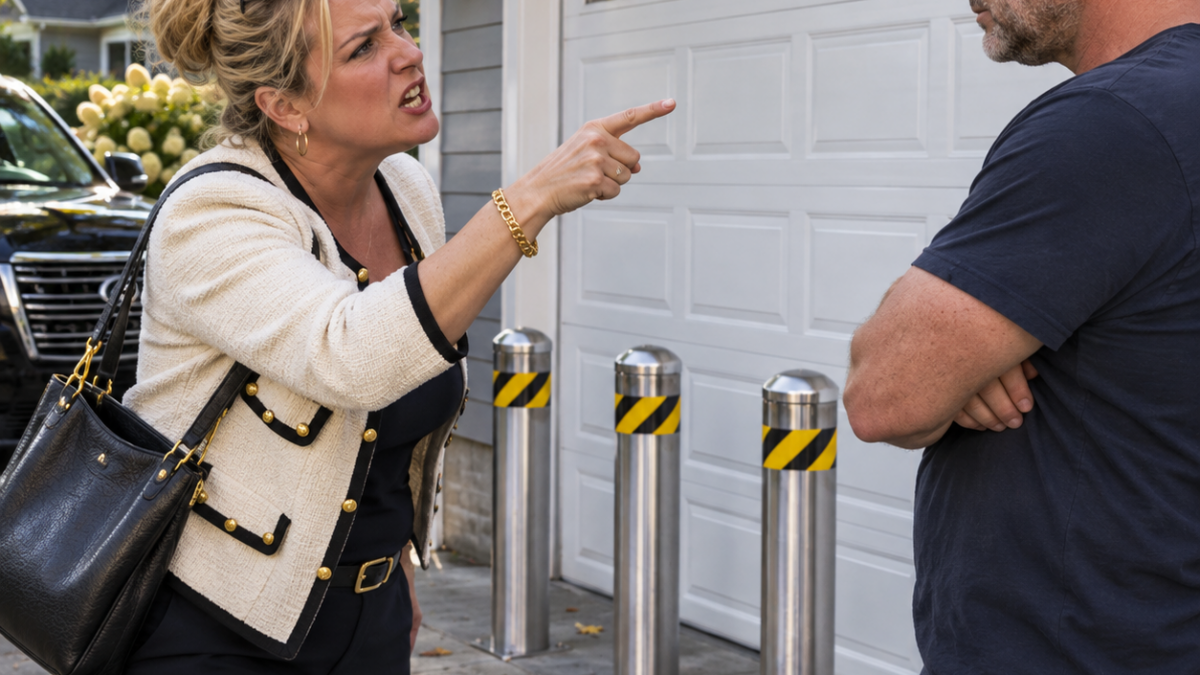
HOA Karen Kept Using Master Keys to Enter My SUV—So I Trapped Her Lexus Behind Steel Bollards and Let the Police Read Her Own Rulebook
Karen had spent three months insisting that her position as RCA chairwoman gave her the right to unlock my SUV, enter my garage, and inspect anything parked on my privately owned driveway, so when I installed three retractable steel bollards behind my gate, I did it to stop her from crossing a boundary she had already ignored half a dozen times.
Then one Saturday morning she drove her white Lexus onto my property, blocked my garage, tried my SUV door again, and never noticed the steel posts rising behind her until she climbed back into the driver’s seat and discovered she had no way out.
What Karen still did not know was that while she was screaming at me to “lower those damn posts,” six neighbors were already giving statements about missing garage remotes, copied registration papers, and unauthorized vehicle entries—and the police officer she summoned to arrest me was about to ask why her master key ring opened things she had no legal right to touch.
“LOWER THOSE DAMN STEEL POSTS, CONNOR!”
Karen Whitmore stood in the middle of my driveway with rain-gray clouds gathering behind her and a ring of maybe forty keys swinging from one hand.
Her white Lexus RX was parked directly in front of my garage.
Behind it stood three steel bollards.
Three feet tall.
Six inches thick.
Hydraulic.
Locked in the raised position.
Karen had not noticed them when she drove in.
She noticed them now.
“I’M THE RCA CHAIRWOMAN!”
She shouted the words toward my porch as though rank within a neighborhood association had suddenly become a branch of federal law enforcement.
“YOU CAN’T TRAP MY LEXUS ON COMMUNITY PROPERTY!”
I took another sip of coffee.
“Karen.”
“What?”
“You drove onto my driveway.”
“It’s an RCA access lane.”
“No.”
“You blocked my garage.”
“For an inspection.”
PART2:
“You tried to open my SUV again.”
She threw both hands up.
“That vehicle is in violation.”
“My vehicle is locked.”
“Exactly.”
I almost laughed.
“What exactly did you expect?”
Her face turned bright red.
“I expected you to follow community regulations.”
“Which regulation gives you the right to unlock private vehicles?”
“You know very well the RCA maintains inspection authority.”
“Show me.”
“I don’t have to show you anything.”
“That keeps coming up.”
She marched toward the bottom step.
“Lower those posts.”
“No.”
“Now.”
“No.”
“I will have you arrested.”
“You’ve already called the police on me because your master keys wouldn’t open my SUV.”
I looked at the ring in her hand.
“How did that work out?”
PART3:
Her jaw tightened.
Then she pulled out her phone.
“Fine.”
She dialed.
“I’m calling 911.”
I glanced at my watch.
8:14 a.m.
“Make sure you tell them whose driveway you’re standing in.”
She turned away from me.
That was where the confrontation looked ridiculous.
But it had not started with steel.
It had started exactly ninety-two days earlier at 7:12 on a Tuesday morning.
I remember the time because my security system timestamped everything.
My name is Connor Hale.
I was forty-six then.
I had been a deputy U.S. marshal for twenty-one years.
That fact matters to the story only because Karen kept trying to make it matter.
She believed my job was the reason people would eventually side with me.
It wasn’t.
Private-property records mattered.
Video mattered.
Witnesses mattered.
Her own documents mattered.
My badge mostly stayed inside the house.
Willowbrook Estates was supposed to be quiet.
That was why I bought there.
My wife, Megan, had died eighteen months earlier after a long fight with ovarian cancer.
Our twin sons, Ethan and Caleb, were fifteen.
Losing their mother had changed the rhythm of everything.
Before Megan got sick, our house had been noise.
Sports bags.
Friends.
Laundry.
Arguments over dishes.
Someone always looking for a charger.
Then cancer turned schedules into appointments.
Appointments into scans.
Scans into treatments.
Treatments into hospital nights.
After she died, quiet became dangerous.
The boys retreated differently.
Ethan ran.
Literally.
Cross-country.
Miles every morning.
Caleb disappeared into music and computers.
I worked too much.
We all became very good at functioning.
That was not the same thing as healing.
Six months after Megan’s funeral, I sold our old townhouse and bought a detached home in Willowbrook Estates.
Half-acre lot.
Two-car garage.
Trees behind the fence.
Good school district.
Long private driveway.
The neighborhood was governed by something called the Residential Community Authority.
RCA.
It functioned like an HOA.
Dues.
Common landscaping.
Pool.
Architectural rules.
Vehicle restrictions on public-facing common roads.
I read the documents carefully before buying.
Occupational hazard.
I deal with paperwork for a living.
The deed was simple.
My house was private.
Garage private.
Driveway private.
Six-foot strip along the curb subject to utility access.
Nothing unusual.
The RCA owned:
Clubhouse.
Pool.
Landscaped islands.
Private walking paths.
A narrow service road behind the tennis courts.
It did not own my driveway.
Karen Whitmore disagreed.
Karen was fifty-eight.
RCA board chairwoman for nine years.
Retired real-estate office manager.
She wore fluorescent safety vests whenever she conducted what she called “community inspections.”
Nobody had required a safety vest.
There were no construction zones.
No traffic control duties.
She simply liked the effect.
Clipboard.
Vest.
Master-key ring.
White Lexus.
That was her uniform.
The first time I met her, she stood on my front lawn and said:
“We do things a certain way here.”
I said:
“Good to know.”
She pointed at my black Chevrolet Tahoe.
“Government vehicle?”
“No.”
“What do you do?”
“I work for the Justice Department.”
Her eyes sharpened.
“What branch?”
“U.S. Marshals Service.”
That changed her posture immediately.
Not fear.
Interest.
“You’re a federal marshal?”
“Deputy U.S. marshal.”
She smiled.
“We like having law enforcement in the community.”
I should have corrected the way she said we.
Instead I said:
“I’m just a neighbor when I’m home.”
That was exactly how I wanted it.
Karen heard something else.
Useful.
For the next few weeks she mentioned my job to people I had never met.
At the pool:
“That’s Connor. He’s federal.”
At a board meeting:
“We have a U.S. marshal on Willow Court.”
At a neighborhood barbecue:
“Connor can probably confirm this.”
I began answering:
“No, Connor cannot confirm that.”
She did not enjoy that.
Then came 7:12 a.m.
I was in the kitchen making eggs.
Ethan was upstairs.
Caleb was looking for his math book.
My phone buzzed.
Motion alert.
DRIVEWAY — VEHICLE ZONE.
I opened the camera feed.
Karen stood beside my Tahoe.
Fluorescent vest.
Clipboard on the hood.
Key ring in hand.
She inserted a key into the driver’s door.
Turned.
Nothing.
Tried another.
Then another.
I stared at the screen.
Caleb walked in.
“What?”
“Stay inside.”
That got his attention.
“Why?”
“Just stay here.”
I stepped outside.
“Karen.”
She jumped.
Then turned as though I had interrupted her.
“Morning.”
“What are you doing?”
“Vehicle compliance inspection.”
“With a key?”
She looked down at the ring.
“Master access.”
“Take it out of my door.”
She sighed.
“Connor, your vehicle isn’t opening.”
“That is how locks work.”
“These keys open compliant vehicles.”
“No.”
“Yes.”
“No.”
Her mouth tightened.
“Authorized neighborhood vehicles are supposed to use standard access cylinders.”
That sentence was so strange I thought I had misheard.
“Authorized by who?”
“The RCA.”
“My Tahoe?”
“Anything subject to community inspection.”
“My private vehicle is not subject to your inspection.”
She tapped the clipboard.
“You have dark rear tint.”
“Factory tint.”
“There’s equipment inside.”
“Correct.”
“There may be prohibited storage.”
“Inside my SUV?”
“Yes.”
I stepped closer.
Not aggressively.
Enough that she removed the key.
“Do not touch my vehicle again.”
She lifted her chin.
“I’m doing my job.”
“You are attempting to unlock a privately owned vehicle without permission.”
“It is parked in a visible community space.”
“My driveway.”
“RCA-controlled frontage.”
“No.”
“Connor, do not abuse your government position with me.”
I almost laughed.
“I haven’t shown you a badge.”
“You told me what you are.”
“You asked.”
She pulled out her phone.
“This is intimidation.”
“Karen.”
“I’m calling police.”
I looked at her.
“For what?”
“Tampered locks.”
That was the first 911 call.
She did not whisper.
She stood directly in front of my house and said:
“I need police immediately.”
Pause.
“Yes, Willowbrook Estates.”
Pause.
“There’s a suspicious vehicle with altered locks.”
I leaned against the porch post.
The suspicious vehicle was mine.
The illegal alteration was a factory Chevrolet lock that would not open with Karen’s random key.
Two county patrol cars arrived about ten minutes later.
Deputy Aaron Salazar stepped out of the first.
Deputy Mike Brandt from the second.
Karen practically ran toward them.
“My master keys work on every authorized vehicle in Willowbrook.”
Salazar looked at the key ring.
“Ma’am.”
“Yes?”
“Why are you attempting to unlock somebody else’s vehicle?”
“Because I’m RCA board chairwoman.”
She said it as though the explanation had solved everything.
Brandt looked at me.
“You the owner?”
“Yes.”
“Vehicle registered to you?”
“Yes.”
“ID?”
I handed him my driver’s license.
He ran the plate.
Everything matched.
Then Karen interrupted:
“He has illegally altered the locking mechanism.”
Salazar looked at the Tahoe.
“How do you know?”
“My key won’t open it.”
Brandt actually looked away.
I could see him trying not to smile.
Karen continued.
“The RCA has master access.”
“Master access to what?”
“Our properties.”
Salazar asked.
She corrected:
“Community-regulated assets.”
“My car is not a community asset.”
I said.
She glared.
Salazar asked:
“Do you have paperwork authorizing entry into his vehicle?”
Karen pulled out her clipboard.
There were RCA forms.
Inspection notices.
Parking rules.
Nothing granting vehicle-entry authority.
Salazar read two pages.
Then:
“Ma’am, none of this says you can unlock private vehicles.”
“You’re taking his side.”
“I’m reading your own paper.”
Karen pointed at me.
“He’s federal.”
I closed my eyes.
Salazar looked at me.
“You law enforcement?”
“Yes.”
“What agency?”
“U.S. Marshals.”
I gave him credentials because he asked.
He checked.
Then returned them.
Karen folded her arms.
“See?”
Salazar looked confused.
“See what?”
“He’s using his position.”
Salazar shook his head.
“He answered my question.”
Then he pointed toward my Tahoe.
“You cannot enter this vehicle without the owner’s consent, a lawful authority, or an emergency.”
Karen said:
“I have RCA authority.”
“No.”
“Then what are my master keys for?”
Brandt answered:
“Honestly, ma’am, I’m wondering the same thing.”
That humiliated her.
I could see it.
She left before the deputies did.
I thought that would end things.
Instead, it started the campaign.
The next morning, a handwritten violation notice was tucked beneath my windshield wiper.
UNAUTHORIZED LOCK MODIFICATION.
FINE: $250.
I photographed it.
Sent it to the RCA management email.
Received no answer.
Two days later:
COMMERCIAL / GOVERNMENT VEHICLE PROHIBITED IN RESIDENTIAL AREA.
Fine:
$500.
The Tahoe was personally owned.
Not a government vehicle.
No markings.
No emergency lights.
No commercial registration.
I sent a certified dispute.
Karen denied it personally.
Her letter said:
Vehicle presents an appearance inconsistent with normal residential use.
I called the RCA attorney listed in the governing documents.
He told me he did not represent individual homeowners and could not advise me.
Fine.
I filed everything.
Then Karen went door-to-door.
A petition appeared.
REMOVE UNSAFE / NONCOMPLIANT VEHICLE FROM WILLOW COURT.
She collected fourteen signatures.
Three people later told me they thought they were signing a general parking petition.
One neighbor, Sam Rodriguez, came over embarrassed.
“She told me it was about abandoned cars.”
“My Tahoe moves every day.”
“I know.”
“Did you read it?”
“No.”
He rubbed his face.
“My wife already yelled at me.”
“Good.”
Sam smiled.
“She said you’d say that.”
The notices continued.
Then Karen crossed a line I could not ignore.
She approached Ethan and Caleb near the mailbox.
I learned about it because Ethan walked inside angry enough to slam the front door.
“What happened?”
“Your crazy HOA lady.”
“What did she do?”
“She stopped us.”
“Why?”
Caleb came in behind him.
“She said Dad is breaking community rules.”
Ethan continued.
“She said your vehicle could be removed.”
Caleb added:
“And that if we cooperate with community leadership there won’t be consequences.”
I stood.
“What consequences?”
“She didn’t say.”
I felt something cold settle in my stomach.
“Did she touch either of you?”
“No.”
“Block you?”
“No.”
“Threaten you?”
Ethan thought.
“Not exactly.”
Then:
“She said maybe if you were a better example we wouldn’t have to worry about community consequences.”
That was enough.
Not criminal.
Not dramatic.
Enough.
I walked to Karen’s house.
Did not wear a badge.
Did not carry credentials.
Did not record secretly.
I rang the bell.
Karen opened.
“What?”
“Do not approach my sons again.”
She crossed her arms.
“They are residents.”
“They are minors.”
“They were in a common area.”
“You spoke to them about an adult dispute.”
“They live in your household.”
“Karen.”
She smiled.
“Maybe if you were a better example, your children wouldn’t have to worry about community consequences.”
Word for word.
I stared at her.
Then said:
“Do not speak to my sons about me, my vehicle, fines, or RCA disputes again.”
“You don’t control community communications.”
“I control whether you are welcome interacting with my children.”
She rolled her eyes.
“Anything else?”
“Yes.”
“Stay off my driveway.”
She closed the door.
That night I reviewed every camera clip from the previous month.
Front door.
Garage.
Driveway.
Side yard.
Most were nothing.
Deliveries.
Birds.
Boys leaving school.
Me leaving for work.
Then I found Karen.
More than once.
6:31 a.m.
She walked halfway up the driveway and photographed the Tahoe VIN through the windshield.
3:18 p.m.
She tried the passenger door.
8:04 a.m.
She stood beside my garage keypad and photographed it.
Another day she crouched near my rear license plate.
Nothing clearly criminal in several clips.
But the pattern bothered me.
So I asked neighbors.
Carefully.
Not:
Has Karen stolen from you?
Instead:
“Has Karen ever entered your vehicle or garage without permission?”
Sam stared.
“Why?”
“Just answer.”
He thought.
“Vehicle?”
“Yes.”
“Once.”
“Explain.”
“She said she was checking parking permits.”
“Did she open it?”
“I thought my wife left it unlocked.”
“Was anything missing?”
Sam frowned.
“Garage remote.”
My stomach tightened.
“You reported it?”
“No.”
“Why?”
“Thought I lost it.”
Another neighbor, Ruth Coleman, said Karen had opened the passenger side of her Honda while it was parked outside.
“She said she needed the registration information for RCA records.”
“Did you give permission?”
“I thought the board could do that.”
“Why?”
“She told me.”
Ruth looked embarrassed.
“My registration was in the glove box.”
“Anything missing?”
“Two dollars in quarters.”
She laughed nervously.
“I didn’t blame her.”
Another resident, Greg Harmon:
Garage remote gone.
Another:
Registration paper had obviously been moved.
Another:
Nothing missing, but door found ajar.
Six households.
Maybe coincidence.
Maybe not.
I told each person:
“Write down what you remember.”
Not for me.
For themselves.
Dates if possible.
Photos.
Receipts for replacement remotes.
Do not exaggerate.
Do not coordinate stories.
Just document.
I also pulled RCA records.
The “master key” issue bothered me.
What were those keys?
Willowbrook homes were built over twenty years.
Different manufacturers.
Different car brands.
There was no legitimate key ring capable of opening every “authorized vehicle.”
That claim was nonsense.
Then Sam called.
“Connor.”
“Yeah?”
“You need to see something.”
He came over with an old RCA binder.
Previous board chair had given it to him years earlier when Sam served briefly on a parking committee.
Inside were forms for:
Pool gate keys.
Clubhouse storage.
Utility enclosures.
Mailbox cluster service.
No vehicle keys.
No garage keys.
No residential keys.
Karen’s ring was her own invention.
I began to suspect she had accumulated:
Old spare keys residents had turned over.
Keys copied during service projects.
Garage emergency keys.
Maybe random blanks.
Enough to create the appearance of authority.
Then came the wheel lock.
Thirty-dollar yellow clamp.
Cheap imported thing.
Attached to my front-left tire.
Large orange sticker on the windshield:
RCA IMPOUND NOTICE.
VEHICLE IMMOBILIZED FOR NONCOMPLIANCE.
RELEASE FEE: $350.
PAYABLE TO RCA ENFORCEMENT OFFICE.
I stood in the driveway staring at it.
Caleb came outside.
“Seriously?”
“Yes.”
“Can you cut it?”
“Yes.”
“Are you going to?”
“No.”
“Why?”
“Because I want photographs first.”
He smiled.
“You’re doing the work voice.”
“What voice?”
“The one where you sound calm and somebody is about to have a bad day.”
I photographed everything.
Then checked the camera.
7:12 a.m.
There she was.
Karen.
Fluorescent vest.
Clipboard.
Wheel clamp.
She knelt beside the Tahoe.
Installed it.
Stuck the notice on the windshield.
Then, unbelievably, tried the driver door again.
Three keys.
Nothing.
She looked around.
Walked toward the garage.
Tried the handle.
Locked.
Then examined the keypad.
My camera captured her face perfectly.
4K.
I called the non-emergency police line.
Same deputy, Salazar, eventually came.
He looked at the wheel clamp.
Then at me.
“I know.”
He sighed.
“She did this?”
I showed the video.
“Yes.”
He watched.
“Did she damage anything?”
“Not that I can tell yet.”
“Did you authorize immobilization?”
“No.”
“Any legitimate towing proceeding?”
“No.”
“RCA documents?”
I handed him the fake impound sticker.
He read it.
“Payable to RCA Enforcement Office.”
“There is no RCA Enforcement Office.”
He looked at me.
“You sure?”
“I called the management company.”
“They have no such department.”
Salazar took photographs.
Then said:
“You can remove it.”
“I’d rather she be asked to.”
“Fair.”
We went to Karen’s house.
She came outside furious.
“You called police over a compliance clamp?”
Salazar said:
“Ma’am, did you install this on Mr. Hale’s vehicle?”
“Yes.”
“Why?”
“Unpaid violation fines.”
“Do you have legal authority to immobilize private vehicles?”
“RCA enforcement authority.”
“Show me.”
She produced a rule allowing removal of abandoned vehicles from common parking areas after notice.
Salazar looked toward my house.
“That vehicle is on his driveway.”
“His frontage is subject to RCA jurisdiction.”
“Not according to the property record.”
“He’s manipulated the records.”
I almost smiled.
Salazar asked:
“Did you try to open his vehicle again?”
“No.”
I played the clip.
Karen’s face changed.
Salazar looked at her.
“That is you.”
“I was checking whether the notice was visible.”
“With a key?”
She said nothing.
Salazar made the report.
No arrest.
No grand scene.
He warned her again:
Stay off the property.
Do not touch the vehicle.
Karen removed the clamp herself.
She threw it into her Lexus.
Then looked at me.
“This isn’t over.”
I answered:
“I know.”
That afternoon, I called Ray Donnelly.
Ray had spent twenty-eight years installing hydraulic barriers for warehouses, municipal facilities, gated estates, and commercial loading yards.
We had worked together on a fugitive-security project years earlier.
I did not ask him for anything law-enforcement-related.
I asked:
“Do you install residential retractable bollards?”
He laughed.
“What kind?”
“The kind that stop a vehicle.”
“Yes.”
“How quickly?”
“Depends why.”
“Private driveway trespass.”
He became interested.
Two days later he visited.
Surveyed the property line.
Checked utility markings.
Drainage.
Driveway width.
I showed him exactly where I wanted them.
Three retractable steel bollards placed entirely inside my boundary.
Normally down.
Remote controlled.
Manual override.
Safety sensors.
Not hidden traps.
Not spikes.
Not something that would damage a vehicle driving normally.
Visible steel posts that rose only after the driveway was clear of the sensor zone.
I asked:
“Can somebody accidentally drive over them while they’re rising?”
“No.”
“Vehicle sensor prevents that.”
“Good.”
“Trying to catch somebody?”
“No.”
“Trying to stop somebody.”
He nodded.
“Better answer.”
I also installed a simple gate camera covering the entire driveway entrance.
And a sign:
PRIVATE DRIVEWAY — NO RCA VEHICLE INSPECTIONS — NO TRESPASSING.
Karen photographed it the same afternoon.
Three days later, the bollards were operational.
I used them mostly at night.
Boys loved them.
Ethan called them “Dad’s castle defenses.”
I said:
“They are driveway access control.”
Caleb answered:
“That is the least fun possible name.”
For twelve days, Karen stayed away.
Then Saturday morning arrived.
I was on the porch.
Coffee.
No uniform.
No government vehicle.
No badge.
Ethan at a cross-country meet.
Caleb asleep.
At 8:02, Karen’s Lexus turned onto my driveway.
I watched.
She drove past the private-property sign.
Stopped directly in front of the garage.
Got out.
Fluorescent vest.
Key ring.
Clipboard.
I did not move.
She walked to the Tahoe.
Tried the driver’s door.
Once.
Then again.
I said:
“Karen.”
She spun.
“You cannot keep doing this.”
“I’m conducting a compliance inspection.”
“No.”
“The board voted.”
“Show me.”
She held up a paper.
From twenty feet away, I could see it was an RCA violation sheet.
“Leave.”
“You’re refusing inspection?”
“Yes.”
“I’m documenting refusal.”
“Document yourself leaving.”
She photographed the Tahoe.
Then walked toward the garage.
“Karen.”
“What?”
“Get off my property.”
“You cannot restrict board access.”
“I already have.”
She reached for the garage handle.
That was enough.
I pressed the bollard remote.
Behind her Lexus, the three steel posts began rising.
Slowly.
Hydraulic hum.
Karen did not hear.
Or did not care.
They reached full height.
Locked.
She tried the garage handle.
Then returned to the Lexus.
Opened the driver door.
Got inside.
Reverse lights came on.
Then stopped.
She looked in the mirror.
Her head snapped around.
Door opened.
She stepped out.
And that brought us back to:
“LOWER THOSE DAMN STEEL POSTS, CONNOR!”
I stayed on the porch.
“Karen, you drove onto my property.”
“You trapped me!”
“No.”
“You entered through an open driveway.”
“You raised barriers behind me!”
“After you got out and started trying doors.”
“That is kidnapping!”
“No, Karen.”
“You are not inside the Lexus.”
She pulled out her phone.
911.
I let her.
The call went almost exactly the way I expected.
“My vehicle is trapped.”
Pause.
“By steel security barriers.”
Pause.
“No, I’m not inside.”
Pause.
“Yes, I can leave on foot.”
Pause.
“I need officers.”
She glared at me.
“They’re coming.”
“Good.”
Within fifteen minutes, Deputy Salazar arrived.
I nearly felt bad for him.
He stepped out.
Saw Karen.
Saw me.
Saw the Lexus.
Saw the bollards.
Closed his eyes briefly.
“Morning.”
Karen rushed him.
“He trapped my vehicle.”
Salazar looked at the posts.
“Is anyone trapped inside?”
“My Lexus.”
“That wasn’t my question.”
“He deliberately raised these.”
Salazar looked at me.
“Connor?”
“Yes.”
“Your property?”
“Yes.”
“Permit?”
I handed him the installation permit and survey.
He checked the boundary.
All three bollards were several feet inside my property line.
Karen said:
“He cannot block community access.”
Salazar looked toward the garage.
“What community access?”
“My inspection rights.”
He stared.
“We’ve discussed this.”
“She’s been trespassed from the property.”
I said.
Salazar nodded.
“Correct.”
Karen snapped:
“I have RCA master authority.”
He looked at her key ring.
Then something happened.
A second patrol car pulled up.
Officer Brandt.
Same officer from the first call.
He stepped out.
Saw Karen’s keys.
And laughed.
Not cruelly.
Just exhausted disbelief.
“Again?”
Karen pointed.
“This is harassment.”
Brandt looked at me.
“Did she enter your property?”
“Yes.”
“Video?”
“Yes.”
“Did she touch the vehicle?”
“Yes.”
“Video?”
“Yes.”
“Garage?”
“Yes.”
“Video?”
“Yes.”
Karen yelled:
“He’s recording me illegally.”
I said:
“Exterior security cameras.”
Brandt shrugged.
“Not illegal.”
Salazar asked:
“Will you lower the bollards?”
I said:
“After the trespass report is documented and she agrees not to return.”
Karen screamed:
“You cannot hold my property hostage!”
Salazar looked at me.
“Can you physically lower them?”
“Yes.”
“So there’s no mechanical issue?”
“No.”
“Any payment demand?”
“No.”
“Any condition besides her leaving?”
“No.”
He nodded.
Karen interrupted.
“He wants me to surrender RCA authority.”
I said:
“No.”
“I want you to obey the trespass notice.”
Salazar looked at Karen.
“Ma’am, he is allowed to control access to his private driveway.”
“What about my car?”
“You drove it there.”
“He raised the posts!”
“After you parked.”
“He has to let me out.”
Salazar looked at me.
“You are going to let the vehicle out, correct?”
“Yes.”
“Good.”
Then to Karen:
“And you are going to leave.”
She folded her arms.
“I am not leaving until he is cited.”
“For what?”
“Illegal restraint.”
“You were never restrained.”
“My vehicle was.”
“Vehicles do not have constitutional liberty interests, ma’am.”
Brandt coughed to hide a laugh.
Karen glared at him.
Then Salazar asked the question that shifted everything.
“Why were you here?”
“Inspection.”
“Of what?”
“The SUV.”
“Why?”
“Noncompliance.”
“Why were you trying to open it?”
Her face tightened.
“I wasn’t.”
I said:
“I have video.”
She turned toward me.
“You think cameras make you untouchable.”
“No.”
“They make timelines easier.”
Salazar asked:
“Connor, show me.”
I brought up the clip.
Karen.
Key into Tahoe.
Two attempts.
Then garage handle.
Salazar watched.
Brandt watched.
Karen said:
“I was verifying secure storage.”
Salazar turned.
“Secure storage of what?”
“Potentially restricted materials.”
He stared at her.
“What restricted materials?”
“I don’t know.”
“Then how do you have probable cause to search for them?”
She snapped:
“This isn’t police procedure.”
“No.”
Salazar said.
“It’s trespassing.”
That word landed.
Karen’s face changed.
Then a blue pickup stopped at the curb.
Sam Rodriguez stepped out.
Behind him, Ruth Coleman walked over from two houses down.
Then Greg Harmon.
I had not called them.
They had seen the police cars.
Sam said:
“Officer.”
Salazar turned.
“Yes?”
“I need to tell you something about those keys.”
Karen spun.
“Stay out of this.”
Sam stopped.
Then looked at Salazar.
“She’s opened my truck.”
Ruth said:
“Mine too.”
Karen stared.
Greg walked closer.
“My garage remote disappeared after she went through my SUV.”
Karen shouted:
“That is a lie.”
Salazar raised a hand.
“One at a time.”
Sam looked at me.
I said:
“Tell him what you know.”
Not what I suspected.
What he knew.
Sam described his truck.
Date range.
Missing remote.
Ruth described registration papers copied.
Greg described finding his door open.
Another neighbor, Denise Palmer, joined.
Then another.
Within twenty minutes, six people were standing near the sidewalk.
Karen looked at me.
“You organized this.”
“No.”
“You’ve been turning people against me.”
“I asked them questions.”
“You’re investigating me.”
“No.”
“I documented behavior on my property.”
Salazar asked:
“Ma’am, do those keys open residents’ vehicles?”
Karen said:
“They’re authorized access keys.”
“Authorized by whom?”
“The RCA.”
“Give me the board policy.”
She reached into her folder.
Nothing.
Then another sheet.
Parking rules.
Nothing.
Brandt asked:
“Where did the keys come from?”
Karen hesitated.
“Various community sources.”
“What does that mean?”
“Historical records.”
“Keys are not records.”
She looked angry.
“Residents provide access when necessary.”
Ruth said:
“I never gave you my car key.”
Sam:
“Neither did I.”
Greg:
“Mine sure wasn’t volunteered.”
Karen pointed at all of them.
“This is a coordinated attack.”
Salazar said:
“Karen.”
She stopped.
“I need you to hand me the key ring.”
Her eyes widened.
“No.”
“Why?”
“That is RCA property.”
“Then the RCA can document ownership later.”
“You cannot seize it.”
“At the moment, multiple people are alleging those keys have been used to enter private vehicles.”
“I’m requesting you preserve them while we sort this out.”
“No.”
She stepped backward.
Salazar’s voice changed.
“Do not put them in your pocket.”
Karen froze.
Brandt stepped closer.
“Ma’am.”
She handed them over.
That was the first moment she looked afraid.
Not angry.
Afraid.
Salazar bagged the ring.
Not as evidence in some dramatic felony arrest right there.
As property connected to multiple complaints requiring investigation.
Then he asked me:
“Lower the bollards.”
I pressed the remote.
The posts descended slowly.
Flush with the driveway.
Karen ran to the Lexus.
Opened the door.
Salazar stopped her.
“Before you leave.”
“What now?”
“You have been told more than once not to enter this property.”
“I have RCA rights.”
“You do not have rights to this driveway.”
“You were previously warned.”
“Today you returned and attempted vehicle entry.”
He issued a formal trespass notice.
In writing.
Karen refused to sign.
He wrote:
REFUSED.
Then handed her a copy anyway.
“You return without permission, it may result in arrest.”
She looked at me.
“This isn’t finished.”
I answered:
“No.”
“It isn’t.”
She drove away.
I thought the rest would be a neighborhood disciplinary mess.
Board hearing.
Maybe civil court.
It became considerably larger.
Not because I was a U.S. marshal.
Because of the keys.
Police photographed every one.
Some were ordinary house-key shapes.
Some were vehicle keys cut for older models.
Several had handwritten tags.
C-14.
R-7.
G-3.
One said:
PALMER GAR.
Another:
ROD TRK.
When Denise Palmer saw that photograph, she went white.
PALMER GAR.
Her garage.
She had never authorized Karen to possess a key.
Then came the garage remotes.
Greg’s missing opener had not simply disappeared.
Security footage from a grocery store parking lot showed Karen’s Lexus near his truck on the day he believed it vanished.
Not proof by itself.
But enough to deepen the investigation.
A search warrant was not obtained immediately.
People think law enforcement works like television.
One accusation.
Doors kicked.
Handcuffs.
No.
Statements.
Corroboration.
Serial numbers.
Key identification.
Security footage.
Property records.
Only then does something bigger happen.
The RCA board held an emergency meeting three nights after the Lexus incident.
Packed clubhouse.
Karen arrived without her fluorescent vest.
That alone made her look smaller.
She took the chairwoman’s seat.
Board vice president Daniel Cho opened the meeting.
“Before regular business, we need to address allegations concerning unauthorized entry.”
Karen interrupted:
“I will not participate in a witch hunt.”
Daniel looked at her.
“You are chairing an organization that may have property belonging to residents.”
“The keys were surrendered illegally.”
“They were surrendered to police.”
“Under coercion.”
“Then your lawyer can address that.”
Karen stared.
Daniel continued.
“We need to determine whether the RCA authorized vehicle inspections.”
Karen opened a binder.
“Yes.”
“Where?”
She read:
“The authority may inspect visible exterior conditions and enforce parking compliance.”
Daniel nodded.
“Visible exterior.”
“Correct.”
“Where does it say unlock vehicles?”
“It is implied.”
A homeowner shouted:
“No, it isn’t.”
Daniel raised his hand.
Quiet.
Then:
“Where does it say enter garages?”
Karen said:
“It doesn’t need to list every enforcement method.”
Treasurer Helen Moss spoke.
“I have been on this board seven years.”
Everybody turned.
“We have never voted to authorize entry into private vehicles.”
Karen’s expression hardened.
“You weren’t present for every enforcement committee action.”
“I’m the treasurer.”
“That has nothing to do with compliance.”
Helen opened a folder.
“I checked every budget.”
“There is no enforcement office.”
Murmurs.
Karen shifted.
Helen continued.
“There is no approved budget for master vehicle keys.”
More murmurs.
“There is no board resolution authorizing key collection.”
She looked directly at Karen.
“And there is no line item for the $350 release fees you have been collecting.”
I sat in the back.
That was new to me.
Someone shouted:
“What release fees?”
Helen held up copies.
“Three residents brought me payment receipts.”
Wheel clamps.
Fake impound stickers.
$250.
$300.
$350.
Payments.
Not always to the RCA account.
Several checks had been written to:
Willowbrook Compliance Services.
Nobody on the board recognized the company.
Karen did.
Her face showed it.
Daniel asked:
“What is Willowbrook Compliance Services?”
Karen replied:
“An enforcement contractor.”
“Who owns it?”
No answer.
“Karen.”
She stared.
“My sister manages it.”
The room erupted.
Daniel hit the table.
“Order.”
Helen said:
“The registered address matches Karen’s home.”
Silence.
I felt the room change.
This was not about my Tahoe anymore.
The board had a private enforcement operation collecting money from homeowners under the appearance of RCA authority.
Daniel asked:
“Did the board approve this vendor?”
Karen said:
“You all benefited from improved compliance.”
“That is not an answer.”
She stood.
“I will not be interrogated by amateurs.”
Then looked at me.
“This man has poisoned the community.”
I stayed seated.
Daniel said:
“Connor hasn’t spoken.”
Karen pointed.
“He’s a federal marshal.”
There it was again.
As though my job had secretly controlled the room.
I finally stood.
“My employment has nothing to do with your board records.”
“You used your connections.”
“No.”
“The same county deputies who came the first time came again because you kept calling them.”
Laughter.
Karen’s face went red.
I continued.
“I didn’t seize your keys.”
“I didn’t subpoena your bank records.”
“I didn’t write your rules.”
“And I didn’t start Willowbrook Compliance Services.”
She said nothing.
I sat down.
The board voted that night to suspend Karen’s chair authority pending investigation.
She called it illegal.
Then left.
The next morning, Helen Moss found something worse.
RCA electronic files contained vehicle-information spreadsheets.
License plates.
VINs.
Home addresses.
Names.
Insurance expiration dates.
Vehicle descriptions.
In some cases:
Garage remote model.
Door keypad type.
Spare-key note.
The spreadsheet columns did not look like normal parking enforcement.
They looked like access intelligence.
Helen called police.
Then called me.
I told her:
“Do not send the file to me.”
She sounded surprised.
“Why?”
“Because I’m a witness.”
“Give it directly to the investigators.”
That mattered.
I did not want anyone later claiming I had manipulated evidence through my job.
I recused myself from everything I possibly could.
My agency supervisor knew the situation.
I filed an internal notification because my credentials had become part of the original police contact.
Then I stayed out.
Two weeks later, officers executed a search warrant at Karen’s house and at a small rented storage unit connected to Willowbrook Compliance Services.
The neighborhood watched.
I did not.
I took Ethan and Caleb to breakfast.
When we came back, Sam was waiting.
“They found garage remotes.”
I stopped.
“How do you know?”
“Greg got a call.”
“How many?”
“Don’t know.”
That afternoon, investigators contacted affected residents.
The search reportedly recovered:
Vehicle registration photocopies.
Key blanks.
Several copied house and garage keys.
Garage-door remotes.
Violation-payment records.
Cash envelopes.
Clamp devices.
And folders organized by street.
My name was one.
HALE — WILLOW COURT.
Inside were printed photographs of my Tahoe.
Plate.
VIN.
Garage door.
Driveway.
Even one photograph of Ethan and Caleb walking home.
That one changed my reaction.
The boys had already lost their mother.
I had tolerated Karen’s nonsense because I believed adults could resolve it.
Seeing my children filed inside an enforcement folder made the situation different.
Not because a photograph in public was automatically criminal.
Because of context.
She had turned our household into a project.
Ethan stared at the photocopy.
“She was following us?”
“I don’t know.”
“Why does she have this?”
“I don’t know.”
Caleb looked at me.
“You always say that.”
“What?”
“Don’t know.”
I sat down.
“That’s because guessing makes fear worse.”
He hated that answer.
But it was true.
I told both boys:
“If investigators learn something we need to know, we’ll know.”
Ethan asked:
“Is she going to jail?”
“I don’t know.”
“There.”
“I know.”
For the first time in months, he smiled.
The criminal case developed slowly.
Karen was charged initially with trespass and several property-related offenses connected to specific incidents investigators believed they could prove.
Additional financial charges followed after records from Willowbrook Compliance Services were reviewed.
The case was not everything neighbors suspected.
Some missing change could never be tied to anyone.
One woman claimed jewelry disappeared from her car six months earlier.
No proof.
Another believed Karen had copied her house key.
Possible.
Not provable.
The prosecutor did something I respected.
Used what could be established.
Did not turn rumor into a charge.
The strongest cases involved:
Unauthorized vehicle entry captured on security cameras.
Possession of copied keys.
Unlawful wheel immobilization connected to payment demands.
Misrepresentation of RCA enforcement authority.
Funds collected through the private compliance company.
Repeated trespass after warnings.
The RCA filed its own civil action.
Karen had used the board’s name and logo on notices without proper authorization.
Residents demanded refunds.
Insurance carriers became involved.
Lawyers multiplied.
My personal civil claim was simpler.
Camera installation upgrades.
Minor lock damage from one attempt.
Wheel-clamp scratch repair.
Bollards?
Those were mine.
I had chosen them.
I never tried to make Karen pay for them.
Ray Donnelly laughed when I told him.
“You should.”
“No.”
“Why not?”
“I wanted them.”
“You wanted them because of her.”
“Still mine.”
He shrugged.
“You’re a terrible plaintiff.”
“I’m trying to remain a decent witness.”
The bollards became famous in Willowbrook.
Kids called them “Karen blockers.”
I hated that.
Caleb printed a tiny label on his 3D printer:
AUTHORIZED ANTI-KAREN DEFENSE SYSTEM.
He tried to stick it on the control box.
I made him remove it.
Mostly.
I found it in the garage six months later.
The funniest consequence was that Karen’s Lexus did not suffer one scratch.
Despite everything she claimed.
No trapped axle.
No damaged bumper.
No tire contact.
Nothing.
The hydraulic safety system had worked exactly as designed.
Her vehicle had simply been parked inside a controlled private entrance.
She could walk away at any time.
Police made sure the car was released.
That eliminated one of her favorite arguments.
She tried calling the bollards a booby trap.
The county inspector disagreed.
Properly permitted retractable access barriers.
Clearly visible when raised.
Vehicle sensors.
Manual emergency release.
No concealed hazard.
No trap.
Karen hated that report.
At the RCA disciplinary hearing, she made one final attempt to reshape the story.
She stood before nearly eighty homeowners.
“I was protecting property values.”
Nobody reacted.
“I was enforcing standards everyone demanded.”
Still nothing.
“You cannot complain about disorder and then attack the person maintaining order.”
Daniel Cho asked:
“Did homeowners authorize you to enter their cars?”
Karen sighed.
“We’ve covered this.”
“No.”
“Answer.”
She looked toward the crowd.
“Compliance occasionally requires access.”
Ruth Coleman stood.
“My glove box is not community access.”
Applause.
Daniel raised a hand.
“Please.”
Then asked:
“Did you operate Willowbrook Compliance Services?”
Karen said:
“It provided necessary services.”
“Did the board approve it?”
“The board benefited.”
“Did the board approve it?”
Silence.
“Did you personally receive money from vehicle-release fees?”
Her attorney leaned toward her.
Karen did not answer.
Daniel closed his folder.
The membership vote removed her from the board.
Not suspended.
Removed.
The margin was overwhelming.
Even people who had defended her for years voted yes.
Sam sat beside me.
He whispered:
“Think she’ll finally move?”
“No idea.”
“You should raise the bollards just in case.”
I almost laughed aloud.
The boys began recovering before I did.
That surprised me.
For months after Megan died, every problem felt heavier because I was carrying it alone.
Then something about the absurdity of Karen’s campaign brought us together.
Ethan started checking cameras with me.
Caleb helped label clips.
Not because I wanted them involved in the conflict.
Because they were already involved.
Karen had made sure of that.
One night, Ethan said:
“Mom would hate her.”
Caleb shook his head.
“Mom would invite her inside.”
We both looked at him.
“What?”
He smiled.
“Then Mom would make coffee and destroy her politely for forty-five minutes.”
That was exactly Megan.
I laughed harder than I had in a year.
Then all three of us went quiet.
Good quiet.
The kind where memory hurts and warms at the same time.
Karen eventually pleaded to several charges rather than take everything to trial.
The agreement included restitution.
Probation.
Community service.
A prohibition against serving on any homeowners or neighborhood association board during the probation period.
No contact with several residents except through attorneys.
And no entry onto my property.
The financial case forced Willowbrook Compliance Services to refund documented unauthorized fees to multiple households.
The RCA reimbursed others first, then pursued recovery separately.
The board changed its entire enforcement structure.
No board member could personally conduct vehicle inspections.
No private keys.
No independent “master key” systems.
No private contractor tied to a board member without full disclosure and competitive approval.
No vehicle immobilization unless legally authorized and handled through a licensed towing or parking-enforcement process applicable to common property.
Most importantly:
Private driveways were explicitly identified as private.
It was ridiculous that anyone needed the clarification.
We wrote it anyway.
One afternoon, almost a year after the Lexus incident, I was washing my Tahoe when a car slowed near the house.
White Lexus.
Karen.
She had not moved yet.
Her probation order allowed her on the public neighborhood road.
Not my property.
She stopped at the curb.
Window down.
I remained beside the Tahoe.
She looked at the three bollard caps sitting flush with the driveway.
“Those still work?”
“Yes.”
She laughed bitterly.
“I bet you love them.”
“They’re useful.”
“Cost you a lot?”
“Enough.”
“All because of me.”
I looked at her.
“No.”
She seemed offended.
“What do you mean?”
“I installed them because I wanted control over my property.”
“Because of me.”
“You were the reason I stopped assuming a sign was enough.”
That silenced her.
She looked toward the garage.
Then:
“You ruined my reputation.”
“No.”
“Everyone thinks I’m a thief.”
“I never called you that.”
“You went around questioning people.”
“I asked whether you entered their vehicles.”
“You knew what would happen.”
“I knew people deserved to compare experiences.”
She gripped the steering wheel.
“You had a badge behind you.”
“No.”
“That’s what you never understood.”
I stepped closer to the edge of my driveway but not into the street.
“My badge never made my property more private.”
“My sons didn’t get extra rights because their father was federal.”
“Sam’s truck wasn’t more protected because he knew me.”
“Ruth’s glove box did not become private because deputies believed her.”
I pointed to the pavement between us.
“You kept confusing authority with access.”
She looked away.
After a moment:
“I was trying to keep standards.”
“No.”
“You were trying to make nobody tell you no.”
Her eyes snapped back.
Maybe that was cruel.
Maybe it was exact.
She said:
“You think you’re better than me.”
“No.”
“I think my driveway is mine.”
She drove away.
That was the last conversation we had.
She sold her house six months later.
On moving day, I watched from the kitchen as boxes went into a truck.
No celebration.
No lawn chairs.
No neighbors cheering.
I did not want humiliation.
I wanted peace.
The white Lexus left last.
It passed my house.
Did not slow.
My bollards stayed down.
That mattered to me.
I had built them to control access.
Not to perform revenge.
There is a difference.
People who hear the story love the moment Karen’s Lexus was stuck.
I understand why.
It is visual.
Almost comedic.
Woman spends months insisting she can enter somebody else’s property.
Then parks herself exactly where the property owner controls the exit.
Steel rises.
Authority ends.
Perfect reversal.
But that was not the moment that mattered most.
The important moment happened when six neighbors walked toward the deputies and began telling separate stories.
Because until then, Karen’s behavior survived through isolation.
Every resident thought:
Maybe it’s only me.
Maybe I misunderstood.
Maybe this is allowed.
Maybe arguing isn’t worth it.
Maybe I lost the remote.
Maybe I misplaced the quarters.
Maybe board members really can inspect vehicles.
Maybe I’m being difficult.
That is how illegitimate authority grows.
Not because everyone believes it.
Because everyone believes everyone else believes it.
Once people compared notes, the illusion collapsed.
Karen had a safety vest.
Clipboard.
Keys.
Title.
Letters with logos.
Violation forms.
Those things looked official.
But none of them created rights that did not exist.
A key can open a lock.
It does not create permission.
A clipboard can hold rules.
It does not create jurisdiction.
A title can give authority inside an organization.
It does not erase a deed.
And a person saying “I’m allowed” often enough does not make it true.
My sons learned that lesson earlier than I wanted.
Maybe that is not entirely bad.
A few months after everything settled, Ethan came home from practice.
He tossed his bag near the garage.
Looked at the bollards.
“Dad.”
“What?”
“When I’m sixteen and driving, are you going to raise these if I miss curfew?”
“Yes.”
He stared.
I smiled.
“No.”
Caleb called from inside:
“He’s lying.”
I shouted:
“Do your homework.”
That night, I stood in the driveway after the boys went inside.
The neighborhood was quiet.
The kind of quiet I originally bought the house for.
Megan would have liked that evening.
Cool air.
Trees moving.
Porch light.
Boys arguing upstairs.
Normal.
The Tahoe sat in front of the garage.
Locked.
No violation paper.
No fake clamp.
No fluorescent vest.
Three small steel circles were visible in the concrete behind it.
The bollards were lowered.
I could raise them whenever I wanted.
Or leave them down.
My choice.
That was the point.
For months, Karen believed boundaries were insults directed at her.
A locked SUV was defiance.
A closed garage was obstruction.
A private driveway was community property simply because she wanted access.
She believed authority meant never encountering a locked door.
Eventually, she learned the opposite.
Real authority has edges.
And healthy authority knows where they are.
The first time Karen tried her master key in my Tahoe, she was shocked that the lock did not recognize her.
A year later, the entire neighborhood understood something she never had.
Neither did the law.








