HOA Karen Ignored My 3 Alligator Warnings and Brought 200 Guests to My Private Lake—Then Her $5.4M Deal Collapsed
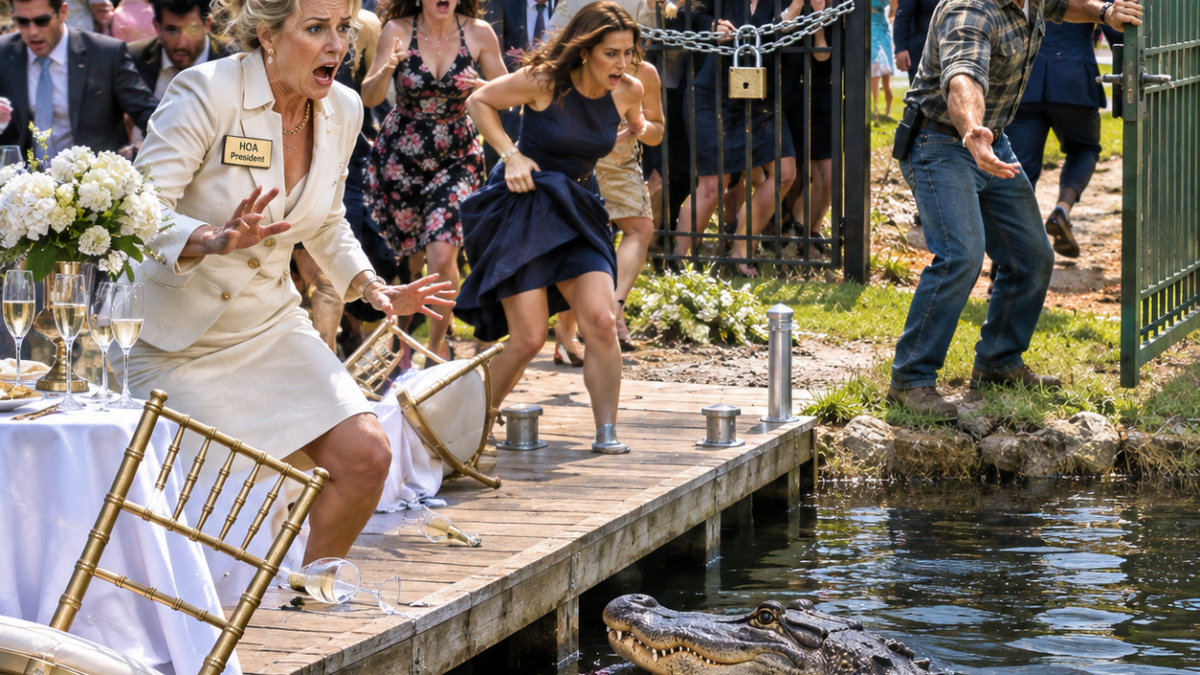
HOA Karen Ignored My 3 Alligator Warnings and Brought 200 Guests to My Private Lake—Then Her $5.4M Deal Collapsed.
Everett Stroud warned HOA President Denise Voss three separate times that Blackwater Lake was private property and home to wild alligators, but she cut his fence, removed his warning signs, sold 200 tickets at $450 each, and told wealthy investors the shoreline was perfectly safe.
When a ten-foot alligator surfaced beneath her floating VIP dock, the guests stampeded toward the nearest exit—only to discover Denise had personally ordered the gate chained shut so nobody could leave before her sales presentation was over.
Then the man Denise had called a selfish liar unlocked his own farm to save all 200 guests, while investigators uncovered a forged lake-access agreement, a secret $620,000 payment to Denise’s private company, and the $5.4 million development deal she had built on land she never owned.
At 12:17 on a cloudless Saturday afternoon, Blackwater Lake looked beautiful enough to make people forget what it was.
That was part of the danger.
The water lay dark and almost perfectly still beneath the June sun, reflecting cypress branches and white clouds with the deceptive calm of polished glass.
Two hundred adults stood along the southern shore holding champagne.
Most wore clothes chosen for photographs rather than mud.
Light linen suits.
Summer dresses.
Polished shoes.
Wide-brimmed hats.
Real estate brokers moved through the crowd with name badges clipped to their lapels.
Investors stood beside developers.
Several wealthy Willow Crest homeowners had invited friends from Atlanta, Jacksonville, and Tampa.
A six-piece band played beneath a white canopy beside a newly built stage.
Servers in black vests moved between long tables draped with linen.
Silver trays carried crab cakes, oysters, fruit, and champagne flutes.
At the center of it all stood Denise Voss.
Fifty-two.
HOA president.
Developer.
Professional fundraiser.
A woman who had spent twenty years learning that if you spoke with enough certainty, most people assumed someone else had already checked whether you were right.
She wore a white suit.
Pearl earrings.
Her dark blond hair was pulled into a smooth knot.
In one hand she held a champagne flute.
In the other, a wireless microphone.
Behind her, a floating dock extended into the lake.
The dock had not existed three weeks earlier.
Neither had the stone steps leading to it.
Neither had the photograph platform.
Neither had the wide path cut through the fence from Willow Crest Estates.
And none of them had Everett Stroud’s permission to be there.
Denise lifted her glass.
The band faded.
PART2:
“Ladies and gentlemen,” she said, smiling toward the crowd, “today we open the most beautiful private waterfront experience in the county.”
Applause rolled across the lawn.
Everett heard it from behind the fence line of his farm.
He stood several hundred yards away on higher ground beside his pickup.
He was forty-six.
Broad-shouldered from decades of field work.
Gray beginning at his temples.
A former water-management engineer who had spent most of his career studying drainage systems, wetland restoration, flood corridors, and the complicated relationship between human construction and water that never cared what was written on a zoning map.
He had left government consulting four years earlier to manage the family property full-time.
Blackwater Lake covered twenty-three acres.
Despite the name, the water was not truly black.
It looked that way because of tannins from surrounding vegetation and the shadows cast by cypress trees.
Everett’s grandfather had bought the land decades earlier.
His father had expanded it.
Everett inherited responsibility for maintaining the lake, the wetlands connected to it, and the fences surrounding the shoreline.
He knew where turtles nested.
Where water rose first after summer storms.
Where feral hogs crossed the north boundary.
And where alligators tended to bask when temperatures climbed.
He also knew the biggest animals did not always announce themselves.
That was why the signs mattered.
PRIVATE PROPERTY.
PART3:
ALLIGATOR HABITAT.
NO PUBLIC ACCESS.
He had installed them at every likely access point.
Now two of the largest were gone.
The posts remained.
Bare.
On the other side of the new opening in his fence, Denise’s guests drank champagne.
Everett looked at his phone.
His final warning call remained in the history.
8:11 a.m.
Four hours earlier.
No return call.
He had warned her three times.
Not vague warnings.
Not angry threats.
Not a neighbor saying he did not like crowds.
Three documented statements.
Wild alligators live here.
You do not have permission to use this property.
Do not bring 200 people to this shoreline.
Denise ignored all three.
Everett had spent the morning reporting the event to county officials and providing emergency crews with a map showing the safest approach if something went wrong.
He had no legal authority to march into the middle of 200 guests and physically remove them.
And after Denise’s workers cut the fence, he had made a deliberate decision not to create a confrontation around heavy equipment and temporary structures.
Document.
Report.
Preserve.
That had been his strategy.
Now he watched Denise invite a silver-haired man onto the floating dock.
Trevor Dane.
Fifty-seven.
Managing partner of a real estate investment firm.
The man Denise had been trying to impress for months.
Trevor’s company was considering a $5.4 million development and marketing agreement connected to thirty-eight planned luxury homes on the Willow Crest side of the property.
Those homes were being advertised with something they did not legally possess.
Lake access.
The photographs Denise wanted that afternoon were supposed to make the promise look real.
Two hundred people gathered around a waterfront.
Music.
Dock.
Champagne.
Investors.
If the photographs circulated later, Blackwater Lake would no longer look like Everett’s private property.
It would look like an established amenity.
That was what Denise needed.
Not merely a party.
Evidence of normal use.
Or at least the appearance of it.
She led Trevor and several associates onto the dock.
A photographer backed toward the rail.
“Closer together.”
Trevor laughed.
A woman beside him lifted her glass.
The photographer adjusted his angle.
“Everybody lean in just a little.”
Under the dock, something moved.
Willa Merritt saw it first.
Willa was thirty-four.
Event director.
She had spent eleven years coordinating weddings, corporate gatherings, waterfront receptions, and political fundraisers.
She had learned early that outdoor events did not fail because tablecloths wrinkled.
They failed because somebody ignored wind.
Heat.
Rain.
Electricity.
Alcohol.
Water.
Animals.
Or exits.
The wake coming from the reeds was wrong.
Long.
Smooth.
Moving against the faint surface current.
Willa stared.
A young server beside her followed her gaze.
“What is that?”
Willa did not answer.
The shape moved closer to the dock.
For one second, it resembled a floating log.
Then the log changed direction.
A broad snout emerged.
Two dark eyes rose above the surface.
Then a ridged back.
Black-green armor reflecting sunlight.
Ten feet.
Maybe slightly more.
The alligator floated almost motionless beside the dock.
Close enough that Trevor Dane could have leaned over the railing and touched its back with an umbrella.
The woman in the pale blue dress saw it.
Her mouth opened.
The scream came a fraction of a second later.
Her champagne glass slipped.
Hit the wooden boards.
Exploded.
Trevor turned.
The photographer looked down.
Someone shouted:
“Alligator!”
The word traveled through the party faster than the sight did.
People on the dock surged backward.
The walkway leading to shore was narrow.
Designed for photographs.
Not evacuation.
A man in a linen suit slipped on spilled champagne.
Went down hard.
Two strangers grabbed his arms and dragged him upright before the crowd behind stepped on him.
The band stopped mid-song.
One trumpet gave a final ugly note.
At the back of the lawn, guests who could not see the dock began running because everyone in front of them was running.
Chairs toppled.
A table tipped.
Glasses shattered across grass.
Denise grabbed the microphone.
“Everyone remain calm.”
Nobody did.
“The animal is outside the designated guest area.”
That statement might have helped if the alligator had not been floating visibly beside the dock.
A man pointed.
“There!”
Another scream.
Then the entire lawn moved.
Nearly two hundred people ran toward the nearest exit.
The service gate.
Black steel.
Eight feet wide.
Thirty yards from the main tables.
The first man reached it and grabbed the bars.
Pulled.
Nothing.
He pulled harder.
A heavy chain rattled on the opposite side.
Padlock.
The gate was locked.
He shouted:
“Open this!”
People behind him kept coming.
They did not yet understand the front had stopped.
Bodies compressed.
Someone fell.
A woman screamed that she could not breathe.
Another guest climbed onto a decorative planter trying to get above the crowd.
The pressure at the gate increased.
Denise stared.
For the first time that afternoon, her face emptied.
She knew exactly why the gate was locked.
She had ordered it.
At 8:42 that morning, Willa had objected.
Not politely.
Not vaguely.
Directly.
“You cannot lock that exit with two hundred people beside water.”
Denise had looked at her phone.
“It’s a service gate.”
“It’s the nearest route to high ground.”
“Guests are not supposed to use it.”
“That is irrelevant in an emergency.”
Denise had sighed.
“I do not want people wandering into the maintenance area.”
“We have investors coming.”
“The sightline is ugly.”
Willa stared at her.
“You are closing an exit because it looks ugly?”
“I’m controlling access.”
“No.”
“You’re locking an exit.”
Denise had turned to security.
“Chain it.”
Willa said:
“Put my objection in the operations log.”
Denise ignored her.
So Willa wrote it herself.
8:42 A.M.
SERVICE GATE LOCKED AT DIRECTION OF DENISE VOSS DESPITE EVENT DIRECTOR’S SAFETY OBJECTION.
Her handwriting shook slightly.
She had wondered afterward whether she should quit.
She did not.
That question would haunt her.
Now two hundred people were pressed against the gate she had warned Denise about.
A few broke away toward lower ground.
That was worse.
The land sloped toward reeds.
Mud.
Shallow marsh.
Exactly the habitat Everett had warned them about.
Willa ran.
“Not that way!”
People ignored her.
She raised both arms.
“Stay uphill!”
One man in a navy blazer pushed toward the reeds.
“There’s another road.”
“No.”
“There isn’t.”
He kept going.
Then Willa saw another ripple.
Smaller.
Closer to the bank.
“STOP!”
Something in her voice reached him.
He froze.
A dark shape moved through shallow water.
The man stumbled backward.
Then ran uphill so quickly he lost one shoe.
Across the property, Everett saw the crowd pile against the locked gate.
He did not hesitate.
He had spent his career around emergencies.
Flooding.
Storm evacuations.
Failed culverts.
Road washouts.
He knew the most dangerous part of an incident was often not the original hazard.
It was what frightened people did afterward.
The alligator was in the lake.
The people were crushing each other on land.
Everett ran for his truck.
Then changed his mind.
Faster on foot across the upper pasture.
He grabbed the key ring from his belt.
His maintenance gate sat two hundred yards west of the event.
It opened onto a raised dirt road running through his farm.
Solid ground.
Away from marsh.
Wide enough for ambulances.
He reached it.
Unlocked.
Swung both halves open.
Then called Willa.
She answered while running.
“Everett?”
“My west maintenance gate is open.”
“Bring everybody uphill.”
“Do not send anyone toward the reeds.”
“Use the gravel path by the old oak.”
“I can see it.”
“I’m opening county-road gate too.”
“Emergency crews can come straight through.”
Willa shouted to staff.
Three servers.
One security guard who had stopped taking instructions from Denise.
They formed a human line.
Arms out.
“THIS WAY.”
“UPHILL.”
“DO NOT RUN TOWARD WATER.”
The first guests reached Everett’s gate.
Some were crying.
One woman had blood on her shin.
A man held his shoulder.
An older guest limped badly.
Everett stood beyond gate.
“Keep moving.”
“Wide road ahead.”
“You’re safe up here.”
He did not say:
I told you so.
He did not ask who owned tickets.
He did not ask who voted for Denise.
People needed out.
That was all.
The line began to stretch instead of compress.
Panic slowly loosened.
The first sirens became audible.
Everett ran to outer gate.
Opened it.
Then stood in middle of dirt road waving the first ambulance through.
By 12:42, the scene had changed completely.
Paramedics treated injuries near Everett’s barn.
Deputies separated witnesses.
Laurel Briggs from the state wildlife agency established a strict boundary around the lake.
Forty-three.
Short dark hair.
Sun-faded uniform.
She looked toward guests, then the dock, then the reeds.
“Everybody stays away from water.”
One deputy asked:
“Are you going to remove the alligator?”
“No.”
“Why?”
“Because it’s a wild animal in wild habitat.”
“It hasn’t attacked anyone.”
“We remove people from the hazard first.”
That distinction mattered.
The alligator had not chased a guest.
Had not charged the dock.
Had not bitten anybody.
It had surfaced.
That was all.
The injuries came from people.
Falls.
Collisions.
Crowding.
A locked exit.
Eleven guests required medical treatment.
No one was touched by an alligator.
Laurel eventually found Everett.
“You own this lake?”
“Yes.”
“You permit public events?”
“No.”
“Did you know about this one?”
“I warned them three times not to hold it.”
She looked at him.
“Documented?”
“Everything.”
“Good.”
Then she saw missing warning signs.
“Where were those?”
Everett pointed.
“Posts are there.”
“Signs were removed this week.”
“By who?”
“Still documenting.”
Laurel nodded.
Not assuming.
Good.
Deputy Hollis Pike arrived.
Forty-five.
Sheriff’s office.
Veteran investigator.
He found Denise near stage arguing with a security supervisor.
“This is being blown completely out of proportion.”
Hollis said:
“Ma’am.”
“Step away from the microphone.”
Denise looked offended.
“I am the event organizer.”
“That is why I need to speak to you.”
She straightened.
“Fine.”
“Who owns this property?”
“The HOA has access rights.”
“That’s not what I asked.”
“The lake is adjacent to Willow Crest.”
“Who owns it?”
Denise glanced toward Everett.
“Everett Stroud is listed on old records.”
“Old?”
“Current deed.”
Everett said from several feet away.
Denise shot him a look.
Hollis held up one hand.
“One at a time.”
Denise opened leather folder.
“We have authorization.”
She produced packet.
BLACKWATER LAKE ACCESS AUTHORIZATION.
At bottom:
Everett Stroud.
Signature.
Hollis looked at Everett.
“Is this yours?”
“No.”
Denise said:
“He signed it.”
Everett did not raise voice.
“I have never seen that document.”
Hollis took packet.
Placed in evidence sleeve.
“Do you have proof you warned HOA about alligators?”
Everett handed him folder.
First warning.
Twenty-three days earlier.
Email sent to Denise, board, contractor, event company.
Trail-camera photographs.
Alligator near bank.
Second warning.
Public meeting six days earlier.
Written summary.
Witnesses.
Third warning.
That morning.
Recorded on gate camera.
Denise said:
“He has been trying to sabotage this event from beginning.”
Hollis looked at her.
“By warning you about wildlife on his own property?”
“He exaggerated risk.”
Laurel spoke.
“No.”
Everyone turned.
She pointed toward lake.
“That is known American alligator habitat.”
“An animal surfacing beside shore is entirely consistent with the environment.”
Denise said:
“There’s never been an attack.”
Laurel’s expression hardened.
“Absence of prior attack is not proof of safety.”
Everett almost smiled.
It was exactly what he had told the board.
A warning comes before somebody gets hurt.
Then security guard stepped forward.
“Deputy.”
Hollis looked.
“I need to tell you about the gate.”
Denise’s face changed.
Tiny.
But Everett saw it.
“What gate?”
Hollis asked.
“The service gate everybody ran to.”
“Who locked it?”
The guard swallowed.
“Mrs. Voss ordered us to chain it.”
Denise interrupted:
“For controlled access.”
Hollis ignored her.
“Was it locked during event?”
“Yes.”
“Did staff object?”
Willa appeared carrying operations binder.
“I did.”
She opened page.
Pointed to handwritten entry.
8:42.
Hollis read.
“Why did you object?”
“Because two hundred people were gathering beside water.”
“That gate was the nearest safe exit away from shoreline.”
“I told Denise it should remain accessible.”
“And?”
“She ordered it locked anyway.”
Denise said:
“The primary guest entrance remained open.”
Willa looked at her.
“Halfway around the event.”
“Past stage.”
“Past catering trucks.”
“And through the bottleneck we specifically avoided during setup.”
Hollis closed binder.
Now incident was not:
Wild animal unexpectedly frightens party.
It was:
Organizer warned about wildlife.
Removed warning signs.
Held event on disputed property.
Locked exit over professional objection.
That was different.
Trevor Dane arrived.
His white shirt had champagne stains.
One trouser knee muddy.
His expression looked nothing like investor who had smiled for photographs forty minutes earlier.
He held phone.
“Denise.”
She turned.
“You knew?”
“I knew there were reports of wildlife.”
“Reports?”
Trevor pointed toward lake.
“That thing was under my feet.”
“Wildlife moves.”
“You told us the shoreline had been cleared and assessed.”
“It was.”
“By whom?”
Silence.
Trevor’s voice rose.
“Who certified this was safe?”
Denise said:
“There was no reason to believe an animal would approach during an event.”
Everett unlocked his phone.
Opened morning recording.
His own voice:
This is my third and final warning.
There are large alligators in this lake.
You do not have permission to bring two hundred people onto my property.
Denise’s recorded voice:
My guests arrive in less than four hours.
Your lake is not going to ruin my business.
Nobody spoke afterward.
Trevor stared at her.
“You said there was no meaningful alligator hazard.”
Denise’s mouth tightened.
“I said risk was manageable.”
“That is not what you told me.”
Willa looked toward Everett.
Then toward police.
She made a decision.
Maybe the most important one she had made in weeks.
“Deputy.”
She handed Hollis entire event file.
“Everything.”
Emails.
Schedules.
Vendor contracts.
Safety notes.
Authorization packet.
Marketing drafts.
Guest operations.
Hollis took it.
Willa said:
“You need to look at page thirty-seven.”
Blackwater Lake Access Authorization.
Signature.
Blank verification section.
Illegible witness.
Everett looked again.
“I did not sign that.”
Hollis asked:
“Do you know who created it?”
“No.”
“Did you authorize anyone to sign for you?”
“No.”
Trevor pulled phone.
“There’s something else.”
Denise turned toward him.
“Trevor.”
He ignored her.
His investment firm had already wired $620,000.
Not full $5.4 million agreement.
A securing payment.
Exclusive negotiation rights.
Initial access and development due diligence.
Hollis asked:
“To whom?”
Trevor opened wire confirmation.
Read.
Voss Shoreline Ventures LLC.
Everett looked at Denise.
Not the HOA.
Not his name.
Denise’s company.
Trevor said:
“Denise told us Voss Shoreline Ventures was the authorized development representative for Blackwater Lake.”
Everett almost laughed.
The audacity was so large it briefly stopped feeling real.
Hollis said:
“Who owns Voss Shoreline Ventures?”
Trevor looked at Denise.
“She does.”
Willa’s face changed.
“I thought the HOA was contracting the development.”
Trevor said:
“So did we.”
Denise stepped forward.
“It is a special-purpose entity for the waterfront project.”
Everett said:
“What waterfront project?”
She ignored him.
Trevor continued:
“Our $5.4 million agreement requires proof of lawful lake access.”
“You supplied that packet.”
Denise answered:
“And it is valid.”
Everett held deed copy.
“No.”
“It isn’t.”
Trevor looked at Hollis.
“If this signature is false, our agreement is void.”
Then to Denise:
“And I want the $620,000 back.”
Denise’s composure finally cracked.
For first time, anger overwhelmed performance.
She turned on Everett.
“You could have let us use the lake for one afternoon.”
The sentence hung there.
Everett looked at two hundred shaken guests standing on his farm.
Eleven injured.
Paramedics.
Police.
Wildlife officers.
Broken glass.
Then back to Denise.
“I warned you three times.”
“You turned my property into your business.”
“And your guests into your risk.”
No one around them spoke.
Twenty-three days earlier, Everett had still believed this could be stopped by one letter.
He wrote it at his kitchen table before sunrise.
Three words in bold:
ALLIGATORS LIVE HERE.
He was not being dramatic.
He was trying to be impossible to misunderstand.
The lake had a natural channel to a larger wetland system.
American alligators moved through it.
Some seasonal.
Some regular.
Trail cameras showed several.
Juveniles.
Medium adults.
At least one large animal close to ten feet.
Everett had seen bigger tracks.
He did not feed them.
Never encouraged them.
Did not treat them as pets.
Wild animals.
That was exactly why public access stayed restricted.
People think alligator danger looks like a movie.
Open jaws.
Charging animal.
Thrashing attack.
Real hazard often looks like still water.
A head that appears where nobody expected.
A dog wandering too close.
A child near edge.
An adult deciding one photograph is worth stepping nearer.
Everett understood.
Denise did not want to.
Her first visit came after Everett stopped Grant Hollowell’s survey crew.
Grant had arrived believing the HOA had development rights.
Everett showed deed.
Parcel.
No authorization.
Grant stopped.
Professional response.
Denise arrived furious.
“You embarrassed my contractor.”
“I prevented your contractor from surveying land I own.”
“We need a path.”
“No.”
“This benefits entire neighborhood.”
“No.”
“You’re blocking property values.”
“No.”
Denise stared.
“Is that your answer to everything?”
“When you’re asking for something you don’t own?”
“Yes.”
She wanted warning signs removed.
He refused.
She wanted trail opened.
Refused.
She wanted floating dock.
Refused.
Then:
“You don’t own the view.”
Everett said:
“No.”
“But I own shoreline you want to stand on.”
That difference became their entire conflict.
That night Everett found marketing.
Digitally cleaned shoreline.
Mud replaced with sand.
Reeds removed.
Warning signs erased.
SAFE.
EXCLUSIVE.
UNFORGETTABLE.
That was when irritation became concern.
Denise was not merely asking.
She was selling.
So Everett emailed everyone.
Board.
Event company.
Contractor.
Denise.
Clear.
No permission.
Alligators.
No signs removed.
No fence changed.
No gathering.
Denise replied:
Your concerns have been received.
Three hours later new advertisements appeared.
That phrase stayed with Everett.
Received.
Not addressed.
Not resolved.
Received.
A bureaucratic way of saying:
I know.
I’m doing it anyway.
Six days before opening, Everett went to HOA meeting.
He brought enlarged trail photographs.
One showed a large alligator stretched on mud within feet of future dock location.
Another showed two smaller animals near reeds.
He brought survey.
Deed.
Wildlife safety information.
Residents listened.
One board member asked:
“Should we postpone?”
Denise interrupted.
“No.”
Then to Everett:
“You are weaponizing fear.”
He answered:
“I am describing wildlife.”
“There hasn’t been an attack.”
Everett let silence settle.
“A warning is supposed to come before somebody gets hurt.”
That line made room quiet.
Denise moved to next agenda item.
After meeting, emails began.
Residents accusing him of selfishness.
One man:
You don’t even use half that shoreline.
Another:
Community growth matters too.
A woman politely suggested compromise.
Everett replied to almost none.
Saved all.
Folder.
Date.
Meanwhile Willa Merritt was getting nervous.
She asked Denise:
“Do we have owner consent?”
“Yes.”
“Can I have copy?”
“It’s with legal.”
“Wildlife assessment?”
“Handled.”
“By who?”
“Willa, you’re running catering and event flow.”
“Stay in your lane.”
That irritated Willa.
Her lane was keeping guests alive.
She had planned waterfront events.
She knew one rule:
Water changes everything.
Alcohol plus water.
Crowds plus water.
Children plus water.
Wildlife plus water.
You never treat shoreline like ballroom wall.
Then she saw packet.
Everett Stroud signature.
Something wrong.
Verification incomplete.
Witness unreadable.
Willa saved scan.
Not because she knew it was forged.
Because she had learned never to rely on one copy of important authorization when somebody got defensive about showing it.
Then welcome packets arrived.
Inside:
Thirty-eight luxury homes.
PRIVATE RIGHTS TO BLACKWATER LAKE.
FLOATING DOCK ACCESS.
LAKESIDE PROMENADE.
WATERFRONT EVENTS.
Willa stared.
This was not party.
It was sales demonstration.
Trevor Dane’s $5.4 million development partnership depended on proving rights.
Denise needed crowd.
Needed photos.
Needed investors to believe access already normalized.
Everett’s refusal threatened much more than one afternoon.
That explained pressure.
Then first contractor quit.
Grant would not proceed without valid authorization.
Denise hired another crew.
Everett’s camera caught bolt cutters.
Fence.
Signs removed.
Path widened.
Dock installed.
He came immediately.
Denise waved packet.
Would not hand it over.
He filmed.
Filed trespass report.
Grant wrote confirming he stopped because owner did not consent.
Second warning had become legal paper.
Then opening morning.
Third warning.
Gate camera captured.
Everett showed fresh alligator image.
Near dock.
Denise looked at watch.
Your lake is not going to ruin my business.
Then three orders.
Remove signs.
Hide muddy bank.
Lock service gate.
The second and third turned reckless event into trap.
Willa knew.
She wrote log.
She still stayed.
After disaster, guilt came hard.
At 4:00 that afternoon, after all guests were accounted for, she sat on Everett’s barn step with bottled water.
Hands shaking.
Everett passed.
She said:
“I should have stopped it.”
He paused.
“You tried to keep gate open.”
“I stayed.”
“Yes.”
“I kept working.”
“Yes.”
“I knew something was wrong.”
Everett sat beside her.
Not comfortingly.
Honestly.
“Why didn’t you leave?”
Willa wiped face.
“I thought if I stayed, at least somebody cautious would be here.”
“That may have saved people.”
“I also thought she probably had paperwork I hadn’t seen.”
“That part was wrong.”
“I know.”
Everett looked toward paramedics.
“You handed police your file.”
“That matters now.”
Willa nodded.
“I don’t feel brave.”
“Most useful things don’t feel brave when you’re doing them.”
She laughed once through tears.
“Engineer answer.”
“Former engineer.”
“Still.”
The investigation separated problems.
That was important.
Wildlife agency addressed lake safety and habitat.
Sheriff addressed trespass, documents, access, gate.
County addressed unauthorized structures.
Investors addressed contracts and money.
HOA addressed Denise’s governance.
Everett’s attorney, Caroline Webb, addressed his property.
She was fifty.
No dramatic style.
First thing she told him:
“Do not try to own all the investigations.”
“I don’t.”
“Good.”
“Your case is simple.”
“Restore your property.”
“Stop commercial use.”
“Recover documented damage.”
“Bar unauthorized access.”
“Let prosecutors decide crimes.”
Everett liked her immediately.
She filed for injunction.
Fence.
Dock.
Path.
Advertising.
No use.
No transfer of claimed rights.
No one allowed to act as though HOA possessed lake access.
Temporary order granted quickly because ownership clear and event evidence ugly.
Floating dock closed.
Steps taped.
Path blocked.
Signs restored temporarily.
Then permanent restoration required.
Ticket refunds.
All 200.
$90,000.
Not because every guest deserved extra damages automatically.
Because they paid for event represented as lawful and safe waterfront experience that could not lawfully continue.
Sponsors demanded money.
Trevor terminated $5.4 million deal.
Most important financially:
$620,000.
Voss Shoreline Ventures.
Investigators froze certain transfers pending review.
Denise’s lawyers argued legitimate project entity.
Trevor’s lawyers asked one devastating question:
What lawful rights did entity own?
No answer.
No deed.
No easement.
No license signed by Everett.
Only disputed authorization.
And Everett denied it.
Forensic examination followed.
Metadata.
Document origins.
Signature comparison.
Electronic history.
Witness line.
Not overnight.
Months.
Eventually investigators concluded authorization was forged.
The source evidence connected creation and use to Denise’s commercial project.
Criminal decisions came later.
Everett did not celebrate.
He had already gotten more important thing:
No one stood on shoreline without his permission.
The HOA meeting two weeks after event was packed.
Eighty-five valid ballots.
Residents angry.
Embarrassed.
Afraid of liability.
An older board member held Everett’s first email.
“How many times did you need to hear the word alligator?”
Denise sat front.
No white suit.
Dark blazer.
Attorney beside her.
She tried to explain.
Risk management.
Community opportunity.
Investor deadlines.
Belief access agreement valid.
Resident shouted:
“Why was gate locked?”
Another:
“Why were signs removed?”
Another:
“Why did your private company get $620,000?”
Denise’s attorney told crowd not to prejudge.
Fair.
But HOA removal was not criminal conviction.
It was governance.
Members could decide confidence lost.
Vote:
82 remove.
3 retain.
Denise removed immediately.
No applause at first.
Then scattered clapping.
Everett did not attend.
He watched alligator move across far bank that evening instead.
People later asked why.
“Didn’t want see her lose?”
“Not my HOA.”
“They created problem.”
“They fix board.”
His fight was boundary.
Not throne.
Restoration began.
Floating dock removed section by section.
Willa came one morning.
Not as event director.
Work clothes.
She helped catalog debris because her company was cooperating with investigation.
Grant Hollowell supervised restoration under new authorization directly from Everett.
He asked:
“Where do you want fence?”
“Exactly original line.”
“Same opening?”
“No opening.”
Grant nodded.
“Signs?”
“Bigger.”
He almost smiled.
“Fair.”
They replanted shoreline.
Native grasses.
Repaired disturbed soil.
Removed photo platform.
Wood steps.
Artificial sand.
Yes, Denise’s crew had trucked in pale sand to make promotional photographs look resort-like.
Everett insisted it go.
Not because sand ugly.
Because it did not belong to bank and could affect erosion and habitat.
Restoration was not about making place look “wild.”
It was about putting system back.
Laurel Briggs reviewed habitat work.
She said:
“You know people are going to blame alligators.”
“I know.”
“Even though none touched anyone.”
“I know.”
“Some residents asked whether state should remove them.”
“What did you say?”
“That wild animals do not get punished because humans held unauthorized cocktail party in their habitat.”
Everett smiled.
“I like you.”
“Professionally?”
“Absolutely.”
She laughed.
Signs went up:
PRIVATE LAKE.
ALLIGATOR HABITAT.
NO UNAUTHORIZED ACCESS.
One added:
DO NOT FEED OR APPROACH WILDLIFE.
Everett did not open lake to public afterward.
That disappointed some residents who thought settlement could include scheduled access.
No.
His property.
His choice.
He did allow wildlife officers.
Approved maintenance.
Researchers once.
No tourists.
Trevor Dane returned early spring.
Called first.
Important.
Everett met him at farm gate.
Trevor wore boots this time.
No suit.
No contract.
“I owe you thanks.”
“For what?”
“You opened your gate.”
“You were trespassing.”
Trevor smiled weakly.
“We were.”
“I didn’t open it for HOA.”
“I opened because people needed a way out.”
Trevor nodded.
“I also owe apology.”
“I trusted documents because they fit deal I wanted.”
“That happens.”
“Not excuse.”
“No.”
They looked at lake.
An alligator lay in sunlight far across water.
Trevor watched.
“Have you ever thought about removing them?”
“No.”
“Could make place profitable.”
Everett looked at him.
“They were here before her party.”
“They’re not ones who lied.”
Trevor nodded.
That line stayed with him.
Before leaving:
“If you ever want conservation funding, call me.”
Everett said:
“If I do, I’ll ask.”
That mattered.
Choice.
Months after event, Willa sent envelope.
Final event file.
And laminated warning sign Denise ordered removed.
WARNING.
ALLIGATORS PRESENT.
Everett placed it beside three warning notices.
Looked for a long time.
Everything could have ended earlier.
First email.
Denise could cancel.
Second meeting.
Could postpone.
Fence crew.
Could stop.
Third warning.
Could move guests somewhere else.
Gate objection.
Could leave exit open.
At every stage there was an exit.
Denise locked all of them.
Literally once.
Metaphorically many times.
That was what fascinated Caroline Webb.
“She didn’t have one catastrophic decision.”
“She had fifteen opportunities to reverse.”
Everett said:
“People think backing down looks weak.”
“Sometimes.”
“Then they spend millions avoiding appearance of weakness.”
Denise’s criminal and civil matters moved slowly.
Investigators determined forged authorization had been used in transactions.
Voss Shoreline Ventures returned $620,000 under legal resolution.
Additional claims.
Guest injuries.
Property damage.
Sponsors.
Trevor’s firm.
Insurance questions.
Denise lost event company.
Lost development opportunity.
Her business reputation collapsed.
Everett never claimed she lost literally everything.
People exaggerated.
She had a home.
Assets.
A life.
But she lost project built on lake.
HOA presidency.
Private company’s credibility.
$5.4 million deal.
And ability to present herself as trusted operator without explaining Blackwater Lake.
That was enough consequence.
Everett’s civil claim stayed narrow.
Fence.
Shore.
Vegetation.
Legal costs where recoverable.
Trespass damages.
Protection.
No request for neighborhood homes.
No revenge number.
Caroline told him:
“You’re leaving money arguments on table.”
“Maybe.”
“Certain claims could support more.”
“I don’t want to spend three years proving how emotionally damaged I am.”
“Fair.”
“I want fence.”
“You have fence.”
“I want no one coming through it.”
“You’ll get that in order.”
He did.
Permanent restrictions.
No Denise-controlled entity allowed commercial use.
No advertising.
No claimed access.
Any future access by HOA required new written agreement from Everett.
He laughed at last part.
“They’re never getting one.”
Caroline said:
“Still useful to write.”
Because law should not rely on mood.
Years passed.
Blackwater Lake returned to quiet.
No stage.
No band.
No champagne.
The reeds grew back.
Alligator trails appeared along mud.
Everett continued monitoring.
The ten-foot animal?
Laurel thought likely adult male.
Not unusually aggressive.
Maybe simply moved toward shade beneath dock.
People had built structure in his water.
Animal used it.
That was all.
Everett sometimes wondered what party looked like from alligator’s perspective.
Noise.
Music.
Vibrations.
Shadows.
Then panic.
Humans loved making themselves center.
Wildlife usually had no idea.
One year later, local news wanted anniversary story.
Everett refused live interview.
Agreed one recorded statement.
Reporter asked:
“Did alligators nearly kill two hundred people?”
“No.”
She blinked.
“But there was panic.”
“Yes.”
“Eleven injuries.”
“Yes.”
“Alligator triggered it.”
“An alligator surfaced.”
“Human decisions created dangerous crowd conditions.”
“Especially locked gate.”
Reporter looked surprised.
“That’s less dramatic.”
“It’s more accurate.”
He insisted.
No one attacked.
Alligators were not villains.
Denise’s disregard for warning and emergency egress created risk.
This mattered because sensational coverage could lead people to harass animals or demand removal unnecessarily.
Laurel thanked him later.
“You’d be surprised how many people want wildlife punished for headlines.”
“I wouldn’t.”
Everett’s engineering background deepened lesson.
He began speaking occasionally at land-management workshops.
Not motivational.
Practical.
Private water bodies.
Habitat.
Trespass.
Event safety.
One slide had photo of chained gate.
Title:
THE SECOND HAZARD.
He explained.
Original hazard:
Large wild animal near crowd.
Secondary hazard:
Panic with blocked egress.
Often secondary kills more.
Same in floods.
Fires.
Industrial accidents.
People build safety systems only around first event they imagine.
Good planning asks:
What happens when humans react?
A fire alarm with locked exit.
Flood with blocked road.
Animal sighting with crowd funnel.
That part of Denise’s decision was unforgivable to Everett.
She had been warned by professional event director.
Still locked gate to control photographs and sponsor flow.
Not ignorance.
Priority.
Appearance over escape.
Willa eventually started own event-safety consulting firm.
First page of operations checklist:
NEVER LOCK AN AVAILABLE EMERGENCY EXIT FOR AESTHETIC OR CROWD-CONTROL PURPOSES.
She sent Everett copy.
He replied:
Looks obvious now.
She wrote:
It looked obvious then.
That hurt.
But true.
Willa lived with fact she stayed.
She used guilt productively.
Trained planners.
Taught documentation.
Stopped events when conditions unsafe.
Once canceled waterfront wedding because lightning line approached.
Bride furious.
Two hours later storm struck.
No one hurt.
Willa called Everett afterward.
“I finally walked away before somebody got hurt.”
“You didn’t walk away.”
“You stopped it.”
She was quiet.
“Thanks.”
Grant Hollowell changed too.
His company required title verification before access work outside client-controlled parcels.
He used Blackwater as training case.
A young foreman once said:
“But if client says they have permission?”
Grant answered:
“Clients say lots of things.”
“Verify.”
That was how systems learn.
Willow Crest Estates changed governance.
Conflict-of-interest policy.
Private-company disclosures.
Legal review for property agreements.
Two-signature financial authority.
External event safety signoff.
No single president could bind HOA to commercial land-use claims without board and counsel review.
Meetings became slower.
Residents complained.
An older member stood:
“Slow is better than running from an alligator into a locked gate.”
Policy passed.
The line became neighborhood joke.
Everett tolerated it.
Mostly.
What bothered him was people turning incident into triumph.
“Everett beat HOA.”
No.
He prevented further trespass.
“Karen got what she deserved.”
Maybe.
Not his job to decide cosmic fairness.
“Alligator saved lake.”
Absolutely not.
The alligator was not strategy.
It surfaced.
Everett had warned because he hoped nobody ever had to see proof.
That was perhaps most important.
People sometimes enjoy validation after warning ignored.
See?
I told you.
Everett felt none.
Watching 200 people run was terrifying.
He would rather be mocked forever and never see panic.
Correct warning is not a bet you hope to win.
It is a problem you hope to prevent.
Years later, a new Willow Crest president called.
Marta Reynolds.
Polite.
“We’re planning conservation education day.”
Everett waited.
“We’d like wildlife officer to speak about wetlands.”
“Good.”
“We wondered if we could use lake overlook.”
“No shoreline.”
“Understood.”
“There’s county road viewpoint.”
“We can use that.”
“Can we put temporary sign identifying lake?”
“On HOA property, sure.”
She paused.
“That easy?”
“You asked for something you own.”
Marta laughed.
“Fair.”
Then:
“Would you speak?”
“No.”
“Also fair.”
Event happened.
No trespass.
No alligator incident.
No drama.
Everett appreciated.
Boundary respected.
Community continued.
That contradicted Denise’s old argument that saying no to lake access meant hating neighborhood.
No.
Everett could cooperate without surrender.
One summer, Trevor Dane donated to wetland conservation fund.
Not Everett.
Regional nonprofit.
He wrote note:
Some assets should remain exactly where they are.
Everett smiled.
Investor learned.
Good.
Denise eventually wrote Everett.
Three years later.
Envelope.
Handwritten.
He almost did not open.
Inside apology.
Not legal language.
No request.
She wrote that she had convinced herself development would benefit everyone.
Every setback felt like sabotage.
She stopped hearing warnings as information and began hearing them as attacks.
The $5.4 million deal became proof she was succeeding.
Canceling event felt like admitting failure.
By morning of party, she knew there were alligators.
Knew gate issue.
Still believed control could compensate.
She wrote:
I thought if I controlled the people, the photographs, the path, the dock, and the timing, I could control the outcome.
Everett read sentence twice.
That was it.
Control illusion.
Water engineers know it well.
You do not control water.
You route.
Respect.
Design for uncertainty.
Denise tried to control wild habitat like ballroom.
She apologized for placing guests at risk and using Everett’s property.
No excuses by end.
Everett folded letter.
Put in drawer.
Did not write back for weeks.
Then:
I received your letter.
I appreciate that you acknowledged what happened.
I hope you use what you learned somewhere useful.
That was all.
No friendship.
No invitation.
No lake tour.
Forgiveness and access separate.
Everett understood that.
He did not need to hate her forever.
He also did not need to trust her.
At fifty-five, Everett started restoring north marsh with state program.
No commercial project.
Remove invasive plants.
Improve habitat.
Someone joked:
“More alligators?”
“Better wetland.”
“Animals decide rest.”
He built observation platform on his own property.
Private.
For family and researchers.
The irony amused him.
He was not opposed to docks.
He was opposed to stolen docks.
Structures built with permission and ecological review were fine.
That distinction proved conflict never about hoarding view.
It was about who decides.
One of Everett’s nieces asked:
“Why didn’t you just let them have party?”
She was sixteen.
Not hostile.
Curious.
Everett pointed to lake.
“What if I walked into your room while you were gone, invited two hundred people, moved your furniture, and told them I had permission?”
“That’s different.”
“How?”
She thought.
“Because room is personal.”
“This land is personal.”
“And legally mine.”
“But also there were alligators.”
“Yes.”
“That makes it worse.”
She nodded.
Simple.
Ownership plus safety.
No need overcomplicate.
He also taught:
Property rights do not mean you can do anything you want.
Wetland laws.
Wildlife laws.
Water rules.
He owned lake but did not own alligators as objects.
Could not simply kill or relocate without authority.
Ownership has boundaries too.
That made him different from Denise.
She thought property adjacent to her community became opportunity because she wanted it.
Everett believed even his deed existed inside larger legal/ecological system.
Restraint.
That word.
Years later, Laurel Briggs brought university students to survey habitat.
Everett gave permission.
In writing.
Date.
Area.
Purpose.
They laughed at formality.
Laurel did not.
“She learned from you.”
Everett said:
“I learned from Denise.”
One student asked about famous ten-foot alligator.
Laurel said:
“Could be dead.”
“Could have moved.”
“Wild animals don’t file change of address.”
They found tracks.
Not huge.
Everyone stayed back.
No selfies close.
Education without spectacle.
That was how Everett wanted lake known.
Not as monster water.
Living ecosystem.
Blackwater was beautiful.
Also dangerous.
Both true.
Modern marketing hates truths that coexist.
Safe or unsafe.
Good or bad.
Amenity or threat.
Reality mixed.
You can enjoy lake from respectful distance.
You can manage habitat without panic.
You can own land and still have duties.
You can be warned without being afraid.
Denise’s marketing stripped complexity:
SAFE.
EXCLUSIVE.
UNFORGETTABLE.
The last word came true.
Just not as she planned.
Willow Crest residents never forgot footage.
Alligator beside dock.
Guests at gate.
Everett opening farm.
Denise standing with microphone.
It became institutional memory.
New board members received incident summary during orientation.
Not gossip.
Risk-management case.
One heading:
DO NOT REPRESENT RIGHTS THE ASSOCIATION DOES NOT POSSESS.
Another:
NEVER REMOVE SAFETY WARNINGS FROM THIRD-PARTY PROPERTY.
Another:
EVENT EGRESS MAY NOT BE RESTRICTED FOR AESTHETIC OR COMMERCIAL REASONS.
Good.
If humiliation becomes policy improvement, maybe useful.
Everett aged.
His pickup rusted.
Fence replaced again after storm.
Signs faded in sun and were replaced.
Lake remained.
Alligators came and went.
The property-development boom cooled.
Some of Denise’s proposed luxury lots eventually built without private lake rights.
Homes still sold.
Funny.
The entire $5.4 million scheme was not necessary for community survival.
Willow Crest did fine without stealing lake.
People adapt.
That may have been the greatest waste.
Denise risked everything for “opportunity” that was not required.
Existing homeowners still had club pool.
Trails.
Park.
Property values recovered with market.
No need Blackwater.
Ambition told her otherwise.
Everett had seen similar in engineering.
A developer insists on extra lots.
Road too narrow.
Drainage compromised.
Wetland filled.
All to make project “work.”
Sometimes best design is accepting less.
Denise could not.
One afternoon, Everett found original removed sign in workshop.
The one Willa mailed.
WARNING — ALLIGATORS PRESENT.
Sun-faded.
Bolt holes.
He considered putting it back.
Instead hung it inside barn.
Why?
New signs larger.
Clearer.
Old sign became reminder.
Tyler, neighbor’s boy helping with fence, asked:
“Is that from party?”
“Yes.”
“Did she really take these down?”
“Yes.”
“Why?”
“Bad for pictures.”
Tyler stared.
“That’s stupid.”
“Most disasters look stupid afterward.”
Before?
They often look like compromise.
Convenience.
One small shortcut.
One gate.
One sign.
One fence section.
One permission assumed.
Everett told him:
“Danger rarely arrives wearing a sign that says danger.”
Tyler pointed to alligator sign.
“This one literally did.”
Everett laughed for full minute.
Kid had him.
The story people told simplified.
“I warned HOA three times about alligators.”
“They opened lake.”
“Two hundred people ran.”
True.
But the alligator was only visible climax.
Real story about ignored consent.
Commercial pressure.
Fake authorization.
Locked gate.
Private company.
$620,000.
$5.4 million promise.
Each layer mattered.
If event were lawful and properly managed, an alligator sighting might have led to controlled evacuation.
No panic injuries.
If gate open, crowd disperses faster.
If warning signs remain, guests know risk.
If event canceled, nothing.
If Denise asks and Everett says no, end.
The disaster required chain of choices.
That is why Everett rejected idea “nature got revenge.”
Nature did not care.
Alligator did not know Denise’s name.
Lake did not understand contracts.
Human consequences came from human decisions.
On fifth anniversary, Trevor called.
“Do you ever think about that day?”
“When people ask.”
“I do.”
“Why?”
“I was standing on dock believing a brochure.”
Everett smiled.
“Expensive lesson.”
“Very.”
Trevor said:
“My firm changed due diligence.”
“How?”
“No more relying on seller-supplied access documents for material amenities.”
“Independent title verification.”
“Direct owner confirmation.”
“Good.”
“Your disaster improved our contracts.”
“My disaster?”
“Fair.”
“Her disaster.”
They laughed.
Trevor added:
“I still hate alligators.”
“They’re indifferent.”
“Somehow worse.”
Everett hung up smiling.
Willa’s firm became successful.
She sent holiday card every year.
Not lake pictures.
Usually her kids.
One year message:
Every gate open and accounted for.
Everett laughed.
Guilt had become craft.
That is one way people heal.
Not pretending.
Building habits.
Everett himself changed.
Before Denise, he assumed posted signs enough.
After, he added cameras.
Digital property records.
Emergency contact map.
Not because he lived afraid.
Because he learned people can ignore visible boundary when money tells them to.
He also built stronger relationship with HOA leadership.
Counterintuitive.
Knowing neighbors prevents vacuum where ambitious person controls information.
Once a year, new HOA board representative met Everett.
No authority.
Just communication.
If storm knocks fence.
If wildlife issue.
If trespass.
Phone numbers.
Simple.
Conflict prevention.
Years later, Marta said:
“You know, it’s weird.”
“What?”
“We never fight.”
“Why would we?”
“Because everyone said lake owner hates HOA.”
Everett smiled.
“I hate people cutting my fence.”
“Different category.”
Exactly.
When Everett turned sixty, family held cookout at farmhouse.
Not shoreline.
Enough space.
Grandchildren ran.
Someone joked:
“Careful, Grandpa has alligators.”
Everett replied:
“Grandpa has rules.”
Laughter.
Later, alone, he drove fence.
Stopped near place temporary path had been.
You could barely tell.
Grass.
New posts.
Warning sign.
Beyond, Willow Crest rooftops.
He remembered crowd pouring through farm gate.
The older man with twisted ankle.
Woman crying.
Willa counting heads.
Sirens.
Denise arguing.
Trevor’s wet shirt.
The strange silence after recording played.
He realized what stayed with him most was not being proven right.
It was unlocking gate.
He had every reason to be furious.
Those people were trespassing.
Some had paid money to enjoy land without permission.
Some probably believed Denise’s emails calling him selfish.
None mattered in emergency.
Humans needed way out.
He opened.
That was who Everett wanted to remember being.
Not man who warned.
Man who opened gate after warning ignored.
He hoped he would always choose that.
Property boundaries matter.
Human life matters more in emergency.
Those values do not conflict.
You can enforce boundary afterward.
First get people safe.
He considered Denise’s locked gate beside his open one.
Maybe that was whole story.
She locked a gate to control people.
He opened one to save them.
Control versus responsibility.
Denise had authority title.
Everett had actual land rights.
But moral difference came from choices when panic started.
She blamed.
He evacuated.
She tried microphone.
He opened road.
Leadership is often clearest after plan fails.
Denise looked strong while everything followed script.
Everett became leader when script collapsed.
No stage.
No microphone.
Just key.
That is why several guests later wrote him letters.
Thank you for opening your farm.
Thank you for helping my husband.
Thank you for letting ambulance through.
One woman apologized for believing marketing.
Everett kept letters in box.
Not as trophies.
Proof that people can revise judgment.
He preferred that to revenge.
Denise’s apology later joined same box.
Not because equal.
Because closure.
People ask:
Would you do it differently?
Everett thought.
Maybe call emergency authorities sooner.
Push court order before event if enough time.
Maybe stand at county road with giant warning banner.
But hindsight easy.
He had reported.
Warned.
Documented.
He could not predict Denise would literally chain service exit.
Willa could.
She objected.
That was where line crossed into something worse.
If Everett replayed one moment, it was 8:42.
Not present.
But heard later.
Willa:
You cannot lock that exit.
Denise:
Chain it.
Everything else suddenly unnecessary argument.
A person in charge given clear safety warning.
Chose image.
That choice changed consequences.
It also taught Everett that experts must sometimes refuse more forcefully.
Willa learned same.
Warning can be documented, but sometimes professional duty means walk out or call authority.
Nuance.
No one perfect.
Everett never judged her harshly.
She had less power than Denise and more courage than most.
She preserved truth.
Helped evacuation.
Handed file.
That mattered.
On an autumn morning many years later, Everett stood at Blackwater Lake edge with Laurel.
Both older.
They watched juvenile alligator sunning far bank.
Laurel said:
“Remember when everybody wanted them removed?”
“Yes.”
“Population stable.”
“Good.”
“Fence working.”
“Good.”
“Humans learning?”
Everett considered.
“Intermittently.”
She laughed.
They stayed quiet.
Water still.
No dock.
No music.
No champagne.
Everett looked toward reeds where ten-footer once surfaced.
Maybe same animal.
Maybe not.
He felt no anger.
Only respect.
Land does not remember contracts.
Animals do not understand greed.
But consequences leave marks in people.
Everett learned to document.
Willa learned to stop unsafe events.
Trevor learned to verify.
HOA learned no one president owns neighboring property.
Denise learned ambition cannot manufacture consent.
At least Everett hoped.
He turned away from lake.
Near gate stood new sign.
Large red letters:
PRIVATE PROPERTY.
ALLIGATOR HABITAT.
NO PUBLIC ACCESS.
Below, smaller:
AUTHORIZED PERSONNEL ONLY.
Somebody had added reflective strip.
Visible day and night.
Everett touched post.
Solid.
Then drove toward house.
Behind him, alligator remained exactly where it belonged.
Years earlier, Denise Voss had looked at Blackwater Lake and seen a missing amenity.
A feature she could package.
Photograph.
Sell.
Everett looked at same water and saw something else.
Boundary.
Habitat.
Responsibility.
Neither perspective made him anti-development.
It made him honest about what development required.
Permission first.
Safety second.
Profit after.
Denise reversed order.
Profit first.
Appearance second.
Permission whenever somebody asked.
Safety whenever convenient.
That is why everything collapsed.
Not because an alligator was unusually aggressive.
Because a human being treated warnings as obstacles.
The $5.4 million deal did not vanish because nature attacked.
It vanished because the contract relied on rights Denise did not possess.
The $620,000 was not questioned because lake dangerous.
It was questioned because money went to private company claiming authority it had to prove.
The $90,000 ticket revenue was refunded because guests paid for event built on false representations.
Denise lost presidency because members stopped trusting her judgment.
Every consequence connected to choice.
The alligator merely forced all hidden decisions into daylight at once.
That is what emergencies do.
They reveal.
They do not create every weakness.
They expose the ones already there.
Locked gate had been problem before anybody ran toward it.
Fake authorization had been problem before Trevor wired money.
Removed signs had been problem before alligator surfaced.
Cut fence had been trespass before first champagne poured.
Denise’s failure existed hours, days, weeks before panic.
At 12:17, everyone else finally saw it.
That was why Everett never used phrase:
I told you so.
Too small.
Too satisfied.
Warnings are not trophies.
They are chances.
He gave Denise three.
She ignored every one.
The final time she saw Everett, years after apology letter, happened by accident.
County courthouse parking lot.
Everett there for unrelated land filing.
Denise leaving another office.
They stopped.
“Everett.”
“Denise.”
She looked healthier.
Less polished.
Maybe simply older.
“I heard lake is part of conservation program now.”
“Voluntary habitat management.”
“Still private?”
“Yes.”
She smiled faintly.
“Of course.”
Pause.
Then:
“I drive past sometimes.”
Everett did not know what to say.
Denise continued:
“I can’t believe I thought two hundred people belonged there.”
He looked toward traffic.
“People convince themselves of things when enough money is attached.”
She nodded.
“I thought you were trying to humiliate me.”
“I was trying to stop you.”
“I know.”
Then:
“Thank you for opening the gate.”
That surprised him.
“You were there too.”
“I know.”
“I don’t remember much after screaming started.”
“I remember that.”
Everett looked at her.
For once, no defense.
Just truth.
“You’re welcome.”
They parted.
That was enough.
No friendship.
No rewritten history.
One human acknowledgment.
When Everett reached truck, he sat a moment.
Thought about strange ending.
For years, story belonged to conflict.
Now it did not.
Lake remained.
His life remained.
Willow Crest remained.
Even Denise remained.
Consequences can be severe without erasing people.
Maybe that mattered too.
The most satisfying justice is not always enemy destroyed.
Sometimes it is truth restored to proper scale.
Private lake becomes private again.
Wildlife remains wild.
Guests refunded.
Money returned.
Documents investigated.
Damaged fence rebuilt.
Authority limited.
Community continues.
That was Blackwater.
Today, if you stand on Everett’s back porch near sunset, you can see lake through cypress trees.
Sometimes an alligator’s eyes appear.
Sometimes nothing.
Most evenings quiet.
No one pays $450.
No investors pose on dock.
No luxury brochure calls it safe.
No one promises exclusive waterfront lifestyle.
It is what it always was.
A twenty-three-acre lake connected to wetlands.
Beautiful.
Private.
Alive.
Potentially dangerous.
Not evil.
Not harmless.
Real.
On Everett’s desk sits one folder.
Three warnings.
First email:
ALLIGATORS LIVE HERE.
Second meeting notes.
Third recorded warning transcript.
Beside them:
Willa’s old operations log.
8:42 A.M.
SERVICE GATE LOCKED OVER OBJECTION.
And the laminated sign Denise had ordered removed:
WARNING — ALLIGATORS PRESENT.
Everett rarely opens folder now.
No need.
But he keeps it because memory changes.
Stories grow.
People add.
Alligator becomes fifteen feet.
Guests become five hundred.
Denise becomes cartoon.
Everett becomes hero who wrestled gate open while reptile charged.
None true.
Truth is enough.
Ten-foot alligator surfaced.
Two hundred people panicked.
Gate was chained.
Everett opened safer route.
Eleven injured in crowd movement.
No one bitten.
Warnings existed.
Permission did not.
Money followed false authority.
Evidence exposed it.
That story needs no embellishment.
One afternoon, Everett’s grandnephew found folder.
Read.
Then asked:
“Were you scared?”
Everett thought.
“When?”
“When alligator came.”
“I was too far away to be scared of alligator.”
“When people got trapped.”
“Yes.”
“Did you think they might get hurt?”
“Yes.”
“Did you want Denise to know she was wrong?”
Everett smiled.
“Not then.”
“What did you want?”
“Gate open.”
That answer puzzled boy.
Everett took him to fence.
Showed maintenance road.
“This is where people came out.”
“Why didn’t they use HOA gate?”
“Locked.”
“Why?”
“Someone wanted control.”
The boy looked toward lake.
Then at Everett’s gate.
“You had key.”
“Yes.”
“So you saved them.”
Everett shook his head.
“Lots of people helped.”
“Willa moved crowd.”
“Staff guided.”
“Paramedics came.”
“Wildlife officers kept people back.”
“I opened one gate.”
Boy considered.
“Still important.”
“Yes.”
Everett agreed.
“Still important.”
That was perhaps final lesson.
You do not have to save whole situation.
Sometimes responsibility is your gate.
Your warning.
Your document.
Your decision.
Do your part correctly.
Others can do theirs.
Disasters become worse when everyone assumes somebody else will.
They become survivable when enough people act where they actually have authority.
Denise tried to control things she did not own.
Everett controlled what he did.
His property.
His gate.
His response.
That difference protected two hundred people more effectively than Denise’s microphone ever could.
Years earlier, she had said:
“Your lake is not going to ruin my business.”
In the end, lake did not ruin anything.
It remained exactly what it was.
Wild.
Private.
Uninterested.
Denise’s business collapsed because she built it on a lie about who owned the shoreline and then treated every warning as a personal attack.
The alligator never asked for money.
Never signed a contract.
Never removed a sign.
Never locked a gate.
It simply surfaced.
And for one terrifying afternoon, that was enough to make two hundred people see everything Denise had spent weeks trying to hide.








