HOA Karen Had My Locks Cut Twice and Called the Police When I Refused to Give Her a Key—So I Built a Biometric Gate With No Key She Could Ever Take
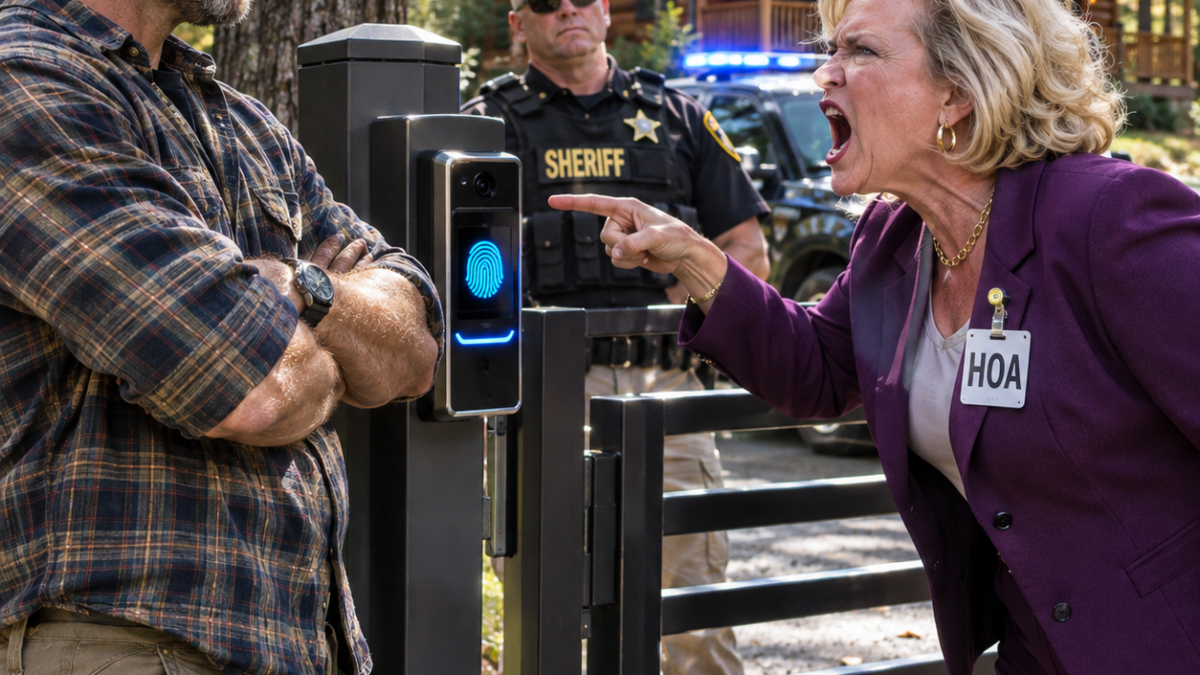
HOA Karen Had My Locks Cut Twice and Called the Police When I Refused to Give Her a Key—So I Built a Biometric Gate With No Key She Could Ever Take.
HOA president Diane Wexler called the sheriff twice because I refused to give her a key to a mountain cabin that had never belonged to her neighborhood, then sent her maintenance man to cut my locks when the police wouldn’t help her.
So I replaced the padlock with a biometric steel gate that had no key, no code, and nothing she could copy—and every time she touched it, crossed my fence, or tried to force her way onto my land, the system quietly built a permanent record.
What Diane didn’t know was that by the time she led thirty homeowners across my boundary with a bullhorn, her own insurance company, a property-crimes detective, and a newspaper reporter were already watching the same case collapse around her.
My name is Curtis Bain.
I was forty-seven years old when Diane Wexler decided she needed a key to my father’s cabin.
Not wanted one.
Needed one.
That distinction mattered to her.
To me, the distinction that mattered was simpler.
It was my cabin.
My road.
My gate.
My land.
And there had never been a key in the world that belonged to her.
I work as a cybersecurity consultant in Asheville, North Carolina.
Before that, I spent twelve years in the Air Force working signals intelligence and electronic security systems.
I don’t mention that because I think military service makes somebody automatically smarter than everyone else.
It doesn’t.
I’ve met brilliant civilians and foolish colonels.
But twelve years in that work teaches you certain habits.
You learn that access is either authorized or it isn’t.
You learn that logs matter.
You learn that the person making the loudest demand is not automatically the person with the strongest credentials.
And above all, you learn that a security system is only as strong as the point where somebody can bypass it.
My father understood that long before I did.
His name was Earl Bain.
He bought twenty-six acres on the western slope of Pisgah Ridge in 1989.
Back then, there wasn’t much around it.
Oak.
Hickory.
Poplar.
A seasonal creek cutting through the northeast corner.
Blackberries along the logging trail.
A gravel access road running about three hundred yards from County Route 9 through the woods.
He built the cabin himself in 1991 with help from two friends and a cousin who owed him money.
Twelve hundred square feet.
Post and beam.
Metal roof.
Stone fireplace.
Wraparound porch.
Nothing fancy.
PART2:
He used to say anything larger would just give him more places to lose his reading glasses.
Every Friday after work, Dad drove up there.
In deer season, he hunted.
Spring, he fished.
Summer, he sat on the porch with Louis L’Amour paperbacks until lightning bugs floated through the meadow.
Sometimes I went with him.
Sometimes I didn’t.
When I was young, I thought the cabin was boring.
No cable.
No neighbors.
No arcade.
No reason to be there if you were fifteen years old and convinced civilization only existed within walking distance of a mall.
Dad never forced it.
“That mountain will still be there when you get old enough to understand it,” he told me once.
He was right.
By my thirties, the cabin had become the place I went when the rest of my life got too loud.
Long contract.
Divorce.
Bad week.
Good week.
Didn’t matter.
I’d drive up Friday afternoon.
Phone off.
PART3:
Beer in the cooler.
Split wood.
Grill a steak.
Sit on the porch.
Listen to the creek.
Dad died in 2016.
Pancreatic cancer.
Six months from diagnosis to funeral.
Fast enough that your mind never catches up with your calendar.
The cabin came to me free and clear.
The first weekend after the funeral, I went up alone.
I sat in his reading chair until after dark and didn’t turn on a single light.
That place wasn’t just property anymore.
It was the last room in the world that still felt arranged around him.
By then, Ridgecrest Meadows existed east of the property.
The subdivision had gone in around 2008.
Sixty-two houses.
Half-acre lots.
Community pool.
Walking trail.
Decorative street signs.
The standard suburban arrangement.
The developer had purchased roughly a hundred acres beside Dad’s land.
Our properties shared about four hundred feet of boundary.
A simple split-rail fence marked most of it.
That was the entire legal relationship.
Dad’s twenty-six acres were never annexed into Ridgecrest Meadows.
Never subjected to the covenants.
Never part of the HOA.
No shared road.
No easement.
No utility corridor.
Nothing.
My gravel road entered from County Route 9 and served one destination.
The cabin.
Dad’s old gate stood at the road entrance.
Tubular steel.
Chain.
Padlock.
He had installed it in the 1990s after local teenagers started riding ATVs through the woods.
Nobody had ever complained about it.
Then Diane Wexler moved into Ridgecrest Meadows.
She arrived in 2019.
Fifty-four years old.
Divorced.
Originally from Charlotte.
Silver Lexus.
Blond hair cut in a sharp bob.
The kind of energy that didn’t enter a room so much as occupy it.
Within three months, she ran for HOA president.
Unopposed.
That should have been a warning.
Nobody sane wanted the job badly enough to compete with her.
Within six months, mailbox-height rules changed.
Fence-stain colors were revised.
Basketball hoops became architectural issues.
Homeowners began receiving notices for things nobody remembered caring about before Diane arrived.
I heard about most of it secondhand.
It wasn’t my neighborhood.
I didn’t care.
Then Diane walked up my driveway during a community yard sale.
I was stacking split wood beside the cabin.
She appeared carrying a leather folder.
“Mr. Bain?”
“That’s me.”
“I’m Diane Wexler.”
“Okay.”
“President of Ridgecrest Meadows.”
I waited.
She looked around the clearing.
The cabin.
The trees.
The gravel.
Then said, “Have you considered paving this driveway?”
I thought I had misheard.
“Why?”
“It would be more visually compatible.”
“With what?”
“The surrounding community.”
I leaned on the splitting maul.
“You mean Ridgecrest?”
“Yes.”
“My land isn’t in Ridgecrest.”
Her smile did something strange.
Didn’t disappear.
Just hardened.
“Well, we’re all neighbors here.”
“We are.”
“Then you understand property values affect everyone.”
“I understand I like gravel.”
She looked down the road.
“Dust can migrate.”
“So can opinions.”
That was probably unnecessary.
Still true.
She gave a small laugh.
“I’m only trying to be constructive.”
“I appreciate the visit.”
She understood she had been dismissed.
Diane did not enjoy dismissal.
The first key letter came two years later.
March 2022.
Official Ridgecrest Meadows letterhead.
The document informed me that my gate “impeded emergency-access coordination.”
The HOA had adopted something called the Ridgecrest Community Safety Initiative.
Under this initiative, I was required to provide the HOA with a key to my padlock within thirty days.
I sat at my kitchen table in Asheville and read it twice.
Then checked my deed.
Survey.
County GIS.
Fire maps.
Everything.
Nothing had changed.
The road was private.
No public easement.
No common access.
No subdivision utility.
No emergency route.
The nearest Ridgecrest house was hundreds of feet from my road.
Their dedicated entrances were on the east and south sides.
I wrote back politely.
Dear Ms. Wexler,
The Bain property is not a member of Ridgecrest Meadows HOA and is not subject to its governing documents. The gate referenced is located entirely on private property. No public, emergency, or HOA easement crosses the parcel. Accordingly, no key will be provided.
I enclosed my deed and survey.
Certified mail.
Return receipt.
That should have ended it.
Instead, two weeks later, another letter arrived.
The board had voted to classify my gate as a “community safety obstruction.”
I was now ordered to provide access within fifteen days.
Failure would result in “corrective action” and a $300 fine.
I laughed.
Not because it was funny.
Because I genuinely didn’t know what else to do.
I pinned the letter to the cabin refrigerator.
Then went fishing.
The following Saturday, I drove up and found the gate open.
The padlock lay in the gravel.
Cut cleanly through the shackle.
Fresh tire tracks ran past it.
I stood there longer than I should have.
The violation was small physically.
A thirty-dollar lock.
One chain.
But if you’ve ever had somebody enter property you thought was secure, you understand the feeling.
The land looks different afterward.
Not damaged.
Invaded.
Dad had mounted a trail camera near that gate for deer.
I had replaced it in 2018 with a newer model.
I pulled the SD card.
Wednesday.
2:47 p.m.
White pickup.
Man gets out.
Bolt cutters.
Cut.
Gate opens.
Truck drives through.
Eleven minutes later, it leaves.
No front plate visible.
Rear plate washed out by glare.
But the truck carried a Ridgecrest parking sticker.
I should have called the sheriff.
I didn’t.
That was my mistake.
I still thought reason would eventually enter the story.
I replaced the lock.
This time, hardened steel.
Anti-cut shackle.
Pick-resistant core.
Cost more than the gate itself deserved.
Then I added a second trail camera at another angle.
The next Wednesday, they cut that one too.
Same clean bite.
Same type of tool.
But this time I had the plate.
Glenn Furlow.
Ridgecrest Meadows contracted maintenance supervisor.
And there was more.
Three minutes after Glenn opened the gate, Diane’s silver Lexus arrived.
She waited.
Then drove through behind him.
She remained on my property twenty-two minutes.
The camera caught her leaving.
I watched the footage on my laptop that evening.
The mountain behind the cabin turned purple in sunset.
Creek moving through the trees.
Wood smoke in the air.
Everything peaceful except the screen.
Diane.
Glenn.
My broken lock.
I paused the footage on her Lexus.
I remember thinking:
She believes she is allowed to do this.
Not that she can get away with it.
Something worse.
She believed her position made permission unnecessary.
I still didn’t call the sheriff.
Not that night.
Instead, I built a better gate.
Six-foot welded steel.
Reinforced crossbar.
Concrete footings.
Commercial padlock.
Steel guard over the shackle so bolt cutters couldn’t reach it.
About two thousand dollars in material.
One long Saturday.
Two more cameras.
One facing County Route 9.
One hidden thirty feet back in the trees.
Cloud uploads.
Motion alerts.
I stood back when I finished.
It wasn’t beautiful.
Dad would have called it excessive.
But it was mine.
Three days later, the sheriff appeared at my primary residence in Asheville.
A young deputy stood on my porch.
Maybe twenty-five.
His name was Aaron Webb.
He looked almost embarrassed.
“Mr. Bain?”
“Yes.”
“I’m following up on a complaint.”
“About?”
“A gate.”
I laughed once.
Aaron looked apologetic.
“Ms. Diane Wexler alleges that you installed an unauthorized security barrier on a shared access road and that it may obstruct emergency services.”
I invited him in.
Kitchen table.
Deed.
Survey.
Trail footage.
Cut locks.
Diane’s Lexus.
The Ridgecrest letters.
Aaron took notes.
“Your road serves anything besides the cabin?”
“No.”
“Any recorded easement?”
“No.”
“Fire department ever use it?”
“No.”
“Public maintenance?”
“No.”
He looked at the video again.
“That’s their maintenance truck?”
“Yes.”
“Did you authorize him to enter?”
“No.”
He exhaled.
“I’m going to close this complaint.”
“Today?”
“Probably before I leave your driveway.”
That should have been embarrassing enough for Diane to stop.
Instead, it gave her a new idea.
She began claiming my gravel road encroached on HOA land near Lot 62.
The closest section of my road runs near the Ridgecrest boundary.
Not across.
Near.
Diane hired a surveyor.
Keith something.
He placed stakes and issued language saying approximately three feet of my road might fall “within the margin of measurement uncertainty” near the HOA common area.
Might.
Uncertainty.
Diane removed both of those words whenever she described it.
She wrote to the county road department.
Fire marshal.
Planning office.
She called it a “shared boundary access corridor.”
I was copied on everything.
I read the letters over leftover chili.
For the first time in months, I felt calm.
Because now she had moved from annoying into measurable.
I hired Richard Goss.
Licensed surveyor.
Thirty-two years’ experience.
The kind of man other surveyors stop talking when he enters a boundary dispute.
Richard spent two days on site.
GPS.
Historic monuments.
Recorded plats.
Control points.
He came to the porch on the second afternoon.
“No encroachment.”
“How close?”
“Fourteen point three feet at the nearest point.”
“So Keith was wrong.”
Richard took off his cap.
“His methodology was poor.”
“That’s surveyor language for wrong.”
“Yes.”
“Could an honest surveyor get three feet?”
“Not using the monuments I found.”
He reviewed the HOA survey and later wrote that it relied on outdated reference points and did not conform with current professional standards.
I sent Richard’s certified plat to every government agency Diane had contacted.
Planning closed its file.
Road department closed its file.
Fire marshal called me personally.
“Mr. Bain, your gate does not affect required emergency access.”
“Thank you.”
“I’m sorry you’re dealing with this.”
“So am I.”
That should have been the end.
Instead, Diane called a special HOA meeting.
She asked Ridgecrest homeowners to authorize legal action against me.
The issue, according to her presentation, was public safety.
What if wildfire blocked the southern entrance?
What if flooding blocked the east entrance?
What if emergency vehicles needed my private road?
She described my gate as a threat to sixty-two families.
The fact that the county fire marshal had already rejected that argument apparently did not make the slideshow.
Forty-one voted yes.
Nine voted no.
One of the nine was Connie Pruitt.
Retired schoolteacher.
Lot 23.
Connie asked whether there was any recorded easement.
Diane said the HOA attorney believed the community had “strong equitable access rights.”
The attorney was Paul Dietrich.
Paul sent me a four-page demand letter.
Remove gate.
Provide emergency access credentials.
Pay $2,200 in accumulated community-safety fines.
He cited three statutes.
I read them.
Two applied to commercial buildings.
The third expressly excluded private residential roads without a public-access designation.
I forwarded the letter to Helen Sharp.
Helen was a property-rights litigator in Asheville.
Twenty-five years’ experience.
Polite.
Exact.
Never raised her voice.
People who needed yelling did not enjoy discovering how little she required it.
She read Dietrich’s letter.
Then looked at me.
“Did he write this?”
“Apparently.”
“All four pages?”
“His signature.”
She slid it back.
“This is embarrassing.”
“For me?”
“For him.”
Her response was nine pages.
Actual law.
Certified survey.
Fire marshal letter.
Sheriff complaint closure.
Lock-cutting footage.
She ended with a warning that continued attempts by an HOA to exercise authority over non-member private property could expose the association and individual board members to liability.
Dietrich answered with one paragraph:
The Association is reviewing its options.
Helen smiled.
“What?”
“He’s done.”
“How do you know?”
“A lawyer who believes his client has a case does not replace four pages with one sentence.”
The HOA liability carrier received Helen’s letter.
That changed things.
The insurer reviewed the file.
Two weeks later, Ridgecrest’s board received a warning.
Continued pursuit against clearly non-member property might fall outside policy coverage if the board ignored known jurisdictional limits.
Translation:
Keep going and you may pay for the consequences yourselves.
Diane ignored it.
I learned that because Connie called Helen.
She was scared.
Diane had dismissed the insurance warning as “overcautious.”
Two board members objected.
Diane pushed forward.
Then she called the sheriff again.
Saturday morning.
I was installing a motion floodlight above the gate when Aaron Webb’s cruiser pulled up.
He stepped out.
Saw me.
Closed his eyes briefly.
“Please don’t tell me.”
“I didn’t call you.”
“I know.”
“What now?”
He read from his report.
“Fortifying property in a threatening manner designed to intimidate neighboring residents.”
I looked at the gate.
Then at the floodlight.
Then back at him.
“Paramilitary?”
He looked down.
“That word appears.”
“Excellent.”
He walked around.
Inspected the cameras.
Steel gate.
Light.
“Looks like a gate.”
“Thank you, deputy.”
“Looks like cameras.”
“You’re very good.”
“Looks like a floodlight.”
“County training really pays off.”
He laughed despite himself.
Then closed the complaint.
Before leaving he leaned against the cruiser.
“Between us?”
“Yes.”
“We’ve had four complaints from Ms. Wexler in about three months.”
“All against me?”
“Yes.”
“All closed?”
“Yes.”
He hesitated.
“My sergeant has noticed.”
That mattered.
Diane’s reports were no longer isolated complaints.
They were becoming a pattern.
That evening I sat on Dad’s porch with a beer.
The ridge went purple.
The creek was low.
Cicadas loud.
I opened my laptop.
Until then, I had been thinking like a homeowner.
Stronger locks.
Better evidence.
Letters.
Survey.
That night I started thinking like the man I had been in the Air Force.
The key was the problem.
As long as there was a physical key, Diane could demand one.
Copy one.
Steal one.
Cut around one.
Argue that somebody should possess one.
So I removed the concept.
I spent two hours designing a new access-control system.
Commercial-grade motorized cantilever gate.
Twelve feet wide.
Reinforced steel.
Anti-climb construction.
No exposed lock.
Solar power.
Battery backup.
Encrypted radio fob.
Phone authentication.
Biometric confirmation.
No keypad.
No combination.
No physical key.
Then I added a hardened roadside access panel.
Intercom.
High-resolution camera.
License-plate recognition.
Any vehicle approaching would be photographed.
Plate recorded.
Timestamp.
Cloud upload.
Then perimeter monitoring.
Four hundred feet of shared boundary.
Fence vibration sensors.
Infrared tree-line detection.
Four cameras with overlapping coverage.
Then logs.
Every event.
Motion.
Intercom press.
Gate command.
Plate capture.
Boundary trigger.
Tamper event.
Automatic backup.
It took three weeks.
When I finished, Helen came to see it.
She stood beside County Route 9 looking through the gate.
“This is ridiculous.”
“Legally?”
“No.”
“Then thank you.”
“Your father had one padlock.”
“My father didn’t have Diane.”
I mounted a polished aluminum sign.
PRIVATE PROPERTY
NO KEYS
NO CODES
NO EXCEPTIONS
BIOMETRIC ACCESS ONLY
ALL APPROACHES RECORDED AND LOGGED
Helen read it.
“You enjoyed that.”
“A little.”
“Try not to enjoy things in litigation.”
“Impossible.”
I also finally did what I should have done months earlier.
I filed a criminal trespass complaint regarding Glenn Furlow cutting the locks.
Both incidents.
Video.
Plate.
Diane’s Lexus.
The sheriff assigned Detective Bill Tatum.
Fifteen years in property crimes.
Quiet.
Heavy mustache.
The kind of man who listened until people became uncomfortable and started filling silence.
Bill interviewed Glenn.
Glenn cooperated.
He admitted Diane told him the gate was on “community-adjacent land” and that the HOA had authority to preserve access.
He said she provided the bolt cutters.
He said she instructed him both times.
He claimed he believed her.
Bill told me afterward:
“I believe he believed some of it.”
“Does that matter?”
“It matters to charging and cooperation.”
“What about Diane?”
“We’re sending the file to the DA.”
I didn’t tell anyone.
No Facebook.
No neighbor gossip.
No victory lap.
I kept building the record.
Diane met the biometric gate at 10:17 on a Monday morning.
The system logged her Lexus before I even knew she was there.
I was at my desk in Asheville.
Phone buzzed.
Vehicle approach.
Plate recognized.
Unknown authorized status.
I opened video.
Diane sat behind the wheel.
Sunglasses.
Jaw tight.
Forty-three seconds.
Then she pressed the intercom.
I let it ring.
Again.
Again.
Five times.
No answer.
She got out.
Walked to the gate.
Ran one hand along the steel.
Looked for a padlock.
None.
Crouched.
Inspected the bottom rail.
Looked at the motor housing.
Took photographs.
Stared at the sign.
I could almost see the realization.
There was nothing to demand.
No key to hand over.
No code to subpoena through an HOA vote.
Nothing her maintenance man could clip with bolt cutters.
Access existed only when I authenticated it.
She returned to the Lexus.
Left.
The system had fourteen still photographs.
One continuous video.
Five intercom attempts.
Plate.
Time.
Zero access.
Wednesday, she called the sheriff again.
Electronic surveillance.
Alleged violation of North Carolina recording law.
Aaron came back.
He looked at me.
“I want a different beat.”
“Request denied.”
He inspected camera angles.
My land.
Public road.
No camera aimed into Ridgecrest yards.
Complaint closed.
Twenty minutes.
Thursday, Diane emailed every Ridgecrest homeowner.
My gate was now a “hostile militarized barrier.”
She said I was using surveillance technology to monitor families.
She scheduled another special meeting.
Forty-four homeowners attended.
She projected a photograph of the gate.
Called it “Fort Knox on our doorstep.”
Then proposed an $8,000 special assessment to fund litigation.
Thirty-one voted yes.
Thirteen no.
Connie stood.
“Has counsel confirmed we have legal standing?”
Diane answered:
“Counsel is working on it.”
Connie said:
“That isn’t what I asked.”
Diane moved on.
Behind the scenes, their insurer had not moved on.
The carrier assigned investigator Ruth Chandler.
Ruth reviewed everything.
Meeting minutes.
Invoices.
Dietrich’s letters.
Surveys.
Glenn’s maintenance charges.
Insurance warning.
Police complaints.
She discovered Ridgecrest had spent $14,600 fighting me.
Surveyor.
Lawyer.
Contractor.
Special meetings.
Administrative costs.
All directed at land the HOA did not govern.
Then she found that the insurer’s written warning had been discussed in closed session.
Diane had told the board to ignore it.
Ruth scheduled a full board review.
Called it routine.
Diane accepted.
She had no idea what was in Ruth’s file.
She also did not know Bill Tatum’s criminal case had been approved by the DA.
Warrants were being prepared.
Then came the community safety walk.
That was Diane’s masterpiece.
She promoted it everywhere.
Facebook.
Email.
Flyers.
COMMUNITY SAFETY WALK
PROTECT OUR ACCESS
SATURDAY 9:00 AM
She expected fifty.
Thirty showed.
My cameras counted them.
I was in Asheville watching live.
Diane led from the front.
Clipboard.
HOA lanyard.
Bullhorn.
She walked along the Ridgecrest side of the split-rail fence.
For forty minutes, everything was legal.
Ridiculous.
But legal.
She pointed at my cameras.
Floodlights.
Fence sensors.
The gate.
I could hear some homeowners asking questions.
One said, “Isn’t that his property?”
Diane answered through the bullhorn:
“Private ownership does not eliminate community responsibility.”
Then she stepped over the fence.
Just like that.
Low rail.
One leg.
Then the other.
Ten feet onto my land.
My phone lit up.
PERIMETER EVENT — EAST BOUNDARY.
Then another.
Three board members followed.
Keith Avery.
Nicole Pham.
Mike Castellano.
Most of the others stayed behind the fence.
That told me something.
Diane approached one of my camera posts.
Pointed at it.
Her voice came clearly through the audio.
“This is what paranoia looks like.”
I stared at my screen.
She was standing on private property she had repeatedly been told was private, directly beneath a camera she had been warned was recording, calling me paranoid for recording unauthorized entry.
I could not have scripted it.
I called Helen.
“She’s over the fence.”
“How far?”
“Ten feet.”
“Anyone with her?”
“Three board members.”
“Recording?”
“Three angles.”
“Do not go there.”
“I’m in Asheville.”
“Good.”
She called Bill Tatum.
He asked for clips.
The new footage could support additional trespass charges and civil claims.
Diane still had one more audience.
Reporter Cassie Drummond.
Asheville Citizen Times.
She had seen the public event announcement and driven out.
Parked about two hundred feet away on County Route 9.
Telephoto lens.
She photographed Diane stepping over the fence.
Bullhorn in hand.
Board members following.
Thirty witnesses.
Diane had organized her own documentation team.
Cassie called me that afternoon.
“Mr. Bain?”
“Yes.”
“I’m a reporter.”
“I know who you are.”
“I watched the event today.”
“That sounds unfortunate.”
“I have photographs of Ms. Wexler crossing your boundary.”
“Yes.”
“I’d like your comment.”
I gave her Helen’s number.
Helen gave a factual summary.
No insults.
No speculation.
Cut locks.
Unfounded complaints.
Surveys.
Insurance warning.
Trespass.
Pending legal process.
Monday, Helen filed.
Buncombe County Superior Court.
Ridgecrest Meadows HOA.
Diane Wexler individually.
Glenn Furlow.
Keith Avery.
Nicole Pham.
Mike Castellano.
Claims included trespass, interference with property rights, harassment, abuse of process, and related civil causes.
Damages alleged:
$68,000.
Security costs.
Surveys.
Attorney expenses.
Loss of use.
Other damages.
Public record.
Thursday was the insurance meeting.
Six p.m.
Community center.
I did not attend.
Not my HOA.
Connie later told me every detail.
Ruth Chandler arrived with another insurance representative and a folder nearly two inches thick.
All five board members present.
Twenty-five homeowners.
Ruth began politely.
Then stopped smiling.
$14,600 spent pursuing a non-member property.
Two documented lock-cutting incidents.
Four unfounded complaints to law enforcement.
One disputed survey contradicted by a certified plat.
Legal action pursued after insurer warning.
Special assessment approved without confirmed legal standing.
Closed-session attempt to declare private property a shared access corridor.
Then the consequence.
Ridgecrest Meadows would be reclassified as high risk.
Premium increase:
Sixty percent.
Worse:
The insurer would exclude costs arising from the Bain dispute because the board had been explicitly warned and continued anyway.
Meaning the HOA could no longer assume the insurance company would pay for Diane’s campaign.
The room erupted.
Connie stood holding a copy of the original insurance letter.
“You told us they supported us.”
Diane tried to answer.
Connie read the warning aloud.
People started shouting.
“Why didn’t we see this?”
“Where did the $14,600 go?”
“Why did we vote on litigation?”
“You said the lawyer agreed.”
Diane raised her hands.
“Please.”
Then the community-center door opened.
Bill Tatum entered.
Uniformed deputy with him.
Connie said the room became so quiet she could hear the fluorescent fixtures buzzing.
Bill identified himself.
“Ms. Wexler?”
She looked at him.
“Mr. Furlow?”
Glenn was seated in the back.
He stood immediately.
Bill told them he had warrants.
Criminal trespass related to the lock-cutting incidents.
Additional allegations concerning Diane’s direction of the activity.
Professional.
Calm.
No theatrics.
Diane’s face drained.
She stood.
Someone asked:
“Are you arresting our president?”
Bill said:
“I’m serving lawful warrants.”
That was all.
As Diane walked toward the door, Connie spoke.
She told me later she regretted it.
Then admitted she didn’t regret it very much.
“Diane.”
Diane turned.
“You spent our money trying to get a key to a man’s gate.”
Nobody moved.
Connie continued.
“Now you can’t even get out of your own mess.”
No applause.
No laughter.
Just silence.
Cassie’s article ran the next morning.
HOA PRESIDENT CHARGED WITH TRESPASS AFTER YEAR-LONG CAMPAIGN AGAINST NEIGHBOR’S LOCKED GATE.
Photographs showed the gate.
Boundary.
Diane with bullhorn.
The story quoted the fire marshal.
Certified survey.
Insurer.
Helen.
Diane’s description of my property as militarized.
More than a thousand shares in two days.
Someone made a meme of my gate sign.
WHEN KAREN CAN’T GET A KEY.
I laughed once.
Then stopped reading comments.
Internet attention has a way of turning people into cartoons.
Diane was wrong.
Repeatedly.
Aggressively.
But I didn’t need ten thousand strangers inventing additional crimes for her.
The criminal cases resolved three months later.
Glenn pleaded to misdemeanor trespass.
Fine.
Probation.
His cooperation mattered.
Diane pleaded to two misdemeanor trespass counts and one charge connected to directing the lock cutting.
Suspended sentence.
Eighteen months probation.
$1,500 fine.
No contact with me.
No entry onto my property.
No administrative complaints concerning my land.
The civil case settled five months later.
$41,000 total.
Twenty-three thousand from Ridgecrest.
Eighteen thousand from Diane personally.
Legal expenses.
Security costs.
Survey fees.
Damages.
Not a fortune.
Enough.
The HOA removed Diane in a special election.
Fifty-four to two.
She put her house on the market.
Moved to Charlotte before Christmas.
Keith and Nicole resigned.
Mike Castellano apologized publicly and stayed.
Connie became president.
Unanimously.
That part amused me.
The woman who had repeatedly asked the obvious question nobody wanted to answer became the person everyone trusted.
Connie contacted Helen first before visiting me.
“Can I come to the cabin?”
Helen asked.
“Why?”
“To apologize.”
Helen called me.
“You want to meet her?”
“Yes.”
“She says she’s bringing brownies.”
“Definitely.”
Connie arrived on a Saturday afternoon.
No bullhorn.
No clipboard.
Brownies.
She stood outside the biometric gate.
Pressed the intercom.
I answered.
“Identify yourself.”
She looked into the camera.
“Your worst nightmare. HOA president.”
I laughed.
Opened the gate.
She drove up.
We sat on Dad’s porch.
Connie placed a new set of Ridgecrest bylaws on the table.
One added section explicitly stated that the HOA had no authority over adjacent non-member property.
Board officers could not authorize entry onto neighboring private land.
No community initiative could create access rights absent recorded legal authority.
“I wish we’d written this fifteen years ago.”
“You shouldn’t have needed to.”
“I know.”
She looked toward the ridge.
“What can we do?”
“Nothing.”
“I’m serious.”
“So am I.”
“To make it right.”
I thought about that.
Then looked toward the boundary.
“One marker.”
“What?”
“At the fence where Ridgecrest meets County Route 9.”
“What should it say?”
“Something boring.”
She smiled.
A month later they installed it.
Wooden post.
Simple plaque.
RIDGECREST MEADOWS HOA BOUNDARY
ADJACENT PRIVATE PROPERTY BEYOND THIS POINT
Perfect.
No names.
No accusations.
No history.
Just a line.
My father would have liked it.
Glenn Furlow wrote me a handwritten apology.
He said Diane told him the HOA had legal authority.
He should have checked.
He should never have cut a lock based only on somebody’s word.
He asked for no forgiveness.
That helped.
I called him.
“You made a bad decision.”
“I know.”
“Two.”
“I know.”
“You ever cutting anybody’s lock again?”
He laughed nervously.
“No, sir.”
“Then we’re good.”
I meant it.
The easiest thing in a story like this is turning everyone into villains.
Glenn wasn’t Diane.
He was an employee who trusted the wrong authority and failed to ask the right question.
That failure mattered.
So did his cooperation afterward.
Diane never apologized.
Not to me.
I didn’t need it.
I used part of the settlement to repair the cabin porch.
Dad’s boards were starting to rot.
New wood.
Same design.
Upgraded wood stove.
Better reading chair in the corner where his old one had stood.
I donated two thousand dollars to the volunteer fire department.
The same department Diane had tried to use against me.
The chief called.
“You know you don’t need to prove anything.”
“I’m not.”
“Then why?”
“Because your department answered questions honestly when somebody was trying to weaponize you.”
He was quiet.
“That might be the nicest reason we’ve gotten money all year.”
The biometric gate stayed.
Still there.
Still no key.
People online assumed the gate was some kind of personal victory monument.
It wasn’t.
It was a solution.
Diane wanted a key.
So I installed a system where keys did not exist.
Remove the object of the argument.
That was the cybersecurity lesson.
People focus on denying requests.
Sometimes the better solution is changing the architecture so the request becomes meaningless.
Give me the password.
There isn’t one.
Give me the key.
There isn’t one.
Tell me the code.
No code.
Let me copy access.
Access is tied to authentication you do not possess.
That drove Diane insane because she couldn’t convert the problem back into something she could demand.
Her whole style depended on entitlement to procedure.
Letters.
Votes.
Complaints.
She thought enough official-looking steps could create a right where none existed.
The gate didn’t argue.
Closed meant closed.
Authorized meant authorized.
The system did not care who chaired a committee.
Years later, Connie asked me something.
We were standing near the boundary marker during a fall cleanup.
“Why didn’t you just give the HOA an emergency key in the beginning?”
I looked at her.
“You too?”
“No. I’m asking seriously.”
“Because it wouldn’t have ended there.”
“You think?”
“I know.”
I leaned against the fence.
“If I had given Diane one emergency key, who holds it?”
“President.”
“Then when does it get used?”
“Emergency.”
“Who defines emergency?”
She smiled.
“Diane.”
“Then maintenance needs access.”
“Probably.”
“Then survey.”
“Yeah.”
“Then board inspection.”
“Okay.”
“Then maybe a contractor needs a copy.”
Connie nodded.
“Point taken.”
“But there’s a bigger reason.”
“What?”
“Permission given under pressure gets remembered as precedent.”
She looked toward Ridgecrest.
“You really do work in cybersecurity.”
“Unfortunately.”
The cabin remained my Friday escape.
Gate opens by fingerprint.
Truck climbs the gravel road.
Oaks.
Meadow.
Stone chimney.
Sometimes deer trigger the perimeter cameras.
Wild turkeys.
Once a black bear stood directly in front of the roadside panel and stared into the lens for forty seconds.
The system logged:
UNIDENTIFIED APPROACH.
I saved that clip.
Probably my favorite one.
No HOA badge.
No bullhorn.
Bear didn’t demand credentials.
Just sniffed the camera and left.
The mountain went back to being quiet.
That took longer inside me.
For months after everything ended, every motion alert made my stomach tighten.
Even when I knew Diane was gone.
Even after the no-contact order.
Even after the boundary marker.
Security systems can stop intrusion.
They cannot immediately convince your nervous system the intrusion is over.
One Friday evening, I sat on the porch with Dad’s old paperback beside me.
Wind moving through the hardwoods.
Creek ticking over stones.
Then I realized I had not checked the gate feed in six hours.
That felt like winning.
Not the $41,000.
Not the vote.
Not the headline.
Six hours without thinking about Diane.
That was peace.
People who followed the story often focused on the arrests.
The bullhorn.
The biometric gate.
The memes.
The insurance increase.
Those were dramatic.
But the part I think about most happened much earlier.
The first cut lock.
Thirty dollars.
That was the moment.
I could have treated it as nothing.
Replace it.
Move on.
A lot of people would.
I almost did.
Then the second lock was cut.
And Diane’s Lexus followed Glenn through.
That clarified everything.
Boundaries are strange.
Most of the time, they exist quietly.
You do not stand at your property line every morning congratulating yourself.
You don’t stare at your front door thinking about your right to decide who enters.
You simply live inside the assumption.
Then somebody crosses without permission.
Suddenly the invisible line becomes the most important thing in the world.
Diane used the language of safety because safety sounds noble.
Emergency access.
Community coordination.
Fire response.
Those words matter.
That is exactly why they should not be abused.
Real emergency planning is based on maps.
Fire code.
Recorded access.
Engineering.
Not one HOA president deciding the neighboring cabin would be convenient if she could obtain a key.
The fire marshal had confirmed Ridgecrest met access requirements.
Two entrances.
County roads.
My driveway was irrelevant.
But Diane’s argument was never truly about emergency response.
It was about whether someone beside her neighborhood could tell her no.
That was the part she could not tolerate.
No key.
No jurisdiction.
No access.
No.
Every escalation was her attempt to turn no into negotiation.
First letter.
Second letter.
Fine.
Cut lock.
Cut another lock.
Police complaint.
Survey.
Government complaints.
Board vote.
Lawyer demand.
Second police complaint.
Special assessment.
Community march.
Trespass.
She believed persistence created entitlement.
It didn’t.
It created evidence.
Every time she escalated, another neutral party entered the record.
Sheriff.
Surveyor.
Fire marshal.
Attorney.
Insurance carrier.
Detective.
Reporter.
Court.
By the end, Diane was no longer arguing with me.
She was arguing with documentation generated by almost every institution she had tried to recruit.
That is the irony.
She called the sheriff.
The sheriff documented her complaints as unfounded.
She hired a surveyor.
I obtained a better certified survey.
She contacted the fire marshal.
He cleared my gate.
She used HOA counsel.
Her lawyer backed away.
She triggered insurance review.
The insurer found $14,600 in unsupported conflict spending and excluded coverage.
She organized the community walk.
My cameras and a reporter documented her trespass.
The tools she thought would expand her power ended up limiting it.
Dad would have appreciated that.
He didn’t trust people who needed titles.
I once asked him why he never joined the local hunting club board.
He said:
“Anyone who wants to be president of a hunting club shouldn’t be trusted near a rifle or a meeting agenda.”
Probably unfair.
Very Dad.
He believed fences existed to avoid arguments.
You marked the line so nobody had to guess.
That is why the Ridgecrest plaque means more to me than the settlement.
It made the boundary visible for the next person.
No Curtis.
No Diane.
No old dispute.
Just information.
HOA ends here.
Private property begins there.
Simple.
Sometimes people need physical reminders of legal reality.
I still keep one of Dad’s old padlocks in the cabin.
Not either one Glenn cut.
Those became evidence and eventually disappeared into case storage before being returned.
This older lock came from the original gate.
Rusty brass body.
Heavy key.
One day I put it beside the biometric panel and laughed.
Dad had one piece of brass.
I had cameras, encrypted radios, plate recognition, cloud logging, infrared sensors, solar backup.
He probably would have asked:
“Does it keep people out?”
“Yes.”
“Then why do you need the rest?”
“Because people sue now.”
He’d have laughed.
Maybe.
I think he would have understood.
Security is not really about hardware.
It’s about certainty.
Who entered?
When?
How?
Authorized?
Not authorized?
What happened next?
Diane tried to live in ambiguity.
Maybe the road is shared.
Maybe the survey means encroachment.
Maybe emergency access gives us authority.
Maybe the HOA can fine you.
Maybe a contractor had permission.
Maybe cameras are illegal.
Maybe our rights extend beyond the fence.
The system removed maybe.
Plate.
Time.
Image.
Boundary.
No access granted.
That is why I called it done when the gate went live.
Not unbeatable in some absolute sense.
Anything physical can be defeated with enough force.
A truck could ram it.
An excavator could tear it out.
A saw could cut steel.
The point was not making entry physically impossible.
The point was making unauthorized entry impossible to disguise.
You could beat the metal.
You could not beat the record.
That was what Diane never understood.
The most secure part of the gate wasn’t the steel.
It was the log.
Years later, a homeowner from Ridgecrest named Tom Avery—not related to Keith—came by the cabin.
He pressed the intercom.
“Curtis?”
“Yeah?”
“This is Tom from Ridgecrest. Connie gave me your number.”
“What’s up?”
“My son lost his dog.”
I opened the gate.
No hesitation.
Tom drove up.
Black-and-white border collie had escaped during a thunderstorm.
We searched my woods for three hours.
Found the dog tangled in mountain laurel near the creek.
Tom cried when we carried him back.
On the porch afterward, he looked toward the gate.
“You know, for years I thought that thing meant you hated us.”
“I don’t hate Ridgecrest.”
“I know that now.”
“It means I decide who enters.”
Tom nodded.
“That’s fair.”
Exactly.
A boundary is not hostility.
A locked door is not hatred.
Privacy is not aggression.
Refusing access is not the same as attacking somebody.
Those distinctions became blurred during Diane’s presidency because she needed them blurred.
If my gate could be described as hostile, her intrusion became defense.
If my privacy became community danger, her demand became public service.
Language can turn entitlement into virtue if nobody checks what the words actually mean.
That is why I became careful with words afterward.
Diane did not get arrested because she was a “Karen.”
She faced consequences because evidence showed unauthorized entry and direction of lock cutting.
The HOA did not lose because all HOAs are evil.
Ridgecrest lost because its board repeatedly asserted authority it did not possess after being warned.
The homeowners were not stupid for initially believing Diane.
Most had jobs.
Families.
They trusted elected volunteers and hired professionals.
Trust is necessary for communities to function.
The failure was that too few people asked for documentation before voting.
Connie did.
Others eventually joined her.
That mattered.
When she became president, one of Connie’s first rules was that every legal claim presented at a membership meeting had to include the actual attorney opinion supporting it.
No “our lawyer says.”
Show the letter.
If there was no letter, say that.
Insurance warnings had to be disclosed.
Board conflicts listed.
No closed-session vote could create authority over non-member land.
Basic governance.
Nothing revolutionary.
That was the most frustrating part.
So much damage had been caused by ignoring ordinary boundaries that should never have required a lawsuit.
The homeowners paid for Diane’s choices too.
Higher premiums.
Legal bills.
Settlement.
Special meeting costs.
Fractured relationships.
It took years for Ridgecrest to recover financially.
That bothered me.
Some of the people writing those checks had voted against Diane.
Some had never attended a meeting.
Some had moved in after the whole thing began.
That is how collective governance works.
Bad leadership spreads costs beyond the leader.
Which is why boring oversight matters before the crisis.
After Diane left, Connie mailed every homeowner a one-page explanation of the settlement.
No spin.
No “community challenge.”
No blaming outsiders.
She wrote:
The prior board asserted authority over neighboring property it did not possess. Those actions created legal and insurance costs. New procedures have been adopted to prevent recurrence.
I framed that too.
Not in the cabin.
I’m not insane.
But I kept it.
Accountability in one paragraph.
I never wanted Ridgecrest destroyed.
I wanted them off my land.
That difference matters.
When the insurer announced the sixty-percent premium increase, some people expected me to enjoy it.
I didn’t.
That increase came from homeowners’ dues.
Families.
Retirees.
People who had been misled.
Diane suffered consequences personally later.
The HOA suffered sooner.
That is one reason I agreed to settle the civil case for less than Helen believed we could push toward.
She told me:
“You have leverage.”
“I know.”
“You could ask for more.”
“I know.”
“Then why aren’t you?”
“Because the neighborhood didn’t cut my locks.”
“Their contractor did.”
“At their president’s direction.”
“The board authorized the campaign.”
“Some of them.”
Helen leaned back.
“You’re making my job annoyingly moral.”
“I thought lawyers liked nuance.”
“Only when billable.”
We settled.
Enough to make me whole.
Enough that Ridgecrest understood the cost.
Not enough to become revenge.
Helen approved reluctantly.
That was probably the right amount.
The gate still logs every approach.
Last month:
UPS truck.
Connie.
Two deer.
Tom Avery.
Black bear.
Unknown sedan that made a U-turn.
My own truck.
Nothing dramatic.
I like it that way.
Sometimes I sit in Dad’s chair and think about the whole sequence.
It could have ended after the first letter.
She asks.
I say no.
Done.
It could have ended after the first police complaint.
Sheriff confirms private land.
Done.
After Richard’s survey.
Done.
Fire marshal.
Done.
Insurance warning.
Done.
Any of those could have been the off-ramp.
Diane rejected every one.
That was her downfall.
Not bad luck.
Not a clever lock.
Not my military background.
Not Helen.
Not the newspaper.
She lost because she kept treating facts as temporary obstacles.
No became something she could outvote.
A boundary became something she could redefine.
A sheriff’s closure became something she could complain around.
A survey became something she could replace.
An insurer warning became cowardice.
The more reality disagreed with her, the more convinced she became that reality was resisting leadership.
That is a dangerous way to live.
Eventually there is nowhere left to escalate except into consequences.
I learned something too.
For the first few months, I wanted to beat Diane.
That mindset almost pulled me into the same kind of obsession.
Better lock.
Better letter.
Better argument.
Better evidence.
Winning.
Helen noticed.
We were sitting in her office after the second sheriff complaint.
She said:
“You know the goal isn’t to make her lose.”
“Feels like it.”
“The goal is to make her stop.”
I looked at her.
“That sounds like the same thing.”
“It isn’t.”
She was right.
Winning is personal.
Stopping the behavior is practical.
The gate helped because it made the problem practical.
She cannot enter.
Everything else became secondary.
Once I stopped needing Diane to admit she was wrong, I became harder to manipulate.
She could scream.
File.
Vote.
Write.
Call police.
I no longer needed emotional resolution from her.
I needed documentation and distance.
That is why I never contacted her after she moved.
No letter.
No final message.
No “I told you so.”
Nothing.
The gate closed behind the story.
That was enough.
On the seventh anniversary of Dad’s death, I spent the weekend at the cabin.
No laptop.
No case files.
No motion-feed review.
I took one of his old Louis L’Amour books from the shelf.
Sat in the chair.
Read until sunset.
Lightning bugs came out.
Exactly like they used to.
At some point, the gate sent a motion alert.
I ignored it.
Ten minutes later, I checked.
Deer.
Doe and two fawns near the entrance.
I watched the clip.
Then deleted it.
Dad would have laughed at me for spending thousands of dollars to identify deer electronically when he could do it from tracks.
Maybe he was right.
Maybe not.
The cabin changed after him.
So did I.
But some things stayed.
The creek.
The ridge.
The smell of rain on oak leaves.
The way morning fog sits below the porch.
The silence after sunset.
And the feeling that when I drive through the gate and it closes behind me, the world has been reduced to the size I can handle.
That was always what the cabin was for.
Diane almost turned it into a battlefield.
I refused to let her keep it that way.
That is the ending people sometimes miss.
The strongest lock was not the biometric gate.
The strongest lock was deciding the conflict did not get to live in my head after the legal part ended.
I rebuilt the porch.
Lit the stove.
Read Dad’s books.
Let the forest reclaim the silence.
Ridgecrest remained next door.
That was fine.
Neighbors do not have to own each other to coexist.
They need lines.
Respect.
And enough humility to accept that somebody else’s property is not an unfinished extension of their own plans.
The boundary plaque now stands where the split-rail fence meets County Route 9.
Most drivers barely notice it.
That’s good.
Boundaries work best when nobody needs to fight about them.
I sometimes stop there when walking.
The plaque is weathering now.
Lettering still clear.
RIDGECREST MEADOWS HOA BOUNDARY.
ADJACENT PRIVATE PROPERTY BEYOND THIS POINT.
Twenty words would have saved us a year.
Maybe not Diane.
But everyone else.
People ask whether the biometric system was overkill.
Absolutely.
It was also effective.
No lock has been cut since.
No HOA representative has crossed without permission.
No sheriff complaint has been filed.
No survey stakes mysteriously appear.
No emergency key exists.
Connie once asked if the fire department could access the property if I were unconscious.
Good question.
Unlike Diane’s demand, that one had an actual answer.
I worked directly with county fire officials.
They hold a documented emergency override through a secure dispatch protocol.
Not the HOA.
Not a board president.
Actual emergency services.
Access is logged.
Use requires a dispatch event.
That is how real emergency planning works.
Specific authority.
Specific purpose.
Accountability.
Diane wanted indefinite access because she called it safety.
I gave legitimate responders controlled access because safety actually required it.
The difference is everything.
One winter, snow covered the ridge.
Six inches.
Enough to make the gravel road disappear under white.
I drove up anyway.
Fingerprint opened the gate.
Motor pushed it aside.
I passed through.
It closed.
I parked near the cabin.
Snow absorbed every sound.
I stood on the porch.
Dad’s chair visible through the window.
Smoke starting from the chimney.
For a moment, I thought about that first cheap padlock.
About Glenn’s bolt cutters.
Diane’s Lexus.
The sheriff at my door.
All the letters demanding a key.
Then I looked down the road.
Gate hidden by trees.
Quiet.
I finally understood why Dad never needed more than that old chain.
It wasn’t because the lock was stronger.
People respected the line.
Security technology had become necessary only after respect failed.
That is the part nobody selling locks wants to tell you.
The best security system is still a person seeing a boundary and deciding not to cross it.
Diane saw mine.
Then crossed anyway.
Again and again.
So I built something she couldn’t argue with.
A gate with no key.
A system that never forgot.
And a record that turned every unauthorized step into evidence.
She thought the lock was what stopped her.
It wasn’t.
The lock only stopped the truck.
The documentation stopped the story she had been telling everyone else.
That story said she was protecting her neighborhood.
The camera showed her trespassing.
That story said the HOA had access rights.
The survey showed it didn’t.
That story said emergency services needed my road.
The fire marshal said they didn’t.
That story said the board’s insurer supported its actions.
The insurance letter said stop.
That story said I was paranoid.
Then thirty witnesses watched her step across my fence while a reporter photographed it.
Eventually reality accumulated faster than Diane could rename it.
That was when she lost.
Not when the gate closed.
Not when the warrant was served.
Not even when the vote was 54–2.
She lost the first time the facts became stronger than her authority.
Everything after that was paperwork catching up.
I’m fifty now.
Still consulting.
Still going to the cabin Friday evenings.
The gate recognizes me before I reach it.
Phone authenticates.
Motor slides open.
Sometimes I use the fingerprint panel anyway.
I like the ritual.
Touch.
Green light.
Open.
Drive through.
Close.
No key dangling from the ignition.
No spare hidden under a rock.
No envelope in an HOA office.
Nothing Diane Wexler could ever have demanded.
Inside the cabin, Dad’s old brass key still hangs on a nail beside the fireplace.
It doesn’t open the new gate.
Doesn’t open much of anything anymore.
I keep it because it belonged to him.
Sometimes I hold it.
Heavy little piece of metal.
A reminder that keys mean trust.
That is what Diane misunderstood from the beginning.
A key is not just access.
It is permission.
Dad gave me his because the cabin became mine.
I give temporary access to friends because I choose to.
Emergency responders have access because there is a defined public purpose and accountability.
Diane wanted one because she believed wanting authority was the same thing as having it.
It never was.
She called the police over my cabin keys.
She spent HOA money trying to force me to surrender them.
She cut locks.
Hired surveyors.
Filed complaints.
Organized votes.
Led people across my boundary.
And in the end, I solved the argument in the simplest possible way.
I built a lock she couldn’t beat because there was nothing left for her to steal, copy, demand, or cut.
No key.
No code.
No loophole.
Just one rule the system enforced every single time.
If you don’t have permission, the gate stays closed.








