HOA Karen Had Her Husband Block My Culvert After Ignoring 11 Months of Warnings—Then One Storm Washed Out Her Only Road Home and Left the HOA With a $186,000 Bill
HOA Karen Had Her Husband Block My Culvert After Ignoring 11 Months of Warnings—Then One Storm Washed Out Her Only Road Home and Left the HOA With a $186,000 Bill
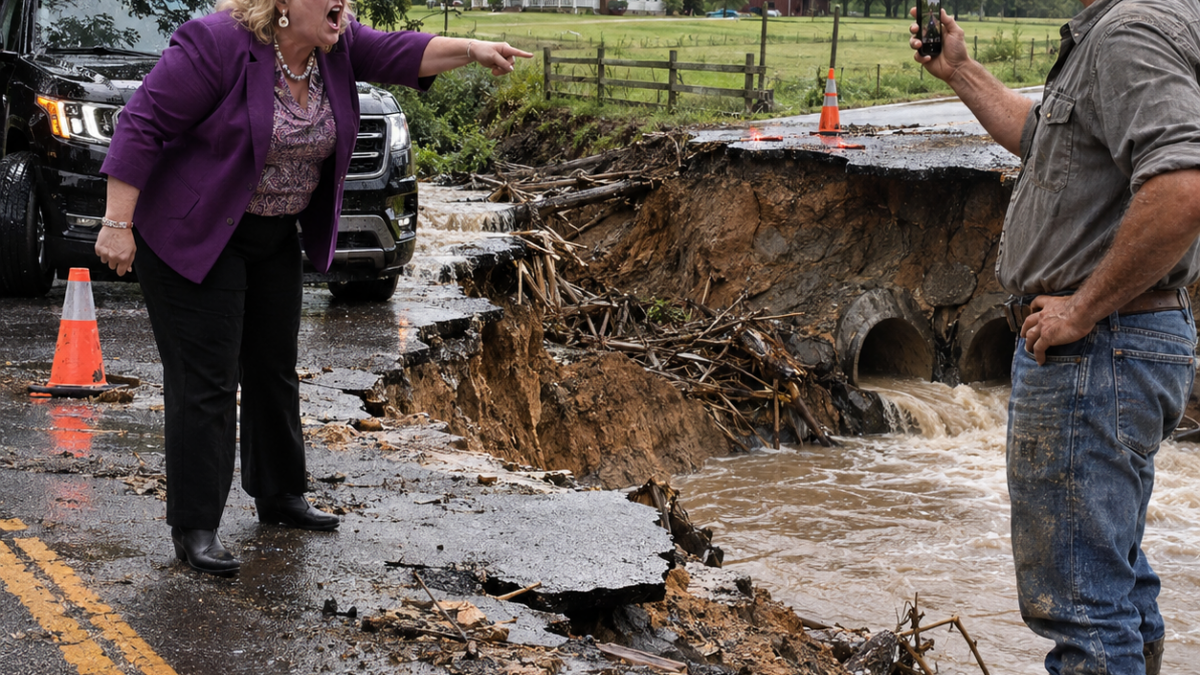
For eleven months, HOA president Lenora Hartzfield ignored every warning that the old culvert beneath my private road was failing—then the road collapsed and trapped sixty families behind a forty-foot hole.
She blamed me in front of deputies, sued me for destroying the only access to her neighborhood, and demanded that I repair a road her own HOA was legally required to maintain.
Five days later, she stood at my farm gate begging for another way home and accidentally confessed into my recording phone that she had ordered her husband to sabotage the culvert on purpose.
My name is Ben Howerin, and before Cedar Hollow Estates was built behind my farm, nobody had ever argued with me about Millbrook Road.
There wasn’t much reason to.
Millbrook was an old private road running seven-tenths of a mile from County Route 18 across the southern side of my family’s farm. It crossed Willow Creek on a concrete culvert, climbed gently past our hay fields, and ended near a line of pecan trees where the Howerin property once disappeared into nothing but pine forest.
My great-grandfather used part of it as a wagon track.
My grandfather paved it after the war.
My father widened it enough for modern farm equipment.
And when I inherited the farm, I owned every foot of it.
Not the county.
Not the township.
Not a subdivision.
Me.
That fact mattered less than you might think because I never treated the road like some sacred kingdom.
The mail carrier used it.
Utility crews used it.
Hunters occasionally turned around on it.
Neighbors drove across when storms flooded the county road farther east.
I never charged anyone.
I never put up a gate.
I never wanted a gate.
My father raised me with the belief that land ownership was mostly responsibility with a little privilege mixed in.
“If you’re lucky enough to own ground,” he used to say, “try not to become the kind of man who needs everybody else to notice.”
I tried to live that way.
Then Cedar Hollow Estates arrived.
Three years before the washout, a developer bought nearly two hundred acres of woodland bordering the back of my farm.
Sixty houses went up.
Nice houses.
Stone fronts.
Two-car garages.
Decorative mailboxes.
A clubhouse beside a retention pond someone had decided to call Lake Cedar, even though it was barely large enough to support six ducks.
The development had one problem.
Its original public entrance was narrow and steep.
The county approved it for ordinary residential use, but emergency services wanted a secondary access route.
That was when an old document from 1958 came back to life.
My grandfather, Earl Howerin, had granted a limited easement across Millbrook Road to the neighboring timber parcel.
The language was remarkably clear for a document typed on paper older than my mother.
The owners of the dominant parcel could use Millbrook Road for ingress and egress.
In return, the easement holder was responsible for maintenance attributable to that use.
When Cedar Hollow was built on the old timber property, the easement passed with it.
Their sixty homes gained a legal right to cross my road.
Fine.
I didn’t object.
I met the developer before the first house was occupied.
We sat at my kitchen table.
His name was Martin Leeds.
He was practical.
I showed him the deed.
He showed me engineering plans.
PART2:
We agreed Cedar Hollow would maintain the road surface from the subdivision gate to County Route 18, inspect drainage annually, and coordinate any major work with me.
Nothing dramatic.
Nothing hostile.
Martin even joked that the HOA would probably maintain Millbrook better than I ever had.
“For what they’re charging in dues,” I said, “they better gold-plate the potholes.”
We shook hands.
Then the developer turned the subdivision over to the homeowners.
And they elected Lenora Hartzfield.
Lenora was fifty-two when I met her.
Tall.
Perfect blond hair.
Sharp face.
Always dressed as though she might accidentally be photographed.
She drove a black Cadillac Escalade and wore sunglasses in weather that did not require them.
Her husband, Gordon, owned Hartzfield Earthworks, a grading and excavation company.
That should have meant she understood roads.
Instead, it meant she believed she owned one.
The first problem was mud.
I had driven my tractor across Millbrook after a rainstorm.
The tires left tracks.
Not damage.
Mud.
Two days later, I received an email.
PART3:
SUBJECT: ROAD CONDITION VIOLATION.
At first I thought it was spam.
Then I read:
Mr. Howerin,
The Cedar Hollow HOA has received complaints regarding agricultural mud deposited on Millbrook Road. Please ensure all vehicles exiting your property are cleaned before using community access roads. Continued violations may result in fines.
I read it three times.
Then I walked outside and looked at the road.
My road.
I called the number in Lenora’s signature.
She answered.
“Cedar Hollow Homeowners Association, Lenora speaking.”
“This is Ben Howerin.”
“Oh.”
That single syllable already sounded disappointed.
“I got your email.”
“Good.”
“You’re fining me?”
“Potentially.”
“For mud on Millbrook Road.”
“Yes.”
“My private road.”
A pause.
“Our residents have easement access.”
“I know.”
“Then you understand we have maintenance concerns.”
“I do.”
“But your email says community access road.”
“That’s what it is.”
“No, Lenora. It’s private property subject to an easement.”
She sighed.
“Ben, I don’t want to play legal word games.”
“Neither do I.”
“Then clean the road.”
“I already did.”
“Good.”
“And don’t send me HOA violation notices.”
“Our covenants—”
“I’m not in your HOA.”
“You benefit from our maintenance.”
“You’re legally obligated to maintain the easement.”
Silence.
Then she said, “You’re going to be difficult, aren’t you?”
I remember leaning against my kitchen counter.
“No.”
“What?”
“I’m going to be accurate.”
She hung up.
That should have told me everything.
Over the next two years, Lenora treated the easement like jurisdiction.
She emailed me because my fence was “visually inconsistent with Cedar Hollow standards.”
The fence had existed since 1983.
She complained about my hay bales being visible from the road.
She sent a letter saying my equipment shed needed repainting.
I mailed that one back with a copy of the deed and a sticky note:
NOT IN HOA.
She stopped sending formal violations after my attorney contacted her.
But the attitude remained.
Her attorney at the time sent my lawyer a letter describing Millbrook Road as “a shared private roadway.”
My attorney, Priya Menon, circled shared and wrote in the margin:
Cute.
Priya had handled land and agricultural disputes for almost twenty years.
She was forty-three, calm, small, and capable of making grown men regret talking over her.
She reviewed the 1958 easement and told me the law was straightforward.
“They can use it.”
“I know.”
“They maintain it.”
“I know.”
“You cannot interfere with reasonable access.”
“I don’t.”
“They cannot expand their rights simply because more people use it now.”
“Also know.”
“Then why are we meeting?”
I handed her Lenora’s fence letter.
Priya read it.
Looked at me.
Then laughed.
“Because she’s annoying.”
“Exactly.”
For a while, that was the worst of it.
Then I noticed the crack.
It was March.
I was checking fence posts near Willow Creek when I saw a thin line running across the pavement above the culvert.
Millbrook crossed the creek on a steel-reinforced concrete pipe installed in the late 1970s.
The creek wasn’t large most of the year.
Maybe six feet across.
But in heavy rain, runoff from the ridge turned it into a brown, fast-moving channel.
The culvert carried that water beneath the road.
I had inspected it every spring since my father died.
That year, the road surface had dipped maybe half an inch.
Not much.
But enough.
I put a six-foot level across the pavement.
Then a string line.
Then measured again.
A depression was forming over the upstream side of the pipe.
I climbed down.
The inlet had erosion around one edge.
Nothing catastrophic yet.
But the culvert was old.
And Cedar Hollow traffic had multiplied road use tenfold.
Passenger cars.
Delivery trucks.
Garbage trucks.
Contractors.
Boat trailers.
And increasingly, Hartzfield Earthworks equipment.
I photographed everything.
Measurements.
Crack.
Pipe.
Embankment.
Then attended the next HOA board meeting.
Cedar Hollow meetings were technically for members only, but easement matters affected me, and the board had previously allowed me to speak.
I arrived with enlarged photographs.
Lenora sat at the center table.
Beside her were the treasurer, Neil Brandt, vice president Sharon Bell, secretary Donna Pike, and two at-large board members.
Maybe twenty homeowners attended.
I waited through twenty minutes about mailbox colors.
Then fifteen minutes about a resident parking a camper beside his garage.
Finally Lenora looked at me.
“Mr. Howerin, you had something?”
“Yes.”
I stood.
“The Willow Creek culvert under Millbrook is showing settlement.”
Lenora looked bored.
I passed photos forward.
“The pipe needs inspection and likely replacement before another heavy-rain season.”
She looked at one picture.
“What exactly do you want us to do?”
“Maintain the easement.”
“It’s your road.”
There it was.
I held up the deed.
“It is my road.”
Several residents looked at one another.
“And the easement makes maintenance your responsibility.”
Lenora leaned back.
“That is your interpretation.”
“No. It’s the sentence.”
I read it.
“The grantee, successors, and assigns shall bear responsibility for ordinary maintenance and necessary repair arising from use of said roadway.”
Neil Brandt, the treasurer, reached for the document.
“Can I see that?”
Lenora put one hand on it first.
“We’ve seen it.”
Neil looked surprised.
I noticed.
Lenora continued.
“We are not replacing private infrastructure every time Mr. Howerin identifies a crack.”
I looked around.
“I’m not asking you to replace my barn roof.”
A few people smiled.
“This culvert carries the road your entire neighborhood uses.”
Lenora folded her arms.
“It has been there for decades.”
“Yes.”
“And still works.”
“For now.”
“So this is speculative.”
“No.”
“Do you have an engineering report?”
“Not yet.”
“Then come back when you do.”
Her tone ended the discussion.
I stood there another moment.
“You should at least reduce heavy truck traffic until it’s inspected.”
Lenora smiled.
“Are you now regulating HOA traffic?”
“I’m warning you about weight on a compromised culvert.”
“Your opinion is noted.”
I gathered my photos.
As I walked out, an elderly homeowner near the door whispered, “I believe you.”
I turned.
Her name was Dorothy Whitlock.
She was seventy-eight.
Small.
White hair.
She lived in Cedar Hollow with her husband, Art.
I knew them because Art waved every time he crossed my road.
Dorothy touched my arm.
“Lenora doesn’t like being told she owes money.”
I smiled.
“Most people don’t.”
“She especially doesn’t.”
That sentence came back to me later.
The next week I hired Moreno Civil & Drainage.
They sent an engineer.
He inspected the culvert and recommended replacement within twelve months, sooner if heavy construction traffic continued.
Estimated cost:
$14,200.
Not catastrophic.
Cedar Hollow collected more than $170,000 a year in dues.
According to its public reserve summary, they had more than $200,000 in reserves.
I sent the report, quote, photographs, and deed excerpt by certified mail.
Nine days later, the envelope came back.
REFUSED.
The word was handwritten beside the postal sticker.
I recognized Lenora’s handwriting from previous letters.
Priya stared at the envelope.
“She refused certified notice?”
“Yes.”
“She knows refusing mail does not make it disappear?”
“I assume.”
“Never assume.”
She scanned everything.
“Keep the original.”
“I was planning to.”
“Also send email.”
“I already did.”
“Response?”
I handed her my phone.
Lenora’s reply:
We do not accept responsibility for infrastructure located on Mr. Howerin’s privately owned property.
Priya looked up.
“She’s building your case for you.”
“I don’t want a case.”
“I know.”
“Can’t we just make them fix the pipe?”
“Yes.”
“How?”
“Eventually, with court involvement.”
I groaned.
“Or we keep documenting until they realize you’re serious.”
I chose documentation.
For months, nothing happened.
The crack widened.
The dip deepened.
I sent measurements in May.
Again in July.
Again in August.
No repair.
Then Hartzfield Earthworks started hauling fill for Cedar Hollow Phase Two.
The original sixty-home development was complete, but a neighboring tract had been approved for another forty houses.
Access for heavy construction vehicles could have come from the county road.
Instead, Hartzfield trucks used Millbrook because it shortened the trip.
Starting around five each morning, dump trucks came through.
Tandem-axle.
Loaded.
Sometimes one every fifteen minutes.
The first morning, I stood at the roadside counting.
Twenty-seven passes before breakfast.
I called Lenora.
She did not answer.
I emailed.
No response.
Then I called Gordon Hartzfield directly.
His company office transferred me.
He came on sounding irritated.
“What?”
“This is Ben Howerin.”
“I know who you are.”
“Your trucks are crossing Millbrook.”
“Yes.”
“The culvert is compromised.”
“So?”
“So stop running loaded trucks over it.”
He laughed.
Not maliciously.
Almost dismissively.
“That culvert holds garbage trucks.”
“Not repeated loaded dump trucks.”
“It’s concrete.”
“It’s failing.”
“Then fix your road.”
I closed my eyes.
“The easement requires Cedar Hollow to maintain it.”
“Talk to my wife.”
“I did.”
“Then talk louder.”
He hung up.
The next morning, I installed two signs.
WEIGHT LIMIT 10 TONS.
CULVERT DAMAGE AHEAD.
I was careful.
I did not block access.
I did not forbid ordinary residents.
I posted a reasonable safety warning on my own property.
Two days later, one sign disappeared.
The other had been knocked flat.
My trail camera captured a Hartzfield Earthworks pickup.
Not enough to see who removed it.
Priya looked at the video.
“More cameras.”
I bought four.
One at each end.
One facing the culvert.
One hidden high in an oak tree.
“Document everything,” Priya said.
That became our mantra.
Date.
Time.
Truck.
Weather.
Road condition.
Every warning.
Every response.
By September, the crack had opened enough that rainwater collected inside it.
I sent another certified notice.
Accepted by the HOA secretary this time.
No response.
Then October’s forecast changed.
A tropical system coming up from the Gulf was expected to stall over central Georgia.
Six inches of rain overnight.
Possibly more in localized areas.
I checked the culvert.
The upstream ditch had accumulated more sediment than normal.
I cleared branches.
The pipe still drained, but slowly.
Something bothered me.
I could not see deep inside because of muddy water.
I sent Lenora one final email.
Subject:
URGENT — MILLBROOK ROAD / CULVERT FAILURE RISK.
I wrote:
Forecast rainfall creates a substantial risk of culvert washout. I strongly recommend Cedar Hollow immediately close Millbrook to heavy vehicles and arrange emergency inspection or replacement.
Please confirm receipt.
She replied in fifty-two seconds.
Don’t threaten me, Ben.
The road will be fine.
I showed Priya.
She called me.
“Do not touch that pipe beyond ordinary emergency debris removal.”
“I know.”
“Do not excavate.”
“I know.”
“Do not alter the road.”
“I know.”
“And if it fails?”
“Call the county.”
“And?”
“Record.”
“Good.”
At 1:47 the next morning, rain woke me.
Not ordinary rain.
The kind that sounds solid against a metal roof.
I pulled on boots.
Rain jacket.
Headlamp.
Took the truck as far as I safely could.
Then walked.
Willow Creek was raging.
Water had risen almost to the culvert crown.
Instead of passing freely, it backed up upstream into the pasture.
I shined my flashlight at the opening.
The flow looked wrong.
Restricted.
I could see debris.
Mud.
Something pale.
Concrete, maybe.
I did not climb into a flood channel to investigate.
I set orange cones and flares fifty yards from each side.
Then called county dispatch.
“Private road with residential easement. Culvert may fail.”
The dispatcher took my information.
I called Cedar Hollow’s emergency number.
No answer.
Called Lenora.
Voicemail.
Called Neil Brandt.
He answered half asleep.
“What’s wrong?”
“Close Millbrook from the subdivision side.”
“Why?”
“The culvert’s backing up.”
“Oh God.”
“Do not let anyone cross if you can avoid it.”
“I’ll go.”
I was still setting flares when dispatch called back.
“Mr. Howerin?”
“Yes.”
“We have a medical call inside Cedar Hollow. Ambulance en route.”
My stomach dropped.
“What address?”
“Whitlock residence.”
Dorothy.
Art.
Then I remembered.
Art was on home oxygen.
Power was out.
The backup concentrator had failed.
The main entrance to Cedar Hollow had flooded at the lower intersection.
Millbrook was the only viable route.
I looked at the creek.
Water was almost touching the road base.
“Tell EMS the culvert is unstable.”
“They’re aware.”
Headlights appeared through the rain.
The ambulance stopped at my flare.
I ran up.
The driver rolled the window down.
“Can we cross?”
I looked at the pavement.
The dip was worse.
“How heavy are you?”
“Twelve thousand pounds.”
I swore.
The paramedic beside him said, “Patient has severe respiratory distress.”
There are moments when property law becomes irrelevant.
This was one.
I walked the culvert.
Shined my light.
Listened.
No cracking yet.
I told them to cross slowly, one vehicle only, dead center, no stopping.
I stood beside the ditch in rain so hard I could barely see.
The ambulance crawled over.
The road dipped beneath its rear axle.
My heart stopped.
Then it climbed off.
They reached Cedar Hollow.
Twenty-eight minutes later, the ambulance returned with Art Whitlock inside.
I could see Dorothy through the rear window.
She was crying.
The driver stopped before the culvert.
I guided them again.
Inch by inch.
The tires rolled across.
The asphalt flexed.
A crack opened another inch beside the shoulder.
“Keep moving!”
They made it.
The ambulance disappeared toward County Route 18 at 3:40 a.m.
I remained.
I knew I should leave.
Instead I stood there watching.
At 4:05, the sound came.
Not an explosion.
A groan.
Deep.
Like a tree breaking underwater.
The upstream shoulder dropped first.
Then the asphalt folded downward.
A section roughly forty feet wide collapsed into the creek.
Water exploded through the opening.
Mud.
Chunks of pavement.
Concrete.
Branches.
I stumbled backward.
The road was gone.
Where the ambulance had driven twenty-five minutes earlier was now a hole twelve feet deep.
Maybe more at the center.
I stood in the rain shaking.
Not from cold.
If they had arrived five minutes later.
If I had not set the flares.
If I had waved them across and the culvert failed beneath them.
I sat down in the mud.
I stayed there until daylight.
At 8:52, Lenora arrived from the county-road side.
Her Escalade came around the curve too fast.
She saw the barriers.
Braked.
Stopped twenty yards from the washout.
She stepped out wearing a purple blazer under a raincoat and shoes that had no business being near mud.
She stared at the hole.
Then at me.
“What did you do?”
I was too tired to answer.
She marched closer.
“What did you do?”
“Stay back from the edge.”
“You destroyed it.”
I pulled out my phone.
Started recording.
She saw.
“Don’t you dare.”
“Keep talking.”
“This is criminal.”
“Maybe.”
“You sabotaged our access.”
“Your access road collapsed.”
“My road.”
I looked at her.
“Interesting choice of words.”
“Fix it.”
“No.”
Her face changed.
“What?”
“No.”
“You own it.”
“And your HOA has maintenance responsibility.”
“You caused this.”
“Call the sheriff.”
“I will.”
“Good.”
She did.
Deputy Sam Eaton arrived twenty minutes later.
Sam knew me.
Not socially.
Rural county.
Everybody eventually knows everybody a little.
He stepped out, looked at the washout, and whistled.
“Hell of a hole.”
Lenora immediately started talking.
“He intentionally allowed this to happen after threatening us for months.”
Sam held up a hand.
“Ma’am.”
“He refused to maintain the road.”
“Ma’am.”
“He put illegal weight restrictions—”
“Mrs. Hartzfield.”
She stopped.
Sam looked at me.
“Ben.”
I handed him a folder.
He stared.
“You brought paperwork?”
“I’ve been waiting eleven months.”
Inside:
1958 deed.
Easement clause.
Engineer report.
$14,200 quote.
Certified-mail receipt.
Returned envelope marked refused.
Photographs.
Emails.
Texts.
Weight-limit notice.
Storm warning.
County dispatch call number.
Sam read slowly.
Lenora paced.
“This is ridiculous.”
He kept reading.
Then looked at her.
“Ma’am, this appears primarily civil.”
“So arrest him for destruction of property.”
“Whose property?”
“Our road.”
Sam looked at the deed.
“According to this, road belongs to him.”
“He destroyed access.”
Sam glanced toward the hole.
“Did you watch him destroy it?”
“No.”
“Then what evidence do you have?”
“He warned us it would fail.”
“That usually works against your argument.”
Her face reddened.
Sam closed the folder.
“County engineer needs to inspect this.”
“And what are we supposed to do?”
“Use alternate access.”
“It’s flooded.”
“Then county emergency management will coordinate.”
“This is outrageous.”
Sam looked at her.
“Ma’am, based on what I’m reading, you were notified repeatedly.”
She pointed at me.
“He is trying to extort the HOA.”
I laughed despite myself.
“I sent you a fourteen-thousand-dollar repair quote.”
“You wanted control.”
“Of my property?”
Sam stepped between us.
“That’s enough.”
Then he looked at Lenora.
“This is not looking good for you.”
She stared at him.
He immediately clarified.
“I’m not making a legal finding. I’m telling you these documents do not support the story you just gave me.”
For the first time that morning, Lenora said nothing.
County engineer Ray Alonzo arrived the next day.
The water had dropped enough to safely inspect the washout.
Ray climbed down wearing chest waders and a hard hat.
I watched from above.
He examined broken concrete.
Pipe sections.
The upstream inlet.
Then he stopped.
“Ben.”
“What?”
“Come down to the bench, not the channel.”
I climbed carefully.
He pointed.
The culvert inlet was packed with material.
Not ordinary storm debris.
Compacted fill.
Broken concrete.
Chunks of asphalt.
Clay.
Ray dug into it with a shovel.
“This didn’t wash here naturally.”
“You sure?”
“Look at the gradation.”
I stared.
“This is construction debris.”
“Yes.”
“Could trucks have accidentally spilled it?”
“Not in this quantity.”
He looked up.
“Either somebody dumped near the inlet and it migrated, or somebody placed it here.”
My stomach went cold.
I thought about trail cameras.
Three weeks earlier, one had triggered repeatedly after midnight.
I had skimmed clips looking for trespassers.
Nothing obvious.
I went home.
Opened the footage.
Found the date.
12:11 a.m.
Hartzfield Earthworks dump truck.
Backing toward the creek.
12:17.
Tailgate lifting.
Fill sliding out.
12:32.
Another load.
Then a man stepped into view wearing a white hard hat.
Heavyset.
Gordon Hartzfield.
He directed the driver.
Pointed toward the culvert.
At 12:48, Gordon himself operated a loader, pushing material toward the inlet.
I watched it twice.
Then again.
My hands started shaking.
Priya answered immediately.
“I have video.”
She was silent.
I sent it.
Thirty seconds later:
“Do not send that to anyone else.”
“Why?”
“Preserve metadata.”
“I will.”
“Make three copies.”
“Already.”
“Call Ray and Deputy Eaton.”
“Okay.”
“And Ben?”
“Yes?”
“Stop talking directly to Lenora.”
“That may be difficult.”
“Make it less difficult.”
By afternoon, nearly all sixty Cedar Hollow families were effectively trapped.
The main public entrance remained flooded and partially washed out at the county intersection.
Millbrook was severed.
Emergency services arranged a temporary foot crossing along higher ground, but vehicles could not pass.
School buses stopped at County Route 18.
Residents walked children out.
People parked cars outside the neighborhood.
Groceries came in by utility carts.
The residents were furious.
At first, many aimed that anger at me.
I received emails.
You did this.
Fix your road.
We have children.
My wife is pregnant.
People need to work.
I answered each one the same way.
I am working with county officials. I have never blocked lawful access. The road collapsed after repeated maintenance warnings to the HOA.
No insults.
No arguments.
Priya insisted.
“Let Lenora talk.”
“She’s telling everyone I caused it.”
“Good.”
I stared at her.
“How is that good?”
“Because every lie becomes another thing she has to defend.”
The HOA called an emergency meeting that evening.
The clubhouse ran on generator power.
The room overflowed.
People stood along walls.
I was invited reluctantly.
Lenora sat at the front.
Neil Brandt beside her.
Vice president Sharon Bell.
Residents shouted before the meeting even started.
“When is the road reopening?”
“Who’s paying?”
“Why weren’t we warned?”
Lenora banged a wooden gavel.
“This meeting will come to order.”
Someone shouted, “Answer the question!”
She looked at me.
“Our community has suffered a catastrophic road failure on privately owned property.”
I almost smiled.
Careful wording.
“The property owner failed to perform necessary repairs despite being aware of deterioration.”
I stood.
“No.”
The room turned.
Lenora glared.
“You will wait for public comment.”
“No.”
“Mr. Howerin—”
“You just accused me publicly.”
Neil looked uncomfortable.
I walked toward the front holding the returned certified envelope.
“I warned this board in March.”
People murmured.
“I brought photographs here.”
A man shouted, “I remember.”
“I sent an engineering report.”
I held it up.
“Fourteen thousand two hundred dollars.”
Then the envelope.
“Certified mail refused.”
Neil leaned toward Lenora.
She ignored him.
I continued.
“In October, before the storm, I warned you the culvert could fail.”
I read her text.
Don’t threaten me, Ben. The road will be fine.
The room changed.
People looked at Lenora.
Then I said:
“Your maintenance obligation is in the easement.”
Neil stood.
“Wait.”
Everyone stopped.
He looked pale.
“Where is the road reserve?”
Lenora’s face went rigid.
“Neil.”
“What?”
“This is not the time.”
“I’m treasurer.”
“Yes.”
“And we had a road reserve.”
Someone shouted, “How much?”
Neil stared at the table.
“Two hundred twelve thousand.”
The room exploded.
“Where?”
“Then why wasn’t the culvert fixed?”
“Two hundred thousand?”
Lenora banged the gavel.
Neil looked at her.
His voice shook.
“I asked for reserve statements last month.”
“We are not discussing confidential financials.”
“I signed them.”
“Neil.”
He sat down.
But the question stayed in the room.
Where was the money?
That night, someone knocked on my farmhouse door at 10:40.
I took my old dog, Jasper, with me to the porch.
Neil stood there.
Wet.
No coat.
Folder under one arm.
He looked terrified.
“Can I come in?”
I stepped aside.
We sat at the kitchen table.
He placed the folder between us.
“I can’t sleep.”
“What is it?”
“Reserve reports.”
I did not touch them.
“Why bring them to me?”
“Because I think she stole from us.”
That was not a sentence you hear casually.
“Neil.”
“I’m serious.”
He opened the folder.
The 2022 reserve study included Millbrook culvert replacement.
Estimated cost:
$16,000 within three years.
The HOA had set aside funds.
Then, eleven months earlier, the reserve balance dropped by $212,000.
Description:
STRATEGIC INFRASTRUCTURE INVESTMENT.
I looked at Neil.
“What does that mean?”
“I asked.”
“And?”
“Lenora said the board approved a short-term secured loan.”
“To who?”
He turned the page.
HARTZFIELD EARTHWORKS LLC.
I sat back.
Her husband’s company.
“What collateral?”
“That’s the problem.”
“What?”
“There isn’t any.”
“Board approval?”
Neil swallowed.
“I signed.”
“You approved it?”
“I signed a resolution packet.”
“Did you read it?”
“Not closely enough.”
That answer cost him something.
He looked ashamed.
“Lenora told us it was a ninety-day bridge loan. Twelve percent interest. She said we’d make money for the reserves.”
“How much has come back?”
“Nothing.”
“When was payment due?”
“Six months ago.”
“Did you ask Gordon?”
“Yes.”
“He said phase-two receivables were delayed.”
I looked at him.
“And you kept this quiet?”
Neil’s eyes filled.
“I was afraid.”
“Of what?”
“Being blamed.”
I said nothing.
He continued.
“I kept telling myself the money would come back.”
“That doesn’t explain the culvert.”
“I know.”
“The reserve study specifically listed it.”
“I know.”
“And Lenora still told me it was my problem.”
Neil covered his face.
“I know.”
I pushed the folder back.
“You need to give this to an attorney.”
“I thought you were—”
“No.”
“To the county?”
“Maybe.”
“To the police?”
“Probably after legal review.”
He looked at me.
“Will you help?”
“I’ll call Priya.”
She arrived at 7:30 the next morning.
Read everything.
Then told Neil to obtain his own counsel.
“Why?”
“Because you signed documents.”
His face drained.
“I thought—”
“Neil, I am Ben’s attorney. Not yours.”
“Am I in trouble?”
“I don’t know.”
She softened.
“But if you have evidence of financial misconduct, preserve it and talk to independent counsel before giving statements.”
Neil nodded.
He stood to leave.
At the door, he turned to me.
“I’m sorry.”
“For what?”
“For looking at the floor in March.”
I remembered the meeting.
Half the room avoiding my eyes.
I nodded.
“Then stop doing that.”
Two days later, I was served.
Lenora sued me.
Technically, the HOA sued me, but her name was all over the filing.
The complaint alleged:
Failure to maintain road.
Intentional obstruction of easement.
Negligence.
Private nuisance.
Interference with access.
Damages in excess of $500,000.
Emergency request compelling me to rebuild the road immediately.
I called Priya.
She read the complaint.
Then laughed once.
“What?”
“She sued the one man with all the evidence.”
“I’m glad you’re enjoying yourself.”
“I’m not.”
“You laughed.”
“That was professional disbelief.”
“She wants a court order making me pay.”
“She also just created discovery rights.”
I paused.
“Oh.”
“Yes.”
“Financial records?”
“Yes.”
“Internal emails?”
“Yes.”
“Board communications?”
“Yes.”
“Truck logs?”
Priya smiled.
“Now you’re learning.”
The next few days were chaos.
County crews built a temporary gravel approach to the flooded public entrance, but only light vehicles could use it.
Cedar Hollow residents still depended largely on walking out.
Some blamed me.
Others started bringing me coffee.
Dorothy Whitlock came to my porch after Art returned from the hospital.
She hugged me without warning.
“You saved him.”
“The paramedics did.”
“You got them across.”
“I waved a flashlight.”
“You got them across.”
She pressed a pie into my hands.
Peach.
Warm.
“Art says thank you too.”
“How is he?”
“Complaining.”
“Good sign.”
She smiled.
Then looked toward Millbrook.
“Lenora still says you caused it.”
“I know.”
“She’s losing people.”
“I’m not trying to win people.”
Dorothy studied me.
“That might be why you are.”
On day five, around sunset, Jasper started barking near the gate.
I stepped outside.
Lenora was walking up my farm lane.
On foot.
Her purple shoes were muddy.
Her hair looked different.
Less perfect.
Her Escalade sat visible on the far side of the washout.
She stopped outside the gate.
“Ben.”
Priya had told me not to speak directly to her.
So naturally, the universe delivered Lenora to my porch.
I took out my phone.
Started recording before opening the gate.
“What do you want?”
“Access.”
“To?”
“My house.”
“The county entrance is open to passenger vehicles now.”
“It adds six miles and there’s a line.”
“My farm lane isn’t part of your easement.”
“I know.”
That surprised me.
She knew.
“Then why are you here?”
“Because your farm lane connects around the upper pasture to Cedar Hollow.”
It did.
An old equipment road ran behind my barn, crossed high ground, and emerged near the subdivision maintenance lot.
Not designed for neighborhood traffic.
But usable.
“Name your price.”
I stared at her.
“What?”
“How much?”
“For what?”
“Temporary access.”
“You think this is about money?”
“Everything is eventually about money.”
“No.”
Her expression hardened.
“I have a lawsuit pending.”
“I know.”
“You’re exposed, Ben.”
“Then why are you here asking me for help?”
She stepped closer.
“You think you’re smart because you took some pictures.”
I said nothing.
She continued.
“The pipe was failing anyway.”
“Maybe.”
“You were going to force us to pay.”
“The deed forces you to pay.”
“Same thing.”
“No.”
Her voice rose.
“You don’t understand what it’s like managing sixty families.”
“Probably not.”
“Every repair becomes a fight. Every assessment becomes a fight. Everybody wants services and nobody wants dues raised.”
I kept the phone low beside my leg.
She looked toward the washout.
“That culvert could have lasted another year.”
“Ray says the inlet was packed with fill.”
Her eyes flicked toward me.
“Storm debris.”
“Construction debris.”
“Same difference.”
“No.”
Then she said the sentence that changed everything.
“I told Gordon to dump that fill.”
I stopped breathing.
She kept going.
“That pipe was supposed to fail slowly.”
My hand tightened around the phone.
“What?”
She was angry now.
People say too much when they think anger is power.
“It was supposed to settle.”
“Why?”
“So you’d be forced to repair your own road before next year’s development traffic.”
I stared at her.
“You intentionally blocked the culvert?”
“Don’t make it dramatic.”
“Did Gordon know why?”
“He does what I tell him when it involves HOA access.”
I almost could not believe how easy she was making this.
“What about the sixty families?”
“It wasn’t supposed to collapse in one storm.”
“What about Art Whitlock?”
Her face shifted.
“That was unfortunate.”
I felt something inside me go cold.
“An ambulance crossed twenty-five minutes before that road disappeared.”
“I didn’t know the storm would be that bad.”
“You had my warning.”
“You always warn people.”
“That’s your defense?”
She suddenly noticed the phone.
Her eyes narrowed.
“Are you recording me?”
“Yes.”
Everything changed.
She stepped backward.
“Delete that.”
“No.”
“Ben.”
“No.”
“You cannot record private conversations.”
“We are standing outside my farm gate.”
“You set me up.”
“You came here.”
She reached toward the phone.
I stepped back.
“Don’t.”
She stopped.
For the first time since I had known her, Lenora looked afraid.
Not angry.
Afraid.
“You have to delete that.”
“No.”
“I’ll deny it.”
“That’s your choice.”
“Gordon will say you edited it.”
“Also his choice.”
She stared.
Then her anger returned.
“Fine.”
She pointed toward the farm lane.
“Are you opening it or not?”
I looked toward Cedar Hollow.
Sixty families.
People who had not packed a culvert.
Children.
Older residents.
Nurses.
Teachers.
Mechanics.
People who had trusted a board.
I could have said no.
Legally, I had every reason.
Emotionally, part of me wanted Lenora to walk the six miles around.
But my father’s voice lived in that farm.
Land ownership was responsibility.
I unlocked the gate.
“Residents can use the lane.”
She stared.
“Everyone?”
“Cedar Hollow residents only.”
“What about construction?”
“No.”
“Hartzfield trucks?”
“Absolutely not.”
“I’ll need access.”
“You can drive through like everyone else.”
“Speed?”
“Ten miles an hour.”
“That’s ridiculous.”
“It’s a farm lane.”
“You’re doing this to humiliate me.”
“No.”
I looked at her muddy shoes.
“You’re doing a pretty good job yourself.”
She hated that.
I continued.
“No heavy vehicles. One direction at a time. I’ll post instructions. You will not claim this creates an easement.”
“Temporary license?”
“Yes.”
“You expect me to sign?”
“I expect the HOA to.”
She looked stunned.
She had expected revenge.
Instead she got paperwork.
That night, Priya listened to the recording.
Once.
Then again.
Then she set my phone down very carefully.
“Ben.”
“Yes.”
“Do you understand what you have?”
“Yes.”
“No, you don’t.”
“She confessed.”
“She admitted intentional interference with drainage infrastructure after documented warnings, while litigation accuses you of causing the collapse.”
“I understood that part.”
“And she tied Gordon directly to it.”
“Yes.”
“And potentially created exposure beyond civil liability.”
I sat back.
“Criminal?”
“Possibly.”
She looked at me.
“You do not post this.”
“I wasn’t planning to.”
“You do not send it to neighbors.”
“Okay.”
“You give a copy to law enforcement and preserve the original.”
“Yes.”
“Metadata.”
“Yes.”
“Backup.”
“Yes.”
She smiled faintly.
“I have trained you well.”
The next morning, Cedar Hollow residents started using my farm lane.
I stood near the barn directing traffic for the first hour.
Cars came slowly.
Some drivers avoided eye contact.
Others waved.
One woman stopped.
“Thank you.”
“You’re welcome.”
A man behind her rolled down his window.
“I’m sorry I called you an asshole on Facebook.”
I blinked.
“I didn’t see it.”
“Oh.”
He looked disappointed and relieved at the same time.
“Still sorry.”
“Drive slow.”
“Yes, sir.”
Dorothy came through riding with her daughter.
She held a pie out the window.
“You cannot keep doing this.”
“You saved Art.”
“I already got one pie.”
“This one’s pecan.”
I took it.
“Proceed.”
By noon, homemade signs appeared near the farm lane.
THANK YOU, BEN.
PLEASE DRIVE SLOW.
NO HARTZFIELD TRUCKS.
That last one made me laugh.
Lenora’s Escalade eventually passed.
She did not look at me.
For the first time in three years, residents were looking past her.
That affected her more than any argument I had ever made.
The court hearing came ten days later.
Judge Alan Pruitt presided.
Sixty-two years old.
Gray hair.
Reputation for hating theatrics.
The courtroom was packed.
Cedar Hollow residents filled the benches.
Local reporter in the back.
Lenora sat with two attorneys.
Gordon beside her.
Priya brought three binders.
Not one.
Three.
“You said phone book.”
“Changed my mind.”
Lenora’s lawyer began.
He described me as a hostile servient-estate owner.
He said I resented Cedar Hollow.
Had posted unauthorized weight restrictions.
Had refused maintenance.
Had allowed a known hazard to worsen.
Had then used the collapse to leverage concessions.
The story sounded almost plausible if you ignored every document.
Priya waited.
Then stood.
“Your Honor, the easement language is one paragraph.”
She handed up the deed.
She read the maintenance clause.
The judge looked toward opposing counsel.
“Do you dispute authenticity?”
“No, Your Honor, but maintenance obligation does not absolve the fee owner of negligence.”
“Understood.”
Priya introduced the March photographs.
Engineer report.
Repair quote.
Certified mail.
The envelope stamped refused.
Judge Pruitt held it.
“Mrs. Hartzfield personally refused this?”
Lenora’s attorney stood.
“We cannot establish who wrote—”
Priya produced postal confirmation.
Accepted refusal by L. Hartzfield.
The judge said nothing.
Then the October email.
URGENT — FAILURE RISK.
Lenora’s response.
Don’t threaten me, Ben. The road will be fine.
The room went very quiet.
Priya introduced county dispatch records showing I reported the hazard before the collapse.
Ambulance logs.
Emergency flares.
Photographs.
Deputy Eaton’s report.
County engineer Ray Alonzo testified next.
He explained the blockage.
Construction fill.
Concrete debris.
Compaction.
Opposing counsel asked whether the storm alone could have caused failure.
“Yes.”
That made Lenora’s side perk up.
Ray continued.
“But not when it did.”
“What do you mean?”
“The culvert had reduced hydraulic capacity because the inlet was substantially obstructed. With full flow, it likely would have survived that storm or at minimum failed later.”
“Likely?”
“Engineering is probability, counselor.”
“So you cannot say the blockage caused the collapse.”
“I can say it materially contributed.”
Priya asked one question.
“Would you intentionally place construction debris at the inlet of a compromised culvert before a six-inch rain event?”
Ray looked at her.
“Absolutely not.”
Then came the trail-camera footage.
Large courtroom monitor.
Hartzfield Earthworks truck.
Midnight.
Gordon.
Loader.
Fill.
The video played.
Nobody spoke.
Priya called Gordon.
He looked terrible before he reached the stand.
Sweat at his collar.
Hands shaking.
She asked about his company.
The Phase Two project.
Truck routes.
Then the footage.
“Mr. Hartzfield, is that your truck?”
“Yes.”
“You?”
He stared.
“Yes.”
“What are you dumping?”
“Fill.”
“Where?”
“Near the creek.”
“Why?”
“Erosion control.”
Ray Alonzo, seated behind me, actually exhaled in disbelief.
Priya remained calm.
“Did an engineer direct you to place fill there?”
“No.”
“Did Mr. Howerin authorize it?”
“No.”
“Did the HOA board vote to authorize it?”
“I don’t know.”
“Who told you to do it?”
Gordon looked at Lenora.
She stared straight ahead.
His lawyer objected.
Privilege did not apply between spouses in that context the way they hoped.
Judge Pruitt allowed limited response.
Gordon swallowed.
“My wife.”
Lenora stood.
“That is a lie.”
The bailiff stepped forward.
Her attorney grabbed her arm.
“Mrs. Hartzfield, sit down.”
She did.
Priya waited.
Then asked Gordon:
“What did she tell you?”
His voice was barely audible.
“That Ben would have to fix it if the culvert started failing.”
“Did she instruct you to block it?”
“She said add fill around the inlet.”
“How much?”
“I don’t remember.”
“Three truckloads?”
“Maybe.”
“Did you know that could restrict water flow?”
He looked down.
“Yes.”
The room changed.
People behind Lenora started whispering.
Priya returned to counsel table.
Picked up my phone.
I knew what was next.
Judge Pruitt admitted the audio after authentication.
Priya connected it.
Lenora’s voice filled the courtroom.
I told Gordon to dump that fill.
A pause.
That pipe was supposed to fail slowly.
Another.
So you’d be forced to repair your own road before next year’s development traffic.
No one moved.
Lenora covered her face.
For three years, I had never seen her voluntarily silent.
Judge Pruitt listened to the entire recording.
Then removed his glasses.
He looked at Lenora.
Then Gordon.
Then their attorneys.
Then the HOA lawyer.
“Counsel.”
The HOA attorney stood slowly.
“Your Honor.”
“Does the association intend to continue pursuing the allegation that Mr. Howerin intentionally caused this collapse?”
The attorney looked at Lenora.
Then at the board members seated behind her.
Neil shook his head.
The attorney turned.
“No, Your Honor.”
Lenora whispered something.
Her lawyer ignored her.
The judge recessed for forty minutes.
When he returned, his ruling was careful.
Not cinematic.
Courts rarely sound like movies.
He found the easement valid.
Found maintenance responsibility primarily with Cedar Hollow under the deed.
Found substantial evidence the HOA received actual notice of deterioration.
Found evidence that agents associated with Hartzfield Earthworks intentionally deposited material near the culvert inlet.
Denied the HOA’s request to compel me to pay reconstruction.
Ordered the HOA to fund a properly engineered replacement.
Estimated emergency reconstruction:
$186,000.
The judge did not legally remove Lenora from HOA office.
That part came later through board procedure.
But he did something worse for her.
He referred the evidence to the district attorney and state investigators.
He also ordered preservation of HOA financial records connected to road maintenance and Hartzfield Earthworks.
The moment he said preservation, Neil looked at me.
We both knew.
The reserve money.
Outside court, reporters surrounded us.
I said almost nothing.
One asked, “Do you feel vindicated?”
“No.”
“Why?”
“Because sixty families still have a broken road.”
“What about Mrs. Hartzfield?”
“That’s between her, her neighbors, and investigators.”
“Do you want her prosecuted?”
“I want the truth established.”
Priya later told me that answer made me sound reasonable.
I told her I was reasonable.
She said, “Let’s not get carried away.”
The HOA held another emergency meeting two nights later.
This time, Lenora did not sit at the center.
Neil did.
The bylaws allowed the board to suspend an officer for misconduct pending membership vote.
Five board members voted yes.
One abstained.
Lenora voted no.
Naturally.
The membership recall required a separate ballot.
Two weeks later, sixty homeowners voted.
Fifty-six favored removal.
Three opposed.
One ballot was invalid because someone wrote a paragraph across it.
Lenora Hartzfield was no longer HOA president.
Neil Brandt did not want the job.
That was one reason people trusted him.
He was elected interim president anyway.
“I hate you,” he told me when we met afterward.
“For what?”
“You told me to stop looking at the floor.”
“You’re welcome.”
State investigators arrived at the HOA office the following week.
Not with dramatic sirens.
With subpoenas.
Accountants.
Boxes.
Laptops.
The $212,000 reserve transfer was real.
So was the loan.
But the paperwork was worse than Neil knew.
Interest payments listed in HOA reports had never been received.
Some financial statements were altered to show accrued interest as cash.
Hartzfield Earthworks had used part of the money to purchase equipment.
The HOA had no secured collateral.
Lenora had signed on behalf of the association.
Gordon had signed for his company.
Conflict-of-interest disclosure:
None.
Investigators also found that Hartzfield Earthworks billed Cedar Hollow for road-maintenance services it had not performed.
Including culvert inspection.
That invoice made Neil physically sick.
$4,800.
Inspection date:
Six weeks after I first warned them.
No inspection had occurred.
The criminal cases took months.
That is important.
People later told the story as though Lenora confessed on Sunday and was marched into jail Monday.
No.
Law moved slower.
Gordon’s business records were audited.
Bank accounts examined.
Emails subpoenaed.
Board minutes compared.
Lenora hired a criminal-defense lawyer.
Gordon hired a different one.
Their marriage did not survive the process.
By the following summer, Gordon pleaded guilty to criminal mischief and falsifying business records.
He agreed to restitution and probation.
Lenora faced more serious allegations connected to misuse of HOA funds and directing the sabotage.
She eventually pleaded guilty to misappropriation of association funds and attempted property damage.
She avoided a long prison sentence but served several months in county custody, paid restitution, and was barred from serving as an officer of any homeowners association under terms of her plea.
Some residents said that was too little.
Others said seeing her lose the position she had treated like a throne was punishment enough.
I didn’t celebrate.
That surprised people.
Priya once asked why.
We were standing near the rebuilt culvert.
“Because I never wanted this.”
“That answer is annoyingly noble.”
“It’s true.”
“You wanted the road fixed.”
“Yes.”
“And?”
“I wanted her to leave me alone.”
Priya laughed.
“Apparently litigation was the long route to privacy.”
Rebuilding Millbrook took three months.
Not because the culvert itself required three months.
Because engineers redesigned the crossing.
Larger pipe.
Improved headwalls.
Emergency overflow channel.
Reinforced shoulders.
Load-rated pavement.
Drainage inspection ports.
The kind of structure we should have installed before any of this happened.
The final cost was $186,000.
Cedar Hollow paid.
Insurance covered part.
Recovered reserve money eventually covered more.
I did not pay for the easement portion.
I did voluntarily pay $11,000 to widen the farm entrance beside it because the construction made it practical.
Neil tried to argue.
“The HOA should pay that.”
“No.”
“It benefits road users.”
“It benefits my equipment.”
“You’re impossible.”
“That’s what Lenora said.”
He stopped arguing.
During construction, my farm lane remained temporarily open to Cedar Hollow.
Every morning, cars passed the barn.
People waved.
Children started waving first.
Then adults copied them.
Someone left a basket of tomatoes on my porch.
Another left biscuits.
Three different families brought pies.
By week four, I had enough baked goods to develop a medical condition.
Dorothy Whitlock organized most of it.
“You started this.”
“I’m feeding you.”
“You’re killing me slowly.”
“That’s how Southern women get even.”
Art recovered from the storm-night emergency.
He started walking again by spring.
Whenever he crossed the temporary lane, he saluted me.
I told him to stop.
He never did.
The new culvert opened in February.
Clear cold morning.
No huge ceremony.
Neil wanted one because residents had endured months of detours.
I agreed if it stayed simple.
County engineer Ray Alonzo attended.
Deputy Sam Eaton.
Priya.
Contractors.
About forty residents.
Dorothy and Art stood in front.
Neil handed me oversized ceremonial scissors.
I refused.
“You’re the HOA president.”
“Interim.”
“Still your problem.”
He cut the ribbon.
Everyone applauded.
Then he pulled out documents.
“Before anybody drives across, one more thing.”
We had rewritten the easement agreement.
The 1958 document was legally valid but outdated.
The new agreement preserved Cedar Hollow’s access and clarified responsibility.
Routine surface maintenance shared according to actual use.
Structural maintenance allocated primarily to Cedar Hollow because residential traffic accounted for the majority.
Heavy commercial use required notice.
Farm equipment retained unrestricted access.
Weight limits required engineering support.
Emergency closure authority clearly defined.
Annual culvert inspection.
Written records.
No more ambiguity.
No more assumptions.
No more secrets.
I signed.
Neil signed.
Priya notarized.
Dorothy clapped first.
Then everybody else.
I looked at the road.
Same path.
Different understanding.
That mattered.
People often think peace means returning to how things were.
It doesn’t.
Sometimes how things were is what caused the disaster.
Peace means building something better than before.
The washout changed Cedar Hollow.
Not perfectly.
No neighborhood becomes wise forever because one president fails.
Six months later, residents were fighting about holiday decorations.
A year later, someone accused the board of favoritism over pool passes.
Normal life returned.
That was good.
But certain things stayed different.
Financial statements became public to homeowners monthly.
Contracts involving board members’ relatives required independent review.
Reserve transfers over $25,000 required membership notice.
Infrastructure inspections were documented.
Neil refused to approve a single invoice without backup.
People called him paranoid.
He said, “Correct.”
Hartzfield Earthworks lost most of its local work.
Gordon sold two trucks.
Eventually the business closed.
Lenora moved out of Cedar Hollow after her case ended.
I heard she moved to Alabama near her sister.
I never saw her again.
Once, years later, I received a letter.
No return address.
I recognized the handwriting.
Ben,
I have had a great deal of time to think about what happened.
I know you will probably never believe me, but I never intended anyone to be hurt.
The plan was to create enough visible failure that you would finally accept responsibility for the road.
I believed you were exploiting the easement language to make the HOA pay for property that ultimately belonged to you.
I was wrong.
I should have handled the maintenance issue honestly.
I should not have involved Gordon.
I should not have moved the reserve money.
I should not have blamed you.
You could have closed your farm lane after the collapse.
You did not.
I did not understand that at the time.
I do now.
I am sorry.
Lenora
I read it twice.
Then put it in a drawer.
I never answered.
Some apologies are not invitations.
They are endings.
I accepted that she understood.
I did not need a relationship with her.
The farm is quieter now.
Millbrook Road still runs across the southern field.
Fresh pavement.
White edge markings near the culvert.
Inspection marker on the headwall.
Every March, Neil and I walk it together.
First year he came wearing new boots.
I laughed.
“What?”
“You look like an HOA president.”
“I hate you.”
We checked drainage.
Measured settlement.
Photographed the pipe.
Signed the inspection log.
It took forty minutes.
Eleven months of disaster had taught us the value of forty boring minutes.
Dorothy and Art lived in Cedar Hollow another six years.
When Art died, the funeral procession used Millbrook Road.
Dorothy asked me first.
She didn’t need to.
The easement allowed it.
But she asked.
That mattered too.
I stood beside my mailbox as the procession passed.
Dorothy saw me from the second car.
She pressed her hand to the window.
I raised mine.
The ambulance night came back.
Rain.
Flashlight.
The road bending beneath the tires.
Sometimes I still dream about it.
In the dream, the ambulance arrives five minutes later.
I wake before the road gives way.
That is probably my mind protecting me.
People like the ending of this story.
The confession.
The courtroom recording.
The removed HOA president.
The reserve fund investigation.
Those are satisfying pieces.
But that is not the part I remember most.
I remember 3:40 in the morning.
The ambulance rolling off the culvert.
Dorothy’s face behind the glass.
Then 4:05.
The groan.
The road collapsing into brown water.
Twenty-five minutes.
That was the difference.
Every time someone tells me I should have just let Lenora learn her lesson earlier, I think of Art.
There were sixty families behind her.
You cannot punish a neighborhood to teach one person humility.
That was the choice Lenora never understood.
Power made everything personal to her.
My road.
Her authority.
My warning.
Her reputation.
My evidence.
Her control.
She thought if she could force me to lose, she would win.
But roads do not care about pride.
Water certainly doesn’t.
A culvert does not know who is HOA president.
Six inches of rain does not read covenants.
Physics keeps cleaner records than people do.
Block a pipe.
Water backs up.
Load a weak road.
It settles.
Ignore cracks.
They spread.
Ignore warnings.
Consequences do not disappear.
They wait.
My father used to say something similar about farming.
“You can argue with a man,” he told me once. “You cannot argue with water. Water eventually goes where the truth says it should.”
I did not understand that as a boy.
I do now.
The culvert sits beneath Millbrook today larger than the original.
When the creek rises, water passes cleanly through.
No drama.
That is exactly how infrastructure is supposed to behave.
Nobody applauds a culvert that works.
Nobody posts photographs of ordinary drainage.
Nobody holds emergency HOA meetings because nothing happened.
That is success.
The most important things we maintain are often the things nobody notices until they fail.
Roads.
Trust.
Records.
Promises.
Accountability.
Lenora let all of them decay at the same time.
First the pipe.
Then the reserve fund.
Then the board’s trust.
Then her own story.
By the time she stood at my farm gate asking for another way home, the physical road was the smallest thing that had collapsed.
Her credibility was gone.
Her authority followed.
And the moment she admitted what she had done, even she seemed to understand it.
She had spent years insisting Millbrook Road was hers whenever ownership gave her power.
Then the morning it failed, she insisted it was mine because responsibility became expensive.
That contradiction was the whole story.
People love rights until maintenance comes due.
They love authority until accountability arrives.
The deed my grandfather signed in 1958 contained both.
Cedar Hollow had a right to cross.
And a duty to maintain.
One sentence.
Lenora spent three years trying to keep the first half and erase the second.
Water eventually restored the punctuation.
I still have the returned certified envelope.
REFUSED.
It sits in a file box with the old photographs, the storm warning, the original $14,200 repair quote, the lawsuit, and a copy of the final easement agreement.
Sometimes I show it to younger farmers who ask why I document everything.
I hold up the envelope.
“Because one day somebody may say you never warned them.”
Then I show them Lenora’s email.
Don’t threaten me, Ben. The road will be fine.
“Because one day somebody may deny knowing.”
Then the trail-camera still.
Hartzfield truck at midnight.
“Because what people do when nobody is watching matters.”
Then the court transcript.
I told Gordon to dump that fill.
“Because eventually they may tell the truth themselves.”
And finally the new agreement.
Clear maintenance terms.
Inspection schedule.
Cost sharing.
Emergency procedures.
“This is the only page that really matters now.”
That surprises them.
Everyone expects the confession to be my favorite evidence.
It isn’t.
The agreement is.
Evidence wins disputes.
Good agreements prevent the next one.
Three years after the washout, Cedar Hollow voted to rename its secondary entrance.
Someone proposed Howerin Access.
I objected immediately.
“No.”
Neil laughed.
“We expected that.”
“Then why ask?”
“Dorothy made us.”
She was sitting in the clubhouse front row.
Eighty-two now.
Still dangerous.
“What should we call it?” she asked.
“Millbrook.”
“That’s already the road.”
“Exactly.”
No plaques.
No monuments.
No heroic nonsense.
Millbrook Road.
The same name my grandfather used.
The same road.
Only safer.
They approved it.
That was enough for me.
I still farm the same land.
Soybeans in the lower field.
Hay near the creek.
Cattle on the north pasture.
Jasper is gone now.
Old age.
I buried him beneath the pecan trees.
Neil remains HOA president despite complaining every year that he plans to quit.
Nobody believes him.
Priya still represents me.
She raised her rates.
I accused her of exploiting my dependence.
She said, “Unlike your culvert, my billing is properly maintained.”
Some people never miss a chance.
On heavy-rain nights, I walk to Willow Creek.
Not because I distrust the new structure.
Because memory has habits.
I shine a flashlight toward the inlet.
Watch the water.
Listen.
Then I usually feel foolish.
But I check anyway.
One November night, years after everything, Neil found me there.
Rain falling lightly.
He pulled up in his pickup.
“You know we have sensors now.”
“I know.”
“County monitors water level.”
“I know.”
“The culvert is rated for a hundred-year event.”
“I know.”
“Then why are you standing in the rain?”
I looked at him.
“Trauma.”
He laughed.
“Fair.”
He stood beside me.
Water flowed under the road.
Clean.
Steady.
Nothing clogged.
Nothing cracked.
No headlights.
No ambulance.
No screaming HOA president.
Just rain.
Neil said, “You know what’s weird?”
“What?”
“If Lenora had paid fourteen thousand dollars when you first asked, none of this happens.”
I nodded.
“No lawsuit.”
“No investigation.”
“No reserve scandal.”
“No road collapse.”
“No criminal case.”
“No temporary farm lane.”
“Probably no me becoming president.”
“That might have been worth fourteen thousand by itself.”
He told me to go to hell.
Then he looked at the culvert.
“Fourteen thousand.”
“Yep.”
“She risked everything over fourteen thousand.”
“No.”
He looked at me.
“What do you mean?”
“She risked everything because paying it would mean admitting she wasn’t in control.”
Neil thought about that.
Then nodded.
That was the most expensive part.
Not asphalt.
Not concrete.
Pride.
Pride turns cheap repairs into expensive disasters.
It turns questions into insults.
Warnings into threats.
Neighbors into enemies.
And once pride starts paying the bills, everybody else gets the invoice.
Cedar Hollow paid $186,000 for a repair that could have cost $14,200.
Residents lost access.
Children missed school.
Workers missed shifts.
Art Whitlock nearly lost far more than a road.
The HOA spent money on lawyers.
The state spent money investigating.
Gordon lost his company.
Lenora lost her office, reputation, marriage, and freedom for a while.
All because a crack in March offended the wrong person’s ego.
That may be the strangest thing about disasters.
They often announce themselves quietly.
A hairline crack.
A returned envelope.
A missing reserve statement.
A truck at midnight.
A sentence in anger.
We imagine disaster arriving with thunder.
Usually it begins as something small enough to ignore.
Then somebody chooses to ignore it.
Again.
And again.
Until the day ignoring it becomes impossible.
I never intentionally let Millbrook Road wash out.
That version makes a better headline.
The truth is more important.
I warned the people responsible.
I documented the damage.
I sought repair.
I posted safety signs.
I sent certified mail.
I notified them before the storm.
I called emergency services.
I guided an ambulance across.
And when the structure finally failed, I refused to spend my money hiding somebody else’s decision.
That distinction matters.
There is a difference between causing consequences and refusing to rescue people from consequences they deliberately created.
Even then, I opened my farm lane.
Not for Lenora.
For the Whitlocks.
The teachers.
The children.
The people who had paid dues and assumed those dues were protecting them.
The road was mine.
The access was theirs.
The sabotage was Lenora’s.
The responsibility belonged where the documents said it belonged.
Once those things were separated, everything became easier.
That is what paper does when it is honest.
It separates facts from noise.
The deed did not scream.
The repair quote did not get angry.
The trail camera did not care who was HOA president.
The phone did not argue with Lenora.
It simply remembered.
And in the end, that was enough.
A road can wash away overnight.
A lie usually takes longer.
But water and truth have something in common.
Given enough time, both eventually find the lowest place.
Lenora spent eleven months refusing to fix a failing road because she believed I would always be the easier person to blame.
Then one storm took the road away.
Five days later, standing in the mud at my gate, she gave me the one thing she had refused to give me from the beginning.
The truth.
I already had my phone recording.
All I had to do was let her keep talking.








