HOA Karen Gave Me 72 Hours to Leave My $30 Million Home— They Didn’t Know I Own the Entire Community
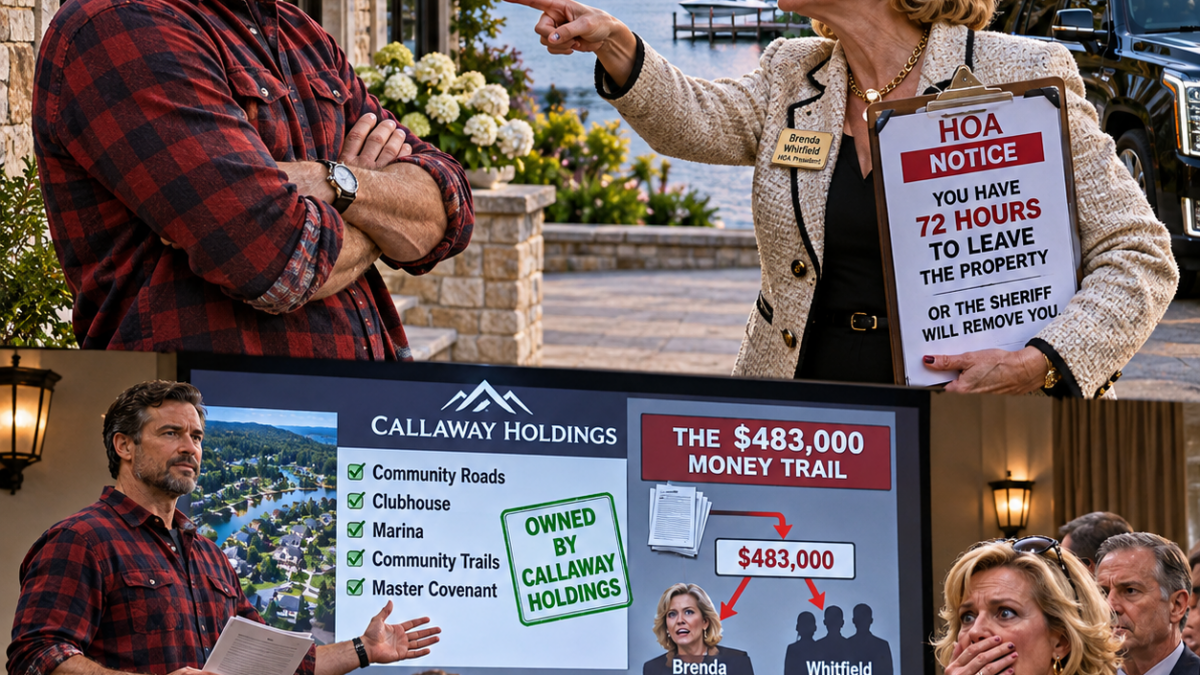
HOA Karen Gave Me 72 Hours to Leave My $30 Million Home— They Didn’t Know I Own the Entire Community.
The HOA president stood on the porch of my $30 million lakefront home, pointed at my front door, and calmly informed me that I had seventy-two hours to leave before she called the sheriff to remove me.
What she didn’t know was that the road beneath her Escalade, the clubhouse where she held her board meetings, the marina, the community trails, and the master covenant she had spent nine years using against everyone else were all controlled by a company I had quietly purchased after the original developer went bankrupt.
And when 156 residents eventually packed that clubhouse to learn who Callaway Holdings really was, Brenda Whitfield discovered that trying to evict the man in the flannel shirt had exposed a $483,000 money trail leading straight to her own family.
My name is Garrett Callaway.
The first time I drove through the gates of Glacier Ridge Estates after moving home, I rolled down the windows of my F-250 and let the Montana air fill the cab.
Pine.
Wet earth.
Cold water.
Something sharp underneath it all that reminded me of snow even in July.
The road curved between ponderosa pines before opening onto Flathead Lake.
Water spread beneath the mountains like polished glass.
For the first time in almost two years, something in my chest loosened.
I had spent sixteen years practicing commercial real-estate law in Denver.
Corporate leases.
Development agreements.
Land acquisitions.
Receiverships.
Projects worth hundreds of millions of dollars.
I knew what twelve-point language buried on page sixty-three of a contract could do to somebody who hadn’t read it.
I knew what easements were worth.
I knew the difference between ownership and access.
And I knew exactly how dangerous it was when somebody with a title started pretending the two were the same thing.
But I didn’t come home to Montana because of law.
I came home because of my father.
Earl Callaway bought three thousand acres outside Kalispell in 1971.
He was twenty-six years old.
Not wealthy.
Not connected.
Just stubborn.
He ran cattle.
Cut timber.
Built fences.
Fixed tractors with parts he shouldn’t have been able to make work.
He woke before sunrise almost every day for forty years.
When I was a kid, I thought that was normal.
PART2:
Then I grew up and realized most people don’t spend their lives staring down February mornings at ten below zero because a calf might need help.
Dad loved the land in a quiet way.
Never called it beautiful.
Never talked about legacy.
He simply took care of it.
In 2004, a development company called Pinnacle Development approached him.
They wanted most of the acreage above the lake.
Luxury homes.
Private roads.
Clubhouse.
Trails.
Marina.
Two hundred planned homes.
Dad resisted for almost a year.
Then he made a deal.
He sold development rights to most of the property.
But he kept forty lakefront acres for the family.
PART3:
And because he trusted developers about as much as he trusted a bull standing behind him, he added one clause.
Right of first refusal on the master covenant and all common-area assets if Pinnacle ever transferred or lost them.
Roads.
Trails.
Marina.
Clubhouse.
Community infrastructure.
At the time, everybody treated it like old-rancher paranoia.
Even me.
I remember reading that contract when I was in law school.
I called him.
“Dad, why did you fight them over this?”
He said:
“Never sell the last key to your own gate.”
That was Earl Callaway.
One sentence.
No explanation.
Then he’d hang up.
Dad died two years before I came home.
Pancreatic cancer.
Three months from diagnosis to funeral.
My sister Nina called me while I was sitting in a conference room in Denver.
I had been reviewing a commercial lease.
She said:
“Garrett, you need to come.”
I said:
“I’ll get a flight tomorrow.”
There wasn’t a tomorrow.
Not for him.
I missed it.
That’s the kind of regret that doesn’t shout.
It sits beside you.
At dinner.
In traffic.
At three in the morning.
I went to the funeral.
Returned to Denver.
Worked another six weeks.
Then one Monday morning, I walked into my managing partner’s office.
“I quit.”
He stared.
“You’re making partner next quarter.”
“I know.”
“You’re forty-four.”
“I know.”
“What are you going to do?”
“Go home.”
He thought I meant vacation.
I didn’t.
I loaded everything important into my truck and drove north.
Then something happened Dad never lived to see.
Pinnacle Development collapsed.
Bad debt.
Overexpansion.
Projects in three states.
The company entered receivership.
Glacier Ridge itself wasn’t bankrupt.
Residents still owned their homes.
But Pinnacle’s remaining developer interests and common infrastructure became receivership assets.
The master covenant.
Roads.
Clubhouse.
Marina.
Certain trails.
Lake-access facilities.
Dad’s old clause woke up.
I called Warren Engel, our family attorney in Kalispell.
“Read me Dad’s right-of-first-refusal language.”
He did.
I listened.
Then said:
“All of it?”
“All of it.”
“How much?”
“Receiver’s looking for four-point-two million.”
I sat on the porch of Dad’s old ranch house.
Looked toward the lake.
“Do it.”
I bought the package through Callaway Holdings LLC.
I didn’t announce it.
Didn’t need to.
The property records existed.
The transfer was recorded.
But Callaway Holdings used Warren’s office as registered agent.
No website.
No public marketing.
No reason for residents to care who stood behind it.
Most people assumed some investment company had replaced Pinnacle.
Fine with me.
I wasn’t interested in becoming emperor of Glacier Ridge.
I wanted to preserve Dad’s rights and make sure nobody chopped up the remaining land.
Then I built my house.
Calling it a house is a little ridiculous.
It was a thirty-million-dollar lodge on Dad’s forty acres.
Reclaimed timber.
Montana fieldstone.
Glass walls facing Flathead Lake.
Private dock.
Workshop.
Guest wing for Nina and her family.
Nothing flashy from the road.
Most of the money was in engineering, stonework, timber, and the view.
Dad’s old saddle hung above the fireplace.
His pocket watch sat in my desk.
I drove an F-250.
Wore flannel.
Worked on my own fence.
That confused certain kinds of people.
Brenda Whitfield arrived on my third day.
White Escalade.
Linen blazer over yoga pants.
Chanel sunglasses.
Blond hair.
Clipboard.
She walked up my drive like she’d already scheduled the meeting.
“Mr. Callaway?”
“Garrett.”
“Brenda Whitfield.”
“President of Glacier Ridge HOA.”
“Welcome.”
I waited.
She looked past me toward the house.
Then toward my truck.
Then fence.
Then lake.
“We have a few concerns.”
Already.
“About?”
She opened the clipboard.
“Your truck.”
I looked at the F-250.
“What did it do?”
“Commercial-class vehicle parked in a residential driveway.”
“No signage.”
“It’s still visually inconsistent.”
“Okay.”
“Your cedar fence.”
“What about it?”
“Unapproved material.”
I looked at the cedar fence.
Dad had cut half those posts years earlier.
“What else?”
“Dock.”
“Unauthorized permanent lake structure.”
“My dock is on my private forty acres.”
She didn’t react.
“And your mailbox.”
I smiled.
“Let me guess.”
“Nonconforming design.”
I laughed.
Brenda didn’t.
“The families here have standards, Mr. Callaway.”
“I’m sure they do.”
“I hope you’ll cooperate.”
“I’ll read the rules.”
Her smile sharpened.
“Good.”
She left.
I poured coffee.
Didn’t think about her again.
That was my mistake.
Not because I should’ve immediately revealed ownership.
I shouldn’t have.
But I underestimated Brenda’s need to control people.
The violation letters started the following week.
Four of them.
Official HOA letterhead.
Her signature in blue ink.
$500 fine each.
Fourteen days to comply.
Fence.
Truck.
Dock.
Mailbox.
I sat at the kitchen table.
Opened the CC&Rs.
Eighty-seven pages.
Read every section she cited.
Section 4.7.
Approved fence materials.
Cedar explicitly allowed.
Section 6.3.
Commercial vehicles.
Defined as vehicles displaying commercial signage or above a specified classification.
My personal F-250 didn’t qualify.
Section 9.1.
Shared lake frontage.
My dock wasn’t on shared frontage.
It was entirely within the forty acres Dad retained.
Section 5.2.
Mailbox colors.
Mine complied.
Brenda had cited a subsection that didn’t even govern my mailbox design.
I wrote four responses.
No insults.
No threats.
Just language.
Quote.
Document.
Conclusion.
This violation notice has no basis in the governing documents and should be withdrawn immediately.
Certified mail.
Return receipt.
Three days later, my neighbor Hank Dawson came over.
Sixty-eight.
Retired carpenter.
Hands like old leather.
He carried beer.
“You got Brenda letters?”
“How do you know?”
“She sends them to everybody she doesn’t like.”
We sat on the back porch.
Hank told me she’d been president nine years.
Three families had sold and left after prolonged enforcement battles.
Fines.
Inspections.
Threats.
Social pressure.
“She picks somebody.”
“How long?”
“Usually takes eight months.”
“To what?”
“Make them leave.”
I looked at him.
“You’re serious.”
“One guy fought.”
“What happened?”
“Board hit him with a twelve-thousand-dollar special assessment.”
“For what?”
Hank shrugged.
“Something they called compatibility remediation.”
“That isn’t even a thing.”
“Worked.”
“He sold.”
Then Hank looked toward my house.
“You’ve got the nicest property here.”
“She’ll hate that.”
The next morning, another certified letter.
Emergency board session.
Held the previous night.
Six new rules adopted.
Architectural preapproval.
Vehicle registration.
Sixty-day landscaping inspections.
New guest-parking restrictions.
Lakefront noise rules.
And one that would have made me laugh if it hadn’t been so revealing.
Community Compatibility Assessment.
It supposedly gave the board authority to determine whether a homeowner’s lifestyle and conduct were compatible with “community values.”
No objective standard.
No definitions.
Nothing.
A blank check.
Six rules in one evening.
Every one aimed at the guy Brenda had met three weeks earlier.
I didn’t reveal Callaway Holdings.
Instead, I drafted a formal legal objection.
Proper statutory language.
Procedural challenges.
Notice failures.
Vagueness.
Selective enforcement concerns.
I sent it as Garrett Callaway.
Homeowner.
Nothing else.
Hank called two days later.
“You scared her.”
“How?”
“She hired counsel.”
“Good.”
“She’s never needed counsel before.”
“Probably should’ve.”
But Brenda didn’t back down.
She escalated.
Tuesday night.
10:15.
I returned from Warren’s office.
Pressed gate remote.
Nothing.
Again.
Red light blinked.
Deactivated code.
I called the security company.
Guard sounded embarrassed.
“Mr. Callaway…”
“Open the gate.”
“I can’t authorize it.”
“Why?”
“Mrs. Whitfield suspended your access pending compliance review.”
I sat there in the truck.
On a road Callaway Holdings owned.
Behind a gate Callaway Holdings owned.
Being denied access by a woman whose authority existed under a covenant Callaway Holdings held.
The irony was almost artistic.
But revealing myself that night would’ve wasted everything.
So I parked.
Reclined the seat.
Pulled a Carhartt jacket from behind me.
Slept in the truck.
Temperature dropped into the low forties.
At 6:15 the morning guard opened manually.
Wouldn’t look at me.
That afternoon, Brenda emailed Glacier Ridge residents.
Hank forwarded it.
She warned of a “noncompliant homeowner.”
Recommended residents avoid engaging with him.
Claimed the board was protecting the neighborhood’s safety and values.
No name.
Didn’t need one.
Within two days:
People stopped waving.
Woman walking a golden retriever crossed the road.
Man at mailbox cluster pulled his daughter closer when I approached.
Nobody yelled.
Nobody confronted me.
That would’ve been easier.
Instead there was silence.
Social isolation is strange.
You think you’re independent until ordinary politeness disappears.
A nod.
Morning.
Nice weather.
Those tiny interactions vanish, and suddenly you realize how much they mattered.
Brenda knew that.
She weaponized belonging.
Hank didn’t care.
He kept showing up.
One evening we sat near his fire pit.
He poured whiskey.
“She tells people you’re dangerous.”
“What did I do?”
“Apparently threatened her at your door.”
“I barely spoke.”
“Doesn’t matter.”
Then:
“I’ve seen this part.”
“What happens next?”
“She creates a record.”
“Then files something.”
I looked into the fire.
“Good.”
Hank frowned.
“Good?”
“I want to see what she’s willing to put in writing.”
That’s where my sixteen years in real-estate law mattered.
Pressure doesn’t scare lawyers nearly as much as undocumented pressure.
Once people start documenting bad decisions, the shape changes.
I built a timeline.
Every letter.
Every certified receipt.
Gate suspension.
Brenda email.
Witness.
Date.
Time.
Then I started pulling financial records.
Not because I owned the common infrastructure.
Because I wanted to know who had been paying whom.
Warren obtained public and available association filings and pushed for records through appropriate channels.
Contracts.
Vendor disclosures.
Financial statements.
Board minutes.
Maintenance invoices.
Five years.
Then Saturday morning came.
7:45.
Coffee steaming in my kitchen.
Three hard knocks.
Brenda.
Navy blazer.
White blouse.
Pearls.
Sunglasses pushed onto her forehead.
Behind her stood two board members.
Gerald Foss.
Patricia Klein.
Neither looked at me.
Brenda held a manila folder.
“Mr. Callaway.”
“Morning.”
“The board voted unanimously.”
“For?”
“You have seventy-two hours to vacate this property.”
I actually looked behind me.
As though maybe she was speaking to someone else.
“What?”
“You heard me.”
“If you refuse, we will file a lien, freeze your association account, and request sheriff enforcement.”
I picked up my coffee.
Took a sip.
“This isn’t a negotiation.”
I looked at Gerald.
He stared at the porch.
Patricia looked miserable.
Then I asked:
“Brenda.”
“Yes?”
“Do you know who holds the master covenant for Glacier Ridge?”
She blinked.
“Pinnacle Development.”
“What does that have to do with anything?”
“Nothing.”
“Just curious.”
She looked annoyed.
“Seventy-two hours.”
Then turned.
Heels clicking down the stone path.
Gerald almost tripped.
Patricia looked back once.
I saw doubt.
Then the Escalade disappeared.
I stood there.
The lake beyond the house was covered in thin morning fog.
Ospreys circling.
Pines dark along the opposite shore.
My father bought this land more than fifty years earlier.
Brenda had walked onto his forty acres and told his son to pack.
I went inside.
Called Warren.
“She just gave me seventy-two hours.”
“Specific grounds?”
“No.”
“Court order?”
“No.”
“Lien?”
“Threatened.”
“Sheriff?”
“Threatened.”
Warren sighed.
“She can’t remove you by board vote.”
“I know.”
Then he said:
“Funny timing.”
“Why?”
“The financial records came in.”
I sat.
“How bad?”
“Come see me.”
Warren’s office sat above a fly-fishing shop in Kalispell.
Old brick.
Bad fluorescent lights.
Printer-toner smell.
He had five years of records spread across the conference table.
First:
Summit Property Services.
Owned by Todd Whitfield.
Brenda’s husband.
HOA payments:
$96,000 annually.
Supposed purpose:
Comprehensive landscaping.
Five years:
$480,000.
Problem:
Actual landscaping was performed by Bridger Lawn and Tree.
About $31,000 annually.
Both being paid.
Then emergency repair fund.
$185,000 over five years.
Twelve listed projects.
Warren said:
“Drive them.”
I did.
Seven didn’t exist.
No new drainage.
No resurfaced trails.
No retaining-wall repairs.
Original materials still there.
We pulled registrations for two contractor entities:
Ridge Maintenance LLC.
Flathead Services Corp.
Same PO box.
Connections to Todd’s business address.
Created shortly after Brenda became president.
Warren estimated roughly $483,000 in questionable payments traceable through connected entities.
Then there was a broader gap between collected dues and clearly documented community spending.
Approximately $1.2 million requiring explanation.
Not all necessarily stolen.
That’s important.
A financial gap means:
Find the records.
Not automatically:
Crime.
But $483,000 had documentation serious enough to warrant independent review.
Treasurer Colleen Marsh had signed many disbursements.
Warren asked:
“Involved?”
I shook my head.
“Scared.”
“How do you know?”
“I’ve watched her at meetings.”
“She doesn’t look at Brenda.”
“She looks at the table.”
Warren stared.
“That’s a lawyer’s psychological assessment?”
“No.”
“Ranch kid.”
“Worse.”
I called Nina.
My sister.
CPA.
Twelve years forensic accounting.
Temperament of a prosecutor and patience of a chainsaw.
“I need help.”
“How much?”
“Five years.”
“Why?”
“HOA president tried to evict me.”
Pause.
Then:
“For the woman who tried to throw you off Dad’s land?”
“Yes.”
“When?”
“As soon as you can.”
“I’ll be there Thursday.”
She flew in with a suitcase and laptop bag heavier than her clothes.
First thing she said:
“Show me everything.”
For twelve days, my dining room became an audit room.
Laptop.
External monitor.
Binders.
Sticky notes.
Printer.
Bank records.
Invoices.
Contractor registrations.
Nina followed transactions.
Not assumptions.
If one vendor received money, where did it go?
If two invoices described the same service, were they duplicates?
Were projects real?
Who approved payments?
Were contracts competitively bid?
Who owned the companies?
On day eight, around two in the morning, she looked up.
Forty-seven transactions.
Approximately $483,000.
Documented connections.
“That part is clean enough to hand investigators.”
“You sure?”
“Yes.”
“What about the million-plus gap?”
“Needs more records.”
“So we don’t call it stolen.”
“Correct.”
That’s why I love my sister.
She doesn’t improve a story at the expense of evidence.
She compiled a sixty-page report.
Charts.
Timelines.
Sources.
Supporting documents.
Warren sent it to state authorities and relevant law enforcement.
A preliminary inquiry opened.
Then we turned to the master covenant.
The document Dad had preserved.
The transfer agreement Callaway Holdings bought.
Warren and I went clause by clause.
As covenant holder, Callaway Holdings retained defined powers over common-area assets.
Could call certain special community meetings with required notice.
Could approve or reject specified major financial actions above contract thresholds.
Could terminate certain vendor contracts connected to common property.
Could participate in amendments under the required homeowner-vote framework.
Not unlimited power.
That’s important.
I didn’t own people’s houses.
I couldn’t decide who lived there.
I didn’t have authority to cancel mortgages or seize private property.
What I owned were the common assets and covenant-holder rights inherited from the developer structure.
Roads.
Trails.
Marina.
Clubhouse.
And certain governance rights attached to the master document.
Enough.
I called a community meeting.
Thirty days’ notice.
Every household.
Notice read:
GLACIER RIDGE COMMUNITY MEETING
Financial Review
Board Governance
Master Covenant Holder Address
Called by Callaway Holdings LLC
Two hundred letters.
Then I visited Colleen Marsh.
She opened her door in a robe.
Looked exhausted.
“I know about the vendors.”
She went pale.
“I know about Summit.”
“Ridge Maintenance.”
“Flathead Services.”
She started crying.
“I wanted to say something.”
“For how long?”
“Three years.”
“Why didn’t you?”
“Every time I asked, Brenda shut me out.”
“She told me I could be personally liable if I disclosed financial information.”
I sat.
“Colleen, you need your own attorney.”
She nodded.
“I’m not here to promise you immunity.”
“I’m asking you to preserve your records and tell investigators the truth.”
She wiped her face.
“What do you need at the meeting?”
“The truth.”
That’s all.
I visited homeowners who had been targeted.
Eight families.
Different stories.
Same emotional pattern.
Exhaustion.
People tired of feeling that Brenda decided whether they belonged.
Then Todd Whitfield made another mistake.
Somebody spray-painted one word across my gate.
LEAVE
Three-foot red letters.
Fresh paint.
Security camera captured the person.
Dark jacket.
Cap.
Face mostly down.
Then he turned.
Infrared caught him.
Todd.
Clear enough to identify.
I saved the footage.
Three copies.
Warren.
Law enforcement.
Offline drive.
Brenda responded to the meeting notice with an email blast.
She called Callaway Holdings an “outside entity.”
Claimed it was attempting a hostile takeover.
Told residents not to attend.
That was funny for two reasons.
First:
Callaway Holdings wasn’t outside.
Second:
Telling two hundred wealthy homeowners not to look at financial records is one of the most effective ways to make them look.
I didn’t respond emotionally.
Instead, I sent each household one sheet.
Numbers.
Five years of dues.
Documented community spending.
Amount requiring reconciliation.
$483,000 tied to vendors with connections requiring investigation.
No accusations beyond what the records supported.
At the bottom:
Full documentation will be available for review at the October 12 meeting.
The RSVPs started immediately.
112 households within a week.
Brenda hired a private investigator.
Gray Malibu.
Same overlook road three mornings.
Followed me to Warren.
Nina.
County offices.
Sheriff’s office.
I waved once.
He drove away.
Every place he followed me probably made Brenda feel worse.
Because the pattern was obvious.
I wasn’t fighting an HOA fine anymore.
I was building a file.
Then came her most aggressive financial move.
Emergency board session.
Colleen excluded.
Special assessment:
$15,000 per household.
Claimed purpose:
Critical infrastructure repair.
Potential total:
About $3 million if collected broadly.
Colleen found out when a resident called her.
She called me shaking.
“They voted without me.”
Warren reviewed the covenant.
Large financial actions above a defined threshold required covenant-holder approval under the developer-era master agreement.
No approval had been requested.
Callaway Holdings sent formal notice.
Special assessment not authorized under the master covenant.
Do not collect pending legal review.
Potential personal liability for unauthorized action.
Every board member served.
That’s when Brenda finally understood Callaway Holdings wasn’t a passive LLC.
Then Todd connected the last dot.
Public filing.
Registered mailing address.
My address.
Callaway Holdings.
Callaway.
Garrett Callaway.
Colleen later told me what happened.
Todd walked into his kitchen holding paperwork.
“Brenda.”
She looked.
“It’s him.”
“Who?”
“Callaway Holdings.”
She stared.
“The man in the flannel shirt?”
“Yes.”
“He owns the covenant.”
“Roads.”
“Clubhouse.”
“Marina.”
Her kingdom had never been hers.
She had simply been elected to manage part of it.
October 12.
6:00 p.m.
Glacier Ridge clubhouse.
Timber frame.
Floor-to-ceiling windows facing Flathead Lake.
By 5:30, the parking lot was half full.
By six:
156 residents.
Highest turnout anyone could remember.
Brenda sat in front.
Red blazer.
Pearls.
Sunglasses folded in her lap.
Todd beside her.
Gray suit.
Sweating.
Deputy Ray Stockton stood near the back in plain clothes.
A representative from the Attorney General’s office sat nearby with a legal pad.
Warren in the second row.
Nina beside him.
Hank near the aisle.
Colleen halfway back.
I walked to the podium.
The room went silent.
“My name is Garrett Callaway.”
A few people shifted.
“Most of you know me as the man with the truck Brenda didn’t like.”
Small laugh.
“Some of you were told not to speak to me.”
“I understand why some of you listened.”
“No hard feelings.”
Brenda stared.
I clicked the first slide.
A photograph of my father.
Young.
Standing beside a fence post with mountains behind him.
“My father, Earl Callaway, purchased this land more than fifty years ago.”
“In 2004, he sold development rights to Pinnacle Development.”
“But he kept forty lakefront acres.”
“And one contractual protection.”
Next slide.
Right of first refusal.
Then receivership documents.
“When Pinnacle failed, its remaining Glacier Ridge assets went into receivership.”
“My father’s contractual right became exercisable.”
“Through Callaway Holdings LLC, I acquired those assets.”
Next slide.
Recorded transfer.
Master covenant assignment.
Common-area deed schedule.
Roads.
Trails.
Marina.
Clubhouse.
I looked at Brenda.
Then back at residents.
“Callaway Holdings is my company.”
“I hold the master covenant and the common-area assets listed in these recorded documents.”
Whispers rolled through the room.
I said:
“To be clear, I do not own your private homes.”
“I do not decide who gets to live here.”
“But the roads, clubhouse, marina, specified trails, and covenant-holder rights Brenda has repeatedly described as belonging to some distant development company are held by Callaway Holdings.”
Then:
“By me.”
Brenda stood.
“That’s a lie.”
Warren stood too.
No shouting.
He held a folder.
“Certified deed transfers.”
“Recorded master covenant assignment.”
“Receivership approval.”
“County stamps.”
“Originals are available for inspection after the meeting.”
Brenda sat.
No argument.
Then came Nina’s report.
I didn’t say:
Brenda stole $1.2 million.
We couldn’t prove that.
I said:
“Here is what we can prove.”
Slide.
HOA revenue.
Documented expenses.
Unreconciled difference.
Next.
Summit Property Services.
Todd Whitfield connection.
Payments.
Actual landscaping vendor.
Duplicate service periods.
Next.
Ridge Maintenance.
Flathead Services.
Business registrations.
Related addresses.
Invoices.
Projects.
Photographs showing seven listed projects were not found at described locations.
“Approximately $483,000 in transactions require criminal and civil investigation based on the records we’ve obtained.”
“Every number on this presentation has supporting documentation.”
Colleen stood.
Her voice was thin.
But she didn’t sit again.
“I’m Colleen Marsh.”
“Board treasurer.”
“I signed some of these disbursements.”
People turned.
“I should have challenged them sooner.”
“I didn’t.”
“Brenda excluded me from meetings.”
“She told me I’d be personally liable if I disclosed internal records.”
“I was afraid.”
She swallowed.
“That doesn’t excuse my silence.”
“I have given investigators my records.”
“I will cooperate.”
No applause.
Good.
It wasn’t an applause moment.
Then I showed Todd at my gate.
Infrared video.
Red paint.
LEAVE
Todd stopped bouncing his knee.
Brenda stood.
“This is a setup.”
“He’s trying to steal the community.”
I raised one hand.
“Brenda.”
She stopped.
For nine years, she’d controlled rooms by filling silence faster than anyone else.
I let the silence sit.
Then:
“You knocked on my door and told me I had seventy-two hours to leave.”
She stared.
“You threatened to lock me out of my home.”
“You told neighbors I was dangerous.”
“You told residents Callaway Holdings was an outside entity.”
Then I gestured toward the floor.
“This clubhouse is one of the assets held by Callaway Holdings.”
“The road you drove here on is one of the roads held by Callaway Holdings.”
“The marina is part of that same recorded transfer.”
“You didn’t try to remove a trespasser from your community.”
I paused.
“You tried to order the covenant holder off his own forty acres.”
The room erupted.
Some laughter.
Some clapping.
I waited.
Didn’t encourage it.
Then Deputy Stockton stepped forward.
He wasn’t there for theater.
He was there because investigators had reached the point where action had been authorized.
Todd Whitfield was taken into custody pursuant to warrants related to the ongoing financial investigation.
He didn’t fight.
Just stood.
Hands behind him.
The click of cuffs was quieter than movies make it sound.
But in that room?
Everybody heard it.
Brenda didn’t get marched out beside him that second.
Her situation took longer.
Records.
Interviews.
Counsel.
Evidence.
Real investigations aren’t synchronized for dramatic effect.
But her presidency ended that night.
Motion to remove her as HOA president and from board leadership moved forward under the association’s governing process.
Residents voted overwhelmingly against her continued leadership.
She walked out before the meeting fully ended.
No crowd chasing her.
No one yelling.
The door simply closed.
The following months were slower.
And messier.
Investigators examined vendor payments.
Shell-company relationships.
Board approvals.
Todd’s businesses.
Brenda’s role.
Some allegations were supported.
Others needed correction once complete records surfaced.
That’s how investigations should work.
Facts first.
Narrative second.
Todd faced serious financial charges.
Brenda faced proceedings tied to the financial scheme and governance conduct.
The case did not need me exaggerating it.
The documents were enough.
Todd and Brenda sold their home.
Moved.
Nobody lined the road to watch.
Hank told me the moving truck left one Tuesday morning.
I said:
“Good.”
He asked:
“That’s it?”
“What do you want me to do?”
“Wave a handkerchief?”
He laughed.
Two weeks after the meeting, Glacier Ridge held new elections.
Colleen did not immediately pretend she had been a hero.
That mattered to me.
She stood before residents and said:
“I failed to speak soon enough.”
People respected that.
She later became part of the new leadership under strict transparency rules.
Monthly financial reporting.
Published minutes.
Independent review.
Vendor disclosures.
Competitive bidding.
No surprise rules passed at secret emergency sessions.
No access deactivations based on a president’s personal command.
No “community compatibility” nonsense.
I used Callaway Holdings’ covenant-holder authority carefully.
That mattered too.
The worst possible ending would’ve been me becoming Brenda with better paperwork.
I could not decide who belonged.
Didn’t want to.
My job was to stabilize the common assets and make the governance structure transparent.
We reviewed vendor contracts.
The new landscaping contract came in roughly forty percent below what Summit had been charging.
Some other costs dropped too.
Homeowner dues were reduced substantially once the financial picture stabilized and duplicated or inflated expenses were removed.
Not because I gave people a gift.
Because residents stopped paying for nonsense.
One evening Hank walked over holding his new statement.
“You did this?”
“No.”
“Numbers did.”
He shook his head.
“You lawyers are exhausting.”
“Accurate.”
Then we dealt with the land.
Dad had always worried Glacier Ridge would eventually eat the remaining forest.
He hated seeing elk pushed farther up the ridge every year.
So I worked with conservation lawyers and local partners.
Five hundred undeveloped acres were eventually protected through permanent conservation restrictions.
Old-growth sections.
Wetlands along Meadow Creek.
Part of the elk corridor.
No houses.
No commercial logging.
No new roads beyond what conservation management required.
Nina read the final documents.
“Dad would’ve complained about the legal fees.”
“Yes.”
“Then bragged to everyone.”
“Definitely.”
We created a small scholarship too.
Named for Earl Callaway.
Ten thousand dollars annually toward college for a Glacier Ridge student.
First recipient was Sarah Pruitt.
Seventeen.
Environmental science.
Her mother had nearly sold after years of Brenda’s enforcement pressure.
Sarah wrote me a letter.
Not polished.
Not dramatic.
She wrote:
Mr. Callaway, I think your dad would be happy that the land is helping people who live here instead of just being worth money.
I kept it beside Dad’s pocket watch.
That meant more to me than every vote.
The first Founders Festival under the new structure happened the following fall.
Hank ran barbecue.
Built his smoker from an old propane tank.
Probably violated six fire codes.
I chose not to investigate.
Kids fishing tournament.
Bluegrass band.
Pie contest.
Three women nearly started another civil war over huckleberry recipes.
Somebody hung a banner:
EARL CALLAWAY FOUNDERS FESTIVAL
Between two ponderosa pines.
When the wind caught it, the canvas snapped.
I stood there longer than necessary.
Nina came beside me.
“You okay?”
“Yeah.”
“You’re crying.”
“Smoke.”
“Wind’s going the other direction.”
“Go away.”
She smiled.
That night, after the band finished, I walked to the dock.
Lake black.
Stars reflected so clearly it looked like the sky continued below the water.
I thought about Dad signing Pinnacle’s contract at his kitchen table.
Reading glasses sliding down his nose.
Stubby pencil.
Probably irritating three corporate lawyers by refusing to give up one clause.
Right of first refusal.
He had no idea Pinnacle would collapse.
No idea I’d become a real-estate lawyer.
No idea I’d come home.
No idea a woman named Brenda would someday stand on his land and tell his son he had seventy-two hours to leave.
He simply knew one thing.
Never sell the last key to your own gate.
That one instinct changed everything.
People still ask me whether I “owned the whole neighborhood.”
The answer needs context.
I owned the master covenant rights and the common-area assets Callaway Holdings acquired.
Roads.
Clubhouse.
Marina.
Certain trails.
Infrastructure.
Not people’s houses.
Not their lives.
Not their votes.
And that’s exactly why Brenda failed.
She spent nine years confusing administrative authority with ownership.
HOA president became queen in her mind.
A violation letter became law.
A board vote became eviction.
Her preference became community standard.
Then she encountered someone who actually understood where the legal boundaries were.
The irony wasn’t that I had more power.
The irony was that I understood mine had limits.
She didn’t.
One afternoon months after the scandal, Colleen sat with me on the porch.
She said:
“Why didn’t you tell her on day one?”
“That I controlled Callaway Holdings?”
“Yes.”
I thought.
“Because it shouldn’t have mattered.”
She frowned.
“How?”
“My fence was legal before she knew.”
“My truck was legal before she knew.”
“My dock was private before she knew.”
“She didn’t have authority to lock me out before she knew.”
“My rights didn’t come from owning the covenant.”
“They already existed.”
Colleen nodded slowly.
“If you’d told her?”
“She would’ve behaved differently because she was afraid of me.”
“And?”
“I wanted to know how she behaved when she thought I was powerless.”
That answer surprised even me.
But it was true.
People reveal themselves most clearly around those they believe cannot hurt them.
Brenda saw:
Flannel.
Work boots.
Pickup.
Quiet man living alone.
She thought I was easy.
So she showed me everything.
Selective enforcement.
Gate suspension.
Social isolation.
Threats.
Secret board actions.
Then:
Leave now.
She built the case herself.
Hank said something similar.
“Never interrupt a person who’s digging the hole you’re going to use as evidence.”
Not sure where he got that.
Probably misquoted somebody famous.
I still use it.
My house remains.
Same fence.
Same dock.
Same F-250 for another two years until the transmission finally died.
Brenda would’ve enjoyed that.
I bought another truck.
Still no HOA approval.
The mailbox?
Unchanged.
Cedar.
Black numbers.
Perfectly compliant.
I considered painting it neon orange out of spite.
Didn’t.
Growth again.
The entry gate has a new security policy.
No board president can unilaterally deactivate resident access.
Emergency suspensions require documented cause and independent review.
That policy exists because I spent one cold night sleeping in my truck on a road my own company owned.
Sometimes good rules are born from extremely stupid events.
Callaway Holdings also changed.
I created a resident advisory council.
Common-area budgets reviewed publicly.
Major capital projects require homeowner input beyond minimum legal requirements.
Why?
Because owning infrastructure doesn’t mean you know what everybody needs.
Brenda thought authority meant fewer questions.
I learned the opposite.
The more power you have, the more questions you should tolerate.
One spring morning, I saw a new family walking near the marina.
The father recognized me.
“Mr. Callaway?”
“Garrett.”
“We just moved in.”
“Welcome.”
His wife laughed.
“We read about you.”
“That worries me.”
Their son looked up.
“Do you really own the road?”
“Technically my company owns some common roads.”
“Can you close them?”
I looked at his father.
He looked horrified.
I laughed.
“No.”
“Not because I feel like it.”
The boy seemed disappointed.
Good.
Power should be boring to children.
The old spray-painted gate panel is stored in my workshop.
I replaced that section rather than sanding it.
Not because I wanted a trophy.
Because Dad built part of the original frame.
I couldn’t throw it away.
On the back, in marker, Nina wrote:
TODD’S MOST EXPENSIVE ART PROJECT.
I didn’t ask.
She has boundary issues.
Sometimes I look at the word:
LEAVE.
Red faded darker now.
It used to make me angry.
Not anymore.
Because I did leave once.
Denver.
Career.
Life I’d built there.
Then came home.
Nobody was going to make me leave Dad’s land because my truck offended their standards.
That was never the fight.
The fight was whether one person could make the entire community afraid to ask:
Where does your authority come from?
Once residents asked that question, Brenda’s world collapsed fast.
Where does the vehicle rule come from?
Wrong section.
Where does fence violation come from?
Cedar allowed.
Where does the dock violation come from?
Private acreage.
Where does the right to deactivate access come from?
Nowhere she could justify.
Where does the right to evict come from?
Not a board vote.
Where did the vendor money go?
Now we were asking the right question.
That’s the thing about abusive systems.
They survive partly through complexity.
People assume:
Somebody must know.
The president must have checked.
Treasurer must have approved.
Attorney must agree.
Security company wouldn’t do it otherwise.
Everybody assumes somebody else verified the foundation.
Then one person reads the document.
Suddenly:
Cedar is approved.
Truck isn’t commercial.
Dock is private.
Road authority has conditions.
Vendor invoice doesn’t match work.
Shell company shares an address.
$483,000 starts asking questions of its own.
My father barely finished high school.
But he understood something plenty of lawyers miss.
Read before you sign.
Keep what matters.
And never assume the person wearing the nicest jacket owns the ground they’re standing on.
The $30 million house gets attention when people tell the story.
I understand why.
Big number.
But the house isn’t what I cared about.
Dad’s forty acres could have held a one-room cabin and I’d have fought the same way.
The value wasn’t marble or timber.
It was the fact that he kept that piece.
When everybody else saw development potential, he kept a shoreline.
When developers asked for total control, he kept a clause.
When I wanted to build something enormous after he died, I kept his saddle in the middle of it so I wouldn’t forget what existed first.
The morning Brenda told me to leave, I could’ve ended the confrontation in thirty seconds.
I could’ve pulled the transfer agreement from my office.
Shown her.
Said:
“Actually, Brenda, I own the clubhouse where you hold meetings.”
Would’ve been satisfying.
Also stupid.
She would’ve stopped talking.
Called lawyers.
Destroyed documents maybe.
Changed tactics.
Warned Todd.
Instead, I took a sip of coffee.
Asked one question.
Then let her leave.
That gave Nina twelve days with the records.
Gave Colleen time to decide she was done being afraid.
Gave Todd enough confidence to paint my gate on camera.
Gave Brenda enough confidence to attempt a $15,000 special assessment she lacked authority to impose.
Every move narrowed her options.
By the night of the meeting, I didn’t need a dramatic confrontation.
I needed a projector.
That’s real leverage.
Evidence displayed in chronological order.
I still practice law occasionally.
Consulting.
Property matters.
Nothing like the Denver years.
When somebody calls me about an HOA dispute, the first thing I say is:
“Send me the documents.”
Not the Facebook post.
Not what your neighbor said.
Documents.
Declaration.
Bylaws.
Amendments.
Notices.
Minutes.
Deed.
Survey.
Because every HOA story has two versions.
The emotional version.
And the recorded version.
Sometimes they match.
Sometimes they don’t.
Mine didn’t.
Brenda’s version:
Dangerous homeowner.
Noncompliant property.
Outside corporation.
Hostile takeover.
Necessary emergency rules.
Necessary assessment.
Her own records:
Cedar approved.
Truck outside commercial definition.
Private dock.
Improper access suspension.
Connected vendor payments.
Unverified projects.
Master covenant held by Callaway Holdings.
And a homeowner she was trying to evict who happened to be the man behind it.
I remember the exact moment during the meeting when she understood she was finished.
Not when I revealed Callaway Holdings.
Not when Nina’s chart appeared.
Not when Todd’s camera footage played.
It happened when Colleen stood.
Brenda turned toward her.
For years, Colleen had looked down whenever Brenda spoke.
That night, she didn’t.
She looked directly at Brenda.
Then said:
“I should have spoken sooner.”
That was the real end.
Control depends on cooperation.
Fear is cooperation.
Silence is cooperation.
People looking away is cooperation.
The moment enough people stop?
The title means nothing.
Brenda had a president’s chair.
She no longer had a room willing to obey.
Today, Glacier Ridge is quiet.
Not silent.
Quiet.
Difference matters.
People wave again.
Neighbors argue about normal things.
Marina slips.
Snow removal.
Christmas-light dates.
Whether dues should cover pickleball courts.
God help us.
Hank still walks over uninvited.
He claims this is grandfathered behavior.
Nina visits every summer.
We sit on the dock.
She criticizes my coffee.
I criticize her spreadsheets.
Normal.
Every October, the Founders Festival returns.
Kids fish.
Hank burns at least one brisket and insists it’s “bark.”
Someone always brings huckleberry pie.
The scholarship recipient gets introduced.
Dad’s name hangs between the trees.
And every year, near sunset, I walk away for a few minutes.
Down to the lake.
I sit where he used to sit.
Sometimes I bring his pocket watch.
It doesn’t run.
I could repair it.
I won’t.
The hands stopped at 4:17.
The hour he died.
Nina thinks keeping it that way is morbid.
Maybe.
But some things don’t need fixing.
They need remembering.
I think about the call I missed.
The flight I didn’t take soon enough.
The years I thought there would always be another weekend.
Then I look toward the ridge.
Five hundred acres protected.
Lights from homes between trees.
Clubhouse windows glowing.
Road curving through the pines.
Dad sold most of the land because he understood things change.
He kept part because he understood some things shouldn’t.
That’s balance.
Brenda never understood balance.
To her:
Control had to expand.
One more rule.
One more inspection.
One more fine.
One more person pushed out.
She told me:
“You don’t belong in a place like this.”
Flannel.
Boots.
Truck.
Apparently those were disqualifying.
But Glacier Ridge existed because Earl Callaway once stood on raw Montana dirt wearing almost exactly the same things.
That’s the irony I never said to her face.
Didn’t need to.
The land knew who came first.
So did the documents.
The last time somebody asked me what happened to Brenda, I said:
“She learned the difference between managing something and owning it.”
That’s really the whole story.
She managed an HOA.
She thought that made the neighborhood hers.
It didn’t.
I owned common assets.
That didn’t make the homeowners mine either.
Authority is not ownership.
Ownership is not permission to abuse authority.
The difference between Brenda and me wasn’t who had the bigger title.
It was whether we understood where our rights stopped.
On that Saturday morning, she stood on my porch.
Behind her, Gerald and Patricia.
Escalade in the driveway.
My father’s lake behind me.
She looked at my work boots.
My flannel shirt.
My coffee.
Then said:
“Seventy-two hours.”
She expected fear.
I asked:
“Do you know who holds the master covenant?”
She said Pinnacle.
Wrong answer.
I could have corrected her then.
Instead, I let her drive away on a road Callaway Holdings owned.
Past a gate Callaway Holdings owned.
Toward a clubhouse Callaway Holdings owned.
Where she would spend the next month trying to prevent a meeting called under a covenant Callaway Holdings held.
Then on October 12, in front of 156 residents, I finally gave her the answer.
“My father protected the right to reclaim these assets.”
“Pinnacle went bankrupt.”
“I exercised that right.”
“Callaway Holdings bought the roads.”
“The marina.”
“The clubhouse.”
“The trails.”
“The master covenant.”
Then I looked at the woman who had stood on my porch and told me I didn’t belong.
“Callaway Holdings is me.”
The room went silent.
And for the first time in nine years, Brenda Whitfield had no rule to quote.
Because she had spent years deciding who belonged in Glacier Ridge.
She simply never bothered to find out who owned the ground beneath her chair.








