HOA Karen Forged My Death Certificate and Sold My Cabin for $3 Million—Then I Walked Into the Closing Alive With the Original Deed
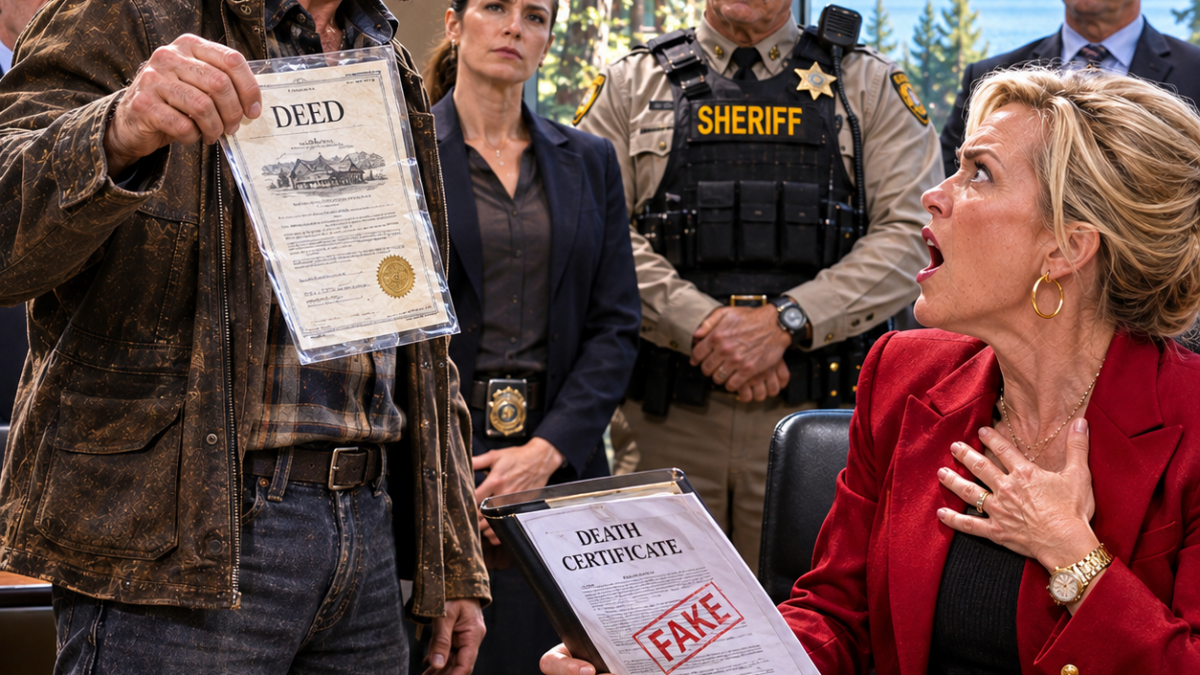
HOA Karen Forged My Death Certificate and Sold My Cabin for $3 Million—Then I Walked Into the Closing Alive With the Original Deed.
For six weeks, HOA president Vanessa Pritchard told an entire Colorado mountain community that Orson Hadley had died in the wilderness, then used a death certificate, changed locks, and forged estate paperwork to prepare his eighteen-acre lakefront cabin for a $3 million sale.
On closing morning, Vanessa sat across from the buyer smiling beside a stack of documents that treated Orson like a dead man—until the conference-room door opened and the man whose signature she had been using walked in carrying his passport, driver’s license, and original deed.
But the moment that truly ended Vanessa’s plan came seconds later, when she pointed at Orson and screamed that he was an impostor, only for her own HOA treasurer to stand up behind him and say, “No, Vanessa. I’m going to tell them what really happened.”
By the time Orson Hadley returned to Silverpine Ridge, he had been dead for forty-three days.
At least according to the paperwork.
He did not learn that at a sheriff’s office.
He did not learn it from his lawyer.
He learned it from a maintenance contractor standing on the other side of a brand-new steel gate that had been installed across Orson’s own driveway.
The contractor sounded confused.
“Sir, what did you say your name was?”
“Orson Hadley.”
Silence.
Long enough that Orson looked at his phone to make sure the call had not dropped.
Then:
“That can’t be right.”
“What can’t?”
“The owner of this property is deceased.”
Orson stood beside his truck staring at the gate.
Behind it, his gravel road curved through ponderosa pine toward the log cabin his father had left him.
Same road.
Same forest.
Same mountain.
Different lock.
“What did you say?”
“The owner passed away.”
“No.”
Another pause.
“Sir, I’m only reading the work order.”
“I’m the owner.”
“I understand what you’re saying.”
“No, you don’t.”
Orson’s voice remained calm.
That was one of the things people found strange about him.
He could be furious without sounding furious.
Forty-three years old.
Environmental survey engineer.
Spent most of his adult life working in places where mistakes in maps, boundaries, drainage, and environmental permits could cost companies millions.
He had learned early that anger did not change coordinates.
Evidence did.
He looked at the sign wired to the new gate.
ESTATE PROPERTY
AUTHORIZED PERSONNEL ONLY
PENDING TRANSFER
Parcel number beneath it.
His parcel number.
His father’s land.
Orson asked:
“Who hired you?”
PART2:
The contractor hesitated.
“Silverpine Property Services.”
“Who authorized Silverpine?”
“Estate representative.”
“Name?”
“I’d have to look.”
“Look.”
Another silence.
Then:
“Vanessa Pritchard.”
Orson closed his eyes.
Of course.
He thanked the contractor.
Ended the call.
Then stood for a long time beside the gate.
The last time he had seen Vanessa Pritchard was six weeks earlier through the window of the Silverpine Ridge HOA office.
He had driven past on his way toward a remote environmental survey project in western Colorado.
She had watched him leave.
He remembered that now.
At the time, it meant nothing.
Now?
PART3:
It meant too much.
Silverpine Ridge had grown around Clearwater Lake during the previous decade.
Luxury mountain homes.
Stone entrance.
Clubhouse.
Security.
Golf carts.
Landscaped medians that looked absurd beside actual wilderness.
Almost every acre of shoreline had been developed.
Almost.
On the eastern edge sat eighteen acres that had belonged to the Hadley family since Orson’s father purchased them decades earlier.
A weathered log cabin.
A private trail to the lake.
Ponderosa pine.
Aspen.
Rock outcrops.
Old gravel road.
No HOA.
That last point had irritated Vanessa for years.
Silverpine Ridge’s declaration specifically excluded the Hadley parcel.
It predated the development.
No dues.
No covenant enforcement.
No architectural control.
No assessment power.
Vanessa still behaved as though geography should eventually correct the legal inconvenience.
She first approached Orson with an offer.
$420,000.
He declined.
Then:
$580,000.
But only if he included his lake-access rights.
“No.”
She smiled.
“Think about it.”
“I have.”
“The market is changing.”
“So?”
“You’re sitting on land that could become enormously valuable.”
“It already is.”
“To you.”
“Yes.”
That answer annoyed her more than if he had demanded twice the money.
At the next HOA meeting, Orson attended only to deliver a boundary survey relating to the association’s proposed road expansion.
Vanessa used the opportunity to humiliate him.
She stood at the front of the clubhouse and said:
“Some properties simply outlive their usefulness.”
People laughed politely.
She continued.
“Silverpine is becoming one of the most valuable resort communities in the county, but we still have an old cabin sitting on prime lake frontage because one person refuses to see what the land could become.”
Orson had been standing near the door.
He looked at her.
“It’s my property, Vanessa.”
She smiled.
“I understand.”
“Your vision doesn’t appear anywhere on my deed.”
Several homeowners laughed.
Not cruelly.
Still enough.
Vanessa’s face reddened.
She never forgot embarrassment.
Within two weeks, HOA violation letters began arriving at Orson’s cabin.
Roof materials.
Fence condition.
Truck parking.
Woodpile placement.
Road maintenance.
Every letter carried a fine.
Every response from Orson included the same attachment:
Recorded deed.
Exclusion language.
One by one, the HOA withdrew the fines.
Then his neighbor Walt Ingram mentioned something.
Walt lived on a separate parcel outside the association.
Sixty-two.
Retired fire captain.
One of those men who noticed vehicles, smoke, weather, and people who did not belong.
He stopped by Orson’s porch one morning.
“Vanessa’s been meeting with a developer.”
“Good for Vanessa.”
“Lake developer.”
“Still good for Vanessa.”
“Big one.”
Orson looked up from the survey equipment he was cleaning.
“You trying to tell me something?”
“I’m telling you she had lunch twice with Bram Huxley.”
That name Orson knew.
Bram Huxley represented Westward Summit Development.
Luxury resorts.
Private marinas.
Boutique mountain hotels.
“You sure?”
“Sat behind them at the lodge.”
“What’d you hear?”
“Not much.”
Walt hesitated.
“Your name.”
Orson stopped.
“What?”
“Once.”
“What context?”
“Didn’t catch it.”
Orson shrugged.
“If she wants to offer again, she can.”
Then he left for the six-week job.
The work was remote enough that ordinary cell coverage disappeared for days at a time.
Satellite check-ins.
Field stations.
Mountain weather.
Long hikes.
Exactly the type of job Orson liked.
He switched on his cabin security system.
Locked everything.
Gave emergency contact information to an old college friend in Denver.
Then drove out.
Two weeks later, Vanessa declared him dead.
The funeral notice went first.
ORSON HADLEY
197?–2026
TRAGIC LOSS IN REMOTE WILDERNESS ACCIDENT
Posted inside the Silverpine Ridge community center.
Then HOA email.
Then an emergency board meeting.
Vanessa stood before homeowners wearing black.
Not funeral black exactly.
Expensive black.
Her voice trembled at the right moments.
She announced that Orson had suffered a fatal accident during a remote field assignment.
Search-and-rescue crews had supposedly confirmed his death.
She placed a photocopy of a death certificate on the table.
One homeowner asked:
“Has anybody talked to family?”
Vanessa lowered her eyes.
“Estate representatives are handling the matter.”
Another asked:
“Was there a funeral?”
“Private.”
Then she added the sentence that converted tragedy into opportunity.
“Orson had made clear that if anything happened to him, he wanted the property sold rather than abandoned.”
Completely false.
But dead people are convenient that way.
They rarely interrupt.
Within days:
Locksmiths changed Orson’s cabin locks.
A maintenance company installed the estate sign.
Furniture began disappearing.
His carved HADLEY nameplate was removed from the gate.
The old wood stove his father had installed was disconnected.
Books boxed.
Survey equipment inventoried.
Leather chair carried out.
Walt watched.
He called Orson.
Voicemail.
Again.
Nothing.
The story became easier to believe.
When Walt confronted Vanessa outside the HOA office, she gave him a sympathetic smile.
“Grief is difficult.”
“I’m not grieving.”
“That may take time.”
“I’m asking why the HOA is controlling his property.”
“We’re assisting the estate.”
“Why?”
“Because responsible people have to step in when someone leaves affairs unresolved.”
“Did Orson ask you?”
“Walt.”
Her voice became firmer.
“This is now a legal matter.”
That phrase worked surprisingly well on people.
Legal matter.
It meant:
Stop asking.
Somebody smarter has checked.
Inside the HOA office, one person kept asking anyway.
Della Norwood.
Fifty-one.
Treasurer.
Worked beside Vanessa for nine years.
Della had never liked Vanessa, exactly.
But she respected her competence.
Vanessa got things done.
Budgets.
Road repairs.
Vendor disputes.
Insurance.
People tolerated the personality because they liked results.
Then Della noticed HOA money paying Orson’s “estate expenses.”
Legal services.
Property preparation.
Security.
Listing costs.
She entered Vanessa’s office.
“Why are we paying these?”
Vanessa barely looked up.
“Community interest.”
“Orson wasn’t an HOA member.”
“We have a contingent financial interest.”
“What interest?”
“The redevelopment transaction.”
Della stared.
“What redevelopment transaction?”
Vanessa looked up.
“It’s being handled.”
“By who?”
“Counsel.”
“Which counsel?”
“Della.”
The warning was subtle.
“Focus on the budget.”
Della left.
Did not stop thinking.
Then she saw the draft purchase agreement.
Vanessa’s office door was open.
Document on desk.
WESTWARD SUMMIT DEVELOPMENT.
Seller:
Estate of Orson Hadley.
Purchase price:
$3,000,000.
Della stopped breathing for a second.
Three million dollars.
For eighteen acres and a cabin.
Then she saw a line near the bottom.
Consulting and transaction facilitation fee:
$680,000.
Recipient company listed separately.
Alpine Meridian Consulting LLC.
Della had never heard of it.
She made a mental note.
Did not touch the document.
The sale was supposed to transform Silverpine Ridge.
Vanessa sold homeowners the idea aggressively.
Private lakeside retreat.
Walking trails.
Small marina.
Premium cabins.
Destination branding.
Property values rising.
She spoke about Orson’s death as if it had solved an old planning problem.
The cabin became “the former Hadley parcel.”
His road became “future resort access.”
His shoreline became “commercial lakefront.”
A man’s life disappeared under development language.
At the title company in Denver, Quinn Fenner disliked the file almost immediately.
Thirty-six.
Compliance officer.
Methodical.
Not dramatic.
She had stopped transactions for less.
The death certificate looked reasonable.
So did the estate representative appointment.
The transfer filing.
The authorization letter.
The problem was verification.
The death certificate referenced a state record number that did not align cleanly with the confirmation system.
Quinn requested direct validation.
Vanessa began calling.
First politely.
Then impatiently.
“This closing is time-sensitive.”
“Yes.”
“You’re jeopardizing a three-million-dollar deal.”
“I’m verifying seller authority.”
“We’ve provided the documents.”
“I’m verifying them.”
“Do you understand who the buyer is?”
“Yes.”
“Then why are you creating unnecessary problems?”
Quinn responded:
“Because dead sellers create necessary problems.”
Vanessa did not find that funny.
Two days later, state vital records answered Quinn.
NO MATCHING DEATH RECORD FOUND.
Quinn sat still.
Then checked again.
Name.
Date of birth.
Residence.
No record.
She called her supervisor.
Then legal counsel.
Funds were flagged.
Closing could not release until resolved.
Vanessa did not know yet.
At the same time, Orson was driving home.
He reached Silverpine Ridge.
Saw gate.
Made calls.
Then drove directly to the HOA administration building.
The receptionist looked up.
Saw him.
Went white.
“Can I help you?”
“I’m Orson Hadley.”
She stopped breathing.
On the counter sat a thick file.
HADLEY ESTATE.
Death certificate clipped front.
Orson reached toward it.
Not removing.
Just enough to read.
His name.
His date of birth.
His address.
DECEDENT.
He took out his phone.
Photographed what was openly visible.
Then an inner door opened.
Vanessa stepped out.
She froze.
For one second, every layer of confidence disappeared.
Pure shock.
Then rebuilt.
“Security.”
Orson stared.
“Vanessa.”
“Security!”
A guard stepped from the hallway.
Vanessa pointed.
“This man is impersonating Orson Hadley.”
The receptionist looked as though she might faint.
Orson pulled out his driver’s license.
Vanessa would not take it.
“The real Orson Hadley is dead.”
Orson almost laughed.
“I seem to be handling it well.”
“This is fraud.”
“Yes.”
“Security, remove him.”
Orson did not resist.
That mattered.
He photographed the visible papers.
Put away his identification.
Walked out.
In the parking lot, he called Greer Madsen.
Thirty-nine.
Property-fraud and title litigator.
She had once helped him with a boundary dispute.
She answered:
“Orson.”
“Apparently I’m dead.”
Silence.
“What?”
“Vanessa has a death certificate.”
Another silence.
“Where are you?”
“HOA parking lot.”
“Do not go back inside.”
“I wasn’t planning to.”
“Do not cut locks.”
“They changed them.”
“Do not enter cabin.”
“It’s my cabin.”
“I know.”
“Then why?”
“Because if there are forged estate documents and a pending transaction, you do not want them claiming you broke into property under legal administration.”
Orson looked at his own road in the distance.
“That sounds insane.”
“Fraud usually does from the victim’s side.”
He drove to Greer’s office.
Passport.
Driver’s license.
Deed.
Property-tax payments.
Employment records.
Field logs.
Satellite check-ins.
Payroll.
Photos from survey project.
Everything proving the obvious.
He was alive.
Greer searched records.
Her expression changed.
“There’s a transfer filing.”
“I didn’t sign anything.”
“I know.”
“Estate?”
“No probate case I can find.”
“Sale?”
She turned screen.
$3,000,000.
Closing Friday.
Two days.
Orson stared.
Not at price.
At his father’s cabin address underneath it.
“They’re selling my father’s house.”
“Yes.”
Greer looked at him.
“If we’re stopping this cleanly, we act before money moves.”
The next morning, Orson verified his identity through proper state channels.
Vital records confirmed:
No death record.
No legitimate death certificate.
Greer searched probate records.
No estate.
No court-appointed representative.
No judge had granted anyone authority to sell.
Then she found another document.
Purported statement from Orson.
Signed before his “death.”
It said if he died, the property could be sold under certain terms.
Orson read the signature.
“That’s not mine.”
Greer compared it against:
Tax returns.
Bank documents.
Recorded deed.
Old survey filings.
Different.
Close enough for a casual reader.
Not close enough under scrutiny.
Then Quinn Fenner called.
Greer answered.
“Ms. Madsen?”
“Yes.”
“I’m compliance at the title company handling the Hadley transaction.”
Greer sat straighter.
“Good timing.”
“I understand you represent a man identifying himself as Orson Hadley.”
“He is Orson Hadley.”
“I need verified documentation.”
“You’ll have it in ten minutes.”
Quinn explained:
No funds would be released until identity and seller authority were resolved.
Greer sent:
Official ID verification.
Vital-record confirmation.
Title dispute notice.
Certified deed.
Emergency motion.
Quinn froze the file.
Not literally a final cancellation yet.
But no money moving.
Then Greer contacted state authorities.
The case landed with Kendra Fisk.
Forty-five.
State investigator specializing in forged public records and real-estate fraud.
Kendra did not care how obvious Orson’s story seemed.
She said:
“I need to prove who created the documents.”
Orson nodded.
“I’m alive.”
“Yes.”
“That helps.”
“But alive doesn’t tell me who forged paper.”
Fair.
Kendra began with records.
Source documents.
Filing timestamps.
IP logs where available.
Witnesses.
Not assumptions.
Meanwhile, Vanessa learned Orson had returned.
She called trusted board members.
Her story changed.
The dead man was now an impostor.
Identity thief.
Con artist.
She told them:
“Someone has discovered the value of the estate and is trying to steal it.”
Amazing.
The actual owner had become the thief.
A letter arrived at Greer’s office.
HOA letterhead.
Orson instructed to stay away from the cabin.
No contact with buyer.
No interference with transaction.
Greer placed it into evidence file.
“Keep sending letters.”
Orson looked at her.
“Why?”
“Every lie has a date.”
Then Orson remembered his cabin security cameras.
Motion clips uploaded through satellite before system shut down.
They logged in.
Two days after he left:
Two people on porch.
Testing locks.
One wore Silverpine maintenance jacket.
Another carried folder.
Forty-seven minutes later:
System offline.
Never returned.
Kendra took copies.
Not proof of whole conspiracy.
Proof of timeline.
Quinn supplied another piece.
Wire instructions.
They had changed three times.
First:
Estate trust account.
Second:
Escrow intermediary.
Third:
Separate corporate account.
Then revised again.
Title compliance hated changing wire instructions.
Classic fraud indicator.
Who benefited?
Still unclear.
Then Della Norwood called Greer.
Unknown number.
“Vanessa didn’t only fake his death.”
Greer glanced at Orson.
“What did she do?”
“She already decided where the money goes.”
Della came in next afternoon.
Exhausted.
Folder.
Emails.
Ledger extracts.
All documents she had lawful access to as treasurer.
Greer established that immediately.
“No stealing originals.”
“I know.”
“No deleting records.”
“I know.”
“No entering systems after your access is revoked.”
“I know.”
Kendra recorded interview.
Della explained:
Months before Orson’s “death,” she saw a power of attorney supposedly signed by him.
She questioned witnesses.
Vanessa shut her down.
Then death certificate appeared.
Della believed it.
Why wouldn’t she?
Most people do not assume HOA presidents manufacture death certificates.
Then a bookkeeper mentioned consulting fee.
$680,000.
Alpine Meridian Consulting.
Della searched public filings.
Layered ownership.
Registered agent.
Management entity.
Eventually:
Vanessa.
Not directly on first page.
But controlled through intermediary.
Orson stared.
“She gets six hundred eighty thousand?”
Della nodded.
“If closing funds distribute as drafted.”
“From selling my property.”
“Yes.”
“Anything to actual estate?”
Della looked sick.
“There is no estate.”
Exactly.
The purchase money was supposed to move through a manufactured structure.
Some to obligations.
Some to “estate.”
Some to fees.
A huge portion to Vanessa-linked entity.
Kendra asked:
“Who approved HOA expenses tied to transaction?”
Della lowered her eyes.
“I approved some.”
“Knowing?”
“No.”
“Later?”
“I suspected.”
“Why not report?”
Della’s voice dropped.
“I thought she’d destroy my career.”
Orson asked:
“So you let her destroy my life?”
Della looked at him.
Tears appeared.
“Yes.”
No excuse.
That answer mattered.
She continued:
“And then I realized that.”
The next morning Vanessa suspended Della.
Policy violations.
Accounting staff instructed not to communicate.
Wrong move.
Della had been afraid of losing position.
Now position gone.
Fear gone with it.
She returned to Kendra with another document.
Draft distribution schedule.
$680,000 consulting fee.
Vanessa approval.
Wire instructions.
Now motive had number.
Bram Huxley was growing nervous too.
Title company called him.
Problems.
He phoned Vanessa.
“What’s happening?”
“A fraudster has appeared.”
“What fraudster?”
“Man impersonating Hadley.”
“Title says death cannot be verified.”
“They’re being manipulated.”
“By who?”
“His attorney.”
Bram’s voice hardened.
“I want the estate representative at closing.”
“You’ll have them.”
“I want original authority.”
“Yes.”
“And complete chain of title.”
“Yes.”
“If you cannot provide it, nothing signs.”
Vanessa agreed.
She was running out of room.
Her solution was more paper.
Emergency board meeting.
Resolution supporting transaction.
One board member refused.
Howard Kessler.
Retired accountant.
He read the resolution.
“Where is authority over Hadley property?”
Vanessa said:
“Already established.”
“Where?”
“Counsel.”
“Which counsel opinion?”
“Howard.”
“No.”
She leaned toward him.
“If this project dies because of you, every homeowner will know.”
Howard pushed paper back.
“Good.”
Vanessa’s eyes narrowed.
He later gave Kendra notes from every private meeting.
At the cabin, cleaning crews arrived.
Walt Ingram called Orson.
“They’re inside.”
Orson stood.
Greer said:
“No.”
“They’re cleaning my house.”
“I know.”
“They removed my stove.”
“I know.”
“I’m going there.”
“No.”
He stared.
Greer continued:
“You go there angry, security calls sheriff, Vanessa says dead man impersonator broke into estate property.”
“It’s my property.”
“And we are about to prove that without giving her a distraction.”
Orson sat.
Barely.
Greer filed emergency relief.
No transfer.
No disposal.
Preserve property.
Preserve contents.
Title company already froze funds.
Then they searched historical deed file.
That uncovered something neither Vanessa nor Bram fully appreciated.
Original addendum from Orson’s father’s purchase.
Lakefront road right-of-way.
Restrictions limiting commercial shoreline development.
Old language.
Still potentially enforceable.
Greer did not overclaim.
“We need complete review.”
“What does it mean?”
“Possibly that Bram’s marina concept cannot be built as sold.”
Orson stared.
“So she wasn’t only selling my cabin.”
“No.”
“She was selling rights she didn’t own either.”
“Yes.”
The $3 million made more sense.
His parcel was key.
Without road access and shoreline control, resort plan broke.
Vanessa needed Orson gone not merely because he refused to sell.
Because living owner could say no forever.
Dead owner?
Paper could speak for him.
Closing day.
Friday.
10:00 a.m.
Title company conference room in Denver.
Bram arrived with company attorney and financial representatives.
Quinn sat with file.
Bright tabs everywhere.
Unresolved.
Della sat along back wall.
Folder in lap.
Vanessa entered in tailored navy suit.
Calm.
Confident enough.
She nodded to Della.
Earlier that morning, Della had texted:
Sorry for disappearing. I’ve been ill. I will attend closing and sign HOA acknowledgment if needed.
Vanessa immediately lifted suspension.
She never asked why fear had turned into cooperation overnight.
At 9:59, Vanessa began.
“This transaction represents an important opportunity to honor the late owner’s property by—”
Bram interrupted.
“Legal issues first.”
Vanessa smiled.
“Of course.”
She opened folder.
The door opened.
Orson walked in.
Dark canvas jacket.
Dusty hiking boots.
His father’s worn leather briefcase.
Greer beside him.
The room went silent.
Vanessa stood so fast her pen hit the floor.
For perhaps two seconds, nobody spoke.
Orson walked to Quinn.
Opened briefcase.
Driver’s license.
Passport.
Certified deed.
Tax records.
Identity verification.
Placed them in a neat row.
Then looked at Vanessa.
“Before anyone signs anything, I’d like to know why my death certificate is in this room.”
Bram stared.
His attorney stopped moving.
Quinn remained professionally calm.
Vanessa pointed.
“He’s an impostor.”
Orson almost smiled.
“There it is.”
“Security!”
No one moved.
Greer spoke.
“My client is Orson Hadley, lawful title owner.”
Vanessa shook her head.
“No.”
Greer placed official verification on table.
“No matching death record.”
“Identity confirmed.”
“No probate estate.”
“No valid representative appointment.”
“Formal title dispute filed.”
“Emergency relief requested.”
Quinn nodded.
“Our company has received all of that.”
Vanessa stared at her.
“You accepted my file.”
“We accepted it for review.”
“You approved closing.”
“No.”
“You scheduled closing.”
“Yes.”
“That means—”
“It means we scheduled a meeting.”
Quinn looked at Bram.
“No funds will be released under current documentation.”
Vanessa’s face changed.
“No.”
She reached into folder.
“I have a valid death certificate.”
Orson looked directly at her.
“Then whose funeral did you attend, Vanessa?”
Silence.
“Mine?”
He waited.
“Because I certainly wasn’t invited.”
Bram stood.
“Enough.”
He looked at Vanessa.
“Explain why your death certificate cannot be verified.”
“It can.”
“Then verify it.”
“The state database is wrong.”
Bram’s attorney raised eyebrows.
Vanessa continued:
“This man may have stolen identification.”
Orson said:
“I also stole forty-three years of memories.”
Vanessa ignored him.
Bram turned to Quinn.
“Can seller authority be verified?”
“No.”
“Title?”
“Disputed.”
“Death?”
“Unverified and contradicted by live claimant with government identification.”
“That’s enough.”
Vanessa looked toward back wall.
“Della.”
Della did not move.
“Della.”
Louder.
“Tell them.”
Della stood slowly.
Walked forward.
Stopped behind Orson.
Vanessa smiled desperately.
“Tell them the board authorized this.”
Della looked at her.
“No, Vanessa.”
Silence.
“I’m going to tell them what really happened.”
Vanessa’s face emptied.
Della placed folder on table.
She explained only what she knew.
HOA funds paid transaction-related expenses without proper approval.
Vanessa concealed beneficial ownership of Alpine Meridian Consulting.
Draft distribution included $680,000 fee.
Wire instructions changed.
Documents appeared without board review.
Della had questioned power of attorney.
Was told to stop asking.
Then discovered Orson was alive.
She had provided records to investigators.
Vanessa backed toward her chair.
“You’re suspended.”
Della almost laughed.
“You reinstated me this morning.”
Bad detail.
Worse timing.
The conference-room door opened again.
Kendra Fisk entered.
Two uniformed officers.
No dramatic rushing.
No guns drawn.
Kendra walked to Vanessa.
“Ms. Pritchard.”
Vanessa grabbed purse.
“I’m leaving.”
Kendra stepped into path.
“No.”
“This meeting is over.”
“For you, yes.”
She produced warrant.
Vanessa looked at Orson.
Then Bram.
“This is political.”
Bram stared.
“You tried to sell me property you did not own.”
Vanessa turned on him.
“You knew the value.”
“I knew the representations you gave us.”
“You wanted the land.”
“I wanted a lawful transaction.”
Kendra said:
“Vanessa Pritchard, you are under arrest pursuant to warrant issued in connection with the ongoing fraud investigation.”
Vanessa’s face crumpled.
“This is insane.”
An officer cuffed her.
The $3 million agreement remained on table.
Unsigned.
Signature lines empty.
Vanessa was led past Orson.
He did not smile.
No triumph.
No speech.
Then he said:
“You should have checked whether I was dead before you tried to bury my name.”
She looked at him.
Nothing came out.
Closing suspended.
Deposit remained protected in escrow.
No wire.
No transfer.
No sale.
After the room cleared, Greer pulled Orson aside.
“There’s more.”
He laughed once.
“Of course.”
She opened old deed addendum.
Road rights.
Shoreline restrictions.
Commercial development limits.
Bram’s proposed marina relied on rights Vanessa could never grant.
The cabin alone was not why she needed property.
The parcel unlocked whole resort concept.
Without it:
No clean lakefront route.
No promised marina configuration.
No trail network as marketed.
No prestige project.
No $680,000 fee.
Orson sat.
“She couldn’t build without me.”
“Not as promised.”
“So she killed me.”
“On paper.”
“Yes.”
Kendra’s financial investigation expanded.
Alpine Meridian ownership traced.
Vanessa.
Indirectly.
But decisively.
Emails showed she had planned fee before announcing Orson’s supposed death.
Another message:
HADLEY WILL BE OFF GRID FOR WEEKS. TIMING IS IDEAL.
That one chilled Orson more than death certificate.
She had waited for him to disappear.
Not wilderness accident.
Opportunity.
Locksmith invoices.
Security contracts.
Maintenance orders.
Listing preparations.
All dated.
All tied back.
Someone had created false death certificate.
Someone forged estate appointment.
Someone filed fraudulent transfer support.
Investigators separated who did what.
That mattered.
Not every HOA board member was criminal.
Some were negligent.
Some deceived.
Some cooperated.
Howard had refused resolution.
Della had approved questionable payments but later exposed them.
Her cooperation did not erase responsibility.
She knew that.
The community audit began.
Residents were furious.
Not merely because Vanessa tried stealing Orson’s property.
Because HOA dues financed pieces of it.
Security.
Legal work.
Listing support.
Consulting.
House preparation.
All for land the HOA never owned.
Special meeting.
Standing room only.
Vanessa removed from office.
Most loyal board members recalled.
Independent audit.
Records preservation.
Bram terminated purchase.
Deposit returned under contract protections.
Then, one week later, Bram asked Orson for coffee.
Orson agreed.
Public café.
No lawyers at first.
Bram looked tired.
“I owe you an apology.”
“Yes.”
“I should have verified more independently.”
“Yes.”
“I relied on the seller package.”
“Yes.”
Bram sighed.
“You enjoy this?”
“No.”
“Could’ve fooled me.”
Orson drank coffee.
Bram continued.
“I’m still interested.”
“No.”
“I haven’t made an offer.”
“No.”
“Five minutes?”
“Fine.”
“Direct sale.”
“Legitimate.”
“Independent title.”
“Your attorney.”
“Fair market appraisal.”
“Above market.”
Orson listened.
Then shook his head.
Bram said:
“You don’t even know number.”
“I don’t need it.”
“Everyone has a number.”
“Maybe.”
“What’s yours?”
Orson looked toward mountains beyond window.
“My father didn’t leave me three million dollars.”
Bram waited.
“He left me a place nobody could order me out of.”
That ended negotiation.
Bram nodded.
“Fair.”
Civil litigation continued.
Arrest did not magically correct title.
Court had to void fraudulent records.
Confirm ownership.
Address damages.
Recover property.
Inventory losses.
Legal process.
Slow.
Orson entered cabin again only after court protections and access were cleared.
New locks removed.
Old? Gone.
Furniture missing.
Bookshelves removed.
Wood stove gone.
Leather chair gone.
Survey gear boxed elsewhere.
Some recovered.
Some damaged.
Some paid through judgments.
He walked into living room.
It smelled like cleaning chemicals.
Staged.
Neutral.
Strangers had prepared his home to sell.
That bothered him almost more than the papers.
On wall:
Photograph of his father.
Fishing rod.
Clearwater Lake behind.
Frame crooked.
Orson reached up.
Straightened it.
Then sat on floor.
For first time since gate, he cried.
Not because he nearly lost millions.
Because someone had entered his father’s house and behaved as if Orson’s existence was an administrative inconvenience.
Fraud is often described financially.
Dollar amount.
Loss amount.
Restitution.
But identity fraud does something else.
It erases.
For six weeks, the community spoke about Orson in past tense.
His belongings became estate assets.
His house became inventory.
His road became future development.
His shoreline became an amenity.
His preferences became whatever Vanessa claimed dead man had wanted.
When he returned, he had to prove he was entitled to his own name.
That left damage no check could fully price.
Walt came by.
He stood at doorway.
“Can I come in?”
Orson smiled faintly.
“Apparently you’re first person who asked.”
Walt entered.
Looked around.
“They took stove.”
“Yes.”
“Bastards.”
“Yes.”
“I tried calling.”
“I know.”
“Thought you were dead.”
“I heard.”
Walt’s eyes filled.
Orson said:
“Don’t.”
“I’m not crying.”
“You’re terrible liar.”
Walt laughed.
Then hugged him.
Orson tolerated it for approximately three seconds.
Enough.
Criminal case moved over months.
Prosecutors charged Vanessa for conduct they could prove.
Forged public records.
Conspiracy relating to attempted theft of real property.
Financial fraud.
Associated offenses.
Other participants faced consequences according to role.
No cartoon outcome.
No fifty-year sentence because story demanded one.
Evidence.
Statutes.
Plea negotiations.
Trial on contested counts.
Quinn testified.
Vital-record verification.
Title inconsistencies.
Changing wire instructions.
Kendra testified about document origins and financial tracing.
Della testified about internal HOA spending.
Howard provided meeting notes.
Bram described seller representations.
Orson testified last.
Prosecutor asked:
“When did you first learn you were dead?”
Some jurors smiled.
Orson did not.
“At my gate.”
“What happened?”
“A contractor told me property owner was deceased.”
“And who was property owner?”
“I was.”
“Are you alive today?”
Defense objected to theatrics.
Judge sustained partly.
Question obvious.
But point landed.
The most damaging evidence against Vanessa was not Orson walking into closing.
It was her planning.
Timing.
Messages.
Consulting ownership.
False documents.
Money.
Story became larger than personal feud.
She had used HOA authority to build private profit.
The community audit found other improper expenditures too.
Not all criminal.
Some conflicts.
Some unapproved.
Some just bad governance.
New board rebuilt procedures.
Independent audit.
Related-party disclosure.
No HOA funds for non-HOA property disputes without formal legal authority.
Transaction approvals.
Term limits.
Document access.
Della resigned as treasurer after case.
She did not demand forgiveness.
She said:
“I should have spoken sooner.”
New board asked Howard Kessler to serve temporarily.
He agreed one year.
No more.
Orson’s county records were corrected by court order.
Fraudulent transfer documents canceled.
His ownership reaffirmed.
Road rights clarified.
Shoreline restrictions reviewed.
Damages awarded for:
Property restoration.
Removed contents.
Security damage.
Legal expenses where recoverable.
Other proven losses.
Not emotional fantasy numbers.
Documented harm.
The $680,000 fee never happened.
Alpine Meridian collapsed under investigation.
Vanessa lost position.
Then reputation.
Then freedom for a period determined by court.
Residents who once admired her decisiveness began remembering all moments when “decisive” had actually meant “nobody challenged her.”
That is how abusive leadership survives.
Results arrive first.
Cost becomes visible later.
Orson wanted nothing to do with the new HOA.
He remained outside it.
Legally.
Geographically.
Emotionally.
But new president came anyway.
Maria Ellison.
Retired judge.
Resident.
Uncomfortable with being called president.
Good sign.
She stood at Orson’s gate.
Did not enter.
“Mr. Hadley?”
“Orson.”
“May I come up?”
“Yes.”
That question alone changed tone.
She carried no violation folder.
Only letter.
Formal apology from Silverpine Ridge.
Acknowledged:
His property never belonged to HOA.
Association lacked authority.
Funds had been misused.
Board actions caused harm.
Future boards would respect recorded boundaries.
Orson read.
Then handed back.
“You keep it.”
Maria looked surprised.
“Why?”
“I don’t need apology framed.”
“We mean it.”
“I believe you.”
“Will you attend next meeting?”
“No.”
She smiled.
“Fair.”
Before leaving:
“We’d like to discuss maintenance of lakefront road.”
“Recorded easement?”
“Yes.”
“Bring survey.”
“I will.”
Normal.
That was all Orson wanted.
Real conversations about real rights.
Not declarations.
Eventually he explored conservation agreement.
Not because Vanessa scared him into locking land forever.
Because case reminded him how development pressure changes.
One owner says no.
Next may not.
He met land-trust attorney.
Reviewed voluntary options.
No rush.
He wanted commercial limitations preserved.
Forest.
Shoreline.
Cabin.
Maybe someday another family.
Maybe not.
But not luxury marina Vanessa invented.
Walt recovered something from maintenance dumpster.
The Hadley nameplate.
Weathered carved board.
HADLEY.
He had pulled it out weeks earlier.
Stored in garage.
One winter afternoon he arrived with it.
Snow falling.
“Found your corpse’s sign.”
Orson laughed.
“Where?”
“Dumpster.”
“Of course.”
They mounted it back onto gatepost.
Old screw holes lined perfectly.
Walt stepped back.
“So.”
“What?”
“What are you doing now that you’re officially alive?”
Orson tightened final screw.
“Same thing as before.”
“Which is?”
“Living on my own land.”
Walt grinned.
“Radical.”
Winter settled.
Snow around cabin.
Clearwater Lake froze near shore.
Aspens bare.
For first time in months, silence returned.
But story did not disappear.
Reporters called.
Podcasts.
True-crime shows.
Headlines:
DEAD MAN WALKS INTO HIS OWN CLOSING.
HOA PRESIDENT TRIED TO SELL LIVE MAN’S CABIN.
$3M GHOST PROPERTY SCAM.
Orson refused almost all.
He disliked how stories simplified.
Vanessa became caricature.
Orson became hero.
Della became whistleblower saint.
Reality more complicated.
Della had signed checks before resisting.
Quinn simply did her job.
Bram had ignored warning signs because deal was attractive.
Walt believed death story because Orson truly was unreachable.
Board members accepted papers without verification.
Vanessa’s scheme worked because dozens of ordinary assumptions lined up.
Someone else checked.
Someone else verified.
Seal looks real.
Attorney letter exists.
Death certificate looks official.
Estate representative says authorized.
Title filing stamped.
HOA president confident.
Fraud thrives in delegated trust.
Everyone assumes verification happened somewhere upstream.
Sometimes it never did.
The person who stopped $3 million transfer was not Orson.
It was Quinn.
A compliance officer who asked:
Does this death record actually exist?
That question mattered more than dramatic entrance.
Orson knew it.
He sent Quinn handwritten thank-you.
She replied:
I did my job.
He wrote back:
Exactly.
That exchange remained on his desk.
Kendra later told him something similar.
“The closing was useful.”
“But case was built before you entered.”
“Della.”
“Quinn.”
“Records.”
“Wire changes.”
“Identity verification.”
“You walking in made it memorable.”
“Paper made it prosecutable.”
Orson appreciated that.
He had always trusted measurements more than speeches.
One spring morning, he walked lake path with conservation surveyor.
They stopped at shoreline.
She asked:
“Why not sell?”
“Don’t need to.”
“Three million is substantial.”
“Yes.”
“Sentimental?”
“Partly.”
“Environmental?”
“Partly.”
“What’s rest?”
Orson looked at cabin.
“Choice.”
That was it.
Vanessa never understood choice as value.
To her, land unsold was land awaiting correct offer.
A refusal meant insufficient price.
Another offer.
Another pressure point.
Another strategy.
She could not accept that Orson had already decided.
No.
Not negotiation position.
Answer.
When no did not move, she removed person who said it.
On paper.
That is why case disturbed Orson more than attempted theft.
Forgery was not merely stealing property.
It was erasing consent.
Dead people cannot say no.
Vanessa had solved her negotiation problem by declaring opponent dead.
Years passed.
Silverpine Ridge resort expansion happened elsewhere.
Smaller.
Legal.
No Hadley land.
No marina on his shoreline.
Property values continued rising anyway.
That irony amused Walt.
“All that crime for nothing.”
“Not nothing.”
“What?”
“$680,000.”
“Right.”
Walt shook head.
“People really ruin their lives for numbers.”
“Usually numbers attached to stories they tell themselves.”
Vanessa’s story:
Community progress.
Property values.
Vision.
Modernization.
Orson selfish obstacle.
She repeated story until theft felt like leadership.
That is dangerous moment.
People rarely begin by saying:
I’m going to become criminal.
They begin:
I deserve this.
They are unreasonable.
Everyone benefits.
I’ll fix paperwork later.
No one gets hurt.
Then six weeks later a living man is standing in a title office asking why his death certificate is on table.
Della visited Orson once after trial.
She stood outside gate.
“Can I come in?”
“Yes.”
They sat porch.
She looked older.
“I’m sorry.”
“I know.”
“I believed her.”
“Everyone did for awhile.”
“I signed payments.”
“Yes.”
“You could hate me.”
“I could.”
“Do you?”
Orson thought.
“No.”
She looked relieved.
He stopped that.
“That doesn’t mean you were right.”
“I know.”
“Or that cooperation erased it.”
“I know.”
She nodded.
“I keep thinking if I had asked one more question…”
“Then ask one more next time.”
Della smiled weakly.
“That’s what Kendra said.”
“Smart woman.”
They drank coffee.
No dramatic forgiveness.
Human.
Eventually Della moved away.
Quinn stayed at title company.
Bram developed another project.
Howard served one year as treasurer.
Maria’s board became boring.
Good.
Orson returned to field work.
Shorter trips.
More redundant check-ins.
Walt insisted.
“If you disappear six weeks again, I’m making you call every Sunday.”
“You my mother now?”
“Your mother had better judgment.”
Fair.
Security system upgraded.
Independent satellite backup.
Gate camera.
Cabin inventory.
Title-monitoring alerts.
Not paranoia.
Experience.
One notification arrived two years later.
Routine county indexing.
Orson still opened immediately.
Fraud leaves habits.
He also placed certified copies of deed in multiple locations.
Lawyer.
Safe deposit.
Digital archive.
The old original remained in his father’s leather briefcase.
Sometimes he opened it.
Not because paper itself held magic.
Because documents are memory with legal teeth.
One summer afternoon, neighborhood teenager stopped at gate.
Bike.
Maybe fourteen.
“Mr. Hadley?”
“Yes?”
“Is it true someone said you died?”
“Yes.”
“While you were alive?”
“That’s usually when it becomes a problem.”
Kid laughed.
“Did you scare them when you walked in?”
“Probably.”
“Cool.”
Orson smiled.
Then kid asked:
“How did they almost sell it if it wasn’t theirs?”
Good question.
“They had papers.”
“Fake?”
“Some.”
“Didn’t anyone check?”
“Eventually.”
Kid frowned.
“That seems dumb.”
“Yes.”
The simplicity pleased Orson.
Adults build systems complicated enough to forget simple rules.
You cannot sell what you do not own.
You cannot create death by photocopy.
You cannot turn a forged signature into consent.
You cannot make title real by stamping false paper.
Yet if enough institutions fail to verify, even absurd lies can move surprisingly far.
That became lesson.
Not that Orson was clever.
He was absent.
For six weeks, he did nothing.
Others mattered.
Walt watched.
Della questioned.
Quinn verified.
Greer acted.
Kendra investigated.
Howard refused.
Bram finally stopped.
Truth survived because no single lie controlled everyone.
Vanessa controlled HOA narrative.
Not state vital records.
She controlled board paperwork.
Not Orson’s passport.
She controlled locks.
Not deed history.
She controlled listing.
Not title company escrow.
She controlled timing.
Not heartbeat.
That last one remained almost funny.
At closing, Vanessa had yelled:
The real Orson Hadley is dead.
Orson remembered looking at his hands.
Dust under nails from fieldwork.
Pulse in neck.
Standing inside room.
He almost admired certainty.
Almost.
Years later, someone asked what he felt in that moment.
Angry?
Vindicated?
Amused?
He answered:
“Tired.”
Because by then he understood what came next.
Even after arrest:
Court.
Records corrections.
Property recovery.
Insurance.
Inventory.
Audits.
Depositions.
Trial.
Being alive was easy.
Proving what living person legally owned took months.
That is reality revenge stories rarely include.
Justice is paperwork too.
The difference is honest paperwork.
The conservation agreement finally went through.
Not full land lock.
Partial.
Forest corridor and shoreline protected against intensive commercial development.
Cabin remained.
Access remained.
Orson retained control consistent with agreement.
He did not make it a monument to case.
No plaque about Vanessa.
No giant fence.
No revenge sign.
Only old Hadley nameplate.
One winter, heavy snow bent it crooked.
Walt offered fix.
Orson said:
“Leave it.”
“Why?”
“Looks lived in.”
The phrase mattered.
Vanessa had treated cabin like asset because she never understood lived-in value.
Scratches.
Stove.
Chair.
Nameplate.
Photograph.
A place is not less valuable because spreadsheet cannot maximize it.
Sometimes its value is precisely that it is not optimized.
One evening, Orson sat on porch.
Clearwater Lake turning gold.
No marina.
No resort guests.
No board meeting.
Just water.
Walt came by with beer.
“You ever think three million?”
Orson laughed.
“Sometimes.”
“Regret?”
“No.”
“Not even a little?”
“Ask me when property taxes come.”
Walt nodded.
“Fair.”
They sat.
Then Walt said:
“You know what part still bothers me?”
“What?”
“I believed you were dead.”
“That wasn’t your fault.”
“I should’ve checked.”
“How?”
“Sheriff.”
“College friend.”
“Your employer.”
“Something.”
Orson looked at him.
“Vanessa counted on grief being impolite to question.”
Walt thought.
“That’s ugly.”
“Yes.”
She had weaponized social manners.
Do not challenge a death.
Do not question estate.
Do not disturb grieving process.
People who asked became disrespectful.
That insulated lie.
Orson learned another lesson:
Respect does not require surrendering verification.
You can be compassionate and still check.
Sometimes checking is the compassionate act.
The old false death certificate eventually became evidence archive.
Orson never wanted copy.
Greer kept one in case file.
Years later she joked:
“Want it framed?”
“No.”
“Could put it beside deed.”
“No.”
“Conversation piece.”
“No.”
She smiled.
“Still no sense of humor.”
“I walked into room where someone had paperwork proving I was dead.”
“That is objectively funny in retrospect.”
“Barely.”
Then he laughed.
Because time can make certain horrors absurd.
Not harmless.
Absurd.
On fifth anniversary of incident, Orson returned from another survey assignment.
Only ten days this time.
Walt had put sign at gate:
WELCOME BACK FROM THE DEAD AGAIN.
Orson stared.
Then laughed so hard he had to lean on truck.
Walt stepped from trees.
“Got you.”
“Take it down.”
“Never.”
They kept sign in barn.
Not at gate.
Some scars become jokes after enough distance.
But the land remained serious.
Eighteen acres.
Cabin.
Road.
Lake access.
Rights.
Not because Orson defeated HOA.
Because Vanessa never possessed them.
Important difference.
People often frame disputes as winner takes property.
No.
Orson did not win ownership.
He already had it.
Court recognized it.
That distinction matters.
Rights do not begin when judge says so.
Judge confirms when someone violates them.
Vanessa’s confidence never changed title.
Her forged filing never changed title.
Locks never changed title.
Listing never changed title.
Three-million-dollar contract never changed title.
The whole machinery was an elaborate performance around one stubborn fact:
The land was Orson Hadley’s.
And Orson Hadley was alive.
At sunset, he walked down private path to Clearwater Lake.
Pines dark around him.
Water calm.
A few lights from Silverpine homes visible across lake.
He could imagine Vanessa years earlier looking at same shoreline and seeing:
Cabins.
Marina.
Trails.
Revenue.
Commission.
Reputation.
He saw:
His father teaching him to fish.
His mother reading on dock.
His first survey tripod.
Winter tracks.
Firewood.
Silence.
Neither vision was automatically morally superior.
But only one person had legal right to choose.
That was what Vanessa refused to accept.
She thought community ambition could outrank individual consent.
She thought official-looking paperwork could manufacture missing permission.
She thought a man being unreachable was close enough to dead.
She thought if sale moved fast enough, truth would arrive too late.
It almost did.
Almost.
But Quinn checked the record.
Della checked the money.
Greer checked title.
Kendra checked documents.
Bram finally checked seller authority.
And Orson walked through the door.
One living man.
One real deed.
One unanswered question.
Why is my death certificate in this room?
Everything Vanessa had built around the lie began collapsing from that question outward.
The $3 million contract stayed unsigned.
The $680,000 fee never moved.
The resort plan died.
The false records were corrected.
The cabin returned to its owner.
And years later, the only sign at the end of the gravel road was the same weathered board Vanessa had ordered thrown away.
HADLEY.
Nothing else.
No warning.
No slogan.
No reference to scandal.
It did not need one.
Because after everything Vanessa Pritchard had done to erase Orson Hadley from his own land, the simplest fact became the most satisfying one.
His name was back on the gate.
And he was still there to read it.








