HOA Karen Forced Her Guards Into My Home at Midnight—Then My Police Chief Wife Watched the Sheriff Put Her in Handcuffs
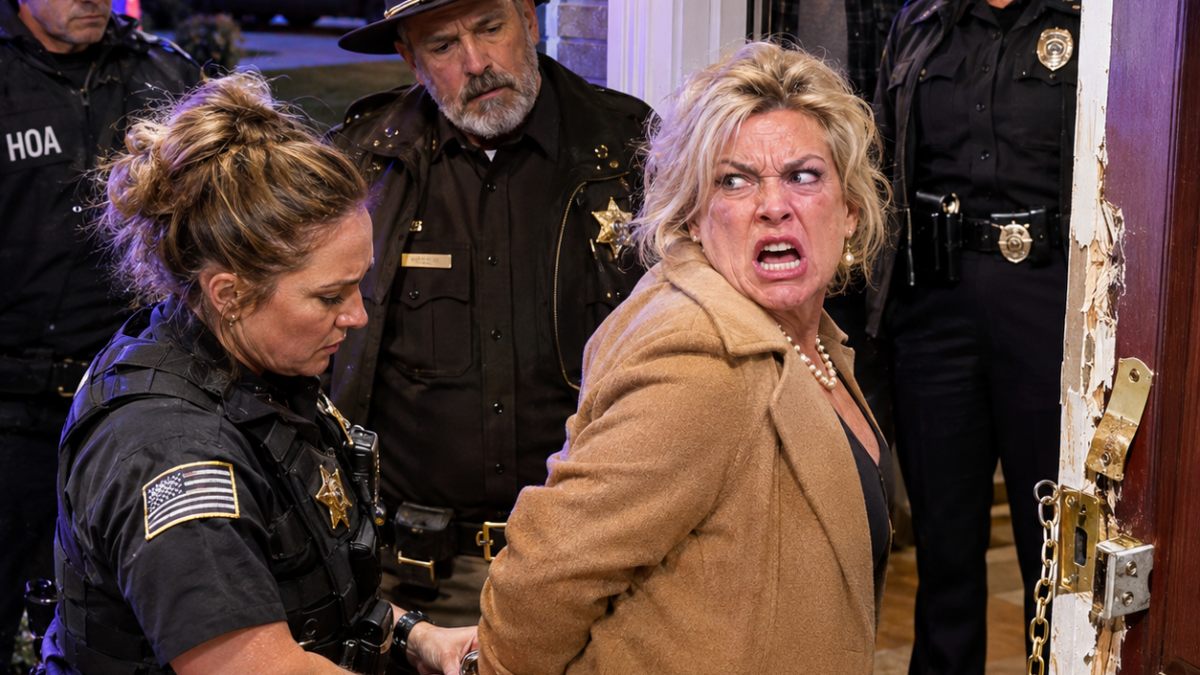
HOA Karen Forced Her Guards Into My Home at Midnight—Then My Police Chief Wife Watched the Sheriff Put Her in Handcuffs.
At 12:07 a.m., HOA president Mavis Hollender stood on Elliot Granger’s porch with two private guards, gave him thirty seconds to open his own front door, and then ordered them to pry the latch apart using an “emergency inspection order” bearing the forged signature of Elliot’s wife.
Mavis believed Police Chief Andrea Granger was safely two towns away, which was exactly why she had copied Andrea’s name onto the document—but fourteen minutes after midnight, Andrea turned onto Laurel Court, saw strangers inside her home, and immediately refused to use a single officer under her command.
Then the county sheriff discovered there had never been a gas leak, the “inspection” team had been sent specifically to steal a blue binder containing questions about $640,000 in HOA payments, and Mavis had written her cover story before she ever knocked on the door.
At seven minutes past midnight, Elliot Granger heard the front-door chain begin to tear out of the wall.
The sound was different from anything he had expected.
Not loud.
Not dramatic.
A slow metallic complaint.
Steel scraping against steel.
A screw twisting through wood fibers.
Then another.
Elliot stood six feet inside his own foyer and watched the door shudder each time Vernon Dobbs pushed the flat pry tool deeper between the frame and the latch plate.
Outside, beneath the warm porch light, Mavis Hollender looked at her gold wristwatch.
“Mr. Granger,” she said through the narrowing gap, “you were given every opportunity to cooperate.”
Elliot kept his voice level.
“I told you I do not consent to entry.”
Mavis smiled.
“You don’t have the right to refuse an emergency inspection.”
“There is no emergency.”
“There is a suspected gas leak.”
“No utility company has contacted me.”
“That is irrelevant.”
“My detectors have not gone off.”
“Also irrelevant.”
“Then show me a lawful order.”
She raised the document again.
Red stamp.
Official-looking heading.
EMERGENCY PUBLIC SAFETY AUTHORIZATION
At the bottom sat a signature that supposedly belonged to the chief of police.
Andrea Granger.
Elliot’s wife.
That was the part Mavis clearly expected to frighten him.
It did.
Just not in the way she intended.
Elliot knew his wife’s signature.
He had seen it on tax forms.
Mortgage papers.
Birthday cards.
PART2:
Letters to city employees.
Notes left on the refrigerator.
The shape on Mavis’s page looked close.
Too close.
But wrong.
Andrea’s real signature had changed over the years.
The version on the paper looked older.
More formal.
The kind she had used on public documents before she became police chief.
Elliot stared through the door.
“Where did you get that?”
Mavis’s smile narrowed.
“You have ten seconds.”
“Who authorized you to use my wife’s signature?”
“Ten.”
“Mavis.”
“Nine.”
Vernon shifted his weight against the pry bar.
The second guard, Leo Dunlap, stood near the edge of the porch.
Younger.
Late twenties.
PART3:
He looked less certain.
“Eight.”
Elliot glanced toward his phone on the side table.
Leo stepped subtly into the path between Elliot and the table.
That movement told Elliot more than anything Mavis had said.
If this were a legitimate safety inspection, nobody would need to stop him from calling someone.
“Seven.”
Elliot looked directly at the doorbell camera.
He spoke clearly.
“My name is Elliot Granger. It is 12:07 a.m. I am inside my own home at 18 Laurel Court. I am telling Mavis Hollender, Vernon Dobbs, and Leo Dunlap that I do not consent to their entry.”
Mavis’s face hardened.
“Remove the latch.”
Vernon pushed harder.
The top screw tore loose.
Elliot stepped backward.
Mavis looked up.
Directly at the camera.
For a second, she smiled.
It was a small smile.
Satisfied.
Certain.
The smile of someone who believed she had already won.
Five days earlier, Elliot would not have imagined that the president of Briarwood Estates could end up breaking into his house after midnight.
Until that week, he had never considered himself one of Mavis Hollender’s enemies.
Elliot had spent most of his career working in systems auditing for a large corporation.
He was not flashy.
Not confrontational.
Not interested in neighborhood politics.
He liked numbers because numbers usually became less confusing the longer you examined them.
People often became more confusing.
After taking early retirement, he did occasional consulting from his home office and spent the rest of his time reading, restoring old radios, and finding increasingly complicated reasons not to clean the garage.
Andrea still worked.
She served as police chief in a neighboring city.
Their home, however, sat outside that city’s jurisdiction.
Briarwood Estates fell under county authority.
That detail rarely mattered.
Until the night it mattered more than anything.
Elliot and Andrea had lived in Briarwood for six years.
The neighborhood was pleasant in the way planned communities often were.
Tree-lined streets.
Matched mailboxes.
Trimmed lawns.
A clubhouse.
Decorative stone walls at the entrance.
And rules.
Lots of rules.
Mavis had been president for three consecutive terms.
She had issued violation letters over fence stains, flower-bed borders, basketball hoops, driveway parking, holiday lights, and the height of ornamental grasses.
She liked to describe herself as the person preserving Briarwood’s standards.
Most people paid what they were told to pay.
Changed what they were told to change.
And moved on.
Elliot had done the same.
He disagreed with some rules.
But disagreement was not worth turning every Tuesday night into a board fight.
Then Brenda Keen knocked on his door.
Monday afternoon.
4:20 p.m.
Elliot remembered the time because he had just finished a consulting call.
Brenda was the HOA treasurer.
Almost sixty.
Careful.
Mild.
The type of person who apologized before asking you to move your grocery cart.
She stood on the porch holding a thick folder.
“Do you have a minute?”
Elliot looked at the folder.
“That sentence rarely means a minute.”
Brenda tried smiling.
Failed.
“Can I come in?”
He brought her into the office.
She placed copies of HOA financial records on his desk.
“I think something is wrong.”
“What kind of wrong?”
“I don’t know.”
“Then start with what you know.”
That was Elliot’s habit.
Facts first.
Brenda explained that Briarwood had recently announced it lacked enough reserve money to replace the clubhouse roof without a substantial special assessment.
That surprised her.
The reserve had been healthy.
She started tracing expenditures.
Then found a vendor.
HOLLENDER PROPERTY MAINTENANCE
Over sixteen months:
Approximately $640,000.
Elliot looked at the name.
“Related to Mavis?”
“I don’t know.”
“Same surname.”
“Yes.”
“Any disclosure?”
“Not in what I can find.”
He began reading invoices.
Drainage maintenance.
Tree removal.
Emergency repairs.
Fence work.
Road-edge stabilization.
Landscape remediation.
The problem was not simply the amount.
Several invoices carried identical invoice numbers.
Descriptions repeated word-for-word.
Some payments appeared in different budget categories for apparently similar work.
Three separate invoices described emergency drainage repair on the same section of common property.
Elliot tapped one.
“This one says work completed April 12.”
Brenda nodded.
He tapped another.
“This says April 18.”
“Yes.”
“Same location.”
“Yes.”
“Same description.”
“Yes.”
“Same amount.”
“Yes.”
He leaned back.
“That doesn’t prove anyone stole anything.”
Brenda exhaled.
“I know.”
“It proves these need explanation.”
“I know.”
“Do you have vendor contracts?”
“Some.”
“Board approvals?”
“Some.”
“Work completion records?”
“That’s where I started getting worried.”
Elliot organized copies.
He did not call anyone dishonest.
He did not accuse Mavis.
He made a list.
Invoice.
Amount.
Budget category.
Supporting records.
Missing documentation.
Duplicate number.
Potential relationship.
Then he placed everything into a blue three-ring binder.
On the cover he wrote:
BRIARWOOD HOA FINANCIAL REVIEW
“Take this to an independent auditor,” he told Brenda.
“Mavis controls which auditor the board uses.”
“Then ask the full board.”
“She’ll destroy me.”
Elliot smiled slightly.
“For asking where six hundred forty thousand dollars went?”
“You don’t attend enough meetings.”
Maybe he didn’t.
Brenda left copies with him because she was worried records could disappear.
That was not unusual in an audit context.
Preserve what you are lawfully entitled to review.
Keep copies.
Do not alter originals.
That evening, Elliot sent a digital copy to an independent attorney who had previously advised the homeowners’ review committee.
A precaution.
At the time, it felt excessive.
Two days later, it stopped feeling excessive.
Wednesday morning, an HOA violation notice appeared in Elliot’s mailbox.
It accused him of improperly using his garage to store “business-related materials.”
Elliot read it twice.
He had no commercial inventory.
No customers visiting.
No employees.
A few consulting boxes.
Old records.
Tools.
He wrote a response.
Then another notice arrived.
This one demanded access to inspect his home office for alleged covenant compliance issues.
That was stranger.
Elliot called Brenda.
“Did you tell Mavis I’m reviewing invoices?”
Silence.
Then:
“I asked a question at the office.”
“What question?”
“I asked for the vendor ownership records.”
“And?”
“She asked why.”
“You told her.”
“I said you were helping me reconcile them.”
Elliot looked at the blue binder on his desk.
“Okay.”
“I’m sorry.”
“Don’t be.”
“What are you going to do?”
“Nothing dramatic.”
That evening, Mavis drove slowly past the Granger house.
Elliot happened to be in the office.
The blue binder stood near the window.
Mavis’s SUV stopped.
Not long.
Maybe fifteen seconds.
Long enough.
She looked toward the office window.
Then drove away.
At Thursday’s HOA meeting, Elliot decided to ask publicly.
No accusations.
No grandstanding.
During open comments, he stood.
“I’d like clarification on payments to Hollender Property Maintenance.”
Mavis immediately interrupted.
“That subject is not on tonight’s agenda.”
“It concerns association expenditures.”
“You can submit your question in writing.”
“I have.”
“Then the board will respond appropriately.”
“I’m asking because several invoices—”
“Mr. Granger.”
Her voice became sharper.
“This association will not become a platform for baseless accusations.”
“I didn’t accuse anyone.”
“You are implying financial misconduct.”
“I am asking why duplicate invoice numbers appear.”
People began turning.
That was what Mavis hated.
Not the question.
The audience.
She closed the discussion.
After the meeting, she intercepted him near the exit.
“You have no idea what you’re interfering with.”
Elliot looked at her.
“I’m asking where homeowners’ money went.”
“You’re spreading suspicion.”
“Then documentation should clear it.”
Her face changed.
“Perhaps we need to see exactly what you’ve been keeping in that house.”
At the time, he thought it was intimidation.
It was worse.
The next day, Mavis summoned Vernon Dobbs.
Vernon ran the private security company Briarwood used at its gates and clubhouse events.
A small firm.
Mostly patrol work.
Parking disputes.
Alarm calls.
He had worked for Mavis long enough that her requests no longer surprised him.
That was dangerous.
She spread a floor plan of Elliot’s house across the HOA conference table.
Old construction records.
Three red circles.
Home office.
Garage.
Built-in filing cabinet.
Nothing to do with gas.
Vernon asked:
“Do we have a court order?”
Mavis handed him a document.
Emergency public safety authorization.
Official-looking seal.
Signature.
Vernon read only enough to reassure himself.
“Police chief signed this?”
“Yes.”
“And county knows?”
“Proper authorities are aware.”
“How urgent?”
“Tonight.”
“After midnight?”
“He’ll resist if he has neighbors watching.”
Vernon looked at the floor plan again.
“What are we looking for?”
“The blue binder.”
He glanced up.
“I thought this was gas.”
“The binder contains association records that must be secured.”
“Why is it in his house?”
“He took it improperly.”
That was false.
But Vernon did not verify.
He quoted an after-hours surcharge.
$3,500.
Mavis agreed.
Leo Dunlap sat nearby.
Newer employee.
He looked at the floor plan.
“Shouldn’t a gas leak have utility technicians?”
Mavis answered:
“They’ll be involved if necessary.”
Leo looked at Vernon.
Vernon shrugged.
The job moved forward.
Mavis then manufactured the emergency.
She wrote a report claiming a possible gas leak.
Claimed Elliot had refused licensed technicians.
No technician had ever appeared.
No leak detector reading existed.
No utility complaint.
No fire-department call.
Then she took an old administrative form and built something designed to look like public authorization.
At the bottom she inserted a copied signature.
Andrea Granger.
Police chief.
Elliot’s wife.
Mavis knew Andrea would be away at a regional conference.
That was the point.
Andrea could not appear.
Elliot would see his wife’s name.
He would hesitate.
Maybe doubt what Andrea had told him.
Maybe assume some interagency process had happened above him.
Maybe open the door.
If he did, Mavis could recover the binder quietly.
If he did not, she had another plan.
That plan existed in draft form before midnight.
A complaint accusing Andrea of abuse of power.
It alleged that the police chief had approved the inspection, then improperly reversed herself to protect her husband.
Mavis had already prepared both sides of the story.
If Elliot complied, she got the binder.
If Andrea became involved, Mavis planned to turn the chief into the scandal.
Thursday afternoon, two guards appeared outside the Grangers’ side fence.
They photographed doors.
Windows.
The narrow side passage.
Elliot walked out.
“What are you doing?”
One guard said:
“Emergency-exit mapping.”
“For what?”
“HOA safety planning.”
“Leave.”
They did.
Elliot saved the camera footage.
Then emailed the HOA.
No inspection authorized.
No entry consent.
Any lawful safety issue should be referred to the appropriate public agency or utility.
He copied an attorney.
He also ensured the entire blue binder existed digitally outside the house.
That decision destroyed Mavis’s plan before she ever reached the porch.
She just did not know it.
At 11:48 Friday night, Elliot’s phone buzzed.
Emergency inspection team arriving tonight. Refusal will result in forced access.
He called the number.
No answer.
Again.
Nothing.
Then headlights appeared.
White HOA SUV.
Mavis.
Vernon.
Leo.
At 12:07, the chain plate finally tore free.
The door swung inward.
Elliot stepped backward.
Vernon entered first.
Leo followed.
Mavis crossed the threshold.
Elliot felt something cold settle in his stomach.
The event had crossed a line.
Before that second, people could still argue about threats.
Bad paperwork.
HOA arrogance.
Now three people were physically inside a private home after the owner had explicitly refused consent.
Elliot did not push anyone.
He did not reach for a weapon.
He stepped backward.
Then pressed a small emergency button mounted discreetly along the hallway wall.
He had installed it years earlier after Andrea recommended a monitored security system.
Never used it.
The button switched interior cameras to continuous recording.
Sent alerts.
Uploaded images automatically.
Not just inside the house.
To remote storage.
Elliot looked at Mavis.
“Are you claiming you have legal authority to enter my home without my consent?”
She barely looked at him.
“I am the HOA president.”
“That isn’t what I asked.”
“That’s all the authority I need.”
The hallway microphone captured it perfectly.
At 12:14 a.m., Andrea Granger turned onto Laurel Court.
Her conference had ended early.
She had chosen to drive home that night instead of staying at the hotel.
Seven minutes before reaching Briarwood, her phone received the security alert.
Front door forced.
Unknown people inside.
She accelerated.
Then deliberately slowed.
That decision mattered.
Andrea had been a police officer for more than twenty years.
Patrol.
Investigations.
Command.
She understood that the worst thing she could do was arrive at her own home as police chief and begin issuing orders as though Briarwood belonged to her department.
It did not.
Her home sat under county jurisdiction.
She called the emergency line.
Identified herself.
“Chief Andrea Granger, neighboring city. I am calling as a homeowner and involved party.”
The dispatcher asked:
“Chief, do you need your department contacted?”
“No.”
“Your officers?”
“No.”
“County response only?”
“Yes.”
She gave the address.
Explained strangers had forced entry.
Private security.
HOA president.
Possible forged paperwork.
Then:
“I will not direct responding deputies.”
The dispatcher logged it.
Andrea turned onto Laurel Court.
White HOA SUV blocked most of her driveway.
Front door stood open.
Porch light illuminated a bent chain hanging from the frame.
She parked across the street.
Not behind the SUV.
Across.
Visible.
Neutral.
Then walked toward the house.
Inside, Mavis had ignored the kitchen.
Ignored the gas appliances.
Ignored the furnace closet.
Ignored everything remotely connected to a gas leak.
She headed down the hallway.
Straight toward the office.
Elliot moved to the doorway.
“What are you inspecting in here?”
“Electrical systems.”
“With a filing cabinet?”
“Move.”
“No.”
Vernon grabbed Elliot’s upper arm.
Hard.
Pulled him sideways.
Elliot stumbled against the wall.
“Let go.”
“Stop obstructing.”
Mavis entered the office.
Her eyes went directly to the built-in cabinet.
She opened it.
Blue binder.
Exactly where the floor plan said.
She pulled it out.
Flipped pages quickly.
Then saw the vendor name.
HOLLENDER PROPERTY MAINTENANCE
Her expression changed.
She shut the binder.
“These documents belong to the association.”
Elliot, still held by Vernon, said:
“They are lawful copies.”
“They were removed improperly.”
“No.”
“I’m recovering HOA property.”
“From my filing cabinet.”
Mavis slid the binder into her leather tote.
Elliot looked toward the hallway camera.
“That is being recorded.”
Mavis followed his gaze.
Her jaw tightened.
“Take the camera down.”
Vernon released Elliot and stepped toward it.
Leo caught Vernon’s wrist.
That was the first open break in Mavis’s control.
Vernon stared.
“What are you doing?”
Leo said:
“There’s nothing in our contract about cameras.”
Mavis turned.
“Remove it.”
Leo shook his head.
“We were told this was safety.”
“It is.”
“Then why are we taking paperwork?”
“That binder belongs to the association.”
Leo looked at Elliot.
Then at Mavis.
“I was told to inspect a gas hazard.”
“And now I am telling you—”
“I don’t have gas equipment.”
Silence.
Leo continued.
“Neither does Vernon.”
Mavis’s face flushed.
“You work for me tonight.”
“I work for the security company.”
“I can make sure you never work another contract in this county.”
Leo released Vernon’s wrist.
But did not move away from the camera.
Then Andrea’s voice came from the front door.
“Why are there people inside my house?”
Everybody turned.
Mavis froze.
For less than a second.
But Andrea saw it.
Then Mavis recovered.
She lifted the forged document.
“This inspection was authorized by public safety officials.”
Andrea stepped inside.
Not far.
She looked at Elliot first.
“You okay?”
“Yes.”
“Are you hurt?”
“Arm.”
Vernon immediately moved away.
Andrea looked at Mavis.
“Show me.”
Mavis handed over the document.
She did not know what else to do.
Andrea read.
The signature at the bottom made her almost laugh.
Not because it was funny.
Because she knew exactly where it came from.
An old publicly available department form.
Andrea used to sign her full name with a large looping G.
She had changed the style years earlier.
Someone had copied it.
“Who authorized you to use my signature?”
Mavis lifted her chin.
“This came through administrative channels.”
“Which?”
“I’m not discussing internal public-safety procedures with an involved party.”
Andrea looked at her.
“My signature is on the page.”
“Yes.”
“I did not sign it.”
Mavis said nothing.
“I never approved an inspection here.”
Still nothing.
Andrea lowered the document.
“Everybody stop.”
Her voice sharpened just enough.
“Leave the house and wait outside for county deputies.”
Mavis glanced toward the office.
“The inspection is already underway.”
“There is no inspection authorized by me.”
“You are not the authority here.”
Andrea nodded.
“Correct.”
That answer confused Mavis.
Andrea continued.
“This is under county jurisdiction.”
She stepped aside.
“So let the county verify your paperwork.”
Mavis looked toward the open office.
Then at her tote.
Andrea followed the glance.
That was when she realized the fake signature was only one layer.
Something else had brought Mavis into the house.
Elliot said:
“She took the binder.”
Andrea looked at the tote.
Mavis snapped:
“Association property.”
Andrea did not argue.
“Put it down and wait outside.”
“No.”
“If you believe you have legal authority, waiting for verification should not be a problem.”
Mavis’s face changed.
She stepped toward the office again.
Andrea stood still.
Did not touch her.
Did not block physically.
“I am asking you as the homeowner to leave.”
Mavis replied:
“And I am telling you the HOA has authority.”
Then came a sound from outside.
One short siren burst.
Blue and red light moved across the living-room wall.
Mavis looked toward the window.
Everything about her changed.
She pulled the binder from her bag.
Walked quickly into the office.
Placed it on the desk.
Smoothed her coat.
Then leaned toward Vernon.
Quietly:
“When they ask, tell them he let us in.”
Elliot stood only a few feet away.
He heard every word.
So did the hallway microphone.
Sheriff Ross Maddox entered first.
Early fifties.
Long career in county patrol.
The kind of officer who became quieter when other people became louder.
Deputy Lydia Sloan followed.
Ross looked at the scene before taking statements.
Broken chain.
Pry marks.
Steel tool on floor.
Private guards.
HOA president.
Police chief.
Homeowner.
He raised one hand.
“Nobody moves.”
Mavis began immediately.
“Sheriff, thank God. We are conducting an emergency gas-safety inspection and the homeowner has been obstructive.”
Ross looked at her.
“I said nobody moves.”
She stopped.
Then Ross looked at Andrea.
“Chief?”
Andrea spoke first.
“I live here.”
He nodded.
“I am an involved party and witness.”
Another nod.
“I am not directing this investigation.”
“Understood.”
“My department has no jurisdiction here.”
“Understood.”
She stepped back.
That exchange destroyed one of Mavis’s fallback plans.
Ross separated everyone.
Lydia photographed the door.
The chain plate.
Pry tool.
Elliot’s arm.
Then Mavis was interviewed.
She held up the paper.
“Emergency authorization.”
Ross asked:
“Issued by whom?”
“Public safety.”
“Which agency?”
“It’s coordinated.”
“Agency name.”
She pointed to Andrea’s signature.
“Even his own wife approved it.”
Ross turned toward Andrea.
Andrea’s answer was simple.
“I never signed that document.”
Ross radioed the county building and safety office.
The on-call official checked.
No emergency inspection.
No request.
No case number.
No order.
Then Ross contacted the gas utility.
No reported leak.
No abnormal service call.
No technician dispatched.
No emergency notice.
Nothing.
He returned to the foyer.
“Ms. Hollender, this is not a warrant.”
“It’s an emergency authorization.”
“No issuing agency recognizes it.”
“They may not have the right file.”
“The utility has no leak report.”
“Mister Granger refused access.”
“To whom?”
“The inspection team.”
“Which licensed gas technician is here?”
Silence.
Ross looked at Vernon.
“Are you licensed to inspect gas systems?”
“No.”
“Leo?”
“No.”
“What equipment did you bring?”
Vernon said nothing.
Ross looked at the pry tool.
“Besides that.”
Leo looked away.
Then Ross reviewed security footage.
Not edited clips.
Full sequence.
Elliot opening door on chain.
Mavis demanding entry.
Countdown.
Explicit refusal.
Vernon forcing the latch.
Leo moving between Elliot and the phone.
Mavis crossing threshold.
Her statement:
I am the HOA president. That’s all the authority I need.
Then office.
Vernon restraining Elliot.
Mavis taking binder.
Camera order.
Leo refusing.
Then Mavis telling Vernon:
When they ask, tell them he let us in.
Ross stopped playback.
Looked at Mavis.
“Why did a gas inspection require financial records?”
“They belong to the association.”
“That isn’t what I asked.”
“They were improperly removed.”
“Do you have a court order authorizing their seizure?”
“No.”
“Any warrant?”
“No.”
“Any written consent from Mr. Granger?”
“He’s an HOA member.”
Ross looked at her.
“That is not consent.”
Vernon changed after that.
Until then, he had protected Mavis.
He said he believed the paperwork.
Ross asked:
“Were you instructed before arrival to force entry if refused?”
Vernon hesitated.
Then:
“Yes.”
“By whom?”
“Mavis.”
Mavis turned.
“You’re lying.”
Vernon stared at the floor.
Ross asked:
“What were you told to locate?”
Another pause.
“The blue binder.”
Mavis’s face went white.
Leo confirmed.
“We were told the binder was the priority.”
Ross asked:
“What about gas?”
Leo shook his head.
“No equipment.”
“Any technician?”
“No.”
“Were you told to inspect meter?”
“No.”
“Furnace?”
“No.”
“What were you told?”
“Office. Garage. Filing cabinet.”
Ross stood quietly.
He was building probable cause the way professionals do.
Not from one dramatic fact.
From alignment.
No lawful order.
No gas emergency.
Forced door.
Physical restraint.
Specific target unrelated to safety.
False signature.
Attempt to remove financial records.
Instructions to lie about consent.
Mavis began threatening the guards.
“You will never work in Briarwood again.”
Ross interrupted.
“Stop speaking to witnesses.”
“They work for me.”
“Not right now.”
He stepped aside with Lydia.
They spoke quietly.
Then Ross returned.
“Ms. Hollender.”
“Yes?”
“Turn around.”
Mavis laughed.
Not nervous laughter.
Disbelief.
“Excuse me?”
“Turn around and place your hands behind your back.”
“You cannot be serious.”
“I am.”
“I am the president of the Briarwood Homeowners Association.”
Ross looked at her.
“That does not grant authority to break into a residence.”
“This was official business.”
“The evidence available tonight does not support that.”
“You’ll destroy this community if you treat board officers like criminals for performing safety duties.”
Ross gave Lydia a small nod.
Lydia stepped forward.
Mavis looked at Andrea.
That was the moment she expected intervention.
“Chief Granger.”
Andrea said nothing.
“You signed the authorization.”
Andrea shook her head.
“No.”
“If I’m arrested, you’re part of this.”
“The signature is being examined as forged evidence.”
Mavis’s voice rose.
“Then order him to stop!”
Ross answered.
“Chief Granger is not directing this investigation.”
The porch went quiet.
Neighbors had begun emerging.
Lights on.
People standing at driveways.
Phones held discreetly.
Mavis looked from Ross to Andrea.
For the first time that night, nobody responded to the authority she projected.
Lydia took her left wrist.
Then right.
The cuffs closed.
Metallic.
Clean.
Mavis stopped mid-sentence.
She looked down.
Actually looked confused.
As though rules had always been things she administered to other people.
Andrea stood beside Elliot.
Did not smile.
Did not touch her badge.
Did not issue a command.
Elliot reached for her hand.
Mavis was placed in the patrol car.
Vernon remained for questioning about his role in forced entry and restraint.
Leo gave a full statement.
Before Lydia closed the rear door, Mavis shouted:
“I’ll sue every one of you!”
Elliot stood on the porch.
His broken door hanging behind him.
He answered once.
“You came here to inspect my house.”
Mavis glared.
Elliot nodded toward the blue binder now secured as evidence.
“Now they’re going to inspect your records.”
Ross heard.
He looked at Elliot.
“What records?”
Elliot explained.
Hollender Property Maintenance.
Duplicate invoices.
$640,000.
Missing supporting documents.
Brenda.
The independent audit request.
Ross listened.
Then:
“You think that’s why she came tonight?”
“I think the binder was her target.”
“Why?”
“I don’t know yet.”
At 12:43 a.m., the patrol car left Laurel Court.
Elliot and Andrea went back inside through a door that no longer locked properly.
The house smelled faintly of splintered wood.
Andrea touched the bent chain.
“You’re replacing the whole frame.”
“I know.”
“You okay?”
“Yes.”
She looked at his arm.
“No.”
“I’m fine.”
“Again, different thing.”
He smiled.
Then looked toward the office.
The blue binder was gone temporarily as evidence.
But the digital copies were safe.
Andrea said:
“She expected me to be away.”
“Yes.”
“She used my signature because she knew I was gone.”
“Yes.”
“Why mine?”
Elliot thought.
“To scare me.”
Andrea looked toward the front window where the last county vehicle remained.
“Maybe.”
There was something else.
They would learn it soon.
Three days later, investigators found a handwritten note among Mavis’s records.
RECOVER THE BINDER BEFORE THE COUNTY AUDIT.
That destroyed the safety-inspection story.
Then the digital examination went deeper.
Draft inspection forms.
Emails.
Office computer files.
One email instructed staff to create paperwork specifically justifying access to Elliot’s home office.
Not kitchen.
Not utility room.
Office.
Another referenced the blue binder.
Then investigators found the draft complaint against Andrea.
Prepared before the break-in.
It accused Police Chief Andrea Granger of approving the inspection, then reversing herself after her husband resisted.
Mavis had designed a trap.
If Elliot surrendered the binder, she won.
If Elliot resisted and Andrea intervened using her office, Mavis would accuse Andrea of corruption.
If the police became involved, the forged signature would create confusion.
If guards were questioned, they had already been coached to say the chief knew.
That was why Andrea’s restraint mattered so much.
She had not sent her own officers.
Had not made arrests.
Had not seized evidence.
Had not ordered county deputies.
She had announced her conflict openly.
Then stepped back.
Mavis had written a scandal requiring Andrea to act like an angry police chief protecting her husband.
Andrea refused the role.
Her professional discipline destroyed the second half of Mavis’s plan before anyone knew it existed.
The financial investigation proceeded separately.
That distinction mattered.
The break-in did not automatically prove the $640,000 had been stolen.
Irregular invoices are not convictions.
Questions are not proof.
Investigators and an independent auditor examined each payment.
Contracts.
Work orders.
Bank records.
Vendor ownership.
Completed projects.
Check approvals.
Meeting minutes.
Some expenses had legitimate support.
Others appeared duplicated.
Inflated.
Poorly documented.
Or tied to work nobody could verify.
The relationship between Mavis and Hollender Property Maintenance became a major issue.
Homeowners were furious.
But Elliot repeatedly said the same thing.
“Let the audit finish.”
One neighbor confronted him outside his mailbox.
“You knew she was stealing.”
“No.”
“You had the binder.”
“I had questions.”
“Same thing.”
“No.”
The neighbor frowned.
Elliot continued.
“If I accused her of stealing before the evidence established it, I’d be doing exactly what she did to me.”
That ended the conversation.
Brenda became central to rebuilding the HOA.
She hated attention.
But she stood in front of residents and walked through finances line by line.
The board suspended Mavis’s financial access.
Then appointed an interim administrator according to bylaws.
No improvisation.
No revenge vote.
Procedure.
The irony was not lost on Elliot.
Mavis had spent years treating rules as weapons.
The community removed her power by following them carefully.
Then Brenda found another email.
Sent by Mavis to the security company before the break-in.
If police arrived, guards were to state that Andrea knew of the inspection and approved it.
That email matched the prewritten complaint.
This was no improvised lie after things went wrong.
The cover story existed before the crime.
Vernon faced his own legal consequences.
He had physically forced the door.
Restrained Elliot.
Trusted paperwork he never verified.
At first he tried saying he was only following client instructions.
That did not erase personal responsibility.
Later, he admitted Mavis told him the order was valid and instructed force if Elliot refused.
Leo’s position was different.
He entered.
He blocked Elliot’s access to the phone.
Those actions mattered.
But he also refused to destroy the camera and then cooperated fully.
Responsibility remained specific.
Andrea appreciated that.
She had spent her career watching public anger flatten facts.
People want everyone on the wrong side to be equally guilty.
Law does not work that way when it works properly.
Months passed.
The criminal case moved through normal procedure.
Mavis claimed she believed the inspection lawful.
Her attorneys suggested staff prepared forms.
Suggested the security company exceeded authority.
Suggested the gas concern had been sincere.
The record was difficult to reconcile with those claims.
Camera footage showed her ordering forced entry.
Electronic records tied her to the false inspection paperwork.
County records proved no order existed.
The gas utility had no complaint.
The floor plan targeted a filing cabinet.
Both guards said the binder was the objective.
And the draft complaint against Andrea existed before midnight.
Eventually, after negotiations and court proceedings, Mavis accepted responsibility for conduct proven in the break-in, including the forged-document component.
The financial investigation continued on its own track.
Elliot insisted the two matters not be collapsed into one dramatic story.
The break-in was established through evidence.
The financial questions required separate proof.
That discipline helped the homeowners recover money lawfully.
Some funds were frozen.
Some recovered.
The association filed civil claims against responsible parties where evidence supported them.
Not every suspicious dollar automatically became recoverable.
Not every invoice became a crime.
But enough irregularities survived scrutiny that Mavis’s three-term image as the guardian of Briarwood’s finances collapsed.
Elliot had his own civil claim.
Door.
Frame.
Security system restoration.
Documented losses.
Legal expenses included under the settlement terms.
Repairs.
Eventually a civil settlement held Mavis personally responsible for $38,400.
The important part was not the number.
It was who paid.
Not the homeowners collectively.
Not a special assessment.
Not dues.
Mavis.
For years, she had mailed violation invoices to homeowners with language implying payment was inevitable.
Now she was the person writing the check.
Andrea was formally cleared of approving the inspection or directing Mavis’s arrest.
That mattered more to her than any public apology.
Her name had been forged specifically because Mavis believed police power could be turned into a weapon.
Andrea wanted the record equally clear:
She had not signed.
She had not authorized.
She had not commanded county deputies.
She had not used her office to rescue her husband.
She had acted as a homeowner and witness.
Nothing more.
One reporter asked Andrea:
“Was it difficult not to arrest Mavis yourself?”
Andrea looked at him.
“I couldn’t arrest her myself.”
“You know what I mean.”
“No.”
She did.
But she wanted the distinction spoken.
“My authority is not personal property.”
That line appeared in the paper.
Elliot cut it out.
Andrea found the clipping.
“You’re keeping that?”
“Yes.”
“Why?”
“Good quote.”
“You married me for my quotes?”
“No.”
“Smart.”
Seven months after the midnight break-in, Briarwood held one of the most crowded HOA meetings in its history.
Folding chairs filled every row.
Residents stood along the back wall.
People who had ignored HOA meetings for years suddenly wanted to know everything about:
Contracts.
Payments.
Inspection authority.
Private security.
Board records.
Financial access.
Conflict disclosure.
Brenda presented the audit reforms.
Dual authorization for significant payments.
Independent contract approval.
Public meeting-record archive.
Vendor relationship disclosures.
Clear limits on private security.
No residential entry without lawful consent or recognized legal authority.
Then Elliot was invited to speak.
Someone asked whether he intended to run for HOA president.
He smiled.
“No.”
Several people laughed.
“Why not?”
“I never wanted to control Briarwood.”
He looked toward the projected financial reforms.
“I wanted the people controlling it to follow the same rules they expect homeowners to follow.”
That was all.
At the board’s request, and with Elliot’s agreement, a portion of the midnight footage was shown.
12:07.
Mavis on porch.
Thirty-second ultimatum.
Chain being pried.
Her voice:
I am the HOA president. That’s all the authority I need.
The room went still.
Then the video advanced.
Ross asking for issuing agency.
Mavis unable to provide one.
Andrea saying:
I never signed that document.
Then Lydia placing handcuffs on Mavis.
Andrea standing nearby.
No order.
No smile.
No celebration.
Just watching.
Several residents had seen clips before.
Few had seen sequence.
Chronology changed everything.
One photograph can suggest.
One sentence can distort.
A complete sequence explains.
That was Elliot’s professional obsession.
Systems auditing is often chronology.
What happened first?
Who authorized what?
Which record existed at that time?
What changed later?
Mavis relied on isolated pieces.
A forged signature.
An official-looking seal.
An HOA title.
A gas-leak allegation.
Each looked powerful alone.
Placed in sequence, they collapsed.
No utility alert.
Then fake emergency.
Then forced entry.
Then direct movement to office.
Then binder.
Then camera order.
Then instruction to lie.
Then prewritten complaint.
Chronology exposed purpose.
After the meeting, Elliot and Andrea walked through the parking lot.
Evening sky violet.
Cold.
Andrea slipped her hands into her coat pockets.
Elliot said:
“I thought I’d need you to stop her.”
“You did.”
“No.”
He looked at her.
“I mean your position.”
She understood.
“You thought police chief outranked HOA president.”
“Basically.”
“And?”
“You didn’t use it.”
“No.”
“Still stopped her.”
Andrea shook her head.
“I didn’t.”
“Ross did.”
“Evidence did.”
He smiled.
“You’ve become very philosophical.”
“I’m tired.”
They reached the car.
Andrea looked back toward clubhouse.
“It wasn’t about who had more power.”
“What then?”
“Power still has rules.”
That was the lesson Mavis never learned.
She thought office created permission.
President.
Security contractor.
Police chief.
Sheriff.
To her, every title was a weapon.
Andrea saw titles differently.
Limits.
Obligations.
Jurisdiction.
Review.
That was why she had been so careful that night.
Her restraint had not been passivity.
It was control.
A few weeks later, settlement payment arrived.
Completed in full.
Elliot placed the confirmation in his desk.
Beside the new blue binder.
The original had returned after evidentiary needs were satisfied.
He had reorganized it.
Not out of obsession.
Out of habit.
Invoices.
Audit report.
Recovery records.
Governance reforms.
He considered changing the cover.
Andrea asked:
“To what?”
“I don’t know.”
“Keep it.”
“Why?”
“History.”
He looked at the words:
BRIARWOOD HOA FINANCIAL REVIEW
“Pretty boring history.”
“The best kind.”
Their front door had been replaced.
Not just repaired.
New frame.
New reinforced latch.
Security cameras upgraded.
Not because Andrea wanted the house to feel like a fortress.
Because once someone has forced your door, the old door never feels quite the same.
For the first month, Elliot woke whenever headlights crossed the bedroom ceiling.
He checked the porch camera.
Delivery van.
Neighbor.
Teenager coming home late.
Nothing.
Andrea noticed.
“Stop checking.”
“I’m not checking.”
“You’re holding your phone.”
“I’m reading.”
“At 2:30?”
“News.”
She raised an eyebrow.
He put it down.
Fear lingers after facts are resolved.
The law can establish:
You were right.
It cannot immediately convince your nervous system that midnight doorbells are ordinary again.
That took time.
One night, nearly three months later, the doorbell rang at 11:56.
Elliot froze.
Andrea was brushing her teeth.
She came out.
“What?”
He pointed.
Doorbell rang again.
They checked camera.
A teenage neighbor.
Holding a lost dog by the collar.
Elliot laughed.
Not loudly.
Relieved.
He opened the door.
The teenager said:
“Sorry it’s late.”
Elliot looked at the dog.
“Better reason than the last person had.”
The teenager did not understand.
Good.
Not every new resident needed the story.
Mavis’s authority disappeared from Briarwood slowly.
Her name came off official communications.
Then vendor contacts.
Then gate instructions.
Then committee records.
A new interim administrator sent the first neighborhood email.
Subject:
CLUBHOUSE ROOF PROJECT UPDATE
Elliot almost laughed.
The roof.
The original problem.
The association ultimately found funds after questionable payments were frozen or recovered.
The replacement proceeded under transparent bidding.
Three contractors.
Published numbers.
Board vote.
No connected company.
When work started, Elliot walked past the clubhouse.
Brenda stood watching.
“You know what bothers me?”
“What?”
“This roof could’ve been fixed months ago.”
“Yes.”
“All because I looked at one number.”
“No.”
She frowned.
“No?”
“Because you looked twice.”
That was what mattered.
Everybody sees strange numbers.
Few stop.
Check.
Ask.
Preserve.
Brenda had.
Elliot had helped organize.
Andrea had stepped back when conflict came.
Ross verified.
Leo questioned.
Each person did one ordinary thing correctly.
The story later became dramatic:
Police Chief Wife Watches HOA Karen Arrested.
True.
But incomplete.
The more important part was that the police chief did not make the arrest.
That protected everyone.
If Andrea had stormed inside flashing her badge and ordered her husband’s enemy handcuffed, Mavis’s prewritten complaint might have worked.
People would ask:
Was arrest personal retaliation?
Did chief pressure deputies?
Did evidence get collected fairly?
Mavis had planned exactly that uncertainty.
Andrea denied her every piece.
She identified herself as involved.
Called independent jurisdiction.
Let county verify.
Provided signature exemplars later.
Nothing more.
Professional discipline is not dramatic.
That is why it is powerful.
Mavis depended on drama.
Forced countdown.
Midnight.
Fake emergency.
Security guards.
Red stamps.
Threats.
She created urgency because urgency makes people surrender judgment.
Elliot remembered the countdown.
Thirty.
Twenty.
Ten.
It was absurd after the fact.
There was no gas.
No fire.
No leak.
No child in danger.
Nothing required thirty seconds.
The countdown existed only to make thought feel like obstruction.
That became another lesson Elliot shared whenever anyone asked.
Real emergencies can demand fast action.
But manufactured urgency is one of the oldest ways to prevent verification.
Someone says:
No time.
Open now.
Sign now.
Pay now.
Move now.
Give me records now.
Ask why.
Mavis needed the binder before county audit.
That was her clock.
Not public safety.
Her private fear.
The note investigators found said it plainly.
Recover the binder before the county audit.
There had been no gas timer.
Only accountability approaching.
Vernon’s company changed after the case.
It had to.
A private security firm cannot survive long if employees believe an HOA president can authorize forced residential entry by handing over a homemade form.
New policy required:
Direct verification of any court order.
No forced entry for HOA covenant enforcement.
No detention or restraint absent lawful grounds.
No document seizure.
No reliance solely on client-provided government forms.
Leo left the company before reforms fully settled.
He later sent Elliot a letter.
Not asking forgiveness.
Explaining.
“I should have stopped it at the porch.”
Elliot read.
Andrea read.
Leo wrote that he knew something felt wrong when Mavis showed a floor plan circling the filing cabinet.
He stayed quiet because Vernon was his boss.
Then he blocked the phone.
Entered anyway.
Later refused to remove camera.
Eventually testified.
He did not ask to be called a hero.
Good.
He wasn’t.
He had made mistakes.
Then made a better decision before the night ended.
Elliot replied with one paragraph.
Thank you for telling the truth when it mattered. I hope next time you trust your doubt earlier.
That was all.
Vernon never wrote.
His legal consequences were handled separately.
Elliot did not need every participant to apologize.
He had learned that closure built around other people’s remorse is unreliable.
Records are more dependable.
Mavis’s financial case took longer.
Some homeowners wanted immediate accusations.
Brenda resisted.
“We are not doing what she did.”
That became informal rule.
No public claim beyond evidence.
Some invoices were legitimate.
Others lacked support.
Some recoveries came through civil processes.
The association’s attorney pursued responsible parties.
No one simply assumed all $640,000 was stolen.
That distinction frustrated people who wanted clean villain math.
Reality rarely provides it.
Mavis had behaved criminally in the break-in.
That did not automatically convert every transaction she ever approved into theft.
Elliot insisted on that.
At one meeting, a man shouted:
“She forged your wife’s signature! Why are you defending her?”
Elliot answered:
“I’m not.”
“You keep saying not every invoice is theft.”
“Because that’s true.”
“She deserves everything she gets.”
“Maybe.”
He paused.
“But facts don’t change because we dislike someone.”
The room quieted.
That sentence became the standard Briarwood had lacked.
Rules for enemies and friends should match.
Otherwise, governance is personality.
Exactly what Mavis built.
Andrea eventually received a formal letter clearing her of any role in approving the entry or directing the arrest.
She put it in a drawer.
Elliot asked why not frame it.
“That would be weird.”
“Maybe next to your diploma.”
“No.”
“Chief commendation?”
“No.”
“Living room?”
“Absolutely not.”
He smiled.
She hated symbolic displays of vindication.
She preferred the file exist.
Enough.
Several months later, another HOA president from a nearby community asked Andrea to speak about dealing with private security.
She declined.
“This was personal.”
Then suggested county attorney and licensed security professionals instead.
Elliot teased her.
“You missed a chance to become HOA celebrity.”
“I’d rather eat glass.”
“Fair.”
Elliot, ironically, became the person neighbors called about bylaws.
He hated it.
“Can the board fine me for leaving trash bin out?”
“I don’t know.”
“You audit things.”
“That does not make me HOA oracle.”
“But you beat Mavis.”
“I did not beat Mavis.”
People never liked that answer.
They wanted simple contest.
Elliot versus Mavis.
Andrea versus Mavis.
Sheriff versus Mavis.
The real story was systems versus unilateral power.
That was harder to fit into gossip.
One Sunday afternoon, Brenda came over with a new set of financial reports.
Elliot looked at them.
“No.”
She blinked.
“What?”
“I’m retired.”
“You were retired last time.”
“That was emergency.”
“This is budget review.”
“No.”
“I brought cookies.”
He looked at container.
“What kind?”
“Oatmeal chocolate chip.”
He sighed.
“One hour.”
Andrea walked through.
“Corruption begins with cookies.”
Brenda laughed.
Elliot pointed at spreadsheet.
The neighborhood was healing.
Ordinary complaints returned.
Pool hours.
Dog waste.
Parking.
Paint.
That was good.
Mavis’s era slowly became something people referenced less.
A lesson.
Not identity.
New board rules required any request to enter a home to rest on actual lawful authority.
No “HOA inspection emergency” invented by president.
If genuine gas leak suspected:
Call utility.
Fire department.
Public safety.
Not private guards with pry bars.
That should have been obvious.
Many reforms are obvious after abuse.
The challenge is writing them before next ambitious person decides unwritten limits do not exist.
Elliot helped draft one rule:
No association officer may represent themselves or private contractors as possessing governmental authority they do not hold.
Simple.
Clear.
Someone asked:
“Do we really need to write that?”
Elliot looked at repaired front-door photograph.
“Yes.”
The hardest part for Andrea came months later.
Not court.
Not press.
A city employee asked quietly:
“Chief, why didn’t you just arrest her yourself?”
Andrea answered:
“Because I couldn’t.”
“But she was inside your house.”
“Yes.”
“You’re police.”
“I was the victim’s spouse.”
That conversation bothered her.
Not employee’s ignorance.
The cultural assumption behind it.
That holding authority means using it whenever useful.
Andrea had spent her career fighting exactly that.
Public power is not personal tool.
That principle feels abstract until your husband’s door is broken and the person responsible is standing ten feet away.
Then restraint becomes expensive.
She wanted to grab Mavis.
Of course she did.
She wanted to order Vernon against wall.
Wanted to tear fake signature in half.
Wanted to demand immediate answers.
She did none of those.
Not because she was unemotional.
Because she knew anger did not expand jurisdiction.
Later, Elliot watched full footage and noticed Andrea’s hand trembling slightly when she took the fake order.
He paused video.
“You were shaking.”
“No.”
“Your hand.”
She looked.
Tiny movement.
“I was furious.”
“You looked calm.”
“I wasn’t.”
That made Elliot feel strangely better.
For months he had remembered Andrea as almost superhuman.
Controlled.
Certain.
Now he saw the cost.
Restraint is not absence of emotion.
It is action chosen despite emotion.
He closed video.
They rarely watched again.
Mavis eventually became a name in legal records rather than daily conversation.
Elliot stopped checking online case docket every week.
Then monthly.
Then at all unless attorney contacted him.
That was deliberate.
Andrea said:
“She already took enough of our time.”
He agreed.
The blue binder stayed.
Door stayed.
House stayed.
Life had to become larger than one night.
They traveled.
Elliot took more consulting work than he intended.
Andrea complained about budget meetings at city hall.
They argued about replacing dishwasher.
Normal things.
One anniversary, Elliot gave Andrea a new pen.
She stared.
“What is this?”
“For signatures.”
She looked at him.
“Too soon?”
“It’s been two years.”
“Still too soon?”
She started laughing.
“No.”
Then examined pen.
“Nice.”
“Harder to forge.”
She threw wrapping paper at him.
Humor came back slowly.
That mattered.
Once something becomes joke, it has lost some power.
Not all.
Enough.
Briarwood’s governance reforms lasted beyond the people who wrote them.
That was the real victory.
Five years later, a new homeowner questioned a contractor payment.
Board produced:
Contract.
Bid comparison.
Vote.
Invoice.
Completion photos.
No hostility.
No midnight inspection.
No threats.
Just documents.
Brenda, no longer treasurer, called Elliot after hearing.
“You know what happened?”
“What?”
“Someone asked where money went.”
“And?”
“They answered.”
He smiled.
“Revolutionary.”
“Very.”
The clubhouse roof lasted.
Mavis had once used supposed property-value preservation to justify everything.
Her control.
Her fines.
Her intimidation.
But Briarwood did not collapse when she left.
Lawns stayed green.
Mailboxes matched.
Homes sold.
Children played.
Property values did not require one woman breaking into houses.
Communities survive leaders who call themselves indispensable.
That is another lesson.
Elliot eventually replaced the emergency panic button with newer system.
Installer asked:
“Ever used old one?”
“Once.”
“Did it work?”
“Yes.”
“Then why replace?”
“Technology.”
He did not tell whole story.
Not every technician needed it.
The old button went into a box.
Andrea found it months later.
“Keeping?”
Elliot thought.
“No.”
Trash.
That felt good.
Evidence had been copied.
Case done.
Objects associated with fear do not all deserve museum space.
Same with broken chain plate.
He had kept it initially.
Then threw it away.
Andrea asked:
“You sure?”
“Yes.”
“Why now?”
“Because door works.”
Repair is sometimes letting broken part leave.
The blue binder was different.
It had become useful.
Audit reference.
Governance history.
But eventually even that changed.
Elliot scanned final records.
Returned HOA copies as appropriate.
Kept what he lawfully could.
Then replaced cover.
Andrea noticed.
“What does it say?”
He turned it.
BRIARWOOD — AUDIT & REFORMS
No Mavis.
No break-in.
Forward-looking.
Andrea smiled.
“Better.”
Years later, when someone new asked about the midnight story, Elliot gave short version.
“Mavis tried to force an inspection to get financial records.”
“Your wife arrested her?”
“No.”
“But your wife was police chief.”
“Yes.”
“So she arrested her.”
“No.”
“Who did?”
“County sheriff.”
“Why?”
“Because we live in county jurisdiction.”
“That’s less dramatic.”
“It’s more important.”
He would explain.
Andrea called county precisely because she had a conflict.
If she had acted personally, Mavis could have twisted it.
The fact Andrea didn’t use power was what protected the outcome.
People usually understood eventually.
The title made them click.
The details made them think.
One evening, long after Mavis left office, Elliot sat in the den reading.
Cold coffee beside him.
Almost same setup.
Doorbell chimed.
12:05 a.m.
He looked at Andrea.
She looked at him.
Neither moved for one second.
Then Elliot checked camera.
Sheriff Ross Maddox.
Older now.
Off duty.
Standing on porch holding a casserole dish.
Elliot opened the door.
“Ross?”
Ross raised the dish.
“My wife says Andrea lent her this six months ago.”
Andrea came down hall.
“At midnight?”
Ross shrugged.
“I work weird hours.”
Elliot stared.
Ross smiled.
“Want to see a warrant?”
Elliot laughed so hard he had to step aside.
Ross entered.
Legally.
With permission.
That story became the better midnight story.
Not because it erased first.
Because home had returned to being home.
A place where door could open voluntarily.
Years later, Andrea retired from police department.
At retirement ceremony, speakers praised leadership.
Judgment.
Integrity.
Elliot sat front row.
Someone referenced “high-profile conflict-of-interest incident” without details.
Andrea glared at Elliot afterward.
“Did you tell them?”
“No.”
“You smiled.”
“I smile when proud.”
“Suspicious.”
At home, she placed retired badge in a drawer.
Elliot asked:
“That’s it?”
“What should I do, build shrine?”
“No.”
“Then yes.”
She looked relieved.
Authority ended.
Identity continued.
Another lesson Mavis never learned.
Being president had become who she was.
When title disappeared, she behaved as though someone stole her life.
Andrea had always understood office was borrowed.
You hold power temporarily.
Under rules.
Then give it back.
That belief had guided her at 12:14 a.m. when every human instinct told her to use whatever authority she had.
She did not.
That restraint became the strongest contrast between the two women.
Mavis believed title opened doors.
Andrea believed title created limits.
The county sheriff’s arrest proved which understanding could survive law.
On the tenth anniversary of the break-in, nobody commemorated it.
Good.
Elliot noticed date only because an old calendar reminder resurfaced from archived file.
He deleted it.
Andrea asked:
“What was that?”
“Nothing.”
“Looked serious.”
“Old reminder.”
“For?”
“Door repair follow-up.”
She understood.
“You want dinner out?”
“For broken-door anniversary?”
“Bad marketing.”
They laughed.
Stayed home.
Elliot looked at front door.
Newer now.
Painted.
No visible scar.
Security camera still above.
Working.
Not because they expected Mavis.
Because cameras were ordinary.
Package deliveries.
Wildlife.
Visitors.
Normal.
That was healing.
Tools lose association with trauma when used for everyday life again.
One morning, camera captured raccoon standing upright against door.
Andrea sent screenshot to Elliot.
Unauthorized inspection.
He replied:
Does it have lawful order?
She sent:
No, but very persuasive face.
He laughed.
Life reclaimed the technology.
The final audit recovery numbers were less dramatic than gossip expected.
Some money recovered.
Some frozen.
Some claims pursued.
Some transactions could not be conclusively classified.
That was okay.
Justice is not making every suspicion become certainty.
The most important reforms remained:
Independent review.
Dual signatures.
Transparent records.
Conflict disclosures.
No private forced entry.
No impersonation.
No one-person emergency authority based on invented facts.
Those changes protected future residents who never knew Mavis.
That mattered more than whether everyone remembered Elliot.
At final community meeting Elliot attended, a young couple sat near back.
They had moved in recently.
During discussion about inspection policy, husband whispered:
“Why are these rules so specific?”
The wife answered:
“Something must’ve happened.”
Elliot heard.
Smiled.
He did not turn around.
That was exactly right.
Good rules often look strangely specific because someone once found a loophole.
Future residents need not relive story.
They only need protection.
Andrea reached for Elliot’s hand.
Same gesture from midnight porch.
Different room.
Different feeling.
He squeezed.
No threat.
No siren.
No broken latch.
When meeting ended, they walked home.
Laurel Court quiet.
Porch lights.
Matched mailboxes.
Briarwood had always been ordinary beneath Mavis’s theatrics.
It had simply forgotten for a while that authority was supposed to be boring.
At their driveway, Elliot stopped.
Andrea looked.
“What?”
He pointed at front door.
“Remember when I thought your job would save me?”
She smiled.
“Didn’t it?”
“No.”
“Harsh.”
“Your judgment did.”
She thought.
Then nodded.
“That I’ll take.”
They walked inside.
Door closed.
Latch clicked.
A small sound.
Ordinary.
Elliot liked it.
Mavis Hollender had once believed an HOA presidency, two security uniforms, a red seal, and a forged police-chief signature were enough to open any door in Briarwood.
For seven minutes after midnight, she almost made that illusion physical.
She forced a latch.
Crossed a threshold.
Put her hands on the binder she wanted.
Ordered a camera removed.
Told her guards to lie.
Every visible symbol on that porch seemed to belong to her.
Then reality arrived slowly.
First Elliot’s cameras.
Then Andrea.
Then county deputies.
Then utility records.
Then public-safety records.
Then guard statements.
Then digital files.
Then audit.
Then court.
Nothing as theatrical as Mavis’s countdown.
Stronger anyway.
Because legitimate authority does not become more legitimate when it shouts.
It survives verification.
The fake inspection did not.
The fake gas leak did not.
The forged signature did not.
The coached story did not.
And the woman who had spent three terms mailing other people fines learned that night that a homeowners association can regulate many things.
Paint.
Fences.
Parking.
Landscaping.
It cannot turn a president into a judge.
It cannot turn a security guard into police.
It cannot turn a copied signature into consent.
And it cannot turn a private house into association property because somebody important wants what is inside.
At 12:07 a.m., Mavis Hollender believed Elliot Granger had thirty seconds to obey her.
By 12:43, she was sitting in the back of a county patrol car while his police chief wife stood silently on the porch.
Andrea never ordered the arrest.
She never needed to.
Mavis had already provided almost everything the sheriff required.
The broken door.
The forged document.
The false emergency.
The stolen binder.
The recorded threats.
And, most damaging of all, her own voice declaring exactly how she believed the world worked:
I am the HOA president. That’s all the authority I need.
It wasn’t.
And once the handcuffs closed, everyone in Briarwood finally understood the difference.








