HOA Karen Flooded Her Own Lake Party and Blamed Me—Then My Trail Camera Caught Her Blocking the Drain and Writing My Name on the Evidence
PART2:
“So does your face.”
The sign stayed.
Even after he died.
Especially after he died.
Inside the workshop was his red steel tool chest.
Old.
Heavy.
Paint chipped on the corners.
The bottom drawer had to be lifted slightly before it would close.
I could have replaced it twenty years earlier.
I never did.
My daughter had asked once:
“Why do you keep Dad’s old chest when you own better tools?”
Because better and valuable are not always the same thing.
I did not say that.
I just said:
“It still works.”
That was the kind of answer Dad would have understood.
PART3:
My workshop sat on the lower side of my property, close to a shallow drainage ditch running beside my gravel lane.
Rainwater from the clubhouse lawn entered that ditch.
It passed through a large pipe beneath my driveway.
Then emptied over a rocky bank toward the lake.
Nothing sophisticated.
Nothing beautiful.
Just a drainage system doing what drainage systems are supposed to do.
Move water.
Beside the drain entrance stood an orange fiberglass marker.
Tall enough to see from a vehicle.
Ugly enough that Evelyn hated it.
Useful enough that I never considered removing it.
The ground dropped sharply beside the ditch.
The marker stopped people from driving a wheel into it.
That was all.
Six days before Evelyn’s party, she came to my workshop carrying a photograph.
She had become HOA president the previous fall.
Before that, she had chaired two committees and organized several neighborhood events.
I never had much trouble with her until she got the title.
Then every imperfect thing near the clubhouse seemed to become evidence of some larger failure.
My boat was a “visual concern.”
The gravel lane needed a “softer presentation.”
My workshop was an “eyesore visible from community space.”
The outdoor racks where I stored steel stock needed screening.
The old wooden bench near my door apparently looked “commercial.”
It was commercial.
That was because I ran a repair business.
I was underneath a customer’s generator when her shoes appeared beside my creeper.
White shoes.
Not work shoes.
Evelyn never wore shoes that admitted dirt existed.
“Daniel?”
I rolled out.
“What broke?”
She frowned.
“Nothing broke.”
“Then you’re in the wrong place.”
She held up the photograph.
“I wanted to discuss Saturday.”
“What’s Saturday?”
“My anniversary celebration.”
I wiped my hands on a rag.
“Congratulations.”
“Thank you.”
She showed me the photograph.
It was a rendering or staged planning photo of the low clubhouse lawn.
Long white tables.
Flower arrangements.
A tent.
String lights.
The lake behind everything.
It looked expensive.
“What am I looking at?”
“The layout.”
“Looks like tables.”
She tapped one corner.
“Your orange marker will be visible here.”
I stared at her finger.
“The drain marker?”
“Yes.”
“You want me to move the marker.”
“It would improve the photographs.”
“No.”
Her expression tightened.
“Only for the afternoon.”
“No.”
“It’s bright orange.”
“That’s why it’s there.”
She gave a small sigh.
“We’ll have guests walking through that area.”
“Then you need it more than I do.”
She lowered the photograph.
“Daniel.”
“Evelyn.”
“You could cooperate.”
“I am cooperating.”
“How?”
“I’m telling you where not to put anybody’s ankle.”
I stepped outside with her.
Pointed toward the ditch.
“See that?”
“Yes.”
“Water comes down the clubhouse lawn.”
“I know.”
“Goes into this ditch.”
“I know.”
“Through the pipe.”
“Yes.”
“So don’t put tables there.”
“We aren’t.”
“Don’t block this opening.”
“We won’t.”
“Don’t cover it.”
Her mouth tightened again.
“The service corner is unattractive.”
“Rain doesn’t care.”
“There’s no rain in the forecast.”
“Then you won’t notice the drain.”
She turned to leave.
I looked again at the picture.
Something sat in front of the drain area.
Large wooden flower box.
“That can’t go there.”
She turned.
“It’s decorative.”
“It’s blocking access.”
“It won’t be directly against the pipe.”
“Keep it away.”
“It’s one afternoon.”
I said:
“Rain doesn’t care how long you rent a table.”
She left without getting what she wanted.
That night, I sent an email.
Short.
No argument.
I wrote that the orange marker had to stay.
The drainage entrance had to remain unobstructed.
I attached a photograph of the exact location.
Her reply came eleven minutes later.
Two words.
Noted, Daniel.
I saved it.
Not because I expected a legal fight.
Because my father had taught me something useful about repairs.
If somebody asks you to do something stupid, write down that you told them it was stupid.
The next morning, my grandson Noah came over.
Nine years old.
Curious about everything.
He had recently started what he called a wildlife survey around the lake.
His survey consisted of one spiral notebook, a cheap pair of binoculars, and complete confidence that every muddy mark belonged to an interesting animal.
Raccoon track?
Recorded.
Deer print?
Recorded.
Dog footprint?
Potential wolf.
Squirrel?
“Possible juvenile fox.”
I told him foxes did not climb my bird feeder upside down.
He said we needed more evidence.
That was how the trail camera arrived.
I had bought it for him months earlier.
Mounted it beneath the workshop eave.
The frame covered the grass strip, part of the ditch, and the drain entrance.
A deer trail crossed nearby.
Raccoons passed at night.
Once we recorded the neighbor’s cat stalking a leaf for six minutes.
Noah treated every clip like National Geographic.
That Tuesday morning, we checked the batteries.
I reset the date and time.
Noah watched the test feed on my laptop.
I walked through frame.
Waved.
He laughed.
“You look weird.”
“Thank you.”
“You wave like you don’t know what your hands do.”
“Someday you’re going to need college money.”
He stopped laughing.
I checked the drain while we were outside.
Pulled leaves from the grate with a rake.
The pipe was open enough that I could see daylight through the far end.
Noah found a small frog on the edge.
He took a photograph.
The frog sat beside the pipe opening.
Orange marker behind it.
My rake leaning against the fence.
At the time, the only thing Noah cared about was the frog.
Later, that photograph became important.
That happens with evidence.
The useful thing is often sitting in the background of a picture nobody took for that reason.
Wednesday, a landscaping crew arrived.
I heard the small loader from the workshop.
They worked near the clubhouse lawn removing old shrubs and brush.
A trailer stood near the ditch.
One wheel too close.
I went over.
A young man climbed down.
Gray work shirt.
Dark square over one pocket.
His name was Owen.
Maybe thirty.
Polite.
Sweating already.
“Trailer needs to move.”
He looked at the ditch.
“Too close?”
“Yeah.”
I showed him the drain.
“Keep everything clear of this.”
He nodded.
“We’re only screening the service corner.”
“Fine.”
“Mrs. Price wants the pipes hidden from the tables.”
“Hide them visually if you want.”
I pointed.
“Do not block water.”
“Got it.”
“Roots too.”
He looked toward a pile of cut shrubs.
“Understood.”
I asked about the flower box.
“We’re using a screen instead.”
“Good.”
“Nothing permanent.”
“Better.”
Then I went back to my generator.
I did not stand over him.
I did not photograph the work.
I did not inspect behind every bush.
That was the first choice I later replayed.
But life is full of choices that become mistakes only because somebody else acts dishonestly afterward.
At the time, Owen seemed like a worker doing a normal landscaping job.
When the root pile disappeared later, I assumed they hauled it away.
Thursday, Evelyn came back.
This time she carried a printed sheet.
EVENT COURTESY REQUEST
She wanted:
Workshop doors closed during guest arrival.
Boat moved behind the house.
No machinery from four to eight.
No outdoor deliveries.
No “industrial activity visible from reception lawn.”
I read it.
“You want me to close my business for your anniversary.”
“Four hours.”
“I have work.”
“You can plan around it.”
“I’m not signing this.”
“It’s just a courtesy agreement.”
“Then you don’t need my signature.”
She looked through the open workshop door.
Dad’s red tool chest sat against the back wall.
Above it, his crooked sign.
She pointed.
“Guests will see all that.”
“They’ll survive.”
“Daniel, this is a formal event.”
“So?”
“You could try supporting the neighborhood for once.”
That irritated me.
I should have let it pass.
Instead:
“If your party needs my place to disappear, you picked the wrong clubhouse.”
Her face changed.
Not much.
Enough.
She folded the paper.
Turned.
Walked away.
I regretted it.
Not because it was false.
Because sharp sentences are easy to repeat without context.
That evening, I sent another email.
I wrote that I would keep machinery noise down during dinner.
The workshop would remain open if necessary.
The boat would stay where it was.
And again:
The drain and access lane must remain clear.
No reply.
Friday, I saw the decorative screen.
Wooden frame.
Leaves woven through wire.
It stood between the party lawn and the ditch.
From the clubhouse, it hid my orange marker.
It also hid the drain.
I walked around the end.
Still accessible.
Tight.
But accessible.
I checked that I could get there with the rake.
Then returned to work.
That was the mistake I thought about more than any other afterward.
I confirmed I could reach the drain.
I did not bend down and inspect the opening.
If I had, I might have seen something.
Maybe not.
I still don’t know exactly when the plywood first went fully into place.
The trail camera filled some gaps.
Not all.
Saturday morning was busy.
I finished the generator.
Helped the owner load it.
White chairs arrived next door.
Tablecloths.
Flowers.
Catering trucks.
Evelyn moved across the lawn pointing people where to go.
By early afternoon, the weather changed.
The morning forecast had been mild.
Now radar showed a band of heavy rain heading toward us.
I sent Evelyn a message.
Please check that your crew left the drain open. Heavy rain expected.
She replied:
Our people know what they’re doing.
I looked out from the workshop.
The screen stood there.
Several empty flower crates had been stacked near the narrow opening around its end.
I almost walked over.
Then my daughter called.
She wanted to know what time she should bring Noah the next morning.
We talked.
Ten minutes.
Maybe fifteen.
That choice bothered me afterward too.
I would catch myself thinking:
If I had walked over.
If I had ignored the phone.
If I had checked one more time.
But guilt can become arrogant in its own way.
It assumes you were responsible for predicting another person’s deliberate act.
I wasn’t.
Around five, rain began.
Soft at first.
Guests laughed.
Servers moved napkins under the tent.
Music continued.
I could hear it from the shop.
Then the rain strengthened.
A steady sheet against the metal roof.
Water flowed down from the clubhouse lawn.
Normally, during hard rain, the drain made a recognizable sound.
Water entering the grate.
Running beneath my drive.
Out toward the lake.
I heard rain.
Music.
Voices.
No pipe.
That bothered me immediately.
I stepped outside.
The ditch was filling.
Fast.
I grabbed my rake.
Walked down the lane.
The decorative screen blocked the entrance.
The flower crates had shifted into the gap.
I had to drag them out of the way.
By then, brown water had spread across the low lawn.
White tablecloths lifted in the wind.
Guests were standing.
A waiter carried glassware uphill.
Someone yelled to shut off the music.
The lake party turned into confusion.
I walked toward the drain.
Could not see the opening beneath the water.
Then I saw an older woman in a wheelchair.
A younger woman tried pushing her over saturated grass.
Front wheels sinking.
I dropped my rake.
“Stop.”
The younger woman looked at me.
“Use the paved path.”
“I can’t get her turned.”
I grabbed the wheelchair frame.
Together we backed it.
Mud pulled at the small front wheels.
The older woman looked frightened.
We got her onto firmer ground.
Then the concrete path.
She gripped my wrist.
“Thank you.”
Before I answered, Evelyn came toward us.
White party dress.
Wet hem.
Hair beginning to loosen.
She looked at the water.
Then at my rake.
Then at me.
“What did you do?”
I stared.
“I’m trying to open the drain.”
“You were down there with that.”
“Yes.”
“You blocked it.”
“What?”
Her voice rose.
Guests turned.
“You’ve been angry about this party all week.”
“Get everybody uphill.”
“He blocked the drain because I wouldn’t cancel!”
That was the first public accusation.
Immediate.
Prepared.
Not:
What happened?
Not:
Can you fix it?
Not:
Is the pipe broken?
She went straight to motive.
I picked up my rake.
“Argue later.”
Water reached the gravel outside the workshop.
I called an emergency drainage company.
A man answered.
“Saturday callout is expensive.”
“Come.”
“Flooding?”
“Yes.”
“Structure?”
“Workshop threatened.”
“Address?”
I gave it.
Then called my neighbor Walt.
Walt was sixty-eight.
Retired electrician.
The kind of neighbor who did not ask many questions when somebody said:
“Bring a hand cart.”
He arrived in four minutes.
Water seeped beneath the workshop door.
Dad’s tool chest stood on a wooden base he had built specifically to keep it above spills.
Walt and I started moving lower drawers onto the bench.
Sockets.
Wrenches.
Measuring tools.
Old files.
Boxes of parts.
Water spread across the floor.
I was angry.
But fear came with it.
Those tools were not priceless to anyone else.
Insurance could buy wrenches.
It could not buy the wear Dad’s hands had left on certain handles.
The drainage worker arrived as the rain began easing.
Scott.
Late forties.
High boots.
Flashlight.
Long-handled tools.
He surveyed the water.
“Everybody stay back.”
I did.
That mattered later.
I did not clear the drain.
Scott did.
He moved around the screen.
Pulled branches.
Debris.
Then his rake struck something.
A flat sound.
He stopped.
“That’s not leaves.”
He worked slowly.
Water swirled around his boots.
A straight edge appeared.
Plywood.
A square sheet wedged across the grate.
In front of it:
A heavy clump of cut roots.
Packed deliberately enough to hold the board.
Scott stopped before removing either.
Pulled out his phone.
Photographed them.
Then:
“You want this open?”
“Yes.”
He removed the root mass.
Then worked the plywood loose.
The drain took water immediately.
The level began falling.
Brown current rushed through the opening.
Leaves.
Mud.
A white party napkin spun through.
Evelyn stood beside me.
“There.”
She pointed.
“You knew exactly what was in it.”
I looked at her.
“So did the man who just pulled it out.”
She said nothing.
Scott placed the plywood and roots on a tarp beside my workshop.
I asked him:
“Keep the photos.”
“I will.”
“Write what you found.”
“Always do.”
I paid the callout charge.
Went inside.
My clothes were soaked.
Walt stayed near the door.
Then he said:
“Don’t you have that deer camera?”
I stopped.
The trail camera.
I had forgotten.
We pulled the memory card.
Opened the first relevant clip.
Owen.
Gray shirt.
Carrying plywood.
Walking down the bank.
My stomach tightened.
Next clip.
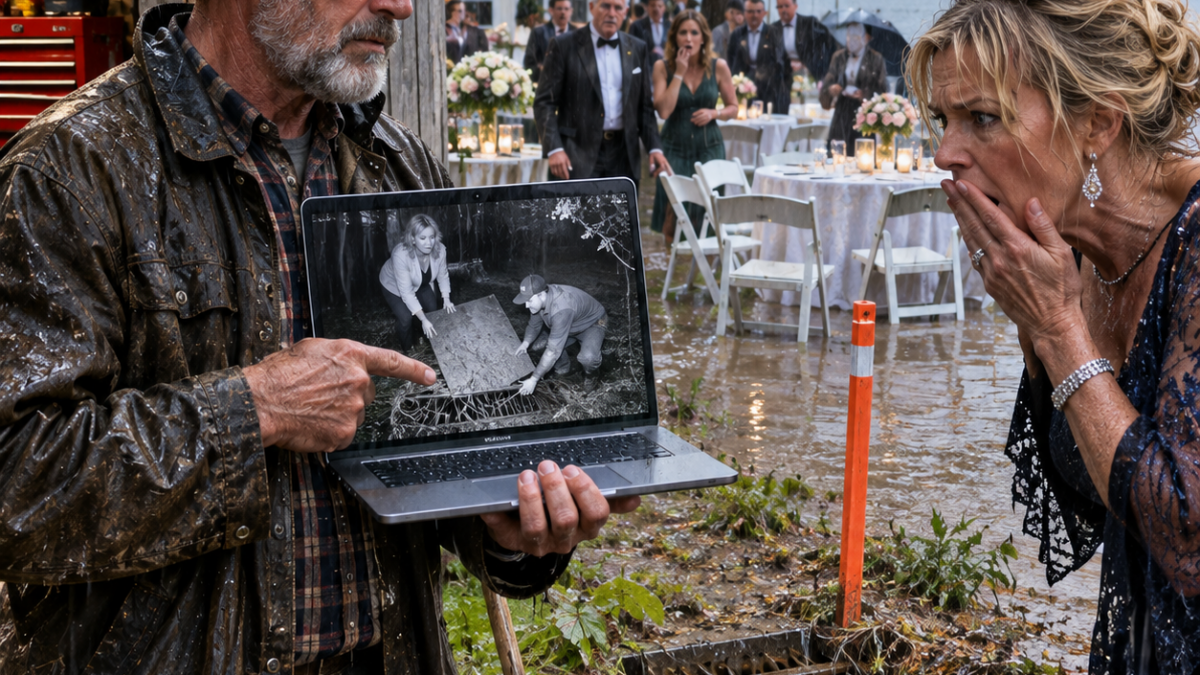
Evelyn entered.
Pointed at the drain.
Owen placed the board.
They worked together.
Then roots.
Evelyn helped push the clump against the opening.
Walt leaned closer.
“Well.”
I said nothing.
We played it again.
Same.
No misunderstanding.
No leaves naturally collecting.
Hands.
Board.
Roots.
Then another clip.
Evelyn alone.
She carried something white.
At first, because of the angle, I could not see it.
Then she turned toward the camera.
Small white plastic board.
Black marker.
She knelt.
Wrote.
Attached it above the blocked drain using black plastic ties.
The words faced the camera.
DRAIN CLOSED BY OWNER
Below:
DANIEL BENNETT
Walt sat back.
“She put your name on it.”
I did not answer.
I replayed it.
Her hand.
Marker.
My name.
Not somebody else’s handwriting.
Not a worker.
Hers.
Then I noticed the final seconds.
She stepped back.
Looked at the sign.
Adjusted one corner.
Walked away.
I reached for my phone.
Walt stopped me.
“Who?”
“Her.”
“No.”
“She put my name—”
“I saw.”
“I’m calling her.”
“Save everything first.”
That sentence probably saved me from making the night messier.
He was right.
I copied every file.
Not only the incriminating clips.
Everything.
Empty grass.
Deer.
Raccoon.
Shadows.
Me walking by.
Noah’s test clip.
I did not rename originals.
I did not edit.
I copied one set to my computer.
Another to an external drive.
Then I put the card in an envelope.
Date.
Time.
Camera location.
Walt watched.
“What about the sign?”
We looked outside.
Scott had left debris on the tarp.
The white board was not obvious.
I called him.
“You find a small white sign?”
“Yeah.”
“Where?”
“Came loose when I pulled branches.”
“What did you do with it?”
“Put it in the debris pile.”
Walt and I went outside with flashlights.
Mud.
Plywood.
Roots.
Wire ties.
Under one branch:
White board.
Mud across half my last name.
Two black plastic tie pieces still attached.
I did not wash it.
Did not wipe it.
Photographed it in place.
Then the surrounding debris.
Then the drain.
Walt brought a plastic tub.
We put the sign inside.
Plywood stayed beneath the roof overhang.
Then I called the sheriff’s office.
I explained.
Flooding.
Blockage.
Video.
False sign.
No immediate danger now.
The dispatcher asked:
“Do you know the people in the video?”
“One is HOA president Evelyn Price.”
“Other?”
“Landscaping worker. First name Owen.”
“Last name?”
“Don’t know.”
She gave me a report number.
I wrote it on the memory-card envelope.
By ten, the party had disappeared.
No music.
No string lights reflected prettily in the lake.
Workers folded soaked cloths.
Chairs scraped across the clubhouse porch.
The workshop smelled like wet cardboard and old oil.
Two boxes of parts were ruined.
The base beneath Dad’s tool chest had swollen along one edge.
I ran my hand over it.
Dad built that base himself.
“Workshops need to survive spills, bad boots, and bad luck,” he had said.
It had survived.
Mostly.
I wished I could tell him.
My daughter called after I asked her to delay Noah’s visit.
“Are you hurt?”
“No.”
“House?”
“Fine.”
“Then why do you sound like that?”
I sat on the porch.
“Because somebody did it on purpose.”
Silence.
I told her what I knew.
Not what I suspected beyond evidence.
Evelyn and Owen blocked the drain.
I had video.
I did not know what they intended the rain to do.
That distinction mattered.
My daughter said:
“You reported it?”
“Yes.”
“Then let the report work tonight.”
“I want to go over there.”
“I know.”
“She put my name on a sign.”
“I know.”
“I want her to see the video.”
“She will.”
“Tonight.”
“No.”
She sounded like her mother.
That usually irritated me.
That night it helped.
“Eat something.”
“I’m not hungry.”
“Dad.”
I ate a sandwich.
The next morning, three messages waited.
Two neighbors:
Are you okay?
The third:
Why did you close the drain?
Then I saw Evelyn’s neighborhood email.
Sent shortly after seven.
Subject:
SATURDAY EVENT DAMAGE — DRAINAGE INCIDENT
She wrote that the party suffered serious flooding after a drain on my property was discovered blocked.
She mentioned my prior objections.
Said I had been seen carrying a rake near the drain.
Then attached a photograph.
The white sign.
DRAIN CLOSED BY OWNER — DANIEL BENNETT
Clear.
Dry.
Perfect.
She wrote that the HOA would seek reimbursement for cleanup and damaged rentals.
Then the sentence that made me angriest:
Residents are asked not to confront Mr. Bennett while the matter is reviewed.
She had accused me publicly.
Then presented herself as the responsible person preventing conflict.
I began typing.
My first two sentences were fine.
My third contained language my grandson did not need repeated.
I deleted everything.
Started again.
I did not close the drain. I have reported evidence showing the drain was blocked by other people. Please preserve the email and its attachment. I will provide the records through the proper channels.
I read it aloud.
Then sent.
Deputy Cole arrived around eleven.
Calm.
Mid-forties.
He examined the drain.
Workshop waterline.
Debris.
White sign.
Plywood.
Roots.
He photographed before touching.
Then sat at my kitchen table.
We watched original files.
He asked:
“Trail camera sends footage remotely?”
“No.”
“Stored locally?”
“Yes.”
“Settings?”
“Manual.”
“Who set date and time?”
“Me. Grandson helped verify Tuesday.”
I showed the test clip.
Me waving like an idiot.
Cole smiled briefly.
Then notes.
He wanted copies of original files.
Not a phone video of the laptop.
Good.
I liked that.
Then he asked about my argument with Evelyn.
I told him everything.
Orange marker.
Workshop request.
Boat.
Courtesy sheet.
My sentence:
“If your party needs my place to disappear, you picked the wrong clubhouse.”
I hated giving him that line.
But omitting it would make me look dishonest later.
He wrote it.
“Owen?”
I explained our Wednesday conversation.
“Witness?”
“Not that I know.”
That was uncomfortable.
The video later showed me pointing at the drain beside Owen.
No audio.
That clip could be interpreted two ways.
My account:
Keep it clear.
Evelyn’s potential account:
Block it here.
I noticed that immediately.
Evidence is strong when you admit what it cannot prove.
Cole left with copies and instructions for me to preserve emails, bills, photographs, and damaged materials.
That afternoon, Noah came over.
He stood in the workshop doorway.
Looked at the fans.
Tools on towels.
Then asked:
“Did the frog get washed away?”
Of course.
Not the board.
Not Evelyn.
The frog.
“I don’t know, buddy.”
He pulled out his notebook.
Then showed me Tuesday’s picture.
The frog.
Drain open.
Orange marker.
Rake leaning nearby.
I stared.
“Can your mom send me the original?”
“Why?”
“It shows how things looked before.”
His eyes widened.
“Is it evidence?”
“It might help.”
He stood straighter.
Then spent an hour sorting dry washers while my daughter and I moved ruined boxes.
Beneath one, we found a wooden file handle.
Split years earlier.
Dad had wrapped it with two neat turns of wire.
My daughter held it.
“You’re keeping this?”
“Yes.”
She did not say:
It’s only a tool.
That was why I loved her.
Monday, I called the landscaping company.
Owner:
Russell.
I told him his employee appeared on video placing plywood and roots across the drain.
Silence.
Then:
“Can you send it?”
I did.
Also told him Deputy Cole had copies.
Russell called back less than an hour later.
“I need to talk to Owen.”
“So do I.”
“Let me find out what he was told.”
I asked him to preserve:
Work order.
Messages.
Photographs.
Invoices.
Any change orders.
He agreed.
Later, Scott sent his emergency service report.
It described:
Plywood across grate.
Cut root material packed in front.
Flow restored after removal.
Photographs attached.
Important.
Rain produced water.
The obstruction prevented proper drainage.
That was different from saying the rain had nothing to do with flooding.
I wanted accuracy.
Anger makes people want complete blame.
Reality usually has multiple causes.
Heavy rain mattered.
Blocked drainage mattered more.
Then an HOA envelope arrived.
Special board hearing.
Proposed assessment against me for party damage tied to the blocked drain.
Evelyn’s photograph attached.
No mention of my camera files.
I called Ruth.
Board secretary.
“Has the board seen my footage?”
“I don’t know.”
“Who prepared this packet?”
“Evelyn.”
“Give me an email that reaches every board member.”
Ruth did.
I sent:
Camera footage.
Scott’s report.
Noah’s earlier photograph.
My warning email.
Evelyn’s Noted, Daniel response.
My weather message before the party.
I asked for confirmation.
Martin confirmed.
Claire confirmed.
Evelyn did not.
Then Russell called.
“Owen says Evelyn told him you wanted it.”
I went still.
“What?”
“She says you requested temporary closure to prevent runoff from washing dirt onto your lake bank.”
“That never happened.”
“I’m telling you her account.”
“Did you read my email?”
“Yes.”
“The one saying leave it open?”
“Yes.”
“So.”
“I know.”
Then Ruth sent an updated hearing packet.
Evelyn had added a statement.
It said:
I supplied the plywood.
I requested temporary blockage.
I told Evelyn what to write on the sign.
At the bottom:
Owen — statement awaiting worker confirmation.
Blank signature line.
I called Russell immediately.
“Did Owen sign anything?”
“No.”
“Has he seen this?”
“No.”
“You need to.”
I emailed it while we spoke.
He read.
Then:
“That is not what he told me.”
“What did he tell you?”
“That Evelyn said you wanted the pipe screened from view.”
“Screened is not blocked.”
“I know.”
“He says she claimed you had approved placement.”
I stared at the old email on my desk.
Keep drain open.
Noted, Daniel.
“Tell the board.”
“I will.”
“Before Thursday.”
“Yes.”
Then I sent the updated statement to Deputy Cole.
That night, I reviewed every trail-camera clip.
Not just the obvious ones.
Wednesday:
Landscaping trailer backs in.
Owen exits.
I walk into frame.
No sound.
I point at the pipe.
Owen looks.
Nods.
Moves.
That could support me.
Or Evelyn.
I made a note:
Ambiguous. No audio.
Saturday morning:
Owen carries plywood from clubhouse direction.
The board has a pale stripe and two screw holes.
Not from my workshop.
Useful.
Next clip:
Evelyn carries black plastic ties.
Hands them to Owen.
Points toward grate.
Owen shakes his head once.
She points again.
He sets the board down.
They leave frame.
Then gap.
Next clip:
Installation.
Then later:
Evelyn returns alone.
Writes my name.
The camera recorded motion in bursts.
Not continuous surveillance.
There were gaps.
I documented the gaps too.
If I wanted people to trust what the footage showed, I could not pretend it showed what it did not.
Russell arrived next morning.
Owen with him.
Owen carried a folded work shirt.
Would not look at me initially.
Then:
“I’m sorry about your shop.”
“Thank you.”
“I didn’t know that would happen.”
I wanted to say:
What did you think water does when you cover a drain with plywood?
I did not.
He already looked ashamed.
Shame can either produce honesty or silence depending on how hard you push.
I needed honesty.
We stood at the drain.
“Show me.”
Owen pointed.
“Mrs. Price wanted it hidden.”
“I told you to keep it clear.”
“I know.”
“What did she say?”
“That you didn’t want runoff washing dirt onto your bank during the party.”
“That’s false.”
“I know now.”
“She said we’d worked it out?”
“Yes.”
“What did you propose?”
“The leaf screen higher up.”
“The decorative screen?”
“Yes.”
“She said people could still see the pipe.”
“So?”
“She told me to put the board loosely across it.”
“And roots?”
“She said they’d hold it.”
“Did you know that would restrict flow?”
“I knew it could.”
That answer mattered.
Not:
No idea.
He admitted poor judgment.
“Why do it?”
“She said it was temporary.”
“How temporary?”
“Photographs.”
Then:
“She said she’d remove it after.”
I looked toward Russell.
He rubbed his forehead.
“That is not in the work order.”
Owen looked down.
Russell said:
“You do not alter drainage because a client says it’s okay.”
“I know.”
“Especially without telling me.”
“I know.”
I asked Owen:
“Will you tell Deputy Cole this?”
“Yes.”
“Board?”
He looked at Russell.
Russell answered:
“He tells the truth.”
Owen’s shoulders dropped.
Inside the workshop, Russell placed the work order on my bench.
Shrub removal.
Brush hauling.
Decorative leaf screen.
Nothing about drainage.
Then he showed me text messages from Evelyn to Owen.
One:
Use the loose board behind clubhouse shed. Daniel is fine with it. Just keep that pipe out of the pictures.
There it was.
Before Owen performed the work, she had already told him I approved it.
Another:
Leave the roots where I showed you. I’ll handle the rest.
Russell printed them.
Dates.
Number.
Original device preserved.
Then Owen saw the white sign in the plastic tub.
His expression changed.
“I never saw that.”
“She put it up after.”
“With your name?”
“Yes.”
He got angry then.
Not at me.
At Evelyn.
He walked outside and called the sheriff himself.
That mattered.
Russell gave me his insurer’s information.
“I’m reporting our part.”
“I appreciate that.”
“I’m not promising what they pay.”
“I’m not asking you to.”
“My employee should not have touched the pipe.”
“No.”
“He was misled.”
“Yes.”
“Both can be true.”
That was exactly right.
Owen had made a bad decision.
Evelyn had lied to him.
One did not erase the other.
A carpenter named Glenn inspected Dad’s tool chest base.
He pressed the swollen corner.
Checked joints.
“The chest is fine.”
“Base?”
“Repairable.”
“Can we save the back rail?”
“Why?”
I crouched.
Brushed dust away.
Dad’s pencil writing.
Date.
The year we built it.
Glenn saw.
“Yeah.”
“You can keep that?”
“I can.”
That was the first genuinely good news I had heard all week.
My lawyer, Rebecca Hall, met me the next morning.
She reviewed everything.
Camera files.
Texts.
Scott’s report.
Hearing packet.
Unsigned Owen statement.
My emails.
She looked over her glasses.
“They want you to pay how much?”
“No final amount yet.”
“Good.”
“Why good?”
“Because you’re not arguing against a number yet.”
“What am I arguing?”
“Responsibility.”
She explained something simple.
The board hearing was not a criminal trial.
It could not decide every legal question.
But I had to respond because the HOA was considering charges against me.
“Do not sign anything just to make this disappear.”
“I wasn’t planning to.”
“People say that until they’re offered peace.”
“I like expensive peace.”
“Apparently.”
We prepared a short response.
No exaggeration.
We did not claim rain was irrelevant.
Rain caused the water volume.
We did not claim Owen had no role.
He did.
We said:
I had repeatedly warned against blocking the drain.
The entrance had been deliberately obstructed.
The footage showed who handled the obstruction.
Texts showed Evelyn falsely telling Owen I approved.
The sign with my name had been written by Evelyn.
I had not authorized any of it.
Then I paid Rebecca.
Another receipt.
By Thursday, my folder had become almost as thick as some repair manuals.
I lost one generator job because I could not finish on schedule.
Customer took it elsewhere.
I recorded that.
Rebecca warned:
“Documenting a lost job does not guarantee recovery.”
“I know.”
“Profit is harder to prove.”
“I know.”
“I’m saying this because people start building fantasy damages when they get angry.”
“I want an honest list.”
“Good.”
The hearing took place in the clubhouse.
The party decorations were gone.
One fabric divider still had a brown water stain along its bottom.
Evelyn sat in the center.
Ruth at one end.
Martin and Claire on either side.
Walt sat behind me.
Russell and Owen together.
Evelyn spoke first.
Wet linens.
Rental damage.
Cleanup labor.
Destroyed floral arrangements.
My argument before the party.
My resentment.
My rake.
My statement about the wrong clubhouse.
She told it cleanly.
That was what bothered me.
The story sounded plausible.
Angry mechanic does not want fancy event.
Mechanic knows drainage system.
Mechanic blocks drain.
Flood happens.
Mechanic appears holding rake.
Sign has mechanic’s name.
If you removed the camera footage, it was a believable story.
Martin asked me to respond.
I stood.
“I objected to blocking the drain.”
Not the party.
Not drainage.
Blocking.
I showed the first email.
Then Evelyn’s reply:
Noted, Daniel.
Noah’s photograph.
Open pipe.
Orange marker.
Rake.
Evelyn said:
“That only proves it was open Tuesday.”
I nodded.
“That’s correct.”
She looked surprised.
I was not going to fight true points simply because they helped her temporarily.
Next:
Scott’s report.
Plywood.
Roots.
Restored flow after removal.
Then video.
Owen carrying board.
Evelyn pointing.
Installation.
She interrupted.
“I already explained we believed Daniel requested it.”
Russell slid a printed text toward the board.
“Then explain why you told my employee Daniel had approved it.”
Evelyn looked at him.
“I understood he had.”
“From what?”
“My conversations with Daniel.”
I said:
“What conversation?”
She ignored me.
Owen stood.
“He told me Wednesday to keep debris away from the opening.”
Evelyn turned sharply.
“You said you didn’t remember every word.”
“I remember that.”
He explained his suggested leaf screen.
Evelyn’s story about my approval.
Her promise to remove the board after photographs.
Then he lifted the statement she had prepared.
“I did not write this.”
Silence.
“I did not approve it.”
He looked directly at Evelyn.
“Please stop putting my name on things.”
Ruth wrote quickly.
Claire asked:
“Why was an unconfirmed statement included in a packet supporting a proposed charge?”
Evelyn answered:
“It was clearly marked awaiting confirmation.”
Claire:
“But the account was being used against Daniel before the named witness agreed it was true.”
Evelyn shifted.
I returned to the laptop.
“One more clip.”
White board.
Marker.
Evelyn.
My name.
Nobody spoke while the video played.
When it ended, Evelyn said:
“The sign identified the property owner.”
Ruth lifted a hand.
“Wait.”
She pulled Evelyn’s Sunday email photograph from the packet.
Compared it to my video time.
“This photograph…”
She looked at Evelyn.
“You said the sign was found after the flooding.”
Evelyn’s eyes shifted.
Ruth placed the photograph beside my laptop.
Dry ground.
Clean roots.
No rain.
No wet tables.
No flood.
Then I played the final clip.
Evelyn finished tying the sign.
Stepped backward.
Raised her phone.
Took a photograph.
The same photograph she later circulated as evidence against me.
The room went completely still.
Martin looked at Evelyn.
“Why did you say this was discovered afterward?”
“I took a photograph for association records.”
“Before the flooding.”
“Yes.”
“After writing Daniel’s name yourself.”
“I believed that was the arrangement.”
Russell pushed the work order toward her.
“No drainage work.”
Evelyn turned.
“Your employee did the installation.”
“Yes.”
“Then perhaps your company—”
Russell cut in.
“My employee made a mistake.”
He pointed to the text.
“You told him the owner approved it.”
Owen nodded.
“You said you’d remove it after photos.”
Martin picked up my email.
Read aloud:
The drain entrance must remain open.
Then:
Noted, Daniel.
He looked at Evelyn.
“You received this six days before the event.”
She said nothing.
“What changed?”
“We spoke.”
“When?”
“I don’t remember.”
“What did Daniel say?”
“That he was concerned about runoff washing onto his property.”
I answered:
“That conversation did not happen.”
She looked at me.
“You were angry.”
“Yes.”
“You threatened—”
“No.”
I kept my voice level.
“I was angry because you wanted me to hide my workshop and boat.”
Then:
“That does not mean I flooded your guests.”
I stopped.
I had rehearsed more.
A lot more.
Anger gives you speeches at three in the morning.
But the board had:
Email.
Video.
Text messages.
Unsigned false statement.
Predated photograph.
My speech could only make things less clear.
Claire moved to withdraw the proposed charge against me.
Martin seconded.
Evelyn protested.
“The association still has bills.”
Claire said:
“Then we determine who is responsible for them.”
She looked at the sign.
“We do not send them to Daniel because you wrote his name on a piece of plastic.”
The notice was withdrawn.
That was it.
A motion.
Second.
Vote.
Ruth drew a line through the proposed decision.
For a few seconds, I felt nothing.
I had imagined vindication as something larger.
Maybe applause.
Maybe Evelyn admitting it.
Maybe anger leaving my body all at once.
Instead, Walt touched the back of my chair.
I realized I had been holding my breath.
The board voted to send the complete record to:
HOA attorney.
Association insurer.
Deputy Cole.
Evelyn was instructed not to contact contractors or handle flood-related claims for the association.
She objected.
Martin said:
“Put the objection in writing.”
That nearly made Walt laugh.
Outside, Owen waited.
“I’m sorry.”
I set my folder on the truck hood.
“You need to understand something.”
He nodded.
“You do not block drainage because somebody says it’ll be fine.”
“I know.”
“People could’ve lost more than tablecloths.”
He looked toward my workshop.
“I know.”
I believed he understood.
That did not erase what he did.
Learning is not the same as escaping responsibility.
Russell’s insurer contacted me.
The board sent a correction to the same neighborhood email list Evelyn had used.
It said:
The accusation against Daniel Bennett had been withdrawn.
Evidence showed he had warned against obstructing the drain.
He did not authorize the blockage.
Anyone who shared the prior message was asked to share the correction.
Claire sent me a draft.
One sentence called the incident an “unfortunate misunderstanding.”
I replied:
“Remove that.”
She called.
“Why?”
“Because Owen misunderstood.”
“Yes.”
“I failed to recheck behind the screen.”
“Okay.”
“Evelyn wrote my name on a sign and photographed it before the flood.”
Silence.
“That is not a misunderstanding.”
Claire removed the sentence.
That mattered more than I expected.
Language matters.
Calling deliberate conduct a misunderstanding makes the victim carry part of the blame for not understanding the lie correctly.
I was not doing that.
A drainage specialist inspected the system.
Pipe.
Slope.
Outlet.
He found no internal collapse.
No hidden failure.
No evidence the pipe was simply too small for ordinary drainage conditions.
His report was careful.
Heavy rain supplied water.
The plywood and packed roots severely restricted the entrance.
The obstruction caused water to back across the low ground.
The decorative screen and flower crates made emergency access harder.
That was accurate.
Not:
Every raindrop was Evelyn’s fault.
Not:
Without Evelyn, no water would have existed.
The problem was deliberate restriction during heavy rain.
Scott’s photographs supported it.
Noah’s pre-event photo supported it.
Water level dropping after the obstruction was removed supported it.
I liked reports that stopped where evidence stopped.
Maybe because I had just spent a week dealing with someone who did the opposite.
The workshop dried slowly.
Glenn repaired Dad’s tool chest base.
New wood replaced the damaged section.
He kept the back rail.
Dad’s pencil date remained.
Glenn asked:
“Want stain to match?”
I looked at the new pale wood against the old.
“No.”
“You sure?”
“I’ll know.”
“Know what?”
“What happened.”
He smiled.
Left it.
A few hand tools needed cleaning.
Some cheap parts were ruined.
Cardboard boxes gone.
The old file with the wire-wrapped handle survived.
I placed it back in the top drawer.
That was when the workshop started feeling like a workshop again instead of an evidence locker.
Rebecca prepared my civil claim.
Emergency drainage service.
Workshop repairs.
Damaged property.
Legal expenses covered by the agreement we were seeking.
Documented costs only.
The lost generator job was harder.
Customer’s message existed.
Potential profit did not.
I included it as a recorded loss.
Did not inflate it.
Did not pretend every hour of anger deserved a dollar amount.
Eventually the civil claims settled before trial.
The landscaping company’s insurer paid its agreed share based on the work Owen performed.
Evelyn paid the remaining agreed amount under a written settlement.
It covered documented property losses, emergency drainage costs, and included legal expenses as agreed.
No jackpot.
No giant humiliation award.
No six-figure check for emotional distress.
I did not become rich because someone flooded my workshop.
I got my documented losses addressed.
Responsibilities put in writing.
That was enough.
Claims from party guests and rental companies were handled separately.
None came back to me.
When the money cleared, I told my daughter.
Then Walt.
Walt asked:
“You buying a new tool chest?”
“No.”
“Good.”
“Why?”
“Your father would complain about the price.”
I laughed harder than it deserved.
The criminal process continued after the civil settlement.
Deputy Cole interviewed Owen.
Russell.
Evelyn.
Reviewed texts.
Camera originals.
Emails.
Service report.
He did not tell me everything.
That was proper.
I was a complaining witness, not investigator.
Months later, Evelyn pleaded guilty to a misdemeanor property damage charge arising from the deliberate obstruction.
Probation.
Community service.
The court accounted for damage payments already made.
No double recovery.
No prison.
I did not need prison.
I needed a public record establishing something simple:
The blockage was deliberate.
I had not caused it.
She had conditions to follow.
The legal part ended quietly.
Her HOA presidency ended sooner.
Members called a meeting.
I attended.
Did not speak.
Claire summarized findings.
Ruth read the correction into the minutes.
Residents asked questions about:
Contractor instructions.
Board packet.
Unsigned statement.
Party claims.
Evelyn’s email.
The photograph.
Then they voted.
She was removed.
When the result was announced, Evelyn gathered her folder.
Stood.
Walked out.
I stayed seated.
Walt whispered:
“You’re not going after her?”
“For what?”
“I don’t know. Dramatic parking-lot confrontation.”
“No.”
“You’re disappointing.”
I smiled.
I had nothing left to say to Evelyn that the evidence had not already said better.
The new board adopted rules.
Simple ones.
Work affecting drainage required written authorization from whoever legally controlled the system.
Qualified contractor review where appropriate.
Event layouts could not block marked drainage access.
Claims against homeowners required review by more than the person making the accusation.
And my favorite:
Any named witness had to see and approve a statement before that statement appeared in a board packet under their name.
That rule should not have needed writing.
Apparently it did.
Several neighbors apologized.
One man stopped me near the mailbox.
“I forwarded Evelyn’s email to my brother.”
“Okay.”
“I told him you’d done it.”
“Did you send the correction?”
“Yes.”
“Then thank you.”
He looked uncomfortable.
“Is that it?”
“What do you want?”
“I don’t know.”
“I don’t need you to suffer.”
I really didn’t.
I did not want to spend the rest of my life collecting apologies like receipts.
I wanted the next person accused by an HOA president to get a question before a judgment.
That was more useful.
Owen came back later in the summer.
Russell’s company had been hired to finish removing old shrub debris.
Before beginning, Owen walked over.
Held up the work order.
“No drainage work.”
I read it.
“Good.”
“Trailer stays here.”
He pointed farther from the ditch.
“Good.”
Later, I watched another worker set boards near the drain.
Owen stopped him.
Moved the boards himself.
That meant more than another apology.
A person saying:
I learned,
is easy.
Watching him behave differently when nobody asked—that mattered.
The new HOA board held a smaller gathering near the end of summer.
Higher clubhouse lawn.
Tables far from ditch.
Orange marker visible.
Drain access completely open.
Claire came over beforehand.
“Do you mind?”
“Mind what?”
“The party.”
“No.”
She smiled.
“I thought so.”
“I never minded people having a party.”
“I know.”
This time, I believed she did.
Noah came over that morning.
We checked the trail camera.
Still under the workshop eave.
I had considered moving it.
For a while, looking at that camera made me think of Evelyn rather than deer.
But Noah wanted it there.
He did not think of evidence.
He thought of raccoons.
That seemed healthier.
We opened clips.
Deer.
Another deer.
Raccoon.
Bird fighting its reflection.
Then Noah paused.
At the bottom of the frame:
A frog.
Sitting near the open drain.
He leaned toward the screen.
“Do you think that’s the same frog?”
“I have no idea.”
He studied the image.
“I’m writing maybe.”
“Seems scientific.”
He wrote:
Possible same frog.
That afternoon, a short rain moved across the lake.
Nothing dramatic.
I stood inside the workshop with Noah.
Water gathered in the ditch.
Moved toward the grate.
Entered.
Passed beneath the driveway.
At the outlet, we heard the familiar rushing sound.
The sound missing during Evelyn’s party.
Noah watched.
Then wrote in his notebook.
“What?”
“Drain working.”
I looked at Dad’s tool chest.
Back against the wall.
Repaired base.
Old rear rail still there.
His pencil date.
Then outside.
Orange marker.
Open water.
No screen.
No flower crates.
No sign with my name.
“Good,” I said.
And we went back to looking for deer.
For a while, I thought that was where the story ended.
It wasn’t.
Not exactly.
Because what stayed with me was not Evelyn’s conviction.
Not the board vote.
Not even the trail-camera clip.
It was how easy the accusation had been.
She had done three things very well.
First, she established motive.
Daniel hates the party.
Second, she created physical evidence.
Sign with Daniel’s name.
Third, she placed me at the scene holding the exact tool a person might use to clear—or block—a drain.
If the trail camera had been mounted six feet farther left, the truth might have been much harder to prove.
That bothered me.
Not because I thought I would have been convicted of anything serious based solely on her story.
Because reputations are not courtrooms.
Neighbors do not wait for discovery.
Emails travel.
People fill gaps.
A photograph feels like proof even when the person who took it manufactured the scene.
I knew engines.
I did not know how vulnerable ordinary people were to staged evidence until my own name appeared on that sign.
Afterward, I became more careful.
Not paranoid.
Careful.
Written instructions.
Photographs before work.
Contractors told exactly what must remain clear.
I installed a second camera covering the workshop entrance.
Not because I wanted to record neighbors.
Because I operated a business.
Dad used to say:
“Measure twice.”
I expanded that.
Measure twice.
Write once.
Save everything.
But I also learned something else.
Evidence can protect the wrong person too if you choose only the pieces that help you.
The Wednesday clip of me pointing at the drain looked bad without audio.
If Evelyn had released that alone, people could have said:
See?
Daniel showed Owen where to place the board.
That is why I gave Deputy Cole the clip.
Even though it could be used against me.
Even though Rebecca might have preferred less ambiguity.
The truth was I had been there.
I had pointed.
The words were not recorded.
Pretending otherwise would make my evidence collection no better than Evelyn’s.
The difference between proof and propaganda is often whether you include the inconvenient parts.
I wanted the full sequence.
Noah’s test clip.
The frog.
Me pointing.
Owen carrying the board.
Evelyn handing him ties.
The installation.
The sign.
The photograph.
Rain.
Scott clearing it.
All of it.
Truth was not one perfect frame.
It was chronology.
That lesson mattered more than I expected.
A year later, Claire asked me to speak briefly at an HOA safety meeting.
I almost refused.
Then she explained the topic.
Event planning near shared drainage.
I said:
“I am not giving a speech about Evelyn.”
“You don’t have to.”
“What do you want me to say?”
“What would you tell people?”
I stood in the clubhouse for maybe five minutes.
No drama.
I said:
“If something looks ugly but serves a safety purpose, ask why it exists before you hide it.”
People laughed slightly.
I pointed toward the orange marker visible through the window.
“That thing is ugly.”
More laughter.
“It’s supposed to be.”
Then:
“If you alter water, electricity, gas, structural support, traffic access, or anything else you don’t understand, stop and ask the person responsible.”
Owen was not there.
But I thought of him.
“Temporary does not mean harmless.”
That was the whole talk.
Afterward, an older resident approached.
“I always hated that orange post.”
“I know.”
“Still do.”
“Good.”
She smiled.
“I also know what it’s for now.”
Better.
The workshop stayed.
That was another quiet victory.
Evelyn had wanted it hidden.
Maybe not destroyed.
But invisible.
Doors closed.
Boat moved.
Marker removed.
Rough edges covered.
What happened after the flood made the workshop more visible than it had ever been.
Adjusters came.
Police.
Board members.
Carpenter.
Neighbors.
People saw Dad’s old tool chest.
The crooked Bennett Repair sign.
The shelves.
The grease stains.
The real place behind what Evelyn called an eyesore.
Somebody brought me a diesel pump afterward because he had never realized I still took small jobs.
Another neighbor asked me to repair a mower engine.
I joked with Walt:
“Evelyn accidentally did my marketing.”
He said:
“Send her commission.”
“No.”
“Fair.”
Noah grew older.
His wildlife notebook filled.
The frog sightings became a running argument.
Same frog?
Different frogs?
He became less willing to label every print a wolf.
Progress.
One afternoon, when he was eleven, he asked:
“Why did Evelyn put your name on the sign?”
I had avoided telling him details when he was younger.
Now he had seen enough.
“She wanted people to believe I closed the drain.”
“Why?”
“Because she closed it.”
He thought.
“That’s stupid.”
“It was dishonest.”
“Same thing.”
“Not always.”
He looked at the drain.
“Did she know the rain was coming?”
“She had my message.”
“So yes.”
“She knew rain was forecast.”
“Did she know it would flood?”
“I don’t know.”
That mattered.
I would not turn uncertainty into certainty for a better story.
He asked:
“Why didn’t Owen stop her?”
“He should have.”
“Why didn’t he?”
“He believed something she told him.”
“That you said it was okay?”
“Yes.”
Noah frowned.
“But you didn’t.”
“No.”
“So he should’ve asked you.”
“Yes.”
He wrote something.
“What?”
“Ask the person.”
“About what?”
“If somebody says somebody else said something.”
I smiled.
“Good rule.”
Children simplify ethics better than committees.
Years passed.
The new board became less new.
People stopped talking about the lake party.
Another HOA president came.
Then another.
The orange marker eventually faded.
I replaced it.
Bright orange again.
A neighbor joked:
“Evelyn would hate that.”
I said:
“Probably.”
Then went back to work.
I did not want her name attached permanently to every ordinary thing.
That would mean she still controlled too much.
The drain was not Evelyn’s drain.
The workshop was not the place Evelyn flooded.
The trail camera was not the camera that caught Evelyn.
Those things existed before her.
They continued after.
That is how recovery works sometimes.
You return objects to their ordinary meaning.
Tool chest becomes tool chest again.
Camera becomes deer camera.
Drain becomes drain.
Neighbor becomes neighbor.
Rain becomes weather.
For months after the incident, heavy rain made me anxious.
I would step outside.
Check grate.
Even if I had checked an hour earlier.
Then eventually I stopped doing that every time.
Not because I trusted water less.
Because I trusted the system again.
Open entrance.
Clear route.
No plywood.
Simple.
The one thing I kept from the incident was a copy of the white sign.
Not the original.
That went through the evidence process and eventually was returned.
I did not hang it.
I put it in a file.
Sometimes I wondered why I kept it.
Then I understood.
Dad kept broken parts too.
Not junk.
Examples.
A cracked bearing race.
Failed seal.
Bent valve.
He would show younger mechanics:
“Here’s what happens when…”
The sign became that for me.
Here’s what happens when someone decides appearances matter more than function.
Here’s what happens when authority becomes permission to invent facts.
Here’s what happens when you assume nobody is recording.
But mostly:
Here’s what happens when you keep your records.
I never became friends with Evelyn afterward.
There was no dramatic reconciliation.
No apology delivered on my porch.
No moment where she admitted everything to me personally.
Legal accountability is not emotional closure.
Those are separate.
The misdemeanor plea mattered because it created a public record.
The settlement mattered because losses were addressed.
The board removal mattered because she no longer held that authority.
I did not require her transformation.
If she learned something, good.
If she didn’t, still good that the rules changed around her.
That is one advantage institutions have over personal forgiveness.
You do not need everyone to become better.
Sometimes you make it harder for the next person to do the same bad thing.
Written approval.
Contractor review.
Independent claim review.
Witness confirmation.
Clear drainage access.
Those rules were boring.
Excellent.
Boring rules prevented another exciting disaster.
The most satisfying moment came much later.
Not the hearing.
Not the guilty plea.
A summer afternoon.
Noah older.
I was in the workshop repairing an old diesel pump.
Outside, the HOA held another gathering.
People laughed.
Music low.
Tables on the high lawn.
The drain completely visible.
Orange marker standing ugly and bright.
Rain started unexpectedly.
Not heavy.
Enough.
Nobody panicked.
One board member walked over.
Checked the grate.
Clear.
Water passed.
Party continued.
That was it.
No accusation.
No damage.
No emergency callout.
No trail-camera evidence.
Nothing happened.
People underestimate the value of nothing happening.
A good drain is boring.
A safe party is boring.
A responsible board meeting is boring.
A contractor asking before changing something is boring.
I had learned to appreciate boring.
Dad would have too.
Machines running properly rarely make interesting stories.
They just work.
One evening, Walt sat with me outside the workshop.
He had brought two beers.
We watched the lake.
He said:
“You know the funniest part?”
“What?”
“She wanted the orange marker gone because it ruined the pictures.”
“So?”
“Now every time I see it, I think of her.”
I laughed.
“That’s not funny.”
“It is to me.”
He pointed.
“That thing outlasted her presidency.”
“Low bar.”
“Still.”
We sat quietly.
Then he said:
“You ever wonder what would’ve happened without that camera?”
“Yes.”
“What?”
“I don’t know.”
That answer was honest.
Maybe Owen tells the truth quickly.
Maybe Russell’s texts surface.
Maybe Scott’s report plus my emails are enough.
Maybe board members believe me.
Maybe not.
Maybe Evelyn’s photograph dominates.
Maybe I spend months proving a negative.
Maybe neighbors never fully believe me.
The camera made truth faster.
It did not create truth.
That distinction helped.
I did not want to live believing everyone needed surveillance to be honest.
But I also never again mocked Noah’s wildlife project.
The kid wanted deer.
He gave me timestamps.
Years later, when he was old enough to understand the whole thing, I told him:
“You saved me a lot of trouble.”
He smiled.
“The frog saved you.”
“What?”
“If I hadn’t wanted frog pictures, the drain wouldn’t be in frame.”
“That is terrible logic.”
“Still true.”
I thought.
Maybe.
Life turns on ridiculous details.
A child’s interest in frogs.
A camera angle.
An email saved.
A worker refusing to sign someone else’s statement.
A neighbor saying:
Save everything first.
A drainage technician taking photographs before pulling debris.
A contractor keeping text messages.
A secretary noticing a photograph was dry.
No single dramatic act cleared my name.
A chain of ordinary good habits did.
That may be the real reason Evelyn’s plan failed.
She relied on everyone being sloppy.
She relied on me deleting emails.
Owen forgetting instructions.
Russell not keeping work orders.
Scott pulling debris without documenting.
The board accepting her packet.
Neighbors believing the photograph.
The camera missing her.
Instead, little records survived.
Records are stubborn.
They do not care who is president.
The photograph that hurt her most was her own.
I still think about that.
She took it before the rain.
Probably because she wanted proof ready.
Maybe she imagined somebody would find the sign later.
Maybe she planned to say the board had documented it.
Whatever the reason, her desire to control the story created a timestamped contradiction.
Dry ground.
Clean sign.
Her own phone visible in my trail-camera clip.
Sometimes people manufacture evidence because they think evidence is just an object.
A photograph.
A sign.
A statement.
They forget context is evidence too.
When was it created?
Who created it?
Who had access?
What existed before?
What happened after?
Who signed?
Who did not?
Her photograph did not fail because it was fake.
It showed a real sign.
Her failure was that the sign itself was part of the deception.
That is a more dangerous kind of lie.
Technically true image.
False story.
After everything, I became wary of phrases like:
The photo proves it.
A photo proves what is visible.
Interpretation comes next.
The dry sign showed my name.
The video showed who wrote it.
Both were necessary.
Rebecca once said:
“Your case was lucky.”
I bristled.
“Lucky?”
“In one way.”
“How?”
“She documented herself.”
I could not argue.
Then Rebecca added:
“But luck only matters if you preserve it.”
Fair.
Dad would have liked her.
He appreciated people who reduced complicated problems to one good sentence.
The lower edge of his tool chest eventually needed another repair unrelated to the flood.
Normal age.
I did it myself.
Removed one piece.
Reused another.
Kept the rail with his pencil mark.
My daughter came by.
“You know you could buy a new base.”
“I know.”
“Why don’t you?”
“It still works.”
She smiled.
“You sound like Grandpa.”
“Poor girl.”
She looked toward the drain.
Orange marker.
Clear water.
Then:
“You know Evelyn called all this ugly.”
“Yep.”
“Do you care?”
“No.”
That was true.
At sixty-three, I had already spent enough of my life learning what mattered.
A tool does not need to be pretty.
A workshop does not need to disappear for somebody’s photographs.
A drain does not need to match a wedding anniversary color palette.
A neighborhood does not become better because every rough edge is screened from view.
Function matters.
History matters.
Truth matters.
And if something is there for safety, leave it alone.
That last part should not have required a criminal case.
But apparently it did.
The final time I saw Evelyn up close was nearly a year after the hearing.
Grocery store.
Produce aisle.
She saw me.
I saw her.
For a second, both of us stopped.
I expected:
Apology.
Anger.
Avoidance.
She said:
“Daniel.”
“Evelyn.”
Then nothing.
She looked older.
So did I, probably.
She pushed her cart past.
I let her.
I did not follow.
No speech.
No reminder.
No satisfaction in making her uncomfortable.
She already had a record.
Probation.
Community service.
Settlement.
Removal.
I had my workshop.
Sometimes justice is not getting the final word.
Sometimes it is no longer needing one.
That evening, I returned home.
Opened the workshop.
Dad’s sign above the door.
Tool chest against the wall.
I worked until dark.
Rain began around seven.
I heard it on the roof.
Then the familiar sound.
Water moving through the pipe.
For half a second, I stopped.
Listened.
The sound no longer frightened me.
It simply meant the drain was doing its job.
I kept working.
Later, Noah came over.
Not nine anymore.
Taller.
Less impressed by raccoons.
Still checked the camera sometimes.
He found another frog.
Maybe same one.
Probably not.
He asked:
“Do you ever wish you moved the camera after everything?”
“No.”
“Why?”
“Because it was never an evidence camera.”
“What?”
“It’s a trail camera.”
He smiled.
“That caught evidence.”
“Once.”
He looked toward the drain.
“Still works.”
“So does the drain.”
He wrote something.
“What?”
He showed me.
Drain working. Frog present.
I laughed.
“Scientific.”
“Very.”
We sat at the bench.
Outside, water moved beneath the driveway without anyone noticing.
That was exactly how it should be.
Years earlier, Evelyn wanted an orange marker removed because it spoiled her photographs.
She wanted my workshop hidden because real tools and old paint did not match the image she was selling.
She wanted the drain screened because infrastructure looked ugly beside white tables.
Then when the thing she hid failed exactly the way I warned it could, she needed somebody else’s name on the failure.
Mine.
For a few hours, it worked.
Guests believed her.
Neighbors repeated it.
The board prepared a charge.
One photograph made me look guilty.
But truth had been sitting beneath my workshop eave the whole time, recording twenty-second clips because my grandson wanted to know what animals crossed the grass at night.
It recorded Owen carrying plywood.
It recorded Evelyn pointing.
It recorded her helping pack roots against the grate.
It recorded her returning with a sign.
It recorded her writing my name.
And because she wanted her evidence to look convincing, it recorded her stepping back on dry ground and taking the photograph she later claimed proved I had flooded her party.
That was the part I could never make more perfect if I were inventing it.
She did not merely get caught blocking the drain.
She got caught manufacturing the reason people should blame me for the consequences.
The board withdrew its claim.
The correction went out.
The damages were paid.
Her authority ended.
The court record reflected that the obstruction had been deliberate.
My father’s tools survived.
The drain was repaired and kept clear.
Owen learned enough to stop the next worker from putting boards beside it.
The HOA learned enough to write rules that should have existed already.
And my grandson got his frog pictures back.
People sometimes ask what I would have done differently.
I give them the practical answer.
Check behind the decorative screen.
Photograph before the event.
Maybe insist in writing that no worker touch the drain.
But emotionally?
Nothing important.
I would still help the woman in the wheelchair before clearing the pipe.
I would still tell Deputy Cole about my angry comment.
I would still include the ambiguous video of me pointing at the drain.
I would still refuse to call deliberate framing a misunderstanding.
And I would still choose a settlement covering real losses instead of turning the whole thing into a fantasy about revenge.
Because my goal was never to destroy Evelyn.
It was to keep her story from replacing what actually happened.
That is a smaller goal than revenge.
And a better one.
The neighborhood eventually forgot the soaked tablecloths.
Nobody remembered the anniversary cake.
The rental company replaced whatever needed replacing.
The lawn dried.
The lake went back to looking like a lake.
But whenever I see that orange marker standing beside the ditch, I remember one thing clearly:
A safety marker can be ugly and still be valuable.
So can an old workshop.
So can a crooked hand-painted sign.
So can a tool chest somebody else would have thrown away.
Not everything needs to look beautiful to deserve protection.
Sometimes the rough, practical, unfashionable thing is exactly what keeps the water moving in the right direction.
And sometimes, when somebody decides appearances matter more than truth, all it takes to bring everything back into the open is one cheap trail camera, one honest timeline, and the patience not to let anger erase the evidence before it can speak.








