HOA Karen Fined Me Over the Propane Tank Feeding All 140 Homes—Then I Shut Off the Gas and Her Entire Subdivision Went Cold
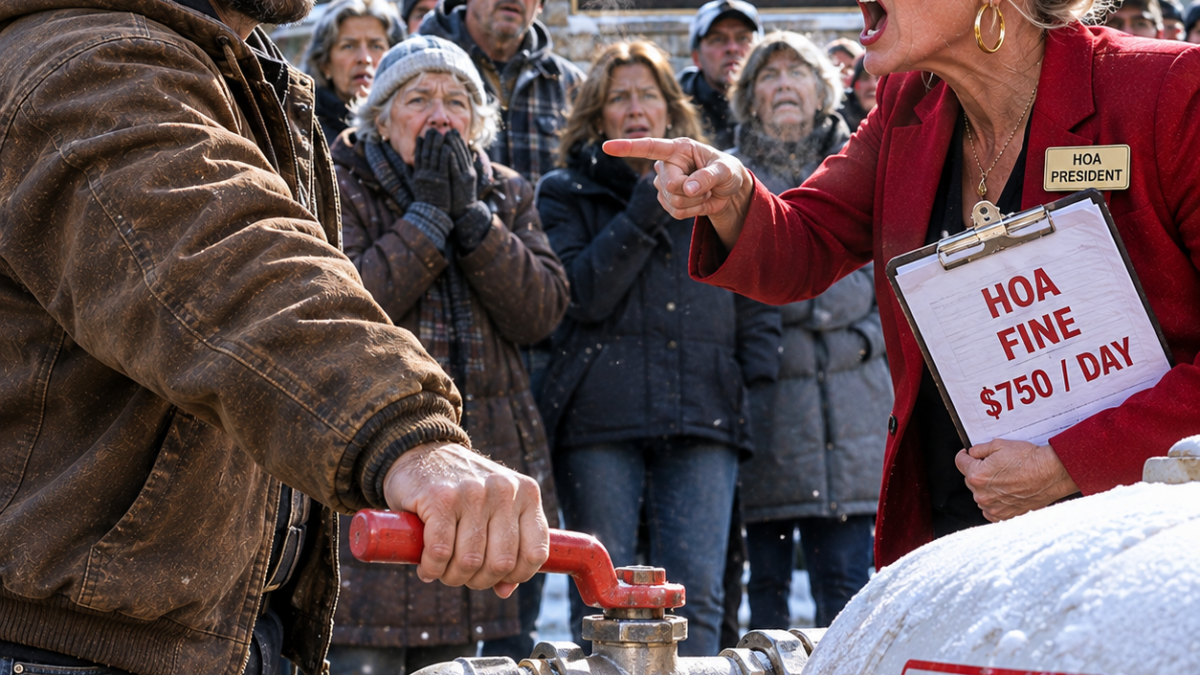
HOA Karen Fined Me Over the Propane Tank Feeding All 140 Homes—Then I Shut Off the Gas and Her Entire Subdivision Went Cold.
At 9:07 on a Monday morning, every gas furnace, stove, dryer, and water heater in Willow Ridge Estates went silent at exactly the same time.
For fourteen months, HOA president Charlotte Ellison had been fining me over the propane tank that supplied all 140 homes while secretly withholding the homeowners’ gas payments—and three days before the shutdown, she told the neighborhood my legally required service notice was a scam.
What Charlotte never understood was that the “ugly tank” she wanted removed was protected by a ninety-nine-year recorded easement, and once her own financial records surfaced, the neighbors realized I hadn’t shut down their subdivision—the woman collecting their money had.
My name is Nick Dalton.
My wife, Aaron, and I live at the very end of Maple Court in Willow Ridge Estates.
Technically, that sentence is misleading.
Our house sits beside Willow Ridge.
Not quite inside it.
That distinction would eventually matter more than anyone expected.
I own Ridgeline Community Gas.
Small company.
Three employees besides me.
Two service trucks.
One aging office.
And one very large propane tank sitting behind a gravel safety yard at the edge of my property.
Most people driving past thought the tank belonged to the HOA.
Some assumed it belonged to the county.
Others probably never thought about it at all.
That was exactly how my father liked it.
His name was Raymond Dalton.
In 1998, the developer building Willow Ridge had a problem.
The nearest natural-gas main stopped miles away.
Extending it would have cost more than the first phase of the development could support.
No gas meant no furnaces.
No gas stoves.
No propane fireplaces.
No hot water from the systems the builder had already specified.
Dad owned a small rural-energy company.
The developer approached him.
Dad designed a private propane distribution network.
One central storage facility.
Underground mains beneath the subdivision streets.
Individual regulators and service branches feeding every house.
In return, Dad received payment, one lot at the end of Maple Court, and something much more important.
A recorded ninety-nine-year easement protecting the tank, distribution equipment, service access, and underground lines.
The agreement survived changes in ownership.
It survived future HOA boards.
It survived neighborhood rule changes.
PART2:
And it clearly established that the propane facility could remain in place so long as it met applicable safety requirements.
Dad made me read that agreement when I took over Ridgeline.
Not once.
Three times.
“Why?”
I complained.
“Because someday somebody with a clipboard is going to decide they understand this system better than the people who built it.”
I laughed.
He didn’t.
Dad had been gone seven years when Charlotte Ellison showed up with the clipboard.
Until then, the arrangement worked almost invisibly.
Willow Ridge had 140 homes.
The HOA collected a monthly energy assessment of forty-two dollars per home.
That amount changed slightly with fuel costs over the years, but the structure remained the same.
The HOA collected.
The HOA sent one consolidated payment to Ridgeline.
We maintained the tank.
Maintained the mains.
Handled safety inspections.
Delivered propane.
Responded to leaks.
PART3:
Residents never dealt with 140 individual fuel accounts.
Simple.
Efficient.
Boring.
Dad loved boring systems.
“Boring means everyone is warm.”
Then Charlotte became president.
She won easily.
Pearls.
White SUV.
Immaculate lawn.
Binder under one arm.
Her campaign message was:
HIGHER STANDARDS FOR WILLOW RIDGE.
Most homeowners loved it.
Cleaner entrance.
Better landscaping.
Stricter enforcement.
Property values.
The usual promises.
I barely noticed.
I wasn’t particularly involved with the HOA.
Ridgeline dealt with the treasurer for payments.
I dealt with gas.
Then my first violation notice arrived.
UNSIGHTLY INDUSTRIAL STRUCTURE.
I stared at the photograph.
My propane tank.
The same tank that had been sitting there since 1998.
The same tank inspected every year.
The same tank feeding Charlotte’s own furnace.
Fine:
$250.
I laughed.
Then I made the mistake of assuming one conversation would solve it.
I went to the HOA office.
Charlotte sat behind a desk with her binder open.
“Nick Dalton.”
She smiled.
“I’ve been expecting you.”
“I hope so.”
I placed the recorded easement in front of her.
“You fined a protected utility facility.”
She glanced at the first page.
Barely.
Then pushed it back.
“The board has adopted updated appearance standards.”
“Those standards don’t override a recorded easement.”
“Easements can be modified.”
“By agreement.”
“Exactly.”
“I’m not agreeing.”
Her smile tightened.
“The community has changed since 1998.”
“The gas system hasn’t.”
“That tank is an eyesore.”
“That tank heats your house.”
She leaned back.
“We’re discussing appearance.”
“I’m discussing ownership.”
Charlotte closed the binder.
“Move it behind screening.”
“The required safety clearances limit what can be installed around it.”
“Then relocate it.”
“No.”
She looked almost amused.
“Everyone says no at first.”
I picked up the easement.
“Then everyone doesn’t understand utility infrastructure.”
The next notice arrived four days later.
$500.
Then another.
DAILY NONCOMPLIANCE PENALTY:
$500 PER DAY.
Red envelopes started landing at our house.
Aaron stacked them at the end of the kitchen table.
One afternoon she counted them.
“Nick.”
“Yeah?”
“She’s going to try to lien the house.”
“I know.”
“That doesn’t bother you?”
“It bothers me.”
“You don’t look bothered.”
“I’m collecting paper.”
She stared at the pile.
“How much paper do you need?”
“Enough to prove this isn’t a misunderstanding.”
Aaron leaned back.
“You think she knows?”
“Yes.”
That was what bothered me.
Charlotte had seen the easement.
She knew the tank was protected.
Yet the fines continued.
So we kept every envelope.
Every photograph.
Every violation code.
Every signature.
CHARLOTTE ELLISON.
Large.
Confident.
Always at the bottom.
Then she held a town hall.
Aaron and I went.
The clubhouse was packed.
Charlotte had a projector.
Slide one:
DANGER NEXT DOOR.
Then a full-screen photograph of my propane tank.
People turned toward me.
Charlotte spoke slowly.
“This industrial storage vessel sits alarmingly close to a residential community.”
I almost stood immediately.
Aaron put one hand on my arm.
“Wait.”
Charlotte continued.
“Our children play nearby.”
“Our homes sit nearby.”
“And yet one private operator insists his commercial equipment should remain above community standards.”
A man in front whispered:
“Commercial?”
Someone else:
“Is it safe?”
Then Ruth Alvarado stood.
Seventy-eight.
Cane.
White hair.
Lived in Willow Ridge since 1999.
She pointed toward the screen.
“Charlotte.”
Charlotte paused.
“Yes, Mrs. Alvarado?”
“That tank has heated my house for twenty-five years.”
A few people laughed softly.
Ruth continued.
“My stove too.”
“Thank you, Mrs. Alvarado.”
“And Raymond Dalton checked my regulator himself when my husband was sick.”
Charlotte’s expression cooled.
“This isn’t about individual anecdotes.”
“It’s about safety.”
Ruth lifted her chin.
“Then show us what is unsafe.”
The room went quiet.
Charlotte reached toward the sound controls.
Ruth’s microphone shut off.
“Mrs. Alvarado, you’re out of order.”
That was the moment I stopped thinking Charlotte was merely obsessed with appearances.
People who have evidence usually enjoy showing it.
People who shut off questions usually have something else.
That night, I opened Ridgeline’s accounts.
I had been focused on field work for months.
Our bookkeeper had flagged Willow Ridge as overdue, but cash flow from other customers had kept us comfortable, and I had assumed the HOA was behind because of an administrative transition.
I opened the ledger.
Then sat very still.
One month unpaid.
Two.
Three.
Then fourteen.
$82,320.
The HOA had not sent Ridgeline a full energy payment since Charlotte became president.
Yet every month, homeowners had apparently continued paying their forty-two-dollar assessment.
I called our bookkeeper.
“Is this right?”
“Yes.”
“Fourteen months?”
“Yes.”
“Why didn’t you tell me it was this high?”
“I did.”
I closed my eyes.
She had.
Emails.
Statements.
Past-due notices.
I had kept saying the HOA would catch up.
Dad had trained me never to threaten residential service casually.
“You don’t use heat as leverage.”
He said.
“People forget paperwork.”
“Kids still get cold.”
So Ridgeline kept delivering propane.
We were effectively financing Willow Ridge.
Eighty-two thousand dollars.
And Charlotte was fining me for the equipment she had stopped paying to use.
Aaron looked at the screen.
“She’s collecting the money.”
“It appears so.”
“Then where is it?”
“That is becoming a very interesting question.”
The next morning, I sent a formal default notice.
Certified.
Then another under the service agreement.
Then a third addressed to the board.
All three came back signed.
GORDON PIKE.
HOA treasurer.
No response.
No payment.
No phone call.
Nothing.
That was strange.
Gordon had always been careful.
Before Charlotte, he called if payment was three days late.
Now he signed for three default letters and said nothing.
Either he knew and didn’t care—
or Charlotte was controlling information.
Then Charlotte escalated.
County fire marshal complaint.
IMMINENT EXPLOSION HAZARD.
That phrase appeared on the paperwork.
Two days later, a county vehicle rolled into my driveway.
Fire Marshal Tom Gity stepped out.
Early fifties.
Gray mustache.
Clipboard.
No interest in HOA politics.
Exactly the kind of person I wanted.
“Mr. Dalton?”
“Nick.”
“Tom Gity.”
“I know.”
“You’ve got an unhappy neighbor.”
“I’ve got 140 customers.”
He smiled.
“Let’s look at the tank.”
I gave him everything.
Installation records.
Pressure tests.
Valve maintenance.
Relief-device certifications.
Cathodic-protection records.
Inspection history.
Setback measurements.
Emergency shutoffs.
Delivery logs.
He walked the facility for almost two hours.
Checked clearances.
Checked fencing.
Checked signage.
Checked regulator equipment.
Checked the manifold.
Then stood beside the tank writing.
I waited.
Finally he closed the clipboard.
“Nick.”
“Yeah?”
“This may be one of the better maintained private systems I’ve inspected this year.”
I laughed.
“Can I quote you at the next HOA meeting?”
“Please don’t.”
Then the white SUV arrived.
Fast.
Charlotte stepped out.
Heels.
Binder.
She walked toward us before her door had fully closed.
“Tom.”
Gity looked at her.
“Mrs. Ellison.”
“Tell him.”
“Tell him what?”
“That this is unsafe.”
Gity glanced at me.
Then at her.
“I didn’t find an unsafe condition requiring shutdown or removal.”
Her smile vanished.
“You haven’t seen the neighborhood impact.”
“I inspected the propane system.”
“Children live here.”
“Yes.”
“That tank could explode.”
“So can improperly maintained equipment.”
He pointed toward the facility.
“This is properly maintained.”
She stepped closer.
“The HOA has determined it violates community safety standards.”
Gity’s voice became flat.
“The county determines compliance with applicable fire-safety requirements.”
Charlotte stared.
Then he added:
“And filing an emergency hazard complaint without factual support can create its own problems.”
She went silent.
Then returned to her SUV.
I thought that would end it.
It didn’t.
The following Saturday, 7:03 a.m., engines woke us.
Crane truck.
Flatbed.
Excavator.
Utility crew.
Brandt Excavating.
Charlotte stood beside them.
Clipboard.
She actually looked pleased.
Aaron came onto the porch.
“What is she doing?”
I already knew.
I walked toward the tank.
The foreman climbed down.
“Mr. Dalton?”
“Yes.”
“We’re here to remove the tank.”
“No.”
He looked at Charlotte.
She held up paper.
“Board Resolution Fourteen.”
I looked at her.
“Charlotte.”
“Yes?”
“Are you absolutely sure you want to do this?”
Her smile widened.
“Remove it.”
I turned to the foreman.
“This facility sits on private property under a recorded utility easement.”
His expression changed.
“She said this was HOA common property.”
“It isn’t.”
Charlotte snapped:
“Do not listen to him.”
The foreman looked uncomfortable.
I pulled out my phone.
Called the sheriff.
Deputy Aaron Mills arrived four minutes later.
I showed him:
Deed.
Recorded easement.
Utility agreement.
Fire marshal report.
Charlotte showed him Resolution Fourteen.
He read everything.
Then walked toward the foreman.
“Until this ownership dispute is resolved, you do not have permission from the property owner to enter this facility.”
The foreman raised both hands.
“That’s enough for me.”
Charlotte stepped forward.
“I am president of the association.”
Mills looked at her.
“Does the association own this parcel?”
“Yes.”
I answered:
“No.”
He checked the deed again.
Then at Charlotte.
“Recorded title says Mr. Dalton.”
She pointed toward the tank.
“The board ordered it removed.”
“The board cannot authorize entry onto property it doesn’t own.”
That was the end of the excavation crew’s enthusiasm.
They packed up.
Charlotte stood by her SUV.
“You’ll regret this.”
I was tired.
“Charlotte.”
“You are threatening the fuel supplier for your own house.”
She drove away.
That afternoon Aaron and I met Mitchell Shaw.
My attorney.
He had represented Ridgeline for years.
He read the service agreement.
Twice.
Then pointed.
“Section Nine.”
Nonpayment beyond ninety days.
Thirty-day cure notice.
Right to suspend service.
Then:
“Section Eleven.”
Interference with the supply facility.
Material breach.
Seventy-two-hour emergency termination provision after notice where continuing operations are being obstructed or threatened.
Mitchell looked up.
“You have already exceeded every notice period.”
I knew.
He continued.
“You can suspend service.”
I looked out the window.
“One hundred forty houses.”
“Yes.”
“Families.”
“Yes.”
“Older people.”
“Yes.”
“Kids.”
“Yes.”
Aaron touched my shoulder.
“Do it correctly.”
I looked at her.
“What does that mean?”
“Tell everybody.”
“Give them time.”
“Protect the people who cannot safely lose heat.”
She was right.
We checked the weather.
Mild stretch.
Daytime high around fifty-four.
No freezing overnight forecast during the notice window.
Then we built a vulnerable-household list based only on people who voluntarily contacted us after notice.
Eleven homes needed extra support.
Seniors.
One newborn.
A resident using oxygen.
Two people with mobility problems.
We arranged electric heaters.
Hotel rooms if needed.
Meals.
Emergency numbers.
Ridgeline paid.
I notified Fire Marshal Gity.
He agreed to be present during the controlled shutdown.
Then Aaron and I did something I hope never to do again.
We knocked on 140 doors.
Each resident received:
Seventy-two-hour suspension notice.
Reason:
HOA account delinquency.
Amount owed:
$82,320.
Contract section.
My direct number.
Safety instructions.
Emergency accommodations.
At Ruth Alvarado’s house, she read the notice twice.
Then looked at me.
“So Charlotte hasn’t paid you?”
“Not for fourteen months.”
“We paid her.”
“I know.”
“Every month.”
“I know.”
“Then where did our money go?”
“That is the question your board needs to answer.”
She looked toward the clubhouse.
Then back at me.
“For once somebody told us the truth before doing something.”
That mattered.
At the HOA office, Charlotte received the same notice.
According to Gordon Pike, she read it.
Laughed.
Tore it in half.
Then emailed the neighborhood:
FALSE SERVICE THREAT.
IGNORE.
NO AUTHORIZED GAS INTERRUPTION WILL OCCUR.
Anyone interfering with HOA utility service would face legal action.
Within hours, residents started calling me.
“Nick, is this real?”
“Yes.”
“Charlotte says you can’t.”
“Read the contract citation on the notice.”
“Are you seriously shutting everyone off?”
“If the default isn’t cured.”
“You’d do that?”
“I’ve supplied fourteen months without payment.”
Most calls ended differently after that sentence.
Sunday evening, I called Charlotte.
One last time.
She answered.
“What?”
“Pay the arrears.”
“No.”
“Withdraw the unlawful fines.”
“No.”
“Put acknowledgment of the easement and service agreement in writing.”
Silence.
Then she laughed.
“Do your worst.”
“Charlotte.”
“You are a nobody with a tank.”
I closed my eyes.
“Monday, nine a.m.”
“Good night.”
She hung up.
I told Aaron.
“She made her choice.”
Aaron shook her head.
“No.”
“She made everybody else’s choice for them.”
Monday morning.
Clear.
Cold enough that people noticed.
Not dangerous.
Fire Marshal Gity arrived before eight.
Mitchell came with copies of notices and the contract.
My two Ridgeline technicians checked every isolation valve and monitoring point.
Aaron stood beside me.
At 8:55, I still hoped a payment would arrive.
None.
At 9:00 Mitchell checked the account.
Nothing.
At 9:03 Gordon Pike called.
I answered.
“Nick.”
“Gordon.”
“What are you doing?”
“What the contract says.”
“Charlotte says this isn’t legal.”
“Did you read the notices you signed for?”
Silence.
“Gordon?”
“Yes.”
“Did Charlotte show them to the board?”
Another silence.
My stomach tightened.
“No.”
He whispered.
“I was told not to.”
“Why?”
“I can’t talk.”
Then he hung up.
At 9:07, I turned the first controlled isolation valve.
Then the second.
System pressure began falling in the subdivision distribution side.
Gity watched.
My technician watched gauges.
No drama.
No explosion.
No chaos.
Just pressure slowly dropping.
One by one, appliances stopped receiving fuel.
Pilot systems shut down.
Water heaters stopped firing.
Gas stoves clicked without flame.
Furnaces went quiet.
Gity tagged the isolation point.
Recorded the shutdown.
“All safe.”
He said.
I nodded.
I felt sick.
I had been in the gas business most of my life.
Our job was turning systems on.
Not off.
By ten, the clubhouse parking lot was packed.
Residents wearing coats.
Phones.
Not because their houses had become dangerously cold.
Because nobody understood what had happened.
Charlotte arrived in the white SUV.
She stepped out.
Saw 140 angry customers.
And for the first time since I met her, she looked small.
Dave Lindgren shouted:
“Charlotte!”
She turned.
“Why is my gas off?”
She pointed toward me.
“He’s extorting this neighborhood!”
Nobody reacted.
Ruth Alvarado stepped forward.
Cane in one hand.
My notice in the other.
“He warned us.”
Charlotte stared.
Ruth continued.
“Three days ago.”
“You told us it was fake.”
Someone else shouted:
“Where did our forty-two dollars go?”
Another:
“We paid every month!”
Dave:
“Open the books!”
Charlotte clutched her binder.
“Financial records are confidential board material.”
That was the wrong answer.
Gordon Pike stood near the back.
Sweat on his forehead despite the cold.
He looked at me.
Then Charlotte.
Then the homeowners.
“I can’t do this anymore.”
Charlotte spun.
“Gordon.”
He continued.
“I signed for Nick’s certified notices.”
Murmurs.
“He sent three.”
Charlotte said:
“This is not the time.”
Gordon’s voice shook.
“She told me to destroy them.”
The crowd went silent.
Charlotte stepped toward him.
“Be careful.”
He almost stopped.
Then Ruth said:
“Keep talking.”
Gordon looked at her.
Something changed.
“She said Ridgeline was bluffing.”
“She said Nick wouldn’t shut anything off because he was afraid residents would hate him.”
I could not argue with that.
She had been partly right.
Gordon continued.
“The energy-assessment money stopped going to Ridgeline fourteen months ago.”
Dave yelled:
“Where did it go?”
Gordon swallowed.
“An account labeled Landscape Reserve.”
“Who controls it?”
Charlotte shouted:
“That is a gross simplification!”
Gordon looked at the crowd.
“Charlotte.”
No one moved.
“Charlotte was the only officer with direct transfer authority.”
Her face went white.
Then Gordon opened a folder.
“Eighty-two thousand three hundred twenty dollars should have gone to Ridgeline.”
“The audit trail shows transfers out of the reserve.”
“For what?”
someone asked.
Gordon stared at Charlotte.
“A stone patio.”
Silence.
“Pergola.”
Someone muttered:
“Whose?”
Gordon answered:
“Charlotte’s residence.”
The parking lot erupted.
He raised his voice.
“Landscaping invoices.”
“Two board retreats in Naples.”
“Consulting expenses.”
“All charged through the reserve account.”
Charlotte lunged verbally.
“You approved those payments!”
“I signed summaries you prepared.”
“You’re the treasurer!”
“Yes.”
His voice cracked.
“And I should’ve checked.”
That quieted people more effectively than shouting.
“I should’ve checked.”
He repeated.
“I didn’t.”
“That’s on me.”
“But the gas money was moved.”
“And you knew.”
Charlotte pointed at him.
“You’re lying to save yourself.”
Gordon pulled out a flash drive.
“I brought the records.”
That was when the sheriff’s SUV entered.
Deputy Mills.
Same deputy from the tank-removal attempt.
Charlotte practically ran toward him.
“Deputy!”
She pointed at me.
“Arrest that man.”
Mills got out.
“For?”
“He shut off our gas.”
Fire Marshal Gity stepped beside him.
Mitchell Shaw joined them holding the service agreement.
Mills looked from Charlotte to me.
Then at the crowd.
“Was notice given?”
Mitchell answered:
“Contractual notice periods were exceeded.”
“Residents received direct seventy-two-hour notice.”
“HOA was more than a year delinquent.”
“Interference with the facility created a separate material breach.”
He handed Mills the paperwork.
Charlotte shouted:
“Resolution Fourteen ordered that tank removed.”
Mitchell opened the recorded easement.
“Resolution Fourteen cannot extinguish a ninety-nine-year recorded property right by internal HOA vote.”
Charlotte’s mouth opened.
Nothing came out.
Ruth leaned on her cane.
“You told us he was the problem.”
Charlotte turned toward her.
“This neighborhood will freeze because of him!”
I stepped forward.
“No.”
Everyone looked at me.
“I will restore service today.”
Murmurs.
Charlotte stared.
“If the interim board acknowledges the contract, withdraws the attempted tank-removal order, and places the unpaid balance into escrow from existing HOA reserves.”
Dave yelled:
“We have reserves?”
Gordon nodded.
“Enough.”
“Then do it!”
Someone produced a clipboard.
Recall petition.
Dave Lindgren held it up.
“Who wants her out?”
Hands.
Dozens immediately.
Then more.
Homeowners lined up.
Charlotte stared as signatures accumulated.
By noon, 118 of 140 households had signed support for removing her as president through the association’s recall process.
She stood beside her SUV.
No binder open now.
No microphone.
No audience listening obediently.
Just people asking what she had done with their money.
A temporary board was selected under the HOA’s procedures.
Dave.
Ruth.
Two parents.
Retired accountant named Susan Mercier.
Gordon offered to resign immediately.
Susan said:
“No.”
“You stay long enough to explain every transaction.”
He nodded.
“Fair.”
Mitchell drafted a short acknowledgment.
The interim board recognized:
Ridgeline’s recorded easement.
Validity of the service contract.
The outstanding arrears.
No right to remove or interfere with the propane facility absent lawful modification.
They signed it on the hood of Dave’s truck.
Then the board authorized escrow of the unpaid amount while the accounting investigation continued.
At 2:06, Mitchell received confirmation that funds were secured.
At 3:30, I reopened the distribution valves.
Slowly.
Controlled.
Gity monitored.
Ridgeline technicians went house to house where manual relighting or safety verification was needed.
Volunteer residents helped us coordinate access.
The first house I personally checked was Ruth’s.
She stood in the kitchen.
I turned the stove knob.
Igniter clicked.
Blue flame.
Ruth put her hand over her mouth.
Then looked at me.
“About time.”
I laughed.
“Fourteen months late.”
“Not the gas.”
“What?”
“The truth.”
By sunset Willow Ridge glowed again.
Furnaces.
Water heaters.
Kitchen lights.
Normal.
Aaron and I sat on our porch.
Neighbors kept coming.
Casseroles.
Coffee.
Apologies.
One man brought beer.
Another brought a handwritten note from his kids:
THANK YOU FOR OUR HOT WATER.
I almost felt guilty.
Aaron looked at me.
“You warned them.”
“I still shut it off.”
“For six hours.”
“Still.”
“Nick.”
She took my hand.
“Charlotte was betting that your conscience would let her keep stealing.”
I looked toward the tank.
“She almost won.”
The forensic audit took six weeks.
Gordon cooperated fully.
The numbers were worse than anyone expected.
The entire $82,320 owed to Ridgeline had been diverted from its intended purpose.
Some remained in HOA accounts.
Some had been spent.
Investigators traced expenditures connected to Charlotte’s property improvements, travel, consulting charges, and other transactions requiring deeper review.
Not every questionable payment automatically became criminal.
That distinction mattered.
But enough records were clear.
The county prosecutor eventually filed theft- and fraud-related charges.
Gordon faced consequences too.
He had signed records he should have questioned.
His cooperation mattered, but it did not make his earlier failure disappear.
The HOA voided every fine against my propane facility.
All of them.
The attempted lien process disappeared.
Resolution Fourteen was rescinded.
Willow Ridge also reimbursed my documented legal costs through settlement.
Charlotte was removed permanently from HOA leadership.
The court eventually ordered substantial restitution related to the diverted gas payments and associated losses, along with additional penalties and restrictions arising from the case.
She did not look at me during the final hearing.
I was fine with that.
I had never needed an apology from Charlotte.
I needed her to stop touching my tank.
The HOA rewrote its financial controls.
No single officer could move reserve funds alone.
Two signatures required above defined thresholds.
Monthly bank reconciliation sent to the full board.
Quarterly financial summary available to homeowners.
Annual outside audit.
Utility assessments segregated from general reserves.
And perhaps most important:
No HOA rule or board resolution could be used to interfere with recorded third-party utility rights without legal review.
Ruth loved that one.
“Should have called it the Charlotte rule.”
She said.
“Absolutely not.”
“Why?”
“Because then she still gets a rule named after her.”
Ruth thought.
“Good point.”
She joined the permanent board.
Not president.
She refused.
“I’m seventy-eight.”
I reminded her she had used that excuse only when convenient.
She hit my shoe with her cane.
Gordon stepped down as treasurer once the audit was complete.
Before leaving, he came to my house.
“I’m sorry.”
“I know.”
“I should’ve told you about the letters.”
“Yes.”
“I kept thinking Charlotte had a plan.”
“Probably did.”
He looked confused.
“That was the problem.”
He laughed once.
Then stopped.
“I signed things I didn’t read.”
“My father would’ve hated you.”
Gordon nodded.
“Fair.”
“He’d also tell you not to do it twice.”
“I won’t.”
I believed him.
Months later, Fire Marshal Gity came for our regular inspection.
He walked around the tank.
Checked tags.
Valves.
Distances.
Then looked toward the neighborhood.
“Still dangerous?”
“Extremely.”
He raised an eyebrow.
“Tank?”
“No.”
“HOA meetings.”
He laughed.
The tank remained exactly where Dad installed it.
We repainted the gravel-yard fence.
Replaced two warning signs.
Upgraded the emergency shutoff labeling.
Ruth wanted to put up a plaque.
I said no.
She ignored me.
One afternoon I found a small metal sign attached outside the safety fence.
RIDGELINE COMMUNITY GAS
SERVING WILLOW RIDGE SINCE 1998
Underneath:
ASK QUESTIONS BEFORE YOU REMOVE THE THING KEEPING YOU WARM.
I stared.
Ruth appeared behind me.
“Too much?”
“Yes.”
“I like it.”
“I know.”
It stayed.
For years, people had driven past the tank without knowing what it did.
After Charlotte, everyone knew.
Sometimes too well.
New homeowners would knock on my door.
“Are you Nick?”
“Yes.”
“Is that the famous propane tank?”
I hated that phrase.
“It’s a propane tank.”
“Our realtor told us about it.”
“Of course.”
“Can you really shut down the whole neighborhood?”
I always corrected that question.
“Ridgeline can suspend contracted service under certain conditions.”
“That sounds like yes.”
“It sounds like contracts matter.”
One young homeowner asked:
“Would you ever do it again?”
I thought before answering.
“Only if I had exhausted every safer option.”
That was the truth.
People loved the dramatic version of what happened.
HOA Karen fines gas-company owner.
Owner turns valve.
Entire subdivision goes dark.
Karen exposed.
Great story.
Reality felt different from inside it.
I had spent Sunday night checking the weather every hour.
Worrying about Ruth.
Worrying about the newborn.
Worrying whether someone had a medical condition we didn’t know about.
Worrying Charlotte would convince someone to tamper with a regulator.
Worrying that one angry homeowner would try to relight equipment incorrectly.
That was why Gity had been there.
Why my technicians had been ready.
Why we supported vulnerable households before shutdown.
Why we hand-delivered notices.
Power feels very different when you are the person responsible for using it.
Charlotte never understood that.
To her, authority seemed valuable because it allowed you to force outcomes.
My father taught me the opposite.
The more power you have over someone else’s safety, the more reluctant you should be to use it carelessly.
That was why Dad had kept gas flowing when homeowners paid late during layoffs.
Why he had driven through snowstorms to relight furnaces.
Why he had made me read every contract.
Not because contracts give you weapons.
Because they tell you where your responsibilities stop and someone else’s begin.
Charlotte blurred all of that.
She thought being HOA president meant she could redefine property rights.
She thought collecting residents’ money made it board money.
She thought a resolution could erase an easement.
She thought if she called my tank dangerous enough times, eventually someone with actual authority would agree.
The fire marshal didn’t.
The sheriff didn’t.
The recorded deed didn’t.
The service agreement didn’t.
Eventually her own homeowners didn’t.
That was the real shutdown.
Not the propane.
Her credibility.
One spring afternoon, almost a year later, I was servicing a regulator when a moving truck entered Maple Court.
New family.
Young couple.
Two kids.
Charlotte’s old house had finally sold.
I did not know that until the truck stopped there.
Aaron joined me at the fence.
“That’s weird.”
“What?”
“Someone else living there.”
We watched the new owners carry furniture inside.
No drama.
No red envelopes.
No binder.
Just people moving.
A few days later the husband came to my house.
“Mr. Dalton?”
“Nick.”
“I’m Ben.”
“We bought the Ellison place.”
“Welcome.”
He looked uncomfortable.
“I’ve heard… things.”
“Neighborhoods love stories.”
He laughed.
Then pointed toward the tank.
“Does our gas really come from there?”
“Yes.”
“Anything I need to do?”
“Pay your assessment.”
He smiled.
“Done.”
Then:
“And don’t try to remove the tank?”
“That helps.”
We both laughed.
Normal.
That mattered to me.
I did not want Charlotte’s failure to poison her old address forever.
Houses don’t commit fraud.
People do.
Aaron and I had our own conversation about the future of Ridgeline.
The system was aging.
Still safe.
Still maintainable.
But ninety-nine-year easements do not mean equipment lasts ninety-nine years.
Eventually Willow Ridge might connect to natural gas.
Maybe electrify completely.
Maybe install community heat pumps.
Maybe continue propane.
Technology changes.
The one thing I promised the new board was that Ridgeline would never use its easement to prevent sensible modernization.
That surprised them.
Dave asked:
“You’d let us replace your system?”
“If there’s a better solution.”
“What about the easement?”
“An easement protects our rights.”
“It doesn’t obligate me to become stupid.”
He laughed.
I continued.
“Charlotte’s mistake was assuming rights exist only when they help her.”
“I’m not making the opposite mistake.”
That became the healthiest relationship Ridgeline ever had with Willow Ridge.
Every year:
Open meeting.
Fuel costs presented.
Maintenance forecast.
Questions answered.
Assessment calculated transparently.
Nobody had to wonder where forty-two dollars went.
Ruth attended every meeting.
Every question.
Every invoice.
At one point she asked why a valve cost $680.
I explained.
She asked again.
I explained differently.
She asked a third time.
Finally I said:
“Ruth.”
“What?”
“You trust me?”
“Yes.”
“Then why are you asking?”
She lifted her cane.
“Because that’s how we got Charlotte.”
Fair.
I handed her the supplier invoice.
She smiled.
“Good boy.”
Dad would have loved her.
The strangest artifact from the whole case was not Charlotte’s fine.
Not the audit.
Not Resolution Fourteen.
It was one of the seventy-two-hour notices we delivered.
Ruth had kept hers.
She framed it.
At the bottom, beside my handwritten phone number, she wrote:
THE FIRST HONEST WARNING WE GOT.
When she showed me, I said:
“That’s depressing.”
“Yes.”
“But also nice.”
“No.”
“It’s depressing.”
She laughed.
As the years passed, people stopped introducing me as the guy who shut down Willow Ridge.
Thank God.
I became Nick again.
Gas guy.
Neighbor.
The person with the service truck.
Sometimes that meant 2:00 a.m. calls.
“Smell propane.”
“I’m coming.”
“No hot water.”
“I’ll be there tomorrow.”
“Fireplace won’t ignite.”
“That is not an emergency.”
“Christmas guests are here.”
“That is emotionally an emergency.”
Normal work.
I liked it.
One November evening, I sat on the porch with Aaron.
First real cold front of the season.
Furnaces across Willow Ridge started cycling.
You could barely hear anything.
Just a faint mechanical hum from somewhere beyond the trees.
Aaron looked toward the tank.
“You know what’s funny?”
“What?”
“She wanted it gone because she thought it made the neighborhood look bad.”
I smiled.
“And now?”
“Nobody sees it.”
“That’s always been the goal.”
A good utility is almost invisible.
It does its job.
People stay warm.
Nobody holds meetings about it.
Dad understood that.
Charlotte wanted every visible thing controlled.
Tank.
Mailbox.
Landscaping.
People.
She never noticed the invisible systems keeping everything together.
Contracts.
Trust.
Accounting.
Maintenance.
Recorded property rights.
Until she broke enough of them that everything became visible at once.
The fuel stopped.
The books opened.
The letters surfaced.
The money trail appeared.
Gordon talked.
The board collapsed.
One valve did not expose Charlotte.
Fourteen months of records did.
The valve merely made everyone finally ask why the gas company had not been paid.
That is the part people miss.
I did not shut down Willow Ridge to punish Charlotte.
Punishment would have been easy.
I could have suspended service months earlier.
I didn’t.
I kept supplying fuel because homeowners had paid.
Because Dad had taught me never to turn ordinary families into bargaining chips.
But eventually continuing service was no longer protecting them.
It was protecting Charlotte.
As long as the furnaces kept running, nobody asked where the assessment money went.
Charlotte counted on that.
She counted on my conscience.
She assumed I would keep absorbing the loss forever because the alternative made me look cruel.
Once I understood that, the decision changed.
We gave notice.
Protected vulnerable residents.
Used mild weather.
Coordinated with the fire marshal.
Followed the contract.
Then stopped subsidizing the lie.
Six hours later the truth had done what fourteen months of invoices could not.
It got everyone’s attention.
I still have one of Charlotte’s red envelopes.
FINAL DEMAND.
$500 PER DAY.
REMOVE PROPANE STORAGE TANK.
Her signature fills nearly the entire bottom line.
I keep it beside Dad’s original 1998 agreement.
Ninety-nine-year utility easement.
Recorded.
Stamped.
Boring.
The red envelope looked more intimidating.
The old contract mattered more.
That is another lesson people learn too late.
The loudest document is not always the strongest one.
Sometimes a person with a title hands you something covered in bold letters and expects you to panic.
Fine.
Violation.
Resolution.
Final notice.
But beneath all of that might be a deed written twenty-five years earlier that quietly says:
No.
Charlotte once told me easements could be fixed.
She was right about one thing.
Property arrangements can change.
Contracts can change.
Neighborhoods can change.
But not because one person decides reality is inconvenient.
Change requires process.
Agreement.
Consent.
Documentation.
That is what she refused to respect.
Years later, Willow Ridge eventually began studying conversion to a modern centralized energy system.
The board invited Ridgeline to participate.
Engineering study.
Costs.
Alternatives.
Residents voted.
Everything transparent.
Ruth was in the front row.
Naturally.
At the end of the meeting she walked over.
“So someday the tank goes?”
“Maybe.”
She looked almost sad.
“I fought for that tank.”
“You fought for proper process.”
“Same thing.”
“No.”
I smiled.
“That’s the whole point.”
She thought.
Then nodded.
“Fine.”
“But if they remove it, I want the sign.”
“Deal.”
The system may not last forever.
Neither will I.
Neither will Willow Ridge in its current form.
But that was never what Dad wanted preserved.
He wanted agreements to mean something.
He wanted neighbors treated like customers, not leverage.
He wanted people warm.
And he wanted whoever inherited Ridgeline to understand that maintaining a utility meant maintaining trust.
Charlotte thought she was fighting an ugly tank.
She wasn’t.
She was fighting twenty-five years of recorded rights, maintenance records, service history, and a contract her own HOA had relied on every winter.
She fined me for it.
Tried to remove it.
Stopped paying for the fuel flowing through it.
Then told 140 families that the warning their heat could be suspended was fake.
At 9:07 on Monday morning, the pressure gauge began falling.
By ten, the clubhouse parking lot was full.
By noon, homeowners were reading bank records.
By afternoon, Charlotte’s authority was gone.
By 3:30, the gas was flowing again.
The tank never moved an inch.
That was what made the whole thing so strange.
Charlotte spent fourteen months trying to remove the object she called the problem.
In the end, we removed nothing.
Not the tank.
Not the pipes.
Not the easement.
Not the service agreement.
We only removed the person who had been standing between the homeowners and the truth.
And the moment she was gone, Willow Ridge got warm again.








