HOA Karen Fined Me Just $1—Then the County Learned That “Consent” Was Holding Up Her $99 Million Development
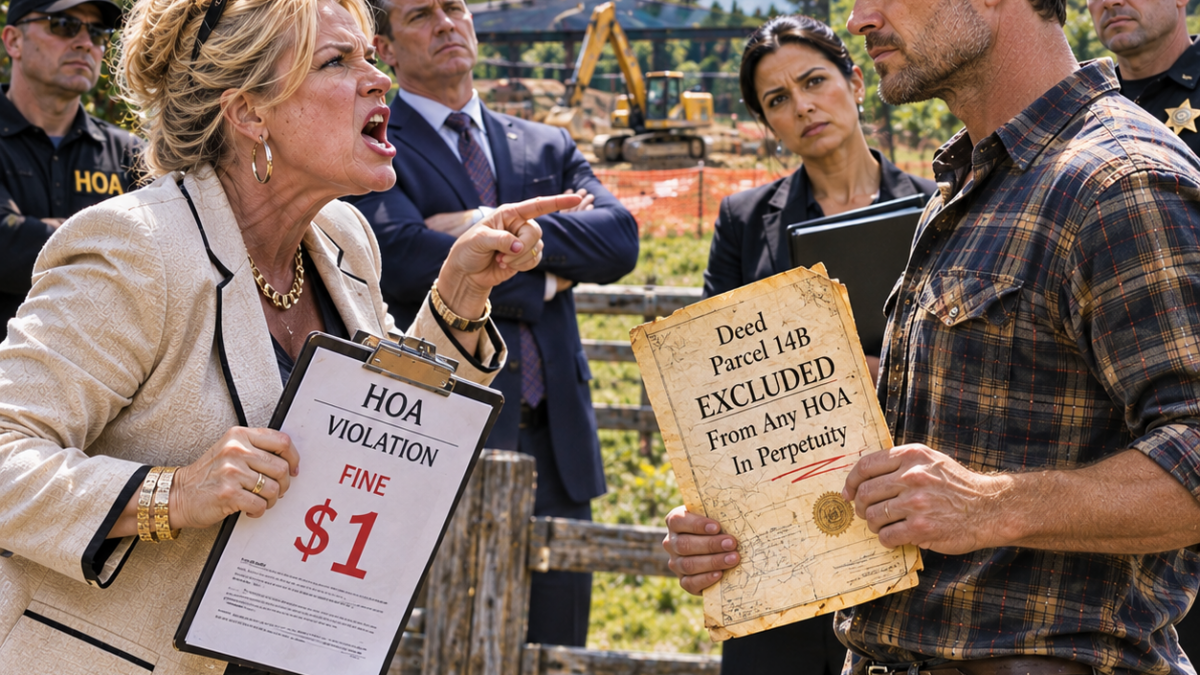
HOA Karen Fined Me Just $1—Then the County Learned That “Consent” Was Holding Up Her $99 Million Development.
The HOA fine was exactly one dollar, and that was the first thing that frightened me—because no homeowners association spends postage, staff time, and legal paperwork chasing a single dollar unless the money itself isn’t the point.
Seventy-two hours later, I would be standing in a packed county hearing holding that same dollar while the HOA president watched her $99 million development lose the only access road that made the entire project possible.
But the real trap wasn’t the fine—it was the signature line beneath it, because if I had signed without reading one word near the top of the page, I would have given them something my grandfather had spent his final years trying to protect.
My name is Ethan Brooks.
For sixty-three years, my family has owned an apple orchard in Marlow County.
It isn’t enormous.
Forty-three acres.
A farmhouse.
Two equipment barns.
A little farm stand beside County Route 9.
And row after row of apple trees stretching down a gentle slope toward Mill Creek.
My grandfather Walt planted the first row in 1963.
He did it by hand.
No irrigation system.
No hired crew.
Just Walt, my grandmother Rose, and a borrowed tractor that broke down twice before the first twelve trees were in the ground.
By the time I was born, the orchard had become the kind of place people recognized from the road.
Red barns.
Weathered fencing.
Wooden apple crates stacked by the stand every September.
Families came for cider.
Kids ran between the rows.
My grandfather knew half the county by first name.
Then Marlow County changed.
The farms around us disappeared one by one.
Hay fields became subdivisions.
Old barns became shopping centers.
The dirt road at our southern boundary became a four-lane boulevard.
And eventually, Silverbrook Estates grew around our orchard like concrete water rising around an island.
Four hundred luxury homes.
Stone entrance monuments.
Decorative ponds.
Private clubhouse.
Tennis courts.
Swimming pools.
Artificial waterfalls.
Everything landscaped within an inch of its life.
They hated the orchard.
Not openly at first.
Silverbrook’s first board sent polite letters.
Would we consider replacing the old rail fence?
PART2:
Would we remove the rusted tractor beside the equipment barn?
Could we stop running the cider press before 8:00 a.m.?
Could we screen the farm equipment from neighborhood view?
Grandpa answered every letter the same way.
No.
Then he’d put it in a drawer.
He didn’t dislike the people living there.
He disliked anyone who believed moving next to a farm gave them the right to redesign it.
After he died, the letters started coming to me.
I handled them the same way.
The orchard wasn’t inside Silverbrook.
Never had been.
Our deed predated the development by decades.
We didn’t pay HOA dues.
We weren’t subject to their architectural rules.
And as far as I knew, the relationship was simple.
They had their property.
I had mine.
Then on a Tuesday morning in June, Linda Hargrove walked through my front gate holding a white piece of paper.
Linda was the HOA president.
Mid-fifties.
Perfect blond bob.
Cream slacks.
PART3:
Navy blazer despite the heat.
The kind of smile that always made me feel like I’d entered a negotiation before anyone told me what we were negotiating.
“Morning, Ethan.”
“Linda.”
“I have something minor we need to clean up.”
She handed me the notice.
Across the top:
SILVERBROOK ESTATES HOMEOWNERS ASSOCIATION
NOTICE OF VIOLATION
I laughed before I reached the bottom.
Fine assessed:
$1.00.
“One dollar?”
Linda smiled.
“Administrative minimum.”
“For what?”
She pointed.
“Unapproved property markers.”
I looked toward the orchard.
Orange survey stakes ran beside the southern fence.
I’d put them there because a surveyor was scheduled later that week.
“Those are on my property.”
“We believe they’re within Silverbrook’s managed boundary.”
“You believe wrong.”
“That’s why we have procedures.”
I looked back at the notice.
One dollar due Friday.
After Friday:
$50 per day.
That was strange enough.
Then Linda extended a clipboard.
“Just sign acknowledgment of receipt and give me the dollar.”
Her pen was already clicked open.
“Seriously?”
“It saves everybody time.”
I took the clipboard.
“I’m not driving to the bank for a dollar.”
She laughed.
“Cash is fine.”
“I probably have one in the truck.”
“Perfect.”
She held out the pen again.
“Signature first.”
My hand moved.
I almost signed.
That’s the part I still think about.
I wasn’t intimidated.
I wasn’t fooled by some elaborate legal strategy.
I was bored.
It was a dollar.
I wanted Linda gone so I could finish replacing irrigation tubing before the afternoon heat.
The most dangerous paperwork in the world is often the paperwork you don’t think matters enough to read.
I put the pen tip near the signature line.
Then something above it caught my eye.
ACKNOWLEDGMENT OF ASSESSMENT AND MEMBERSHIP STATUS.
I stopped.
“Membership?”
Linda’s smile stayed in place.
“What?”
“This says membership status.”
“Standard language.”
“I’m not a member.”
“It’s boilerplate.”
“Then why do I need to acknowledge it?”
Her expression tightened almost invisibly.
“You’re acknowledging receipt of the fine.”
“That’s not what the title says.”
“Ethan.”
I flipped the page.
There were two more paragraphs.
One referred to continuing assessment obligations.
Another referenced community infrastructure benefits.
I handed the clipboard back.
“I’ll have my attorney look at it.”
Linda laughed softly.
“For one dollar?”
“Yes.”
“You’re going to pay a lawyer hundreds of dollars to review a one-dollar fine?”
“If it’s really just a dollar, you shouldn’t care.”
That was the first moment her smile disappeared.
Only briefly.
Then it came back.
“Friday.”
She tapped the notice.
“After that, fifty dollars per day.”
“I heard you.”
She walked away.
I watched her get into a black SUV.
I should have gone back to work.
Instead I stood at the gate staring at that dollar amount.
An HOA never wastes a stamp on one dollar.
That thought wouldn’t leave me.
That night, around 9:30, headlights came slowly up my driveway.
Then went dark.
Old Ford pickup.
Frank Delaney climbed out.
Frank owned twelve acres north of mine.
Seventy-two years old.
Retired electrician.
One of those men who had apparently been born sixty years old and simply continued from there.
He didn’t come to the porch.
He waved me toward the truck.
“What’s wrong?”
He looked toward Silverbrook.
“Linda come see you?”
I stopped.
“Yes.”
“Dollar?”
Now I was listening.
“How do you know that?”
Frank looked sick.
“Don’t pay it.”
“What?”
“Don’t sign anything either.”
“Why?”
He rubbed one hand over his mouth.
“They got me with that.”
“When?”
“Two years ago.”
“You’re in Silverbrook?”
“No.”
“Then what did you pay?”
“One dollar.”
He looked at me.
“Exactly one.”
The hair rose on my arms.
“What happened?”
Frank leaned against the truck.
“They said one of my fence posts was outside compliance.”
“You don’t belong to the HOA.”
“I know.”
“They fined you anyway?”
“One dollar.”
“And you paid?”
Frank nodded.
“They gave me the same form.”
“You signed it?”
“Yes.”
“What did it do?”
His voice dropped.
“I still don’t know all of it.”
“Frank.”
“I thought it was nothing.”
He looked toward the glowing monument at the end of the road.
Then said:
“Ask her about Crossing.”
“What crossing?”
He pointed.
I followed his finger.
Silverbrook had recently installed an enormous illuminated billboard near the main entrance.
I had driven past it dozens of times.
Never stopped.
That night I did.
SILVERBROOK CROSSING
400 NEW HOMES
LUXURY LIVING • RETAIL • GREEN SPACE
COMING SOON
$99 MILLION MASTER DEVELOPMENT
Below it was a stylized site map.
Existing Silverbrook on the east.
New development west.
A main boulevard connecting both.
I stepped closer.
Looked at the road.
Then at the orchard.
The proposed entrance cut directly through my property.
Not near it.
Through it.
Right down the middle of Grandpa’s oldest apple rows.
I stood there under the billboard lights staring at a glossy green line labeled:
SILVERBROOK CROSSING PARKWAY.
It entered from the existing subdivision.
Crossed County Route 9.
Then continued directly across Parcel 14B.
My parcel.
My orchard.
I drove home.
Didn’t sleep.
Instead I went to Grandpa’s study.
I hadn’t properly entered the room since the funeral.
His desk remained against the wall.
Old books.
County maps.
Pencils in a coffee mug.
A faded photograph of Grandma standing beside the farm stand.
I remembered something he’d told me years earlier.
“If you ever think a deed is boring, that’s because nobody’s trying to steal the land yet.”
I had laughed.
That night it didn’t sound funny.
I pulled drawers.
Files.
Old tax receipts.
Nothing.
Then I remembered the floorboard.
As a kid, I’d watched Grandpa hide emergency cash beneath a loose plank beside the bookcase.
I pulled it.
There was no cash.
There was a rusted tin box.
Inside:
A yellowed deed.
Old survey map.
Several letters.
And a check.
Silverbrook Estates HOA.
Pay to:
Walter Brooks.
Amount:
$1.00.
Dated 2009.
Stamped:
PAID.
My stomach dropped.
Underneath it was an envelope.
ETHAN.
Grandpa’s handwriting.
I opened it.
Son,
If you’re reading this, they’ve come for the orchard again.
In 2009, Silverbrook mailed me a one-dollar check.
They called it a courtesy reimbursement for a boundary marker.
I cashed it because I thought it was ridiculous.
It was the biggest mistake I ever made with this land.
They later claimed the payment proved I accepted association benefits.
Never take their dollar.
Never sign their paper.
I stopped.
Read it again.
They had done this before.
To Grandpa.
The letter continued.
The answer is in the deed.
Parcel 14B was protected when Silverbrook’s original land was divided.
They know it.
That’s why they need your consent.
Protect the trees, son.
They were never for sale.
Walt.
My hands were shaking.
I unfolded the deed.
Page one.
Page two.
Then page four.
I stared.
Page three was missing.
I searched the tin box.
Desk.
Floor.
Nothing.
Gone.
At sunrise, I walked outside.
Another notice had been stapled to my gate.
PAST DUE.
Balance:
$51.
One-dollar fine.
Plus first $50 daily penalty.
Below it:
LIEN REMEDIES MAY APPLY.
Down the road, a survey truck was parked partly across my southern field.
Two men were setting equipment.
And beside them stood Garrett Voss.
I’d seen Garrett’s picture in the business section.
Developer.
Silverbrook Crossing.
Dark suit despite the mud.
Expensive boots probably ruined within five minutes.
He watched me approach.
“Ethan Brooks.”
“You’re on my land.”
“We’re confirming preliminary alignment.”
“Leave.”
He smiled.
“You haven’t heard the offer.”
“I don’t care.”
“Six million.”
I stopped.
Not because I wanted it.
Because it was more than I expected.
“For what?”
“Road corridor and development rights.”
“How much land?”
“Approximately eight acres.”
“The middle eight.”
“Yes.”
“Splits the orchard.”
“We would compensate you.”
“You’d destroy it.”
“You’d retire.”
“I like working.”
Garrett smiled.
“Everybody likes money.”
“Not everybody likes you.”
The survey crew suddenly became very interested in their equipment.
Garrett stepped closer.
“Sign the HOA acknowledgment.”
I looked at him.
“What does that have to do with your road?”
He didn’t answer.
There it was.
“Nothing,” he said finally.
“Then stop asking.”
He slipped his hands into his pockets.
“I can make you a very rich man, Ethan.”
“I already have what I want.”
“That can change.”
“Is that a threat?”
His smile became colder.
“Refuse long enough, and I’ll make you a very poor man.”
I pulled out my phone.
“Say that again.”
His smile disappeared.
He walked away.
The surveyors followed.
That afternoon, a courier arrived.
Formal demand.
Pay $51.
Sign acknowledgment.
Deadline:
Seventy-two hours.
Failure would result in all available remedies against the property.
I looked at the date.
Friday.
Then I looked at Silverbrook Crossing’s public county schedule.
Final planning commission vote:
Friday.
6:00 p.m.
Seventy-two hours.
Same deadline.
Now I knew the dollar wasn’t the target.
Time was.
I called Priya.
She had represented my family in a drainage dispute years earlier.
Sharp.
Patient.
Absolutely incapable of being impressed by fancy letterhead.
She arrived that evening.
Read the violation.
Then read it again.
Then she went completely quiet.
“What?”
“This isn’t a fine.”
“It says fine.”
She looked at me.
“It’s a trap.”
I sat.
She pointed to the acknowledgment.
“This language can be used to establish that you recognize HOA jurisdiction.”
“I don’t.”
“I know.”
“Does signing really do that?”
“Not automatically.”
She held up one finger.
“Important distinction.”
I nodded.
“They can’t magically make you an HOA member because you signed a receipt. But if they’re building a larger record of voluntary recognition—payments, accepted benefits, acknowledgments—they can use it as evidence.”
“Evidence for what?”
Priya pulled up the county planning application.
Silverbrook Crossing.
Transportation access.
Affected parcels.
Then she found an attachment.
Her face changed.
“What?”
“They listed your orchard.”
“As what?”
“Consenting parcel.”
I stood.
“What?”
She turned the laptop.
Parcel 14B.
Status:
ASSOCIATION-AFFILIATED / CONSENT SATISFIED.
Supporting history:
2009 consideration payment accepted by landowner.
One dollar.
Grandpa’s check.
“They’re using that?”
“Yes.”
“That’s insane.”
“Maybe.”
She continued reading.
“But insanity filed properly still has to be defeated.”
“What does the county require?”
“Uninterrupted control or consent for every parcel in the primary access corridor before final approval.”
“So without me?”
“No road.”
“No road?”
“No project.”
I stared at the screen.
“Ninety-nine million dollars.”
“That’s the advertised development value.”
“And they need my orchard.”
“At least for this access design.”
Priya looked toward the old deed.
“What does Walt’s letter say?”
I showed her.
She read.
“Where’s page three?”
“Missing.”
“Recorded county copy?”
“Should exist.”
“When does records close Friday?”
“Five.”
“Hearing six.”
Priya looked at me.
“We find page three.”
Friday afternoon I walked into the Marlow County Records Office at 3:02.
Two hours before close.
Marge Whitfield worked behind the counter.
Sixty-something.
Reading glasses.
A voice that made everybody sound twelve.
“What do you need?”
“Recorded deed for Parcel 14B. Original filing.”
She entered the number.
Went into the back.
Returned with a thick file.
Page one.
Page two.
Page four.
My stomach dropped.
“Marge.”
“I see it.”
“Where’s three?”
She frowned.
“Shouldn’t happen.”
She checked the file jacket.
Then the circulation log.
Stopped.
“What?”
Her finger rested on a line.
Two weeks earlier.
Document removed for certified-copy review.
Signed:
LINDA HARGROVE.
I stared.
“The HOA president checked out my deed page?”
“She signed for the file.”
“Where is it?”
“Supposed to be here.”
“It isn’t.”
Marge looked toward the office supervisor.
Then back at me.
Lowered her voice.
“There may be another copy.”
“Where?”
“Microfilm.”
“Great.”
“In the basement.”
“Let’s go.”
“The reader doesn’t work.”
My heart sank.
Marge looked at the clock.
4:29.
Then grabbed a key ring.
“Come on.”
“You’re allowed?”
“No.”
That was my favorite answer all week.
The basement vault smelled like dust and paper.
Rows of film canisters.
Old county archives.
Marge found 1962 property division records.
Parcel 14B.
Microfilm reel.
She loaded it into an ancient reader.
Motor whined.
Image flickered.
Page one.
Two.
Then static.
Machine died.
“No.”
Marge slapped the side.
Nothing.
4:41.
“Can you copy the film another way?”
“Not here.”
“Tomorrow?”
“Monday.”
“The hearing is in an hour.”
She looked genuinely sorry.
Then my phone rang.
Frank.
I answered.
His voice was shaking.
“Ethan.”
“What?”
“They’re at your orchard.”
“Who?”
“Survey crew.”
My pulse jumped.
“They’re pulling your stakes.”
I ran.
Priya met me at the orchard.
So did Frank.
A crew was removing orange survey stakes along my southern boundary.
Linda stood nearby filming.
“What the hell are you doing?”
The workers stopped.
Linda smiled.
“Removing unauthorized markers.”
“Those are my survey stakes.”
“Inside HOA-managed property.”
“Get off my land.”
She raised the phone.
“Threatening contractors won’t help you Friday.”
I walked toward the closest remaining stake.
“Don’t touch that.”
One worker pulled.
The orange stake came free.
And something glinted underneath.
Small brass cap.
Flush with soil.
Stamped:
Parcel monument.
Linda saw it.
Her hand started shaking.
Frank whispered:
“That’s one of the originals.”
I photographed it.
Then another.
We found three.
The old property division was physically marked in the ground.
Linda stopped recording.
“Those don’t prove anything.”
I looked at her.
“Then why are you shaking?”
She walked away.
At 11:52 that night, Priya came into my kitchen carrying her laptop.
“Marge got it.”
“What?”
“Microfilm service contractor.”
She opened the screen.
Scanned page three.
Recorded 1962.
Parcel 14B.
Priya read aloud.
“Parcel Fourteen-B shall remain excluded in perpetuity from any homeowners’ association, successor association, assessment district, or private common-interest governance established upon adjoining parcels.”
I stopped breathing.
She continued.
“No roadway, drainage corridor, common facility, or development access may cross Parcel Fourteen-B without separately executed written permission from the Brooks owner or lawful heirs.”
I sat down.
“Excluded in perpetuity.”
“Yes.”
“So Grandpa’s dollar?”
“Doesn’t override the deed.”
“His cashed check?”
“No.”
“The fine?”
“No.”
“The acknowledgment?”
“If you had signed it, they would’ve had something new to argue with.”
“But I didn’t.”
Priya smiled.
“No.”
Her phone buzzed.
She read.
The smile disappeared.
“What?”
“Voss’s lawyers filed an emergency motion.”
“For what?”
“To bar you from interfering with the hearing based on alleged established HOA membership.”
I laughed.
Priya didn’t.
“They know page three exists.”
“How?”
“I don’t know.”
“They took the county copy.”
“Looks that way.”
“What do we do?”
She closed the laptop.
“We go to the hearing.”
Friday.
5:52 p.m.
County administration building.
Parking lot packed.
News vans.
Silverbrook residents.
Development consultants.
Union representatives.
Engineers.
People wearing suits expensive enough that I briefly wondered whether Garrett had ordered them in bulk.
Inside, every seat was taken.
Silverbrook Crossing dominated the presentation screen.
$99 MILLION INVESTMENT.
400 HOMES.
ROAD IMPROVEMENTS.
NEW TAX BASE.
Linda stood at the podium.
Garrett sat behind her.
Priya and I stood along the back wall.
Chairman Tom Reyes opened the final consent review.
An engineer presented the road alignment.
Then Tom asked:
“All affected parcels secured?”
Linda approached the microphone.
“Yes.”
“Every parcel?”
“One hundred percent.”
Priya looked at me.
I held the folder tighter.
Tom asked:
“Any outstanding owner objections?”
I stood.
“I object.”
The room turned.
Linda smiled.
It was almost impressive.
“Mr. Brooks is an association member in good standing.”
I walked forward.
“No, I’m not.”
“His dues history demonstrates otherwise.”
“What dues?”
Linda lifted a document.
“Recorded financial consideration.”
I reached the podium.
Pulled out Grandpa’s canceled check.
One dollar.
Then I pulled a dollar bill from my wallet.
Held it up.
“This?”
A few people laughed.
Linda didn’t.
“This is the consideration you’re talking about?”
She said:
“It’s evidence of voluntary affiliation.”
“No.”
I held up Grandpa’s 2009 letter from Silverbrook.
“This letter came with the check.”
Priya had found it among the tin-box papers.
I read:
COURTESY REIMBURSEMENT FOR REPLACEMENT OF TEMPORARY BOUNDARY MARKER.
“No membership.”
I looked at Linda.
“No dues.”
I held up the dollar.
“No consent.”
The room went quiet.
Priya stepped forward.
“And there is something more important.”
Certified copy.
Page three.
She handed it to Chairman Reyes.
Tom read silently.
Then asked:
“County certified?”
Marge Whitfield stood in the third row.
“Yes.”
Linda turned.
I hadn’t known Marge was coming.
Priya had.
Tom read the clause aloud.
“Excluded in perpetuity.”
The words changed the room.
“No association.”
Linda’s smile disappeared.
“No assessment.”
Garrett leaned toward one of his attorneys.
“No roadway or development access without written permission from the Brooks heirs.”
Tom looked at me.
“Mr. Brooks, have you given permission?”
“No.”
Garrett stood.
“Chairman, this is an archival document whose enforceability requires—”
Priya interrupted.
“You may litigate enforceability. But the application states consent has already been obtained.”
Tom looked at Garrett.
“That appears inaccurate.”
Linda suddenly snapped.
“That page is a forgery.”
Silence.
Tom looked at her.
Linda continued.
“The original is locked in my—”
She stopped.
Too late.
I actually saw the moment she understood what she’d said.
Tom leaned forward.
“Locked in your what?”
Linda’s face turned pale.
Nothing.
Marge walked toward the front carrying a records sign-out log.
She held it up.
“Mrs. Hargrove checked out the deed file two weeks ago.”
Linda looked at her.
“You had no authority to disclose—”
“Your signature is here.”
Marge laid the log on the table.
Tom stared.
“Was the page present when Mrs. Hargrove received the file?”
“Yes.”
“When it was returned?”
“No.”
Garrett whispered something to Linda.
She turned completely white.
Then Chairman Reyes asked a question nobody expected.
“How many people in this room have received or paid a one-dollar assessment, reimbursement, fee, or similar HOA transaction connected to property outside Silverbrook?”
Frank stood.
Raised his hand.
Then a woman behind him.
Another man.
Five.
Eight.
Ten.
More.
Hands across the back of the room.
People started talking.
“My father’s property.”
“They mailed us a dollar.”
“I signed a receipt.”
“They said it was administrative.”
“I paid it.”
Tom struck the gavel.
“Order.”
Garrett stood.
Slowly.
Turned toward the exit.
The doors opened before he reached them.
A woman entered wearing a dark state windbreaker.
Two deputies behind her.
She looked directly at Garrett.
“Mr. Voss?”
He stopped.
“I’m Investigator Dana Whitlock with the State Attorney General’s Office.”
Nobody moved.
Dana looked toward Linda.
“Mrs. Hargrove.”
Linda gripped the podium.
“This is a county planning hearing.”
“I know.”
Dana carried a thick folder.
“Our office has been reviewing financial activity associated with land-consent services connected to Silverbrook Crossing.”
Garrett’s attorney stood immediately.
“My client will not answer questions.”
Dana nodded.
“That’s his right.”
Then she opened the folder.
“Our investigation has identified approximately $1.4 million transferred from entities connected to Voss Development into an account linked to Mrs. Hargrove.”
The room erupted.
Tom hit the gavel.
Linda shouted:
“That isn’t what it looks like.”
Dana continued.
“Several transfers contain the memorandum description ‘consent services.’”
Linda turned toward Garrett.
“You said it was legal.”
Garrett said nothing.
For once, his silence was the most honest thing about him.
Dana did not arrest anybody in the hearing room.
She didn’t need to.
She was there because the state wanted documents preserved and the principal parties formally notified.
The criminal investigation would proceed on its own timeline.
The planning decision did not need to wait.
Chairman Reyes looked at the board.
Then at the application.
Then at me.
“Parcel Fourteen-B does not consent.”
“No.”
“Access corridor therefore lacks complete control.”
“Yes.”
Garrett’s land-use attorney rushed forward.
“We can redesign.”
Tom said:
“Not tonight.”
“The investment—”
“Not relevant to whether the submitted application is accurate.”
“The county will lose—”
“The application states one hundred percent consent.”
Tom held up the certified deed.
“It does not have one hundred percent consent.”
Then the vote.
Commissioner one:
“No.”
Two:
“No.”
Three.
Four.
Five.
Six.
Chairman Reyes last.
“No.”
Seven to zero.
Project approval revoked.
The gavel came down.
Outside, reporters were already shouting.
I didn’t feel triumphant.
Mostly I felt tired.
Priya touched my shoulder.
“You okay?”
“I think so.”
“You just shut down a ninety-nine-million-dollar project.”
“No.”
I looked toward the hearing-room doors.
“They built a ninety-nine-million-dollar project that depended on land they didn’t control.”
She smiled.
“That’s a very Ethan answer.”
By Monday, Silverbrook’s board had called an emergency meeting.
Linda resigned before the vote.
Three other board members followed.
The county reviewed every one-dollar consent filing connected to the Crossing project.
Properties that had been represented as HOA-affiliated without valid legal basis were removed from the consent list.
Some owners received refunds.
Others hired lawyers.
The developer’s financing froze.
Not because the county physically seized ninety-nine million dollars.
Because lenders do not release development money when the only approved access corridor has just lost consent.
The project did not disappear overnight.
Developers rarely disappear.
Garrett’s company tried alternate alignments.
Every one cost more.
Some required buying additional parcels.
Others needed new traffic studies.
The original schedule collapsed.
That was enough.
Meanwhile, the state investigation widened.
The $1.4 million in “consent services” became the center of it.
I didn’t pretend to know what every transfer meant.
That was the investigators’ job.
What I knew was simpler.
Linda had spent years using tiny transactions to manufacture a paper trail.
One dollar here.
One dollar there.
A signature.
An acknowledgment.
A “courtesy” check.
A trivial fine.
Nobody hires a lawyer over a dollar.
That was the brilliance.
And the ugliness.
The amount was designed to be beneath resistance.
Frank came to the orchard the following Saturday.
I was replacing the old wooden boundary stakes.
Not orange temporary stakes this time.
Stone markers.
Permanent.
We found the brass 1962 caps and set each marker directly beside one.
Frank carried the last stone with me.
He was crying.
I pretended not to notice until he said:
“I should’ve listened.”
“To who?”
“Myself.”
We lowered the marker.
He wiped his face.
“They got me because I didn’t want to look difficult over a dollar.”
“They almost got me too.”
“You didn’t sign.”
“My hand was on the paper.”
He stared.
“Really?”
“Really.”
We stood between the oldest apple rows.
I pulled Grandpa’s letter from my pocket.
It had been folded so many times the edges were soft.
I read the final line aloud.
“Protect the trees, son.”
Frank looked toward the orchard.
“They were never for sale.”
I nodded.
“No.”
October came.
The orchard turned red and gold.
Something changed in Silverbrook.
People came.
Not lawyers.
Not board members.
Families.
A few at first.
Then dozens.
For years, some Silverbrook residents had treated the orchard like an ugly reminder of what had existed before their neighborhood.
That fall they brought their kids to pick apples.
Frank set up a cider table.
Lorraine from the bakery brought doughnuts.
Someone strung lights along the farm stand.
A little boy asked me:
“Are these the trees they were going to cut down?”
His mother looked embarrassed.
“Don’t bother Mr. Brooks.”
“It’s okay.”
I crouched.
“Some of them.”
“Why?”
“To build a road.”
He looked around.
“But there’s already a road.”
I laughed.
“Exactly.”
Inside the farm stand, beside the cash box, I hung a small frame.
Inside:
One dollar bill.
Underneath:
NOT FOR SALE.
People asked.
I told them.
The HOA fined me one dollar.
That dollar almost gave them the evidence they needed to claim my land had accepted their authority.
My grandfather had cashed one years before.
The developer needed the orchard for the road.
The county needed valid consent.
The entire project had been built around the assumption that nobody would fight over something so small.
One woman stared at the frame.
“So that’s the dollar that stopped ninety-nine million dollars?”
“No.”
She looked confused.
“The deed did.”
I pointed toward the orchard.
“And my grandfather did.”
The dollar just made me look.
That became the part I remembered most.
The smallest number in the whole story had hidden the biggest risk.
One dollar.
Not six million.
Not $1.4 million.
Not ninety-nine million.
One.
Because the dollar was never about money.
It was about getting a signature from someone who felt ridiculous for hesitating.
That’s why I tell people the same thing whenever they ask about the framed bill.
If somebody puts a tiny fine in one hand and a pen in the other, don’t laugh so hard that you stop reading.
Ask what the signature actually acknowledges.
Ask what rights they’re claiming.
Ask why the amount is so small they know you probably won’t fight it.
Ask what happens after you sign.
Because Linda Hargrove nearly got my family’s orchard for the price of a gumball.
Not by buying it.
Not by condemning it.
Not by winning in court.
By betting that I would think one dollar was too insignificant to deserve my attention.
My grandfather had made that mistake once.
He spent the rest of his life making sure I didn’t repeat it.
Silverbrook Crossing never ran through the orchard.
The first row Walt planted is still there.
Some of the trunks lean now.
A few trees don’t produce much anymore.
I keep them anyway.
One afternoon after the harvest, I stood beside the oldest row and looked toward the Silverbrook entrance.
The enormous Crossing billboard had been taken down.
Only two steel posts remained.
My orchard was quiet.
Frank’s truck was parked by the barn.
Kids had left a few apples lying in the grass.
I took Grandpa’s letter from my pocket one more time.
Protect the trees, son.
They were never for sale.
For years, I thought that sentence was about sentiment.
Family.
Tradition.
Memory.
Now I understood it differently.
Grandpa wasn’t telling me to reject every offer forever.
He was telling me that no one else gets to decide the price of something that isn’t theirs.
Not an HOA president.
Not a developer.
Not a planning application.
And definitely not a one-dollar fine.
That dollar is still hanging beside the farm stand.
People call it the most expensive dollar in Marlow County.
I always correct them.
It never cost me anything.
Because I never paid it.








