HOA Karen Fined Me $5,000 Over My Propane Tank—Then I Found Their Sewer Pump on My Ranch and Shut Down the Entire Subdivision
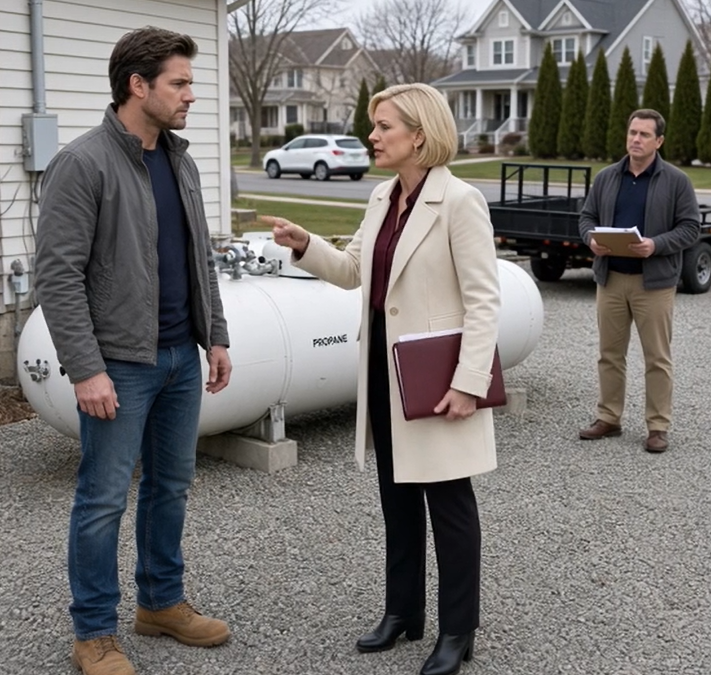
PART2:
The east pasture climbed gradually toward what eventually became Redstone Crest.
When I bought the ranch, there was no subdivision.
There was sagebrush.
Rock.
A busted horse paddock.
And a dirt road that ended at a gate nobody used.
I was thirty-six.
I had spent fifteen years working other people’s cattle, hauling hay, repairing equipment, and picking up winter construction work whenever ranch jobs slowed.
Earl Danner owned Harland Creek then.
Seventy-three.
Widowed.
No children interested in livestock.
I had worked for him off and on for three years.
The first time I asked what he wanted for the ranch, he laughed.
“You?”
“Yes.”
“You got money?”
“Some.”
“How much?”
“Not enough.”
He stared.
“At least you’re honest.”
PART3:
We talked for six months.
I borrowed more money than I was comfortable admitting to my mother.
Put almost everything I had into the down payment.
Earl carried part of the note.
For seven years, I worried about money before breakfast every morning.
Eventually the operation stabilized.
Not rich.
Never rich.
But mine.
That mattered.
Every acre had a job.
The west meadow produced hay.
The north paddocks handled spring grass.
The lower ground carried summer rotation.
And the eastern strip Redstone Crest would later treat like vacant dirt was critical to moving cattle between two larger grazing areas without putting livestock onto the county road.
A buried stock-water line crossed part of it.
So did a compacted cattle lane.
Nothing about that field looked expensive from the balcony of a seven-hundred-thousand-dollar house.
No landscaping.
No gazebo.
No pool.
No decorative stone.
Just grass.
That is the dangerous thing about working land near development.
People who do not understand it often mistake undeveloped for unused.
Redstone Crest began construction eleven years after I bought the ranch.
At first I did not care.
The developer owned the ridge.
If people wanted big houses overlooking cows, good for them.
I even sold the original developer a temporary construction-access license over a narrow corner of my eastern parcel.
Six months.
Dates written clearly.
Insurance requirements.
Restoration obligations.
Payment.
Most importantly, expiration.
They used it.
They paid.
They restored the lane.
The agreement ended.
That was how property arrangements were supposed to work.
Ask.
Write it down.
Use what was agreed.
Leave when it ends.
Then the homeowners moved in.
Most were fine.
Some even became customers.
A few bought freezer beef from me every fall.
Kids waved from the walking trail.
One retired couple named Frank and Delia Mercer used to bring me peach pie during branding season because Delia believed all cowboys were permanently underfed.
Then came complaints.
Dust.
Odor.
Flies.
Early equipment noise.
Cattle bawling.
One memorable letter demanded I control “excessive rooster activity.”
I did not own a rooster.
I called the management company.
The woman who answered sounded embarrassed.
“Mr. Harland, I’m very sorry.”
“Do I need to submit a picture of all my cows to prove none are roosters?”
“No.”
“That was going to be difficult.”
She laughed.
Then became serious.
“The HOA has no authority over your ranch.”
“I’m aware.”
“We’ll correct the mailing list.”
A week later I got an apology.
That should have settled the relationship.
For most residents, it did.
Then Monica Vale became board president.
Monica was in her early fifties.
Dark hair.
Gold earrings.
Designer sunglasses.
Always in a blazer.
Cobalt.
Red.
Cream.
White.
She walked with the posture of somebody who expected rooms to rearrange themselves when she entered.
Our first direct interaction was about manure smell after rain.
I was replacing wire near the county road when her white SUV stopped.
She stepped out.
“Mr. Harland?”
“Yes.”
“I’m Monica Vale, president of Redstone Crest.”
“I know.”
She looked annoyed that the title did not impress me more.
“We’ve received several complaints regarding odor.”
I looked toward the cattle.
Then back.
“From the cows?”
“Yes.”
“There are cows.”
“I can see that.”
“That probably explains it.”
Her lips tightened.
“The community has standards.”
“So does the county.”
“This ranch is zoned agricultural.”
“That doesn’t mean you have no nuisance obligations.”
“Correct.”
“So perhaps you could be cooperative.”
“I am.”
“How?”
“I’m telling you exactly who has jurisdiction.”
“If you believe I’m violating county nuisance rules, report it to the county.”
She stared.
“You’re a very difficult person.”
“I’m repairing a fence.”
“That isn’t what I meant.”
“I know.”
She left unhappy.
That became our pattern.
Monica brought a demand.
I asked for the legal basis.
She called me difficult.
I continued ranching.
Then came the propane tank.
The tank was not new.
It had sat behind the equipment shed for eleven years.
Five-hundred-gallon aboveground agricultural tank.
Set on concrete supports.
Used for a shop heater and backup generator.
It was inspected.
Setback-compliant.
Protected by steel bollards.
Nothing glamorous.
Nothing hidden.
Nothing illegal.
For eleven years, nobody cared.
Then I repainted it.
That was apparently the mistake.
The old coating had begun flaking, so I stripped rust and painted the tank bright white.
Three days later, I received a certified letter from Redstone Crest HOA.
NOTICE OF EXTERIOR VIOLATION.
Unauthorized utility storage vessel visible from community common area.
Fine:
$250.
Corrective action required within ten days.
I read it twice.
Then laughed.
The letter referenced Section 8.4 of the Redstone Crest Architectural Standards.
I was not in Redstone Crest.
I called the management company.
Different company now.
A man named Tyler answered.
I explained.
He put me on hold.
Came back.
“Mr. Harland, I see the violation.”
“Good.”
“Then you also see the address.”
“Yes.”
“Is Harland Creek Ranch listed as a lot in Redstone Crest?”
Pause.
“I’ll need to research that.”
“You don’t.”
“I’m telling you it isn’t.”
“The violation came through the board directly.”
“Who submitted it?”
“I can’t disclose—”
“Monica.”
He stopped.
“Mr. Harland—”
“Cancel it.”
“I need board authorization.”
“No.”
“You need a map.”
The next letter arrived two weeks later.
SECOND NOTICE.
Fine balance:
$500.
I sent a certified response.
My deed.
Parcel map.
County zoning classification.
A copy of the HOA plat with my property boundary highlighted in yellow.
And one sentence:
Harland Creek Ranch is not subject to Redstone Crest covenants, architectural standards, assessments, fines, or enforcement authority.
I thought that would end it.
Monica mailed a third notice.
$1,000.
Then a fourth.
$1,750.
The letters became stranger.
The tank was allegedly:
visually incompatible with neighborhood character.
A potential safety risk.
Detrimental to property values.
An unapproved commercial energy installation.
Then came the one that finally made me stop laughing.
FINAL DEMAND BEFORE COLLECTION ACTION.
Total claimed balance:
$5,000.
The association reserves all legal remedies, including collection, attorney’s fees, and lien enforcement where applicable.
I called Monica directly.
She answered on the second ring.
“Redstone Crest.”
“This is Wade Harland.”
“I assumed.”
“You’re threatening to lien land you do not govern.”
“I’m advising you of our remedies.”
“You have no remedies.”
“The tank impacts our community.”
“That doesn’t make me a member.”
“You benefit from road improvements, drainage infrastructure, landscaping—”
“I use none of them.”
“You benefit from increased regional property values.”
I laughed.
“That is not how covenants work.”
“You are being deliberately obstructive.”
“No.”
“I’m being deliberately outside your HOA.”
She went quiet.
Then:
“Move the tank behind the barn and this goes away.”
There it was.
Not safety.
Not law.
Visibility.
“Is that what this is about?”
“The tank is an eyesore.”
“It’s on my ranch.”
“Residents see it.”
“They also see cattle.”
“Don’t be ridiculous.”
“Would you like me to move those behind the barn too?”
“You know what I mean.”
“I do.”
That was exactly the problem.
I called an attorney.
Her name was Ellen Ruiz.
Forty-something.
Property and agricultural law.
Recommended by my farm bureau representative.
She read the letters.
Then looked over her glasses.
“This is either incompetence or bluffing.”
“Which?”
“Doesn’t matter yet.”
She sent one letter.
Four pages.
Polite.
Boring.
Effective.
Harland Creek Ranch was not encumbered by Redstone Crest declarations.
No contractual relationship existed.
Any further assertion of assessment authority could constitute improper collection conduct and interference with property rights.
Do not record anything against the parcel.
Do not contact Wade directly regarding HOA violations.
All communication through counsel.
The fines disappeared.
No apology.
No admission.
Just silence.
For six months.
I assumed Monica had finally found somebody on the board capable of reading a plat.
I was wrong.
During those six months, Redstone Crest had a bigger problem.
Wastewater.
The subdivision sat uphill from my ranch.
Early phases used a combination of gravity sewer and a smaller lift arrangement feeding into the regional district system.
Then the final phase added more houses than the original infrastructure comfortably handled.
There had been backups.
Alarm events.
High wet-weather flows.
Nothing catastrophic yet.
But enough that the utility district, county engineering staff, and Redstone Crest were working on an upgrade.
The plan included a new pump station and force main.
I knew almost none of this at the time.
Why would I?
Their sewer system was their business.
Then one Wednesday morning in late October, I heard heavy equipment from my east pasture.
That was unusual.
I had scheduled nothing.
I drove the pickup across the ranch.
Came over a small rise.
Hit the brakes.
Fence open.
Skid steer.
Excavator.
Conduit.
Trench.
Concrete.
Pump station.
For a few seconds my brain tried to force the scene into some explanation that made sense.
Maybe utility district easement I had forgotten?
No.
Maybe boundary farther uphill?
No.
I knew that fence.
I built half of it myself.
The new station stood approximately seventy yards inside my parcel.
Fresh concrete.
Control cabinet.
Electrical service stub.
Pipe heading uphill toward Redstone Crest.
Workers in reflective vests.
And Monica Vale.
Cobalt-blue blazer.
Black pants.
Leather portfolio.
Shoes that would never recover.
The contractor foreman saw me first.
“Morning.”
“Who authorized you to enter this ranch?”
He looked at Monica.
Answer enough.
Monica approached.
“Wade.”
“Why is there a pump station on my property?”
“This is the Redstone Crest wastewater upgrade.”
“I know what it is.”
“I asked why it’s here.”
“The board handled the necessary approvals.”
“With who?”
She opened the portfolio.
“The project has county approval.”
“Not what I asked.”
“You are being unnecessarily confrontational.”
I pointed at the fence opening.
“You drove an excavator through my cattle lane and poured a permanent concrete station seventy yards inside my property.”
“I’m being surprisingly calm.”
The foreman shifted.
His name, I later learned, was Aaron Pike.
He looked like a man realizing the person who signed his work order might not have been telling the whole truth.
Monica said:
“The association holds utility rights through this corridor.”
“Show me.”
“They’re part of the project file.”
“Show me.”
“I don’t carry every recorded instrument into a pasture.”
“You carried enough paperwork to threaten me.”
She ignored that.
I walked toward the control cabinet.
That was when she snapped:
“Touch that panel and I’ll have you arrested.”
Everyone stopped.
I turned.
“This is community infrastructure,” she said.
“I wasn’t going to touch it.”
“But if I did, you understand it is sitting on my side of the fence.”
“You have no right to interfere with critical infrastructure.”
“You keep using the word right.”
“I’m asking you to show me one.”
Then the county inspector arrived.
Ben Morrison.
Mid-forties.
Work boots.
Safety vest.
The expression of a man who had spent too many years watching people insist that approved project and approved installation were identical concepts.
He inspected before talking.
Pad.
Conduit.
Pipe.
Trench.
Survey stake.
Then plans.
His eyebrows drew together.
Monica noticed.
“This installation is approved.”
Ben looked up.
“I didn’t ask whether the project is approved.”
He pointed.
“I’m asking why it’s here.”
Monica’s jaw tightened.
“The site was adjusted.”
“Do you have the stamped revision?”
“The engineer coordinated it.”
Ben looked at Aaron.
Aaron looked toward his excavator.
Ben walked back to truck.
Twenty minutes of calls.
Monica paced.
I stood beside my pickup.
At one point she said:
“You understand delaying this project could expose you to significant liability.”
I almost admired the confidence.
“You’re standing on my property warning me about liability for delaying a structure I never authorized.”
“This infrastructure is necessary for hundreds of residents.”
“Then it should probably be installed where you have permission.”
“You really want to become the man who shuts down sewer service for families over a technicality?”
There it was.
The first attempt to make her decision my moral problem.
I said:
“A property line isn’t a technicality.”
Ben returned.
“Everybody hold.”
Aaron nodded immediately.
Monica said:
“For how long?”
“I need documents.”
“We are already behind schedule.”
“That is not my problem.”
Ben looked at me.
“You own Parcel 47-219?”
“Yes.”
“How long?”
“Nineteen years.”
“Any utility easement granted to Redstone Crest HOA or Canyon Regional Sanitation District along this line?”
“Not by me.”
“Prior owner?”
“Nothing on title when I bought.”
“Temporary construction license?”
“Yes.”
“Eleven years ago.”
“Expired after six months.”
Ben’s eyes changed.
“Do you have copy?”
“Yes.”
Monica jumped in.
“That may be the document.”
“No,” I said.
“It says temporary construction access.”
“It granted access.”
“For six months.”
“It established historical use.”
Ellen would later tell me Monica’s sentence was one of the most legally unhelpful things she could possibly have said in front of a county inspector.
Ben only asked:
“When did it expire?”
I gave date.
He wrote.
Then pointed uphill.
“The stamped set I have places the pump station one hundred twelve feet northwest of this location.”
Monica said:
“Field conditions required adjustment.”
“That happens.”
Ben stayed calm.
“But when permanent infrastructure crosses onto a different parcel, the revision requires property authorization.”
“We have it.”
“Great.”
“Show me.”
“I’ll have management send it.”
“Until then, no work.”
Monica’s face hardened.
“You’re issuing a stop-work order?”
“I am now.”
He pulled a bright orange form from clipboard.
Aaron muttered something under his breath.
Ben attached the notice to temporary fence.
Monica stared at me as though I had done it.
“You’re enjoying this.”
“No.”
And I meant it.
This was not funny anymore.
A five-thousand-dollar fake propane fine was funny.
An HOA pouring sewer infrastructure onto my ranch was expensive.
The trench had severed part of the cattle lane.
My stock-water pipe lay exposed.
Fence removed.
Grass torn up.
And I still did not know how they had convinced professionals they had rights to be there.
I called Ellen.
She arrived ninety minutes later.
County office sent survey technician.
Utility district engineer came too.
His name was Daniel Cho.
He carried rolled plan set.
He walked the boundary twice.
Then looked at Monica.
“This isn’t where we approved energization.”
Monica said:
“The board approved relocation.”
Daniel looked genuinely confused.
“The board cannot relocate district-connected infrastructure onto private property without an easement.”
“We were told the corridor was available.”
“By who?”
“Our project consultant.”
Aaron finally spoke.
“We received a site directive signed by HOA.”
Daniel turned.
“You didn’t confirm recorded easement?”
Aaron’s face reddened.
“We were given title exhibit.”
“Which exhibit?”
Monica said:
“This is becoming unnecessarily accusatory.”
Ellen arrived at exactly that moment.
She heard the last sentence.
“I’m Wade Harland’s counsel.”
Monica’s face changed.
Not much.
Enough.
Ellen looked at structure.
Then at me.
Then trench.
“Tell me nobody energized this.”
Daniel answered.
“Controls were powered for testing.”
“Any wastewater?”
“No.”
“Good.”
Ellen looked at Monica.
“Produce the easement.”
“We’re retrieving it.”
“Excellent.”
“We can wait.”
They could not.
Because there was no easement.
By 4:30 that afternoon, county records confirmed it.
No recorded Redstone Crest utility easement on Harland Creek Ranch.
No sanitation district easement.
No force-main easement.
No pump-station parcel.
No permanent access.
Only one historic instrument referencing subdivision construction:
the expired six-month license I had signed with the original developer eleven years earlier.
Somebody had used it.
The next discovery came the following morning.
Aaron’s company emailed Ellen the “property rights package” they had received before mobilization.
Inside:
county plat.
Utility plan.
A title exhibit.
And my old construction license.
Except the first page had been detached from the original attachment and included in a package labeled:
EXISTING ACCESS/EASEMENT DOCUMENTATION.
Nobody had changed my signature.
Nobody forged the document itself.
They had done something both simpler and stupider.
They presented an expired temporary license without emphasizing the expiration page.
Page three contained the date.
Page three was included.
But Monica had apparently assured the contractor and consultant the document established continuing access rights.
An engineer’s internal note said:
HOA confirms existing Harland corridor available for permanent utility placement; formal legal cleanup to follow if required.
Ellen read that twice.
Then handed it to me.
“What does formal legal cleanup mean?”
“It means somebody knew there was a problem.”
“Can they do that?”
“People can write almost anything in an email.”
“That wasn’t my question.”
“No.”
She sat back.
“They cannot acquire a permanent easement by describing one into existence.”
County issued full stop-work order for the relocated station.
Utility district refused to accept facility.
Electrical provider declined final service authorization without proof of property rights.
The pump station became a very expensive metal box sitting uselessly in my pasture.
That should have forced Monica to negotiate.
Instead, she escalated.
Two days later, Redstone Crest’s attorney sent Ellen a letter arguing the HOA possessed rights through:
implied easement.
Necessity.
Historical use.
Equitable reliance.
Possible prescriptive use.
Ellen read it at her desk.
Then said:
“They’re throwing every noun they know at the wall.”
“Any of them work?”
“No.”
“Why?”
“An implied easement usually comes from prior common ownership under specific circumstances.”
“Your ranch and subdivision were never one parcel in the relevant way.”
“Necessity?”
“They have another lawful station location.”
“More expensive does not mean legally necessary.”
“Historical use?”
“Temporary permission defeats the idea of adverse use.”
“Prescriptive?”
“Same problem.”
“You authorized access.”
“Permission is the opposite of adverse.”
I leaned back.
“So what do they actually have?”
“A concrete pad.”
“On my land.”
“Yes.”
“Great.”
Then Ellen smiled.
I had learned to worry when she smiled.
“There’s also the propane tank.”
“What about it?”
“Their prior fines.”
She pulled my old letters.
“They spent six months insisting property boundaries gave them rights over something visible from their subdivision.”
“Now they want boundaries treated as flexible because they built expensive infrastructure on wrong side.”
I smiled too.
“That useful?”
“Maybe not legally.”
“Very useful in front of humans.”
The Redstone Crest board scheduled emergency meeting.
Residents began asking questions because orange stop-work notice was visible from upper trail.
Rumors spread.
Sewer failure.
Rancher sabotage.
County dispute.
Environmental violation.
Monica sent a community email.
Due to an unexpected neighboring property-access challenge, the wastewater upgrade project is temporarily paused. The board is working diligently to protect homeowners from outside interference.
Outside interference.
That would have been me.
On my land.
Frank Mercer forwarded the email.
Subject line:
Thought you might enjoy this.
I did not.
I called him.
“People believe I’m blocking sewer service?”
“Some.”
“What do you believe?”
“I’ve known you nine years.”
“And?”
“You’re too cheap to block anything unless somebody made you.”
I laughed.
Delia yelled from background:
“Tell Wade Monica’s full of it.”
Frank said:
“Delia says good evening.”
The first public board meeting after stop-work drew almost two hundred people.
Redstone Crest clubhouse only seated eighty.
Others stood.
I had no intention of attending.
Ellen told me to.
“Why?”
“Because Monica has already made you the villain.”
“I don’t care what they think.”
“You will if two hundred angry homeowners start calling county commissioners.”
I went.
Jeans.
Work jacket.
No blazer.
Monica sat at front with board members.
Five people total.
Vice president Glen Mercer—not related to Frank—looked sick.
Treasurer Susan Kim had a stack of binders.
Association counsel sat at one side.
Monica opened meeting.
She spoke for twelve minutes.
Infrastructure.
Growth.
Community needs.
Unforeseen legal obstacle.
Neighboring landowner.
Historical corridor.
Time-sensitive completion.
Potential costs.
Then public comment.
A man stood.
“Is our sewer going to stop working?”
Monica:
“No.”
Another:
“Why was pump moved?”
“Engineering conditions.”
“Why onto his property?”
“Property rights are disputed.”
I almost stood then.
Ellen touched my sleeve.
Wait.
Frank got microphone.
“I have one question.”
“Did Wade sign an easement?”
Monica answered:
“The legal status is more complicated.”
Frank:
“That means no.”
Applause.
Monica banged gavel.
Then Delia stood.
Seventy-two.
Five feet two.
Dangerous when irritated.
“Did he sign anything?”
Monica:
“As I said—”
Delia:
“Ma’am, I have raised three children.”
“I recognize avoiding a yes-or-no question.”
Laughter.
Gavel.
Treasurer Susan leaned toward Monica and whispered.
Monica ignored.
Then a younger homeowner named Priya Shah asked:
“How much money has been spent at the disputed location?”
Silence.
Monica looked at treasurer.
Susan took microphone.
“Current construction expenditures attributable to the station and force-main segment are approximately one hundred forty-seven thousand dollars.”
Room changed.
Priya:
“How much would relocation cost?”
Susan:
“Preliminary estimate not final.”
“How much?”
Monica intervened.
“We’re evaluating.”
Priya:
“How much?”
Susan swallowed.
“Possibly eighty to one hundred twenty thousand additional, depending on salvage.”
Someone yelled:
“Are you kidding me?”
Another:
“Who approved moving it?”
Monica:
“The board.”
Glen Mercer suddenly said:
“No.”
Room went silent.
Monica turned.
“What?”
Glen lifted microphone.
“The board approved wastewater upgrade.”
“We did not vote to put station on Harland property.”
Monica’s face changed.
“Glen.”
“I reviewed minutes.”
“There was no parcel relocation vote.”
Susan looked down.
Another board member, Dr. Alan Webb, adjusted glasses.
“I also don’t remember such vote.”
Monica’s voice sharpened.
“The engineering subcommittee authorized field decisions.”
Glen:
“You chaired the subcommittee.”
Monica:
“With management.”
Susan:
“Did management approve easement?”
Association counsel leaned toward microphone.
“I recommend the board refrain from discussing privileged matters.”
Residents erupted.
Ellen whispered:
“There.”
“What?”
“The crack.”
Meeting dissolved into shouting.
Monica adjourned early.
It did not help.
By Monday, residents submitted records requests to HOA.
Colorado common-interest law required certain association records be available to owners.
Invoices.
Meeting minutes.
Contracts.
Communications.
Not everything.
Enough.
That was how the email surfaced.
Monica to management manager.
Sent six weeks before construction.
Subject:
PUMP STATION LOCATION.
The engineer is concerned the HOA parcel option requires additional retaining work and will increase cost significantly.
The Harland side is flatter and provides easier equipment access.
We have used that corridor before.
Proceeding there may save $80,000+.
Do not re-engage Harland unless absolutely necessary.
He has historically been unreasonable about community impacts and will likely attempt to extract a premium.
Management manager responded:
Do we have permanent easement rights?
Monica:
Counsel can clean up documentation afterward.
Existing access agreement should be sufficient to proceed.
That email changed everything.
Not because it proved some dramatic criminal conspiracy.
It proved knowledge.
She knew asking me was an issue.
She knew the station could be built on HOA-controlled land.
She knew moving it onto mine was cheaper.
And she chose to proceed first and “clean up” later.
Ellen read the email in silence.
Then:
“She thought once concrete was down, you’d have no choice.”
I understood immediately.
Facts on the ground.
Spend enough money.
Build enough infrastructure.
Then approach landowner and say moving it would harm everyone.
Make refusal look selfish.
Monica had not accidentally crossed the line.
She gambled that after crossing it, pressure would force me to accept.
That made me angrier than the pump station itself.
“What do we do?”
Ellen folded hands.
“What do you want?”
“Off my land.”
“Anything else?”
“Fence restored.”
“Lane restored.”
“Water line inspected.”
“Pasture repaired.”
“Legal fees.”
“Anything else?”
I thought about propane letters.
“No.”
She nodded.
“Good.”
“You don’t want money?”
“I want my ranch.”
That answer ended up saving me from several bad decisions.
Because the next three weeks got ugly.
Redstone Crest’s insurer became involved.
Contractor’s insurer.
Engineering consultant.
Management company.
Utility district.
County.
Everyone wanted to know who represented to whom that property rights existed.
Everyone had lawyers.
Nobody wanted to be the last person holding invoice.
Meanwhile, Redstone Crest’s old sewer arrangement continued operating.
Barely.
The new pump station had been scheduled because the upper phase was nearing capacity thresholds.
The county had already planned to issue additional certificates of occupancy once upgrade went online.
Without it, twenty-seven newly completed houses could not connect permanently.
The county froze final occupancy approvals for those homes.
Then heavy rain arrived.
Two days.
Saturated ground.
Inflow increased.
Old lift system alarmed three times.
Utility district deployed portable bypass pumping and issued temporary restrictions.
No irrigation discharge.
No pool draining.
Clubhouse showers closed.
Construction connections suspended.
Residents were asked to minimize nonessential water use during peak hours.
News stations described it as “Redstone Crest sewer shutdown.”
That phrase stuck.
I did not shut their sewer off.
Nobody cut pipes.
Nobody denied occupied families basic service.
The county and district imposed emergency controls because the subdivision’s planned capacity upgrade could not legally be accepted.
But facts made terrible headlines.
HOA Karen Fights Rancher—Subdivision Sewer Shut Down.
My phone started ringing.
Reporters.
Angry homeowners.
Supportive homeowners.
One man left voicemail:
“I hope you’re proud making kids unable to shower.”
His house had full water.
I deleted it.
Another said:
“My husband is on dialysis and all this scares us.”
I called that woman back.
Not because I caused the problem.
Because fear was real anyway.
I explained what utility district had told me.
Occupied homes remained served.
Emergency bypass in place.
No planned water shutoff.
She cried.
Then apologized.
I told her not to.
This was when I learned anger and information travel at different speeds.
Monica used that.
She sent another community email.
Mr. Harland’s refusal to allow continued access has created significant hardship and may delay critical wastewater improvements.
Ellen nearly levitated when she read it.
We sent cease-and-desist demanding correction.
Monica refused.
So Ellen recommended one thing I hated.
Public statement.
“I’m not doing television.”
“You don’t have to.”
“Statement only.”
She wrote three paragraphs.
I edited two words.
It said:
Harland Creek Ranch has never granted Redstone Crest HOA a permanent utility easement.
The HOA constructed a pump station and force-main segment on private ranch property without the owner’s authorization.
Mr. Harland has not requested payment to allow the installation to remain and has not interfered with lawful utility service.
He has requested removal of unauthorized infrastructure and restoration of damaged ranch property.
County and sanitation district decisions regarding project approval and service restrictions are made by those agencies, not Mr. Harland.
That was it.
No Monica.
No insults.
No propane story.
Yet.
The propane story came out anyway.
Frank posted copies of old HOA fine letters in the Redstone Crest resident forum after I gave permission.
His caption:
Interesting how our HOA insisted boundaries mattered when they fined the ranch, but now calls them “technical.”
Residents lost their minds.
Someone made side-by-side graphic.
LEFT:
PROPANE TANK — OUTSIDE HOA BUT “COMMUNITY IMPACT.”
RIGHT:
SEWER STATION — ON PRIVATE RANCH BUT “HISTORICAL CORRIDOR.”
Monica hated that graphic.
I know because she mentioned it at the next meeting.
“This community is being manipulated through social media memes.”
Delia Mercer shouted:
“The meme has your letterhead.”
The board meeting was standing-room only.
This time Monica did not control room.
Susan Kim, treasurer, had hired her own counsel.
Glen Mercer had requested independent review.
Alan Webb called for executive session.
Then a homeowner made motion from floor demanding Monica resign.
Procedurally meaningless.
Emotionally powerful.
She refused.
“I have done nothing except protect the association from unnecessary costs.”
Priya Shah stood.
“You saved eighty thousand by putting our sewer plant on land we didn’t own.”
“That is not an accurate characterization.”
Priya held printed email.
“It’s your characterization.”
Applause.
Monica’s voice rose.
“Mr. Harland has been hostile to this community for years.”
That was the moment I finally stood.
Ellen whispered:
“Keep it short.”
I took microphone.
“I don’t belong to your community.”
A few people murmured.
I continued.
“That isn’t an insult.”
“It’s a legal fact.”
“My ranch is next to Redstone Crest.”
“Your rules stop at your boundary.”
“Mine does too.”
“I didn’t tell you what color to paint your houses.”
“I didn’t fine you for outdoor furniture.”
“I didn’t tell you where to park.”
“Your HOA fined me five thousand dollars over a legal propane tank because you could see it from your trail.”
“Then your president used an expired access agreement to support moving permanent wastewater infrastructure onto my land without asking.”
Monica interrupted:
“That is disputed.”
I looked at her.
“No, Monica.”
“The easement is disputed.”
“The fact you never asked me is not.”
Silence.
I continued.
“I’m not asking your homeowners for money.”
“I’m not asking your HOA to buy my land.”
“I’m asking you to remove what you built without permission and put it where your approved plan originally put it.”
A man in back shouted:
“How long will that take?”
I looked toward utility district engineer Daniel Cho, who was attending.
“Ask the district.”
Daniel stood.
“Current estimate three to six weeks for temporary bypass arrangements and site relocation, assuming immediate board authorization.”
Another homeowner:
“And if they don’t authorize?”
Daniel hesitated.
“Then restrictions remain until lawful capacity solution is completed.”
That was when residents understood.
The person capable of ending the “shutdown” was not me.
It was their board.
Monica kept fighting for another ten days.
Why?
Pride.
Liability.
Maybe she believed conceding would make insurers blame her personally.
Maybe she believed pressure would eventually make me cave.
Then the county issued formal notice requiring removal or lawful authorization of encroaching infrastructure before project acceptance.
Utility district adopted resolution refusing service through the station on unowned property.
Engineering consultant withdrew certification of final location.
Contractor stopped billing except demobilization.
The path narrowed to one choice.
Move it.
Emergency board session.
4-1 vote.
Relocate to original HOA parcel.
Monica voted no.
That was effectively the end of her presidency.
She resigned forty-eight hours later.
Her resignation email was twelve paragraphs.
She blamed:
hostile neighboring interests.
media distortion.
board disloyalty.
county inflexibility.
contractor misunderstandings.
rapid growth.
outdated land records.
Everything except the sentence:
I made a bad decision.
The new interim president was Susan Kim.
Her first call was to me.
“Mr. Harland.”
“Wade is fine.”
“Wade.”
Pause.
“I owe you an apology.”
“You personally?”
“No.”
“The association.”
“That’s different.”
“Yes.”
She sounded tired.
“I’ve reviewed the file.”
“All of it.”
“I understand why you’re angry.”
“I’m past angry.”
“What are you now?”
“Busy.”
She laughed once.
First honest laugh I had heard from an HOA officer in years.
“We’d like to negotiate restoration.”
“Talk to Ellen.”
“I will.”
Then:
“One more thing.”
“What?”
“The propane fines.”
I waited.
“They should never have been issued.”
“No.”
“We are formally rescinding them.”
“They were already unenforceable.”
“I know.”
“We’re still putting it in writing.”
A week later I received letter.
Not apology exactly.
Better than nothing.
The association acknowledges Harland Creek Ranch is not subject to Redstone Crest governing documents and has no outstanding assessments, fines, or enforcement obligations to the association.
I framed it.
Not in house.
In shop.
Above propane tank inspection records.
Ellen called that petty.
I called it documentation.
Relocation took thirty-two days.
The HOA-approved site uphill required retaining wall and additional trenching.
More expensive.
Exactly why Monica moved it.
Contractors removed control cabinet from my pasture.
Broke concrete.
Excavated pad.
Removed pipe segment.
Repaired stock-water line.
Rebuilt cattle lane.
Replaced fence.
Reseeded damaged ground.
Ellen hired independent agricultural restoration consultant.
At first HOA insurer complained.
Then contractor insurer covered part.
Association covered deductible and certain excluded costs.
Final direct cost to Redstone Crest exceeded the original eighty-thousand-dollar “savings” by more than double when legal fees, bypass pumping, redesign, and restoration were included.
I never learned exact full number.
Residents claimed $214,000.
Someone else said $238,000.
Susan would only say:
“More than anyone should ever spend to avoid knocking on a neighbor’s door.”
That was accurate enough.
The new station eventually went online.
Restrictions lifted.
Pending houses received occupancy approvals.
No environmental disaster.
No families displaced.
No children deprived of showers.
The subdivision survived.
That is another thing about dramatic conflicts.
People often talk as if one mistake will destroy everything.
Usually life becomes inconvenient.
Expensive.
Embarrassing.
Then people fix it.
The legal aftermath continued longer.
The HOA pursued claims against its former management company and project consultant.
Contractor pursued change-order compensation.
Insurance carriers argued.
I stayed mostly out.
My settlement with association was simple.
They paid restoration expenses, attorney fees related to encroachment, and compensation for temporary loss of pasture use and cattle-lane disruption.
No lottery money.
No mansion.
No revenge jackpot.
Enough to make me whole.
That was what I wanted.
Monica moved out of Redstone Crest eight months later.
I did not throw a party.
I found out because Frank told me.
“House sold.”
“Good for her.”
“That’s it?”
“What do you want me to do?”
“Dance.”
“My knee hurts.”
Delia shouted from background:
“He’s boring.”
I remained boring.
The ranch needed work.
Winter hay.
Calving.
Equipment.
The eastern pasture looked scarred for months.
Fresh seed took slowly.
Fence posts were newer than the rest.
Concrete removal left a pale patch that eventually greened.
Cows did not care.
That helped.
Animals have no interest in symbolic victories.
Grass grows or it doesn’t.
Water works or it doesn’t.
Fence holds or it doesn’t.
Simple.
The propane tank stayed exactly where it had always been.
White.
Visible.
Legal.
About six months after station relocation, Susan invited me to Redstone Crest annual meeting.
I declined.
She called again.
“We’re revising boundary and adjacent-property policy.”
“That sounds thrilling.”
“It isn’t.”
“Then why would I come?”
“Because we want someone to explain where we went wrong.”
“Your attorney can.”
“He will.”
“Then you’re covered.”
Pause.
“Residents asked for you.”
“No.”
“Why?”
“I don’t belong to your HOA.”
She laughed.
“Point taken.”
They revised policies anyway.
Any project involving adjacent private land required:
recorded easement verification by counsel.
parcel-owner written consent.
board vote recorded in minutes.
independent survey confirmation before mobilization.
No enforcement letters could be issued to non-HOA parcels.
I did not need the details.
But Frank showed me.
“Look.”
He pointed at first line:
The Association acknowledges its authority is limited to property and persons subject to its governing documents.
I smiled.
“That took lawyers?”
“Apparently.”
Life returned to normal.
Mostly.
But something changed between ranch and subdivision.
People began asking before assuming.
A resident called before trimming brush near my fence because she was not sure where line sat.
Another asked whether kids could photograph calves from outside gate.
Someone reported a broken strand of wire instead of complaining.
I started waving more.
Not because HOA won me over.
Because homeowners were not Monica.
That distinction mattered.
It is easy to turn institutions into faces.
HOA becomes Monica.
Rancher becomes me.
But Redstone Crest had 241 homes by then.
Teachers.
Veterans.
Nurses.
Retirees.
Engineers.
Families.
Most had never seen pump plan.
Most had trusted elected board.
Most were as surprised as I was.
Frank once said:
“You know what people are embarrassed about?”
“What?”
“We complained about your cows while our sewer station was sitting in your pasture.”
I laughed.
“You didn’t put it there.”
“No.”
“Still.”
Delia handed me peach pie.
“Eat.”
Some justice arrives in court.
Some arrives in pie.
Two years later county planner contacted me.
Redstone Crest wanted to build pedestrian trail extension near ranch boundary.
Not on my land.
Near.
Planner wanted verification.
I met them.
Survey stakes.
Maps.
Susan came too.
Different HOA president by then, but still on board.
She stood beside line.
Trail stayed twelve feet inside common parcel.
Drainage routed away from cattle lane.
No easement needed.
Before meeting ended she asked:
“Anything else?”
I looked.
“No.”
“That’s it?”
“That’s it.”
She smiled.
“Almost disappointing.”
I understood.
The relationship had become boring.
Boring is underrated.
A year after that, my propane regulator failed.
I replaced it.
The new assembly was slightly taller.
Visible from the subdivision trail.
I was tightening fitting when a white SUV slowed on county road.
For one absurd second my body remembered Monica.
Then window rolled down.
It was Priya Shah.
“New tank?”
“Regulator.”
“Legal?”
I stared at her.
She laughed.
“Joking.”
“Dangerous hobby.”
She drove on.
I laughed too.
That was when I knew whole thing was finally over.
Not when Monica resigned.
Not when pump moved.
Not when settlement check cleared.
When somebody from Redstone Crest could joke about propane tank and neither of us needed to reach for a lawyer.
Years later, people still tell story wrong.
They say:
“Wade shut down an entire subdivision because HOA fined him.”
Not really.
They say:
“He turned off their sewer.”
Absolutely not.
They say:
“He owned the land under all their utilities.”
No.
They say:
“The HOA forged his deed.”
No.
The truth was less cinematic and more useful.
An HOA president spent too much time treating influence like ownership.
First she tried to enforce subdivision aesthetics against land outside her subdivision.
Then, when a public infrastructure project became expensive, she treated a temporary access agreement as if it gave permanent rights.
She assumed asking permission would cost money.
So she decided asking forgiveness later would be cheaper.
That calculation failed.
Not because I was clever.
Because property records existed.
Plans existed.
Expiration dates existed.
Meeting minutes existed.
Emails existed.
And eventually enough people read them.
The most satisfying moment was not Monica resigning.
It was not the stop-work notice.
It was not residents confronting her.
It happened months later in the east pasture.
The contractors had finished restoration.
I walked the cattle lane alone.
New fence.
Fresh gravel.
Water line repaired.
Seed just beginning to catch.
The spot where pump station had stood was still visible.
A rectangle of disturbed earth.
Nothing else.
No cabinet.
No concrete.
No orange mesh.
No humming equipment.
Just land.
My land.
A young heifer walked over.
Sniffed the fresh soil.
Then relieved herself directly where Monica had once stood in her cobalt-blue blazer threatening to have me arrested.
I laughed so hard I had to lean against fence.
Nobody was there to see it.
Which somehow made it better.
I never hated Redstone Crest.
I hated being told that somebody else’s convenience created rights over my property.
There is a difference.
Communities need infrastructure.
Subdivisions need sewer systems.
Cities grow.
Ranches sell.
Boundaries change.
People have to cooperate.
But cooperation is not:
We spent money, therefore you must accept what we did.
It is not:
Everyone benefits, therefore your consent is optional.
It is not:
We represent hundreds of homeowners, therefore one landowner matters less.
Real cooperation begins before the excavator arrives.
It begins with a phone call.
A map.
A question.
Maybe compensation.
Maybe no.
Maybe another route.
Maybe eighty thousand dollars more.
That is what ownership means.
Not unlimited power.
The right to be asked.
People later wanted some grand lesson.
Property rights.
HOA overreach.
Government process.
Corporate arrogance.
Take your pick.
Mine was simpler.
Whenever somebody tells you something “has already been handled,” ask one question.
By whom?
Monica kept saying:
The board handled it.
The engineer handled it.
Management handled it.
County approved it.
Everyone handled something.
Nobody handled the most basic part.
The land was mine.
Nobody asked me.
That single omission stopped a project, delayed twenty-seven homes, forced emergency sewer bypass operations, cost the association more than twice what Monica had hoped to save, removed a board president, triggered insurance claims, and turned a five-thousand-dollar propane fine into the most expensive lesson Redstone Crest ever received.
All because one woman believed the easiest person to ignore would eventually become the easiest person to pressure.
She was wrong.
I did not shut down Redstone Crest because I was angry about a propane tank.
I did not shut anything down at all.
I simply refused to pretend they owned something they did not.
The county did the rest.
And once the paperwork caught up with the concrete, the entire subdivision learned something every rancher already understands.
A fence is not merely something that keeps cattle in.
Sometimes it is the line that keeps everybody else honest.








