HOA Karen Fined Me $2,400 for Mooring My Own Boat—Then State Agents Found 31 Illegal Dock Leases Worth $558,000
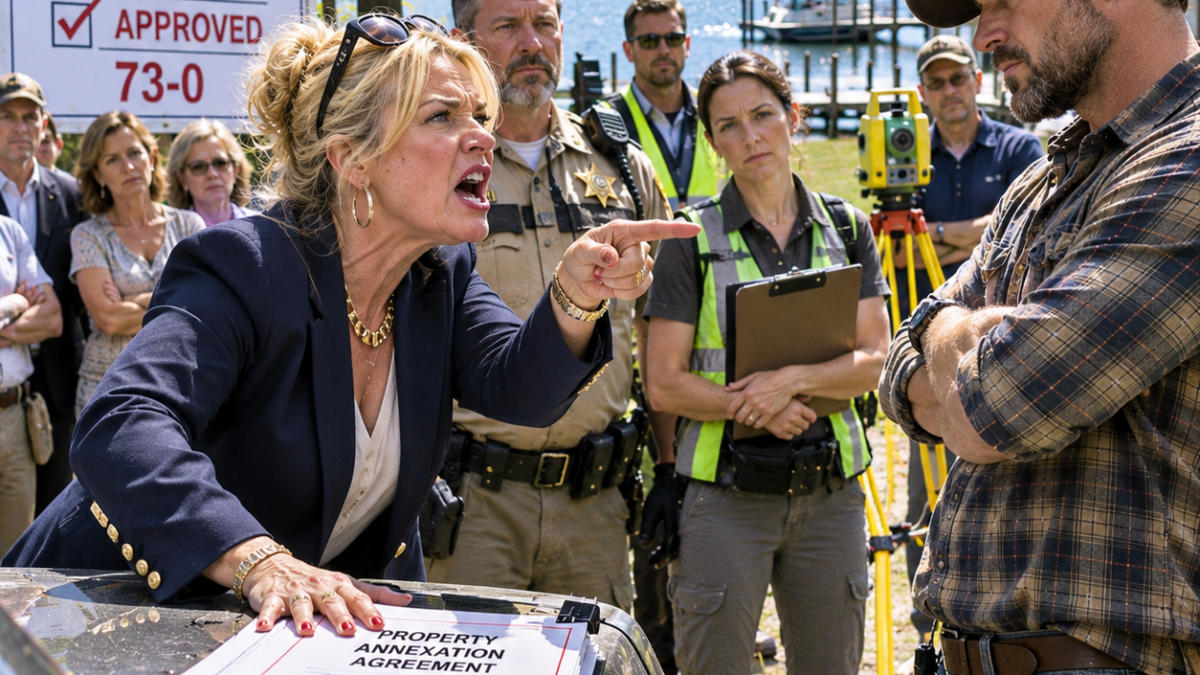
HOA Karen Fined Me $2,400 for Mooring My Own Boat—Then State Agents Found 31 Illegal Dock Leases Worth $558,000
The red violation notice was nailed to my boathouse before sunrise, demanding $2,400 because I had supposedly moored my own fishing boat illegally in water I had been using for six years.
Across the cove, HOA president Karen Vardell stood beside thirty-one brand-new numbered slips and told me I had forty-eight hours to pay or move—but when I asked who had given her authority over my shoreline, she smiled and said, “Thirty-one people already trust me with it.”
Ten days later, two state agents opened a sealed blue folder in front of those same thirty-one people and discovered Karen had sold $558,000 worth of exclusive dock leases on public water she had no commercial right to control—and the only thing standing between her and the money was a signature she had been trying to trick out of me from the beginning.
I found the notice at 6:15 on a gray October morning.
I remember the time because I looked at my phone twice.
Once when I left the house.
Again when I saw the red paper.
My name is Davis Huxley.
I was fifty-four years old, had spent almost twenty years repairing marine engines and dock equipment, and owned a small house on Alder Wake Lake in northern Michigan.
Nothing fancy.
Cedar siding.
One-car garage.
Old gravel driveway.
A narrow strip of shoreline with a boathouse my father and I had rebuilt when I bought the place.
I wasn’t rich.
But the house was paid for.
The land was mine.
The boathouse was mine.
And the twenty-four-foot aluminum fishing boat tied beside it was absolutely mine.
I had kept that boat in the same place for six years.
Same mooring ring.
Same bow line.
Same stern line.
Every spring I renewed the private mooring permit required by the state.
The current permit was hanging in a plastic sleeve inside the boathouse.
That morning, however, a bright red piece of paper had been driven through the wooden door with a roofing nail.
HOA VIOLATION NOTICE.
I stared at it.
Then laughed.
Not because it was funny.
Because I wasn’t in an HOA.
My property sat west of Cedar Hook Shores, a gated subdivision that stretched along the eastern side of the cove.
They had eighty-something landscaped homes.
A clubhouse.
Tennis courts.
A swimming platform.
Matching mailboxes.
Rules about garbage cans.
I had none of those things.
My parcel had been created decades before Cedar Hook existed.
I had never joined.
Never signed covenants.
Never paid dues.
Never voted in their elections.
PART2:
Never asked permission from them to do anything.
Yet the notice listed three separate violations.
$800 each.
UNAUTHORIZED MOORING WITHIN COMMUNITY-CONTROLLED WATERFRONT ZONE.
Total due:
$2,400.
One violation was dated fourteen days earlier.
The second nine days earlier.
The third three days earlier.
I looked at my boat.
It had not moved.
Someone had simply counted the same boat three times and turned one invented violation into three.
I took photographs.
The notice.
The nail.
The boat.
The shoreline marker.
The mooring permit.
The view across the cove.
That’s when I noticed Karen.
She was walking toward me.
Not alone.
Karen Vardell was fifty-two and had been president of Cedar Hook Shores for almost five years.
She wore white sneakers, fitted black pants, and a navy quilted vest with the Cedar Hook logo embroidered over one breast.
Two property-management employees followed her carrying clipboards.
She looked across the water at my boat.
Then at me.
“Good morning, Davis.”
“Karen.”
PART3:
“I see you found the notice.”
“Hard to miss.”
She smiled.
“That was intentional.”
I pulled it from the door.
“You fined me twenty-four hundred dollars.”
“Three violations.”
“For one boat.”
“Three separate documented occasions.”
“The boat hasn’t moved.”
“That doesn’t matter.”
“It seems relevant.”
Karen’s expression remained pleasant.
“Cedar Hook recently adopted updated waterfront-management standards.”
“I don’t live in Cedar Hook.”
“The standards cover the community-managed water zone.”
“What community-managed water zone?”
She turned and pointed across the cove.
That’s when I really looked.
New floating docks.
A lot of them.
Bright white decking.
Metal pilings.
Branching sections extending into the cove.
Numbered markers every twenty or thirty feet.
C-01.
C-02.
C-03.
All the way down.
At the entrance was a sign that had not been there the week before.
PRIVATE MARINA
RESERVED BERTHS ONLY.
I looked back at Karen.
“When did the HOA become a marina?”
Her smile tightened.
“The association has always had authority to manage community waterfront.”
“Your waterfront.”
“The entire eastern shoreline zone.”
“This is the western side.”
“The lake doesn’t care what your deed says.”
I stared at her.
She actually said it.
The lake doesn’t care what your deed says.
“Well,” I said, “the county does.”
One of the management employees looked down.
Karen ignored that.
“You have forty-eight hours.”
“To do what?”
“Pay the penalties or remove the boat.”
“No.”
Her smile vanished.
“No?”
“No.”
She looked almost surprised.
People probably did not say that to her often.
I went inside the boathouse.
Came back with my deed copy and mooring permit.
“Here’s the permit.”
She didn’t look.
“And here’s the parcel description.”
Nothing.
“Do you have something recorded showing Cedar Hook controls my mooring?”
She pointed at the notice.
“I’m holding it.”
“That isn’t what I asked.”
“Our rules have been reviewed.”
“By whom?”
“Our attorney.”
“Great. Have him send me the recorded authority.”
Karen stepped closer.
“You’re making this unnecessarily difficult.”
“I’m standing beside a boat I’ve kept here legally for six years.”
“Things change.”
“Property rights don’t change because you printed a red piece of paper.”
Her jaw tightened.
“If the boat is still here in forty-eight hours, we will arrange removal.”
“You mean towing.”
“If necessary.”
“Put that in writing.”
“It is in writing.”
“No.”
I held up my phone.
“Tell me on camera that you’re ordering a towing company to remove my permitted boat from property outside your HOA.”
Her eyes went to the phone.
For the first time that morning, she hesitated.
Then she turned.
“You’ve been warned.”
Her little procession walked away.
I kept filming until they disappeared.
People like Karen depend on panic.
Panic makes people pay.
Panic makes people sign.
Panic makes people move things before they understand why they were told to move them.
Documentation makes that harder.
I spent the next hour photographing everything.
My property markers.
The mooring.
The distance from shore.
The new marina.
The numbered slips.
Then I drove to the Cedar Hook office.
I submitted a written request for three things.
The HOA’s governing documents.
Minutes showing adoption of the new waterfront rule.
Any recorded instrument granting Cedar Hook authority over my property or mooring.
Twenty minutes later, Karen invited me into the conference room.
This time she had an attorney.
Gray suit.
Glasses.
Mid-fifties.
He introduced himself as Martin Cole, counsel for Cedar Hook Shores.
Karen unrolled a glossy map across the table.
The cove had been shaded blue.
My shoreline included.
Across the top:
CEDAR HOOK SHORES COMMUNITY WATERFRONT MANAGEMENT AREA.
It looked impressive.
Professionally designed.
Color-coded.
Absolutely meaningless.
There was no surveyor seal.
No legal description.
No county recording stamp.
No parcel number.
No state authorization.
I pointed.
“Who prepared this?”
Karen said:
“Our planning consultant.”
“Licensed surveyor?”
Martin interrupted.
“This isn’t a boundary proceeding.”
“Then why are you using it to tell me where your authority ends?”
Silence.
I tapped my property.
“This parcel isn’t part of Cedar Hook.”
Karen said:
“Water-use rules are different.”
“Show me.”
Martin folded his hands.
“Internal HOA documents aren’t available to nonmembers.”
I looked at him.
Then at Karen.
“So let me understand.”
Neither answered.
“You’re saying HOA rules apply to me.”
“Yes,” Karen said.
“But because I’m not a member, I can’t see the records creating those rules.”
Martin spoke carefully.
“That’s an oversimplification.”
“No. That’s the exact contradiction.”
Karen slid another document across.
“Let’s resolve this instead.”
Four pages.
Settlement agreement.
First page:
HOA cancels $2,400 penalty.
I almost laughed.
Then I saw the attachment.
ACCESS ACKNOWLEDGMENT AND SHORELINE USE ADDENDUM.
I read.
Access across my property.
Long-term duration.
Rights assignable to third parties.
Commercial access language hidden beneath paragraphs about liability and maintenance.
I looked up.
“Why does settling a boat fine require me to grant access across my land?”
Karen answered immediately.
“Insurance.”
“For what?”
“Marina safety.”
“What marina?”
Her face tightened.
I continued reading.
The agreement would allow people to cross a twelve-foot strip along the northern edge of my parcel.
Not just HOA staff.
Authorized users.
Invitees.
Licensees.
Third parties.
I closed it.
“No.”
Karen leaned forward.
“Davis, this is the easiest solution for everyone.”
“For you.”
“You owe twenty-four hundred dollars.”
“No, I don’t.”
“We’ll erase it.”
“In exchange for access rights.”
“Standard administrative language.”
“Then remove it.”
“We can’t.”
“Then I’m not signing.”
The attorney said:
“You may want independent counsel before rejecting an accommodation.”
“I may.”
I stood.
Karen said:
“You’re going to regret making this hostile.”
I looked at her.
“You nailed a $2,400 fake fine to my building before sunrise.”
Then I left.
That afternoon, the Cedar Hook newsletter went out.
It never used my name.
Didn’t need to.
AN UNCOOPERATIVE NEIGHBORING LANDOWNER IS CURRENTLY OBSTRUCTING IMPORTANT WATERFRONT SAFETY IMPROVEMENTS.
Underneath was a photograph of my boathouse.
Two days later, a woman in a golf cart stopped on the road above my property.
“You should move your boat.”
“Why?”
“You’re holding up the marina.”
“What marina?”
She stared at me like I was joking.
Then drove away.
Someone left a handwritten note in my mailbox.
STOP BEING SELFISH.
Karen had turned a property dispute into a public campaign.
So I stopped dealing with Karen.
I dealt with records.
My deed confirmed exactly what I knew.
Outside Cedar Hook.
No HOA covenant.
No waterfront restriction.
No association authority.
But there was something buried in an appendix.
Twelve-foot maintenance easement.
Recorded more than forty years earlier.
That concerned me.
An easement is a right.
Not ownership.
But rights can survive subdivisions.
I needed to know what it said.
Before I could pull the original, a man named Walter Fenner came roaring across the cove in a silver runabout.
Too fast.
He cut the throttle near my dock.
“Davis?”
“Yes.”
“You need to move that boat.”
“Why?”
“It’s blocking the marina turning basin.”
“According to who?”
“Cedar Hook.”
I looked at the laminated tag tied to his bow.
C-17.
“You leased one of those slips?”
Walter puffed up slightly.
“Yes.”
“How much?”
His expression changed.
“That’s private.”
“Then why are you on my dock asking about my boat?”
He exhaled.
“Eighteen thousand.”
I stared.
“What?”
“Ten-year lease.”
“For that floating slip?”
“Yes.”
“From the HOA?”
“Of course.”
“Have you seen the commercial marina permit?”
Walter frowned.
“The HOA handles permits.”
“Who signed your contract?”
“Karen.”
“In her capacity as HOA president?”
“I assume.”
I looked across the cove.
Thirty-one numbered slips.
Some incomplete.
Several walkway sections not even anchored properly.
“When does it open?”
“Showcase next week.”
“And you’ve already paid?”
“Yes.”
Walter’s confidence was disappearing.
He looked at my boat.
“We were told you’re demanding money.”
“What?”
“Karen said you’re refusing access because you’re trying to force the association to buy your shoreline.”
I laughed.
Not happily.
“Walter, no one has offered to buy anything.”
He looked at me.
“That isn’t what we were told.”
“I’m beginning to understand.”
Karen had built two stories.
To Cedar Hook residents, I was the selfish neighbor creating a safety issue.
To paying marina customers, I was the greedy landowner holding their expensive leases hostage.
Every person who paid her money became pressure against me.
Clever.
I asked:
“Do you have your contract?”
“Of course.”
“Read it.”
“I already did.”
“No.”
I looked at him.
“Read every page.”
He drove away angry.
That evening, I hired Mason Reddick.
Licensed hydrographic surveyor.
Specialized in waterfront boundaries, submerged-land permissions, riparian access, and the strange legal territory where private property meets public water.
He found the easement three days later.
“It is valid.”
My stomach dropped.
“So Karen has access.”
“Keep reading.”
The easement had been created before Cedar Hook existed.
At the time, the land behind my parcel was a farm.
The document allowed the rear landowner to cross a twelve-foot strip for one purpose:
Inspection and maintenance of a stormwater drainage system running to the lake.
When the farm was subdivided, that limited right eventually transferred to Cedar Hook.
“So they can cross.”
“Yes.”
“For drainage.”
“Yes.”
“Marina guests?”
“No.”
“Dock carts?”
“No.”
“Boat owners?”
“No.”
“Commercial access?”
“Absolutely not.”
Mason tapped the page.
“An easement does not become whatever the dominant owner finds convenient.”
He looked at me.
“Karen has a right.”
He pointed.
“She just doesn’t have the right she’s claiming.”
That distinction saved me from making a serious mistake.
I’d considered blocking the path entirely.
If I had, Karen could legitimately accuse me of interfering with drainage maintenance.
Instead, we documented exactly what the easement allowed.
The next morning, two flatbed trucks arrived.
Karen had sent them.
Drivers showed me authorization for “drainage maintenance.”
The trucks carried floating dock sections.
Mooring cleats.
Galvanized pilings.
No pipe.
No drainage equipment.
No excavation tools.
I smiled.
“What are you repairing?”
The lead driver looked at his paperwork.
“Drainage access.”
“What drainage component?”
He looked again.
“I just deliver.”
“Work order?”
None.
I photographed the cargo.
Delivery sheet:
CEDAR HOOK MARINA — PHASE TWO.
Mason photographed it too.
The trucks left.
Karen emailed within an hour accusing me of interfering with easement rights.
I forwarded the email to my attorney.
No response needed.
That afternoon, Mason completed the first survey.
My legal mooring position.
Twelve-foot easement.
Actual drainage outfall.
Proposed marina pathway.
They did not line up.
Then Mason unfolded another map.
There was a dashed boundary farther into the lake.
“What’s this?”
“State-managed submerged land.”
He pointed.
“Public lakebed.”
“So?”
“Your friend’s new dock anchors are beyond the permitted area.”
“Which ones?”
He marked several.
“Those.”
I stared across the cove.
“Can they do that?”
“With authorization.”
“Do they have it?”
“We’re going to find out.”
Public-record requests revealed the answer.
Cedar Hook had a permit.
One permit.
For a single shared non-commercial community dock.
Residential use.
No paid berths.
No marina.
No commercial leasing.
Any major expansion required state review.
Karen’s thirty-one-slip operation was not remotely covered.
I filed an inspection request with the state agency responsible for submerged public lands.
Talia Brooke called two days later.
She was exactly the kind of government inspector I wanted.
Boring.
Careful.
Unimpressed by anybody’s emotions.
“You have photographs.”
“Yes.”
“A survey.”
“Preliminary.”
“Commercial-use evidence?”
“A man told me he paid eighteen thousand.”
“Written contract?”
“Not yet.”
“Then I have a dock expansion to inspect, not necessarily an illegal marina.”
“Understood.”
“I need documents.”
“I’ll get them.”
Karen learned I’d contacted the state almost immediately.
The HOA issued a statement calling the numbered slips “temporary event equipment.”
The berth numbers suddenly became “organizational markers.”
Then orange buoys appeared around the cove.
Conveniently arranged so my fishing boat looked like it sat inside a restricted marina zone.
I left the boat exactly where it was.
Mason and I surveyed from public water.
Two full days.
GPS.
Anchors.
Pilings.
Dock geometry.
Buoys.
Approved state footprint.
The differences were enormous.
We sent everything to Talia.
Then Walter called.
His voice had changed.
“Can I come over?”
“Sure.”
He arrived at eight the next morning.
No boat.
Truck.
Manila envelope.
He sat at my kitchen table.
Didn’t take his coat off.
“I read it.”
“The contract?”
“All of it.”
He pushed it toward me.
Ten-year exclusive berth lease.
C-17.
Initial payment:
$18,000.
Then I saw the company name.
Vardell Waterfront Management LLC.
Not Cedar Hook Shores HOA.
I looked at Walter.
“Who is this?”
“Karen.”
“Her company?”
“Yes.”
“How do you know?”
“State business registry.”
The signature at the bottom:
Karen Vardell
Authorized Representative
Vardell Waterfront Management LLC
My heart started beating faster.
She had not been leasing HOA slips.
She was using an HOA project to operate her own private marina company.
The brochure attached to Walter’s contract made it worse.
PREMIUM COMMERCIAL MARINA.
EXCLUSIVE WATERFRONT ACCESS.
SECURE LONG-TERM BERTHS.
The state authorization allowed none of it.
Then I saw the site diagram.
The access walkway for paying customers followed the northern edge of my property.
The exact twelve-foot strip covered by the old drainage easement.
I understood the $2,400 fine instantly.
Karen wasn’t trying to collect $2,400.
She needed the access.
My signature would convert a narrow drainage easement into something broad enough to serve commercial marina customers.
I looked at Walter.
“Did she tell you access was secured?”
“Yes.”
“In writing?”
“Brochure says guaranteed.”
He rubbed both hands over his face.
“I put retirement money into this.”
“How much?”
“Eighteen.”
“I know.”
“No.”
His voice broke slightly.
“I cashed out part of an IRA.”
I hated hearing that.
Walter looked at me.
“Withdraw the complaint.”
“What?”
“Just temporarily.”
“Walter—”
“If the marina opens, maybe everything gets fixed.”
“The state still hasn’t authorized commercial use.”
“Then they’ll get the permit.”
“Maybe.”
“And your land access—”
“No.”
“Davis.”
“No.”
He slammed one palm on the table.
“You’re going to cost me eighteen thousand dollars.”
I remained seated.
“No.”
His face flushed.
“Karen might.”
Silence.
I pushed the contract back.
“If I help her open an illegal business, more people can lose money.”
Walter stared at the paper.
“I’m already in.”
“I know.”
“Then what am I supposed to do?”
“Help me stop it before there are thirty more Walters.”
That landed.
He sat for almost an hour.
Eventually he pushed the contract toward me.
“Copy it.”
“You sure?”
“Use it.”
I scanned every page.
Walter signed written authorization allowing us to provide it to regulators.
Talia called within an hour.
“This is what I needed.”
“Enough?”
“Enough to formally investigate commercial leasing.”
The next morning, Karen came to my shoreline.
Alone.
No staff.
No clipboard.
No smile.
She looked at my boat.
Then me.
“Twenty-four thousand.”
I almost thought I’d misheard.
“What?”
“I’ll pay you twenty-four thousand dollars.”
“For?”
“Withdraw the state complaint.”
I stared.
“Move the boat temporarily.”
Nothing.
“And sign the access acknowledgement.”
There it was.
“Why twenty-four?”
“Ten times your fine.”
“My fake fine.”
Her jaw tightened.
“Davis, take the win.”
“What win?”
“You get money.”
“And you get access.”
“The community gets access.”
“No.”
Her face changed.
“What?”
“I saw Walter’s lease.”
She froze.
“C-17.”
Nothing.
“Vardell Waterfront Management.”
Still nothing.
“This isn’t the community’s marina.”
Her voice dropped.
“You don’t understand the structure.”
“Then explain.”
“It’s a management arrangement.”
“Why is your private company collecting eighteen thousand dollars per slip?”
She stared.
“Send your offer through your lawyer.”
I walked toward the boathouse.
She followed three steps.
“You are destroying something people are depending on.”
“No.”
I turned.
“You sold them something you didn’t have permission to sell.”
Her face turned red.
“You’re selfish.”
“Maybe.”
“You’re small.”
“Could be.”
“You will regret this.”
“Put that in writing too.”
She left.
Talia wanted more leases.
Walter helped.
That mattered.
A week earlier, he’d been furious with me.
Now he called other berth holders.
Some hung up.
Others listened.
Several sent contracts.
Wire-transfer receipts.
Emails.
Almost every agreement looked identical.
Ten-year term.
$18,000 initial payment.
Numbered berth.
Vardell Waterfront Management.
Exclusive access.
Davis’s shoreline shown as part of the marina approach.
Mason completed his sealed final survey.
That became our technical evidence.
My attorney filed for a temporary order protecting my boat from towing.
The judge issued exactly what we requested.
The HOA could not tow or remove it without lawful authority.
The order explicitly preserved legitimate drainage access.
Perfect.
I didn’t want more.
Karen received the order Thursday.
By Thursday evening, she emailed everyone that the marina showcase would proceed.
I later learned she said:
“We will not allow one neighbor’s harassment to stop progress.”
Meanwhile, the Cedar Hook treasurer began looking at money.
Her name was Evelyn Pruitt.
Nine years on the board.
Meticulous.
Quiet.
She found $146,000 pulled from HOA reserves.
Roof money.
Road money.
Emergency money.
Payments to dock contractors.
But every payment was coded:
DRAINAGE SYSTEM STABILIZATION.
The actual drainage system had not been touched.
Evelyn called an attorney.
Smartest thing she could have done.
She provided records through proper legal channels.
Then Talia scheduled the inspection.
Same morning as Karen’s marina showcase.
That was not an accident.
Talia wanted everything deployed.
Every dock.
Every berth holder.
Every contract.
Every numbered sign.
I planned to arrive by boat.
The night before, another person called.
Hollis Crane.
Independent escrow administrator.
“I have records relevant to tomorrow.”
“What records?”
“Berth contracts.”
“How many?”
“All of them.”
I sat down.
“What do you mean all?”
“Thirty-one.”
Silence.
“And there is a disbursement condition I believe the state inspector needs to understand.”
“What condition?”
“I’ll explain tomorrow.”
At nine the next morning, the Cedar Hook lawn looked like a wedding reception.
White balloons.
Folding chairs.
Podium.
Coffee.
Pastries.
Residents in fleece and boat shoes.
Potential customers.
Families.
At the end of the dock:
CEDAR HOOK PRIVATE MARINA
EXCLUSIVE WATERFRONT ACCESS
Karen wore a navy blazer.
Microphone.
Perfect smile.
I approached from the water.
My fishing boat idled slowly through the public navigation channel.
Completely legal.
I reached my mooring.
Killed the engine.
Stepped onto my dock.
Across the cove, Karen stopped talking.
Then recovered.
“Ladies and gentlemen, you are seeing exactly the obstruction we’ve been dealing with.”
Several people turned toward me.
Karen held up the red notice.
“This neighboring landowner has ignored twenty-four hundred dollars in lawful penalties.”
I smiled.
She ordered two dock attendants to prepare my boat for towing.
They approached.
I held up the court order.
“Before either of you touches the boat, read this.”
They did.
One looked at the other.
Then at Karen.
Neither moved.
“Do your job!”
The younger attendant shook his head.
“Ma’am, the order says we can’t.”
Karen stepped off the podium.
That’s when Talia arrived.
Hard-sided case.
Beside her walked a uniformed state waterway enforcement officer.
Karen’s voice stopped.
Talia introduced herself.
“We’re conducting the scheduled inspection.”
“This is a private HOA event.”
“Not the water.”
Silence.
Mason arrived with the survey.
I brought my binder.
Talia compared everything.
Approved original dock.
Current footprint.
My mooring.
Drainage easement.
Marina access.
State submerged-land boundary.
Pilings.
Anchors.
Unauthorized extensions.
Karen argued the docks were temporary.
Talia asked:
“Do you have authorization for commercial use?”
Karen opened her folder.
Flipped pages.
Closed it.
“No commercial activity has begun.”
Talia looked toward the numbered slips.
Then toward the crowd.
“How many people here have paid for a berth?”
Walter raised his hand.
Then another person.
Another.
More.
Talia opened her hard case.
Inside were submitted leases.
Then Hollis stepped forward carrying a sealed blue folder.
Karen saw it.
Her entire face changed.
“No.”
Everyone heard.
Hollis handed the folder to Talia.
Karen moved toward them.
“That material is confidential.”
Talia looked up.
“It was released under authorization from the contracting parties and escrow administrator.”
“Not here.”
“What?”
“Don’t open it here.”
For the first time since I’d known her, Karen sounded frightened.
Not angry.
Frightened.
Talia broke the seal.
The crowd went silent.
Master berth registry.
Thirty-one assigned slips.
Thirty-one contracts.
She counted.
One.
Two.
Three.
People started murmuring around number seven.
By fifteen, Karen was arguing.
“These are future reservations.”
Talia continued.
Twenty-one.
Twenty-two.
Twenty-three.
At thirty-one she stopped.
Every contract:
$18,000.
Thirty-one times eighteen thousand.
$558,000.
Then Talia asked:
“How many commercial-marina permits has Cedar Hook Shores or Vardell Waterfront Management received for this operation?”
Nobody answered.
She looked at her officer.
“Zero?”
“Zero.”
Talia turned to Karen.
“The current state authorization permits one non-commercial community dock.”
Karen said:
“These contracts are conditional.”
Talia selected one.
Walter’s.
She read the relevant language.
Exclusive use.
Specific berth.
Ten-year term.
Effective from signing.
Guaranteed access.
Not a future reservation.
Not an expression of interest.
A lease.
One man in the crowd shouted:
“You told me this was approved.”
Another woman yelled:
“You said the state signed off.”
Karen raised both hands.
“Everyone needs to calm down.”
That was a mistake.
Nobody wanted to calm down anymore.
A man held up his contract.
“I wired eighteen thousand dollars.”
Another:
“So did I.”
A woman near the dock shouted:
“That was my husband’s insurance money.”
Karen looked at me.
Of all people.
Me.
“You did this.”
I said nothing.
“You’ve destroyed the future of this community.”
I finally answered.
“I didn’t sell thirty-one things I didn’t own.”
The crowd became quiet enough to hear me.
“You did.”
Talia issued an immediate administrative order.
No commercial marina operation.
No further leasing.
Preserve all records.
No modification or removal of structures pending review except under agency direction.
State survey and enforcement review to follow.
Then she announced the financial records would be referred to appropriate investigators.
Karen walked away from the podium.
Nobody followed.
The balloons kept moving in the wind.
One tore loose.
Floated across the lake.
I remember watching it because the whole morning felt unreal.
Then Hollis asked to speak privately.
We sat behind my boathouse.
He opened a leather portfolio.
“All $558,000 is still there.”
Walter stared.
“What?”
“In escrow.”
I leaned forward.
“Karen never got it?”
“Not one cent.”
Hollis showed us the agreement.
The money could only be released after Vardell Waterfront Management proved two things.
First:
Legal commercial rights to operate the marina.
Second:
Legally established customer access to the berths.
Hollis pointed to the second requirement.
“This is why she needs you.”
I stared.
The practical access route to the marina crossed my parcel.
The only existing legal right was the twelve-foot drainage easement.
That could not be converted to commercial customer traffic.
Karen needed a broader agreement.
Signed by me.
Recorded.
Assignable.
Exactly what she’d slipped behind the $2,400 settlement.
I felt cold.
“The fine.”
Hollis nodded.
“Leverage.”
“She would’ve canceled it if I signed.”
“Yes.”
“And then submitted my access agreement to you.”
“Most likely.”
“To release the escrow.”
“Yes.”
Walter whispered:
“Half a million dollars.”
“Five hundred fifty-eight thousand.”
Then Hollis showed me the worst part for Karen.
Personal guarantee.
She had personally certified that required access rights and permits either existed or would be lawfully obtained before disbursement.
Not just HOA liability.
Karen.
Her name.
Her guarantee.
She had created the escrow structure to reassure customers.
Instead it protected them from her.
That afternoon, my attorney formally requested preservation of all funds.
Berth holders were informed how to seek cancellation and refunds.
Evelyn’s financial records reached investigators.
The $146,000 reserve diversion became part of the case.
Karen blamed the construction company.
Payment authorizations carried her signature.
She blamed the marina management company.
She owned it.
She blamed the HOA.
The leases were hers.
Every road led back to the same name.
Karen Vardell.
The emergency HOA meeting was packed.
Evelyn stood at the front.
Opened the books.
Walked everyone through them.
One line at a time.
$28,000.
Drainage stabilization.
Actually dock construction.
$41,000.
Drainage stabilization.
Dock materials.
$33,000.
Same.
Total:
$146,000.
No complete board authorization.
No real drainage work.
Karen interrupted.
“This is a selective presentation.”
Evelyn said:
“No.”
She held up the ledger.
“This is our accounting system.”
Residents began shouting.
Karen demanded order.
Nobody listened.
A motion was made to remove her as president.
Paper ballots.
Overwhelming.
Karen Vardell was no longer president of Cedar Hook Shores.
The new board ordered an independent audit.
Sued to recover unauthorized spending.
Implemented dual-signature controls.
And cooperated with state investigators.
The thirty-one leases were canceled through the proper process.
Because Karen could not satisfy the escrow conditions, all $558,000 was returned.
Walter came to my house the morning his refund cleared.
He stood in my driveway.
“It’s back.”
“Good.”
“All of it.”
“Good.”
He laughed once.
Then hugged me.
I was not expecting that.
“Okay, Walter.”
“Sorry.”
“It’s fine.”
He stepped back.
“I called you selfish.”
“You did.”
“I was angry.”
“I know.”
“I would’ve lost eighteen thousand.”
“Probably.”
He shook his head.
“You could’ve just moved your boat.”
“Yes.”
“And signed.”
“Yes.”
“Why didn’t you?”
I thought about it.
“Because she couldn’t explain why she had the right to demand it.”
Walter nodded.
“That simple?”
“Yes.”
It really was.
Karen had tried to overwhelm a simple question with complexity.
Maps.
Rules.
Fine notices.
Lawyer letters.
Community pressure.
Marina customers.
Buoys.
Easements.
Safety.
Insurance.
But the question never changed.
What gives you the right?
The legal answer was:
Almost nothing she claimed.
The drainage easement remained.
I respected it.
Cedar Hook had the right to maintain the stormwater system.
We never challenged that.
The state-approved non-commercial community dock remained.
Residents could use it within its permit.
The unauthorized commercial extensions were removed or corrected.
Numbered berth signs came down.
Orange buoys disappeared.
No marina showcase.
No commercial lease business.
The state investigation continued.
Financial investigators took over the allegations involving reserve money and representations to berth customers.
Karen was not handcuffed on the dock.
There was no cinematic arrest.
Real accountability tends to move more slowly.
Subpoenas.
Audits.
Interviews.
Claims.
Court filings.
Insurance notices.
Lawyers.
Her personal guarantee meant she could not simply say the HOA had done everything.
Her signature sat where it mattered.
My own case ended quietly.
The $2,400 fine was formally canceled.
The HOA reimbursed my surveying and legal expenses.
The towing threats stopped.
Then the new board surprised me.
They offered money.
A real offer.
Annual lease payment for access across my land.
Enough that I could have covered my property taxes several times over.
A smaller, legal commercial marina might be possible someday if the state approved it and if I granted access.
I declined.
The board president looked surprised.
“You don’t want the money?”
“No.”
“Why?”
“Because I’m not interested in turning my property into the gate for a marina.”
“We could negotiate safeguards.”
“I know.”
“Then what do you want?”
I looked toward the lake.
“Fix the drainage system.”
He frowned.
“The drainage?”
“The thing your easement actually exists for.”
“And the dock?”
“Keep the community dock you already have permission for.”
“No commercial marina?”
“Not across my land.”
He nodded.
“Fair.”
That word mattered.
Fair.
Not victory.
Not revenge.
Not punishment.
Just everybody staying inside the rights they actually possessed.
That autumn, the cove looked normal again.
I walked down the same gravel path one morning carrying the same thermos.
No red notice.
No warning buoys.
No numbered slips.
No attendants.
My twenty-four-foot fishing boat moved gently against the same lines it had used for six years.
Inside the boathouse, on my workbench, sat the canceled violation notice.
$2,400.
Three fake $800 fines.
I kept it.
Not because I enjoyed looking at it.
Because it reminded me how close the whole scheme came to working.
Karen did not need me to believe she controlled the lake forever.
She only needed me to believe it for long enough to sign four pages.
If I had panicked about the tow threat, maybe I would have signed.
If I had seen “$2,400 canceled” and stopped reading, maybe I would have signed.
If Walter had never reread his contract, maybe we would not have found Vardell Waterfront Management.
If Mason had not pulled the old easement, maybe I would have made the mistake of blocking lawful drainage access and handed Karen a real claim against me.
If Talia had acted on photographs alone, Karen could have dismissed the investigation as a neighbor feud.
If Hollis had released the escrow early, thirty-one families might have lost $558,000.
And if Evelyn had not looked at the reserve ledger, Cedar Hook residents might never have known their own money had helped build Karen’s business.
That is what bothered me most afterward.
The scheme did not depend on one giant lie.
It depended on dozens of smaller assumptions.
People assume an HOA president has authority.
People assume a numbered slip has a permit.
People assume a glossy brochure means somebody checked.
People assume a lawyer letter means the law is on the sender’s side.
People assume a fine printed in red must have consequences.
People assume a person with a title knows where their power ends.
Karen understood those assumptions.
She used them.
Until people started asking for the documents behind them.
Walter asked for his contract.
Mason asked for the easement.
I asked for the permit.
Talia asked for commercial authorization.
Evelyn asked where the reserve money went.
Hollis asked whether the escrow conditions had actually been met.
Every question made Karen’s story smaller.
Eventually there was nowhere left for it to hide.
Months later, Walter and I went fishing.
That surprised both of us.
He pulled his runabout alongside my dock one cold Saturday.
“No berth number?”
I asked.
He laughed.
“No eighteen-thousand-dollar parking spot.”
“Good.”
“You fishing?”
“Was planning to.”
“Come with me.”
I looked at him.
“In the boat that started this?”
“Seems appropriate.”
We spent five hours on the lake.
Caught almost nothing.
Talked about everything except Karen.
Near sunset, we passed the old Cedar Hook dock.
Now reduced to the permitted community footprint.
A couple sat on the end with coffee.
A teenager was tying up a kayak.
Nothing commercial.
Nothing exclusive.
Nothing impressive.
Walter looked toward it.
“You know what’s strange?”
“What?”
“I like it better now.”
“The dock?”
“The lake.”
I understood.
For months, the cove had felt like somebody was trying to claim it.
Number it.
Price it.
Sell it.
Now it was just water again.
Alder Wake Lake had existed long before Cedar Hook Shores.
Long before my boathouse.
Long before Karen.
It would exist long after all of us.
Karen had once told me:
“The lake doesn’t care what your deed says.”
In one narrow sense, she had been right.
The lake didn’t care.
The law did.
The state did.
The county did.
The escrow company did.
The thirty-one people who had trusted her with $558,000 definitely did.
And eventually, Cedar Hook residents did too.
The last official document I received was not dramatic.
One page.
Cedar Hook Shores.
Penalty reference number.
Status:
VOID.
Amount due:
$0.
I put it beside my mooring permit.
Then went outside.
Same boat.
Same location.
Same lines.
Six years before Karen arrived.
Still there after she was gone.
People sometimes ask me why I didn’t just pay the $2,400.
It would have been cheaper than lawyers.
Cheaper than the survey.
Cheaper than the time.
They’re right.
If the story had really been about $2,400.
It wasn’t.
The fine was bait.
Karen wanted access.
The access unlocked the escrow.
The escrow contained $558,000.
Thirty-one people had already signed leases for berths she didn’t have commercial authority to provide.
The old twelve-foot easement was the key.
Except it opened only one door.
Drainage maintenance.
Karen needed it to open another.
Commercial marina access.
She couldn’t rewrite the recorded easement.
So she tried to get me to do it for her.
Cancel a fine.
Sign some “standard paperwork.”
Problem solved.
For her.
Almost.
In the end, Karen lost the presidency she had used to pressure people.
Thirty-one illegal leases collapsed.
Every berth holder got the escrowed money back.
The state shut down the unauthorized commercial operation.
Cedar Hook recovered control of its own finances.
And the $2,400 violation notice became exactly what it had always been.
A piece of red paper.
My boat never moved.
That may be my favorite part.
Karen changed the rules.
Created a marina.
Sent trucks.
Installed buoys.
Threatened towing.
Sent lawyer letters.
Turned neighbors against me.
Offered me money.
And tried to sell thirty-one people an exclusive future built partly on my property.
Through all of it, my fishing boat remained tied to the same two lines.
The entire scheme moved around it.
The boat never moved an inch.
Neither did the truth.








