HOA Karen Fined Me $200 a Day for the Scrap Her Husband Dumped on My Land—Then I Sold His “Junk” for $1.27 Million
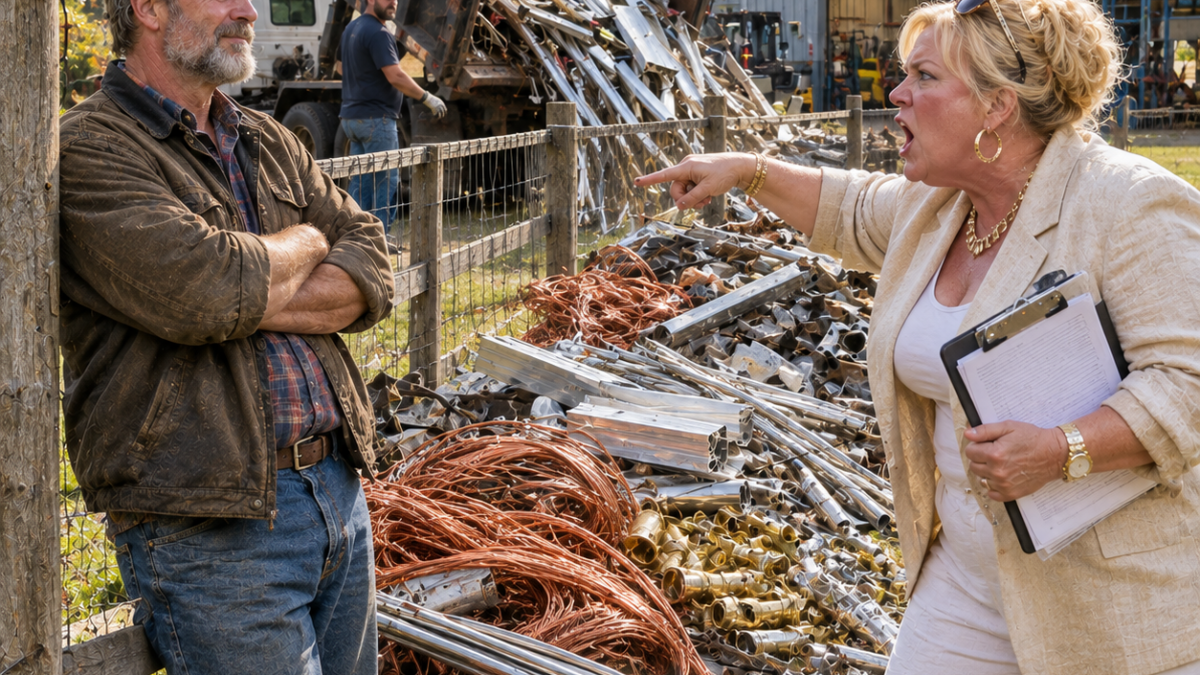
HOA Karen Fined Me $200 a Day for the Scrap Her Husband Dumped on My Land—Then I Sold His “Junk” for $1.27 Million.
For twenty years, the metal factory behind my property threw copper, brass, stainless steel, and aluminum over my fence, and when the factory owner’s wife became HOA president, she fined me $200 a day for the very pile her husband’s workers had created.
Brenda Sutcliff called my father’s three-acre homestead a junkyard, threatened to lien the house where my wife had spent her last months, and told me nobody in Ridgecrest Meadows wanted “people like me” living beside them—all while her own family had been claiming hundreds of thousands of dollars in tax deductions for waste-disposal services that apparently never happened.
Then I stopped looking at the pile like a humiliated homeowner and started looking at it like the federal metals specialist I had been for thirty years, and when a certified appraiser finally pushed a fourteen-page report across my kitchen table, the number at the bottom was $1,274,000—and Brenda still had no idea I had already found the records that could bring down her husband’s factory, her HOA presidency, and the shell company hidden inside her own family.
“Get this junk off your yard or I’ll lien your house tonight.”
Brenda Sutcliff stood at the bottom of my porch steps with one hand on her hip and the other holding a manila folder against her chest.
It was nine in the morning.
July heat already pressed over Culpeper County like a wet blanket.
Cicadas screamed from the oaks.
The gravel beneath Brenda’s white Escalade still ticked from the heat of the tires.
She had parked diagonally across the drive, as if even her vehicle needed to occupy more space than everyone else’s.
I stayed in the shade of the porch.
“Ma’am, that metal came from your husband’s factory.”
Brenda lifted her sunglasses.
“I don’t care.”
“You should.”
“I said I don’t care.”
She pointed toward the east fence.
Copper tubing.
Steel angle.
Aluminum extrusion.
Brass fittings.
Twenty years of industrial scrap lying along the slope between my barn and the commercial parcel behind me.
“You think I care where it came from?”
Her voice sharpened.
“Look at this place.”
Then she looked at me.
“You live like an animal.”
I had been insulted professionally.
Personally.
By supervisors.
Contractors.
Engineers.
Politicians.
Union reps.
Men who thought federal laboratory work meant I had never touched a real piece of metal.
None of that prepared me for the calm with which Brenda said those words on the porch my father had built with his own hands.
I did not answer.
She mistook silence for weakness.
People like Brenda usually do.
“If you can’t maintain the property,” she continued, “then move.”
I looked at her.
“What?”
“No one wants this here.”
She gestured again.
The barn.
The piles.
The house.
Maybe me.
Then she said the sentence I remembered longest.
“No one has ever wanted you here.”
I wish I could tell you I had a clever response.
I didn’t.
I was sixty-two years old.
Recently widowed.
Recently retired.
PART2:
Living in the same house where I had been born.
And for one ridiculous second, a woman with a clipboard made me feel like I was twelve.
Then I looked past her toward the property line.
A strip of copper bus bar caught the sun.
Bright orange.
Clean.
Heavy.
And something inside me shifted.
Not anger.
Recognition.
I said:
“Brenda.”
“What?”
“You really want that metal gone?”
“Yes.”
“All of it?”
“Every piece.”
I nodded.
“Good.”
She frowned.
“Good?”
“Yes.”
“What does that mean?”
“It means I heard you.”
She stared another second.
Then smiled.
That smile was the beginning of her mistake.
She believed I was surrendering.
What I was actually doing was starting an inventory.
My name is Garrett Holloway.
I was born on those three acres in 1961.
My father, Thomas Holloway, bought the land ten years earlier when the valley still had more cows than houses.
He built the house in 1974.
Cedar milled from trees on the property.
Foundation poured with two friends and a rented mixer.
The front porch has two handprints pressed into one corner of the concrete.
My father’s.
My mother’s.
They made them the week before I was born.
Dad used to say:
“Now if the county ever claims this place isn’t ours, I got fingerprints.”
That was his idea of legal planning.
He was not a lawyer.
He was good at staying.
I grew up there.
Creek water.
Sawdust.
Grease.
Hot summers.
A barn that smelled like oak, motor oil, and mice.
I learned to rebuild a carburetor before I was old enough to legally drive the truck it belonged to.
Then I left.
Virginia Tech.
Materials science.
Thirty years in a federal metals-testing laboratory outside Richmond.
Tensile testing.
Fracture analysis.
Alloy identification.
Failure investigations.
Corrosion.
Conductivity.
Spectroscopy.
The kind of work where a mistake three decimal places to the right can become somebody else’s million-dollar problem.
I loved precision.
I still do.
I can look at some copper alloys and make a good guess from color and finish.
Give me weight, hardness, conductivity, and a sample and I’ll tell you much more.
Not glamorous.
Useful.
That is my favorite kind of work.
I retired at fifty-seven because my wife Carol got sick.
Pancreatic cancer.
Fourteen months.
Carol had taught middle-school science for twenty-eight years.
She was small.
Quiet.
The sort of woman who could silence a classroom by lowering her voice.
When the oncologist told us what the scans showed, Carol looked at him and asked:
“How much time do people spend pretending statistics apply to individuals?”
The doctor blinked.
Carol smiled.
“I’m a science teacher.”
Then she fought.
Chemo.
Surgery that bought less time than we hoped.
Hospitalizations.
Weight loss.
Pain.
We came back to the homestead during her final year because Carol said she wanted to hear the creek through the bedroom window.
So we did.
I retired.
We moved home.
She died in our bedroom one April morning while dogwoods were blooming outside.
For months afterward, if I kept the windows shut, the house still smelled faintly like her lavender soap.
So I kept them shut more often than I should have.
Grief creates strange maintenance routines.
I mowed.
Fixed fence.
Painted trim.
Repaired the porch.
Kept Carol’s coffee mug on the same shelf.
Worked because work gives your hands something to do while your mind refuses.
The scrap had been there long before Carol became ill.
Sutcliff Precision Metal Works opened behind my eastern fence in 2003.
Dale Sutcliff purchased six acres.
Built a fabrication shop.
Cutting.
Welding.
Custom steel.
Aluminum work.
Contractors.
Good business.
Loud business.
Metal fabrication generates scrap.
At first, I did not care much.
A few copper pipe ends.
Some aluminum shavings blown by wind.
A handful of stainless pieces near the fence.
I told Dale.
He shrugged.
“Cleanup crew’ll handle it.”
They didn’t.
Year two:
more.
Year three:
brass fittings.
Short rods.
Wire.
Rejected cuts.
Then workers began throwing material directly over the fence.
Convenience.
That was all.
Why carry scrap to proper collection when a wooded slope existed ten feet away?
I complained.
Dale promised.
Nothing changed.
I sent a certified letter.
No answer.
I called county offices twice.
I was told it looked like a civil property matter unless hazardous waste was involved.
So I did what I always did professionally.
I kept records.
Date.
Approximate material.
Estimated weight.
Photographs.
Every month.
Old lab habit.
Document as though someone you have never met will one day ask you to explain exactly what happened.
For twenty years, no one did.
Then Ridgecrest Meadows appeared.
Developer Weston Price bought farmland between my property and the main road.
Two hundred houses.
Sidewalks.
Stone entrance sign.
Playground.
Pond with a decorative fountain.
Mailboxes aligned in matching clusters.
HOA.
I never joined.
Never signed.
Never requested annexation.
Didn’t care.
Until the first violation letter arrived.
Ridgecrest Meadows Homeowners Association.
President:
Brenda Sutcliff.
Dale’s wife.
Of course.
The first notice said:
ACCUMULATED DEBRIS.
UNSCREENED STORAGE.
AESTHETIC BLIGHT.
I laughed.
The debris came from her husband.
The “storage” included my father’s barn.
I responded politely.
My property predates Ridgecrest.
I am not a member.
The scrap originates from Sutcliff Precision Metal Works.
Please direct concerns there.
No answer.
Then:
$200 daily fine.
That got my attention.
Second notice a week later.
Third.
Then formal demand.
Thirty days to remediate or face escalated penalties and possible lien proceedings.
Copied:
county zoning.
HOA board.
Fire marshal.
The word hazardous appeared four times.
No identification of hazard.
No source.
Just enough language to make ordinary people afraid.
That was Brenda’s talent.
Paper that sounded more official than it was.
I drove to the county clerk.
Old carpet.
Copier toner.
Buzzing fluorescent lights.
Doris at the records counter brought me a cardboard box.
“Good luck.”
I spent three hours.
Eleven dollars in copies.
Subdivision charter.
Boundary survey.
Amendments.
Plat.
My parcel appeared inside the HOA boundary line.
That surprised me.
Then I looked for the thing that would make the line mean something.
Annexation agreement.
None.
Signed covenant.
None.
Deed amendment.
None.
Consent by my father.
None.
Consent by me.
None.
Original subdivision inclusion?
Impossible.
My father owned our parcel decades before Ridgecrest existed.
Weston Price’s surveyor had simply drawn the HOA boundary around my three acres.
As if the line itself created ownership.
It did not.
I sat under those fluorescent lights with coffee going cold and felt the first piece click.
Brenda had been fining a property the HOA had no legal authority over.
Every letter.
Every threat.
Every dollar.
Nothing.
I did not tell her.
Not yet.
I copied everything.
Went home.
Placed the file in my gun safe beside Carol’s wedding ring and my old federal service papers.
Then the factory dumped another load.
Tuesday afternoon.
Flatbed backed to fence.
Hydraulic bed rose.
Whine.
Metal slid.
Crash.
Driver never got out.
I watched from kitchen window with a bowl of leftover chili in my hand.
After he left, I walked down.
Fresh pile.
Red Virginia clay.
Sunlight bouncing from aluminum.
I knelt.
Picked up a copper bus bar.
Roughly eighteen inches.
Maybe one inch thick.
Clean cut.
Minimal corrosion.
The moment I held it, my brain changed roles.
For twenty years I had looked at the scrap as a landowner.
Violation.
Mess.
Trespass.
That afternoon I looked at it as a metals specialist.
C11000 copper.
Electrolytic tough pitch.
High conductivity.
Heavy.
Useful.
Valuable.
I weighed it in my palm.
Approximately three pounds.
At then-current copper prices, maybe thirteen dollars.
One piece.
I looked around.
Thousands.
Copper tubing.
Bus bar.
Stripped cable.
Brass gate valves.
Yellow brass stock.
Stainless rods.
Angles.
Sheet offcuts.
Aluminum extrusion.
Some pieces large enough to be sold as usable surplus rather than raw scrap.
I stood slowly.
The pile did not look ugly anymore.
It looked like inventory nobody had bothered valuing.
That evening, kitchen table.
Calculator.
Twenty years of logbooks.
Commodity-price sheets.
Conservative weights.
Copper alone:
over $400,000 by rough estimate.
Add brass.
Stainless.
Aluminum.
I stopped.
Recalculated.
Used lower prices.
Lower weights.
Still seven figures.
I sat back.
Carol’s photograph was on the mantel.
Same one from our twenty-fifth anniversary.
She was laughing because the photographer had told me to look natural and I apparently looked like somebody expecting a tax audit.
I raised my bourbon.
“Honey.”
The house stayed quiet.
“I think the neighbors made me rich.”
It was the first time I had laughed alone since she died.
Next morning:
Tractor Supply.
Four trail cameras.
Infrared.
Motion activated.
Weatherproof.
Thirty-nine dollars each.
I installed them at the rear corners.
One aimed at factory access.
One at fence.
One at dumping slope.
One at barn.
Tested sight lines.
Then waited.
Two weeks.
Seventeen separate dumping events.
Workers backing flatbeds.
Tilting.
Throwing.
Driving away.
One cigarette into brass pile.
Another bundle of copper struck barn siding.
Forty pounds, maybe more.
Could have killed somebody.
I saved every file.
Two external drives.
Cloud copy.
File names:
DATE_TIME_MATERIAL_ESTIMATE.
My dining table became a lab again.
Logbooks.
Photographs.
Price data.
Violation letters.
County records.
I had missed that feeling.
Not conflict.
Work.
Carol used to say:
“Don’t get mad, Garrett.”
Then:
“Get organized.”
She said it when insurance rejected a claim.
When a contractor overcharged us.
When a school administrator tried blaming her for a science lab budget problem.
Don’t get mad.
Get organized.
So I did.
Brenda came Saturday.
White capris.
Coral blouse.
Sunglasses on head like a crown.
Manila folder.
“Mr. Holloway.”
“Morning.”
“The board has voted to place a formal lien against your property.”
“No, it hasn’t.”
Her smile twitched.
“Excuse me?”
“The board has no jurisdiction over my property.”
She ignored that.
“Unpaid fines total fourteen thousand six hundred dollars.”
She handed me the folder.
Forty-seven violations.
Sixteen months.
Same allegation.
Industrial debris.
Not one identifying source.
“Brenda.”
“Yes?”
“You know where this metal comes from.”
“The HOA is concerned with your property condition.”
“Your husband dumps it.”
“What occurs on adjacent commercial property is outside our jurisdiction.”
“You are fining me for it.”
“I enforce covenants.”
“Covenants I never signed.”
Her face hardened.
“Thirty days, Garrett.”
Then she turned.
I said:
“You really want all that metal removed?”
She stopped.
“Yes.”
“Good.”
She looked back.
“Good?”
“Nothing.”
She walked to Escalade.
Her heels left small dents in gravel.
I watched her drive away.
Then called the Virginia Department of Environmental Quality.
“Does Sutcliff Precision Metal Works have a valid solid-waste disposal permit?”
Hold music.
Bad saxophone.
Woman returned.
“No active permit.”
“Pending?”
“No.”
“Historical?”
Pause.
“No record.”
I asked her to repeat it.
She did.
I wrote it down.
Circled date.
Twenty years of commercial metal waste moved across a property line without a disposal permit.
That was no longer only trespass.
It was environmental enforcement territory.
I did not know exact criminal exposure yet.
I was not a lawyer.
But I knew enough to stop calling the material junk.
Brenda’s next tactic was social.
Beautification Committee.
Twelve residents.
Meeting minutes.
Eastern boundary concerns.
That meant me.
Within a week:
three complaints filed with county code enforcement.
Almost identical.
Same phrases.
Same format.
One alleged illegal salvage yard.
Another groundwater risk.
Third claimed barn likely to collapse onto adjacent houses.
The barn sat 140 feet from nearest home.
Hand-hewn oak beams.
Fifty years.
No structural distress.
County inspector Leland Crawford arrived Wednesday.
Young.
Coffee.
Expression of a man wishing for a quieter assignment.
He walked barn.
Fence.
Scrap.
“Where’d this come from?”
I pointed.
“Factory.”
“All of it?”
“Twenty years.”
He looked at factory roof.
Then pile.
“You ever complain?”
“Repeatedly.”
He wrote.
Inspection result:
no structural deficiency.
No code violation found.
No evidence of groundwater contamination.
Industrial character of material consistent with adjacent commercial operation.
That last sentence was gold.
First official record independently connecting debris to factory.
Brenda called emergency board meeting.
Wanted private attorney.
Board voted four to three against.
Her control was slipping.
So she did the dumbest thing anyone in this entire story did.
She filed a DEQ complaint against me.
Unlicensed metal recycling operation.
Photographs taken from factory loading dock.
Complaint co-signed by Dale Sutcliff.
I read the letter on my porch.
Started laughing.
Loudly enough to scare cardinals from dogwood.
The man whose factory had been dumping industrial metal onto my land for twenty years had asked environmental regulators to investigate why industrial metal was on my land.
I called DEQ.
“I’ll cooperate completely.”
The woman said:
“Would you like to file a counter complaint?”
“Yes, ma’am.”
I wrote fourteen pages.
Thirty-seven exhibits.
Trail-camera footage.
Twenty-year log.
Certified letters.
Permit search.
HOA notices.
County inspection.
Price estimates.
Every piece of paper Brenda created became supporting evidence of the waste her husband had deposited.
That was when the whole story began reversing.
Not because I had some elaborate revenge plan.
Because they kept documenting themselves.
Then came the tax records.
I was at county assessor’s office reviewing Dale’s property file.
I wanted value.
Liens.
Encumbrances.
Routine due diligence.
A business-expense reference caught my eye.
Industrial waste disposal services.
Blue Ridge Environmental Solutions LLC.
Approximately $38,000 annually.
Varied by year.
Twenty years.
Roughly $760,000 total.
I wrote company name.
Went to public-library computer.
State Corporation Commission.
Blue Ridge registered in 2004.
One year after factory opened.
Registered agent:
Pamela Wayne Scott.
Name meant nothing.
Then HOA directory.
Brenda’s sister.
Charlottesville.
No environmental-services background.
No employees I could find.
No equipment.
No office.
Registered address:
UPS mailbox store.
I sat in library parking lot.
Engine off.
Cicadas screaming.
Summer heat against windshield.
Pieces aligned.
Dale had claimed disposal expenses.
Waste had not been professionally removed.
It had been dumped over my fence.
Money flowed to a company controlled by his wife’s sister.
Maybe there was an explanation.
I could not assume intent.
But it was enough to call someone who knew the law.
Tucker Ashworth.
College roommate.
Twenty-five years environmental-law practice in Norfolk.
Semi-retired in Albemarle County.
He listened to everything.
Thirty seconds of silence.
Then:
“Garrett.”
“Yeah?”
“You may own the metal.”
That got my attention more than anything else.
He explained abandoned-property concepts.
Dumping.
No retrieval.
No ownership assertion.
Long passage of time.
He told me not to sell anything yet.
We would document.
Verify.
File appropriate claim.
Tucker arrived Thursday.
Old truck.
Muddy boots.
Legal pad.
File folders.
Six-pack.
We sat in Carol’s wicker chairs on porch.
Mockingbirds arguing in dogwood.
Built strategy.
First:
ownership claim.
Second:
environmental complaint.
Third:
tax-fraud referral.
Fourth:
challenge HOA jurisdiction.
Then independent appraisal.
Vance Kendrick came from Roanoke.
Forty years scrap and recycling.
Portable scale.
Magnetometer.
Spectrometer.
Spent six hours.
Sorted.
Tested.
Photographed.
Conductivity.
Acid testing.
Alloy identification.
Weight estimates.
He sat at kitchen table late afternoon.
Glasses on forehead.
Report in hand.
“Mr. Holloway.”
“Yes?”
“I’ve got a number.”
“How bad?”
He smiled.
“You’re going to like this kind of bad.”
He slid report.
Appraised value:
$1,274,000.
I stared.
“One point two?”
“One million two hundred seventy-four thousand.”
I read again.
“Whoever’s been throwing this away is either very rich or very stupid.”
I looked toward factory.
“Little of both.”
The number did not feel real.
Money attached to an insult rarely does.
For twenty years I had looked at that pile and seen disrespect.
Now a certified report said it represented more money than Carol and I had ever held at one time.
But Tucker warned me.
“Appraisal isn’t cash.”
“I know.”
“Markets move.”
“I know.”
“Sorting and transport matter.”
“I know.”
“Ownership first.”
“I know.”
He smiled.
“You were annoying in college too.”
“Precision.”
“Obsession.”
“Same thing.”
We filed.
Then waited.
Meanwhile, I requested HOA financial information through Hank Prescott.
No relation to Brenda despite the unfortunate surname coincidence.
Retired man.
Corner house.
One of the few residents willing to challenge her.
Seventeen homeowners fined in three years.
Payments not clearly accounted for.
General fund.
No independent audit.
Maintenance contracts.
Legal spending.
Questions.
Interesting.
Not yet central.
I kept separate files.
That is important.
Do not mix suspicion with proof.
Sixty days.
No competing ownership claim.
Court approved abandoned-property claim.
The metal was mine.
Legally.
Documented.
Tucker called.
“Congratulations.”
I looked outside.
“Doesn’t feel different.”
“It will when trucks arrive.”
I called the Richmond recycler.
Scheduled.
Two days later, Sutcliff Precision flatbed arrived first.
Not dumping.
Loading.
Two workers crossed my fence with bolt cutters and hand truck.
I watched from kitchen.
Coffee.
Phone recording.
One cut wire.
Other dragged brass.
They moved fast.
I did not confront.
That was hard.
People think staying inside is cowardice.
Sometimes walking outside turns evidence into argument.
I let camera run.
Approximately three hundred pounds loaded.
Then called sheriff.
Deputy Terence Griggs arrived in fourteen minutes.
Found workers halfway over fence with hand truck full of copper.
“Permission?”
“No.”
“Work order?”
None.
They said Dale sent them to recover company property.
Griggs asked:
“Whose property are you standing on?”
They did not know my name.
I brought court order.
Ownership.
Footage.
Trail-camera records.
Two workers cuffed.
Trespass report.
Theft report.
Dale named as directing party.
Later, reviewing cameras, I found three previous nighttime retrieval attempts.
They had realized value too late.
That made me angry.
Then strangely amused.
For twenty years, Dale had thrown metal away.
The moment a court said I owned it, he wanted it back.
Brenda meanwhile authorized another emergency HOA meeting.
She presented my property as toxic hazard.
Children at risk.
Industrial contamination.
Did not disclose husband owned factory responsible.
Did not disclose workers arrested.
Board authorized $12,000 for private attorney.
Five to two.
Hank voted no.
Called me.
“She’s burning HOA money to bury you.”
“Let her.”
Pause.
“Why?”
“Every dollar creates a record.”
Hank laughed.
“You’ve been waiting for this a while.”
“Twenty years, give or take.”
The HOA lawyer, Clifton Dahl, filed for temporary restraining order.
Tucker read it.
Snorted.
“Wrong statute.”
“What?”
“He cited agricultural blight.”
“I’m not agricultural.”
“I know.”
“He doesn’t?”
“Apparently not.”
Motion denied.
Judge Patricia Hartwell.
No standing.
No imminent harm.
Material conflict not disclosed.
HOA president married to factory owner responsible for alleged condition.
Tucker framed the footnote.
Actually framed it.
Put beside law degree.
Brenda responded with fury.
Handwritten note beneath windshield at grocery store.
DROP IT OR LOSE EVERYTHING.
No signature.
Heavy floral scent.
I photographed.
Bagged.
Saved.
Then bought soup, bread, chicken.
Drove home listening to Willie Nelson.
I expected fear.
Instead, I felt calm.
Organization has that effect.
Dale filed police report accusing me of stealing proprietary manufacturing material.
Detective Merrill Cantwell investigated.
Good detective.
Thorough.
She inspected.
Reviewed logbooks.
Watched videos.
Read ownership order.
Then interviewed Dale.
Could not produce inventory records.
No purchase orders.
No batch records.
No manifests.
Eventually admitted material was scrap.
Claimed he intended to retrieve it.
For twenty years.
Detective asked why he had not.
No useful answer.
Case against me closed.
But during factory visit, Cantwell noticed no obvious waste-management infrastructure.
No dumpsters.
No containment.
No labeled disposal areas.
No manifests.
She forwarded observations to DEQ.
Another doorway opened because they had tried using law enforcement against me.
Then IRS Criminal Investigation called.
Agent Weaver.
Interview.
Shell company.
Deductions.
No apparent disposal service.
Pamela.
Blue Ridge.
Twenty years.
Agent listened quietly.
Asked precise questions.
I gave precise answers.
No speculation.
By then, pressure surrounded Sutcliffs from four directions.
Environmental.
Sheriff.
IRS.
HOA jurisdiction challenge.
And I still had not sold one pound.
I marked next annual HOA meeting.
First Thursday October.
Open comment.
Public.
That became the moment.
Seventy residents.
Community-center basement.
Folding chairs.
Fluorescent light.
Coffee urn.
Brenda at center.
Navy blazer.
Gold buttons.
Reading glasses.
Dale front row.
Arms crossed.
Clifton beside him looking tired.
Tucker beside me in back.
Hank two rows ahead.
Meeting began normally.
Budget.
Landscaping.
Dogs off leash.
Then:
property standards enforcement.
Brenda started talking about me.
“Longstanding nuisance.”
“Unpaid fines.”
“Available legal remedies.”
No mention TRO denial.
No mention factory workers arrested.
No mention conflict.
Then:
“Questions?”
Tucker nudged.
I stood.
“I’d like public comment.”
Brenda looked over glasses.
“Three minutes.”
“I’ll need five.”
“No.”
“Then I’ll speak quickly.”
Murmur.
I walked to podium.
Binder.
Opened.
“My name is Garrett Holloway.”
Silence.
“I have lived on the same three acres in this county for sixty-two years.”
I pointed toward Dale.
“For twenty years, Sutcliff Precision Metal Works has dumped industrial metal scrap over my fence and onto my land.”
Dale shifted.
“I documented it.”
I held logbook.
“Every load.”
“Every date I observed.”
“Material estimates.”
“Photographs.”
“Now trail-camera footage.”
I held appraisal.
“And I had the accumulated material independently appraised.”
Pause.
“One million two hundred seventy-four thousand dollars.”
The room changed.
Not a murmur.
A physical shift.
Heads turning.
Somebody said:
“What?”
I continued.
“Copper.”
“Brass.”
“Stainless steel.”
“Aluminum.”
“Material this HOA has called junk while fining me two hundred dollars a day.”
Brenda’s face tightened.
“For sixteen months, President Sutcliff has issued forty-seven violations against me for possessing material her husband’s factory placed on my land.”
I lifted county records.
“This HOA also has no legal jurisdiction over my parcel.”
Now people spoke.
“What?”
“How?”
I waited.
“The subdivision boundary map includes my property.”
“But my parcel was never annexed.”
“I never signed covenants.”
“My father never signed covenants.”
“My deed was never amended.”
“So every fine against my property is void.”
I looked at Brenda.
She had gone pale.
Then looked at residents.
“The twelve thousand dollars spent on litigation against me came from your dues.”
That hit harder than million-dollar scrap.
People understand their money.
Brenda leaned toward microphone.
“This is an inappropriate—”
I kept going.
“The attorney’s temporary restraining order was denied.”
Hank said loudly:
“She didn’t tell us that.”
Brenda looked at him.
I continued.
“DEQ is investigating Sutcliff Precision for unpermitted waste disposal.”
Dale stood slightly.
Tucker watched.
I said:
“The sheriff has charged two factory workers after they crossed my fence and attempted to remove metal that a court has already recognized as mine.”
Dale:
“That metal belongs to my company.”
Tucker stood.
“Court order says otherwise.”
Clifton touched Dale’s arm.
Sit.
I turned one page.
“And for approximately twenty years, Sutcliff Precision has claimed waste-disposal expenses paid to Blue Ridge Environmental Solutions.”
The room quieted again.
“That company is registered to Brenda Sutcliff’s sister.”
Brenda stood.
“Stop.”
I looked at her.
“No employees we could identify.”
“No equipment.”
“No office.”
“Registered to a mailbox.”
“Waste allegedly paid for disposal remained on my property.”
Brenda’s voice cracked.
“You are accusing my family of fraud.”
“No.”
I shook my head.
“I am telling the membership that the IRS Criminal Investigation Division is reviewing the matter.”
Silence.
Dale stared at floor.
Clifton began packing his briefcase.
That told the room more than anything I said.
I closed binder.
“I am not here to ask you for money.”
“I am not asking this HOA to clean up the scrap.”
“I am not asking for permission.”
“The court approved my claim.”
“I own the metal.”
“I have arranged sale.”
Then:
“One more thing.”
I looked toward Hank.
“I move for a vote of no confidence in Brenda Sutcliff’s presidency.”
Hank’s hand went up before I finished.
His wife.
Couple behind.
Then another.
And another.
Hands across room.
Not dramatic chanting.
Not cheering.
Just people deciding they had seen enough.
Final:
61 to 9.
Brenda resigned the next morning.
Dale’s factory received DEQ cease-and-desist within weeks.
Environmental penalties followed.
Required waste-management upgrades.
Containers.
Manifests.
Containment.
Compliance work.
Expensive.
IRS case took longer.
Federal cases do.
Thirteen months.
Charges involving tax-fraud conspiracy.
Blue Ridge dissolved.
Pamela cooperated.
Back taxes.
Penalties.
Interest.
Large numbers.
Dale avoided prison under plea arrangement involving restitution and supervised probation.
Workers?
Misdemeanor pleas.
Community service.
Probation.
I did not push for harsher punishment.
They had been employees following bad instructions.
They cut my fence.
Tried taking property.
Wrong.
But their role was not Dale’s role.
Responsibility should be proportional.
That matters to me.
Then came the trucks.
Cold November morning.
Three commercial flatbeds.
Recycler crew.
Copper first.
Sorted.
Banding.
Scales.
Brass and stainless.
Aluminum.
Two days.
Twenty years of material disappeared from my land.
I stood in barn doorway.
No cheering.
No victory dance.
The sound was strange.
Metal dragging.
Chains.
Forklift.
Engines.
Each load removed part of something I had resented so long that empty ground felt unfamiliar.
When the last truck pulled away, I walked to fence.
Red clay.
Flattened grass.
Barn wall visible all the way to corner.
For twenty years, the pile had been part of the landscape.
Now gone.
Carol should have seen it.
That thought hurt.
Nine days later, payment cleared.
$1,274,000.
Same credit union account Carol and I had used since 1989.
I logged in.
Looked.
Logged out.
Did not know what to feel.
People imagine sudden money creates euphoria.
Maybe if it comes from lottery.
This money came from years of disrespect.
I did not feel lucky.
I felt settled.
First:
paid remaining mortgage.
Not much.
Then fence repair.
Barn siding.
Property cleanup.
Professional soil assessment.
Clean.
Then landscaping.
Crepe myrtles along property line.
Carol always wanted them.
Pale pink.
She said they reminded her of her grandmother’s place in Lynchburg.
I had resisted for years.
“Too ornamental.”
That is what I said.
She called me “a man emotionally threatened by flowering trees.”
She was right.
I planted twenty-one.
Then I created the Carol Holloway Environmental Stewardship Scholarship.
Three hundred thousand dollars set aside.
For county high-school students studying environmental science, materials engineering, natural-resource management.
First recipient:
seventeen-year-old vocational-school student.
Virginia Tech.
Water quality.
Quiet.
Focused.
Stubborn.
Carol would have loved her.
At ceremony, the girl asked why I chose those fields.
I said:
“Because knowing what something is can change what it’s worth.”
She smiled.
I added:
“And knowing where waste goes can change who pays for it.”
That was the real lesson.
Hank became HOA president.
Against his better judgment.
First act:
independent audit.
That opened another mess.
Improper fines.
Missing deposits.
Legal expenses lacking votes.
Maintenance work awarded to Brenda’s cousin.
Approximately forty-one thousand in questionable allocations.
New board issued refunds where supported.
Published books.
Changed controls.
Two-signature approval.
Regular statements.
Boring governance.
Good governance is usually boring.
I stayed outside HOA.
My parcel never belonged.
Hank invited me to meetings anyway.
I declined most.
Once I went for boundary clarification.
Brenda did not attend.
She stayed in neighborhood for a time.
We crossed paths once at grocery store.
Frozen-food aisle.
She saw me.
I saw her.
No words.
She looked smaller without title.
Maybe that was imagination.
Authority changes posture.
I did not need an apology.
By then, Carol’s crepe myrtles mattered more.
They bloomed first time following July.
Pale pink.
Wind.
I sat in Carol’s wicker chair.
Watched.
Sunset behind ridge.
House cedar smell with windows open.
Barn empty.
Fence repaired.
No metal.
For the first time since returning home, silence at east property line.
No hydraulic bed.
No crash.
No dumping.
I thought about Brenda’s first threat.
“Get this junk off your yard or I’ll lien your house tonight.”
She got what she wanted.
The junk was gone.
Just not in the way she expected.
I have thought a lot about what might have happened if I lost my temper that day.
If I shouted.
Threatened Dale.
Dragged scrap back across fence.
Got into fight.
Maybe arrested.
Maybe sued.
Maybe gave Brenda exactly the version of me she wanted to present.
Instead:
records.
Logs.
Cameras.
Appraisal.
Court order.
DEQ.
IRS.
Sheriff.
Documents.
I spent thirty years in laboratories where emotion did not change metal properties.
Steel does not care how angry you are.
Copper does not care whether you feel insulted.
Evidence is similar.
A dated photograph remains a dated photograph no matter who yells.
That steadiness saved me.
Carol would have understood.
She always did.
Don’t get mad.
Get organized.
I keep that written on a card inside desk drawer now.
Not because I forget.
Because I like seeing her handwriting beside it.
She had written the phrase years ago on the back of a grocery receipt after our insurance company rejected storm damage.
I found it in one of her notebooks.
Framed it eventually.
People ask:
“Were you really sitting on a million dollars all those years?”
Not exactly.
I was sitting beside material that eventually appraised at that.
Markets fluctuate.
Some required sorting.
Transportation.
Legal ownership.
But yes.
The underlying value was enormous.
That fact embarrasses me slightly.
Federal metals specialist.
Thirty years.
And for two decades I never bothered to calculate.
Why?
Because context controls perception.
Someone dumps something over your fence and calls it waste.
You see waste.
You assume it has disposal cost.
The moment I looked with professional eyes, the category changed.
Not trash.
Copper.
Not debris.
Brass.
Not nuisance.
Stainless.
Not shame.
Inventory.
There is a broader lesson in that.
People do it with themselves too.
Someone calls you old.
Difficult.
Poor.
Broken.
Unwanted.
After enough repetition, category feels factual.
Brenda called me an animal.
Said nobody wanted me there.
For one second, I believed the feeling even though I knew the words were absurd.
I was born there.
My parents’ handprints were in porch concrete.
Carol died there.
No one had more claim to belonging.
Yet confidence can sound like authority when grief has made you tired.
That is why records matter.
They remind you what feelings obscure.
Deed.
Date.
Signature.
Boundary.
Ownership.
Truth is often boring enough that bullies hope you won’t look it up.
Brenda’s power depended on people not looking.
Not checking boundary map against deeds.
Not asking where fines went.
Not demanding votes.
Not checking conflicts.
Not noticing her husband’s company was source of the “blight” she used to threaten me.
Once people looked, her authority shrank quickly.
But I do not tell this story as:
Quiet man destroys evil HOA queen.
That is too simple.
Brenda made choices.
Bad ones.
Dale made worse.
But several board members had gone along because they trusted paperwork.
Neighbors complained because Brenda told them contamination threatened children.
Some were scared.
Not malicious.
Hank himself admitted he had voted for fines years earlier without understanding process.
People do that.
Systems fail because ordinary people become passive, not only because bad people become powerful.
That is uncomfortable.
It is also useful.
The new board changed rules so one president could not control everything.
Audits.
Conflict disclosures.
Recorded votes.
Clear jurisdiction.
Appeals.
Those reforms mattered more than Brenda losing title.
Replacing one person without changing structure just waits for next person.
My father understood structure differently.
He built house.
Foundation.
Oak beams.
Fence.
He liked physical things because you could inspect them.
When I was maybe twelve, we repaired barn roof after storm.
I complained a board looked fine.
Dad said:
“Fine from ground ain’t same as sound from ladder.”
I did not understand why I remember that sentence.
Now I do.
Brenda looked fine from ground.
HOA looked organized.
Letters professional.
Gold logo.
Formal terms.
You climb ladder?
No authority.
No consent.
No audit.
Conflict.
Bad load paths.
Everything eventually fails where structure is weakest.
The factory nearly failed too.
It recovered after compliance upgrades.
Under new management later.
Dale sold majority interest.
New owners installed proper scrap sorting.
Covered containment.
Regular licensed recycling pickup.
Ironically, once they managed metal correctly, they began selling scrap as a revenue stream.
Somebody at the factory told me they cleared over eighty thousand dollars first year.
I laughed.
Not because funny.
Because obvious.
They had been throwing money over my fence for two decades.
Convenience can be expensive.
Dale’s problem was he thought disposal was somebody else’s problem.
Brenda’s problem was she thought appearances mattered more than source.
My problem was I tolerated it too long.
That last one matters.
I kept logs for twenty years.
That was useful.
But why did I accept dumping for twenty?
I tell myself:
career.
Travel.
Carol.
County indifference.
Dale promises.
Life.
All true.
Still.
Boundaries work best early.
A small problem easier to correct than a mountain.
I should have pushed harder after year one.
That is hindsight.
But it is real.
Documentation is not substitute for timely action.
It is support for action.
Now if anyone crosses a boundary, I address it.
Calmly.
Immediately.
The crepe myrtles make that line beautiful.
Also obvious.
No one dumps there.
First scholarship recipient sent me a postcard after freshman year.
Virginia Tech.
She wrote:
Mr. Holloway, I’m taking materials chemistry and now I understand why you got excited about copper.
I laughed so hard I scared a squirrel off porch.
Second line:
Also my professor says your seven-figure scrap pile is the weirdest scholarship origin story he has ever heard.
Fair.
I framed that too.
My house now contains more framed paperwork than Carol would have tolerated.
She would have said:
“Walls are for art.”
She was right.
So I put documents in office.
Her watercolors remain elsewhere.
Balance.
Some mornings, I still smell lavender.
Probably imagination.
Memory can reproduce scent with disturbing accuracy.
I sit on porch.
Coffee.
Look at handprints.
Mother’s smaller.
Father’s larger.
Crepe myrtles beyond.
Where metal used to be.
I sometimes imagine telling Dad.
“Factory dumped a million dollars over fence.”
He would squint.
Then ask:
“You sold it?”
“Yes.”
“You pay taxes?”
“Yes.”
“Good.”
That would be entire conversation.
Carol would have been more impressed.
Not by money.
By organization.
She would ask how many binders.
Four.
She would laugh.
“Of course.”
Then probably point out I had spent more on label tape than necessary.
Marriage never really stops giving you conversations after someone dies.
You just supply both sides.
Hank comes over sometimes.
Still HOA president.
He hates it.
Which is why he is good.
People who enjoy authority too much should rarely have all of it.
He says meetings now average forty minutes.
No screaming.
No surprise liens.
No secret lawyers.
No beautification committee.
Someone complained that without Brenda the neighborhood lacked “leadership energy.”
Hank told me:
“We’re aiming for leadership boredom.”
Perfect.
I still keep every original Brenda letter.
Forty-seven violations.
Lien threat.
Environmental complaint.
At first I thought I would burn them after case.
Carol liked burn piles.
She would have approved ceremonially.
I kept them instead.
Not because angry.
Because memory edits.
Five years from now I might soften details.
Ten years, maybe question whether I overreacted.
Paper does not care.
There it is.
$200 per day.
Industrial debris.
Hazard.
Lien.
My property.
Their source.
Their words.
I also keep Dale’s original certified-letter receipt from 2004.
Proof I told him.
Twenty years matters.
Documentation converts “everybody knew” into date.
That is the boring power of records.
The million-dollar check became the flashy part strangers wanted.
But money was not the most valuable recovery.
The land looked like ours again.
That was it.
No metal against barn.
No factory workers crossing fence.
No letters threatening Carol’s home.
I could walk east boundary and see grass.
Pink blossoms.
Fence.
Sky.
Nothing else.
That was wealth.
The rest sat in an account.
Used carefully.
Scholarship.
Repairs.
Taxes.
I did not buy boat.
Did not buy Corvette.
Did not move.
People found that disappointing.
One cousin said:
“If I got 1.2 million, you’d never see me again.”
I said:
“I spent my life trying to get back here.”
Why would I leave?
Money changes options.
Not necessarily desires.
Carol wanted crepe myrtles.
I wanted quiet.
We both got our wish, just later than expected.
There is one part of the story people misunderstand.
They call it revenge.
It wasn’t.
Revenge would have been dumping the scrap back on Dale’s property.
Smashing something.
Humiliating Brenda deliberately.
I wanted those things in flashes.
I am human.
But every time anger rose, I heard Carol.
Get organized.
Organization produces consequences without requiring cruelty.
DEQ did its job.
IRS did its job.
Court did its job.
Sheriff did its job.
HOA residents made their vote.
I did not have to become prosecutor, judge, or executioner.
I needed to preserve facts long enough for institutions to see them.
Institutions are imperfect.
Slow.
Frustrating.
But when evidence is clear, they can work.
Not always.
I was fortunate.
Tucker helped.
Hank helped.
Leland wrote honest report.
Detective Cantwell paid attention.
People matter inside systems.
That is another reason I refuse to turn myself into lone hero.
Lone heroes make good thumbnails.
Real victories require phone calls.
Clerks.
Inspectors.
Lawyers.
Witnesses.
People willing to read boring documents.
Doris at county clerk once recognized me months afterward.
I came for another record.
She said:
“You were the metal man.”
I laughed.
“Apparently.”
“You find what you needed?”
“More than I expected.”
She nodded.
“Told you good luck.”
“You did.”
She looked pleased as if she personally caused $1.27 million.
Maybe she deserved a little credit.
She found the box.
Sometimes one small helpful act shifts everything.
That is how stories actually move.
Not only big confrontations.
One clerk.
One report.
One deleted comment preserved.
One timestamp.
One worker who says his boss sent him.
One judge reading correct statute.
Brenda wanted spectacle.
Threats.
Meetings.
Letters.
People frightened by official language.
I answered with accumulation.
Evidence works like scrap.
One piece seems small.
Over twenty years it becomes too heavy to ignore.
That may be my favorite metaphor from the whole mess.
The very thing they thought was worthless accumulated until it became fortune.
So did every record.
One photo.
One note.
One receipt.
One video.
One complaint.
One corporate filing.
One tax entry.
One letter.
Individually:
small.
Together:
weight.
Enough to crush a lie.
If I teach anything through the scholarship, I hope it is that.
Know what you are looking at.
Do not accept somebody else’s label.
Waste.
Junk.
Nuisance.
Hazard.
Those are conclusions.
Ask composition.
Source.
Ownership.
Value.
Data.
The same applies outside metals.
When a person with authority says:
“This is the rule.”
Ask:
“Show me.”
When they say:
“You owe this.”
Ask:
“Under what authority?”
When they say:
“Everybody agrees.”
Ask for vote.
When they say:
“This belongs to us.”
Check deed.
Precision is not rudeness.
It is protection.
Carol understood that better than I did emotionally.
She could be kind and exact.
A rare combination.
The scholarship bears her name because she deserved to be tied to something forward-looking, not cancer.
I did not want her memorial to be a hospital wing or bench nobody sits on.
Students.
Education.
Environment.
Materials.
She would have liked that.
First award ceremony, I set one of her old science textbooks on table.
Not planned.
Just felt right.
Winner’s mother asked who Carol was.
“My wife.”
“Did she teach?”
“Twenty-eight years.”
The girl touched book.
“I wish I met her.”
I said:
“So do I.”
Simple.
Then we talked about Virginia Tech.
That was healing more than any check.
A year later, I opened windows on Carol’s death anniversary.
First time I had deliberately done it.
Lavender smell disappeared.
Cedar came in.
Crepe myrtles.
Cut grass.
For years I kept windows closed because I thought scent was memory.
I learned memory does not need trapped air.
House can breathe.
So can grief.
That is not part of HOA story people share.
Maybe it should be.
Conflict forced me to reenter my own life.
I had been preserving Carol’s house.
The lawsuit required moving through it.
Documents.
Offices.
People.
Planting.
Scholarship.
I began participating again.
Not because Brenda helped.
I will not give her credit she did not earn.
But surviving one fight sometimes wakes parts of you grief made quiet.
Carol would not want me becoming a museum guard.
I know that now.
The front porch handprints remain.
My parents.
Crepe myrtles bloom.
Barn still stands.
Oak beams still sound.
Factory operates legally.
HOA is boring.
My property line is clear.
And the pile?
Gone.
Every piece.
The “junk” Brenda demanded I remove.
The “hazard” Dale claimed to have professionally disposed of.
The “eyesore” neighbors complained about.
Converted into money.
Debt paid.
Fence fixed.
Scholarships funded.
Flowers planted.
There is something almost too neat about that.
Life rarely gives symbolism so obvious.
But sometimes it does.
Brenda once told me:
“No one has ever wanted you here.”
She was wrong.
My father built here.
My mother pressed hand into porch.
Carol chose to die here.
I came home by choice.
Students now come here once a year for scholarship luncheon.
Hank parks in my driveway and complains about HOA budgets.
Doris from county office came to see crepe myrtles one spring because she heard the story through her sister.
People belong in places because of relationships, history, legal ownership, memory—not because somebody with a blazer approves.
That lesson cost Brenda more than she expected.
It almost cost me peace.
I kept mine.
If you ask me what exact moment I knew I had won, it was not HOA vote.
Not DEQ order.
Not IRS call.
Not $1,274,000 appraisal.
It was the morning after final truck left.
I walked to east fence before sunrise.
No metal.
Just red clay.
Grass flattened.
A few silver fragments too small for loaders.
I picked them up by hand.
Put them in bucket.
Then stood.
Factory roof beyond trees.
Sun coming up.
No crash of scrap.
No hydraulic bed.
No shouting.
I could hear creek.
That was the first time in twenty years the boundary sounded like mine.
I took Carol’s old gardening gloves from barn.
Started digging holes for crepe myrtles.
One.
Two.
Three.
Twenty-one.
By noon my back hurt.
Hands blistered.
I was filthy.
Happier than I had been in a long time.
At tree number twelve, I said out loud:
“You happy now?”
Carol did not answer.
I pictured her rolling her eyes.
“Took you long enough.”
She would have been right.
I watered every tree.
Then sat on porch.
Not rich.
Not victorious.
Just home.
That is the part I keep.
Brenda’s HOA dumped twenty years of shame on the wrong property.
Her husband’s factory called valuable material waste because they thought nobody would ever ask what it was.
She fined me for their mess because she believed official-looking paper could overwrite origin.
She threatened a lien because she thought grief had made me easy to move.
Maybe for a while it had.
Then I remembered what I knew.
Metals.
Records.
Precision.
And Carol’s voice.
Don’t get mad, Garrett.
Get organized.
So I did.
Twenty years of metal became $1.274 million.
Twenty years of records became a case.
Forty-seven HOA violations became evidence of the very dumping Brenda wanted to hide.
And the woman who told me nobody wanted me there finally learned something my father had understood when he pressed his hand into wet concrete half a century earlier.
You do not decide whether a man belongs on land that has carried his family’s fingerprints longer than your neighborhood has existed.
You check the deed.
You check the records.
And if you insist on calling a million dollars’ worth of copper, brass, stainless, and aluminum “junk,” you should be very sure the quiet widower standing across from you does not know exactly what it is worth.








