HOA Karen Filled My Drainage Ditch for “Curb Appeal”—Then 11 Minutes of Rain Exposed the County Warning She Ignored
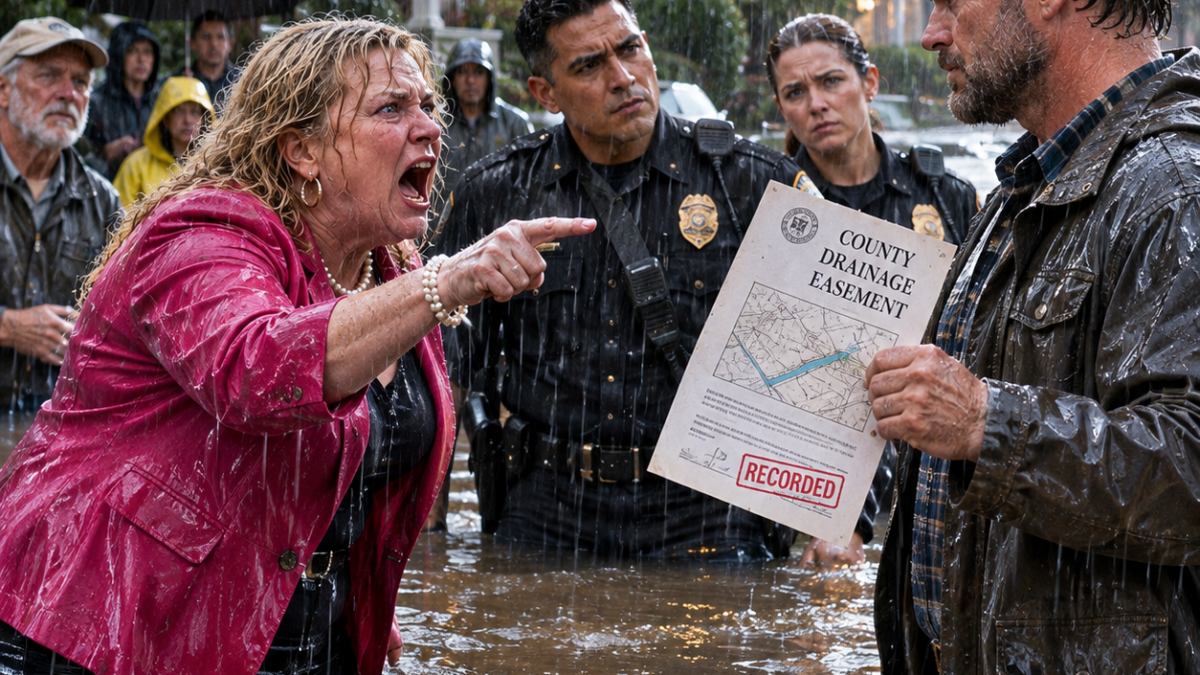
HOA Karen Filled My Drainage Ditch for “Curb Appeal”—Then 11 Minutes of Rain Exposed the County Warning She Ignored
Eleven minutes after the first hard burst of spring rain, Willow Lane began filling like a bathtub, and the same HOA president who had ordered my drainage ditch buried for “curb appeal” was standing knee-deep in brown water screaming that I had flooded the neighborhood.
Three weeks earlier, I had mailed her a certified copy of a 1996 county stormwater easement stating in plain language that the ditch could never be obstructed, but instead of reading it she fined me $500, hired a contractor before sunrise, and covered the entire channel with truckloads of dirt and perfect green sod.
What Pamela Hargrove did not know was that I had also discovered the county had already denied her permit months earlier—and by the time the police arrived, the water was rising, fourteen basements were filling, her own treasurer was shaking with fear, and the evidence she thought nobody would ever see was already sitting in my hands.
My name is Dean Maddox.
I bought the last house on Willow Lane because I wanted quiet.
That sounds ridiculous now.
But at the time, quiet was exactly what Linden Park Estates appeared to offer.
Tree-lined streets.
Older brick homes.
Big maples.
Wide lawns.
A little pond at the center of the development where children fed ducks and retirees walked in circles every morning before breakfast.
My house sat at the far end of Willow Lane where the pavement narrowed slightly and the development backed into county-owned woods.
Three bedrooms.
Two baths.
Detached garage.
A screened porch.
The kind of house that looked ordinary until you stood there long enough to imagine yourself growing old in it.
There was only one ugly thing.
The ditch.
It ran along the entire side boundary of my property.
About four feet wide in most places.
Maybe eighteen inches deep during the dry months.
Mud.
Reeds.
Stones.
A corrugated drainpipe entering beneath the road near my driveway.
My real estate agent, Nicole, called it “a little eyesore.”
I asked:
“Flooding problem?”
She shook her head.
“Not according to the disclosure.”
“Mosquitoes?”
“Not especially.”
“Smell?”
“No.”
“Then I can live with ugly.”
She laughed.
“You’re going to fit in well.”
PART2:
That turned out to be one of the least accurate predictions anyone had ever made about me.
The ditch did not bother me.
I had grown up in Indiana farm country.
Ditches were normal.
They carried water.
Water went downhill.
You did not argue with gravity.
That was the extent of my engineering knowledge then.
My neighbor Walt Pruitt knew considerably more.
Walt was seventy-four, retired from the municipal water department, widowed, and had lived on Willow Lane since the houses were new enough that the trees came with plastic stakes.
Three days after I moved in, he leaned over the fence while I was trimming an overgrown hedge.
“You the new guy?”
“Dean.”
“Walt.”
We shook hands over the fence.
He nodded toward the ditch.
“Don’t fill that.”
I laughed.
“Wasn’t planning to.”
“I’m serious.”
“So am I.”
He studied me.
PART3:
“Real estate lady call it ugly?”
“Eyesore.”
Walt snorted.
“Of course.”
“What’s the story?”
He pointed toward the road.
“That ditch takes almost every drop from this end of Willow Lane.”
“Really?”
“Whole street slopes toward you.”
I looked uphill.
Subtle.
But yes.
Every driveway sat just a little higher than mine.
Walt continued.
“Storm drains along the curb feed into that channel.”
“And then?”
“Runs down your side.”
“Across the culvert.”
“Into county drainage beyond the woods.”
I nodded.
“Seems simple.”
“It is.”
He looked at me.
“Which is why people keep trying to screw with it.”
That got my attention.
“Who?”
“Homeowners.”
“HOA.”
“Developers.”
“Everybody thinks water is ugly until it’s in their basement.”
Then he told me about 1998.
Three days of spring storms.
One blocked outlet.
Water backed up.
Willow Lane became a river.
Walt’s basement took almost three feet.
Furnace ruined.
Furniture ruined.
Boxes of his late wife’s photographs destroyed.
He pointed toward his porch.
“Water made it to that second step.”
I looked.
That was a long way from the street.
“What caused it?”
“Debris and a collapsed pipe downstream.”
“After that, county rebuilt the whole system.”
He nodded at my ditch.
“That channel is the reason we sleep when it rains now.”
Then he said something I remembered later word for word.
“Son, don’t ever let anyone touch it.”
I laughed at the time.
“Who’s going to touch a ditch?”
Walt did not laugh.
“HOA people get bored.”
That should have been my warning.
Linden Park Estates had an HOA.
Not a particularly aggressive one, according to the documents I signed.
Annual dues.
Common landscaping.
Pond maintenance.
Clubhouse.
Architectural review for major exterior changes.
Routine stuff.
The president was Pamela Hargrove.
Fifty-six.
Blond hair always styled.
Bright clothing.
Perfect nails.
The kind of person who could make a sentence like “community standards” sound like a threat.
I met her two weeks after moving in.
She appeared at my front door holding a welcome basket and a folder.
“Dean Maddox?”
“Yes.”
“Pamela Hargrove.”
She smiled.
“HOA president.”
“Nice to meet you.”
She handed me the basket.
Inside:
Coffee mug.
Coupons.
Map.
Newsletter.
Small jar of local honey.
And, oddly, a printed copy of the lawn-height rules.
Pam looked past me toward the side lot.
“That drainage area is unfortunate.”
I followed her eyes.
“The ditch?”
“Yes.”
“It’s functional.”
“It’s visible.”
“Also functional.”
She smiled like I had made a joke.
“We have a spring home tour coming up.”
“Okay.”
“Willow Lane is one of the featured streets.”
“Congratulations?”
She ignored that.
“We’re encouraging residents to improve curb appearance.”
“I just moved in.”
“Exactly.”
Her eyes went back to the ditch.
“We’ll talk.”
Then she left.
I thought nothing of it.
A week later, the HOA newsletter arrived.
Bright pink headline.
CURB APPEAL INITIATIVE — LET’S MAKE LINDEN PARK SHINE!
There were before-and-after landscaping photos.
Flower recommendations.
Mailbox painting guidelines.
Power-washing reminders.
Then page two.
A photograph of my side yard.
My ditch.
Across it, in large red letters:
EYESORE.
I stared.
No address.
But anyone on Willow Lane knew exactly whose property it bordered.
Below the picture:
Certain drainage features in older sections of the community no longer reflect modern landscaping expectations. The board is reviewing opportunities to improve visual continuity before the annual spring tour.
I walked straight across the street to Walt.
He was watering tulips.
I handed him the newsletter.
He read it.
Then closed his eyes.
“Oh no.”
“What?”
He gave it back.
“I told you.”
“It says review.”
“It says Pam.”
“That’s not the same thing.”
“To you.”
The next HOA meeting was Tuesday.
I went.
The clubhouse smelled like old carpet and coffee.
About thirty people attended.
Pam sat at the front with four board members.
Treasurer Martin Keller was beside her.
Martin was sixty, thin, gray hair, glasses.
He looked like a man who apologized when other people bumped into him.
I raised my hand during open comments.
Pam smiled.
“Dean.”
“Question about the curb appeal program.”
“Of course.”
I held up the newsletter.
“What exactly are you planning to do with the drainage ditch beside my lot?”
Pam leaned back.
“Well, Dean, we’ve received complaints.”
“About water?”
“Appearance.”
“Does the board have a drainage plan?”
She smiled.
“Ditches are for farms.”
There were a few laughs.
I did not.
“That ditch carries stormwater.”
“Modern communities use enclosed drainage.”
“Then are you installing engineered storm pipe?”
Her smile weakened.
“We’re exploring options.”
“Approved by the county?”
She tapped her pen.
“Dean, we appreciate your concern.”
“That wasn’t an answer.”
Martin Keller looked down at his papers.
That was the first moment something felt wrong.
Not because Pam avoided the question.
People avoid questions all the time.
Because Martin looked afraid.
Not irritated.
Not bored.
Afraid.
I said:
“I’d like to see any drainage plan before work starts.”
Pam answered:
“The board has authority over common-area beautification.”
“The ditch is on my side lot.”
“It serves community drainage.”
“Exactly.”
“That makes it a community feature.”
I frowned.
“So it belongs to the HOA when you want to landscape it and to me when it’s ugly?”
A few people laughed.
Pam did not.
“We’ll send you the appropriate paperwork.”
I went home unconvinced.
The next morning, I drove to the county records office.
I did not know what I was looking for.
That matters.
People imagine I had some grand legal strategy.
I didn’t.
I was a homeowner who did not want a group of volunteers changing drainage next to my foundation.
I asked the clerk:
“Do you have records for stormwater drainage in Linden Park Estates?”
She disappeared for twenty minutes.
Returned with a folder.
Inside:
Plat maps.
Drainage plans.
Maintenance records.
And one document from 1996.
RECORDED STORMWATER EASEMENT.
I read it slowly.
The ditch along my property was part of a county-recognized drainage corridor.
The easement allowed maintenance access.
Required free flow.
And contained one sentence so simple that even I understood it.
NO FILL, STRUCTURE, LANDSCAPING, OR OTHER OBSTRUCTION SHALL BE PLACED WITHIN THE DRAINAGE CHANNEL WITHOUT PRIOR WRITTEN APPROVAL FROM THE COUNTY ENGINEER.
I asked for a certified copy.
Then another.
Then two more.
The clerk smiled.
“Planning a fight?”
“I hope not.”
“You took four copies.”
“I’m optimistic, not stupid.”
That afternoon, I mailed one certified copy to the HOA.
Addressed personally:
Pamela Hargrove, President.
I attached a letter.
Pam,
The drainage ditch beside my property is covered by a recorded stormwater easement and cannot legally be filled or obstructed without written county approval. Please confirm that no work will occur until the county engineer has reviewed and approved any proposed modification.
Regards,
Dean Maddox
I emailed a copy too.
And copied the county stormwater office.
Two days later, I received the HOA’s response.
Not a discussion.
Not a plan.
A fine.
$500.
Violation:
Interference with approved community beautification activities.
I stared at it.
Then laughed.
Not because it was funny.
Because sometimes absurdity is the only thing standing between you and anger.
I called Pam.
She answered on the fourth ring.
“Pam.”
“Dean.”
“I received a $500 fine.”
“Yes.”
“For sending you a county easement?”
“For obstructing board-approved maintenance.”
“There is no approved maintenance if the county hasn’t approved it.”
“Dean, the board’s attorney has reviewed this.”
“Great.”
“Send me the opinion.”
Silence.
“The board does not have to provide internal legal communications.”
“Then send me the county permit.”
Another silence.
“Anything else?”
“Yes.”
“Don’t touch that ditch.”
Pam hung up.
Walt came over that evening.
I showed him the fine.
He shook his head.
“She’s going to do it.”
“You don’t know that.”
“I do.”
“How?”
“Because people who plan to ask permission don’t fine you for showing them the rules.”
That was when I realized he was right.
Pam was not planning to negotiate.
She was planning to act before anyone could stop her.
At 5:12 Thursday morning, my windows rattled.
At first I thought thunder.
Then another vibration.
Diesel.
I got up.
Looked outside.
Three dump trucks.
One skid steer.
A landscaping crew.
Bright work lights.
And Pamela Hargrove standing on the sidewalk holding a coffee.
I pulled on work boots.
Ran outside.
“What are you doing?”
Pam turned.
“Morning, Dean.”
“What are they doing?”
“Correcting the landscaping.”
The first truck backed toward the ditch.
Its bed rose.
Soil began sliding.
“STOP!”
The driver hesitated.
Pam waved.
“Keep going.”
I ran inside.
Grabbed the certified easement.
Came back.
Held it up.
“This is county drainage.”
Pam did not even look.
“It’s an HOA common area.”
“No, it isn’t.”
“Dean, we’ve been through this.”
“No.”
“You talked over me.”
“This is different.”
She sipped coffee.
“Sod goes down tomorrow.”
The contractor approached.
Heavyset man.
Mid-forties.
Brown jacket.
Vince Dorsey.
“Sir.”
I looked at him.
“You’re filling a recorded drainage easement.”
He glanced at Pam.
“I was told this was permitted.”
“Ask her for the permit.”
Pam said:
“Vince, keep your crew moving.”
I held the easement toward him.
He read enough to understand the problem.
“You got county approval?”
Pam’s voice sharpened.
“You’re under contract.”
“That wasn’t my question.”
She stepped close to him.
“It’s approved.”
Vince looked at me.
Then back at Pam.
Finally:
“I was told this was all approved.”
He turned.
Walked toward the skid steer.
But he looked sick.
They worked all morning.
Dump truck after dump truck.
Dirt filled the channel.
The reeds disappeared.
The stones disappeared.
The old flow line disappeared.
By afternoon, a compactor was flattening the top.
Friday morning, sod arrived.
Bright green.
Perfect rolls.
By Friday evening, the drainage ditch looked like it had never existed.
Neighbors walked past admiring it.
“Beautiful.”
“Finally.”
“So much cleaner.”
One woman stopped beside me.
“You must be thrilled.”
I looked at the green strip.
“No.”
She seemed confused.
Walt stood at his gate.
Arms crossed.
Not speaking.
I walked down the length of the new sod.
At the road edge, something caught my eye.
Gray metal.
I crouched.
The end of the old corrugated pipe was crushed under fill.
Flattened nearly shut by equipment.
I took photographs.
Lots.
Wide shots.
Close-ups.
Video.
Then I checked the weather.
Three-day spring storm.
Starting Sunday evening.
Flood watch.
Potential rainfall:
Three to five inches.
Localized higher totals.
My stomach tightened.
I emailed the county stormwater engineer.
Urgent.
Attached photos.
Easement.
Description.
Automatic reply.
OUT OF OFFICE — RETURNING MONDAY.
It was Friday.
Storm arriving Sunday.
I called the general county number.
Voicemail.
After-hours emergency line handled active flooding, not potential drainage violations.
I called Pam.
No answer.
I called Martin Keller.
He answered.
“Martin.”
“Dean Maddox.”
Pause.
“Yes?”
“Do you know the ditch has been filled?”
Longer pause.
“Yes.”
“Did you approve it?”
“I’m not sure what you mean.”
“You’re the treasurer.”
“I handle finances.”
“Was county approval obtained?”
Silence.
“Martin?”
“I have to go.”
He hung up.
Saturday morning, I returned to the records office.
Asked for everything associated with drainage modifications at Linden Park.
The clerk brought another folder.
Then said:
“There’s also a permit application.”
“What permit?”
“Stormwater modification.”
My chest tightened.
“Who filed it?”
“Linden Park HOA.”
“When?”
“Six months ago.”
I opened it.
Applicant:
Pamela Hargrove.
Proposed work:
Replace open drainage swale with fill and landscape surface.
County review notes.
Insufficient conveyance capacity.
Obstruction risk.
Downstream flow analysis incomplete.
Final page.
Large red stamp.
DENIED.
Date:
June 14.
I stared.
Pam knew.
Not theoretically.
Not because I had mailed her an easement.
She had personally applied for permission.
County told her no.
Months earlier.
And she filled it anyway.
I photographed every page.
Certified copies.
Then called Priya Nair.
Priya was an attorney a coworker had used in a land dispute.
She answered from somewhere noisy.
“Dean?”
I explained.
Slowly at first.
Then faster.
She interrupted only three times.
“Do you have the recorded easement?”
“Yes.”
“Certified?”
“Yes.”
“Proof the HOA received your letter?”
“Yes.”
“Denied permit?”
“Yes.”
“Photographs of the fill?”
“Yes.”
“Contractor identity?”
“Yes.”
Priya went quiet.
Then:
“Dean.”
“Yeah?”
“Keep everything.”
“I am.”
“Do not alter documents.”
“Okay.”
“Back up photos.”
“Already did.”
“And if the storm comes before the county gets there…”
She paused.
“Do not let anyone say you caused this.”
That sentence stayed in my mind all weekend.
Sunday afternoon, clouds covered the sky.
By six, rain began.
Steady.
By eight, heavy.
By nine, violent.
Water hammered the roof.
Gutters overflowed.
Storm drains gurgled.
I stood at the front window.
Willow Lane shone under streetlights.
Then I saw water gather near the curb.
Nothing unusual.
At first.
Then it stopped disappearing.
It spread.
One inch.
Two.
Across the pavement.
Toward driveways.
At 9:53, Walt called.
“Dean.”
“I’m watching.”
“My basement drain is backing up.”
“I’ll come over.”
“No.”
His voice shook.
“Water’s coming in through the window well.”
I grabbed rain gear.
Walked outside.
The street was ankle-deep near the curb.
Neighbors emerged.
Flashlights.
Umbrellas.
Raincoats.
Confused faces.
Someone shouted:
“Storm drain’s blocked!”
I knew.
The drains were not the original problem.
They had nowhere to send water.
The ditch was gone.
I walked to the side lot.
The new sod looked beautiful beneath six inches of water.
Water pressed against it.
Pooling.
Searching for the channel that used to exist.
It could not find it.
I grabbed a shovel from the garage.
Walt arrived carrying a bucket.
Seventy-four years old.
Rain running off his hat.
“I told you.”
“Not helping.”
He smiled grimly.
“What are we doing?”
I pointed.
“Digging.”
A neighbor named Carlos came over.
“Digging what?”
“The old channel.”
“Isn’t that HOA landscaping?”
“It’s county drainage.”
I handed him a shovel.
“You want your basement dry?”
He took it.
Five of us started.
Me.
Carlos.
Walt.
A man named Ryan.
Two teenage brothers from three houses up.
We cut through sod.
Mud.
Compacted fill.
Rain filled every hole we opened.
My shoulders burned.
Hands slipped on the shovel handle.
Water kept rising.
Someone yelled that another basement was flooding.
Then another.
We dug faster.
Walt used the bucket to scoop sludge.
“Pipe should be right there.”
“Where?”
“Another foot.”
We found metal.
Crushed.
Bent.
I swung a pry bar.
Nothing.
Carlos dug around the side.
The teenagers pulled sod.
Then the pipe shifted.
A hole opened.
Small.
Water immediately sucked toward it.
Not enough.
We widened.
Mud collapsed.
I reached in with gloved hands.
Pulled compacted soil.
Then something happened.
A sound.
Deep.
Wet.
Like the ground taking a breath.
Water surged.
A brown torrent shot through the opening.
The channel we had recreated began carrying water.
Fast.
Within seconds, the level around my boots dropped.
People shouted.
“Keep digging!”
We widened the trench.
Water moved faster.
Then headlights swung around the corner.
Pink SUV.
Pam.
She stepped out wearing a hot-pink blazer under a raincoat.
Within seconds, it was soaked.
She saw us.
Her face changed.
“What the hell are you doing?”
Nobody stopped.
Pam marched toward me.
“You’re destroying HOA property!”
“It’s drainage.”
“You’re digging up board landscaping!”
“The street is underwater.”
“Because you blocked the system!”
I stared.
“What?”
She pulled out her phone.
“I’m calling the police.”
“Please do.”
“You’re responsible for this.”
“For what?”
“Flooding.”
I laughed despite myself.
Pam shouted into the phone.
“Emergency.”
“A homeowner is destroying HOA property during a storm.”
Then to me:
“I’ll have you arrested.”
Walt leaned on his shovel.
“Pam, shut up and let the man drain your street.”
She pointed at him.
“You stay out of this.”
“I’ve lived here thirty years.”
“Exactly.”
Rain poured.
Ten minutes later, red and blue lights filled Willow Lane.
Two officers stepped through water.
Officer Salazar.
Officer Brandt.
Pam ran toward them.
“That’s him.”
Salazar looked at me.
Pam pointed.
“He destroyed the drainage.”
Then immediately:
“He dug it up.”
She stopped.
Even she heard herself.
Officer Brandt looked at the flooded street.
Then at the trench.
Then at Pam.
Salazar approached me.
“Sir.”
“Dean Maddox.”
“Explain.”
I walked to my porch.
Grabbed the waterproof folder I had prepared.
Certified easement.
Certified denial.
Certified mail receipt.
Photographs before and after.
Pam’s $500 fine.
Salazar read.
Slowly.
Brandt looked over his shoulder.
Her eyebrows rose at the red DENIED stamp.
Salazar looked at me.
“This ditch was filled by the HOA?”
“Yes.”
Pam interrupted.
“It was beautification.”
Salazar held up one finger.
“Ma’am.”
She stopped.
He read another page.
Then looked at her.
“According to this, the county denied permission.”
Pam crossed her arms.
“The county didn’t understand the project.”
Brandt asked:
“Did you fill it anyway?”
“This is HOA common property.”
Salazar looked at the easement.
“No.”
Pam’s face tightened.
Then orange lights appeared at the end of Willow Lane.
County truck.
A woman stepped out wearing rubber boots and a white hard hat.
Dana Whitfield.
County stormwater engineer.
She had apparently returned early when emergency dispatch notified her of the flooding.
She walked straight into the water.
Looked at the trench.
Looked at the sod.
Looked at the crushed pipe.
“What happened here?”
I handed her the file.
She already knew some of it.
Her office had received my email.
Dana walked the entire drainage line.
Measured.
Photographed.
Then called:
“Who authorized the fill?”
Nobody answered.
She looked at Pam.
“Who authorized it?”
Pam said:
“The HOA board approved landscaping.”
Dana opened her tablet.
Typed.
Then read aloud.
“Permit application number 24-118.”
Pam’s face changed.
Dana continued.
“Applicant Pamela Hargrove.”
Nobody moved.
“Request to fill open stormwater channel.”
She scrolled.
“Denied June 14.”
Rain hit her hard hat.
“Notice mailed to Linden Park Estates HOA.”
She looked up.
“Certified receipt signed.”
She zoomed.
“Martin Keller.”
Everyone turned.
Martin stood near the edge of the crowd.
I had not noticed him arrive.
He held a black umbrella.
His face had gone pale.
Dana asked:
“Mr. Keller?”
He closed his eyes.
“Yes.”
“You signed for the denial?”
“Yes.”
Pam snapped:
“Martin.”
His hands began shaking.
Pam stepped toward him.
“Don’t.”
He looked at her.
Something changed.
Not courage exactly.
Exhaustion.
“I can’t keep doing this.”
Pam stared.
“Doing what?”
Martin laughed once.
Nervous.
Broken.
“Pretending.”
The entire street seemed to go quiet despite the rain.
Pam said:
“You need to go home.”
Martin shook his head.
“No.”
Then walked away.
By midnight, the trench carried enough water that street levels began dropping.
Not instantly.
But visibly.
Driveways emerged.
Curbs reappeared.
The worst of the rain moved east.
By morning, Willow Lane was muddy but mostly dry.
Damage was everywhere.
Fourteen flooded basements.
Three cars with water above the floorboards.
Two furnaces damaged.
Drywall soaked.
Furniture ruined.
Boxes of family belongings destroyed.
Walt lost part of his basement again.
Not three feet like 1998.
Still enough.
He stood in his driveway at sunrise.
I walked over.
“You okay?”
He nodded.
“Could’ve been worse.”
I looked at the muddy street.
“Shouldn’t have happened at all.”
“No.”
He stared toward the reopened ditch.
“People forget why ugly things exist.”
That morning, television crews arrived.
Pam gave an interview from her front lawn.
I watched from across the street.
“This disaster was caused by a reckless homeowner interfering with HOA-managed drainage.”
I laughed.
Priya, standing beside me, did not.
“Let her talk.”
“Why?”
“Because every sentence becomes evidence.”
Pam continued.
“The association acted responsibly and in accordance with community authority.”
Priya smiled slightly.
“She’s doing beautifully.”
“For us?”
“For us.”
Two days later, Martin Keller knocked on my door.
He carried a briefcase.
No umbrella.
No board pin.
No smile.
“Can I come in?”
I stepped aside.
He sat at my kitchen table.
Opened the case.
Folders.
Bank statements.
Invoices.
Minutes.
Contracts.
“What is this?”
Martin looked at his hands.
“The part I should have shown someone six months ago.”
He pulled out a payment ledger.
$38,000.
Vince Dorsey Landscaping.
Paid from HOA reserves.
“Thirty-eight thousand?”
Martin nodded.
“For the ditch?”
“Partly.”
“What do you mean partly?”
He pulled another file.
Development agreement.
BRIGHTWATER DEVELOPMENT GROUP.
Proposed townhomes on acreage beyond Linden Park.
Access requirement.
New road connection.
My stomach tightened.
“Where does the road go?”
Martin unfolded a concept map.
The proposed entrance crossed the same side lot where the drainage ditch had been.
If the ditch disappeared and the ground was graded flat, the strip could become a vehicle approach.
“Pam told everyone it was landscaping.”
Martin nodded.
“That was only the first phase.”
I read further.
Private company:
Hargrove Property Consulting LLC.
Consulting compensation upon access approval:
$400,000.
I looked at Martin.
“Her company?”
“Yes.”
“So she gets paid if Brightwater gets road access.”
“Yes.”
“And the road requires the ditch gone.”
“Yes.”
I sat back.
It suddenly made sense.
The spring home tour.
Curb appeal.
The urgency.
The denied permit.
The false claim that the ditch was obsolete.
The $38,000 reserve payment.
She was not beautifying anything.
She was preparing the corridor.
I looked at Martin.
“How long did you know?”
He swallowed.
“Not everything.”
“That isn’t an answer.”
“Three months.”
I stood.
“Three months.”
“I knew about Brightwater.”
“You knew about the money?”
“Later.”
“And said nothing.”
“I asked Pam.”
“What did she say?”
“That the consulting contract was separate from HOA business.”
I laughed.
“She was using HOA money to prepare the land.”
“I know.”
“You signed checks.”
“I know.”
“You signed for the denied permit.”
His eyes filled.
“I know.”
I wanted to throw him out.
Then he pushed another folder toward me.
“Board minutes.”
I opened them.
Vote approving drainage improvement.
Unanimous.
My eyes moved to treasurer.
Martin Keller.
Signature.
He said:
“I never voted for that.”
I looked up.
“That’s your signature.”
“No.”
He pulled out his driver’s license.
Different slant.
Different shape.
“She copied it.”
“Why didn’t you report it?”
His voice cracked.
“Because I was afraid.”
“Of what?”
“Being blamed.”
“You were already involved.”
“I know.”
He looked at me.
“That’s why I’m here now.”
I stared.
He continued.
“Pam kept saying once the work was done, nobody would challenge it.”
“That everyone would love the landscaping.”
“That Brightwater would bring higher property values.”
“And the reserve money would be replaced after the deal closed.”
“Did she say that?”
“Yes.”
“Anything in writing?”
Martin nodded.
“Emails.”
He had them.
Priya arrived an hour later.
Read everything.
Then looked at Martin.
“Are these originals?”
“Copies.”
“Where are originals?”
“HOA office.”
“Can they be altered?”
“Yes.”
Priya immediately called the county investigator.
Then the sheriff.
Martin agreed to provide a statement.
That afternoon, Vince Dorsey came forward.
He had seen news coverage.
And Pam had apparently stopped returning his calls.
Vince gave us text messages.
Pam:
START BEFORE 6.
Vince:
County approval in hand?
Pam:
YES.
Vince:
Can you send?
Pam:
BOARD HAS IT.
Then later:
If Maddox comes out waving papers, ignore him. He’s been warned.
Another:
SOD DOWN BY FRIDAY. I WANT NO DITCH VISIBLE FOR TOUR WEEKEND.
Then the worst:
Once it’s flat Brightwater can survey the access.
Priya read that one twice.
Then looked at me.
“Dean.”
“What?”
“This is no longer a neighbor dispute.”
I nodded.
“I figured.”
“No.”
She closed the folder.
“This is a case.”
The emergency HOA meeting was scheduled for Thursday night.
The clubhouse capacity was fifty.
More than sixty people came.
Standing along walls.
Hallway.
Doorway.
Pam arrived late.
Hot-pink blazer.
Perfect hair.
She walked to the podium.
“I know emotions are high.”
Someone shouted:
“Fourteen basements!”
Noise erupted.
Pam raised her hands.
“We are investigating what happened.”
I laughed from the back.
She saw me.
“Mr. Maddox’s unauthorized excavation—”
“Stop.”
Priya stood.
Pam stared.
“This is a private HOA meeting.”
“I’m here as Mr. Maddox’s counsel and at the invitation of twelve members.”
More noise.
Pam looked at Martin’s empty board chair.
“Where’s Martin?”
Door opened.
Martin entered.
Briefcase.
Pam’s face went white.
He sat beside Priya.
Felicia? No, different story. We keep Martin.
Pam gripped the podium.
“What are you doing?”
Martin answered:
“What I should have done months ago.”
Priya laid evidence on a folding table.
Not theatrically.
Methodically.
Recorded drainage easement.
No obstruction permitted.
My certified letter.
Delivery receipt.
Pam’s fine.
Denied permit.
Pam’s signature.
Certified receipt.
Martin’s acknowledgement.
Photos of trucks filling the ditch.
Crushed pipe.
Flood.
County engineer’s report.
Then HOA bank ledger.
$38,000 reserve payment.
Brightwater agreement.
$400,000 private consulting payment to Hargrove Property Consulting.
Concept map showing proposed road over the filled drainage corridor.
Then Vince’s texts.
Pam interrupted.
“These documents are being mischaracterized.”
Priya looked at her.
“Which one?”
Pam stopped.
“The development agreement is private.”
“Using HOA funds to prepare access for it isn’t.”
“The reserve expenditure was landscaping.”
“After the county denied the work.”
“The county was wrong.”
“Then why didn’t you appeal?”
Silence.
Martin opened the forged board minutes.
“I never voted.”
Pam looked at him.
“Yes, you did.”
“No.”
“Your signature is there.”
Martin held up the real signature page from another approved budget.
“No.”
“Something that looks like it is.”
The room erupted.
A man near the door shouted:
“Vote her out.”
Another:
“Now.”
Pam hit the podium.
“This meeting is not properly noticed for removal.”
A homeowner held up the bylaws.
“We collected the signatures.”
More voices.
Emergency removal procedure.
Supermajority attendance.
Written petition.
Everything had been done.
Pam’s face changed.
“No.”
The vote was not close.
It was not merely majority.
Every eligible household represented in the room voted for removal.
Unanimous.
Pam stood behind the podium while hands went up.
One after another.
Neighbors who had praised the new sod.
Neighbors who had clapped when the ditch disappeared.
People whose basements had flooded.
People whose homes had not.
Martin raised his hand last.
Pam stared at him.
He kept it up.
The temporary board chair announced:
“Pamela Hargrove is removed as president effective immediately.”
Nobody cheered.
That surprised me.
There was only silence.
Maybe because everyone understood how much damage had already been done.
Pam stepped away from the podium.
She looked toward me.
Not ashamed.
Not yet.
Furious.
“This isn’t over.”
Priya answered before I could.
“No.”
“It isn’t.”
A week later, Pam sat in an interview room with a county investigator and a sheriff’s detective.
Misuse of HOA reserve funds.
Potential fraud.
Falsified board records.
Illegal obstruction of a drainage easement.
Property damage.
Misrepresentations to the contractor.
Undisclosed financial interest in Brightwater’s road access.
She asked for an attorney.
That was the first smart thing I had seen her do in months.
Civil claims came quickly.
Fourteen homeowners.
Insurance companies.
County enforcement.
HOA recovery action.
My own claim.
Vince’s company faced liability too.
He had been misled.
But he had still filled a drainage easement without seeing the permit he said he needed.
He did not escape responsibility.
Neither did Martin.
He cooperated.
That mattered.
But cooperation after damage did not erase months of silence.
Priya told me something I had to learn repeatedly.
“There are very few completely innocent adults in a mess this large.”
Pam caused it.
Martin enabled parts of it.
Vince failed to verify.
The board stopped asking questions.
Neighbors celebrated something they did not understand.
And I?
I had documents.
I had warned people.
But I still spent days hoping somebody else would stop the work before the storm arrived.
That was not guilt.
Priya was clear about that.
But it was a lesson.
Systems fail through layers.
So does accountability.
County hearings began in summer.
Dana Whitfield testified about the drainage.
She explained the original system in terms anyone could understand.
Willow Lane sloped south.
Curb drains collected runoff.
The open ditch provided storage and conveyance.
Its grassed sides slowed water while carrying flow toward the downstream county channel.
Fill reduced capacity.
The crushed culvert blocked the outlet.
Heavy rainfall then caused water to back up through the street system.
Simple.
The judge asked:
“Would the flooding have happened if the ditch remained functional?”
Dana answered carefully.
“The storm was significant.”
“Some localized water accumulation could have occurred.”
“But the widespread street flooding and rapid basement intrusion were directly worsened by the illegal obstruction.”
Pam’s attorney tried another angle.
“Mr. Maddox excavated during the storm, correct?”
“Yes.”
“Could that excavation have caused uncontrolled flow?”
“It restored a partial drainage path.”
“So he altered the site?”
“During an active emergency.”
“Without permission?”
Dana looked at him.
“The permitted drainage feature had already been illegally removed.”
“Mr. Maddox reopened the historical channel sufficiently to reduce flooding.”
“Did he worsen conditions?”
“No.”
“Did he help?”
“Yes.”
That ended that.
The county imposed fines.
The court ordered restoration.
Brightwater terminated its access deal.
Without the road corridor, the townhome project became financially unworkable in its original form.
The $400,000 consulting agreement disappeared.
Pam’s private company received nothing.
The HOA sued for repayment of unauthorized reserve expenditures.
Homeowners and insurers pursued flood losses.
Fourteen families submitted claims.
Finished basements.
Furniture.
Electrical systems.
Appliances.
Drywall.
Flooring.
Vehicles.
Mold remediation.
The numbers climbed fast.
Pam’s attorney argued that not every dollar could be attributed to her personally.
Maybe.
That became an issue for insurance and apportionment.
But the court had little difficulty with the illegal drainage obstruction.
Pam had applied.
Been denied.
Received notice.
Signed documents.
Then ordered the work anyway.
The final hearing was quieter than the HOA meeting.
Pam sat at one table.
Priya beside me at another.
Representatives for the county.
HOA.
Affected homeowners.
The judge reviewed the record.
He did not shout.
Did not make a viral speech.
He did something more damaging to Pam.
He read facts.
Permit applied for.
Denied.
Drainage easement recorded.
Notice received.
No authorization obtained.
HOA reserve funds spent.
Contractor instructed to proceed.
Private financial interest undisclosed.
Flood damage followed.
Then he ruled.
Full restoration of the drainage corridor.
County civil penalty.
Repayment of improperly used HOA funds.
My $500 fine void.
Liability for damages allocated through the civil claims and insurance proceedings.
Brightwater agreement invalidated as it related to unauthorized access.
Additional matters involving forged records and potential financial misconduct referred appropriately.
Pam looked smaller at the end.
Not because she had lost her pink blazer.
She still wore it.
Because titles had always made her larger.
President.
Board.
Community.
Authority.
Now she was simply Pamela Hargrove.
A homeowner facing consequences.
On the courthouse steps, she stopped in front of me.
Priya moved slightly closer.
I raised a hand.
It was fine.
Pam’s face looked exhausted.
“You’re happy?”
“No.”
“Fourteen families flooded and you’re happy?”
“No.”
“You destroyed everything.”
I stared.
“Me?”
She laughed bitterly.
“You buried me with a ditch, Dean.”
For a second, I almost felt sorry for her.
Then I remembered Walt standing in his flooded basement.
The crushed pipe.
The denied permit.
The morning dump trucks arrived.
The neighbors digging in cold rain because water was entering their homes.
I answered:
“No, Pam.”
She stared.
“You buried the street.”
I looked at her.
“I just dug it back up.”
She had no response.
That summer, county crews rebuilt the drainage system.
Not the old muddy ditch exactly.
Better.
Engineered.
Wider where needed.
New reinforced culvert beneath the road.
Stone protection at the inlet.
Native grasses.
Wildflowers along the banks.
Erosion-control matting.
Inspection ports.
Permanent markers showing the stormwater easement.
The county also installed a small sign:
STORMWATER FACILITY — DO NOT FILL OR OBSTRUCT.
Walt loved that sign more than any normal person should.
He brought a folding chair to the side lot almost every evening.
Sat beside the new channel.
Coffee.
Sometimes beer.
One night I walked over.
“You know this is strange.”
“What?”
“Watching drainage.”
He looked offended.
“Some people watch golf.”
“Fair.”
The wildflowers bloomed by August.
Black-eyed Susans.
Purple coneflower.
Native grasses.
Butterflies.
People walked past.
“This is actually beautiful.”
Walt would say:
“Functional things usually are if you stop trying to hide them.”
That line stayed with me.
The HOA changed too.
Not magically.
Organizations do not become good because one bad president leaves.
But rules changed.
Any expenditure above a certain threshold required two board signatures.
Any project affecting drainage, roads, utilities, or easements required independent professional review.
Board members had to disclose outside financial interests.
Meeting minutes were posted publicly within seven days.
Reserve expenditures received quarterly review.
Martin resigned as treasurer.
He did not fight removal.
Before leaving, he stood at one meeting and said:
“I should have spoken sooner.”
Nobody applauded.
That was appropriate.
He continued.
“I thought keeping quiet was avoiding conflict.”
“It wasn’t.”
“It was choosing a side.”
That was one of the most honest things anyone said during the entire mess.
Vince Dorsey kept his landscaping company.
Barely.
His insurer paid part of the damage.
He lost municipal work for a period because of the permit issue.
He also changed company policy.
No excavation or drainage work without the actual permit physically verified by his office.
Not the client saying it existed.
Not “coming tomorrow.”
Not “the board handled it.”
Document.
Number.
Issuing authority.
I ran into him at a hardware store almost a year later.
He saw me first.
“Dean.”
“Vince.”
He looked uncomfortable.
“I should’ve stopped.”
“Yes.”
“I knew something felt wrong.”
“Yes.”
He nodded.
“I’m sorry.”
I believed him.
That did not erase anything.
It did not have to.
People confuse apology with reset.
Sometimes apology is simply accurate accounting.
You name what you did.
You accept that the damage remains.
Then you behave differently next time.
Walt’s basement took six months to repair.
Insurance covered most.
Not all.
I helped him replace shelving.
One afternoon we found a plastic bin of photographs on the highest storage rack.
Dry.
He opened it.
Pictures of his wife.
Their children.
Christmas.
Vacations.
He touched one.
“Lost half of these in ’98.”
I did not know what to say.
He closed the box.
“This time I moved them upstairs when I saw the forecast.”
“Smart.”
He looked at me.
“No.”
“Learned.”
There is a difference.
The next spring, the forecast called for heavy rain.
Not catastrophic.
Enough.
I found myself watching the weather app constantly.
Walt noticed.
“You nervous?”
“No.”
“You’ve checked radar six times.”
“Professional interest.”
“You sell industrial equipment.”
“Still.”
Rain began overnight.
I woke at 2:30.
Walked to the window.
Water ran along the curb.
Entered the storm drain.
Disappeared.
I pulled on a jacket.
Went outside.
The new channel was full.
Not overflowing.
Water moved steadily through native grass.
Under the road culvert.
Down toward county woods.
Exactly as designed.
Walt’s porch light came on.
He appeared holding coffee.
“You too?”
“Couldn’t sleep.”
He walked over.
We stood in the rain.
Watching water.
No alarms.
No police.
No pink SUV.
No people with shovels.
Just rain entering a ditch.
At 3:00, Walt smiled.
“Pretty, isn’t it?”
I laughed.
“Yeah.”
It was.
Not because of flowers.
Because it worked.
That changed how I thought about “curb appeal.”
People use that phrase as if appearances are harmless.
Usually they are.
Paint the mailbox.
Trim shrubs.
Plant roses.
Fine.
But there is a dangerous kind of beautification that begins when people decide they dislike seeing how something works.
Ditches.
Retention ponds.
Utility boxes.
Fire lanes.
Drainage channels.
Easements.
Things designed for ugly days.
On sunny afternoons, they seem unnecessary.
Wasteful.
Unattractive.
Until weather arrives.
Then you discover why someone put them there.
Pam wanted Willow Lane to look perfect for one weekend.
The ditch represented disorder.
Mud.
Weeds.
Water.
She looked at it and saw something unfinished.
Walt looked at the same ditch and remembered 1998.
I looked at it and eventually learned to see what it actually was.
Protection.
One spring afternoon, almost exactly a year after the flood, the HOA held its home tour again.
I expected them to skip Willow Lane.
They didn’t.
New president.
A woman named Elaine Porter.
Retired school principal.
Terrifying in a much healthier way.
She came to my house.
“Dean.”
“Yes?”
“We want to include your side lot.”
I stared.
“The ditch.”
“Stormwater garden.”
“It’s a ditch.”
“It has flowers.”
“Still a ditch.”
She smiled.
“We’re calling it resilient landscaping.”
“Of course you are.”
She handed me a brochure.
There was a photograph of the restored channel.
Caption:
FUNCTIONAL LANDSCAPES CAN BE BEAUTIFUL LANDSCAPES.
I laughed.
“Walt write this?”
“No.”
“He will claim he did.”
During the tour, people stopped.
County staff had placed a small educational sign showing how stormwater traveled through Willow Lane.
Children watched water from a demonstration hose move through the swale.
Parents read about native grasses.
A woman I recognized from the year before came over.
She had complimented the sod.
“Dean.”
“Hi.”
“I owe you an apology.”
“You don’t.”
“I clapped.”
I knew what she meant.
The morning the landscaping finished.
“Everyone did.”
“Not everyone.”
She looked toward Walt.
He sat in his chair like a victorious old king.
I smiled.
“He’s never going to let us forget.”
“Good.”
That was the neighborhood afterward.
Not perfect.
Just more careful.
People asked questions.
Who owns this?
What does it do?
Is there a permit?
What happens when it rains?
Those are boring questions.
Boring questions save money.
Sometimes lives.
Pam eventually sold her house.
Not immediately.
About eighteen months later.
No dramatic eviction.
No crowd watching.
A moving truck arrived.
Boxes.
Furniture.
Same as anyone else.
I saw her once before she left.
She was standing near the mailbox.
No pink blazer.
Jeans.
Sweater.
For a moment she looked like any other neighbor.
She saw me.
I expected nothing.
Then she said:
“Dean.”
“Pam.”
She looked toward the drainage channel.
Wildflowers had gone to seed.
“Looks good.”
“Yeah.”
Pause.
“I still think the old ditch was ugly.”
I laughed.
She almost smiled.
Then looked away.
“I should’ve listened.”
That surprised me.
I did not rush to make her feel better.
“Yes.”
She nodded.
“I thought if I could fix how everything looked, people would see I was doing something.”
“That wasn’t the problem.”
“I know.”
She glanced toward the houses.
“I liked being president too much.”
Another honest sentence.
She left the next morning.
I never saw her again.
The Brightwater property was eventually developed through a completely different entrance on the county road two miles away.
It cost the developer considerably more.
Which proved something.
There had always been another solution.
Pam’s solution had simply been the cheapest for the developer and most profitable for her.
That is how many property disputes become ugly.
Not because there is no legal way forward.
Because someone discovers an illegal shortcut is cheaper.
Then begins telling themselves the shortcut is reasonable.
Then necessary.
Then deserved.
By the time anyone pushes back, they no longer see themselves taking something.
They see the other person preventing progress.
That was Pam’s greatest mistake.
Not greed.
Greed was part of it.
But entitlement did the real damage.
She convinced herself that because the ditch was ugly, it was useless.
Because the county denied her permit, the county was unreasonable.
Because I objected, I was difficult.
Because Martin hesitated, he was weak.
Because Vince asked questions, he was wasting time.
Everyone who stood between her and what she wanted became the problem.
Eventually even water became the problem.
But water does not care about board votes.
It does not care about newsletters.
Does not care whether sod is pretty.
Does not recognize HOA authority.
It follows gravity.
That spring, gravity won.
The flood cost far more than the ditch ever did.
And the most ironic part?
The restored drainage became one of the nicest features in Linden Park.
Native plants.
Stone edge.
Butterflies.
Wildflowers.
Children stopping to look at frogs after storms.
No one called it an eyesore anymore.
Walt called that “the expensive way to learn obvious things.”
He died three years later.
Peacefully.
At home.
His daughter sold the house.
Before leaving, she walked over and handed me his folding chair.
“He wanted you to have this.”
I looked at it.
Faded green fabric.
One arm repaired with duct tape.
“I don’t need a chair.”
She smiled.
“He said you’d say that.”
Of course.
I kept it.
Every spring, when the first heavy storm comes, I put it beside the drainage channel.
Sometimes I sit.
Sometimes I just look.
Water enters at the road.
Moves through grass.
Under the culvert.
Away from the houses.
Nothing dramatic.
That is the goal.
Good infrastructure is boring when it works.
The street stays dry.
Basements stay dry.
People sleep.
No police.
No lawsuits.
No emergency shovels.
No arguments in knee-deep water.
Just a ditch doing its job.
And every time I see it, I think about that first morning Walt leaned over my fence and said:
“Don’t ever let anyone touch it.”
At the time, I thought he was an old man being territorial about drainage.
Now I understand.
He was not protecting mud.
He was protecting memory.
He remembered what happened when the system failed.
Pam did not.
Or worse, she believed memory mattered less than appearance.
Eleven minutes after the rain started, Willow Lane taught everyone the difference.
By morning, fourteen basements had flooded.
The HOA president had blamed me.
The police had read her denied permit.
The county engineer had stood in the mud asking who authorized the work.
Her treasurer had finally stopped protecting her.
And the entire neighborhood had watched water expose what paperwork and meetings had been hiding for months.
Pam thought burying the ditch would make an ugly problem disappear.
She was wrong.
She buried the evidence of how the neighborhood stayed dry.
Then the rain dug up the truth for her.
I just helped it along with a shovel.








