HOA Karen Dumped a Wall of Branches Across My Only Lake Road—So I Turned Her Mess Into Free Mulch for the Neighbors She Was Charging
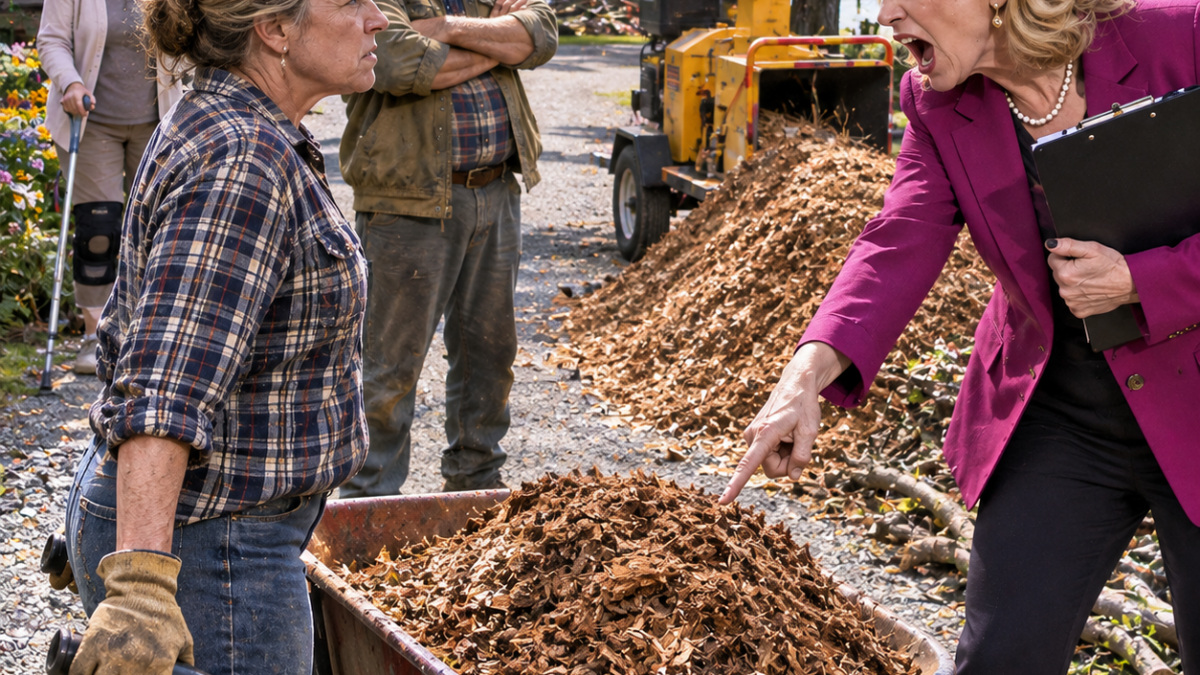
HOA Karen Dumped a Wall of Branches Across My Only Lake Road—So I Turned Her Mess Into Free Mulch for the Neighbors She Was Charging.
Three days after HOA President Colleen Hart ordered a tree crew to bury the only road to my lake house beneath a wall of branches, my wife—still recovering from knee surgery—had to leave our truck behind and struggle home with a cane because Colleen had decided blocking my property was the price I should pay for telling her no.
Then I discovered the homeowners uphill had already been charged for “debris removal and offsite disposal,” even though the same debris they had paid to haul away was sitting across my road with a note saying it was now entirely my responsibility.
So I rented a chipper, turned Colleen’s pile into clean mulch, and started giving it free to the very neighbors she was threatening with landscaping violations—and that was when she made the mistake of trying to stop one elderly woman’s wheelbarrow in front of everyone.
The first thing Colleen Hart said when she saw the wheelbarrow was:
“Put that back.”
She didn’t say hello.
Didn’t ask what was happening.
Didn’t mention the road that had been blocked for three days.
She stepped directly in front of Joyce Caldwell, planted one hand on her hip, and pointed at a wheelbarrow full of fresh wood chips as though Joyce had just been caught stealing jewelry.
Behind us, the chipper was finally silent.
My gravel lane stretched clear from the workshop to the bend for the first time since Wednesday.
The air smelled like oak, maple, gasoline, and freshly cut wood.
A small pile of mulch sat beside my shed.
My wife Elaine watched from the porch with her leg elevated on a cushion.
Three of Colleen’s own HOA neighbors stood nearby holding bags, buckets, or wheelbarrows.
And Joyce—seventy years old, five feet four on a generous day—kept both hands firmly around the handles.
“You told us to cover our bare flower beds,” Joyce said.
Colleen’s expression hardened.
“That material belongs to the association.”
I shut off the chipper’s fuel valve and stepped closer.
“Interesting.”
Colleen looked at me.
“What?”
I reached into the pocket of my work shirt.
“I’ve got a note that says something different.”
Her eyes moved toward my hand.
Three days earlier, she had taped that note to the very branches she was now claiming belonged to her.
It said the debris had been placed on my access corridor and that disposal was my responsibility.
But before I could unfold it, Joyce reached beneath her gardening gloves and pulled out another piece of paper.
Her monthly HOA assessment.
She held it toward Colleen.
“Then why did you charge me to have it hauled away?”
The silence after that question was the first moment I realized this fight was no longer just about my road.
My name is Ray Foster.
I was sixty-five that summer.
My wife Elaine and I had lived beside Lake Mercer for nineteen years.
Not in one of the big houses uphill.
Our place sat below them.
Small cedar-sided house.
Workshop.
Two-car garage.
A narrow dock.
PART2:
Raised garden beds Elaine treated like a second family.
And one gravel road connecting all of it to the county road.
One.
No back entrance.
No second driveway.
No private emergency road hidden through the woods.
If something blocked that lane, our vehicles did not get home.
The homeowners association known as Cedar Hollow sat uphill from us.
Eighty-six homes built on a wooded ridge.
Nice place.
Stone entrance walls.
Decorative streetlights.
Flower beds at every intersection.
Rules about mailbox colors, lawn height, roof shingles, fence styles, garbage cans, parking, and apparently everything else people could imagine regulating once they had enough time and clipboards.
We were not members.
Never had been.
Our property existed before the subdivision.
The boundary followed the upper edge of the drainage ditch running beside our road.
Some HOA-owned trees stood above the ditch.
Their branches occasionally reached over my lane.
That was fine.
Trees do not read surveys.
I trimmed what was mine when necessary.
They maintained what was theirs.
PART3:
For years, nobody had much trouble understanding the difference.
Then Colleen became HOA president.
Colleen Hart was fifty-seven and carried authority the way some people carry perfume.
Too much.
She liked rules.
More accurately, she liked being the person who explained rules to everybody else.
She drove a silver crossover.
Always had a clipboard.
Always seemed to be on her way somewhere more important than wherever she currently was.
She was not stupid.
That mattered.
People prefer antagonists who are obviously ridiculous.
Colleen wasn’t.
She understood contracts.
Budgets.
Homeowner procedures.
Vendor scheduling.
She could run a meeting.
She remembered details.
Her problem was simpler.
She believed being in charge of the HOA meant being in charge wherever the HOA could see.
My lane happened to be visible from their lower boundary.
That was how the trouble started.
Four days before the branches appeared, I was fixing a loose board on the little footbridge over the drainage ditch when Colleen walked down the lane.
Elaine had undergone knee surgery six weeks earlier.
Nothing dramatic.
A repair she had postponed too long.
Recovery was going well.
But uneven ground still bothered her.
The bridge let her reach the raised vegetable beds without stepping down into the ditch and back up.
I had promised to finish the handrail before she planted beans.
Small promise.
The kind I liked keeping.
I was tightening a screw when I heard Colleen.
“We’re trimming tomorrow.”
I looked up.
She stood six feet away holding pink marking flags.
“Morning to you too.”
She ignored that.
“The roadside trees.”
“Which ones?”
“Association boundary.”
I stood and wiped sawdust from my jeans.
“Your side of the ditch?”
“Along the corridor.”
“There is no shared corridor.”
She gave me that look.
The one people use when they believe a technical fact is an inconvenience rather than a fact.
“Nobody’s taking your road, Ray.”
“I didn’t say you were.”
“We’re trimming branches overhanging it.”
“Fine.”
“The crew may need access.”
“From where?”
“The lane.”
“No.”
Her eyebrows lifted.
“No?”
“Your trees are uphill.”
“The bucket truck can stay on your road.”
“They may need room below for debris.”
“Not on my lane.”
She sighed.
“It’s temporary.”
“Still no.”
“Ray, don’t make this difficult.”
I set the drill on the bridge rail.
“Colleen, I’m not making anything difficult.”
“This is the only road to my house.”
“If branches come down, your crew takes them away.”
“They don’t store them here.”
She pointed toward the shoulder.
“We’re talking about a few limbs.”
“Then putting them on your property should be easy.”
She looked toward the house.
Elaine was sitting on the porch with an ice pack across her knee.
Colleen knew about the surgery.
Everybody did.
Elaine had lived around the lake long enough that half the neighborhood had brought food.
Colleen looked back at me.
“I’ll tell the crew to be reasonable.”
“Tell them the lane stays open.”
“They’re professionals.”
“So am I when I say no.”
That ended the conversation badly.
Colleen went uphill.
I finished the bridge.
The next morning, the tree crew arrived around eight.
I heard chainsaws while making coffee.
From the kitchen window, I could see the top of a bucket truck through the trees on the HOA road.
Exactly where it should have been.
“Maybe that was painless.”
Elaine looked up from the table.
“You just doomed us.”
I laughed.
“What?”
“You said it out loud.”
“At nine, we left for physical therapy.
Elaine hated therapy.
Not the therapist.
The exercises.
Especially anything involving stairs.
Afterward we stopped at the grocery store.
Milk.
Eggs.
Coffee.
Chicken.
Three tomatoes Elaine said were too expensive and bought anyway.
We headed home around noon.
I turned onto the lake lane.
Stopped.
For several seconds, neither of us said anything.
Branches covered the road.
Not a pile beside it.
Not a few pieces along one shoulder.
A wall.
Fresh oak limbs.
Maple.
Leafy branches.
Thick pieces.
Small tangled pieces.
The whole lane.
Some sections rose chest high.
The debris continued around the bend far enough that I could not see the house.
Elaine leaned forward.
“Oh, Ray.”
I put the truck in park.
There was no tree crew.
No flagger.
No equipment.
No warning cone.
Nothing.
I got out.
The fresh-cut smell was overwhelming.
A white sheet of paper was taped to a branch at eye level.
I pulled it loose.
VEGETATION CLEARED FROM ACCESS CORRIDOR.
DISPOSAL IS THE RESPONSIBILITY OF THE PROPERTY OWNER.
Signed:
COLLEEN HART
PRESIDENT, CEDAR HOLLOW HOA
I stood there reading it.
Elaine lowered the passenger window.
“Can we get through?”
“No.”
“What about around?”
I checked.
Uphill side:
Ditch.
Steep bank.
Soft ground.
Downhill side:
Old stones, wet soil, lake drainage.
Taking the truck around would likely put us in the ditch.
I looked at Elaine.
Her cane was behind the seat.
The distance from where we sat to the house was a little under a quarter mile.
Not far.
Unless your knee had recently been opened by a surgeon.
I called Colleen.
She answered immediately.
“The trimming is complete.”
“You blocked my road.”
“The debris came from over your property.”
“It came from your trees.”
“Branches extended into your access corridor.”
“So you cut them.”
“Yes.”
“Then you remove them.”
“That’s your responsibility now.”
“Come down here.”
“I’m busy.”
“My wife can’t walk through this.”
“There should be space along the edge.”
“There isn’t.”
Pause.
“Well, I’m sure you can clear enough.”
I looked at Elaine.
Groceries beside her.
Cane behind the seat.
Something changed in me.
Not rage.
Rage is loud.
This was colder.
“Do not send anybody else onto my road.”
“Ray—”
I hung up.
Then photographed everything.
Wide shots.
Close shots.
The note.
Truck.
Blocked lane.
Ditch.
Elaine inside the truck.
Not because I wanted a picture of my wife struggling.
Because I had spent thirty-two years maintaining equipment at a farm supply yard.
One thing that job taught me:
When somebody creates a problem and later says the problem never existed, photographs become very patient witnesses.
I started pulling branches.
By hand.
No chainsaw at first.
Just enough to create a walking path.
Every limb seemed connected to three others.
I moved one.
Another rolled into its place.
My gloves filled with sap.
A branch scraped my wrist.
Elaine called:
“Don’t hurt yourself.”
“I’m fine.”
“You’re sixty-five.”
“Thank you for the reminder.”
“You’re welcome.”
It took almost forty minutes to make a narrow strip.
Not vehicle width.
Walking width.
I carried the groceries first.
Two trips.
Then returned.
Elaine got out with her cane.
“You can stay in the truck.”
“For how long?”
“I’ll figure something out.”
“Ray.”
I knew the tone.
I moved beside her.
“Firm gravel on the left.”
“I see it.”
We walked.
Slowly.
I stayed on the downhill side so if she stumbled, she fell toward me rather than the ditch.
Halfway down, she stopped.
Not dramatically.
Just stopped.
Closed her eyes.
“Pain?”
“A little.”
“We can sit.”
“On what?”
I looked around.
“Excellent point.”
We stood there until it eased.
Then kept going.
She never complained.
That made me angrier.
Elaine had never liked being treated as fragile.
She did not need Colleen’s pity.
She needed access to her own house.
When we reached the porch, she sat.
I brought an ice pack.
Then called Ben Wallace.
Ben was the HOA’s property manager.
Not president.
Paid administrator.
Forty-three.
Generally reasonable.
He answered:
“Ray.”
“Check your email.”
“What am I looking at?”
“The road.”
I sent photographs.
Silence.
Then:
“That wasn’t the work order.”
“What was?”
“Trim and remove.”
“Then why is removal blocking my driveway?”
“I don’t know.”
“Find out.”
“I will.”
“Keep the original work order.”
Another pause.
“Why?”
“Because instructions changed.”
Ben’s voice became more serious.
“Okay.”
“And save the change.”
“If there was one.”
“There was.”
“How do you know?”
“Because nobody accidentally disposes of six truckloads by building a wall across somebody’s only road.”
I called the sheriff’s non-emergency number.
Deputy Michael Lewis came around three.
He photographed the road.
Read Colleen’s note.
Asked whether I had threatened anyone.
“No.”
“Moved any of their equipment?”
“No.”
“Were workers still here when you arrived?”
“No.”
He gave me a report number.
“This is partly civil.”
“I figured.”
“I’ll contact the association.”
“Can you make them remove it?”
“I can’t order private contractors back without more.”
Not the answer I wanted.
But honest.
He added:
“Document any reasonable costs you incur restoring access.”
That part stayed with me.
After he left, I called two tree companies.
First:
“Next Wednesday.”
Second:
“Friday.”
Estimate:
Around $1,100.
Maybe more depending on hidden material.
It was Wednesday.
My truck remained parked near the county road.
My workshop was beside the house.
Fuel cans inside the truck.
Tools in both places.
I could spend two days navigating branches because Colleen wanted to punish me for saying no.
Or I could solve the physical problem while documenting the rest.
At four, a pickup arrived.
Company logo on the door.
HILLSIDE TREE & LANDSCAPE
A man stepped out.
Early forties.
Brown work shirt.
Name embroidered above pocket:
AARON
“Mr. Foster?”
“Yes.”
“Ben Wallace called us.”
He walked down the lane.
His face changed.
“We weren’t supposed to leave this.”
“Where were you supposed to leave it?”
“Nowhere.”
He took out his phone.
“Original work order included haul-off.”
“Then why didn’t you haul it?”
He scrolled.
“Our foreman got a change.”
“From Colleen?”
Aaron looked uncomfortable.
“Yes.”
“What did it say?”
“That material would stay on the lower access lane.”
“Did it say I agreed?”
“Yes.”
“I didn’t.”
“I understand that now.”
“Can I see it?”
“I need permission to release company messages.”
“Preserve it.”
“I will.”
He examined the pile.
Then offered:
“I can send two guys back tonight to open a vehicle path.”
“Where do they put the branches?”
“Shoulder.”
“Not the ditch.”
“No ditch.”
“Not the lake edge.”
“No.”
“Then yes.”
They returned before dark.
Two workers moved brush until a single narrow vehicle path existed.
Barely.
I drove the truck slowly through.
Mirrors almost touched branches.
But I got home.
Elaine watched from the porch.
When I parked, she said:
“Look at you.”
“What?”
“Back on your own property.”
“Luxury.”
That night I could have paid somebody to haul everything.
Instead, Aaron had said something while inspecting the pile.
“A chipper would eat most of this.”
I called my old friend Dale Morgan.
Dale ran a small tree service.
We knew each other because I had repaired his trailer brakes so many times he eventually stopped pretending the damage was normal.
I told him about the pile.
He said:
“I can rent you the tow-behind Saturday.”
“I haven’t used that model.”
“I know.”
“How?”
“Because you’re calling me.”
Fair.
“I’ll run it.”
“What will it cost?”
He gave me a number.
Less than half the removal quote.
“Come look first.”
Dale arrived Thursday at lunch.
Walked the pile.
Pulled limbs aside.
Checked for metal.
Plastic.
Wire.
He pointed toward the larger wood.
“Firewood.”
Then smaller branches.
“Mulch.”
I looked toward Elaine’s raised beds.
“We’d have a lot.”
“You’d have enough to mulch half the county.”
That became the first moment I stopped seeing the branches only as garbage.
A problem has weight.
Sometimes it also has material.
If Colleen wanted me responsible for the material, fine.
Maybe responsibility could become ownership.
But before I touched it with a chipper, I wanted that written down.
That afternoon Joyce Caldwell walked down the lane.
Joyce lived two houses above the bend.
Her husband, Frank, had spent most of the winter receiving cancer treatment.
Nothing terminal.
But enough that their yard had become low priority.
She often brought Elaine tomatoes.
Elaine gave her zucchini in quantities that should have required legal disclosure.
Joyce stopped near the pile.
“I wondered what happened.”
I told her.
Her face tightened.
“Colleen sent us notices Monday.”
“What notices?”
“Landscaping.”
She opened a grocery bag.
Pulled out a pink sheet.
Bare soil visible around shrubs.
Must cover with mulch or approved ground material by end of month.
“Seriously?”
“You know Colleen.”
I looked at the pile.
Then at her.
“I’m turning this into mulch Saturday.”
Joyce smiled.
“Could I buy some?”
Something about the question bothered me.
Not Joyce.
The idea that she might pay for material she had already indirectly paid to create.
“You can have some.”
“Ray, no.”
“Yes.”
“I don’t want to take advantage.”
“You aren’t.”
She looked relieved.
Then pulled out the rest of her HOA statement.
“Elaine asked what they were charging us.”
I glanced.
Then stopped.
Tree-trimming assessment.
Description:
ROADSIDE PRUNING, DEBRIS REMOVAL, AND OFFSITE DISPOSAL
I read it again.
“How much?”
She showed me.
“I already paid with dues.”
I looked toward my road.
Then back at the paper.
The HOA had told homeowners they paid for removal and offsite disposal.
Colleen told me disposal was my responsibility.
“Can I photograph this?”
Joyce hesitated.
“My account number—”
“Fold it.”
She covered private information.
I photographed only the service description and date.
Joyce asked:
“Does that mean she stole the money?”
“No.”
She seemed disappointed.
“Why not?”
“Because we don’t know what the contractor billed.”
“But we paid.”
“Yes.”
“Maybe they credited it.”
“Maybe.”
“Maybe the HOA hasn’t paid them yet.”
“Maybe the wording is wrong.”
She sighed.
“You’re no fun.”
“I’ve been married forty years. Elaine could have told you that.”
“What do I do?”
“Ask for the contractor invoice.”
“Can I?”
“You’re a member.”
“I’m not.”
Joyce nodded.
She folded the bill carefully.
Before leaving, she looked at the branches.
“Still saving me some?”
“Yes.”
That evening, I showed Elaine.
She read the statement.
“Send it to Ben.”
“I will.”
“Ask a question.”
“What question?”
She looked at me.
“Don’t tell him they’re stealing.”
“I wasn’t going to.”
“Good.”
“What did you think I was going to do?”
She smiled.
“I married you.”
Fair enough.
I emailed Ben.
Attached the photo.
Asked:
Was the HOA charged for hauling and disposal?
Did the contractor issue a credit after instructions changed?
What happened to the homeowner assessment?
Then:
I intended to clear the road myself Saturday.
Some branches would become mulch.
Some might be given away.
Before doing so, I wanted written confirmation that the association claimed no ownership interest in material it had left on my property.
Ben responded:
I’m obtaining contractor records. Do not dispose of anything until I confirm.
I called.
“I can’t leave my road like this.”
“I know.”
“Then move quickly.”
He did.
Friday morning, Dale came back to sort.
We did not run the chipper.
We separated larger wood.
Removed plastic twine.
Moved tangled sections.
Then Dale stopped.
“Ray.”
“What?”
“This isn’t all from your roadside trees.”
“How do you know?”
He pointed.
Narrow upright hedge cuttings.
Fresh.
Different species.
“This came from a hedge.”
I knew exactly which one.
The tall hedge surrounding the HOA clubhouse parking lot.
Two hundred yards uphill.
I took photographs.
Now the story changed again.
Colleen had not merely left overhanging branches on my road.
She had used my road as a dumping site for unrelated HOA landscaping waste.
I called Aaron.
“Did your crew bring clubhouse hedge material here?”
Long pause.
“I need to check.”
“I have it in front of me.”
“I believe you.”
“I need to know who ordered it.”
“I’ll call.”
While waiting, we documented everything.
Truck tire marks.
Pile composition.
Hedge branches.
Oak.
Maple.
No rushing.
No hiding.
At noon, Elaine came down.
Cane.
She looked at the cleared strip.
“Move.”
“What?”
“You’re standing where I need to walk.”
I stepped aside.
She walked from the house to the bridge.
Across.
Back.
Slow.
No stop.
She smiled.
“Better.”
I watched her return.
That was when I remembered the reason behind everything.
Not proving Colleen wrong.
Not winning a meeting.
Not humiliating an HOA.
I wanted my wife to walk safely from her house to her garden.
The dispute had become larger because Colleen insisted on making it larger.
But the objective remained small.
Clear the road.
Repair damage.
Keep it clear next time.
Aaron called.
“The hedge was ours.”
“I know.”
“Two loads.”
“Who ordered them down here?”
“Mrs. Hart.”
“Did she say I agreed?”
“Yes.”
“I sent a refusal.”
“Ben showed it to us.”
“What was the original contract?”
“Trim and haul.”
“Then?”
“Colleen changed disposal.”
“Did you reduce your invoice?”
“Yes.”
That surprised me.
“How much?”
“I can’t give you the customer number without authorization.”
“Fine.”
“But haul-off was removed.”
“So homeowners were charged using the original work description.”
“Sounds like it.”
“Did your company receive the full amount?”
“No.”
Important distinction.
The contractor had not pocketed money for a service never performed.
The HOA had simply billed homeowners before the change and had not yet corrected the charge.
Maybe dishonesty.
Maybe incompetence.
Maybe Colleen planned to use the credit elsewhere.
We still needed records.
I called Ben.
He now had both invoices.
Original included haul-off.
Revised showed a credit.
“What happens to the credit?”
“I’m taking it to Susan.”
“Who?”
“Treasurer.”
“Will homeowners get it back?”
“They should.”
“Should isn’t a result.”
“I know.”
“And the branches?”
“Colleen still says they’re your responsibility.”
“Good.”
“Good?”
“Put that in writing.”
“Ray—”
“I’m serious.”
“I’m processing them tomorrow.”
“Some will become mulch.”
“I may give some away.”
“If she says they’re mine, I want her to say the association makes no claim after I spend money dealing with them.”
Ben understood.
An hour later:
Forwarded email from Colleen.
Mr. Foster may arrange disposal at his expense. The association will not retrieve material placed on his property and asserts no ownership interest in debris after placement.
I printed it.
Then printed my earlier question specifically mentioning mulch and giveaway.
Added both to the envelope with her original note.
Elaine tapped the papers.
“Keep those.”
“I plan to.”
That evening, Joyce returned.
With Beverly Mills.
Beverly was sixty-two.
Quiet.
Her husband had lost his warehouse job in January.
She carried two empty feed bags.
“Joyce said you might have extra.”
“Tomorrow.”
She looked embarrassed.
“I don’t need much.”
“You’ll have enough.”
“I can pay something.”
“No.”
“Ray—”
“No.”
Then she explained.
Her yard notice required mulch too.
She had priced bags at the garden center.
Not a fortune.
But when unemployment had already made every grocery receipt stressful, forty dollars mattered.
I understood that feeling.
I had lived through layoffs.
Mortgage years.
Kids needing braces.
Transmission failures.
One expense is small only when it arrives alone.
“Come tomorrow afternoon.”
Dale arrived Saturday at eight.
He laid out rules.
No loose clothing near the chipper.
Nobody near the feed chute except us.
Branches sorted first.
Metal checked.
Engine off before anyone approached the finished pile.
I followed every instruction.
At sixty-five, I had no interest in proving bravery to rotating machinery.
The chipper started.
Loud.
Branches disappeared.
Chips sprayed into the collection area.
A mountain of Colleen’s problem slowly became usable material.
Every hour, more road appeared.
Gravel.
Drainage edge.
Grass.
By eleven, I could see the bend.
By noon, the lane looked like a road again.
Joyce arrived with her wheelbarrow.
Beverly with her bags.
They stayed near the porch until Dale shut down.
We loaded modest amounts.
Joyce pulled money from her pocket.
I held up a hand.
“You already paid somebody to haul it once.”
She laughed.
Then stopped.
“Ben said the contractor credited the HOA.”
“Good.”
“I asked Susan where that money is.”
“Better.”
Beverly tied her bag.
“This helps more than you think.”
“I know.”
After they left, we ran another hour.
Two other neighbors stopped.
I told them they could collect later when the machine was off.
One man named Stan offered to repair the road shoulder.
His tractor had a grading blade.
“Let me document first.”
“Fair.”
That offer meant something.
People who had barely spoken to me were beginning to see my road not as the boundary between us but as something somebody had mistreated.
Around two, Joyce returned for another load.
I filled the wheelbarrow.
Then Colleen’s crossover appeared.
She stopped hard at the bend.
Door opened.
“What is going on?”
I signaled Dale.
He shut the chipper down.
Colleen walked toward us.
Her eyes moved from the chips to the sign I had placed beside the pile:
FREE WOOD CHIPS — ASK BEFORE LOADING
Then she saw Joyce.
“Put that back.”
That returned us to the beginning.
Joyce held the wheelbarrow.
“You told us to cover bare beds.”
“That material belongs to the association.”
I reached for Colleen’s note.
Joyce pulled out her billing sheet.
“Why did you charge us for hauling?”
Colleen looked at the paper.
Then at me.
“The association’s internal billing is none of his business.”
Joyce answered:
“It’s my bill.”
I unfolded Colleen’s note.
“You left this.”
“That refers to disposal responsibility.”
“And yesterday you wrote you made no claim to the debris.”
“That doesn’t authorize commercial redistribution.”
“No one is paying.”
“You rented commercial equipment.”
“To clear a road you blocked.”
“On residential property.”
“My property isn’t HOA property.”
She photographed the chipper.
Then my sign.
“Good.”
I said.
“Take pictures.”
Her eyes narrowed.
Then she turned to Joyce.
“If you use that material, don’t expect it to satisfy your landscape notice.”
Joyce stared.
“Why?”
“It isn’t approved mulch.”
“Show me the rule.”
Colleen pulled a pen from the clipboard.
“We have landscaping standards.”
“Which one?”
“Joyce, I’m not debating regulations in the middle of a road.”
“You’re standing in front of my wheelbarrow.”
Dale stepped beside me.
Said nothing.
Elaine came down from the porch.
I hated that immediately.
Her knee had already paid enough.
She stopped on level gravel.
“Joyce.”
Joyce looked toward her.
“If you want, leave your load here until you check the rules.”
For half a second, Colleen’s expression eased.
She thought Joyce would surrender.
Joyce straightened.
“No.”
She pushed the wheelbarrow.
“I’m taking it.”
Colleen stepped aside.
Barely.
Joyce walked uphill.
Beverly stood nearby.
Empty bags in hand.
Her face had gone pale.
“I can’t afford a fine.”
“You don’t have to take anything.”
She looked disappointed.
“I’m sorry.”
“Don’t be.”
I put her bags on the porch.
“Your pile stays.”
Colleen photographed everything again.
“This will be reported.”
“Include your branches.”
She turned.
“And the note.”
She walked back to her car.
Then left.
I watched until she disappeared.
Dale said:
“Pleasant woman.”
“She’s delightful.”
“How much longer?”
“Hour.”
“Let’s finish.”
We did.
No dramatic rebellion.
No parade of neighbors hauling chips in front of her house.
No revenge convoy.
We simply finished clearing my road.
By mid-afternoon, I could drive from the workshop to the county road without folding the mirrors.
Dale gave me his invoice.
I paid.
He handed me a copy.
“Keep it.”
“I keep everything now.”
“Good habit.”
He looked toward Elaine.
She sat with her leg raised.
“Worth it?”
I looked at the clear lane.
“Yes.”
That evening, Joyce texted a photograph.
Her flower bed.
Mulch spread neatly around shrubs.
Before and after pictures.
Her message:
Learning from you.
I smiled.
Sunday morning brought another picture.
A fresh HOA notice.
LANDSCAPING REMAINS NONCOMPLIANT.
Reason:
Material obtained from unapproved roadside processing operation.
Deadline:
Wednesday.
Remove and replace.
Joyce called.
“Do I have to pull it out?”
“I don’t know.”
“What do the rules say?”
“Bare beds require mulch or approved ground cover.”
“Supplier requirement?”
“No.”
“Material specification?”
“Just safe landscape material.”
“Send Ben both.”
“I already did.”
“Copy Susan.”
“Already did.”
I laughed.
“You’re getting dangerous.”
“I’m seventy.”
“I’ve earned dangerous.”
I sent Ben photographs.
My road.
Original pile.
Colleen’s no-ownership statement.
Dale’s description of clean branch material.
Then I stopped.
That mattered.
Joyce’s yard was Joyce’s fight.
I could provide evidence.
I should not turn her property into my revenge project.
Monday, Ben called.
“Colleen filed a complaint against you.”
“For what?”
“Commercial operation.”
I looked toward the empty spot where the chipper had been.
“There’s no operation.”
“She says people collected landscaping products.”
“They did.”
“Did anyone pay?”
“No.”
“Donations?”
“No.”
“Delivery?”
“No.”
“Advertising?”
“Cardboard sign beside the pile for people already invited.”
He sighed.
“The county received it too.”
That irritated me more than it should have.
Not because I feared the complaint.
Because every false complaint costs time.
Forms.
Calls.
Waiting.
Hours you never get back.
I called county land use.
A woman named Teresa answered.
I explained.
One-day chipper rental.
Branches dumped across access road.
Free chips.
No business.
No recurring activity.
She asked for photos.
Invoice.
Messages.
I sent everything.
Tuesday, Teresa and a colleague visited.
They walked the property.
Looked at workshop.
Mulch pile.
Road.
No price board.
No equipment.
No customers.
No business signage.
I showed Dale’s invoice.
“One day.”
“Do you plan to continue accepting brush?”
“No.”
“Sell mulch?”
“No.”
“Deliver it?”
“No.”
She nodded.
“We’ll review.”
Before leaving, I showed the original blockage.
“Please note this started because material was left across the road.”
She wrote it down.
While waiting, Stan came over.
He crouched near the ditch.
“The trucks crushed the edge here.”
“I saw that.”
“There’s another spot down there.”
I hadn’t.
He showed tire ruts pressing gravel into the drainage path.
“If you get a hard rain, water could run across the road.”
We measured.
Photographed.
Made a sketch.
Stan offered a repair estimate.
Now I had something useful.
Not:
They damaged my road.
But:
Twenty-eight feet of shoulder affected.
Drainage obstruction.
Fresh gravel needed.
Blade work.
Specific cost.
Elaine found me at the kitchen table that afternoon.
Folder open.
Pictures everywhere.
“You need to go outside.”
“I am outside half the day.”
“You need to go sit by the lake.”
“I’ve got calls.”
“Twenty minutes.”
“Elaine.”
She picked up her cane.
“Walk with me.”
We went to the dock.
Her pace had improved.
No branch pile.
No narrow walking strip.
Clear road.
Clear bridge.
We sat on cushions.
A fishing boat crossed the lake.
For twenty minutes, neither of us talked about Colleen.
Then Elaine said:
“I don’t want you spending the summer staring up that road.”
“I don’t either.”
“Then stop trying to win each little argument.”
I looked at her.
“What does that mean?”
“Ask for something that ends it.”
That was why I married her.
Not because she made everything easy.
Because she knew when I had narrowed my attention too much.
The mulch solved the branches.
It did not solve the boundary problem.
I called Martin Hale.
Local attorney.
Paid for an hour.
Took everything.
Survey.
My refusal.
Colleen’s disposal note.
Her written no-ownership statement.
Deputy report.
Chipper invoice.
Road estimate.
Martin read quietly.
Then asked:
“Do you want to sue?”
“No.”
“Really?”
“I want costs paid.”
“Road repaired.”
“Written rule that they stay off my lane without permission.”
“Anything else?”
“Joyce left alone.”
He shook his head.
“That part is separate.”
“I know.”
“Her HOA notice belongs to her.”
“Your property claim belongs to you.”
“Same event.”
“Different rights.”
I nodded.
“I don’t want homeowner money.”
“Good.”
“I want what this cost me.”
Martin prepared a demand.
Chipper.
Dale’s labor.
Reasonable legal expense.
Road repair.
Written access protocol.
No dumping.
No staging.
No equipment storage.
No contractor use without my written permission.
The board scheduled a special meeting.
Thursday.
Ben said:
“Bring records.”
Then paused.
“Colleen says you agreed to receive the material.”
I looked at my printed email.
“No.”
“I know.”
“Then why are we discussing it?”
“Because she made the statement.”
“Do you have my refusal?”
“Yes.”
“Do you have her dumping note?”
“Yes.”
“Then we’re good.”
He sighed.
“I wish meetings worked that quickly.”
The night before, Joyce came over.
Beverly with her.
They brought rules.
Notices.
Tree-work bill.
Beverly said:
“I want to speak.”
“You don’t have to.”
“I paid too.”
“You didn’t take mulch.”
“No.”
“Because I was afraid she’d fine me.”
She looked toward the road.
“That’s why I should speak.”
We copied documents.
Covered account numbers.
Highlighted only relevant language.
Thursday morning, county land use emailed.
Complaint closed.
No ongoing commercial operation.
No zoning action.
I printed it.
Put it in the folder.
No clever email to Colleen.
No victory lap.
At five, Aaron called.
“We’re coming to the meeting.”
“Why?”
“Owner approved release of work orders.”
“Original and changes?”
“Yes.”
“Foreman?”
“Phone.”
“Did Colleen tell you to place debris beside the road or on it?”
Aaron became quiet.
“On it.”
“How clearly?”
“You should hear the messages.”
The HOA meeting room was full.
More people than normal.
Elaine sat beside me.
Joyce and Beverly nearby.
Stan in back with repair estimate.
Aaron at the front.
Susan Miller, HOA treasurer, sat beside Ben.
Colleen opened.
“This situation began as a routine maintenance project that Mr. Foster escalated by refusing cooperation and later distributing association-owned landscape material.”
Susan interrupted.
“Stop.”
Colleen looked offended.
Susan held up a printed email.
“You wrote that the association made no ownership claim.”
“That referred to disposal.”
“If you disclaim the material and tell him to dispose of it at his own cost, you don’t later claim theft because he processed it.”
Colleen tightened her jaw.
Joyce said:
“He gave it away.”
Susan nodded.
“Exactly.”
Then she addressed billing.
Original contractor invoice included hauling.
Colleen had canceled that portion.
Contractor issued credit.
Homeowners had already been billed using the original estimate.
The difference remained in the association’s account.
Not stolen by contractor.
Not missing.
Not yet returned.
Colleen said:
“We could apply it toward future landscape projects.”
Susan looked at her.
“Not without board approval.”
A murmur moved through the room.
That answered the money question.
Then Aaron opened his folder.
Original order.
TRIM / CLEAN / HAUL OFFSITE
Next:
Change request.
LEAVE MATERIAL ON LOWER ACCESS LANE. PROPERTY OWNER RESPONSIBLE.
I said:
“I never agreed.”
Colleen answered:
“You refused reasonable access arrangements.”
“I refused storage.”
“You were uncooperative.”
Ben placed my email on the table.
Read:
Crew may trim branches from association property provided my lane remains open and no debris, equipment, or materials are stored on my road or bank.
Silence.
Then Aaron turned on speakerphone.
Foreman joined.
Ben asked:
“Were you told Mr. Foster agreed to take debris?”
“Yes.”
“By whom?”
“Mrs. Hart.”
Colleen leaned back.
Then Aaron placed another page on the table.
Follow-up question from foreman:
FIRST LOAD MAY RESTRICT VEHICLE ACCESS. CONFIRM PLACEMENT?
Colleen’s answer:
USE GRAVEL LANE. MR. FOSTER CAN MOVE IT WHEN HE IS READY TO TAKE RESPONSIBILITY.
Ben read it aloud.
Nobody spoke.
Then another message.
Foreman:
FULL LOAD WILL CLOSE LANE. CONTINUE?
Response:
THEN CLOSE IT.
You could feel the room change.
Not loudly.
No gasps.
Just people becoming still.
Colleen leaned forward.
“Out of context.”
Susan looked at the page.
“What’s the context?”
“The crew needed to complete the job.”
“And you knew it would close the road?”
“He had alternatives.”
I said:
“What alternatives?”
She looked at me.
“You could have allowed staging.”
“On my property.”
“For a few hours.”
“I said no.”
“Exactly.”
Susan’s face tightened.
“So you closed his road because he said no.”
“That is not what happened.”
Aaron spoke carefully.
“Our crew should have stopped.”
Everyone looked toward him.
“We followed Mrs. Hart’s direction.”
“But when it became clear access would be blocked, our foreman should have called the property owner or our office before continuing.”
That mattered.
Accountability works better when everybody owns their part.
I did not want the contractor pretending Colleen forced their hands.
Adults made choices.
Then Susan turned to Elaine.
“Mrs. Foster.”
Elaine straightened.
“Did the obstruction prevent you from reaching your home by vehicle?”
“Yes.”
“What happened?”
“Ray cleared a narrow path.”
“I walked.”
“With your cane?”
“Yes.”
“Were you recovering from surgery?”
“Yes.”
Colleen started:
“There was room—”
Susan raised a hand.
“Let her finish.”
Elaine did not exaggerate.
“I got home.”
“I had to stop halfway.”
“I don’t need special treatment.”
She rested both hands on the cane.
“I need the road to my house left open.”
No speech I could have made would have been stronger.
Bill Hanson, another board member, looked at Colleen.
“We approved trimming and hauling.”
“You canceled the haul.”
“It saved money.”
Bill looked toward Elaine.
“No.”
“It moved the cost to somebody else.”
That was exactly it.
Joyce stood next.
“I’d like my notice addressed.”
She presented the landscaping rule.
Bare soil required mulch or approved ground covering.
No supplier requirement.
No prohibition on clean chipped wood.
Then the second notice declaring her mulch invalid because it came from an “unapproved roadside operation.”
I handed Ben the county closure letter.
No commercial operation.
Colleen said:
“That does not make the product approved.”
Joyce answered:
“What is wrong with it?”
“We don’t know what it contains.”
Aaron spoke.
“We cut the branches.”
Everyone looked at him.
“Oak.”
“Maple.”
“Some hedge material from our own clubhouse job.”
“Dale sorted it before chipping.”
I handed over Dale’s written description and invoice.
I said:
“If Joyce broke a written landscaping rule, show her.”
“Don’t invent one because she accepted material from me.”
Beverly stood.
Her voice shook.
“I left my bags behind.”
Colleen looked at her.
“Why?”
“Because you threatened Joyce with a violation.”
“I did not threaten her.”
“You told her the mulch wouldn’t count.”
“And I already had a yard notice.”
“I can’t afford a fine.”
“I was trying to do what the HOA told me.”
“Ray offered help.”
Beverly sat.
Colleen looked around.
That was when I think she realized the meeting was no longer about me.
As long as it was Ray versus Colleen, she could call it a personality conflict.
Difficult outsider.
Uncooperative landowner.
Old man angry about branches.
But Joyce was her homeowner.
Beverly too.
Susan was treasurer.
Bill was board.
Aaron was contractor.
Elaine simply wanted to reach home.
The story had become too crowded for Colleen to control alone.
Susan called for a vote.
Withdraw Joyce’s notice.
Approved.
No homeowner would be cited merely for using clean wood chips from my property.
Approved.
Existing landscaping standards applied exactly as written.
No new supplier rule.
Approved.
Colleen objected.
Her objection went into the minutes.
Then the credit.
Susan proposed returning each household’s proportional share of the canceled hauling/disposal charge.
Colleen argued:
“Future landscaping—”
Susan cut her off.
“We’ll budget future work openly.”
Approved.
Then my claim.
The board wanted counsel review before settling costs.
I disliked waiting.
Martin had warned me that would happen.
Ben said:
“Written response by next Wednesday.”
“Put that in the minutes.”
He did.
Then came the most important vote.
Pending investigation, Colleen’s authority to direct contractors or issue violation notices was suspended.
She remained president for the moment.
But she could not wake up Friday morning and start another war with a clipboard.
For the first time since the branches appeared, I left a meeting feeling the road might stay clear.
Outside, Aaron stopped beside my truck.
“Our owner wants to cover the damage our trucks caused.”
“Talk to Martin.”
“Everything written.”
“Yes.”
Elaine climbed into the passenger seat.
Aaron said:
“Mrs. Foster.”
She looked over.
“I’m sorry about the walk.”
Elaine nodded.
“Next time somebody tells your crew to block a road, call the person who lives on it.”
“We will.”
Friday morning, Joyce knocked on my workshop door.
She held up her phone.
“Notice withdrawn.”
“Written?”
“Email.”
“Best kind.”
Then she pointed toward the small mulch pile marked BEVERLY.
“Can we finish this?”
We loaded Beverly’s bags.
Joyce took two.
I carried two.
We drove them uphill.
Beverly met us.
“I thought I’d missed my chance.”
“You left bags.”
“Hard to forget you.”
She laughed.
We placed them beside the flower bed.
She asked:
“What do I owe?”
“Nothing.”
Joyce said:
“He keeps saying that.”
“Eventually you have to believe him.”
The remaining mulch disappeared slowly.
Not a crowd.
Not retaliation.
People called first.
One couple filled plastic tubs.
Stan took a load for trees near his shed.
Another neighbor brought a small trailer.
I kept enough for our paths.
Our garden.
Around the workshop.
Wednesday, Ben sent the proposed settlement.
Martin reviewed every line.
HOA reimbursed:
Chipper.
Dale’s labor.
Reasonable legal consultation.
Contractor covered road-edge and drainage damage.
No charge for opening the emergency vehicle path because the contractor acknowledged its own role in creating the blockage.
Most important:
Future tree work could not use my lane for dumping, staging, storage, or equipment access without written permission.
Any work potentially affecting the road required advance coordination.
Ben would handle notice.
No board officer could override it informally.
I read that paragraph twice.
Then again.
Martin asked:
“You satisfied?”
“Yes.”
“No punitive money.”
“I don’t want punitive money.”
“No payment for your time.”
“I don’t expect one.”
“You could sue.”
“I know.”
He leaned back.
“Then sign.”
We settled.
No courtroom.
No giant award.
No television moment.
I got exactly what I had asked Elaine for at the lake.
Something that ended it.
Stan repaired the road the next week.
Fresh gravel.
Corrected shoulder.
Cleared ditch.
We waited for rain.
It came hard that Friday.
I stood under the workshop awning with Stan.
Water ran through the drainage channel.
Not across the road.
“No washout.”
He nodded.
“Looks right.”
I looked toward the house.
Elaine stood inside the kitchen window.
No blocked road.
No branches.
No clipboard.
“Yeah.”
“It does.”
At the next regular HOA meeting, the board removed Colleen as president.
Susan became interim president.
I did not attend.
People found that disappointing.
Joyce said:
“You should have seen her face.”
“I don’t need to.”
“Really?”
“Really.”
I was home building the handrail beside the footbridge.
Elaine had said she didn’t need one.
I told her I might.
She let me finish.
Colleen drove past once.
Her car slowed.
Then continued.
No apology.
I stopped expecting one.
An apology would not have repaired the gravel.
Would not have refunded the homeowners.
Would not have withdrawn Joyce’s notice.
Would not have created the written access agreement.
Sometimes people think closure requires the person who caused damage to admit everything.
It doesn’t.
Closure can be a clear road.
Signed paper.
Repaired ditch.
Withdrawn violation.
A wife walking to her garden without stopping.
A few weeks later, Aaron came down the lane.
On foot.
He pointed toward a cracked branch high above the boundary.
“We need to remove that.”
“Thursday.”
“Morning?”
“Eight.”
“We’ll haul everything.”
“Put it in the work order.”
He smiled.
“Already there.”
Thursday morning, the crew arrived.
Bucket truck stayed uphill.
Lane remained open.
They lowered the limb.
Loaded every piece.
Aaron walked the road before leaving.
“Clear?”
I looked.
Nothing.
No branch wall.
No note.
No newly assigned responsibility.
I signed one line:
SITE LEFT CLEAR.
That was it.
Ordinary.
After everything, ordinary felt luxurious.
By early summer, Joyce’s shrubs looked better than mine.
She made sure I knew.
Beverly brought Elaine a photograph of flowers growing through a bed covered with the chips.
Stan said his mulch had survived two storms.
Other loads had spread throughout Cedar Hollow.
The same branches Colleen had used to block me were now protecting soil around the neighbors’ plants.
That irony pleased people.
It pleased me too.
But not for the reason everyone assumed.
People told me:
“You got revenge.”
I didn’t.
Revenge would have been dumping mulch on Colleen’s driveway.
Charging double.
Embarrassing her publicly.
Trying to ruin her yard.
I did none of that.
I solved a problem she created.
The fact that the solution benefited the people she thought she controlled was simply better.
One evening, Elaine carried bean seeds across the footbridge.
No hesitation.
She placed her cane against the raised bed.
I brought the watering can.
“Don’t drown them.”
“I know how to water beans.”
“I’ve watched you.”
“What does that mean?”
“You water like you’re putting out a barn fire.”
I handed her the can.
She smiled.
We planted.
Then walked toward the dock.
At the bend, I turned around.
My truck stood beside the workshop.
The gravel lane ran clean to the county road.
Fresh wood chips covered a narrow strip beneath Elaine’s flowers.
We had kept enough for ourselves.
She put one hand on my arm.
“Done looking?”
“Yes.”
“Good.”
We walked toward the lake.
That should have been where the story ended.
But the road taught me something that lasted longer than Colleen’s presidency.
People assume property disputes are mostly about property.
They usually aren’t.
They’re about permission.
Control.
Boundaries.
The sentence you can’t do that here can offend somebody more than losing money.
I had told Colleen no.
No staging.
No dumping.
No control over my lane.
She could have respected it.
Instead she decided my refusal needed a consequence.
That was why the foreman’s printed message mattered so much.
FULL LOAD WILL CLOSE LANE. CONTINUE?
THEN CLOSE IT.
That was not an accident.
Not confusion.
Not a contractor mistake.
A decision.
A small one.
Four words.
But it told the entire story.
She wanted the road blocked because blocking it forced me to accept the responsibility I had refused voluntarily.
Then she made another mistake.
She put the responsibility in writing.
The debris was mine.
So I treated it like mine.
That was the part she could not stand.
Control only works if the other person accepts your definition of the problem.
Colleen defined the pile as punishment.
I defined it as raw material.
She defined the neighbors as people who needed compliance notices.
I saw people who needed mulch.
She defined the contractor credit as money available for another project.
Susan saw homeowner money waiting to be returned.
She defined Joyce’s wood chips as a violation.
Joyce asked:
Show me the rule.
Four words can damage power too.
Show me the rule.
Show me the invoice.
Show me the work order.
Show me where I agreed.
Show me who authorized it.
Those questions changed more than shouting ever could.
The following year, Cedar Hollow adopted new contractor procedures.
Residents had access to project scopes before special assessments.
Change orders above a threshold required board approval.
Any material change affecting adjacent property had to be documented.
Vendor credits from homeowner assessments had to be returned or formally reallocated by vote.
No one named the rule after Colleen.
Probably wise.
Joyce called it “the branch rule.”
Ben hated that.
The name stuck anyway.
Susan eventually won the regular election for HOA president.
She was less interesting than Colleen.
That was good.
Meetings became shorter.
People complained about lawn weeds instead of financial mysteries.
Ben remained property manager.
Aaron’s company kept the landscaping contract after it updated internal policy requiring foremen to stop work if a client ordered them to block private access without verified permission.
Dale continued reminding me that his chipper had become “the most famous piece of equipment in the county.”
It hadn’t.
But I let him enjoy it.
Beverly’s husband found work that fall.
The next spring, they bought their own mulch.
She stopped by first.
“I feel guilty.”
“Why?”
“I’m not taking your free stuff.”
“That is devastating.”
She laughed.
Then handed Elaine a tray of flowers.
“Payment for last year.”
Elaine said:
“There was no bill.”
“I know.”
Sometimes kindness wants somewhere to go after the crisis is over.
We let it.
Colleen remained in the neighborhood.
That surprised people.
She did not move.
Did not disappear.
Did not become publicly humble.
She attended some meetings.
Sat in the back.
Spoke occasionally.
Less often.
One morning, maybe a year after everything, I saw her walking near the boundary.
No clipboard.
Just a dog on a leash.
She stopped.
I was replacing a reflective marker at the lane entrance.
“Ray.”
“Colleen.”
She looked toward the road.
“It looks good.”
“Yes.”
Pause.
“I never intended for Elaine to get hurt.”
I kept working.
“She wasn’t hurt.”
“I know.”
“But I heard she struggled walking.”
“She did.”
Colleen looked away.
“The crew should have left a path.”
“Yes.”
“I thought you would move the branches with your tractor.”
“I don’t own a tractor big enough for that.”
“I assumed—”
“That was the problem.”
She looked at me.
“What?”
“You assumed my no didn’t matter.”
She said nothing.
I drove the marker into the ground.
Then added:
“You didn’t need to know whether I had a tractor.”
“You needed to leave the road open.”
She nodded once.
Not an apology.
Maybe the closest she could manage.
Then she walked away.
I never told Joyce.
Some conversations do not need an audience.
By then, I understood something else.
Not everyone who overreaches is a monster.
Sometimes they’re ordinary people who have been allowed too long to confuse responsibility with control.
Colleen had been elected to manage common property.
Enforce written rules.
Oversee vendors.
Manage budgets.
Useful responsibilities.
Then slowly, authority became identity.
A neighbor saying no felt like disrespect.
An outsider asserting a boundary felt like defiance.
A disagreement became something to punish.
That’s dangerous because it can happen in very small systems.
HOA boards.
School committees.
Volunteer clubs.
Workplaces.
Anywhere somebody starts believing the title means the rules belong to them instead of the people the rules are supposed to serve.
The wheelbarrow moment exposed that better than anything I could have said.
Joyce wasn’t rebellious.
She wanted to comply.
Her notice said:
Cover bare soil.
She obtained clean mulch.
Covered bare soil.
Then Colleen changed the standard because the source of the mulch undermined her authority.
That was when Joyce stopped asking:
Am I complying?
And started asking:
Where is the rule?
That shift is hard to reverse.
Once people realize they are allowed to read the paperwork, power becomes less mysterious.
Elaine eventually recovered fully.
Mostly.
Cold mornings still bothered the knee.
She blamed the surgeon.
The surgeon blamed age.
I blamed Elaine’s refusal to sit still.
She ignored both of us.
The footbridge handrail remained.
She used it even after she no longer needed the cane.
Beans grew badly that first summer.
Too much shade.
Elaine blamed my watering.
I blamed the beans.
Marriage survived.
One afternoon, our granddaughter visited.
She was fourteen and had heard the story from Joyce, who apparently believed my life required unauthorized distribution.
“You’re the mulch grandpa.”
I stared.
“I have accomplished other things.”
“Did you really give HOA property away?”
“No.”
“Grandma said they said it was theirs.”
“They also said it was mine.”
“So you found a loophole?”
“No.”
“What was it?”
“Paperwork.”
She looked disappointed.
I understood.
Paperwork is rarely viral.
A wheelbarrow is better.
But the paperwork mattered more.
Colleen’s first note:
My responsibility.
Her email:
Association claims no ownership.
Work order:
Haul offsite.
Change order:
Leave on road.
Foreman’s question:
Road will close.
Her answer:
Then close it.
Billing:
Homeowners charged for disposal.
Revised invoice:
Disposal credited.
Joyce’s rule:
Mulch required.
No approved supplier.
County:
No commercial activity.
Board minutes:
Notices withdrawn.
Settlement:
No future access without written permission.
That folder was the real story.
The wood chips were simply what everybody could see.
Years later, I still keep the folder.
Not because I expect Colleen to return with another branch truck.
Because documentation changes how conflict feels.
At the beginning, I felt powerless.
A road blocked.
Wife in truck.
HOA president telling me it was my problem.
Contractor gone.
Deputy unable to magically fix it.
Then each piece of paper turned an argument into something measurable.
Date.
Instruction.
Cost.
Rule.
Decision.
Once a conflict becomes specific, it becomes harder for people to hide inside emotion.
Colleen kept saying I was difficult.
Maybe.
But “difficult” is not a property right.
She said I was uncooperative.
Maybe.
But “uncooperative” does not authorize dumping.
She said the mulch was unapproved.
Show the standard.
She said I had agreed.
Show the agreement.
She said the association owned it.
Show the ownership claim.
Every time the story became specific, her position got smaller.
That is probably why she preferred broad accusations.
They feel powerful.
Specifics have edges.
Elaine once asked whether I would do anything differently.
I thought about it.
“Yes.”
“What?”
“I’d take the groceries home before arguing with Colleen.”
She laughed.
“Seriously.”
“I am serious.”
Then:
“I’d call the contractor sooner.”
“Anything else?”
“No.”
“You wouldn’t refuse staging?”
“No.”
“You wouldn’t just let them do it?”
“No.”
“Even knowing everything that happened?”
“Yes.”
She smiled.
“That’s my husband.”
I never wanted the dispute.
But avoiding conflict by surrendering boundaries is not peace.
It is simply delayed conflict.
If I had said yes to branches once, maybe nothing else happened.
Maybe.
Or maybe my lane became the convenient place every year.
Tree debris.
Snow staging.
Contractor parking.
Equipment.
Why not?
Ray allowed it last time.
Boundaries are easiest to protect before everyone starts treating them as optional.
By the third summer, the mulch was gone.
Broken down into soil.
Mixed with leaves.
Roots grew through it.
You could not point at any particular wood chip and say:
That came from the branch wall.
That came from the clubhouse hedge.
That was inside Joyce’s wheelbarrow when Colleen tried to stop her.
The material disappeared into something useful.
I liked that.
Problems do not always need to remain monuments to themselves.
Sometimes the best ending is decomposition.
Colleen lost her office.
The road got repaired.
Money got credited.
Mulch fed flowers.
Life moved on.
No plaque.
No revenge sign.
I never put up a board saying:
FREE MULCH COURTESY OF COLLEEN HART.
Joyce suggested it.
Elaine threatened to divorce me if I did.
I believed both women.
Instead, the entrance to my lane has one small sign now.
PRIVATE ROAD — KEEP ACCESS CLEAR
That’s all.
No HOA reference.
No history.
No warning paragraph.
Aaron saw it once.
“Subtle.”
“I learned restraint.”
He laughed.
“Sure.”
The clearest memory I still have is not Colleen standing in front of the wheelbarrow.
It’s Elaine walking the road after Dale and I had sorted the branches.
She came down with the cane.
Told me to move.
Walked the test lane.
Across the bridge.
Back.
Then said:
“That’s better.”
That was the goal.
Everything else grew around it.
People like stories where the bad person loses spectacularly.
I understand.
There is satisfaction in consequences.
Colleen did lose the presidency.
Lost contractor authority.
Lost the ability to invent a new violation whenever somebody annoyed her.
But the most satisfying part for me was quieter.
Thursday morning.
Weeks later.
Aaron’s crew removed the cracked limb.
They worked from HOA property.
They kept my lane open.
They loaded every piece onto their own truck.
Then Aaron walked down.
Showed me the work order.
One line highlighted:
ALL DEBRIS TO BE REMOVED FROM SITE. PRIVATE ACCESS ROAD TO REMAIN OPEN AT ALL TIMES.
I signed:
SITE CLEAR.
He left.
Nothing happened.
No argument.
No meeting.
No lawyer.
No wheelbarrow confrontation.
Just a tree crew doing tree work correctly.
That was what winning looked like.
Ordinary behavior finally replacing unnecessary conflict.
One evening at the end of summer, Elaine and I sat on the dock.
The lake was almost flat.
A bass boat moved across the far side.
Someone’s dog barked uphill.
Cicadas loud in the trees.
She rested her hand on mine.
“Look.”
“At what?”
“The flowers.”
Along the edge of our lane, the strip we had mulched was full of color.
Purple coneflowers.
Yellow black-eyed Susans.
A few marigolds Elaine insisted had reseeded themselves and I suspected she planted secretly.
The gravel was clean.
Drainage clear.
Truck by the workshop.
Everything accessible.
I thought about the wall of branches.
How enormous it had looked when we first turned onto the road.
An obstacle.
A threat.
A message.
You said no, so now this belongs to you.
Colleen had meant that as punishment.
She was right about one thing.
For a while, the branches did belong to me.
And once they did, I stopped treating them like her weapon.
I turned them into something useful.
Mulch for Joyce.
Mulch for Beverly.
Mulch for Stan.
Mulch for my own wife’s flowers.
That may be why the story still makes me smile.
Not because I beat an HOA president.
Because the one thing she deliberately placed in my way ended up helping the very people she thought it would inconvenience.
She blocked my road with branches.
I cleared the road.
She told me the mess was mine.
I believed her.
Then I shared it.
And by the time she decided she wanted it back, her neighbors were already pushing it home in wheelbarrows.








