HOA Karen Dug 3 Trenches Across My Private Road—Then Her HOA Got Hit With a $2.6M Utility Damage Claim
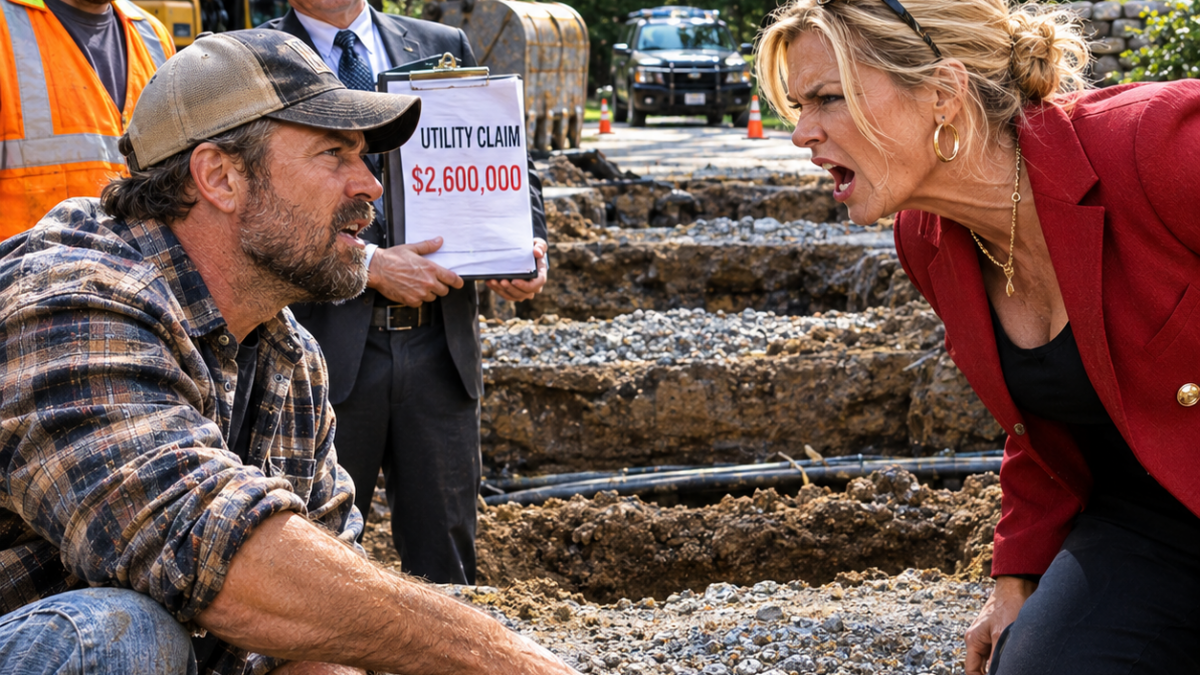
PART3:
The shortest line from existing water and electrical infrastructure to Dean’s project ran directly beneath Brooks Hollow Road.
After the meeting, Catherine cornered me near the clubhouse exit.
“Ethan.”
“Catherine.”
“We should discuss the utility easement.”
“There isn’t one.”
“That’s what we need to fix.”
She handed me a folder.
Temporary construction access.
Permanent underground utility corridor.
Water.
Power.
Communications.
Maintenance rights.
The proposed easement sliced straight down part of my road.
“No.”
“You haven’t read it.”
“I read enough.”
“It won’t affect your use.”
“It affects my ownership.”
She smiled.
“Everything has a price.”
“Not everything.”
“Everyone signs eventually.”
I handed the folder back.
“No.”
Her smile stayed.
Her eyes did not.
What Catherine did not know was that another easement already existed under that road.
Dad had signed it in 2009.
Cascade Fiber Network.
At the time, the company was expanding a regional fiber backbone.
Dad allowed them to bury a major trunk line beneath Brooks Hollow Road in exchange for compensation and long-term maintenance obligations.
I remember him making me sit at the kitchen table and read the agreement.
I was twenty-five.
I complained.
He ignored me.
Section after section.
Depth.
Access.
Restoration.
Notification.
Emergency repair.
Then he pointed to the utility schedule.
Replacement value:
$2.6 million.
“That line is not your cable television.”
He said.
“It carries real traffic.”
“What kind?”
“Internet.”
“Emergency communications.”
“Hospital traffic.”
“Business systems.”
“Doesn’t matter.”
He tapped the paper.
“Never let anyone dig on this road without a locate.”
“Dad, I know what 811 is.”
“Then remember it.”
I did.
Small orange utility markers stood along the road.
Most neighbors had stopped noticing them years earlier.
I never did.
Saturday morning, I was making pancakes for my daughter when the house shook.
Lily was eleven.
She looked up from the kitchen table.
“Earthquake?”
“No.”
Then came the diesel rumble.
Heavy.
Close.
I walked to the window.
Yellow excavator.
On my road.
I was out the door before I remembered I was still wearing house socks.
I shoved my feet into boots without changing them and ran downhill.
The excavator bucket had already opened the first trench.
Fresh gravel.
Brown soil.
Rock piled across the shoulder.
Dale Hutchins was in the cab.
Local excavation operator.
I knew him.
He knew me.
The second he saw me, his face changed.
He shut the machine down.
“Ethan.”
“What are you doing?”
He climbed out.
“I have a work order.”
“From who?”
He handed it over.
STILLWATER PINES HOA.
Utility installation preparation.
Authorized by:
Catherine Whitlock.
I scanned the page.
Then stopped.
UNDERGROUND UTILITIES PRESENT:
NONE.
I looked at Dale.
“You called 811?”
He looked away.
“No.”
“Did anybody?”
“Catherine said utilities had been cleared.”
“By who?”
“She gave me the work order.”
“That is not a locate.”
Then the Range Rover appeared.
White.
Spotless.
HOA1 plate.
Catherine stepped out wearing a tan blazer and boots too clean for the road she had just torn apart.
“Ethan.”
“Shut this down.”
She glanced at the trench.
“It’s temporary.”
“There is a fiber backbone under this road.”
“No.”
“Yes.”
“We checked.”
“With who?”
She hesitated.
“The association has plans.”
“Plans aren’t a locate.”
I pointed toward an orange utility marker less than thirty feet away.
“That is there for a reason.”
Catherine crossed her arms.
“The board approved the project.”
“No board voted on digging my road.”
“It’s the association access road.”
“No.”
I stepped closer.
“You have an easement to drive over it.”
“You do not own it.”
“The easement gives us maintenance authority.”
“Not excavation rights.”
She gave me the little smile I had learned to hate.
“You’re being territorial.”
“It is literally my territory.”
Dale almost smiled.
Then thought better of it.
I took out my phone.
Called 811.
Put it on speaker.
I gave the address.
Explained active excavation.
The operator checked.
No existing locate request.
She created a ticket and explained that standard marking required time.
Catherine heard everything.
When the call ended, she asked:
“How long?”
“Two business days.”
She laughed.
“Nobody is waiting two days.”
I stared.
“Catherine.”
She turned toward Dale.
“Keep digging.”
Dale did not move.
“You heard him.”
He said.
“There’s fiber.”
Catherine stepped toward him.
“If anything happens, the HOA covers you.”
That sentence would follow her for months.
Dale looked at me.
Then at Catherine.
Then back at the machine.
“I need something in writing.”
“You already have it.”
She pointed at the work order.
Dale looked unhappy.
I knew enough about construction to understand what was happening.
He should have walked.
I wish he had.
But he was operating under a signed work order from a client telling him utilities had been cleared.
He made the wrong decision.
I decided I would make the record as clear as possible.
I drove back to my barn.
Grabbed orange marking paint.
Red danger tape.
A measuring wheel.
Dad’s old fiber agreement.
I returned.
Using the recorded utility sketch, existing markers, and known alignment, I painted a bright warning line along the approximate route.
I did not pretend it was an official locate.
I wrote:
FIBER — DO NOT DIG.
Then stretched red tape across the active section.
“Stop work until Cascade or 811 marks it.”
Catherine walked toward the tape.
“Move this.”
“No.”
“You are obstructing an HOA project.”
“Correct.”
She lifted the tape.
Duck-walked under it.
Then told Dale:
“Second trench.”
He started the machine.
I called Cascade’s emergency number.
Explained everything.
Location.
Active digging.
No locate.
The dispatcher said they were escalating.
Catherine waved at Dale.
The bucket dropped.
Second trench.
The whole time I documented.
Video.
Work order.
Equipment.
Catherine.
The orange utility markers.
The red tape.
The first trench.
Then the second.
By 10:15, Brooks Hollow Road looked like somebody had attacked it with a giant axe.
Two trenches.
Third excavation beginning.
I called Cascade again.
“Crew is still digging.”
“We’ve notified regional field operations.”
“When are they coming?”
“Emergency dispatch is in progress.”
Catherine heard me.
“Ethan.”
“What?”
“You’re making this much bigger than it needs to be.”
“You’re cutting three trenches across a road you don’t own over a buried line you refused to locate.”
“It’s conduit preparation.”
“For Dean.”
She stiffened.
“This is an HOA improvement.”
“It serves Ridgeline.”
“It benefits the whole community.”
“Then why didn’t the board vote?”
Her expression changed.
Tiny.
There.
Then gone.
“I’m done discussing this.”
She turned.
“Dale.”
Third trench.
He lowered the bucket.
Steel teeth hit compacted gravel.
Then soil.
Then—
A dull crunch.
Not metal.
Not rock.
Concrete.
The bucket lifted.
A broken section of protective encasement came with it.
Then black conduit.
Then strands.
Hundreds of them.
Thin glass fibers.
Snapped.
Hanging.
Everything went quiet.
Dale killed the engine immediately.
My phone vibrated.
No service.
Then another alert from my home network app.
Connection lost.
I stepped toward the trench.
“Do not touch anything.”
Dale climbed down.
His face had gone pale.
Catherine stared at the broken conduit.
“It’s just a ditch.”
I looked at her.
“No.”
I pointed.
“That is the Cascade backbone.”
She waved one hand.
“Nobody is going to notice one cable.”
Dale stared at her.
“Ma’am.”
His voice was quiet.
“That is not one cable.”
Then Catherine made the worst decision of the morning.
Not digging.
Not ignoring 811.
Not ordering the second trench.
This one.
She looked at Dale and said:
“Backfill it.”
He stared.
“What?”
“Cover it.”
“Now.”
“Before everybody starts turning this into something.”
I felt every remaining doubt disappear.
Dale stepped away from the excavator.
“No.”
“Excuse me?”
“I’m done.”
“You are under contract.”
“I’m not burying damaged fiber.”
“I will sue you.”
“Okay.”
He pulled the key from the machine.
Put it in his pocket.
“You can sue me.”
Catherine turned toward me.
“This is because of you.”
I almost laughed.
“Catherine.”
“You dug the trench.”
I started documenting.
Wide photographs.
All three cuts.
Broken conduit.
Strands.
Equipment position.
Orange markers.
Red tape.
811 confirmation number.
Work order.
Then I called the sheriff.
Deputy Mike Sandoval arrived about twenty minutes later.
By then Catherine had left.
Then returned.
This time she wore the expression she used at HOA meetings.
Calm.
Professional.
Concerned.
“Deputy.”
She walked toward him.
“This is a civil dispute.”
Sandoval looked at the road.
Then the trench.
Then the broken fiber.
“Doesn’t look civil yet.”
“Mr. Brooks is interfering with an authorized community project.”
I handed him the deed.
And the easement.
He read.
“Who owns the road?”
“Me.”
“HOA?”
“Access easement.”
“No excavation rights.”
Catherine interrupted.
“We have maintenance authority.”
Sandoval looked at her.
“Does maintenance include cutting three trenches?”
She said nothing.
He crouched near the broken conduit.
Then stood.
“Who called 811?”
“I did.”
I said.
“Before or after digging started?”
“After I found the excavator.”
“Who hired the operator?”
Catherine said:
“Mr. Brooks.”
Dale was standing near his truck.
He looked up.
“That is not true.”
Catherine turned.
“Dale.”
He pulled the work order from his cab.
“I was hired by Stillwater Pines HOA.”
He handed it to Sandoval.
“Signed by her.”
The deputy read it.
Then looked at Catherine.
The calm smile disappeared.
By noon, the outage had spread.
Internet down.
Cell backhaul affected.
Landlines in parts of the ridge.
Business connections.
Emergency communications rerouting.
Mrs. Alvarez came down the road holding her medical-alert pendant.
She was seventy-eight.
“Ethan.”
“Yes?”
“It’s not working.”
She pressed the button.
Nothing.
That was the moment Catherine’s face finally changed.
Not because of the cable.
Because neighbors were watching.
At 12:40, Cascade Fiber arrived.
Three white trucks.
Splice van.
Generator trailer.
Utility support vehicle.
A woman stepped out wearing a white hard hat.
Dark braid.
Navy Cascade jacket.
Tablet already open.
“Who owns this property?”
“I do.”
“Ethan Brooks.”
“Yes.”
“Priya Nair.”
“Regional field engineering.”
She walked straight to the trench.
Looked once.
Then:
“288-count backbone.”
She crouched.
“Primary regional route.”
She checked the broken encasement.
Then her tablet.
“No locate ticket.”
I gave her my new ticket number.
She looked.
“Created this morning.”
“Yes.”
“After excavation started?”
“Yes.”
She looked at Dale.
“You operator?”
“Yes.”
“Who hired you?”
“Stillwater Pines.”
Catherine stepped forward.
“Mr. Brooks arranged the excavation.”
Dale closed his eyes.
Like he could not believe she was doing it again.
“No.”
He pulled out his phone.
“I have the work order.”
Then:
“And texts.”
Priya held out her hand.
Dale opened the messages.
Catherine to Dale:
SKIP 811. BROOKS WILL ONLY STALL US.
Another:
DEAN NEEDS THE PIPE IN BEFORE MONDAY.
Another:
HOA WILL COVER ANY ISSUES.
Priya read them twice.
Deputy Sandoval read over her shoulder.
He said nothing.
Just wrote.
Catherine tried another direction.
“This road is HOA property.”
I opened my truck.
Pulled out the deed.
The road was part of the Brooks parcel.
Recorded 1994.
HOA easement limited to ingress, egress, and defined maintenance.
Section Four prohibited excavation or installation of additional utilities without owner consent.
Cascade’s utility easement came later.
Recorded.
Separate.
Priya read both.
Then looked at Catherine.
“My company has a recorded utility right beneath this road.”
She pointed at the trench.
“And now we have physical damage, no locate request, photographs, and a signed work order.”
Her voice became very calm.
“You will be hearing from our claims department.”
That was the first time Catherine stopped talking voluntarily.
Repair lasted nineteen hours.
Floodlights turned Brooks Hollow Road into daylight overnight.
Cascade brought additional technicians.
Temporary rerouting.
Emergency splicing.
Traffic management.
Generators.
Rain started around nine.
Of course it did.
Washington.
Lily came walking down the road around midnight wearing her yellow raincoat and carrying two thermoses.
I nearly yelled at her for being outside that late.
Then saw my neighbor Mrs. Alvarez walking behind her.
“She has supervision.”
Mrs. Alvarez said.
“Questionable supervision.”
I answered.
Lily handed me coffee.
“Grandpa would be mad.”
“At me?”
“At her.”
She pointed vaguely toward Stillwater Pines.
Then:
“He’d also say you should’ve made them stop.”
That hurt because she was right.
“I tried.”
“You should’ve stood in front of the excavator.”
“No.”
I said immediately.
“Never do that.”
She looked at me.
“Why?”
“Because being right doesn’t make a thirty-ton machine harmless.”
Dad would have agreed.
Facts first.
Safety first.
Then fight.
Sunday morning, Catherine called an emergency HOA meeting.
I did not attend.
Didn’t need to.
Tom Reeves, the HOA treasurer, called me afterward.
Quiet man.
Blue cardigan.
Former bank manager.
“I asked her when the board voted.”
“And?”
“She said Thursday.”
“Was there a meeting Thursday?”
“No.”
“What else?”
“I asked whether insurance covers it.”
“And?”
“She said yes.”
“You believe her?”
“No.”
Neither did I.
Monday morning, 9:02.
Certified letter.
Cascade Fiber Network.
NOTICE OF CLAIM.
Claimed exposure:
$2.6 million.
The schedule included emergency repair costs.
Temporary rerouting.
Service disruption.
Carrier credits.
Additional network response.
Potential third-party claims.
The amount was not simply the replacement cost of one cut cable.
It reflected the consequences of striking a regional backbone.
The HOA received the same notice.
Then came the insurance response.
Coverage disputed.
Then denied under the policy language cited by the carrier because the excavation had allegedly been undertaken without required authorization and after required utility-notification procedures were knowingly bypassed.
That distinction mattered.
An accident after a proper locate request?
Different problem.
A documented instruction to skip 811?
Much worse.
Stillwater Pines had about $380,000 in reserves.
The board initially circulated a worst-case special assessment.
Nearly $15,700 per household.
The neighborhood exploded.
By Thursday, the clubhouse was packed.
I went this time.
Not to gloat.
Because Catherine had started telling homeowners the outage was my fault.
She stood at the front.
Tan blazer.
Microphone.
“I want everyone to understand that Mr. Brooks escalated a minor construction error into a major claim.”
I almost admired the sentence.
A minor construction error.
Three trenches.
Critical fiber.
Nineteen-hour repair.
Tom Reeves raised his hand.
“Catherine.”
She tried to ignore him.
He remained standing.
“Where is the vote?”
“What vote?”
“The authorization for the excavation.”
“We discussed the utility project.”
“That isn’t a vote.”
“The board supported the expansion.”
“That isn’t a vote either.”
Murmurs.
Tom held up the bylaws.
“Construction expenditures above ten thousand dollars require a recorded board vote.”
The room changed.
Catherine’s voice sharpened.
“The work was urgent.”
“Why?”
“Utility coordination.”
“For Stillwater Pines?”
“Yes.”
That was when Rachel Mendoza walked in.
My attorney.
Forty-one.
Property and construction litigation.
No patience for performance.
She sat beside me.
Catherine pointed.
“Nonmembers cannot participate.”
Rachel smiled.
“We’re not here to participate in HOA governance.”
She placed a folder on the table.
“We’re here because the HOA excavated Mr. Brooks’s property.”
Then she looked at Tom.
“You’re correct.”
“No recorded authorization appears in the minutes we obtained.”
Catherine snapped:
“The president has emergency authority.”
Rachel opened the bylaws.
“Not for a $48,000 utility excavation benefiting a separate development.”
Silence.
Catherine looked toward Tom.
His face had gone pale.
“Forty-eight?”
He asked.
Rachel paused.
“You didn’t know?”
Tom looked at Catherine.
“What did we pay Hutchins Excavation?”
Catherine said nothing.
Tom left the room.
Came back fifteen minutes later with a laptop.
HOA online banking.
$48,000.
HUTCHINS EXCAVATION.
No attached board resolution.
No approved project number.
Dale later confirmed his actual contracted portion had been structured through work orders he received from Catherine.
Then Tom found something worse.
Incoming payment.
$75,000.
To:
WHITLOCK COMMUNITY CONSULTING LLC.
From:
RIDGELINE HOMES.
Dean Prescott’s development company.
Tom stared at the screen.
Then at Catherine.
“What is this?”
She went very still.
“Private consulting.”
“For your brother-in-law?”
“Site coordination.”
“For the project requiring a utility route through Ethan’s road?”
Nobody spoke.
Tom whispered:
“You were paid to make this happen.”
“No.”
“Seventy-five thousand dollars?”
“For legitimate work.”
“Did you disclose it?”
Catherine looked around.
Then back at him.
“It was not HOA business.”
Rachel said:
“It became HOA business when you used HOA money and HOA authority to perform work that benefited the company paying you.”
That ended the meeting.
Not officially.
Emotionally.
Afterward, the board took control of records.
Independent counsel came in.
Tom opened everything.
Bank statements.
Emails.
Minutes.
Contracts.
Texts.
Dale signed a sworn statement.
County records confirmed no permit had been issued for the utility work.
811 records confirmed there had been no locate request before excavation.
Cascade preserved network data.
My photographs preserved the trenches.
Deputy Sandoval’s body camera preserved Catherine claiming I had hired the contractor.
Dale’s work order contradicted her.
And his texts contradicted her more.
SKIP 811.
BROOKS WILL ONLY STALL US.
DEAN NEEDS THE PIPE IN BEFORE MONDAY.
That was the sequence nobody could talk around.
Catherine had a financial relationship with Dean’s company.
Dean needed utilities.
I refused an easement.
Catherine used HOA funds to excavate anyway.
She told the contractor utilities were absent.
She instructed him to bypass 811.
Then the fiber was cut.
Once people saw that chain, the story changed from:
HOA accidentally damaged a cable.
To:
Why was the HOA doing this work at all?
Tom organized a recall petition.
Seventy-eight percent of homeowners signed.
I didn’t.
Couldn’t.
I wasn’t an HOA member.
That was almost poetic.
Catherine had spent months pretending the HOA controlled my road.
In the end, the residents she actually did represent removed her.
The recall meeting was packed.
She arrived in the same tan blazer she had worn the morning the road was cut.
Tom read the resolution.
“Effective immediately, Catherine Whitlock is removed as president and director of Stillwater Pines Homeowners Association.”
No applause.
Just silence.
She stood.
Picked up her folder.
Walked outside.
I was in the parking lot talking to Rachel.
Catherine saw me.
“You ruined me.”
I looked at her.
“No.”
She laughed bitterly.
“You called everyone.”
“You hired the excavator.”
“You turned the neighborhood against me.”
“I’m not in the neighborhood.”
“You stopped the development.”
“I said no to an easement.”
Her eyes filled.
“Do you know what this has cost?”
“Yes.”
I looked toward Brooks Hollow Road.
“About two point six million dollars so far.”
She flinched.
Then I said:
“You dug the ditch, Catherine.”
“I only called it what it was.”
She left.
The legal aftermath took months.
Not one dramatic afternoon.
Cascade pursued the parties it believed responsible.
The HOA retained separate counsel.
Ridgeline retained separate counsel.
Catherine retained her own attorney.
Dale had an insurer and legal counsel.
My claim was separate because my road had been physically damaged.
Then negotiations began.
Cascade had powerful evidence.
Ridgeline had paid Catherine.
Catherine had authorized the work.
The HOA had funded excavation without a proper recorded vote.
Dale had operated without a completed locate process, but he also had written instructions falsely stating no underground utilities were present and texts directing him to skip 811.
Nobody walked away clean.
But not everyone carried the same exposure.
The eventual settlement structure shifted most of the utility liability toward the parties who had profited from and directed the project.
Ridgeline Homes and Catherine carried roughly $2.1 million of the resolution.
Stillwater Pines paid about $500,000 from reserves and negotiated claims without imposing the original $15,700-per-home special assessment.
That mattered to me.
I did not want thirty-nine families bankrupted because their HOA president had acted without telling them.
Some people online would probably call that soft.
They weren’t the ones looking Mrs. Alvarez in the eye while she worried about losing retirement savings because somebody else ordered an excavator.
Rachel recovered $185,000 on my property claim.
Road reconstruction.
Drainage repair.
Surface replacement.
Access disruption.
Legal settlement.
Every dollar went back into Brooks Hollow Road.
I could have pocketed some of it legally.
Didn’t.
Dad had built that road.
I wanted it fixed better than before.
In spring, crews came back.
This time:
Permits.
Locate ticket.
Utility markings.
Cascade representative.
Survey.
Traffic plan.
Actual coordination.
Amazing what happens when people ask first.
The damaged sections were excavated properly.
Subgrade repaired.
Drainage corrected.
Fresh asphalt laid.
New shoulders compacted.
Orange utility markers replaced.
At the entrance we installed a large sign:
FIBER OPTIC BACKBONE BELOW
CALL 811 BEFORE YOU DIG
Lily helped hang it.
She stood on a small ladder.
Tongue sticking out in concentration.
Hammer too large for her hand.
I held the ladder.
“Straight?”
“No.”
She adjusted.
“Now?”
“Still no.”
“You’re annoying.”
“Inherited.”
She smiled.
Mrs. Alvarez came down carrying lemon pie.
Her medical pendant glowed green again.
“Your father would be proud.”
She said.
I looked at the road.
“I think he’d ask why I let them cut three trenches.”
She shook her head.
“No.”
“He’d ask why they didn’t listen the first three times.”
Maybe.
I like to think so.
Dean Prescott’s fourteen-lot project did not disappear completely.
But the easy utility route disappeared.
His permits were reviewed.
Some suspended temporarily while the financial relationship and unauthorized work were investigated.
He eventually had to redesign.
Longer route.
More expensive.
Legitimate easements.
Proper approvals.
The thing he had tried to avoid by pushing Catherine toward my road.
Catherine faced separate legal consequences involving HOA funds and the false work authorization.
The exact criminal and civil outcomes took time.
I followed from a distance.
Once she was off the board, I stopped caring about her personally.
That surprised me.
For weeks I had been furious.
Then suddenly I wasn’t.
The road was fixed.
The line repaired.
Neighbors were safe.
Her power was gone.
Anger had done its job.
I did not need to feed it forever.
Stillwater Pines elected Tom Reeves interim president.
He accepted reluctantly.
Best qualification.
First policy:
No project expenditure above the bylaw threshold without a recorded vote.
Second:
No construction impacting land outside HOA ownership without documented owner permission.
Third:
Any board member receiving money from a vendor, developer, contractor, or related company had to disclose it publicly and recuse where required.
Fourth:
Every excavation project required proof of utility-location compliance before work.
Again:
Rules so obvious nobody thinks they need writing until somebody ignores them.
Tom called me two months later.
“Can we talk?”
“About?”
“The road.”
I almost laughed.
“What about it?”
“We want to repair one shoulder near the gate.”
“Okay.”
“Can we?”
I waited.
He waited.
Then I smiled.
“That was the whole lesson.”
“What?”
“You asked.”
Tom laughed.
“Can we?”
“Yes.”
“Conditions?”
“Send me the plan.”
“Locate first.”
“No excavation outside defined area.”
“You got it.”
That was how normal relationships returned.
Slowly.
One request at a time.
I used to think boundaries existed mainly to keep people out.
Dad knew better.
Boundaries tell people when they need permission.
That is different.
A gate can say no.
A deed can say ask.
An easement can say yes, but only for this purpose.
Problems start when someone hears limited permission and translates it into:
Do whatever is convenient.
Stillwater Pines had the right to use Brooks Hollow Road.
That never meant they could cut it apart.
Cascade had a right beneath it.
That did not mean they could control my surface use beyond their easement.
I owned the road.
That did not mean I could dig carelessly around their line.
Everyone had rights.
Everyone had limits.
The system only worked when people respected both.
Catherine believed limits were obstacles for people with less authority.
That belief cost everyone.
The fiber repair crews told me afterward how close the outage came to being worse.
Traffic had rerouted.
Backup systems activated.
Emergency services remained available through redundancy.
The hospital never lost all communication.
That mattered.
The claim figures were huge, but nobody died.
No ambulance failed because of the strike.
No 911 call vanished forever.
No operating room went dark.
People later dramatized the story.
“Catherine shut down three counties.”
No.
She caused a significant backbone outage and disruption.
Systems rerouted.
Engineers repaired.
Redundancy worked.
Truth was serious enough.
I never needed to exaggerate it.
What frightened me was not what happened.
It was how casually it happened.
One work order.
One word:
NONE.
Under underground utilities.
One instruction:
Skip 811.
One excavator bucket.
That was all.
Critical infrastructure can look unimpressive when it is buried.
A black conduit.
Glass threads.
No flashing lights.
No guards.
No giant warning sign except a few orange posts most people stop noticing.
Then somebody cuts it and discovers how much ordinary life was passing quietly underneath their feet.
That was Brooks Hollow Road.
Dad knew.
That was why he made me read the agreement.
I thought he was being obsessive.
Parents spend years teaching you things you only understand after you need them.
Never dig without calling 811.
Never sign away permanent rights because somebody says the change is temporary.
Never let repeated use become assumed ownership.
And his favorite:
Facts don’t shout, but they never lose.
I used to argue with that one.
Facts absolutely lose sometimes.
People ignore them.
Hide them.
Lie about them.
But I think I understand what he meant now.
Facts stay available.
Long after confidence disappears.
Catherine had confidence.
I had:
The deed.
The easement.
The utility agreement.
The work order.
The 811 ticket.
The photographs.
The texts.
The bank transfer.
The board minutes.
Piece by piece, her story got smaller.
The facts did not need volume.
They only needed preservation.
A year after the trenches were repaired, Lily and I walked Brooks Hollow Road on the anniversary.
She had grown two inches.
The orange markers were still bright.
She kicked a pinecone.
“Do you still hate her?”
“Who?”
“Catherine.”
I thought about it.
“No.”
“You did.”
“Yes.”
“What changed?”
I looked at the road.
“I got what I needed.”
“What?”
“Control of my road back.”
She frowned.
“You always owned it.”
“That’s the point.”
She thought.
Then:
“Grandpa would say something annoying right now.”
“Definitely.”
“Like what?”
I smiled.
“Ownership isn’t real if you don’t understand what you own.”
She rolled her eyes.
“Very Grandpa.”
A few months later, Tom invited me to a Stillwater Pines picnic.
I almost refused.
Technically I still was not a member.
Then Mrs. Alvarez called.
“You are coming.”
“Is that a request?”
“No.”
I went.
People were awkward at first.
Some had blamed me during the outage.
A few had believed Catherine when she said I caused the special assessment threat.
One man approached.
“Ethan.”
“Yeah?”
“I owe you an apology.”
“For?”
“I said you should’ve just signed the utility easement.”
“I remember.”
“I didn’t understand the road was yours.”
“That information was always available.”
He nodded.
“I know.”
“That’s why I’m apologizing.”
Fair.
Another neighbor said:
“We thought Catherine had approval.”
“You weren’t the only ones.”
“Why didn’t you sue all of us?”
“You didn’t dig.”
He laughed nervously.
“No.”
“I mean it.”
I said.
“HOAs are made of people.”
“Sometimes the board acts properly.”
“Sometimes one person uses the structure.”
“I wasn’t interested in punishing thirty-nine families for a decision they never voted on.”
He looked relieved.
“Thank you.”
“Thank Tom.”
“He opened the records.”
Tom heard.
“No.”
He shouted from across the picnic table.
“Thank me by electing somebody else next year.”
Everyone laughed.
He did serve another term.
Of course.
The road has scars.
Even after reconstruction.
If you know where to look, the asphalt color changes slightly at the three cuts.
First trench.
Second.
Third.
I could have asked the paving company to overlay a longer section and make it uniform.
I chose not to.
Not for drama.
Because roads carry history.
Dad’s original alignment.
Old culverts.
Repairs from the 2007 storm.
A widened shoulder after the school bus got stuck.
Now three darker patches.
Lily calls them Catherine’s speed bumps.
They are not bumps.
But I let her.
The $2.6 million number became neighborhood folklore.
People repeat it like Catherine cut a diamond cable worth $2.6 million sitting in the dirt.
That is not exactly what happened.
The claim reflected system-level losses and exposure tied to the strike.
Emergency repairs.
Network restoration.
Rerouting.
Service impacts.
Contractual consequences.
The number represented the cost of ignoring infrastructure, not simply the price of replacing several feet of conduit.
That distinction matters.
Because consequences rarely equal the physical thing you damage.
Sometimes you break a five-dollar part and stop a million-dollar system.
Sometimes you dig a three-foot trench and interrupt services across a region.
Sometimes you ignore a free phone call because waiting two days feels expensive.
Then Monday arrives.
Catherine’s famous sentence still comes up.
“It’s just a ditch.”
She said it before the strike.
Then after.
As if size determined consequence.
I learned the opposite.
The smallest crossings can carry the biggest obligations.
A utility easement.
A road easement.
A buried line.
A signature.
A sentence in a deed.
A text message.
SKIP 811.
BROOKS WILL ONLY STALL US.
Six words did more damage to Catherine’s defense than anything I ever said.
Because they proved knowledge.
Not confusion.
Not accident.
She knew a locate was required.
She decided delay was more inconvenient than risk.
That choice belonged to her.
The HOA learned something too.
Insurance is not a magic shield.
People talk about insurance like it exists to turn every mistake into somebody else’s problem.
Policies have conditions.
Exclusions.
Duties.
The original denial letter terrified residents because Catherine had promised them:
“The HOA will cover it.”
Then:
“Insurance will cover the HOA.”
Both statements were assumptions.
Neither had been verified before work started.
Dale learned the same lesson from another direction.
He came to see me after the settlement.
I was repairing fencing.
He parked near the barn.
“Can we talk?”
“Sure.”
“I should’ve walked off that job.”
“Yes.”
He nodded.
“I knew.”
“Then why didn’t you?”
“Forty-eight-thousand-dollar contract.”
“Crew needed work.”
“Catherine had paperwork.”
“She said utilities were clear.”
I looked at him.
“But you knew there was no locate.”
“Yeah.”
There it was.
He rubbed his hands.
“I keep replaying it.”
“Don’t.”
He looked surprised.
“What?”
“Learn from it.”
“Don’t spend twenty years replaying it.”
“I nearly lost my company.”
“Did you?”
“No.”
“Then do better.”
He nodded.
“I changed our policy.”
“No excavation without ticket confirmation.”
“Even if the customer signs liability.”
“Good.”
He started walking away.
Then turned.
“Your dad ever yell at contractors?”
“Constantly.”
Dale smiled.
“Wish I’d met him.”
“You don’t.”
That spring Cascade sent a representative to our community safety meeting.
Priya.
Same white hard hat.
She brought a cut section of fiber cable.
Passed it around.
People were shocked at how ordinary it looked.
“This?”
Someone asked.
“This caused all that?”
Priya smiled.
“This is what carried all that.”
Better phrasing.
She explained redundancy.
Splicing.
Locate requests.
Why markers are approximate warnings, not permission to excavate blindly.
Why a ticket matters.
Why nobody should rely solely on old drawings.
Afterward Lily asked Priya:
“Did my dad actually save the hospital?”
I winced.
Priya answered perfectly.
“No.”
Lily looked disappointed.
“Your dad tried to stop the damage.”
“The network engineers and backup systems kept services running.”
“Lots of people did their jobs.”
That was the truth.
I thanked her later.
“For crushing my daughter’s heroic version of me.”
“You’re welcome.”
“She’ll recover.”
“She has your personality.”
“Unfortunately.”
Years later, the sign still stands.
FIBER OPTIC LINE BELOW.
CALL 811 BEFORE YOU DIG.
People make jokes about it.
Nobody ignores it.
When a new homeowner moved into Stillwater Pines and wanted to install a driveway drain near the road, he knocked on my door.
“Ethan?”
“Yeah?”
“I’m about to dig.”
I stared at him.
He immediately raised both hands.
“I already called.”
I laughed.
“Ticket number?”
He showed me.
“Good man.”
He looked toward the road.
“People warned me.”
“About me?”
“About the cable.”
“Good.”
Then he asked:
“Did the HOA really owe two point six million?”
I smiled.
“Long story.”
“I heard Catherine buried the cable on purpose.”
“No.”
“I heard she tried to cut the hospital off.”
“No.”
“I heard you stood in front of the excavator.”
“Absolutely not.”
He looked disappointed.
“What actually happened?”
“She wanted a utility route.”
“I said no.”
“She dug anyway.”
“She skipped the locate.”
“They hit the fiber.”
“Then paperwork happened.”
“That’s it?”
“That’s plenty.”
He nodded.
“You really own the road?”
“Yes.”
“Can I still drive on it?”
I laughed.
“That’s literally what your easement is for.”
He left smiling.
That conversation told me Stillwater Pines had finally become healthy again.
The road could be mine without becoming a weapon.
Their easement could be real without becoming ownership.
The fiber company could have rights below without controlling everything above.
Everyone could use what they were entitled to use.
Nobody had to seize the rest.
Dad would have liked that.
He died before Catherine ever became president.
I sometimes wish he had been there that Saturday.
Not because I needed him to fight.
Because I wanted to watch him stand beside that trench.
He would have been quiet.
Then looked at Catherine.
Then the orange marker.
Then Dale.
Then me.
Probably said:
“I told you.”
Nothing more.
Parents dream for decades about getting that moment.
I’m glad I spared him the satisfaction.
But I kept my promise.
Never let anyone dig on this road without calling 811.
Technically I failed for about four hours.
But afterward?
Never again.
Catherine used to say everything had a price.
Maybe she was right.
Her price was assuming she could convert somebody else’s property into her brother-in-law’s utility corridor because waiting for permission was inconvenient.
Stillwater Pines paid part of that price.
Ridgeline paid much more.
Catherine paid personally.
Dale paid in insurance, legal costs, and reputation.
Cascade paid in emergency work.
Residents paid in lost service and fear.
I paid in torn pavement, legal time, and months of stress.
One decision spread outward.
That is the thing about trenches.
They look narrow when you stand beside them.
But consequences do not have to stay inside the cut.
The third trench was only a few feet wide.
The damage traveled for miles.
That is why I still do not call it revenge.
Nobody won because a $2.6 million claim arrived.
Winning would have been Catherine stopping when I said:
“There’s fiber under the road.”
Winning would have been a locate ticket.
A legal easement discussion.
A route everyone agreed on.
No outage.
No lawsuit.
No recall.
No reserves lost.
No investigation.
That possibility disappeared when she lifted my red danger tape, ducked underneath it, and said:
“Keep digging.”
Everything afterward was accounting.
These days, when Lily asks what Brooks Hollow Road will eventually become, I tell her I don’t know.
Maybe she will own it.
Maybe another family member.
Maybe one day the homeowners will buy it.
Maybe some future agreement will change everything.
Property is not frozen forever.
But whatever happens, it will happen on paper first.
With signatures.
With notice.
With permission.
Not because an excavator arrives before sunrise.
That is the promise I inherited.
Not that nothing changes.
That nobody gets to change it secretly.
I still keep Dad’s 2009 Cascade agreement in the fireproof cabinet.
His notes are in the margins.
Next to the $2.6 million replacement schedule, he wrote:
THIS IS WHY WE CALL BEFORE DIGGING.
He underlined it twice.
I used to think that was absurdly obvious.
Then Catherine Whitlock drove past orange utility markers she had seen for years, ignored an active locate warning, ordered three trenches across land she did not own, and told a nervous excavator operator:
“The HOA will cover you.”
Two days later, the HOA discovered exactly how expensive those four words could become.
The road survived.
The fiber was repaired.
The special assessment never hit the homeowners.
The fourteen-lot development had to find another lawful route.
And Brooks Hollow Road is still where my father put it.
Three repaired scars.
New orange markers.
One very bright warning sign.
And every time somebody slows down to read it, I think about Catherine standing over hundreds of broken glass fibers telling me nobody would notice “a little cable.”
She was wrong.
The utility company noticed.
The sheriff noticed.
The insurer noticed.
The board noticed.
The homeowners noticed.
The county noticed.
And eventually a $2.6 million claim arrived with Stillwater Pines HOA printed across the first page.
All because the woman who thought the road belonged to her never stopped long enough to ask the only question that could have prevented everything:
Who actually has the right to dig here?








