HOA Karen Demolished My “Private” Bridge—Then the Sheriff Learned It Belonged to the County
HOA Karen Demolished My “Private” Bridge—Then the Sheriff Learned It Belonged to the County
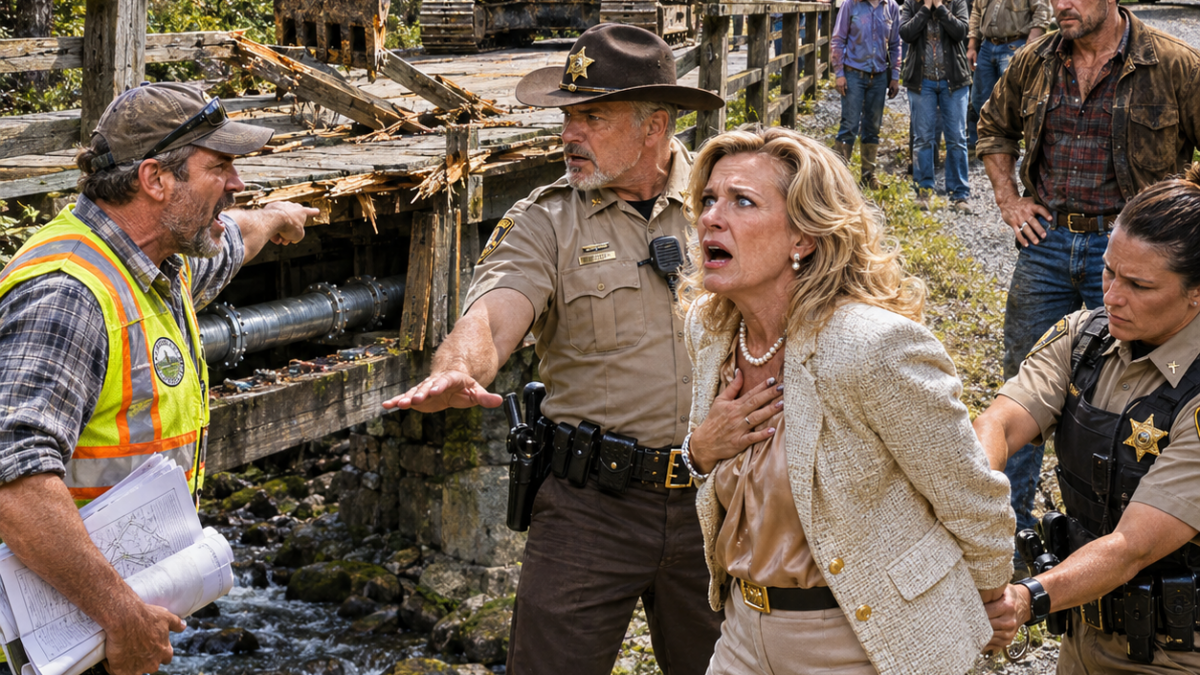
“YOU SHOULD HAVE LISTENED WHEN THE HOA GAVE YOU A CHANCE, CALEB! THIS UNSAFE BRIDGE IS COMING DOWN TODAY, AND THERE’S NOTHING YOU CAN DO ABOUT IT!” Cheryl Monroe shouted as an excavator ripped the first section of wooden railing from the bridge my family had called Bennett Bridge for generations.
I had warned Pine Hollow Estates in writing that they did not have my permission to enter my 58-acre farm, their first engineer had refused to participate because ownership was unclear, and the demolition contractor had asked me one final time whether I approved the work—but Cheryl waved a county permit in the air and ordered the machines forward anyway.
Then Sheriff Owen Parker arrived with the county engineer, who looked at the destroyed railing, the excavator sitting over Mill Creek, and Cheryl’s permit before asking a question that wiped the smile off her face: “Mrs. Monroe, who authorized you to demolish Franklin County property?”
My name is Caleb Bennett.
And the strange part is that until that morning, I thought Bennett Bridge belonged to me too.
So did my father.
So, as far as I knew, did my grandfather.
Our family owned fifty-eight acres in western North Carolina, divided by Mill Creek.
The creek was usually narrow enough that a kid could throw a baseball across it.
But after mountain rain, it changed fast.
Brown water.
Branches.
Fence posts.
Sometimes entire trees.
Bennett Bridge connected the northern and southern halves of our property.
My grandfather Raymond drove cattle across it.
Dad hauled hay over it.
When I was a boy, my cousins and I used to sit on the railing and drop leaves into the creek, then sprint to the other side to see which leaf came through first.
Nobody ever told me the bridge was county property.
Why would they?
Bennett land on one side.
Bennett land on the other.
Bennett Bridge in the middle.
It felt obvious.
And obvious assumptions are often the ones nobody bothers checking.
For decades, that did not matter.
Then Pine Hollow Estates arrived.
A developer bought farmland east of us and built sixty-four homes across a wooded hillside.
Nice homes.
Big porches.
Clean roads.
Two-car garages.
Families who wanted quiet rural life without owning an actual farm.
For the first several years, we got along fine.
Pine Hollow had its own main entrance directly off the county highway.
My bridge sat west of the subdivision.
It had nothing to do with their normal traffic.
Then somebody discovered the shortcut.
PART2:
If Pine Hollow residents drove out through an old maintenance gate, crossed the edge of my northern field, used Bennett Bridge, then followed another gravel road, they could reach the shopping center about eight minutes faster.
Eight minutes.
That was how everything started.
At first, maybe two or three vehicles a day.
I did not care.
Then navigation apps apparently discovered the route.
Traffic increased.
Delivery vans.
Contractors.
Teenagers.
People following maps who had no idea they were driving through working farmland.
One afternoon a delivery truck came around the bend too quickly and nearly hit one of my calves.
That ended my patience.
I installed a sign.
PRIVATE FARM ROAD
LOCAL FARM ACCESS ONLY
PLEASE USE PINE HOLLOW MAIN ENTRANCE
Most drivers respected it.
Some did not.
Then Cheryl Monroe became HOA president.
Late forties.
White luxury SUV.
Perfect folders.
PART3:
She lived near Pine Hollow’s back maintenance road, which meant the shortcut was especially convenient for her.
Our first conversation was almost pleasant.
She came to my front gate.
“Mr. Bennett?”
“That’s me.”
“I’m Cheryl Monroe. Pine Hollow HOA president.”
“I know.”
She smiled.
“I’d like to discuss bridge access.”
“What about it?”
“Our residents have used Bennett Bridge for years.”
“A few have.”
“We’d like to formalize it.”
That sounded reasonable.
She proposed Pine Hollow helping maintain the road and contribute toward bridge repairs in exchange for permanent access.
I did not say no.
More traffic meant liability.
Cattle.
Narrow roads.
An old bridge I had never had professionally inspected.
I told her I would think about it.
Cheryl suggested the HOA hire an engineer.
Again:
Reasonable.
For about two weeks, I actually thought we might work something out.
Then I received:
BENNETT BRIDGE COMMUNITY ACCESS NOTICE.
Not a proposal.
A notice.
Pine Hollow Estates had apparently “determined” that Bennett Bridge was part of a historic neighborhood access route.
Residents were therefore authorized to use it.
I called Cheryl.
“What exactly is this?”
“A temporary access policy.”
“You cannot create an HOA policy for my farm.”
“The bridge has been used publicly for decades.”
“That does not make my cattle field an HOA road.”
“We’re protecting existing access.”
“Existing access was informal.”
She sighed as if I were being difficult.
“Caleb, nobody is trying to take your property.”
Whenever somebody says that while explaining why they need control over your property, pay attention.
I asked for Pine Hollow’s legal opinion.
Nothing arrived.
Instead, the HOA installed a sign near the back road.
PINE HOLLOW SECONDARY ACCESS.
Arrow:
Toward my farm.
I removed it.
Did not damage it.
I drove it to the clubhouse and leaned it beside the door.
Attached a note:
PLEASE DO NOT INSTALL HOA SIGNS ON BENNETT PROPERTY.
Three days later another sign appeared.
This one stayed just inside Pine Hollow’s boundary.
Fine.
But more residents started following it.
So I chained my private farm road.
Cheryl called within an hour.
“You cannot block emergency access.”
“What emergency?”
“The secondary route.”
“It isn’t an emergency route.”
“It could become necessary.”
“Then the county emergency department can call me.”
She said Pine Hollow would review its legal options.
I told her that was exactly what lawyers were for.
Then things got stranger.
Pine Hollow hired William Porter, a bridge inspector.
William called before entering my property.
That immediately earned my respect.
“The HOA asked me to inspect Bennett Bridge because they’re considering regular traffic across it.”
“You have permission.”
He spent almost three hours underneath the bridge.
Measured supports.
Checked decking.
Photographed concrete.
Tested timber.
Then he found an old steel plate beneath one support.
Most of the writing had rusted away.
He cleaned it.
FRANKLIN CO.
That was all we could read.
William frowned.
“Could mean county.”
“Or the company that made it?”
“Possible.”
He needed records.
His final report said the bridge should not carry heavy, regular neighborhood traffic without repairs.
Reasonable.
I sent it to Cheryl.
Instead of reducing traffic, Pine Hollow declared the bridge a safety hazard.
Then I received a letter ordering me to repair my “unsafe private bridge” within thirty days.
Rebecca Hayes, my attorney, read the notice.
She smiled.
“They cannot order you to repair something on your own property for their convenience.”
“That’s what I thought.”
Then she asked:
“Are you completely sure the bridge is yours?”
I stopped.
“Of course.”
“Do you know that, or have you always assumed it?”
That question changed everything.
My deed clearly described property on both sides of Mill Creek.
But it did not specifically describe the bridge.
Rebecca requested old county records.
The problem:
A lot of rural infrastructure from the 1940s and 1950s was still buried in paper archives.
Old plats.
Road files.
Deed books.
Maintenance records.
Nothing immediately answered the question.
The county said it might take several weeks.
Meanwhile, Cheryl increased pressure.
Second safety notice.
Orange cones.
An HOA patrol worker tried placing a temporary barrier on my side of the crossing.
I stopped him.
He apologized immediately.
“Ms. Monroe said the HOA controls bridge safety.”
“She doesn’t.”
At least I thought she did not.
That uncertainty bothered me more every day.
Then Pine Hollow held a community meeting.
Frank Miller, a resident I knew from the feed store, invited me.
Most homeowners did not seem hostile.
They wanted answers.
One woman asked why Pine Hollow even needed the shortcut.
Cheryl said the route could provide emergency access if the main entrance was ever blocked.
Another resident asked whether the fire department had requested that.
Cheryl did not answer directly.
Frank asked:
“Do we have a recorded easement?”
Cheryl said Pine Hollow possessed “historic use rights.”
I stood.
“If you have an easement, show me.”
“The absence of a modern record does not erase decades of public use.”
Rebecca whispered:
“That isn’t an easement.”
Then Cheryl produced a photograph.
Black and white.
A county school bus crossing Bennett Bridge sometime in the 1960s.
That got my attention.
Why was a county school bus using a supposedly private farm bridge?
Cheryl smiled.
“This has always been a public crossing.”
Rebecca looked interested.
Not convinced.
Interested.
Because the photograph suggested that none of us knew the bridge’s full history.
After the meeting, Frank followed me outside.
“Cheryl is talking about replacing it.”
“Replacing what?”
“The bridge.”
“With whose permission?”
“That’s what I asked.”
According to Frank, Cheryl believed that if I refused to repair the “hazard,” Pine Hollow could remove it and install a safer crossing.
I called Rebecca the next morning.
Her advice surprised me.
“Do not threaten them.”
“They’re talking about demolishing my bridge.”
“We still don’t know whether it is your bridge.”
“So I just do nothing?”
“No. We make your position extremely clear.”
She sent formal notice.
I did not authorize Pine Hollow to:
Demolish the bridge.
Modify it.
Repair it.
Replace it.
Enter Bennett property for construction.
If Pine Hollow believed it had independent legal authority, it needed to produce that authority.
Cheryl replied the same day.
The HOA believed historic crossing rights gave it the necessary authority.
Fine.
Prove it.
The county archives still had not located the old bridge file.
William Porter refused to participate in demolition until ownership was resolved.
That should have stopped everything.
Instead, Cheryl hired Ridgeway Site Services.
Supervisor:
Daniel Foster.
Daniel called me.
“Mr. Bennett, Pine Hollow says it has authorization to remove the bridge.”
“I haven’t authorized anything.”
“They gave us a county permit.”
That changed the conversation.
“What permit?”
“Bridge hazard removal.”
He emailed it.
County seal.
Permit number.
Engineering approval.
Project:
MILL CREEK SECONDARY CROSSING.
It looked official.
Rebecca called the county.
The clerk promised to research the number.
Before we received an answer, Cheryl sent another letter.
DEMOLITION MONDAY
8:00 A.M.
I called her.
“You understand I am not giving you permission.”
“We do not need your permission.”
“You’re entering my land.”
“Our crossing rights include maintenance.”
“You’re not maintaining it. You’re demolishing it.”
“We’re removing a dangerous structure.”
“What replaces it?”
“Pine Hollow will determine that later.”
That was when I began to understand.
Cheryl did not merely want a safer bridge.
She wanted control over the replacement.
A wider bridge.
Heavier traffic.
Paved approaches.
Something permanent enough that Pine Hollow could later call the shortcut established infrastructure.
Rebecca saw it too.
Still:
“Do not physically interfere.”
That was hard.
My father would have parked a tractor across the road.
Grandpa probably would have sat on the bridge until everyone went home.
Different generation.
Different approach.
Monday morning, I moved cattle away from the northern field.
Set up cameras.
Parked far enough from the bridge that nobody could accuse me of blocking work.
Rebecca arrived.
Frank came.
Several Pine Hollow residents stood on the neighborhood side.
Cheryl arrived in the white SUV.
Then the excavator.
Daniel Foster walked over first.
“I want this clear. You object?”
“Yes.”
“You do not authorize this?”
“No.”
He nodded.
“Pine Hollow says its permit overrides your objection.”
“That’s between you and Pine Hollow.”
He did not like that answer.
Neither did I.
But Cheryl signed the work order.
His company had been handed government-looking documents.
Everybody now had a choice.
The excavator moved onto Bennett Bridge.
Its bucket grabbed the old wooden railing.
CRACK.
Part of the bridge I had known my entire life broke away.
My stomach twisted.
Frank stared at me.
“You’re really letting them do this?”
“I told them not to.”
“That’s it?”
“That’s it.”
Cheryl walked closer.
“You could have avoided this.”
“Maybe.”
“You should’ve worked with us.”
“I tried.”
“No, Caleb. You tried to control access.”
“It crosses my farm.”
“And now the unsafe bridge is coming down.”
Then the excavator bucket struck something metal.
SCREECH.
Daniel Foster shouted:
“STOP!”
The machine froze.
A thick steel conduit had appeared behind the timber.
Not household wiring.
Heavy infrastructure.
A second metal plate became visible.
Daniel wiped dirt away.
PROPERTY OF FRANKLIN COUNTY.
Nobody spoke.
Rebecca’s phone rang.
She listened.
Then looked directly at me.
“The archive found the bridge file.”
“What does it say?”
She looked toward the bridge.
Then Cheryl.
“Caleb, your grandfather never owned the bridge.”
Cheryl stepped closer.
“What?”
“The county purchased the bridge structure and crossing rights in 1952.”
Before anyone could react, Daniel shouted from below.
“EVERYBODY BACK!”
A smaller pipe had cracked.
Water sprayed beneath the bridge.
Something hissed inside the larger conduit.
I called 911.
Rebecca called the county.
Cheryl kept repeating that the permit allowed demolition.
Then sirens came.
Sheriff Owen Parker.
County utility truck.
Another county vehicle.
Thomas Harris, county engineer.
Thomas jumped out before his truck fully stopped.
He looked at the torn railing.
Damaged deck.
Exposed conduit.
Excavator.
Then Cheryl.
“Who authorized this?”
She pointed at me.
“He owns the bridge.”
Thomas stared.
“No, he doesn’t.”
He pointed toward the county plate.
“Franklin County owns Bennett Bridge.”
Then his eyes moved toward the conduit.
His face changed.
“And somebody just hit one of our main emergency utility crossings.”
A worker near the eastern abutment shouted.
The excavator had also exposed a concrete utility vault.
Inside:
Heavy cables.
Water infrastructure.
Thomas asked for Cheryl’s permit.
She handed it over.
He read the number.
Called his office.
Waited.
Then lowered the phone.
“The permit is real.”
For half a second Cheryl almost smiled.
Then Thomas continued.
“It’s for removing a collapsed storm drain on County Road 18.”
Silence.
“Eight miles from here.”
He held the permit up.
“Someone changed the project description and location.”
Cheryl’s face went white.
Sheriff Parker asked:
“Who prepared this?”
Near her SUV stood Pine Hollow’s maintenance manager, Richard Bell.
He started moving backward.
Parker noticed.
“Mr. Bell, come back here.”
Richard carried a blue folder.
Emails.
Maps.
Demolition checklist.
Same altered permit.
Richard said Cheryl had given him the packet and told him to send it to the contractor.
Cheryl immediately answered:
“I gave him an approved packet. I didn’t tell him to falsify anything.”
Richard stared.
“You gave me the packet.”
Her jaw tightened.
“That doesn’t mean I created it.”
Rebecca leaned toward me.
“She’s separating possession from creation.”
That did not prove Cheryl had edited the permit.
But it told us she already understood what part of the chain she needed to deny.
Then county crews identified the damaged utilities.
The small pipe supported emergency hydrant capacity west of Mill Creek.
The steel conduit carried county emergency communications.
Sheriff repeater traffic.
Fire-network data.
Backup systems.
The county switched traffic onto alternate routes.
Cheryl stared beneath the bridge.
“That was under there?”
Thomas looked at her.
“Yes.”
“How was I supposed to know?”
“By not demolishing county property without a valid county permit.”
Nobody had a good answer after that.
Then Thomas explained the history.
In 1952, my great-grandfather Samuel Bennett had sold the bridge structure to Franklin County for one dollar.
Why?
School transportation.
Emergency access.
Limited local public crossing.
He also granted a narrow crossing easement.
But only across the bridge corridor.
The roads on either side remained Bennett property.
That explained Cheryl’s 1960s school-bus photograph.
The bridge had once served public traffic.
She had been right about that.
She was wrong about what it meant.
Public bridge did not equal public farm road.
Pine Hollow’s shortcut required leaving the county easement and driving across my private property.
Frank stared at the old map.
“So even if the bridge is public, our shortcut isn’t?”
“No,” Thomas said.
Frank looked at Cheryl.
“You knew?”
“No.”
Too fast.
Rebecca asked:
“Did Pine Hollow ever ask Caleb for a formal farm-road easement?”
Cheryl crossed her arms.
“We tried to formalize access.”
“That isn’t what I asked.”
Silence.
Then:
“No.”
No Pine Hollow road easement.
No demolition authority.
No valid bridge permit.
No right to widen anything.
Sheriff Parker did not immediately arrest Cheryl.
Several residents seemed disappointed.
Rebecca heard someone mutter that she should already be in handcuffs.
Rebecca shook her head.
“An arrest isn’t a prize.”
She was right.
The real questions mattered more.
Who altered the permit?
Who knew the county owned the bridge?
Why was Cheryl so determined to remove it?
County closed Bennett Bridge completely.
Including to me.
For the first time in my life, moving equipment between the two halves of my farm required a thirteen-mile road detour.
Frank offered to help haul feed.
That mattered.
The entire conflict could easily have become:
Pine Hollow versus Caleb Bennett.
Instead, Frank stayed Frank.
A resident.
A neighbor.
A man who had not forged anything.
Pine Hollow’s board suspended Cheryl’s authority over construction and property matters.
Residents returned to using their main entrance.
And something funny happened.
Nothing.
Nobody became trapped.
Children still got to school.
Amazon still delivered packages.
Emergency vehicles still reached the neighborhood.
That supposedly critical shortcut turned out to be what it had always been.
Convenient.
Not necessary.
The county archive sent Rebecca the full 1952 bridge agreement.
One dollar.
Bridge belongs to Franklin County.
County maintenance rights.
Public crossing easement.
Utility rights.
And one clause:
Until Franklin County formally abandons the bridge, no private party may materially alter or destroy it.
Painfully clear.
Then the digital investigation began.
The altered permit had metadata.
Original county file downloaded twelve days before demolition.
Modified six hours later.
Computer:
HOA OFFICE 03.
Pine Hollow president’s office.
User profile:
C MONROE.
Cheryl’s attorney correctly pointed out that other people might have used the computer.
Then investigators found the email.
From Cheryl to Richard.
Subject:
FINAL BRIDGE AUTHORITY.
Attachment:
Altered permit.
Message:
USE THIS VERSION ONLY. DO NOT SEND PRIOR DRAFTS.
Richard said he had never seen prior drafts.
So what drafts was she referring to?
The board authorized access to archived email.
Deleted messages came back.
One thread was between Cheryl and her brother.
Steven Monroe.
Owner of Monroe Community Solutions.
Steven:
BRIDGE OWNERSHIP PROBLEM. COUNTY MAY STILL HOLD STRUCTURE.
Cheryl:
DOES THAT HURT ACCESS PLAN?
Steven:
YES. NEED COUNTY COOPERATION OR ABANDONMENT.
Cheryl:
COUNTY WILL TAKE FOREVER.
Steven:
THEN DON’T ASK UNTIL REPLACEMENT IS ALREADY NECESSARY.
Rebecca read that twice.
Another:
Cheryl:
IF OLD BRIDGE IS REMOVED AS HAZARD, CAN HOA BUILD NEW CROSSING?
Steven:
POSSIBLY UNDER EMERGENCY ACCESS ARGUMENT, BUT LAND RIGHTS STILL ISSUE.
Cheryl:
CALEB WILL NEVER GRANT ROAD EASEMENT.
Steven:
THEN CREATE PRESSURE.
There it was.
Pressure.
But pressure for what?
Pine Hollow already had a perfectly good entrance.
Why spend this much money and risk over a shortcut?
Then Susan Grant found the development file.
PINE HOLLOW WEST.
Forty-eight future homes on property beyond my farm.
Developer:
Ridgeway Communities.
Without access across Bennett land and Bennett Bridge, the project required a longer road through steep terrain.
Estimated additional cost:
About $2.6 million.
Now the motive made sense.
Then:
Monroe Community Solutions.
Steven’s company.
Success fee if permanent western access was secured:
$320,000.
Cheryl’s signature approved it.
Her own brother stood to earn hundreds of thousands of dollars if she turned Pine Hollow’s shortcut into a permanent development corridor.
Then county investigators found something else.
The old bridge itself created a problem for the development.
Franklin County controlled it.
Pine Hollow could not simply widen it.
Could not make it four lanes.
Could not redesign it for construction trucks.
But if the old bridge disappeared as a “dangerous structure” and a replacement became an emergency necessity?
That changed the political pressure.
Then Richard told investigators Cheryl had moved old bridge-record boxes from HOA storage into her private office before demolition.
The boxes later disappeared.
Hallway cameras showed Cheryl loading three banker boxes into her SUV.
Traffic cameras later showed her near an abandoned quarry road.
Deputies searched.
Burn barrel.
Charred Pine Hollow records.
One surviving fragment:
BENNETT BRIDGE OWNERSHIP REVIEW.
Another:
COUNTY STRUCTURE — DO NOT MODIFY WITHOUT APPROVAL.
Then a nearly complete email.
From Pine Hollow’s former attorney.
To Cheryl.
COUNTY RECORDS INDICATE FRANKLIN COUNTY OWNS THE BRIDGE STRUCTURE. PINE HOLLOW HAS NO AUTHORITY TO REMOVE, REBUILD, OR MATERIALLY ALTER THE CROSSING WITHOUT COUNTY APPROVAL. BENNETT LAND ACCESS REMAINS A SEPARATE PRIVATE PROPERTY ISSUE.
No ambiguity.
She knew.
A warrant followed.
When deputies first went to Cheryl’s house, she was gone.
SUV gone.
Phone off.
Then Thomas called me from the bridge.
County repair crews had opened the damaged eastern abutment.
Behind the old concrete was a newer conduit.
Not county.
It ran toward Pine Hollow.
Tracing equipment showed it crossed my farm and connected to the HOA maintenance area.
Inside:
Electrical cables.
Communication lines.
Pine Hollow traffic-control infrastructure.
Then Susan found the invoice.
WEST ACCESS PREPARATION — PHASE ONE.
Paid two years earlier.
Before Cheryl asked me to formalize access.
Before the safety notices.
Before demolition.
They had already installed infrastructure across my land for Pine Hollow West.
Then another line.
Larger.
Future power.
Same route.
Frank stared.
“They started building before they had rights?”
“Looks that way.”
Then Sheriff Parker arrived.
“We found Cheryl.”
“Where?”
He pointed toward Mill Creek.
“Here.”
Her SUV had been hidden near Quarry Road.
Footprints led through woods toward the bridge.
A deputy appeared.
Behind him:
Cheryl.
Mud on her shoes.
Canvas bag on her shoulder.
Exhausted.
Sheriff Parker walked forward.
“Mrs. Monroe, you are under arrest.”
That was the moment people later remembered.
Handcuffs closing beside the same bridge she had ordered destroyed.
But the bag mattered more.
Inside:
County survey plates.
Old easement records.
Hard drive.
Original Pine Hollow West plans.
Thomas unfolded one.
Four-lane bridge.
Major entrance road.
Across my farm.
Then Pine Hollow West.
Construction sequence:
PHASE ONE — UNDERGROUND UTILITIES.
Already started.
PHASE TWO — REMOVE EXISTING COUNTY BRIDGE.
PHASE THREE — ESTABLISH EMERGENCY REPLACEMENT CROSSING.
PHASE FOUR — TRANSFER ACCESS TO PINE HOLLOW WEST.
Rebecca stared.
“They planned the demolition before calling the bridge unsafe.”
Yes.
Then Thomas read another note.
COUNTY REPLACEMENT FUNDING EXPECTED AFTER EMERGENCY LOSS.
Nobody spoke.
The plan was not simply to destroy an old bridge.
They expected taxpayers to help finance the replacement.
Sheriff Parker found another agreement.
Monroe Community Solutions.
Ridgeway Communities.
Full success payment:
$1.1 million.
The earlier $320,000 was only one portion.
The full payment depended on permanent western access through a county-funded replacement bridge.
Private development.
Public bridge.
Public money.
Then Thomas noticed another line on the map.
WEST FORCE MAIN.
Frank asked:
“What is that?”
Thomas answered:
“Pressurized sewer.”
County maps showed no sewer line across Bennett Farm.
Utility locator did.
The pipe ran under my field.
Under Mill Creek.
Into Pine Hollow’s maintenance area.
An inspection cap was opened carefully.
The smell told us immediately.
Active sewage.
Regular flow.
Eighteen western Pine Hollow homes were already connected.
Residents had no idea.
Their HOA maintenance records called the pump station:
WEST DRAINAGE BOOSTER.
Not sewer.
Drainage.
For four years residents had paid more than $780,000 toward “west drainage improvements.”
A major portion of that money had built an unauthorized sewer route across my land that would eventually support Pine Hollow West.
County could not simply shut it down.
Eighteen families would have sewage backing into their homes.
I owned the land surrounding the pipe.
I could have screamed:
“Turn it off.”
Instead, I signed a sixty-day emergency-access agreement.
County utility crews could enter.
Maintain the line.
Protect the homes.
No permanent easement.
No new connections.
No expansion.
No charge.
Frank looked at me.
“After everything they did, you’re still letting us use it?”
“I’m letting eighteen families use their bathrooms.”
He laughed.
That was the difference I kept trying to explain.
Boundaries are not revenge.
County designed a new legal lift station entirely inside Pine Hollow.
The eighteen houses would reconnect to the approved eastern sewer system.
Then the hidden pipe across my farm could be abandoned and removed where practical.
Problem solved legally.
Then Rebecca called me into her office.
Sheriff Parker was there.
So was Thomas.
A document sat on the table.
Seller:
Caleb Bennett.
Buyer:
Ridgeway Communities.
Property:
Twenty-six acres of Bennett Farm.
Northern Access Road.
Mill Creek Crossing Corridor.
Price:
$350,000.
My signature at the bottom.
I had never signed it.
Rebecca placed an older timber-sale agreement beside it.
Exact signature.
Copied.
Ridgeway’s president Daniel Grant said Steven Monroe gave his company the purchase agreement and claimed I wanted the deal confidential.
Ridgeway had already paid Steven’s company $275,000 in planning fees.
Daniel admitted:
“We should have contacted you directly.”
“Yes.”
Then he showed us the county transportation-grant package.
Pine Hollow wanted $3.8 million in public funding for “critical rural bridge replacement and emergency access.”
Future homes were included.
Pine Hollow West.
Attached letters supposedly from county officials supported the project.
Thomas read the one carrying his own signature.
“I never wrote this.”
Fake.
Sheriff emergency-management letter.
Fake.
Transportation planner.
Fake.
One false document supporting another.
Fake land purchase.
Fake county support.
Altered demolition permit.
Secret utility corridor.
Destroy old bridge.
Then suddenly a replacement becomes urgent.
That was the system.
Then Thomas looked closer at the replacement-road map.
It did not stop at Pine Hollow West.
Farther west:
MILL CREEK LOGISTICS PARK.
One hundred eighty acres.
Warehouses.
Truck yards.
Distribution centers.
The four-lane bridge would eventually become the eastern entrance for a much larger industrial development.
Owner group included:
Steven Monroe.
Not majority owner.
But enough.
The $1.1 million success fee was not his largest possible benefit.
If the bridge corridor existed, his logistics-property interest could become worth millions.
Then another route on the map crossed my southern pasture.
Almost half a mile.
Commercial truck access.
Another document appeared.
Permanent transportation easement.
Grantor:
William Bennett.
My father.
Signed twelve years earlier.
Dad died nine years before this fight.
Signature looked real.
Because somebody copied it from his will.
Then the note:
RECORD BENNETT SOUTH EASEMENT AFTER EMERGENCY BRIDGE DESIGNATION TO AVOID PREMATURE TITLE CHALLENGE.
Premature title challenge.
They knew it could fail.
They simply planned to file it after the bridge was gone and urgency was high.
Then Sheriff Parker found Steven at a storage facility outside Asheville.
Inside his truck:
Laptops.
County seals.
Blank forms.
Portable scanner.
Inside the storage unit:
Road barriers.
Survey gear.
Utility conduit.
And blasting permits.
For my southern pasture.
The future truck road needed to cut through a rock shelf beside Mill Creek.
Permit numbers were legitimate.
Locations had been altered from unrelated quarry work.
Same method.
Then Frank called.
“Caleb, do not come through the south road.”
“Why?”
“There’s a blasting company.”
My stomach dropped.
By the time Thomas and I headed toward the farm, workers had already drilled holes.
Frank remained on the phone.
Then:
“Smoke.”
Thomas looked at me.
“They may have armed the charges.”
“Frank, get away.”
A deep boom came through my phone.
Then another.
Gray dust climbed above the trees.
When we reached the pasture, part of the rock shelf had collapsed toward Mill Creek.
For several terrible seconds, I could not see Frank.
Then he emerged from the dust with two blasting workers.
Covered in dirt.
Alive.
No serious injuries.
The supervisor handed Sheriff Parker the work packet immediately.
He genuinely believed he was performing county-authorized emergency slope work.
Thomas barely needed to read it.
“Fake.”
Six holes had been drilled.
Two detonated.
Four remained armed.
The supervisor had stopped after Frank warned him the landowner had never approved the work.
That decision prevented much worse damage.
Bomb technicians made the remaining charges safe.
County crews cleared enough rock from Mill Creek to prevent flooding.
I gave them immediate access.
Water does not care who won a property argument.
By sunset, the creek flowed normally again.
My pasture looked awful.
Broken stone.
Damaged trees.
Collapsed fence.
But the cattle were safe.
Nobody hurt.
Repairable.
I learned to appreciate that word.
Then investigators searched Steven’s files.
One folder:
PUBLIC COST STRATEGY.
The plan was simple.
Make Bennett Bridge appear unsafe.
Remove it.
Create an emergency access crisis.
Pressure Franklin County to build a larger replacement.
Connect the replacement to Pine Hollow West.
Extend that road toward Mill Creek Logistics Park.
Public bridge.
Public road funding.
Private development profit.
Estimated taxpayer-supported savings:
More than four million dollars.
Now everything made sense.
Cheryl’s attorney argued she may have believed Pine Hollow West was a legitimate neighborhood expansion.
Possible.
But she knew the county probably owned Bennett Bridge.
She knew Pine Hollow did not have an easement across my farm road.
She knew Steven would receive money if western access succeeded.
She signed the transportation-grant application.
She forwarded the altered permit.
And records warning against demolition ended up burned near Quarry Road.
Steven designing the larger scheme did not erase Cheryl’s own choices.
The criminal cases took time.
As they should.
Records.
Computer evidence.
Financial accounts.
Fake signatures.
Altered government papers.
County losses.
Insurance claims.
No instant television justice.
Ridgeway Communities surprised me.
Daniel Grant came to my farm without an army of lawyers.
He looked at the blast damage.
“I owe you an apology.”
“You didn’t set the charges.”
“No. But my company accepted a land purchase contract without ever meeting the seller.”
“That was a mistake.”
“Yes.”
No excuses.
That mattered.
Ridgeway canceled the version of Pine Hollow West that relied on Bennett land.
Daniel said they might still develop their western parcels someday.
“If we need anything from you, we ask.”
“Good start.”
We shook hands.
Not friends.
Not enemies.
Just two people finally respecting a boundary.
The Logistics Park collapsed even faster.
Without the bridge corridor, fake easement and public funding, investors walked.
Maybe something will eventually be built there.
Fine.
But no truck road crosses my cattle pasture using my dead father’s copied signature.
Rebecca recorded formal title notices.
No Pine Hollow West road.
No commercial transportation easement.
No utility corridor.
No development right through Bennett Farm unless properly created and recorded.
Clear paper.
Future arguments prevented before they start.
Then Franklin County repaired Bennett Bridge.
Not replaced.
Repaired.
The foundations were still strong.
New railing.
Deck sections.
Support reinforcement.
Protected fiber.
Rebuilt utility vault.
No giant four-lane crossing.
No massive development entrance.
The exact old modest bridge Steven had tried to eliminate turned out to be perfectly repairable.
The county commission held a public hearing.
Thomas explained everything.
Franklin County owned Bennett Bridge.
Bennett family owned the surrounding farm.
The public crossing easement remained narrow.
It did not give Pine Hollow the right to drive across my private roads as a shortcut.
One commissioner asked:
“Do you want the county to abandon the bridge?”
That was a real question.
If abandoned, maybe my family could eventually gain greater control over the structure.
But Thomas said the crossing still had legitimate emergency value during wildfires, floods and road closures.
I thought about my great-grandfather.
He had sold the structure for one dollar because the valley needed a crossing.
“Keep it.”
Frank looked surprised afterward.
“After everything Pine Hollow did?”
“Pine Hollow didn’t do everything.”
He understood.
Cheryl made choices.
Steven made choices.
Some board members failed to ask enough questions.
But sixty-four families did not forge permits.
The county fire department did not.
Tomorrow’s residents should not lose a useful emergency bridge because yesterday’s leaders were dishonest.
The hidden sewer line disappeared from service once Pine Hollow’s legal lift station was completed.
All eighteen houses moved back onto the approved system.
Nobody lost service.
No sewage backed into homes.
The unauthorized force main across my field was flushed and sealed.
Accessible sections removed.
Creek section abandoned safely underground.
Everything recorded.
The hidden electrical and communication conduits were removed or legally abandoned.
My field stopped being a secret development corridor.
The blasting damage took longer.
Fence rebuilt.
Rock stabilized.
Native vegetation replanted.
Erosion monitored.
Within a year, the scar was smaller.
Not gone.
Healing.
Land remembers damage.
But land can recover when people finally stop fighting it.
Cheryl eventually faced charges tied to the altered permit, destruction of county property, record concealment and other evidence-backed actions.
Her attorney contested some allegations.
Other matters ended through negotiated resolutions and court proceedings.
She did not disappear into prison forever.
Real consequences were slower.
Restitution.
Probation conditions.
Restrictions.
Court orders.
Steven’s case was larger.
Fraud-related financing.
Fake government documents.
False easements.
Copied signatures.
Unauthorized utilities.
Blasting paperwork.
Multiple agencies had pieces.
Eventually he accepted responsibility for major parts after investigators connected his computers, accounts, development interests and document files to the scheme.
I stopped caring about every hearing.
The plan was dead.
The papers were dead.
My farm was mine.
That was enough.
I attended one major hearing involving Cheryl.
She looked different without the HOA title.
No white SUV waiting.
No board members surrounding her.
No notices in her hand.
Just a woman standing before a judge because decisions finally had consequences.
Afterward she stopped in the hallway.
“Caleb.”
I waited.
“I was wrong about the bridge.”
“That’s pretty clear.”
“I thought if we removed it, the county would have to replace it.”
“I know.”
“I told myself the new road would help Pine Hollow.”
“And Steven?”
She looked down.
“Yes.”
Then:
“I convinced myself you were the problem because you kept saying no.”
That sentence stayed with me.
Sometimes the person protecting the boundary becomes easier to hate than the person demanding the boundary disappear.
“You could’ve asked.”
She nodded.
“I know.”
That was all.
No dramatic forgiveness.
No handshake.
But she finally understood the simplest part.
Ask.
One year after demolition, Franklin County reopened Bennett Bridge.
No ceremony.
Thank God.
Thomas called me that morning.
I drove over in my old truck.
Frank met me on the Pine Hollow side.
The restored bridge looked almost exactly like the old one.
Wood railing.
Simple deck.
Same narrow crossing.
Then Thomas pointed toward a new metal plate.
FRANKLIN COUNTY BRIDGE
PUBLIC STRUCTURE
LIMITED ACCESS EASEMENT
“Now do you know whose bridge it is?”
I laughed.
“Apparently not mine.”
That became the joke.
People still ask why I let Cheryl destroy it.
Why didn’t I park a tractor across the entrance?
Why didn’t I chain myself to the railing?
Why didn’t I physically stop the excavator?
The answer is not clever.
I had already said no.
In writing.
The contractor knew I objected.
Pine Hollow claimed independent legal authority.
Rebecca told me not to turn a paperwork dispute into a physical confrontation.
So I let everyone stand behind their own choices.
I did not secretly know Franklin County owned the bridge.
That discovery surprised me too.
This was not some brilliant trap.
The truth was almost better.
Cheryl was defeated by boring things she refused to respect.
Records.
Boundaries.
Permits.
Ownership.
Consent.
Today Pine Hollow residents use their main entrance.
The extra eight minutes never ruined anyone’s life.
The back maintenance gate remains closed except for legitimate emergency and maintenance situations.
Frank eventually became permanent HOA president after residents elected him.
He hates when I remind him.
Board meetings are public.
Major contracts receive independent legal review.
Family-connected vendors must be disclosed.
County documents are verified directly with the county.
No development project gets hidden inside a safety budget.
Pine Hollow became boring.
That may be the highest compliment I can give an HOA.
Ridgeway Communities later developed part of its western property using another access road it purchased legally from another landowner.
Smaller project.
More expensive road.
No Bennett property.
Daniel Grant sent me the final map before construction started.
Not because he needed my approval.
Because he wanted me to know their road stayed away from mine.
That was respect.
The Logistics Park never happened in its original form.
Maybe it will someday.
If it does, whoever builds it will need actual roads, legitimate easements, real permits and real signatures.
That does not seem unreasonable.
My cattle field looks normal again.
Grass covers most of the blast scar.
The abandoned sewer corridor is documented.
The fiber line beneath Bennett Bridge is protected.
The emergency water line works.
And whenever heavy rain fills Mill Creek, the bridge still stands where it has for generations.
Sometimes I stop there.
Just for a minute.
Look at the county plate.
My bridge that was never really mine.
Yet that bridge taught me more about ownership than almost anything I actually own.
Owning land does not mean you own every structure touching it.
Using something for years does not make it yours.
Calling something “historic access” does not create an easement.
A copied signature does not create consent.
An HOA vote does not become law because somebody says it loudly enough.
My great-grandfather understood something in 1952 that took all of us decades to remember.
He protected his farm.
And he still let the community have a useful bridge.
Those ideas were never enemies.
That was what Cheryl failed to understand.
When I refused Pine Hollow’s shortcut, she treated my no like hostility toward the entire neighborhood.
It was not.
I simply did not want my cattle road turned into infrastructure for somebody else’s development without my permission.
You can help neighbors and still have boundaries.
You can support public safety and still protect private land.
You can be kind and still say no.
So yes.
I stood twenty yards away and watched an HOA excavator tear apart the bridge my family had always called ours.
Then Franklin County arrived and told Cheryl Monroe she had just ordered the demolition of county property using a permit belonging to a drainage project eight miles away.
The investigation uncovered altered government paperwork, hidden utilities, fake land agreements, copied signatures, unauthorized sewer infrastructure, a public-funding strategy and a development plan stretching far beyond Pine Hollow.
Cheryl was eventually arrested.
But the handcuffs were never the ending I cared about.
The ending came months later.
I was crossing the repaired bridge with a trailer full of feed behind my truck.
Frank was coming from the other direction.
The bridge was still too narrow for both vehicles.
We stopped in the middle.
He rolled down his window.
“Public bridge.”
I smiled.
“Private road.”
Frank laughed.
Then he backed up and let me cross.
For the first time in a very long time, everybody finally understood where one ended—
and the other began.








