HOA Karen Demanded My Farmhouse Because I Lived Alone—Then Called 911 and Told Police I Was an Armed Squatter
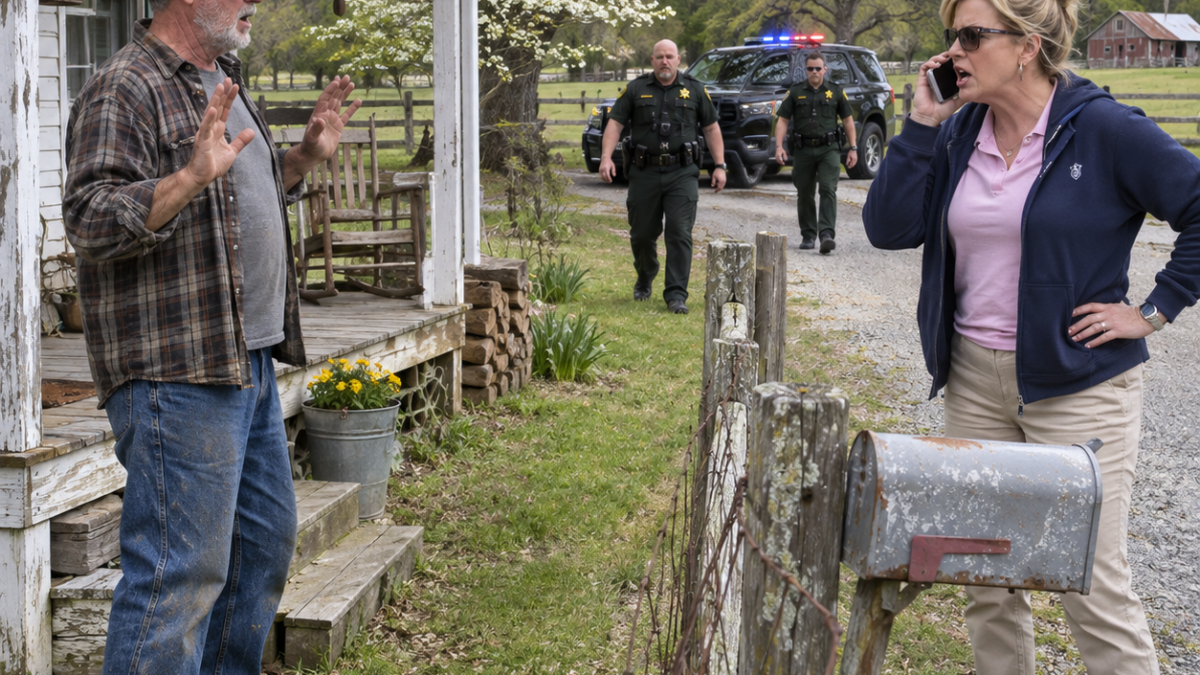
HOA Karen Demanded My Farmhouse Because I Lived Alone—Then Called 911 and Told Police I Was an Armed Squatter.
Vivian Hale spent months telling our neighbors that a retired man living alone had no right to keep a four-bedroom farmhouse when she had two children—and eventually she produced paperwork claiming I had already agreed to give it to her.
When I refused to leave, she called 911, reported an armed stranger inside “her” house, and sent three sheriff’s patrol cars racing toward a property my family had owned for decades.
What Vivian did not know was that thirty-four years with the Chicago Fire Department had taught me never to argue with a dangerous lie when I could document exactly who created it.
“That’s him! He’s the one who stole my house! Don’t let him go back inside!”
Vivian Hale stood behind three sheriff’s patrol cars, pointing at me like she’d just caught a dangerous criminal.
The deputy approaching my porch stopped.
One hand remained near his belt.
Not on his weapon.
Near it.
That distinction mattered.
“Sir, we’ve received a report that an armed squatter has taken over this residence.”
I looked past him at Vivian.
Then I looked at the farmhouse my uncle had left me.
White siding I had repainted myself.
Green metal roof I’d replaced two summers earlier.
Porch columns I’d rebuilt with lumber from the old barn.
Four bedroom windows facing the orchard.
My house.
My land.
My taxes.
My repairs.
My name on the recorded deed.
“Deputy, I’ve lived here for four years. My name is on the deed.”
Vivian shouted from the driveway.
“He’s lying! That house was reassigned to me!”
The deputy turned.
“Ma’am, let me speak to him.”
“He’s dangerous!”
Her voice went higher.
“He has guns!”
That sentence changed everything.
PART2:
I’d spent thirty-four years with the Chicago Fire Department.
For most of those years, I worked on the same streets where police officers, paramedics, and firefighters learned the same hard lesson:
Bad information can kill people before the truth reaches the scene.
A caller says someone has a gun.
Responders arrive expecting one.
A frightened homeowner makes the wrong movement.
An officer has half a second to interpret it.
There is no apology that fixes the outcome.
So I did exactly what training had taught me.
I kept both hands visible.
Palms open.
Stayed on the porch.
Did not reach for my pocket.
Did not argue.
“I own firearms,” I told the deputy. “They’re secured inside. I don’t have one on me.”
He nodded.
“Thank you.”
Then he looked directly at me.
Recognition moved across his face.
“Mr. Dwyer?”
“Yes.”
That helped.
His name was Deputy Mark Reyes.
PART3:
And eight days earlier, he’d personally warned Vivian Hale to stay off my property after she showed up in my driveway at four in the morning.
Now she’d called 911 and reported that I was an armed stranger occupying her home.
All because I wouldn’t give her my farmhouse.
It sounds ridiculous when you say it quickly.
It did not feel ridiculous with three patrol cars blocking my driveway.
It started eleven months earlier.
I retired at sixty-two.
Thirty-four years in Chicago.
Started as a firefighter in 1988.
Finished as a captain.
I had seen apartment fires.
Warehouse collapses.
High-rise evacuations.
Children carried through smoke.
Old men sitting on curbs watching everything they owned burn behind them.
There are experiences that teach you what matters.
A quiet morning mattered.
Coffee on a porch mattered.
A house nobody could order you out of mattered.
When Uncle Frank died, he left me Willow Creek Farm.
Everybody called it a farm even though by then it was mostly twenty-two acres of orchard, meadow, old fencing, and one barn that leaned west whenever the wind came from the east.
Frank had never married.
I was his closest nephew.
We weren’t sentimental men.
He never said:
I want you to have the place.
He said:
“You’re the only idiot in the family stubborn enough to fix that barn.”
That was Frank.
When his will was read, the farmhouse and land came to me free of any mortgage.
I moved from Illinois to Willow Ridge, Tennessee, three months later.
The first year was work.
Porch floor.
Barn roof.
Electrical panel.
Kitchen plumbing.
Septic inspection.
Fence posts.
Orchard pruning.
I replaced seventy-three feet of rotten pasture fence before realizing I didn’t own a single animal that needed a fence.
Kept repairing anyway.
Frank would have.
The farmhouse had four bedrooms.
One was mine.
One became an office.
One held old family furniture.
One became a guest room my sister used twice.
Nobody asked whether I needed them.
Until Vivian.
She arrived the following spring.
Two children.
An aging thirty-one-foot RV.
A white pickup.
And enough possessions strapped beneath blue tarps that I initially assumed she was moving into an actual house.
She wasn’t.
The neighboring parcel had belonged to a developer who’d carved sixteen small residential lots out of former pasture.
Vivian purchased Lot 7.
There was no house on it.
Only electrical service, a gravel pad, and temporary RV authorization while construction was supposedly underway.
First day I saw her, I walked over with a grocery bag full of apples.
My trees had produced more than I could use.
She stepped out of the RV wearing yoga pants, sunglasses, and an expression that suggested unexpected visitors should have appointments.
“I’m Tom Dwyer.”
She looked toward my property.
“The farmhouse?”
“Yes.”
“That’s yours?”
“Unless somebody changed something this morning.”
She did not laugh.
I handed her the apples.
“Welcome to Willow Ridge.”
Her daughter came outside.
Maybe twelve.
Son looked eight or nine.
Normal kids.
Tired.
Probably embarrassed about moving.
Vivian accepted the bag.
“Thanks.”
Then she kept staring at my house.
“Four bedrooms?”
I looked back.
“Four.”
“For just you?”
“Yes.”
She actually frowned.
“Well, that’s a terrible waste.”
I thought she was joking.
“House hasn’t complained yet.”
Again, no laugh.
She asked:
“You retired?”
“Fire department.”
“Wife?”
“My wife died seven years ago.”
Her face changed for about two seconds.
“Sorry.”
“Thank you.”
Then:
“So you’re alone.”
Something about the way she said it stayed with me.
Not sympathy.
Calculation.
I went home.
A week later Vivian introduced herself again.
This time as president of the Willow Ridge Community Association.
She had printed letterhead.
Logo.
Green tree.
Blue ridge.
Very professional.
The association was new.
Voluntary.
Most of the development lots were covered by a neighborhood maintenance covenant for the private entrance road and drainage retention pond.
Frank’s property wasn’t part of the development.
The farm existed decades before the subdivision.
My deed made that plain.
So did the county plat.
Vivian apparently disagreed.
First notice:
Grass height.
I called the phone number.
Vivian answered.
“Your roadside verge exceeds eight inches.”
“That’s hayfield.”
“Community standard is six.”
“My property isn’t in your community association.”
“You’re physically inside Willow Ridge.”
“The development is inside what used to be part of Willow Creek. That’s not the same thing.”
She paused.
“We’re trying to create consistency.”
“Good luck.”
I hung up.
Second notice:
Exterior paint.
My barn was red.
Apparently acceptable colors were cream, gray, white, and “natural earth tones.”
I emailed:
The barn predates your association by approximately seventy years.
Third notice:
Compost location.
Fourth:
Fence materials.
Fifth:
Prohibited agricultural appearance.
That one was my favorite.
I called my attorney.
Her name was Rachel Kim.
Forty-two.
County attorney for years before private practice.
She had handled Frank’s estate.
“Do I need to answer these?”
“No.”
“Can they fine me?”
“They can write the number $500 on as many pieces of paper as they like.”
“That sounds entertaining.”
“They cannot create a lien without legal authority.”
“Good.”
“Tom.”
“Yes?”
“Keep everything.”
“I do.”
“Everything.”
I understood the emphasis.
I bought a scanner.
Made folders.
Dates.
Photographs.
Certified mail.
Vivian came to my porch two weeks later.
No violation notice.
No folder.
Just herself.
“Can we talk?”
“Sure.”
She sat across from me.
I poured iced tea.
She did not touch it.
“I’ve been thinking about our situation.”
“I didn’t realize we had one.”
She smiled.
“You have more space than you need.”
There it was again.
“And I have children.”
“I noticed.”
“They need stability.”
“I agree.”
“We’ve been in the RV six months.”
“I thought you were building.”
“Construction costs changed.”
“Sorry to hear that.”
“I’m trying to create the best situation possible.”
“Sure.”
She leaned forward.
“What if we traded?”
I waited because I genuinely didn’t understand.
“Traded what?”
“Properties.”
I laughed.
Not at her.
The idea simply made no sense.
Vivian did not laugh.
“You would take my lot.”
“Your empty lot.”
“With the RV.”
“And you would take my farmhouse.”
“Yes.”
I stopped smiling.
“You’re serious.”
“You don’t need four bedrooms.”
“That isn’t how property ownership works.”
“You’re one person.”
“Yes.”
“My children share eight feet of sleeping space.”
“I’m sorry.”
“You have unused rooms.”
“They’re mine.”
She stared.
That was when the conversation changed.
Before that moment, I thought Vivian was making a strange proposal.
After it, I understood that she considered my refusal morally wrong.
“Do you understand how selfish that sounds?”
I put down my glass.
“You asked me for my house.”
“I proposed an exchange.”
“A twenty-two-acre farm and paid-off four-bedroom home for a subdivision lot and old RV.”
“The land is valuable.”
“Not that valuable.”
Her eyes narrowed.
“You could afford something smaller.”
“Yes.”
“Then why don’t you?”
“Because I like this.”
“My kids need it more.”
“They may.”
That answer surprised her.
I continued.
“Need doesn’t transfer title.”
Vivian stood.
“So that’s it?”
“Yes.”
“You won’t even think about it?”
“I already did.”
“You thought about it for thirty seconds.”
“It didn’t require thirty.”
She left angry.
Next morning a new association notice appeared.
UNCOOPERATIVE PROPERTY STATUS REVIEW.
I framed it.
For about two months, things stayed annoying but manageable.
Then her children began crossing my fence.
The first time, I found them picking peaches.
I said:
“You two want some, ask.”
The boy froze.
The girl apologized.
I gave them a grocery bag.
“No climbing the trees. Some branches are old.”
They nodded.
I didn’t blame kids for being kids.
Second time they were in the barn.
That worried me.
Rusty tools.
Loose boards.
Old hayloft ladder.
I walked them out.
“Barn is off-limits. You can get hurt.”
The girl said:
“Mom says this will be ours soon anyway.”
I stopped.
“What?”
She looked uncomfortable.
“Nothing.”
I crouched slightly.
“Your mom told you you’re moving here?”
The boy nodded.
“She said you’re going to the RV.”
I stood.
“Okay.”
I did not correct them aggressively.
They weren’t the problem.
That evening I called Vivian.
“Stop telling your children they’re getting my house.”
Silence.
“I told them we’re discussing options.”
“No.”
“You’re being dramatic.”
“They entered my barn because they believe they’ll own the property.”
“They’re children.”
“Exactly.”
“Then don’t frighten them.”
“I didn’t.”
“Your tone right now—”
“Vivian.”
I stopped her.
“We are not exchanging houses.”
“You’ve made that clear.”
“Then make it clear to them.”
She hung up.
Three days later I found a peach tree with a major branch broken.
Could have been weather.
Could have been kids.
I didn’t accuse anyone.
I photographed it.
Then someone spray-painted:
GREEDY OLD MAN
across the side garage wall.
That one I reported.
Deputy took photographs.
No evidence of who did it.
Vivian posted online that afternoon.
Not naming me.
Not technically.
But everybody knew.
Imagine being a single older man sitting in a huge family home while children next door sleep in an RV. Some people have forgotten what community means.
Comments came.
A few agreed.
Most people avoided taking sides.
One woman named Melissa Harper wrote:
Property isn’t allocated according to bedroom occupancy, Vivian.
Vivian deleted the comment.
That was when I installed cameras.
Front gate.
Porch.
Garage.
Barn.
Orchard.
Driveway.
Not hidden.
Signs too.
VIDEO SURVEILLANCE IN USE.
Vivian called that intimidation.
I called it evidence.
Then the envelope arrived.
No postage.
Inside my mailbox.
Three pages.
RESIDENTIAL PROPERTY EXCHANGE AGREEMENT.
My farmhouse address.
Vivian’s parcel.
Transfer terms.
Effective date.
My supposed signature.
I stared at it.
It looked close.
Not good.
But close.
Someone had copied the shape from somewhere.
Underneath:
Thomas E. Dwyer.
Notarized.
Commission number.
Seal impression reproduced electronically.
I called Rachel.
She said:
“Don’t touch anything else.”
“I already touched it.”
“Fine. Put it in a plastic sleeve.”
“It was in my mailbox.”
“Photograph where you found it?”
“I did.”
“Good.”
Thirty minutes later I was in her office.
Rachel studied the signature.
“That isn’t yours.”
“No.”
“Where could she get a sample?”
“Association correspondence?”
“You sign anything?”
“Certified mail receipts.”
“Possible.”
She looked at the notary section.
Typed the commission number.
Waited.
Frowned.
“What?”
“This number doesn’t return to this notary.”
“Fake?”
“Maybe fabricated. Maybe copied incorrectly.”
She made another search.
“No current Tennessee commission.”
She printed the result.
Then looked at me.
“Tom, this is not HOA nonsense anymore.”
“I know.”
“This document purports to convey real property.”
“I know.”
“If somebody tries to record it—”
“They can steal the house?”
“Not exactly.”
She leaned back.
“But they can create a title problem.”
I felt my stomach tighten.
“What do we do?”
“Certified copy of your deed.”
“I have one.”
“Probate documents.”
“Have them.”
“Recent title search.”
“Can get it.”
“Then we notify the county recorder that you dispute any attempted conveyance.”
She paused.
“And we report the forged instrument.”
I did.
The sheriff’s office took a report.
No arrest.
Not yet.
Possession alone didn’t prove who created it.
Vivian denied knowledge.
Called it:
“A draft negotiation copy.”
Rachel nearly laughed.
“A draft with a forged signature and fake notary?”
Vivian’s attorney—she had one now—sent a letter claiming the document was prepared “for discussion purposes” and mistakenly completed with a “sample execution.”
Rachel replied with three pages.
I didn’t understand every legal phrase.
The final sentence was clear:
Mr. Dwyer has never consented to transfer, exchange, lease, surrender, or otherwise convey any interest in Willow Creek Farm to Ms. Hale or the Willow Ridge Community Association.
That should have ended it.
It didn’t.
Vivian started livestreaming.
She stood near the public road with my farmhouse behind her.
“This is the property dispute I told you about.”
She told viewers I’d promised to exchange houses.
Then backed out after she spent money preparing her lot for me.
False.
She claimed I’d joined the association.
False.
She claimed Willow Ridge had an “occupancy allocation policy” prioritizing families.
Not legally meaningful.
Then she said something that made Rachel call me immediately.
Vivian announced that association leadership had “reassigned underutilized housing.”
“What does that even mean?”
Rachel said:
“Nothing.”
“Then why do you sound concerned?”
“Because she’s building a narrative.”
“For who?”
“Anybody who will listen.”
Then came four o’clock in the morning.
My driveway camera alerted.
Motion.
I woke.
Checked the monitor.
Vivian.
Flashlight.
Phone.
Walking toward my garage.
I called the non-emergency line.
Then changed to 911 when I saw her trying the side door.
I did not go outside.
Deputy Reyes arrived.
Found her near the porch.
Vivian claimed she was “inspecting association property.”
Reyes looked at my posted no-trespassing signs.
Then at her.
“Do you live here?”
“It’s under reassignment.”
“Is your name on the deed?”
“Not yet.”
“Did the owner give you permission to be here at four in the morning?”
She looked toward my camera.
“He’s harassing me with surveillance.”
Reyes said:
“That wasn’t my question.”
He gave her a formal trespass warning.
I stood on the porch after she left.
Reyes said:
“You have documentation on this dispute?”
“A lot.”
“Keep it.”
“I will.”
“She seems convinced.”
“That worries me more than if she knew she was lying.”
Reyes nodded.
“Those can be harder situations.”
Eight days later she called 911.
Armed squatter.
Stolen house.
Immediate threat.
Three patrol cars.
That was how we arrived at my porch.
Deputy Reyes took my deed package.
He examined the recorded deed.
Book and page.
County seal.
Frank’s probate order.
Tax statements.
Driver’s license.
Utility bills.
Insurance.
Then the fake transfer agreement.
“Mr. Dwyer, is this your signature?”
“No.”
“You never signed this?”
“No.”
“Never authorized anyone to sign?”
“No.”
He looked toward Vivian.
She stood near the road holding her own folder.
Reyes turned to another deputy.
“Stay with Mr. Dwyer.”
Then walked down the driveway.
I could not hear the first part.
Then Vivian got louder.
“He gave me the house!”
Reyes said something.
She opened her folder.
Papers came out.
More shouting.
Then Reyes looked back at me.
Something had changed.
He returned holding another document.
“Mr. Dwyer.”
“Yes?”
“You need to see this.”
The top read:
EMERGENCY OCCUPANCY REASSIGNMENT CERTIFICATE
Willow Ridge Community Association.
My address.
Reason:
Underutilization / Community Family Hardship.
Approved by:
Vivian Hale, President.
Two board members.
And beneath that:
Resident consent established by executed exchange agreement.
I stared at it.
“This has no legal effect.”
Reyes said:
“I know.”
Then:
“She presented it to dispatch as evidence she owned the house.”
I looked at Vivian.
“That explains the three cars.”
“She reported that an armed male had illegally entered after she had been awarded possession.”
I said nothing.
“She specifically stated you were unknown to her.”
That caught me.
“Unknown?”
“Yes.”
“She gave my name on violation letters for months.”
“I know.”
“She’s been on my porch.”
“I know.”
“You warned her personally eight days ago.”
Reyes nodded.
“I know.”
That was the first moment I understood the 911 call might become a problem for Vivian rather than me.
Not because she was mistaken.
Because some of her statements could be objectively compared to documented prior contact.
Reyes asked:
“Do you have your camera footage from the trespass?”
“Yes.”
“Keep it.”
“Already copied.”
“Good.”
He returned to Vivian.
Another conversation.
Less shouting this time.
Then he walked toward the other deputies.
They spoke.
Vivian noticed.
Her posture changed.
She stopped pointing at me.
Started talking rapidly to the woman beside her—one of the association board members.
Reyes came back.
“We’re not removing you.”
“I assumed.”
“I need you to stay on your property while we finish.”
“Fine.”
“Do not engage with Ms. Hale.”
“Gladly.”
Thirty minutes later, Vivian left.
Not in handcuffs.
People online later claimed she was “arrested on the spot.”
She wasn’t.
Real situations are usually slower than internet stories.
But the sheriff’s office opened a report for possible false reporting, misuse of emergency services, document fraud, and attempted property-related fraud.
Rachel called it:
“Finally enough rope.”
I said:
“That’s not legal terminology.”
“It should be.”
The next morning, she ordered a full title search.
That found the next surprise.
Someone had attempted to record a quitclaim deed against my property six days earlier.
Attempted.
Not completed.
The recorder rejected it.
Why?
Parcel description inconsistency.
Frank’s property had two legal descriptions.
The old metes-and-bounds description from 1957.
And a modern GIS reference.
Whoever prepared the fake deed copied the tax parcel summary instead of the complete legal description.
The county rejected it as insufficient.
Rachel called me.
“You got lucky.”
“How lucky?”
“Very.”
“Could they have recorded it with the right description?”
“Potentially enough to create a serious dispute.”
“But recording doesn’t make it valid.”
“No.”
“But I’d have to fight it.”
“Yes.”
I sat at my kitchen table.
The same kitchen Frank had installed in 1983.
The same table I’d refinished.
For the first time, Vivian’s behavior stopped feeling merely absurd.
She had tried.
Actually tried.
Not complained.
Not posted online.
Not threatened.
Tried to put paperwork into the county record claiming an interest in my farm.
Rachel obtained the rejected instrument.
Grantor:
Thomas E. Dwyer.
Grantee:
Vivian Marie Hale.
Consideration:
Mutual housing exchange and community accommodation.
Signature:
Again not mine.
Notary:
Different from the earlier fake agreement.
This commission existed.
That was worse.
Rachel called the notary.
His name was Stephen Rollins.
Mobile notary.
He remembered Vivian.
He did not remember me.
Because I had never been there.
According to his log, Vivian presented a man claiming to be Thomas Dwyer.
The notary copied driver’s-license information.
License number did not match mine.
Photograph in the retained ID scan?
Blurry.
But definitely not me.
Rachel’s voice changed when she told me.
“This is no longer just document fabrication.”
“What is it?”
“Somebody impersonated you before a notary.”
The sheriff got the record.
The investigation widened.
Vivian kept posting.
Big mistake.
One livestream said:
The current occupant is using technicalities to reverse a lawful family reassignment.
Another:
I have signed documents proving the house was promised to us.
Another:
Police are protecting a single armed man instead of two children.
Rachel saved every video.
So did I.
Commenters became cruel on both sides.
I stopped reading.
Vivian eventually created a fundraising page for legal expenses.
Headline:
Single Mom Fighting Armed Squatter for Family Home.
That one Rachel sent directly to the investigator.
Why?
Because Vivian wasn’t merely claiming confusion privately.
She was publicly asserting ownership while soliciting money based on it.
Money changes certain legal questions.
Then something unexpected happened.
Melissa Harper called me.
The neighbor whose comment Vivian had deleted months earlier.
“You need to see something.”
“What?”
“Association meeting minutes.”
“I don’t belong to the association.”
“That’s why.”
She came over with copies.
Vivian had conducted a board meeting three weeks before the 911 call.
Four attendees.
Agenda item:
Farmhouse Community Acquisition.
I read it twice.
“Acquisition?”
Melissa nodded.
Minutes recorded Vivian saying:
Mr. Dwyer’s household consists of one occupant and therefore represents inefficient use of residential capacity.
Another line:
Association authority should be tested through emergency reassignment procedures.
Tested.
That’s what bothered me.
Not that she believed she had authority.
She wanted to test whether anyone would stop her.
I read further.
One board member asked for legal opinion.
Vivian replied:
Counsel is unnecessary until challenged.
I looked at Melissa.
“Who wrote these minutes?”
“Secretary.”
“Does she know you copied them?”
“She gave them to me.”
“Why?”
Melissa looked toward Vivian’s RV across the field.
“Because she’s scared.”
That secretary was Elaine Porter.
Two days later she met Rachel.
Then sheriff investigators.
Elaine explained that Vivian had pushed the community association into escalating actions against me.
Most board members assumed the notices were symbolic.
Then Vivian introduced the exchange agreement.
Elaine questioned my signature.
Vivian said:
“Tom signed privately because he’s embarrassed.”
Elaine believed her.
For a while.
Then Vivian asked the board to approve the emergency occupancy certificate.
Elaine refused.
Her signature appeared anyway.
Forged.
Now we had another victim.
The second board member’s signature?
Real.
His name was Carl Henning.
Carl owned three rental properties in the development.
Rachel discovered another detail.
Carl had lent Vivian $18,000.
Secured informally against her empty lot.
If Vivian acquired my farmhouse, the plan—according to text messages Elaine later produced—was to refinance the property and repay Carl.
There it was.
Not children needing bedrooms.
Not community fairness.
Money.
Vivian needed housing.
Yes.
She also owed Carl money.
Carl wanted repayment.
My paid-off farmhouse had equity.
A lot of it.
The county assessment valued the house and acreage at $612,000.
Market value likely higher.
Vivian’s lot and RV together?
Maybe $96,000.
The “swap” would have moved more than half a million dollars of value in her direction.
Suddenly the absurd proposal looked less absurd.
Still outrageous.
But financially understandable.
Rachel said:
“This is why I hate cases that start funny.”
“Because they stop being funny.”
“Exactly.”
Investigators subpoenaed communications.
Carl lawyered up immediately.
Then began cooperating.
That was how we learned the rest.
Vivian had contacted him months earlier about an “unused legacy property” she believed could be brought under association control.
Mine.
She argued that because Willow Creek Farm’s driveway connected to a road maintained partly by the Willow Ridge Community Association, the farm could be treated as an “associated parcel.”
Legally wrong.
She knew there was a problem.
Carl told her to speak to a lawyer.
She didn’t.
Instead she found online templates.
Community reassignment.
Occupancy policy.
Voluntary transfer.
Quitclaim deed.
Most were meaningless in Tennessee property law.
But assembled together, stamped, notarized, and presented confidently to people who didn’t know the property history, they looked official.
Rachel explained it perfectly.
“Paper has psychological power.”
“What do you mean?”
“People assume documents exist because somebody had authority to create them.”
She held up Vivian’s emergency occupancy certificate.
“Put a logo on it, use twelve-point Times New Roman, add signature lines, and half the world stops asking whether the organization issuing it has any jurisdiction.”
Vivian understood that instinctively.
She built authority out of formatting.
The sheriff’s investigators understood something else.
Intent.
They had:
The fake exchange agreement.
The fake emergency reassignment certificate.
Elaine’s forged signature.
The attempted quitclaim deed.
The impersonated notarization.
911 recording.
Trespass warning.
Livestreams.
Association minutes.
Text messages.
And Carl.
The 911 recording was played for me months later.
Vivian sounded panicked.
“There’s a man inside my house.”
Dispatcher:
“Do you know who he is?”
“No.”
That lie alone was remarkable.
“Does he have weapons?”
“Yes. Multiple guns.”
“Can you see one?”
“No, but he has them.”
“Where are you now?”
“Outside. I’m afraid for my children.”
“Are your children with you?”
“No.”
Another detail.
The dispatcher asked:
“Has this man threatened you?”
Vivian:
“He stole my home.”
“Has he threatened physical harm?”
“He’s dangerous.”
“Has he shown a weapon?”
“No.”
Then:
“He’s a retired fireman. Those people usually have guns.”
That was how an ownership dispute became three patrol cars treating the scene as a potential armed-occupant call.
When Deputy Reyes heard the full recording, he looked furious.
Not theatrical.
Professional anger.
“She used our response as leverage.”
That was exactly what she did.
Vivian had tried documents.
Association notices.
Public pressure.
Trespass.
Then she used law enforcement as an eviction tool.
That crossed a line even people who had tolerated her before could understand.
The Willow Ridge Community Association held an emergency meeting.
I did not attend.
Melissa called afterward.
“Vivian is out.”
“As president?”
“Yes.”
“Vote?”
“Eleven to one.”
“Who voted for her?”
“Herself.”
I laughed.
“What about Carl?”
“Resigned before the meeting.”
“Smart.”
“Elaine is acting president.”
“Poor woman.”
“She says the association is hiring actual counsel.”
“Revolutionary idea.”
Melissa laughed.
Then became serious.
“They’re rescinding every notice issued against your farm.”
“They had no authority anyway.”
“I know.”
“They know now.”
The association sent me a formal letter.
No dramatic apology.
Probably because lawyers wrote it.
It acknowledged:
Willow Creek Farm was not subject to the association covenant.
No authority existed to impose architectural, landscape, occupancy, or use restrictions.
The emergency reassignment certificate was void.
Any prior statements suggesting otherwise were withdrawn.
Rachel told me to keep the letter forever.
I did.
Vivian’s situation deteriorated quickly after that.
Her fundraising page disappeared.
Her social accounts went private.
The RV stayed dark some nights.
Then one morning it was gone.
I thought she’d fled.
She hadn’t.
She moved temporarily to her sister’s house after investigators executed a search warrant on the RV.
They seized electronics.
Printer.
Association files.
A portable document scanner.
Notary-stamp images.
Copies of my certified-mail signatures.
That last item bothered me more than I expected.
She had saved my signatures.
Practiced from them.
Somebody had sat inside that RV copying my name until the result looked close enough to use.
For years I’d entered burning structures.
I’d had ceilings collapse near me.
I’d crawled through rooms where visibility ended at my mask.
Those things were dangerous.
But they were straightforward.
Fire doesn’t pretend to be your neighbor.
Fire doesn’t smile when you bring apples.
Six months after the 911 call, Vivian was indicted.
Not for “trying to steal a house.”
Criminal charges have specific elements and specific names.
The state alleged counts involving forgery, criminal impersonation connected to the notarized deed, filing or attempted use of a fraudulent instrument, false reporting, and identity-related fraud.
Carl faced separate charges but reached an agreement after cooperation.
Elaine was not charged.
The evidence showed her signature had been used without permission.
The man who impersonated me before the notary was identified too.
Vivian’s cousin.
Forty-eight.
Similar height.
Baseball cap in the notary-office security footage.
He pleaded guilty early.
That mattered later.
Vivian did not.
She insisted there had been a verbal agreement.
Then a written agreement.
Then that someone else forged the documents to “help” complete what I’d already promised.
Her explanations changed because facts did not.
Rachel warned me:
“Don’t expect a movie ending.”
“What does that mean?”
“It means no courtroom confession.”
“Good.”
“Probably no dramatic cross-examination.”
“Even better.”
“Could take a year.”
“I have nowhere to go.”
That became my advantage.
Vivian had always acted as though being alone made me weak.
No wife.
No children at home.
No household depending on me.
She interpreted solitude as lack of connection.
But solitude also gave me time.
I documented everything.
Maintained the property.
Answered my attorney.
Showed up when investigators asked.
Did not post.
Did not retaliate.
Did not argue online.
Did not walk over to her RV.
Did not give her the confrontation she wanted.
Rachel once said:
“You are annoyingly disciplined.”
“Thirty-four years of incident command.”
“Is everything fire department with you?”
“Most useful things.”
A civil case came first.
Quiet.
Efficient.
Rachel filed to clear any potential cloud created by the attempted fraudulent deed and sought a permanent injunction against Vivian asserting ownership or entering the farm.
Vivian’s new attorney did not fight much.
The court entered an order affirming my sole title.
No exchange.
No association interest.
No reassignment.
No occupancy right.
No easement beyond the preexisting road access arrangement.
The judge also prohibited Vivian from representing publicly or privately that she owned any interest in Willow Creek Farm.
That last paragraph felt good.
Not because I needed a judge to tell me my house was mine.
Because Vivian finally had a consequence every livestream could not talk around.
The criminal case resolved nine months later.
Vivian accepted a plea.
I attended sentencing.
Not because I wanted to see her punished.
I wanted to hear whether anyone would say plainly what happened.
The prosecutor did.
He laid out the sequence.
Initial request for property exchange.
Escalating association pressure.
Fabricated transfer agreement.
Attempted deed.
False emergency certificate.
911 call characterizing the lawful owner as an unknown armed squatter.
The prosecutor said:
“This case is not a neighborhood disagreement that became heated. It is a deliberate attempt to use fabricated documents, false authority, and emergency public resources to dispossess a lawful homeowner.”
That sentence mattered.
Vivian sat at the defense table.
No sunglasses.
No livestream.
No association binder.
She looked smaller.
The judge asked whether she wished to speak.
She did.
“I was trying to provide stability for my children.”
My stomach tightened.
Even then.
The judge said:
“Your children were not responsible for these documents.”
“No.”
“You were.”
Vivian looked down.
“I felt ignored.”
The judge waited.
“I felt like nobody cared that we were living in an RV while he had all that space.”
There it was.
The original belief.
Still alive beneath everything.
The judge responded:
“Need does not create ownership.”
Exactly.
Vivian received a combination of incarceration, suspended time, probation, restitution obligations, and restrictions related to contact and fraudulent filings.
It wasn’t twenty years.
Didn’t need to be.
Carl’s cooperation reduced his exposure substantially.
Her cousin received probation after his guilty plea and cooperation.
Some people online wanted dramatic destruction.
Prison forever.
Children taken.
RV seized.
Everything lost.
Real justice is rarely as emotionally symmetrical as strangers want it to be.
I didn’t need Vivian ruined.
I needed her stopped.
She was.
Willow Ridge changed after that.
The association amended its bylaws.
Any property action required legal review.
Any enforcement document needed citation to actual covenant authority.
Board votes had to be recorded.
No single officer could issue “emergency” property directives.
Their lawyer held a workshop explaining the radical concept that an HOA cannot govern property outside its recorded jurisdiction.
Melissa sent me the presentation.
I laughed for ten minutes.
Elaine became permanent president.
She came by one afternoon.
Not at four in the morning.
At three-thirty.
Rang the bell.
Held a pie.
“I don’t know if this is weird.”
“Depends what’s in the pie.”
“Apple.”
“Come in.”
We sat on the porch.
She apologized.
Not for Vivian.
For herself.
“I should have questioned things earlier.”
“You did eventually.”
“I signed some of those notices.”
“I remember.”
“I thought because your driveway connected to our road—”
“You assumed.”
“Yes.”
I nodded.
“I’ve made assumptions too.”
She looked toward the orchard.
“I’m sorry.”
“Accepted.”
That was enough.
Her kids—Vivian’s kids—were the part I thought about most.
They hadn’t created any of it.
After Vivian moved away from Willow Ridge permanently, the girl wrote me a note.
I almost didn’t open it.
Rachel had trained me to be suspicious of envelopes.
Inside:
Mr. Dwyer, I’m sorry we went into your barn and took peaches. Mom told us the house was going to be ours. I know now it wasn’t. Thank you for not yelling at us.
No return address.
I sat with that note for a long time.
Then put it in the same file cabinet as the deed.
Different folder.
Some records are evidence.
Some are reminders.
The farmhouse stayed exactly where it had always been.
I repainted the garage wall.
Repaired the peach branch as best I could.
It never grew quite straight again.
Still produces fruit.
The barn roof eventually needed another section replaced.
I complained to Frank out loud while doing it.
“Should’ve left me a condo.”
The orchard got better after proper pruning.
One fall I had so many apples I put a table near the road.
FREE APPLES. TAKE WHAT YOU NEED.
Melissa saw it.
“You know somebody could say you’re not using them efficiently.”
“Don’t start.”
She laughed.
People sometimes ask why I didn’t sell after everything.
As if the place became contaminated by the dispute.
It didn’t.
The house did nothing wrong.
Neither did the land.
One woman’s entitlement didn’t change what Uncle Frank left me.
If anything, it made me understand ownership differently.
I used to think a deed was just a legal document proving what belonged to you.
Now I understood it was also a boundary against other people’s stories.
Vivian had built an entire story about my farmhouse.
A single old man did not need it.
A mother did.
Therefore the allocation was unjust.
Therefore resistance was selfish.
Therefore association intervention was moral.
Therefore fake paperwork could be treated as paperwork that should have existed.
Therefore police could remove the person standing in the way.
Each step felt reasonable to her only because she never returned to the first question.
Whose property is it?
Mine.
That answer wasn’t cruel.
It wasn’t anti-family.
It wasn’t anti-community.
It was simply true.
A year after the 911 call, Deputy Reyes drove up.
No lights.
No emergency.
He stepped out carrying a cardboard box.
“You in trouble again?”
I asked.
“Constantly.”
“What did I do now?”
“Nothing.”
He opened the box.
Inside was a small retirement plaque.
Not his.
Mine.
Chicago Fire Department had mailed it to my old address years earlier.
Some bureaucratic mix-up eventually redirected it through my sister.
She had called the sheriff’s office because she somehow remembered Reyes’s name from the case.
He laughed while explaining.
“Your family has unusual delivery methods.”
“That we do.”
He handed it over.
Thirty-four years.
My name.
Service dates.
I stared.
Reyes looked toward the porch.
“Hard to believe somebody convinced dispatch you were some unknown squatter.”
“She didn’t convince them long.”
“No.”
He became serious.
“You handled that day well.”
“Didn’t feel like it.”
“You kept your hands visible.”
“I knew what the call sounded like on your end.”
“That helped.”
I nodded.
Then:
“Did you ever find out how many cars would have come if she’d said I was actively holding a gun?”
Reyes looked at me.
“More.”
I believed him.
That was the part I never found funny.
Documents can be fixed.
Paint can be covered.
A forged deed can be challenged.
An association can vote.
A false story about an armed person can produce a consequence that no court can reverse.
Vivian either understood that and used it deliberately, or she didn’t understand it and made the call anyway.
Neither possibility comforted me.
Reyes looked toward the orchard.
“You got coffee?”
“Always.”
We sat on the porch.
Two men who met because a woman tried to have one remove the other from his own house.
Life is strange.
Eventually the story became local gossip.
Then county gossip.
Then mostly old news.
New homeowners moved into Willow Ridge.
Some didn’t know anything about Vivian.
Good.
Communities shouldn’t be forced to live forever inside their worst conflict.
The association entrance sign was replaced.
The new one read simply:
WILLOW RIDGE
No “exclusive community.”
No “managed residential district.”
Just the name.
Elaine asked if I wanted the farm added voluntarily to the association.
I stared at her.
She immediately laughed.
“I’m kidding.”
“Good.”
“I learned.”
“You almost ruined a perfectly good pie relationship.”
She still brings apple pie every fall.
I supply the apples.
Fair exchange.
A real one.
Three years after the incident, I turned sixty-five.
My sister visited.
She slept in one bedroom.
Her daughter and husband took another.
My old firehouse friend Eddie came down from Chicago and took the third.
For one weekend, all four bedrooms were occupied.
Saturday morning I stood in the kitchen listening to people complain about coffee strength.
Eddie said:
“Big house for one guy.”
Everybody went silent.
He didn’t know.
My sister almost choked.
I looked at him.
“Careful.”
“What?”
“Apparently that’s how wars start around here.”
When I finally told him the story, he laughed until I reached the 911 call.
Then stopped.
“Armed squatter?”
“Yes.”
“In your house?”
“Yes.”
“She knew you.”
“Yes.”
“Knew you were retired fire?”
“Yes.”
“And told cops you were an unknown armed guy?”
“Yes.”
Eddie stared.
“Tom.”
“I know.”
“You could’ve gotten killed.”
“I know.”
That was all.
Firefighters don’t always need long conversations about danger.
Sometimes the sentence is enough.
After everyone left Sunday, the farmhouse became quiet again.
Four bedrooms.
One occupant.
No guilt.
I walked upstairs.
Guest room empty.
Office empty.
Frank’s furniture collecting dust in the third bedroom.
My room at the end of the hall.
A terrible waste, Vivian had said.
Maybe.
But ownership is full of inefficient things.
Books you haven’t read lately.
Tools you use twice a year.
Land left wild for deer.
Bedrooms waiting for family to visit.
A porch with six chairs when one man usually sits in one.
Not everything has to operate at maximum occupancy to deserve to exist.
That was perhaps the strangest part of Vivian’s logic.
She believed unused capacity belonged morally to whoever could use it more.
But taken seriously, that idea destroys the concept of having anything.
Your spare bedroom.
Your second car.
Your savings.
Your extra acre.
Your empty chair.
Someone always needs something more than you do.
Compassion asks what you choose to give.
Entitlement decides what you should be forced to surrender.
Those are not the same thing.
I still give fruit away.
Still help neighbors.
Loan tools.
Let Elaine use my tractor occasionally.
Fixed Melissa’s porch railing without charging her.
One winter I let a family from the development park two cars in my barn during a hailstorm.
None of that means they own the barn.
Community works because generosity remains voluntary.
The minute somebody can manufacture a legal-looking document and call your generosity mandatory, it stops being community.
One afternoon, years later, I opened the file cabinet.
My property file was thick now.
Original deed.
Probate order.
Tax records.
Trespass report.
Fake exchange agreement.
Rejected quitclaim deed.
911 incident number.
Court order.
Association disclaimer.
Vivian’s final no-contact provision.
I considered throwing some of it away.
Rachel would have appeared from thin air and slapped me.
So I kept everything.
At the front I placed one sheet.
Not legal.
My handwriting.
IF ANYONE EVER CLAIMS THIS HOUSE WAS TRANSFERRED, CALL RACHEL BEFORE ARGUING WITH THEM.
Practical experience.
The strangest document stayed in the back.
The original exchange proposal.
My fake signature.
Vivian’s name.
Farmhouse for RV.
Every time I saw it, I remembered the first conversation.
“You don’t need four bedrooms.”
She was right about one thing.
I didn’t need four bedrooms.
But she had confused need with right.
I didn’t need the old barn either.
Didn’t need twenty-two acres.
Didn’t need six porch chairs.
Didn’t need Frank’s apple press.
Didn’t need the battered Chicago Fire helmet sitting on my office shelf.
Need is a very low standard for deciding what a person may keep.
Sometimes we keep things because they connect us to the people who came before.
Sometimes because we worked for them.
Sometimes because they’re useful.
Sometimes because they’re ours.
That last reason is enough.
The morning Vivian called 911, she stood behind three patrol cars and screamed that I had stolen her house.
For several minutes, the scene looked exactly like the story she wanted to create.
Police.
Armed suspect warning.
Terrified homeowner.
Disputed residence.
Official papers.
She had built the picture carefully.
What she could not control was everything underneath it.
The recorded deed.
The probate file.
The tax history.
The cameras.
The trespass warning.
The fake notary.
The rejected deed.
The meeting minutes.
The messages.
The dispatcher recording.
Reality has an advantage lies rarely respect.
It existed before they arrived.
Deputy Reyes didn’t save my property that morning.
My uncle’s deed had already done that.
Rachel didn’t make me the owner.
She proved what was already true.
The court didn’t give me the farmhouse.
It simply stopped someone else from pretending she could.
And I didn’t win Willow Creek Farm from Vivian Hale.
It had never been hers to lose.
That’s the part I remember whenever somebody asks how I “beat the HOA.”
I didn’t.
There was no dramatic loophole.
No secret billionaire connection.
No surprise federal authority.
I owned my house.
She didn’t.
Everything else was noise.
Dangerous noise.
Expensive noise.
At one point, potentially deadly noise.
But still noise.
These days, mornings are quiet again.
I wake around six.
Make coffee.
Walk the porch.
Check the weather.
Sometimes deer stand near the orchard fence.
The peach tree Vivian’s kids damaged leans slightly left now.
I could replace it.
I don’t.
It still blossoms.
Still makes fruit.
There’s a lesson in that somewhere, though I’m too old to force symbolism onto trees.
Last fall a new family moved into Lot 7.
Actual house this time.
Young couple.
Baby.
Golden retriever.
The husband came over the first week.
“Mr. Dwyer?”
“Tom.”
“I’m Aaron.”
He pointed toward the property line.
“I wanted to check where the boundary actually runs before I put up a fence.”
I almost laughed.
Instead I pulled the survey map.
We walked it together.
He marked the corners.
Then asked:
“Do you care if the fence is black?”
“Why would I?”
He shrugged.
“Association standards.”
“Ask Elaine.”
“You’re not in the HOA?”
“No.”
He looked toward my farmhouse.
“But you’re right here.”
“Yes.”
He seemed confused.
Then accepted it.
No argument.
No emergency occupancy certificate.
No attempted deed.
Just a neighbor asking before building.
Before leaving, I gave him a bag of apples.
He looked inside.
“That’s a lot.”
“I have more than I need.”
Then I caught myself.
For a second we both stood there.
He had no idea why I was smiling.
“Something funny?”
“No.”
I looked back at the farmhouse.
Four bedrooms.
One retired man.
Twenty-two acres.
More apples than I could possibly eat.
“No,” I said. “Nothing funny at all.”
And I handed him the bag because giving something away feels completely different when nobody believes they have the right to take it.








