HOA Karen Demanded $1 Million or Ordered Me Off My Own Land—Then I Terminated the Ground Lease Under Her Entire 120-Home Neighborhood
HOA Karen Demanded $1 Million or Ordered Me Off My Own Land—Then I Terminated the Ground Lease Under Her Entire 120-Home Neighborhood.
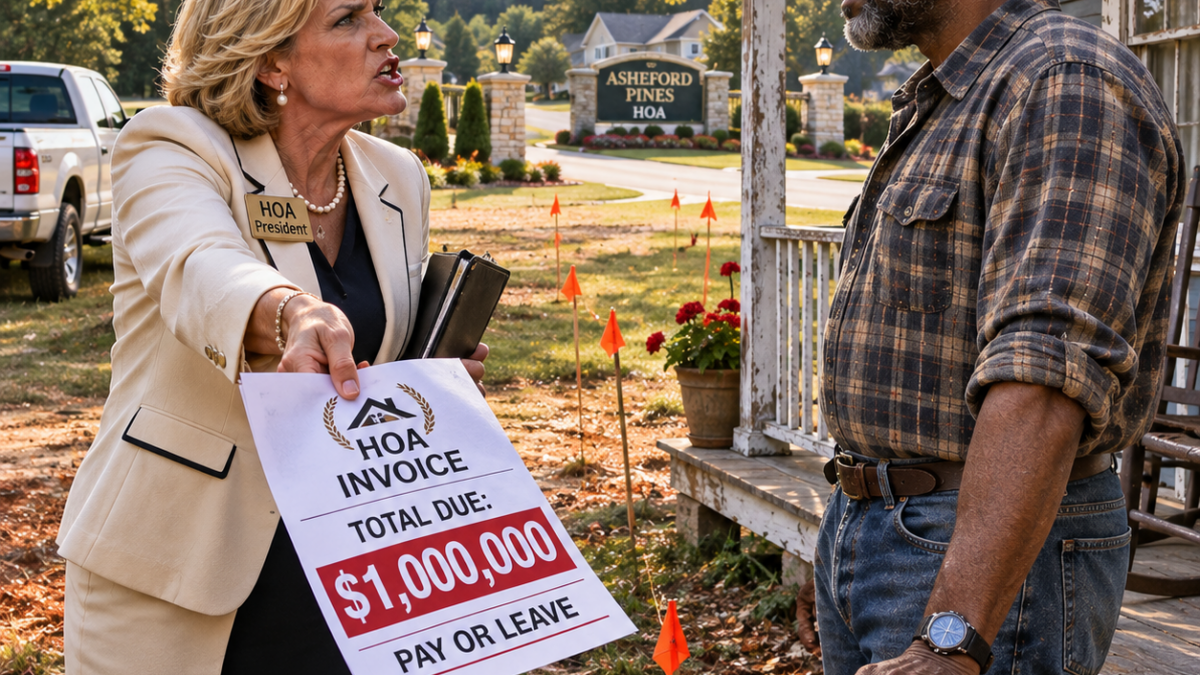
Cynthia Hargrove dropped a one-million-dollar HOA invoice in front of Terrence Burke and told him to either pay it or abandon the North Carolina land his Black grandfather had bought for cash in 1952 after a white bank refused him a loan.
What Cynthia did not know was that the 120 homes she claimed Terry was “dragging down,” along with their clubhouse, pool, access road, walking trails, water lines, and sewer easements, were sitting on forty acres the Burke family had never sold at all—they had only leased them to the subdivision developer.
And buried inside that thirty-year ground lease was seven lines Terry’s sharecropper grandfather had dictated decades earlier: if the HOA or anyone governing the leased land ever engaged in documented racial discrimination and failed to stop it, the Burke family could terminate the entire lease with thirty days’ notice and no right to cure.
Terrence Burke knew what red Carolina clay smelled like after rain.
Most people smelled mud.
Terry smelled his grandfather.
Elijah Burke had spent nineteen years building the twelve hundred dollars it took to buy eighty-five acres outside Asheford, North Carolina, in 1952.
Not borrowing.
Buying.
Cash.
That distinction mattered to Elijah.
It mattered because the bank had told him no.
Not because the acreage was poor.
Not because Elijah lacked work.
Not because he had a history of unpaid debt.
The banker had looked at him, listened to a Black sharecropper explain that he wanted land of his own, and decided that ownership was not a sound investment for a man “in his position.”
Elijah had understood the position.
He had lived inside it his whole life.
So he saved.
Sharecropping.
Factory floors.
Seasonal work.
Skipped meals.
Boot soles worn thin.
He kept money in places banks could not refuse to give back to him because he had never handed it to them.
And when he finally had enough, he walked into the county recorder’s office and put his name on a deed.
Eighty-five acres.
Tobacco land.
Red clay.
Pines.
A creek cutting across the back section.
One large oak near what would later become the farmhouse.
Elijah built that farmhouse himself.
Not elegantly.
The porch steps were slightly crooked.
One beam in the kitchen sat an inch lower than its twin.
The original screen door never closed quietly.
It whined at the hinge, then slapped the frame.
Elijah refused to replace it.
PART2:
“Door still knows how to close,” he would say.
For Terry, that sound became part of the land.
The screen door whining.
Gravel beneath tires.
Cicadas.
Rain on the tin roof.
His grandfather’s hands around a coffee mug.
Terry grew up in Durham, but every summer brought him back.
Elijah would walk him along the property lines and teach him things Terry did not realize were lessons.
“Know where your ground stops.”
“Why?”
“Because somebody else always got an idea where theirs starts.”
At ten, Terry laughed.
At fifty-eight, he understood.
Elijah grew tobacco first.
Then vegetables as his back deteriorated.
Collard greens.
Tomatoes.
Snap beans.
Sweet potatoes.
He would sit beneath the oak after clearing brush, boots coated in red clay, and rub his palms together.
Terry remembered the calluses.
Hard.
Warm.
Permanent.
That was the word that stayed.
Permanent.
Land was the first thing in Elijah Burke’s American life that treated him like a man with a permanent claim.
Because legally, finally, he had one.
Terry joined the Army at eighteen.
Army Corps of Engineers.
PART3:
Twelve years.
He learned soil.
Drainage.
Grades.
Loads.
Surveying.
How to make roads survive bad weather.
How to read land as a system instead of scenery.
When he left the service, he became a civil engineer in Raleigh.
Good career.
Good house.
Good life.
He married Denise.
They had Naomi.
Every summer, the three of them drove back to Asheford.
Naomi would ride on Denise’s lap in the passenger seat when she was small enough that such things still felt normal.
Gravel crunched beneath tires.
Screen door whined.
Elijah’s house waited.
When Terry’s father eventually inherited the property, almost nothing changed.
The Burke family did not sell.
Then 1998 came.
A developer named Garrett Tully approached Terry’s father.
Residential demand was pushing outward from town.
Forty acres of Burke land sat in exactly the place a developer wanted.
Tully proposed purchasing.
The family declined.
Then leasing.
That conversation lasted longer.
The final agreement was a thirty-year ground lease.
Forty of the eighty-five acres.
Ownership remained with Burke family.
Tully’s company received the right to develop and use the land during lease period.
Rent paid.
Modest.
Reliable.
The family kept title.
Development became Asheford Pines Estates.
One hundred twenty homes.
Clubhouse.
Swimming pool.
Walking trails.
Access road.
Utility easements.
The neighborhood looked permanent.
That was what subdivisions were designed to look like.
Permanent.
But permanence and ownership were not same thing.
The residents owned their houses under arrangements created within the development.
The Burke family still owned the dirt beneath critical shared infrastructure subject to the ground lease.
Most residents never thought about it.
Why would they?
Twenty years passed peacefully.
HOA formed.
Dues collected.
Pools cleaned.
Roads maintained.
Families moved in.
Children rode bicycles.
School buses came through.
Nobody had reason to study the old lease.
Elijah did.
Before the agreement had been signed, the old man sat beside the family attorney and insisted on one condition.
Article 14.
Section 3.
The lawyer initially thought it was unusual.
Elijah did not care.
He had been refused housing three times during his life because he was Black.
Not hypothetically.
Three actual doors closed.
Three actual occasions when somebody had looked at him and decided his race mattered more than his money, work, family, or character.
He was willing to let homes rise on his land.
He was not willing to let his own land become an instrument for doing to another Black family what had been done to him.
He dictated the clause.
The developer accepted.
Years later, hardly anyone remembered it existed.
Elijah did.
He wrote in pencil beside it:
Never let them forget whose ground they stand on.
Terry’s father remembered.
Then life moved.
People died.
Papers went into cabinets.
Children became adults.
Contracts became historical documents nobody read because nothing had gone wrong.
Until Cynthia Hargrove.
Terry moved back to the farmhouse after Denise died.
Cancer.
Four years before Cynthia entered story.
That loss hollowed him differently than military grief.
Different from losing parents.
Different from friends.
Denise had been the person who knew which version of Terry was sitting beside her before he knew himself.
Angry Terry.
Tired Terry.
Stubborn Terry.
The version pretending not to be afraid.
She knew.
When she became sick, Terry tried to solve cancer like engineering problem.
Appointments.
Second opinions.
Schedules.
Medication.
Nutrition.
He researched.
Organized.
Measured.
Cancer did not care.
After Denise died, Raleigh became too loud.
Too full of memories that did not feel like comfort.
He returned to Asheford.
Moved into Elijah’s farmhouse full-time.
New roof.
New wiring.
Rebuilt kitchen.
Kept porch.
Especially porch.
The crooked step remained.
Screen door still whined.
Some things did not need improvement.
Terry ran his surveying consultancy from kitchen table.
Licensed.
Insured.
Registered.
He worked enough.
Spent mornings with coffee watching fog lift off treeline.
The silence helped.
It did not heal him.
People use that word carelessly.
It helped.
Naomi was twenty-four then.
Finishing law school at Howard.
She called often.
Visited when classes allowed.
Terry pretended not to miss her when she left.
Then Cynthia Hargrove moved into Asheford Pines.
House on Meadow Creek Lane.
Six months later she joined HOA board.
Not long after, president.
Some people seek authority because responsibility attracts them.
Other people discover authority and realize they enjoy being obeyed.
Cynthia belonged to second group.
She was polished.
Real-estate agent.
White Lexus.
Expensive blazer.
Perfect hair.
The kind of person who could insult somebody while making it sound like a scheduling update.
Her first letter to Terry arrived Monday.
HOA letterhead.
Cynthia’s signature.
It informed Terrence E. Burke that his adjacent property failed community aesthetic standards.
Unpainted outbuildings.
Commercial vehicle in driveway.
Unmanaged vegetation.
Terry read it on porch.
Looked toward his Ford F-250.
Company logo.
Parked on his property.
Then toward old barn Elijah had built.
Then garden.
Tomatoes.
Beans.
Collards.
He folded letter.
Went inside.
Opened fireproof safe.
Placed it beside grandfather’s deed.
Said nothing.
That silence would become Cynthia’s greatest misunderstanding.
She thought quiet meant weak.
The letter had no authority.
Terry did not live in Asheford Pines.
His farmhouse was outside HOA.
He paid no dues.
Signed no covenants.
He was not member.
The letter was, legally speaking, a stranger telling him how to park on his own land.
But Terry did not answer.
Not yet.
Two weeks later, Cynthia hosted barbecue.
“Welcome Neighbors Cookout.”
Pastel invitations.
Handwritten notes.
Scented cardstock.
One went to every bordering household.
Almost.
Two did not.
Terry Burke.
Earl Dawson.
Earl was sixty-five.
Retired postal worker.
Owned five acres on opposite side of Terry’s land.
Old family property.
Also outside HOA.
Also Black.
That evening Earl leaned against Terry’s truck.
“The whole neighborhood got one.”
Terry looked at him.
“You sure?”
“She walked past my mailbox.”
“Maybe forgot.”
Earl laughed.
“Forgot yours too?”
Terry said nothing.
Earl shook head.
“Convenient memory.”
Terry did not attend.
Neither did Earl.
But somebody at barbecue repeated Cynthia’s speech afterward.
A white neighbor who felt uncomfortable enough to whisper but not uncomfortable enough to interrupt while it happened.
Cynthia stood on clubhouse steps.
Cup in hand.
Talked about protecting what made Asheford Pines “special.”
Their values.
Their standards.
Then:
“Unfortunately, there are some properties nearby—I won’t name names—that just don’t reflect who we are as a community.”
Pause.
Perfectly placed.
No names necessary.
Board secretary Brenda Caldwell sat behind her.
Something about statement bothered Brenda.
She ignored feeling.
Then group chat.
Neighborhood watch.
Cynthia posted photograph of Terry’s white Ford.
Company logo visible.
Truck parked in Terry’s driveway.
Caption:
Does anyone recognize this vehicle? It’s been parked near our entrance for weeks. Just want to make sure our families are safe.
Forty-three residents saw.
Nobody corrected.
Nobody wrote:
That is Terrence Burke.
He owns the farm beside us.
His family owns ground under half our common infrastructure.
Nobody knew last fact.
But some knew first.
Silence.
A Black man’s work truck was converted into a threat by caption.
Terry received screenshot from neighbor.
He stared.
His own driveway.
His own truck.
Photographed like evidence.
He saved it.
No comment.
No response.
He was starting file.
Then county inspector.
Anonymous complaint.
Unlicensed commercial operation in residential area.
Surveying consultancy.
Inspector spent an hour.
Measured outbuildings.
Photographed equipment.
Asked questions.
Terry answered politely.
Then provided state license.
County registration.
Insurance.
Tax records.
Permit documentation.
Inspector found nothing.
Case closed.
But something remained after truck left.
Not legal consequence.
Humiliation.
Terry stood beside barn Elijah had built while a stranger measured it because someone inside neighboring subdivision had decided the Black man outside must be violating something.
That night silence did not help.
He lay awake staring ceiling.
He thought of Denise.
She had known when to fight.
She had known when waiting was stronger.
Without her, waiting felt like surrender.
He called Naomi.
Did not mention Cynthia.
Asked about classes.
Naomi talked about due process.
Constitutional precedent.
Housing law.
Her voice had fire.
Terry smiled.
He would need that fire soon.
Next morning, he went to county recorder.
Something had been bothering him.
Ground lease.
Exhibit B.
Original survey plat.
He did not have full copy.
The clerk searched.
Twenty minutes.
Returned with rolled yellow-edged document.
Terry unrolled it at counter.
His eyes followed lines.
Farmhouse.
Tree line.
Then boundaries extending.
Into subdivision.
Around clubhouse.
Pool.
Access road.
Utility corridors.
He leaned closer.
Then rolled it carefully.
Thanked clerk.
Sat in truck.
Hands on wheel.
Across road, entrance sign read:
ASHEFORD PINES ESTATES.
Terry whispered:
“Pop, what did you do?”
He did not yet understand significance.
But he understood enough to keep looking.
Cynthia meanwhile escalated.
Petition.
Sixty-two signatures.
County rezoning request for adjacent agricultural parcels.
Official purpose:
Prevent commercial and industrial encroachment.
Environmental stewardship.
Groundwater protection.
There was one relevant agricultural parcel.
Terry’s.
His “industrial operation” was surveying consultancy and vegetable garden.
At county commission meeting, Cynthia wore polished blazer.
Presented color handouts.
She said “property values” eleven times.
“Community safety” six.
“Agricultural contamination risk” four.
She never said Terry’s race.
She did not need to.
Terry sat back row.
Only Black face among most of those seats.
He let her finish.
Then submitted two-page written response.
Property predates subdivision by forty-six years.
Valid permits.
Valid licenses.
No basis for rezoning petition under applicable county rules.
Commissioners tabled Cynthia’s request unanimously.
Terry walked out feeling momentary relief.
Then certified mail came.
Law-firm letterhead.
Browder and Associates.
Inside:
Invoice.
Not settlement offer.
Not negotiation.
Invoice.
Terrence E. Burke.
Cumulative infrastructure benefit assessment:
$400,000.
Aesthetic noncompliance remediation:
$150,000.
Community property value depreciation:
$350,000.
Legal and administrative processing:
$100,000.
Total:
$1,000,000.
Payment due within ninety days.
Failure could result in lien and forced sale remedies.
Alternative:
Vacate.
Terry read it twice.
One million dollars.
From an HOA he did not belong to.
For land his grandfather bought for twelve hundred dollars after being denied loan.
Terry placed invoice on kitchen table.
Picked up coffee.
His hand remained steady.
Pulse did not.
He called old Army friend who had become real-estate attorney in Charlotte.
Read document.
Long silence.
Then laughter.
Not gentle laughter.
“Terry.”
“Yes?”
“They cannot assess a non-member.”
“I know.”
“They cannot lien property outside their covenants.”
“I know.”
“This is a ransom note on law-firm stationery.”
Terry almost smiled.
“Still need to answer it.”
“Unfortunately, yes.”
Formal response cost money.
That irritated him more.
Money had been set aside for Naomi’s final semester.
Now somebody else’s abuse of stationery was going to consume legal fees.
Naomi learned Sunday.
Four seconds silence.
Then:
“Dad, file with HUD.”
“Finish finals.”
“Dad.”
“I’ll handle it.”
“You sound tired.”
“I am.”
That admission frightened her more than anger would have.
Around same time, Terry noticed drainage problem.
Three Asheford Pines homes had redirected downspouts toward shared easement road.
Rain flooded it.
Standing water.
Mud.
Erosion.
Terry was civil engineer.
He measured.
Photographed.
GPS coordinates.
Flow rates.
Dates.
Filed proper county complaint.
Not revenge.
Infrastructure.
County inspector confirmed stormwater mismanagement.
HOA fined $3,500.
Cynthia knew exactly who reported.
Phone rang that night.
Unknown.
Terry answered.
“Mr. Burke.”
Cynthia.
Cold.
Controlled.
“I think we need to meet.”
“About what?”
“The assessment.”
“You can explain it on phone.”
“No.”
“My office.”
“Tomorrow.”
“Ten.”
Terry should have declined.
Instead agreed.
He wanted to hear her say one million dollars in person.
Wanted to look at the person using paperwork to attempt dispossession and see whether she believed her own story.
Cynthia’s real-estate office smelled like vanilla candles.
Fresh flowers.
White walls.
Photographs.
Cynthia with mayor.
Cynthia at ribbon cutting.
Cynthia beside sold signs.
She offered sparkling water.
Terry declined.
“Can I call you Terry?”
“Mr. Burke is fine.”
Barely a flicker.
She opened binder.
Tabs.
Charts.
Graphs.
Infrastructure.
Road maintenance.
Security.
Lighting.
Fourteen pages of calculations assigned to a man who had never signed into HOA.
She finished.
Terry said:
“None applies.”
“Your property directly impacts—”
“I am not in your HOA.”
Cynthia closed binder.
Slowly.
“Let me be direct.”
“Please.”
“I have the board.”
Terry waited.
“One hundred twenty homeowners.”
Still.
“Attorneys.”
Still.
“Resources.”
She leaned back.
“You have a farmhouse and a vegetable garden.”
Terry’s face did not move.
“You can fight us.”
Pause.
“Spend everything you have.”
Another.
“Or walk away clean.”
“The million is negotiable.”
Terry looked at her.
“The leaving isn’t.”
There it was.
Not fees.
Not aesthetics.
Land.
Anything else?
Cynthia smiled.
“This is a courtesy.”
Terry stood.
Reached for hat.
She changed.
“Sit down.”
Terry stopped.
Did not sit.
“I said sit.”
“I heard.”
Her voice dropped.
“You know what your problem is?”
Terry put hat under arm.
“You people always think you’re owed something.”
Silence.
“Always.”
Her face had sharpened.
No Realtor smile now.
“Your grandfather was a sharecropper.”
Terry’s hand stopped near doorknob.
“Let’s be honest. He got lucky buying dirt seventy years ago, and now you strut around like it made you royalty.”
Terry turned.
“This is not your community.”
Cynthia’s eyes held his.
“It never was.”
“You don’t belong in it.”
“You don’t contribute to it.”
“You drag it down just by being here.”
She moved closer.
“Your house is an eyesore.”
“Your truck is an eyesore.”
Then:
“Frankly, Mr. Burke, you are an eyesore.”
Vanilla candle flickered.
Printer hummed in adjacent room.
Cynthia continued.
“You will pay.”
“Or I will bury you in lawyers, inspectors, complaints, and liens until you can’t afford the gas to drive off your own property.”
Terry stared.
“I will make your life so miserable on that little patch of clay that you will beg me to take the million.”
She adjusted blazer.
Smile returned.
“Pay or leave.”
Pause.
“Honestly, I’d prefer leave.”
Terry looked at her long enough that she shifted.
Then said:
“My grandfather used to say something about people who threaten you with your own land.”
Cynthia waited.
“Let them talk.”
He put hat on.
“The dirt remembers who planted it.”
He walked out.
Did not slam door.
In adjacent office, Brenda Caldwell sat frozen.
Door had been cracked.
She had heard everything.
You people.
Sharecropper.
Eyesore.
Pay or leave.
Brenda stared at desk.
Hands shaking.
Something inside her relationship with Cynthia broke.
Terry sat in truck five minutes.
Engine off.
Hands trembling now.
Not fear.
Rage.
The old kind.
Contained.
Not gone.
He opened glove compartment.
Denise photograph.
Looked.
Put back.
Drove home.
Walked property line wearing Elijah’s old boots.
Stopped beneath oak.
“I don’t know if I can do this, Pop.”
Wind moved leaves.
“They want a million dollars for your ground.”
Terry swallowed.
“She looked at me like I was dirt.”
Screen door whined behind him.
He called Naomi.
“Baby girl.”
“Yes?”
“I need your help.”
She heard it immediately.
“What happened?”
“I need you to listen carefully.”
Three days later Naomi called.
“Dad.”
“Yes?”
“I read lease.”
“All of it?”
“All of it.”
Pause.
“Including Exhibit B.”
Terry waited.
“Including Article Fourteen.”
Another pause.
Then Naomi laughed.
Pure disbelief.
“Dad, do you understand what Grandpa Elijah did?”
“No.”
“Not on the phone.”
She drove down that night.
Midnight.
Kitchen table.
Two coffees.
Original lease.
Yellowed pages.
Binder clip.
Naomi unfolded Exhibit B.
“Look.”
Terry leaned.
Forty leased acres.
House lots occupied part.
But critical shared infrastructure also within leased ground.
Access road.
Clubhouse.
Pool.
Water easement.
Sewer.
Trails.
Every resident drove over Burke land.
Every swimmer used facility on Burke land.
Every utility depended partly on rights granted by lease.
“They don’t own it,” Terry said.
“No.”
“They lease it.”
“Yes.”
“Until 2028.”
Naomi looked at him.
“They did.”
Terry caught wording.
“Did?”
Naomi flipped to page twenty-two.
Article 14.
Section 3.
Seven lines.
Manual typewriter.
Indented.
Key impressions visible through paper.
She read aloud.
If leaseholder, successors, assigns, agents, or any governing body associated with leased premises engaged in, endorsed, or failed to remedy documented racial discrimination against lessor, lessor’s family, or any person of color residing on or visiting leased premises or adjacent properties—
Burke family could terminate lease upon thirty days written notice.
No right of cure.
Terry did not move.
Naomi repeated:
“No right of cure.”
“No second chance.”
“No remediation period.”
“One documented act?”
“Properly documented.”
Terry looked at clause.
Then margin.
Elijah’s pencil.
Never let them forget whose ground they stand on.
Terry touched writing.
“He wrote this?”
“Dictated it.”
“He had sixth-grade education.”
“And better instincts than every lawyer Cynthia hired.”
Terry stood.
Walked onto porch.
Sat in dark.
Cried.
Not triumph.
Gratitude.
His grandfather, denied housing, denied credit, denied dignity in ways younger generations struggled to imagine, had still agreed to let a community rise on his family land.
But he had drawn a line.
You will not use my ground to repeat this.
Decades later, Cynthia crossed it voluntarily.
Repeatedly.
And documented herself doing it.
Terry called civil-rights attorney Helen Prior.
Charlotte.
Housing discrimination.
Land-use law.
Excellent record.
She drove down Thursday.
Read lease twice.
Then again.
Studied plat.
Looked over glasses.
“Mr. Burke.”
“Yes?”
“This clause is extraordinary.”
“Can it hold?”
“If facts hold.”
“They do.”
“Then prove them.”
That was Helen.
No celebration.
Evidence.
“Courts don’t care what you felt.”
Terry bristled slightly.
Helen corrected.
“Emotion matters for damages and context.”
“But first we prove acts.”
Dates.
Quotes.
Witnesses.
Documents.
“She’s rude” is interpretation.
“On March fourteenth at ten-oh-seven a.m., Cynthia Hargrove said ‘you people always think you’re owed something’ in presence of Brenda Caldwell”—that is fact subject to testimony.
Terry installed cameras.
Porch.
Driveway.
Property line.
Farm road.
Written log.
Every letter.
Every complaint.
Exact quote.
Time.
Witness.
Naomi took leave from law school and moved home temporarily.
She archived Cynthia’s posts.
Facebook.
HOA app.
Nextdoor.
Instagram.
“Neighborhood character.”
“Maintaining standards.”
“One person drags everything down.”
Dog-whistle language preserved.
Earl Dawson contributed his spiral notebook.
Barbecue exclusion.
Truck post.
Cynthia’s husband blocking Earl’s drive for three hours.
Comments.
Dates.
“I figured somebody might need it.”
Terry smiled.
“Didn’t know it’d be this satisfying?”
Earl grinned.
“Exactly.”
Naomi contacted Brenda.
Handwritten note.
No pressure.
I know what you heard.
If willing to talk, here’s my number.
Brenda called next day.
Whispering.
“I can’t stop hearing it.”
“What?”
“You people.”
She said Cynthia had used phrase as though natural.
Like something rehearsed internally.
Brenda agreed to preserve minutes and email threads.
Anonymous initially.
Helen accepted.
Then Terry ordered full survey.
Licensed independent surveyor.
Eighty-five acres.
Bright orange stakes.
Three feet high.
Impossible to ignore.
Markers crossed visual landscape of Asheford Pines.
Clubhouse corners.
Pool fence.
Access road.
Utilities.
Every stake said same thing without words.
Burke property.
Cynthia saw them.
Did not ask what they meant.
Instead she complained Terry was surveying “HOA land.”
That became police call.
Deputy Roy Stokes arrived.
Body camera.
Terry stood in vegetable garden.
“Mr. Burke, call says you’re trespassing.”
Terry looked at tomatoes.
Then deputy.
“On what?”
“Asheford Pines property.”
Terry pointed down.
“This is Burke property.”
Stokes sighed.
“Third call this month.”
Terry looked at body cam.
“Keep that running.”
“Already is.”
The deputy compared survey markers and county plat.
Confirmed every stake on Burke land.
No violation.
He pulled Terry aside.
“If she files another false report, I’m recommending DA look.”
For first time, tone carried respect.
Cynthia then emailed all 120 households.
Urgent safety concern.
Adjacent property owner photographing homes.
Disturbingly, children.
Increasingly aggressive.
Refusing lawful assessment.
Putting families at risk.
Terry had photographed survey stakes.
His own boundary markers.
Cynthia transformed a civil engineer documenting land into dangerous Black man photographing children.
That evening magnolia scent drifted through window.
Normally summer softness.
Terry barely noticed.
Then pastor called.
James Whitfield.
Twenty years.
Baptized Naomi.
Eulogized Denise.
“Terry, listen.”
Terry already knew tone.
“Some folks from Asheford Pines are in my congregation.”
“Okay.”
“They’re concerned.”
“About?”
“You.”
Silence.
“They asked me to talk.”
“About?”
“Maybe pull back a little.”
Terry closed eyes.
“Let it cool down.”
“Keep peace.”
Ten seconds.
Then Terry asked:
“Pastor.”
“Yes?”
“When has keeping peace ever kept a Black man safe?”
Nothing.
No answer.
Because both knew history.
Terry hung up.
That hurt worse than Cynthia.
The person who buried Denise had asked Terry to become smaller so other people could remain comfortable.
Another sleepless night.
Cynthia called emergency HOA meeting.
Brought local attorney whose regular work barely touched complex land law.
He floated absurd possibilities.
Eminent domain.
Mechanic’s lien.
Condemn outbuildings.
Residents did not know enough to recognize nonsense.
Cynthia stood before them.
“We need to take our neighborhood back.”
Take back.
Again.
From whom?
She claimed Terry had freeloaded on infrastructure for twenty years.
Claimed one-million assessment generous.
His refusal “aggression.”
Brenda sat taking minutes.
Every word.
After meeting, she copied them.
Mailed to Naomi.
No return address.
By then Helen and Terry were drafting termination notice.
But she wanted one more explicit official record.
HUD complaint filed.
Pattern.
Exclusion.
Targeted complaints.
Weaponized sheriff calls.
Smear email.
Million-dollar demand.
Discriminatory comments.
HUD opened investigation.
Cynthia went quiet.
Two weeks.
No letter.
No call.
No police.
Terry started wondering whether lawyer finally explained reality.
Then Saturday morning.
Construction debris blocked farm road.
Concrete chunks.
Rebar.
Broken drywall.
Truckload.
Driveway impassable.
Terry walked down.
Pulverized concrete smell.
Rust.
Dust.
Something white fluttering inside debris.
Receipt.
Hauling company.
Customer:
Asheford Pines HOA.
He looked at camera.
Red light.
Timestamp.
4:38 a.m.
Terry called Stokes.
Then smiled.
Not because destruction pleased him.
Because Cynthia had finally attached her name to act no explanation could prettify.
Deputy arrived.
Body cam.
Photographs.
Receipt.
Called hauling company.
Order confirmed.
Mrs. Cynthia Hargrove.
Paid HOA check.
While Stokes wrote, white Lexus came fast.
Cynthia.
Door left open.
Hair slightly loose.
“What now?”
Stokes kept writing.
“Illegal dumping.”
“Illegal?”
She laughed.
“We were clearing community debris.”
“This is private property.”
Cynthia looked at Terry.
“Private?”
“Ma’am, according to survey and county records, this farm road is on Mr. Burke’s property.”
Her face tightened.
“That’s ridiculous.”
“Dumping here is a misdemeanor.”
She turned fully toward Terry.
“You called police on me again.”
Terry looked at pile.
“Somebody dumped concrete on my road at four in morning.”
“Your name’s on receipt.”
“That was—”
She stepped closer.
“We were improving—”
“At four in the morning?”
Her voice dropped.
Stokes stood fifteen feet away.
Camera running.
Terry’s fence camera running.
Cynthia saw none of it.
Or no longer cared.
“You want to know what I think, Terry?”
“It’s Mr. Burke.”
“I think you’re a parasite.”
Stokes stopped writing.
“I think your grandfather was a parasite.”
Terry’s expression stayed blank.
“A sharecropper who stumbled into dirt and convinced himself it made him a landowner.”
“It didn’t.”
“It made him a squatter with a receipt.”
Stokes looked toward Terry.
Then Cynthia.
She kept going.
“Seventy years later, here you are.”
“Same thing.”
“Different generation.”
“Same dead weight.”
Birds seemed suddenly absent.
“These families built careers.”
“Built homes.”
“Built a community.”
“And every morning they look out and see your shack.”
“Your weeds.”
“Your rusted truck.”
Terry did not move.
“You are a stain on this neighborhood.”
“And everyone knows it.”
She stepped closer.
“They’re just too polite.”
“But I’m not.”
“Not anymore.”
Then the words that ended everything.
“You people.”
She emphasized it.
“And I mean your people, Terry.”
Stokes’s mouth tightened.
“You don’t build.”
“You don’t contribute.”
“You show up.”
“Take up space.”
“Wait for somebody else to do the work.”
Then complain.
Then demand.
Then welfare check.
Then seventy years of luck.
Terry felt rage moving through his body like electricity.
He said nothing.
Cynthia pointed toward farmhouse.
“We offered you a million dollars.”
“More than this mud pile will ever be worth.”
“You threw it in our faces.”
“Fine.”
“I’ll use every dollar in HOA account.”
“Every lawyer.”
“Every connection.”
“You will lose this property.”
“And when you’re gone, when we pave over your garden and your grandfather’s shack, nobody will remember a Burke was ever here.”
Terry looked at her.
Cynthia’s chest rising fast.
“People like you don’t leave marks.”
“You leave messes.”
Silence.
Camera hummed.
Terry glanced at Stokes.
The deputy’s mouth was slightly open.
He mouthed:
I got it.
Terry looked back.
“Are you finished?”
Cynthia’s jaw set.
“I’ve barely started.”
Terry’s voice became quietest it had been all morning.
“Actually, Cynthia.”
“You just finished.”
“You just don’t know it yet.”
He turned.
Walked to porch.
Sat.
Picked up coffee.
Behind him, Cynthia slowly noticed body camera.
Then fence camera.
Her face drained.
Stokes keyed radio.
“Dispatch, I’m going to need a supervisor.”
That evening Naomi called Helen.
“We have it.”
Body cam.
Security video.
Deputy witness.
Exact words.
Every phrase.
Helen did not celebrate.
“Send everything.”
Pause.
“Termination notice Monday.”
Monday.
9:04 a.m.
Process server at Cynthia’s house.
Bathrobe.
Coffee.
Envelope.
Thirty-day notice terminating ground lease under Article 14, Section 3.
Signed:
Terrence E. Burke, Lessor.
Attachments.
Body-cam transcript.
Security video.
Still photographs.
Brenda’s affidavit.
Earl’s notes.
Hauling receipt.
HUD complaint file.
Million-dollar invoice.
Cynthia read first page.
Coffee mug slipped.
Shattered tile.
Thirty days.
Her house stood in neighborhood whose common system depended on land Terry’s family owned.
She hired attorneys.
Emergency injunction.
Judge reviewed lease.
Then clause.
Then evidence.
Body-cam transcript word for word.
Decision took forty minutes.
Termination valid.
No right of cure.
Lease dissolved.
Terry executed termination.
Tuesday.
6:00 a.m.
Steel gate across primary access road located on Burke property.
Chain.
Padlock.
White sign.
PRIVATE PROPERTY OF TERRENCE E. BURKE
NO TRESPASSING
GROUND LEASE TERMINATED
Clubhouse doors chained.
Pool facilities on Burke easement shut.
Walking trails inaccessible where they crossed leased land.
Water and sewer rights entered immediate legal crisis requiring new agreement.
By 7:15, residents were standing outside.
School bus could not enter normally.
Delivery vehicles turned away.
Orange stakes everywhere.
For first time, Asheford Pines residents saw legal geography their neighborhood had ignored.
Then white Lexus.
7:32.
Cynthia got out.
Read sign.
Grabbed chain.
Pulled.
Nothing.
Again.
Nothing.
She stood there.
Not theatrical.
Frozen.
The world she believed she controlled had just been reduced to something physical.
Chain.
Gate.
Deed.
By noon Raleigh television crew arrived.
Helen had made one call.
Emergency meeting could not occur at clubhouse.
Locked.
Pastor Whitfield offered church parking lot.
Folding chairs.
Card table.
Two hundred residents.
County commissioner.
Deputy Stokes.
Camera.
Cynthia arrived prepared.
Blazer.
Makeup.
Notes.
“This is an attack on our community by a vindictive individual.”
Someone called from third row:
“Your attorneys already lost.”
“The judge ruled.”
Murmurs.
Cynthia tried to continue.
Then Terry walked front.
Clean flannel.
Pressed jeans.
Elijah’s boots.
One folder.
He spoke slowly.
“My name is Terrence Burke.”
No microphone theatrics.
“My grandfather bought eighty-five acres here in 1952.”
Naomi placed enlarged deed.
“Elijah Burke.”
Signature.
“He paid cash because no bank would lend him money.”
Next board.
1998 ground lease.
“My family never sold forty acres under Asheford Pines.”
“We leased them.”
Another.
Exhibit B.
Clubhouse highlighted.
Pool.
Road.
Utilities.
Trails.
Gasps.
Someone whispered:
“Oh my God.”
Naomi placed Article 14.
Read it.
No one moved.
Then million-dollar invoice.
Enlarged.
Residents saw it first time.
One man said aloud:
“They charged him for his own land.”
Then body-cam transcript.
Screen.
Cynthia’s words.
You people don’t build.
Your grandfather was a sharecropper who got lucky.
Nobody will remember a Burke ever existed.
Silence.
Terry faced crowd.
Not Cynthia.
“She told me to pay one million dollars or leave.”
“She told me I didn’t belong.”
“She told me nobody would remember my family.”
He looked row by row.
“My grandfather built this community into the ground you’re standing on.”
Pause.
“Literally.”
He pointed toward development.
“The gate is locked.”
“The pool is shut.”
“The clubhouse is shut.”
“That did not happen because I wanted your children punished.”
“It happened because the lease Cynthia was supposed to respect contained one condition my grandfather insisted on.”
“This land would not be used to dehumanize people.”
Brenda stood.
Hands shaking.
“She said it.”
Everyone turned.
“I was there.”
Cynthia stared.
Brenda swallowed.
“She called him ‘you people.’”
“She told him to pay or leave.”
“I should have said something sooner.”
Her eyes filled.
“I’m sorry, Terry.”
Parking lot erupted.
“You told us he owed us money!”
“We don’t even own this!”
“What did we pay for?”
“Why didn’t board know?”
Cynthia grabbed purse.
Terry raised hand.
Noise lowered.
He had power.
Real power now.
Not title.
Not clipboard.
Ownership.
Lease terminated.
Gate locked.
Families trapped in broken legal arrangement.
He could have punished them.
Helen had explained options.
Relocation of shared infrastructure could cost millions.
Four to six million was early estimate.
Cynthia demanded one.
Terry could have let neighborhood bleed.
Instead he said:
“I do not want to evict 120 families.”
Silence.
“My grandfather did not write that clause to punish innocent people.”
“He wrote it so his land would never be used to do to somebody else what was done to him.”
Then terms.
“Cynthia Hargrove resigns tonight.”
“New board.”
“Then we negotiate a new lease.”
“Fair market terms.”
“Clear protections.”
“And a written guarantee that what happened to me never happens to anyone else on Burke land.”
One person clapped.
Then ten.
Then nearly everyone.
Cynthia pushed through crowd.
White Lexus left.
Nobody watched.
All eyes stayed on Terry.
That was difference between power and grace.
Cynthia had used borrowed authority to make somebody smaller.
Terry used ownership to reopen gate for people who had been misled.
Not immediately.
Not without conditions.
But intentionally.
Cynthia resigned that evening.
One-sentence email.
No apology.
The new board rescinded million-dollar demand unanimously next morning.
Her attorney stopped returning calls.
Legal consequences followed.
False reports.
Illegal dumping.
Her real-estate licensing problems.
Body-cam footage reached local news.
Then larger outlets.
She listed house eleven days later.
Sold below expectations.
White Lexus left Asheford.
Did not return.
Terry did not watch.
Wednesday morning, he drove to steel gate.
Brenda Caldwell, now interim board president, waited.
Not same Brenda as earlier storylines; this Brenda was the secretary from Asheford Pines, the one who finally testified.
She offered hand.
Terry accepted.
Helen stood beside them.
Naomi too.
New lease.
Forty years.
Fair market rent adjusted every five years.
Reviewed line by line.
Burke family advisory seat on HOA board.
Voting power.
Not decoration.
A portion of lease revenue funded Elijah Burke Scholarship.
Two annual awards.
Open to Asheford County students.
Preference for first-generation college applicants.
Two acres set aside for community garden.
Open to everyone.
Collard greens.
Sweet potatoes.
Tomatoes.
Snap beans.
Same crops Elijah grew.
Updated Article 14.
Plain language.
Expanded.
Every homeowner received copy.
Every homeowner acknowledged it.
No buried clause.
No excuse.
Terry signed.
Naomi co-signed for family.
Brenda signed for HOA.
Then Terry removed chain.
Opened gate.
Drove his Ford through first.
Not because he needed ceremony.
Maybe because Elijah would have liked it.
Pool refilled Saturday.
Kids in by noon.
Chlorine.
Cut grass.
Charcoal.
Earl Dawson brought smoker.
Ribs.
Brisket.
Sweet tea.
Families brought side dishes without invitation card.
No one excluded.
No pastel stationery.
No “community standards” speech.
Just people.
Three months later:
First Asheford Heritage Festival.
Two hundred attendees.
Display about Elijah Burke.
1952 deed.
Photograph.
Boots.
Naomi spoke.
Almost cried.
Pastor Whitfield came.
Found Terry beside garden.
“I should have stood with you.”
Terry looked at him.
“I was afraid,” pastor admitted.
Terry could have punished him with silence.
Instead:
“You’re here now.”
Pause.
“That counts.”
Pastor rolled sleeves.
Started planting.
Deputy Stokes came off duty.
Brought son.
Terry taught boy to bait hook at pond on back forty.
Kneeling in mud.
Patient.
Same way Elijah taught him.
Naomi graduated Howard that spring.
Her thesis examined morality clauses and ground leases on historically Black-owned property.
Helen offered job.
Naomi accepted.
Opening day of community garden came late afternoon.
Sun low.
Gold across red clay.
Terry knelt between rows.
Elijah’s boots sank into soil.
He picked up handful.
Held close.
Same smell.
Rain.
Clay.
Tomato leaves.
Grandfather’s hands.
“We’re still here, Pop.”
That could have been ending.
But Terry knew stories about land rarely end with one victory.
They continue in habits.
Every morning afterward, he still sat on porch with coffee.
Fog.
Treeline.
Screen door.
The legal documents stayed inside safe.
Not displayed.
He did not need to turn his home into courtroom exhibit.
The million-dollar invoice remained.
Folded.
Filed.
Naomi once asked why.
“Evidence.”
“Case is over.”
“History isn’t.”
That was Terry.
He did not obsess.
He remembered.
There is difference.
Cynthia’s greatest mistake had not been demanding one million dollars.
It was believing ownership came from dominance.
She saw clubhouse.
Pool.
Homes.
Lawyers.
Board votes.
She assumed whoever controlled visible structures controlled ground beneath.
Elijah understood opposite.
Buildings come later.
Ground comes first.
That was more than property lesson.
Terry thought about it often.
Identity works similarly.
People build assumptions on you.
Titles.
Labels.
Rumors.
Threat.
Eyesore.
Freeloader.
Parasite.
Those are structures.
They can feel permanent because everyone sees them.
But beneath is deed.
Truth.
History.
Who you are before somebody else’s words.
Terry’s grandfather had spent life being told he occupied space he did not deserve.
Yet he bought land.
Legally.
Cash.
Put name on record.
That record outlived people who denied him loan.
It outlived banks.
Developers.
Presidents.
And Cynthia.
That permanence moved Terry more than revenge.
One evening Earl came over.
Two beers.
They sat under oak.
Earl said:
“You know everybody’s calling you the man who evicted HOA.”
Terry groaned.
“I didn’t evict homeowners.”
“Internet doesn’t care.”
“I terminated lease.”
“That’s less catchy.”
Terry laughed.
Earl took drink.
“You could’ve kept gate locked.”
“Yes.”
“Why didn’t you?”
Terry looked toward subdivision.
Children riding bikes.
“Because my grandfather didn’t save this land so I could become Cynthia with better paperwork.”
Earl nodded slowly.
“That sounds like Elijah.”
“It does.”
“And you.”
Terry did not answer.
He had spent months fearing fight would change him.
Anger can become identity.
He had felt satisfaction watching Cynthia’s face when chain would not move.
He was human.
He had imagined making her feel every ounce of humiliation she created.
But when two hundred residents stood in church parking lot, most frightened, he saw something else.
Families.
Children.
People who had liked Cynthia’s Facebook post without understanding.
Some complicit.
Some silent.
Some ignorant.
Some genuinely misled.
Punishing all of them would have felt powerful.
It would not have been right.
That distinction became Terry’s private measure.
What can I do?
What should I do?
Power answers first.
Character answers second.
Elijah had known.
Why include no-right-of-cure clause if he intended never to use leverage?
Because deterrence matters.
But once leverage succeeds, choice remains.
Terry chose new lease.
Fairer.
Safer.
More transparent.
That became legacy.
Not gate.
Garden.
Naomi loved that.
She told him:
“Grandpa Elijah wrote a legal weapon.”
Terry corrected.
“A fence.”
“What?”
“He wrote a fence.”
“Same thing.”
“No.”
“A weapon hurts somebody.”
“A fence tells them where not to cross.”
Naomi smiled.
“That’s your engineer brain.”
“Maybe.”
But Terry meant it.
Article 14 did not exist to create suffering.
It marked boundary.
Do not discriminate on this land.
Cynthia crossed.
Consequence.
Simple.
The newer Article 14 became clearer.
Not racially discriminatory conduct only.
Also retaliation.
Selective enforcement.
Harassment based on protected status.
Independent review procedures.
Reporting.
Board duties.
Not because every disagreement needed nuclear option.
Because power must know boundary before conflict.
The HOA changed.
Meetings became boring.
Terry considered that excellent.
Budgets.
Landscaping.
Pool filters.
Road maintenance.
No speeches about “taking neighborhood back.”
Brenda served six months as interim president, then declined reelection.
A school principal named Javier Morales became president.
First meeting he said:
“My goal is for nobody outside this room to know my name.”
Terry laughed.
Perfect.
Pastor Whitfield helped at garden every other Saturday.
Not as penance forever.
Eventually as habit.
One morning, while planting sweet potatoes, he said:
“You know the call I made?”
“Yes.”
“I thought I was preventing escalation.”
Terry kept digging.
“I know.”
“I told myself peace was neutral.”
Terry stopped.
“It isn’t always.”
“No.”
Pastor nodded.
“I know now.”
They worked.
No dramatic forgiveness.
Sometimes repair is showing up repeatedly.
Brenda Caldwell did same.
Her affidavit had mattered.
She had been secretary while Cynthia acted.
She carried guilt.
At first she tried apologizing every time she saw Terry.
He finally stopped her.
“You apologized.”
“I know.”
“You testified.”
“Yes.”
“You helped fix.”
“Yes.”
“Then keep doing better.”
She did.
She helped establish scholarship.
Reorganized board records.
Made financial documents accessible.
Published lease summary.
People need paths back from silence.
Otherwise shame becomes another excuse to avoid action.
Terry learned that too.
Not everybody deserves immediate trust.
But communities cannot function if one failure permanently defines every person who later corrects.
Cynthia never corrected.
Different.
No apology.
No accountability.
Only consequences.
Terry stopped expecting anything from her.
That was freedom.
The farmhouse remained outside HOA.
No dues.
No aesthetic rules.
Cynthia’s original letter became joke.
One spring, Terry deliberately left work truck in exact same place photographed in neighborhood-watch post.
Earl saw.
“Making statement?”
“No.”
“Looks like statement.”
“It’s my driveway.”
Best possible answer.
Terry’s garden expanded.
Community plot next door changed relationships.
Residents came asking about collards.
Children learned difference between snap bean and lima bean.
Terry taught composting.
A woman who had once clicked heart reaction under Cynthia’s “community safety” email later helped weed.
She apologized.
Terry accepted.
Then handed her hoe.
Action.
The Elijah Burke Scholarship awarded first recipients.
A white girl whose mother worked at diner.
A Black boy whose father drove county sanitation truck.
Both first-generation college applicants.
Terry liked that.
Elijah’s protection had been written from Black experience.
Its legacy did not need to become exclusion in reverse.
The old man had wanted land to resist humiliation.
Education fit.
At award ceremony, Terry held photograph of Elijah.
No formal portrait.
Elijah in work clothes.
Hat.
One hand on fencepost.
Terry told students:
“He had sixth-grade education.”
“He understood contracts better than people with degrees because he understood what happens when power assumes you won’t read.”
Students listened.
“Read.”
“Ask.”
“Know what you sign.”
“Know what you own.”
Then:
“And if somebody tells you you don’t belong, make them prove they have authority to decide.”
Naomi smiled from back.
That line became quoted locally.
Terry hated becoming quote person.
Earl printed it on a mug.
Terry refused to use.
Earl gave another for Christmas.
The story of million-dollar invoice grew in retelling.
People said Cynthia tried to buy Terry’s whole eighty-five acres for one million.
Not exact.
She assessed one million and threatened forced-sale mechanisms, while verbally telling him pay or leave.
Terry corrected people.
Accuracy mattered.
People said Terry “owned every house.”
Not exact.
He owned land subject to lease and key common infrastructure rights; property interests were more complicated.
Correct.
People said he shut water off to children for weeks.
Not true.
Service interruption was pending and legal negotiations moved quickly.
Terry corrected.
People said pool drained as revenge.
Operational consequence of lease termination affecting facilities on Burke easement.
Again.
Details.
Why care?
Because exaggeration weakens truth.
Truth was already extraordinary.
No need improve.
Helen taught same.
“If fact is good, don’t decorate.”
Terry adopted.
That is why he disliked viral version.
She demanded a million.
He took neighborhood.
Then gave back.
Catchy.
But not complete.
What mattered was how.
Lease.
Clause.
Evidence.
Court.
Grace.
Without process, story becomes fantasy.
Terry wanted people facing actual HOA abuse to understand difference.
Do not hear his story and chain a gate because angry.
Read documents.
Get counsel.
Survey.
Document.
Use legal process.
His leverage was unusually strong because family owned land and lease contained unusual clause.
Most homeowners do not have that.
The lesson is not replicate outcome.
Replicate preparation.
That became repeated line at community meetings.
Naomi helped father turn folder into educational materials.
Not legal advice.
General rights literacy.
Ground leases.
Easements.
CC&Rs.
Public records.
Fair housing protections.
People showed up.
Some with legitimate grievances.
Some not.
Terry learned another thing.
Not every person angry at HOA is right.
One man complained HOA fined him for parking RV across sidewalk.
Terry asked:
“Did you?”
“Yes.”
“Then move RV.”
Man looked betrayed.
“I thought you were anti-HOA.”
“I’m anti-people abusing authority.”
“Different.”
That mattered.
Principles must survive when they inconvenience you.
Cynthia’s failure had been opposite.
Rules only when useful.
Lease irrelevant until it protected her.
Property rights sacred until Terry’s.
Community safety urgent when aimed at Burke truck.
Illegal dumping acceptable when HOA ordered.
That inconsistency exposed her.
Terry would not repeat.
When new board asked Burke advisory seat to approve a rent adjustment favorable to family but above market, Terry voted no.
Naomi stared afterward.
“Dad, that’s our money.”
“It’s not fair rate.”
“You’re impossible.”
“Probably.”
Elijah would approve.
The farmhouse itself changed little.
New roof eventually weathered.
Screen door still whined.
One porch board replaced.
Terry kept crooked step.
Visitors tripped occasionally.
Naomi threatened repair.
“No.”
“Why?”
“Grandpa built it.”
“He built it crooked.”
“History.”
“Liability.”
Lawyer daughter.
They compromised with small handrail.
Denise’s photograph stayed in glove box for years.
Then one afternoon Terry took it inside.
Framed.
Placed on kitchen shelf.
That marked another kind of recovery.
Grief had made him keep Denise portable.
As if memory needed ride with him.
Eventually home was enough.
Naomi noticed.
Said nothing.
Sometimes silence is love.
Terry’s nights improved after conflict.
Not immediately.
Body still expected unknown-number call.
Truck at dawn.
Email.
He would wake at 4:38, time debris dumped.
For months.
Therapy helped.
He resisted.
Naomi insisted.
“You handled racism, property war, public threats, Mom’s death, and you think sleeping badly is moral achievement?”
Terry went.
Counselor asked what made land important.
Terry gave practical answer first.
Family asset.
History.
Economic independence.
Then eventually:
“It was the first thing my grandfather owned that nobody could tell him wasn’t his.”
That sentence cracked something open.
Because Cynthia had done exactly that.
Not merely threatened Terry.
She had reopened family history.
A white authority figure telling a Burke:
You don’t deserve your ground.
Pay.
Leave.
Elijah’s clause was not legal trick.
It was intergenerational answer.
No.
Not again.
That recognition helped Terry process anger.
He had been fighting Cynthia.
Also banker from 1952.
Housing denials.
Lunch counters.
Every quiet humiliation Elijah carried but rarely described.
No one person can settle history.
Trying will crush you.
Terry eventually understood.
He did not need to avenge Elijah.
He needed honor boundary Elijah created.
Done.
The garden became best symbol.
At first Terry managed alone.
Then residents volunteered.
Rows.
Compost.
Tool shed.
Children’s section.
Earl handled smoker at events.
Pastor planted.
Brenda scheduled volunteers.
Javier arranged water.
Every year produce boxes went to food pantry.
Terry chose collards closest to farmhouse.
Same as Elijah.
One summer a boy asked:
“Why community garden if your family owns land?”
Terry said:
“Because sharing and taking are different.”
Boy frowned.
“What?”
“If I give you tomato, that’s sharing.”
“Yes.”
“If you walk into my garden and decide tomato belongs to you because you want it?”
“Stealing.”
“Exactly.”
Simple.
Cynthia’s mistake reduced to tomato.
The boy understood.
Community is not entitlement.
Generosity requires choice.
That theme stayed.
The one-million-dollar invoice remains almost comic now.
Terry occasionally pulls out during workshops.
People laugh at amount.
He does too.
Then reminds:
“At time, this cost me sleep.”
Paper can be absurd and frightening simultaneously.
Authority on letterhead affects nervous system.
Even invalid demands require response sometimes.
That is why knowing rights matters.
Naomi framed a copy for her law office.
Terry called it tacky.
She disagreed.
Under invoice she placed Elijah’s Article 14.
Above:
READ THE FINE PRINT.
Clients loved.
Terry pretended not to.
Naomi’s work with Helen grew.
Housing discrimination.
Property.
Land-use.
Historically Black-owned land.
She became exactly kind of attorney Elijah would not have known how to imagine.
A granddaughter interpreting clauses he dictated before she was born.
At her swearing-in ceremony, Terry carried Elijah’s old boots in trunk.
Did not bring inside.
Too sentimental.
After ceremony, he drove to cemetery.
Elijah.
Then Denise.
Different sections.
He told Denise:
“She did it.”
Wind.
No answer.
Enough.
The subdivision eventually stopped being “the HOA that got evicted” in local memory.
New families moved.
Old ones left.
Children grew.
Clubhouse repainted.
Pool resurfaced.
The gate remained but normally open under lease.
White sign removed.
Terry kept it in barn.
Not trophy.
Record.
Earl wanted hang it.
Terry refused.
“No need.”
“You keep everything else.”
“Not everything needs wall.”
He was learning.
Memory can be archived without living inside it.
Cynthia’s old house sold to couple with two young children.
Terry met them once.
They were nervous.
Clearly knew history.
The husband said:
“I hope there’s no bad blood attached to property.”
Terry answered:
“House didn’t do anything.”
That relieved them.
Another lesson.
Do not inherit enemy.
Cynthia left.
Done.
Punishing next residents would make Terry exactly what he opposed.
The new family joined garden.
Good.
One October evening, decades-old lease copy sat on table because Naomi was preparing a seminar.
Terry ran finger over Elijah’s pencil.
Never let them forget whose ground they stand on.
Naomi asked:
“Do you think he knew this would happen?”
“No.”
“He expected it?”
Terry considered.
“He knew it could.”
“That’s sad.”
“Yes.”
Then:
“He built anyway.”
Important.
Elijah did not avoid leasing because he feared discrimination.
He created guardrail and participated.
That nuance mattered.
Protection should enable life, not shrink it.
Elijah’s clause made development possible on terms he could accept.
Terry’s updated lease did same.
The point was not retreat into eighty-five acres forever.
It was relationship with boundaries.
That is healthier than fear.
Terry thought about Cynthia’s phrase:
People like you don’t leave marks.
He smiled sometimes.
Elijah left marks everywhere.
Deed.
Farmhouse beams.
Crooked step.
Ground lease.
Pencil note.
Vegetable rows.
Terry.
Naomi.
Scholarship.
Garden.
The irony was almost too easy.
People who understand legacy rarely need to announce it.
It simply persists.
Cynthia had photographs with mayor.
Ribbon-cuttings.
Titles.
Within months, her name vanished from HOA letterhead.
Elijah never held title beyond landowner.
His decisions still governed community seventy years later.
That is legacy.
Not visibility.
Durability.
Terry’s Army background also became part of how he survived.
Contain emotion.
Document terrain.
Do not confuse movement with progress.
Wait.
But he also learned military stoicism had costs.
He had not told Naomi early because he thought protecting daughter meant carrying alone.
Wrong.
Naomi’s help changed outcome.
Helen.
Brenda.
Earl.
Stokes.
Community.
No one wins complicated fight alone.
Terry’s self-image as man who handles things nearly isolated him.
Denise would have called him stubborn.
She would be right.
That became another lesson at workshops:
“Ask for help before you’re exhausted.”
He disliked saying it.
Said anyway.
Pastor once joked:
“You preaching now?”
Terry said:
“No. I’m warning.”
Same thing, pastor replied.
The phrase “pay or leave” also changed meaning.
At first terror.
Then joke.
Earl made sign for garden shed:
PAY $1 OR LEAVE WITH A TOMATO.
Terry removed.
Earl replaced.
Eventually Terry surrendered.
Children put dollar in jar and took tomatoes.
Proceeds scholarship.
Pain turned humor without erasing history.
That is healing too.
Not everything must remain solemn.
The gate incident became Heritage Festival story each year.
Terry refused reenactment.
Naomi proposed jokingly.
“No.”
“Actors?”
“No.”
“Miniature gate?”
“Naomi.”
She laughed.
They displayed deed instead.
Better.
Education over spectacle.
Local schools eventually brought students to Elijah Burke display.
Teachers discussed land ownership, segregation, fair housing, contracts, civil rights.
Terry sometimes spoke.
One child asked:
“Why did your grandfather lease to white people after white people treated him badly?”
Terry paused.
Excellent question.
“Because he did not believe every person should be punished for what other people did.”
Another:
“Then why did he put discrimination rule?”
“Because forgiveness and trust do not mean removing boundaries.”
Children nodded.
Adults should too.
That balance became core.
Grace without boundary invites abuse.
Boundary without grace becomes isolation.
Elijah managed both.
Terry learned later.
Cynthia managed neither.
She had boundary obsession when aimed outward and no respect for others.
That is domination, not order.
One spring rain turned clay dark red.
Terry stood on porch.
Smell.
Grandfather.
Naomi’s car pulled in.
Screen door whined.
She carried folders.
“What now?”
“Lease review.”
“We signed it three years ago.”
“Five-year adjustment coming.”
Terry groaned.
Life.
Contracts continue.
Legacy requires maintenance.
No magical ending.
Read again.
Review.
Update.
The new HOA did.
Transparent.
No crisis.
Good governance is repetitive.
Terry appreciated.
He once joked to Javier:
“You’re boring.”
Javier said:
“Thank God.”
Exactly.
Cynthia had made HOA exciting.
Nobody should want that.
The clubhouse reopened under new lease and added a framed copy of Article 14.
Near entrance.
Not huge.
Plain.
Residents could read.
Beneath, small plaque about Elijah.
Terry resisted plaque.
Lost.
It said:
THIS COMMUNITY STANDS ON LAND OWNED BY BURKE FAMILY SINCE 1952.
MAY IT ALWAYS STAND FOR DIGNITY AS WELL.
Terry admitted it was decent.
Naomi had written.
Of course.
The million-dollar figure faded into anecdote.
But what Terry remembered emotionally was Cynthia’s office.
Vanilla candle.
Her saying sharecropper.
The way she reduced Elijah to luck.
That wounded more than money.
Because luck was insult to labor.
Nineteen years.
Factory.
Fields.
Skipped meals.
Cash.
Calling that luck erased sacrifice.
Terry eventually stopped needing strangers to understand.
He knew.
Naomi knew.
Deed knew.
Land knew.
That was enough.
“The dirt remembers who planted it.”
Elijah may or may not have said exact phrase exactly as Terry recalled—family sayings change—but meaning remained.
Land contains evidence of labor.
Fence lines.
Fruit trees.
Foundations.
Drainage ditches.
Gardens.
You can rename development.
Put stone entrance.
Plant ornamental shrubs.
The ground beneath carries earlier work.
That is partly why historical landownership matters so deeply to families excluded from wealth-building.
Terry knew this personally before learning academic terms.
Elijah’s eighty-five acres were not just dirt.
They were refusal.
The family’s refusal to remain tenants forever.
Cynthia tried to reverse that symbolism.
Pay or leave.
Become tenant emotionally on your own deed.
Terry refused.
Not loudly.
Legally.
That mattered.
One afternoon, Terry stood at county recorder’s office again.
Same counter where he first unrolled Exhibit B.
Clerk recognized him.
“You’re Mr. Burke.”
“Yes.”
“My husband watches news.”
Terry smiled politely.
He requested certified copies of updated lease memorandum.
Clerk processed.
Before leaving, Terry looked at old book indexes.
Elijah’s 1952 deed remained.
Ink.
Paper.
County seal.
Seventy-plus years.
Cynthia’s presidency had lasted barely two.
Sterling? No, wrong story. Terry laughed inwardly at how these HOA stories can blur in public memory, but his records did not.
That is why paper matters.
Names.
Dates.
Parcels.
Contracts.
Specific.
He walked outside.
Red clay dust on truck tires.
Back to farmhouse.
The last time Cynthia’s name came up directly was at garden meeting.
New resident asked:
“Was she really as bad as everybody says?”
Terry looked at Brenda.
Earl.
Pastor.
Naomi.
Then said:
“She made choices.”
Resident waited.
“Records show what they were.”
That was all.
He did not need adjectives.
Maybe maturity is letting facts carry judgment.
Terry still had anger.
Do not misunderstand.
Forgiveness did not erase.
He did not invite Cynthia back.
Did not send Christmas card.
Did not seek reconciliation.
Grace for 120 families did not require access for person who harmed him.
Boundaries again.
You can choose not to retaliate and still keep distance.
Important.
People often pressure victims to forgive in ways that restore offender’s comfort.
Terry refused.
Cynthia’s resignation and departure were consequences.
No need soften.
His grace went where innocent people lived.
That was enough.
The scholarship grew.
Local businesses donated.
Eventually four awards annually.
Community garden expanded food donation.
A small legal-aid clinic partnered with Naomi.
Elijah’s single clause produced institutions.
That stunned Terry.
One man with sixth-grade education writing seven lines because he remembered discrimination created decades-later scholarship and legal awareness.
You cannot predict impact.
That is legacy too.
The farmhouse porch became where students sometimes came after award ceremonies.
Terry told stories.
Never too polished.
Elijah’s flaws included.
Stubborn.
Temper.
Terrible at apologizing.
Overcooked greens occasionally.
Terry did not want saint.
People are easier to learn from when human.
Same with Terry.
He lost temper privately.
Shouted once after Cynthia left office meeting.
Slammed truck steering wheel.
Had fantasies of tearing down entrance sign.
Never did.
He was not emotionless strategist.
He contained action.
Difference.
Courage is not absence anger.
It is refusing to let anger choose method.
Helen said that once.
Terry wrote down.
Naomi claimed credit.
She probably had said similar first.
Family arguments survive victories.
Good.
The old screen door eventually broke beyond repair.
Hinge split wood.
Terry stood looking.
Could salvage?
Maybe.
Naomi said:
“Dad.”
He sighed.
Replaced.
But saved old hinge.
Ridiculous.
He knew.
History is slippery.
We keep pieces.
New door did not whine.
For weeks silence felt wrong.
Earl came over.
“You need oil?”
“No.”
“Then why are you annoyed?”
“Door’s too quiet.”
Earl laughed so hard he had to sit.
Eventually Terry installed small spring that gave faint familiar sound.
Not identical.
Enough.
That is grief.
You recreate sound knowing original gone.
Enough.
Denise’s absence softened in same way.
Not replaced.
Integrated.
She would have loved garden.
Terry believed.
She would have liked Naomi’s career.
Would have mocked one-million invoice.
Probably framed.
Maybe that is where Naomi got it.
Terry sometimes imagined telling Denise whole story.
She would stop him halfway.
“You mean clubhouse is on our land?”
“Yes.”
“And she told you to leave?”
“Yes.”
“What did you say?”
“Are you finished?”
Denise would roll eyes.
“That’s all?”
“Yes.”
“You are impossible.”
Memory made him smile.
The most important moment may not have been gate.
Maybe office.
Cynthia telling him million negotiable, leaving not.
That clarified intent.
Not money.
Removal.
Once Terry understood, he stopped trying to convince her he was reasonable.
He shifted to protection.
People waste years trying to persuade someone whose goal is not resolution.
Recognizing intent matters.
Not every dispute is misunderstanding.
Some are domination.
Then strategy changes.
Document.
Third parties.
Formal channels.
Do not bargain away dignity hoping bully becomes fair.
Terry learned.
The one-million-dollar demand itself, legally absurd, still served intimidation.
Huge number designed to create helplessness.
Terry’s attorney laughed because legal basis weak.
Terry did not initially laugh because numbers can frighten even when false.
That is another lesson.
An invalid demand can still coerce people without resources to challenge.
Access to counsel mattered.
Naomi’s legal education mattered.
Helen mattered.
Terry’s engineering expertise mattered.
What about someone without?
That question led to scholarship and legal clinic partnership.
He did not want story to end with “smart man wins.”
Systems should not require exceptional expertise just to keep your land.
That became advocacy.
Not political grandstanding.
Local.
Practical.
Workshops.
Record searches.
Survey discounts.
Civil-rights referrals.
Small infrastructure for fairness.
Terry liked that because engineers build systems.
Maybe he never stopped being Corps.
He just built different kind.
The access road changed too.
Under new lease, maintenance responsibilities clear.
Drainage corrected.
Downspouts rerouted.
No ankle-deep flooding.
The stormwater complaint that had escalated war ultimately improved road.
Terry reviewed drainage plan.
Professionally paid this time.
He invoiced HOA.
Javier laughed:
“You’re charging us?”
“Absolutely.”
“Community spirit?”
“Doesn’t pay engineering insurance.”
Fair.
They paid.
That was healthy relationship.
Business.
Boundaries.
Mutual respect.
Terry attended barbecue the next summer.
First official community barbecue after Cynthia.
No scented invitations.
Open notice.
Brenda personally brought invitation to Terry and Earl.
Terry almost declined out of habit.
Earl said:
“We’re going.”
“Why?”
“Free ribs.”
Excellent argument.
They went.
Some residents awkward.
Others warm.
One man who had liked Cynthia’s truck post apologized.
“I should’ve asked whose truck.”
Terry said:
“Yes.”
Man waited.
Terry handed him plate.
Conversation continued.
Repair does not require pretending harm never happened.
Acknowledge.
Then see.
Kids ran.
Pool open.
Clubhouse behind.
Terry looked at ground.
Burke land.
But he did not feel possessive.
That surprised.
Ownership secure enough to allow generosity.
When insecure, people clutch.
Cynthia had no land ownership yet acted possessive.
Terry owned and could share.
Again difference.
Article 14 updated copy sat inside clubhouse.
People knew.
No fear.
A rule that protects dignity should not threaten decent people.
Only behavior crossing it.
That is how law should feel.
Terry eventually stopped checking cameras constantly.
First months, every alert.
Now deliveries.
Deer.
Raccoons.
Earl once wandered in at 6 a.m. to borrow socket wrench.
Camera captured.
Terry texted:
“Thief.”
Earl replied:
“Your people don’t build.”
Terry stared.
Then laughed until coffee spilled.
Dark humor among friends can reclaim words.
But only from trust.
Context matters.
Cynthia’s phrases lost some sting because Terry chose where they could exist.
He never forgot body-cam video.
He stopped watching.
Evidence preserved.
No need re-injure.
Helen advised.
Good.
Naomi once asked whether to include clip in law-school presentation.
Terry said no.
“Transcript enough.”
“Why?”
“I don’t want strangers consuming it.”
That distinction grew important.
Trauma can become spectacle.
Terry had seen video circulate online.
Some comments supportive.
Some racist.
Some entertaining themselves.
He withdrew.
Story belonged to public record partly.
Pain remained his.
He set boundary.
Again.
The phrase “Pay $1M or Leave” became headline.
Catchy.
But Terry’s favorite line came from Elijah.
Never let them forget whose ground they stand on.
Not as threat.
As reminder.
Every community stands on history.
Literal ground once belonged to someone, worked by someone, taken from someone, bought by someone, inherited.
Ignoring history does not erase.
It leaves people vulnerable to repeating.
Elijah understood because history had happened to his body.
Lunch counter.
Housing denial.
Bank denial.
He created contract remembering.
Terry continued remembering without turning memory into vengeance.
That balance may be hardest thing.
At Heritage Festival several years later, a child asked:
“Did Mr. Elijah hate white people?”
Terry froze.
Teacher looked nervous.
Terry crouched.
“No.”
“How know?”
“Because he leased land to families of all kinds.”
“Then why rule about racism?”
“Because not hating someone doesn’t mean letting them hurt you.”
The child nodded.
Good enough.
Adults complicate what children can understand.
You can be open and protected.
Kind and firm.
Graceful and powerful.
Terry’s entire story lives there.
Cynthia thought kindness meant weakness.
She was wrong.
Terry’s choice to reopen gate required more strength than keeping it chained.
Because anger had legal permission.
Grace was optional.
He chose.
That is why 120 families later respected him beyond landowner.
Not because he saved them.
Because he refused to make innocent people pay Cynthia’s debt.
Power reveals character most when retaliation is available.
Cynthia with HOA power chose humiliation.
Terry with lease power chose reform.
That difference outlived scandal.
Years later, people no longer remembered exact fine amount Cynthia invented beyond million.
They remembered garden.
Scholarships.
Elijah’s name.
That pleased Terry.
Negative event became origin story, not destination.
One late afternoon Terry walked property line alone.
Orange survey stakes gone now.
Permanent monuments remain.
He stopped near clubhouse boundary.
Children laughing at pool.
Access road traffic.
Garden rows farther back.
He thought about first time he saw Exhibit B.
“Pop, what did you do?”
Now he knew.
Elijah had not built trap.
He built memory into contract.
A legal reminder that land ownership could carry moral terms.
That is sophisticated.
Maybe not universally replicable.
But meaningful.
Terry touched boundary marker.
Then kept walking.
At farmhouse, new screen door gave faint creak.
Coffee waiting.
Naomi due weekend.
Fog would come in morning.
Life.
The million-dollar invoice sat in safe.
Ground lease renewed.
Cynthia gone.
Elijah still on deed.
Terry still there.
That was enough.
Because when Cynthia Hargrove told Terrence Burke to pay one million dollars or leave, she believed the houses around her proved who belonged.
She believed a clubhouse, pool, white Lexus, attorneys, and HOA title were ownership.
She believed Elijah Burke had been lucky.
She believed Terry could be exhausted until he surrendered.
What she never understood was that Elijah had spent nineteen years making sure “luck” had a deed.
He had built a farmhouse.
Raised family.
Leased land without surrendering it.
And written seven lines ensuring that anyone who used his ground to treat another person as less human could lose the privilege of standing on it.
Cynthia crossed that line.
The lease ended.
The gate closed.
The pool emptied.
The clubhouse went dark.
One hundred twenty families learned where their ground actually came from.
Then Terry reopened everything.
Not because Cynthia deserved mercy.
Because the families were not Cynthia.
Because Elijah’s legacy was never about taking homes.
It was about dignity.
So Terry negotiated.
He planted.
He funded students.
He gave children a garden.
He gave community another chance.
And every summer, when rain hits the red Carolina clay and the smell rises from the earth, Terry still thinks of Elijah’s hands.
Callused.
Warm.
Permanent.
The land remembers.








