HOA Karen Declared My Private Pool a Public Amenity for Her Party—So I Drained All 20,000 Gallons
HOA Karen Declared My Private Pool a Public Amenity for Her Party—So I Drained All 20,000 Gallons
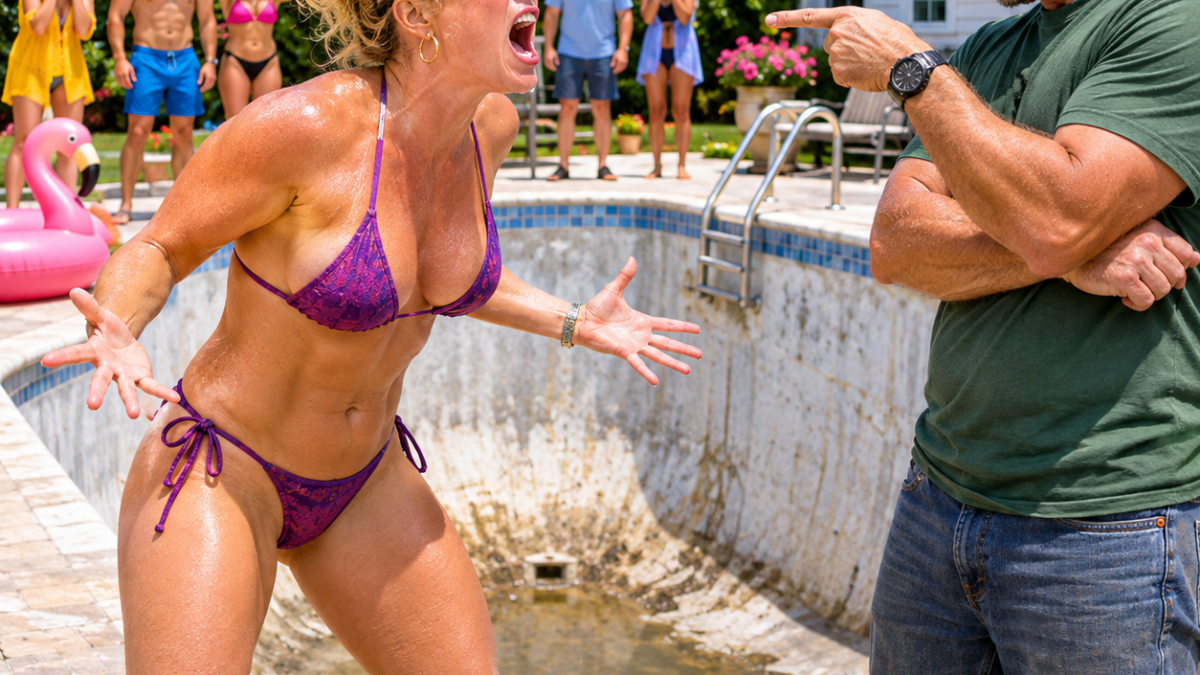
When HOA president Karen Whitmore announced that sixty residents would be holding their summer party in my private backyard, she didn’t ask for permission—she simply mailed everyone invitations, hired a lifeguard, charged recreation fees, and declared my swimming pool a “public amenity.”
So two days before the party, after telling her no for the last time, I legally drained every gallon from the pool and locked my gate.
But when Karen arrived with families, caterers, HOA paperwork, and deputies she expected to force me to cooperate, one question about a nineteen-year-old “pool covenant” began unraveling something far bigger than a neighborhood party.
The first thing Karen Whitmore said when she saw my empty swimming pool was:
“What have you done?”
She stood at the edge of my backyard in a bright yellow summer dress with a clipboard tucked against her chest and a Pine Ridge HOA event badge hanging around her neck.
Behind her, nearly sixty people had gathered outside my locked fence.
Families.
Children carrying inflatable tubes.
Parents with coolers.
Folding chairs.
Towels.
Food trays.
A portable speaker.
A hired lifeguard in red shorts.
Two catering workers unloading aluminum pans beside the curb.
Someone had tied balloons to my mailbox.
Another person had stretched a banner across the outside of my fence.
PINE RIDGE SUMMER POOL PARTY
COMMUNITY AMENITY DAY
And beside my driveway stood a temporary parking sign.
PUBLIC POOL PARKING.
Only one problem.
There was no public pool.
There was my pool.
On my four acres.
Behind my house.
Inside my fence.
And I had drained every gallon out of it two days earlier.
PART2:
Karen stared down into the empty concrete basin as if I had destroyed a city recreation center.
“You knew we reserved this space for today.”
“No,” I said.
“You announced that you reserved it.”
“That is not the same thing.”
“You received the notice.”
“I received a letter telling me you had designated my pool as a public amenity.”
“Exactly.”
“And I told you no.”
Her jaw tightened.
“You cannot just shut down an amenity after residents have planned around it.”
I laughed once.
“Watch me.”
Her face reddened.
“Families paid for this event.”
“Refund them.”
“The association hired vendors.”
“Refund them too.”
“Our clubhouse pool is closed.”
“That sounds like an HOA problem.”
“You’re being unbelievably selfish.”
I looked around.
PART3:
Children were staring through the fence.
Some parents looked angry.
Others looked confused.
One father was reading the PUBLIC POOL PARKING sign twice, like the words might rearrange themselves into something reasonable.
A few residents had already begun asking why the gate was locked if the party had supposedly been approved.
Then Karen said the words that changed the argument.
“We have legal recreational-use rights here.”
I stopped smiling.
“No, you don’t.”
“Yes, we do.”
“Show me.”
She immediately opened her clipboard.
That told me she had expected the challenge.
The top sheet had been laminated.
PINE RIDGE COMMUNITY AMENITY DESIGNATION.
My address appeared beneath it.
A color map showed my backyard.
The swimming pool shaded blue.
Patio shaded blue.
Pool house and outdoor bathroom.
Part of my side driveway.
Karen tapped the page.
“The board approved this three months ago.”
“The board cannot vote itself ownership of my backyard.”
“You use Pine Ridge roads.”
“I have a recorded easement.”
“You benefit from neighborhood security.”
“I never requested it.”
“You receive community services.”
“I pay separately for anything I use.”
She lifted the document higher.
“This pool is listed as an auxiliary recreation facility.”
“By who?”
“The association.”
“Karen, you cannot designate somebody else’s swimming pool as public because you put the words on a piece of paper.”
That was when the sheriff’s cruiser arrived.
Karen smiled.
Of course she had called them.
Deputy Laura Mitchell stepped out of the first vehicle.
Deputy James Walker arrived behind her.
Karen hurried over.
“Officer, thank goodness. The property owner intentionally disabled a community amenity to interfere with an authorized HOA event.”
Laura looked toward my fence.
Then the crowd.
Then the empty pool.
Then me.
“Sir, is this your property?”
“All of it.”
Karen interrupted.
“The HOA has community-use rights.”
Laura raised one hand.
“I’ll get to that.”
I gave her my identification.
Ryan Mercer.
I had owned the house for eleven years.
Laura asked:
“Have you ever signed a recreational-use agreement with Pine Ridge?”
“No.”
“Ever given the HOA permission to use the pool?”
“No.”
“Accepted payment in exchange for pool access?”
“No.”
Karen stepped forward.
“The permission existed before he bought the property.”
That was new.
I turned.
“What?”
She pulled out another page.
“This property has a historic amenity covenant.”
Laura read it.
Dated nineteen years earlier.
Seven years before I bought the house.
It supposedly said George Bennett, the previous owner, had granted future Pine Ridge residents access to a swimming pool during approved neighborhood events.
There was one remarkable problem.
The swimming pool did not exist nineteen years ago.
I built it three years after buying the house.
Laura looked up slowly.
“Ma’am, how could this document give access to a swimming pool that had not been constructed?”
Karen opened her mouth.
Nothing came out.
James moved closer.
He compared the land description with information on his tablet.
“This property description doesn’t match Mr. Mercer’s deed.”
Karen stiffened.
James pointed.
“This section belongs to the old developer parcel.”
The document looked increasingly like somebody had assembled it from pieces of unrelated old paperwork.
Laura asked:
“Where did you get this?”
“Association records.”
“That’s not specific enough.”
“Our property management consultant.”
“Name?”
“Paul Norton.”
I had never heard of him.
One of the catering workers approached.
“Ma’am, are we still setting up?”
Karen snapped:
“Give us a minute.”
The caterer looked at the locked gate.
“I was told the HOA owns the pool area.”
“They don’t,” I said.
Karen answered:
“That’s disputed.”
Laura looked at her.
“No. At the moment, ownership is not disputed. Mr. Mercer owns the land. The question is whether the HOA has any legally enforceable use rights.”
That distinction mattered.
Then Laura asked me:
“Why did you drain the pool?”
I told her.
Because Karen announced a party after I repeatedly refused.
Because invitations had been mailed with my home address.
Because a lifeguard had been hired.
Because my backyard appeared on the HOA website as an amenity.
Because dozens of strangers were expected to arrive at noon.
And because I decided the simplest way to make one fact absolutely clear was to remove the thing Karen intended to use.
The water.
Karen stared.
“You did that deliberately.”
“Yes.”
“To sabotage this event.”
“To protect my property.”
“You wasted thousands of gallons.”
“My water.”
“You created a hazard.”
“Inside my locked yard.”
“You embarrassed the association.”
“That part was free.”
James turned his head.
I am still fairly certain he was trying not to laugh.
Then Laura asked:
“Did residents pay specifically for today?”
Karen hesitated.
Interesting.
“How much?” Laura asked.
Karen said:
“Residents pay annual recreation fees.”
“How much?”
She did not answer.
A homeowner behind her did.
“Six hundred dollars.”
Karen spun toward him.
The man continued:
“We were told the increase was because Pine Ridge added a second pool.”
I looked at Karen.
“Second pool?”
The crowd got quiet.
Another resident said:
“My dues went up too.”
A woman near the gate pulled up the HOA website.
There it was.
PINE RIDGE AMENITIES.
Clubhouse.
Playground.
Tennis court.
Walking trail.
Primary pool — temporarily closed for renovation.
Then:
MERCER AUXILIARY POOL — SEASONAL ACCESS.
My pool.
Photographed from inside my backyard.
I stared at the picture.
Someone had physically entered my property to take it.
That was when I realized this had never been one ridiculous Saturday party.
Pine Ridge had been presenting my private swimming pool as one of its amenities for months.
And residents had apparently been paying for it.
But to understand how an HOA president reached the point where she stood outside my backyard demanding that I refill a pool she had declared public, you have to go back nearly seven months.
My name is Ryan Mercer.
I was forty-nine.
I owned a three-bedroom house and a little more than four acres outside Raleigh, North Carolina.
My home was older than Pine Ridge.
The original owner, George Bennett, had owned a larger property before development swallowed most of the surrounding land.
When developers arrived, George refused to sell his house and four acres.
They built Pine Ridge around him.
Years later, I bought the place.
My deed was straightforward.
Private property.
No Pine Ridge membership.
No HOA covenants.
No community recreation easement.
The only connection was road access.
Development had eliminated the old direct route to the county highway, so my property had a permanent recorded easement along Pine Ridge Drive.
I paid a fixed annual road-maintenance contribution.
That was it.
My house was not part of the HOA.
My yard was not.
My garage was not.
My pool certainly was not.
The pool did not even exist when I bought the place.
I built it three years later.
Nothing elaborate.
Rectangular.
Deep end.
Concrete deck.
Outdoor shower.
Small pool house with a bathroom and equipment room.
I saved for years because my wife Sarah loved swimming.
She used to say water was the only place her brain became quiet.
Four years after the pool was completed, Sarah died.
Cancer.
Fast.
Unfair.
For a long time, I barely went into the backyard.
The pool became something I maintained because letting it fall apart felt like losing another piece of her.
Then my daughter Jennifer started bringing my grandson Caleb over on weekends.
Caleb was one of those children who believed walking near water violated some law of nature.
He ran.
Jumped.
Splashed everybody within twenty feet.
The first summer he started swimming confidently, I found myself sitting beside the pool laughing again.
The place became happy without becoming less sad.
That is hard to explain unless you have loved someone who died.
A place can hold both.
That was why the pool mattered.
Most Pine Ridge residents understood that my property was separate.
Frank Miller helped me repair fences.
Susan Parker brought cookies every Christmas.
Robert Jenkins once spent half a Saturday helping cut apart a storm-damaged oak tree.
Normal neighbors.
Good people.
Then Karen Whitmore became HOA president.
Our first disagreement seemed minor.
She came to my door.
“Ryan, I have a favor.”
That sentence usually means somebody wants something expensive.
“The Pine Ridge swim team needs a temporary practice location.”
“Why?”
“Our main pool requires maintenance.”
“How many kids?”
“About twenty.”
“How often?”
“Three times a week.”
“For how long?”
“Maybe six weeks.”
I laughed.
“No.”
She looked genuinely surprised.
“We can pay.”
“No.”
“Two thousand dollars.”
“No.”
“Why?”
“Because I don’t want twenty children practicing in my backyard three nights a week.”
“It helps the community.”
“I’m sure.”
“You have plenty of space.”
“I do.”
“Then what is the problem?”
“I said no.”
That should have ended it.
A week later:
Four thousand dollars.
Still no.
Then Karen suggested a “shared amenity partnership.”
I said:
“I use Pine Ridge Drive because I have a legal road easement. That does not give Pine Ridge access to my swimming pool.”
“Everything is negotiable.”
“My pool isn’t.”
That was the beginning.
The Pine Ridge pool problem turned out to be worse than routine maintenance.
A buried plumbing leak had damaged part of the filtration system.
Deck concrete had to be removed.
Summer was approaching.
Families were angry.
Recreation fees had already been collected.
The swim team needed somewhere to go.
And Karen began telling residents that my pool might become available.
Not telling me.
Residents.
Frank warned me.
“You know Karen keeps saying negotiations are ongoing.”
“They aren’t.”
“She says the pool may open.”
“It won’t.”
“Tell her.”
“I already did.”
Frank shrugged.
“Tell her harder.”
I emailed Karen.
My pool is private.
There is no negotiation.
No Pine Ridge residents, teams, events, contractors, or HOA representatives have permission to use it.
Her response:
UNDERSTOOD. WE WILL CONTINUE EXPLORING ALL COMMUNITY OPTIONS.
That sounded bureaucratically harmless.
Then Linda Harris knocked on my door.
“Is the temporary pool opening next month?”
“What temporary pool?”
She pointed behind me.
“Yours.”
“No.”
Her expression changed.
“Karen said…”
“Karen is wrong.”
I called Pine Ridge management.
Susan Parker answered.
“Our system has your property listed as auxiliary recreation.”
“Remove it.”
“I’m not sure I can.”
“Why?”
“Board designation.”
I actually laughed.
“The board voted to make my swimming pool theirs?”
“I don’t think it was explained that way.”
“How was it explained?”
“As activation of an existing recreation easement.”
First time I had heard that phrase.
I hired Rebecca Hayes.
She had handled a property dispute for me before.
Rebecca checked everything.
Deed.
Title history.
Easements.
Development plat.
No recreational rights.
No pool agreement.
Nothing.
She sent Pine Ridge a letter demanding proof of whatever “historic easement” Karen believed existed.
The HOA attorney, Charles Bennett, said he would review development records.
Then silence.
Almost two months.
I assumed Charles had found nothing and killed the idea.
Then I found a little blue sign near my fence.
PINE RIDGE AUXILIARY POOL
STAFF ENTRANCE.
I pulled it out.
Karen denied knowing who installed it.
A week later, another appeared.
Then two pool-maintenance workers came through my side gate while I was home.
I stopped them.
They showed me their work order.
PINE RIDGE POOL #2.
My address.
Weekly chemical testing.
They were embarrassed.
Apologized.
Left.
Rebecca sent another letter.
No contractors.
No maintenance.
No entry.
Then someone filed an online request with my gas utility adding Pine Ridge HOA as an authorized property manager.
That frightened me more than a sign.
Utilities removed them immediately.
Rebecca started keeping a file.
Then Frank brought over the summer newsletter.
GOOD NEWS — EXPANDED SUMMER RECREATION OPTIONS.
Inside:
Due to repairs at Pine Ridge’s primary pool, residents will receive seasonal access to the Mercer Auxiliary Pool beginning June 15.
My home address.
Hours:
10:00 a.m. — 7:00 p.m.
Tuesday through Sunday.
Guest rules.
Lifeguard schedule.
They had published operating hours for my backyard.
I called Karen.
“You announced my pool is public.”
“Community.”
“Same problem.”
“We have documentation supporting access.”
“Show it.”
“Our consultant is completing title verification.”
“Then why are there published hours?”
“Summer scheduling cannot wait forever.”
“My answer is no.”
“Residents have already paid recreation fees.”
“Refund them.”
“We budgeted around expanded amenities.”
“Not my problem.”
Then Karen said:
“You are going to create a serious problem for yourself if you keep interfering with established community rights.”
That sounded like a threat.
Rebecca agreed.
She demanded my address be removed from all publications.
The webpage disappeared.
Four days later it returned.
Now it said:
AUXILIARY ACCESS PENDING FINAL CONFIRMATION — PER HOA COUNSEL REVIEW.
Charles Bennett called Rebecca almost immediately.
He had never approved that language.
Someone was invoking “HOA counsel” without HOA counsel.
Then came the invitation.
PINE RIDGE SUMMER KICKOFF.
Saturday.
Noon to five.
Location:
MERCER AUXILIARY POOL.
Food.
Music.
Games.
Lifeguard.
Residents only.
I called Karen one final time.
“Cancel it.”
“The board approved it.”
“I don’t care.”
“Families have plans.”
“Cancel it.”
“You are not being reasonable.”
“You scheduled a party inside my backyard.”
“We believe the easement gives us event rights.”
“Show me the easement.”
“You’ll receive it.”
“When?”
“Soon.”
That night I made my decision.
I could simply lock the gate.
But Karen had already sent contractors into my yard.
I could call law enforcement in advance.
Maybe that would stop the event.
Maybe not before sixty people showed up.
Or I could make my swimming pool physically incapable of being used.
So I drained it.
Legally.
I rented a discharge pump.
Ran water into my drainage area according to county rules.
It took hours.
By Friday afternoon:
Empty.
Clean.
Locked behind the fence.
Completely useless for a pool party.
Frank came over.
Looked into the basin.
Then looked at me.
“You drained the whole thing?”
“Yes.”
“You know Karen is going to lose her mind.”
“Yes.”
“You seem happy.”
“No.”
He stared.
“Maybe a little.”
Maybe.
Saturday I left early for supplies.
When I came home, my street looked like a county fair.
Which brought us back to Karen.
The crowd.
The sheriff.
The fake nineteen-year-old covenant referring to a pool that had not existed.
Then Susan Parker arrived carrying her laptop.
“Karen, we need to talk.”
“Not now.”
“Yes. Now.”
She pulled up Pine Ridge accounting.
The HOA had collected an additional recreation assessment.
Total:
$96,400.
Part of the board explanation:
MERCER AUXILIARY POOL OPERATIONS AND RESERVE.
Amount allocated:
$38,000.
I stared.
“You collected thirty-eight thousand dollars for my pool?”
Susan nodded.
Karen jumped in.
“That was for future operations.”
“Operations you never had permission to provide.”
“It was based on the easement.”
Laura asked:
“Where is the money?”
Susan started reviewing payments.
Lifeguard contract.
Insurance.
Pool-service deposits.
Party vendors.
Then:
Transfer.
$22,000.
Recipient:
NORTON COMMUNITY AMENITIES LLC.
Paul Norton.
The same consultant who produced the historic covenant.
Rebecca arrived twenty minutes later.
She read it.
“This is nonsense.”
Then she noticed George Bennett’s signature.
I still had old closing documents from when I bought the property.
George’s authentic signature appeared there.
The signature on the new covenant looked almost identical.
Not merely similar.
Same angle.
Same tiny interruption in the ink.
Same shapes.
It looked copied.
Then Rebecca checked the date.
The covenant was supposedly created nineteen years earlier.
But it listed my current street address.
That street number was created only after Pine Ridge was built twelve years earlier.
The document had somehow predicted an address seven years before it existed.
Susan whispered:
“Oh my God.”
Then James returned from his cruiser.
“No recorded recreation covenant exists against this parcel.”
Good.
Then:
“But Pine Ridge submitted something three weeks ago.”
Notice of public recreational use.
It claimed residents had continuously used my property for more than ten years.
False.
Attached photographs supposedly proved it.
One photograph showed families around my pool.
I recognized the day.
Jennifer’s birthday two summers earlier.
She had invited Pine Ridge families she knew.
Another photograph:
Frank and his grandson swimming.
With my permission.
Another:
Susan’s family at a barbecue.
With my permission.
Every time I had invited neighbors onto my property, somebody had collected the photographs and converted my kindness into evidence against my ownership.
Rebecca looked at me.
“These don’t establish public access.”
I knew that.
Still hurt.
Laura asked Susan to open the internal project folder.
Karen said:
“No.”
Laura looked at her.
“Why?”
“Privileged HOA material.”
Charles Bennett arrived almost perfectly on cue.
“They are not privileged simply because they are internal records.”
He looked at Susan.
“Open it.”
Folder:
AUXILIARY POOL CONVERSION.
PUBLIC USE EVIDENCE.
OWNER RESISTANCE STRATEGY.
Rebecca opened the last file.
Step one:
ESTABLISH HISTORIC NEIGHBORHOOD USE.
Step two:
DESIGNATE POOL AS AUXILIARY AMENITY.
Step three:
COLLECT RECREATION FEES AND BEGIN OPERATIONAL MANAGEMENT.
Step four:
IF OWNER RESISTS, DOCUMENT DISRUPTION OF RESIDENT ACCESS.
Step five:
SEEK EMERGENCY COURT ORDER PRESERVING COMMUNITY USE.
There was even a note anticipating that I might lock my gate or disable the pool.
OWNER MAY DISABLE POOL OR LOCK ACCESS ONCE NOTIFIED. SUCH ACTION STRENGTHENS INTERFERENCE CLAIM.
They wanted me to resist.
They expected it.
Then Susan opened another map.
SITE EXPANSION — PHASE TWO.
My pool was only the beginning.
Side yard shaded for parking.
Lower field:
FUTURE RECREATION LAWN.
Detached garage:
POSSIBLE COMMUNITY STORAGE.
The pool was the foothold.
Then Laura received a radio call.
A deputy walking the back edge of my property had found a gate.
A gate I had never installed.
Professionally cut into my fence.
Fresh concrete around the posts.
Electronic lock.
Susan checked Pine Ridge’s access-control database.
There it was.
MERCER POOL GATE.
Residents with recreation privileges could apparently open my backyard with their HOA key cards.
I looked at Karen.
She said nothing.
Then several residents’ phones chimed at once.
HOA notification:
DUE TO OWNER INTERFERENCE, TODAY’S POOL EVENT IS TEMPORARILY DELAYED.
ALTERNATE ACCESS PROCEDURES ARE BEING ACTIVATED.
Rebecca looked at Karen.
“What alternate access?”
Karen didn’t answer.
Then we heard machinery behind the house.
I ran toward the pool equipment area.
The pump-room padlock was gone.
A thick temporary hose had been attached to the pool fill system.
It ran through the unauthorized gate toward Pine Ridge.
Water began rushing into the empty pool.
They were refilling it.
Without me.
Thomas Reed, a utility contractor attending the party with his family, ran over.
He looked at the line.
Then his face changed.
“Ryan, shut this down.”
I reached toward the valve.
“Not there.”
“Why?”
“That isn’t connected to your house supply.”
“What is it connected to?”
We followed the hose.
Through my fence.
Across the walking trail.
Behind a Pine Ridge maintenance building.
Temporary manifold.
Thomas checked the meter.
Then looked at Susan.
“This is the fire suppression main.”
Laura frowned.
“What does that mean?”
“They’re filling his pool from the neighborhood emergency water line.”
Susan went pale.
“That can’t be right.”
Thomas checked again.
“It is.”
The same reserve system meant to supply hydrants during a fire.
Thousands of gallons had already moved.
Then an alarm sounded somewhere inside Pine Ridge.
A maintenance employee came running.
“Pressure alarm at the clubhouse.”
Thomas looked at the gauge.
“Fire-system pressure is dropping.”
Before anyone could fully process that—
Smoke rose beyond the trees.
Thick.
Black.
A woman on the trail screamed:
“House fire!”
Everything changed.
The pool stopped mattering.
Thomas immediately isolated the temporary connection.
Laura called the fire department.
Residents cleared the road.
Karen stopped arguing.
I will give her that.
When reality arrived, she helped move people.
Three engines entered Pine Ridge within minutes.
Thomas briefed the captain.
Hydrant pressure lower than normal.
Not gone.
But low enough that the first crews requested a tanker backup.
The burning house belonged to Harold and Susan Jenkins.
Harold had been in the garage.
A battery charger apparently ignited near his workbench.
He escaped.
Susan was away.
Their dog got out too.
Those facts mattered more than everything else.
The garage and part of the second floor were badly damaged.
Firefighters contained the flames before they reached the neighboring house.
Later, they said reduced water pressure slowed the opening minutes.
Not enough to claim the house would have escaped serious damage otherwise.
Enough to matter.
Eleven thousand gallons.
That was approximately how much water had been diverted from the emergency reserve while Karen tried to refill my pool for her party.
Eleven thousand gallons.
The party disappeared.
Caterers left.
Lifeguard left.
Residents went home quietly.
Nobody complained about my empty pool anymore.
Deputies photographed everything.
Unauthorized gate.
Hose.
Broken lock.
Valve connection.
The fire department ordered the entire Pine Ridge suppression system inspected.
Several real HOA facilities were temporarily closed.
Karen had tried to create one fake amenity and succeeded in shutting down several real ones.
I did not enjoy that irony.
Harold’s house had burned.
That took the humor out.
The next day, I visited him at his daughter’s house.
He looked exhausted.
I expected anger.
He said:
“You didn’t hook up that hose.”
“No.”
“You told them not to use your pool.”
“Yes.”
“Then don’t carry somebody else’s stupid decision.”
His dog’s medication had been destroyed.
Jennifer helped arrange replacements through a veterinary clinic.
Small thing.
But that weekend needed small good things.
Pine Ridge residents organized meals.
Cleanup.
Clothing.
Temporary help.
Watching them reminded me why I never considered the whole neighborhood my enemy.
Most of them had been lied to too.
The investigation became quieter after that.
Quiet usually means paperwork.
The fake historic covenant was examined.
George Bennett’s signature had been digitally copied.
Document metadata showed it was created four months earlier.
Author:
P. NORTON.
Paul Norton.
His company, Norton Community Amenities LLC, had been created only eight months earlier.
The $22,000 Pine Ridge paid him was labeled:
AMENITY RIGHTS VERIFICATION AND ACTIVATION.
What had Paul actually done?
Copied an old signature.
Built a fake historical agreement.
Collected private family photographs from social media.
Turned invited visits into “public use evidence.”
Prepared the recreation-use filing.
Advised Karen that repeated HOA activity might strengthen a claim.
Then emails showed Paul had warned her.
HISTORIC ACCESS CLAIM IS NOT GUARANTEED.
OWNER OPPOSITION CREATES SIGNIFICANT LITIGATION RISK.
DO NOT SCHEDULE PUBLIC USE UNTIL COUNSEL CONFIRMS.
Karen replied:
COUNCIL TAKES TOO LONG. RESIDENTS NEED A SOLUTION BEFORE SUMMER.
Another exchange:
Karen:
CAN WE ESTABLISH USE FIRST AND DEAL WITH MERCER AFTER?
Paul:
POSSIBLE, BUT NOT RECOMMENDED.
Karen:
IF RESIDENTS BEGIN USING IT REGULARLY, THAT STRENGTHENS OUR POSITION, CORRECT?
Paul:
POTENTIALLY.
That was the plan.
Create the use.
Then point to the use as proof the use already existed.
The unauthorized gate fit it too.
Karen had personally approved the $6,800 installation.
Charles Bennett had emailed her weeks earlier:
DO NOT INSTALL ACCESS INFRASTRUCTURE UNTIL OWNERSHIP AND EASEMENT RIGHTS ARE RESOLVED.
Her reply:
UNDERSTOOD.
Then she installed it anyway.
Pine Ridge held an emergency meeting.
Karen did not chair it.
Robert Jenkins did.
Harold attended.
Bandage on one arm.
When he walked in, residents stood.
Nobody instructed them.
They just did.
Karen was suspended as president.
Unanimous vote.
Financial access removed.
Maintenance authority removed.
Contractor access removed.
Then Harold stood.
He did not shout.
“My garage burned while emergency water was being sent to a swimming pool we had no legal right to use.”
Karen started crying.
Harold continued.
“I don’t want revenge. I want to know nobody here can ever do something this stupid again.”
That changed the tone.
Not revenge.
Accountability.
The HOA agreed to refund the recreation assessment portion connected to my pool.
The fake listing was removed permanently.
My fence would be restored.
The gate removed.
Property outside Pine Ridge could not be used by contractors without verified owner permission.
Karen apologized for the fire-system connection.
Then still tried to argue the HOA may have had some legitimate historic access basis.
The room groaned.
Frank raised his hand.
“Karen, did Ryan ever say yes?”
Silence.
“Once?”
“No.”
“Then that should have mattered.”
Exactly.
The pool was professionally cleaned.
Emergency-water residue removed.
I refilled it.
My water.
My decision.
No announcement.
No event.
Jennifer and Caleb came over.
Caleb jumped in before I finished telling him not to run.
Frank arrived carrying chairs.
“So when does public access begin?”
I stared at him.
He smiled.
“Too soon?”
“Much.”
I laughed anyway.
For the first time in months, the backyard felt like mine.
Then Paul Norton agreed to an interview.
He admitted the false covenant.
Copied signature.
Fake public-use filing.
Social-media photographs.
He claimed Karen demanded a legal theory quickly.
Did she specifically order him to forge George Bennett’s signature?
No.
He did that himself.
Did she eventually suspect the document was fabricated?
Yes.
Paul said Karen noticed the electronic file was new even though the agreement supposedly was old.
He told her he had “reconstructed” it from historical records.
She asked whether that was legally safe.
He said:
“Safe enough if nobody challenges it.”
Karen supposedly answered:
“Ryan will challenge it.”
Paul said:
“Then establish use before he can stop it.”
Karen:
“Do it.”
Then Paul revealed the pool had never been the final goal.
A developer—Mountain Ridge Communities—was planning roughly eighty new homes north of my property.
The expansion needed additional recreational capacity under county planning rules.
Pine Ridge’s existing pool was too small.
A second HOA pool on Pine Ridge land could cost more than a million dollars because of drainage problems.
My pool already existed.
If they could classify it as community recreation, the developer could count it.
Mountain Ridge had discussed paying Pine Ridge approximately $800,000 in development contributions if the expansion moved forward.
Now I understood why Karen had been willing to spend tens of thousands chasing something I kept refusing.
The pool was worth more to the expansion than it was as a place for children to swim.
Then Paul said:
“The pool wasn’t the only part of Ryan’s property in the plan.”
A strip along my northern edge was intended as a pedestrian and utility connector toward the new development.
Pool first.
Then trail.
Then utility.
Then emergency access.
My private property would become increasingly entangled with Pine Ridge until each new intrusion looked smaller than the last.
Rebecca asked:
“The pool was the doorway?”
Paul nodded.
“Exactly.”
We inspected the wooded land behind my garage.
Fresh survey stakes.
Orange ribbon.
Cleared line.
NORTH CONNECTOR.
UTILITY.
TRAIL CENTER LINE.
Almost four hundred feet.
No permission.
A data logger with a Mountain Ridge tag was buried near one marker.
Douglas Price, the developer’s regional director, denied authorizing trespass.
Then checked his files.
They had an access form.
Signed:
Ryan Mercer.
Not by me.
It granted one year of survey and soil-testing rights across my land.
Compensation:
Ten dollars.
I almost laughed.
Then Mountain Ridge sent its preliminary expansion map.
My pool shaded blue.
Northern strip green.
Behind my house:
FUTURE COMMUNITY RECREATION EXPANSION.
Possible second pool.
Bathhouse.
Parking.
My detached garage was gone from the plan.
Who provided the land concept?
Karen Whitmore.
Then investigators searched Paul’s office.
Locked cabinet.
File:
MERCER ACQUISITION CONTINGENCY.
If amenity status fails:
DIRECT ACQUISITION STRATEGY.
Target purchase price:
$620,000.
Far below what my land was worth strategically.
How would they reduce my leverage?
Legal expenses.
Access disputes.
Maintenance complaints.
Public-use claims.
Pressure.
Make keeping the property more exhausting than selling it.
A note:
KAREN WANTS DEAL COMPLETE BEFORE NORTH PHASE ANNOUNCEMENT.
Then investigators found a purchase option.
Buyer:
PINE RIDGE COMMUNITY DEVELOPMENT LLC.
Seller:
Ryan Mercer.
Price:
$620,000.
Closing:
60 days.
My signature.
Fake.
Notary:
Susan Parker.
Susan looked like she might be sick.
“I never notarized anything for Ryan.”
Her official notary journal proved it.
On the claimed date and time, she was at a dentist appointment.
Then she remembered something.
Months earlier Karen had asked her to notarize a recreational access agreement without me being present.
Susan refused.
She emailed Charles Bennett.
Karen requested notarization of Mercer agreement without owner present. I declined.
Charles replied:
CORRECT. DO NOT NOTARIZE ANY MERCER DOCUMENT UNLESS RYAN MERCER APPEARS WITH IDENTIFICATION.
Karen had been told directly.
No shortcuts.
Digital metadata showed Paul built the fake purchase option.
Karen’s Pine Ridge-issued laptop later edited it.
She added the $620,000 price.
Added the sixty-day closing period.
Paul later added the fake notary block.
Then we learned something even bigger.
Pine Ridge Community Development LLC was not the HOA.
It only sounded like the HOA.
Private company.
Ownership:
Karen Whitmore — 40%.
Paul Norton — 30%.
Carolina Growth Partners — 30%.
Carolina Growth Partners belonged to Richard Whitmore.
Karen’s husband.
Together, the Whitmore family controlled seventy percent of the private company trying to acquire my home.
Then came the resale agreement.
Pine Ridge Community Development LLC planned to buy my property for $620,000.
Then resell it to Mountain Ridge.
Price:
$1.35 million.
They would more than double the value almost immediately.
And I had never agreed to the first sale.
The HOA president had been using HOA communications.
HOA money.
HOA maintenance workers.
Resident fees.
A fake “public amenity” story.
All while her family positioned itself to profit personally from the land beneath that amenity.
Residents were furious.
Another meeting.
Robert explained the private company records.
The HOA never authorized it.
Never approved Karen’s ownership.
Never approved the fake purchase option.
Then Frank asked:
“Did HOA money pay Paul while he was also working for Karen’s private company?”
Susan checked.
“Yes.”
That conflict said almost everything.
Harold asked:
“Was the pool party part of this?”
Yes.
Finally, we understood why the event mattered.
Sixty residents.
Lifeguard.
Catering.
HOA signs.
Key-card gate.
Maintenance schedule.
Photographs.
Attendance records.
Invoices.
One successful party could create a thick paper trail showing my pool operating as a Pine Ridge amenity.
Then later:
Look.
Residents use it.
The HOA maintains it.
The HOA pays insurance.
The HOA schedules events.
The HOA has access infrastructure.
Why is Ryan suddenly trying to take away a community resource?
Draining the pool had not merely ruined Karen’s party.
It destroyed the evidence she wanted to create.
A woman at the meeting asked me:
“Why haven’t you sued all of us?”
I almost laughed.
“You didn’t connect my pool to the fire main.”
A few people smiled.
“You didn’t install the gate. You didn’t forge paperwork. Most of you believed your HOA.”
I wanted my damage repaired.
Legal costs covered.
Accountability.
I did not want retirees losing savings because Karen hijacked their association.
Pine Ridge created a restitution and legal fund using insurance, recovered consultant money, and nonessential project reserves.
Decorative entrance improvements were postponed.
Nobody complained.
My pool returned to normal.
Then Mountain Ridge’s independent appraisal arrived.
Strategic value of my property given the proposed expansion:
$1.4 million to $1.7 million.
Karen’s company had tried to obtain it for $620,000.
Less than half.
Mountain Ridge requested a meeting.
Douglas Price came with counsel.
He apologized.
“We should have contacted you directly before relying on access documents from a consultant.”
“Yes.”
“We failed.”
“Yes.”
No excuses.
He explained Mountain Ridge could redesign the project without my land.
More expensive.
Bridge around wetlands.
Longer utilities.
New recreation area.
Possible.
Then he offered $750,000 for a narrow northern utility and pedestrian easement.
No pool access.
No yard access.
No garage.
No recreation rights.
I did not accept.
I did not reject.
Rebecca ordered an independent valuation.
That was what real negotiation looked like.
Ask.
Explain.
Offer.
Wait.
Karen resigned from the board.
For almost a month, things were quiet.
Then Thomas Reed called.
“Ryan, are you home?”
“Yes.”
“Go outside. Look north.”
Heavy equipment stood beyond my tree line.
Bulldozer.
Excavator.
Dump trucks.
Utility crew.
Men removing a section of Pine Ridge’s boundary fence.
I called Douglas.
“I did not authorize construction.”
Not good.
The project supervisor approached carrying paperwork.
“Mr. Mercer? We’re starting emergency connector work.”
“No, you aren’t.”
“We have county authorization.”
Fake county emergency order.
It claimed the recent Pine Ridge fire proved a public-safety need for an emergency route across my northern land.
Rebecca called the county.
No such authorization.
The contractor stopped immediately.
Then a worker shouted:
“Boss, somebody moved the property markers.”
My real pins were gone.
Temporary markers placed almost eighty feet inside my property.
Client listed on the contractor packet:
PINE RIDGE COMMUNITY DEVELOPMENT LLC.
Karen’s private company.
Electronic authorization:
Karen Whitmore.
Except Karen had already resigned.
Investigators checked her devices.
She had not logged in.
Who authorized the contractor’s $100,000 deposit?
Richard Whitmore.
Her husband.
Richard had been almost invisible throughout the story.
Now he became central.
Carolina Growth Partners—his company—had a separate agreement with an investment group.
If the north connector became operational:
$2 million development payment.
Richard had borrowed $800,000 against that expected money.
Loan due in thirty days.
If the connector died, his company might collapse.
Now he had motive to keep pushing after Karen stopped.
Then my security system alerted.
POOL EQUIPMENT ROOM — DOOR OPEN.
Someone was inside my backyard.
Deputies moved toward the house.
One camera briefly showed a man beside my filtration system.
Another showed somebody near the gas meter.
Then the feed died.
A loud metallic bang.
Water poured across the patio from the equipment room.
Then I smelled it.
Sharp.
Chemical.
Thomas did too.
“Back up.”
A yellow-green haze began moving from the equipment-room doorway.
Chlorine.
Someone had damaged the chemical system and shut down ventilation.
For once, nobody rushed in.
Fire department.
Protective equipment.
Evacuation.
Jennifer and Caleb were not there.
Best news possible.
The chemical release stayed mostly contained around the equipment area.
Nobody seriously injured.
Pumps damaged.
Pipes broken.
Equipment room needed reconstruction.
Pool needed professional treatment.
But nobody was swimming when it happened.
Investigators found two temporary laborers missing from the fake connector project.
Aaron Price.
Kevin Mills.
Richard’s office had specifically requested them.
Aaron lawyered up quickly and talked.
Richard had hired them for “site protection.”
Claimed the pool system crossed a future utility area and needed to be shut down.
Aaron said he believed they were disabling equipment.
Kevin began breaking things.
Aaron backed away and left.
Phone records supported much of that.
Kevin was arrested later.
Messages from Richard were found.
One mattered most:
POOL MUST BE OUT OF SERVICE BEFORE COUNTY REVIEW.
UNSAFE PRIVATE SYSTEM SUPPORTS ALTERNATE RECREATION PLAN AND EMERGENCY CONNECTOR.
My pool had first been valuable because Karen wanted to claim it.
Now Richard wanted it damaged because an unusable pool could support the argument that the development needed new recreation facilities and the connector route.
Either way—
My property was just a tool in somebody else’s financial plan.
That finally simplified everything.
Money.
Richard’s private development payment.
His loan.
His deadlines.
His desperation.
The $100,000 contractor deposit came from the private development company.
An account supposedly frozen internally.
How had Richard accessed it?
He created a new bank authorization using an older corporate resolution.
Karen’s signature appeared.
Karen denied signing.
This time investigators believed her quickly.
The signature had been copied.
The same trick used against me had been turned on her.
There was something sad about that.
Not satisfying.
Sad.
Once a group of people decides signatures, consent, property lines, and rules can become flexible whenever convenient, eventually nobody trusts anything.
Richard disappeared for two days.
Then surrendered through an attorney.
No chase.
No shootout.
No movie ending.
Just evidence.
Fake emergency permit.
Contractor deposit.
Copied corporate authorization.
Messages to workers.
Private development contract.
$800,000 loan.
Chemical-system instructions.
Financial motive.
He claimed he never wanted anyone hurt.
Maybe true.
Karen probably did not want Harold’s house damaged either.
Paul probably did not imagine the fake covenant would lead to emergency water being drained during a real fire.
Everybody believed they were creating small, controlled problems.
That is the danger.
Dishonest actions rarely stay the size you intended.
A fake amenity designation became a fire-suppression problem.
A pressure campaign became forged purchase documents.
A fake access project became a hazardous chemical release.
Each lie required another action to preserve it.
The criminal and civil cases took almost a year to resolve.
Responsibility was not equal.
I cared about that.
Richard faced the most serious consequences tied to the final construction fraud, company-fund misuse, copied authorization, trespass planning, and pool-equipment incident.
Kevin faced consequences for what he personally damaged.
Aaron received a lighter outcome because evidence showed he did not create the chemical release and he cooperated.
Paul had already admitted his role in forged documents and false filings.
Karen had not authorized Richard’s final sabotage.
No evidence showed she knew he would restart construction after her resignation.
But her earlier choices remained hers.
She knew I never agreed to pool access.
Approved the unauthorized gate.
Pushed Paul to establish use before I could stop it.
Approved refilling the pool from an emergency reserve system despite warnings.
Edited the fake purchase option.
Concealed her ownership interest.
Used her HOA position while pursuing a private land deal.
Her negotiated resolution involved probation, restitution, financial penalties, and long-term restrictions from HOA leadership and community-property management.
She surrendered claims to profits from the development company.
The company was dissolved.
Pine Ridge mostly got legal bills and lessons.
Insurance covered substantial damage.
Recovered consultant money covered some.
Restitution and settlements handled other portions.
My fence was restored.
Legal expenses covered.
Pool equipment room rebuilt.
Pumps replaced.
Patio professionally cleaned.
The pool itself underwent an independent safety inspection.
I refused to reopen it until experts said it was safe.
That took almost two months.
Every weekend Caleb asked:
“Ready?”
“No.”
“Now?”
“No.”
“Tomorrow?”
“No.”
He did not appreciate legal patience.
When the pool finally reopened, I did not throw a party.
Family.
Jennifer.
Caleb.
My brother Daniel and his wife.
Frank, because Frank materializes whenever food appears.
Harold and Susan too.
Harold stood beside the water.
“No lifeguard?”
“Private pool.”
“No HOA banner?”
“Definitely not.”
“No access wristband?”
“Leave.”
He laughed.
That afternoon reclaimed the place better than anger ever could.
People I invited.
Swimming because I invited them.
Nothing becoming evidence.
Nothing being “activated.”
Just normal life.
Pine Ridge changed too.
Robert Jenkins became HOA president.
He did not want the job.
Frank said that was probably why people trusted him.
Susan remained property manager.
The investigation cleared her of the forged notarization.
Paul had digitally copied a seal image from an older legitimate document.
Susan cried when Laura told her.
Relief and grief can look similar.
New HOA rules appeared.
No board member could secretly own part of a company doing business with the HOA.
No outside property could be advertised as an amenity without written permission independently confirmed with its owner.
No maintenance worker could enter private land because one board officer said so.
Emergency utility changes required licensed approval.
Consultants could not draft easement documents outside counsel review.
And no HOA event could be scheduled on property it did not own before the owner said yes.
Apparently that final concept required a bylaw.
The recreation-fee mess had to be repaired.
Unused portions were refunded.
Some money had already gone to vendors.
The board used recovered funds and delayed cosmetic projects rather than immediately raising dues.
The expensive decorative entrance sign got postponed.
Frank said the old one worked.
Everybody suddenly agreed.
Mountain Ridge still wanted its northern expansion.
But they redesigned.
Narrow strip along the far northern edge of my property.
About thirty feet.
Underground utility corridor.
Landscaped pedestrian trail.
No emergency vehicle road through my yard.
No pool rights.
No parking.
No expansion beyond the easement.
Their emergency route would go elsewhere, even though that cost more.
That mattered.
They stopped asking my property to solve every inconvenience in their project.
Initial offer:
$750,000.
My appraisal said the corridor saved them much more than that.
We negotiated.
For months.
Final:
$960,000.
Privacy fence.
Drainage improvements.
Creek restoration.
Landscaping.
Permanent buffer keeping future neighborhood facilities away from my house and pool.
Rebecca inserted one sentence in bold:
NOTHING IN THIS EASEMENT CREATES PINE RIDGE HOA MEMBERSHIP, RECREATIONAL RIGHTS, POOL ACCESS, OR AUTHORITY OVER THE MERCER PROPERTY.
I loved that sentence.
Frank read the agreement.
“After everything, you still gave the developer access?”
“Sold an easement.”
“You people and that word.”
“It matters.”
“They tried to take your property.”
“Some people did.”
“And now you’re helping their development?”
“I made a deal.”
He stopped.
Exactly.
The entire story had always been about choice.
Karen did not ask whether I wanted sixty people in my pool.
She designated it.
Paul did not ask if I signed an easement.
He manufactured one.
Richard did not ask whether he could build a connector.
He invented emergency authority.
Mountain Ridge eventually did what everybody should have done at the beginning.
Ask.
Offer.
Wait.
Accept that I had the right to say either yes or no.
The expansion moved forward smaller than originally planned.
Sixty-four houses instead of eighty.
Mountain Ridge built its own new recreation facility.
Including a new swimming pool.
On property they actually owned.
Imagine that.
The first summer it opened, Frank texted me a photograph.
PUBLIC AMENITY.
I answered:
CHECK THE DEED.
He replied:
ALREADY DID.
At least somebody learned.
Harold’s house was rebuilt too.
Garage repaired.
Electrical system upgraded.
He became obsessive about fire safety.
Then joined Pine Ridge’s facilities committee.
I asked why he would voluntarily deal with the HOA after everything.
“Someone sensible needs to ask where the water lines go.”
Fair.
Almost two years after the original party, Karen contacted Rebecca.
She wanted to apologize to me directly.
I almost declined.
Eventually agreed.
Coffee shop.
Neutral ground.
Not my property.
Not Pine Ridge.
Karen looked older.
Less polished.
No clipboard.
That helped.
“I kept telling myself I was helping the neighborhood.”
I waited.
“The pool was broken. Residents were angry. The expansion could bring money. We needed more recreation. Your pool was already there.”
“Yes.”
“I started thinking that made it reasonable.”
“It didn’t.”
“I know.”
She looked down.
“Every time you said no, I decided you were being difficult instead of accepting that no was the answer.”
Probably the most honest sentence she had ever said.
Then she admitted why seeing my empty pool that Saturday had frightened her so badly.
It was not mainly the ruined party.
The party was supposed to generate the photographs.
Residents swimming.
HOA banners.
Lifeguard.
Check-in.
Maintenance.
Catering.
A real operating record.
My drained pool destroyed the picture they needed.
“That’s why I called the sheriff,” she said.
“I thought police would make you look like the person disrupting established community access.”
Instead, Laura asked to see the documents.
One question.
Then another.
Then another.
Fake covenant.
Recreation fees.
Paul.
Gate.
Fire line.
Private development company.
Fake purchase option.
Richard.
Everything.
Karen had called law enforcement expecting authority to force me to cooperate.
Instead, authority began asking whether she had any right to be there.
Those questions destroyed the plan.
I accepted her apology.
We did not become friends.
Forgiveness and trust are different things.
She eventually moved away.
I hope her life became quieter.
Today, the pool is still behind my house.
Full of water.
Usually.
I have drained it twice since then for maintenance.
Every time Frank notices, I get the same message.
POOL PARTY CANCELLED?
Sometimes I ignore him.
Sometimes I send a picture of the empty basin.
The unauthorized gate is gone.
Caleb helped me plant flowering shrubs where the concrete posts had been.
They are taller now.
The equipment room has new safety systems.
Better lock.
Camera.
Not because I live expecting another scheme.
Learning is not the same as fear.
I still invite Pine Ridge neighbors over.
Harold and Susan.
Robert.
Susan Parker and her grandchildren.
Even some families who arrived carrying pool toys that first Saturday have eventually swum in my backyard.
The difference is one word.
Invited.
That one word solves almost everything.
Karen’s original request did not need to become a disaster.
If she had come to me and said:
“Our pool is broken. Could we rent yours for one afternoon?”
I probably still would have said no to sixty people.
Maybe I would have allowed ten families.
Maybe one swim-team practice.
Maybe nothing.
The answer was mine.
And if the answer was no, Pine Ridge had options.
Rent a commercial pool.
Partner with another neighborhood.
Refund recreation fees.
Delay the event.
Build another pool on land they owned.
Instead, Karen decided the goal was important enough to make my property public on paper.
Then she spent months trying to force reality to match the paperwork.
That was the mistake.
People sometimes confuse boundaries with selfishness.
They are not the same.
A boundary simply identifies where somebody else’s choice ends and yours begins.
Kindness works much better after that line is understood.
I helped Harold after the fire.
I let neighbors swim later.
I sold Mountain Ridge an easement.
I did not become bitter and build a ten-foot wall around everything.
But every one of those decisions happened because I made it.
The story sounds ridiculous when people summarize it.
“HOA Karen designated my private pool as a public amenity for her party, so I drained it.”
That is exactly what happened.
She announced my pool as Pine Ridge property.
Residents paid fees expecting access.
She scheduled a sixty-person event in my backyard.
Installed an electronic gate.
Created maintenance records.
Hired a lifeguard.
Arranged vendors.
And planned to use the successful event to help manufacture a history of community access.
So before anyone arrived—
I removed the water.
Twenty thousand gallons of argument disappeared.
No swimmers.
No HOA party photographs.
No attendance record proving an “established” amenity.
No happy families behind a Pine Ridge banner inside my yard.
Just an empty concrete basin.
And one property owner who had said no.
If I had opened that gate simply because refusing felt uncomfortable, sixty smiling people would have entered.
Karen would have taken photographs.
The HOA would have recorded the event.
Maintenance crews would have serviced the pool.
Invoices would have called it Pine Ridge Pool Number Two.
The website would have listed hours.
Residents would have returned.
And months later, somebody would have stood in court holding all those records and asked:
“If this was always private, why did Pine Ridge operate it as an amenity?”
That history never happened.
Because the pool was empty.
Sometimes protecting a boundary does not require screaming louder.
Sometimes you simply remove the thing somebody intends to take for granted.
Mine happened to hold about twenty thousand gallons of water.
And on the Saturday Karen brought sixty people to claim it—
it held none.








