HOA Karen Cut My Fence Again After a Judge Ordered Her to Stop—Then the Judge Pulled Up to the Road Herself
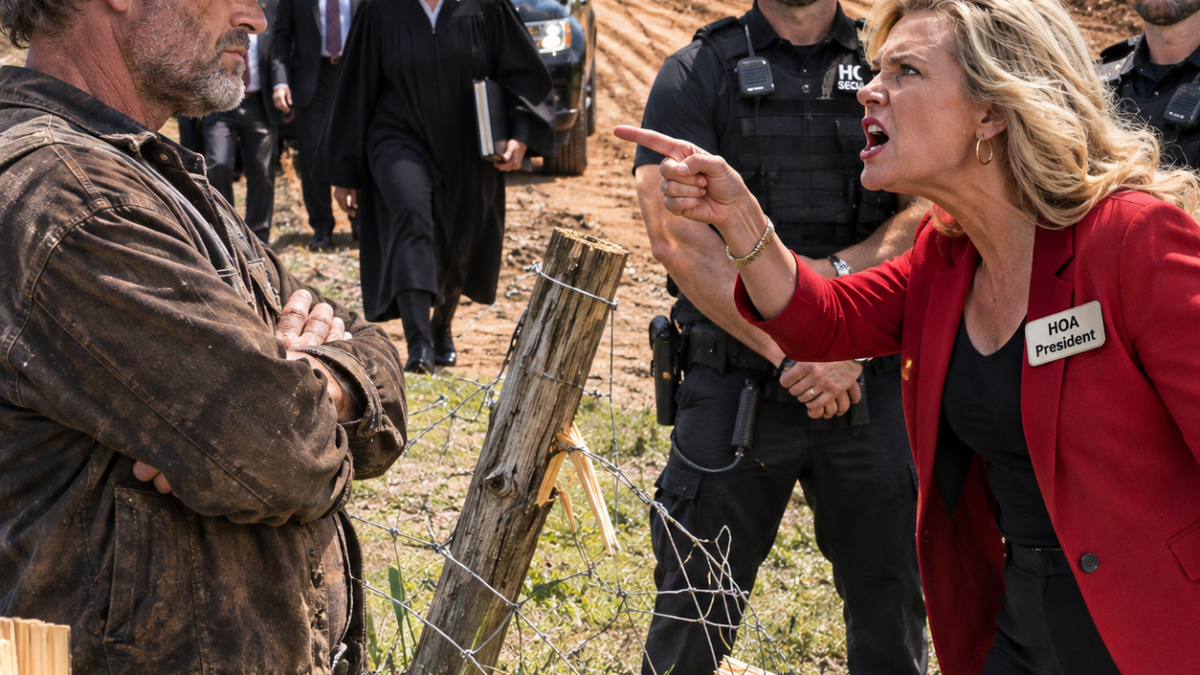
PART2:
Then one bulldozer rolled directly over the spot.
Wesley closed his eyes for half a second.
Not in disbelief.
He had passed disbelief weeks earlier.
He was trying not to let anger choose his next action.
His phone was already ringing.
Fletcher.
Wesley answered.
“You seeing this?”
“I’m looking at it.”
“Do not go into the work zone.”
“They’re cutting my fence.”
“I know.”
“They’re on my land.”
“I know.”
“They ran over the order.”
“I saw.”
Wesley pulled on his boots.
“What do you want me to do?”
“Go there.”
“That sounds different from stay out.”
“Stand where they can see you.”
“Okay.”
“Record everything.”
“Okay.”
“Do not touch Monica.”
“I wasn’t planning to.”
PART3:
“Do not touch a guard.”
“Fletcher.”
“Do not touch equipment.”
“I know.”
“And whatever they say, don’t let them make you angry enough to become the story.”
That sentence slowed him.
Because that was exactly what Monica Crestwood had been trying to do for months.
Turn Wesley into the unreasonable one.
The angry rancher.
The stubborn neighbor.
The man blocking progress.
The man standing between eighty homeowners and a safer future.
Fletcher continued:
“I’m filing before sunrise.”
“What?”
“Emergency contempt.”
Wesley looked at the bulldozer pushing through his field.
“I thought courts weren’t open.”
“They are when somebody drives a Caterpillar over the judge’s signature.”
Wesley hung up.
He went to the gun safe.
Not for a weapon.
For the red fireproof folder on the top shelf.
Deed.
Survey.
Certified injunction.
Service receipt.
Photographs from the first fence cutting.
He placed everything in his truck.
Then drove toward the north pasture.
The Arden property covered sixty-four acres along the western boundary of Stonehaven Ridge.
It was not a glamorous ranch.
No grand entrance.
No lake.
No luxury barn.
Pasture.
A small stand of oak.
One creek.
A machinery shed.
An old farmhouse Wesley had rebuilt in pieces after buying the property twenty-three years earlier.
The land had belonged to an elderly cattleman named Ralph Meeks before him.
Ralph had sold because his knees no longer let him climb onto a tractor.
Wesley had promised to keep most of the ground open.
Not as a legal condition.
Just a promise.
He had.
The old farm road crossing the northern field predated Wesley’s ownership.
Two tire tracks worn through grass.
Then gravel added gradually.
Tractors.
Feed truck.
Pickup.
Occasional hay trailer.
It went nowhere useful to Stonehaven Ridge.
It never had.
No recorded easement.
No shared right.
No public road.
It was simply Wesley’s private farm lane running from the county highway through his pasture.
For almost two decades, nobody cared.
Then Stonehaven Ridge decided to grow.
The subdivision had been built in stages.
First thirty homes.
Then forty-eight.
Then eighty.
Now the HOA and a developer wanted another phase along the ridge.
Dozens more houses.
More traffic.
More construction.
The existing subdivision entrance curved through a wooded slope and joined the county road near a blind rise.
County traffic engineers had already expressed concern about increasing daily vehicle counts without upgrades.
The developer needed a second access option.
Monica Crestwood saw Wesley’s farm road.
Straight.
Flat.
Already reaching the highway.
And decided it was the answer.
She approached Wesley almost a year before the bulldozers.
At first, politely.
She arrived at his farmhouse with a folder and an offer.
Forty-foot strip.
Running along his north side.
Permanent sale.
The HOA would extend its new road across the pasture and connect directly to the county highway.
“It’s generous,” Monica said.
Wesley looked at the number.
It wasn’t terrible.
It also wasn’t remotely enough.
He asked:
“Have you walked the route?”
“Our engineer has.”
“With me?”
“No.”
“Then walk it.”
They did.
Wesley showed her the drainage swale.
Every spring, water came off the ridge and spread through the low pasture.
The natural grade carried runoff toward the creek without flooding the house or barn.
A forty-foot engineered road raised above the field would cut the drainage pattern nearly in half.
Culverts could help.
But poor design could push water south.
Straight toward Wesley’s lower pasture and equipment shed.
Then there was the land division itself.
A permanent subdivision road would split his sixty-four acres.
Cattle and equipment would have to cross it.
Traffic would change the character and marketability of the property.
Privacy.
Noise.
Headlights.
Stormwater.
Everything.
Wesley folded Monica’s offer.
“No.”
She stared.
“Is the amount insufficient?”
“The route is wrong.”
“We can increase compensation.”
“Still wrong route.”
“Everything is negotiable.”
“Not this.”
Monica smiled tightly.
“Think about it.”
“I already did.”
That should have ended the matter.
Instead, Monica changed the question.
Within a month, HOA letters stopped asking to purchase.
They began asserting that Wesley’s farm road had been used historically by the surrounding community.
Historic access.
Implied access.
Then “prescriptive rights.”
The words changed every time Fletcher disproved the previous version.
Wesley’s response remained the same.
Show me the recorded easement.
There wasn’t one.
Fletcher spent an afternoon at the county archive.
Deeds.
Plats.
Old road records.
Subdivision filings.
Nothing.
Monica then produced old photographs.
Pickup trucks.
Utility vehicles.
People crossing the field decades earlier.
Fletcher looked at them.
“So?”
Monica’s attorney argued historical use.
Fletcher asked:
“Hostile use?”
No proof.
“Continuous for the statutory period?”
No reliable proof.
“Without permission?”
Worse.
Some photographs showed Ralph Meeks standing beside the vehicles.
Apparently allowing them through.
Permission destroys many attempts to characterize historical use as hostile.
The prescriptive argument weakened.
Then, three weeks before the Friday morning bulldozing, Wesley discovered his fence cut for the first time.
Seventy feet.
Posts pulled.
Fresh orange survey paint across the grass.
A contractor truck appeared on camera.
Vendor markings tied to Stonehaven Ridge.
Wesley did not confront the crew.
He drove to Fletcher.
The attorney watched footage twice.
Then asked:
“You want this stopped?”
“Yes.”
“Then we stop talking to Monica as if this is a negotiation.”
Fletcher filed for emergency injunctive relief.
Judge Judith Keen got the case.
Everyone in the county legal community knew her reputation.
Precise.
Patient.
Unimpressed by volume.
She had been on the bench nearly fifteen years.
Fletcher once described her:
“She’ll let you talk until you run out of excuses, then ask the one question you should’ve answered first.”
At the emergency hearing, Judge Keen reviewed:
Wesley’s deed.
Recorded surveys.
Fence photographs.
Security video.
HOA contractor documents.
Stonehaven correspondence.
The association argued unresolved historical access.
The judge did not decide the final property dispute at that stage.
That was important.
A preliminary injunction was not final victory for Wesley.
It was an order preserving the property until the court could decide.
But Judge Keen had seen enough to understand that physical changes could destroy the very thing being litigated.
So she wrote broadly.
Stonehaven Ridge Homeowners Association.
Its board.
Employees.
Agents.
Contractors.
Security personnel.
Anyone acting on its behalf.
All prohibited from entering Wesley Arden’s parcel for road construction.
No grading.
No fence removal.
No boundary movement.
No roadway building.
No excavation.
Nothing until further order.
Monica was present through counsel.
Her lawyer received the order.
The registered HOA office received certified service.
Fletcher sent another copy to the contractor.
Wesley laminated one.
Zip-tied it to the repaired fence at the location of the first cut.
For a week, nothing happened.
Wesley started sleeping again.
He knew the lawsuit would continue.
Fine.
Courts move slowly.
He could handle slow.
What he could not tolerate was waking to machines in the field.
Then Friday came.
When Wesley reached the north pasture that morning, the first bulldozer had already pushed nearly a hundred yards.
The crew was grading a broad lane through grass.
Not the exact route Stonehaven had previously proposed.
It ran roughly fifteen feet east.
That was apparently Monica’s legal theory.
A different alignment meant a different road.
Therefore, somehow, a court order forbidding any road construction on Wesley’s parcel did not apply.
Private security had established barricades at both ends.
Six guards.
Black shirts.
Dark tactical-style pants.
No firearms visible, but equipment belts.
Radios.
The chief was Daryl Knox.
Forty-five.
Former nightclub security manager turned private contractor.
His company had expanded into HOA patrols and construction-site security.
Wesley parked twenty feet outside the barricade.
Daryl approached.
“You can’t enter.”
Wesley looked behind him.
At his field.
“My property.”
“Authorized construction zone.”
“On my property.”
“I have instructions.”
Wesley lifted the certified injunction.
“Have you read this?”
Daryl barely glanced.
“I was briefed.”
“By who?”
“President Crestwood.”
“Did she give you a copy?”
“No.”
“Then read mine.”
“I don’t need to.”
That was a mistake.
Not legally decisive by itself.
But a mistake.
Wesley held up his phone.
“You’re telling me you will detain me if I walk onto land I own?”
Daryl looked directly at camera.
“If you cross the barricade, we will remove you and contact sheriff.”
“Under what authority?”
“HOA construction control.”
“Is that a law?”
Daryl’s jaw tightened.
“Don’t make this difficult.”
Wesley almost laughed.
Then he remembered Fletcher.
Don’t become the story.
He stepped back.
“Okay.”
Daryl looked relieved.
He mistook restraint for surrender.
Again.
Monica arrived at 6:10.
Business clothes.
Cream trench coat.
Leather boots.
As if she were inspecting landscaping.
She walked to center of fresh roadway and spoke with Seth Mallory, the grading contractor.
Seth looked uncomfortable.
Thirty-nine.
Experienced excavation operator.
His company had enough legitimate work that he did not need a land dispute.
But Monica had assured him the court-order problem was handled.
Wesley called across:
“Monica.”
She turned.
He pointed at the injunction lying in the mud.
Cracked laminate.
Mud pressed into one corner.
“Your crew tore that off my fence.”
Monica glanced.
Then back at Wesley.
“That order doesn’t apply to this road.”
Wesley took three slow steps closer without crossing the barricade.
“Are you sure?”
“Absolutely.”
“You’ve read it?”
“Yes.”
“It says no roadway construction anywhere on my parcel.”
“This is an emergency access improvement on a revised alignment.”
“Is the revised alignment on my property?”
“That remains disputed.”
Wesley looked at the camera.
“I’m asking again. Are you saying the court injunction does not prohibit what you’re doing this morning?”
Monica’s voice remained clear.
“Yes.”
“Absolutely?”
“Absolutely.”
Wesley stopped recording only after she walked away.
Fletcher called.
“You got that?”
“Yes.”
“Back it up.”
“Already uploading.”
“How far have they gone?”
“Maybe three hundred feet.”
“County?”
“Not here.”
“Permit board?”
“No.”
“Good.”
“Good?”
“Meaning no one can later pretend a county inspector directed this.”
By 7:30, nearly nine hundred feet of roadbed cut across Wesley’s pasture.
The crew moved fast.
That was the plan.
Monica believed completion would create political reality.
Once eighty families had an emergency route, what judge would order it removed?
Once pavement existed, who would insist grass return?
Once houses depended on it, could Wesley really take it away?
She had written that idea to another board member.
Wesley did not know that yet.
But the logic was visible in the speed.
Fletcher filed the emergency contempt motion.
He included:
Second fence cutting.
Video.
Crushed injunction.
Monica’s statement.
Security barricades.
Contractor activity.
Wesley’s exclusion from his own land.
Then he contacted Rachel Dunmore at county engineering.
“Is Stonehaven’s new road approved?”
Rachel checked.
“No.”
“Grading permit?”
“No.”
“Drainage?”
“No.”
“Fire department request?”
“No.”
“Emergency access designation?”
“No.”
“Any road authorization on Arden parcel?”
“No.”
That dismantled Monica’s public justification before lunch.
Because Stonehaven’s newsletter had already gone out.
EMERGENCY COMMUNITY ACCESS IMPROVEMENT.
Fire safety.
Evacuation.
Response time.
Public safety.
The county had requested none of it.
The fire authority had requested none of it.
No engineer had approved the alignment.
It didn’t even match the preliminary plan Stonehaven had earlier submitted.
They had invented a road on the ground first and hoped paperwork would catch up.
Then Lydia Prescott arrived.
Independent surveyor.
Wesley had hired her after first fence incident.
She carried written authorization from Wesley to enter and survey his property.
Daryl blocked her.
“This area is restricted.”
“I’m working for the owner.”
“Doesn’t matter.”
She held up letter.
“He is the owner.”
“I have instructions.”
“From someone who owns the land?”
“From Stonehaven Ridge.”
Lydia looked toward Wesley.
He filmed.
That footage went to Fletcher.
By noon, the contempt filing contained almost everything Judge Keen needed.
Almost.
But she wanted more than video.
She could have ordered immediate halt from chambers.
Instead, she chose something nobody expected.
Judicial site visit.
Formal.
Court reporter present.
Both parties notified.
Counsel required.
Survey work under court authority.
Monica received notice through her attorney.
Her attorney called immediately.
“Do not do anything else.”
“What do you mean?”
“I mean stop the work.”
“We’re almost finished grading.”
“Stop.”
“The judge isn’t coming personally.”
“She ordered a judicial view.”
“She’ll send staff.”
“Monica.”
“We need hours.”
“No.”
“If we stop now, Wesley wins.”
“Stop.”
Monica ignored him.
She told Daryl:
Keep barricades up.
No one gets through without her approval.
Seth’s crew kept moving.
At 1:08 p.m., a plain county sedan approached.
No lights.
No siren.
No sheriff markings.
Daryl walked toward it.
The driver lowered a window.
Daryl said:
“Road ahead is restricted by Stonehaven Ridge HOA.”
The rear door opened.
A woman in a gray coat stepped onto the dirt.
Daryl continued:
“I’ll need authorization before—”
Then Fletcher appeared from beside Wesley’s truck.
Daryl looked at him.
Then at the woman.
Fletcher said:
“Mr. Knox, this is Judge Judith Keen.”
Daryl’s face changed.
Not dramatically.
Worse.
Slowly.
As comprehension arrived.
Judge Keen looked at the barricade.
Then the road.
Then at Daryl.
“Authorization from whom?”
“Ma’am?”
“You said I need authorization.”
Daryl swallowed.
“My instructions are from President Crestwood.”
“Does Ms. Crestwood believe her authority supersedes an order of this court?”
Daryl had no answer.
Monica appeared moments later.
She recognized Judge Keen instantly.
Her posture changed.
Voice changed.
The woman who had spent the morning saying “absolutely” now sounded almost apologetic.
“Your Honor.”
Judge Keen said:
“Ms. Crestwood.”
“This is not what it appears to be.”
Judge Keen looked over nearly nine hundred feet of newly graded road.
Then at fresh-cut fence.
Then at barricades.
“What does it appear to be?”
“A misunderstanding concerning alignment.”
The judge did not debate.
She turned to court reporter.
“Begin the record.”
Then:
“Ms. Prescott will complete her survey. No person present will interfere.”
Monica’s lawyer arrived looking as if he had aged five years since breakfast.
He quietly acknowledged.
Monica tried:
“Your Honor, I don’t think it is necessary for us to walk the entire—”
Judge Keen looked at her.
“This is a noticed judicial view.”
Pause.
“It is not a courtesy visit.”
Monica stopped.
Daryl moved barricade.
The same barrier that had prevented Wesley from entering his own pasture now opened for the judge.
Wesley walked behind Fletcher.
He said almost nothing.
He had spent months imagining some moment when Monica would finally be forced to listen.
Now that it was happening, he felt less satisfaction than expected.
Mostly exhaustion.
They walked.
Judge Keen stopped near the first cut fence.
Something half buried beneath track marks caught her attention.
“Do not move that.”
Everyone stopped.
She pointed.
The laminated injunction.
Cracked.
Mud-covered.
Flattened by machinery.
The same order carrying her signature.
The court reporter documented.
Photos.
Location.
Condition.
Wesley’s stomach tightened.
Not because the paper mattered more than land.
Because of what it represented.
Monica’s people had not simply overlooked the order.
Someone had physically removed it from the fence and discarded it before driving through.
Lydia set up survey equipment.
Total station.
Receiver.
Original county monuments.
Recorded deed.
She began calling measurements.
Thirty-one feet.
Then thirty-four.
Thirty-eight.
The new road was nowhere near a disputed line.
At its nearest point, it sat roughly thirty-one feet inside Wesley’s recorded boundary.
Elsewhere deeper.
The alignment curved intentionally around old oaks Wesley had refused to remove.
Widened in low pasture where equipment needed turning room.
It was not an accidental drift.
It was designed.
Rachel Dunmore arrived with county maps.
Judge Keen asked:
“Is this roadway shown on any approved plan?”
“No, Your Honor.”
“Has the county issued a grading permit?”
“No.”
“Drainage plan?”
“No.”
“Fire authority requested it?”
“No.”
“Emergency management?”
“No.”
Rachel pointed to preliminary Stonehaven submission.
“The route they previously proposed is different.”
Judge Keen looked at Monica.
“You described this as an emergency improvement?”
Monica said:
“Yes.”
“Requested by whom?”
“The community required—”
“Which public authority requested it?”
Silence.
Judge Keen turned to Seth.
“Mr. Mallory, who directed your crew to begin this morning?”
Seth looked at Monica.
Then his attorney, who had arrived after hearing a judge was onsite.
“Stonehaven Ridge.”
“Who specifically?”
“President Crestwood.”
“Written?”
“Yes.”
Monica stepped in.
“The contractor misunderstood the limits.”
Seth’s head turned.
“No.”
The word was quiet.
Everyone heard.
He continued:
“I asked whether the court order was cleared.”
Judge Keen said:
“And?”
“I was told association counsel had handled it.”
Monica said:
“The board authorized emergency work.”
A board member named Alan Pierce had come with HOA counsel.
He spoke.
“No, we didn’t.”
Monica looked at him.
Alan continued:
“We voted to continue legal review. We did not vote to construct a road today.”
Judge Keen looked at HOA counsel.
“Did you advise Ms. Crestwood that construction could proceed?”
The lawyer closed his eyes briefly.
Then:
“No, Your Honor.”
“Your advice?”
“That no roadway could be built on Mr. Arden’s parcel while the injunction remained in effect, regardless of alignment.”
Monica’s face went pale.
Fletcher said nothing.
He did not need to.
Judge Keen asked:
“Was that advice written?”
“Yes.”
“Preserve it.”
Fletcher immediately requested formal preservation of communications.
Granted.
Then Daryl made his own calculation.
He was watching a judge personally examine the site his guards had spent hours protecting.
Whatever loyalty he had to Monica did not extend to being held in contempt for her.
He handed over security activity log.
One entry:
4:31 A.M.
Per President Crestwood:
Hold north and south access points.
Deny owner entry until roadway grade complete.
That sentence landed harder than nearly anything else.
Not merely enter land.
Not merely construct.
Actively keep the owner out so work could finish before intervention.
Judge Keen read it.
Then looked at Daryl.
“You knew Mr. Arden owned the property?”
“Yes, Your Honor.”
“And your instructions were to deny him entry anyway?”
“Yes.”
“Did anyone provide you a superseding court order?”
“No.”
“Modification?”
“No.”
“Stay?”
“No.”
Judge Keen returned the log.
“I believe the court has seen enough.”
No yelling.
No threat.
No dramatic lecture.
That calm frightened Monica more than anger would have.
The judge ordered every party to appear at courthouse at two.
Emergency contempt hearing.
On the walk back, Wesley stopped beside Daryl.
Quietly:
“You knew from the first hour?”
“Yes.”
“That I owned it?”
“Yes.”
“Why tell me I’d be trespassing?”
Daryl looked toward Monica.
“Those were the instructions.”
“From her?”
“Yes.”
Fletcher wrote it down.
At two, the courtroom was full.
Monica had changed clothes.
Darker suit.
More conservative.
Her attorney looked miserable.
Fletcher carried binders.
Wesley sat beside him.
Judge Keen entered.
Everyone stood.
HOA counsel argued good faith.
Emergency needs.
Community pressure.
Deadline.
Misunderstanding regarding alignment.
Fletcher did not call Monica reckless.
Did not call her corrupt.
Did not call her a liar.
He built dates.
Day Three:
Injunction signed.
Monica notified.
Day Four:
Her attorney emails explicit scope.
No roadway anywhere on Arden property.
Day Eight:
Monica asks whether shifting alignment fifteen feet could avoid injunction.
Attorney says no.
Day Ten:
Seth Mallory crew scheduled.
Day Eleven:
Security instructed to block both ends.
Day Twelve:
Fence cut.
Injunction removed.
Bulldozers enter.
Fletcher then introduced Seth’s emails.
Monica’s directives.
Security log.
Her recorded “Absolutely.”
County permit records.
Survey measurements.
Then one email.
From Monica to a fellow board member.
ONCE THE ROAD IS OPEN, NO JUDGE IS GOING TO MAKE EIGHTY HOMEOWNERS GIVE IT BACK.
The courtroom changed.
Wesley felt it.
Board members in gallery stopped looking toward Monica.
Judge Keen read email silently.
Then:
“Ms. Crestwood, did you write this?”
Monica leaned toward counsel.
He whispered.
“Yes, Your Honor, but—”
“Then answer yes.”
“Yes.”
“You contend it is out of context?”
“Yes.”
Judge Keen ordered surrounding messages read aloud.
They made it worse.
Monica discussing construction timing.
How quickly the road could be graded.
Concern Wesley would return to court.
Need to create access before intervention.
Not safety.
Not misunderstanding.
Speed.
Judge Keen looked at Monica.
“If you genuinely believed my injunction did not apply to the revised alignment, why did you not ask the court for clarification?”
Monica said nothing.
“You had counsel.”
Silence.
“You had an active case.”
Silence.
“You had a judge available to interpret her own order.”
Silence.
“Why send bulldozers instead?”
Nothing.
Her attorney tried to answer.
Pressure.
Development deadline.
Community safety.
Financing.
Judge Keen listened.
Then asked:
“Counsel, are you asking this court to establish that a private development deadline excuses deliberate violation of an injunction?”
“No, Your Honor.”
“Then the deadline is irrelevant.”
That ended it.
The court found sufficient evidence of willful noncompliance to issue immediate enforcement.
Construction stopped.
All equipment out.
All guards off Wesley’s land.
No additional gravel.
No asphalt.
No drainage work.
No modifications.
Electronic communications preserved.
Association to pay independent survey costs arising from violation.
Reasonable attorney fees tied to enforcement.
Restoration plan due within defined period.
Future entry only under court-approved process.
Then Monica asked:
“Your Honor, given the expense already incurred, could the roadway remain temporarily until the underlying access case is decided?”
Judge Keen looked at her.
“Costs incurred while violating a court order do not make the violation lawful.”
Nothing more.
The judge required court representative, Lydia, and Rachel to personally confirm the land had been vacated before day ended.
No phone assurances.
No email.
Physical verification.
By sunset, equipment rolled out.
One bulldozer.
Then excavator.
Then second dozer.
Security barricades removed.
Daryl’s guards left.
Wesley stood alone afterward.
He walked the nine hundred feet.
Slowly.
Photographing.
Fence.
Topsoil.
Ruts.
Drainage.
Graded roadbed.
Every foot.
No victory pose.
No social media.
No selfie beside bulldozer.
He was building next record.
Because contempt hearing was not end.
Restoration.
Damages.
Costs.
Underlying title case.
Those remained.
Then Fletcher got an internal spreadsheet.
Stonehaven reserve fund.
Monica had funded road construction from community reserves without required board approval.
Large expenditures needed formal vote.
There wasn’t one.
Contract change order.
Expanded security contract.
Mobilization costs.
All signed by Monica.
Board members began asking.
Where did money come from?
Who approved?
Why were pool and landscaping reserves reduced?
Monica called emergency meeting.
Proposed board retroactively ratify the road project.
Essentially approve after the fact what she had already done.
It could not erase contempt.
But she wanted political cover.
Board refused.
Then Seth’s invoice arrived.
Mobilization.
Grading.
Equipment.
Crew.
Removal.
The HOA was paying to build illegal road and paying again to remove machines after judge ordered it stopped.
Insurance carrier issued warning.
Intentional violation of known court order might not be covered under portions of association liability policy.
That terrified the board more than Wesley’s anger ever could.
If insurance denied.
Who pays?
Homeowners.
Monica attempted to blame Daryl.
Security exceeded instructions.
Daryl produced texts.
KEEP ARDEN OUT UNTIL SETH FINISHES GRADE.
DO NOT LET SURVEYOR THROUGH.
NO ENTRY WITHOUT MY APPROVAL.
Monica’s number.
Timestamp.
No ambiguity.
Lydia completed restoration estimate.
Fence.
Posts.
Topsoil.
Grade.
Drainage swale.
Compaction damage.
Seed.
Survey monuments.
Approximately $186,400.
Before legal fees.
Before survey enforcement costs.
Before other claims.
Stonehaven homeowners learned number.
General meeting filled.
Residents asked questions Monica had kept away from them.
Had county permitted road?
No.
Had fire department requested it?
No.
Had board approved construction?
No.
Had association’s lawyer advised Monica to proceed?
No.
Then why?
Monica talked about safety.
Deadlines.
Community needs.
No answer survived documents.
A homeowner named Denise Carver stood.
“My dues pay for pool.”
“Yes.”
“Landscaping.”
“Yes.”
“Common areas.”
“Yes.”
“Did my money pay private security to keep a man off his own land while we were under court order?”
Monica stared.
Denise repeated.
“Did it?”
The treasurer answered.
“Yes.”
Room erupted.
Not shouting at Wesley.
At Monica.
For first time, the people she had claimed to protect became the people demanding accountability.
Then Monica did something so audacious Fletcher initially thought someone had fabricated it.
Special assessment notice.
Addressed to Wesley Arden.
Claim:
His property benefited from roadway improvement.
Amount due:
proportional construction expense.
An HOA that had just been found in violation for building an unauthorized road on his private property tried to bill him for the road.
Fletcher read it.
Once.
Twice.
Then started laughing.
Wesley looked at him.
“What?”
“I’m sorry.”
“Is this fake?”
“No.”
“What do we do?”
“Nothing creative.”
He filed it in open contempt case.
Same judge.
No commentary needed.
Judge Keen called parties back for final remedy and sanctions hearing.
The dynamic had changed completely.
Stonehaven’s board now had separate counsel.
They no longer allowed Monica’s personal decisions to define association legal strategy.
Judge Keen identified four key facts.
Monica knew of injunction.
Her lawyer explicitly warned her not to proceed.
She ordered construction anyway.
She directed security to exclude property owner long enough to complete work.
Willful.
Not misunderstanding.
Restoration costs assigned to association.
Attorney fees and survey expenses tied to enforcement.
But Judge Keen also imposed a personal sanction against Monica.
Important.
Because homeowners had not authorized contempt.
They should not absorb every consequence of one officer’s deliberate violation.
Special assessment against Wesley:
Void.
Any lien based on illegal road:
Prohibited.
Restoration supervised independently.
No Stonehaven-controlled surveyor.
No self-certification.
Then road came out.
The same ground Monica had tried to transform into permanent access was stripped back.
Gravel removed.
Compacted base broken.
Grade restored.
Drainage swale rebuilt.
Topsoil returned.
Fence reconstructed.
New boundary monuments set.
Seed.
Hay.
Time.
The road disappeared.
Stonehaven’s board removed Monica as president.
Her contract authority ended.
Security agreement with Daryl’s company terminated.
New rules required multiple approvals for:
Construction.
Security deployments.
Large reserve withdrawals.
Legal changes involving neighboring property.
No single president could repeat the same sequence quietly.
Monica did not go to prison.
No dramatic arrest.
No squad car.
This was civil contempt and governance failure.
The consequences were still substantial.
Personal sanctions.
Loss of office.
Financial exposure.
Association claims against decisions outside her authority.
Public record.
Her name attached to a judicial finding that she deliberately ignored a court order.
For someone who had spent years treating procedure as a tool for controlling everyone else, being formally recorded as the person who refused to obey procedure mattered.
Wesley never celebrated.
That disappointed some neighbors.
A man named Aaron Voss came to fence one afternoon.
“You won.”
Wesley was repairing a gate hinge.
“Did I?”
“They tore road out.”
“Yes.”
“Monica’s gone.”
“Yes.”
“Judge sanctioned her.”
“Yes.”
“That sounds like winning.”
Wesley tightened bolt.
“I have a fence to rebuild.”
Aaron laughed.
Then saw Wesley wasn’t joking.
Winning did not return months.
Did not return sleep.
Did not undo two fence cuttings.
Did not instantly regrow damaged pasture.
Didn’t make neighbors forget being told Wesley was endangering them.
It restored boundary.
That was enough.
Stonehaven’s expansion changed.
Developer revised.
New access route planned entirely inside property it controlled.
More expensive.
Less convenient.
But legal.
That part mattered too.
The new homes were not forbidden forever.
Wesley had never demanded that.
He demanded that the shortcut not run across his pasture.
Sometimes people frame property disputes as landowner versus progress.
But progress does not require a particular neighbor to surrender his land because the alternative costs more.
The developer eventually solved it.
Retaining wall.
Intersection upgrade.
Internal road.
Money.
Engineering.
Permits.
The thing Monica said could not be done was simply less cheap than taking Wesley’s field.
Years later, Wesley drove past the new entrance.
Traffic flowed.
Nobody crossing his pasture.
Stonehaven survived.
That was proof Monica’s “emergency” had never been the only option.
Only preferred one.
Wesley kept the crushed laminated injunction.
Fletcher wanted it for case file originally.
After closure, returned.
Mud embedded between layers.
One corner broken.
Tire-track impression faint across judge’s signature.
Wesley mounted it inside a weatherproof display just inside his boundary.
Not because he expected anyone to violate again.
Because he wanted memory outside his head.
Below it, no angry slogan.
Just:
COURT ORDER — PROPERTY BOUNDARY CASE
Date.
That was all.
One day his daughter, Mara, visited.
She was thirty-two and lived two counties away.
She looked at display.
“Dad, that’s a little dramatic.”
“Maybe.”
“You keep a crushed injunction in a box.”
“Yes.”
“Normal people keep family photos.”
“I have those.”
“Inside?”
“Yes.”
She laughed.
Then became serious.
“You were scared?”
Wesley looked toward fence.
“Of what?”
“That day.”
He took time.
“Yes.”
She seemed surprised.
“Of guards?”
“Some.”
“Monica?”
“No.”
“What then?”
He looked at pasture.
“That doing everything right might still not matter.”
Mara said nothing.
Wesley continued.
“You hire lawyer.”
“Yeah.”
“You get survey.”
“Yeah.”
“You go to court.”
“Yeah.”
“Judge signs order.”
“Yeah.”
“And then somebody just drives over it.”
He pointed toward display.
“For a few hours that morning, I wondered what system was left.”
Mara looked at crushed paper.
“Then judge showed up.”
“Yes.”
“That’s why you keep it.”
“Partly.”
Not because judge was heroic in some cinematic way.
She did her job.
That was the point.
A system only matters if orders are enforced.
Monica had gambled that delay would beat enforcement.
Finish first.
Argue later.
Create physical fact.
Make removal politically difficult.
Judith Keen’s arrival destroyed that strategy.
Not by yelling.
By showing up before completed road could become accepted reality.
Wesley thought about her question often.
Authorization from whom?
Daryl had security uniform.
Barricades.
Radio.
Six guards.
Signs.
Monica had HOA title.
Contractor.
Machines.
Deadline.
Money.
But when judge asked authorization from whom, every layer of apparent authority collapsed.
Because none outranked court order.
That became the lesson Wesley gave anyone who asked.
Authority is not how confident someone sounds.
It is not a vest.
Not a badge-shaped patch.
Not a title.
Not number of people behind you.
Authority has source.
Scope.
Limits.
Monica kept extending hers until it broke.
At Stonehaven’s next annual meeting, new president invited Wesley.
He declined.
They asked again.
He went.
Not because he wanted applause.
Because new board proposed boundary protocol.
Before any work within twenty-five feet of neighboring parcel:
Survey verification.
Written owner notice.
Permit confirmation.
Board vote.
Legal review.
Contractor receives actual court orders or restrictions directly.
No president can verbally override.
Wesley read.
Said:
“Good.”
New president asked:
“Anything else?”
“Yes.”
“What?”
“Make security read court orders.”
Nervous laughter.
He wasn’t joking.
They added it.
Daryl’s company lost Stonehaven contract.
He later sent Wesley a letter.
Not apology exactly.
More explanation.
His company had relied on client instructions.
Guards were not trained to interpret civil injunctions.
Procedures had changed.
If a court order involved property under security assignment, legal review required before deployment.
Wesley wrote back:
You knew I was the owner.
Daryl responded:
Yes.
That was fair.
Wesley respected honesty more than excuses.
Seth Mallory kept contracting.
His company had cooperated.
He provided emails.
Stopped when court ordered.
He visited Wesley after restoration.
“I should’ve called your lawyer myself.”
“Probably.”
“I believed Monica when she said it was cleared.”
“I know.”
“Next time someone says court order handled?”
“Ask to see the order.”
Seth smiled.
“Exactly.”
Another system improved because somebody learned expensive lesson.
Judge Keen issued final closure months later.
At final hearing, Monica said:
“All of this started because of a few fence sections.”
Judge Keen corrected her.
“No.”
The room quieted.
“This matter did not begin with a fence.”
She looked at Monica.
“It began when you decided an order of this court was optional.”
That was the final word.
Not road.
Not HOA.
Not pasture.
Compliance.
The dispute could have remained ordinary.
A boundary case.
Slow.
Annoying.
Lawyers.
Surveys.
Eventually ruling.
Monica transformed it by believing physical completion could outrun law.
That belief cost Stonehaven.
$186,400 restoration estimate.
Legal fees.
Survey costs.
Construction mobilization.
Demobilization.
Security.
Insurance uncertainty.
Development delays.
Board upheaval.
All for a road that existed only weeks.
Wesley’s pasture took longer to heal.
First rain exposed compaction.
Grass grew thin in road footprint.
Restoration contractor aerated.
Added soil.
Reseeded.
Drainage swale worked.
The next spring, water flowed correctly.
That gave Wesley more satisfaction than sanctions.
He stood during a storm with rain jacket.
Watched water move through grass.
No ponding.
No washout.
He smiled.
That was restoration.
Not just tearing road up.
Putting land back to function.
Fence rebuilt.
Stronger posts.
Same recorded line.
He added steel gate at farm road entrance.
Locked when not needed.
Not because Stonehaven remained threat.
Because boundaries easier to respect when visible.
On inside of gate:
PRIVATE PROPERTY
NO PUBLIC ROAD
No Monica.
No HOA reference.
No “violators.”
Nothing personal.
Years passed.
The crushed injunction display weathered.
Wesley replaced clear cover once.
A neighbor asked:
“Why not take it down?”
“Why?”
“It’s over.”
“That doesn’t mean it didn’t happen.”
But Wesley did not live in the story.
He grazed cattle.
Repaired tractor.
Helped Mara build a deck.
Went fishing.
Paid taxes.
Complained about diesel prices.
Ordinary life reclaimed space.
That was better than revenge.
Monica moved out of Stonehaven several years later.
Wesley saw moving truck.
No conversation.
He did not need one.
For months during dispute, he had imagined telling her what damage she caused.
By time chance came, he realized consequences already said it.
No speech necessary.
One afternoon, Stonehaven resident named Denise stopped.
The same woman who asked about dues.
She held pie.
Wesley laughed.
“What is this?”
“Peace offering.”
“You didn’t cut my fence.”
“No, but I believed her for a while.”
“You don’t owe me pie.”
“I already baked it.”
He took it.
She said:
“I thought you were preventing emergency access.”
“I know.”
“She made it sound like our houses were going to burn because of you.”
“I know.”
“I feel stupid.”
“Don’t.”
“Why?”
“Because that’s why documents exist.”
She looked confused.
Wesley explained:
“You had her version.”
“Yeah.”
“Then county records came out.”
“Yeah.”
“You changed your mind.”
“Yes.”
“That’s all people can do.”
Denise smiled.
“Still keeping pie?”
“Yes.”
Good boundaries did not require permanent enemies.
That mattered.
Wesley did not want Stonehaven residents afraid to speak to him.
They lived next door.
Kids retrieved balls.
Dogs escaped.
Storm trees fell.
People needed each other sometimes.
The goal was not wall.
Consent.
Respect.
One winter, a Stonehaven drainage contractor needed temporary access to inspect culvert along shared boundary.
New HOA president emailed.
Included map.
Insurance.
Dates.
Crew.
Purpose.
Asked.
Wesley said yes.
Two hours.
Stay along fence.
No grading.
Contractor entered.
Did work.
Left.
Nothing happened.
Wesley smiled afterward.
That was normal.
Permission requested.
Permission defined.
Permission honored.
No emergency litigation.
No judge arriving in pasture.
Civilization in miniature.
Fletcher eventually retired.
At his retirement dinner, Wesley was invited.
Fletcher told story badly after two whiskeys.
He made Judge Keen sound like she stepped from sedan wearing lightning bolts.
Wesley corrected him.
“She had gray coat.”
“It’s a story, Wesley.”
“Accuracy matters.”
“That’s why nobody lets you give speeches.”
Fletcher laughed.
Then raised glass.
“To documentation.”
Wesley raised his.
“To not touching anyone.”
Fletcher pointed.
“That too.”
They had joked about restraint for years.
But it mattered.
Wesley had every emotional reason to walk past guards.
Cut barricades.
Stop bulldozers physically.
Maybe law would still protect him.
Maybe not.
Instead, he stood.
Recorded.
Called attorney.
Waited.
That felt passive.
It wasn’t.
Restraint is action when opponent is waiting for reaction.
Monica wanted a confrontation she could recast.
An angry landowner.
Threatening workers.
Obstructing emergency road.
Instead, cameras showed:
Wesley standing outside his own field.
Security blocking him.
Monica admitting order did not apply.
Bulldozers working.
Court paper under tracks.
No distraction.
That clarity made enforcement easier.
Wesley sometimes wished more people understood that.
Strength is not always stepping forward.
Sometimes it is refusing to give somebody better story than facts.
Years after, Mara’s son Caleb asked about old road.
He was ten.
“Grandpa, where did it go?”
“What road?”
“The HOA road.”
Wesley pointed.
“Across there.”
Grass covered everything.
Caleb squinted.
“I don’t see it.”
“Exactly.”
“Was it big?”
“Big enough.”
“Did judge really come?”
“Yes.”
“In a police car?”
“No.”
“Helicopter?”
“No.”
“What?”
“Sedan.”
Caleb looked disappointed.
“What color?”
“Gray-ish.”
“That’s boring.”
“Yes.”
“Did she yell?”
“No.”
“Did she arrest anyone?”
“No.”
“Then why is story famous?”
Wesley laughed.
“Good question.”
Caleb waited.
“Because everybody expected loud people to matter most.”
“Who mattered?”
“The person with authority.”
“Judge?”
“Also surveyor.”
“Also lawyer?”
“Yes.”
“Also you?”
Wesley thought.
“Mostly the paper.”
Caleb frowned.
That was not exciting.
Wesley liked that.
Truth often disappoints people raised on cinematic justice.
No handcuffs.
No sheriff dragging Monica away.
No bulldozer revenge.
A judge arrives.
Reads.
Measures.
Asks.
Orders.
Road removed.
Costs assigned.
President removed.
Life goes on.
That was enough.
The biggest consequence wasn’t humiliation.
It was that Stonehaven lost ability to pretend rules applied only outward.
HOAs create rules for homeowners constantly.
Setbacks.
Parking.
Architecture.
Fences.
Lawns.
Monica had spent years enforcing compliance.
Then treated a court injunction as flexible.
That contradiction destroyed trust faster than property dispute itself.
People will tolerate strict leader.
Some even prefer one.
What they cannot tolerate forever is leader who believes rules bind everyone except herself.
That was Monica’s final mistake.
Not cutting fence.
Not building road.
Not even guarding it.
Believing her objective justified ignoring order.
Once she crossed that line, every email became evidence.
Every guard became witness.
Every bulldozer became measurement.
Every dollar became questionable expense.
Every attempt to rationalize made chronology stronger.
She had been warned.
By Wesley.
By Fletcher.
By her own attorney.
By injunction itself.
She continued.
No ambiguity left.
One spring morning years later, Wesley walked north field at sunrise.
Dew.
Fence straight.
Gate shut.
Old oaks along route had survived because road curved around them.
Ironically, the crew’s attempt to save time had preserved trees Monica’s preliminary plan might have removed later.
Birds.
Grass.
Drainage.
No gravel.
He stopped where Judge Keen found crushed injunction.
Nothing marked the spot.
Wesley preferred that.
The display remained near boundary, but field itself needed no monument to conflict.
Land healed best when allowed to forget.
He looked toward Stonehaven rooftops.
New phase eventually completed through redesigned internal access.
Fewer homes than original.
Traffic safer.
County required road upgrades.
Development adjusted.
Nobody died because Wesley kept his pasture.
Nobody’s house became unreachable.
The emergency Monica described never existed.
Her urgency was financing.
Permits.
Schedule.
Money.
Those are real pressures.
Not emergency.
Wesley had worked construction management before buying the property.
He understood deadlines.
A missed window can cost millions.
Crews need scheduling.
Financing carries interest.
Permits expire.
But pressure does not change ownership.
Deadline does not create easement.
Budget does not suspend injunction.
That principle remained.
When Stonehaven board later asked him whether he would sell a different strip someday, Wesley did not automatically say no.
He walked route.
Different location.
Less drainage impact.
He considered.
Then declined because it still cut pasture inconveniently.
Board said:
“Thank you for considering.”
That was all.
No letters asserting historic rights.
No survey paint overnight.
No guards.
No court.
Wesley thought:
Look how easy this can be.
Ask.
Receive answer.
Change plan.
Monica made everything hard because she treated other people’s boundaries as temporary obstacles.
At final board meeting before she was removed, according to Denise, Monica had said:
“I was elected to get things done.”
Wesley heard later.
He understood sentiment.
Getting things done is valuable.
Until the thing requires someone else’s land.
Then leadership means accepting limit.
Monica could not.
She viewed no as inefficiency.
Injunction as delay.
Survey as technicality.
Judge as person who would eventually accommodate reality she created.
Then judge walked road herself.
Measured reality before Monica could finish manufacturing it.
That was why title people gave story eventually became:
THE DAY THE JUDGE SHOWED UP.
Wesley never liked it.
To him, important day was earlier.
Day Judge Keen signed injunction.
System had already spoken.
The site visit only proved Monica had chosen not to listen.
Still, he understood why people remembered sedan.
Daryl saying road restricted.
Rear door opening.
Judge stepping into dirt.
Authorization from whom?
The question cut through months of posturing.
Authorization from whom?
Not HOA title.
Not guards.
Not contractor.
Not deadline.
Not eighty homeowners.
Not money.
Whose authority allows you to enter this land despite a court order?
Nobody’s.
That was end.
Everything afterward was accounting.
Restoration.
Fees.
Sanctions.
Governance.
Wesley’s new weatherproof copy of injunction faded slightly over years.
Ink protected.
He replaced seal strip.
Inside, Judge Keen’s signature remained dark.
Mara once asked whether he would keep it forever.
“No.”
“When take down?”
“When I sell.”
“And then?”
“I’ll give it to next owner.”
She laughed.
“You’re serious.”
“Yes.”
“Why?”
Wesley looked toward boundary.
“Because people forget.”
That was perhaps deepest lesson.
Documents outlive conversations, but only if someone keeps them.
Ralph Meeks had kept old deeds.
Wesley kept surveys.
Fletcher kept emails.
Daryl kept logs.
Seth kept written instructions.
Monica’s own attorney kept warning.
Each record prevented later rewrite.
Without them, story could have become:
Confusing boundary dispute.
Contractor misunderstanding.
Emergency road.
Ambiguous order.
Instead it became dated chronology.
Known injunction.
Written warning.
Planned violation.
Security exclusion.
Construction.
That is what contempt looked like.
Not dramatic rebellion.
An email saying do it anyway.
Wesley grew older.
Sold cattle.
Leased pasture.
Kept farmhouse.
Stonehaven continued.
Judge Keen retired eventually.
Local newspaper ran profile.
Wesley sent short note.
Thank you for doing your job when it mattered.
She replied handwritten.
Mr. Arden—
That was always the assignment.
Take care.
J. Keen
Wesley framed it?
No.
Mara wanted him to.
He put it in fireproof folder.
Of course.
One day Caleb will inherit.
He should read documents.
Not stories.
Because stories compress.
HOA ignored injunction.
Judge arrived.
Road disappeared.
True.
But compressed story misses what matters.
Wesley said no first.
Asked for easement.
There was none.
Camera caught fence cut.
Court order clear.
Monica served.
Her attorney warned.
She asked how to get around order.
Was told she could not.
Then ordered construction anyway.
Security blocked owner.
Surveyor blocked.
County had no permit.
Judge verified.
Email proved intent.
Only then enforcement.
Justice looks slow because it is built from steps.
Each step matters.
That is why Wesley had not rushed onto field with bolt cutters.
He trusted process reluctantly.
Monica bet against it.
The process showed up in gray sedan.
Years later, when someone at diner recognized Wesley and said:
“You’re guy whose HOA got smacked by judge.”
Wesley sighed.
“Neighboring HOA.”
“Same thing.”
“No.”
“Didn’t she drive out personally?”
“Yes.”
“Must’ve been something.”
“It was.”
“What’d Karen’s face look like?”
Wesley looked at man.
“Her name was Monica.”
“Whatever.”
Wesley returned to coffee.
He disliked reducing people to caricatures even when they had wronged him.
Monica was not a cartoon.
She was capable.
Organized.
Persistent.
Good at convincing people.
Those qualities might have made her effective leader.
Untethered from limits, they became destructive.
That was more useful lesson than “Karen gets owned.”
A foolish villain is easy to avoid.
A competent person who begins believing outcomes justify violations is more dangerous.
Monica convinced herself road was necessary.
Then that necessity became moral permission.
Then court order became obstacle to greater good.
Once someone believes that, almost anything can be reframed.
Fence cutting becomes safety.
Trespass becomes emergency access.
Blocking owner becomes construction control.
Disobeying judge becomes protecting eighty families.
Language changes before conduct does.
Wesley learned to listen for it.
Years afterward, Stonehaven proposed drainage work near boundary.
New president wrote:
We believe this will benefit both properties.
Would you review?
Wesley did.
Agreed.
Because “benefit” was invitation.
Not command.
Difference mattered.
The work improved drainage.
No conflict.
Monica had once told him he was anti-community.
He wasn’t.
He was anti-taking.
People confuse those when community wants private thing.
A community is not automatically entitled to whatever is useful to it.
A rancher is not automatically right because alone.
Law decides.
Documents decide.
Consent decides.
That was why injunction existed.
To prevent physical force from deciding before court did.
Monica tried to reverse order.
Build first.
Make court adapt.
Judge Keen refused.
That preserved more than Wesley’s pasture.
It preserved meaning of injunction.
If a party can violate order and keep benefit because violation expensive to undo, then court order becomes suggestion for people with enough money and machinery.
Judge Keen understood.
That was why she said money spent illegally did not legalize result.
Wesley repeated that once to Caleb, older now.
Sixteen.
Caleb had gotten speeding ticket.
Complaining.
“Everyone drives that fast.”
Wesley said:
“That isn’t defense.”
“Grandpa.”
“Just saying.”
“You’re turning HOA thing into traffic ticket?”
“Rules.”
Caleb rolled eyes.
Mara laughed.
Life normal.
That was best ending.
No road.
No guards.
No headlines.
Wesley complained about teenagers.
Pasture grew.
Fences needed repair for ordinary reasons.
One post rotted.
He replaced.
As he worked, he remembered first cut.
Then second.
He realized he no longer felt anger.
Memory without adrenaline.
That was healing.
He hammered staple.
Pulled wire tight.
Same boundary.
No one watching.
No court.
No camera.
Just work.
The second time Stonehaven Ridge cut Wesley Arden’s fence, Monica Crestwood believed she had learned from her first failure.
She thought she had found cleverer route.
Shift road fifteen feet.
Call it emergency access.
Build before court can react.
Guard both ends.
Finish first.
Create fact.
She was wrong because she never understood what the injunction actually protected.
It did not protect one fence alignment.
It protected Wesley’s land from being physically transformed while ownership dispute remained unresolved.
Every actor was named.
Every form of construction prohibited.
Nothing vague.
And Monica had been told exactly that.
She did not lose because Judge Keen surprised her with obscure rule.
She lost because the rule was clear enough that even her own lawyer had warned her.
The judge arriving in person made scene memorable.
But the real reversal had happened days earlier when Monica decided a signed court order was merely something she could interpret around.
From that moment, every bulldozer track moved her farther from the argument she needed.
By time gray sedan reached barricade, road was already evidence.
The crushed injunction was evidence.
Daryl’s log was evidence.
Seth’s emails were evidence.
Monica’s own words were evidence.
The judge did not arrive to create consequence.
She arrived to see consequence Monica had already built with her own machines.
And when the final gravel was lifted weeks later, the most expensive thing removed from Wesley’s pasture was not the road.
It was Monica’s belief that if she finished breaking the rules quickly enough, the rules would have to move around her.
They didn’t.
The fence went back exactly where it had always belonged.








