HOA Karen Cut My Farm Gate and Marched Onto My Property—Then Three FBI SUVs Rolled Up and She Learned Who I Really Was
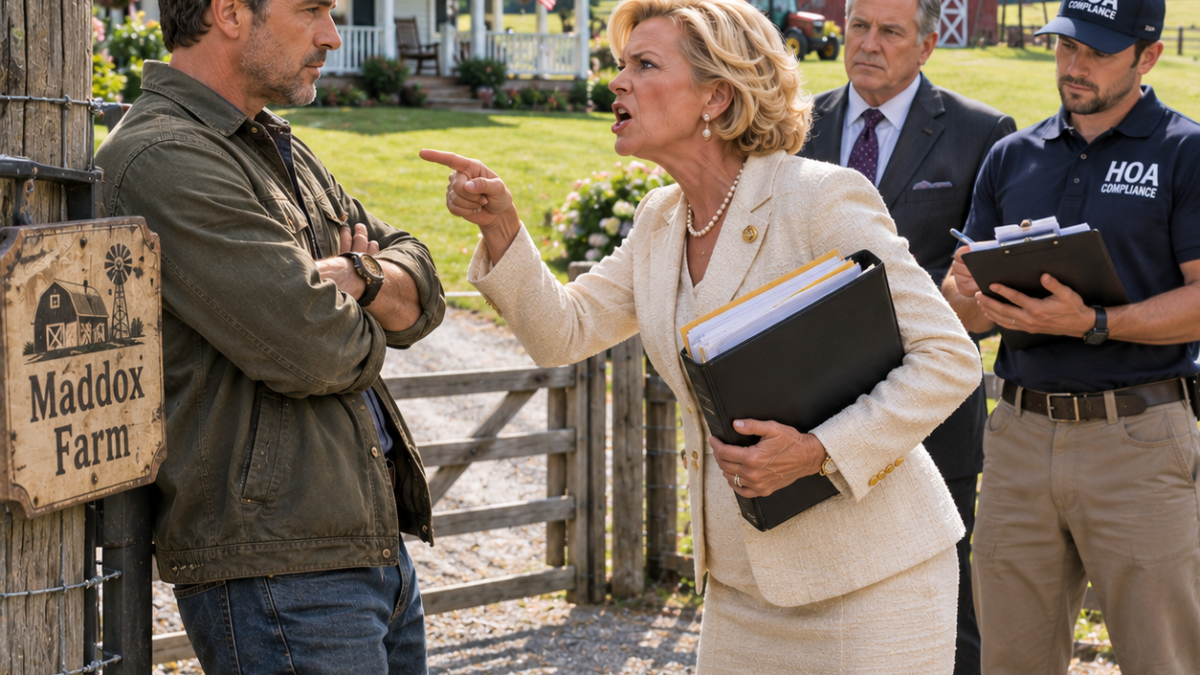
HOA Karen Cut My Farm Gate and Marched Onto My Property—Then Three FBI SUVs Rolled Up and She Learned Who I Really Was
The HOA president marched onto my forty-acre farm with a compliance folder, two witnesses, and an $18,500 lien threat, convinced I was just another homeowner she could intimidate into submission.
What she did not know was that the company name clipped to her inspector’s paperwork matched a shell corporation from a federal fraud case I had spent years trying to solve.
And when she later ordered one of her men to cut the chain on my private gate in front of twenty neighbors holding phones, she still had no idea why three black SUVs were already waiting less than a mile away.
My name is Cole Maddox.
For twenty years, I worked cases involving people who believed money could be made to disappear if they moved it through enough accounts, companies, family members, vendors, and excuses.
Fraud.
Embezzlement.
Asset concealment.
Shell companies.
Fake invoices.
Businesses that existed only on paper.
People who smiled across conference tables while lying about millions of dollars.
By the time I bought the farm, I had grown tired of listening to people explain why money had vanished.
I wanted silence.
Forty acres at the edge of Oak Hollow seemed like exactly that.
White farmhouse.
Weathered barn.
Pasture.
A line of old maples along the southern fence.
Porch facing east.
On the first morning after I moved in, I sat outside before sunrise with coffee and heard nothing but wind moving through grass.
No phones.
No interviews.
No conference rooms.
No fluorescent lights.
Just wind.
That was what I wanted.
Nobody in Oak Hollow knew what I actually did.
As far as most people were concerned, I was a middle-aged man who had bought the old Barlow farm and kept mostly to himself.
That suited me.
My badge stayed inside a safe in the basement.
So did an older government phone I had never bothered throwing away.
I did not plan to need either one.
Eight months after I moved in, I found the first notice taped to my gate.
MONDAY.
7:10 A.M.
I remember the exact time because I had just come back from checking a section of fence near the creek.
The paper was inside a clear plastic sleeve.
Oak Hollow Estates Homeowners Association.
MANDATORY ROUTINE COMPLIANCE INSPECTION.
Property owner required to schedule access to exterior structures and interior areas subject to covenant review.
Failure to preschedule:
$750 administrative fine.
Signed:
Judith Alcott
President
Oak Hollow Estates HOA
I read it twice.
Then a third time.
The amount bothered me less than the language.
It sounded practiced.
Not like someone had written to one homeowner.
Like somebody had been sending versions of that letter for years.
I took it inside.
Made coffee.
Read it again.
My farm sat beside Oak Hollow Estates.
Not inside the developed section.
PART2:
I remembered that from the closing paperwork.
But I had not memorized every covenant.
So I did not assume anything.
Twenty years in investigations had taught me that confidence and correctness were not the same thing.
At three that afternoon, my neighbor Loretta Odell walked up the driveway carrying a pie.
Loretta was seventy-four.
Small.
Gray hair pinned back.
She had lived in Oak Hollow longer than almost anyone.
She held the pie with both hands like she was afraid of dropping it.
“Blueberry,” she said.
“Thank you.”
“I make too many.”
“I’m willing to help with that problem.”
She smiled.
Then saw the HOA notice on my kitchen counter.
The smile disappeared.
“Judith?”
“Yes.”
Loretta looked toward the window.
Then lowered her voice.
“Don’t let that woman into your house.”
I watched her.
“Why?”
“She puts liens on people.”
“For what?”
“Anything.”
She sat.
Her fingers tightened around the edge of the chair.
“The Hendersons lost their place.”
“Over what?”
“Fence.”
“A fence?”
“That’s what started it.”
Loretta shook her head.
“Then fees. Then legal costs. Then more fees. Every time they argued, something else got added.”
“Did they have an attorney?”
“Eventually.”
She looked down.
“Too late.”
I sat across from her.
“What does the HOA spend money on?”
Loretta gave a humorless laugh.
“That’s another question.”
“What do you mean?”
“We pay road assessments.”
“How much?”
“Four hundred extra some months.”
“For roads?”
“Supposedly.”
I had driven through Oak Hollow plenty of times.
Potholes.
Cracks.
Gravel patching.
Nothing that looked like expensive resurfacing.
Loretta looked at me carefully.
“Judith says everything costs more now.”
“Maybe it does.”
“You sound like you believe her.”
“I sound like I don’t know yet.”
That answer seemed to calm her.
Before leaving, she stopped at my door.
“She doesn’t like people asking for paperwork.”
I looked at the notice again.
“That might become a problem.”
Judith arrived Wednesday at exactly ten.
I was on the porch.
She came up the driveway with two men.
Judith Alcott was in her late fifties.
Perfect blond-gray hair.
Navy slacks.
Cream jacket.
Gold earrings.
Expensive shoes that were completely wrong for a gravel farm driveway.
She carried a thick folder against her chest.
Beside her walked a gray-haired man in a charcoal suit.
Behind them came a younger man carrying a clipboard.
His polo read:
OAK HOLLOW HOA COMPLIANCE.
Judith smiled.
“Mr. Maddox.”
“Ms. Alcott.”
“Mrs. Alcott.”
“Mrs. Alcott.”
She glanced toward the barn.
“This should only take five minutes.”
“What should?”
“Our routine compliance inspection.”
“What are you inspecting?”
“General covenant conformity.”
“That’s broad.”
She laughed.
“You’re new.”
“Eight months.”
“You haven’t been through one of these yet.”
“No.”
“That explains the confusion.”
She opened the folder.
“We’ll need access to the barn, exterior improvements, utility areas, and the home.”
I looked at her.
“My house?”
“Yes.”
“Which covenant gives you interior inspection rights?”
The smile changed.
Not gone.
Sharper.
“Mr. Maddox, I don’t think we need to start with hostility.”
“I asked for the rule.”
She looked at the man beside her.
“This is Howard Pembrook, our treasurer.”
Howard nodded.
Barely.
He did not look me in the eye.
Judith indicated the younger man.
“Trent Lawson. Compliance services.”
Trent gave me an awkward half wave.
Judith continued.
“We inspect all properties subject to Oak Hollow standards.”
“Show me the provision.”
She sighed.
Then said something that told me more than she realized.
“I make the rules here, Mr. Maddox.”
Not:
The covenants say.
Not:
The board adopted.
Not:
Our attorney advised.
I make the rules.
Howard kept staring at the gravel.
I noticed.
People who are nervous about conflict look at the ground.
So do people carrying something heavier.
Then my eyes went to Trent’s clipboard.
Behind the compliance checklist was an invoice.
White paper.
Green header.
Only part of it was visible.
GREENLINE PROPERTY SERVICES LLC.
Everything inside me changed.
Not outside.
Outside, I stayed bored.
Slightly annoyed.
Exactly what Judith expected.
Inside, I was standing three years earlier in an FBI field office in Nashville staring at a wall covered with bank records and company filings.
Greenline Property Services LLC.
Invoices for landscaping never performed.
Maintenance contracts without employees.
Payments routed through accounts opened and closed within months.
Addresses that led to rented mailboxes.
Phone numbers that stopped working.
The company had appeared in a larger financial fraud case.
We followed the money for months.
Then lost it.
Greenline became one of the loose ends.
A ghost company with real deposits.
And now its name was clipped to an HOA inspector’s clipboard three feet from my gate.
I looked at Trent.
“Who handles your invoices?”
He blinked.
“What?”
Judith stepped in.
“That’s not relevant.”
I kept my tone easy.
“Just curious.”
“We are here to inspect your property.”
I sighed.
“Not today.”
Her face tightened.
“You are refusing?”
“I said not today.”
“You were properly noticed.”
“I’m asking for the covenant.”
Judith stepped closer.
“You have seven days.”
“For what?”
“Full compliance.”
“And if I don’t?”
She opened the folder.
Pulled out a prepared form.
“An $18,500 lien may be filed against the property.”
I looked at the amount.
Then at her.
“That escalated quickly from seven hundred fifty dollars.”
“You have multiple potential violations.”
“You haven’t inspected anything.”
“We have preliminary observations.”
“From the road?”
“From association records.”
I almost smiled.
Instead, I rubbed my jaw like a tired farmer who wanted everybody to leave.
“Let me think about it.”
Judith mistook patience for surrender.
People like her often do.
She smiled again.
“Good.”
Then leaned slightly toward me.
“You’ll find cooperation is much cheaper.”
She turned.
Howard followed.
Trent walked last.
As he passed, the invoice shifted.
Greenline Property Services.
Invoice total:
$27,600.
I memorized it.
Judith’s heels clicked against the gravel all the way back to her SUV.
She drove away believing she had won.
That night, I went to the basement.
Opened the safe.
Badge.
Credentials.
Old phone.
I turned the phone on.
Battery still held a charge.
One number mattered.
I called.
“Tasha.”
Silence.
Then:
“Who is this?”
“Cole.”
Another pause.
Longer.
“Cole Maddox?”
“Unless somebody stole my phone.”
She laughed once.
Then her voice changed.
“Are you okay?”
“I need you to check something.”
“What?”
“Greenline Property Services LLC.”
Silence.
Not normal silence.
The kind that tells you the answer matters.
“Cole.”
“Yes?”
“Why are you asking about Greenline?”
“It appeared on paperwork at my local HOA.”
“Your HOA?”
“Maybe not actually mine. I’m checking that.”
“What paperwork?”
“Compliance invoice.”
“Who?”
“Oak Hollow Estates.”
Tasha stopped talking.
I knew her well enough to wait.
Finally:
“Don’t call anyone else.”
“That sounds promising.”
“Cole.”
“I’m listening.”
“I’ll call you.”
Tasha Reeves had been my supervisor for six years.
Smart.
Methodical.
Impossible to impress.
Forty-eight minutes later, my phone rang.
“Where are you?”
“Kitchen.”
“Alone?”
“Yes.”
“Good.”
Her voice was tight.
“Oak Hollow is already inside an open investigation.”
I leaned against the counter.
“For what?”
“Reserve fund irregularities.”
“How much?”
“Current estimate?”
“Yes.”
“Two point three million.”
I looked toward the dark window.
“Missing?”
“Diverted, misrepresented, or unsupported.”
“Greenline?”
“One of several vendors.”
“Who controls it?”
“That’s what we haven’t proved.”
“What do you have?”
“Money trail.”
“Intent?”
“Not enough.”
“Direct beneficiary?”
“Not enough.”
I said nothing.
Then Tasha said:
“You may have just put the missing piece in front of us.”
“What do you need?”
“One thing.”
“What?”
“Act normal.”
I smiled.
“I am normal.”
“No, Cole. You’re investigative normal. I need confused farmer normal.”
“That hurts.”
“Don’t reveal yourself.”
“Understood.”
“Don’t threaten them.”
“Understood.”
“Don’t confront Greenline.”
“Understood.”
“Collect what comes to you lawfully.”
I looked toward the safe downstairs.
“You want me operational?”
“I want you observant.”
“Difference?”
“A lot of paperwork.”
I laughed quietly.
Then she said:
“Cole.”
“Yeah?”
“If Judith Alcott is connected, do not give her any reason to change behavior.”
That was the moment the farm stopped being retirement.
The next morning, I drove to the county records office.
I asked for my deed.
Plat.
Subdivision records.
Anything connecting my farm to Oak Hollow Estates.
The clerk found the documents.
Twenty-five minutes later, I was reading the legal description that made me smile.
My forty acres had once been part of a larger tract.
When Oak Hollow was developed, the farm parcel had been explicitly excluded.
Not exempted temporarily.
Not grandfathered under modified rules.
Carved out.
Separate legal parcel.
No HOA membership.
No declaration binding it.
No assessment obligation.
No compliance authority.
Judith had no jurisdiction.
None.
She had threatened an $18,500 lien against property her association had no legal power to regulate.
I copied everything.
Then called an attorney I trusted.
Priya Raman.
Priya handled property and financial litigation.
More importantly, she knew when not to talk too much.
I told her I needed help with a local civil issue and would explain the rest in person.
Before meeting her, I visited Loretta.
She invited me to the kitchen.
Tea.
A plate of cookies.
Then a stack of documents.
“This is what I meant.”
Special assessment.
$400.
Road rehabilitation.
Another.
Road maintenance reserve.
Another.
Infrastructure stabilization.
I looked at the invoice attached.
Greenline Property Services LLC.
Road resurfacing.
$412,000.
I stopped.
“What road?”
“The entrance road.”
“When?”
“Supposedly last year.”
I had driven it that morning.
Potholes deep enough to hold rainwater.
Cracked asphalt.
Gravel thrown into broken edges.
No evidence of recent full resurfacing.
“May I photograph these?”
Loretta hesitated.
“Will Judith know?”
“Not from me.”
She nodded.
Her hands shook slightly.
“If I don’t pay, they’ll put a lien on the house.”
“Who told you that?”
“Judith.”
“In writing?”
Loretta pulled out another letter.
FINAL ASSESSMENT WARNING.
Failure to pay may result in lien enforcement.
Signed:
Judith Alcott.
I photographed every page.
Then drove the Oak Hollow entrance road slowly.
Every pothole.
Every crack.
Every failed patch.
Every shoulder.
Invoice:
$412,000 fresh asphalt and drainage correction.
Road:
obviously not fresh.
I photographed everything.
Then noticed the white SUV behind me.
Two car lengths.
I turned.
It turned.
I slowed.
It slowed.
Pulled into a feed store.
The SUV entered the same lot.
I walked inside.
Seed.
Work gloves.
Mineral blocks.
I was near the fencing aisle when Judith appeared.
Alone.
She walked toward me.
“Mr. Maddox.”
“Mrs. Alcott.”
“You’ve been busy.”
“Buying feed?”
“Taking pictures.”
I picked up a box of fence staples.
“Pretty road.”
Her voice dropped.
“You should be careful.”
“With potholes?”
“With disrespect.”
I looked at her.
She stepped closer.
“People who disrespect me lose their homes.”
I kept my face neutral.
My phone was inside my jacket.
Recording.
“Is that a threat?”
Judith smiled.
“No.”
Then she tilted her head.
“It’s a promise.”
She walked away.
I stayed another five minutes.
Bought the staples.
Saved the recording.
Sent it to Tasha.
Her reply:
Keep acting normal.
That night, at 1:14 a.m., my trail camera sent an alert.
Motion.
Barn.
I opened the feed.
A figure moved inside.
Flashlight.
Duffel bag.
I zoomed.
Trent.
HOA compliance polo gone.
Dark jacket.
Baseball cap.
He carried something heavy from his vehicle into my barn.
Then another.
Barrels.
Rusty.
Metal.
Labels taped to the sides.
HAZARDOUS MATERIAL.
SOLVENT WASTE.
I stared at the screen.
Those barrels were not mine.
Trent moved them against the back wall.
Then took photographs.
That was the part that made everything clear.
He was not dumping waste.
He was manufacturing evidence.
I stepped onto my porch.
From there, I could see a faint light inside the barn.
Every instinct told me to walk down there.
Catch him.
Stop him.
Tasha’s voice came back.
Act normal.
Collect.
Do not interrupt unless safety requires it.
I called her.
She answered on the second ring.
“Tasha.”
“What happened?”
“He’s inside the barn.”
“Who?”
“Trent Lawson.”
“Doing what?”
“Planting barrels marked hazardous waste.”
Silence.
“He photographing them?”
“Yes.”
“Any immediate danger?”
“Don’t know contents.”
“Stay back.”
“Tasha—”
“Cole.”
“I can take him.”
“I know.”
“I can stop this now.”
“No.”
Her voice hardened.
“Let him finish.”
I hated it.
“What if there’s something dangerous in those drums?”
“We’ll get a team ready. Don’t open them.”
I watched Trent photograph the last barrel.
He left at 1:29.
Tasha said:
“Perfect.”
I stared at the phone.
“Perfect?”
“He just turned your private-property dispute into evidence fabrication and trespass on camera.”
At sunrise, I photographed the barrels from a safe distance.
Did not move them.
Did not touch seals.
Priya arrived at eight-thirty.
Gray sedan.
Black portfolio.
She watched the trail footage twice.
Then read the property plat.
Covenants.
HOA notices.
Lien threat.
Greenline invoices.
Finally she looked at me.
“Cole.”
“Yes?”
“She has no jurisdiction over this farm.”
“I know.”
“Her agent entered private property in the middle of the night.”
“Yes.”
“Appears to have placed material here.”
“Yes.”
“Then photographed it.”
“Yes.”
“And she has already threatened a lien.”
“Yes.”
Priya stared at me.
“You have terrible luck with retirement.”
“So I’ve been told.”
She wrote one letter.
Short.
Precise.
My farm was not HOA property.
No inspection rights existed.
No lien authority existed.
No person associated with Oak Hollow was authorized to enter.
All threatened enforcement must cease.
Preserve records.
Do not remove or alter anything connected to the alleged violation.
Priya sent it.
Judith ignored it.
Instead, she escalated.
Certified letters.
Violation notices.
Final compliance warnings.
Then a neighborhood Facebook post.
POLLUTION CONCERN AT ADJACENT PROPERTY.
She did not initially use my name.
Later she did.
Residents of Oak Hollow should be aware that Mr. Cole Maddox has refused inspection of suspected hazardous materials that may threaten neighboring properties.
A photograph appeared.
One of the barrels Trent had planted.
He had taken it from inside my barn.
Some neighbors stopped waving.
Loretta did not.
She came over carrying another envelope.
“I know those aren’t yours.”
“How?”
“You don’t even store gasoline in the barn.”
Fair.
My fuel tank sat in a permitted enclosure outside.
Tasha called after reviewing the newest letters.
“She’s helping us.”
“Doesn’t feel like it.”
“Every certified mailing tied to a fraudulent scheme matters.”
“She’s accusing me of hazardous waste.”
“We know.”
“I’m becoming unpopular.”
“Survive.”
“How encouraging.”
Then Tasha said:
“Cole, if she’s knowingly using interstate vendors, electronic payment systems, mail, and shell companies as part of the same scheme, every new act can help establish intent.”
“So keep letting her talk.”
“Exactly.”
Judith kept talking.
The night before her seven-day deadline expired, somebody knocked on my front door.
11:36 p.m.
Howard Pembrook.
HOA treasurer.
Gray face.
Shaking hands.
No suit this time.
Just jeans and a windbreaker.
I opened the door.
“Howard.”
“I can’t stay.”
“Then don’t.”
He looked behind him.
“Can I come in?”
I let him.
He stood in my kitchen.
Did not sit.
“I can’t sleep.”
“What happened?”
“She made me sign the checks.”
“Judith?”
He nodded.
“For Greenline?”
His eyes snapped up.
“You know about Greenline?”
“Answer the question.”
“Yes.”
“How much?”
“I don’t know exactly anymore.”
“That’s a bad answer for a treasurer.”
“I know.”
His voice cracked.
“She moved funds between reserve categories. Emergency approvals. Vendor reimbursements. Special projects. Sometimes I refused.”
“What happened?”
“She threatened me.”
“With what?”
“Same thing she threatens everyone with.”
He laughed bitterly.
“Liens. Lawsuits. Accusations. She knew things about board members.”
“Did you personally benefit?”
“No.”
“Can you prove that?”
“I think so.”
He reached into his coat.
Pulled out a small black USB drive.
“Everything.”
“What is everything?”
“Ledgers.”
He put it in my palm.
“Vendor payments.”
Another breath.
“Bank transfers.”
“Emails?”
“Yes.”
“Board minutes?”
“Yes.”
“Greenline?”
Howard finally looked directly at me.
“All of it.”
I closed my fingers around the drive.
“Why bring this to me?”
“I saw what she did to you.”
“You mean the barrels?”
His face changed.
“You know?”
“Howard.”
He looked down.
“She told us she had evidence.”
“She manufactured it.”
He shut his eyes.
“I knew this was coming.”
“What?”
“Not the barrels. Something like it.”
“Why didn’t you stop her?”
“Because I’m a coward.”
I let the silence sit.
Then:
“You came here.”
“That doesn’t erase everything.”
“No.”
He looked relieved that I did not pretend it did.
“What happens now?”
“Go home.”
“What?”
“Act normal.”
Howard stared.
“You sound like—”
“Go home, Howard.”
He nodded.
At the door he stopped.
“Judith watches my house.”
“How do you know?”
“White SUV.”
Same one.
I sent the drive to Tasha through proper channels before midnight.
Her team began reviewing it.
At dawn, my phone buzzed.
Oak Hollow neighborhood group.
MANDATORY SPECIAL BOARD INSPECTION.
Maddox property.
10:00 a.m.
All residents encouraged to attend.
I read it twice.
Judith wanted an audience.
Not enforcement.
Theater.
Humiliation.
Tasha called.
“We saw the post.”
“So did I.”
“Team will be nearby.”
“When?”
“Positioned before ten.”
“Entry?”
“Not until predicate.”
“She plans to cross my gate.”
“Maybe.”
“Her notice says inspection.”
“We need a clear overt act.”
I looked toward the barn.
“Trent already trespassed.”
“Correct.”
“So why wait?”
“Because today may connect Judith directly to the conduct in front of witnesses.”
I understood.
“Time?”
“Ten-fifteen unless circumstances accelerate.”
I showered.
Put on jeans.
Boots.
Olive field jacket.
Then went downstairs.
Opened the safe.
Badge.
Credentials.
I held them for a moment.
Eight months earlier, I had locked them away because I wanted to stop being Special Agent Cole Maddox every time I looked in a mirror.
That morning, I slipped the badge into the inside pocket of my jacket.
Right over my heart.
Then I walked outside.
At 9:58, cars started arriving.
Judith.
Howard.
Trent.
Two board members.
Twenty or more homeowners.
Phones already recording.
Loretta stood near the rear.
She looked terrified.
Judith walked toward my gate.
Same thick folder.
Same confident smile.
She raised her voice.
“Mr. Maddox.”
“Judith.”
“Today is the final compliance inspection.”
“You received my attorney’s letter.”
“I received an opinion.”
“It says you have no authority here.”
“That is disputed.”
“No.”
I looked at the neighbors.
“It really isn’t.”
Judith opened her folder.
Read aloud.
Eleven violations.
Hazardous materials.
Unapproved agricultural structures.
Drainage.
Fencing.
Access denial.
Nuisance condition.
She finished.
Then looked at me.
“You have sixty seconds before I authorize entry.”
The crowd became quiet.
Even the birds seemed to stop.
I looked at Trent.
Bolt cutters rested against his leg.
Then Howard.
He would not look at Judith.
I looked back at her.
“Last chance.”
She smiled.
“What?”
“Walk away.”
A few neighbors shifted.
I kept my voice calm.
“I’m giving you an opportunity to leave my property alone.”
Judith laughed.
Loud.
Sharp.
“You still think this is your property to control?”
“Yes.”
“It’s subject to Oak Hollow authority.”
“No.”
“Trent.”
He looked at her.
“Cut the chain.”
He froze.
Judith’s expression hardened.
“Now.”
Trent picked up the bolt cutters.
I said:
“Don’t.”
He looked at me.
Then Judith.
Her voice dropped.
“You work for me.”
That did it.
Trent put the jaws around the chain.
Metal tightened.
One hard squeeze.
SNAP.
The sound carried across the driveway.
The chain fell.
Gate swung inward.
Judith stepped onto the gravel.
Heels crunching.
Chin high.
She turned slightly toward the homeowners.
“See?”
She smiled.
“Easy.”
I looked at my watch.
10:12.
Three minutes early.
I said:
“Judith.”
She turned.
“You have just entered private agricultural property after receiving written notice that you have no authority to do so.”
She waved the folder.
“I am the HOA president.”
“And that means what exactly?”
“It means I have enforcement authority.”
“Not here.”
She pointed toward the barn.
“We are inspecting those hazardous materials.”
“No.”
“You admitted they exist.”
“I admitted nothing.”
“Trent saw them.”
I looked at Trent.
His face went white.
Judith continued.
“He documented them.”
“Yes.”
I said it softly.
“He certainly did.”
Something changed in her eyes.
Then I heard engines.
Not loud at first.
Low.
Heavy.
Coming up the road.
People turned.
Three black Chevrolet Suburbans appeared beyond the trees.
One behind another.
Perfect spacing.
Hidden grille lights flashed red and blue.
Nobody spoke.
The Suburbans turned onto my drive.
Stopped.
Doors opened.
Agents stepped out.
Dark suits.
Raid jackets on two.
Tasha from the lead vehicle.
Judith’s smile weakened.
Then disappeared.
“What is this?”
I unzipped my jacket.
Reached inside.
Pulled out the badge.
Held it where she could see.
“Special Agent Cole Maddox.”
Silence.
Not movie silence.
Real silence.
The kind where twenty people suddenly stop breathing at once.
Judith stared at the badge.
Then at me.
Her folder slipped.
Papers scattered across my gravel.
“You’re…”
She stopped.
I lowered the badge.
“Yes.”
“You’re FBI?”
“I am.”
Loretta covered her mouth.
One neighbor whispered something I could not hear.
Judith stepped backward.
“This is intimidation.”
Tasha walked forward.
“Judith Alcott?”
Judith looked at her.
“Who are you?”
“Supervisory Special Agent Tasha Reeves.”
Judith turned toward Howard.
Then Trent.
Then me.
“This is about an HOA inspection.”
Tasha stopped several feet away.
“No.”
Judith’s face changed.
Tasha continued.
“This is about an ongoing federal financial investigation.”
Judith’s breathing quickened.
“I want my attorney.”
“You’ll have that right.”
“What investigation?”
Tasha nodded to another agent.
He stepped forward.
Judith started backing toward the gate.
Tasha said:
“Judith Alcott, you are under arrest.”
The neighbors gasped.
Judith shouted:
“For what?”
Tasha read the charges that had been authorized at that stage.
Wire fraud.
Mail fraud.
Conspiracy.
Embezzlement-related offenses tied to approximately $2.3 million in association funds.
Judith spun toward Howard.
“He did it!”
Howard flinched.
Then stepped forward.
“No.”
His voice shook.
“You did.”
Judith stared.
“You signed every check!”
“You made me sign them.”
“You’re lying.”
Howard looked at the neighbors.
Then at her.
“No.”
He swallowed.
“Not anymore.”
Trent suddenly moved.
Not toward Judith.
Toward his truck.
An agent shouted:
“Stop!”
Trent ran.
Maybe fifteen yards.
Agent Hadley caught him before he reached the gate.
They went down against the grass.
No punch.
No dramatic fight.
Just a short, desperate sprint from a man who knew the barn footage existed.
Judith started screaming.
“This is ridiculous!”
Tasha ignored the volume.
Agents secured her hands.
One neighbor still held his phone up.
Another lowered his completely.
Most had forgotten they were recording.
Loretta walked toward me.
She was crying.
“You’re FBI?”
“Apparently.”
She slapped my arm.
“You let me bring you pie!”
“I liked the pie.”
Then she hugged me.
Hard.
Like I was one of her sons.
Judith saw it.
“Loretta! Don’t believe him!”
Loretta turned.
For the first time since I had known her, the fear was gone from her face.
“I believed you for eight years.”
Judith stopped yelling.
Loretta looked at the handcuffs.
“That was enough.”
The searches began that afternoon.
HOA office.
Greenline records.
Accounts.
Vendor files.
Electronic devices.
Board archives.
The USB Howard gave me became one piece among many.
Important.
Not magical.
Real investigations do not end because someone hands you a flash drive.
They begin asking better questions.
Greenline Property Services turned out to be exactly what we had suspected years earlier.
A shell.
Invoices routed through associated accounts.
Maintenance billed but not performed.
Reserve funds moved into vendor payments.
Some payments passed through layered entities before landing in accounts connected to Judith and people working with her.
The road invoice Loretta showed me was only one example.
$412,000 for resurfacing that had never happened.
Landscaping.
Drainage.
Security improvements.
Emergency maintenance.
Compliance consulting.
Greenline appeared again and again.
So did other vendors.
Some real.
Some inflated.
Some effectively ghosts.
The HOA’s reserve losses and diverted funds were eventually calculated at roughly $2.3 million.
The liens became another part of the investigation.
Judith had used fines and escalating legal threats to pressure homeowners.
Some charges were legitimate assessments tangled together with unsupported penalties.
Others were based on enforcement practices the board had never properly authorized.
The Hendersons’ case was reopened.
So were others.
Priya handled the civil side for several families once the records became public.
Within weeks, a judge entered orders stopping enforcement of fraudulent or unsupported liens pending review.
Eventually, every lien tied to Judith’s scheme was voided.
Loretta came to my porch the day Priya received the first major order.
Priya read part of it aloud.
Not theatrically.
Just enough.
Invalid assessments.
Improper enforcement.
Release of specified liens.
Loretta stood beside my porch rail.
“What does that mean?”
Priya smiled.
“It means the homes listed here are safe from these claims.”
Loretta stared at her.
“Mine?”
“Yes.”
She sat down.
Then cried.
Not the frightened tears I had seen at her kitchen table.
Relief.
I went inside.
Got tissues.
When I came back, she was laughing at herself.
“I hate crying in front of lawyers.”
Priya said:
“I bill extra for that.”
Loretta laughed harder.
That was the first time I had heard her laugh without looking toward the road first.
Howard cooperated fully.
That did not erase his conduct.
He had signed checks.
He had remained silent too long.
He had watched Judith scare people.
But he also preserved records.
Brought them forward.
Testified.
Accepted responsibility for what he had done and failed to do.
His legal outcome reflected that cooperation.
Trent’s situation was harder.
The barn footage was devastating.
Entry after midnight.
Barrels.
Photographs.
Communications recovered later showed the “hazardous waste violation” had been discussed before he entered.
The barrels themselves were handled by a trained team.
They were not some catastrophic toxic threat.
They existed to make a photograph convincing enough to support enforcement.
That was almost worse.
Judith had wanted evidence.
When evidence did not exist, someone created it.
The neighborhood Facebook post disappeared within hours of Judith’s arrest.
Screenshots did not.
Neither did the certified letters.
Tasha had been right.
Judith had mailed, emailed, posted, signed, and documented her own conduct because she believed paperwork was power.
She never imagined paperwork could become evidence against her.
Oak Hollow held an emergency meeting without her.
For the first time in years, homeowners demanded bank records instead of accepting summaries.
They elected an interim board.
Independent accountant.
Outside counsel.
Full forensic audit.
Loretta attended every meeting.
She sat in the front row.
The first meeting after the arrest, somebody suggested creating a committee to “restore community trust.”
Loretta raised her hand.
“What restores trust is showing us the bank statements.”
Nobody argued.
The roads became almost symbolic.
Everybody had paid for them.
Nobody had received them.
Once funds were frozen, traced, and recovery proceedings began, the new board prioritized actual repairs.
The first resurfacing crew arrived months later.
Real company.
Real equipment.
Real asphalt.
Loretta called me.
“You need to come see this.”
“I know what asphalt looks like.”
“No, you don’t understand. They’re actually putting it on the road.”
I drove over.
Fresh black surface.
Steam.
Rollers.
Neighbors standing outside like somebody was building a monument.
Loretta pointed at the crew.
“Four hundred twelve thousand dollars.”
“Hopefully not this time.”
The new treasurer overheard.
“It’s not.”
Good.
Judith fought the charges at first.
Then the records kept accumulating.
Bank transfers.
Greenline files.
Emails.
Vendor links.
Threatening communications.
Lien records.
The barn incident.
Howard’s testimony.
Trent’s statements.
Eventually, Judith entered a plea agreement.
She faced years in federal prison.
Restitution.
Forfeiture.
Financial restrictions.
The exact legal consequences mattered to the people she had harmed.
To me, the more important part came earlier.
The moment everyone stopped believing she could decide reality by putting it on HOA letterhead.
Greenline’s old case finally closed too.
For three years, that company had existed in my mind as an unanswered question.
A name on invoices.
A dead phone.
A mailbox.
A trail that vanished.
Then one Wednesday morning, Trent stood outside my farm holding a clipboard.
Three feet away.
Greenline clipped to the back.
Sometimes investigations break because somebody finds a hidden bank account.
Sometimes because a witness finally talks.
And sometimes because a retired agent buys forty acres and the wrong HOA president decides to perform a “routine inspection.”
I stayed on the farm.
That surprised Tasha.
“You coming back?”
“No.”
“You sure?”
“Yes.”
“You accidentally solved part of an old case from your porch.”
“That does not sound relaxing when you say it like that.”
“You miss the work.”
“Sometimes.”
“Then?”
“I don’t miss needing it.”
She understood.
My badge went back into the safe.
This time, I expected it to stay there.
Priya helped clean up the last civil threats against my property.
The HOA formally acknowledged in writing that the forty-acre farm was not and had never been subject to Oak Hollow’s governing declaration.
No fines.
No inspection rights.
No assessments.
No lien authority.
I framed that letter.
Not because it was beautiful.
Because Judith had once stood on my driveway and told me:
I make the rules here.
Now the association’s own records said otherwise.
Loretta still brought pie.
Not every week.
Enough.
One morning she sat beside me on the porch.
The road beyond my farm had finally been repaired.
“You knew the whole time?”
“Knew what?”
“That she was stealing.”
“No.”
“You knew something.”
“I knew Greenline.”
“And you didn’t tell me.”
“Couldn’t.”
She studied me.
“Was any part of you actually a farmer?”
I looked toward the pasture.
“I own forty acres.”
“That wasn’t my question.”
“I can fix fence.”
“So can I.”
“You’re seventy-four.”
“And?”
Fair.
I smiled.
“Most of what I know about cattle came from books and neighbors correcting me.”
“I knew it.”
“What gave me away?”
“You bought the wrong mineral block the first month.”
I laughed.
“You could have told me.”
“I wanted to see how long it took you.”
“Cruel.”
“You’re FBI. You survived.”
Life became ordinary again.
That was the best part.
Sunrise.
Coffee.
Fence repairs.
Rain.
Tractor that refused to start whenever someone was watching.
Neighbors who started waving again.
Some apologized.
Some did not.
I did not need all of them to.
The people who had treated me like a polluter had been shown a photograph and told it was proof.
Most had no reason to suspect their HOA president was sending someone into a barn after midnight to manufacture that proof.
That did not make every accusation pleasant.
It made them understandable.
The Henderson family eventually received relief from the lien issues connected to Judith’s enforcement practices.
They did not get back every year they had lost fighting.
Courts can restore title.
Money.
Legal status.
They cannot return time.
That stayed with me.
Judith’s power had never really come from covenants.
It came from exhaustion.
She made resistance expensive.
Confusing.
Embarrassing.
She threatened liens.
Sent letters.
Added fees.
Posted accusations.
Brought an audience.
Most people eventually decided peace was cheaper.
That was why she misread me.
Not because I was FBI.
That only changed what happened after I noticed Greenline.
She misread me because I did not panic when she escalated.
She assumed calm meant weakness.
She assumed silence meant fear.
She assumed a man in work boots on a porch had fewer options than a woman with a folder.
The badge made for a dramatic moment.
It was not the thing that beat her.
Records did.
Loretta’s assessments.
The road invoices.
County property documents.
The trail-camera footage.
Priya’s letter.
Howard’s USB.
Greenline’s banking trail.
Judith’s own certified mail.
Her own posts.
Her own signature.
Her own order to Trent.
Her own decision to cut my chain in front of twenty witnesses after receiving written notice that my farm was outside the HOA.
The loudest thing I ever did was probably nothing.
I waited.
At the feed store, I let her talk.
At the barn, I let Trent finish.
At the gate, I gave her one last chance.
Walk away.
She laughed.
Then ordered the chain cut.
The sound of those bolt cutters stayed with me longer than the sirens.
SNAP.
That was the exact moment Judith Alcott stopped being able to call what she was doing a misunderstanding.
Months after everything ended, I replaced the chain.
Same gate.
Better lock.
Loretta watched from the road.
“You expecting another inspection?”
“No.”
“Then why the new lock?”
“Tractor store had a sale.”
She shook her head.
“Government answer.”
I finished securing it.
Then walked back to the porch.
Sun was coming up.
The same view I bought the place for.
Pasture turning gold.
Wind through the grass.
Nothing urgent.
No SUVs.
No shouting.
No compliance notices.
I sat down with coffee.
For twenty years, I had chased people who believed financial crimes were clever because they were complicated.
Judith believed something similar about power.
If she hid authority behind enough paperwork, fees, vendors, rules, and threats, nobody would ask whether the authority existed in the first place.
Most people did not.
Until she walked onto the wrong farm.
Not because I was more important than the people she had threatened before me.
I wasn’t.
Loretta’s house mattered as much as mine.
The Hendersons’ home mattered.
Every homeowner who paid assessments expecting roads and received fake invoices instead mattered.
I was simply the person who recognized one name on one invoice.
Greenline Property Services LLC.
That was the loose thread.
Judith pulled everything else apart herself.
The fake inspection.
The lien threat.
The threats in the feed store.
The barrels.
The letters.
The public humiliation attempt.
The chain.
By the time those black SUVs turned onto my driveway, the investigation had already become larger than me.
I sometimes think about the expression on Judith’s face when I opened my jacket.
People who hear the story always focus on that.
The badge.
The silence.
The folder falling from her hands.
But that was not my favorite moment.
My favorite moment came weeks later.
Loretta stood on freshly repaired pavement in front of her house.
A road crew was packing up.
Her lien had been voided.
Her home was safe.
She looked down at the new asphalt.
Then at me.
“You know what’s funny?”
“What?”
“All those years she told us the money was going into the road.”
I nodded.
Loretta tapped the pavement with the toe of her shoe.
“This is the first time I can actually see where it went.”
That was better than an arrest.
Better than a badge.
Better than watching Judith finally lose the authority she had abused.
It was something real replacing something fake.
A road where the invoice said there should be a road.
A safe home where a fraudulent lien had hung over an old woman.
A quiet farm where no HOA had the right to enter.
And me, back on my porch, listening to the one thing I had bought forty acres to hear.
Nothing but wind.








