HOA Karen Cried When I Bought the Lake—Then the Survey Crew Marked Her Backyard
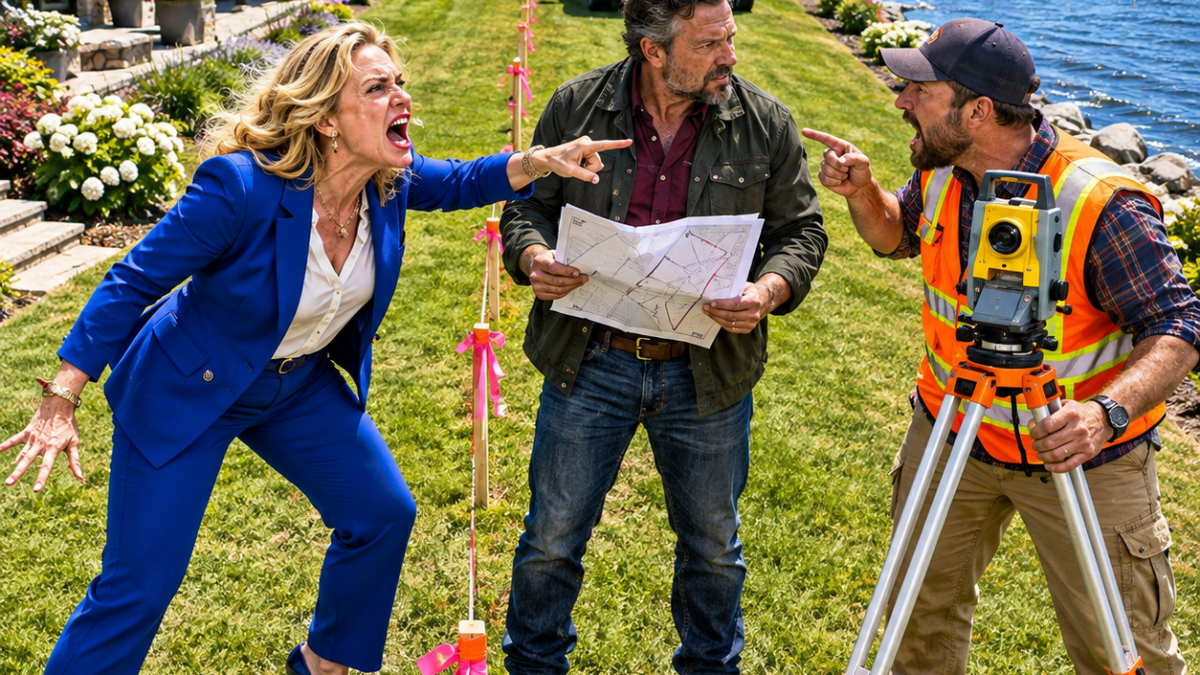
**“YOU CAN’T JUST BUY OUR LAKE, RYAN—PINE VALLEY HAS CONTROLLED THIS WATER FOR EIGHTEEN YEARS, AND I WON’T LET YOU TAKE IT AWAY FROM THIS COMMUNITY!” HOA president Karen Whitmore shouted through tears beside her stone patio less than four hours after the deed was recorded.**
The survey crew ignored the shouting, followed the original Bennett monuments through the trees, and planted bright orange stakes fifteen feet behind Karen’s dock, beside her flower garden, across the middle of her manicured backyard, and finally toward the pool house she had spent years believing sat entirely on her deeded property.
Then Thomas Reed checked one buried monument again, looked toward Karen’s retaining wall, and quietly told me, “Ryan, her backyard isn’t the biggest problem”—because the line we were following did not stop at her lawn, and somewhere beneath Pine Valley Estates were signs that somebody had been changing far more than property maps.
I never planned to own a lake.
That sounds strange considering how much trouble I eventually went through to protect one, but it is true.
My name is Ryan Mercer.
I ran a small construction and property-maintenance company about forty minutes from Cedar Lake.
Most of my days were ordinary.
Barn roofs.
Decks.
Rental houses.
Storm repairs.
Fence work.
Helping older property owners maintain places that had become harder for them to manage alone.
Cedar Lake was one of those places I had known since childhood.
My father first took me fishing there when I was nine.
Back then there were only a few cabins.
An old wooden boat ramp.
A small dam.
Heavy trees around most of the shoreline.
No clubhouse.
No tennis courts.
No stone entrance.
No neighborhood calling itself Pine Valley Lake Community.
The lake belonged to the Bennett family.
Eventually Henry Bennett inherited it.
Henry was in his seventies when I met him again as an adult.
Quiet man.
Patient.
Remembered everyone’s name.
Walked around Cedar Lake most mornings with an old yellow dog named Duke.
After his wife died, the fishing cabin became his main home.
He cared about the lake more than he cared about what it was worth.
That difference matters.
Pine Valley Estates had been built along the eastern and southern sides of Cedar Lake about eighteen years earlier.
More than a hundred expensive homes.
Clubhouse.
Pool.
Walking trails.
Tennis courts.
Some private docks.
The original developer never bought Cedar Lake.
Instead, it signed a recreational agreement with Henry’s father.
Pine Valley residents could fish.
Kayak.
Use certain shoreline access points.
Maintain approved docks.
In exchange, the HOA helped with trash collection, basic dock upkeep and insurance.
The agreement was generous.
It was also clear.
PART2:
Pine Valley could use the lake.
Pine Valley did not own the lake.
It did not own the lakebed.
It did not own the dam.
And it did not own the narrow protected strip of Bennett land that wrapped around large sections of the shoreline.
For years, nobody cared much about the distinction.
Henry liked families using the water.
Residents respected him.
Kids waved when his little fishing boat passed.
If somebody lost a paddle, Henry helped.
If a boat motor died, Henry usually towed them home.
He never acted as though ownership made him more important than the people around him.
Then Karen Whitmore became HOA president.
Karen lived on the south shore.
Huge house.
Swimming pool.
Stone patio.
Outdoor kitchen.
Pool house.
Private dock.
PART2:
Landscaping so perfect it looked professionally photographed every morning.
She was organized.
Confident.
Residents initially liked her.
Contractors worked faster when Karen called.
The entrance looked better.
Common areas stayed clean.
Meetings started on time.
The trouble was that Karen slowly began speaking about Cedar Lake as if Pine Valley owned it.
Newsletters called it:
OUR PRIVATE LAKE.
Signs appeared telling non-residents to stay away.
The HOA started charging additional fees for lake events and certain dock activities.
Henry objected once.
Karen told him those were merely management fees.
“They don’t change your ownership.”
Henry did not enjoy conflict.
So he let a lot of little things go.
One afternoon, after my company repaired his cabin railing, we sat on the porch overlooking Pine Valley.
Henry nodded toward the houses.
“Most people over there are decent.”
“I know.”
“One loud person can make a whole neighborhood look worse than it really is.”
That stayed with me.
Henry never confused Karen with Pine Valley.
That would eventually keep me from making the same mistake.
The first serious boundary problem happened when Pine Valley widened a walking trail.
Workers cleared brush beyond the area allowed under the recreational agreement.
Henry stopped them.
The supervisor checked his plans.
According to the HOA map, the land was Pine Valley common property.
Henry brought out his deed.
The crew apologized and moved back.
Karen was furious.
She called Henry and accused him of interfering with a community improvement project.
Henry told her:
“You can improve your property all you want.”
Then:
“You cannot improve mine without asking.”
Karen said the boundary had been “understood differently” for years.
Henry answered:
“A boundary doesn’t move because somebody understands it differently.”
Not long after that, Karen tried to buy Cedar Lake.
First offer:
$600,000.
Henry refused.
Then:
$800,000.
No.
Pine Valley began discussing a special assessment to purchase the lake permanently.
Karen told residents the HOA was “negotiating.”
Henry told me there was no negotiation.
“They keep offering.”
“And?”
“I keep saying no.”
“What if they offer a lot?”
“They already have.”
He was not opposed to money.
He was worried about what Pine Valley wanted to build.
Rental boats.
Larger event facilities.
Expanded shoreline structures.
More commercial activity.
Henry believed the lake would become an amenity first and a lake second.
Age eventually changed his situation.
His knees were bad.
Dam maintenance became harder.
The woods required work.
His daughter wanted him closer to her in Colorado.
Then one afternoon Henry called me to the cabin.
Duke slept beneath the porch table.
Henry poured coffee.
“I’m selling Cedar Lake.”
I assumed Karen had finally reached his price.
“No.”
“Then who?”
He looked at me.
“You.”
I laughed.
Actually laughed.
“Henry, I repair decks.”
“You own rental properties.”
“I don’t own lake money.”
“I’m not giving it away.”
“That’s reassuring.”
He smiled.
Henry was willing to finance part of the purchase over time.
I spent weeks talking with my bank.
Rebecca Hayes, my attorney.
Environmental consultants.
Accountants.
Eventually the impossible became possible.
The sale included:
Cedar Lake.
Lakebed.
Dam.
Henry’s cabin.
Several wooded parcels.
And the old Bennett protected shoreline strip.
That strip was where everything became complicated.
Decades earlier, when Bennett land around the lake had been divided and sold, the family retained a band of property around large portions of the water.
Usually twenty to forty feet wide.
Sometimes much wider where old drainage channels or creek valleys widened.
Homeowners could have dock rights.
Limited licenses.
Walking access.
But unless a later deed specifically transferred the strip, their private lot stopped behind it.
Rebecca warned me before closing.
“The old surveys are messy.”
“How messy?”
“Some modern Pine Valley maps don’t match the recorded Bennett descriptions.”
“What does that mean for the homeowners?”
“We won’t know until Thomas surveys it.”
I hated that answer.
Some residents had expanded lawns.
Gardens.
Patios.
Fences.
Docks.
Possibly structures.
I had no interest in buying Cedar Lake and immediately becoming the man who told a hundred families half their yards were mine.
So before closing, I made one decision.
Pine Valley’s existing normal access would continue for ninety days while everything was reviewed.
Fishing.
Kayaking.
Walking.
Existing docks.
No new construction.
No expansion.
No shoreline changes.
Rebecca put it in writing.
Fair.
Temporary.
Clear.
Karen hated it.
Two days before closing, she called.
“You have no right to buy community property.”
“Henry owns it.”
“Pine Valley has maintained this lake for eighteen years.”
“Under an agreement.”
“That gives us equitable rights.”
“It gives you the rights written in the agreement.”
She then argued Pine Valley had promoted lake access when selling homes.
If Pine Valley had marketed something it did not own, I did not see how that became Henry’s fault.
Or mine.
Still, I told her:
“I’m not closing the lake.”
She ignored that.
Within hours, Pine Valley homeowners received an email warning that an “outside investor” was taking control of their lake.
No mention of Henry’s ownership.
No mention of the ninety-day access agreement.
No mention that I lived less than an hour away.
The message sounded like I planned to arrive with gates, lawyers and bulldozers.
Residents panicked.
An older woman named Laura Collins went to Henry’s cabin crying because she thought her grandchildren would lose the place where they learned to swim.
Henry made tea.
Explained the truth.
Then called me.
I spoke with Laura directly.
“No one is closing Cedar Lake tomorrow.”
“You promise?”
“Yes.”
“Karen said access could disappear immediately.”
“Karen is wrong.”
Laura began telling neighbors to stop panicking.
Frank Wilson, a Pine Valley board member, asked for the actual documents.
Rebecca sent them.
Recreational agreement.
Temporary access extension.
Henry’s deed.
Frank called later.
“The HOA email left out a lot.”
“Yes.”
Karen did not like residents reading source documents.
At the next board meeting, she warned that I might eventually charge enormous lake-access fees.
Technically, future agreements were negotiable.
But I had never said that.
I attended the meeting.
Explained my plan.
Inspect the dam.
Survey boundaries.
Test water quality.
Then negotiate a long-term recreational agreement.
Most residents looked relieved.
Karen asked:
“Are you planning to survey private backyards?”
“If the legal boundary runs through areas being used as backyards, Thomas has to locate it.”
The room became quiet.
Karen leaned forward.
“My backyard is deeded property.”
“I hope it is.”
That made her furious.
But I meant it.
Boundary problems make everybody miserable.
I wanted Thomas to prove the modern maps were correct.
Closing happened Thursday morning.
Henry signed.
Then I did.
Bank transferred the funds.
Rebecca recorded the deed.
By lunchtime, Cedar Lake belonged to me.
Henry handed me an old brass cabin key.
“Take care of it.”
“I will.”
“And don’t become one of those people who thinks owning land means owning everybody around it.”
“I won’t.”
That afternoon I met Thomas Reed and his survey crew.
We began along the southern shore.
Karen was waiting.
“You went through with it?”
“Yes.”
“You actually bought the lake?”
“Yes.”
Her eyes filled.
Real tears.
For a second, I felt sorry for her.
Then she pointed toward me.
“You stole this lake from the community.”
“I bought it from the owner.”
Thomas’s crew began working.
First monument.
Walking trail.
Fine.
Second.
Landscaped drainage area.
Slight discrepancy.
Third.
Eight feet.
Then twelve.
Then eighteen.
As we approached Karen’s property, the disagreement grew.
Her yard sloped beautifully toward Cedar Lake.
Grass.
Flowers.
Pool.
Outdoor kitchen.
Pool house.
Stone retaining wall.
Dock.
The original Bennett deed tied the boundary to old monuments above the seasonal high-water line.
Thomas found one beneath a hedge.
Another beside the garden.
Then orange stakes began crossing Karen’s lawn.
She told him to stop.
Thomas said:
“Mrs. Whitmore, stakes don’t transfer property. They show where the records indicate the line is.”
“This cannot be right.”
“We’ll verify every point.”
One flag went near the pool.
Another beside the pool house.
Then a crew member found an iron pin behind the retaining wall.
Thomas checked it three times.
“If this belongs to the Bennett line, part of the wall crosses the boundary.”
Karen snapped:
“Move the pin.”
Thomas looked at her.
“That is not how surveying works.”
She pointed toward the pool house.
“That building has permits.”
“Permits do not determine ownership.”
Then another monument appeared.
Older.
Bennett parcel number stamped into it.
That monument placed the boundary almost thirty feet farther inland than the modern HOA map.
Rebecca arrived with the certified original subdivision plat.
We spread it across my truck hood.
The protected Bennett strip was right there.
Karen’s private lot stopped behind it.
Her modern backyard did not.
The original house remained safely inside her lot.
Pool came later.
Pool house later.
Patio later.
Landscape expansion later.
Rebecca asked:
“When were these approved?”
Karen did not answer.
Susan Grant, Pine Valley’s community manager, pulled the property file.
Pool expansion approved six years earlier.
Pool house four years earlier.
Both applications contained a newer map showing Karen’s property extending all the way to the lake.
Thomas compared the maps.
On the newer one, the protected Bennett strip had simply disappeared.
Not shifted.
Erased.
Karen blamed the prior management company.
Susan called them.
Their archived map showed the correct strip.
Then she checked who uploaded the revised version used for Karen’s approvals.
Board account.
User:
K. WHITMORE.
Karen went still.
“That was my landscaping committee login.”
Rebecca asked:
“You uploaded this?”
“I uploaded what the contractor gave me.”
“What contractor?”
Karen hesitated.
“My brother-in-law.”
Company:
Whitmore Shoreline Design.
Then Susan searched HOA payments.
Karen’s property was not the only one.
Whitmore Shoreline Design had worked on eleven Pine Valley lakefront homes.
Thomas looked along the shore.
“We need to survey all eleven.”
Karen sat on her stone steps.
That should have been enough trouble for one afternoon.
It was not.
William Parker, one of Thomas’s crew members, found a buried concrete cap behind Karen’s pool house.
Not a boundary monument.
Utility box.
Inside:
Large valve.
Pipe running toward Cedar Lake.
No line appeared on official Pine Valley utility plans.
A faded metal tag did.
PINE VALLEY IRRIGATION INTAKE.
Frank stared.
“Our irrigation is city water.”
Susan agreed.
“It’s supposed to be.”
We followed the line toward the lake.
Behind Karen’s dock, hidden in vegetation, sat a locked metal cabinet.
Inside:
Two industrial pumps.
Running.
Digital controller.
Daily totals.
Not hundreds of gallons.
Not thousands.
Millions.
Thomas stared.
“This is not a backyard sprinkler.”
Karen suddenly said:
“You need to turn those off.”
Thomas reached toward the disconnect.
Then stopped.
“Why?”
Fear replaced her anger.
“Because if you shut those pumps off, you’re going to find out what else they’re connected to.”
That sentence changed the investigation.
For once, Karen’s warning was useful.
Thomas left the system running until a licensed utility engineer could trace it safely.
Laura Bennett arrived before dark.
The pipes crossed Karen’s yard.
Walking trail.
Clubhouse.
One branch fed common irrigation.
Another fed the decorative entrance pond.
Third entered an underground storage tank not shown on fire plans.
Then Laura found another buried system behind the clubhouse.
Filters.
Chemical tanks.
Pumps.
Controls.
Part of the network could send water back toward Cedar Lake.
From Pine Valley’s stormwater basin.
That basin collected runoff from roads, parking lots, roofs and landscaping.
No discharge permit.
No Bennett authorization.
Nothing.
Laura sampled everything.
The county environmental office ordered controlled shutdown and testing.
I did not shut off Pine Valley’s access.
Did not lock docks.
Did not tell residents to leave their backyards.
Thomas continued surveying.
The next eleven properties were far less dramatic than Karen’s.
Most had minor encroachments.
Flower bed four feet over.
Fire pit six feet.
Dock approach slightly outside the private lot.
Jennifer Collins had a stone patio and outdoor kitchen about twelve feet inside the protected strip.
She looked terrified.
“I paid thirty-eight thousand dollars for this.”
“I believe you.”
“The HOA approved it.”
“I believe that too.”
“Am I tearing it out?”
“Not today.”
We created temporary permissions while the investigation continued.
I could have demanded immediate removal.
I also could have created ten enemies before breakfast.
Most homeowners had not altered maps.
They had hired contractors.
Submitted plans.
Received HOA approval.
Paid money.
They believed they were building on their own property.
Punishing them first would have been easy.
Understanding how the problem happened was harder.
We chose harder.
The wrong shoreline map first appeared seven years earlier.
Before Karen became president.
That seemed helpful to her.
Until Thomas compared file histories.
The earliest false map had been created from an old development concept drawing.
Not the final subdivision plat.
Someone had turned a preliminary map into an official-looking boundary map.
Then Pine Valley began using it.
The source account belonged to the old developer office.
Former developer manager William Grant denied creating it.
He pointed out a driveway detail proving it was an early draft.
So the original mistake might actually have begun as sloppy paperwork.
But later behavior was different.
Karen knew official tax maps did not match Pine Valley’s internal map.
She had asked Steven about it.
Archived email:
KAREN: RESIDENTS ASKING WHY HOA MAP DIFFERS FROM TAX MAP.
STEVEN: TAX MAPS ARE OUTDATED. USE OURS.
KAREN: WILL THIS CREATE PROBLEMS?
STEVEN: ONLY IF BENNETT FAMILY PUSHES BOUNDARY.
That was not innocent confusion anymore.
Karen knew there was a conflict.
She kept using the version that benefited Pine Valley.
Then we investigated the hidden pumps.
Fifteen years earlier, during severe drought, Pine Valley’s original developer had received temporary permission from the Bennett family to pump lake water for landscaping.
Ninety days.
One pump.
Maximum daily volume.
Then disconnect.
William Grant remembered doing exactly that.
The modern pumps were only six years old.
Installer:
Whitmore Shoreline Design.
Karen chaired the landscaping committee that approved a $184,000 “irrigation efficiency upgrade.”
The invoice mentioned pumps.
It did not say:
REBUILD PRIVATE CEDAR LAKE INTAKE.
Other committee members said they believed the new system recycled water from Pine Valley’s entrance pond.
Karen said Steven told her old drought rights still existed.
No lawyer had confirmed that.
No board resolution renewed them.
No Bennett permission.
The pump logs showed Pine Valley had removed a staggering amount of water over six years.
Not enough to visibly drain Cedar Lake because the watershed continually replenished it.
But enough to save Pine Valley a great deal of money.
Frank looked at the numbers.
“We owe you.”
“Henry, mostly.”
I called Henry.
Explained everything.
His first question:
“Did it hurt the lake?”
“We don’t think seriously.”
“Fish okay?”
“So far.”
“Then don’t go crazy over money.”
“Henry, they took your water for six years.”
“Be fair.”
That was Henry.
Then environmental testing came back.
Cedar Lake did not show dangerous overall contamination.
Good.
But return water carried elevated fertilizer compounds and traces of road pollutants.
County shut down the return system until proper permits and treatment could be established.
Pine Valley switched irrigation back to city water.
Lawns survived.
The entrance pond dropped slightly.
No disaster.
I thought the worst part might finally be behind us.
Then Thomas moved north.
Four boundary lines matched.
Fifth:
Fence two feet over.
Sixth:
Everything changed.
An original Bennett monument sat almost seventy feet inland from Pine Valley’s modern boundary.
Then another.
And another.
The recorded deed matched them.
The old protected strip widened into a long drainage parcel almost two hundred feet deep.
Pine Valley’s modern map showed it as common property.
Thomas followed the line.
Straight into Pine Valley’s maintenance building.
Susan stared.
“That building is ours.”
Rebecca answered:
“The building may be. The ground under it appears to belong to Ryan.”
The retained Bennett parcel continued.
Under the service road.
Behind the clubhouse.
Across part of the tennis area.
Then under Pine Valley’s main entrance road.
Their only wide connection to the county highway.
Frank looked at me.
I knew exactly what he feared.
I was not going to block residents into their neighborhood.
But another massive title problem had just surfaced.
Then Thomas found fresh scrape marks around one of the old monuments.
The soil had been disturbed.
A chain lay buried underneath.
Thirty feet away, the chain connected to another stone monument lying flat under leaves.
Broken at its base.
Recently.
Someone had removed it.
Karen had followed us.
When she saw the stone, her expression changed.
Recognition.
“You know something.”
“No.”
“You reacted.”
Finally:
“There was a project.”
“What project?”
“Boundary cleanup.”
Thomas looked at her.
“That is not a surveying term.”
Karen admitted Whitmore Shoreline Design had been hired to remove “obsolete markers” that did not match Pine Valley’s current maps.
“How many?”
“I don’t know.”
Susan searched the financial archive.
SHORELINE BEAUTIFICATION AND OBSOLETE MARKER REMOVAL.
Contractor:
Whitmore Shoreline Design.
Payment:
$96,000.
Report:
Twenty-three removed objects.
Wood stakes.
Metal posts.
Four concrete monuments.
Three stone markers.
Disposal location:
Buried on site beneath future community improvement area.
Behind the clubhouse.
Under the tennis courts.
County survey officials joined us before anything was excavated.
Two feet down:
Broken concrete monument.
BENNETT.
Then another.
Then another.
The removed markers came almost entirely from areas where Pine Valley later expanded yards, roads, docks or facilities toward the lake.
One intact stone had even been fitted with a newer metal plate reading:
PINE VALLEY NORTH LINE.
Underneath:
Original Bennett stamp.
Rebecca looked at Karen.
“This was deliberate.”
Karen said she did not know.
Maybe.
Maybe not.
Before we could push further, Pine Valley security called Susan.
Construction equipment at the dam.
Concrete saw.
Excavator.
Karen whispered:
“No.”
I turned.
“What?”
“My brother-in-law said there was one more boundary issue.”
“What issue?”
“The dam.”
Thomas went pale.
Karen said Steven had filed a “corrected dam easement.”
There was no legitimate corrected easement.
Then security reported workers cutting the spillway access wall.
And pulling the original Bennett monument beside the control gate.
Then—
“They’re lowering the lake.”
By the time we reached the dam, Cedar Lake had dropped almost three feet.
Water roared through the release channel.
Excavator beside the control gate.
Concrete saw running.
Crew had paperwork claiming Pine Valley controlled the dam.
County seal.
Emergency authority.
Fake.
Thomas recognized immediately that the engineer’s signature was wrong.
The crew stopped when confronted.
Again—
ordinary contractors relying on documents.
The more dangerous problem was the gate.
Opened far beyond normal maintenance level.
Thomas and I closed it slowly.
Rapid changes could damage the mechanism or downstream channel.
Forty minutes later, the flow finally eased.
Cedar Lake had fallen almost five feet.
Mud exposed.
Docks hanging low.
Residents gathered along the shore.
Karen admitted Steven was involved.
Then another secret surfaced.
Pine Valley North.
A proposed second development north of Cedar Lake.
Ninety-two homes.
Second marina.
Luxury cabins.
Private lake club.
Walking trails.
Potentially millions in added value.
Karen had approved an exploratory planning study.
The Pine Valley board had never been told the real scope.
The development was not even owned by the HOA.
It belonged to:
Pine Valley North Development LLC.
Sole manager:
Steven Whitmore.
Karen’s brother-in-law.
She had been promoting a project she believed would expand Pine Valley.
Steven privately owned the company that stood to profit.
The project’s financial model estimated more than $18 million in additional value if it could guarantee Cedar Lake access.
And outside investors wanted proof that Pine Valley controlled:
Lake access.
Shoreline management.
Dam operations.
Steven gave them proof.
Fake proof.
A ninety-nine-year recreational lease over Cedar Lake.
Fake Henry signature.
Permanent dam-control easement.
Fake.
Exclusive shoreline management agreement.
Fake.
Purchase option allowing Steven’s company to buy Cedar Lake from Henry for $1.8 million.
Also fake.
Henry laughed when I called.
“If I already sold an option for $1.8 million, why would I sell the lake to you?”
Exactly.
Signatures had been copied from real documents.
Timber sale.
Insurance renewal.
Other Bennett paperwork.
Real signatures.
False agreements.
Summit Development Capital had already advanced Steven’s company $260,000 based partly on those documents.
That moved the matter far beyond an HOA argument.
Summit reported suspected fraud.
Prosecutors got involved.
Steven disappeared for a short time.
Karen resigned as HOA president.
Before she did, she came to Henry’s old cabin alone.
No attorney.
No Steven.
No board.
“I owe you an apology.”
“You owe Henry one too.”
“I know.”
She cried again.
Not angry tears.
Embarrassed ones.
“I thought I was protecting Pine Valley.”
“By using maps you knew didn’t match official records?”
She nodded.
“I told myself the old strip didn’t matter because everyone had used the shoreline for years.”
“It mattered.”
“I know.”
“You knew enough then.”
She did not argue.
That mattered.
Karen admitted she wanted Pine Valley North.
More homes.
More members.
Higher property values.
Larger community.
Steven repeatedly told her Cedar Lake was “basically already Pine Valley’s.”
She wanted to believe him.
So every question became easier to dismiss.
Henry’s deed?
Old.
Boundary monuments?
Obsolete.
Bennett shoreline strip?
Confusing.
Missing permits?
Paperwork issue.
No legal dam authority?
Historic use.
Karen had not invented every lie.
But she had accepted every lie that gave her the answer she wanted.
Then she told me:
“Steven has another plan.”
“What plan?”
“I don’t know exactly. He kept talking about the old lakebed.”
Cedar Lake had been created seventy years earlier by damming a natural creek.
Before the lake existed, the valley held several properties.
One narrow old Dawson parcel crossed what became the deepest part of the lake.
The Bennett family had purchased it in 1954.
Clean recorded deed.
No modern claim survived.
But attached to that old deed was a historic easement for Central Valley Water Cooperative.
Old irrigation line.
Long abandoned.
Thomas hired divers.
The ancient underwater intake still existed.
Cracked.
Covered in mud.
Then the diver followed the buried pipe.
Old steel.
Old steel.
Then—
new connection.
Modern bolts.
Modern valve.
New pipe running toward Pine Valley.
Someone had rebuilt part of the abandoned system beneath Cedar Lake.
A modern industrial pump sat inside a steel cage attached to the old structure.
Power cable live.
Pine Valley records contained a $390,000 project:
DEEP WATER RESILIENCE SYSTEM.
Supposedly emergency drought protection.
Karen had signed the payment.
She said Steven told the board it was connected to the entrance pond.
It was not.
The hidden underwater pump discharged north.
Toward Steven’s Pine Valley North development land.
Pine Valley residents had paid for infrastructure serving a private development that did not yet exist.
And the pump could move enough water to lower Cedar Lake noticeably during heavy use.
Steven’s future plans showed three additional intakes.
He intended Cedar Lake to supply construction water, ponds and landscaping for ninety-two new homes.
Without Henry’s permission.
Without mine.
Sheriff deputies found Steven at his company storage yard loading records into a trailer.
Warrants followed.
Inside his office:
Original survey files.
Altered maps.
Fake Bennett documents.
Dam paperwork.
Removed monument records.
Development plans.
Folder:
CEDAR CONTROL.
The strategy was shockingly simple.
Create enough paper showing Pine Valley “control” that any future owner would face years of expensive litigation.
Then negotiate from strength.
One note read:
POSSESSION BECOMES REALITY IF MAINTAINED LONG ENOUGH.
Rebecca stared.
“That is not how deeds work.”
Maybe Steven knew.
Maybe he hoped everyone else didn’t.
Then investigators found:
PLAN B — WATER EVENT.
If ownership was challenged, lower Cedar Lake.
Expose the hidden underwater Pine Valley infrastructure.
Then use that dramatic visual to claim historic control of the water.
That explained the fake dam order.
The crew was not merely changing a wall.
Steven wanted the lake lowered enough to expose infrastructure he had secretly built beneath it.
The five-foot drop had already done part of the work.
Near the northern shore, a concrete structure appeared above the waterline.
Modern.
Much larger than the old intake.
County investigators opened it under warrant.
Inside:
Pump controls.
Meters.
Electrical panels.
Pine Valley North plans.
And a large red valve.
Laura traced it.
The valve did not control water leaving Cedar Lake.
It controlled water returning.
From Pine Valley’s stormwater system.
A second branch came from the maintenance yard.
The maintenance yard sitting partly on my land.
The yard stored:
Fertilizer.
Pool chemicals.
Fuel.
Cleaning compounds.
Landscaping products.
The pipe around one connection carried dark residue.
Then Laura found a handwritten logbook.
Most entries boring.
Pressure.
Pump hours.
Levels.
Then:
NIGHT FLUSH.
Again.
Again.
One entry:
HIGH CONCENTRATION. RUN AFTER MIDNIGHT. LAKE CAN ABSORB.
Nobody spoke.
Environmental technicians found hundreds of dead fish trapped in a shallow northern pool exposed by the lowered water.
Not proof yet.
But enough.
Everybody stayed out of the water.
Then security called.
Someone was moving chemical storage tanks at the maintenance yard.
We arrived to smoke.
One shed burning.
Tanker truck beside the hidden drainage line.
Hose connected.
And Steven Whitmore standing beside the open valve.
He froze when sheriff vehicles entered.
Firefighters secured the scene.
Thomas closed the valve.
Tanker contents:
Industrial wash water.
Fuel residue.
Fertilizer traces.
Pool chemicals.
Maintenance waste.
Material that should have been properly treated or disposed.
Steven had connected it to the line leading toward Cedar Lake.
The fire was contained before it reached the larger fuel area.
Nobody hurt.
That mattered.
Inside a surviving metal cabinet:
Chemical logs.
Pump sheets.
Night flush records.
Fertilizer rinse.
Equipment wash.
Fuel separator discharge.
One category:
MIXED.
The county immediately shut every hidden Pine Valley water connection.
No intake.
No return.
No night flushing.
Lake closed temporarily.
For swimming.
Fishing.
Everything.
I had owned Cedar Lake only weeks and was already watching environmental crews test whether it had been used as a waste-disposal system.
Karen stood outside the maintenance yard.
“I didn’t know about this.”
I believed her.
Not because she had become trustworthy overnight.
Because evidence supported it.
Karen knew about wrong maps.
Knew boundary differences existed.
Knew Pine Valley lacked clear lake rights.
Approved questionable projects.
Trusted Steven far too easily.
But Steven had built something larger behind everyone.
One hidden system gave him three advantages.
Cheap lake water for Pine Valley.
Cheap disposal for maintenance waste.
Infrastructure ready for Pine Valley North.
If he could make the system look old and permanent enough, he could create a story that Pine Valley had always controlled the lake.
The next morning, Pine Valley held its largest meeting ever.
Karen sat in the audience.
Not at the board table.
She had resigned.
Frank read her statement.
She admitted using maps she knew did not match old records.
Admitted approving Whitmore projects without proper legal review.
Admitted supporting Pine Valley North without understanding who really owned it.
Admitted personal trust in Steven influenced her decisions.
She did not admit knowing about illegal waste discharge.
No evidence proved she did.
Then Karen stood.
“I thought I was protecting property values.”
Silence.
“I thought the Bennett boundary rules were old problems we could clean up later.”
She looked at me.
“I was wrong.”
Then:
“Because I wanted the answer to be easy, I kept believing the person who gave me easy answers.”
Probably the most truthful thing Karen ever said.
One resident asked:
“Are you sorry because you got caught?”
Karen paused.
“Maybe part of me is.”
Then:
“But I’m also sorry because people trusted me.”
Not perfect.
Real.
Pine Valley hired independent legal counsel.
Environmental specialists.
Forensic accountants.
No Whitmore vendors.
No family contracts.
No private maps.
No “boundary cleanup.”
The lake remained closed nearly three weeks.
Testing found contamination near the hidden discharge points.
Fertilizer compounds.
Petroleum traces.
Maintenance waste.
Serious enough for remediation.
Not enough to destroy Cedar Lake.
Most of the lake remained within safe environmental ranges.
The worst sediment was removed.
Native shoreline restored.
Hidden pipes sealed.
Underwater pump removed.
Industrial pumps behind Karen’s dock removed.
The lake reopened.
The survey took longer.
Thomas reconstructed the entire boundary using:
Recorded deeds.
Surviving monuments.
Old photographs.
Subdivision plats.
County records.
Verified reference points.
Good news:
Pine Valley had not accidentally built half the neighborhood on my property.
Most homes were safe.
Problems concentrated around the shoreline.
Karen’s pool house and part of the patio.
Several smaller homeowner encroachments.
Maintenance building.
Part of the tennis area.
Service road.
And the main entrance road.
Huge legal problems.
Still fixable.
I met with Rebecca.
Thomas.
Frank.
Susan.
Temporary board.
Frank asked:
“What do you want?”
“No locked gates.”
He relaxed slightly.
“No random demolition.”
More relief.
“No homeowners losing houses.”
Then:
“I want clean agreements.”
Pine Valley purchased a permanent easement for its main entrance road at fair market value.
Not revenge pricing.
Not free.
Maintenance building stayed under a long-term ground lease.
Moving the entire facility would have been stupid.
The small strip beneath the tennis area was sold to Pine Valley.
Homeowner encroachments were handled individually.
Some bought narrow strips.
Some received recorded licenses.
Some moved fences.
Nobody lost a house.
Nobody woke up to bulldozers.
Karen’s parcel was harder.
Pool house crossed deeply into the protected strip.
Removing it would have cost a fortune.
Selling the entire shoreline area would have damaged my conservation goals.
Rebecca found a middle solution.
Karen bought a precisely defined parcel beneath the existing pool house and patio.
Independent appraisal.
Fair value.
No penalty price.
No special discount.
Existing structures could remain.
No future expansion toward Cedar Lake.
No larger dock.
No commercial use.
Protected strip preserved around it.
Karen signed.
Afterward she looked at the last orange stakes.
“I hated those flags.”
“I know.”
“I thought you put them there to scare me.”
“Thomas put them there to show the line.”
“I understand that now.”
The flags disappeared.
Permanent survey monuments replaced them.
Recorded.
Verified.
Harder to erase.
Pine Valley North died.
Summit Development Capital withdrew.
Without fake lake rights, the numbers no longer worked the same way.
The northern landowners could still sell their own property to someone.
Their choice.
But no future developer could advertise Cedar Lake access without negotiating with the lake owner.
Me.
Steven’s legal problems grew.
False Henry signatures.
Fake dam order.
Altered maps.
Removed monuments.
Hidden utility systems.
Misused Pine Valley money.
Summit financing.
Improper disposal.
Tanker incident.
Some allegations changed during prosecution.
Some were negotiated.
Others moved through court.
I stopped attending most hearings.
Justice often moves slower than anger.
That does not mean it is weak.
The evidence did not need emotion.
Recorded deeds.
Server logs.
Payment records.
Pump histories.
Chemical sheets.
Buried survey stones.
False documents.
That was enough.
Karen’s consequences were different.
She had not fabricated every signature.
Had not secretly owned Pine Valley North.
Had not been standing beside the tanker valve.
But she had knowingly used maps that contradicted recorded boundaries.
Approved work without adequate review.
Helped turn an internal fiction into normal HOA practice.
Allowed ambition and trust to replace verification.
She was permanently removed from HOA leadership.
Civil claims followed.
Some settlements.
Legal expenses.
Loss of reputation.
For Karen, that last one hurt deeply.
For years, she had controlled meetings.
Approved projects.
Spoken as Pine Valley’s voice.
Now she was one homeowner.
One vote.
No special authority.
I assumed she would move.
She stayed.
And something unexpected happened.
She began helping with the cleanup.
Not as president.
As a resident.
She helped people locate old property files.
Turned over personal records.
Cooperated with investigators.
Volunteered during shoreline restoration.
Some neighbors forgave her.
Some did not.
Both responses were fair.
An apology does not create an obligation to forgive.
Pine Valley elected Laura Collins president.
The same woman who had once gone crying to Henry because she thought I was going to take away her grandchildren’s lake.
She understood the documents now.
Her first new rule:
No HOA map may be used for property approval unless it matches a recorded survey or licensed surveyor’s work.
Second:
Independent review for contracts involving board members’ families.
Third:
Every water system must appear on official utility plans.
Rules that should have been obvious.
The HOA also stopped calling Cedar Lake:
OUR PRIVATE LAKE.
Official material now said:
PINE VALLEY RESIDENTS ENJOY PERMITTED RECREATIONAL ACCESS TO PRIVATELY OWNED CEDAR LAKE.
Less exciting.
More accurate.
The lake reopened.
Children returned first.
Kayaks.
Fishing poles.
Life jackets.
Then walkers.
Retired couples.
Docks.
Normal life.
Henry came back from Colorado.
Duke rode beside him.
He stood outside the cabin and stared at the water.
“Fish okay?”
“Mostly.”
“Good.”
I told him everything.
He shook his head.
“I should’ve checked more.”
“No.”
“I knew Pine Valley was getting too comfortable.”
“That isn’t the same as knowing what Steven was doing.”
Henry looked at me.
“Silence makes people comfortable too.”
I remembered that.
Kindness without boundaries can become permission in somebody else’s mind.
That does not make kindness wrong.
It means kindness needs clarity.
So I signed a new recreational agreement with Pine Valley.
Twenty years.
Fishing.
Kayaking.
Approved swimming areas.
Existing legal docks.
Reasonable annual fee.
Part of the money went directly toward:
Water testing.
Dam maintenance.
Shoreline restoration.
Habitat work.
No giant profit.
No punishment.
Commercial events required permission.
New docks required review.
No unapproved water withdrawal.
No underground systems.
No discharge.
Ever.
Frank asked whether “ever” could be bold.
Rebecca actually made it bold.
Past lake-water use became another settlement.
Pump logs gave us reasonably accurate figures.
Henry was owed most of the value because the pumping began while he owned Cedar Lake.
I expected him to demand every dollar.
He did not.
He wanted:
Fair compensation.
Legal costs.
Environmental restoration.
Then donated part of his share to a county youth fishing program.
“Why?”
“Children didn’t steal the water.”
That was Henry.
I used much of my own recovery for lake work.
Conservation fund.
Testing.
Dam inspections.
Shoreline stabilization.
Habitat.
If ownership meant anything, it meant responsibility.
Two years later, Pine Valley looked almost identical from across Cedar Lake.
Same homes.
Clubhouse.
Tennis courts.
Green lawns.
Karen’s pool still glittering in the sun.
The difference was mostly invisible.
Deeds were correct.
Easements correct.
Boundary monuments correct.
Utility plans correct.
The HOA finally knew where its land stopped.
That invisible clarity made the place calmer than it had been in years.
No mystery construction crews.
No “obsolete” survey markers.
No hidden pumps.
No night flushing.
No fake dam orders.
No development plans pretending Cedar Lake already belonged to someone else.
One original Bennett monument was preserved near the clubhouse.
Pine Valley installed a plaque.
ORIGINAL BENNETT SHORELINE BOUNDARY
VERIFIED DURING CEDAR LAKE RESURVEY
No accusation.
No names.
Just fact.
Karen avoided the plaque for months.
Then one afternoon I found her standing beside it.
She noticed me.
“I used to think old markers were problems.”
“They can be.”
She smiled.
“Not the way I meant.”
“No.”
She looked across the lake toward her house.
“My pool house is still ugly from this side.”
“It always was.”
She laughed.
First time we had ever laughed together.
We did not become friends.
We also stopped being enemies.
That was enough.
People still tell the story as though the funniest part was Karen crying because I bought Cedar Lake.
It was memorable.
She stood beside an expensive stone patio believing I had somehow stolen a community asset.
Then Thomas started placing orange flags through her yard.
One by the dock.
One beside the flowers.
One across the lawn.
One near the pool house.
Everything Karen believed about her property seemed to collapse within an hour.
But the orange flags were never the problem.
They only showed the problem.
The false maps existed before the survey.
The buried monuments existed before the survey.
The hidden water system existed before the survey.
Steven’s development scheme existed before the survey.
The fake documents existed before I bought Cedar Lake.
The survey merely forced everyone to stop looking at the story they had repeated for years—
and look at the ground.
Property lines do not care who speaks loudest at an HOA meeting.
Water rights do not change because a newsletter says “Our Lake.”
A draft development map does not become a deed because enough people print it.
And repeated use does not automatically become ownership just because nobody complained yesterday.
Henry taught me the part I care about most.
You can protect a boundary without becoming cruel.
You can let children fish.
Keep the entrance road open.
Let homeowners keep safe improvements while documents are corrected.
Sell a small strip at fair value.
Negotiate access.
Help neighbors.
And still say:
“This is mine. Ask first.”
There is nothing hostile about that.
It is respect.
Today, Cedar Lake is still privately owned.
Mine.
Pine Valley residents still use it.
Legally.
Under a clear agreement.
The HOA maintains its own land.
I maintain the lake and dam.
We share information.
When Pine Valley wants to change something near the shoreline, somebody calls.
When I need to perform dam work that affects resident docks, I call them.
Simple.
Boring.
Healthy.
And Karen?
She still lives in the same house.
Her backyard is smaller than she once believed.
The pool house now sits on a parcel she legally purchased from me after the survey.
The orange flags are gone.
Except one.
Karen keeps it in her garage.
She told me that herself.
I asked why.
She looked embarrassed.
“To remind me to check before I assume.”
I could not argue with that.
Because the day I bought Cedar Lake, Karen Whitmore cried like I had taken something from her.
Then the survey crew marked her backyard.
And by the time the final boundary was finished, everyone discovered the truth was much bigger than one pool house, one angry HOA president, or one strip of shoreline.
For years, Pine Valley had been living beside Cedar Lake as if permission and ownership meant the same thing.
They did not.
And once those orange flags went into the ground, nobody could pretend otherwise anymore.








