HOA Karen Claimed My 61-Acre Stone Quarry Was Theirs—Then I Showed the Judge the Deed to Their Own Clubhouse
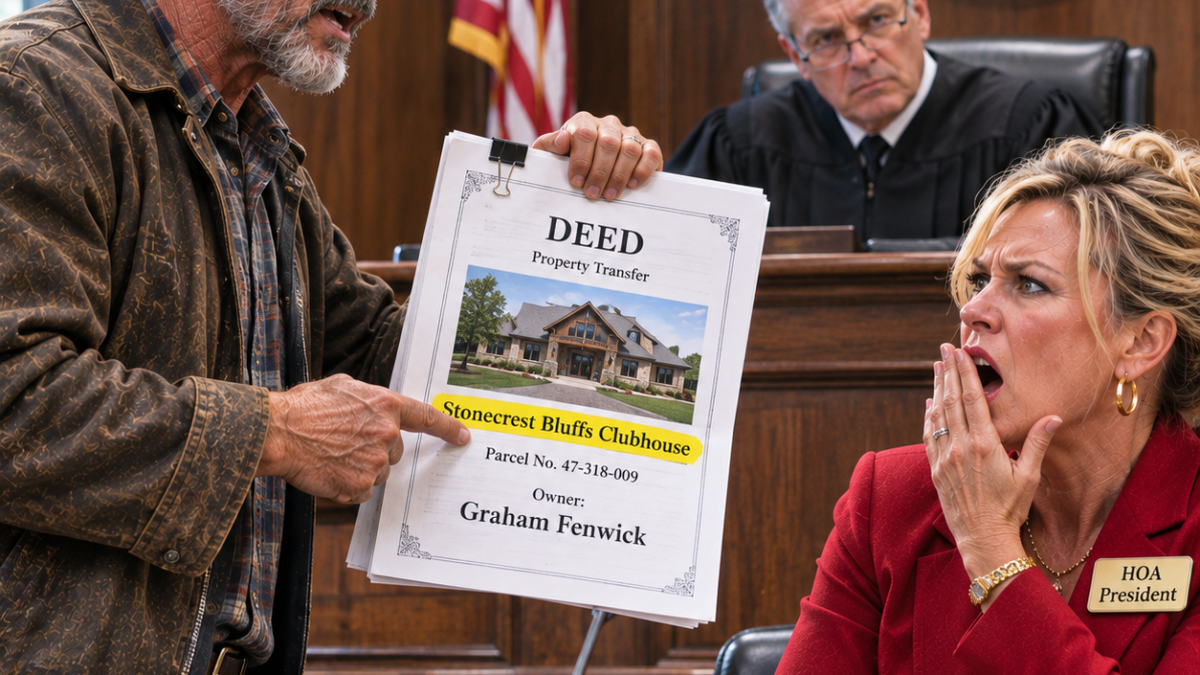
PART2:
My father had known the developer who originally built the subdivision.
Stonecrest and Millstone had existed beside each other for decades without serious trouble.
Then Karen became president.
She had a talent for turning ordinary disagreements into tests of authority.
Wrong mailbox color.
Trash cans left out too long.
Holiday lights one day past the approved date.
I had heard stories.
They meant little to me.
I did not live inside Stonecrest.
Their bylaws had as much authority over my quarry as I had over the wallpaper inside their kitchens.
Or so I thought.
I got out of my truck.
Karen smiled.
Not warmly.
Like someone who had rehearsed the moment.
“Good morning, Mr. Fenwick.”
I looked toward the excavator.
“Why are your trucks blocking my gate?”
She tapped the leather folder against her palm.
“This quarry has belonged to Stonecrest Bluffs for years.”
I waited.
Sometimes if you let somebody hear their own sentence in silence, they realize how ridiculous it sounds.
Karen did not.
“You simply refuse to acknowledge the legal status.”
I looked over my shoulder.
“Sixty-one acres?”
“Yes.”
“Mine?”
PART3:
“Community reserve.”
I almost laughed.
She opened her folder.
Spread a large planning map across the hood of her SUV.
The Stonecrest homes were drawn neatly along the ridge.
Clubhouse near the top.
Walking paths.
Roads.
Drainage.
Below them, the quarry was shaded pale green.
Across the center:
STONECREST COMMON RESOURCE RESERVE.
I stared.
“What is this?”
“Recorded community plan.”
“That isn’t my deed.”
“It supersedes older documents.”
“No.”
Karen looked surprised.
Not because I disagreed.
Because I did it without hesitation.
She pointed toward the quarry.
“You will stop extraction immediately.”
“No.”
“You will surrender the main gate keys.”
“No.”
“Commercial traffic on Stonecut Lane will cease until the association reviews operating rights.”
“No.”
Her mouth tightened.
“Personal equipment must be removed by Friday.”
I looked at her.
“My equipment?”
“The association needs a complete inventory before taking management control.”
Two men wearing Stonecrest security shirts walked into the yard.
One photographed our wheel loader.
The other photographed the crusher.
Then they began placing orange stickers on equipment.
INVENTORY ITEM.
I stepped in front of them.
“Stop.”
The younger guard hesitated.
Karen said:
“Continue.”
I looked at him.
“You put one more sticker on my machine and your employer will be receiving an invoice for removing adhesive from commercial equipment.”
The man looked at Karen.
I said:
“Do not look at her.”
“You’re standing on my property.”
“Leave.”
The guards slowly stepped back.
Karen’s voice turned colder.
“If you resist, the association will ask the court to remove you and seek compensation for every ton of stone illegally extracted from community land.”
That sentence stayed with me.
Not because I believed her.
Because she believed enough in whatever she was doing to threaten me openly.
I looked at her map again.
Something bothered me.
The supposed Stonecrest boundary cut across Stonecut Lane at a strange angle.
No fence.
No monument.
No historical line.
No natural feature.
Land boundaries rarely wander without reasons.
Road.
Creek.
Old grant line.
Survey bearing.
Something.
This one seemed drawn to capture exactly what Karen wanted.
“Where did that line come from?”
She folded the map.
“Association records.”
“Which record?”
“Our legal file.”
“Which deed?”
Karen smiled.
“We possess documents stronger than whatever your family has kept in a filing cabinet.”
That irritated me.
Not because she insulted our records.
Because my father’s filing cabinets had been organized better than most government offices.
I asked:
“Have you ever read the deed to your clubhouse?”
The smile disappeared.
Half a second.
Maybe less.
Then returned.
“What does that have to do with this?”
“I asked a question.”
“The clubhouse title is not relevant.”
“Maybe.”
She closed the folder.
“You have until Friday.”
I looked toward the excavator.
“If that bucket crosses my gate, I’ll treat it as trespass.”
Karen put on her sunglasses.
“You may want to save your energy for court.”
By three that afternoon, her attorney’s filing arrived.
Stonecrest sought an injunction stopping quarry operations across the disputed land.
I read it twice.
Not because it was convincing.
Because it was enormous.
Legal descriptions.
Maps.
References to “community reserve.”
Historical planning documents.
Claims about common ownership.
The filing did not look like bluffing.
That evening, I sat in my office long after the crusher stopped.
My grandfather’s photograph hung above the desk.
Arthur Fenwick in 1959.
Wool jacket.
Work gloves.
Standing beside the first primitive stone saw the quarry ever used.
My father had written beneath it:
FIRST MAN STUBBORN ENOUGH TO THINK THIS WOULD WORK.
I looked out the office window.
Stacked pallets of cut stone.
Loader parked.
Dust settling over the benches.
Karen had not come for a few feet of boundary.
She wanted the entire quarry.
Sixty-one acres.
And she already had lawyers trying to make the claim look old.
Within a week, she attacked the business.
Letters went to three of my largest customers.
STONECREST BLUFFS HOMEOWNERS ASSOCIATION
NOTICE OF DISPUTED QUARRY OWNERSHIP.
The letters warned that stone purchased from Millstone might be subject to litigation because the material was allegedly being removed from property owned by the association.
One general contractor suspended a $180,000 order.
Another customer called.
“Graham, tell me this is nonsense.”
“It is.”
“Can you prove it?”
“Yes.”
“Send me everything.”
That hurt.
Men who had bought stone from us for years suddenly needed proof that we owned the hill beneath our equipment.
I did not blame them.
A contractor could not install thousands of dollars of material on a commercial project while somebody claimed it was stolen stone.
I mailed deeds.
Tax records.
Licenses.
Survey maps.
Then Karen blocked Stonecut Lane.
Portable steel barrier.
Two security guards.
The barrier sat exactly where the haul road left quarry property and ran below the Stonecrest clubhouse toward the county highway.
Karen claimed that stretch belonged to the association.
Commercial trucks now required written approval.
Loaded trucks sat idle.
Drivers waited.
My fourteen workers still got paid.
I refused to make Karen’s stunt their problem.
But payroll did not care whether trucks moved.
Insurance did not care.
Fuel bills did not care.
Equipment leases did not care.
If the blockade lasted, it would bleed the quarry.
I knew what Karen wanted.
Anger.
A dramatic video.
A loader ripping down her barrier.
A shouting quarry owner confronting HOA guards.
Then she could tell eighty-six families:
See?
This is the man stealing your land.
On the third day, she appeared beside the barrier with a man holding a video camera.
I parked twenty feet away.
Got out.
Karen said:
“You’re obstructing association property.”
I took photographs.
Barrier.
Survey marks.
Security trucks.
License plates.
Time.
Date.
I wrote down every delayed order.
Every idle truck.
Every employee hour.
Karen kept talking.
I did not.
Finally she snapped:
“You have nothing to say?”
“Yes.”
“What?”
“I’ll see you in court.”
Then I called Delia Carver.
Delia had represented my company once in a supplier contract dispute.
Early fifties.
Straight black hair.
Voice so calm it made angry people sound foolish.
She listened.
No interruption.
When I finished, she asked:
“Did you move the barrier?”
“No.”
“Touch it?”
“No.”
“Threaten anyone?”
“No.”
“Good.”
She said:
“Do not fight Karen Strickland at that gate.”
“What do I do?”
“Make her explain the gate under oath.”
That sentence became my rule.
Document.
Do not perform.
Record.
Do not retaliate.
Facts first.
Temper later.
That night, somebody called my personal number.
Woman.
Low voice.
“My name is Beatrice Lowry.”
I knew the name.
Stonecrest treasurer.
“What can I do for you?”
“Has Karen ever approached you about selling stone to the association?”
“No.”
“Never?”
“No.”
“Clubhouse project?”
“No.”
Silence.
Then:
“She told us there was an arrangement.”
“What arrangement?”
Another pause.
“I shouldn’t be calling.”
“But you did.”
“I approved an advance transfer.”
“How much?”
“I can’t discuss the accounts.”
“Then why ask me?”
She inhaled.
“Because the paperwork lists projected quarry revenue.”
My chair creaked as I sat straighter.
“Revenue from my quarry?”
“Yes.”
“I’ve never signed anything.”
Beatrice said nothing.
“Who told you I did?”
“I have to go.”
The line disconnected.
The next morning, Delia called.
“Karen filed a supplemental exhibit.”
“What?”
“Recorded document.”
“Deed?”
“Not exactly.”
“What does that mean?”
“It means the map she waved around may not be the real problem.”
The HOA called an emergency homeowner meeting Thursday evening.
Nearly every household attended.
I went with Delia.
The Stonecrest clubhouse sat near the bluff edge.
Stone and glass.
Large deck facing the quarry.
Ironically, much of the exterior stone had come from Millstone decades earlier.
My father sold it to the original developer.
Legal sale.
Paid invoice.
Nobody claimed the quarry afterward.
Karen stood before a projector.
Aerial photographs of my pit behind her.
Loaded trucks.
Cut benches.
Crusher.
She made it look like a crime scene.
“For decades,” she told residents, “private operators have extracted material from land that rightfully belongs to this community.”
Murmurs.
I watched faces.
Confusion first.
Then anger.
Karen clicked to another slide.
Rendering.
Walking trails.
Scenic overlook.
Open-air restaurant.
Landscaped terrace.
The quarry transformed into an amenity.
People began imagining property values.
That is how ownership disputes become emotional.
Do not show people a deed.
Show them what they think they are losing.
Karen said:
“Every truck of stone removed from that quarry is value taken from your homes.”
Several people applauded.
Then the back doors opened.
Delia and I walked in.
Karen’s smile tightened.
She could not easily throw me out after telling everyone I had stolen millions from them.
So she offered:
“Three minutes.”
I stood at the microphone.
No slides.
No accusation.
Three questions.
“Who sold Stonecrest the quarry?”
Silence.
“What price did the association pay?”
Silence.
“Which deed carries the signature of the lawful owner transferring those sixty-one acres?”
Karen stepped forward.
“Those details are part of pending litigation.”
“That is not an answer.”
“Our counsel will address ownership through proper channels.”
“Good.”
“Then I look forward to seeing the deed.”
I stopped.
People expected more.
I gave them none.
Karen immediately changed the subject.
Truck video.
Safety.
Dogs walking near commercial traffic.
Noise.
Dust.
A few homeowners demanded operations stop.
I understood.
Karen could not answer ownership.
So she replaced:
Who owns this?
with:
Who is dangerous?
Fear moved faster.
I thanked them.
Left.
Near the back wall, Beatrice stood without applauding.
As I passed, she pressed an envelope into my hand.
Did not look at me.
Outside under a parking light, I opened it.
Stonecrest HOA resolution.
Clubhouse expansion.
Budget.
Ordinary until page four.
Projected revenue:
QUARRY MATERIAL SALES.
Dated six months earlier.
Six months before Karen first told me Stonecrest owned the quarry.
Delia read it twice.
“She planned the money first.”
I stared at the clubhouse windows.
Then the dark pit below.
“She didn’t discover an old ownership claim.”
“No.”
“She needed one.”
Next morning Delia sent preservation demands.
Emails.
Bank records.
Contracts.
Meeting minutes.
Stone-sale agreements.
Quarry-related communications.
Karen learned Beatrice had spoken to me.
Before lunch, she introduced a motion to remove Beatrice as treasurer.
That told us fear had moved both directions.
Then came the first court hearing.
Judge Meredith Voss.
Sixties.
Precise.
Patient.
Impossible to read.
Stonecrest’s attorney presented the 2011 amended development plat.
Recorded.
Stamped.
Official.
Across Millstone Quarry:
STONECREST COMMON RESOURCE RESERVE.
Their argument was simple.
The quarry had been incorporated into long-term community planning.
Fenwick records were old.
Boundary descriptions imperfect.
My family never objected to the 2011 plat.
Therefore Stonecrest had rights.
Delia submitted my deed.
Tax receipts.
Operating licenses.
Historic surveys.
No transfer from Fenwick.
The HOA lawyer attacked the older boundary calls.
Different coordinate systems.
Aging monument references.
Survey technology.
Judge Voss refused to make a final title ruling.
She froze changes to the disputed area pending a full survey.
Balanced.
Except the most productive quarry bench sat inside the disputed zone.
Our output dropped almost overnight.
Customers got nervous.
One canceled.
Foreman Eli came into my office.
“Do I start warning people?”
“About layoffs?”
“Yes.”
I looked through the glass at the crew.
Dale.
Miguel.
Sasha.
Tommy.
People with mortgages.
Kids.
Medical bills.
“No.”
“How long can we carry everyone?”
“I don’t know.”
“That isn’t an answer.”
“It’s the honest one.”
That night Karen emailed me.
Friendly.
Almost sympathetic.
Stonecrest would purchase whatever “disputed interest” I believed I possessed.
$280,000.
One condition.
Withdraw all objections to the clubhouse expansion.
I printed it.
Delia read.
“Do not answer.”
“I wasn’t going to.”
“Good.”
She hired Wyatt Pike.
Land surveyor.
Almost forty years experience.
Had the personality of a fence post and roughly the same tolerance for nonsense.
He spent a week in archives.
Then another week in the field.
His first result worried me.
“The 2011 plat is genuine.”
I looked at him.
“Meaning?”
“It was properly signed and recorded.”
“So Karen’s right?”
“I didn’t say that.”
“You said the map is real.”
“A real map can still describe somebody else’s land incorrectly.”
He pointed to the strange boundary.
“This line existed before 2011.”
“Where?”
“Older drawing.”
“Whose?”
“Clubhouse transaction.”
He showed me a tiny symbol near the clubhouse parcel.
Not in the legend.
“Reference mark,” he said.
“To what?”
“That’s what I’m trying to find.”
Then:
“I don’t think your father sold the quarry.”
“But?”
“I think somebody has been treating a planning reference as if it were a transfer.”
He asked for everything from the clubhouse construction period.
My father’s files.
Photographs.
Letters.
Road agreements.
I searched boxes that night.
Found invoices.
Correspondence with developer Leland Marsh.
Truck-access discussions.
Stone-supply receipts.
Nothing suggesting sale.
While Wyatt searched paper, somebody began stealing stone.
Night watchman Dale called me at six one morning.
“Boss.”
“What?”
“Trucks last night.”
“What trucks?”
“Not ours.”
Security footage showed two dump trucks entering a strip below the clubhouse.
Loading limestone.
Leaving after midnight.
No company markings.
Judge Voss had ordered neither side to alter disputed ground.
Somebody ignored her.
My first instinct was physical.
Block the trucks.
Park a loader across the route.
Delia’s voice returned.
Make her explain it under oath.
So we set up another camera from undisputed Fenwick land.
License plates.
Times.
Loads.
Every trip.
Delia subpoenaed trucking records.
Bills of lading led to Hensley Ridge Development.
Victor Hensley.
Contractor selected for Karen’s clubhouse expansion.
That was not all.
Geological engineer Leah Brandt inspected the cut.
Soft-spoken.
Methodical.
She crouched near the base of the ridge for nearly an hour.
Measured.
Photographed.
Then looked up at the clubhouse.
“What?”
I asked.
“This rock shelf matters.”
“To the quarry?”
“To the hill.”
The night trucks had taken stone from a natural limestone shelf near the toe of the slope.
Above it sat the clubhouse.
Leah would not exaggerate.
She did not claim immediate collapse.
She said continued removal could reduce lateral support and destabilize terrain.
“Can they keep digging?”
“They shouldn’t.”
“Dangerous?”
“Potentially.”
“Will you write that?”
“I’ll write exactly what the data supports.”
I liked her immediately.
Delia filed to stop further disturbance.
Preserve GPS data.
Delivery tickets.
Extraction records.
Seek damages.
For the first time, Karen was not choosing the battlefield.
She reacted loudly.
Press release.
Stonecrest was “reclaiming community resources from private exploitation.”
I was supposedly sabotaging neighborhood improvements.
Meanwhile, records later showed Karen told Victor to accelerate night hauling.
Move as much stone as possible before the next hearing.
Then Victor called me.
Smooth voice.
Practical.
“Graham.”
“Yes.”
“We should resolve this.”
“Legally?”
“With money.”
“I’m listening.”
“I can pay you enough to stop asking questions about those truckloads.”
I leaned back.
“How much stone did you take?”
“Not enough to matter.”
“It matters to me.”
“You’re looking at the wrong thing.”
“What should I be looking at?”
“What Karen promised the bank.”
Then he hung up.
Delia followed the hint.
Construction financing statement.
Stonecrest HOA borrower.
$3.6 million.
Collateral:
Overlook Clubhouse and its parcel.
The project described in the bank filing was far larger than anything homeowners had approved.
Entertainment complex.
Rooftop restaurant.
Event space.
Glass overlook.
Commercial operations.
Something ambitious.
Expensive.
And partly financed on projected income tied to quarry stone.
Karen needed my limestone.
Not symbolically.
Financially.
Without it, the numbers stopped working.
Wyatt took us into the county recorder’s basement.
Windowless.
Dust.
Bound volumes.
Fluorescent lights.
We searched deeds between 1988 and 2011.
Late afternoon, Delia found the 1994 clubhouse permit file.
Reference:
Deed Book 1187.
Page 442.
Exhibits A–C.
The digital scan had only the typed deed pages.
No exhibits.
Clerk’s note:
Original attachments retained in bound volume.
The HOA attorney tried to stop us from obtaining them.
Called it irrelevant.
Fishing expedition.
Delia answered:
“Your client’s ownership theory depends on a 2011 plat that copied this 1994 boundary.”
“If you want the court to trust the later map, the court should see the original document the map references.”
Judge Voss agreed.
Three days later, an archivist carried the book to the reading table.
Heavy leather binding.
Old paper.
Eleven typed pages.
Exhibit A.
Exhibit B.
Exhibit C.
I saw the signature first.
Leland Marsh.
The developer who sold Stonecrest its clubhouse parcel.
My father knew him.
Worked with him.
Supplied stone.
Never sold him the quarry.
Wyatt examined every bearing.
Every symbol.
Every call.
He became very quiet.
Delia read after him.
Then she became quiet too.
I hated that.
“What?”
Neither answered immediately.
“Is it enough?”
Delia closed the folder.
“It may do more than win the quarry.”
“What does that mean?”
“It means we need to understand the consequences before we use it.”
I did not sleep well.
Karen sensed danger.
New settlement offer arrived within forty-eight hours.
$450,000.
Twenty-four hours to accept.
Release all quarry claims.
Withdraw clubhouse objections.
At that point, cash was becoming a problem.
Contracts delayed.
Payroll heavy.
Production limited.
A year earlier, $450,000 would not have bought the quarry.
But it could have relieved pressure.
That was what Karen counted on.
I told Delia:
“Respond.”
“With no?”
“Three conditions.”
Full disclosure of every financial interest Stonecrest held in quarry extraction.
No confidential settlement hiding third-party transactions.
Immediate stop to all alterations.
Karen rejected all three within an hour.
That speed was an answer.
Night before Karen’s deposition, Delia spread the clubhouse deed across my kitchen table.
She turned to Exhibit A.
Placed her finger beneath one line.
I read.
Then again.
LAND DESIGNATED QUARRY TRACT Q, INCLUDING ALL SURFACE ESTATE, SUBSURFACE ESTATE, MINERAL RIGHTS, STONE RIGHTS, AND APPURTENANT EXTRACTION RIGHTS, IS EXPRESSLY EXCEPTED FROM THIS CONVEYANCE AND REMAINS RESERVED TO ITS LAWFUL OWNER.
I stared at Delia.
“Excepted.”
“Yes.”
“Not conveyed.”
“Yes.”
“The clubhouse deed says they do not own the quarry.”
“Yes.”
I laughed.
Not because it was funny.
Because I had spent weeks answering maps, threats, barriers, and lawsuits while the proof had been sitting inside the deed to Karen’s own clubhouse since 1994.
Then Delia turned to Exhibit B.
Permanent haul-road easement.
Stonecut Lane.
For the benefit of Quarry Tract Q.
The HOA clubhouse property had been conveyed subject to my family’s permanent right to use Stonecut Lane for quarry operations.
Karen had blocked a road her own deed legally required Stonecrest to keep open.
Then Exhibit C.
Delia said:
“This one is why I didn’t celebrate.”
Slope-protection agreement.
One hundred eighty-foot buffer between quarry and clubhouse.
No cutting.
No excavation.
No removal of lateral-support material.
Responsibility for damage caused by unauthorized activity.
I looked at the map.
Night trucks had been digging directly inside that zone.
Karen had not only stolen stone.
She may have endangered the property the bank was holding as collateral.
Then Beatrice called again.
Karen’s allies had removed her as treasurer.
She arrived at Delia’s office carrying a canvas tote filled with records.
Ledger copies.
Bank correspondence.
Budget minutes.
Loan documents.
Email printouts.
She looked exhausted.
“I signed some of these.”
“Which?”
“Transfers.”
“Karen told me they were clubhouse improvements.”
“Were they?”
“Not all.”
The real project was huge.
$3.6 million financing.
Commercial entertainment complex.
Revenue model depended on stone sales and future commercial operations.
No lawful quarry purchase.
No owner agreement.
Karen needed my property to rescue a project she had already pushed too far.
If the bank learned Stonecrest did not own the limestone, projected revenue collapsed.
If the slope was damaged, the clubhouse collateral became a problem.
If homeowners learned the financing exceeded what they had been told, Karen’s political control collapsed.
Everything depended on forcing me to concede.
Victor’s deposition confirmed more.
Delivery tickets.
Night hauling.
Karen instructions.
Then Delia asked:
“Did you ever receive a title report questioning the HOA’s ownership of Millstone Quarry?”
Victor’s lawyer requested break.
When they returned:
“Yes.”
“When?”
“Before substantial excavation.”
“What did the report say?”
“Ownership was unresolved.”
“Yet you removed stone?”
“Under Karen’s direction.”
“So you knew the association’s ownership had not been established.”
“Yes.”
That ended the innocent-mistake story.
Delia kept the clubhouse deed away from reporters.
No public reveal.
No social-media fight.
She wanted Karen under oath first.
At the next hearing, Karen testified.
Cream-colored suit.
Calm.
Judge Voss asked about title.
Delia asked:
“Mrs. Strickland, what document establishes Stonecrest Bluffs HOA’s ownership of Millstone Quarry?”
Karen answered immediately.
“The clubhouse conveyance and the later community development plan establish the association’s rights.”
Delia wrote it down.
No argument.
Next question.
I looked at her.
She whispered:
“She tied herself to it.”
Final title hearing drew a crowd.
Homeowners.
Bank representatives.
Victor’s lawyers.
Quarry workers.
Reporters.
Karen sat at counsel table looking composed.
Judge Voss entered.
Everybody stood.
Delia began with Fenwick title.
My grandfather.
My father.
Me.
Taxes.
Licenses.
Surveys.
No recorded sale.
Then she placed the certified 1994 clubhouse deed before the court.
Judge Voss read.
Eight-point-four acres conveyed to Stonecrest.
Clubhouse parcel.
Grounds.
Specific rights.
Then Exhibit A.
She slowed.
Read the quarry exclusion.
Looked up.
“Counsel.”
Stonecrest’s attorney stood.
“Yes, Your Honor.”
“Do you dispute the authenticity of this deed?”
“No.”
“Do you dispute that Quarry Tract Q is expressly excluded from the conveyance?”
He hesitated.
“No.”
The room changed.
Karen leaned toward him.
Whispered.
Delia said:
“The 2011 planning plat does not convey land.”
“It designates land use.”
“It cannot transfer title that the underlying deed expressly withheld.”
Stonecrest attorney argued later rights might exist.
Judge Voss:
“Produce the deed.”
He had none.
“Purchase agreement?”
None.
“Recorded conveyance?”
None.
“Mineral-right transfer?”
None.
Wyatt testified.
Plain English.
“You can label land ‘community reserve’ on a planning drawing.”
“That does not make the planner the owner.”
He paused.
“Writing your name on someone else’s truck does not transfer title to the truck.”
A few people smiled.
Judge Voss did not.
But she understood.
Wyatt explained the strange symbol.
Reference marker pointing back to Exhibit A.
The line Karen treated as a Stonecrest boundary was never intended to convey Quarry Tract Q.
Then Exhibit B.
Permanent quarry access over Stonecut Lane.
The same road Karen blocked.
Judge Voss turned toward Karen.
“Mrs. Strickland.”
“Yes?”
“Your association accepted its clubhouse land subject to this easement.”
Karen swallowed.
“Our interpretation—”
“The language says permanent right of passage for quarry operations.”
“Our 2011 plan—”
“Is a plan.”
Judge Voss looked at the document.
“This is a deed.”
That sentence ended the road dispute.
Judge Voss ruled Millstone Quarry belonged to me.
Stonecrest failed to prove any ownership interest.
Barrier removed.
Interference prohibited.
Property records preserved for damages.
I exhaled for what felt like the first time in months.
My employees behind me whispered.
Someone squeezed my shoulder.
Then Delia stood.
“One additional matter, Your Honor.”
Karen looked toward her.
Delia placed Exhibit C on the easel.
Slope Protection and Lateral Support Agreement.
One hundred eighty feet.
No cutting.
No excavation.
No weakening.
Responsibility.
Delia said:
“The deed does not merely identify what Stonecrest does not own.”
“It identifies what Stonecrest agreed to protect.”
Leah Brandt testified.
Fresh excavation.
Night hauling.
Rock shelf removed inside protected buffer.
New cracks.
Measurable surface movement.
She did not sensationalize.
That made it worse for Karen.
“Is the clubhouse going to collapse?” Delia asked.
“I cannot say that.”
“Is there sufficient evidence to justify concern?”
“Yes.”
“Would you recommend continued public occupancy without additional evaluation?”
“No.”
“Why?”
“Because material contributing to slope support has been removed in a zone specifically protected from excavation.”
County building safety officials inspected.
Parts of the clubhouse closed temporarily.
Then engineering estimates arrived.
Slope stabilization.
Ground restoration.
Foundation reinforcement.
Potential cost:
More than $2.1 million.
The bank froze the remaining construction loan.
Its collateral was under safety review.
Stonecrest’s claimed stone revenue was now nonexistent because the quarry was legally mine.
Victor faced claims for removed limestone.
Karen faced personal-liability questions.
Her entire financial structure began folding in on itself.
She called an emergency homeowner meeting.
Blamed me.
Claimed decades of quarrying destabilized the slope.
Some believed her.
For several days.
Then Wyatt and Leah compared aerial photographs.
Historic quarry faces.
Survey points.
Night-truck GPS.
Delivery records.
The fresh excavation matched Victor’s recent work.
Not my lawful quarry operations.
Measurements beat speeches again.
I instructed Delia to pursue damages.
Lost contracts.
Blocked road.
Stone removed.
Business interruption.
Land restoration.
But I made one thing clear.
“I do not want eighty-six families paying for Karen.”
Delia looked at me.
“The HOA is a legal entity.”
“I know.”
“Some liability may belong to it.”
“I know.”
“I’m saying separate what the membership legitimately authorized from what she did beyond authority.”
Beatrice helped.
Board minutes.
Votes.
Approvals.
Unauthorized commitments.
Hidden financing.
Who knew what.
When.
The picture became clearer.
Karen had stretched authority far beyond anything homeowners approved.
Not every dollar could be recovered from her.
Not every innocent resident could be insulated from consequences.
But responsibility could be targeted far more fairly than simply dumping the entire disaster onto monthly assessments.
Karen received notice from the bank.
Loan default.
If unresolved, lender could enforce its rights against collateral.
The Overlook Clubhouse.
The building from which Karen had spent months claiming my land.
She tried to take the quarry to protect a clubhouse project.
Now the quarry dispute threatened the clubhouse itself.
The association removed Karen from office.
The vote was not close.
Beatrice sat in the front row.
When results were announced, Karen stood.
“This neighborhood has no idea what it’s doing.”
A man near the back said:
“We know exactly what you did.”
Nobody applauded.
No celebration.
People were too tired.
Karen walked out through the same doors where she had once shown homeowners renderings of restaurants and overlooks built on land she did not own.
The legal fallout continued.
Damages.
Restitution.
Contract claims.
Investigations into loan disclosures.
Victor’s company.
Stone removals.
Misrepresentations.
Karen’s personal role.
No instant ending.
Real cases are rarely clean.
Months.
Negotiations.
Experts.
Insurance.
Eventually Millstone received compensation for documented losses.
The quarry resumed full production.
Customers returned.
The $180,000 contractor restored its order.
Eli stopped asking about layoffs.
Dale complained about night shifts again, which I took as a sign life had normalized.
The clubhouse was harder.
Stonecrest inherited a $3.6 million financing mess and an expensive stabilization problem.
The bank had rights.
Homeowners did not want years of foreclosure litigation.
New board negotiated.
Sale of clubhouse at appraised value.
Proceeds used to address obligations and restructure what remained.
Private homes were never collateral.
Only the clubhouse parcel.
Still, residents were heartbroken.
The Overlook had hosted weddings.
Graduations.
Christmas parties.
Memorials.
Children’s birthdays.
Karen’s choices did not erase those memories.
Then I made an offer.
Delia thought I was joking.
“You want to buy the clubhouse?”
“Yes.”
“Why?”
“Because whoever controls that parcel controls land directly above the protected slope.”
“Graham.”
“I’m serious.”
“You’ve spent a year fighting their HOA.”
“I’m not buying the HOA.”
“I’m buying land.”
That was the point.
Control of the slope.
No future president deciding to cut into it.
No developer promising a glass restaurant over a geological buffer.
Millstone Quarry had recovered.
Credit strong.
Orders restored.
Damages award available as part of negotiated consideration if parties agreed.
I submitted a formal bid.
Not insulting.
Appraised value.
Transparent terms.
Bank reviewed it.
Stonecrest’s new board reviewed it.
After weeks:
Accepted.
Closing day was almost disappointingly ordinary.
Conference room.
Pens.
Title documents.
Wire confirmation.
Delia.
Bank lawyer.
Association representatives.
I signed.
The courthouse deed that once proved Stonecrest did not own my quarry was followed by a new deed showing I now owned the clubhouse parcel.
Karen arrived that morning to collect personal items at a scheduled time.
She saw the deed folder.
Stopped in the doorway.
“You bought our clubhouse.”
“Yes.”
“Just to humiliate me?”
I looked at her.
“No.”
“You expect me to believe that?”
“I bought it because you taught me what happens when the wrong person controls land.”
Her face tightened.
“That building belongs to the community.”
“It belonged to the HOA.”
“You know what I mean.”
“Yes.”
“And I’m going to let the community use part of it again.”
She looked surprised.
“Then why buy it?”
“So nobody digs beneath it in the dark again.”
Karen said nothing.
For once.
She left.
I did not reopen immediately.
First:
Survey.
Geotechnical work.
Slope stabilization.
Drainage.
Foundation checks.
Stone replacement.
No shortcuts.
Leah supervised the ground work.
Wyatt verified boundaries.
County inspected.
When the building was safe, we reopened part of it.
Not as a luxury event empire.
Main hall became a regional stone-and-quarry history exhibit.
Old tools.
Photographs.
Cutting methods.
Samples of limestone.
My grandfather Arthur beside the first bench.
Thomas Fenwick operating a chain saw in 1978.
Invoices showing stone supplied for schools, churches, courthouses, and, yes, the Stonecrest clubhouse itself.
Another room became meeting space.
I signed a written agreement allowing Stonecrest’s new residents board regular access.
Clear schedule.
Clear responsibility.
Clear price.
Mostly maintenance cost.
Beatrice chaired the committee.
No one had to guess what the agreement meant.
That was intentional.
In my quarry office, I framed two documents.
Millstone Quarry deed.
Overlook Clubhouse deed.
Between them:
Karen’s old planning map.
Green shading across my quarry.
STONECREST COMMON RESOURCE RESERVE.
Eli saw it.
“You kept that?”
“Yes.”
“Why?”
“Educational material.”
“You enjoying this too much?”
“Probably.”
He laughed.
Outside my window, loaded trucks rolled down Stonecut Lane.
The barrier was gone.
Permanent easement honored.
Engines steady.
Dust rising.
Exactly as they had before Karen decided a planning label could overpower a deed.
One afternoon, several months after reopening, a Stonecrest resident named Martin Hayes came into the quarry office.
He was one of the men who had demanded I stop operations at the first HOA meeting.
He stood awkwardly near the door.
“Can I talk to you?”
“You’re already doing it.”
He smiled nervously.
“I owe you an apology.”
I waited.
“I believed her.”
“Yes.”
“I thought you were stealing from us.”
“I know.”
“She showed us that map.”
“I saw.”
“And the renderings.”
“Yes.”
Martin looked through the office window.
“My wife and I bought our house because of the view.”
“Good view.”
“Then Karen started saying the quarry was ours.”
“I remember.”
“I wanted to believe her.”
That was honest.
“Of course.”
He looked surprised.
“Of course?”
“Someone tells you there are sixty-one acres of valuable land below your house that you already own?”
“I understand why that sounds good.”
He nodded.
“I signed the petition.”
“I know.”
“I’m sorry.”
“Thank you.”
He waited.
Maybe expecting more.
Forgiveness.
Anger.
Lecture.
I said:
“Next time somebody tells you that you own land, ask for the deed.”
He laughed.
“Fair.”
That became the joke around Stonecrest.
Show me the deed.
Someone proposed repainting a clubhouse room.
“Show me the deed.”
New landscaping.
“Show me the deed.”
One resident printed the phrase on a coffee mug for Beatrice.
She brought me one.
I refused to use it in public.
Privately, I did.
The slope took nearly a year to stabilize fully.
Engineers installed reinforcement.
Rebuilt portions of the limestone toe.
Improved drainage.
Monitoring points.
Survey benchmarks.
The clubhouse never collapsed.
That mattered.
Online versions of the story later claimed I “proved Karen almost sent eighty-six families into a landslide.”
No.
That is not what Leah said.
She said unauthorized excavation created measurable risk requiring evaluation and repair.
Truth was strong enough.
It did not need exaggeration.
Karen had already taught me what happens when people bend facts toward the result they want.
I refused to repeat the method against her.
She lost office.
Lost credibility.
Faced financial and legal consequences based on what evidence supported.
Victor’s company paid for stone and restoration liabilities according to settlement.
The bank recovered what it could.
Stonecrest rebuilt finances slowly.
No giant cinematic prison scene.
No helicopter.
No federal raid.
Just accountability.
Sometimes that is more painful because it lasts.
Karen had to watch the clubhouse she used as the center of her authority pass into my ownership.
She had to watch Millstone trucks use the road she tried to close.
She had to watch residents choose new leadership.
She had to see every claim she made reduced to documents she had either misunderstood, misrepresented, or hoped nobody else would read.
Years later, Wyatt retired.
We held a small lunch at the quarry.
Nothing fancy.
Sandwiches in the scale-house office.
Leah came.
Delia.
Beatrice.
Eli.
Even Judge Voss’s former clerk stopped by, though the judge obviously did not.
Wyatt looked at the framed planning map.
“Still hanging that thing?”
“Yes.”
“Terrible survey drawing.”
“It changed my life.”
“No.”
He took a bite of sandwich.
“The deed changed your life.”
“The drawing just wasted everybody’s time.”
Classic Wyatt.
Before leaving, he tapped the map.
“You know what that symbol was now.”
“Yes.”
A tiny reference notation.
Pointing to Exhibit A.
The clause expressly excluding Quarry Tract Q.
Karen’s map had carried the clue the whole time.
Nobody had bothered to follow it.
That was one of the deepest lessons.
Documents rarely lie on their own.
People misuse them.
The 2011 plat was real.
The planning designation was real.
The lines were copied from something real.
Karen took those true pieces and built a false conclusion.
Therefore:
We own the quarry.
But the older document said the exact opposite.
A map showing future planning cannot magically transfer mineral rights.
A recorded label cannot erase a deed exclusion.
An HOA vote cannot manufacture ownership.
An angry crowd cannot move a survey monument.
And a president saying “community property” often enough does not turn somebody else’s stone into community property.
For decades, I thought property disputes were mostly about where lines sat on the ground.
Karen taught me they can also be about where lines sit in people’s heads.
She convinced herself the quarry should belong to Stonecrest.
That became:
Stonecrest plans for the quarry.
Then:
Stonecrest has rights.
Then:
Stonecrest owns it.
Then:
Graham is stealing from us.
Each sentence moved a little farther from reality.
By the time she stood at my gate with an excavator, she was no longer asking what the records said.
She was using records to decorate a conclusion she had already chosen.
That is dangerous.
Especially when money is involved.
The clubhouse expansion was not evil by itself.
A larger meeting hall?
Fine.
Restaurant?
Maybe.
Overlook?
Could have been beautiful.
The problem was Karen financed the dream with assets she did not control.
Projected stone sales from my quarry.
Then when reality threatened the project, she chose to fight reality.
Block the road.
Scare customers.
Mine at night.
Hide financing.
Silence Beatrice.
Push me toward bankruptcy.
Offer pennies.
It almost worked.
That is the uncomfortable part.
If I had torn down the barrier with a loader, Karen would have had video of an angry quarry owner destroying “community safety equipment.”
If I had accepted $280,000 because cash flow was tight, she would have obtained a release.
If Beatrice stayed quiet, we might not have found the money trail until much later.
If Wyatt stopped at the 2011 plat and treated it as gospel, we might never have opened the 1994 deed book.
If Victor had not told me to look at the bank, maybe we would not have understood the financing pressure.
If Delia had rushed the clubhouse deed into newspapers, Karen might have changed her testimony before tying her own claim to that document under oath.
Small decisions.
That is how cases turn.
Not one heroic moment.
A series of people deciding to check one more thing.
The most dramatic day came after the ownership ruling.
Reporters stood outside the courthouse.
One asked:
“Mr. Fenwick, how does it feel to beat the HOA?”
I hated the question.
“I didn’t beat eighty-six homeowners.”
“You beat their association.”
“No.”
“I proved my deed.”
“Isn’t that the same?”
“No.”
A few months earlier, many Stonecrest residents genuinely believed Karen.
They were wrong.
That did not make them thieves.
Karen used their fear and self-interest.
The distinction mattered because I still had to live below them.
Their rainwater came down the same slope.
Their traffic crossed roads near mine.
Our properties were geologically connected whether we liked each other or not.
You do not fix one reckless leader by declaring war on an entire neighborhood.
So when damages came, I told Delia again:
“Separate Karen from Stonecrest wherever the law allows.”
She did.
Not perfectly.
The HOA still had obligations.
Organizations act through people.
But the new board was not treated like an enemy.
That decision made later cooperation possible.
When I bought the clubhouse, some people expected revenge.
High rent.
Locked doors.
“No HOA Allowed” sign.
I considered that last one for perhaps thirty seconds.
Then Beatrice said:
“Don’t be childish.”
I said:
“You’re getting very comfortable talking to your landlord.”
She laughed.
The main meeting room remained available to residents.
Written agreement.
No ambiguity.
The exhibit hall brought visitors.
School groups.
Local history organizations.
Stone-carving demonstrations.
Eventually, the clubhouse earned modest income honestly.
Not enough for anyone to build a rooftop restaurant.
Enough to cover upkeep.
One Saturday I walked into the exhibit room and found a group of children around the old 1994 deed display.
A boy pointed at Exhibit A.
“What does excepted mean?”
“It means left out.”
“So the HOA bought everything except the quarry?”
“Correct.”
“Then why did they think they owned it?”
I looked through the glass toward the quarry below.
“That’s a long story.”
His teacher laughed.
“We have time.”
So I told the short version.
People read the map.
Nobody read the deed.
The boy frowned.
“That’s dumb.”
Children are brutally efficient.
“Yes.”
“Did the lady go to jail?”
“Not for owning the wrong map.”
He looked disappointed.
Adults teach children to expect dramatic punishment.
Real consequences are different.
Lawsuits.
Debt.
Loss of position.
Repayment.
Reputation.
Years of explaining.
Sometimes those cut deeper.
Then the boy asked:
“Do you own this building now?”
“Yes.”
“And the quarry?”
“Yes.”
“So you won everything?”
I thought.
“No.”
He looked confused.
“I kept what was mine.”
“That isn’t the same thing.”
He did not understand.
Maybe he will someday.
Winning would have meant none of it happened.
No lost contracts.
No blocked trucks.
No sleepless nights.
No employees asking whether to search for work.
No hillside damage.
No clubhouse closure.
No residents learning their money was tied to a project they did not understand.
No lawyers.
No experts.
No ruined friendships.
Restoration is not victory in the pure sense.
It is what comes after damage when people do the best they can with what remains.
That is why I did not enjoy Karen losing the clubhouse as much as people assumed.
By then, the building was not only hers.
It belonged emotionally to people who had wedding pictures there.
Retirement dinners.
Holiday parties.
Children learning to swim in the old pool below.
I had no interest in humiliating them.
Buying it solved a land-control problem.
The irony was unavoidable.
But irony was not the reason.
One evening, almost two years after the first bulldozer appeared at my gate, Karen came to the clubhouse.
Scheduled.
Final box of personal HOA records that still belonged to her.
Beatrice was there.
So was I.
Karen stood in the doorway.
Different woman.
Not physically.
Still composed.
But the certainty was gone.
She looked at the quarry through the big windows.
Trucks moving down Stonecut Lane.
“You kept the road open.”
I almost smiled.
“Your old deed requires it.”
“I know.”
Silence.
Then:
“You think I never read that deed.”
“Did you?”
“Not the exhibits.”
There it was.
Three words.
Not the exhibits.
I stared at her.
“You threatened a sixty-one-acre business without reading three exhibits?”
She looked angry.
Mostly at herself.
“The 2011 plan called it community reserve.”
“It did.”
“Our attorney said the association had rights.”
“Use rights are not ownership.”
“I understand that now.”
I walked toward the window.
“You knew enough to ask.”
“I thought Leland Marsh intended the quarry to become part of Stonecrest eventually.”
“Maybe he did.”
“Intent is not a deed.”
Karen said nothing.
Then:
“The project would have increased every home value.”
“Maybe.”
“You act like I did it for myself.”
“Didn’t you?”
She flinched.
“There were contractor relationships.”
“Financing.”
“Political power.”
“You wanted the clubhouse expansion.”
“Yes.”
“That is not the same as personal theft.”
“No.”
“But when the financing depended on stone you didn’t own, you chose the project over the truth.”
Her eyes moved toward the quarry.
“I thought you would sell.”
“You offered $280,000.”
“You were under pressure.”
“Pressure you created.”
She closed her eyes briefly.
Then said:
“I was trying to save the clubhouse.”
I looked at the ceiling.
The building she nearly lost trying to protect.
“Funny way to save something.”
She almost smiled.
Did not.
Before leaving, Karen stopped near the front door.
“I’m sorry about the road.”
Not the quarry.
Not the letters.
Not the night trucks.
The road.
Maybe that was all she could say honestly.
I answered:
“Thank you.”
Then she left.
I never saw her again.
Years passed.
Millstone continued.
We modernized the wire saw.
Replaced a loader.
Installed a better dust-control system.
Eli eventually became operations manager.
I took more mornings off.
Not many.
I am still a Fenwick.
We distrust leisure.
Beatrice remained involved with the residents committee for several years.
Then she moved to be closer to grandchildren.
Before leaving, she gave me the original canvas tote she used to carry the financial records into Delia’s office.
“What am I supposed to do with this?”
“Frame it.”
“No.”
“Put quarry brochures in it.”
“No.”
She laughed.
Then became serious.
“I almost didn’t call you.”
“I know.”
“I was scared Karen would destroy me.”
“I know.”
“She tried.”
“I know.”
Beatrice looked toward the clubhouse.
“If I had stayed quiet…”
“Someone else might have found it.”
“You don’t know that.”
“No.”
“I don’t.”
She swallowed.
“Thank you for not treating all of us like we were her.”
That meant more than she knew.
“Thank you for making the call.”
We hugged.
Brief.
Awkward.
Stone people are not known for emotional efficiency.
Wyatt died a few years after retirement.
Heart attack.
Sudden.
At his memorial, his daughter displayed photographs from surveys.
Mountains.
Farms.
Roads.
Wetlands.
Quarries.
One photo showed him standing below Stonecrest with a total station.
Me beside him looking irritated.
Caption:
THE CASE WITH THE DEED NOBODY READ.
I laughed in a funeral home.
His daughter said:
“He talked about that one constantly.”
“Why?”
“He loved being right.”
“That sounds like Wyatt.”
She handed me his old field notebook from Millstone.
Inside:
bearing notes.
monument sketches.
Then a line underlined twice:
MAPS SHOW INTENT.
DEEDS SHOW OWNERSHIP.
I keep it in the quarry office.
Not framed.
Some things belong in drawers.
One spring, heavy rain hit western Pennsylvania for four straight days.
Leah called.
“Go check the slope monitors.”
I did.
Everything stable.
Drainage performed.
Reinforcement held.
Clubhouse safe.
Quarry benches fine.
I stood in rain looking up.
That slope had become the physical symbol of the whole dispute.
Two properties.
Different owners.
Connected whether anyone liked it or not.
My quarry supported their hillside.
Their drainage affected my quarry.
The original 1994 deed recognized that.
That was why the buffer existed.
My father and Leland Marsh understood something Karen forgot.
Property rights do not have to mean pretending neighbors are unrelated.
You can own your land completely and still owe care where your choices affect someone else.
That is what Exhibit C really meant.
Not:
The HOA controls the quarry.
Not:
The quarry controls the clubhouse.
It meant:
Neither side gets to destroy the support beneath the other.
That was a better philosophy than anything Karen wrote in her press releases.
Today, Millstone Quarry looks different from the place my grandfather cut.
Larger benches.
Modern equipment.
Safer roads.
Dust systems.
Laser measurements.
But some things remain.
His first drill bit hangs in the office.
Dad’s coffee thermos sits on a shelf.
Completely useless.
I will never throw it away.
Near the scale house is a block of limestone carved with three words:
CHECK THE DEED.
Eli ordered it as a joke.
I pretended to be annoyed.
It stays.
Every time a new driver asks why, somebody tells the story.
Usually wrong.
“Graham stole an HOA clubhouse.”
No.
“Karen accidentally gave him the quarry.”
No.
“The judge gave Graham the clubhouse.”
Definitely not.
I correct them.
I already owned the quarry.
The judge confirmed it.
Later, I bought the clubhouse lawfully when the association and lender chose to sell.
Words matter.
Especially ownership words.
Bought.
Sold.
Conveyed.
Reserved.
Excepted.
Easement.
License.
Collateral.
People use them casually.
Courts do not.
Karen said:
“Our quarry.”
The deed said:
Fenwick.
Karen said:
“Our road.”
The deed said:
Permanent quarry access.
Karen said:
“Our stone.”
The deed said:
Surface and mineral rights reserved.
Karen said:
“Our clubhouse is safe.”
Exhibit C said:
Do not excavate the supporting buffer.
In the end, the old document never changed.
Only who finally read it.
That is the strangest part.
Nothing magical appeared.
No secret will.
No hidden treasure map.
The courthouse did not discover a new law.
The truth had been recorded for decades.
Karen’s entire campaign depended on people reading labels instead of instruments.
COMMON RESOURCE RESERVE.
COMMUNITY PLAN.
HOA PROPERTY.
Words printed on maps.
Signs.
Emails.
Press releases.
Meanwhile, the legally controlling deed sat in a bound book collecting dust.
Once opened, the argument changed.
That is why I remember my first question to Karen.
Have you ever read the deed to your clubhouse?
At the time, I did not know exactly what it contained.
I only knew property stories usually begin farther back than the person shouting loudest wants you to look.
I had no idea the answer would cost her control of the building she used as headquarters.
No idea it would expose the permanent haul-road easement.
No idea it would reveal the slope-protection buffer.
No idea the quarry stone she secretly removed was helping undermine the asset pledged to the bank.
I just knew one thing.
If somebody says they own what your family has held for sixty years, make them show the transfer.
Not a rendering.
Not a planning map.
Not a vote.
Not a letter from an HOA lawyer.
Not a sign beside a bulldozer.
The transfer.
Karen never could.
The first morning, she said I had until Friday to remove my equipment.
Years later, the quarry equipment was still there.
The crusher still rumbled.
Trucks still rolled down Stonecut Lane.
Fourteen employees became sixteen.
Orders grew.
The clubhouse remained on the ridge.
Repaired.
Stable.
Used.
But now its deed sat in my company safe beside the Millstone deed.
Two properties.
Two legal histories.
One hill.
When I look at them, I do not think:
I beat Karen.
I think:
This could have been avoided.
That is the frustrating truth behind most expensive disputes.
Karen could have knocked on my door.
“We want stone.”
Fine.
Ask.
“We want an agreement for trucks.”
Fine.
Negotiate.
“We want to buy land.”
Make an offer.
“We want to expand the clubhouse.”
Show residents the real numbers.
But she wanted the answer before the conversation.
She needed my quarry to fit the project.
So she started treating consent as a delay.
That is when ambition becomes dangerous.
Once you decide the outcome matters more than permission, every boundary starts looking negotiable.
Every document becomes an inconvenience.
Every person saying no becomes an enemy.
Karen called me greedy because I refused to surrender land.
She told eighty-six families I was taking money from them because I continued operating my own quarry.
She blocked the road her deed required her to keep open.
She removed stone from a protected area.
Then when the consequences reached her clubhouse, she blamed the quarry.
That cycle could have continued forever if people had kept believing volume over evidence.
They stopped.
That was the real ending.
Not the new deed.
Not the courthouse ruling.
Not the clubhouse sale.
People started asking:
Where is the document?
Who approved this?
Where did the money go?
What exactly did we vote for?
What exactly do we own?
Those are healthy questions.
They sound distrustful.
They are actually how trust survives.
Blind trust gave Karen enormous power.
Transparent rules rebuilt Stonecrest.
I learned something too.
Being right does not mean you should enjoy everybody else being wrong.
I could have squeezed the HOA after winning.
Closed Stonecut Lane wherever technically possible.
Refused clubhouse cooperation.
Demanded every legal dollar regardless of who paid.
Made the residents feel the cost of having believed Karen.
That would have felt satisfying for a week.
Then I still would have lived below eighty-six angry families on a shared hillside.
Instead, we built clear agreements.
The quarry remained mine.
The clubhouse became mine later through an actual sale.
Stonecrest retained meeting access.
Slope protections strengthened.
Everyone knew the boundaries.
Nobody had to guess.
That is better than revenge.
Less exciting.
More useful.
Sometimes reporters still call around anniversaries of the case.
One asked recently:
“What was Karen Strickland’s biggest mistake?”
I thought she expected:
Blocking the road.
Stealing stone.
Hiding financing.
Misrepresenting ownership.
Those were all mistakes.
But I said:
“She thought paperwork only mattered when it supported her.”
The reporter paused.
“What does that mean?”
“She loved the 2011 plat.”
“Hated the 1994 deed.”
“Loved the clubhouse loan.”
“Hated the slope agreement.”
“Loved the map calling my quarry a reserve.”
“Hated the clause saying it was excluded.”
“That’s not how records work.”
“You don’t get to choose only the pages you like.”
The reporter wrote it down.
Then asked:
“And yours?”
“My biggest mistake?”
“Yes.”
I looked through the office window.
The ridge.
The clubhouse.
The haul road.
“I assumed nobody could seriously threaten land when my family had a clean deed.”
“That was naïve.”
“Ownership does not defend itself.”
People do.
Sometimes slowly.
Sometimes expensively.
Sometimes after a bulldozer is already parked at your gate.
The old planning map still hangs between the two deeds in my office.
Karen’s green shading covers Millstone Quarry.
Under certain light, the map almost looks convincing.
That is why I keep it.
A reminder.
Something can look official and still be wrong.
Something can be recorded and still not mean what someone claims it means.
Something can be repeated by lawyers, boards, contractors, homeowners, banks, and reporters—and still fall apart when one person finally reads the underlying document.
Outside, Millstone keeps working.
Stone comes from the hill.
Cut.
Finished.
Loaded.
Sold.
Legally.
The trucks climb Stonecut Lane beneath the clubhouse.
They pass over a road Karen once blocked and now use an easement her own deed confirms.
Sometimes visitors stand at the clubhouse windows and watch the quarry.
The exhibit inside explains the history.
Fenwicks.
Marsh.
Stonecrest.
The deed.
The dispute.
Not as propaganda.
As record.
One display contains a certified copy of Exhibit A.
The sentence is highlighted:
QUARRY TRACT Q… EXPRESSLY EXCEPTED FROM THIS CONVEYANCE.
Children read it.
Law students read it.
Homeowners read it.
People often laugh at how simple the decisive language was.
That is common in complicated cases.
Months of threats.
Hundreds of pages.
Millions of dollars.
Then one sentence.
The land was never theirs.
Karen marched into Millstone Quarry telling me sixty years of family ownership could be erased because a planning map called the land a community reserve.
She demanded my keys.
Tagged my machines.
Blocked my trucks.
Scared my customers.
Sent crews onto my stone at night.
And forced me into court to prove what my family already knew.
So I did.
Then I handed the judge Karen’s own clubhouse deed.
That deed did more than save my quarry.
It exposed the road easement Karen violated.
It revealed the protected slope her contractor damaged.
It froze the financial scheme built on stone she did not own.
And eventually, when the association could no longer afford to keep the building Karen had used as the center of her power, that same clubhouse came up for sale.
This time, someone actually asked the owner.
This time, there was a real price.
This time, there was a lawful closing.
This time, every page was read.
I bought it.
Not because I wanted Karen’s chair.
Not because I wanted her office.
Not because I wanted eighty-six homeowners bowing to the quarryman below the ridge.
I bought it because she taught me a lesson my grandfather probably already understood.
Never assume land is safe merely because the truth is obvious.
Put the truth in writing.
Record it.
Read it.
Protect it.
And when somebody arrives at your gate claiming your property belongs to them, do not waste your first breath shouting.
Ask the simplest question in the world.
Show me the deed.








