HOA Karen Changed the Locks on My Private Pool and Told Me I Needed “Owner Hours”—So I Drained the Pool Before Her Summer Swim Program Could Start
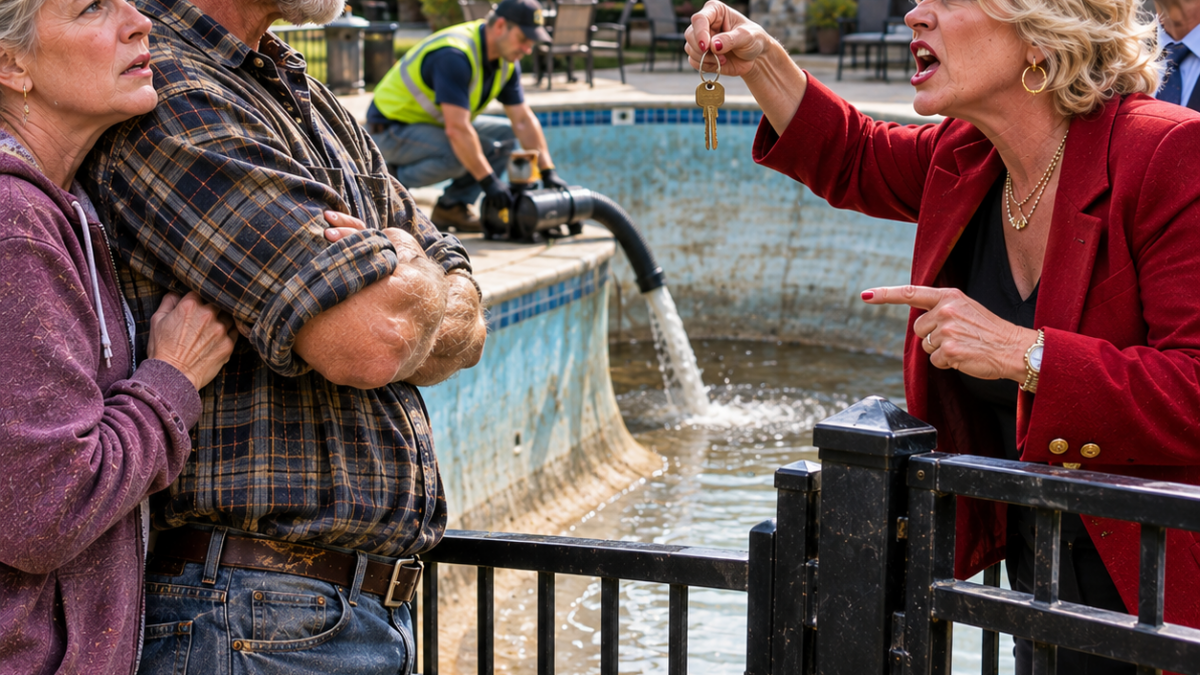
HOA Karen Changed the Locks on My Private Pool and Told Me I Needed “Owner Hours”—So I Drained the Pool Before Her Summer Swim Program Could Start.
The HOA changed the locks on my pool gates on a Thursday afternoon and left my wife standing outside our own fence with her blue exercise belt still hanging on a chair beside the water.
By Saturday morning, their president was shaking a new brass key through the fence and shouting that I had no right to drain a “community facility”—while a professional pool crew I had hired watched the water level fall from a pool I had paid for, permitted, insured, heated, and maintained for twenty-three years.
Then the HOA treasurer arrived carrying a bank letter, and I learned the board had done something far worse than promise my pool to the neighbors: they had listed it as a long-term community swimming amenity in paperwork supporting a loan, using a four-year-old charity agreement that had expired at six o’clock on one Saturday afternoon.
My name is Frank Bennett.
I was sixty-four when my HOA decided the swimming pool behind my garage belonged to everybody.
Not legally.
Not according to the deed.
Not according to the county permit.
Not according to the survey.
But according to Linda Walsh, president of the Willow Creek Homeowners Association, that distinction had apparently become inconvenient.
I spent thirty-eight years maintaining heating systems in public schools.
Boilers.
Circulation pumps.
Air handlers.
Control valves.
The machines nobody thinks about until they stop working in January.
That kind of work teaches you something useful.
Systems do not care what you intended.
A valve is either open or closed.
A pump is either powered or it is not.
Water goes where pressure sends it.
And when something fails, you start with what actually exists instead of what somebody wishes existed.
I wish HOA boards worked the same way.
My wife Diane and I had lived in Willow Creek for twenty-three years.
Our children were still young when we bought the house.
The backyard backed toward the clubhouse lawn, although our lot was separately surveyed and fenced.
The swimming pool came seven years later.
We saved for it.
Not easily.
For almost four years, we put money aside.
Skipped vacations.
Delayed replacing a car.
Did most of the landscaping ourselves.
When the excavation crew finally dug the shell, our daughter stood beside the hole with both arms stretched out as if she had personally engineered the entire project.
Diane took a picture.
PART2:
That photograph eventually became part of the strangest property dispute of our lives.
The pool was not enormous.
Kidney-shaped.
Shallow end near the patio.
Deep end toward the rear fence.
Concrete deck.
Small equipment shed on the side.
A six-foot fence enclosed it.
One gate opened toward our patio.
The other opened toward a narrow service lane beside the clubhouse property.
That second gate existed for practical reasons.
Pool trucks.
Chemical deliveries.
Repair equipment.
Instead of dragging hoses through Diane’s flower beds, workers could stop along the shared service drive and come directly through.
It was convenient.
For years, nobody thought that convenience meant ownership.
Then Linda became HOA president.
Linda Walsh had lived in Willow Creek maybe eight years.
Late fifties.
PART3:
Always dressed as though someone might photograph the board meeting for a business magazine.
She spoke with the confidence of a person who believed confidence itself settled disagreements.
If Linda said something was “community property,” most people did not ask for a parcel number.
If she said something was “required by insurance,” people signed.
If she called something “temporary,” I had learned to ask for an end date.
Eight days before I drained the pool, I walked outside with a leaf net and found a laminated notice taped to my gate.
SUMMER POOL ACCESS SCHEDULE
OWNER HOURS:
MONDAY
WEDNESDAY
FRIDAY
6:00 A.M.–8:00 A.M.
All remaining hours:
ASSOCIATION SCHEDULING.
I stood there for a full minute.
Then called Diane outside.
She came through the patio door in old sandals, one hand resting on the gatepost.
Her knee had been operated on five months earlier.
Recovery was going well, but slowly.
Water walking had become the one exercise she could do without paying for it the rest of the day.
Her blue flotation belt hung over a chair near the shallow end.
She read the notice.
Then again.
“That can’t be serious.”
“It has a start date.”
She looked through the fence.
“Those hours won’t work for me.”
“We’re not asking for better hours.”
She looked at me.
“Good.”
Our house belonged to Willow Creek because we shared the private road and certain neighborhood infrastructure.
The pool did not.
That seemed so obvious I felt ridiculous having to say it.
I called Linda.
She answered immediately.
“Frank, I assume you saw the schedule.”
“I saw something taped to my fence.”
“The board is trying to make access fair.”
“For who?”
“For the residents who’ve asked about summer swimming.”
I looked through the kitchen window.
Diane had taken her exercise belt off the chair and was carrying it inside.
“They can ask.”
Linda paused.
“The association has a recreation shortage.”
“That doesn’t involve my backyard.”
“We’ve discussed community participation before.”
“No.”
“We have records.”
“Then bring them.”
Another pause.
“You want to do this formally?”
“I want to know what makes you think you can schedule my pool.”
She said she would come that evening.
Linda arrived at six with Greg Marshall, the HOA treasurer.
Greg carried a file folder and the expression of a man who had already realized he should have asked more questions.
Linda placed the access schedule on our patio table.
“This is not taking anything from you.”
I laughed once.
“You gave me six hours a week in my own pool.”
“You’ll have protected owner hours.”
“I already have owner hours.”
“All of them.”
Greg opened his folder.
“There was a prior participation agreement.”
I looked at him.
Then I remembered.
Four years earlier, a family in Willow Creek lost their home to a fire.
Not everything.
But enough.
The association organized a fundraiser.
Bake sale.
Auction.
Donation table.
Someone suggested a supervised pool afternoon for neighborhood children.
Diane and I agreed.
One Saturday.
No charge.
The HOA hired a lifeguard.
Managed the guest list.
Paid for cleanup afterward.
We signed a short agreement because there would be dozens of people on our property and insurance mattered.
It had gone well.
People were respectful.
The fundraiser raised money.
I had never regretted it.
Until Greg laid the old agreement beside Linda’s schedule.
I recognized my signature.
“Keep reading.”
Linda said:
“The title clearly says Owner Participation Agreement.”
“Keep reading.”
She ignored me.
So I turned the page toward Greg.
Under the event date was the sentence:
Permission granted under this agreement terminates at 6:00 p.m. on the date of the event.
Greg read it silently.
Then looked at Linda.
She said:
“The point is that the pool has already served the community.”
“So has my driveway when I helped jump-start your car.”
Linda frowned.
“That is not comparable.”
“It’s exactly comparable.”
“One-time permission doesn’t become permanent ownership because you liked using it.”
Diane sat beside me.
“Why now?”
Linda’s face changed.
Only slightly.
But it was enough.
The Willow Creek clubhouse used to have a splash pad.
Small.
Popular with younger children.
Its circulation pump had failed the previous summer.
Then inspection found deeper problems.
Underground plumbing.
Deck damage.
Drainage.
Repair costs climbed.
The board postponed it.
Residents were angry because recreation dues kept being collected.
Linda had apparently promised a summer swimming program before solving the little problem of where that swimming would happen.
Our pool was fifty feet from the clubhouse lawn.
Already built.
Already heated.
Already fenced.
Already insured.
All she needed was for it to become “community.”
“You understand the pressure,” Greg said.
“I understand it perfectly.”
I looked at Linda.
“I’m not agreeing to solve it.”
Before they left, I told them to remove any posted schedule.
Linda said:
“The board will review your concerns.”
“No.”
She stopped.
“It isn’t a concern.”
“It’s a refusal.”
That night I emailed both of them.
Attached:
Full fundraiser agreement.
Page with expiration time.
Statement that we did not consent to any ongoing use.
Then Diane and I found our records.
Pool construction invoice.
County permit.
Survey.
Fence permit.
Insurance.
Photograph of our daughter beside the empty pool shell.
Private residential pool.
Our property.
Our money.
Next morning, I called county building office.
I was not asking them to settle an HOA dispute.
I asked a narrower question.
“Does anything in your records identify my pool as a community or shared facility?”
The clerk pulled the permit.
Private residential swimming pool.
Frank and Diane Bennett.
No amendment.
No later conversion.
She emailed copy.
I sent it to Greg.
He replied:
Received. Will discuss with board.
Linda did not reply.
Two days later, a woman named Susan stopped me near the mailbox.
I knew her by sight.
She lived near the entrance.
“Frank?”
“Yes?”
“My daughter is excited about the swim program.”
I stared.
“What swim program?”
Her smile disappeared.
She pulled out her phone.
Willow Creek newsletter.
SUMMER SWIM REGISTRATION SATURDAY.
There was a photograph of my pool taken from the clubhouse side of the fence.
Families could register.
Receive access cards.
Review schedule.
Children’s sessions.
Family swim.
Adult exercise.
My pool.
Susan looked at me.
“You didn’t agree?”
“No.”
“Oh.”
She looked genuinely embarrassed.
“My little girl has been talking about it all week.”
That made me angrier than Linda’s schedule.
Not at Susan.
At Linda.
She had promised children something belonging to somebody else.
Now when I said no, I looked like the person taking it away.
“I’m sorry.”
Susan shook her head.
“You didn’t do this.”
I asked her to tell the parents she knew not to show up Saturday.
Then I called Mike Turner.
Mike had serviced our pool for years.
He already had an estimate open for repairs.
Worn surface patches.
Minor finish work.
Nothing catastrophic.
We had planned to drain the pool the next month.
I asked:
“Can you move it forward?”
“How far?”
“This weekend.”
Silence.
“What happened?”
I explained.
He did not laugh.
Did not say:
Let’s teach the HOA a lesson.
He asked practical questions.
“Any standing groundwater issues?”
“No.”
“Any structural changes since my last inspection?”
“No.”
“Anybody currently using it?”
“No.”
“Who controls equipment?”
“I do.”
“I’ll inspect before I agree.”
That was exactly why I trusted him.
Emptying a pool at the wrong time or under wrong conditions can damage it.
I was angry.
I was not stupid enough to destroy a pool we owned just to prove we owned it.
Mike inspected.
Said repair could safely move forward.
His company would pump and collect water properly.
No dumping into street.
Rush charge.
New total:
$3,900.
Original scheduled work would have been $3,450.
Extra:
$450.
Diane and I sat at kitchen table.
She asked:
“Are we doing this because the pool needs work, or because you’re angry?”
“Both.”
She nodded.
Good answer, apparently.
“The repairs need doing.”
“And I’m not leaving it full while people are being told they can come swim after we said no.”
Diane looked at estimate.
“Then close it properly.”
“And tell everybody.”
That night I emailed board.
Private pool.
Permission denied.
Professional repairs beginning Saturday.
Pool closed.
No swimming.
No registration.
I named Mike’s company.
Susan helped notify families.
She did not attack Linda online.
She simply forwarded my notice.
Asked people to acknowledge.
That prevented a lot of children arriving in swimsuits.
Then Thursday afternoon Diane called.
I was at hardware store.
“My key doesn’t work.”
“Which key?”
“Pool gate.”
I left cart in aisle.
When I got home, Diane stood beside patio gate holding towel.
New silver commercial lock.
Our key useless.
Clubhouse-facing gate had also been changed.
Taped to fence:
ACCESS CONTROL UPDATED
CONTACT HOA OFFICE
Through fence I could see our old lock lying on a chair.
Beside it:
Diane’s blue exercise belt.
She had left it there the previous day.
I tried key once.
Redundant.
Then photographed:
Lock.
Gate.
Notice.
Old lock.
Exercise belt.
I called Linda.
She answered:
“We had to secure the facility.”
“You locked us out.”
“You announced plans to interfere with the summer program.”
“There is no program here.”
“The board needs time to resolve ownership questions.”
I looked at our house.
Our fence.
The pool I paid to heat every month.
“You don’t create an ownership question by changing a lock.”
She said:
“Do not damage association property.”
I ended call.
Before I said something useful to her and harmful to me.
Mike came that evening.
Equipment shed remained accessible from our side yard.
HOA had changed gates.
Not equipment controls.
But for Mike’s crew to enter safely, we needed legal access restored.
I hired locksmith.
He documented old locks.
Opened our patio gate.
Installed lock controlled by us.
Mike issued written closure:
POOL CLOSED FOR REPAIR
NO SWIMMERS
NO EXCEPTIONS
I sent to board.
Saturday morning, Mike’s crew arrived.
Secured area.
Checked conditions.
Set collection equipment.
Started draining.
By the time Linda appeared, water level was already below the tile line.
She marched across clubhouse lawn holding brass key.
“What are you doing?”
“Repairs.”
“You cannot drain a community facility.”
I held up original pool invoice.
“Then start by explaining why I paid for it.”
She shook key.
“The board has access rights.”
“Show me.”
She pushed folded page through fence.
Owner Participation Agreement.
My signature.
Four years old.
Same fundraiser.
I read expiration.
“This ended at six p.m. four years ago.”
“We are not litigating interpretation in front of contractors.”
“We are discussing it anywhere you claim that paper gives you my pool.”
Then Greg arrived.
Large envelope.
He looked at lowering water.
Looked at Mike’s truck.
Then asked me:
“Did you get the bank letter?”
Linda turned sharply.
“What bank letter?”
Greg froze.
I held out hand.
He slowly removed a page.
Addressed to Willow Creek HOA.
Regarding financing.
I read.
Clubhouse drainage repairs.
Splash pad reconstruction.
Recreation improvements.
Then facilities list.
And there it was.
Replacement swimming amenity:
THE BENNETT POOL.
Long-term owner participation agreement.
I looked from bank letter to expired fundraiser agreement.
Something inside me went very still.
They had not merely advertised my pool to neighbors.
They had represented access to a bank.
“Give me the rest.”
Linda reached.
“That is association business.”
“My pool is listed in it.”
Greg hesitated.
Then handed over envelope.
Bank conditions.
Loan application summaries.
Board notes.
Fundraiser agreement.
One sentence:
Private owner swimming access secured through existing participation agreement.
I read it twice.
Greg pointed to bank letter.
“They’re asking for more proof.”
“Because this isn’t proof.”
Linda crossed arms.
“The board reasonably believed prior participation could be continued.”
“Then why didn’t you ask?”
“We did.”
“And I said no.”
Mike came around truck.
“Everyone needs to step away from equipment.”
Linda turned on him.
“This work is disputed.”
Mike looked at me.
Then property.
“Mr. and Mrs. Bennett hired us.”
“I’ve reviewed ownership documentation.”
“If you have a court order stopping this job, show me.”
She had none.
Linda told Greg to leave.
He waited until she was several steps away.
“Can I have those originals back?”
“I’ll copy first.”
He nodded.
Inside, Diane read bank sentence.
“So when we said no…”
“They already had a problem.”
“How long?”
Board notes answered.
Six weeks earlier, Linda reported:
Neighborhood swim program can utilize existing pool adjacent to clubhouse.
Property owner has history of cooperation.
Written permission being confirmed.
That was before she asked us anything.
She promised access first.
Tried to manufacture permission later.
Board voted to let her prepare summer plan and loan paperwork.
No vote authorized changing locks.
No vote converted property.
I copied everything.
Preserved order.
Returned Greg’s originals.
Outside, water kept falling.
Diane stood beside fence.
Blue belt now in her hand because Mike had retrieved it.
I said:
“I’m sorry.”
She looked at me.
“For what?”
“This.”
She shook head.
“You don’t understand.”
I waited.
“I’m not sorry we closed it.”
“I’m sorry this is what closing our own pool had to become.”
She looked at belt.
“I had a good thing here.”
That hurt more than Linda.
I had been focused on title.
Fence.
Authority.
Money.
Diane had been focused on whether she could walk tomorrow without pain.
“I’ll find another place while repairs are happening.”
She nodded.
Didn’t pretend that fixed it.
By late afternoon pool was empty.
Mike showed worn finish.
Real repairs.
Real reason.
He secured fence.
Nobody could fall in because of confusion.
That evening I made two columns.
Column one:
Normal repair costs.
$3,450.
Column two:
Dispute-caused costs.
Rush fee $450.
Locksmith.
Legal later.
Diane asked:
“What are you doing?”
“If somebody reimburses us, I’m not charging them for repairs we already needed.”
She pulled chair beside me.
“Good.”
Next morning Susan came.
She brought cancellation notice.
Most families had seen it.
Then:
“Two families asked about refunds.”
“What refunds?”
Susan hesitated.
“Registration fees.”
“How much?”
“Forty dollars.”
I stared.
“They charged people?”
She showed payment announcement.
SUMMER SWIM PROGRAM — $40 HOUSEHOLD REGISTRATION.
Photo of my pool.
Schedule.
My stomach turned.
They had started collecting money for access they did not have.
Susan also brought something else.
Her sister worked at a fitness center.
Supervised water exercise.
Times.
Price.
Instructor contact.
For Diane.
No assumptions.
No registration without asking.
Diane read.
“These hours might work.”
Susan said:
“I go that way Tuesdays and Thursdays.”
“Can drive if you want.”
Diane smiled.
“Yes.”
First simple yes in days.
Monday, I called bank named in HOA letter.
I did not ask about loan amount.
Account.
Approval.
I said:
“Your paperwork identifies my private property as an amenity under a long-term agreement that does not exist.”
Transferred to David.
He listened.
“I cannot discuss HOA application.”
“Fair.”
“I can accept documents concerning your property.”
“That is all I want.”
I sent:
Deed.
Survey.
Private residential pool permit.
Complete one-day fundraiser agreement.
Our written refusal.
Lock-change photos.
Closure notice.
Short statement:
We did not consent to current or long-term HOA swimming access.
Old agreement expired at 6 p.m. four years ago.
David confirmed receipt.
No promises.
Good.
I did not need bank to punish anyone.
I needed file corrected.
Locksmith invoice arrived.
Photos attached.
Commercial replacement locks.
HOA notice.
I asked if he knew who ordered.
“No.”
“Whoever did likely has invoice.”
I wrote that down.
Greg called.
“Linda says you contacted the bank.”
“I corrected information about our property.”
“She says you’re trying to harm association.”
“Did board vote to change our locks?”
Pause.
“No.”
“Did you?”
“No.”
“Who paid locksmith?”
“I’m checking.”
“Preserve receipt.”
“I will.”
An hour later Linda emailed neighborhood.
The Bennetts have emptied a pool while board works to preserve a valued community program.
No mention:
Private pool.
Changed locks.
Written refusal.
Bank paperwork.
Neighbor Bill forwarded.
“Accurate?”
I wanted send essay.
Instead:
Private pool permit.
Photo of lock.
Schedule restricting our access.
Three documents.
One sentence:
Pool is closed for professional repairs. It has never been HOA property.
Bill replied:
“I didn’t know they locked you out.”
That was the fact people understood.
Tuesday, Diane and I met Rachel Moore.
Property attorney.
She asked us to tell story using only supportable facts.
Perfect.
She read fundraiser agreement.
Schedule.
Locksmith photos.
Then asked:
“New agreement offered?”
“No.”
“Any ongoing payments from HOA?”
“No.”
“Chemicals?”
“No.”
“Heat?”
“No.”
“Insurance?”
“No.”
“Service?”
“No.”
“Regular community swimming?”
“No.”
“Other than fundraiser?”
“No.”
She nodded.
“Being generous once does not automatically grant organization permanent control.”
Then she asked about clubhouse-facing gate.
Why?
Shared drive.
Service access.
She wanted documents.
We had agreement.
Years earlier, during clubhouse paving project, neighboring owners agreed service trucks could use shared lane.
It allowed repair vehicles.
Not residents.
Not events.
Not pool access.
Rachel read twice.
“That explains gate.”
Exactly.
A service entrance is not community ownership.
Her retainer:
$750.
Paid.
She warned:
“No cutting fences.”
“No public accusations of crimes.”
“No blocking shared drive.”
“Keep goals narrow.”
“What goals?”
“Keys.”
“Pool repaired.”
“Unauthorized access stops.”
Good.
When we got home, Greg emailed locksmith invoice.
Ordered by Linda.
Description:
REKEY SHARED RECREATION GATES.
Existing owner access to be issued after scheduling approval.
There it was.
Not accidental.
Not oversight.
They intended to withhold our keys until we accepted schedule.
Attached instruction from Linda:
Please complete while residents are away to avoid interruption.
I had been hardware store.
Diane inside.
I sent to Rachel.
Next morning, legal papers arrived.
HOA sued.
Requested temporary order:
Stop changes.
Restore association access.
Preserve “long-used neighborhood amenity.”
They characterized drain as destruction of community benefit.
Attachments:
Fundraiser photos.
Children swimming.
Old agreement.
Picture of clubhouse-facing gate.
No lockout photo.
No expiration emphasis.
Hearing Friday.
I called Rachel.
She asked:
“Judge signature?”
“No.”
“Then this is request, not order.”
That distinction let me breathe.
Mike documented pool condition.
Repairs already underway.
Photographs.
Written statement:
Finish worn.
Repair scheduled before dispute.
Moved forward at owner request.
Area safe and secured.
He did not exaggerate.
Good witnesses don’t need to.
Diane came home from first fitness-center session smiling.
Then saw court papers.
Smile vanished.
Susan followed carrying exercise bag.
“We still going tomorrow?”
Diane looked at lawsuit.
Hesitated.
Then put fitness-center schedule on fridge.
“Yes.”
That tiny decision mattered.
We would not let lawsuit consume entire house.
Rachel inspected service gate next day.
Read access agreement.
Confirmed nothing there transformed pool into shared amenity.
Then asked:
“Any other organized HOA events?”
“One.”
“Fundraiser.”
“Who organized?”
Nancy Cole.
Former HOA secretary.
Moved across town.
Diane called.
Nancy remembered immediately.
“I asked Frank if we could use pool one afternoon.”
“He said one afternoon.”
“I told everybody one afternoon.”
She still had event file.
Donation receipts.
Lifeguard booking.
Cleanup invoice.
Invitation:
PRIVATE POOL GENEROUSLY OFFERED FOR THIS EVENT ONLY.
Perfect.
Not because word “only” was magic.
Because contemporaneous record matched agreement.
Greg found old ledger payments HOA attorney intended use.
Lifeguard.
“Pool maintenance.”
I called Mike.
He searched.
$75.
Four years ago.
“One-time cleanup after charity event.”
Not maintenance program.
Original invoice said:
POST-EVENT FILTER CLEANING AND DEBRIS REMOVAL.
Same payment.
Different label.
The case kept doing that.
Broad modern claim.
Narrow original document beneath it.
Thursday, Greg came to driveway.
“Could you do trial period?”
“No.”
“Saturday mornings?”
“No.”
He rubbed forehead.
“Bank asked board to correct facility information.”
“Then correct it.”
He looked down.
“I should’ve stopped this before locks.”
“Yes.”
I did not tell him it was okay.
It wasn’t.
Regret matters.
But regret is not same as undoing choice.
Friday courthouse.
Diane and me.
Rachel.
Linda with HOA lawyer.
Greg.
Nancy with event folder.
Mike.
Temporary hearing.
HOA attorney argued:
Residents depended on pool.
Owners disrupted long-standing arrangement.
Fundraiser photograph.
Gate to clubhouse.
Rachel responded with complete context.
One event.
Written expiration.
Service access only.
Written refusal.
Private pool permit.
Changed locks.
Then Linda testified.
Rachel asked:
“How many formal HOA pool events?”
Linda hesitated.
“One.”
“Any others?”
“Neighbors used pool as invited guests.”
“Invited by owners?”
“Yes.”
“Before summer schedule, did owners consent?”
“We believed agreement covered continued participation.”
“Did Frank tell you it did not?”
“He disputed our interpretation.”
Rachel showed my email.
Then locks.
“Did you give Frank or Diane working key after rekeying?”
“No.”
“Did they agree to be excluded?”
“No.”
Diane squeezed my hand.
Judge read locksmith order.
Then looked at Linda.
“You instructed work be done while residents were away?”
Linda said:
“To avoid confrontation.”
Then judge asked HOA lawyer:
“Show me document granting association right to lock owners out of their pool.”
Lawyer turned pages.
Stopped at fundraiser agreement.
“Prior participation—”
Judge read expiration.
“This permission ended at six p.m. on listed date.”
“Yes, Your Honor, but history—”
“What history authorized replacing locks?”
Silence.
Linda leaned forward.
“They were going to close pool before we worked things out.”
Judge raised hand.
Rachel then produced pre-dispute repair estimate.
Mike testified.
Work planned.
Not fabricated.
Moved earlier because dispute.
Pool drained safely.
Would be harmed by immediate refill before repairs complete.
HOA lawyer asked:
“Was draining necessary that weekend?”
Mike answered honestly.
“No.”
I felt tension.
Then:
“The repairs were scheduled already.”
“Owner asked to advance them because of dispute.”
Exactly truth.
No hiding motive.
When I testified, I said:
“They advertised sessions after we refused.”
“Then changed our locks.”
“I was not willing to leave the pool available for a program we never agreed to host.”
Judge asked:
“Ongoing payment from HOA?”
“No.”
“Regular maintenance?”
“No.”
“Any continuing access agreement?”
“No.”
Rachel produced one-time $75 invoice.
Nancy explained fundraiser.
Invitation.
Same photograph HOA used.
Photo changed meaning when date returned.
Not neighborhood amenity.
Charity afternoon.
Judge took short recess.
We waited.
No one promised outcome.
When judge returned:
Temporary HOA request denied.
Association had not shown current right to operate or control private pool.
One-day agreement insufficient.
Service lane insufficient.
No order to refill.
No order to give HOA keys.
Not final ruling on every claim.
But immediate takeover failed.
Outside, Linda walked by.
Greg stayed.
“I’m sorry.”
“We need this finished.”
“I know.”
“Then help finish it.”
Mike resumed repairs.
HOA lawyer provided written assurance:
No board member or contractor would enter pool area or alter gates during pending matter.
For first time in a week, I stopped wondering whether another brass key would appear.
Rachel proposed settlement.
HOA drops case.
Acknowledges no ongoing swimming right.
Corrects notices.
No advertising our pool.
No access cards.
No lock changes.
Pays dispute-caused costs.
We calculated carefully.
Normal repairs:
$3,450.
Ours.
Rush charge:
$450.
Locksmith:
$285.
Legal:
$3,150.
Total requested:
$3,885.
Not $7,335.
Not whole pool repair.
Only extra costs tied to dispute.
First HOA offer:
$735.
Rush plus locksmith.
If we drop legal fees.
Letter said both sides contributed to misunderstanding.
Diane read.
“We didn’t change their locks.”
Correct.
We rejected.
Rachel explained litigation risk.
No guaranteed legal fee recovery.
We discussed finances.
Set budget.
Not “fight forever.”
Real limit.
Meanwhile residents demanded answers.
Susan brought registration notice.
Other families too.
They wanted $40 refunded.
They wanted to know:
Why sell program before securing pool?
Why are dues paying lawyers?
Why wasn’t splash pad repaired?
Greg presented full documents at board meeting.
Not Linda’s summaries.
Fundraiser expiration.
Our refusal.
Lock order.
Bank correction.
Court decision.
Residents became angry mostly at board.
Not us.
Because they had been sold a program that never existed.
Board voted to end lawsuit and negotiate without Linda controlling process.
Bank received correction:
No long-term owner agreement.
Bennett pool is not replacement amenity.
I never learned final loan decision.
Didn’t ask.
Not my business.
Three weeks later, settlement signed.
HOA paid $3,885.
Negotiated.
Not court award.
Our normal repairs remained our cost.
Agreement confirmed:
Private pool.
No HOA scheduling rights.
No access-card rights.
No lock authority.
No promotional use without written permission.
Service-drive agreement preserved exactly as written.
That mattered.
Mike could still access equipment.
Practical cooperation continued.
No overreaction.
Board sent correction through same newsletter channels:
Pool privately owned by Frank and Diane Bennett.
Owners did not approve summer program.
Owners did not authorize lock change.
Registration fees refunded.
Some neighbors apologized.
One father said:
“My son was really disappointed.”
“I know.”
“I thought you changed your mind.”
“I wish they hadn’t promised him.”
He nodded.
Enough.
Linda stepped down as president.
Board removed her from recreation authority.
Greg finished refunds.
Then declined another term.
Before leaving he brought a box.
Our old locks.
Canceled community access cards HOA had ordered.
I took locks.
“Cards aren’t mine.”
He took them back.
New board adopted rules:
Current written permission before advertising private property.
Two board approvals for outside work orders.
No assumption that old event permission continues.
Again:
Boring safeguards.
They would have prevented whole mess.
Mike finished pool.
New surface smooth.
Refilled.
Balanced chemicals.
Filter humming.
Normal invoice.
I paid balance.
It felt wonderful to pay a bill nobody copied lawyer on.
Susan kept driving Diane to fitness-center water class.
Even after our pool reopened, Diane went once a week.
“She likes instructor.”
Susan told me.
Diane said:
“I like complaining about music.”
One good friendship grew from dispute.
First morning pool reopened, I unlocked patio gate.
Put key beside Diane’s towel.
She stood on top step holding blue belt.
For a second she looked toward clubhouse.
Then entered water.
Slowly.
One step.
Two.
Three.
Belt around waist.
She began walking shallow end.
I sat with coffee.
Filter hummed.
Sunlight moved on new finish.
After a few laps, Diane turned.
“What time do I have to get out?”
I smiled.
“Whenever you’re ready.”
She started another lap.
That should have been the whole ending.
But I kept thinking about one piece.
The bank letter.
Because Linda’s overreach had moved from neighborhood politics into paperwork outside Willow Creek.
That was what made it dangerous.
If she had only posted schedule, people could argue.
If she had only advertised program, board could cancel.
If she had only changed locks, locksmith could restore.
But once private property became collateral story inside loan documents, the lie gained another life.
Someone at a bank might later say:
We were told access was secured.
Someone on board might say:
We already committed.
Residents might say:
We paid because it was promised.
Every layer creates pressure to turn unauthorized promise into reality.
That is what Linda was doing when she called my refusal a “concern.”
She was trying to move question from:
Do we have permission?
To:
How do we manage resistance?
Big difference.
Six weeks before asking us, she told board:
Pool could support summer program.
Then bank:
Access secured.
Then residents:
Registration open.
Only after that did she bring schedule.
By time Diane and I said no, Linda had built too many promises around a yes that never existed.
So instead of admitting mistake, she tried to manufacture consent from history.
One charity event.
One old signature.
One service gate.
One photograph.
Then new lock.
That sequence taught me more about authority than thirty-eight years in schools.
People do not always steal by hiding.
Sometimes they create so much administrative momentum that surrender begins to look inevitable.
Already announced.
Already budgeted.
Already financed.
Already scheduled.
Already registered.
Already printed.
Already promised to children.
Surely owner will give in.
That logic works on tired people.
Diane almost became one.
Not because she agreed.
Because she needed water for knee.
Every day fight delayed her routine.
That mattered.
Property disputes are not only lines on paper.
They press on ordinary weak points.
Pain.
Time.
Money.
Energy.
If Linda had dragged it six months, maybe she thought we would sign.
That is why Rachel kept asking us:
“What do you actually want?”
Not revenge.
Not clubhouse shut down.
Not dues refunded to everyone.
Not Linda publicly humiliated.
We wanted:
Pool.
Keys.
Repairs.
Costs caused by lockout.
Correction.
Those goals made decisions easier.
When HOA offered $735, we could say no because it did not cover legal consequences.
When residents apologized, we could accept without demanding allegiance.
When service-drive agreement stayed, we did not tear it up just because association abused another agreement.
Precision matters.
Anger hates precision.
Anger says:
They touched one thing, take everything back.
Law asks:
Which right?
Which document?
Which cost?
Which act?
That difference saved us from becoming unreasonable in response to unreasonable people.
A year later, new board president came by.
Her name was Maria Chen.
She held one sheet.
“Pool service company needs temporary parking along shared drive next Wednesday.”
I laughed.
“What?”
“You brought paper.”
“Yes.”
“With date?”
“Yes.”
“Company name?”
“Yes.”
“Reason?”
“Yes.”
“End time?”
“Yes.”
She looked confused.
“Is that unusual?”
“It shouldn’t be.”
I signed access.
Truck came.
Did work.
Left.
No crisis.
Permission is not hostility.
Boundary is not hostility.
They are instructions for how adults cooperate.
Linda had viewed a boundary as obstacle.
That was her real mistake.
We had been generous before.
She thought generosity created claim.
It didn’t.
One-time charity did not convert our pool to common property.
Neighbors invited privately did not create community easement.
Service gate did not create recreational access.
And letting HOA clean up after fundraiser did not turn seventy-five-dollar invoice into years of maintenance.
Each small fact was real.
Her conclusion was not.
I kept old fundraiser invitation afterward.
Not as evidence forever.
As reminder.
PRIVATE POOL GENEROUSLY OFFERED FOR THIS EVENT ONLY.
That sentence made me sad at first.
We had done something kind.
Linda used kindness as leverage.
For a while, I worried Diane would never volunteer property again.
Then two summers later, a family on our street lost their father unexpectedly.
Neighborhood organized meal train.
Children were young.
Diane asked:
“Would you be willing to let them swim one afternoon?”
I stared.
She smiled.
“One afternoon.”
I laughed.
“Yes.”
We wrote new agreement.
One page.
Date.
Time.
Names.
Insurance.
Permission ends six p.m.
Current board signed acknowledgment:
No continuing rights created.
Someone joked we had turned swimming into treaty negotiation.
Maybe.
But afternoon was lovely.
Kids swam.
Neighbors brought food.
No one tried issuing access cards.
When six came, everyone left.
Gate locked.
Normal.
That was important to me.
Abuse should not make you afraid of generosity forever.
It should make generosity clearer.
Greg came too.
Not as board member.
He stood near grill.
Eventually approached.
“Frank.”
“Greg.”
“I’m glad you did this.”
“So am I.”
He looked toward pool.
“I still think about locks.”
“You should.”
“I do.”
Then:
“Linda convinced me we had legal argument.”
“You still voted.”
“I know.”
That was all.
He did not ask forgiveness.
I did not offer absolution.
Sometimes accountability means remembering your part accurately.
Susan remained close with Diane.
Fitness class music apparently never improved.
Mike continued servicing pool.
Every invoice painfully ordinary.
I loved ordinary.
Once he handed me bill and said:
“No HOA surcharge.”
I laughed.
“Get off property.”
Years later, Diane’s knee improved.
She no longer needed belt every day.
Still kept blue one hanging on same chair.
The chair eventually faded.
We replaced it.
Belt stayed.
One afternoon our granddaughter asked:
“Why does Grandma keep that ugly blue thing?”
Diane said:
“Because it works.”
I said:
“Because HOA almost stole it.”
Diane rolled eyes.
“That is not what happened.”
“Close enough.”
“No.”
She looked at granddaughter.
“Your grandfather gets dramatic.”
She was right.
The HOA did not steal blue belt.
It locked her out from it.
That difference matters.
I had learned not to exaggerate.
Our strongest case came from accurate facts.
If I turned every wrong into theft, people could dismiss me as angry.
If I said exactly:
They changed locks without permission.
They withheld keys.
They advertised access.
They charged registration.
They used expired event agreement.
They listed pool in bank paperwork.
Those facts were enough.
Truth rarely needs decoration when the conduct is already absurd.
That is another lesson Linda gave me.
At first, I wanted to call what she did criminal.
Rachel told me:
“Do not guess.”
“Describe.”
So I described.
Judge did not need me to label.
He needed documents.
The moment that stayed with me from hearing was not denial.
It was judge asking:
“Show me the document that gave your client right to lock these owners out.”
Simple.
HOA lawyer flipped pages.
Nothing.
That silence was more powerful than anything I could have shouted through fence.
Linda had schedules.
Keys.
Newsletters.
Registration fees.
Board notes.
Bank references.
But when asked for actual permission to lock us out:
Nothing.
That is how authority should be tested.
Not:
How confident is person?
How official does notice look?
How many neighbors expect benefit?
How much money already committed?
Question is:
What right allows this?
If answer is old expired fundraiser agreement, stop.
The pool remains ours today.
Same basic shape.
Different finish.
Equipment upgraded.
Fence repainted.
Patio gate lock changed again eventually because salt air corrodes everything.
This time I changed it.
Gave Diane first key.
She held it up.
“Do I get owner hours?”
“All of them.”
“Protected?”
“Very.”
She laughed.
We still live beside Willow Creek clubhouse.
Children play on lawn.
Splash pad eventually repaired.
Took longer than board hoped.
Cost more.
They paid for it.
Through actual HOA budget.
Once repaired, nobody needed our pool.
Summer swim program moved to county recreation center for two seasons.
No disaster.
No collapse in property values.
No child permanently harmed because Frank Bennett would not surrender backyard.
Linda had made it sound like neighborhood future depended on us saying yes.
It did not.
That is another tactic worth noticing.
When somebody wants your property badly enough, they may turn preference into emergency.
Residents need this.
Children are counting on it.
Bank expects it.
Board promised it.
Schedule printed.
You’re holding everyone back.
But none of those facts create ownership.
Promises made without your consent do not become your obligation just because other people believed them.
That sentence would have saved me a lot of anger.
I eventually wrote it inside pool folder.
PROMISES MADE ABOUT YOUR PROPERTY WITHOUT YOUR CONSENT ARE NOT YOUR PROMISES.
Diane saw it.
“Getting philosophical.”
“Getting old.”
“Same thing.”
Probably.
I also kept two versions of cost sheet.
Original.
Final settlement.
Normal repair cost stayed our responsibility.
That decision became important later when neighbors heard HOA paid us money.
Rumor:
Bennetts got free pool renovation.
I showed anyone who asked:
Normal repair $3,450.
Paid by us.
Extra costs $3,885.
Paid by settlement.
No windfall.
Facts.
Rumor died.
I was proud of that.
Not because I needed neighbors’ approval.
Because overreach does not justify overclaiming.
If I had demanded whole repair bill, HOA could truthfully say I was using dispute to improve property.
Then story muddies.
Instead:
Our maintenance was ours.
Their lockout costs were theirs.
Clean.
School-bus maintenance taught similar.
If three parts fail, charge three parts.
Don’t replace engine because customer annoyed you.
Precision.
Always precision.
The old brass key Linda waved at fence?
Greg eventually returned it too.
It had opened the commercial lock they installed.
I kept it for while.
Then threw it away.
Unlike blue key in Frank Miller story—different story, different life—this brass key held no sentimental value.
It represented someone else deciding access to my property.
I did not need relic.
I kept locksmith invoice.
More useful.
Paper over symbolism.
One winter, new board reviewed archived documents.
Maria called.
“We found your fundraiser agreement still filed under recreation assets.”
“Move it.”
“We are.”
“To?”
“Expired event permissions.”
“Good.”
“And bank correction is attached.”
“Better.”
I appreciated that.
Records outlive personalities.
Linda left board.
Someone else could later open file, see photograph of children swimming, and misunderstand.
Context prevents repeating history.
That is why I pushed correction through same channels.
Not enough to quietly say:
Oops.
If wrong message went to everyone, correction should too.
That principle applied to newsletter.
Bank.
HOA files.
Court settlement.
Neighbors.
When Linda advertised our pool, image traveled.
So correction traveled.
No revenge.
Symmetry.
Years later, Diane and I sat beside pool on anniversary of her knee surgery.
She walked shallow end without belt.
I had coffee.
She said:
“Remember when you drained this because you were mad?”
I looked offended.
“It needed repairs.”
“You were mad.”
“Both.”
She smiled.
“Still glad I asked.”
I knew what she meant.
At kitchen table before drain:
Are we doing this because it needs work or because you’re angry?
Both.
That answer kept whole case honest.
If I had pretended timing unrelated to HOA, judge could see through.
Mike would contradict.
Documents show original schedule.
Better to say:
Yes, dispute changed timing.
No, repairs were not fabricated.
Yes, I wanted pool unavailable for unauthorized program.
No, I did not recklessly destroy it.
Humans are allowed mixed motives.
Law cares conduct.
Our conduct remained careful.
Professional drain.
Safe water handling.
Secured fence.
Real repairs.
Notifications.
No children arriving.
No sabotage.
That is why title sounds more dramatic than act.
“So I drained the pool they locked me out of.”
Sounds revenge.
Reality was better.
I drained my own pool, safely, for planned repairs, after HOA tried to operate it without permission.
That difference is where story becomes credible.
And still satisfying.
Because Linda’s plan relied on physical pool staying full.
Ready.
Photogenic.
Available.
Once water disappeared, promise became impossible to maintain.
She could not hold registration day beside empty basin with repair crew inside and keep pretending permission issue was minor.
The drain exposed contradiction visually.
People understood.
No water.
No program.
Why?
Owners said no.
Why were owners outside gate?
HOA changed locks.
Everything went backward from there.
Sometimes one physical act forces everyone to inspect paperwork they had ignored.
That was what draining did.
Not punishment.
Clarification.
I wish clarification had cost less.
Diane lost weeks of home exercise.
We spent money early.
Legal fees.
Stress.
Neighbors confused.
Board damaged trust.
Bank paperwork corrected.
All because Linda could not say one sentence:
I promised something before I had permission.
That would have ended almost everything.
She could have canceled.
Apologized.
Repaired splash pad.
Nobody goes court.
Instead she turned mistake into ownership theory.
Then lock.
Then lawsuit.
Pride is expensive infrastructure.
Every HOA should budget for it.
I’m joking.
Mostly.
Today, pool gate opens with simple key.
No card reader.
No association access.
Service gate remains.
Mike’s truck still uses shared drive.
Nobody confuses that anymore.
Beside service gate is small sign:
PRIVATE RESIDENTIAL POOL
AUTHORIZED GUESTS ONLY
I resisted sign at first.
Felt unfriendly.
Rachel said:
“Clarity is friendly.”
She was right.
A boundary clearly stated creates fewer arguments than vague welcome.
We still invite people.
Neighbors.
Family.
Grandkids.
Susan.
Sometimes Maria.
Even Greg once.
Not Linda.
Not because lifetime punishment.
Because she never asked.
If she did?
I honestly don’t know.
Probably no.
Some trust does not return.
That’s allowed.
Forgiveness and access are separate.
Another distinction worth keeping.
On quiet mornings Diane still uses pool.
Sometimes belt.
Sometimes not.
I still sit nearby.
Filter hum.
Sunlight.
Clubhouse chairs scraping beyond fence.
Normal sounds.
One morning she turned and asked same joke:
“What time do I have to get out?”
“Six to eight.”
She splashed water at me.
“Wrong answer.”
I laughed.
“Whenever you’re ready.”
That is the answer we fought for.
Not because hours matter.
Because who decides matters.
The HOA changed my pool lock thinking access control would create authority.
It didn’t.
They printed schedules thinking repetition would create permission.
It didn’t.
They charged registration thinking payment would create entitlement.
It didn’t.
They showed a four-year-old signature thinking old generosity could become permanent obligation.
It didn’t.
They described my pool to a bank as a community amenity thinking paperwork would make it so.
It didn’t.
In the end, every complicated claim ran into the same simple fact.
Diane and I bought the pool.
It sat on our lot.
The county permitted it as private residential pool.
We never transferred it.
We never granted ongoing use.
And when the HOA locked us out of it, they were not protecting a community facility.
They were locking two homeowners out of their own backyard.
So I did what made sense.
I hired professionals.
Closed the area.
Drained the water.
Fixed what actually needed fixing.
And let the paperwork reveal who had been trying to fix something that was never theirs.








