HOA Karen Changed Every Lock on My Christmas Dinner Hall—Then Police Handcuffed Her as 240 Guests Arrived
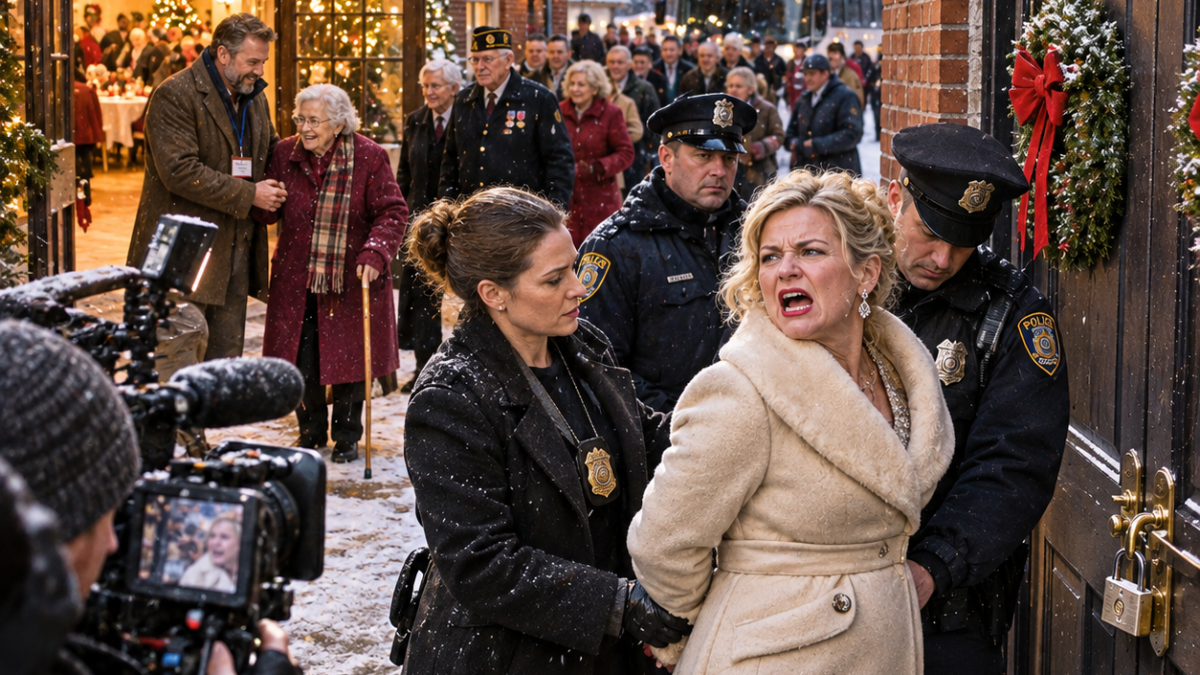
HOA Karen Changed Every Lock on My Christmas Dinner Hall—Then Police Handcuffed Her as 240 Guests Arrived
At 6:00 on Christmas Eve, Graham Whitaker stood outside the hall his father had opened to lonely neighbors for more than thirty years and realized every lock had been replaced while 240 guests were already riding toward him through the snow.
HOA President Karen Duval called it a fire-safety closure, forged Graham’s signature to seize control of the building, and hired a camera crew in advance because she wanted the world to watch elderly guests shiver outside while his Christmas dinner collapsed.
But Karen had made one mistake she never expected anyone to notice: the filmmaker she hired found a shot list describing the “angry stranded crowd” hours before it existed, and by the time the final shuttle arrived, police were waiting beside the very doors Karen thought she controlled.
By 6:00 on Christmas Eve, Hearthstone Hall looked exactly the way Graham Whitaker feared it might look in a nightmare.
Dark.
Locked.
Silent.
A massive wreath still glowed above the main entrance, its warm white bulbs reflecting off fresh brass cylinders that did not belong in any of the doors.
Graham stood beneath it holding a tray of handwritten place cards.
Two hundred forty names.
Two hundred forty people.
All expected dinner.
Down the long road into Brier Glenn, Pennsylvania, the headlights of the first shuttle buses appeared through falling snow.
Across the street, Karen Duval stood beneath the stone archway of the Cedar Ridge Event Center.
Cream wool coat.
Perfect scarf.
Leather gloves.
Camera crew behind her.
She looked calm.
Too calm.
That was what Graham remembered most later.
Not the locks.
Not the police.
Not even the arrest.
Karen looked like a woman waiting for a scene she had already rehearsed.
Nine hours earlier, Hearthstone Hall had been full of warmth.
PART2:
Volunteers in red aprons moved between thirty long tables, spreading white linen and setting out water glasses.
The kitchen smelled of butter, sage, onions, roasting turkey, and brown sugar.
Chef Elise Hartwell stood beside the ovens with a clipboard tucked beneath one arm while two volunteers argued over whether six hotel pans of mashed potatoes would be enough.
“It is not enough,” Elise said.
The older volunteer named Marlene replied:
“It was enough last year.”
“Last year we had two hundred twelve.”
“We have two hundred forty this year.”
Marlene considered.
“Seven pans?”
“Eight.”
“That is excessive.”
Elise pointed a wooden spoon at her.
“There is no such thing as excessive mashed potatoes on Christmas Eve.”
Graham passed them carrying a stack of folded place cards.
“Eight.”
Elise smiled.
“See?”
Marlene sighed.
“Fine.”
The dinner had started with Graham’s father.
Thirty-one years earlier.
Hearthstone Hall was smaller then.
Not a formal event space.
PART3:
Just an old brick assembly building his family owned near the edge of town.
Graham’s father, Arthur Whitaker, discovered that three elderly neighbors planned to spend Christmas Eve alone.
Arthur invited them over.
Then someone mentioned a recently widowed schoolteacher.
Then a veteran living by himself.
Then a nursing aide who always worked Christmas Day and had no family nearby.
Arthur set up one folding table.
Made stew.
Bought cheap rolls.
Seven guests came.
The next year, nineteen.
Then thirty-seven.
By the time Graham was in college, Christmas Eve Dinner had become a local tradition.
No tickets.
No speeches.
No religious test.
No residency rule.
No income requirement.
Arthur’s only standard was simple.
If you would otherwise be alone, or if you simply needed somewhere welcoming to sit, come.
When Arthur died, Graham kept it going.
He was not naturally sentimental.
He did not resemble his father in that way.
Arthur had known everybody’s birthday.
Remembered grandchildren.
Hugged strangers.
Graham ran logistics.
He had spent years coordinating emergency operations after floods and severe storms.
His mind worked in contingencies.
Primary kitchen.
Backup kitchen.
Three shuttle routes.
One backup shuttle.
Medical volunteer roster.
Extra wheelchairs.
Thermal blankets.
Alternate food storage.
Two cases of bottled water beyond the projected need.
Elise once told him:
“You plan Christmas like FEMA is arriving.”
Graham replied:
“FEMA usually wishes people planned like this.”
His father had also left one rule Graham never changed.
No VIP table.
Not for donors.
Not for politicians.
Not for the wealthy residents of Cedar Ridge across the street.
If your name was on the guest list, you sat wherever a volunteer placed you.
Everyone ate the same food.
Everyone entered through the same door.
At 8:45 that morning, Karen Duval entered Hearthstone Hall with two Cedar Ridge HOA board members following her.
Karen had been president of the association for six years.
Cedar Ridge sat directly across from Hearthstone.
Gated.
Stone entrance.
Large homes.
Manicured grounds.
Private event center.
Karen had turned the presidency into something larger than its bylaws ever imagined.
She controlled vendors.
Committees.
Neighborhood publications.
Festival sponsorships.
People who disagreed often discovered they had suddenly violated something.
Fence color.
Holiday lighting.
Parking.
Landscaping.
Karen never shouted first.
That was part of her strength.
She preferred the tone of someone explaining rules everyone else had somehow failed to understand.
She entered Hearthstone as if she had an appointment.
Graham looked up from the table map.
“Morning.”
Karen surveyed the room.
“Beautiful.”
“Thank you.”
She stepped toward the stage.
“I have a few changes.”
Graham stopped.
“What changes?”
She turned.
“The welcome sign outside should be replaced.”
“With what?”
“A Cedar Ridge banner.”
“No.”
Karen blinked.
Graham continued arranging place cards.
“This isn’t a Cedar Ridge event.”
“It serves residents from the surrounding community.”
“It serves anyone who signed up.”
“That’s exactly why formal community sponsorship would strengthen it.”
“No.”
One of the board members shifted uncomfortably.
Karen smiled.
“Three tables near the stage should be reserved for association leadership and major community partners.”
“No VIP tables.”
“Graham.”
“No.”
She looked around.
“There are two hundred forty guests.”
“Yes.”
“That is a considerable event.”
“Yes.”
“You should allow the association to review the guest list.”
Graham finally looked at her fully.
“Why?”
“Security.”
“No.”
“Residency verification.”
“No.”
“Liability.”
“No.”
Karen’s eyes cooled.
“You reject cooperation very quickly.”
“I reject things that change what this dinner is.”
She walked toward one of the long tables.
Touched a place card.
EVELYN PARKER.
Age seventy-eight.
Widow.
Had attended every Christmas dinner since Arthur Whitaker’s final year.
Karen said softly:
“Two hundred forty people.”
Graham waited.
“That’s a lot of people to disappoint on Christmas Eve.”
He understood the sentence for what it was.
Not observation.
Threat.
He answered:
“Good thing none of them will be disappointed.”
Karen’s smile returned.
Then she left.
At the door she stopped.
Photographed the legal occupancy sign.
Then each emergency exit.
Panic bars.
Illuminated EXIT signs.
Side corridor.
Kitchen door.
Graham watched.
“What are you doing?”
“Being thorough.”
She walked outside.
Beside her silver sedan, she made a call.
Graham did not hear all of it.
Only later would phone records reconstruct what happened.
At 8:53, Karen said:
“Proceed with the authorization.”
Pause.
Then:
“He won’t sign anything.”
At 10:45, Graham drove to the regional food bank.
The final fresh-produce pickup needed to be collected personally.
He left Elise in charge.
Volunteers loaded decorations from storage.
For roughly thirty minutes, the front of Hearthstone Hall became unusually quiet.
That was when locksmith Owen Pike arrived.
Fifty-six.
Twenty-six years in business.
The kind of man who distrusted emergency calls from people willing to pay double.
He parked a white service van.
Karen met him outside.
She carried a folder.
Inside:
Temporary management authorization.
Graham Whitaker signature.
Service request.
Fire-safety document with an official-looking seal.
Karen explained:
“Hearthstone Hall has been placed under temporary Cedar Ridge management pending tonight’s safety inspection.”
Owen asked:
“Owner knows?”
“He signed authorization.”
She showed him.
Signature.
Graham Whitaker.
It looked legitimate.
It was not.
Owen began replacing the front lock.
Then kitchen entrance.
West service door.
At the east emergency exit, Karen said:
“This one too.”
Owen looked at the panic hardware.
“No.”
“Excuse me?”
“I’m not modifying a panic exit without direct fire authority.”
“The document is right there.”
“That says building management.”
“I’m talking about panic hardware.”
Karen’s expression changed.
“It needs to be secured.”
“It is secured.”
“From entry.”
“It still needs to open from inside.”
“I need it disabled.”
Owen stood.
“No.”
“I’m paying for the job.”
“Not that part.”
Karen stepped aside.
Made a phone call.
Before Owen finished, an unmarked maintenance truck arrived.
Two workers.
Karen told him:
“They’ll handle the remaining issue.”
Owen did not like that sentence.
He photographed the paperwork.
Photographed his completed locks.
Logged the time.
Left.
At 12:10, Elise carried cranberries toward the front door.
Her key would not turn.
She tried again.
Wrong lock.
Went to the kitchen entrance.
Same.
Side door.
Same.
She called Graham.
“You changed the locks?”
“What?”
“The hall.”
“I’m twenty minutes away.”
“Well, your keys are apparently no longer emotionally committed to this building.”
“Elise.”
“Every door is changed.”
Graham’s voice became quiet.
“Don’t force anything.”
“You want me to break a window?”
“No.”
“I absolutely can.”
“No.”
“Fine.”
Graham returned at 12:31.
Tried his own key.
Nothing.
He stared at the lock.
Elise stood with arms crossed.
“Say it.”
“No.”
“You know who.”
“Yes.”
“Then let me break something.”
“No.”
He took out his phone.
Began recording.
Front door.
Time.
Lock.
Kitchen door.
Time.
Lock.
Side doors.
Scratches.
Hardware.
Then Karen appeared.
Red folder.
She stopped below the steps.
“Your Christmas dinner is cancelled.”
Graham kept the phone recording.
“Why are my locks changed?”
“Hearthstone has been placed under temporary HOA management.”
“By whom?”
“Under emergency safety authority.”
“Show me the original authorization.”
Karen held the folder closer.
“You’ll receive copies through counsel.”
“Who signed management control?”
“You did.”
Graham almost smiled.
“No.”
Karen removed a paper.
Taped it to the door.
EMERGENCY FIRE SAFETY CLOSURE.
Official-looking seal.
Case number.
Inspector name.
The document claimed Hearthstone’s exits failed inspection.
All public gatherings suspended.
Karen stepped back.
“If you attempt to open this building, I’ll make sure the authorities know you violated a closure order.”
Graham photographed the notice.
Not her.
The notice.
Then case number.
Inspector signature.
He walked away.
Karen called after him:
“Where are you going?”
“To verify it.”
Fire prevention office answered.
Graham gave the number.
The duty officer searched.
Then:
“Sir, there is no case with that number.”
“Check address.”
She did.
“No active closure.”
“Inspector James Lowell?”
“Not assigned there.”
“Is this your seal?”
“If you can email a photo.”
He did.
Thirty seconds.
“That is not an authorized notice.”
Graham stared at Karen across the lot.
She was smiling into her phone.
He called Detective Talia Brooks.
Then every vendor began calling.
Table rental.
Server agency.
Produce supplier.
Someone had told them the dinner was cancelled for fire violations.
Karen had moved faster than he expected.
He had two problems.
The building.
The event.
Graham separated them mentally.
Problem one required evidence.
Problem two required logistics.
“Elise.”
She approached.
“Yes?”
“Mobile kitchen.”
Her face changed.
“You mean use it?”
“Immediately.”
“It’s backup capacity, not full.”
“Make it full.”
“We have turkeys inside.”
“Do not force entry.”
“Graham.”
“Start with what we have in trailer refrigeration.”
“I’ll get legal access to inventory if authorities approve it.”
“Keep cooking.”
Elise stared.
Then nodded.
That was why he trusted her.
She did not waste anger when instructions became clear.
Detective Brooks arrived.
Forty-one.
No nonsense.
Graham showed deed.
Video.
Locks.
Fake notice.
His alleged signature.
Brooks listened.
“Ownership doesn’t automatically prove Karen committed a crime.”
“She’s standing there telling me she did this.”
“Good.”
“Then we document that.”
“I still need who ordered locksmith.”
“Who created paperwork.”
“Who used it.”
“And whether we’re looking at civil overreach or forgery and criminal conduct.”
Graham nodded.
He hated the distinction.
Respected it.
Then Fire Supervisor Martin Keane arrived.
He removed the fake notice.
Examined it.
“This seal is copied.”
He walked the building.
Reached east exit.
Crouched.
His face hardened.
“What?”
Graham asked.
“Someone loosened this panic assembly.”
“Can you fix it?”
“Yes.”
“Today?”
“Maybe.”
“Can guests enter?”
“Not until repaired and reinspected.”
Graham closed his eyes.
The fake hazard had created a real hazard.
Karen approached.
“See?”
Martin looked at her.
“What?”
“I warned everyone this building wasn’t safe.”
Graham said nothing.
Martin did.
“This hardware was altered recently.”
Karen’s expression remained innocent.
“So?”
“So I’d be careful what you claim this proves.”
At 1:47, a production van arrived.
VERA SUTTON MEDIA.
By 2:00, cameras were positioned across the street.
Focused on Hearthstone doors.
Guest unloading zone.
Karen.
Graham.
Vera Sutton was thirty-five.
Freelance producer.
She had been hired for what she thought was an HOA documentary about holiday-event safety failures.
Routine work.
Then she opened the client’s shot list.
Her stomach tightened.
Scene 1:
Elderly guests arrive at locked event hall.
Scene 2:
Organizer argues with safety officials.
Scene 3:
Confused attendees gather in cold.
Scene 4:
Angry crowd demands explanation.
Scene 5:
Failure demonstrates need for professional community meal management.
Timestamp on the file:
Previous night.
Vera read twice.
Those were not suggested possibilities.
They were expected outcomes.
She crossed the street.
Found Graham near the mobile kitchen.
“Mr. Whitaker.”
“Yes?”
“I need to show you something.”
She turned tablet.
Graham read.
His face went still.
“When did you receive this?”
“Last night.”
“Before locks changed?”
“Yes.”
“Before fake notice?”
“Yes.”
Vera nodded.
“Your client wrote the incident before it happened.”
“Who is your client?”
“I need to check payment record.”
“Please do.”
Then she added:
“One more thing.”
“What?”
“We were told to keep filming arrivals even if the event was cancelled.”
Graham frowned.
“Why would people arrive if it was cancelled?”
Vera hesitated.
“Because someone from Cedar Ridge is still confirming attendance.”
Graham understood immediately.
Karen did not want cancellation.
She wanted failure.
She needed the guests.
Old.
Confused.
Cold.
Cameras.
Chaos.
He called the four shuttle coordinators.
“Do not change arrival schedule.”
One said:
“But hall—”
“Keep passengers on buses.”
“Heaters running.”
“Volunteers will board.”
“No one stands outside unless directed.”
“Mobility guests stay seated until escorts arrive.”
He called volunteer captains.
Thermoses.
Hot cider.
Coffee.
Blankets.
Clear pathways.
Wheelchairs.
He turned a public humiliation trap into a controlled arrival plan.
Karen approached with camera behind her.
Concerned expression.
“Are you really going to make 240 people spend Christmas Eve in the street?”
Graham looked at her.
“No.”
“You seem very determined to film exactly that.”
Karen’s smile disappeared for half a second.
Vera captured it.
By 3:00, Owen Pike returned.
He had heard there was a dispute.
It bothered him.
He carried photocopies.
Service request.
Authorization.
Work log.
Photographs.
Karen intercepted him.
“Do not speak to Graham without association counsel.”
Owen replied:
“I’m here for the police.”
Perfect timing.
Brooks returned.
They sat in her vehicle.
Owen explained.
Karen showed paperwork.
Karen personally placed emergency order.
Graham examined his forged signature.
Then recognized it.
Four-year-old venue contract.
Same shape.
Even a tiny ink break in the last letter.
“My pen was dying.”
Brooks looked at him.
“You remember that?”
“I remember documents.”
Owen showed call log.
Emergency locksmith request originated from Karen’s personal cell.
Karen shifted stories.
First:
Third party.
Then:
Locksmith misunderstood.
Then:
HOA safety jurisdiction.
Graham produced deed.
Tax records.
Insurance.
Hearthstone had never belonged to Cedar Ridge.
No HOA control.
Brooks documented.
Still no arrest.
She wanted source of forgeries.
Money trail.
Intent.
At 4:00, Evelyn Maddox called.
Cedar Ridge treasurer.
Sixty-three.
Soft-spoken.
Careful.
For six years, she had avoided direct confrontation with Karen.
Not today.
“This was never approved.”
Graham looked across at Karen.
“What?”
“Locks.”
“Management.”
“Anything.”
Then:
“There is something else.”
“What?”
“Financial records.”
“Meet me.”
Inside the storage office, Evelyn arrived carrying two folders.
Vera came too.
She had found the production payer.
Not Cedar Ridge.
Silverpine Civic Services.
Graham searched state corporate registry.
Silverpine.
Eighteen months old.
Majority owned by another entity.
That entity included Karen Duval.
The motive appeared.
For months, Graham’s nonprofit operation had been one of two finalists for a three-year community meal program.
Funded by foundations and local businesses.
Total:
$620,000.
Other finalist:
Silverpine Civic Services.
Selection criteria:
Safety.
Reliability.
Public trust.
Event management.
If Hearthstone failed publicly in front of 240 Christmas guests, Karen could send footage to sponsors.
Vera confirmed.
Final documentary due Christmas night.
Proposal to sponsors December 26.
Karen had manufactured the evidence she needed to win a contract.
Graham sat silently.
Elise stood near the door.
“That woman locked out old people for six hundred grand?”
“Not exactly.”
Graham said.
“She locked them out to make me look incompetent.”
Evelyn opened second folder.
“Worse.”
$48,000 transfer.
Cedar Ridge reserve fund.
Destination:
Silverpine-connected account.
Description:
Operational transition and communications.
Evelyn explained:
“Karen told me the board approved it at a special meeting.”
“Did they?”
“No.”
“How do you know?”
“I’m treasurer.”
“I would have been there.”
She produced minutes.
Board signatures.
Then emails proving two signatories had been out of state.
File metadata showed the minutes were created two days after alleged meeting.
Graham looked at Evelyn.
“You think she forged board minutes?”
“I think an independent investigator needs to decide.”
That was careful.
Correct.
Graham sent documents to Brooks.
Vera preserved everything.
Original files.
Shot list.
Payment records.
Emails.
Graham notified the $620,000 program sponsors only that evidence suggested an attempt to manufacture a public failure and asked them to suspend decisions.
No accusations beyond proof.
Then Evelyn called an emergency Cedar Ridge board meeting.
Four members arrived.
Karen summoned.
Before she did, Graham asked:
“Does this board have authority to open Cedar Ridge Event Center tonight?”
Silence.
Evelyn looked at him.
“Karen is not the entire board.”
The banquet hall seated 300.
Commercial kitchen.
Wheelchair access.
Parking.
Across the street.
Perfect.
Graham did not ask them to punish Karen.
He asked them to feed people.
Board vote.
One.
Two.
Three.
Four.
Approved.
Rental fee waived.
Insurance verification required.
Safety inspection.
Karen entered halfway through.
“What is this?”
Evelyn said:
“Emergency session.”
“You cannot hold one without president.”
“Bylaws permit three directors.”
Karen saw Graham.
“No.”
Motion read.
Use Cedar Ridge Event Center for free Christmas dinner.
Karen’s voice rose.
“This is association property.”
Evelyn answered:
“Yes.”
“That is why the association board is voting.”
Karen cast no.
Final:
4–1.
For the first time in six years, her title did not mean control.
Martin inspected Cedar Ridge Event Center.
Safe.
Legal capacity.
No closure.
Elise walked the kitchen.
Approved.
Then logistics erupted.
Holding trucks across road.
Rental tables redirected.
Servers notified.
Linens moved.
Place cards reconstructed.
Garlands wheeled through snow.
The entire dinner crossed the street.
Graham did not publicly announce until everything was ready.
He did not want one elderly guest wandering between buildings because of confusion.
Karen saw equipment entering her event center.
She rushed over.
“Stop.”
Workers hesitated.
Evelyn stepped between them.
“You don’t own this building.”
Karen glared.
“I’m president.”
Evelyn replied:
“And you don’t own this community.”
That sentence traveled through the room.
Not shouted.
Enough.
At 6:00, first shuttle appeared.
Karen hurried toward her camera.
The moment she had planned.
She still believed she could recover the story.
By 6:10, all four shuttles had arrived.
Private cars too.
Two hundred forty guests.
Snow thickening.
Holiday lights.
Women in red coats.
Veterans.
Retired nurses.
Widowers.
People carrying small gifts for strangers they saw once a year.
Karen climbed Hearthstone steps.
Camera red light on.
She raised her voice.
“Ladies and gentlemen!”
Heads turned.
“The Christmas dinner has been shut down because Graham Whitaker failed to maintain fire-safety standards.”
Camera moved toward shuttles.
Karen continued:
“Two hundred forty people, and this man couldn’t even keep his own building open.”
She waited.
No shouting.
Most guests were still warm inside buses.
Drinking cider.
Volunteers moved calmly.
People using walkers were escorted carefully.
Wheelchair guests went directly to heated staging tent.
No chaos.
Graham approached.
Microphone.
Elise beside him.
Evelyn.
Martin.
He said:
“Ladies and gentlemen.”
Quiet.
“Your Christmas dinner has not been cancelled.”
Applause began.
Small.
Then larger.
Karen stepped forward.
“You cannot open that building.”
Graham turned.
“You’re right.”
Karen looked triumphant.
“We won’t use an unsafe building.”
Then he pointed across road.
Cedar Ridge Event Center glowed.
Double doors opened.
Golden light spilled onto snow.
Sign:
CHRISTMAS DINNER
ALL 240 GUESTS WELCOME
Karen turned.
For the first time all day, she looked genuinely shocked.
“No.”
Graham smiled.
“Dinner’s across the street.”
Guests applauded.
Karen ran toward event center.
“This is private association property.”
Evelyn held up resolution.
“Board authorized it.”
“You’re removed.”
“You do not have unilateral authority.”
“I’ll sue every one of you.”
Detective Brooks approached.
Two officers.
“Ms. Duval.”
Karen turned.
“What?”
“We need to discuss the authorization used for the locksmith.”
“I already told you I didn’t create it.”
“Owen Pike’s records connect your phone directly to the service request.”
“I was forwarding instructions.”
“From whom?”
“I don’t recall.”
Brooks continued.
“The fire closure notice used a seal that Martin Keane’s office confirms was not issued.”
Karen looked at Martin.
He stepped forward.
“My office never closed Hearthstone Hall.”
Karen’s composure slipped.
“This is harassment.”
Brooks raised another file.
“We also have questions regarding $48,000 transferred from association reserve funds.”
Evelyn stood beside her.
“And meeting minutes that appear inconsistent with board records.”
Karen looked around.
Camera still recording.
She turned toward Vera.
“Shut that off.”
Vera did not.
“I said shut it off.”
“I’m preserving evidence.”
Karen moved toward her.
“Give me the files.”
“No.”
Karen lunged toward the red folder being held by her assistant.
One officer stepped in.
“Ma’am, stop.”
“Those are HOA documents.”
“Stop.”
She tried reaching around him.
Brooks said:
“Karen Duval, you are under arrest based on verified evidence relating to forged documents, false authorization used to seize private property, and suspected misappropriation of association funds.”
Karen froze.
Then:
“You cannot arrest me.”
Brooks remained calm.
“I can.”
“I’m president of Cedar Ridge.”
“That does not put you above the law.”
The handcuffs closed.
The last shuttle door opened.
Final guests stepped onto the snow.
Karen stood in front of the same locked Hearthstone doors she had ordered changed.
Camera she hired recorded everything.
Graham did not watch her get placed in the patrol car.
He turned away.
An elderly man named Frank Delaney struggled slightly on the salted path.
Graham offered his arm.
“Easy.”
Frank looked toward police.
“What happened?”
“Long day.”
“Dinner still happening?”
“Yes.”
“That’s all I care about.”
“Me too.”
Inside Cedar Ridge Event Center, Graham stopped.
Above the stage:
SILVERPINE CIVIC SERVICES
THE FUTURE OF COMMUNITY MEAL SUPPORT
Printed banner.
Boxes of brochures.
Prepared in advance.
Before sponsors had chosen anyone.
Elise stood beside him.
“Well.”
Graham exhaled.
“She really thought this was done.”
Volunteers removed banner.
Boxed brochures.
Handed everything to Brooks as evidence.
By 6:45, all 240 guests sat.
Turkey.
Honey-glazed ham.
Roasted vegetables.
Cornbread.
Mashed potatoes.
Eight pans.
Marlene was vindicated.
The piano began.
Carols.
Laughter.
People who entered as strangers passed serving dishes to one another.
Graham stood at the back.
His own hall was locked across the road.
But dinner lived.
Elise handed him leftover place cards.
“You okay?”
“No.”
“Good.”
He looked at her.
“Why good?”
“If you said yes, I’d worry.”
They stood quietly.
Then Graham said:
“My dad would’ve hated this.”
“The arrest?”
“The drama.”
“He would’ve loved the dinner.”
“Yes.”
“That part matters more.”
After dessert, Graham went to microphone.
He did not explain crimes.
Did not mention $620,000.
No forged signatures.
No stolen funds.
Guests had come for company.
Not prosecution.
He said:
“This morning, someone tried to take away the place where we share Christmas dinner.”
Room quieted.
“Tonight, you reminded me something my father understood before I did.”
“A community is not made of walls.”
“Or locks.”
“It is made of people willing to open doors for one another.”
The room stood.
Applause.
Evelyn cried near kitchen entrance.
For six years, she had allowed Karen’s confidence to substitute for authority.
That night she had finally said no.
Investigation continued.
Karen was arrested.
Not convicted yet.
That distinction mattered.
Graham repeated it whenever reporters demanded conclusions.
Police investigated.
Prosecutors evaluated.
Independent auditors reviewed Cedar Ridge finances.
Forged documents examined.
Digital records preserved.
$48,000 transfer traced.
Silverpine contract suspended.
The $620,000 meal-program sponsors froze evaluation.
No contract awarded to Karen’s company.
Cedar Ridge began removing Karen from leadership under bylaws.
Evelyn became interim president.
The first board meeting after Christmas lasted four hours.
Residents were furious.
Some at Karen.
Some at board.
Some at themselves.
A homeowner shouted:
“How did nobody stop this?”
Evelyn answered:
“Because too many of us assumed someone else had checked.”
Silence.
She continued:
“That changes now.”
New rules.
Two signatures for reserve transfers.
Meeting minutes independently circulated to all directors.
Third-party contracts above threshold reviewed by counsel.
No property action outside Cedar Ridge boundaries without explicit legal opinion.
Conflict-of-interest disclosures.
Karen’s private interests would not hide behind association letterhead again.
Graham filed claims for damage to Hearthstone.
Locks.
Emergency exit.
Lost costs.
Business interference.
He did not sue every Cedar Ridge homeowner personally.
People suggested it.
He refused.
“The association board didn’t authorize this.”
“Then why punish residents for Karen’s private scheme?”
His attorney agreed.
Accountability had to follow evidence.
Not anger.
One month later, Cedar Ridge made an offer Graham did not expect.
Permanent Christmas Eve partnership.
Use banquet hall every year.
No charge.
Independent agreement.
Open to anyone.
Inside or outside gates.
Graham listened.
Then proposed something larger.
“Hearthstone remains the year-round community base.”
“Weekly meals.”
“Programs.”
“Support groups.”
“Cedar Ridge gives Christmas banquet capacity.”
“We cook across both kitchens.”
“We use both buildings.”
“No gate restrictions.”
“No VIP tables.”
Evelyn smiled.
“Your father’s rules.”
“Yes.”
Board approved.
The next Christmas Eve, Graham stood outside Hearthstone.
Same wreath.
Different locks.
He inserted his key.
Turned.
Door opened.
Inside, volunteers worked.
Across courtyard, Cedar Ridge Event Center was also open.
Two kitchens.
One dinner.
More than 300 guests now.
Beside Hearthstone entrance, small brass plaque:
NO ONE GETS LOCKED OUT OF CHRISTMAS.
No police.
No camera crew waiting for failure.
No fake closure notice.
Only volunteers.
Red aprons.
Food.
Open doors.
Graham touched the plaque once.
Then entered.
That could have been the ending.
But Karen’s case continued.
Evidence became clearer over months.
The forged management authorization used Graham’s copied signature.
Digital records tied creation to a computer used by Silverpine staff.
The fake fire notice had been assembled from a genuine public template with copied seal graphics.
Phone records connected Karen directly to locksmith scheduling.
Emails linked event lockout to production plans.
The $48,000 reserve transfer had been hidden behind fabricated meeting minutes.
And the documentary contract included language describing the “meal management incident” before Christmas Eve.
That last phrase fascinated prosecutors.
Incident.
Not potential incident.
Not contingency.
Planned incident.
Vera testified about the shot list.
She had spent years producing marketing films.
Nobody had ever hired her to film a failure before arranging the failure itself.
At preliminary hearing, Karen’s attorney tried to portray everything as an aggressive but legitimate safety intervention.
Then Vera’s document appeared.
ELDERLY GUESTS UNABLE TO ENTER.
ANGRY CROWD.
ORGANIZER CONFRONTS OFFICIALS.
Karen sat still.
Graham watched.
No satisfaction.
Mostly disbelief.
How much effort had gone into making two hundred forty people miserable?
Not because Karen hated them.
That almost would have been easier to understand.
They were props.
That was worse.
She needed old people in the cold because their suffering would look persuasive on video.
She needed Graham to appear incompetent.
She needed Hearthstone to fail.
The people themselves were irrelevant.
That realization made Graham angrier than the forged signature.
Arthur Whitaker had built dinner because nobody should feel like background on Christmas.
Karen had tried to turn every guest into background for her contract.
At sentencing months later—after Karen entered pleas on several counts rather than risk trial on every charge—Graham was allowed to submit a statement.
He did not ask for maximum punishment.
He wrote:
“You did not only change locks.”
“You designed a scene in which 240 people were supposed to become evidence for your ambition.”
“Some were widows.”
“Some veterans.”
“Some had nowhere else to go.”
“You wanted them cold, confused, and angry because you believed their humiliation would make your company more valuable.”
“That is the part I find hardest to forgive.”
Karen’s attorney requested leniency.
No prior criminal history.
Community service.
Long HOA leadership.
Reputation.
The judge considered all of it.
So did the victims.
Justice did not erase complexity.
Karen had organized charity drives.
Helped residents after storms.
Raised funds for landscaping and security.
People are rarely one thing.
But good acts do not erase deliberate harm.
The court imposed consequences proportionate to proven offenses.
Restitution.
Probationary conditions after custodial requirements applicable to the plea.
Financial restrictions.
No association office during imposed period.
The specific structure mattered less to Graham than the record.
What she did was no longer called safety.
That was enough.
Silverpine Civic Services collapsed.
Its sponsors withdrew.
The $620,000 meal contract went through a fresh selection process.
Graham’s nonprofit did not automatically receive it.
He insisted.
“We don’t win because the other bidder committed misconduct.”
“We submit again.”
Sponsors were surprised.
Graham submitted.
So did two other organizations.
Independent evaluation.
Months later, Hearthstone Community Table won.
Not because Karen failed.
Because Graham’s operation documented years of service, safety planning, financial transparency, and capacity.
The contract funded three years.
Weekly meals.
Transportation.
Home-delivery support.
Senior outreach.
Christmas Eve remained free outside the program.
Arthur’s rule.
Never turn tradition into something dependent on one grant.
Graham used part of the funding to hire Elise full-time.
She stared at offer.
“Benefits?”
“Yes.”
“Health insurance?”
“Yes.”
“Vacation?”
“Yes.”
“Do I still control mashed potatoes?”
“No.”
She tore the paper.
Graham stared.
Elise laughed.
“I’m kidding.”
She signed.
Hearthstone changed.
More people came.
Not just Christmas.
Tuesdays.
Thursdays.
Lunch.
Coffee.
Bereavement groups.
Veteran breakfasts.
Caregiver support.
One elderly man named Frank Delaney began volunteering after the Christmas arrest night.
He said:
“I’m tired of being served.”
Graham replied:
“That’s not how this works.”
Frank ignored him.
He became dishwasher.
Terrible dishwasher.
Everyone tolerated it.
Evelyn remained Cedar Ridge president for one year.
Then declined reelection.
Residents asked why.
“I spent six years watching one person stay too long.”
“I’m not repeating it.”
She instituted term limits before leaving.
That made Graham smile.
Vera Sutton’s footage became important evidence.
But she refused every offer to turn the story into entertainment.
One streaming company approached.
She said no.
A production executive told her:
“It’s an incredible story.”
Vera answered:
“It was supposed to be propaganda.”
“I’m not turning it into a second product.”
She did eventually make a short documentary.
Not about Karen.
About the dinner.
Title:
OPEN DOORS.
No arrest footage except one brief context shot.
Mostly volunteers.
Guests.
Arthur’s history.
Cedar Ridge and Hearthstone cooperating.
Final image:
Two open buildings facing each other across snow.
Graham approved.
Karen disappeared from daily conversation.
That was healthy.
For months, everything had been about her.
Eventually, the community stopped centering the person who tried to control it.
Christmas returned to food.
People.
Tables.
That was the real restoration.
Three years later, Hearthstone’s old east exit needed replacement.
Normal wear.
Contractor removed hardware.
Graham stood nearby.
New panic bar installed.
He remembered Martin crouching on Christmas Eve.
Tampered screws.
Fake hazard becoming real.
The contractor asked:
“You want smart access?”
“No.”
“Electronic system?”
“No.”
“Why?”
“Keys.”
The man laughed.
“Old-fashioned.”
Graham smiled.
“Reliable.”
He did add one thing.
Every external lock change required two-party authorization.
Written.
Verified.
No exceptions.
Even Graham could not order emergency replacement alone.
Elise teased:
“You don’t trust yourself?”
“No.”
“That’s healthy.”
“Power should be inconvenient.”
She stared.
“Did you rehearse that?”
“No.”
“You should.”
He hated sounding quotable.
Arthur had never cared much about organizational theory.
He cared whether somebody ate.
Sometimes Graham wondered what his father would have done that day.
Probably something less strategic.
Arthur might have taken a hammer to the door.
Graham smiled at the thought.
Then imagined the headlines.
LOCAL MAN VIOLATES FIRE CLOSURE, FORCES ENTRY.
Karen would have gotten exactly what she wanted.
Graham’s restraint had mattered.
Not passivity.
Restraint.
Document.
Verify.
Protect people.
Keep cooking.
His years in disaster logistics taught him something Karen never understood.
The goal during crisis is not to preserve the original plan.
It is to preserve the mission.
Building closed?
Dinner still happens.
Kitchen inaccessible?
Mobile trailer.
Venue compromised?
Move venue.
Vendors threatened?
Replace or reassure.
Camera waiting for chaos?
Remove chaos.
Karen had attacked the plan.
Graham protected the purpose.
That distinction beat her more effectively than anger ever could.
Five years later, the Christmas dinner had grown to 360.
Cedar Ridge Event Center took half.
Hearthstone took overflow.
People moved between buildings.
Some residents from inside Cedar Ridge volunteered regularly.
The gates that once symbolized separation became almost irrelevant on Christmas Eve.
A teenage volunteer asked Graham:
“Was it really true someone got arrested here?”
Graham looked around.
“Unfortunately.”
“What happened?”
“Long story.”
“My mom says she changed all the locks.”
“Yes.”
“Why?”
Graham considered how much to say.
“Because she wanted this dinner to fail.”
The teenager looked around at hundreds of people.
“That seems dumb.”
Graham laughed.
“In retrospect.”
“Were you scared?”
“Yes.”
“You didn’t look scared in the video.”
“That’s because video doesn’t show everything.”
“What were you scared of?”
Graham’s answer came immediately.
“That someone would get hurt outside.”
Not losing building.
Not reputation.
Not contract.
People.
That had always been the true risk.
Two hundred forty guests included individuals with mobility limits.
Heart conditions.
Diabetes.
People poorly equipped for long exposure to cold.
Karen imagined a crowd as visual content.
Graham saw a medical emergency waiting to happen.
That was why the buses stayed warm.
Why cider went aboard.
Why walkways were salted.
Why volunteers controlled movement.
The logistical details nobody filmed were the reason nobody became a tragedy.
That teenager later became a volunteer coordinator.
Years passed.
Graham aged.
Gray at temples.
Elise became executive director of Hearthstone Community Table.
Graham resisted the title “founder.”
His father founded it.
He became “program chair.”
Nobody cared.
Christmas Eve continued.
One year, Graham arrived at 5:45 a.m.
Snow already falling.
He unlocked Hearthstone.
Key turned smoothly.
That small mechanical movement still gave him satisfaction.
He opened the door.
Warm air from inside met cold.
He stood there.
Across street, Cedar Ridge Event Center lights came on.
No one controlling both.
Boards.
Agreements.
Checks.
Transparency.
Messier than dictatorship.
Healthier.
Evelyn, now retired, arrived carrying cinnamon rolls.
“You’re early.”
Graham looked at clock.
“You’re earlier.”
“I’m old.”
“That usually works opposite direction.”
She handed him tray.
They entered.
Near door, brass plaque had developed fingerprints.
NO ONE GETS LOCKED OUT OF CHRISTMAS.
Evelyn touched it.
“Still like this?”
“Yes.”
“You know it sounds sentimental.”
“My father would approve.”
“That’s true.”
They worked.
By noon, volunteers filled building.
At 3:00, turkeys.
At 5:30, shuttles.
At 6:00, doors open.
No police.
No cameras.
That became ordinary.
Ordinary is underrated.
Graham learned that after crisis.
People love dramatic reversals.
Arrest.
Exposure.
Justice.
But the best part came later.
Nothing happened.
Doors opened.
Food stayed hot.
Guests entered.
Nobody manipulated.
Nobody forged.
Nobody feared being locked out.
The absence of crisis became its own kind of victory.
One Christmas, a local reporter asked Graham to revisit the famous night.
He refused at first.
Then agreed to one question.
Reporter asked:
“When Karen changed the locks, when did you know you were going to win?”
Graham smiled.
“I didn’t.”
“But you looked calm.”
“I was managing problems.”
“Was there one turning point?”
“Yes.”
“Which?”
“When I realized the dinner mattered more than Hearthstone Hall.”
The reporter paused.
“Not when you found the forged signature?”
“No.”
“Not Silverpine?”
“No.”
“Not the board vote?”
“No.”
“When I stopped trying to save the building and focused on feeding people.”
That was the lesson.
Karen thought control of a door meant control of an event.
Graham’s father had understood better.
The dinner was never the hall.
Hearthstone was useful.
Beautiful.
Historic.
Meaningful.
But walls are not purpose.
Karen changed the locks because she believed keeping Graham outside meant Christmas itself would fail behind them.
Instead, every person involved adapted.
Elise kept cooking.
Owen returned with records.
Vera refused to manufacture a lie.
Martin protected safety.
Evelyn opened another door.
Board members finally acted independently.
Volunteers redirected.
Drivers waited.
Guests trusted instructions.
Detective Brooks followed evidence instead of spectacle.
One locked hall created dozens of open choices.
Karen’s plan depended on everyone behaving exactly as she predicted.
When they did not, it collapsed.
Her most important mistake was not forged paperwork.
Not the money trail.
Not even the camera contract.
It was believing people were props.
Graham remembered standing outside at six.
Shuttles arriving.
Karen speaking loudly.
Camera turning.
She expected anger.
Instead, Frank Delaney drank cider.
Evelyn Parker waited calmly.
Veterans remained seated.
Volunteers guided walkers.
No one gave Karen the chaos she had ordered.
Then across the street, the doors opened.
That image stayed with Graham more strongly than the handcuffs.
Warm gold light on snow.
Open doors.
Guests moving toward dinner.
Karen standing between two buildings and suddenly controlling neither.
Years later, when Graham finally stepped back from daily operations, the board held a retirement dinner.
He hated retirement dinners.
Too many speeches.
Elise ignored him.
Two hundred people came.
Frank’s daughter attended because Frank had died the previous year.
She brought one of his old Christmas cards.
Evelyn came.
Vera.
Martin.
Owen Pike, now retired.
Detective Brooks.
During dessert, Elise handed Graham a small box.
Inside:
One of the original brass lock cylinders Karen installed.
He stared.
“You kept this?”
Elise smiled.
“Owen did.”
Graham looked at Owen.
“Why?”
Owen shrugged.
“Evidence was released eventually.”
“Thought you might want it.”
“I do not.”
Everyone laughed.
Then Graham noticed engraving added to the cylinder.
NOTHING IMPORTANT WAS EVER BEHIND THIS LOCK.
He laughed harder than he expected.
Then became quiet.
Because it was true.
The food had been behind the doors.
Place cards.
Decorations.
History.
But the important thing was never trapped inside.
Community crossed the street.
Graham held the lock.
For years, he had imagined the story beginning with Karen changing it.
Now he understood the story began thirty years earlier.
Arthur Whitaker setting one folding table.
Seven people.
A pot of stew.
A simple idea:
Nobody eats alone if we can help it.
Karen encountered that tradition and misunderstood it as property.
A hall.
A contract.
A management opportunity.
Something she could control with paperwork.
But traditions rooted in people are harder to seize.
The following Christmas Eve, Graham attended as a guest for the first time.
No clipboard.
No radio.
No emergency binder.
He hated it.
Within twenty minutes, he was helping.
Elise caught him carrying chairs.
“You’re retired.”
“No.”
“Yes.”
“I’m moving a chair.”
“You’re organizing.”
“I’m helping.”
“You alphabetized a volunteer sign-in sheet.”
“It was chaos.”
She pointed toward table.
“Sit.”
Graham obeyed.
Eventually.
His place card read:
GRAHAM WHITAKER
TABLE 1.
He frowned.
“No VIP tables.”
Elise said:
“That’s not a VIP table.”
“It is table one.”
“Numbers must start somewhere.”
He suspected conspiracy.
Across from him sat a widower attending first time.
A nurse working Christmas Day.
A college student unable to travel home.
Two Cedar Ridge residents.
One veteran.
Nobody important.
Everybody important.
Exactly as Arthur intended.
At six, Graham looked toward entrance.
Doors wide open.
A volunteer held one for arriving guests.
Snow blew inside.
No one complained.
The brass plaque beside it caught the light.
NO ONE GETS LOCKED OUT OF CHRISTMAS.
Graham smiled.
Five years earlier, Karen Duval had changed every lock because she believed access belonged to whoever controlled the key.
She forged his signature.
Invented a safety closure.
Tampered with an exit.
Paid a camera crew to record a humiliation she had scripted in advance.
Used HOA funds to finance a private business scheme.
And waited for 240 people to arrive so their disappointment could become her advertisement.
She had planned everything except one thing.
What would happen if the people around her stopped confusing her authority with ownership.
The locksmith came back.
The filmmaker preserved the truth.
The treasurer opened the books.
The board voted.
The fire supervisor followed real safety rules.
The detective followed evidence.
The volunteers kept cooking.
And Graham protected the dinner instead of protecting his pride.
At exactly the moment Karen expected her greatest public victory, another set of doors opened behind her.
That was why Graham never remembered her arrest as the ending.
The handcuffs were consequences.
The open doors were the ending.
Karen changed every lock to keep Christmas dinner out.
By the time police led her away, all 240 guests were walking into the building she thought belonged to her.
And not one of them had to eat alone.








