HOA Karen Chained Up My 6 Rescue Boats as the Flood Rose—Then Deputies Locked Down Her Entire Marina
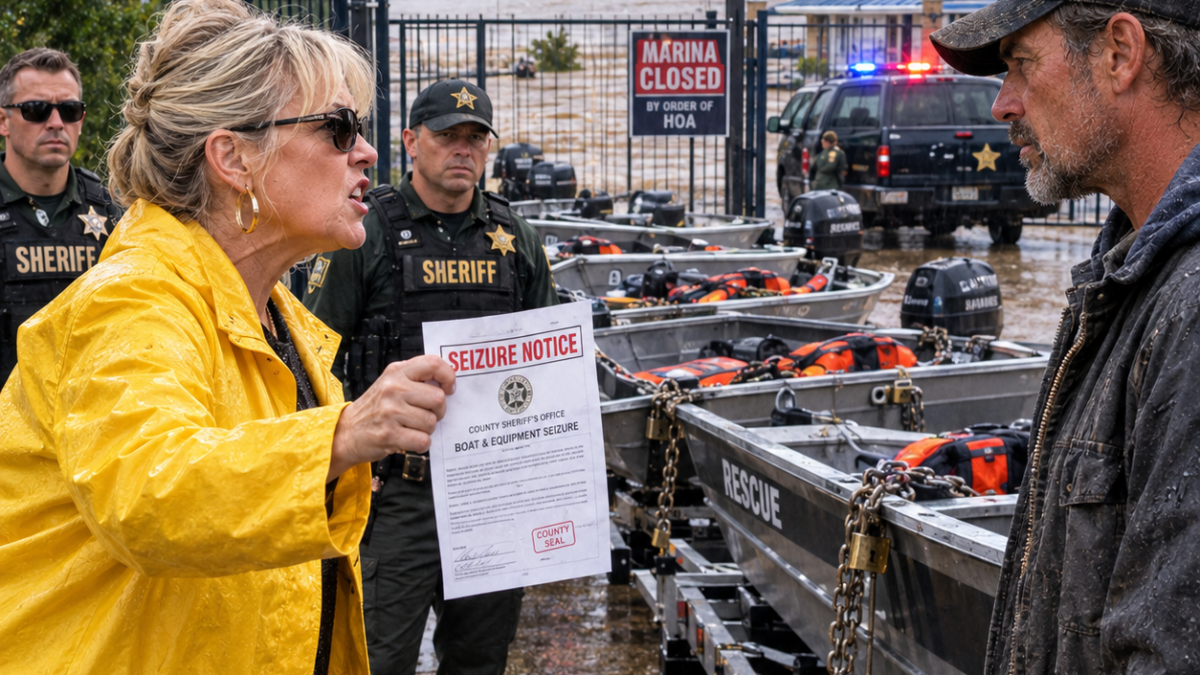
HOA Karen Chained Up My 6 Rescue Boats as the Flood Rose—Then Deputies Locked Down Her Entire Marina
The flood sirens were already screaming when Nolan Pritchard reached the river and found all six of his rescue boats chained behind the HOA marina gate while thirty stranded residents waited across water rising by the minute.
Beverly Straoud told him the HOA had legally seized the fleet over $41,600 in fines, but the county seal on her order was fake, his rescue decals were being stripped away, and somewhere inside the marina sat a contract worth $480,000 carrying a signature Nolan had never written.
By the time deputies finally opened the marina office, Beverly had stopped pretending she wanted his boats for “community safety”—and before the sun went down, the woman who had locked up six rescue vessels was standing in handcuffs while the sheriff ordered every gate, dock, commercial boat, fuel system, and office in her marina placed under county control.
Eighteen hours before the first evacuation call, Nolan Pritchard was kneeling in wet gravel with a wrench in one hand and a flashlight clenched between his teeth.
Rain ticked against the aluminum hull above him.
Not heavy yet.
Steady.
The kind of rain that had been falling since before sunrise and seemed less interested in intensity than persistence.
Behind him, an old weather radio hissed from a workbench beneath the awning.
“…Stonewater River expected to reach major flood stage overnight… residents in low-lying areas should prepare for possible evacuation…”
Nolan pulled the flashlight from his mouth.
“Yeah,” he muttered. “I heard you.”
He tightened the final fuel fitting on Rescue Four.
Six flat-bottomed aluminum boats sat in two rows across his staging lot.
Nothing elegant about them.
No polished teak.
No leather seats.
No stereo systems.
No chrome railings.
They were purpose-built.
Wide deck.
Shallow draft.
Reinforced bow.
Searchlights.
Medical bags.
Throw ropes.
Life jackets.
Portable radios.
Spare propellers.
Each hull carried bright yellow lettering:
PART2:
WILLOWBEND VOLUNTEER FLOOD RESCUE.
Nolan had built the fleet slowly.
One boat at a time.
One used engine.
One trailer.
One upgraded electrical system.
He was forty-three now.
Had worked on marine engines since he was nineteen.
For years, he helped fishermen, dock owners, charter operators, and people wealthy enough to spend more on a propeller than Nolan spent on rent.
He charged them.
Flood rescue was different.
He never charged.
Never planned to.
The first rescue had happened fourteen years earlier when spring storms put half of Granger Hollow underwater.
Nolan had one old jon boat then.
A fifteen-horse outboard.
No radio.
No rescue equipment beyond two life jackets and a rope.
He brought out an elderly couple.
Then a mother with a toddler.
Then went back for a man with an oxygen tank.
By dawn he had made twelve trips.
PART3:
Afterward, county emergency management director Tessa Monroe—back then a field coordinator barely older than Nolan—told him:
“You’re either going to stop doing this or start doing it properly.”
Nolan asked:
“What does properly cost?”
Tessa said:
“More than you have.”
He smiled.
“Then I’ll do it slowly.”
That became the fleet.
Six boats.
Built from paychecks.
Donations.
Used equipment.
Volunteer labor.
Every year Nolan added something.
Searchlights.
Medical storage.
Better radios.
Reinforced skegs.
One boat had a removable ramp for wheelchair users.
Another carried extra fuel.
Two could move through water so shallow their hulls skimmed pavement.
Tessa eventually wrote Nolan’s volunteer team into Willowbend County’s emergency response plan as an auxiliary resource.
Not county-owned.
Not government-funded beyond fuel reimbursement during activation.
But recognized.
When floods came, Tessa could call.
Nolan would launch.
His staging lot sat beside Harbor Crown Marina.
That fact had been convenient once.
Harbor Crown occupied the flashy side of the river.
Private slips.
Luxury homes.
Security gates.
Restaurant.
Clubhouse.
Three fuel docks.
Members paid more per month in marina fees than Nolan paid for his entire workshop.
His lot was different.
Gravel.
Metal shed.
Two shipping containers.
One old pier.
But he owned it.
County records were clear.
Separate parcel.
Outside Harbor Crown Estates HOA.
An old recorded easement gave Nolan the right to use a gravel lane crossing the edge of the marina property to reach the river.
Near the launch stood a weathered wooden sign.
Most people barely noticed it.
The blue marina paint had covered half the lettering years ago.
But if you stood close enough, beneath the new paint you could still read:
EMERGENCY ACCESS MUST REMAIN CLEAR.
Nolan had asked Beverly Straoud about that sign once.
She told him it was “obsolete.”
Beverly was fifty-six.
HOA president.
Controlling partner of Harbor Crown Marina’s operating company.
Silver hair cut perfectly.
Expensive raincoats.
Expensive sunglasses.
A woman who seemed professionally offended by anything not designed for a brochure.
She had spent two years trying to make Nolan disappear.
At first, it was cosmetic.
His boats were ugly.
The gravel lot lowered property values.
His volunteers parked too close to the marina entrance.
One trailer had faded paint.
Then came citations.
Not real county citations.
HOA notices.
Unauthorized commercial activity.
Unsightly industrial equipment.
Improper storage.
Nolan responded each time with the same thing.
Parcel map.
Property record.
Easement.
He was not inside the HOA.
Beverly’s authority ended at his boundary.
That should have ended the argument.
Instead, it made her angrier.
Around noon, while Nolan was testing Rescue Six’s radio, a white Range Rover rolled onto the edge of his lot.
Beverly stepped out.
Two Harbor Crown security guards followed.
Nolan watched them approach.
“Good afternoon, Beverly.”
She looked at the six boats.
“Those all need to be gone by six.”
Nolan thought he had misheard.
“What?”
“You heard me.”
“Why?”
“They constitute unauthorized industrial storage visible from a premium residential waterfront community.”
Nolan wiped grease from his hands.
“Translation?”
“They’re an eyesore.”
He looked at the sky.
Then river.
“County’s under flood watch.”
“That is not my concern.”
“It may become your concern.”
She held out a sheet.
$2,400 fine.
Nolan read the header.
HARBOR CROWN ESTATES HOMEOWNERS ASSOCIATION.
“Still not inside your HOA.”
“You use our access corridor.”
“I have a recorded easement.”
“That agreement is decades old.”
“Still recorded.”
“Old scraps of paper do not override current community governance.”
Nolan walked to his truck.
Pulled out a plastic document sleeve.
Plat map.
Deed.
Easement.
He held them toward her.
“Read.”
She didn’t.
“The river doesn’t care about your rules, Beverly.”
Her expression tightened.
“And neither will people trapped in their houses tonight.”
She looked toward Rescue One.
Then Rescue Two.
Slower than necessary.
Nolan noticed.
“What?”
“I need copies of your registrations.”
“No.”
“Hull identification numbers.”
“No.”
“Engine serial numbers.”
“No.”
“Insurance.”
“No.”
Her eyes narrowed.
Nolan said:
“I’ll show those to the sheriff, emergency management, Coast Guard, insurance company, whoever actually has legal authority.”
“You operate beside my marina.”
“Your marina isn’t a government.”
She stepped closer.
“Be careful, Nolan.”
“With what?”
“You’ve gotten very comfortable treating our patience as weakness.”
Nolan smiled once.
“I think you have that backward.”
She turned.
The guards followed.
Nolan watched the Range Rover leave.
Something bothered him.
Not the fine.
Not the threat.
The numbers.
Hull numbers.
Engine serials.
Insurance.
Those were not things an HOA needed to complain about appearances.
At 3:18, a flatbed with the Harbor Crown logo pulled near the staging lot.
Driver got out.
Walked along Nolan’s trailers with a measuring tape.
Wrote on a clipboard.
Nolan photographed the license plate.
“What are you measuring?”
“Space.”
“For?”
“Marina inventory.”
“These aren’t marina inventory.”
The driver stared.
“Just doing what I’m told.”
“Who told you?”
He got back in the truck.
Around midnight, rain intensified.
Nolan slept in a small apartment over his workshop during flood watches.
At 1:48 a.m., his phone vibrated.
MOTION DETECTED.
CAMERA 7.
He blinked.
Opened app.
Camera 1 unavailable.
Two.
Unavailable.
Three.
Four.
Five.
All offline.
Camera Seven was different.
Old backup.
Hidden inside a storage shed looking through a small opening.
Grainy image.
Headlights.
Tow trucks.
Nolan was downstairs in under a minute.
Truck started.
Wipers fighting rain.
He reached the staging lot at 1:58.
The scene looked impossible.
Three heavy wreckers.
Flatbeds.
Guards.
Two boats already gone.
Four being winched.
Nolan drove across gravel and stopped directly in front of the lead tow truck.
Horn blared.
Driver slammed brakes.
A broad-shouldered man in black Harbor Crown security gear marched toward Nolan.
“Nolan, move the truck.”
“Where are my boats?”
“Step away.”
“Where are they?”
The man opened a folded paper.
“Emergency maritime equipment enforcement order.”
Nolan stared.
“You’re a security guard.”
“Chief of security.”
“Congratulations. Where’s the deputy?”
“This order has county authority.”
He held the document under Nolan’s headlights.
Official-looking seal.
WILLOWBEND COUNTY.
Legal language.
Case number.
Authorized seizure pending compliance.
Something was wrong.
Nolan couldn’t immediately say what.
Then Beverly appeared from the marina gate.
Wide umbrella.
Dry beneath it.
“Nolan.”
“What are you doing?”
“Collecting collateral.”
“For what?”
“Your outstanding fines now total forty-one thousand six hundred dollars.”
He laughed.
The sound came out wrong.
“You made up thirty-nine thousand dollars since lunch?”
“Penalties accumulate.”
“On land you don’t govern.”
“We disagree.”
She nodded toward the tow drivers.
“Continue.”
Nolan stepped toward Rescue Three.
“I need the trauma bag.”
Two guards blocked him.
Nolan stopped.
He could have pushed.
Could have fought.
Would have lost even if he won.
Instead, he took out his phone.
Record.
“State your name.”
Beverly looked directly into camera.
“You are being formally notified that your vessels are in temporary custody of Harbor Crown Marina.”
“Do I have permission to retrieve rescue equipment?”
“No.”
“Those boats are part of the county flood response plan.”
“Not anymore.”
“Whose property are they?”
“Until your debts are satisfied, they are controlled assets.”
“Mine?”
She smiled.
“You should have paid your fines.”
Then:
“Now your boats belong to my marina.”
Nolan felt cold despite the rain.
The last trailer disappeared through the service gate.
Inside the marina, workers lined the boats along VIP dock.
Heavy chain through bow eyes.
Padlocks.
Then Nolan watched them remove portable fuel tanks.
Starter batteries.
Stack everything inside a maintenance shed.
This wasn’t merely storage.
They were disabling them.
He spoke into his recording.
“These boats were built to save lives.”
Beverly turned away.
“You just chained them up before a flood.”
He called sheriff’s office.
Emergency management.
Sent video.
Tow plates.
Registrations.
Deputy Wyatt Hargrove called fifteen minutes later.
Forty-seven.
Supervisor, county water patrol.
Nolan knew him professionally.
Not friends.
Had worked two flood responses together.
“Nolan.”
“Wyatt.”
“I’ve got the seizure document image.”
“It’s fake.”
“Maybe.”
“Maybe?”
“I need to verify it.”
“Beverly’s holding six boats.”
“I know.”
“Roads are already flooding.”
“I know.”
Nolan gripped steering wheel.
“So go in.”
“On what legal basis?”
“She stole them.”
“If that order is forged, yes, we have a very different situation. But I need confirmation before I force entry into a private marina in the middle of a declared emergency.”
Nolan hated the answer.
Trusted it anyway.
“Call the clerk.”
“Already did.”
“At two in the morning?”
“Duty line.”
“Good.”
“Do not cut that gate.”
Nolan looked toward chain-link fence.
“You know me.”
“Yes. That’s why I’m saying it.”
By dawn, Stonewater River had turned brown and violent.
Cutter Road bridge closed.
South warehouse district flooding.
Tessa Monroe called at 6:54.
“How fast can your boats launch?”
Nolan said nothing.
“Nolan?”
“Beverly took them.”
Silence.
“All six?”
“Chained inside Harbor Crown.”
Tessa’s voice changed.
“Why?”
“Long story.”
“I don’t have long.”
“She claims HOA seizure.”
“Can you move any?”
“No fuel tanks. No batteries.”
Tessa swore.
Nolan rarely heard her do that.
Then she started issuing orders to people around her.
“Call Braxton County. Ask for shallow-draft boats. Riverbend too. Get me Harbor Crown management. Now.”
Across the river, thirty people were trapped at Cedar Point Community Center.
The building had been chosen as a neighborhood gathering point because it sat above the immediate floodplain.
Not high enough.
Roads vanished first.
Then parking lot.
Water rose against the first-floor steps.
Generator fuel low.
Cell service weakening.
Retired nurse Ruth Ellison took charge.
Sixty-four.
Gray hair.
Blue rain jacket.
She had no official role.
That is often who ends up organizing emergencies.
Someone who understands panic is contagious and decides not to spread it.
She counted people.
Medications.
Water bottles.
Phone batteries.
One diabetic man had enough insulin for the day.
A woman with COPD had her inhaler.
Two residents needed blood pressure medication by evening.
Ruth called emergency management.
Then Nolan’s number, which someone had saved from a community flood-preparedness meeting.
“Mr. Pritchard?”
“Yes.”
“We’re at Cedar Point.”
“I know.”
“There are thirty of us.”
“I know.”
“Are you coming?”
Nolan looked through the marina fence at his six boats.
“I’m working on it.”
Ruth heard something in his voice.
“What’s wrong?”
“My fleet is unavailable.”
“How unavailable?”
Nolan almost laughed.
“Chained behind a marina gate.”
Ruth went silent.
Then:
“That’s a sentence I did not expect today.”
“Me neither.”
“Don’t lie to me, Mr. Pritchard.”
“About what?”
“Are we in immediate danger?”
“No.”
That was true.
“Could that change?”
“Yes.”
“Thank you.”
That was Ruth.
She did not want reassurance.
She wanted usable truth.
Inside Harbor Crown, Beverly gathered marina staff.
She had printed price sheets.
PREMIUM EMERGENCY WATER TRANSPORT.
Top-tier waterfront members received priority.
Nonmembers subject to availability.
Hourly rate.
Night surcharge.
Hazard surcharge.
Nolan did not know that yet.
But the sheet had been printed before the storm.
That detail would matter.
At 8:40, Nolan arrived at marina gate with county field coordinator Dale Whitaker.
Not the same Dale from the bridge story; different county, different man.
Orange emergency-management vest.
Official request in hand.
Beverly stood behind gate.
“Open it.”
“No.”
Dale held up the letter.
“County is requesting immediate release of Nolan Pritchard’s six rescue vessels for emergency response.”
“They are impounded assets.”
“State of emergency is active.”
“Not relevant.”
“It is very relevant.”
Beverly folded her arms.
“Harbor Crown maintains priority authority over vessels held inside our marina.”
Nolan stared.
“My boats.”
“Disputed.”
Dale said:
“Mrs. Straoud, people are stranded.”
“So use county boats.”
“We are.”
“Then problem solved.”
Nolan stepped closer.
“You disabled mine.”
“You may regain limited access.”
He knew.
There it was.
“How?”
Beverly held up a tablet.
Terms.
Fifteen thousand dollar emergency vessel release fee.
Waiver of claims.
Formal acknowledgment of HOA authority over Nolan’s parcel.
In exchange:
Possible temporary release of two boats.
Nolan read.
Then took a photograph.
“You want me to rent two of my own rescue boats from you.”
“Call it whatever helps.”
“And sign away my land rights.”
“You have created unnecessary conflict for years.”
Dale said:
“This is coercion.”
Beverly looked at him.
“You are trespassing at my gate.”
“This is the county’s official emergency request.”
“And denied.”
Nolan sent photographs to Hargrove and Tessa.
Tessa called Beverly directly.
Nobody heard Beverly’s side.
Her staff heard Tessa’s voice through speaker.
“You are obstructing emergency response resources during a declared flood emergency.”
Beverly said:
“Those resources are under private control.”
“You have been formally notified that we need them.”
“Then pay the release fees.”
Tessa’s voice became flat.
“Mrs. Straoud, I strongly suggest you reconsider.”
Beverly laughed.
“The county doesn’t own this marina.”
Then disconnected.
A young marina employee named Seth stared.
“Thirty people are stranded?”
Beverly looked at her screen.
“If they wanted guaranteed evacuation, they should have paid for waterfront protection.”
Seth’s phone was still connected to Dale.
Speaker on.
Every word carried through.
Nolan heard it outside.
He stared through the fence.
Dale slowly lowered the phone.
“That,” he said, “was stupid.”
Around noon, Hargrove met Nolan at a closed hardware store on high ground.
Documents spread across patrol hood.
Registrations.
Titles.
Engine receipts.
Insurance.
Easement.
Property plat.
Nolan’s signature samples.
Then seizure order.
Hargrove enlarged the seal.
“Border’s wrong.”
“I told you.”
“Form number too.”
“Then go.”
“Wait.”
Hargrove pointed at signature block.
“County Maritime Enforcement Administrator.”
“What?”
“We haven’t had that job title in nine years.”
“So fake.”
“Likely.”
“Wyatt.”
“Likely is not the same as something I can testify to under oath.”
Nolan slammed his palm against hood.
“People are trapped.”
Hargrove didn’t react.
“I know.”
“Every hour matters.”
“I know.”
“Then move.”
Hargrove stepped closer.
“You want her arrested or you want a case that survives Monday morning?”
Nolan stared.
Both.
He knew the answer.
Both.
Hargrove continued.
“Clerk is pulling archives. Prosecutor is on notice. You keep giving me documents.”
Nolan’s phone buzzed.
Unknown number.
Need to talk. Private. — Glenn Foster
Glenn was Harbor Crown’s technical manager.
Fifty-two.
Marine electrician.
Eleven years at marina.
They met behind a shuttered gas station.
Glenn got into Nolan’s passenger seat.
Wet jacket.
Hands trembling.
“She isn’t holding your boats for fines.”
“I know.”
“No. You don’t.”
Nolan waited.
“She told us to strip rescue decals.”
“I saw.”
“Temporary commercial IDs went on this morning.”
“What?”
“VIP dock inventory numbers.”
“Why?”
“Asset inspection tomorrow.”
Nolan’s stomach tightened.
“What kind?”
“Finance and insurance.”
Silence.
A finance company did not inspect seized HOA collateral because of lawn fines.
Glenn continued.
“She ordered us to list all six as Harbor Crown backup equipment.”
Nolan stared.
“She asked me for hull numbers yesterday.”
Glenn nodded.
“She already had photos.”
“Where?”
“I don’t know.”
Glenn pulled folded papers from inside his coat.
Work orders.
RESCUE VESSEL ASSET PREPARATION.
Owner:
Harbor Crown Marina.
Six boats.
Nolan’s boats.
“Why’d you keep these?”
“Normal documentation.”
“Will you give them to Hargrove?”
“Yes.”
“Officially?”
“Yes.”
Nolan called.
Hargrove arrived.
Glenn handed documents directly.
Chain of custody.
Formal statement scheduled.
That evening Beverly learned Glenn had spoken.
She fired him.
Then tried making him sign a statement saying he alone authorized moving the boats.
Glenn read it.
Left unsigned.
Went directly to sheriff’s substation.
By then Nolan could have cut the fence.
Bolt cutters in his truck.
He thought about it.
Six boats.
His property.
People waiting.
But if he broke in, Beverly would get exactly what she wanted.
Trespass.
Property damage.
Chaotic evidence scene.
So Nolan stayed outside.
That was one of the hardest decisions he made during the flood.
Not because law mattered more than people.
Because he believed county would move soon.
Meanwhile, he needed something that floated.
Earl Dawson provided it.
Seventy-three.
Retired fisherman.
Old aluminum jon boat.
Fifteen-foot.
Tired outboard.
Nolan stared.
“This thing has history.”
Earl said:
“So do you.”
“It leaks?”
“Only emotionally.”
Nolan checked hull.
Engine.
Fuel.
Tessa’s team evaluated route to warehouse district.
Six workers trapped in engine repair shop.
Backwater path looked manageable.
County rescue technician Travis Boyd joined Nolan.
Two trips required.
The jon boat had no searchlight.
No reinforced bow.
No fancy radio mount.
It floated.
That was enough.
The first run nearly went wrong halfway.
Floodwater carried pallets.
Trash cans.
Tree limbs.
Then an uprooted tree rotated toward them.
Root ball high.
Nolan cut throttle.
“Hold.”
Travis gripped rail.
Current swung the trunk past.
Three feet.
Maybe less.
They reached shop.
Six men stood at loading dock.
Water waist deep below.
Three passengers first trip.
One mechanic, Curtis Bell, looked around.
“This is the rescue boat?”
Nolan said:
“Today.”
“What about the big ones?”
Nolan pointed across river.
Harbor Crown lights glowed.
His six boats sat in a perfect chained row.
Curtis stared.
“What the hell?”
“Long story.”
Two trips.
Six safe.
By late afternoon, Tessa sent Beverly another written demand.
Release boats.
Beverly replied with invoice.
Emergency rental rate.
Hourly.
Night surcharge.
Fuel surcharge.
Nolan’s own boats.
Tessa forwarded to Hargrove.
He added to case.
Inside marina, water reached electrical service areas.
Glenn’s former coworkers called him.
Fuel equipment threatened.
Generator problems.
Glenn warned them:
“Shut commercial docks.”
Beverly refused.
Refunds would cost money.
Premium clients were calling.
Yachts.
Boats.
Insurance.
She kept operations going.
At Cedar Point, Ruth called again.
Ground floor taking water.
“Mr. Pritchard.”
“I’m here.”
“How bad?”
“County teams are moving.”
“Are your boats free?”
“No.”
Pause.
“Okay.”
“Ruth.”
“Yes?”
“We’re not abandoning you.”
“I know.”
Nolan hated saying things he couldn’t personally guarantee.
So he did not promise an hour.
Did not promise before dark.
He promised effort.
That was honest.
Later he told Tessa:
“I just brought six mechanics out in a boat meant for two rescuers.”
He pointed toward marina.
“She has six boats built for this storm.”
Then a loud bang came from Harbor Crown generator building.
Lights flickered.
Beverly began feeling pressure.
Patrol cars passing.
Questions.
Employees nervous.
She called Nolan.
Voice soft now.
“Nolan, I think we should resolve this.”
He nearly laughed.
“Do you?”
“I can release two boats tonight.”
“Mine?”
“We are not going to get anywhere if you use inflammatory language.”
“What do I sign?”
“Nothing unreasonable.”
Packet arrived by email.
Nolan sat in truck under dome light.
Page one.
He stopped.
All six vessels had been legally transferred to Harbor Crown Marina prior to current flood emergency.
Nolan Pritchard acknowledged no present ownership interest except limited operational rights.
He read again.
Page two.
Waiver.
No claims regarding seizure.
No claims regarding delayed rescue.
No claims against HOA, marina, Beverly.
Page three.
Commercial use of photographs.
Registration information.
Branding.
He understood.
Beverly was not releasing boats.
She was asking him to retroactively bless the theft.
One signature from Nolan could transform:
stolen property
into
voluntary transfer.
He forwarded packet to Hargrove.
Attorney.
Tessa.
Then called Beverly.
“You just put your theft in writing.”
Silence.
“I offered compromise.”
“No.”
“You offered me two boats if I signed that they were never mine.”
“Watch your accusations.”
“You sent me the document.”
He hung up.
Then Hargrove got the call that broke the case.
Viola Hartley.
Chief accountant.
Eleven years at Harbor Crown.
She had records.
They met at substation.
Thick folder.
Viola explained the contract.
Coalition of Riverfront Properties.
Private group of wealthy subdivisions, retirement communities, and riverfront businesses.
They wanted guaranteed private evacuation capacity during floods.
Beverly signed service contract.
Value:
$480,000.
Advance paid:
$160,000.
Requirement:
Harbor Crown maintain six fully operational shallow-draft rescue boats.
Nolan leaned back.
Harbor Crown owned zero.
Viola slid contract.
Photos.
His boats.
Hull IDs.
Engine serials.
Then addendum.
Nolan Pritchard agrees to provide six rescue vessels to Harbor Crown Marina for emergency service operations.
Signature.
Nolan Pritchard.
Not his.
Close.
But wrong.
His N looped differently.
The P was too clean.
Nolan stared.
“She forged me.”
Viola said:
“I asked about it.”
“What did she tell you?”
“That you were difficult and everything would be finalized.”
Hargrove compared signatures.
Registration.
Engine purchase.
Insurance.
Then county clerk confirmation arrived.
No seizure order existed.
No case number.
No authority.
County seal fabricated.
Everything changed at once.
Now Hargrove had:
theft evidence.
forged county document.
forged signature.
commercial fraud.
financial records.
false ownership inventory.
Beverly’s settlement packet.
Emergency obstruction.
Then more.
HOA board member Marlene Prescott had been reviewing reserve accounts.
Large payments labeled flood response services.
Paid to Harbor Crown operating company.
Controlled by Beverly.
No recorded board vote.
Conflict of interest undisclosed.
Homeowners had effectively paid Beverly’s company for a rescue guarantee built around Nolan’s stolen boats.
At the marina, safety problems worsened.
Floodwater in fuel system area.
Electrical hazards.
County safety officer.
Fire marshal.
Emergency closure authority.
Hargrove secured search-and-seizure warrant.
Tessa issued final written demand.
Open gates.
Release rescue boats.
Stop obstruction.
Beverly tossed notice on desk.
According to her assistant:
“They won’t close this marina.”
“Why?”
“Too much money here.”
That was Beverly’s fatal belief.
Money had always made doors open.
Surely it would keep them from closing.
At 10:22 the next morning, sheriff’s convoy arrived.
Patrol units.
Water patrol trucks.
County inspectors.
Fire marshal.
Evidence team.
Beverly stood beneath marina canopy with several yacht owners.
When she saw lights, she smiled.
Probably thought county had come to protect her property.
Hargrove stepped out.
Rain running off hat brim.
“Harbor Crown Marina is closed under emergency safety order.”
Her smile disappeared.
“What?”
“We are executing search-and-seizure warrant covering commercial records, vessels, and equipment connected to an active investigation.”
“You cannot close my marina.”
Hargrove held up papers.
“I’m not asking.”
Deputies moved.
Security guards told to stand down.
Gates secured.
Offices sealed.
Commercial boats photographed.
Fuel docks taped off.
Electrical rooms closed.
Every business-controlled vessel logged by registration and ownership.
Private customer boats were not seized simply for being there.
Hargrove made that clear.
This was not theatrical punishment.
It was evidence control and safety.
Beverly stormed toward office.
“These records are confidential.”
Hargrove followed.
“Not from this warrant.”
Safe opened.
Inside:
$480,000 contract.
Forged addendum.
Asset inventory.
Insurance submission.
Photographs.
Nolan’s hull numbers.
Commercial service pricing.
Invoices.
Then Nolan saw one document carrying his name six times.
He stepped closer.
Beverly pointed.
“He shouldn’t be in here.”
Hargrove looked at Nolan.
“He’s here to identify property.”
Then back to Beverly.
“You told us these boats were HOA impoundments.”
“They are.”
Hargrove held up contract.
“Your company declared it owned them before the seizure supposedly occurred.”
“They were under agreement.”
Nolan said:
“Not with me.”
Beverly turned.
“You signed.”
“No.”
Hargrove placed registration signature beside addendum.
“That’s going to be examined.”
Radio crackled.
Legal confirmation.
Emergency closure.
Expanded seizure authorization.
Beverly’s face changed.
For first time, Nolan saw fear.
Then she slipped away.
Not dramatically.
Quietly.
Toward side office.
Grabbed leather bag.
Started down private dock toward her speedboat.
Glenn saw.
He had been brought to identify equipment.
“Wyatt!”
Hargrove turned.
Glenn pointed.
Two deputies ran.
Beverly had bow line in hand.
“Stop.”
She froze.
Bag opened.
Financial records.
Original vessel transfer papers.
Invoices.
Documents Viola had described.
Hargrove looked at her.
Then cuffs.
Beverly began shouting.
“This is my property!”
“No, ma’am.”
“My attorney—”
“You may call him.”
“You’re making a mistake.”
Nolan stood twenty yards away.
Did not smile.
Did not speak.
Handcuffs clicked.
Marina staff watched.
Premium clients watched.
HOA members watched.
The woman who had chained rescue boats before a flood stood in rain while deputies took control of the business she believed nobody could touch.
Then Hargrove looked at Nolan.
“Your boats are being released as soon as we document condition.”
Nolan exhaled.
“Fuel tanks?”
“Inside shed.”
“Batteries?”
“Same.”
Glenn stepped forward.
“My crew can have them ready.”
Within forty-eight minutes, six engines started.
One after another.
Deep mechanical growl.
Rescue decals partly removed.
Adhesive streaks on hulls.
Chains gone.
Tessa coordinated launch.
Cedar Point first.
Water halfway up first floor.
Thirty adults upstairs.
Rescue One.
Two.
Three.
Four.
Five.
Six.
Nolan took lead.
Ruth was visible in second-floor window.
Orange towel tied outside.
When first boat approached, she shouted:
“Everybody stays calm!”
Nolan smiled despite himself.
He knew her type.
Needed no badge.
No title.
Just authority earned by being useful when everyone else panics.
Trips went carefully.
Four to six passengers depending on boat.
Medically vulnerable first.
Insulin.
Oxygen.
Older residents.
One man refused to leave before his wife.
Nolan said:
“Then you both go.”
Ruth insisted she was last.
Of course.
When final group reached high ground, she stepped onto staging area and gripped Nolan’s hand.
“You’re the boat man.”
“Apparently.”
She looked toward marina across flooded distance.
“I heard what happened.”
“People talk.”
“I spent eighteen hours listening to water rise because somebody wanted to charge for rescue.”
Nolan said nothing.
Ruth squeezed his hand.
“Don’t let them call this a business dispute.”
He remembered that.
Back at Harbor Crown, Beverly sat inside patrol car.
Marina dark.
Deputies at gates.
Two days earlier she’d told Nolan:
Nothing moves through these gates without my permission.
Now Hargrove stood there.
He looked toward patrol car.
“The marina is closed, Mrs. Straoud.”
Then:
“These gates are under county control.”
Nolan heard.
He did not celebrate.
There were still calls.
People needing help.
He turned his boats back toward river.
The flood lasted another two days.
Nolan’s team made forty-one rescue runs.
Not all dramatic.
Some elderly residents from ranch houses.
Three dogs.
A woman with two parrots.
One man angry he could not bring his refrigerator.
Nolan told him:
“Then stay with it.”
The man left refrigerator.
After water receded, investigation accelerated.
Detectives confirmed seizure planned before flood.
Tow trucks arranged.
Camera outage coordinated.
Fake county order printed.
Asset numbers prepared.
Commercial decals ready.
The $41,600 fines were a pretext.
Beverly needed possession.
Why?
$480,000 contract.
She had promised six rescue boats she did not own.
Already collected $160,000 advance.
When storm arrived sooner than expected, deadline became real.
She needed fleet physically inside marina.
Needed it to look like hers.
Needed Nolan’s signature.
When he refused registration records, she took them.
When he refused transfer, she forged it.
When emergency exposed the fraud, she tried buying his real signature after the fact.
Her biggest mistake was sending the settlement packet.
The prosecutor later called it:
“a confession disguised as paperwork.”
Marina safety inspectors documented fuel violations.
Electrical problems.
Emergency procedures ignored.
Operational permits suspended pending repairs.
HOA held special meeting.
Packed.
Marlene Prescott stood front.
Displayed transactions.
Reserve fund money transferred to Beverly’s marina company.
No vote.
No disclosure.
No competitive process.
Homeowners furious.
Some had defended Beverly for years.
“She keeps property values up.”
“She runs things efficiently.”
“She gets results.”
Now they saw what “efficient” had meant.
Ruth spoke at meeting.
Not an HOA member.
Invited by residents.
She stood with no notes.
“When the first floor filled, I had thirty people upstairs.”
Room silent.
“Some were scared.”
She looked toward board.
“Most were.”
Then:
“We had water. Not enough.”
Pause.
“Medicine. Not enough.”
Another.
“Generator fuel. Not enough.”
She looked around.
“What we had plenty of was time to think about six rescue boats sitting behind a gate because somebody decided rescue should belong first to people who could pay.”
No one moved.
“I don’t care what your homes are worth.”
Ruth’s voice stayed calm.
“I care what you think your neighbors are worth when the water rises.”
Motion to remove Beverly as HOA president passed overwhelmingly.
Her marina company faced civil claims.
Coalition canceled contract.
Demanded advance repayment.
Outside audit found more questionable transfers.
Creditors moved.
Court appointed receiver.
Beverly never regained control.
Nolan filed documented claims.
Damage.
Towing.
Equipment restoration.
Lost use.
Legal costs.
An attorney representing Beverly’s company offered settlement.
Generous.
Confidentiality required.
Nolan refused.
His lawyer asked:
“Think about it.”
“I did.”
“Money is significant.”
“I know.”
“You don’t owe the public a crusade.”
“I’m not crusading.”
“What then?”
Nolan looked at six boats outside his shop.
“I’m not getting paid to help them hide why thirty people waited upstairs.”
The criminal case took months.
At trial, prosecution did not need dramatic speeches.
Documents did work.
Fake county seal.
Forged signature.
Contract.
Advance payment.
Asset inventory.
Tow coordination.
Settlement packet.
Emails.
Glenn.
Viola.
Marlene.
Hargrove.
Nolan.
Beverly’s defense argued she believed she had broad authority to secure emergency resources.
Prosecutor asked:
“Then why forge Mr. Pritchard’s signature?”
No good answer.
Defense argued seizure was an attempt to enforce HOA debts.
Prosecutor displayed commercial contract dated before seizure.
Again:
No good answer.
Jury convicted on multiple proven charges.
Fraud.
Forgery.
Theft-related counts.
Financial misconduct.
Sentence:
Seven years.
Restitution.
Nolan attended sentencing.
Did not give dramatic impact statement.
He said:
“Those boats were never built to make me money.”
Pause.
“They were built so strangers would not have to pay to stay alive.”
He looked at judge.
“I want that understood.”
That was all.
Months later, investigators found something almost absurd in old land records.
Before Harbor Crown.
Original waterfront owner had granted permanent emergency access easement along the gravel lane to river.
The same faded sign.
EMERGENCY ACCESS MUST REMAIN CLEAR.
Easement never revoked.
Beverly’s gates.
Toll equipment.
Security checkpoints.
Partially blocked legally protected emergency corridor.
Separate issue.
County worked with receiver.
Unauthorized barriers removed.
Lane graded.
Sign stripped.
Old paint sanded.
Words restored in white.
EMERGENCY ACCESS MUST REMAIN CLEAR.
Nolan stood beside Tessa when crew finished.
She laughed.
“Turns out the old scrap of paper mattered.”
Nolan looked at sign.
“They usually do.”
A new community rescue organization formed with county partnership.
Not county ownership of Nolan’s boats.
That mattered to him.
Clear agreements.
Maintenance support.
Dedicated staging.
Emergency access.
Training.
Insurance.
Written roles.
No ambiguity.
Nolan agreed to oversee equipment.
He refused title “director” at first.
Tessa ignored him and printed it anyway.
Opening day, people gathered near restored pier.
Ruth came.
So did several Cedar Point survivors.
Curtis Bell from engine shop.
Earl Dawson, owner of tiny jon boat that had carried six mechanics in two trips.
Glenn.
Viola.
Hargrove.
Marlene.
No ribbon cutting.
Nolan hated that.
Ruth brought a small metal plaque.
Heavy.
Dark steel.
He turned it over.
“What is this?”
She smiled.
“Piece of chain.”
From the chain that had once locked his boats.
Someone had cut a section.
Flattened part.
Engraved:
NO RESCUE BOAT WILL BE CHAINED HERE AGAIN.
Nolan stared.
Ruth said:
“Too much?”
“Little dramatic.”
“You’ll survive.”
He hung it beside restored emergency-access sign.
Six boats lined at dock.
Fresh decals.
Engines serviced.
Ready for training.
Tessa stood beside him.
“What are you thinking?”
Nolan watched water.
Calm now.
Hard to believe same river had covered roads.
“Beverly thought power was owning the gate.”
Tessa waited.
“She thought if she controlled docks, paperwork, security, money, she got to decide who moved.”
He looked at plaque.
“She chained six rescue boats to protect a business.”
Then toward marina, still partly under receivership.
“In the end, sheriff controlled her gates.”
Pause.
“Court controlled her company.”
Another.
“And now nobody has to buy the right to be rescued.”
Tessa smiled.
“That’s almost a speech.”
“Don’t tell anyone.”
Training started.
Boat One pulled away.
Then Two.
Three.
Six shallow hulls moving across Stonewater.
Behind them sunlight caught fresh white letters on old sign.
Emergency access must remain clear.
Nolan thought about the night his cameras went black.
The fake seal.
Beverly saying:
Now your boats belong to my marina.
At the time, the sentence felt like power.
Later he understood it for what it was.
Panic.
A person who had already promised something she did not own.
Already taken money.
Already built a contract around another man’s property.
Already crossed too many lines to step backward without admitting what she had done.
The flood did not make Beverly dishonest.
It only removed the time she usually depended on to hide it.
Water has a way of doing that.
It reduces things.
Roads become currents.
Homes become roofs.
Money becomes less useful than boats.
Status becomes less useful than competence.
Gates become dangerous if the wrong things are trapped behind them.
And when thirty people are standing on a second floor watching a river rise, the difference between power and service becomes very easy to understand.
Beverly had owned a marina.
Nolan owned six boats.
Only one of those things mattered to Ruth Ellison when the water reached the stairs.
Years later, people still told the story wrong.
They said Nolan “beat the HOA.”
He hated that.
The HOA was not one person.
Homeowners had lost money too.
Some helped remove Beverly.
Some funded rescue access afterward.
They said deputies “seized every yacht.”
Not true.
Private customer boats were documented and protected.
The warrant targeted business assets and evidence.
They said Nolan broke into marina and took boats during flood.
No.
He waited for lawful release.
That had nearly killed him emotionally, but it mattered.
They said Beverly was arrested because she refused to help flood victims.
That wasn’t exactly true either.
Cruelty made people hate her.
Forgery and theft made case.
Facts matter.
Nolan understood that better after court.
He kept copies of everything.
Registration.
Easement.
Emergency plans.
MOUs.
Insurance.
Maintenance logs.
Each boat now had duplicate records stored offsite.
Tessa teased:
“Paranoid?”
“Prepared.”
“Same thing.”
“No.”
He pointed at filing cabinet.
“Prepared has labels.”
Glenn eventually started his own marine-service company.
Small.
Honest.
He hired Seth, the young staffer who asked Beverly about Cedar Point.
Viola became financial manager for a nonprofit housing group.
Marlene stayed on HOA board one year.
Then resigned.
“I’ve had enough governance for one lifetime.”
Hargrove transferred into emergency management liaison role before retiring.
Ruth volunteered with flood-preparedness classes.
She terrified people into keeping medication lists and go-bags.
Nolan loved her.
Not romantically.
Ruth was married forty years and her husband would have objected.
He loved her in the way disaster makes certain people family.
Earl Dawson’s jon boat received a full restoration.
Nolan replaced engine himself.
On transom he painted:
ENGINE SHOP EXPRESS.
Curtis Bell hated it.
Everyone else laughed.
The six rescue boats remained free.
Always.
People donated.
County reimbursed operational expenses during activations.
But nobody received an invoice for rescue.
That became Nolan’s nonnegotiable rule.
During one board meeting, someone suggested corporate sponsorship.
Logos.
Nolan said:
“Fine if they want to donate.”
“What about branded rescue services?”
“No.”
“Why?”
“Because the person being pulled from water shouldn’t have to wonder whether their insurance covers the boat.”
Meeting ended quickly.
Five years after Beverly’s arrest, another storm came.
Not as bad.
River rose.
County activated auxiliary teams.
Nolan arrived before dawn.
New volunteers.
One teenager asked about steel plaque.
“What chain?”
Nolan pointed toward marina.
“Long story.”
“Tell me.”
“After shift.”
They launched.
Three calls.
One stranded family.
Two drivers who ignored barricades.
A dog standing on shed roof.
Nothing like Cedar Point.
At noon, storm weakened.
They returned.
Teenager asked again.
Nolan sat on dock.
Told version.
Not all courtroom details.
Enough.
Teenager said:
“So she stole rescue boats because she wanted to make money from rescues?”
“Yes.”
“That is insane.”
“It was profitable until it wasn’t.”
“What happened to her?”
“Prison.”
“Marina?”
“Different owners now.”
“HOA?”
“Still exists.”
Teenager looked disappointed.
Nolan laughed.
“What?”
“I thought maybe you destroyed it.”
“No.”
“Why not?”
“Because paperwork isn’t evil.”
The teenager frowned.
“People can be.”
“Sometimes.”
Nolan looked toward houses.
“But most disasters don’t need evil.”
“What do you mean?”
“Greed works.”
Pause.
“Cowardice works.”
Another.
“People deciding somebody else’s problem isn’t their problem works too.”
The teenager nodded slowly.
Nolan pointed at boats.
“That’s why procedures matter.”
“That sounds boring.”
“It is.”
“Then why do it?”
“Because boring is what keeps rescue from becoming a story.”
That was the lesson Nolan carried.
The flood story sounded dramatic because systems failed before they worked.
Fake paperwork.
Private greed.
Blocked access.
Delayed boats.
If everything functioned properly, nobody would remember.
Emergency call.
Boats launch.
People rescued.
Done.
Nolan preferred that version.
Every time.
The marina eventually reopened under new management.
Fuel system replaced.
Electrical rebuilt.
Commercial permits restored.
Emergency easement preserved.
No gate across protected lane.
New manager asked Nolan once if he wanted a permanent slip inside marina.
Free.
He declined.
“Why?”
“I like my old pier.”
“It’s crooked.”
“Exactly.”
His staging lot remained gravel.
Boats remained ugly.
Paint faded.
Decals scratched.
That was fine.
Nolan had stopped caring how they looked years earlier.
He cared whether they started.
Whether lights worked.
Whether trauma kits were stocked.
Whether radios charged.
Whether fuel fresh.
He cared that nothing stood between them and water when someone called.
That was enough.
One summer afternoon, Ruth visited.
She walked slower now.
Knee replacement.
Still bossy.
She stood beside plaque.
“You ever regret not taking confidentiality money?”
“No.”
“Not even once?”
“Could’ve bought better engines.”
“You bought better engines anyway.”
“Eventually.”
She touched chain plaque.
“I’m glad you didn’t.”
Nolan looked toward her.
“Why?”
“Because people need to know rescue can be obstructed by paperwork before it’s obstructed by water.”
He smiled.
“That sounds like one of your speeches.”
“I don’t give speeches.”
“You absolutely do.”
She ignored him.
Then looked across river.
Cedar Point had been renovated after flood.
Raised electrical.
Emergency supplies upstairs.
Dedicated radios.
Water.
Medical cabinet.
Better evacuation plan.
“Thirty people were up there,” Ruth said.
“I remember.”
“I kept telling them boats were coming.”
“You didn’t know.”
“No.”
“Why say it?”
She looked at him.
“Because I knew somebody was trying.”
That answer stayed with Nolan.
Trying.
Sometimes that’s all people have until system catches up.
Nolan had been outside gate.
Hargrove verifying seal.
Tessa borrowing boats.
Glenn copying work orders.
Viola opening books.
Marlene reviewing funds.
Ruth keeping people calm.
Nobody had full picture.
Everyone had a piece.
Beverly lost because eventually those pieces connected.
Not because Nolan was stronger.
Not because sheriff dramatic.
Not because flood magically delivered justice.
Evidence.
Witnesses.
Records.
People choosing not to sign false papers.
People choosing to speak.
The river only forced timeline.
That is what Nolan told new volunteers.
“When somebody hands you official-looking paper, read it.”
“When somebody says they own something, verify.”
“When somebody says emergency justifies skipping rules, ask which rules and why.”
“And when emergency actually comes?”
A volunteer once asked.
Nolan looked at boats.
“Then launch.”
Years later, the restored sign weathered again.
Paint chipped.
Nolan repainted it himself.
White letters.
Straight enough.
EMERGENCY ACCESS MUST REMAIN CLEAR.
Below it, the chain plaque remained.
NO RESCUE BOAT WILL BE CHAINED HERE AGAIN.
He stood back.
Tessa, older now, walked up holding coffee.
“Still crooked.”
“What?”
“Sign.”
“It’s fine.”
“Left side lower.”
Nolan squinted.
“No.”
“Quarter inch.”
“You’ve become Beverly.”
Tessa nearly dropped coffee laughing.
“Take that back.”
“Measure it.”
She did.
One-eighth inch.
Nolan refused to fix it.
Out of principle.
That afternoon six boats launched for drill.
One by one.
Same river.
Calm.
Sunlight.
No sirens.
No chained gates.
No premium rescue tiers.
No forged contracts.
Just engines.
Radios.
Volunteers.
Open water.
Nolan stood at end of pier watching them spread into formation.
He thought briefly of Beverly’s sentence from years before.
Now your boats belong to my marina.
She had believed possession was ownership.
A chain.
A gate.
A document.
A seal.
A signature.
She had believed enough official-looking objects could turn another person’s property into hers.
What she never understood was that real authority leaves records.
Real ownership survives scrutiny.
Real emergency service is measured by who gets helped, not who gets billed.
And real power is not the ability to lock a gate.
It is knowing when to open one.
Nolan stepped into Rescue One.
Checked radio.
Fuel.
Medical kit.
Searchlight.
Then looked once toward plaque.
“No rescue boat will be chained here again.”
He smiled.
Started engine.
And followed the others onto the Stonewater River.








