HOA Karen Chained 26 Steel Barriers Across My Ranch Gate—Then I Drove In With a Bulldozer and the Sheriff Holding a Court Order
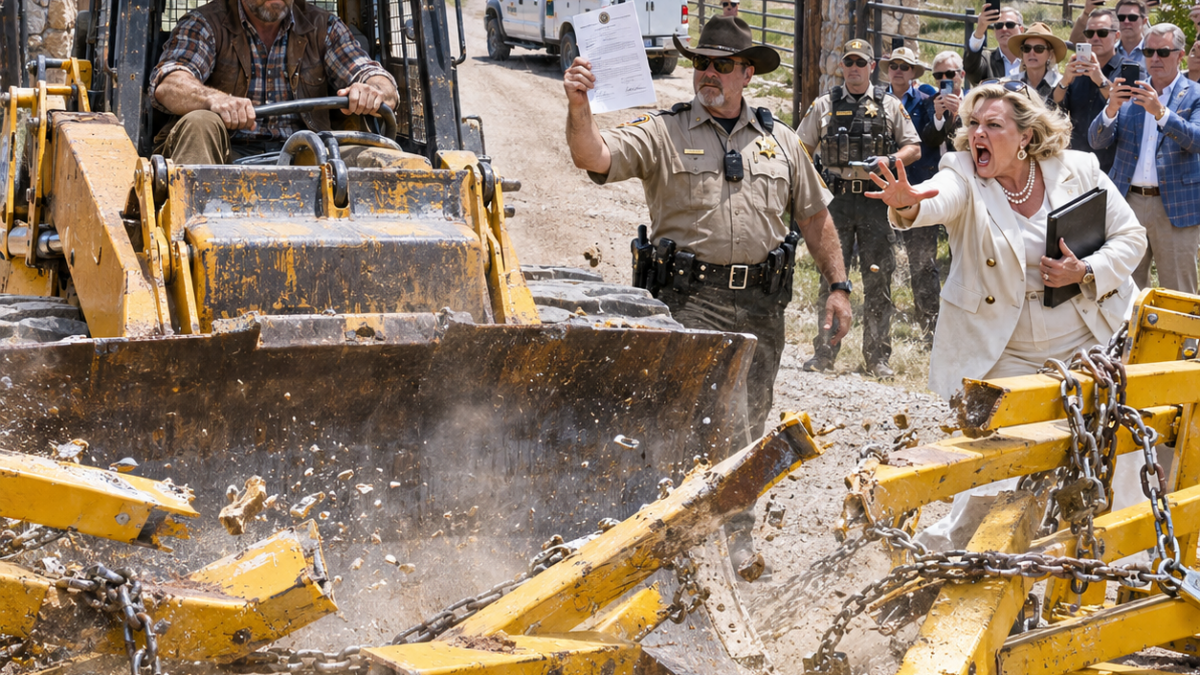
HOA Karen Chained 26 Steel Barriers Across My Ranch Gate—Then I Drove In With a Bulldozer and the Sheriff Holding a Court Order.
At sunrise, Judson Merritt found twenty-six steel barriers chained across the only gate wide enough for his cattle trailers, with HOA president Twila Hensley smiling behind them and threatening to have him arrested if he touched a single bolt.
She thought the barriers would force him to surrender permanent rights to the ranch road before a secret multimillion-dollar resort deal closed—but she had forgotten that a judge had already ordered her HOA never to obstruct that entrance again.
By noon, Judson’s bulldozer was crawling toward the gate with Sheriff Beckett Grady and two patrol units behind it, and Twila was still laughing right up until the sheriff held up the court order and told everyone to clear the road.
Blackstone Ranch covered 640 acres of Montana grassland, timber, and rolling pasture beneath a long western ridge.
The Merritt family had owned it through drought.
Blizzards.
Cattle crashes.
Bank pressure.
Wildfires.
And enough bad beef prices to teach three generations that panic was expensive.
Judson Merritt was forty-eight and had spent twenty years as a construction contractor before coming home to take over the ranch.
He understood land.
More importantly, he understood paperwork.
Property lines.
Access permits.
Road grades.
Construction easements.
Utility corridors.
Drainage plans.
He kept every deed, survey, permit, title policy, and court filing connected to Blackstone Ranch inside a fireproof cabinet in the small office behind his kitchen.
His father used to tease him.
“You planning to sue the grass?”
Judson always answered the same way.
“No. Planning to know which grass is mine.”
That habit would save him.
The main ranch entrance sat along County Highway 8.
A wide timber-and-steel gate opened onto a 380-foot private road leading toward the barns.
It was the only entrance large enough for:
Cattle trailers.
Hay trucks.
Feed deliveries.
Veterinary vehicles.
Fire engines.
Heavy equipment.
The road and gate were entirely inside Blackstone Ranch.
Recorded.
Surveyed.
Undisputed.
Or at least they had been.
PART2:
Five years earlier, a developer bought the rocky hills north of the ranch and created Silver Creek Heights.
Luxury homes.
Stone driveways.
Decorative ponds.
Imported trees that never looked quite happy in Montana.
Million-dollar houses facing the valley.
For the first few years, Judson barely noticed them.
Residents waved.
Judson waved back.
His cows stayed behind their fences.
Their lawn crews stayed on theirs.
Then Twila Hensley became HOA president.
Fifty-three.
Expensive coats.
Sharp voice.
Very good at saying unreasonable things as though everyone else had already agreed.
The first letter concerned dust.
Judson’s ranch road, she wrote, created “airborne particulate affecting Silver Creek’s premium residential environment.”
He ignored it.
Then came a complaint about cattle noise.
Then tractors.
Then the appearance of his weathered gate.
Twila called it:
“Visually inconsistent with the architectural character of adjacent properties.”
Judson pinned that one in his barn.
He liked it.
PART3:
Then she visited.
White SUV.
Leather folder.
Polite smile.
“Mr. Merritt.”
“Twila.”
“I’d like to discuss the entrance.”
“Mine?”
“The shared visual corridor.”
“No such thing.”
She smiled anyway.
Silver Creek wanted to landscape the area.
Stone arch.
Lighting.
Decorative fencing.
Maybe a secondary neighborhood entrance.
All Judson had to do was grant the HOA permanent use rights over his road.
He said no before she finished.
Twila looked surprised.
“Would you like to hear the compensation?”
“No.”
“You don’t know the amount.”
“Doesn’t matter.”
“You may reconsider.”
“Won’t.”
She stared toward the ranch.
“That’s a lot of land for one operation.”
Judson looked at her.
“That’s usually how ranches work.”
She left.
One month later, Silver Creek sent him an invoice.
$1,500 per month.
ROAD MAINTENANCE ASSESSMENT.
Judson mailed it back with a copy of his deed.
Attached was one sentence:
BLACKSTONE RANCH IS NOT A MEMBER OF SILVER CREEK HEIGHTS HOA AND GRANTS THE ASSOCIATION NO AUTHORITY OVER THIS ROAD.
Twila responded by calling a closed board meeting.
The board passed a resolution declaring Judson’s entrance a:
TRAFFIC CORRIDOR AFFECTING COMMUNITY MASTER PLANNING.
Which meant nothing.
But it looked official.
Then came another demand.
Remove the PRIVATE PROPERTY sign.
Accept HOA traffic control.
Pay road fees.
Judson signed nothing.
Trouble escalated sixteen days before the barrier incident.
Silver Creek contractors installed concrete posts near the edge of Judson’s entrance.
Judson called his attorney.
Cecily Drummond.
Forty-five.
Land-use litigator.
Had represented the Merritt family for years.
She filed for emergency relief.
Survey attached.
Deed attached.
Photos attached.
The court issued an order.
Silver Creek Heights, its board, contractors, agents, and anyone acting under its authority were prohibited from:
Blocking.
Restricting.
Or materially interfering with lawful access to Blackstone Ranch through the main entrance.
The order was served.
The process server’s receipt showed:
TWILA HENSLEY.
Signed personally.
Judson thought that would end it.
He underestimated her.
The evening before everything exploded, he noticed a black SUV parked near the ranch gate.
Two men in reflective vests stood with measuring wheels.
One sprayed orange paint into the dirt.
Judson drove down.
“What are you doing?”
They looked at each other.
One folded his measuring tape.
Neither answered.
They got into the SUV.
Drove away.
Judson photographed the plate.
Security camera caught the company logo.
He called Cecily.
“Someone’s measuring the gate.”
“Who?”
“Construction company.”
“Did they enter your land?”
“Looks like it.”
“Save footage.”
“Already did.”
“Anything installed?”
“No.”
“Don’t confront them tonight.”
“I wasn’t going to.”
“Judson.”
“What?”
“You sound like you were.”
He smiled.
“Good night, Cecily.”
He slept badly.
At 5:41 the next morning, metal struck metal.
CLANG.
Judson opened his eyes.
Again.
CLANG.
He stepped onto the porch holding coffee.
Flatbed trucks were unloading bright yellow steel barricades at his gate.
He set the coffee down.
Drove toward the entrance.
Then stopped twenty yards away.
Twenty-six barriers.
Not temporary plastic traffic control.
Steel.
Heavy.
Three staggered rows.
Clamped together.
Several anchored into the ground.
The last row extended past Judson’s marked boundary.
Deep inside the ranch.
Two private security trucks idled beyond them.
The same black SUV sat nearby.
And in front of everything stood Twila Hensley.
White coat.
Leather folder.
Smiling.
A large sign hung across the first row.
ROAD CLOSED
AUTHORIZED HOA ACCESS ONLY
Judson got out.
“What are you doing?”
Twila lifted one sheet of paper.
“Emergency road closure.”
“By who?”
“County.”
Judson held out his hand.
She gave him the page.
County seal.
Traffic engineer signature.
Official-looking reference number.
It claimed the ranch entrance presented an immediate traffic danger and temporarily placed control under Silver Creek Heights pending review.
Judson read it.
Then looked at the barriers.
“County authorized your HOA to close my private road?”
“Temporarily.”
“When?”
“Yesterday.”
“Interesting.”
He pointed at a survey pin.
“Half these barriers are on my parcel.”
“Access control requires adequate setback.”
“You have a court order telling you not to obstruct this entrance.”
“This county safety directive supersedes it.”
“Does it?”
“Yes.”
Twila stepped closer.
“If you damage even one barrier, we will prosecute for destruction of association property.”
Judson looked past her.
Two cattle trailers were already loaded near the shipping pens.
He had a signed livestock delivery contract that afternoon.
The buyer had wired a $48,000 deposit.
Delay could jeopardize the sale.
Twila followed his eyes.
Then smiled.
“Problem?”
“You know what’s scheduled today.”
“Our board was informed commercial traffic might be affected.”
“Commercial traffic.”
“Yes.”
“Cattle.”
“If you want immediate access restored, there is a solution.”
There it was.
“What solution?”
Twila opened her folder.
Permanent Road Use Agreement.
Judson read the first paragraph.
The HOA would receive permanent nonexclusive use of the ranch entrance and internal road corridor.
Authority to improve.
Landscape.
Install lighting.
Coordinate access.
Expand usage subject to master planning.
He looked up.
“You block my road, then offer to unblock it if I give you permanent rights.”
“I prefer negotiated resolution.”
“This isn’t negotiation.”
Twila smiled.
“Call it whatever helps.”
Judson took out his phone.
Started recording.
He slowly panned across:
Barrier one.
Barrier two.
Survey pin.
Anchors.
Security trucks.
Road-closure sign.
Then Twila.
“Repeat what you just told me.”
Her smile faded.
“Turn that off.”
“No.”
A security guard approached.
“Sir, no filming.”
“I’m on my property.”
“Give me the phone.”
Judson stepped backward.
Still recording.
“No.”
Twila took out her own phone.
Called sheriff dispatch.
Loudly.
“There is an agitated rancher threatening contractors.”
Judson didn’t answer her performance.
He called Cecily.
Then Sheriff Beckett Grady.
Beckett had served the county more than ten years as sheriff.
Fifty-six.
Calm.
Slow to accuse.
Even slower to be intimidated.
Judson sent him:
Photos.
Video.
Closure notice.
Court order.
Survey.
Beckett called within minutes.
“Don’t touch the barriers.”
“I know.”
“Don’t argue with security.”
“Trying.”
“I’m checking the document.”
“Twila says county issued it.”
“We’ll see.”
“Cattle have to leave today.”
“I understand.”
“Soon.”
“I understand that too.”
Judson heard paper moving on the other end.
“Let me work.”
Twila meanwhile ordered the contractors to padlock the pedestrian gate.
Judson watched.
Then his phone buzzed.
Unknown number.
DON’T SIGN ANYTHING.
THE ROAD ISN’T WHAT SHE REALLY WANTS.
Judson read it twice.
No name.
No explanation.
He did not reply.
Instead, he drove to town.
Adeline Pomeroy ran the survey office used by the Merritt family for decades.
Forty-three.
Precise enough to get irritated when people called survey monuments “stakes.”
Judson placed the road closure notice on her desk.
Then explained.
She said:
“Give me an hour.”
Forty-seven minutes later, she had:
Current survey.
Historic plat.
Parcel description.
Utility easement.
Road alignment.
Boundary history.
Her conclusion was simple.
“The road’s yours.”
“All of it?”
“All 380 feet behind the highway right-of-way.”
“Silver Creek?”
“They have a narrow underground utility easement near the north edge.”
“Traffic rights?”
“No.”
“Gate authority?”
“No.”
“Barrier rights?”
She looked at him.
“You know the answer.”
Cecily called next.
“I pulled the court order.”
“Still valid?”
“Yes.”
“Any amendment?”
“No.”
“Stay?”
“No.”
“County safety exception?”
“None filed.”
“And service?”
“Twila signed personally.”
Cecily sent him the process-server receipt.
TWILA HENSLEY.
Her signature.
She knew.
The sheriff’s answer came next.
Beckett had called the county road department.
Then the traffic engineer named on Twila’s closure notice.
The engineer’s first response:
“What closure notice?”
Beckett sent him the copy.
Silence.
Then:
“I never signed that.”
The reference number did not exist.
No road hazard report.
No inspection.
No emergency closure.
The county seal had been copied.
The signature had been reproduced.
Forged.
By early afternoon, Beckett had sealed Twila’s document in an evidence envelope.
Case number.
Date.
Initials.
Then he called Cecily.
“Court order is good.”
“Yes.”
“Property line confirmed?”
“Yes.”
“County wants its fake document.”
“Already has a copy.”
“Judson needs access restored.”
“I agree.”
Beckett paused.
“We do this safely.”
“Absolutely.”
Back at Blackstone, the contractor was getting nervous.
Tate Farnsworth.
Thirty-nine.
Small construction company.
Twila had hired him to install the twenty-six barriers.
He walked the line again.
Compared Twila’s drawing against visible boundary monuments.
Something didn’t fit.
He approached her.
“Mrs. Hensley.”
“What?”
“I need the permit.”
“You have the work authorization.”
“The county permit.”
“The HOA handles legal compliance.”
“I’m standing inside the ranch.”
“You’re inside the project corridor.”
“Survey pins say otherwise.”
Twila’s expression hardened.
“Tate, your company has a thirty-seven-thousand-dollar contract.”
“I know.”
“If your crew walks off this job, you don’t get paid.”
He looked at the barriers.
Then at the survey pin.
“That’s not what I’m asking.”
“You’re asking questions you were not hired to ask.”
Tate went quiet.
But he kept the original drawings.
That mattered later.
At 4:18, Judson’s unknown caller phoned again.
He answered.
“Who is this?”
A woman’s voice.
“Vivian Blackwell.”
HOA secretary.
She also handled financial records.
“Why are you texting me?”
“Because Twila’s going to ruin everybody.”
“What does she want?”
“Ask why she needs your road before Friday.”
“Why Friday?”
Silence.
Then:
“Ask where the barrier money came from.”
Call ended.
Judson stared at his phone.
The road wasn’t the real target.
Friday mattered.
Money mattered.
He went into the equipment barn.
His yellow crawler bulldozer sat beneath the lights.
Old but maintained.
Judson had used it for:
Firebreaks.
Road repair.
Snow berms.
Drainage work.
He knew exactly what it could do.
He did not start it.
Not yet.
That evening, Beckett called.
“We’ve confirmed the forged county notice.”
“Okay.”
“And your attorney has court confirmation that the existing order allows restoration of access.”
“Okay.”
“We’ll be there tomorrow.”
Judson looked toward the barn.
“With deputies?”
“Yes.”
“What if the contractor refuses to remove them?”
“Let’s deal with that when we get there.”
Judson smiled faintly.
“Sheriff.”
“Yeah?”
“I have a bulldozer.”
Long pause.
“I know you do.”
At 11:47 the next morning, Judson climbed into the cab.
Turned the key.
Diesel cranked.
Caught.
The engine settled into a heavy rumble.
He eased the crawler out.
Down the ranch road.
Behind him:
Sheriff Beckett Grady.
Two patrol units.
County survey truck.
Adeline.
Cecily.
The procession moved slowly.
Nobody rushing.
By the time they reached the entrance, Silver Creek residents were already gathered.
Twila had told them Judson planned to vandalize HOA property.
Phones were out.
Several residents expected to watch him get arrested.
Twila stood at the front.
The bulldozer stopped thirty yards away.
She pointed.
“There!”
She turned toward Beckett.
“He brought heavy equipment to destroy association property.”
Beckett got out.
“Everyone step away from the barricades.”
Twila blinked.
“Sheriff?”
“Workers, security, residents. Move behind the marked line.”
“Why?”
“Because we’re restoring lawful access.”
The crowd quieted.
Twila walked toward him.
“You saw the closure notice.”
“Yes.”
“Then arrest him.”
“No.”
Her face changed.
Beckett held up the paper.
“This document did not come from the county.”
Whispers.
“It bears a copied engineer signature.”
More whispers.
“And there is an active investigation into how it was created.”
Twila stared.
“This is ridiculous.”
Cecily stepped forward holding the court order.
“The association was served sixteen days ago with an order prohibiting obstruction of Blackstone Ranch’s entrance.”
Twila pointed at the barriers.
“Safety equipment.”
Beckett asked:
“If they’re safety equipment, why are they installed on property you don’t own?”
No answer.
Adeline walked to the boundary monument.
Then another.
Showed the survey.
Several barriers were not merely near the ranch.
They were well inside it.
Beckett looked at Tate.
“Can your crew remove them?”
Tate nodded slowly.
“Yes.”
Twila turned.
“No.”
“Tate.”
“If you touch one clamp, your contract is terminated and I’ll sue you personally.”
The crew stopped.
Beckett said:
“Mr. Farnsworth, I’m not ordering you into a civil dispute. I’m asking whether you will remove your equipment.”
Tate looked at Twila.
Then the sheriff.
Then his employees.
“I need legal advice.”
Fair.
Nobody forced him.
Minutes passed.
No movement.
Judson leaned from the bulldozer.
“I can move them.”
Twila screamed:
“You touch those and I’ll own this ranch before Christmas.”
Cecily looked at Beckett.
They conferred.
Deputies inspected the work area.
Barrier design.
Anchor points.
Open ground on Judson’s side where they could be pushed safely.
No people.
No vehicles.
No livestock.
A safety perimeter was established.
Body cameras running.
Adeline marked the boundary.
Cecily documented.
Beckett stood well outside the machinery zone.
Then he looked at Judson.
“Slow.”
Judson nodded.
“Only into the cleared area.”
“Understood.”
“No one goes near that machine while it’s moving.”
“Understood.”
Beckett raised one hand.
Everyone clear.
Then gave a single nod.
Judson lowered the blade.
Twila shouted:
“STOP!”
Nobody moved toward him.
The bulldozer crawled forward.
Tracks pressed into the dirt.
The blade touched the first steel barrier.
CLANG.
The sound rolled across the valley.
Judson increased pressure slowly.
The barrier flexed.
Its anchor pulled loose.
Steel scraped sideways into the designated open area.
Second barrier tipped.
Third followed.
Clamps snapped.
Not flying through the air like missiles.
Sliding.
Tilting.
Toppling.
Controlled.
But loud enough that every person recording understood exactly what was happening.
Twila ran toward Beckett.
“Do something!”
He didn’t take his eyes from the work zone.
“The entrance is being cleared pursuant to the court order.”
“He’s destroying HOA property.”
“Ownership and damages can be litigated.”
“Then stop him!”
“No.”
Judson pushed another row.
Steel shrieked against steel.
Dust lifted.
Yellow frames folded together.
One resident whispered:
“She’s actually losing.”
Another said:
“Why did we put these here?”
Twila heard.
“These barriers protect you.”
A retired teacher in the crowd asked:
“From cows?”
Twila glared.
Seventeen barriers were moved.
Judson stopped.
Deputies checked the area again.
Anchors from the second row were deeper.
He angled the blade.
Slow pressure.
One refused to move.
He repositioned.
Again.
Metal groaned.
Anchor tore loose with a sharp crack.
Several residents jumped.
Four linked barriers collapsed together and slid across the dirt.
Twila tried to step into the perimeter.
Deputy Reyes—not to be confused with any prior story character; here it was simply one of Beckett’s deputies—blocked her.
“Ma’am, stay back.”
“He is wrecking community assets.”
Beckett finally turned toward the residents.
“The barriers were installed across private property in violation of a standing court order.”
The crowd went still.
“What happens to the barriers afterward is a civil issue.”
He pointed toward the gate.
“What does not happen is this ranch staying blocked.”
Final row.
Final clamps.
Final steel frame.
Judson eased forward.
The last barrier toppled.
He stopped.
Killed the engine.
Silence.
No diesel.
No steel.
Just wind.
For the first time in almost two days, Blackstone Ranch’s main gate stood completely open.
Judson climbed down.
Dust on his sleeves.
He looked at Twila.
“Twenty-six.”
She said nothing.
“Not one belonged across my gate.”
Residents lowered phones.
Questions began.
“Who paid for them?”
“Why were they on his land?”
“Didn’t a judge say not to do this?”
“Why did the county document turn out fake?”
Twila turned toward her SUV.
She reached into her bag.
Keys.
Folder slipped halfway out.
Dark blue cover.
Large label:
SILVER CREEK EXPANSION — CONFIDENTIAL.
Judson saw it.
Months earlier, he had asked Twila during a public county meeting whether Silver Creek planned any development expansion toward Blackstone Ranch.
She had answered:
“No expansion project exists.”
Now the folder was in her hand.
Twila noticed him looking.
She shoved it toward Tate.
“Take this.”
Tate raised both hands.
“No.”
“Excuse me?”
“I’m done.”
“You work for me.”
“No.”
“Take the folder.”
“No.”
A deputy’s body camera captured every word.
Beckett walked over.
“Mrs. Hensley.”
She turned.
“You need to remain while we ask questions about the closure notice.”
Her face hardened.
“Am I under arrest?”
“Not at this moment.”
“Then I’m leaving.”
“You may leave after investigators obtain the information required for this report.”
She looked toward Judson.
“This isn’t over.”
He said nothing.
She pointed.
“Tomorrow you’ll wish those barriers were still standing.”
That afternoon, the cattle trailers left.
Late.
But the buyer accepted the delay.
The $48,000 deposit stayed alive.
Judson thought the worst was over.
At 8:12 that evening, a courier arrived.
NOTICE OF INTENT TO SUE.
Silver Creek Heights demanded almost $900,000.
Barrier damage.
Lost improvements.
Security expenses.
Legal costs.
Reputational harm.
Potential development losses.
Judson read the number.
Called Cecily.
“She’s suing.”
“Expected.”
“For nine hundred grand.”
“Expected less theatrics.”
“She says I damaged community property.”
“Body cameras say otherwise.”
“Still annoying.”
“That’s what litigation is.”
Twila held an emergency HOA meeting the next night.
Clubhouse packed.
She stood before a giant screen.
Video played.
Bulldozer blade.
Crashing steel.
Dust.
Twisted barriers.
The clip had been edited.
No sheriff reading court order.
No Adeline showing boundaries.
No deputies establishing safety perimeter.
No workers being asked to remove the obstruction first.
Just Judson.
Machine.
Destruction.
Twila looked at residents.
“This is who we’re dealing with.”
A few people nodded nervously.
“A dangerous man willing to destroy neighborhood property.”
Then she asked the board to authorize the $900,000 lawsuit.
A homeowner raised his hand.
“I was there.”
Twila ignored him.
He stood.
“The sheriff was there too.”
Another resident:
“He told us the HOA violated a court order.”
Twila said:
“That’s not what the final legal record will show.”
Cecily made sure it did.
Within forty-eight hours she collected:
Ranch security video.
Resident phone recordings.
Sheriff body cameras.
Court order.
Process-server receipt.
Survey.
Fake closure notice.
County verification.
Complete timeline.
Put together, the full recording showed:
Twila knew about the order.
Barriers crossed the boundary.
Contractor hesitated.
Deputies cleared a work zone.
Sheriff confirmed restoration.
Judson moved barriers only after safety controls were established.
Cecily sent Silver Creek’s counsel one letter.
Your client’s edited video materially omits facts preserved on law-enforcement recordings.
Preserve:
All meeting recordings.
Original video files.
Barrier contracts.
Board minutes.
Financial records.
All documents labeled Silver Creek Expansion.
That last phrase caused movement inside the HOA.
Two board members asked Twila for the barrier invoice.
She refused.
“Confidential.”
Then one asked:
“Why is a thirty-seven-thousand-dollar security purchase confidential?”
No answer.
Another requested the expansion file.
Twila said:
“No such project exists.”
But too many residents had seen the folder.
Three days later, Vivian Blackwell walked into Cecily’s office.
Canvas tote.
Copies.
Tired eyes.
Judson sat across the table.
Vivian said:
“I sent the text.”
“I figured.”
“I should have come sooner.”
“Why didn’t you?”
“Twila controls payroll.”
Fair.
She opened the bag.
Barrier invoice.
$37,000.
In resident financial summaries it had been disguised as:
COMMUNITY SECURITY UPGRADE.
Then legal fees.
Consulting fees.
Transfers.
One line stopped Cecily.
$620,000.
RESEARCH AND DEVELOPMENT COST.
“What’s this?”
Vivian swallowed.
“The reason for everything.”
Public corporate records led to:
Silver Creek Mountain Retreat.
Proposed luxury resort.
Estimated value:
$11 million.
Developer:
Kenton Rafferty.
Fifty-seven.
Polished.
Experienced.
Investor-backed.
Plans included:
Private villas.
Restaurant.
Spa.
Event pavilion.
Mountain overlook.
The project had one fatal problem.
Road access.
The existing route into Kenton’s tract was too steep in sections.
Tight turns.
Fire apparatus problems.
Service trucks difficult.
County planning required a compliant access solution.
The easiest route ran through Blackstone Ranch’s gate area.
Kenton had asked Judson directly months earlier.
$1.9 million.
Permanent easement.
Judson said no.
Too much resort traffic.
Too much risk to cattle operations.
Too much interference with ranch traffic.
He thought that ended it.
It didn’t.
Kenton then dealt with Twila.
According to Vivian’s documents, Twila represented that Silver Creek could secure the road.
A consulting entity connected to her stood to receive:
$420,000.
Upon successful access agreement.
Judson stared.
“So she was blocking my cattle to force the easement.”
Cecily said:
“Looks that way. We still verify.”
More records.
Draft permanent easement.
Judson’s name already typed.
Signature line blank.
Investor presentation:
BLACKSTONE ACCESS — FINALIZING.
Site plan:
Resort entrance through Judson’s gate.
Landscaping strips on his pasture.
Lighting.
Guard station.
Road widening.
The HOA promised legal access.
Yet it owned none of the land.
Then came the $620,000 transfer.
HOA reserves.
Intermediary company.
Financial ties to Twila’s consulting operation.
Vivian said:
“The board never got the whole contract.”
“Who approved it?”
“Twila pushed it through executive planning authority.”
“Is that permitted?”
“Not at that amount.”
Cecily didn’t jump to conclusions.
She sent records to proper investigators.
Beckett referred financial questions to his Criminal Investigations Unit.
Meanwhile, Cecily notified:
Resort lender.
Title insurer.
County planning.
Not accusing.
Simply stating a material fact:
No valid easement existed across Blackstone Ranch.
No HOA authority existed to grant one.
The resort’s access representation was disputed and unsupported.
That one notice hit harder than the bulldozer.
Kenton’s lender froze a $4.6 million construction disbursement pending review.
County planning reopened access conditions.
Investors called.
Kenton panicked.
He drove to Silver Creek’s clubhouse.
Confronted Twila in the parking lot.
Residents watched from windows.
“You promised the road was controlled.”
Twila shouted back:
“I said we were working on it.”
“You told investors the ranch owner had agreed in principle.”
“I said we could secure agreement.”
“You gave me a letter.”
“I gave you a planning statement.”
“That’s not what it says.”
Within days, their lawyers were blaming each other.
Tate Farnsworth then cooperated.
He provided:
Barrier contract.
Original construction drawings.
Texts from Twila.
One:
LOCK GATE COMPLETELY BEFORE FRIDAY SITE INSPECTION.
Another:
IGNORE EXISTING STAKES. LAND WILL BE PART OF PROJECT SOON ENOUGH.
Another:
NO TRAILER ACCESS UNTIL MERRITT SIGNS.
Purpose.
Clear.
Pressure Judson.
Create appearance that HOA controlled the entrance.
Get signature before resort inspection.
The residents started asking where their reserve money went.
Petition circulated to remove Twila.
She tried to call another closed meeting.
Board refused.
“Open session or nothing.”
Control was slipping.
Then forensic review of the fake county closure notice came back.
The traffic engineer’s signature had been copied from an unrelated public document.
Pasted onto the fabricated order.
Beckett’s investigators prepared an arrest-warrant application.
Twila called one final emergency HOA meeting.
Eighty-six owners attended.
More than ever before.
She wore a dark blazer.
Stood behind the podium.
“Silver Creek Heights is under attack.”
Nobody applauded.
“Outside interests are attempting to destroy your property values.”
Silence.
“Judson Merritt has cost this association hundreds of thousands—”
Vivian stood.
Hands shaking.
“That’s not true.”
Twila froze.
“Sit down.”
Vivian didn’t.
“The barrier money was hidden.”
Murmurs.
“The $620,000 transfer was never properly disclosed.”
Twila’s face changed.
“You are violating confidentiality.”
Vivian continued.
“The intermediary company has financial connections to Twila’s private consulting interests.”
The room exploded.
A board member stood.
“Is that true?”
Twila said:
“This is a complex strategic transaction.”
“Is it true?”
“The resort benefits Silver Creek.”
“Did HOA money go to a company tied to you?”
“Indirectly—”
“How much?”
Twila avoided.
Cecily had been invited by homeowners demanding transparency.
She stood only when asked.
No speech.
No insults.
She summarized:
Blackstone Ranch owns the road.
A court order prohibited obstruction.
No county closure existed.
Silver Creek had no signed ranch easement.
No authority to promise the road to a resort.
Twila grabbed the podium.
“This meeting is adjourned.”
Nobody moved.
Then the clubhouse doors opened.
Sheriff Beckett Grady entered.
Two deputies with him.
He carried a warrant.
The room went silent.
Twila stared.
“Why are you here?”
“Mrs. Hensley, step away from the podium.”
“No.”
“Please step down.”
“You cannot arrest the president of this association.”
Beckett’s face didn’t change.
“Being HOA president doesn’t put you above the law.”
He informed her the warrant concerned alleged forgery of the county closure document and related conduct supported by the investigation.
An arrest wasn’t a conviction.
Charges would need proof.
Due process would follow.
But the era of Twila controlling every room by volume ended there.
She stepped down.
Deputy placed cuffs.
No cheering.
No celebration.
Just stunned homeowners watching their president leave through the clubhouse doors.
Later that night, the HOA conducted a removal vote under its bylaws.
Eighty-six eligible owners participated.
Seventy-three voted to remove Twila.
An interim board took over.
Independent audit.
Open books.
Recovery actions.
Silver Creek Mountain Retreat received county notice requiring a lawful access redesign.
Judson sat on his porch that evening.
He looked at a still frame from the day before.
Twenty-six yellow barriers in a twisted pile.
He didn’t feel triumphant.
Just tired.
A week later, Kenton Rafferty called.
“I’d like to meet.”
“No.”
“New offer.”
“No.”
“Two and a half million.”
Judson paused.
“Still no.”
“That’s more than the road is worth.”
“Not selling a road.”
“It’s an easement.”
“Same answer.”
Kenton came anyway.
Leather portfolio.
Kitchen table.
$2.5 million.
Permanent right.
Judson listened.
Then pushed it back.
“My land was never for sale.”
“Everything has a price.”
“No.”
“After everything you’ve been through, why keep fighting?”
Judson looked at him.
“I’m not fighting.”
Kenton frowned.
“Then what are you doing?”
“Keeping my ranch.”
Silence.
“Your project needs access.”
“Yes.”
“My ranch doesn’t need your project.”
Kenton left.
The resort had to redesign.
New grading.
New engineering.
Different entrance.
More expensive.
Months delayed.
Millions over projected cost.
No Blackstone easement.
Civil and criminal cases continued.
Independent HOA audit identified:
Barrier costs.
Unauthorized legal expenses.
Questionable transfers.
Resort-related spending.
Consulting arrangements.
The new board pursued recovery.
Silver Creek also settled with Judson for verified losses from the blockade.
Road damage.
Gate repair.
Delayed shipment costs.
Attorney expenses where recoverable.
Twila’s case moved separately through the courts.
Evidence determined what she was responsible for.
Not neighborhood anger.
Kenton’s liability was handled separately too.
Silver Creek Heights survived.
That mattered.
Judson had never wanted eighty-six families financially destroyed.
The association reorganized.
New board.
Budget transparency.
Spending limits.
Conflict disclosures.
No executive road decisions.
Vivian stayed on as treasurer.
This time with full board access and protection from retaliation.
At the first meeting under the new board, they invited Judson.
He almost declined.
Cecily told him:
“Go.”
“Why?”
“Closure.”
“I have a gate.”
“Different closure.”
He attended.
The new president stood.
“Mr. Merritt, on behalf of Silver Creek Heights, we apologize.”
Judson nodded.
“For the barriers.”
Another nod.
“For the false road claims.”
“Okay.”
“For using our residents’ money in a dispute they did not understand.”
Judson looked around.
Some residents looked ashamed.
Others relieved.
He finally spoke.
“I never had a problem with people living up there.”
He pointed toward the hills.
“My problem was people using those families as a reason to take something that wasn’t theirs.”
The retired school teacher who had questioned Twila at the gate approached afterward.
“I should’ve spoken sooner.”
Judson answered:
“You spoke eventually.”
Back at Blackstone, he repaired the entrance.
Regraded ruts.
Replaced damaged posts.
Installed stronger steel gate.
Cameras.
Emergency access lockbox.
Better lighting—ranch lighting, not decorative HOA landscaping.
One crisp autumn morning, Judson was checking fence when Tate Farnsworth’s truck appeared on the county road.
Flatbed behind it.
Yellow steel.
Judson laughed.
He waved Tate down.
“Those look familiar.”
Tate grinned.
“Evidence hold released.”
“Where going?”
“You’ll like this.”
“Where?”
“Mountain Retreat.”
Judson raised an eyebrow.
“Why?”
“County closed some unapproved construction accesses.”
Tate nodded toward the barriers.
“Rental company got the contract.”
Judson couldn’t help it.
He drove over.
Stayed on the public road.
At Kenton Rafferty’s resort entrance, the same yellow barriers now stood in a neat line.
A sign:
UNAPPROVED ACCESS
ENTRANCE CLOSED PENDING REVIEW
No bulldozer needed.
No drama.
Just barriers doing what barriers were supposed to do.
Closing land where lawful authority actually existed.
Judson smiled.
Turned around.
Went home.
That evening, Blackstone Ranch was quiet.
Cattle drifted across the pasture.
The yellow bulldozer sat beside the barn.
Blade resting on dirt.
The ranch gate stood open beneath a Montana sunset turning the clouds orange.
Judson leaned against the fence.
Months earlier, Twila had believed twenty-six steel barriers could change ownership.
That if she blocked his trailers long enough, threatened enough money, waved enough documents, and created enough urgency, eventually he would sign.
She misunderstood the kind of man she was dealing with.
But more importantly—
She misunderstood land.
A barricade does not create an easement.
An HOA resolution does not create ownership.
A forged county seal does not create authority.
A resort investor presentation does not create consent.
And putting someone else’s name on a draft agreement does not mean they agreed.
Judson learned something too.
He had spent most of his life thinking the best protection for a ranch was a strong gate.
He was wrong.
The strongest protection had been:
The deed.
The survey.
The court order.
The camera footage.
The contractor’s texts.
Vivian’s records.
And a sheriff willing to read evidence before deciding which side looked more important.
People later told the story as though the bulldozer had won the fight.
It hadn’t.
The bulldozer only moved steel.
Paper moved everything else.
The lawsuit.
The resort loan.
The HOA board.
The financial investigation.
The fake closure notice.
The hidden expansion agreement.
The twenty-six barriers were simply the loudest part.
The real turning point happened before Judson started the engine.
Sheriff Beckett Grady called the county traffic engineer and asked one question:
“Did you sign this?”
The answer was no.
From there, Twila’s entire structure began collapsing.
Because confidence can survive arguments.
It can survive angry neighbors.
It can survive threats.
What it cannot survive is verification.
Years later, Judson kept one twisted yellow clamp from the barriers.
Not mounted.
Not framed.
It sat on a shelf in the equipment barn.
Occasionally someone asked about it.
He’d tell the story.
Usually they wanted to know:
“Did the barriers really go flying?”
Judson would smile.
“Not like the internet says.”
“Then what happened?”
“We moved them safely.”
“With a bulldozer.”
“Yes.”
“And the sheriff watched?”
“He made sure nobody got hurt.”
“Still sounds pretty good.”
Judson would laugh.
Maybe.
But the part he remembered wasn’t the crash of steel.
It was the silence afterward.
Engine off.
Gate open.
Twenty-six barriers gone.
The road belonging to exactly who it had belonged to before Twila ever arrived.
Nothing about the deed had changed.
Nothing about the boundary had changed.
The only thing that changed was that everybody finally had to acknowledge it.
One spring morning, the new Silver Creek president drove down to Blackstone Ranch.
Stopped outside the gate.
Didn’t enter.
Called Judson.
“Can I come in?”
Judson looked toward the truck.
“Why?”
“We’re repairing a shared drainage ditch near the north boundary. Surveyor wants to show you the plan.”
“Got permits?”
“Yes.”
“Insurance?”
“Yes.”
“Survey?”
“Yes.”
Judson smiled.
“Come through.”
The gate opened.
Truck entered.
Gate closed.
Simple.
Permission.
That was all Twila had ever needed to understand.
Ask.
Accept the answer.
If the answer is no, find another route.
Instead, she spent HOA money, forged authority, blocked a working ranch, endangered contracts, exposed residents to legal costs, and nearly tied an entire luxury resort to land she never controlled.
All because she thought enough pressure could turn no into yes.
It couldn’t.
Blackstone Ranch remained Blackstone Ranch.
Silver Creek remained next door.
The resort eventually found another access plan.
Life continued.
And whenever Judson drove through his gate with a cattle trailer behind him, he remembered sunrise on the morning those twenty-six barriers appeared.
Twila standing in white.
Smiling.
“You may own the ranch, Mr. Merritt, but you don’t control how people reach it anymore.”
She had been wrong.
Not because Judson had a bigger machine.
Not because the sheriff liked him.
Not because ranchers had more rights than homeowners.
She was wrong because the record was clear.
The road was his.
The court had already said it could not be blocked.
And no amount of yellow steel could rewrite that.
Twila Hensley had tried to put twenty-six barriers across Judson Merritt’s freedom.
He cleared every one.
But the bulldozer only opened the gate.
The sheriff’s investigation opened everything else.








