HOA Karen Called Wildlife Officers to Arrest Me for Fishing—Then They Shook My Hand and Read Her the 1998 Deed She’d Violated
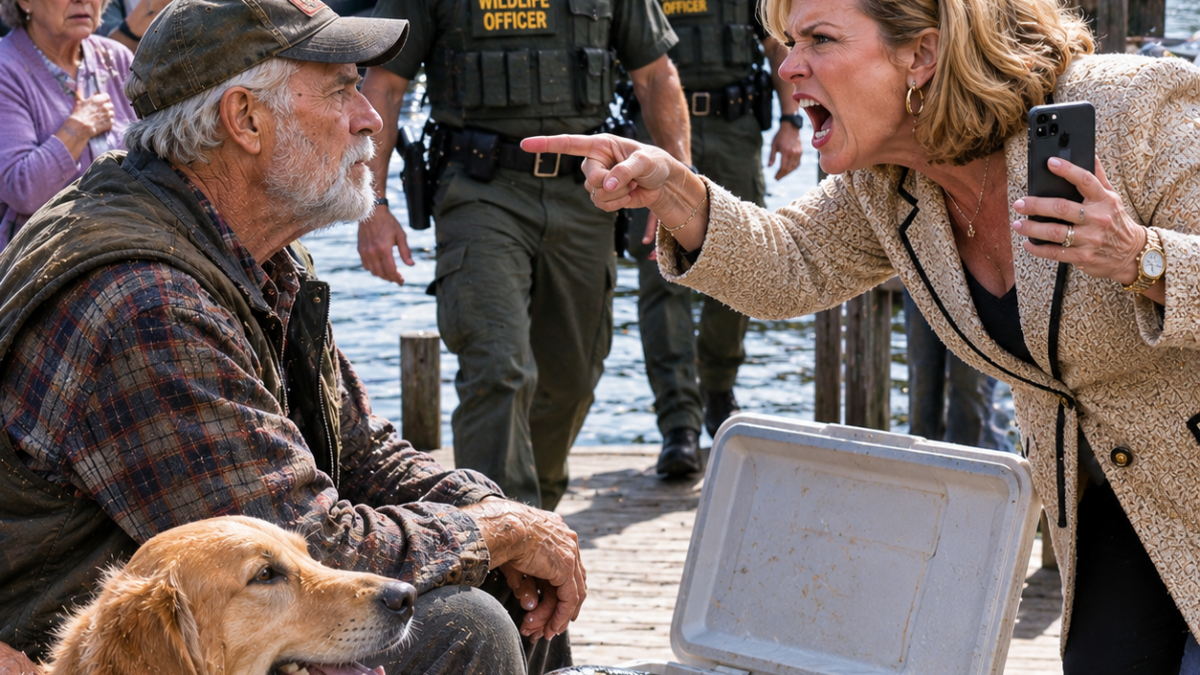
PART2:
Hargrove nodded.
Marlene’s face changed.
Not all at once.
First the smile went away.
Then her jaw loosened.
Then she glanced at the neighbors as though checking whether they had noticed.
They had.
“You know him?”
Hargrove finally turned toward her.
“Yes, ma’am.”
She recovered quickly.
Marlene was good at that.
“I don’t care who he knows. He is violating association rules.”
Hargrove looked back at me.
Then toward the lake.
Then at the new sign beside the walking path.
PRIVATE LAKE
RESIDENTS ONLY
NO FISHING
VIOLATORS WILL BE PROSECUTED
He studied it for a long moment.
Then asked:
“Who installed those?”
Marlene lifted her chin.
“The association.”
“Under whose authority?”
“Our governing documents.”
He looked at her.
“Your bylaws?”
“Yes.”
Hargrove nodded slowly.
Then he asked:
“Do your bylaws override a recorded state access agreement?”
Marlene didn’t answer.
That was the moment the morning changed.
But it had started three months earlier.
My name is Raymond Callaway.
Most people call me Ray.
I was sixty-eight when Marlene Voss decided she owned Silver Pines Lake.
I had been fishing that water since I was nine.
Before the stone entry walls.
Before the manicured trails.
Before half the houses.
Before anybody called the neighborhood Silver Pines.
My family had owned land on the north side of the lake for generations.
Not all the shoreline.
Not all the water.
But enough that my father had spent most of his adult life making sure the public would never lose access to the lake completely.
I spent thirty-one years working in fisheries management for the state.
Started as a field biologist.
Ended my career supervising regional fisheries programs.
I had sampled rivers in January.
Counted spawning beds in rainstorms.
Investigated fish kills in July heat.
Worked invasive species removals.
Helped write lake-management plans.
Testified in hearings where everyone pretended water stopped at property lines.
By the time I retired, I had learned one thing better than anything else:
Water keeps records.
You can lie about what you put into it.
You can hide invoices.
You can change signs.
You can change maps.
But eventually, water tells on you.
After retirement, I wanted something quieter.
Fishing.
Coffee.
Biscuit.
My little workshop.
The same dock my father had repaired with me when I was seventeen.
Most mornings, Biscuit and I walked down before seven.
I brought one rod.
Sometimes two.
A small cooler.
Thermos.
Biscuit usually slept.
When he didn’t, he stared at my bobber like it had personally offended him.
Life was simple.
Then one Monday morning, everything changed.
I reached the lake and found a new sign.
PRIVATE LAKE.
RESIDENTS ONLY.
NO FISHING.
VIOLATORS WILL BE PROSECUTED.
At first I thought someone had put it in the wrong place.
Then I saw another sign farther down the trail.
And another near the marina.
All new.
All identical.
HOA logo at the bottom.
I stood there with Biscuit’s leash in one hand.
Read the closest sign twice.
Then looked at the water.
“Somebody’s lying.”
Biscuit sneezed.
I took that as agreement.
I kept walking.
At the dock, I opened my chair.
Put down the cooler.
Started rigging my line.
I had barely made my first cast when heels clicked behind me.
That sound did not belong on an old wooden dock at seven-thirty in the morning.
I turned.
Marlene Voss.
Mid-fifties.
Navy blazer.
Hair sprayed into place.
Dark sunglasses.
Clipboard.
She had been appointed chair of the HOA Lake and Grounds Committee maybe two months earlier.
I knew her name because she had mailed letters about shoreline standards to residents.
I was not a resident.
So until that morning, she and I had never spoken.
“Sir?”
I looked around.
“Morning.”
“Are you Mr. Callaway?”
“I am.”
She checked a sheet.
“You’re not on the resident list.”
“No.”
“This lake is for Silver Pines residents and authorized guests.”
I looked toward my dock.
Then toward the old path behind her.
“Is that what the new signs are about?”
“Yes.”
“Who approved them?”
“The association.”
“Based on what?”
She frowned.
“Excuse me?”
“What gives the HOA authority to block fishing access?”
“Our governing documents.”
“This property isn’t in your association.”
“You’re standing on lakefront maintained by Silver Pines.”
“No.”
Her expression sharpened.
“Sir, do you understand the word trespassing?”
I looked at her for a moment.
Then smiled.
“I understand it better than you do.”
Her mouth tightened.
I didn’t want a fight.
So I explained.
“The lake has a recorded public-access covenant.”
Marlene laughed.
Actually laughed.
“Sir, we have bylaws.”
“Congratulations.”
“I don’t appreciate sarcasm.”
“I wasn’t being sarcastic.”
She folded one arm across her chest.
“This association controls lake access.”
“No, it manages portions of the shoreline.”
“We control the lake.”
“Not the way you think.”
She shook her head.
“Nobody fishes here without our permission.”
That sentence stayed with me.
Not because it was rude.
Because it was historically absurd.
People had fished Silver Pines long before Silver Pines Estates existed.
My father had made sure of that.
In 1998, when developers acquired surrounding parcels, he negotiated a permanent public fishing and access agreement as part of the transfer involving the lakebed and shoreline rights.
The state became a party to that agreement.
Fishing access from several designated points was protected.
My family retained its own access rights.
The developer got what it needed for the subdivision.
My father made sure nobody could someday put up a gate and pretend the lake had always been private.
Marlene had managed to do exactly that in less than three months.
I reeled in my line.
“I’m going to send you the recorded agreement.”
“You can send whatever you like.”
“You should read it.”
“I know the bylaws.”
“That’s what worries me.”
Her cheeks flushed.
“You’ve been formally warned.”
“Good morning, Marlene.”
I started walking back toward the house.
Biscuit followed.
Halfway along the east side of the cove, he stopped.
His nose lifted.
Then he pulled toward the water.
I noticed the first fish.
Silver belly up.
Then another.
Then five.
Then a cluster near the reeds.
Dead.
Bluegill mostly.
A few shiners.
One young bass.
I crouched.
There were more farther down.
Dozens.
Not hundreds.
But enough.
The water around them had an odd blue-green cast.
Not algae exactly.
Too even.
Too artificial.
I picked up a stick and stirred the surface.
The smell reached me.
Sharp.
Chemical.
Partly like crushed vegetation.
Partly metallic.
I felt the back of my neck tighten.
Some smells disappear after retirement.
Some never do.
Biscuit took one step closer.
I pulled him back.
“No.”
He looked at me.
“Stay out.”
I had sample vials in my workshop because old habits die harder than people think.
Ten minutes later, I came back.
Three clean glass containers.
Gloves.
Labels.
I took samples from three locations.
Shoreline.
Near the dead fish.
Closer to the stormwater outlet.
Date.
Time.
Temperature.
Location.
I photographed everything.
Then I stood there looking across the water toward the eastern pump house.
The HOA used it for irrigation and stormwater management.
Behind it sat the clubhouse.
Nothing visibly unusual.
Still, the water wasn’t right.
I went home.
Placed the samples in a cooler.
Sat at my kitchen table.
Biscuit lay beneath my chair.
I made one phone call.
Daniel Hargrove answered.
“Hargrove.”
“Still answering like somebody just stole your lunch?”
Silence.
Then:
“Ray Callaway.”
“Afraid so.”
“Thought retirement killed you.”
“Almost.”
“What’s wrong?”
He heard it in my voice.
That was one reason I called him.
Danny and I met when he was twenty-three.
Young conservation officer.
Too much confidence.
Not enough mud on his boots yet.
I taught fisheries crews how to preserve evidence from suspected contamination cases.
He taught me that new officers could survive astonishing amounts of stupidity if you kept a tow strap nearby.
Over the years, he became one of the best wildlife officers in the region.
I trusted him.
“I’ve got a fish kill at Silver Pines.”
“How big?”
“Small so far.”
“What species?”
I told him.
“Natural?”
“No.”
“You sound sure.”
“I’m sure enough to call you.”
Pause.
“What are you seeing?”
I described the water.
The smell.
The location.
Then I told him about the new access signs.
That interested him too.
“Any samples?”
“Three.”
“Of course you took samples.”
“I was bored.”
“Ray.”
“They’re labeled.”
“Of course they are.”
I leaned back.
Then said:
“It feels familiar.”
That changed the conversation.
Years earlier, Danny and I had worked a contamination case involving illegal application of aquatic chemicals near a residential pond.
Different chemical.
Different county.
But the early signs were similar.
Dead fish.
Altered water.
People assuming a pretty pond was healthy because somebody had made the vegetation disappear.
Danny went quiet.
I said:
“It’s happening again.”
He answered:
“Don’t do anything yet.”
“I already took samples.”
“Meaning don’t confront anybody.”
“I’m sixty-eight.”
“You were dangerous at fifty.”
“That hurts.”
“Ray.”
“I hear you.”
“We’re coming.”
“When?”
“I’ll call.”
I hung up.
Biscuit looked up.
“Now we wait, boy.”
Waiting turned out to be harder than I expected.
The next day, the dead fish were gone.
Not naturally.
Someone had collected them.
The shoreline had been cleaned.
I found tire tracks near the service entrance.
That evening, I walked past the pump house.
No trespassing.
No touching equipment.
Just walking a route legally accessible from my side.
That was when I saw the green truck.
VOSS GREEN LAWNS.
I knew the name.
Gary Voss.
Marlene’s younger brother.
He had a landscaping and grounds-maintenance company.
The HOA had recently hired him to handle shoreline vegetation, common lawns, and “lake appearance services.”
The phrase lake appearance services bothered me.
Water quality and appearance were not the same thing.
Gary backed his truck beside the pump house.
He opened the rear gate.
Two heavy plastic drums were inside.
Then another.
He moved them using a small hand cart.
I stepped behind a pine.
Raised my phone.
Photo one.
Truck.
Photo two.
Drums.
Photo three.
Gary opening pump-house door.
Photo four.
One barrel inside.
Then a twig cracked beneath my boot.
Gary spun around.
He saw me.
His whole body changed.
He came down the path fast.
“What are you doing?”
“Walking.”
“You taking pictures?”
“Yes.”
“Delete them.”
“No.”
His face reddened.
“You don’t have permission to photograph our equipment.”
“I’m not inside the building.”
“Get off HOA property.”
“I’m on the access trail.”
He stepped closer.
“You didn’t see anything, old man.”
I looked directly at him.
“I saw everything I photographed.”
His hands curled.
For a second, I thought he might grab the phone.
He didn’t.
Good choice.
I walked away.
By morning, my face was on the Silver Pines neighborhood app.
WARNING: POACHER ON PRIVATE LAKE.
Marlene used a photograph of me sitting on my dock.
Below it:
This individual has repeatedly ignored posted restrictions and has been seen removing fish from Silver Pines. Do not engage. Contact HOA security.
Then a skull emoji.
Forty-three comments by lunchtime.
Somebody wrote:
CALL THE GAME WARDEN.
Another:
PEOPLE LIKE THIS THINK RULES DON’T APPLY TO THEM.
Another:
IS HE HOMELESS?
That one made me laugh.
Not because it was clever.
Because my house was visible from the lake.
Nobody asked my side.
Nobody asked why I had been fishing there for decades.
Nobody checked a deed.
Nobody looked up the access agreement.
They saw a post from an HOA officer and filled in the rest.
At one in the afternoon, Marlene hand-delivered an envelope.
Official HOA letterhead.
TRESPASS NOTICE.
$500 FINE.
UNAUTHORIZED HARVEST OF AQUATIC RESOURCES.
I read it on the porch.
Then folded it neatly.
Placed it in my shirt pocket.
Marlene watched.
“That fine increases if you continue.”
“Good to know.”
“You think this is funny.”
“No.”
“You’re deliberately provoking us.”
“I’m documenting you.”
Her expression changed.
Just slightly.
“What does that mean?”
“It means I keep paperwork.”
“This isn’t negotiable.”
“I agree.”
She walked back toward her car.
I put the letter in a folder.
Paper trails are beautiful things.
Not because paper wins automatically.
Because memory becomes very flexible when consequences arrive.
That afternoon, I walked Biscuit along the lake trail.
A woman stopped me.
Lavender cardigan.
White hair.
Trembling hands.
Dolores Finch.
Seventy-one.
I knew her by sight.
She lived two streets above the marina.
“Mr. Callaway?”
“Yes?”
She looked around before speaking.
“My dog swam in the cove last week.”
I felt something tighten inside me.
“What happened?”
“He got sick.”
“What symptoms?”
“Vomiting. Wouldn’t eat. Shaking.”
“Did you take him to a vet?”
“Yes.”
“What did they say?”
“Possible toxin exposure.”
I looked toward the water.
“What part of the lake?”
“The east cove.”
Same area.
“How long was he swimming?”
“Maybe ten minutes.”
“Is he okay?”
“Better.”
She lowered her voice.
“Marlene said the water treatment is safe.”
“What treatment?”
Dolores blinked.
“She said they were controlling weeds.”
“Who told you that?”
“She did. At the garden meeting.”
I took a breath.
“Dolores, keep your dog out of the lake.”
Her face went pale.
“Is it dangerous?”
“I don’t know yet.”
“Should I tell people?”
“Tell anybody whose animals go in the water to keep them out.”
I paused.
“But don’t speculate about why.”
She nodded.
Then looked at the app on her phone.
“They’re saying terrible things about you.”
“I’ve survived worse.”
“I didn’t believe it.”
“Thank you.”
That night, I did something I had not planned to do.
I mounted a trail camera on a pine tree overlooking the pump house.
Camouflaged.
Motion activated.
No flash.
I stayed on my side of the access corridor.
I photographed where I placed it.
Then went home.
For two nights, I barely slept.
Not because I thought somebody would discover it.
Because I wanted to know what it would show.
On the second morning, I retrieved the memory card.
Put it into my laptop.
2:14 a.m.
Green truck.
Gary.
One other man I didn’t recognize.
Hose.
Barrel.
Storm drain.
I watched the clip three times.
Gary connected a transfer hose to a drum.
The other end disappeared into a utility opening.
The runoff line fed toward the eastern cove.
I did not know exactly what chemical was being used.
I did not need to guess.
The video showed enough to justify investigation.
I sent the clips to Danny.
Photographs.
Sample notes.
Marlene’s notice.
Gary’s truck.
Dolores’s statement about her dog.
Then I waited.
Three minutes later, Danny replied.
SATURDAY. 9:00 A.M.
BE AT THE DOCK.
FISH LIKE ALWAYS.
DO NOT CHANGE ANYTHING.
I stared at the message.
Why Saturday?
Why nine?
Why did he want me fishing?
I almost called.
Then decided not to.
If he could tell me more, he would have.
Friday afternoon, I checked the lake.
Fewer dead fish.
The water still looked wrong near the cove.
Saturday morning came bright and cold.
Clear blue sky.
Water smooth enough to reflect the pine line.
I put my fishing gear in the truck.
Cooler.
Permit folder.
Thermos.
Biscuit climbed in.
Before leaving, I checked one document.
State invasive-species volunteer authorization.
Still current.
Part of a community removal program targeting white perch populations in connected waters.
Legal harvest.
Documented.
I had been removing them for months and submitting catch data.
Marlene either didn’t know or didn’t care.
At 8:15, I sat on the dock.
Biscuit at my feet.
Cast.
Waited.
I caught the first white perch at 8:27.
Measured.
Recorded.
Into the cooler.
Second.
Third.
By 8:50, I had six.
Then I heard heels.
Marlene.
Of course.
She had brought people.
At least fifteen.
Two committee members.
Several neighbors.
One man who seemed to film everything that happened in the subdivision.
She stopped behind me.
Looked into the cooler.
Her face brightened.
“There.”
She pointed.
“Proof.”
I kept tying a knot.
“Morning.”
“You were formally ordered to stop.”
“I received your letter.”
“And you ignored it.”
“Yes.”
“Everyone heard that?”
She looked at the phones.
I glanced at Biscuit.
He yawned.
Marlene took out her phone.
She made sure the speaker volume was high.
“Yes, hello?”
She smiled.
“State Wildlife Patrol?”
Pause.
“I’d like to report illegal fishing at Silver Pines Lake.”
She gave the address.
Then my name.
Then added:
“He has a cooler full of fish.”
She looked at me as she said it.
Practically glowing.
The call ended.
Marlene crossed her arms.
“You should’ve listened.”
I reeled in my line.
“Maybe.”
“You’ll be removed from the property.”
“Maybe.”
“You could lose your fishing privileges.”
“Could be.”
That irritated her.
She wanted fear.
I had spent thirty-one years standing beside people who thought badges, uniforms, or official stationery automatically made them right.
Sometimes they did.
Sometimes they didn’t.
Ten minutes passed.
Marlene checked her watch.
Then again.
Neighbors whispered.
The little boy near the path asked his mother:
“Is he going to jail?”
She whispered something I couldn’t hear.
I knelt.
Scratched Biscuit behind the ears.
“We’ll see.”
Then came the engine.
Low at first.
Across the water.
Marlene turned.
A state patrol boat rounded the cove.
Blue lights flashing.
Two officers at the bow.
Hargrove.
And Eli Mercer, a younger officer I had met once at a fisheries seminar.
Marlene smiled like she had just won a court case.
“Now you’ll see.”
The boat eased against the dock.
Hargrove stepped off.
Then came the confrontation.
“ARREST HIM!”
Handshake.
Marlene’s face dropping.
The crowd going silent.
Hargrove asking about the signs.
Then he turned toward me.
“Permit?”
I handed him the folder.
He opened it.
Checked the authorization.
Eli looked into the cooler.
“White perch.”
“Six.”
“Measurements recorded?”
I handed him my notebook.
He nodded.
“Legal invasive removal.”
Marlene stared.
“That’s irrelevant.”
Hargrove looked at her.
“It’s directly relevant to the fishing complaint you made.”
“He’s trespassing.”
“No.”
“He is not a resident.”
“That doesn’t matter.”
“We own the lake.”
Hargrove took a folded document from his case.
“Let’s talk about that.”
Marlene’s posture stiffened.
He opened it.
“This is the 1998 Silver Pines public fishing and access covenant.”
She said:
“I’ve never seen that.”
“That may be part of the problem.”
He pointed toward the water.
“The agreement was recorded when the development acquired surrounding lake property.”
I stood quietly.
Hargrove continued.
“It protects public fishing access at designated points, including this corridor.”
Marlene looked toward me.
“He told you about this?”
Hargrove almost smiled.
“Ray helped explain it to the state when it was recorded.”
Her mouth opened.
I corrected him.
“My father did most of the negotiating.”
Hargrove nodded.
“Ray’s family conveyed certain lakebed interests with permanent access protections.”
Then he turned toward the posted sign.
“Your association cannot use bylaws to eliminate those rights.”
Marlene’s voice rose.
“Our attorney approved those signs.”
“Then I’d like the attorney’s name.”
Silence.
Hargrove continued.
“And until this is reviewed, those signs need to come down.”
“You can’t order an HOA to remove private-property signs.”
“When the signs unlawfully interfere with state-protected public access, we can take enforcement action.”
Marlene looked around.
People were still recording.
This was no longer the video she had expected.
Then Eli looked at me.
“Thirty-one years?”
Marlene frowned.
“What?”
Hargrove said:
“Mr. Callaway served thirty-one years in fisheries management.”
Marlene stared.
“He was a game warden?”
“No.”
I answered.
“Biologist.”
Hargrove added:
“Chief regional fisheries biologist for the last part of his career.”
Eli smiled.
“He trained half the people who trained me.”
I shook my head.
“That sounds depressing.”
Nobody laughed except Eli.
Marlene’s voice became smaller.
“That doesn’t give him special fishing rights.”
“No.”
Hargrove looked at her.
“The covenant does.”
I reached into my pocket.
“There’s one more thing.”
Hargrove’s expression changed.
The neighbors noticed.
I handed him my phone.
He already had the files.
This was theater now, but useful theater.
“Play the second video.”
He did.
Green truck.
2:14 a.m.
Gary.
Hose.
Storm drain.
The crowd went completely silent.
Marlene watched.
Her lips parted.
“That’s…”
She stopped.
Hargrove looked at her.
“Do you recognize the vehicle?”
“No.”
Then somebody behind us said:
“That’s Gary’s truck.”
Dolores.
She had joined the crowd sometime during the patrol boat’s arrival.
Marlene turned.
Dolores stood with both hands gripping her purse.
“My dog got sick after swimming in that cove.”
Marlene snapped:
“This is becoming ridiculous.”
Hargrove raised one hand.
“Everyone needs to stay calm.”
Then we heard a truck door slam behind us.
Gary Voss stood at the top of the path.
He had probably come because someone texted him.
Or Marlene had.
His face changed when he saw the patrol boat.
Then the uniforms.
Then me.
Marlene called:
“Gary.”
He didn’t move.
“Tell them what you were doing.”
Hargrove looked toward him.
“Mr. Voss?”
Gary swallowed.
“Lake maintenance.”
“With what product?”
“Aquatic treatment.”
“What product?”
Gary’s eyes shifted to Marlene.
That told me almost as much as an answer.
Hargrove said:
“Don’t look at her.”
Gary looked back.
“I’d have to check.”
“You applied something to a stormwater line and you don’t know what it was?”
“It was part of the maintenance program.”
“Who instructed you?”
Gary said nothing.
Marlene stepped forward.
“This conversation is inappropriate without counsel.”
Hargrove nodded.
“That’s a reasonable point.”
Then he looked toward Gary.
“You don’t have to answer questions right now.”
Marlene seemed relieved.
Then Hargrove added:
“But you do need to remain available while the environmental investigators conduct their inspection.”
Marlene blinked.
“What investigators?”
Two state vehicles were already turning onto the eastern access road.
That was why Saturday.
That was why nine.
Hargrove had not come because Marlene called.
He had already been coming.
Her complaint simply guaranteed an audience.
The vehicles stopped near the pump house.
Three people stepped out.
Environmental enforcement.
Water-quality specialist.
One wildlife technician.
Marlene stared.
“You can’t search the pump house.”
The environmental investigator approached.
A woman named Dr. Nina Park.
I knew her by reputation.
She held up paperwork.
“We have lawful inspection authority related to a suspected discharge.”
“That building belongs to the HOA.”
“Understood.”
“You need board permission.”
“Not for everything we are here to inspect.”
Marlene’s face went pale.
She looked at Hargrove.
“You set this up.”
“No.”
He nodded toward me.
“Water quality did.”
Marlene looked at me.
For the first time since I met her, she didn’t look angry.
She looked afraid.
The investigation took hours.
The crowd thinned.
Some neighbors stayed.
Others went home.
Nobody was filming me anymore.
The new subject was the pump house.
Investigators documented drums.
Hoses.
Treatment records.
Drain connections.
Product labels.
Storage methods.
Invoices.
The first thing they established was that not every chemical found there was automatically illegal.
That mattered.
I had no interest in turning a real problem into a fake one.
Some aquatic vegetation products can be used lawfully.
Under correct conditions.
At correct concentrations.
With proper permits.
Applied in approved areas.
Recorded properly.
The problem was what the records showed.
Applications not matching treatment logs.
Concentrations inconsistent with approved use.
Chemical handling near the stormwater system.
And a discharge route that could carry treatment residue directly into the eastern cove.
Gary’s landscaping company had been hired by the HOA.
Marlene had pushed the contract through her committee.
That did not automatically mean she knew every detail of what he did.
So I waited.
The state did too.
Samples went to the lab.
The pump house was sealed against further chemical use pending review.
Temporary barriers went up around the storm drain.
The HOA was ordered to suspend lake treatments.
Nobody was arrested on the dock.
That wasn’t how it worked.
Real investigations move slower than neighborhood rumors.
Marlene hated that.
She wanted certainty when she thought I was the target.
Now she complained about due process.
Funny how that happens.
By Monday, the private-lake signs were gone.
Not because Marlene volunteered.
Because the board’s attorney finally reviewed the access covenant.
I heard that from Susan Bell, one of the board members who called me.
She sounded embarrassed.
“We didn’t know.”
“You should have.”
“I know.”
“Did nobody check before installing signs?”
“Marlene said legal had reviewed it.”
“Had they?”
Silence.
“No.”
I almost laughed.
Instead:
“Then start there.”
The HOA formally rescinded my $500 fine.
That part amused me because I was never legally subject to their fine system anyway.
But I kept the cancellation letter.
Paper trail.
Dolores took her dog back to the veterinarian.
He recovered fully.
Whether his illness came directly from lake exposure could never be proven to the standard people wanted.
Too much time had passed.
No sample from the dog had identified the exact substance found in the cove.
I never claimed otherwise.
Dolores didn’t either.
She simply stopped letting him swim there until the state cleared the water.
That was enough.
The laboratory results came back over the next two weeks.
Elevated concentrations of copper-based algaecide in one zone.
A surfactant mixture associated with the treatment product.
Levels high enough near the discharge area to explain acute stress in fish.
The state investigation found that Gary’s company had been using a concentrated formulation through equipment connected near the pump-house drainage system.
Some of the product had entered the stormwater route.
The applications had not been documented properly.
The quantities purchased did not match the quantities recorded as used.
Then investigators found invoices.
That was where Marlene’s position became much harder.
She had approved repeated “emergency lake clarity” treatments.
Not because residents were in danger.
Because several homeowners had complained about aquatic vegetation being visible from lakefront patios.
One email from Marlene said:
The water must be visually clear before the summer home tour.
Another:
We cannot have weeds visible near the premium lots.
Another:
Gary says a stronger application will give us the clean look we need.
That email mattered.
Not because wanting a clear lake was criminal.
Because it showed she knew stronger applications were being discussed.
Investigators still had to determine what she knew about the actual discharge method.
Gary told them he believed the HOA wanted aggressive treatment.
Marlene said Gary was responsible for following all legal requirements.
Both statements could be true.
Both could also be self-protective.
The state handled that part.
I stopped speculating.
My job was over.
Almost.
The Silver Pines board called an emergency meeting.
I didn’t plan to attend.
Susan asked me.
Then Dolores asked me.
Then Hargrove said:
“You should probably go.”
“Why?”
“Because half the neighborhood thinks you’re secretly running the state.”
“That sounds useful.”
“Ray.”
So I went.
The clubhouse was full.
People who had ignored me three weeks earlier now moved chairs so I could sit.
I disliked that almost as much as being called a poacher.
People are too quick to create villains.
They’re just as quick to create heroes.
Usually the truth is more boring.
I sat beside Dolores.
Biscuit stayed home.
Marlene sat at the board table.
No navy blazer this time.
Gray sweater.
No sunglasses.
Her attorney sat beside her.
The meeting began with the association lawyer explaining the access agreement.
Not me.
Good.
He said Silver Pines never had authority to prohibit lawful public fishing at the protected access points.
The posted signs had been removed.
Any future access changes would require legal review.
Then the treasurer discussed lake-treatment contracts.
Gary’s company.
Invoices.
Payments.
The state’s ongoing enforcement review.
Marlene asked to speak.
People began whispering.
She stood.
“I want residents to understand that every decision I made was intended to protect property values and improve the quality of Silver Pines.”
Someone called from the back:
“By poisoning it?”
The board president banged his gavel.
I turned.
“Don’t.”
The man looked at me.
I said:
“Let her finish.”
Marlene looked surprised.
She continued.
“The lake had severe vegetation complaints.”
“Vegetation isn’t contamination,” I said quietly.
Everyone heard anyway.
Marlene looked at me.
“I relied on contractors.”
“That’s possible.”
She blinked.
I continued.
“But you called a healthy-looking shoreline the goal.”
“I wanted the lake maintained.”
“So did I.”
“You acted like I was destroying it before there was proof.”
“No.”
I shook my head.
“I acted like fish were dying.”
The room went quiet.
“There’s a difference.”
Marlene’s attorney whispered something.
She ignored him.
“You were photographing my brother.”
“I photographed equipment entering the pump house.”
“You planted a camera.”
“Yes.”
“That feels like surveillance.”
“It was pointed at a utility building connected to a suspected discharge area.”
“You were looking for something.”
“Yes.”
“What?”
“The reason fish were dying.”
Her face tightened.
“You wanted to prove me wrong.”
“No.”
That answer seemed to anger her.
“I wanted to know what was in the water.”
She stared at me.
I said:
“Marlene, if the samples had come back clean, I would’ve been happy.”
That was the truth.
I didn’t want an environmental case.
I wanted a healthy lake.
The board eventually voted to terminate the landscaping contract.
They also removed Marlene from the Lake and Grounds Committee pending the state review.
She resigned from the board two days later.
Her letter said she could no longer serve effectively in an environment of hostility and misinformation.
I read it once.
Then put it in the folder.
The state enforcement process took longer.
Gary’s company received multiple citations.
Improper handling.
Unreported discharge.
Recordkeeping violations.
The HOA faced penalties too because it had contracted and funded the work without proper oversight.
Some fines were reduced after cooperation.
Others weren’t.
Nobody went to prison.
No dramatic handcuffs.
No television trucks.
That disappointed some neighbors.
Real accountability often does.
People expect one giant moment.
Usually it’s invoices.
Orders.
Fines.
Corrective plans.
Attorneys.
Monitoring.
Expensive mistakes becoming permanent records.
The lake required remediation.
Not some miracle “cleaning.”
The state stopped further applications.
Monitored water.
Managed runoff.
Tracked fish mortality.
Native vegetation returned in places the HOA had spent money trying to make visually empty.
The water became less artificially clear.
That was good.
Healthy lakes are not swimming pools.
By the end of summer, fish counts had improved.
Not fully.
But enough.
Bluegill returned to the east cove.
Young bass appeared along the reeds.
Dragonflies came back thick over the shoreline.
Dolores’s dog eventually swam again.
She asked me first.
“Is it safe?”
“I’m not your veterinarian.”
She frowned.
“Ray.”
“The latest state tests are within normal range.”
“So?”
“So ask your veterinarian.”
She rolled her eyes.
Then asked him.
He said yes.
The dog launched off the bank like he had been waiting for legal clearance his entire life.
Biscuit watched from dry ground.
He has always considered swimming an activity for animals with poor judgment.
The public-access issue changed the neighborhood more than I expected.
Once the signs came down, families began using the legal fishing points again.
At first, Silver Pines residents complained.
Too many cars.
Too many children.
Too many outsiders.
The state worked with the association on clear parking and access rules that respected the covenant without turning the neighborhood into chaos.
That was reasonable.
Public access doesn’t mean no rules.
It means the rules have to be legal.
I helped once.
Only once.
Susan asked me to review a draft fishing-information sign.
It listed limits.
Invasive species guidance.
Trash rules.
Access hours.
I made one change.
At the top, the draft said:
SILVER PINES COMMUNITY FISHING AREA.
I crossed out community.
Wrote:
PUBLIC FISHING ACCESS.
Susan looked at me.
“Still sensitive?”
“No.”
I handed back the marker.
“Just accurate.”
She smiled.
The strangest part came two months later.
A FOR SALE sign appeared in Marlene’s yard.
People immediately started talking.
She’s fleeing.
She can’t face anyone.
The fines ruined her.
Nobody knew.
I certainly didn’t.
Maybe she wanted to leave.
Maybe she had planned to move already.
Maybe the whole experience made the neighborhood unbearable.
I refused to speculate.
A few days later, I saw her near the mailbox station.
I was walking Biscuit.
She was carrying a package.
We could have passed without speaking.
Instead, she stopped.
“Ray.”
“Marlene.”
She looked older than she had three months earlier.
Not dramatically.
Just tired.
Her eyes went toward Biscuit.
“He always with you?”
“Most mornings.”
She nodded.
Then:
“I suppose you’re happy.”
“No.”
That surprised her.
“You got everything you wanted.”
“I wanted the fish to stop dying.”
She looked away.
“The state made it sound like I personally dumped chemicals into the lake.”
“I never said you did.”
“Everyone thinks I did.”
“Then correct the part that isn’t true.”
She looked at me.
“You could have said something.”
“About what?”
“That I wasn’t the one with the hose.”
“I have.”
“You never defended me publicly.”
I almost laughed.
“Marlene, you posted my picture online with a skull emoji.”
Her face colored.
“I thought you were poaching.”
“You didn’t ask.”
“You were fishing after the signs went up.”
“The signs were unlawful.”
“I didn’t know that.”
“I told you.”
“You said there was an agreement. People say things.”
“Then you verify them before accusing someone of a crime.”
She went quiet.
Biscuit sniffed the edge of the road.
Marlene looked toward the lake.
“I really thought we owned it.”
“I know.”
“Our documents call it the Silver Pines private lake.”
“Marketing documents.”
She nodded faintly.
“The developer sold people that idea.”
“Probably.”
She looked at me.
“So everyone was wrong?”
“No.”
I shook my head.
“Everyone trusted the same sentence without checking the deed.”
That was different.
She shifted the package in her arms.
“Gary says you ruined his company.”
“No.”
“He lost contracts.”
“He discharged treatment chemicals improperly.”
“He says he was doing what we asked.”
“Maybe he believed that.”
“You always have an answer.”
“Thirty-one years in government.”
That almost made her smile.
Almost.
Then she said:
“I did want the lake clear.”
“I know.”
“People complained constantly.”
“I believe you.”
“They paid a fortune for those homes.”
“I know.”
“The weeds looked terrible.”
I looked toward the cove.
“What weeds?”
“You know what I mean.”
“No.”
She sighed.
“The plants.”
“Some were native aquatic vegetation.”
“They looked ugly.”
“To you.”
“They lowered property appeal.”
“Maybe.”
She frowned.
“You don’t care about property values.”
“I care about healthy water.”
“That isn’t the only thing people care about.”
“No.”
I nodded.
“That was the mistake.”
She waited.
“You treated the thing you cared about most like it was the only thing that mattered.”
Property values.
Appearance.
Control.
It didn’t make her evil.
It made her dangerous once nobody challenged her.
She looked down at the package.
“I shouldn’t have posted your picture.”
“No.”
“I shouldn’t have called you a poacher.”
“No.”
“I thought the officers would remove you.”
“I know.”
She finally met my eyes.
“When Hargrove shook your hand…”
She shook her head.
“I wanted the dock to open up and swallow me.”
I laughed before I could stop myself.
She looked annoyed.
“Sorry.”
“No, you aren’t.”
“No.”
That time she smiled.
Just barely.
Then she asked:
“Did you know they were coming before I called?”
“Yes.”
Her eyes widened.
“You did?”
“Yes.”
“That patrol boat wasn’t responding to me?”
“Not originally.”
She stared at me.
“What were they coming for?”
“The investigation.”
“And you just sat there?”
“I was told to fish like normal.”
She put one hand over her face.
“Oh my God.”
I had to look away because I was trying not to laugh again.
“So when I called—”
“You made the morning more interesting.”
“You could have told me.”
“And ruined your big arrest?”
That got a real laugh out of her.
Short.
Unwilling.
But real.
Then she became serious again.
“Why didn’t you?”
I thought about the question.
“Because you wouldn’t have believed me.”
She didn’t argue.
That was probably the most honest moment we ever had.
A week later, her house sold.
I never found out exactly why she moved.
Not my business.
Silver Pines changed after that.
Not overnight.
HOAs don’t become humble institutions because one board chair resigns.
But people started asking more questions.
Documents were reviewed.
Contracts required independent approval.
Environmental work required permits to be verified instead of simply mentioned.
Board packets included property maps.
The public-access covenant went into the permanent association records.
Susan became board president the following year.
She asked me to serve on an advisory committee.
I said no.
She asked again.
Still no.
“I’m retired.”
“You keep saying that.”
“Because nobody believes me.”
“You spend six mornings a week monitoring fish.”
“I fish.”
“You record lengths.”
“Habit.”
“You report invasive catch.”
“Civic duty.”
“You helped revise the lake plan.”
“Temporary weakness.”
She laughed.
Then stopped asking.
Mostly.
By the following spring, the lake looked better than it had before the controversy.
Not cleaner.
Better.
There’s a difference.
The shoreline had vegetation again.
Frogs.
Insects.
Small fish.
Water had color.
Life.
Kids fished from the designated public dock.
Some Silver Pines residents hated that at first.
Then something strange happened.
Their kids joined them.
One Saturday, I counted eleven children along the shoreline.
Half residents.
Half not.
Nobody cared which was which.
A boy named Tyler caught his first bass.
Maybe eleven inches.
He shouted so loudly Biscuit woke up from a dead sleep.
Tyler wanted to keep it.
I showed him the size rules.
He looked disappointed.
Then I explained why smaller fish go back.
He lowered it carefully.
Watched it disappear.
“Will I catch him again?”
“Maybe.”
“Will he be bigger?”
“If you leave him alone long enough.”
He thought about that.
Then asked:
“Did you really own the whole lake?”
I almost choked on my coffee.
“No.”
“My mom said your family did.”
“No.”
“Did you give it to the state?”
“Part of the lakebed rights were transferred under an agreement.”
He stared.
“That sounds boring.”
“It was.”
“Then why was everybody fighting?”
“Because boring papers become exciting when nobody reads them.”
He accepted that.
Kids are good that way.
Adults need longer explanations.
Officer Hargrove came fishing one morning that summer.
No uniform.
Just jeans.
Baseball cap.
A fishing rod that cost more than my first car.
I looked at it.
“How much?”
“None of your business.”
“That means too much.”
“Can we fish?”
“You know expensive equipment can’t fix bad technique.”
He sat beside me.
Biscuit immediately moved to his side.
Traitor.
For nearly an hour, we caught nothing.
Then Danny said:
“You know Marlene’s call probably helped.”
“How?”
“Made the access violation happen right in front of us.”
“You already had the covenant.”
“Still nice when evidence volunteers.”
I smiled.
“That’s government laziness.”
“That’s efficiency.”
We sat quietly.
Then he asked:
“Do you miss it?”
“Work?”
“Being involved.”
“No.”
“That was too fast.”
“I miss parts.”
“Which?”
“The fieldwork.”
“Not meetings?”
“I would rather lick the bottom of this dock.”
“Reports?”
“No.”
“Court testimony?”
“Absolutely not.”
“Investigations?”
I watched my line.
“Sometimes.”
Danny nodded.
“Knew it.”
“I don’t miss being responsible.”
“That I believe.”
A fish touched my line.
Then disappeared.
Danny looked toward the east cove.
“You were right to call.”
“I know.”
“You don’t have to say it like that.”
“You said it.”
He laughed.
Then grew serious.
“We were lucky.”
“With what?”
“The discharge wasn’t worse.”
“Yes.”
“We could’ve had a much larger kill.”
“I know.”
“The dog too.”
“Could’ve been worse.”
We both looked at the water.
That was the part people forgot.
The dock confrontation became the story.
Marlene’s face.
Handshake.
Wildlife boat.
Phones.
It was clean.
Easy to retell.
But none of that mattered compared with what almost happened beneath the surface.
A lake can survive bad leadership.
It can survive ugly signs.
It can survive neighborhood gossip.
Chemical mistakes are less forgiving.
Years of fisheries work taught me that ecological damage rarely announces itself dramatically at first.
A few fish.
A strange smell.
Vegetation disappears.
Water gets unusually clear.
People say:
Looks great.
Then something collapses.
That was why I never regretted the samples.
Or the camera.
Or the paperwork.
Not because I wanted to catch Marlene.
Because I wanted to catch the problem before the lake paid for it.
Later that summer, the state installed a small informational sign near the public dock.
Nothing fancy.
SILVER PINES PUBLIC FISHING ACCESS.
Below:
Respect private shoreline.
Follow state fishing regulations.
Dispose of line properly.
Do not disturb aquatic vegetation.
At the bottom was a small paragraph about invasive species.
No HOA logo.
No threats.
No word trespass.
I liked it.
One morning, I saw Dolores reading the sign while her dog splashed in the shallows.
“You approve?”
She asked.
“Mostly.”
“What would you change?”
“The font.”
She stared.
“I’m serious.”
“So am I.”
Biscuit was sleeping under the bench.
Dolores’s dog shook water everywhere.
Biscuit opened one eye.
Disgusted.
Dolores sat beside me.
“You know I almost believed her.”
“Marlene?”
“The post.”
“That’s okay.”
“No, it isn’t.”
“You didn’t know me.”
“I knew you had been fishing here for years.”
“That should’ve raised a question.”
She nodded.
“I think that’s what bothers me.”
“What?”
“I didn’t ask one.”
I looked at the lake.
“That’s how most trouble starts.”
Not with villains.
Not always.
Sometimes with people accepting the first confident explanation because checking takes effort.
Marlene had a title.
Clipboard.
HOA letterhead.
She sounded official.
I was an old man in a fishing chair.
Most people chose the simpler story.
The old man was trespassing.
Then Hargrove shook my hand and everyone chose a new simple story.
Ray secretly owned everything.
That wasn’t true either.
The truth was paperwork.
History.
Public-access rights.
Environmental science.
Permits.
Samples.
Contracts.
A contractor cutting corners.
An HOA chair who cared too much about appearance and too little about verification.
Messier than a viral video.
Usually is.
That fall, Susan asked whether I wanted the old illegal-fishing sign.
They had found one in a storage room.
“Why would I want it?”
“Souvenir?”
“No.”
“Target practice?”
“Tempting.”
She laughed.
“We’re throwing them out.”
“Good.”
A week later, I found one leaning against my workshop.
Someone had written in marker:
FOR RAY’S PRIVATE COLLECTION.
I knew Danny’s handwriting.
I kept that one.
Hung it beside the lawn mower.
Not because I was sentimental.
Because it made me laugh.
The following April, I was back on the dock before sunrise.
Same chair.
Same rod.
Same dog.
Biscuit was older.
So was I.
Water calm.
Mist low over the cove.
I heard footsteps.
A man and his daughter.
Maybe eight years old.
They stopped near the sign.
“Is this where we’re allowed to fish?”
The father asked.
“Yes.”
“Public?”
“Yes.”
He looked relieved.
“We saw houses everywhere and weren’t sure.”
“That’s why the sign exists.”
The girl carried a pink fishing rod.
I pointed to the open space beside me.
“You can use that side.”
She sat.
Her father began rigging her line.
Ten minutes later, she caught a bluegill.
Tiny.
She screamed.
Her father laughed.
Biscuit woke up.
She held the fish like it was a trophy.
“Can I keep it?”
Her father looked at me.
I checked the fish.
Legal.
But small.
“You can.”
She smiled.
Then looked at it.
“Does it get bigger?”
“Yes.”
She thought about that.
“Then I want to put it back.”
I showed her how.
She lowered it into the water.
The bluegill disappeared.
She watched the ripples.
Then looked at me.
“Do you work here?”
I smiled.
“No.”
“Then why do you know everything?”
Her father looked embarrassed.
“Emily.”
“It’s okay.”
I scratched Biscuit behind the ears.
“I used to work with fish.”
She nodded like that made perfect sense.
Then cast again.
I leaned back.
Coffee in one hand.
Rod in the other.
The sun started breaking over the trees.
Across the lake, native grass moved along the eastern cove.
You could no longer see the pump house clearly from the dock because vegetation had grown back.
I liked that.
Silver Pines wasn’t mine.
It had never been mine.
That was the irony Marlene never understood.
I had spent months fighting because she insisted on treating the lake like private property, but I wasn’t trying to claim it for myself.
My father had fought to make sure nobody could.
Not the developer.
Not the HOA.
Not my family.
A lake connected to public water, public wildlife, and a recorded access covenant was never supposed to become somebody’s private ornament.
The public fishing agreement wasn’t about giving me special rights.
It was about preventing people like me from getting special rights.
Everyone got the same lawful access.
That was the point.
People later told the story differently.
They’d say:
Karen called the wildlife officers on Ray, but she didn’t know he used to be their boss.
Not true.
I was never Hargrove’s boss.
Or:
Ray secretly owned the lake.
Also false.
Or:
The wildlife officers arrested the HOA president right there on the dock.
Definitely false.
No one arrested Marlene.
The real story was less dramatic.
And more important.
She put up signs she didn’t have the authority to put up.
She ignored a recorded access agreement because HOA bylaws made her feel certain.
She hired her brother’s company to make the lake look cleaner.
She trusted appearance over ecology.
Gary used treatment methods the state found improper.
Fish died.
A dog got sick after swimming there.
And instead of wondering why a retired fisheries biologist kept showing up with a notebook, Marlene decided I was the threat.
Then she called the exact agency already investigating the lake.
Sometimes irony doesn’t need help.
The state did its job.
The HOA corrected the access problem.
The lake recovered.
Gary paid for his mistakes.
Marlene lost the authority she had misused.
And I went back to fishing.
That was enough.
A year after the confrontation, Hargrove texted me a photograph.
A new wildlife recruit standing beside a sampling boat.
Caption:
HE SAYS HE’S HEARD THE CALLAWAY STORY.
I wrote back:
TELL HIM HALF OF IT IS WRONG.
Danny answered:
WHICH HALF?
I typed:
THE INTERESTING HALF.
He sent a laughing emoji.
I put the phone down.
Biscuit lifted his head.
“You ready?”
His tail moved once.
I packed the cooler.
Not full of illegal fish.
Just lunch.
Then we walked toward the dock.
The public-access sign stood beside the trail.
No private-lake warning.
No HOA threat.
Just rules anybody could read.
I passed it without slowing.
At the end of the dock, I opened my old chair.
Biscuit curled beside my boots.
I cast toward the reeds.
And waited.
Same dock.
Same spot.
Same dog.
The lake looked alive.
That was all I had ever wanted.








