HOA Karen Called Wildlife Officers on My Private Lake—Then They Stepped Off the Truck, Saw Me, and Said, “Director Tillman, Sir.”
HOA Karen Called Wildlife Officers on My Private Lake—Then They Stepped Off the Truck, Saw Me, and Said, “Director Tillman, Sir.”
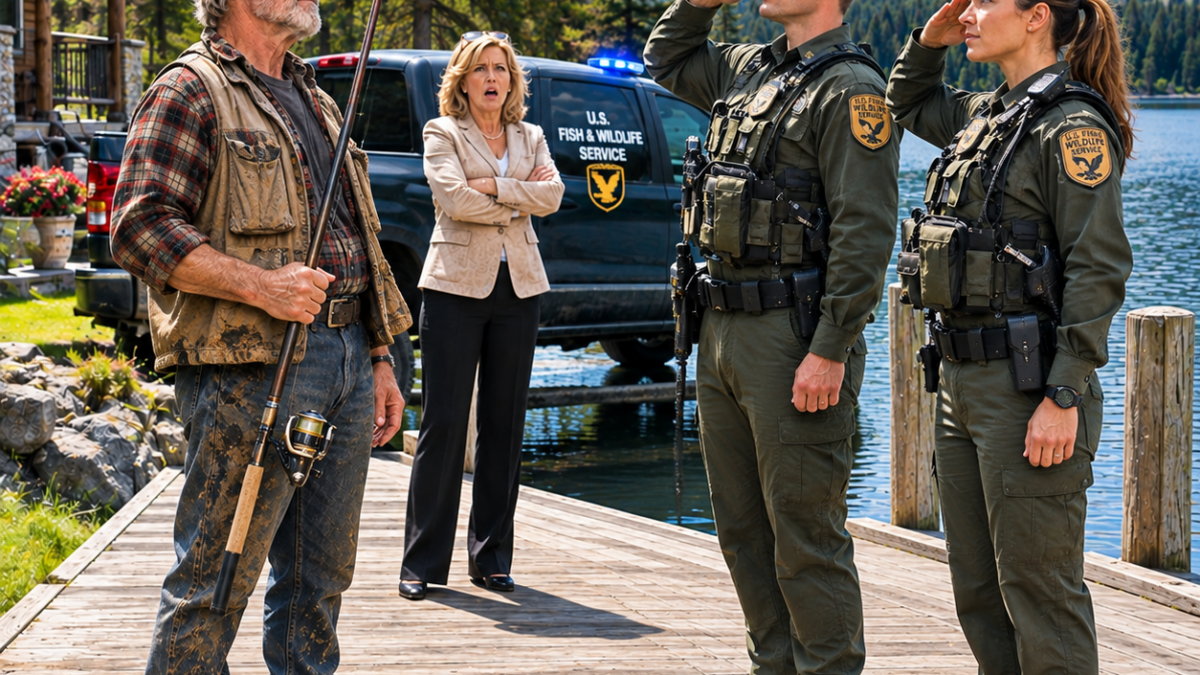
Shelby Denton called wildlife enforcement and had two officers racing toward my private Montana lake within twenty minutes, convinced she was finally going to watch them drag the muddy old rancher off the dock in handcuffs.
She stood behind them smiling while they approached me—until the senior officer stopped dead, straightened his posture, and said, “Director Tillman, sir. I didn’t know you were living out here.”
What Shelby had never bothered to learn was that I had spent twenty-eight years with the United States Fish and Wildlife Service, trained one of the officers she had summoned, signed the other officer’s field commission, and had already begun documenting evidence that the real environmental threat to my lake was coming from her own subdivision.
My name is Garrett Tillman.
I was sixty-one when Shelby Denton decided I was nothing more than a dirty old rancher sitting on a lake she wanted.
I suppose I helped create that impression.
My boots were usually muddy.
My beard had gone mostly gray.
There were holes in two of my favorite flannel shirts.
I drove an old Ford pickup that smelled faintly of wet dog, trout bait, and pine needles.
And after Ellen died, I stopped caring very much what strangers thought when they looked at me.
Before that, I had cared.
Probably too much.
Twenty-eight years with the United States Fish and Wildlife Service has a way of teaching you to polish your boots before meetings, keep your reports clean, and choose words carefully because one badly written sentence can end up being read aloud in federal court five years later.
I started young.
Field officer.
Bitterroot Valley.
Mud up to my knees.
Counting elk.
Checking trap lines.
Inspecting illegal kills.
Crawling through brush to document grizzly dens.
I spent more nights sleeping in government trucks than I care to remember.
Then came supervisory work.
Enforcement coordination.
Interagency operations.
Regional investigations.
Eventually Regional Supervisor.
Assistant Director.
PART2:
And finally Regional Director for Region 6.
Eight states across the Mountain West.
Montana.
Wyoming.
Colorado.
Utah.
North Dakota.
South Dakota.
Nebraska.
Kansas.
A lot of land.
A lot of wildlife.
A lot of people convinced environmental law applied only when it was convenient.
By the time I became Regional Director, I was no longer the man crawling under barbed wire with a camera.
I was the man reviewing the reports written by the people crawling under barbed wire.
I signed commissions.
Reviewed enforcement actions.
Approved investigations.
Sat across tables from ranchers, developers, tribal leaders, county commissioners, corporate lawyers, conservation groups, federal prosecutors, and occasionally people who thought saying “I didn’t know” made a violation disappear.
It rarely did.
PART3:
Officer Kyle Braddock came through a field-training program I helped design.
Twenty-six years old.
Eager.
Smart.
Talked too much.
He graduated third in his class.
I wrote his first performance review.
Later, when he transferred into Montana enforcement, I wrote the recommendation.
Nina Stokes came later.
Sharp.
Quiet.
The kind of officer who noticed tire tracks before anybody else noticed the gate had been opened.
I signed her field commission six years before I retired.
She later told me she framed the letter.
I had forgotten writing it.
Then Ellen got sick.
Pancreatic cancer.
Fourteen months from diagnosis to the morning I woke beside her and realized the room was too quiet.
She was fifty-four.
We had been married thirty-one years.
People say thirty-one years is a long marriage.
It isn’t.
Not when it ends.
The day after the funeral, I sat in my office and stared at a map covering eight states.
Wildlife refuges.
District offices.
Enforcement zones.
All of it suddenly felt like somebody else’s life.
I lasted six more weeks.
Then I resigned.
No retirement ceremony.
No banquet.
No speeches.
I cleaned out my desk.
Took home one framed photograph of Ellen.
A coffee mug.
Two field notebooks.
And an old Fish and Wildlife baseball cap I should probably have thrown away ten years earlier.
Then I drove back to Montana.
My family ranch sat outside Kalispell on 320 acres of pasture and timber.
My grandfather Harold bought it in 1961.
Back then, there had been one house.
One equipment shed.
A collapsing cattle barn.
And a spring-fed lake tucked between granite and cottonwood trees.
Grandpa fished that lake almost every morning until his heart gave out.
On the dock.
Fishing rod still leaning against the railing.
My father kept the ranch afterward.
When he died, it came to me.
I kept it even while working for the federal government because some places are not investments.
They are anchors.
The lake was roughly sixty acres.
Cold.
Deep in the center.
Fed by a creek descending from the ridge.
Rainbow trout.
Cutthroat.
A healthy population of smallmouth that should not have been there but had somehow been there for decades.
And on the north shore stood one giant cottonwood.
Every spring for fifteen years, the same pair of bald eagles nested there.
Ellen named them Lewis and Clark.
The first year we saw them, she sat beside me on the dock with binoculars pressed to her face.
Lewis brought a fish to the nest.
Clark stole most of it.
Ellen laughed.
“They’re explorers.”
“Why?”
“They found the best place in Montana.”
Then:
“They’re never leaving.”
For fourteen years she was right.
After her death, watching those eagles was one of the few things that made the ranch feel less empty.
I barely left for six weeks.
Fishing.
Fence repair.
Coffee.
Watching Lewis and Clark circle the lake.
I stopped shaving regularly.
Stopped replacing clothes just because elbows wore thin.
Stopped answering calls I didn’t recognize.
That was how Shelby Denton met me.
Exactly as she wanted to see me.
Not Garrett Tillman, former Regional Director.
Just Garrett.
Old rancher.
Alone.
Glacier Ridge Estates had appeared three years earlier.
Developer named Wade Denton bought four hundred acres directly east of my fence.
Luxury subdivision.
Forty-seven homes.
Cedar siding.
Stone columns.
Three-car garages.
Mountain views.
Four-hundred-dollar monthly HOA dues.
Community pool.
Fitness center.
Clubhouse.
Private walking paths.
Everything except water.
They did not have a lake.
Mine was visible from nearly half their lots.
Blue through the trees.
Perfect in sunset photographs.
It looked like part of Glacier Ridge if you didn’t bother checking a deed.
The developer apparently hoped I would eventually cooperate.
I never had.
Then Shelby became HOA president.
She was Wade Denton’s wife.
That should have told me enough.
She knocked on my door one Saturday morning in April.
Blond hair pulled tight.
Turquoise earrings.
White linen blazer.
Black yoga pants.
White Escalade parked halfway across my drive.
She smelled like vanilla perfume.
“Mr. Tillman?”
“Yes.”
“Shelby Denton. President of Glacier Ridge Estates.”
I waited.
“We’d like to discuss community access to the lake.”
“No.”
That stopped her.
“I haven’t explained the proposal.”
“You don’t need to.”
She smiled again.
“This could be mutually beneficial.”
“I’m fine.”
“The families in Glacier Ridge are very interested in outdoor wellness.”
“Good.”
“Community-building activities.”
“Also good.”
“Kayaking.”
“There are public lakes nearby.”
She looked past me toward the water.
“We’re talking about your lake.”
“I know.”
She lowered her voice.
“Shared access would dramatically improve the neighborhood.”
“No.”
“You could receive compensation.”
“No.”
“You haven’t heard the number.”
“Doesn’t matter.”
Her eyes moved over my shirt.
Torn elbow.
Coffee stain.
Muddy boots.
“You’re just one man.”
“Yes.”
“Sitting on something the entire community could enjoy.”
“Yes.”
“That seems selfish.”
There are people who use moral language whenever property law fails them.
Shelby was one.
“The lake is entirely inside my deed.”
“It’s a natural resource.”
“Still mine.”
“You don’t use all of it.”
“I don’t use every room in my house every minute either.”
Her smile vanished.
“People around here are trying to build something.”
“So am I.”
“What?”
“A quiet life.”
She turned.
Walked back to the Escalade.
Before climbing in, she looked over her shoulder.
“This conversation isn’t finished.”
It was for me.
Next morning, I found a sign.
Wooden.
Hammered beside my private road.
COMMUNITY LAKE ACCESS →
Green letters.
Arrow pointing toward my dock.
Heel prints in mud.
Narrow.
Deep.
I pulled the sign out.
Broke it.
Burned it.
Did not call sheriff.
Did not send letter.
Mistake.
Three days later:
Certified mail.
Glacier Ridge Estates Homeowners Association.
Gold embossed letterhead.
Two pages.
Community Wellness Bylaw 14.7.
Supposedly required adjacent landowners to provide “reasonable recreational access to shared natural amenities.”
Consequences:
$250 daily fines.
Suspension of community privileges.
County enforcement referral.
I read it twice.
Then pulled my deed.
1961 plat.
Recorded title.
Lake boundary.
Road.
Ranch.
Everything private.
Glacier Ridge had no jurisdiction.
Not even close.
I wrote back.
Professional.
Short.
My property is not within Glacier Ridge Estates.
The lake is privately owned.
The association has no legal right of access.
Please direct future communications to my attorney.
Certified mail.
Paper trails work both ways.
My neighbor Dale later told me Shelby opened the letter inside the HOA office.
Read it.
Tore it in half.
He couldn’t hear everything she said.
One word carried through the open door.
“Bulldozer.”
I should have taken that more seriously.
A week later, I walked down to the lake before sunrise.
October air.
Frozen grass.
Coffee in a thermos.
Something smelled wrong.
Not pine.
Not water.
Chemical.
Wet concrete mixed with rot.
I followed the smell to the south inlet.
Stopped.
The creek was blocked.
Construction debris.
Chunks of concrete.
Rebar.
Drywall.
Plastic sheeting.
Dirt.
A crude dam across the channel.
Water pooled behind it.
Brown.
Foaming.
Below it, three rainbow trout floated belly-up.
My stomach tightened.
I crouched.
The surface carried an iridescent film.
Up on the ridge, beyond my property, sat Glacier Ridge’s active construction staging area.
Same blue plastic.
Same concrete debris.
Same fill material.
I looked toward the cottonwood.
Lewis circled once.
Did not dive.
I walked home.
Opened an old storage cabinet.
Pulled out my field sampling kit.
Ellen once joked that I retired from government but government had not retired from me because I refused to throw away testing equipment.
Good thing.
I sampled four locations.
Upstream.
At debris.
Downstream.
Lake edge.
Labels.
Time.
Coordinates.
Weather.
Chain-of-custody notes.
Field pH.
Turbidity.
Metal strip screening.
pH high.
Turbidity terrible.
Lead indicator dark.
Very dark.
Not courtroom-quality testing.
Enough to tell me something was wrong.
I took thirty-seven photographs.
Wide angles.
Close-ups.
Debris.
Fish.
Runoff.
Upstream condition.
Downstream condition.
Saved originals.
Copied everything.
External drive.
Safe.
Next to Ellen’s rings.
Then I bought new sample containers and collected another set.
One set can be challenged.
Two consistent sets become harder to dismiss.
I did not confront Shelby.
Didn’t call Wade.
Didn’t tell anyone what I suspected.
I had spent too many years watching people destroy evidence after being warned.
So I went fishing.
Two weeks passed.
Shelby apparently assumed I had done nothing.
Tuesday.
4:47 p.m.
She called Montana Fish, Wildlife & Parks.
I know because Kyle later showed me dispatch.
She reported:
Active chemical dumping.
Illegal fish kill.
Ecological emergency.
Protected wildlife endangered.
Those are effective phrases.
Within twenty minutes:
Two enforcement trucks.
Dust rolling behind them.
Shelby waiting at trailhead beside her Escalade.
Blazer.
Folder.
Arms crossed.
Ready for a show.
I was sitting on dock.
Rod in water.
Cold coffee.
Old USFWS cap.
I heard Shelby before I saw them.
Her voice coming through trees.
“He refuses to cooperate.”
Boots on gravel.
Kyle Braddock came around bend first.
Nina Stokes behind him.
Kyle looked toward dock.
Stopped.
Not slowed.
Stopped.
His posture changed.
“Director Tillman?”
I set down coffee.
“Hey, Kyle.”
He walked closer.
“Sir.”
Nina recognized me.
Her eyes widened.
“Director.”
Then smiled.
“You signed my commission.”
“Apparently my mistakes follow me into retirement.”
She laughed.
Shelby stood ten yards behind them.
No smile now.
Kyle cleared his throat.
“Sir, we received a report concerning water contamination and fish mortality.”
“I know procedure.”
“Yes, sir.”
“I also have samples.”
He stared.
“Of course you do.”
“Pull up a chair.”
Shelby stepped forward.
“Excuse me?”
Nobody moved quickly enough for her.
“Aren’t you going to inspect?”
Kyle turned.
“Yes, ma’am.”
“Then why are you talking to him like that?”
Nina looked at her.
“Like what?”
“Like he’s your boss.”
Kyle answered.
“He was.”
Silence.
Shelby blinked.
“What?”
Kyle remained professional.
“Mr. Tillman served as Regional Director with the United States Fish and Wildlife Service.”
Shelby stared at me.
Kyle continued:
“He supervised federal wildlife enforcement across Region 6.”
Nina added:
“He signed my field commission.”
Kyle:
“He trained me.”
Shelby’s face changed.
Not embarrassment yet.
Calculation.
She tried recovering.
“That doesn’t mean he isn’t contaminating the lake.”
“No.”
I nodded.
“It doesn’t.”
That was important.
Titles are not evidence.
Kyle looked at me.
I handed him field notes.
“Upstream.”
Then second page.
“Debris site.”
Then downstream.
Then lake.
Photographs.
Dates.
Sample labels.
“I want independent testing.”
“Agreed.”
Shelby interrupted:
“The lake is obviously polluted.”
I looked at her.
“Maybe.”
“You admit it.”
“I admit dead fish exist.”
“You dumped something.”
“Evidence will answer that.”
She became louder.
“These men came because of me.”
Kyle finally looked at her directly.
“Ma’am, filing a knowingly false emergency report can itself create problems.”
Her mouth opened.
He continued:
“We’re going to investigate the contamination.”
“Good.”
“Every source.”
That word landed.
Source.
She went quiet.
Then turned and walked toward Escalade.
No goodbye.
Tires threw gravel.
After she left, Kyle lowered his voice.
“Sir.”
“Yes?”
“This is third complaint she’s filed in six months.”
“About me?”
“No.”
He looked toward subdivision.
“Two other properties.”
“Type?”
“Livestock. Burning. Water discharge.”
“Substantiated?”
“None.”
Nina said:
“We’ve started documenting pattern.”
I looked at lake.
Then creek.
“Good.”
Kyle watched me.
“You have something?”
“I’m building a file too.”
He sighed.
“I remember that look.”
“What look?”
“The one right before somebody’s month gets worse.”
They sampled.
Photographed.
Logged debris.
Then left.
Most people would have stopped after discovering the man they called enforcement on had once supervised enforcement.
Shelby did not.
Losing made her more ambitious.
A week later she hired an “environmental consultant.”
Craig Fenwick.
Big Sky Environmental Solutions.
Twenty-two-page report.
Professional cover.
Maps.
Charts.
Red warning boxes.
Conclusion:
My lake was severely contaminated and represented an imminent ecological threat.
Copies went to:
EPA Region 8.
County commission.
Montana DEQ.
Local newspaper.
Three days later:
Front page.
LOCAL RANCHER’S PRIVATE LAKE UNDER ENVIRONMENTAL SCRUTINY.
HOA PRESIDENT RAISES HEALTH CONCERNS.
That hurt more than I expected.
Not reputation.
I had survived worse accusations during federal investigations.
But people believed it.
At grocery store, someone spray-painted POLLUTER across my truck.
Red.
Huge letters.
I photographed it.
Next morning, trash came over fence.
Food wrappers.
Dirty diaper.
Note:
HOW DOES IT FEEL?
Photographed.
Bagged.
Logged.
Added to file.
Still not worst.
The eagles disappeared.
Construction traffic along Glacier Ridge Phase Two had intensified.
Dump trucks.
Concrete mixers.
Steel flatbeds.
Engine brakes before sunrise.
Backup alarms late evening.
Their haul route ran within a few hundred yards of cottonwood.
One Thursday, I looked up.
Nest empty.
No Lewis.
No Clark.
No chicks.
Nothing.
I stood at fence for probably twenty minutes.
Ellen had loved those birds.
One of our last good mornings before cancer got bad, she sat on dock watching Clark feed a chick.
She said:
“If I go first, you keep watching them for me.”
At the time, I told her not to talk like that.
Now nest was empty.
I went home.
Called Janet Winslow.
Old EPA colleague.
“Need favor.”
“Garrett?”
“Yes.”
“You retired.”
“I keep hearing that.”
I sent Craig Fenwick’s name and company.
Forty-eight hours later, Janet called.
“You’re going to enjoy this.”
“I doubt it.”
“He has no environmental science license.”
“Degree?”
“Marketing.”
“From?”
“Spokane-area community college.”
I closed my eyes.
“Company?”
“Formed three months ago.”
“Address?”
Pause.
“Matches Ridgeline Development Group.”
Wade Denton’s holding company.
The report that turned neighbors against me had been produced by a marketing graduate operating through an address tied to the developer whose construction debris was sitting in my creek.
That was no longer incompetence.
It was structure.
I added everything to file.
That evening I sat on dock.
Dark water.
No eagles.
Then wings.
Heavy.
Slow.
Lewis landed on cottonwood.
Alone.
He stood on edge of abandoned nest.
I whispered:
“I know, buddy.”
He looked toward water.
“I lost mine too.”
That night, I stopped thinking defensively.
I wasn’t merely clearing my name anymore.
I wanted the entire system examined.
Permits.
Stormwater.
Construction fill.
Inspection.
Money.
Everything.
I filed records requests with county and federal agencies.
Three weeks later:
Four hundred twelve pages.
I spread them across Ellen’s kitchen table.
Read until midnight.
Then one.
Then two.
Three in morning.
Three things emerged.
First:
Stormwater system.
Development plans required six phases of runoff control.
Only three were completed.
Half the infrastructure existed physically.
The rest existed only on drawings.
Construction runoff flowed downhill toward my creek.
Second:
Final inspection.
County inspector Phil Eckert certified environmental systems complete.
March 14.
But records showed they were not complete.
Then another document:
$15,000 cashier’s check.
Ridgeline Development Group.
Deposit into Eckert’s account.
March 12.
Two days before sign-off.
I did not jump to conclusions.
Money timing is evidence.
Not automatic proof of bribe.
But it demanded explanation.
Third:
Fill.
Seventy tons of demolition material purchased from Kalispell teardown.
Manifest warned material required environmental clearance before reuse because of contamination concerns.
I found no clearance.
Yet matching debris now sat in my creek.
I stared at Ellen’s picture.
Glacier National Park behind her.
Wind in her hair.
“I’ve got them.”
Then corrected myself.
“I’ve got enough to ask better questions.”
Old habits.
Never claim more than evidence says.
I gave myself six weeks.
Next county commission meeting.
November 12.
Week one:
Independent laboratory.
Montana Environmental Testing.
Fourteen sample points.
Lake.
Creek upstream.
Downstream.
Construction drainage.
Ten days later:
My lake largely clean.
Upstream clean.
Downstream below Glacier Ridge:
Lead elevated.
Phosphate elevated.
Sediment extremely high.
The pattern pointed uphill.
Not toward my dock.
Week two:
Cameras.
Eight high-quality trail cameras.
Both gates.
Fence line.
Creek.
Dock.
Night vision.
Authenticated timestamps.
I knew exactly how cameras get defeated because I spent decades teaching officers to find hidden surveillance.
So I also knew where people do not look.
Week three:
Agency contacts.
Scott Dunlap.
USFWS special agent.
Old friend.
“Scott.”
“Director.”
“Stop.”
“Never.”
I explained empty eagle nest.
Construction disturbance.
Noise logs.
Photographs.
History of nesting.
“You want case review?”
“Yes.”
“You want me at commission meeting?”
“Yes.”
“I’ll be there.”
Then EPA enforcement contact.
Water results.
Permit records.
Fill documents.
Inspection concerns.
Within hours, they were interested.
Week four:
Conservation easement.
I contacted Montana Land Trust.
Discussed protecting lake and sixty surrounding riparian acres permanently.
No development.
No future subdivision access by assumption.
No marina.
No commercial exploitation.
They moved quickly because of habitat value and eagle nesting history.
Week five:
Reporter.
Claire Jessup.
The woman whose newspaper had printed first story.
“Ms. Jessup?”
“Yes?”
“Garrett Tillman.”
Pause.
“The lake owner.”
“That’s me.”
“What can I do for you?”
“You told one side.”
Silence.
“That’s fair.”
“I’d like you to hear other one.”
“Now?”
“November twelfth.”
“What happens then?”
“The documents get read in same room.”
She agreed.
Week six:
Wait.
Shelby discovered cameras on Sunday.
Camera caught her Escalade stopping.
Window lowering.
Her face.
Phone coming out.
That night:
Letter under my gate.
CAMERAS ARE AN INVASION OF PRIVACY.
REMOVE THEM OR FACE LEGAL ACTION.
Photographed.
Filed.
Three nights later:
2:14 a.m.
Metal clanking.
Two men at south fence.
Bolt cutters.
One ripping cameras down.
I stayed inside.
Did not shout.
Why?
Because they found three.
I had five more watching.
Forty minutes.
Fence cut twice.
Three cameras removed.
Smashed against rocks.
Then they installed a steel sign:
COMMUNITY LAKE ACCESS.
Concrete base.
They had come prepared.
White Ford F-250 waited nearby.
Ridgeline Development Group decal.
Camera six caught plate.
Camera seven caught faces.
Camera eight—hidden birdhouse—caught everything else.
And camera six caught Shelby.
Escalade parked two hundred yards away.
Door open.
Interior light.
Phone at ear.
Watching.
Directing or merely observing?
Video alone could not tell me what she said.
Important distinction.
But she was there.
I made three copies.
Safe.
Attorney.
Agent Dunlap.
Sheriff report next morning.
Deputy watched footage.
“Organized.”
I said:
“Pattern.”
That afternoon, Tom Caldwell came to my door.
Glacier Ridge resident.
Retired structural engineer.
Gray beard.
Quiet.
“I didn’t sign petition.”
“I didn’t ask.”
“I know.”
He held a folded report.
“My water tastes metallic.”
I unfolded laboratory result.
Lead elevated.
Higher than household level should have been.
“How many homes?”
“Don’t know.”
“Others notice?”
“Three neighbors.”
“Tested?”
“No.”
I opened door.
“Come in.”
Now this was no longer my lake versus their HOA.
People inside Glacier Ridge might be affected too.
Shelby spent next two weeks campaigning.
Door to door.
Petition:
PROTECT FAMILIES FROM TILLMAN LAKE ENVIRONMENTAL HAZARD.
Sixty-two signatures.
Some believed her.
Some feared being targeted.
That distinction matters.
She also called television station.
Three-minute segment.
Shelby in navy blazer.
“We just want answers.”
“We want our children safe.”
“We need transparency.”
All perfectly reasonable words.
That is why evidence matters more than tone.
The headline described me as a lonely rancher refusing community access despite health concerns.
My phone received threats.
One offer to buy ranch.
Saved both.
Then Wade Denton made his mistake.
He called County Commissioner Dan Overton.
Offered a $25,000 campaign contribution in exchange for support of a county resolution favoring community lake access.
Overton recorded the call.
I did not know that yet.
Neither did Shelby.
Two weeks before commission meeting, special HOA meeting.
Packed clubhouse.
Shelby presented charts.
Danger zones.
Arrows.
Red circles.
“Our children” repeated enough times to become rhythm.
Commissioner Overton attended.
He asked:
“Has any independent licensed scientist verified these claims?”
Silence.
Shelby held up Fenwick report.
“The report speaks for itself.”
Overton replied:
“Reports don’t speak. Scientists do.”
I liked him immediately.
Shelby moved on.
When I was invited to speak, I stood.
Mud on boots.
Flannel.
People stared.
“I understand concern.”
That surprised them.
“I would be concerned too.”
Shelby looked suspicious.
“The county will have independent answers soon.”
Then:
“If you care about this issue, attend November twelfth meeting.”
I sat.
Nothing else.
Afterward, Claire Jessup called Shelby.
I heard about conversation later.
“Mrs. Denton, I’m working on a follow-up story.”
Shelby apparently sounded delighted.
“It’s about incomplete Glacier Ridge stormwater infrastructure and a $15,000 payment connected to inspector who approved it.”
Five seconds silence.
Call ended.
November 12.
County commission room.
Capacity about 150.
Standing room only.
Glacier Ridge residents.
Media.
Officials.
Shelby front row.
Charcoal blazer.
Petition binder.
Attorney beside her.
Wade two seats away.
Leg bouncing.
I sat third row.
Same flannel.
Same boots.
A woman beside me whispered:
“You Tillman?”
“Yes.”
She shook her head.
I don’t know whether from disgust or disbelief.
Shelby presented first.
Fifteen polished minutes.
Water safety.
Children.
Transparency.
Petition.
Fenwick report.
Charts.
Then she pointed toward me.
“This man is hoarding a natural resource while families live beside an environmental hazard.”
Some applause.
Not much.
Commissioner Overton waited.
“Mr. Tillman?”
I stood.
Buttoned flannel.
Then back door opened.
Kyle Braddock entered.
Full Montana FWP uniform.
Nina Stokes behind him.
They walked down center aisle.
Stopped near podium.
Kyle saw me.
Straightened.
“Director Tillman, sir.”
Nina nodded.
“Sir.”
Room went silent.
Shelby turned.
Her expression said she remembered the dock.
Then two more officials entered.
EPA enforcement representative.
Scott Dunlap from U.S. Fish and Wildlife Service.
Federal badge.
Now everyone understood there was more coming.
I walked to podium.
“My name is Garrett Tillman.”
Pause.
“I served twenty-eight years with United States Fish and Wildlife Service.”
No theatrics.
“My final position was Regional Director for Region 6.”
I pointed slightly toward Kyle.
“Officer Braddock trained under a program I helped build.”
Then Nina.
“I signed Officer Stokes’s field commission.”
Then Scott.
“Agent Dunlap and I worked enforcement cases together for years.”
I looked toward residents.
“But none of that proves my lake is clean.”
That surprised them.
“Data does.”
First document.
Independent laboratory results.
Fourteen sample sites.
Lake:
Within acceptable thresholds tested.
Upstream creek:
Clean.
Downstream of Glacier Ridge:
Lead significantly elevated.
Phosphate elevated.
Sediment extreme.
Second document.
Stormwater plans.
Six phases required.
Only three completed.
Third.
Construction fill manifest.
Environmental clearance warning.
No clearance located before reuse.
Fourth.
Craig Fenwick.
No relevant environmental credentials.
Company newly formed.
Address tied to Ridgeline Development Group.
Shelby stood.
“This is selective.”
Commissioner Overton said:
“You’ll have opportunity.”
She sat.
Fifth.
Camera footage.
Fence cutting.
Camera destruction.
Ridgeline truck.
Shelby’s Escalade nearby.
I was careful.
“This footage documents presence and damage.”
I did not claim audio I did not have.
Then EPA representative stood.
“Our office has opened an enforcement inspection concerning Glacier Ridge stormwater compliance and potentially contaminated fill.”
Murmurs.
Scott Dunlap stood next.
“U.S. Fish and Wildlife Service is reviewing sustained disturbance around a historically active bald eagle nesting site on Mr. Tillman’s property.”
More murmurs.
Then Commissioner Overton reached into his jacket.
Phone.
“One additional matter.”
Wade stopped moving.
Overton explained he had received a call from Wade Denton.
Then pressed play.
Wade’s voice filled room.
Smooth.
Calm.
Twenty-five thousand dollars.
Campaign contribution.
Support for lake-access resolution.
Every word.
Wade’s face turned pale.
At rear of room, county inspector Phil Eckert stood.
Moved toward exit.
An investigator near aisle stopped him.
“Mr. Eckert, please remain available.”
Nobody breathed.
I looked at Shelby.
Petition binder slipping from her lap.
Then said:
“You had wildlife officers at my lake in twenty minutes, Mrs. Denton.”
Pause.
“You just didn’t expect them to call me ‘sir.’”
Her attorney closed his briefcase.
I won’t pretend everything ended that night.
It didn’t.
Investigations are not movies.
No one slammed handcuffs on six people simultaneously while residents cheered.
The next six weeks were paperwork.
Interviews.
Sampling.
Engineering inspections.
Financial records.
Legal notices.
But the direction had changed.
Glacier Ridge’s stormwater system required major corrective work.
Environmental penalties followed.
Wade became subject to investigation over both the inspector payment and commissioner call.
Phil Eckert lost his county position while investigators examined how the final inspection had been approved.
Craig Fenwick’s report became worthless once credentials and company ties were exposed.
Shelby faced her own consequences for trespass, destruction of property, and false reporting allegations.
Then came HOA vote.
Fifty-eight to two.
Shelby removed.
Two votes against removal.
Hers.
Wade’s.
Almost impressive.
Tom Caldwell became president.
The retired engineer with contaminated tap water.
His first action:
Independent testing for every Glacier Ridge home willing to participate.
Eleven showed elevated lead requiring response.
That changed neighborhood anger.
People realized Shelby had spent months directing fear toward my lake while problems inside their own development had been neglected.
Tom’s second action:
Remove supposed community-access rule Shelby had cited against me.
Third:
Formal demand against developer for remediation costs.
That was good governance.
Not attacking neighbors.
Protecting residents.
Claire Jessup’s article ran Sunday.
Front page.
THE MAN THEY CALLED A POLLUTER WAS THE ONE TESTING THE WATER.
Television followed.
Old article comments filled with apologies.
I ignored most.
One message:
WE OWE THAT MAN A BEER.
Dale printed it.
Taped it to my refrigerator.
The conservation easement finalized in December.
Sixty acres around lake.
Riparian habitat protected permanently under recorded terms.
No development.
No HOA marina.
No commercial recreational conversion.
That mattered more to me than Shelby losing office.
The land would remain what Ellen loved.
Then March came.
Cold morning.
Frost.
Mist lifting from lake.
I sat on dock.
Coffee.
No fishing rod.
Just watching.
I heard wings.
Heavy.
Slow.
Lewis appeared over ridge.
Circled once.
Twice.
Landed on cottonwood.
My chest tightened.
Then another eagle.
Clark.
She settled beside nest.
Just like that.
Both.
Home.
I stayed until coffee went cold.
I thought about Ellen.
Her binoculars.
Her laugh.
“They’re explorers.”
“They found the best place in Montana.”
“They’re never leaving.”
She had been wrong for one winter.
That was all.
The following summer, I did something I never expected.
Opened lake to children.
Not HOA access.
Not memberships.
Education.
A dozen kids every Saturday.
Watersheds.
Raptors.
Fish ecology.
Water testing.
Habitat.
Conservation law.
Some lived in Glacier Ridge.
Some of their parents signed Shelby’s petition.
I did not care.
Children are not responsible for adult pride.
They came with notebooks.
Binoculars.
Too many questions.
Perfect.
One boy asked:
“Did you really boss wildlife officers?”
“No.”
“But they call you sir.”
“They call everybody sir.”
Kyle happened to be visiting.
He said:
“No, we don’t.”
Traitor.
The kids laughed.
We named the education program Eagle Lake Saturdays.
Not officially renaming lake.
Just program.
Ellen would have liked it.
Later, I established a small conservation fellowship for Montana students pursuing wildlife biology or environmental science.
First recipient studied bald eagle nesting behavior near freshwater systems.
That felt right.
Years passed.
Glacier Ridge changed.
Not physically much.
Same cedar homes.
Same mountains.
Same pool.
Different culture.
Tom published finances.
Environmental inspections.
Stormwater records.
Board votes.
People could ask questions without being fined for imaginary weeds the next week.
Amazing what happens when authority stops being personal.
Shelby moved away eventually.
Wade’s development company changed hands after lawsuits and remediation costs made Glacier Ridge far less profitable than expected.
I never spoke to either again.
I did see Craig Fenwick once.
Grocery store.
He recognized me.
Turned down another aisle.
Good choice.
People still ask whether Shelby knew who I was before calling wildlife officers.
No.
That is what made moment memorable.
But the reveal itself was never what mattered.
Imagine I had not been Regional Director.
Suppose I had been exactly what Shelby thought.
A lonely old rancher.
Muddy boots.
Torn shirt.
Gray beard.
Would that make her false accusations acceptable?
No.
Would it make my property less private?
No.
Would contamination from her subdivision become my fault?
No.
Would destroying cameras become legal?
No.
My former title changed how quickly officers recognized me.
It did not change facts.
That distinction became important to me.
People love stories where bully chooses wrong person.
Retired judge.
Former general.
Federal agent.
Rich owner.
Someone powerful.
But justice cannot depend on victim secretly being powerful.
Most people are not.
Most people confronting abuse have no old badge in drawer.
No former agents taking their calls.
No decades of enforcement experience.
They still deserve records read correctly.
Property respected.
Evidence tested.
Complaints investigated fairly.
That is why I started teaching something different during Eagle Lake Saturdays.
Not just biology.
Evidence.
We show kids two water samples.
One clear.
One cloudy.
I ask:
“Which is safer?”
They always point to clear.
Then I tell them:
“You don’t know.”
They look confused.
“Clear water can contain contaminants.”
“Cloudy water can be harmless sediment.”
“What do we do?”
Eventually one says:
“Test it.”
Exactly.
Test.
Measure.
Document.
Do not decide because something looks right.
That lesson applies far beyond water.
Shelby looked polished.
Her report looked polished.
Her charts looked polished.
My shirt did not.
My boots did not.
But clean blazer is not evidence.
Mud is not guilt.
That was her first mistake.
Her second was believing volume could replace ownership.
Third was believing fear could replace science.
Fourth?
Calling people who knew me.
I admit that part still makes me smile.
Kyle tells story every Christmas.
Adds details each year.
Latest version has Shelby requesting SWAT team.
Never happened.
Nina insists I smiled before she said “sir.”
Also not true.
Probably.
I was too tired to remember.
What I remember clearly is Shelby’s face.
Not because she was embarrassed.
Because for the first time she realized there was a world beyond her HOA where her title meant nothing.
That can be a difficult discovery for people who spend too long inside small kingdoms.
HOA president sounds important inside clubhouse.
Regional Director sounds important inside federal agency.
Neither title matters to a trout.
Or an eagle.
Or polluted creek.
The water simply carries whatever enters it.
That may be why I always preferred field work.
Nature has no respect for hierarchy.
If the culvert is blocked, it floods.
If runoff carries lead, lead travels downhill.
If construction destroys habitat, animals leave.
No amount of meeting minutes changes that.
The lake recovered.
Fish mortality ended after debris removal and stormwater corrections.
The creek cleared gradually.
Independent testing continued.
Lewis and Clark nested again.
First year back, they raised one chick.
Ellen would have watched every feeding.
I did.
Bought new binoculars.
Hers were still in drawer.
Could not bring myself to use them.
Maybe someday.
One afternoon, Tom Caldwell came down to dock.
“Garrett.”
“Tom.”
“We’ve got something for you.”
He handed me folder.
I immediately disliked it.
“No HOA paperwork.”
He laughed.
“Not HOA.”
Inside:
Letters from Glacier Ridge families.
Apologies mostly.
One from woman who had left huckleberry pie at my gate.
One from father who signed petition because Shelby told him children were being poisoned by my lake.
One from retired couple embarrassed they believed television segment.
I read a few.
Closed folder.
Tom said:
“You don’t have to forgive anybody.”
“I’m not angry at most of them.”
“Why?”
“They were scared.”
“That excuses signing things without checking?”
“No.”
I looked toward lake.
“But fear makes people easy to steer.”
Tom nodded.
“That’s what she used.”
“Yes.”
“Still does bother me.”
“Good.”
He looked at me.
“Good?”
“If it stops bothering you, you stop checking.”
That was something federal work taught me too.
Oversight is inconvenient by design.
People complain audits are annoying.
Environmental permits slow construction.
Inspection logs create paperwork.
Evidence rules create delays.
Yes.
Because speed without verification is how contaminated fill ends up in creek.
How incomplete drainage gets certified.
How fake reports become headlines.
How one confident person can create reality for everyone else.
Glacier Ridge eventually installed full stormwater system.
Expensive.
Very expensive.
Residents were angry about cost.
Some blamed Wade.
Some blamed county.
A few somehow blamed me.
Human nature.
But system worked.
Rainstorms no longer sent brown water into creek.
Tom sent me turbidity readings after first major spring storm.
I replied:
Much better.
He texted:
That is highest praise I’ve ever received from you.
Probably.
The ranch stayed mostly unchanged.
Cattle.
Fence.
Hay.
Lake.
I replaced dock boards one summer.
Same dock Ellen and I built together.
Shelby once told me:
“I want that eyesore torn down.”
I repaired it instead.
New cedar boards.
Same frame.
I kept one old plank.
Ellen’s initials were scratched beneath it.
She had written:
G + E
1997
I found it when lifting board.
Sat there twenty minutes.
Then mounted plank inside workshop.
Some things should not be left to weather forever.
The eagle program grew.
Twelve kids became twenty.
Then local school asked about field trips.
I almost said no.
Too many people.
Then thought about Ellen.
She would have said:
“Stop being grouchy.”
So I said yes.
Now every spring, buses come.
Kids test creek.
Count macroinvertebrates.
Learn why insects tell you about water quality.
Watch eagles from distance.
No one approaches nest.
No one feeds wildlife.
No one calls lake a “community amenity.”
We are very clear about that.
One girl asked:
“If it’s private, why do you let us come?”
I said:
“Because I invited you.”
She shrugged.
Simple answer.
That is the entire difference Shelby refused to understand.
Permission.
Invitation.
Consent.
Private does not mean selfish.
It means owner decides when and how access happens.
I said no to forced HOA access.
I said yes to children learning conservation.
Same land.
Same lake.
Different relationship.
Shelby saw refusal as obstacle.
I saw choice as responsibility.
If I had opened lake to unrestricted neighborhood use, shoreline would have changed.
Boats.
Noise.
Dock expansion.
Trash.
Pressure on eagle nesting.
Not because every resident is irresponsible.
Because forty-seven families create impact simply by existing.
Conservation means limits.
Sometimes limits disappoint people.
That is allowed.
The world does not owe everyone access to everything beautiful.
Sometimes protecting a place means letting fewer people enter.
That lesson became easier once easement was recorded.
No future owner could casually turn shoreline into development.
That gave me peace.
I was not protecting lake only for myself.
I was making my own future decisions smaller too.
That is what real conservation often is.
Choosing not to maximize what land can earn.
Choosing to leave something alone.
Wade never understood that.
He saw water through windows of homes he sold.
Amenity.
Value.
Marketing.
I saw Lewis and Clark.
Grandpa’s fishing rod.
Ellen laughing.
Lead readings.
Trout.
Neither view was neutral.
But only one respected deed.
And habitat.
One day Kyle came out to fish.
First time socially since whole thing.
He brought cheap beer.
Bad bait.
No skill.
“Director.”
“If you call me that on my dock, you’re leaving.”
“Sir.”
“Worse.”
He laughed.
We fished three hours.
Caught almost nothing.
At sunset he said:
“You know what Shelby asked me after first visit?”
“What?”
“If you could be removed from investigation because you knew us.”
I laughed.
“What did you say?”
“I told her your samples would be independently verified.”
“Good.”
“She didn’t like that.”
“Of course.”
“She wanted us to arrest you.”
“Also unsurprising.”
Kyle looked toward cottonwood.
“She really thought the call itself was evidence.”
That sentence stuck.
The call itself was evidence.
Some people believe authorities work like hired muscle.
Call inspector.
Call police.
Call wildlife.
Call county.
Surely they punish person you dislike.
But legitimate enforcement does not belong to caller.
Once investigation begins, it follows facts.
That is what Shelby miscalculated.
She opened door.
Then evidence walked through it.
Her complaint brought officers.
Officers sampled.
Sampling exposed source.
Source led to permits.
Permits led to inspection.
Inspection led to money.
Money led to development company.
Development company led to consultant.
Consultant led to false report.
And one phone call from Wade eventually led to recording.
She wanted government attention.
She got it.
Just not pointed where she expected.
I sometimes wonder what would have happened if Shelby had knocked on my door differently.
No entitlement.
No fake bylaw.
No threats.
Suppose she said:
“Mr. Tillman, our development may be affecting creek feeding your lake. Can we test together?”
Everything could have changed.
I would have said yes.
Probably invited county.
Found stormwater defects sooner.
No dead trout.
Maybe eagles never left.
Maybe Glacier Ridge avoided enormous remediation cost.
Maybe Wade’s other conduct still surfaced eventually.
Maybe not.
But at least water problem could have been solved collaboratively.
Instead Shelby chose ownership battle.
Because she wanted lake.
Then every environmental claim became contaminated by motive.
She could not accept lake was mine.
So when real contamination appeared, she used it as weapon instead of problem.
That is dangerous.
Facts do not care why you discover them.
But motives affect what people do with facts.
I cared whether creek was poisoned even if source turned out to be my septic system.
Shelby cared whether contamination could be used to gain leverage.
There is the difference.
Years after, I still have her first wooden sign in pieces.
I thought I burned it.
Apparently one half survived near barrel.
Dale found it.
COMMUNITY LA—
He brought it over.
“You want this?”
“No.”
“I’m keeping it.”
“Why?”
“History.”
He nailed it inside his barn.
Dale is strange.
The steel sign from camera vandalism went into evidence.
Never wanted it back.
One winter evening, snow covered lake.
No sound.
I sat beside fireplace with Ellen’s photo.
For first time in years, I realized silence no longer hurt as much.
Still lonely.
Different.
Grief had changed shape.
Kids coming Saturdays helped.
Eagles helped.
Even Glacier Ridge helped, in strange way.
Conflict had forced me out of isolation.
People came.
Tom.
Kyle.
Nina.
Claire.
Students.
Neighbors.
I had gone to ranch hoping nobody would need me.
Turns out being needed was not the problem.
Being consumed was.
Federal career had consumed me.
Case after case.
Meeting after meeting.
Ellen got whatever energy remained.
I regretted that.
At ranch, I learned to choose what I gave.
Saturday ecology class?
Yes.
Forced HOA marina?
No.
Old colleague asking advice?
Maybe.
Dinner with Tom and his wife?
Yes.
County committee asking me to chair another board?
Absolutely not.
Boundaries.
Same lesson as property.
You can be generous without surrendering control of your life.
Ellen would have understood.
Her favorite phrase when I worked too much:
“You don’t have to solve every problem because you can.”
I finally learned.
Shelby Denton taught me other half.
You don’t get to solve other people’s lives because you want to.
My lake remains private.
My dock remains old.
My flannel shirts still have holes.
People at Glacier Ridge know who I am now.
I wish they didn’t.
But most stopped caring.
New families move in.
They see old guy in truck.
Wave.
Perfect.
Once, new resident came to gate.
“Are you the wildlife guy?”
“Which wildlife guy?”
“The one who got HOA president arrested.”
“She wasn’t arrested because of me.”
“Oh.”
He looked disappointed.
“Can I fish?”
“No.”
“Okay.”
Then he left.
Best interaction I have had with Glacier Ridge.
Ask.
Answer.
Respect answer.
Society survives.
Lewis and Clark returned every spring after remediation.
Some years chicks.
Some years none.
That is wildlife.
No guarantees.
The cottonwood is aging.
One arborist says maybe twenty more years.
Maybe less.
When it goes, eagles will choose another tree.
I will hate that.
But nature moves.
Humans struggle with that.
We build signs.
Deeds.
HOAs.
Rules.
Trying to make world stay arranged how we prefer.
Some structure is necessary.
But mistake comes when we confuse management with ownership.
Shelby thought presidency meant command.
Wade thought development money meant access.
Phil apparently thought inspection signature could make incomplete system complete.
Fenwick thought professional formatting could make bad science credible.
All versions of same error.
Reality eventually checks.
Sometimes with lab result.
Sometimes with bank record.
Sometimes with two wildlife officers walking down a trail and saying:
“Director Tillman, sir.”
That was the moment everybody remembers.
I understand why.
It is clean reversal.
Twenty minutes earlier, Shelby expected me humiliated.
Then officers recognized me.
Her face dropped.
Good storytelling.
But the best moment came months later.
No crowd.
No officers.
No Shelby.
March morning.
Mist.
Eagles returning.
Lewis first.
Clark behind.
Landing on nest.
Home.
That was victory.
Everything else was administration.
The lake was clean.
Creek recovering.
Kids learning.
Eagles back.
Ellen’s dock still standing.
That is what I wanted.
Not to win argument.
Protect place.
If there is one thing twenty-eight years in wildlife enforcement taught me, it is this:
The loudest person at scene is rarely the most important.
Evidence is usually quiet.
A sample bottle.
A timestamp.
A permit page.
An empty nest.
A bank deposit.
A fish floating where it should not.
You pay attention.
You write it down.
You test it.
You follow where it leads.
Shelby called wildlife officers because she believed authority would belong to whoever summoned it first.
She was wrong.
Authority belongs to law.
Credibility belongs to evidence.
And respect?
That comes from what you did long before anyone arrived.
I never asked Kyle or Nina to call me “sir.”
I would have preferred they hadn’t.
But I will admit something.
When Shelby stood behind them with that folder tucked against her chest, waiting for me to be embarrassed, and Kyle stopped at the dock and said:
“Director Tillman, sir.”
I looked at her.
Just once.
Not smiling.
Not gloating.
Simply watching understanding reach her face.
She had called the right officers.
She had just called them on the wrong man.
And much more importantly—
on the wrong lake.








