HOA Karen Called Wildlife Officers on My Fishing—Then They Walked Past Her, Shook My Hand, and Told Her Who I Was.
HOA Karen Called Wildlife Officers on My Fishing—Then They Walked Past Her, Shook My Hand, and Told Her Who I Was.
Marlene Voss screamed “illegal fishing” loudly enough that half the dock turned toward me, then proudly called state wildlife officers and demanded they arrest the sixty-eight-year-old man sitting beside a cooler full of fish.
She had spent three months telling 214 homeowners that Silver Pines Lake belonged exclusively to the HOA, installing “RESIDENTS ONLY” signs, fining anyone who questioned her, and publicly labeling me a poacher after I refused to stop fishing the water I had known since childhood.
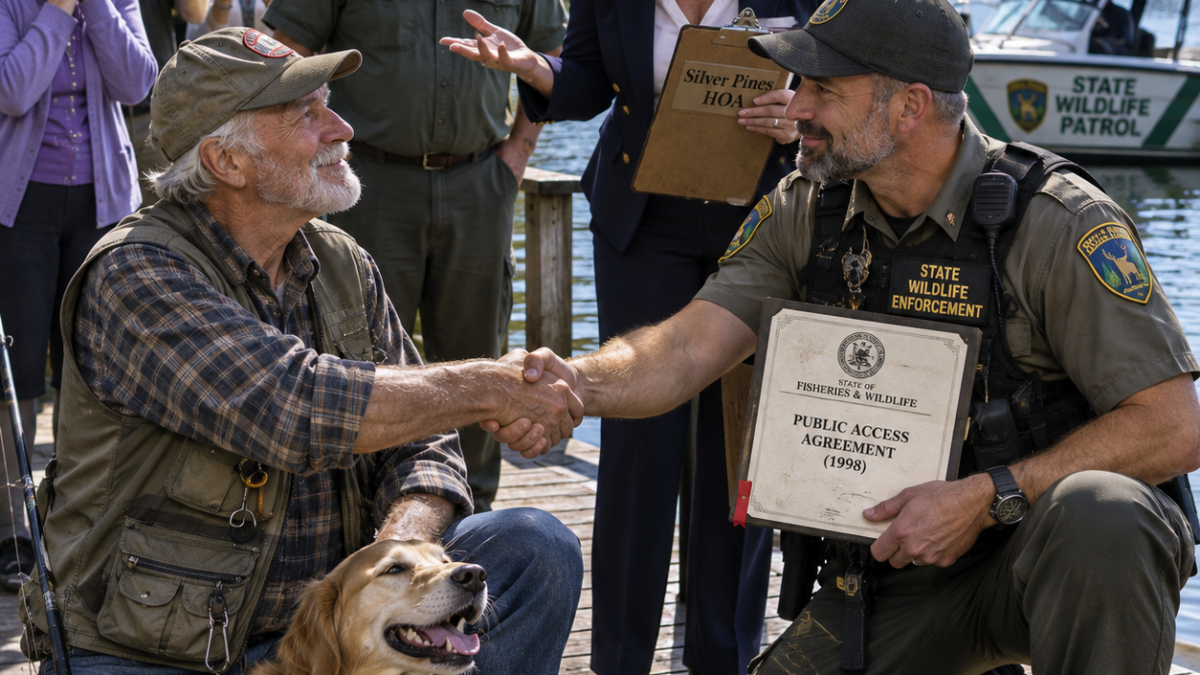
Then the patrol boat reached the dock, the senior officer walked straight past Marlene’s pointing finger, shook my hand, and said, “Mr. Callaway, we’ve been waiting for you”—because there was one detail she had never bothered to check about who actually owned the lake.
My name is Raymond Callaway.
Everybody calls me Ray.
I was sixty-eight years old the morning Marlene Voss tried to have me arrested for fishing.
By that age, I had learned something useful.
When somebody is shouting and you know the paperwork is on your side, shouting back usually just wastes oxygen.
So I kept fishing.
Marlene stood behind me in a white blazer and sunglasses, one hand on her hip, the other holding her phone like a trophy.
“Yes,” she said loudly into the speaker. “I’m reporting an active wildlife violation.”
I adjusted my float.
Beside my boots, Biscuit lifted his head.
Biscuit was a nine-year-old yellow Lab who had spent most of his life believing fishing existed entirely for his entertainment.
He watched my line.
Then Marlene.
Then my line again.
Smart dog.
“Male suspect,” Marlene continued.
I turned slightly.
“Suspect?”
She covered the microphone.
“Don’t interfere.”
“I’m sitting down.”
“You’re illegally harvesting fish from private HOA property.”
I looked toward the water.
Silver Pines Lake stretched nearly six hundred acres under a bright September sky.
Bass rippled near the reeds.
A heron stood motionless in the eastern shallows.
Children were gathering at the far public dock.
Nothing about the lake looked private.
That was because it wasn’t.
But Marlene did not know that yet.
Or maybe she knew part of it and had convinced herself the rest did not matter.
Three neighbors had their phones out.
PART2:
One of them, a man named Peter Lang, was recording vertically.
He looked embarrassed.
Still recorded.
That is the modern neighborhood instinct.
When somebody starts screaming, nobody steps between you.
They film.
Marlene returned to the call.
“He has a cooler full of illegally caught fish.”
I looked down at my cooler.
True.
It was full of fish.
Not illegally caught ones.
White perch.
Invasive in this watershed.
Removed under a state volunteer management permit.
Every fish measured.
Every harvest logged.
Every number recorded.
Marlene had seen the cooler and assumed she had finally found evidence.
That was convenient.
For me.
She ended the call.
“They’re coming.”
“Good.”
Her smile slipped.
“You think this is funny?”
PART3:
“No.”
“You’ve been warned repeatedly.”
“I know.”
“You’ve trespassed.”
“No.”
“You’ve ignored HOA signs.”
“Yes.”
“You’ve ignored fines.”
“Yes.”
“You admitted it.”
“Those signs and fines don’t apply to me.”
She stepped closer.
“They apply to everyone.”
That sentence had become her favorite.
Biscuit looked at her.
He did not wag.
Good judge of character.
Marlene folded her arms.
“When the officers arrive, I hope you finally understand that rules apply to you too.”
I looked at her.
“I’ve spent most of my life enforcing fishing rules.”
She laughed.
“I’m sure you have.”
I turned back toward the lake.
She had no idea.
Three months earlier, Silver Pines had still been the quietest part of my day.
I grew up five miles from that water.
Back then, it wasn’t called Silver Pines.
Locals called it Callaway Lake.
My grandfather called it the reservoir.
My father called it work.
The state eventually called it Silver Pines Conservation Lake.
Names change when lawyers become involved.
Water does not care.
My family had owned most of the lake bed and surrounding timber for generations.
In 1998, after years of negotiations, my parents and uncle conveyed the lake bed and several access corridors to the state.
Not the shoreline development rights.
Not every surrounding parcel.
But the water itself and the public access easements.
One condition mattered more than any other.
Public recreational fishing access must remain open.
Forever.
That word was actually in the recorded agreement.
Forever.
My father insisted.
He had watched too many lakes become private playgrounds once expensive houses appeared.
He told the state attorney:
“If ordinary people can’t bring their kids here with a rod, we’re not signing.”
So they wrote it in.
I spent thirty-one years working for the state fisheries division.
Started as a field biologist.
Spent summers shocking streams, tagging bass, counting spawning beds, testing oxygen levels, and arguing with people who thought every dead fish was caused by somebody upstream “dumping poison.”
Later I became regional fisheries supervisor.
Then chief fisheries biologist for the state.
It sounded important.
Mostly it meant more meetings.
I helped oversee stocking programs, invasive-species control, habitat restoration, water-quality investigations, and public access agreements.
Silver Pines was never officially “my lake.”
But everybody in the department knew my history there.
I had sampled it since I was twenty-three.
I knew where the old creek channel ran beneath the reservoir.
I knew which cove warmed first in spring.
I knew where the submerged timber held crappie.
I knew which shallow flat went hypoxic after long August heat.
And after retirement, I fished there almost every morning.
Same dock.
Same rod.
Same dog.
No uniform.
No badge.
No title.
Just Ray.
That lasted until Marlene Voss became chair of the Silver Pines Estates HOA Lake Committee.
Silver Pines Estates was built on the western side of the lake about fourteen years earlier.
Two hundred fourteen houses.
Stone entrance.
Clubhouse.
Pool.
Walking path.
Several private neighborhood docks built on shoreline parcels the HOA controlled.
Their docks were private.
Their clubhouse was private.
Their parking lot was private.
The water was not.
That distinction would become very expensive for them.
The first sign appeared on a Monday.
I drove in through the county access road just after sunrise.
New aluminum sign.
PRIVATE LAKE
SILVER PINES ESTATES RESIDENTS ONLY
NO FISHING WITHOUT HOA PERMIT
VIOLATORS WILL BE PROSECUTED
I stopped the truck.
Read it.
Then read it again.
Biscuit sneezed.
“Exactly.”
I took a photograph.
Then drove to the dock.
Twenty minutes later, heels clicked behind me.
Nobody who fishes seriously wears heels on a dock at six-thirty in the morning.
I knew trouble before I turned.
Marlene Voss.
Sixty-two.
Brown hair styled into a hard shoulder-length wave.
Navy blazer.
White pants.
Clipboard.
Expensive sunglasses.
She looked at my tackle box.
Then my dog.
Then me.
“Sir.”
“Morning.”
“Do you live in Silver Pines Estates?”
“No.”
“Then you’re not permitted to fish here.”
“I am.”
“No.”
She tapped the clipboard.
“This lake is private.”
“It isn’t.”
Her mouth tightened.
“Sir, I am chair of the HOA Lake Committee.”
“Congratulations.”
“You need to leave.”
“Ma’am, Silver Pines has a recorded public access agreement.”
She smiled.
Not kindly.
“We have bylaws.”
I almost admired that answer.
“Your bylaws don’t override a state easement.”
“They govern this property.”
“Not the lake.”
“This lake belongs to Silver Pines Estates.”
“No.”
“Nobody fishes here without our permission.”
That sentence stopped me.
Not because it was threatening.
Because it was demonstrably false.
I had watched generations fish there.
Families.
Veterans.
Kids.
Tournament anglers.
State crews.
And me.
I said:
“That’s an interesting claim.”
Marlene stepped closer.
“Is there something funny?”
“No.”
“Then leave.”
I reeled in.
Not because she was right.
Because I wanted to check something.
As I walked toward the truck, Biscuit stopped.
He looked toward the east cove.
I followed his gaze.
Silver shapes.
At first I thought sunlight.
Then one rolled.
White belly.
Dead fish.
I changed direction.
Marlene called:
“Where are you going?”
I ignored her.
Twenty yards along the shore, I found the first cluster.
Gizzard shad.
Bluegill.
Several juvenile bass.
Dozens.
Some floating.
Some trapped against reeds.
A fish kill.
That alone did not prove pollution.
Low oxygen can kill fish.
Heat can.
Algae.
Disease.
Turnover.
Nature does unpleasant things without asking humans for help.
Then I saw the water.
Blue-green sheen near the shoreline.
Not normal algae.
I crouched.
Biscuit tried to sniff.
I pulled him back.
“No.”
The smell reached me.
Sharp.
Chemical.
Sweet-green.
Almost like freshly cut grass mixed with solvent.
I had smelled something similar before.
Years earlier.
A golf-course chemical spill had entered a tributary after a storm.
Same wrongness.
Marlene approached.
“What are you doing?”
“Checking the water.”
“You’re not authorized.”
I looked at her.
“Keep dogs and children out of this cove.”
Her expression changed.
“Excuse me?”
“Until it’s tested.”
“You’re not a health official.”
“No.”
“Then stop alarming residents.”
I took three clean glass sample vials from my tackle kit.
Old habits.
I always carried them.
Marlene laughed.
“You carry sample bottles while fishing?”
“Yes.”
“That is bizarre.”
“Probably.”
I labeled them.
Location.
Time.
Date.
East cove.
She watched.
“What do you think you’re doing?”
“Nothing yet.”
I sealed the final vial.
Then stood.
That night, I made one phone call.
Mark Hargrove answered.
He had been a conservation officer when I first met him twenty-seven years earlier.
Back then he was twenty-four, too eager, and convinced every fisherman was lying.
I trained him on aquatic enforcement cases.
He eventually became a senior wildlife officer.
“Ray?”
“Mark.”
“You catch something?”
“Not what I wanted.”
Silence.
I said:
“It’s happening again.”
That was enough.
He knew exactly what I meant.
“Where?”
“Silver Pines. East cove.”
“Samples?”
“Three.”
“Photographs?”
“Yes.”
“Fish mortality?”
“Dozens visible.”
“Odor?”
I described it.
Long silence.
Then:
“Ray, do not confront anybody.”
“I’m retired.”
“That has never stopped you.”
“I’m offended.”
“Good.”
He continued:
“We’re coming.”
“When?”
“I’m not telling you yet.”
“Why?”
“Because you’re terrible at waiting.”
He was right.
I hung up.
Biscuit sat beside my chair.
“Now we wait.”
He thumped his tail.
Two nights later, waiting became useful.
I was walking the eastern trail around sunset.
Technically public access corridor.
Marlene had not yet managed to block it.
Behind the clubhouse stood an old pump house.
Originally used for irrigation.
Later connected to stormwater equipment serving the development.
I noticed a truck.
Green.
VOSS GREEN LAWNS.
That name mattered.
Marlene’s brother, Gary Voss, owned the landscaping company that maintained Silver Pines Estates.
I knew that because his trucks were everywhere.
Gary was unloading barrels.
Not small containers.
Fifty-five-gallon drums.
He moved them from the truck toward the pump house.
Looked over his shoulder repeatedly.
That is never reassuring.
I crouched behind a pine trunk.
Pulled out my phone.
Photo one.
Truck plate.
Photo two.
Barrels.
Photo three.
Pump-house door.
Photo four.
Gary connecting a hose.
Then I shifted my foot.
Twig.
Snap.
Gary spun.
Saw me.
For a second we just stared.
Then he started walking toward me.
Fast.
“What are you doing?”
“Walking.”
“You taking pictures?”
“Yes.”
“Delete them.”
“No.”
His face reddened.
“You didn’t see anything.”
I looked toward the barrels.
“I saw enough.”
“You’re trespassing.”
“No.”
“You old guys think because you’ve been here forever you own everything.”
I almost laughed.
“Gary.”
“What?”
“You should probably stop talking.”
That made him angrier.
He stepped closer.
Biscuit moved between us.
No growl.
Just presence.
Gary looked at the dog.
Then me.
“You keep your nose out of HOA business.”
I smiled.
“Water doesn’t read HOA boundaries.”
He left.
By sunrise the next morning, my photograph was on the Silver Pines neighborhood app.
WARNING — SUSPECTED POACHER / TRESPASSER
The picture showed me walking beside the lake.
Below it:
This individual has repeatedly violated private-lake restrictions. Residents should not engage. Contact HOA security if observed fishing or photographing private infrastructure.
Marlene added a skull emoji.
The skull emoji bothered me more than it should have.
Forty-three comments appeared.
Some supportive of her.
“Thank you for keeping outsiders out.”
“Seen him there before.”
“Call police next time.”
“Why is he photographing our pump house?”
One resident wrote:
“He looks dangerous.”
I showed Biscuit.
“Dangerous.”
Biscuit licked his foot.
Then came the envelope.
Hand-delivered.
SILVER PINES ESTATES HOA
NOTICE OF TRESPASS AND PENALTY
Unauthorized lake access.
Unauthorized fishing.
Photography of restricted community infrastructure.
Fine:
$500.
I folded it.
Placed it in my shirt pocket.
Did not throw it away.
Paper trails are useful.
That afternoon, Dolores Finch stopped me.
Seventy-one.
Lavender cardigan despite the heat.
She walked with a slight limp.
“Mr. Callaway?”
“Yes.”
“You’re the man they posted.”
“I’ve had better publicity.”
She looked around.
“My dog went in the water last week.”
My humor disappeared.
“Where?”
“East cove.”
“What happened?”
“He got sick.”
“How?”
“Vomiting. Shaking.”
“Vet?”
“Yes.”
“What did they say?”
“Possible toxin exposure.”
My stomach tightened.
“What kind of dog?”
“Golden retriever.”
“Name?”
“Winston.”
“Is he okay?”
“Better.”
I looked toward the lake.
“Dolores.”
“Yes?”
“Keep him out.”
“Why?”
“Just keep him out until I tell you otherwise.”
She became frightened.
“What’s in the lake?”
“I don’t know yet.”
“Should I tell everyone?”
“Not yet.”
That felt terrible to say.
But without test results, panic could do damage too.
I asked:
“Did you report it to the HOA?”
“Yes.”
“What did Marlene say?”
“That Winston probably ate something.”
“Anything else?”
“She told me not to spread rumors about water quality because it could hurt property values.”
There it was.
That night, I installed a trail camera.
Camouflaged.
High on a pine.
Pointed toward the pump house and storm drain.
Motion activated.
Infrared.
No visible flash.
Was I being dramatic?
Maybe.
Was I right?
Also maybe.
For two nights, nothing.
Raccoon.
Deer.
Maintenance worker.
One teenager sneaking behind the clubhouse smoking.
Then at 2:14 a.m. on the third night:
Green truck.
Gary.
Barrel.
Hose.
Storm drain.
I watched the video three times.
He connected the hose.
Opened the valve.
Liquid entered the drain.
The drain discharged toward the east-cove watershed.
My hands shook.
Not from excitement.
Anger.
I exported the file.
Photographs.
Sample notes.
HOA notice.
Dolores’s information.
Everything.
Then emailed one address.
Mark Hargrove.
Three minutes later:
SATURDAY. 9:00 A.M.
BE AT YOUR NORMAL DOCK.
FISH LIKE ALWAYS.
DO NOT CHANGE ANYTHING.
I called.
He declined.
Texted:
NO.
I wrote:
WHY SATURDAY?
Reply:
RAY.
That was all.
Officer language for shut up.
Saturday morning arrived clear.
Blue sky.
Light wind.
I packed my rod.
Cooler.
Permit paperwork.
Biscuit.
The white-perch removal program had scheduled volunteer harvest that week anyway.
So I did exactly what Mark said.
Fished.
By 8:40, I had thirteen white perch on ice.
At 8:47, heels clicked behind me.
I almost smiled.
Marlene.
Of course.
But she had brought an audience.
About twelve residents.
Gary too, standing near the path.
Three phones already recording.
Marlene looked at the cooler.
Then at me.
“Still doing it.”
“Morning.”
She opened the cooler before I could stop her.
Silver fish.
Her face lit up.
“Perfect.”
I raised one eyebrow.
“Perfect?”
“Evidence.”
She turned to the neighbors.
“Everybody see this?”
A little boy stared at the fish.
His father pulled him back.
Marlene took out her phone.
“I told you he was poaching.”
I kept reeling.
“Marlene.”
“What?”
“You may want to wait.”
“For what?”
“Nothing.”
Bad habit.
Couldn’t resist.
She dialed.
Put the call on speaker.
“State Wildlife Patrol?”
I could hear the dispatcher.
“Yes, I’d like to report illegal fishing and unlawful harvest at Silver Pines Lake.”
She gave the dock location.
Then:
“Yes, he is here now.”
She looked directly at me.
“He has a cooler full of fish.”
The dispatcher asked something.
Marlene replied:
“No, he does not have HOA authorization.”
I nearly laughed.
She ended the call.
Crossed her arms.
“Now we wait.”
“Yes.”
She checked her watch after two minutes.
Again at four.
Again at six.
At eight minutes, neighbors started whispering.
The little boy asked his father:
“Is he going to jail?”
I knelt.
Scratched Biscuit behind one ear.
“We’ll see.”
Then I heard the engine.
Low.
Across water.
Wildlife patrol boat.
Blue-red emergency lights.
Marlene straightened.
Smile returning.
“Finally.”
The boat slowed near the dock.
Two officers aboard.
Mark Hargrove.
Eli Benton.
Eli had joined after I retired.
I knew him by reputation.
Mark saw me.
Even from twenty yards away, I could see his expression.
Not anger.
Relief.
They docked.
Marlene moved before they had finished tying the line.
“Officer.”
Mark stepped onto the dock.
“Morning.”
“Thank God you’re here.”
He looked at her.
She pointed at me.
“This man has repeatedly trespassed, ignored HOA restrictions, and illegally harvested fish from our private lake.”
Mark took off his sunglasses.
Marlene pointed toward my cooler.
“Right there.”
Mark looked.
Then walked past her.
Straight to me.
I stood.
He extended his hand.
“Ray.”
“Mark.”
We shook.
“Been waiting for you.”
Behind him, somebody whispered:
“What?”
Marlene’s smile disappeared.
She looked from him to me.
“You know him?”
Mark did not answer immediately.
Eli stepped onto the dock.
Looked at me.
Then at Mark.
“That’s Ray Callaway?”
Mark nodded.
Eli smiled.
“Sir.”
He shook my hand too.
“Read your lake-management papers in academy.”
I laughed.
“Then I apologize.”
Marlene’s voice sharpened.
“Excuse me.”
Mark turned.
“Ma’am.”
“Who is he?”
Mark looked at me.
I said:
“Apparently dangerous.”
He almost smiled.
Then told her.
“Ray Callaway spent thirty-one years with the state fisheries division.”
Marlene blinked.
Mark continued.
“Retired chief fisheries biologist.”
A neighbor lowered her phone slightly.
Marlene said:
“That doesn’t give him permission to trespass.”
“No.”
Mark nodded.
“But this does.”
He removed a folded certified copy from his case.
The 1998 agreement.
My family conveyance.
Public fishing access.
Mark read:
“Public recreational fishing access to Silver Pines Lake shall remain open and nonexclusive in perpetuity.”
Marlene’s face changed.
“No.”
“Yes.”
“Our HOA owns the shoreline.”
“Some shoreline.”
“The lake is private.”
“No.”
“The developer told us—”
Mark held up one hand.
“The state holds title to the lake bed and the recorded access corridor.”
He pointed toward the sign visible near the path.
PRIVATE LAKE — RESIDENTS ONLY.
“Your association has no authority to prohibit lawful public fishing in the state access areas.”
Marlene stared.
“Then why has nobody told us?”
I finally spoke.
“Somebody tried.”
I pulled out her $500 notice.
Held it up.
She looked at it.
Mark looked too.
“What’s that?”
“HOA fine.”
“For fishing?”
“Yes.”
Mark’s face went flat.
Marlene said:
“That is separate.”
“No.”
Mark turned toward Eli.
“Photograph the signs.”
Eli nodded.
Marlene stepped closer.
“Wait.”
Mark continued:
“And document any barriers affecting access.”
Her hands tightened around the clipboard.
“You cannot come into our community and—”
“Ma’am.”
Mark’s voice changed.
Calm.
Official.
“This public access agreement predates the subdivision.”
Silence.
Then he said:
“And we’re not here only because of fishing.”
That ended whatever confidence she had left.
Her eyes flicked toward Gary.
I saw it.
So did Mark.
I handed him my phone.
“Video.”
He pressed play.
2:14 a.m.
Green truck.
VOSS GREEN LAWNS.
Hose.
Drain.
Gary.
Everybody watched.
Nobody spoke.
Marlene whispered:
“That’s not…”
Then stopped.
Gary stood at the back of the crowd.
His face had gone white.
Marlene turned.
“Gary.”
He said nothing.
“Tell them what that is.”
Nothing.
“Gary!”
Mark closed the video.
Eli moved toward him.
“Sir.”
Gary stepped backward.
“Don’t.”
“I’m not doing anything.”
“Then stay where you are.”
Marlene looked toward the neighbors.
“It’s a legal algae treatment.”
I turned.
“What?”
She realized the mistake immediately.
Mark heard it too.
“Algae treatment?”
Marlene swallowed.
“The HOA approved treatment.”
“With what chemical?”
“I don’t know.”
“Licensed applicator?”
“Gary’s company.”
“Permit?”
Silence.
“Treatment log?”
Silence.
“Water-use notification?”
Silence.
Mark looked at me.
I said:
“Dead fish appeared after the first application.”
Marlene snapped:
“You don’t know they’re connected.”
“No.”
I nodded.
“That is what testing is for.”
Then Dolores stepped through the crowd.
Winston was not with her.
Good.
“My dog got sick.”
Marlene closed her eyes.
Dolores continued:
“You told me it was nothing.”
“I said we had no evidence—”
“You knew they were treating the water?”
Silence.
“Marlene?”
“Yes.”
Dolores’s face hardened.
“And you let me keep walking Winston there?”
“I didn’t know he would drink—”
“You told everyone the lake was safe.”
Marlene stopped talking.
The environmental response team arrived less than an hour later.
Not dramatic.
White trucks.
Sampling gear.
Evidence containers.
County environmental health.
State water-quality staff.
Wildlife officers.
Pump house sealed temporarily.
Storm drains sampled.
Remaining barrels documented.
Gary’s records requested.
The substance eventually tested as a concentrated aquatic herbicide combined with another lawn-treatment chemical that was not approved for discharge at the concentrations involved.
The investigation found Gary had been disposing of leftover chemical mixtures through the storm drain.
Why?
Money.
Proper hazardous-waste disposal cost money.
Cleaning tanks cost money.
Dumping into a drain at night did not.
At least not until somebody filmed it.
The HOA had contracted Voss Green Lawns for landscaping and approved limited shoreline vegetation treatment.
That did not authorize dumping concentrated chemicals.
But the paper trail became worse.
Marlene had received complaints about dead fish two weeks before I found them.
She had emails.
One resident sent photographs.
Another reported discolored water.
Dolores reported Winston’s illness.
Marlene told the board these were “isolated observations likely related to seasonal algae.”
No testing.
No warning signs.
No notification to wildlife authorities.
Why?
Property values.
She wrote that phrase herself in an email.
We should avoid unnecessary public water-quality concerns during fall listing season.
That sentence eventually cost her the presidency.
For the first week, Silver Pines closed only the contaminated eastern cove.
Not the whole lake.
Fishing access remained elsewhere.
State crews monitored dissolved oxygen.
Fish tissue.
Water samples.
Shoreline vegetation.
Fortunately, the contamination was localized.
The worst immediate kill involved small fish in the drainage zone.
No major long-term toxic accumulation appeared in later testing.
Winston recovered.
A veterinarian documented likely irritant exposure but could not prove the exact chemical caused his illness.
Important distinction.
People in the neighborhood wanted everything tied into one perfect story.
Real evidence is messier.
Gary was cited and later faced environmental penalties, cleanup costs, and licensing consequences.
Voss Green Lawns lost the HOA contract immediately.
The company eventually closed.
Marlene resigned before the next regular board meeting.
Not voluntarily at first.
She announced she was “temporarily stepping aside.”
Nobody accepted that wording.
Two hundred people packed the clubhouse.
I did not attend.
That surprised everyone.
I had no interest.
This was their HOA.
Not mine.
Dolores attended.
Peter sent me a recording afterward.
The acting president, Nathan Cole, opened by removing the private-lake signs.
Not metaphorically.
He brought one into the clubhouse.
Set it on the table.
PRIVATE LAKE.
RESIDENTS ONLY.
He said:
“This sign was installed without proper title review.”
Then:
“We were wrong.”
That was good enough for me.
The HOA rescinded every fishing-related fine.
They reimbursed people who had paid.
Created a public-access map.
Added water-quality reporting rules.
Any chemical treatment near the lake required licensed contractors, documented permits, and public notice where applicable.
No family-owned vendor could be hired without conflict disclosure.
Obvious things.
Often the most important reforms are obvious only after somebody ignores them.
The state required removal of every illegal access restriction.
I helped.
Not officially.
I brought a socket wrench.
Mark found me unscrewing one sign.
“You enjoying yourself?”
“Immensely.”
“You know state maintenance could do that.”
“I know.”
“You’re retired.”
“I know.”
“You’re impossible.”
Biscuit barked.
“See? He disagrees.”
Mark shook his head.
Then looked toward the lake.
“You were right about the water.”
“I was suspicious.”
“Difference?”
“Big one.”
He nodded.
That had always mattered in fisheries work.
Suspicion is not proof.
Pattern is not proof.
Odor is not proof.
A dead fish is not proof.
You sample.
Document.
Compare.
Test.
Then say what the evidence supports.
Marlene’s problem was the opposite.
She started with certainty.
Then worked backward.
Lake is private.
Therefore Ray is trespassing.
HOA controls it.
Therefore signs are legal.
Gary is family.
Therefore his explanation is trustworthy.
Warnings could hurt property values.
Therefore the warnings are probably exaggerated.
Confidence became her evidence.
That is dangerous.
Two months after the first fish kill, the east cove reopened fully.
The water cleared.
Aquatic insects returned.
Bluegill fry appeared in the shallows.
Bass moved back along the weed line.
I know because I checked.
Of course I checked.
One morning Dolores joined me.
Winston came too.
Healthy.
Yellow tail wagging.
I kept him on shore.
She laughed.
“He’s allowed now.”
“I’m still not letting him drink lake water.”
“You don’t trust the cleanup?”
“I spent thirty-one years testing water.”
She smiled.
“So no.”
“Correct.”
She sat beside me.
“You knew those officers would recognize you.”
“Yes.”
“You let Marlene make the call anyway.”
“Yes.”
“Why?”
I looked at Biscuit.
Then the lake.
“Mark told me to fish normally.”
“That isn’t the real answer.”
She had me there.
I shrugged.
“If I argued with her, it becomes two old people yelling on a dock.”
She laughed.
“She isn’t old.”
“Tell her that.”
Dolores almost choked.
I continued:
“If the officer reads the deed, it becomes evidence.”
“You wanted the audience.”
“No.”
I looked toward the neighborhood.
“But it was useful.”
The videos spread.
Not nationally.
Locally.
Then regionally.
The moment people loved was Mark shaking my hand.
Of course.
The internet likes reversals.
Woman calls officer.
Officer knows accused man.
Accuser embarrassed.
Simple.
Clean.
Satisfying.
Reality was more important after that.
The handshake did not clean the lake.
The deed did not make Gary dump chemicals.
Marlene being wrong about access did not automatically make her responsible for contamination.
Those were separate questions that evidence eventually connected in specific ways.
I wish people cared as much about that part.
They usually don’t.
They like:
“Ma’am, you have no idea who this is.”
Mark insists he never said that exactly.
Peter’s video suggests he did.
We still argue.
What I remember was the expression on Marlene’s face when Eli said:
“That’s the Callaway?”
For years, my surname had appeared on old fisheries reports.
Lake maps.
Habitat studies.
Access agreements.
She had been standing on a dock beside Silver Pines Lake telling a Callaway that nobody had ever fished there without HOA permission.
There is irony.
Then there is that.
A month after she resigned, Marlene put her house on the market.
The sign appeared on a Thursday.
I noticed because my morning route passed the neighborhood entrance.
I felt no satisfaction.
That surprised me.
I had spent weeks angry.
Then the anger became work.
Then facts.
Then cleanup.
By the time the FOR SALE sign appeared, I was tired.
Marlene approached me once before moving.
I was at the public launch.
No crowd.
No cameras.
She stood several feet away.
“Ray.”
“Marlene.”
She looked thinner.
No blazer.
Sweatshirt.
“I didn’t know about the deed.”
“I know.”
“You could’ve shown me.”
“I tried to tell you.”
“You said public access agreement.”
“Yes.”
“I thought you were making it up.”
“Why?”
She looked embarrassed.
“Because everybody claims they know their rights.”
I nodded.
“Sometimes they do.”
She looked toward the water.
“I should have checked.”
“Yes.”
Then:
“I didn’t know Gary was dumping concentrate.”
I watched her.
“Did you know he was disposing of chemicals somewhere?”
She did not answer immediately.
That was enough.
Finally:
“I knew he was cleaning equipment.”
“Into the storm drain?”
“I didn’t ask.”
“That was the problem.”
She closed her eyes briefly.
“I thought if there was anything serious, he would tell me.”
“Family makes people stupid.”
She looked at me.
I added:
“Not just you.”
That softened something.
She said:
“I was trying to protect property values.”
“Water quality protects property values.”
“I know that now.”
“Should have known it then.”
She nodded.
No argument.
That was new.
Then she asked:
“Do you hate me?”
“No.”
She looked surprised.
“I hated what you did.”
“That’s different.”
She looked at Biscuit.
He finally wagged.
Traitor.
“I’m sorry,” she said.
I nodded.
“Good luck.”
That was all.
No dramatic forgiveness.
No friendship.
Just two older people beside a lake after all the noise ended.
I still fish Silver Pines.
Most mornings.
Same dock.
Same place.
Biscuit grew slower.
At eleven, he stopped jumping into the truck without help.
At twelve, he developed arthritis.
I bought a folding ramp.
He hated it.
Then accepted it when treats became involved.
The neighborhood changed around us.
More people started using the public dock once the signs disappeared.
At first, some residents complained.
Then something strange happened.
They got used to it.
Children from outside the subdivision fished beside children who lived there.
Retired men shared bait.
Teenagers learned knots.
One Saturday morning, thirty people lined the bank for a state-sponsored fishing clinic.
Mark asked me to volunteer.
“I’m retired.”
“You keep saying that.”
“I mean it.”
“Be there at seven.”
I was there at 6:45.
A little girl named Emma caught her first bluegill.
Maybe six years old.
Pink rod.
Fish the size of my hand.
She screamed as though she had landed a marlin.
Her father laughed.
I helped remove the hook.
She asked:
“Can I keep him?”
“Not this one.”
“Why?”
“Too small.”
She looked disappointed.
I lowered the fish into the water.
“Watch.”
It kicked from my hand.
Disappeared.
Emma smiled.
“He went home.”
“Yep.”
That sentence made me think of my father.
Public access.
Forever.
He had not cared about legal theory.
He wanted children to be able to stand beside the water.
That was all.
The plaque near the boat launch now carries a short history.
SILVER PINES LAKE
PUBLIC FISHING ACCESS PRESERVED THROUGH THE 1998 CALLAWAY FAMILY CONSERVATION AGREEMENT.
Below it:
PLEASE PROTECT THE WATER YOU CAME TO ENJOY.
I argued against putting our family name there.
The state ignored me.
Mark said:
“Take the win.”
“I don’t want a win.”
“You’re exhausting.”
True.
Dolores occasionally walks Winston along the dock.
He is banned from swimming in the east cove by Dolores, not the state.
“Once was enough.”
Smart.
Peter Lang became one of my regular fishing companions.
The man who first filmed Marlene yelling.
He apologized.
“For what?”
“Posting that video.”
“It helped.”
“I should’ve defended you.”
“You didn’t know me.”
“I knew she was being rude.”
“That is not illegal.”
He looked down.
“I stood there filming instead of helping.”
I understood.
Phones give people distance.
You can record injustice without deciding whether you’re responsible for interrupting it.
Sometimes recording is useful.
Sometimes it becomes hiding.
Peter stopped hiding.
He later volunteered for the lake advisory group.
He became annoyingly good at reading meeting packets.
Every time somebody proposed a new rule, Peter asked:
“Where’s the authority?”
I created a monster.
Good.
The lake committee itself changed.
Marlene’s title disappeared.
No more “Lake Committee Chair.”
The HOA renamed it Shoreline Stewardship Committee.
Its jurisdiction was written plainly.
HOA docks.
HOA shoreline.
HOA landscaping.
Not state water.
Not public fishing.
Not wildlife regulation.
That matters.
Good governance often starts by admitting what you do not control.
The environmental incident changed state procedures too.
Not dramatically.
A reporting hotline was added to the public-access board.
Suspected fish kills.
Discoloration.
Chemical odor.
Dead wildlife.
Call immediately.
Do not wait for an HOA meeting.
Again:
Obvious.
Useful.
The first year after cleanup, fisheries crews performed quarterly surveys.
I tagged along once.
Unofficially.
The young biologist running the survey was named Hannah Patel.
Twenty-seven.
Very smart.
She looked at me and said:
“I’ve read your papers.”
I groaned.
“I’m sorry.”
She laughed.
“You wrote the 2003 white-perch recruitment study.”
“I apologize specifically for that one.”
“Why?”
“Thirty-seven pages.”
“It was useful.”
“That makes one of us.”
We electrofished the east cove.
Bass.
Bluegill.
Shad.
Young crappie.
Good distribution.
Healthy condition factors.
Hannah looked at the data.
“Lake’s recovering well.”
I nodded.
That sentence meant more to me than any apology from Marlene.
Water can forgive faster than people if you stop hurting it.
Not always.
Some contamination lasts decades.
We were lucky.
The chemical had been bad enough to kill fish locally and create acute risk, but not persistent enough to poison the entire system for years.
I know the difference.
I had investigated lakes that never fully came back.
Silver Pines did.
By the second spring, frogs returned heavily to the drainage channel.
By June, dragonflies hovered over the reeds.
By August, the bass fishing was almost annoying.
Peter caught a five-pounder from my favorite spot.
He told everyone.
I considered revoking public access.
Joke.
Mostly.
At seventy-one, I finally stopped keeping my old state sampling vials in the tackle box.
Mark noticed.
“You retired?”
“Apparently.”
“What changed?”
“New generation.”
He nodded toward Hannah on the opposite bank.
“She’s good.”
“Better than we were.”
“Don’t tell her.”
Too late.
Biscuit died that winter.
Thirteen.
Cancer.
Quick decline.
I buried him beneath an oak on my property overlooking the water.
For nearly a month, I stopped fishing.
The dock felt wrong.
No yellow body at my boots.
No nose checking the bait bucket.
No tail thumping whenever a bobber moved.
Dolores noticed first.
Then Peter.
Then Mark.
Nobody pushed.
That mattered.
One morning I woke before sunrise.
Habit.
Made coffee.
Looked at Biscuit’s empty bed.
Then picked up the rod.
Went to the lake.
Same dock.
Same spot.
No dog.
I almost left.
Then a boy arrived with his grandfather.
Maybe ten.
They sat at the far end.
Whispered.
Fumbled with tackle.
The boy tangled his line almost immediately.
I watched for three minutes.
Then couldn’t take it.
“Bring that over.”
The grandfather smiled.
“I told you somebody would help.”
I untangled it.
Showed the boy how to pinch the line.
Reset the bobber.
Twenty minutes later, he caught a bluegill.
He smiled like Emma had years before.
Life moved.
That was when the lake became mine again.
Not owned.
Never owned.
Mine in the way places become part of memory.
Years later, people still occasionally recognize me from the old video.
“You’re the guy that Karen called wildlife officers on.”
I hate the phrase Karen.
Her name was Marlene.
She was wrong enough without turning her into a cartoon.
I usually say:
“Yes.”
Then:
“Did they really shake your hand?”
“Yes.”
“Was she shocked?”
Very.
“Did they arrest her?”
No.
That disappoints people.
Truth is less cinematic.
Marlene was not handcuffed on the dock.
Gary was not dragged away.
Nobody seized the clubhouse.
Investigations take time.
Citations happen.
Samples go to labs.
Attorneys review documents.
Agencies determine jurisdiction.
Boards hold votes.
Cleanup contracts get negotiated.
The world is mostly paperwork after the exciting thirty seconds ends.
But paperwork matters.
The original Callaway agreement mattered.
The sample chain mattered.
Gary’s disposal records mattered.
The trail-camera timestamp mattered.
Marlene’s emails mattered.
Dolores’s veterinary records mattered.
The state’s lab results mattered.
That is how truth survives after everybody stops filming.
And that is the lesson I kept.
Not that Marlene called the wrong man.
People love saying that.
“She picked the wrong fisherman.”
No.
She would have been wrong if I were a plumber.
A teacher.
A teenager.
A tourist.
A retired mechanic.
The public access agreement did not care about my résumé.
My career only meant I knew where to look.
The lake belonged to the public because the deed said so.
The water needed investigation because dead fish and contamination required it.
My title did not make those facts more true.
That distinction matters.
I sometimes wonder what would have happened if Marlene had approached me differently that first morning.
Suppose she said:
“Sir, I’m new to the lake committee and our records suggest this may be private. Can you show me the public agreement?”
I would have.
Five minutes.
Problem solved.
Then maybe I would have shown her the dead fish.
Maybe we would have called the state together.
Maybe Gary would have been stopped sooner.
Maybe Winston never got sick.
Maybe Marlene never lost her house.
One question.
Asked without arrogance.
That is how small the distance can be between conflict and cooperation.
But Marlene believed authority had to sound certain.
So she never asked.
She declared.
The lake is ours.
You are trespassing.
Nobody fishes without our permission.
The water is safe.
Gary is licensed.
Residents are overreacting.
Confidence gave her speed.
Questions would have given her truth.
I prefer truth.
It takes longer.
These days, a new sign stands where Marlene’s PRIVATE LAKE sign used to be.
PUBLIC FISHING ACCESS
STATE REGULATIONS APPLY
PLEASE RESPECT HOA-OWNED SHORELINE OUTSIDE DESIGNATED ACCESS AREAS
That is accurate.
Accuracy is beautiful.
Nobody owns more than they actually own.
Nobody gives away more than they actually have.
The public gets its access.
Residents get their private property.
Fish get clean water.
Simple.
On calm mornings, I still see my reflection near the dock.
Older now.
White hair.
Slower hands.
Same old rod.
Sometimes I think about that Saturday when Marlene stood behind me waiting for wildlife officers to carry me away.
She believed the boat coming across the lake represented her authority.
She smiled when she saw the lights.
Then Mark stepped onto the dock.
Walked past her.
Shook my hand.
And everything she believed about that water changed in less than sixty seconds.
But the handshake was never the point.
The deed was.
The water samples were.
The video was.
And the simple fact that a public lake does not become private merely because somebody puts up a sign and repeats the claim loudly enough.
I still fish Silver Pines because that was the promise my family made.
Public fishing.
Forever.
Not public fishing when convenient.
Not public fishing until expensive houses arrive.
Not public fishing unless an HOA president approves.
Forever.
My father understood something Marlene did not.
Water attracts people.
People eventually argue about access.
So he put the answer in writing before any of us needed it.
That piece of paper outlived him.
Outlived the developer.
Outlived the first HOA board.
Outlasted Marlene’s signs.
And one bright Saturday morning, it arrived on a wildlife patrol boat and reminded 214 families that ownership is not created by confidence.
It is created by law.
Stewardship is something else.
That comes from what you do after you learn the truth.
Marlene tried to close the lake.
Gary nearly poisoned part of it.
The neighborhood eventually helped restore it.
Kids came back.
Dogs came back.
Fish came back.
And so did I.
Same dock.
Same place.
No Biscuit anymore.
But sometimes, when my line twitches and the morning is quiet, I still glance down automatically expecting to see him watching the bobber like it owes him money.
Then I smile.
Cast again.
And let the lake be what it was always supposed to be.
Everyone’s.








