HOA Karen Called the Cops When I Refused to Give Her Kids My Lakefront Land—Then the Deputy Found a Deed With My Forged Signature
HOA Karen Called the Cops When I Refused to Give Her Kids My Lakefront Land—Then the Deputy Found a Deed With My Forged Signature
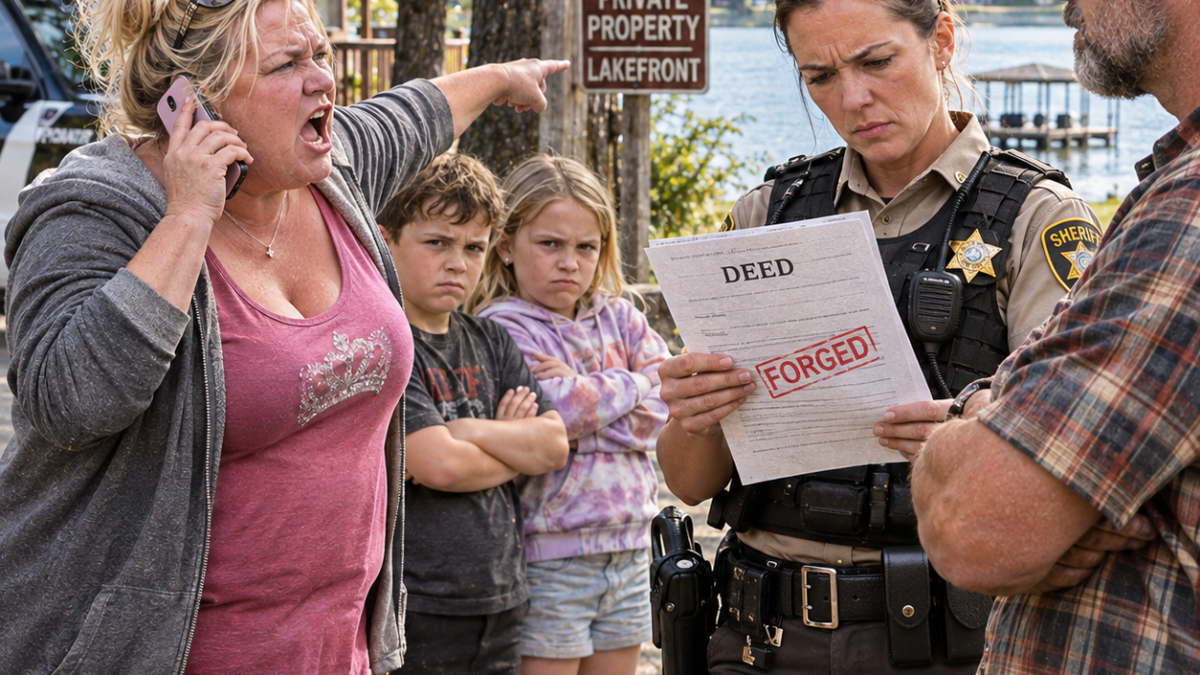
The first police cruiser came through my private gate while the HOA president’s grown son was changing the lock on my storage shed and her daughter was unloading lawn chairs onto six acres of lakefront property my family had owned for forty years.
Denise Harper pointed at me and told the deputy I was trespassing on land that had already been “assigned” to her children, then calmly produced a quitclaim deed showing that I had supposedly signed away the most valuable part of my property to them.
The signature looked enough like mine to fool a stranger, but when Deputy Laura Mitchell checked the notarization and asked where I had been at 11:13 that Friday morning, the confident smile disappeared from Denise’s face.
My name is Nathan Brooks.
I was fifty-one years old when a homeowners association I had never joined decided my family’s lakefront property would be more useful in the hands of its president’s children.
Not purchased.
Not rented.
Not negotiated for.
Given.
At least that was how Denise Harper eventually talked about it.
The afternoon the police arrived, I had just returned from the hardware store.
I came through my gate expecting nothing more dramatic than replacing a broken hinge on the storage shed and maybe getting an hour of fishing in before dinner.
Instead, Madison Harper’s silver SUV was parked halfway across my gravel drive.
Folding chairs sat on the grass near the boathouse.
A blue cooler was beside them.
A sign had been planted next to the driveway.
PRIVATE FAMILY PROPERTY
NO TRESPASSING
The family named on that sign was not mine.
Logan Harper stood beside my storage shed with a cordless drill.
The original lock I had installed was lying in the grass.
A new one was already hanging from the hasp.
For several seconds, I sat behind the wheel and simply stared.
Then Denise walked toward my truck carrying a leather folder.
“Nathan.”
I stepped out.
“What are you doing?”
PART2:
She did not answer the question.
“You should have called before coming down here.”
I almost laughed.
“Before coming to my own house?”
Her expression tightened.
“This section is no longer exclusively yours.”
I looked past her.
Madison was arranging folding chairs under one of the maple trees my mother had planted when I was a teenager.
Logan kept working on my shed.
I raised my voice.
“Logan.”
He looked over.
“Put my lock back.”
He stared at me as if I had interrupted him on his own property.
“My mom said the transfer is complete.”
“There is no transfer.”
Denise sighed.
“We knew you would react emotionally.”
“Somebody changing locks on my property tends to do that.”
“You were given notice.”
“I was given a pile of letters I told you I was not signing.”
“That is not the same thing.”
“It is exactly the same thing.”
Madison walked toward us.
PART3:
“Why are we even arguing with him?”
I looked at her.
“Because you’re standing on my property.”
“You said this was already handled,” she told Denise.
That sentence caught my attention.
Handled.
Denise opened the folder.
“The Pine Haven property committee approved a family-use transfer.”
I stared at her.
“A what?”
“You refused to cooperate, so the board completed the process based on the existing access arrangements.”
My property sat beside Lake Norman in North Carolina.
Almost six acres.
House.
Boathouse.
Dock.
Small pond.
Lower field.
Shoreline.
It was not part of Pine Haven Estates.
Never had been.
Pine Haven came decades later.
Yes, I used one of its roads.
My parents had negotiated a permanent recorded easement with the original developer.
I paid a fixed share of maintenance.
That agreement gave me road access.
It did not give Pine Haven my land.
Denise knew that.
I had explained it so many times that hearing her pretend otherwise made my voice colder.
“Your property committee cannot transfer land it does not own.”
“We have documents.”
“I don’t care what documents you printed.”
“You should.”
Logan came over carrying his drill.
“Mom, just call the police.”
I looked at him.
“That may be the first intelligent thing you’ve said today.”
Denise’s face flushed.
“You are threatening my children.”
“I told them to leave.”
“You said you would have them removed.”
“Yes.”
“That is a threat.”
“No. That is what police are for.”
So Denise called them.
Not me.
Her.
She called 911 and reported that I was refusing to leave property assigned to her children.
She said I had threatened Logan.
She said I was trying to interfere with their lawful use of land they controlled.
By the time Deputy Laura Mitchell arrived, Denise had rewritten the afternoon into a story where I was the intruder.
Laura stepped from her cruiser.
Denise immediately pointed.
“That’s him.”
Laura looked toward me.
Then toward Denise.
Then at the new sign.
“What’s going on?”
Denise spoke first.
“He refuses to leave. My children were granted this parcel and he is intimidating them.”
Laura looked at me.
“Mr. Brooks?”
“This is my property.”
Denise interrupted.
“It was.”
Laura raised one hand.
“Ma’am. Let him answer.”
I pointed toward the hood of my truck.
“My deed folder is right there.”
Denise held up hers.
“So is ours.”
Laura looked between us.
“Who owns the parcel according to the county?”
“I do.”
“Logan and Madison do,” Denise said.
Laura looked toward Logan.
He still had the drill.
“Put that down for now.”
He looked offended.
“I’m repairing our shed.”
“It’s my shed,” I said.
Laura’s voice sharpened.
“Put the drill down.”
He did.
Then Denise handed her the folder.
First page:
Pine Haven HOA resolution.
Second:
Survey map.
Third:
QUITCLAIM DEED.
Grantor:
Nathan Brooks.
Grantees:
Logan Harper and Madison Harper.
My full legal name.
My address.
Correct parcel number.
A legal description covering roughly three-quarters of an acre near the boathouse.
Shoreline.
Part of my driveway.
And a signature at the bottom that looked disturbingly like mine.
Laura looked at me.
“Did you sign this?”
“No.”
Denise laughed once.
“He’s lying because he changed his mind.”
“I never agreed to give your children anything.”
“You agreed to community transfer discussions.”
“No. I agreed to let Pine Haven residents help clean storm debris from my shoreline one Saturday.”
Denise spread her hands.
“You see? There was an agreement.”
Laura looked at her.
“That is not what he just said.”
A second cruiser arrived.
Deputy James Walker joined us.
Logan complained that I had grabbed his drill.
I had not.
Madison said I threatened to throw them into the lake.
I had not.
What I actually said was:
Get off my property before I call the sheriff.
Apparently those words had become much more exciting during the fifteen minutes before deputies arrived.
Laura reached the last page.
Her expression changed.
“Mrs. Harper, who filed this deed?”
“The HOA property consultant.”
“Name?”
“Paul Norton.”
“Was it filed with the county?”
“Yes.”
“When?”
“Friday.”
My stomach tightened.
Friday had been two days earlier.
James walked back to his cruiser and checked the county record.
Five minutes later, he returned.
“There is a filing attached to the parcel.”
I stared.
“Recorded?”
“Preliminary acceptance Friday afternoon. It currently lists Logan and Madison Harper.”
Denise smiled.
Barely.
But she smiled.
Then Laura asked me:
“Mr. Brooks, where were you Friday at 11:13 in the morning?”
“At my brother’s house.”
“Where?”
“Virginia.”
“Can you prove that?”
“Yes. I drove up Thursday night. Stayed until Saturday. Credit cards. My brother. Neighbors. Highway toll records probably.”
James looked down at the deed.
“The notary block says you personally appeared in North Carolina Friday morning.”
Nobody spoke.
Madison stopped looking smug.
Logan’s expression changed.
Denise stared at the document.
That was when I understood this was no longer an argument with an entitled HOA president.
Somebody had already tried to take my land on paper.
To understand why, you have to go back six months.
My parents bought the property when I was eleven.
Back then, it was not impressive.
Small cabin.
Gravel drive.
Old dock.
Trees.
Water.
My father worked constantly.
Over the years he built a boathouse.
Expanded the dock.
Improved drainage.
Added a storage shed.
My mother planted maples near the shoreline.
She said they would look beautiful when I was old enough to complain about raking leaves.
She was right.
Years later, the cabin came down and a modest brick house went up.
Nothing luxurious.
The value came from the land.
Lake Norman property became expensive in ways my parents never imagined.
When they died, my older brother Steven and I inherited everything together.
Steven lived in Virginia.
He had no interest in managing lake property from another state.
I bought his half for a fair price.
No family fight.
No lawsuits.
No hidden resentment.
He still visited.
His grandchildren fished there.
My daughter Rachel came from Georgia with my grandson Noah whenever schedules allowed.
The property stayed family property because everyone involved respected everybody else’s rights.
Pine Haven came later.
A developer bought nearly one hundred acres east of us.
Around 170 homes.
Pool.
Tennis courts.
Walking paths.
Clubhouse.
Because the main development road crossed part of an older access route my parents used, the developer negotiated a permanent easement.
I could use Pine Haven Drive to reach the county road.
Pine Haven maintained that section.
I paid my share.
That was it.
I had no HOA voting rights.
No pool access.
No clubhouse rights.
No HOA dues.
No architectural restrictions.
No HOA control over my house.
For years, everyone understood.
Then Denise Harper became HOA president.
Our first conversation was actually pleasant.
I was repairing fence near the lake.
She walked over.
Denise was about forty-seven.
Always dressed neatly.
Always carried herself as if she had arrived with an agenda even when she claimed she was just stopping by.
She complimented the view.
Then asked:
“Would you mind if Pine Haven residents walked along the shoreline beside your fence?”
“There isn’t a public path there.”
“I know. We’ve discussed creating one.”
“Where?”
She pointed.
Straight through my land.
“That’s mine.”
“I know.”
“Then no.”
Her smile weakened.
“It would be a narrow walking trail.”
“Still no.”
“Residents would really appreciate lake access.”
“You already have access near the clubhouse.”
“That area is crowded.”
I shrugged.
“That sounds like a Pine Haven problem.”
She left politely.
Several weeks later, Pine Haven organized a shoreline cleanup after a storm.
Frank Miller, an older Pine Haven resident I liked, asked whether volunteers could help me remove washed-up trash.
That was different.
They were asking permission.
And helping.
I said yes.
About twenty residents came.
Plastic bottles.
Fishing line.
Branches.
Foam.
Old cans.
I supplied water and sandwiches.
Denise brought Logan and Madison.
Logan was twenty-six.
Madison twenty-three.
Neither seemed terrible.
Logan carried heavy branches.
Madison collected trash near the water.
At the end, Logan stood beside my boathouse.
“This would be perfect for a lake house.”
I smiled.
“It already has one.”
“I mean something new.”
Madison joined him.
“You could divide the property.”
“I could.”
“You ever thought about it?”
“No.”
She pointed toward the grassy area.
“You could build another house right there.”
“Probably.”
Then Denise walked over.
“See? Exactly what I told you.”
I looked at her.
“Told them what?”
“That this part isn’t really being used.”
That bothered me.
Not being covered in concrete did not mean unused.
My family fished there.
My grandson played there.
We ate there.
I walked there.
And even if I did absolutely nothing with it, it would still be mine.
Soon Logan started appearing without permission.
One evening, I found him drinking beer on my dock with two friends.
“My mom said residents use this.”
“No.”
“She said there’s community access.”
“There isn’t.”
“She’s HOA president.”
“She does not own my dock.”
He left after arguing.
The next week Madison came with a paddleboard.
Same conversation.
Then she said:
“You don’t even use this side most days.”
There it was.
The idea behind everything.
If I was not physically occupying a piece of land at that moment, somebody else believed it was available.
I called Denise.
“Stop telling your children they can use my property.”
“They thought the cleanup agreement included continued lake access.”
“It did not.”
“They aren’t hurting anything.”
“That’s not the point.”
“What is the point?”
“Permission.”
Denise sighed.
“Nathan, you’re acting like strangers are invading your home.”
“They’re entering private property after being told not to.”
“They’re my children.”
“That changes nothing.”
Her voice cooled.
“You were friendly when Pine Haven helped clean your shoreline.”
“I still am.”
“Then why are you making this difficult?”
“Because helping me pick up storm trash did not buy my land.”
Long silence.
Then:
“Nobody said anything about buying.”
I remembered that wording later.
A month afterward, Pine Haven sent a formal request.
COMMUNITY RECREATION EASEMENT.
They wanted nearly one acre of shoreline access.
Permanent walking rights.
Permanent lake access.
Offer:
$5,000.
I laughed.
Lakefront access in that area was worth vastly more.
I declined.
Offer became $12,000.
Still no.
Then Denise came with Logan and Madison.
She explained Pine Haven needed additional waterfront recreation space.
The existing community dock was crowded.
Homeowners complained.
“I understand.”
“So you’ll reconsider?”
“No.”
Logan leaned forward.
“You have six acres.”
“Yes.”
“You’re one person.”
“Yes.”
“We have almost two hundred families.”
“Then your HOA should buy enough land for two hundred families.”
Madison crossed her arms.
“That sounds selfish.”
That irritated me.
“Refusing to give strangers my property is not selfish.”
“We aren’t strangers.”
“You are neighbors. Neighbors ask.”
Denise stepped between us.
Then she made another proposal.
Not an HOA easement.
She wanted me to separate roughly three-quarters of an acre around the boathouse.
And transfer it to Logan and Madison.
I genuinely thought I misunderstood.
“Transfer it?”
“Yes.”
“Sell it?”
“Gift or transfer. We can work out details.”
“Why would I give your children lakefront land?”
“Because you don’t have children living here.”
“I have a daughter.”
“She lives in Georgia.”
“So?”
“She has her own home.”
Logan said:
“She doesn’t need this.”
I stared at him.
“That does not make you my heir.”
Denise lowered her voice.
“Nathan, Logan wants to start a family. Madison wants to stay near home. A small lake cottage would give them a future here.”
“Sounds wonderful.”
She smiled.
“Exactly.”
“Buy them property.”
The smile disappeared.
“We cannot afford lakefront property at current prices.”
“Neither could I if my parents had not bought this decades ago.”
“That’s my point. You were fortunate.”
“So?”
“Sometimes fortunate people should help others.”
I stood.
Conversation over.
Helping someone is not surrendering property worth hundreds of thousands of dollars.
Denise left angry.
Ten days later:
HOA violation.
Boathouse paint.
I called management.
Susan Parker answered.
“Oh. You’re the non-HOA parcel.”
“Yes.”
“I’ll cancel it.”
Then:
Unapproved dock storage.
Canceled.
Vegetation violation.
Canceled.
Every time Susan apologized.
Every time another notice arrived.
Finally she whispered:
“President override.”
Denise.
That was when I hired Rebecca Hayes.
Rebecca reviewed everything.
Deed.
Easement.
Development agreements.
Pine Haven covenants.
Her conclusion:
Pine Haven had zero enforcement authority over my property.
Formal letter.
Notices stopped.
For nearly two months.
During the quiet period, my family visited.
Rachel brought Noah.
Steven came from Virginia.
Frank fished with me.
We repainted the old boathouse dark green.
Not because the HOA told me to.
Because it actually needed paint.
That difference mattered.
Sometimes somebody you dislike can point out something true.
Fixing it because you agree is not surrender.
Then Rachel found a sign in the lower field.
RESERVED
HARPER FAMILY USE
I pulled it out.
Denise denied placing it.
Logan admitted he had.
“Mom said we’re still working out the transfer.”
“There is no transfer.”
“She said you’d come around.”
“I won’t.”
He became angry.
“You’re going to leave all this to someone in another state anyway.”
“That someone is my daughter.”
“She has her own house.”
“So do you.”
The next week Madison built a small fire pit near my shoreline.
I called Denise again.
This time there was no friendly tone.
“Your children are not allowed on my property without permission.”
“They’re adults. I can’t control everything.”
“You keep telling them this will become theirs.”
“I told them we’re discussing options.”
“We are not.”
Then she said:
“You may feel differently when you understand the association’s position.”
That sounded like a threat.
Rebecca told me to install cameras.
Two near the drive.
One dock.
One storage shed.
Simple PRIVATE PROPERTY signs.
Nobody crossed for several weeks.
Then Denise invited me to an HOA board meeting.
Rebecca advised going.
Maybe the rest of the board had no idea.
She was right.
Thirty residents.
Seven board members.
Denise introduced:
“Mr. Nathan Brooks, owner of the private lake parcel currently under discussion.”
I disliked “under discussion.”
Then she presented:
PINE HAVEN FAMILY LEGACY PROJECT.
The HOA supposedly wanted to help younger residents remain near their families.
Small cottages.
Youth programs.
Shared recreation.
Then the map appeared.
My land highlighted.
Three-quarter-acre cottage parcel.
Names:
LOGAN HARPER
MADISON HARPER
I laughed.
Not loudly.
Enough.
Denise frowned.
“What is funny?”
“You put your children’s names on my land.”
“This is conceptual.”
“Conceptually put them somewhere else.”
Frank raised his hand.
“Does Pine Haven own that parcel?”
Denise answered:
“Not yet.”
The room changed.
Susan Parker looked surprised.
Robert Jenkins asked:
“Is there a signed purchase agreement?”
“No.”
“Option agreement?”
“No.”
“Donation agreement?”
“No.”
“Then why is the property shown as part of an HOA project?”
“Negotiations are ongoing.”
I stood.
“No. They are not. I said no months ago.”
Silence.
Then Madison spoke from the back.
“Mom said you only wanted more money.”
Everybody looked at Denise.
She did not answer.
Three days later, my cameras recorded Logan and Madison entering with a locksmith.
They changed the shed lock.
Measured shoreline.
Denise arrived with a folder.
I came home.
Ordered them off.
They refused.
Denise demanded I sign final papers.
I refused.
She called 911.
And that brought us back to the forged deed.
After deputies realized I supposedly signed a North Carolina deed while physically in Virginia, the mood changed.
Nobody arrested anyone immediately.
Correctly.
Laura separated everyone.
Photographed the changed lock.
Photographed my broken lock in the grass.
Told Logan and Madison not to touch anything.
Then James found another filing.
Subdivision request.
Submitted almost three weeks earlier.
My six acres would be divided.
The smaller parcel matched exactly what Denise wanted.
Three-quarters of an acre.
Boathouse.
Shoreline.
Part of my driveway.
Owner approval attached.
My name.
My forged signature.
Denise looked genuinely surprised.
“I didn’t know about that.”
Maybe true.
Maybe not.
Then Rebecca noticed something.
After subdivision, the smaller parcel was scheduled to become part of Pine Haven Estates.
Not simply Logan and Madison’s private cottage.
HOA membership.
HOA control.
Utility rights.
Recreation access.
Rebecca looked at Denise.
“You told Nathan this was for your children.”
“It is.”
“Then why is Pine Haven listed as beneficiary of permanent recreational access?”
Denise went quiet.
The final attachment answered.
Development sketch.
Harper cottage near my boathouse.
Paved path behind it.
Path widened.
Connected directly to Pine Haven.
Label:
FUTURE COMMUNITY WATERFRONT ACCESS.
I looked at Denise.
“So your kids get my land and the HOA gets my lake.”
“That was not the final plan.”
“Was it your plan?”
No answer.
Laura ended the argument.
Everyone except me had to leave.
Denise protested:
“This is now my children’s parcel.”
Laura held up the disputed deed.
“No. They have paperwork under investigation.”
Logan became angry.
“We already own it.”
“You have a disputed filing.”
Madison started crying.
She accused me of destroying their future.
For a second, I almost felt sorry for her.
Then I remembered something.
Maybe Denise had promised them something she had no legal right to promise.
Maybe they were entitled.
Maybe both.
But their dreams did not become my obligation because somebody had built those dreams on land I owned.
That night Rebecca and I reviewed documents until late.
County clerk called.
The notary:
Patricia Nolan.
Real notary.
Valid commission.
But Patricia had been attending a conference in Florida on the day the deed said I appeared before her in North Carolina.
Strong evidence.
Then:
Electronic upload account.
Pine Haven Property Management.
Username:
dharper.
Denise Harper.
Not proof she personally clicked upload.
Shared logins exist.
But not good.
My phone buzzed.
Dock camera.
Two men near the boathouse.
One was Paul Norton.
Rebecca recognized him.
Paul hammered orange survey stakes into my shoreline.
UTILITY CORRIDOR.
Then a white truck entered.
CAROLINA WATER AND SEWER CONTRACTORS.
Small excavator behind it.
Paul waved them forward.
Rebecca and I drove down.
“Shut it down.”
Operator stopped.
Paul looked irritated.
“Nathan, calm down.”
“You’re on my property.”
“We have emergency utility authorization.”
“No, you don’t.”
“The new parcel has preliminary access.”
“There is no new parcel.”
Rebecca stepped out.
Paul’s expression changed.
Then Laura’s cruiser arrived.
Contractor shut equipment off completely.
Good decision.
Paul handed Laura a folder.
Another document with my signature.
This one:
Permanent utility easement.
Thirty feet wide.
Running from Pine Haven across the proposed Harper parcel toward the lake.
But the description included:
Pedestrian and recreational access.
Rebecca looked at Paul.
“You buried permanent lake access inside a utility easement?”
Paul said nothing.
Then contractor supervisor spoke.
“We were supposed to begin tomorrow morning.”
“Why are you here tonight?” Laura asked.
He looked at Paul.
“Mr. Norton changed the schedule.”
Paul glared.
The man continued.
“He said the owner discovered the transfer and might get a court order Monday. He wanted the trench open before then.”
He showed Laura a text.
Paul:
MOVE TONIGHT. ONCE TRENCH IS OPEN, BROOKS WILL SETTLE.
There it was.
Not misunderstanding.
Strategy.
Make reversing things expensive.
Create enough facts on the ground that I would give up.
Then Deputy James radioed from Pine Haven.
He found a payment.
HOA paid Paul Norton’s company:
$80,000.
Description:
WATERFRONT ACQUISITION SUCCESS FEE — PHASE ONE.
Success fee before acquiring anything.
Then a second scheduled payment.
$120,000.
Recipient:
HARPER FAMILY HOLDINGS LLC.
Owners?
Logan and Madison Harper.
Payment purpose?
Permanent community lake-access rights across the parcel they were supposedly receiving from me.
Then more.
$120,000 was only the first payment.
Additional annual payments for twenty years.
Possible total:
More than half a million dollars.
My land was not being gifted to Denise’s children because she wanted them to build a future.
They were going to turn around and sell access rights across it back to the HOA.
And Denise had signed the agreement twice.
Once as Pine Haven HOA president.
Once as manager of Harper Family Holdings.
Conflict of interest so obvious that even Logan stopped talking.
Madison looked confused.
When she arrived later, Laura asked:
“Do you know Harper Family Holdings?”
“I’ve heard the name.”
“Are you an owner?”
“I don’t think so.”
Logan interrupted.
“She signed.”
Madison turned.
“What papers?”
Everybody stopped.
Madison said Denise had given her documents “for the cottage.”
She had no idea the HOA planned to pay the company.
Denise arrived.
Immediately told Madison to stop answering.
Laura correctly reminded Madison she had the right to her own attorney.
Then Madison asked her mother:
“Why is the HOA paying us?”
Denise went silent.
Rebecca asked:
“Payment for what?”
“Maintenance.”
“Half a million dollars?”
“Not all profit.”
“Why hide it?”
No answer.
Then Denise looked at me.
“You are one man sitting on six acres of lakefront property while hundreds of families have nothing like it.”
“They bought houses without six acres of private waterfront.”
“The neighborhood needs room to grow.”
“Grow on land you own.”
“Sometimes private property should serve a larger purpose.”
Rebecca laughed once.
Denise looked offended.
Rebecca said:
“Private ownership does not disappear because somebody else has a larger purpose.”
Denise still tried.
“Sign the transfer today. You keep your house and most acreage. Logan and Madison get a small parcel. Pine Haven gets controlled lake access. Everybody benefits.”
“You forgot your children getting paid.”
“That supports maintenance.”
“Then why didn’t the board know?”
Silence.
Deputies removed everyone except me and Rebecca.
Madison left looking more confused than angry.
The next morning, Rebecca froze the subdivision application.
Flagged the deed.
Flagged the easement.
Blocked permits.
Then she found a construction loan.
Harper Family Holdings had applied for $420,000 using my three-quarter-acre parcel as collateral.
Estimated future value after cottage development:
$680,000.
Managers:
Denise Harper.
Logan Harper.
Madison listed only as minority member.
The bank had not released money.
Fraud department froze the application.
Frank came by with coffee.
He looked ashamed.
“I voted for the lake-access project.”
“You did not vote to steal my land.”
“We thought Pine Haven was buying it.”
“That is what Denise told you?”
“Yes.”
Residents had seen something called:
WATERFRONT PARTNERSHIP.
Denise claimed a private owner was voluntarily transferring a small parcel to a young local family who would allow controlled HOA access.
She did not clearly disclose the young family was hers.
She did not disclose my refusal.
Her presentation described negotiations as “substantially complete.”
I told Frank:
“I was substantially saying no.”
He showed me the plan.
Beautiful cottage.
Deck.
Dock extension.
Landscaping.
Walking trail.
Then I noticed parking.
Twelve spaces.
Not on the cottage parcel.
On my remaining field.
“That’s mine.”
Frank frowned.
“We were told it was HOA reserve space.”
It was not.
Rebecca studied the plan.
“They were not going to stop with three-quarters of an acre.”
Once Pine Haven established permanent access across my property, they could argue for parking.
Lighting.
Bathrooms.
Safety improvements.
Maybe another dock.
Then purchase offers for more land.
The cottage parcel was not the destination.
It was the doorway.
Emergency HOA meeting followed.
Denise suspended.
Waterfront spending frozen.
Agreements involving Harper Family Holdings suspended.
Clubhouse packed.
Homeowners learned for the first time that Denise had signed on both sides of an agreement paying her family’s company.
People shouted.
One demanded her immediate arrest.
Robert Jenkins, acting president, calmed them.
Good.
Anger is not evidence.
Then Madison stood.
“My mom told me the land was being donated.”
Denise snapped:
“Madison, sit down.”
She did not.
“She said Mr. Brooks wanted the property kept as family lake use instead of sold to developers.”
I had never said that.
“She said he liked the idea of Logan and me having it because we grew up here.”
I looked at her.
“I never agreed.”
Madison nodded.
After the meeting, she came to me.
“I’m sorry.”
“That does not fix it.”
“I know.”
“I told you to leave the dock.”
“I know.”
“I told you it was private.”
“I know.”
Then:
“I thought Mom had real papers.”
That was the first time I felt genuine sympathy.
Not enough to erase her choices.
Enough to see she had been lied to too.
Rebecca told her:
“Get your own attorney. Not your mother’s.”
Madison did.
That decision eventually mattered a lot.
Investigators traced the deed.
Uploaded through Denise’s HOA account.
Created on Paul Norton’s computer.
Earlier drafts existed.
First:
Logan only.
Second:
Added Madison.
Third:
Added permanent Pine Haven recreation rights.
Fourth:
Expanded property description to include part of my driveway.
The plan grew with every version.
Then emails between Denise and Paul.
Paul:
BROOKS STILL REFUSING. NEED ALTERNATE TRANSFER BASIS.
Denise:
HE’LL NEVER SIGN IF HE THINKS RESIDENTS GAIN ACCESS.
Paul:
THEN STRUCTURE FAMILY TRANSFER FIRST.
Denise:
HOW LONG BEFORE ACCESS RIGHTS ATTACH?
Paul:
IMMEDIATELY AFTER RECORDING IF DOCUMENTS ARE PREPARED TOGETHER.
That destroyed Denise’s claim that she thought I was basically cooperative.
She knew I would refuse if I understood Pine Haven gained permanent lake access.
So they planned to put the family transfer first.
Attach HOA rights immediately afterward.
Another email:
Denise:
HE KEEPS CALLING IT HIS FAMILY PROPERTY.
Paul:
ONCE DIVIDED, EMOTIONAL ARGUMENT WEAKENS.
Denise:
GOOD.
That hurt.
They knew why the property mattered.
Instead of respecting it, they viewed that attachment as an obstacle to weaken.
Paul eventually cooperated.
He admitted preparing the fake quitclaim deed.
Admitted copying my signature from a recorded road easement.
Admitted stealing Patricia Nolan’s real notary seal from unrelated paperwork.
Admitted filing the subdivision request.
Admitted creating the fake utility easement.
Why?
Denise hired him to “solve the waterfront problem.”
Fee:
$80,000 already paid.
Additional $60,000 if the transfer survived county review.
Did Denise explicitly say:
Forge Nathan’s signature?
According to Paul, no.
She told him I would never sign.
She said the project had to move.
Told him to use whatever existing rights were available.
Paul invented a ridiculous theory that my road easement and volunteer shoreline cleanup established enough “community relationship” to support transfer.
Then Denise asked:
“How can it happen without his signature?”
Paul answered:
“We can reconstruct consent from existing records.”
Reconstruct consent.
Fancy language for creating paperwork that makes refusal disappear.
Denise asked whether it could be challenged.
Paul said anything could be challenged.
Her response:
“Then get it recorded before he knows.”
That was much harder to explain.
Then investigators found planning messages about my travel.
Denise:
NEED DEED FILED BEFORE NATHAN’S BROTHER VISITS. STEVEN MAY INTERFERE.
Paul:
FRIDAY WORKS.
Friday.
The day I was in Virginia.
They chose the day the deed falsely claimed I appeared before a North Carolina notary.
That was planning.
Financial motive became clearer.
Harper Family Holdings would receive:
$120,000 upfront.
$24,000 per year for twenty years.
Total:
$600,000.
Logan and Madison would supposedly own the cottage parcel.
Pine Haven would gain access.
Denise’s family would gain long-term income.
Paul would earn consulting money.
I would lose land.
Then Rebecca found another file.
OPTION TWO — FULL WATERFRONT CONTROL.
It proposed using the first easement as leverage to expand.
Additional parking.
Additional “safety” improvements.
Potential purchase of three more acres.
My field.
Part of the orchard.
Family picnic area.
The place my grandson played.
Author metadata:
DARPER.
Created on Denise’s personal laptop.
Not Paul.
Not shared HOA computer.
Hers.
For a month, things quieted.
Court blocked transfer.
Subdivision frozen.
Loan canceled.
Utility contractor repaired damage.
My shed lock replaced.
Logan and Madison formally ordered to stay off.
Madison obeyed.
Robert Jenkins came to my gate.
Called first.
Waited.
That alone felt different.
“The HOA owes you an apology.”
“You personally?”
“The association.”
Pine Haven terminated the waterfront project.
No cottage.
No path.
No parking.
No utility corridor.
No claimed rights.
Then Robert asked:
“Would you still let residents help with shoreline cleanup sometimes?”
I thought.
“Yes.”
He looked surprised.
“The people picking up trash did not forge my deed.”
That was how I wanted to live.
Boundaries.
Not bitterness.
Then Rachel called from Georgia.
“Dad, did you sell the lake property?”
“No.”
“Any part?”
“No.”
“Are you sure?”
“Yes, Rachel.”
“Someone called me about inheritance papers.”
My stomach tightened.
A firm called:
Carolina Estate and Title.
They told Rachel the shoreline parcel had already transferred.
They wanted her to sign a waiver stating she had no future inheritance claim.
Rebecca’s first words:
“Tell her not to sign anything.”
Rachel did not.
The company existed only recently.
Registered agent:
Paul Norton.
But Paul was already cooperating.
He denied the call.
Investigators traced it to a prepaid phone.
Then Rachel received an email.
Inheritance release.
And an offer:
$30,000 if she signed.
Payment source:
Harper Family Holdings.
Records led to Logan’s account.
Then my dock camera alerted.
Logan.
Two other men.
Measuring equipment.
One man lifted a ladder toward my camera.
Feed died.
Lower field camera activated.
Construction truck entered.
LAKEVIEW MARINE DEMOLITION.
They had come to remove my boathouse.
Supervisor believed he had a valid order.
Authorization:
Logan Harper.
Attached:
County demolition notice declaring the boathouse unsafe.
Rebecca called the county.
Fake.
No inspection.
No order.
Laura arrived.
One man carried a case.
Inside:
Property markers.
Labels.
Signs:
PROPERTY OF HARPER FAMILY HOLDINGS
NO TRESPASSING
Then a listing agreement.
My three-quarter-acre shoreline parcel was already being marketed.
Asking price:
$1.115 million.
Offer received:
$900,000.
Buyer:
Blue Water Resort Development.
Purpose:
Private waterfront club.
Short-term rental cottages.
Denise had told me she wanted a family future for her children.
Then she told Pine Haven she wanted community lake access.
Now the family company was preparing to sell my land to a resort developer for nearly a million dollars.
Closing scheduled Friday.
It never happened.
Rebecca contacted Blue Water’s title company.
Sent deed dispute.
Police reports.
Original title.
Notary evidence.
Everything stopped immediately.
Blue Water backed away.
That mattered.
They had been told Harper Family Holdings legally owned the land.
When they learned ownership was disputed, they did not send more contractors.
Did not threaten me.
Did not pretend their offer created rights.
They stopped.
Their real-estate agent, Jennifer Collins, cooperated.
She handed investigators every email.
Denise had written:
FAMILY OWNERSHIP IS COMPLETE. NATHAN IS UNHAPPY WITH TRANSFER BUT NO LONGER HAS LEGAL CONTROL.
Lie.
Another:
DO NOT COMMUNICATE DIRECTLY WITH PRIOR OWNER. HE HAS BECOME HOSTILE ABOUT DEVELOPMENT.
Another lie.
Logan referred to me as:
“Dad’s old neighbor who keeps showing up acting like he owns the dock.”
By then he knew the deed was challenged.
Knew police had been involved.
Knew subdivision was frozen.
His role became harder to excuse.
Madison’s role went the opposite direction.
Her attorney documented that she had withdrawn from Harper Family Holdings operations after the emergency meeting.
Refused to sign the Blue Water listing.
Requested removal from management.
Then one afternoon she called from outside my gate.
She did not walk in.
That small choice mattered.
“I need to tell you something.”
I met her near the drive.
“Logan knew about the money.”
“I figured.”
“No. Before the locksmith.”
That changed things.
She said Denise talked about the cottage for months.
Madison believed I eventually agreed to sell.
Logan knew the HOA access payments could finance construction and generate income.
“Did he know the deed was fake?”
“I don’t know.”
Then she remembered overhearing Logan ask Denise:
“What if Nathan checks county records?”
“What did Denise say?”
Madison looked down.
“By the time he does, we’ll already be too far along.”
Too far along.
That phrase described the entire strategy.
Dig trench before court order.
Change locks.
Record deed.
Build something.
Borrow money.
Sell access.
Create facts faster than I could undo them.
Maybe I would surrender out of exhaustion.
Madison cried.
“I should have listened when you told me to leave the dock.”
“Yes.”
“I shouldn’t have called you selfish.”
“No.”
“I thought you were stopping us from having something Mom said you promised.”
“I never promised.”
“I know.”
I did not tell her everything was fine.
It was not.
I told her:
“You can make better decisions after bad ones.”
Then she handed me a flash drive.
“Family company files.”
Her attorney had a copy.
Inside:
Contracts.
Emails.
Payment schedules.
Maps.
Exit strategies.
Option One:
Keep cottage parcel and collect HOA payments.
Option Two:
Sell to private developer.
Option Three:
Use parcel as leverage for additional shoreline.
Selling my land had always been an option.
Not a late improvisation.
If they kept it:
About $600,000 in long-term HOA payments.
If sold:
Around $900,000 immediately.
If they gained more shoreline:
Much more.
Then investigators found Denise’s personal notes.
Nathan sentimental.
Steven remote.
Rachel potential issue.
My family mapped like problems.
Another note:
Need heirs neutralized before long-term waterfront plan.
That explained Rachel’s waiver.
Rebecca read it.
“This is not somebody misunderstanding an HOA boundary.”
“No.”
“This is planning.”
Court finally issued a broad block against any sale, easement, loan, subdivision, construction, or transfer involving the disputed parcel.
For the first time I could breathe.
Boathouse stayed.
Dock stayed.
Trees stayed.
Blue Water formally withdrew all claims.
Pine Haven sent residents notice:
The HOA had no rights to my shoreline.
Frank came fishing.
“Do I need three lawyers to use your dock now?”
“Four.”
“Expensive?”
“Very.”
We caught two small bass.
Lost another.
No police.
No survey stakes.
No property arguments.
Just water.
That afternoon reminded me why I kept saying no.
My father taught me to fish there.
Rachel learned to swim there.
Noah caught his first fish there.
People looking at a development map saw acreage.
I saw a family history.
Neither perspective is automatically wrong.
The wrong part is deciding your financial use matters more than the owner’s right to choose.
Paul kept cooperating.
Admitted preparing the fake demolition template too.
He claimed Logan used it later without authorization.
Investigators confirmed Logan personally hired the demolition company.
Logan had escalated beyond Paul.
That became a pattern.
Paul helped create the first fake ownership tools.
Denise drove the HOA/family-access plan.
Logan learned how the machine worked.
Then when things started collapsing, he kept running it alone.
Denise eventually gave a full interview.
She admitted creating Harper Family Holdings.
Admitted planning for Logan and Madison to receive the parcel.
Admitted negotiating an HOA-access agreement while controlling the family company receiving payments.
Admitted hiding the family interest from much of the board.
She denied instructing Paul to forge my signature.
Then investigators showed her:
GET IT RECORDED BEFORE HE KNOWS.
Silence.
Then:
RACHEL POTENTIAL ISSUE.
More silence.
Then the note about “heirs neutralized.”
Denise denied writing that one.
Later evidence suggested Logan probably did.
Again:
Different people.
Different responsibility.
Denise explained herself.
She believed I was wasting land.
One man did not “need” six acres of lakefront.
Her children could never afford property like mine.
Pine Haven homeowners paid high dues and taxes and deserved better water access.
Laura asked the obvious question.
“How does any of that give you Nathan’s land?”
Denise had no answer.
That was the entire story in one question.
Need does not create ownership.
Want does not create ownership.
A nice community project does not create ownership.
A mother wanting a future for her children does not create ownership.
Only an owner chooses whether property transfers.
Then Denise blamed Logan for pushing the Blue Water sale.
She said she originally imagined a family cottage.
Logan saw the possibility of a million-dollar sale.
When the HOA-access plan started collapsing, Denise eventually agreed selling might be better.
So even the “family future” explanation disappeared when cash became available.
Logan started claiming I verbally promised them land during the cleanup.
Nobody remembered that.
Fortunately, my cameras did.
Old footage still existed.
Logan:
“Ever thought about dividing the property?”
Me:
“No.”
Madison:
“Could another house be built here?”
Me:
“Maybe.”
No promise.
No gift.
No agreement.
Logan then argued that Pine Haven volunteers had increased the property value by cleaning my shoreline.
Rebecca nearly laughed.
Twenty volunteers picking up storm trash one Saturday did not buy lakefront land.
Then came civil court.
The judge reviewed:
My original deed.
The false quitclaim.
Notary records.
My Virginia travel evidence.
Paul’s admission.
Signature copying.
The result was not complicated.
Fake deed:
Void.
Completely.
Legally, Logan and Madison had never owned my shoreline.
County records corrected.
Subdivision application removed.
Fake easement removed.
Harper Family Holdings lost every property claim.
Outside court, Rebecca said:
“Your land is your land again.”
“It never stopped being mine.”
“Legally true.”
“Still.”
She smiled.
“Fair.”
Ownership was resolved.
Consequences were not.
The false deed had already been used for contracts.
Loan applications.
Blue Water listing.
Access agreements.
Those remained evidence.
That evening Rachel arrived with Noah.
Steven drove down from Virginia.
We cooked by the lake.
For the first time in months, nobody talked about lawyers until dessert.
Steven raised his glass to Dad.
We all did.
Two days later, a tree service called.
“Mr. Brooks, confirming tomorrow’s removal.”
“What removal?”
“The maple line near the lower parcel.”
My mother’s maples.
“I did not order anything.”
The work order came by email.
Remove twelve mature trees.
Clear shoreline view.
Prepare for future-owner improvements.
Authorized:
Logan Harper.
This was after the judge declared the deed void.
Logan now knew, legally, he owned nothing.
Still ordered work.
Tree company canceled.
Then Laura called.
“We can’t find Logan.”
Truck missing.
Phone off.
Minutes later:
Dock camera offline.
Lower-drive camera offline.
Gate camera offline.
One after another.
Then we heard an engine from the lake.
A pontoon boat came to my dock.
Four men stepped off.
One:
Logan.
Another:
Bolt cutters.
Another:
Toolbox.
Fourth:
Bluewater Property Services shirt.
Different company from Blue Water Resort Development.
Logan held a red folder.
I stayed near the house.
Rebecca was with me.
“Logan, leave.”
He laughed.
“No. Read this.”
“Court issued nothing today,” Rebecca called.
“Call the clerk.”
We did.
Fake order.
The man with bolt cutters stopped the second he heard that.
“This was supposed to be legal.”
“It is,” Logan insisted.
“No,” Rebecca said. “The deed was voided two days ago.”
The contractor lowered the cutters.
Another person stepping away once given truth.
Logan became furious.
“You all act like he deserves everything because his parents got lucky forty years ago.”
I said nothing.
“This land could support families.”
“It supports mine.”
“You barely use it.”
“Still mine.”
“You ruined Mom.”
“No.”
“You ruined our future.”
“No.”
“You could’ve given us one piece.”
“I did not owe you one piece.”
Laura’s cruiser appeared.
Logan stopped.
Then threw the red folder onto the grass.
“Fine. You want everything? Enjoy paying for it.”
Inside:
Property-tax reassessment request.
Claiming my land was commercial recreation.
Environmental complaint.
Fire complaint.
Public-access complaint.
One after another.
Filed after the deed had been voided.
Logan continued the pressure strategy alone.
Laura asked:
“Did you file these?”
“Complaints are legal.”
“False ones can create problems.”
He shrugged.
Then one contractor told Laura:
“He hired us to remove the dock tonight.”
“Why tonight?”
No answer.
Rebecca found closing papers.
Buyer:
Carolina Shore Holdings.
Closing:
Tomorrow.
Price:
$1.4 million.
At first I thought Logan was trying to sell the same shoreline piece.
Rebecca looked at the map.
“No.”
“What?”
“This is everything.”
All six acres.
House.
Pond.
Boathouse.
Dock.
Everything.
Seller:
Nathan Brooks.
My name again.
General warranty deed.
Signature prepared.
Closing package.
My phone rang.
David Reynolds.
Carolina Shore Holdings.
“Mr. Brooks, we were told you may be trying to cancel tomorrow’s sale.”
I stared at Logan.
“What sale?”
Silence.
David explained.
They had already wired $500,000 advance into escrow.
Remaining $900,000 due at closing.
Then:
“Our records show you received the $500,000 advance.”
I had received nothing.
Not one dollar.
The closing package looked incredibly professional.
Purchase contract.
Tax records.
Survey.
Title summary.
Copy of my driver’s license.
Bank letter.
Remote video verification supposedly showing me approving the sale.
Account:
NATHAN BROOKS PROPERTY TRUST.
Trustee:
Nathan Brooks.
Never existed in my life.
The $500,000 had already left escrow.
Gone to that fake trust.
Logan looked toward his truck.
Laura noticed.
“Stay here.”
He denied knowing the trust.
Denied knowing Carolina Shore.
Denied knowing Lake County Settlement Services.
Too fast.
Madison arrived with her attorney.
She saw Logan.
“What did you do now?”
“Nothing.”
“You brought people to tear down his dock.”
“Mom’s lawyer said we still had claims.”
“That’s a lie.”
She told investigators Logan had talked months earlier about selling the entire property.
“He said Nathan would lose it eventually anyway because of the tax complaints.”
Then she found an old message.
Logan to Denise:
IF WE CAN MAKE FULL PROPERTY TRANSFER LOOK CLEAN, A DEVELOPER WILL PAY SEVEN FIGURES.
Denise:
STOP TALKING ABOUT THIS BY TEXT.
Not proof she agreed.
Proof she knew he was considering it.
Then:
Logan:
PAUL SAYS FULL TITLE PACKAGE IS POSSIBLE.
Denise:
NOT AFTER EVERYTHING THAT HAPPENED.
That helped Denise.
Logan:
THEN STAY OUT OF IT.
By then, Denise seemed to be backing away from the full-property fraud.
Her earlier conduct remained serious.
But this new scheme was Logan’s escalation.
Financial-crimes investigator Sarah Collins followed the $500,000.
Bank froze the fake trust account fast.
$432,000 still there.
$68,000 already moved.
$20,000 to Lakeside Consulting.
$15,000 cash.
$10,000 paying Logan’s personal credit card.
$8,000 title-document service.
$5,000 marketing.
$10,000 Harper Family Holdings.
Logan had denied knowing about the trust.
The trust paid his credit card.
Then investigators checked who created Nathan Brooks Property Trust.
Email:
Filing paid with his debit card.
Mailbox same one connected to Harper Family Holdings.
Bank account application included my driver’s license.
That disturbed me in a different way.
Signature could be taken from public records.
License could not.
Then investigators searched Paul’s old files.
Image of both sides of my license.
I remembered the cleanup day.
My wallet had sat on the picnic table beside the cooler for maybe ten minutes.
Someone had photographed it.
That was when the whole thing felt less like property fraud and more like someone had been collecting pieces of me.
Name.
Address.
Signature.
License.
Family names.
Travel plans.
Inheritance.
Paul built the first fake transfer machinery.
Denise pushed the family/HOA plan.
Logan watched.
Learned.
Then, once Paul cooperated and Denise began losing control, Logan created his own version.
Fake trust.
Fake settlement company.
Fake full-property sale.
Bigger money.
The remote verification video was next.
A man in a dim room.
Baseball cap.
Partly hidden face.
Holding my driver’s license.
Using my name.
Voice not mine.
Face not mine.
But convincing enough for somebody who had never met me.
Carolina Shore had recorded phone calls with the supposed seller.
Madison listened.
Covered her mouth.
“That’s Logan.”
Her identification alone was not proof.
Phone records.
Digital analysis.
Payment trail.
Those supported it.
Logan had impersonated me multiple times.
Buyer.
Bank.
Settlement company.
Survey service.
He built a fake version of Nathan Brooks who existed only in documents and phone calls.
That was when the story stopped feeling like an HOA fight altogether.
Denise opened the door by deciding my property should solve her family’s problems.
Paul built false paperwork.
Logan learned the worst possible lesson:
Ownership is just a story you tell convincingly.
It is not.
Records matter.
Consent matters.
Identity matters.
Months passed.
Slowly.
The fake full-property deed never recorded because Carolina Shore froze closing.
Most of the $500,000 was recovered.
Remaining losses became restitution claims.
Every false filing connected to Harper Family Holdings, Paul Norton, the fake trust, or Carolina Shore attempt was voided.
Rebecca ordered a complete title examination.
Not quick.
Everything.
Deeds.
Easements.
Liens.
Pending filings.
Subdivisions.
Applications.
Final report:
Clean.
Six acres.
Mine.
Completely.
Then criminal cases.
Paul pleaded guilty first.
He admitted creating the original false quitclaim deed.
Subdivision paperwork.
Utility easement.
Copied notary materials.
Related false documents.
His cooperation helped untangle later conduct.
Sentence reduced.
Not erased.
Business destroyed.
Restitution ordered.
Denise’s case was more complicated.
She did not personally forge every document.
Investigators could not prove she physically copied my signature.
But they could prove:
She knew I had refused.
She structured HOA payments benefiting her family company.
She concealed that conflict from much of the board.
She told Paul to get the deed recorded before I knew.
She supported attaching HOA access rights after a family transfer she knew I would reject if explained honestly.
That was enough for serious consequences.
Denise eventually accepted a negotiated resolution involving fraud-related charges, restitution, probation, financial penalties, and a long restriction from HOA or property-management leadership.
She lost her house later.
Not because I took it.
Legal bills.
Debt.
Restitution.
Some Pine Haven residents celebrated.
I did not.
What happened to Denise was sad.
Not unfair.
Sad.
She started with something understandable.
Her children could not afford expensive lakefront land.
Pine Haven wanted more water access.
Those wants were not evil.
Then she decided my property should solve them.
That was where everything broke.
Wanting something good for your children does not make somebody else responsible for providing it.
Logan’s case was much worse.
Fake trust.
Attempted $1.4 million sale.
Impersonating me.
Fake video verification.
Bank accounts.
Contractor orders.
False complaints.
Money transfers.
Investigators connected those actions directly to him.
He eventually pleaded guilty to multiple fraud and identity-related charges rather than face trial on every count.
He received a prison sentence.
Longer than Paul’s.
Far beyond anything Denise faced.
Evidence justified it.
Madison received no criminal charge connected to the later schemes.
She had made bad choices early.
Entered my land after I told her not to.
Used my dock.
Helped change the appearance of possession.
Called me selfish.
Believed things she should have questioned.
But once she understood, she separated herself.
Got independent counsel.
Refused the Blue Water sale.
Preserved records.
Turned over the flash drive that exposed much of the broader plan.
Later choices mattered too.
Consequences should follow evidence.
Not simply family relationships.
Pine Haven had its own reckoning.
Insurance covered some costs.
Not all.
Residents absorbed part of the damage caused by terrible oversight.
Robert Jenkins published a complete accounting.
Paul’s fees.
Legal costs.
Survey costs.
Recovered money.
Insurance.
Losses.
No hiding.
Then bylaws changed.
No officer negotiating with companies owned by immediate family without full disclosure.
Independent title review for property acquisitions.
Verified closing agents.
No president approving payments to family businesses.
No community project on property outside Pine Haven without a recorded agreement verified directly with the owner.
Obvious rules.
Apparently they needed writing.
Robert eventually came to my gate again.
Called first.
Waited.
He handed me a letter signed by the board.
Not a demand.
An apology.
It acknowledged Pine Haven had allowed its authority, money, and name to be used in a project involving my private property without valid consent.
Then it confirmed:
No ownership rights.
No recreational rights.
No pedestrian rights.
No utility rights.
No inheritance claims.
No future development rights.
I laughed at “inheritance claims.”
Robert smiled.
“We wanted to cover everything.”
“Good idea.”
Then he asked:
“Do you hate us?”
“No.”
He looked surprised.
“Really?”
“I hate what happened.”
“That sounds diplomatic.”
“It’s true.”
Most Pine Haven residents never tried to steal my land.
They believed presentations.
Trusted the president.
Paid dues.
Some defended me once facts came out.
Turning one hundred seventy households into enemies because three people abused trust would have made my own life smaller.
Then Robert asked the question people expected me to answer differently.
“Would you ever let Pine Haven residents use the shoreline again?”
“Yes.”
He stared.
“Sometimes.”
“After everything?”
“By invitation.”
Almost a year after the fake deed was voided, another storm pushed branches and trash onto the shore.
Frank asked if “a few” Pine Haven volunteers could help.
Twenty-seven showed up.
Susan.
Robert.
Linda.
Teenagers.
Even Madison.
She came last.
And stayed outside the gate.
Until I waved her in.
That mattered.
Nobody planted a sign.
Nobody called the dock “community access.”
Nobody claimed rights.
They asked.
They cleaned.
Permission works remarkably well when people respect it.
Afterward, Madison stayed behind.
She looked toward the boathouse.
“Looks better.”
“I painted it again.”
“Green suits it.”
We stood quietly.
Then:
“I’m moving.”
“Where?”
“Raleigh.”
“Good job?”
“Hopefully.”
She smiled.
Then said:
“I used to think owning property made people selfish.”
“What changed?”
“I realized I only thought that because I wanted yours.”
That was honest.
I appreciated it.
We have not spoken much since.
I hope she does well.
Later Rachel asked:
“What are you doing with the property eventually?”
“Leaving it to you.”
She laughed.
“I figured.”
“But I’m putting it in a real family trust.”
“Probably smart after all this.”
Rebecca created one.
Real.
Signed in person.
Properly recorded.
No fake video.
No copied signature.
No secret buyer.
The trust keeps the property in my family unless Rachel or future heirs decide otherwise.
Their choice.
That word mattered.
Choice.
That was what Denise, Paul, and Logan kept trying to remove.
Then something happened that Frank found hilarious.
A marina owner approached me about buying a narrow shoreline easement for emergency boat access during severe storms.
Real offer.
Fair compensation.
Clear limits.
I considered it.
Then signed.
Frank stared.
“After all this, you gave someone access?”
“Sold an easement.”
“You people love that word.”
“Because it matters.”
I had not become somebody who said no forever.
That would mean fear controlled me.
I became someone who required respect before agreement.
There is a difference.
The old storage shed got a stronger lock.
The boathouse stayed.
Dock stayed.
Maple trees stayed.
I added two cameras near the lower drive.
Not because I wanted to live paranoid.
Lakefront property attracts curious people.
My new sign said:
PRIVATE PROPERTY
PLEASE ASK BEFORE ENTERING
Nothing angry.
No threats.
No giant warnings.
Frank thought it was too polite.
I told him:
“Politeness and weakness are not the same thing.”
That may be the biggest thing I learned.
People heard this story later and expected the ending to be about revenge.
Denise ruined.
Logan imprisoned.
Paul losing his business.
They expected me to say I enjoyed watching everything collapse.
I did not.
The satisfying part was much simpler.
The deed was mine.
The shoreline stayed mine.
The dock my father built remained where he built it.
The maple trees my mother planted still threw shade across the water.
My grandson could still fish from the same place where my daughter learned to swim.
Pine Haven remained next door.
We remained neighbors.
And the boundary finally meant what it had always meant.
I think about the afternoon Denise called the police sometimes.
She stood in the middle of my land with Logan and Madison behind her.
My shed had a new lock I did not own.
Their sign said PRIVATE FAMILY PROPERTY.
She pointed at me and told Deputy Laura Mitchell:
“That’s him.”
As if the police had come to remove me.
The man whose name was on the real deed.
Then she handed Laura paperwork meant to prove I no longer owned what my family had held for decades.
For a few minutes, those papers looked powerful.
Official formatting.
Survey.
Notary.
Signatures.
County filing.
That is how schemes like that work.
They depend on the appearance of authority.
A folder.
A seal.
A title.
A confident voice.
Someone saying:
This is already handled.
But confidence does not create ownership.
An HOA vote does not create ownership.
A family’s need does not create ownership.
A consultant’s theory does not create ownership.
A forged deed certainly does not create ownership.
Neither does a community cleanup.
Neither does a walking trail somebody would like to build.
Neither does the fact that one man owns more lakefront than somebody else thinks he “needs.”
The day Denise called the police, she expected the badge to make me give in.
Instead, the deputy asked one simple question.
Where were you Friday morning?
Virginia.
One question.
One impossible notarization.
One crack in the paper story.
Then everything behind it began to come apart.
The fake transfer.
The subdivision.
The utility easement.
The HOA payments.
Harper Family Holdings.
The proposed resort sale.
The inheritance waiver.
The demolition order.
The fake trust.
The impersonation.
The attempt to sell my entire home.
All because people at the center of the plan kept making the same mistake.
They treated my “no” like a problem they were entitled to solve.
It was never a problem.
It was an answer.
Last summer, Noah caught a largemouth bass from the old dock.
Not huge.
He thought it was enormous.
Rachel took pictures.
Steven happened to be visiting.
Frank wandered down because Frank has a supernatural ability to appear whenever somebody opens a cooler.
We ate outside.
The sunset hit the lake.
No HOA meeting.
No lawyers.
No deeds.
No police.
At one point Noah looked toward Pine Haven and asked why the neighborhood path stopped at our fence.
I told him:
“Because this is our property.”
He nodded.
That was enough for him.
Children sometimes understand boundaries better than adults.
Then he asked:
“Can people come over if we invite them?”
“Of course.”
“So the fence doesn’t mean nobody can ever come?”
“No.”
“What does it mean?”
I thought about Denise.
Logan.
Madison.
Paul.
Robert waiting outside the gate.
Twenty-seven volunteers coming only after asking.
The marina easement I willingly signed.
My daughter’s real family trust.
Then I answered:
“It means we get to decide.”
Noah nodded and went back to fishing.
That is all ownership ever meant to me.
Not selfishness.
Not hoarding.
Not power.
Choice.
My parents chose to buy the place.
My brother chose to sell me his share fairly.
I chose to keep it.
I chose not to give Denise’s children three-quarters of an acre.
I chose not to let Pine Haven turn my shoreline into a permanent community amenity.
Later, I chose to let neighbors come help clean after storms.
I chose to sell a narrow easement when an honest buyer approached honestly.
And someday Rachel will choose what happens after me.
That is the part Denise never understood until it was too late.
You cannot call somebody selfish because their choice is not the one you wanted.
And you cannot manufacture consent because refusal is inconvenient.
The old sign Denise’s family planted disappeared years ago.
I kept it for evidence for a while.
Then once the cases ended, I asked Rebecca whether I still needed it.
“No.”
I carried it outside.
PRIVATE FAMILY PROPERTY
NO TRESPASSING
I almost threw it away.
Instead, I laughed.
Because there was one part of the sign that had always been correct.
It was family property.
Just not theirs.








