HOA Karen Called the Cops to Tear Down My Boundary Sign—Then Deputies Put Her Surveyor in Handcuffs Beside It
PART3:
The men looked at each other.
“We don’t have it.”
“You’re staking a line from a plan you don’t have?”
“Our supervisor has the plans.”
“Who’s your supervisor?”
“Ask Mrs. Kessler.”
That name explained the confidence.
Donna Kessler had been president of Briar Haven Ridge for almost four years.
Fifty-three.
Perfect blond-gray bob.
Expensive white SUV.
Tailored jackets even at outdoor meetings.
Clayton had spoken to her fewer than six times.
Every conversation left him feeling as though he had accidentally wandered into a performance review.
Donna did not discuss.
She announced.
She did not ask.
She informed.
She did not disagree.
She corrected.
Clayton had spent twenty years in commercial construction before leaving the industry to build furniture full-time.
He had dealt with foremen, engineers, inspectors, architects, code officials, union crews, owners, and developers.
He respected authority when authority came with a legitimate scope.
He did not respect confidence pretending to be authority.
“Stop working until I see the plan,” he told the crew.
The younger man sighed.
“You’ll need to take that up with the HOA.”
“I am taking it up with you because you’re standing on my property.”
“We’re following instructions.”
“Then follow one more. Don’t move another stake until someone proves you belong here.”
The men packed up.
Reluctantly.
Clayton walked back inside.
His office occupied one corner of the woodworking shop.
A battered desk.
Steel file cabinet.
Computer covered in sawdust despite a plastic keyboard protector.
Against the wall stood a red fireproof document box his father had given him years earlier.
Clayton opened it.
Deed.
Title policy.
Closing documents.
Original survey.
He spread everything across his workbench.
The survey was dated 1974 originally, later referenced and verified during his purchase.
Eastern line ran almost perfectly parallel to the old fence.
Two permanent monuments tied by measurements to a county control point and the public road.
The maintenance strip sat inside his parcel.
Not barely.
Entirely.
No HOA easement.
No recorded right-of-way.
No shared drive.
Nothing.
Clayton took a yellow highlighter and traced the line.
Then he went outside with a tape measure.
Measured from the barn.
From the utility pole.
From the old fence corner.
Photographed everything.
By noon, he had driven a galvanized steel post beside the entrance to the maintenance road.
He bolted a rectangular metal sign to it.
PRIVATE PROPERTY
RECORDED BOUNDARY
NO UNAUTHORIZED ACCESS
Nothing threatening.
Nothing theatrical.
No skull-and-crossbones.
No warning about prosecution.
Just a statement.
He set it several feet inside the line shown on his recorded survey.
Then he took four photographs.
Front.
Back.
North.
South.
He wrote the time in a notebook.
11:57 a.m.
He measured the distance from the sign to the barn corner and utility pole.
His old construction superintendent, Frank Morrow, had once taught him:
“If you think a disagreement is coming, measure before people start remembering differently.”
Clayton had thought Frank paranoid.
Twenty years later, he considered it wisdom.
At 12:43, tires threw gravel near the road.
White SUV.
Donna.
She stopped hard enough that dust rolled around the rear bumper.
She stepped out wearing black trousers, beige jacket, sunglasses.
No greeting.
“Take that down.”
Clayton was sanding a maple tabletop beneath the awning.
He switched off the sander.
“What?”
“The sign.”
“Why?”
“You’ve placed it on HOA property.”
“No.”
Donna walked closer.
“We had the line professionally corrected.”
“Show me the recorded correction.”
“The surveyor has already completed it.”
“Show me.”
“You don’t get to demand internal HOA documents.”
“I do when your internal document supposedly moved my property line.”
She removed her sunglasses.
“I don’t think you understand what’s happening here.”
Clayton leaned against the workbench.
“That is possible.”
“We are building a community access road.”
“On my land.”
“On the corrected boundary.”
“Recorded where?”
“The correction is being processed.”
“Then it isn’t recorded.”
“The survey controls.”
“No. The deed and lawful record control ownership. A surveyor measures. He doesn’t transfer land.”
Donna’s mouth tightened.
“You’ve obstructed community access.”
“There has never been community access here.”
“There is now.”
Clayton stared at her.
“That’s not how land works.”
Her phone appeared.
“I am giving you one opportunity to remove that sign voluntarily.”
“No.”
“You are blocking property that belongs to more than sixty families.”
“No.”
“You have been warned.”
“By someone with no authority over my property.”
Donna tapped her screen.
Then placed a call.
Clayton heard enough.
Sheriff’s office.
She told dispatch:
A neighboring landowner has moved a boundary.
He has seized HOA property.
He is threatening workers.
Clayton stepped closer but kept several yards between them.
“I haven’t threatened anyone.”
Donna turned slightly away.
“Yes, he’s hostile.”
Clayton took out his own phone.
Started recording.
“Please say again exactly how I threatened your workers.”
Donna ignored him.
“Yes. We need deputies here.”
She ended the call.
Then smiled.
Not warmly.
“You’re about to find out what happens when you challenge an entire community.”
Clayton looked at the sign.
Then back at her.
“An entire community still needs a deed.”
Fifteen minutes later, a county patrol car arrived.
Silver survey pickup behind it.
Donna’s smile widened.
The patrol car stopped.
Deputy Paige Sutter stepped out.
Clayton recognized the name.
Thirty-six.
Six or seven years with the sheriff’s office.
Known locally for being slow to speak and difficult to intimidate.
Her partner, Deputy Grant Mercer, came around the passenger side.
Before Paige shut her door, Donna was beside her.
“I’m Donna Kessler. HOA president.”
Paige nodded.
“This man has illegally seized common property.”
Donna pointed toward Clayton.
“He’s erected a private sign inside an HOA right-of-way and interfered with our contractors.”
Paige listened.
No agreement.
No disagreement.
Then:
“Is there a court order concerning this property?”
Donna paused.
“We have a survey.”
“That wasn’t my question.”
“No court order.”
The silver pickup stopped.
A man climbed out.
Late forties.
Pressed green field jacket.
Trimmed beard.
Leather document tube beneath one arm.
He walked with a confidence Clayton recognized from construction meetings.
The kind some professionals develop after years of people assuming stamped paper must equal truth.
“Travis Homestead.”
He offered Paige a business card.
“Licensed professional surveyor.”
Donna said:
“He conducted the correction.”
Travis unrolled a map across his truck hood.
Used his clipboard and tape measure to hold corners down.
Clayton brought his own survey.
Placed it beside Travis’s.
Difference was immediate.
Clayton’s eastern line followed the old recorded monuments.
Travis’s shifted west.
Eleven feet in some places.
More elsewhere.
Enough to swallow Clayton’s entire maintenance road.
“This is the corrected boundary,” Travis said.
Clayton pointed.
“Corrected based on what?”
“The historical record was inaccurate.”
“Which record?”
“Multiple.”
“Name one.”
Travis tapped the lower corner of his drawing.
“County reference D4172.”
There was an embossed-looking seal.
Certification language.
Coordinates.
Professional stamp.
Donna folded her arms.
Clayton looked at Paige.
“Check it.”
Donna scoffed.
“This isn’t a negotiation.”
Paige looked at her.
“It isn’t an arrest either.”
Donna’s face stiffened.
Paige studied both surveys.
Then said:
“We are not deciding property ownership from two maps on the hood of a truck.”
Donna started:
“But—”
Paige continued.
“You will all preserve the property exactly as it is until records can be verified.”
“My surveyor has already—”
Paige turned to Travis.
“Did you record this boundary adjustment?”
“It has county approval.”
“Recorded where?”
Travis tapped D4172 again.
“The reference is there.”
Paige nodded.
“Good.”
She wrote it down.
Then walked toward the fence.
Slowly.
Clayton followed with his eyes.
She stopped near the new private-property sign.
At the base was a metal marker with a red cap.
Clayton had seen it days earlier.
Assumed Travis had placed a witness stake.
Paige crouched.
Touched soil.
Darker.
Loose.
The ground on both sides was hard-packed clay.
Around the pin, someone had disturbed a circle perhaps eighteen inches wide.
Fresh red paint coated the cap.
A drop had dried on nearby gravel.
Paige stood.
“Mr. Homestead.”
Travis walked over.
“This marker new?”
“Reestablished.”
“What does that mean?”
“The previous monumentation was unreliable.”
“Did you remove an old monument?”
“No.”
“Move one?”
“No.”
“Do you have field notes showing the original condition before your work?”
“At my office.”
“Photographs?”
“At my office.”
“Raw measurements?”
“Yes.”
“Can you provide them?”
“Through proper channels.”
Donna stepped in.
“Travis already fixed the old markers.”
Silence.
Paige slowly looked toward her.
“What exactly do you mean by fixed?”
Donna realized it.
“Verified.”
“You said fixed.”
“I meant routine survey work.”
Clayton’s recording captured every word.
Paige wrote something.
Donna’s patience snapped.
“This is ridiculous. Arrest him for trespassing and remove the sign.”
Paige closed her notebook.
“I have no basis to arrest Mr. Weatherby.”
“He’s on our land.”
“That has not been established.”
“The licensed survey says—”
“And his recorded deed says otherwise.”
“So you’re taking his side?”
“I am documenting a property dispute.”
Donna’s voice rose.
“I want Sheriff Ridley.”
“You’re welcome to speak with him.”
Paige headed toward patrol car.
Then stopped.
Turned.
“Mr. Homestead.”
Travis looked up.
“One more question.”
“Yes?”
“Who authorized you to disturb original boundary monuments?”
For the first time, his confidence slipped.
Only slightly.
But Clayton saw it.
“Soil conditions required reestablishment.”
“That’s not an authorization.”
Travis rolled his map.
“I’ll provide my notes.”
Paige nodded.
“Please do.”
The deputies left.
Donna stayed another minute.
“You have twenty-four hours.”
“For what?”
“Take the sign down.”
“No.”
“If you don’t, the association will enforce the boundary itself.”
“Put that in writing.”
She did.
That evening.
Email.
Twenty-four-hour demand.
Threat of HOA enforcement.
Clayton forwarded it to June Whitmarsh.
June had handled a commercial boundary dispute for one of Clayton’s clients years earlier.
Fifty-two.
Quiet voice.
No patience for theatrical legal threats.
She read Donna’s message twice.
Then called.
“Are you an HOA member?”
“No.”
“Is your parcel subject to their covenants?”
“No.”
“Any recorded easement?”
“No.”
“Then their letter does not create jurisdiction.”
“I know.”
“Do not touch the markers.”
“I wasn’t planning to.”
“Do not pull their stakes.”
“Fine.”
“Do not move their fence if they put one up.”
Clayton laughed.
“If they put a fence across my road—”
“You call me.”
“June.”
“You want to win or feel good for fifteen minutes?”
He hated how familiar that sounded.
“Win.”
“Then don’t give them a new issue.”
The next morning, Clayton called Naomi Ashford at the county surveyor’s office.
Naomi had spent twenty-five years in records.
She loved old plats.
Clayton had met her once during a subdivision correction.
He sent her both maps.
An hour later she called.
“Where did you get the new one?”
“HOA surveyor.”
“D4172?”
“That’s what he cited.”
“I don’t like the drawing.”
“Why?”
“A legitimate boundary correction should explain why the prior monumentation is rejected.”
“His doesn’t?”
“No.”
“What does it do?”
“Moves the line.”
Naomi pulled the 1974 record.
Two brass-capped monuments.
Each tied by measurement to a public-road reference and county control point.
Positions did not match Travis’s red markers.
She agreed to attend an independent check.
Clayton hired another private crew.
Two days later, instruments went up.
Total station.
GPS receiver.
Metal detector.
Clayton stood back.
Nobody touched anything until Naomi documented it.
Measurements came in.
Travis’s new line:
approximately eleven feet west of where the historical record placed the boundary.
At one location, metal detector chirped beneath gravel.
Sharp.
The crew stopped.
Naomi knelt.
Swept again.
Same signal.
Another twenty yards north.
Second signal.
She looked at Clayton.
“Call Deputy Sutter.”
Paige arrived forty minutes later.
Body camera.
Evidence bags.
Camera.
They scraped gravel carefully.
First brass-capped monument appeared beneath three inches.
Stamped ID matched old survey.
But it lay at an angle.
Not upright.
Second monument was farther north.
Buried beneath fresh material.
Naomi stared.
“A monument can be replaced if destroyed.”
Clayton asked:
“Can it be moved?”
“Not deliberately to create another boundary.”
She looked toward Paige.
“A licensed surveyor may reestablish a lost corner under professional rules. That requires methodology. Evidence. Documentation.”
She pointed at the buried brass marker.
“You don’t bury known original evidence and then pretend a new location has always been the corner.”
Clayton suddenly remembered the barn camera.
It covered maintenance road.
He ran to shop.
Pulled footage.
Three nights earlier.
11:43 p.m.
Silver Homestead Survey Services pickup.
Two men.
Hand tools.
Exact marker location.
They dug.
Worked.
Then gravel.
Paige watched twice.
“Copy this without editing.”
“I’ll export original.”
“Keep source drive.”
“Okay.”
“This doesn’t prove every part of what happened.”
“I know.”
“But it gives us reason to look.”
Naomi’s formal preliminary findings arrived that afternoon.
Independent measurements aligned with recorded deed and original monuments.
Not Travis’s line.
Deliberate displacement was now a serious possibility.
Clayton read report at kitchen table.
His phone buzzed.
Photo from employee at shop.
HOA security had blocked the maintenance road.
Clayton drove out.
Portable steel fence panels stretched across entrance.
Two private guards.
Placard:
HOA CONTROLLED ACCESS
AUTHORIZED PERSONNEL ONLY
The barrier sat on Clayton’s side.
He parked.
Walked toward guards.
“Whose authorization?”
One handed him a letter.
Donna Kessler.
Nothing from court.
Nothing from county.
No deed.
Clayton photographed it.
Within an hour, Donna arrived with Travis.
She looked at the sign Clayton had planted.
Still there.
“Your access is suspended.”
“By whom?”
“The HOA.”
“Over land it doesn’t own.”
“Travis’s survey establishes ownership.”
“The county’s independent check disagrees.”
Donna smirked.
“Naomi Ashford is not your private lawyer.”
“No.”
“She is also not the title authority.”
“No.”
“So stop pretending this is settled.”
Clayton looked at barrier.
“You aren’t title authority either.”
Donna folded arms.
“You’re one man against an entire community.”
“An entire community still needs a legal deed.”
Her jaw tightened.
She signaled guards.
Two more panels moved.
Clayton’s equipment truck could no longer pass.
He could have removed them in ten minutes with skid steer.
He didn’t.
June would have killed him.
That afternoon, HOA mailed invoice.
$18,000.
Obstruction.
Survey costs.
Security.
Project delay.
Threat:
Lien against property if unpaid within ten days.
June laughed when she saw it.
Actually laughed.
“They are threatening an HOA lien against a nonmember parcel because you won’t let them take it?”
“Apparently.”
“Good.”
“Good?”
“They’re getting sloppy.”
She sent cease-and-desist.
Stop trespass.
Stop obstruction.
Preserve documents.
No false lien.
No work on disputed strip.
Then a man named Harvey Doerr called.
Excavator operator.
His company had graded portions near east line.
Harvey sounded nervous.
“Mr. Weatherby?”
“Yes.”
“I did some work out there.”
“I know.”
“I didn’t know it was your property.”
“Okay.”
“They gave us staking.”
“Who?”
“Surveyor.”
“Travis?”
“Yes.”
Harvey had work orders.
Texts.
Odd night schedule.
Instructions to spread gravel near two monument locations.
Those changes were absent from normal sign-off sheets.
He agreed to provide copies.
Clayton called Paige again.
She documented barrier.
Authorization letter.
Continued intrusion after previous warning.
Donna repeated:
Travis’s survey proves it.
Paige responded:
“Your survey is now part of an investigation into possible monument tampering.”
Donna laughed.
She thought it was intimidation.
“This is a civil dispute.”
Paige said:
“The ownership dispute may be civil. Moving survey monuments and using forged documents are separate questions.”
Donna stopped smiling.
That afternoon, June began preparing emergency injunction.
Clayton turned over originals.
Video.
Photos.
Emails.
Receipts.
He did not remove fence.
Then Donna lost her temper.
At the barrier one afternoon, construction trucks idled behind her.
“You are costing this community every day.”
Clayton said:
“Then stop sending crews onto land you don’t own.”
“That road has to be ready before Friday.”
He caught it.
“Why Friday?”
Donna’s face changed.
Travis looked at ground.
“What’s Friday?”
No answer.
Donna got into SUV.
That night Clayton searched county planning portal.
Briar Haven Ridge Event Pavilion.
Project value:
$2.8 million.
Reception lawn.
Scenic overlook.
Catering building.
Parking.
And access drive.
He zoomed site plan.
The entire main entrance ran directly over his thirty-four-foot strip.
Clayton called June.
“Found Friday.”
Next morning they went to records office.
D4172.
Clerk searched.
Frowned.
“That isn’t a boundary filing.”
“What is it?”
“Fire suppression inspection.”
Commercial property across county.
Nothing to do with Clayton.
Nothing to do with Briar Haven.
The number on Travis’s map was false support.
June’s expression changed.
Until then, she had treated forgery as possibility.
Now someone had used an unrelated county number to make a map look officially approved.
She demanded HOA produce actual boundary adjustment.
Two days later, HOA counsel sent one.
BOUNDARY ADJUSTMENT AGREEMENT.
Clayton Weatherby transfers/adjusts described boundary.
Signature.
Clayton’s name.
Notary.
He stared.
“I never signed this.”
June said nothing.
He looked again.
Signature bothered him.
Too familiar.
Then he remembered.
Building permit for workshop renovation.
Public record.
His signature on permit.
They retrieved it.
Placed beside adjustment agreement.
Identical.
Not similar.
Identical.
Same curve.
Same spacing.
Same tiny ink blot at final stroke.
June said:
“I am not handwriting expert.”
“Neither am I.”
“But human signatures aren’t photocopies.”
She packaged documents.
Chain of source.
Sent investigators and forensic examiner.
County clerk confirmed no recorded adjustment.
Notary information inconsistent with state commission database.
June said:
“This document does not transfer ownership even before we get to forgery.”
Donna responded with neighborhood email.
Clayton sabotaging community project.
Outdated documents.
Expert survey confirmed official line.
Economic damages threatened.
Some residents believed her.
One didn’t.
Ruth Ellery.
HOA treasurer.
Fifty-eight.
Careful.
For three years, she had watched budget meetings.
She had never seen land purchase.
No deed.
No owner payment.
No vote acquiring Clayton’s strip.
She pulled project expenses.
$82,000:
SURVEY CORRECTION AND BOUNDARY STABILIZATION.
Absurd.
And not paid directly to Homestead Survey.
Money went through intermediary consulting firm.
Ruth copied records she was entitled to access.
Naomi delivered final report.
HOA map contradicted original monuments and recorded documentation.
Investigators now had enough to treat issue as possible forgery and deliberate monument tampering.
Then June found financial significance.
Forged adjustment was attached to project funding request.
Certification:
Access rights valid and complete.
Signed:
Donna Kessler.
The event pavilion wasn’t only an HOA amenity.
Donna had partnered with developer Colin Bexley.
Fifty.
Built event venues.
Project marketed to lenders:
$2.8 million.
But without Clayton’s strip, there was no practical primary access.
Donna had promised something she didn’t own.
Lender waiting for title/access confirmation before next funds.
Friday deadline.
There it was.
Donna needed road physically built before review.
Construction traffic.
Gravel.
Fence.
A finished corridor.
If enough reality appeared on ground, perhaps paperwork would look less false.
Ruth kept digging.
Project advance:
$680,000.
Expenses irregular.
Elmcrest Site Holdings LLC received large payments.
Little inspection documentation.
Donna told Ruth records were with contractor.
Then told her treasurer did not need them.
At board meeting, Ruth stood.
“Why are we paying for land work when we don’t own the land?”
Donna snapped:
“Travis handled legal issues.”
“Then where is the deed?”
Donna slammed palm on table.
“You are sabotaging this project.”
Silence.
Homeowners watched.
First open challenge.
Colin Bexley heard enough.
Called Travis.
Asked for raw survey data.
Travis refused.
That scared him.
Developers may tolerate risk.
They hate undocumented risk.
Colin froze work.
Donna called him furious.
He said:
“I am not going to court defending a road nobody can prove we own.”
Lender froze disbursement.
County permitting review opened.
Donna’s timeline collapsed.
Travis received request for formal interview.
He didn’t appear.
Sent email saying he planned to leave county for new contract.
Sheriff Amos Ridley reviewed case.
Thirty years law enforcement.
He organized evidence three ways.
Physical:
Original monuments.
Independent measurements.
Camera footage.
Documentary:
Forged adjustment.
False reference number.
No recorded filing.
Testimonial:
Harvey’s work orders.
Crew instructions.
Deputy observations.
He demanded everything cross-checked.
No arrest built on neighborhood feud.
Then investigators found Travis’s own electronic field timestamps did not match his story.
Orders showed he personally approved work at monument locations.
Raw data missing from package delivered to HOA.
Judge approved warrant.
Forgery-related document use.
Intentional monument tampering.
Donna knew none of that.
All she knew was Clayton’s sign remained.
The sign enraged her.
It stood exactly where she wanted road.
It contradicted every truck.
Every stake.
Every map.
Every email.
Every dollar already spent.
So Donna called sheriff again.
Clayton obstructing surveyor.
Clayton threatening project.
Clayton illegally blocking HOA land.
She wanted deputies.
Publicly.
She wanted Clayton humiliated.
Then she called Travis.
“Come to property.”
He refused.
Packing.
Leaving county next morning.
Donna threatened refund.
Contract.
Reputation.
Tell everybody he abandoned project.
Travis agreed.
Clayton received notice deputies were coming.
June called.
“Do nothing.”
“I know.”
“Don’t confront Travis.”
“I know.”
“Don’t confront Donna.”
“I know.”
“Clayton.”
“What?”
“You sound disappointed.”
He laughed.
He walked to eastern fence.
His sign stood straight.
Binder of originals under arm.
Two patrol vehicles rolled down road.
Paige first.
Grant Mercer behind.
Donna hurried toward them.
Finally.
Her face almost triumphant.
“Arrest him and remove that sign.”
Paige didn’t answer.
She looked past Donna.
Silver Homestead Survey pickup approached.
Travis climbed out.
Document tube.
Same pressed field jacket.
Donna smiled.
“Here is the licensed surveyor.”
Paige stepped around her.
“Travis Homestead?”
“Yes.”
He raised tube.
“I brought documentation.”
“Good.”
Paige moved closer.
“Then we need to speak with you.”
Donna stepped between them.
“He’s here to prove Clayton is trespassing.”
Paige turned her head slightly.
“Ma’am, this isn’t about his sign anymore.”
Travis looked toward second deputy.
Then patrol car.
Something in his face changed.
Paige removed paper from folder.
Judge’s signature visible.
“Mr. Homestead, we have a warrant for your arrest.”
Silence.
Donna froze.
Clayton stood beside sign.
Did not move.
Travis laughed nervously.
“For what?”
Paige said:
“Turn around, please.”
“This is a boundary dispute.”
“Warrant concerns alleged use of forged documentation and intentional tampering with boundary monuments.”
“You can’t arrest a surveyor for correcting a line.”
“We aren’t debating evidence here.”
“I am licensed.”
Paige said:
“A license doesn’t authorize falsifying records.”
Donna stepped forward.
“I demand to see warrant.”
Paige held one hand out.
“Step back.”
“I hired him.”
“I understand.”
“He’s working under HOA authority.”
“Step back.”
Travis tried again.
“Original markers were unreliable.”
Grant moved behind him.
Paige read rights.
Handcuffs clicked.
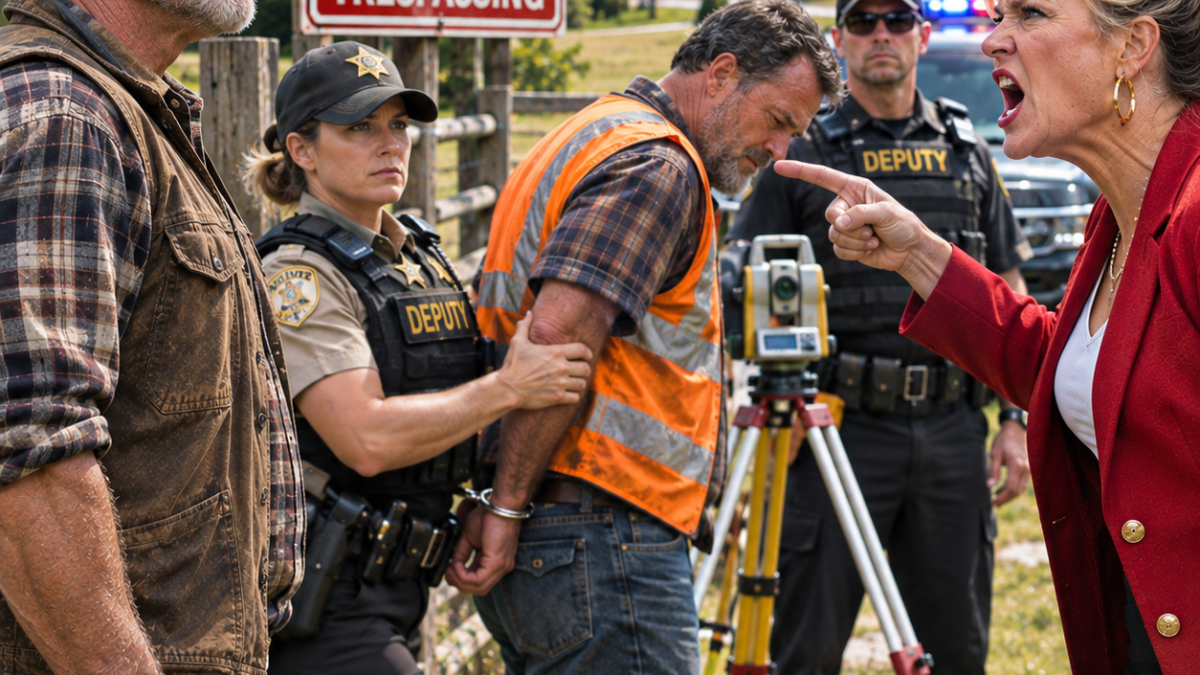
Right beside Clayton’s PRIVATE PROPERTY sign.
Donna stared.
Her entire plan had been constructed around image of deputies forcing Clayton backward.
Instead, her surveyor stood cuffed.
Then Travis twisted around.
Looked at Donna.
“You told me that agreement was already approved.”
Donna’s face drained.
“Shut up.”
Paige’s eyes moved toward her.
Travis opened mouth.
Donna snapped:
“Do not say another word.”
Paige noted it.
Donna tried recovering.
“I knew nothing about any forged signature.”
Nobody had accused her aloud yet.
Clayton noticed.
So did Paige.
Then Donna made worse mistake.
“I only told him to make the paperwork match the new boundary.”
Paige turned slowly.
“Which paperwork, ma’am?”
Donna realized.
Closed mouth.
“I want an attorney.”
Paige nodded.
“Then don’t answer questions.”
Donna walked toward Clayton.
Lowered voice.
“We can settle.”
“No.”
“I’ll have fence moved.”
“No.”
“HOA will pay damages.”
“This stopped being private when somebody put my signature on a document I never signed.”
“You can withdraw complaint.”
“No.”
Criminal investigation no longer belonged to Clayton anyway.
Across road, Colin’s site foreman got phone call.
Stop-work order.
Machines shut down.
Crews pulled out.
Travis placed in patrol car.
Donna stood beside SUV.
Clayton looked at sign.
He did not celebrate.
Sheriff Ridley arrived later.
Spoke privately.
“We’re looking at money now.”
“How much?”
Ridley glanced toward Donna.
“About six hundred eighty thousand dollars.”
By sunset, everyone in Briar Haven knew Travis had been arrested.
Next night clubhouse packed.
Donna stood front.
Claimed dishonest surveyor acted alone.
She had relied on licensed professional.
No knowledge.
No role.
Homeowners asked:
Why $82,000 survey correction?
Why no deed?
Why was construction starting before ownership resolved?
Who approved?
Donna’s answers grew thinner.
Then Ruth stood.
Project payments.
Elmcrest Site Holdings.
No complete invoices.
No inspection sign-offs.
Business records tied Elmcrest to Wade Corliss.
Donna’s longtime business associate.
Money traced toward unrelated expenses, including payments connected to a lakeside property Corliss had purchased.
Investigators did not assume Donna personally stole every dollar.
They traced.
Verified.
Subpoenaed.
Travis, through attorney, eventually cooperated.
He admitted original HOA line didn’t match historic survey.
Provided messages related to adjustment agreement.
His word alone meant little—he had motive to shift blame.
But texts matched drafts.
Payment requests.
Emails.
That independent evidence mattered.
Board called special meeting.
Members removed Donna.
Then replaced rest of board.
Ruth became interim president mainly because nobody else trusted themselves with records.
Independent audit.
Accounts controls.
Donna could no longer authorize contracts.
Her lawyer issued statement:
She was victim of dishonest professional.
Evidence contradicted.
She had participated in communications pushing forged adjustment.
Approved connected payments.
Certified access rights to funding sources.
Eventually prosecutors charged Donna with fraud-related offenses.
Not for calling police.
Calling police was foolish.
Not criminal.
The crime was using false records and a fraudulent scheme to take value from land she did not own and secure funding tied to that false access.
Then Ruth found another document.
Board resolution approving pavilion contract.
Four signatures.
Two board members said:
Not mine.
Forensic review confirmed more forged signatures.
Donna had not only created paperwork suggesting Clayton consented.
Paperwork suggested board consent too.
Layers.
Landowner.
Board.
Survey.
County reference.
Notary.
Every layer designed to make next person assume previous person had already verified.
That was the trick.
Nobody was supposed to go back to original question.
Who actually owns the land?
Clayton.
The $2.8 million pavilion died.
Permits stopped.
Financing gone.
Construction removed.
Strip restored.
Civil court reviewed deed.
Independent survey.
Original monuments.
Confirmed Clayton’s ownership.
HOA claims dismissed.
Barrier removed.
Maintenance road restored.
Settlement covered Clayton’s legal costs, physical damage, restoration.
Travis pleaded guilty to charges involving forged documentation and unlawful monument tampering.
Restitution.
Criminal sentence.
State licensing board revoked surveying license.
The man who believed a professional stamp would make his map unquestionable lost the professional authority behind the stamp.
Donna went to trial later.
Financial records.
Messages.
Drafts.
Payments.
Certifications.
Forged board documents.
Prosecutors proved her participation.
Conviction.
Prison.
Restitution.
Personal assets subject to lawful collection.
Briar Haven residents did not lose homes.
Clayton did not demand rent from neighborhood.
He had no interest in punishing sixty-three households for Donna.
That mattered to him.
The community had already lost enough.
Money.
Trust.
Reputation.
People had believed their president.
Some foolishly.
Some reasonably.
No one deserves collective punishment because they failed to audit every representation made by elected volunteer board.
The new HOA offered to pay restoration.
June negotiated carefully.
Nothing waived investigative obligations.
Nothing granted future rights.
Everything written.
Months later, Clayton walked eastern boundary.
Temporary fence gone.
Original road width restored.
Legitimate brass monuments reset upright and protected with collars.
Updated survey recorded.
No invented line.
No red markers.
The PRIVATE PROPERTY sign remained.
Restoration foreman asked:
“You want this old thing removed?”
Clayton studied it.
Scratched.
Clay at bottom.
Still straight.
“No.”
“Sure?”
“Leave it.”
Beside it, Clayton installed smaller plaque:
BOUNDARY VERIFIED
SEE OFFICIAL COUNTY RECORDS
No threat.
No victory message.
Just information.
One afternoon, Paige Sutter slowed patrol car.
Rolled window down.
“Still standing?”
Clayton smiled.
“Right where it’s always belonged.”
She looked at restored gravel.
Then sign.
“She called us here because she wanted that removed.”
“Yeah.”
“And we ended up finding everything behind it.”
Clayton nodded.
“I put up one sign.”
Paige smiled.
“She brought everybody else.”
Then drove away.
Clayton returned to woodworking shop.
That should have been end.
But stories like this leave residue.
For months, homeowners stopped Clayton at hardware store.
Some apologized.
Some defended themselves.
“We only knew what Donna told us.”
“I know.”
“We thought survey was official.”
“I know.”
“She said you’d signed.”
“I know.”
A man named Howard Reese said:
“I voted for her twice.”
Clayton shrugged.
“So?”
“I feel like an idiot.”
“Don’t.”
“She fooled me.”
“Then be harder to fool next time.”
Howard laughed weakly.
“You make that sound easy.”
“It isn’t.”
Clayton knew.
Confidence works because most people have jobs.
Families.
Bills.
Nobody spends Tuesday night reading plats and LLC filings for fun.
They rely on people whose job is supposedly to know.
Surveyor.
HOA president.
Notary.
Contractor.
County reference numbers.
Once each layer looks official, ordinary people stop checking.
Donna understood that.
She built fraud out of borrowed credibility.
Clayton spent years in construction seeing same principle in harmless form.
Architect trusts engineer.
Owner trusts architect.
Inspector trusts signed plans within scope.
Foreman trusts approved submittal.
Systems function because nobody can personally verify everything.
But systems also fail when someone inserts a lie into trusted layer.
The answer cannot be distrust everyone.
Society would stop.
The answer is traceability.
Records.
Originals.
Independent checks when stakes are high.
That is why Paige’s first question mattered.
Court order?
No.
That is why she noticed soil.
Why Naomi checked control points.
Why June checked reference D4172.
Why Ruth checked payments.
Why Colin asked for raw survey data.
Why lender froze money.
Each person stopped chain long enough to ask:
Where did this come from?
The answer kept returning to Donna and Travis.
One year later, Clayton received certified envelope from new HOA.
He opened cautiously.
Formal apology.
Request to discuss maintenance coordination along shared fence.
Nothing more.
No demand.
No assumed rights.
Ruth called later.
“We want to replace damaged drainage pipe near subdivision side.”
“Does it cross my land?”
“Three feet.”
“Send plan.”
“I will.”
“Contractor insurance?”
“Attached.”
“Dates?”
“Attached.”
“Restoration?”
“Page four.”
Clayton smiled.
“You’ve learned.”
Ruth laughed.
“I never want to see another surprise road as long as I live.”
He granted temporary written access.
Specific.
Two days.
No permanent right.
Work completed.
Crew left.
Ground reseeded.
No conflict.
That mattered too.
People sometimes hear property-rights stories and imagine ideal outcome is wall.
Fence.
Locks.
Nobody allowed in ever again.
Clayton didn’t want isolation.
He wanted consent.
Difference.
A person can say yes only when no remains real option.
Donna had never understood that.
She believed refusal was opening position in negotiation.
If Clayton said no, pressure increased.
Phone call.
Survey.
Fence.
Fine.
Threat.
Forgery.
Police.
She treated boundaries—legal and personal—as obstacles to overcome.
Clayton thought about this when building furniture.
A joint works because parts meet where designed.
Cut one piece too far and everything looks crooked later.
You can force it.
Clamp harder.
Add screws.
Fill gaps.
From distance, maybe table looks fine.
But stress remains.
Eventually wood tells truth.
Land did too.
Original markers sat underground while bright red replacements stood above.
Donna thought visibility would win.
Old brass caps waited.
That image stayed with Clayton.
Truth did not move because someone buried it.
Two years after case, he replaced PRIVATE PROPERTY sign.
Old one rusted at edges.
He considered throwing away.
Instead hung inside woodworking shop.
Not as trophy.
Reminder.
Under it he placed Travis’s fake survey copy from public case record.
Then Clayton’s actual recorded survey.
Visitors sometimes asked.
“What happened?”
He told short version.
“Somebody tried to move a property line.”
“How?”
“Paperwork.”
“You can do that?”
“You can try.”
“What stopped them?”
“Other paperwork.”
They usually laughed.
That was more accurate than dramatic versions.
Not shotgun.
Not bulldozer.
Not screaming match.
Documents.
Measurements.
Camera footage.
A deputy who noticed fresh dirt.
An attorney who checked records.
A treasurer who asked where money went.
And one owner who did not tear down a fence even when every nerve in his body wanted to.
The restraint mattered.
Had Clayton dragged panels away, Donna’s story changes.
Aggressive landowner.
Property destruction.
Threatened security.
Maybe investigation still reaches truth eventually.
Maybe later.
Instead she got nothing.
He recorded.
Waited.
Measured.
Preserved.
It felt weak in moment.
Wasn’t.
Patience denied her distractions.
Years later, a young couple bought house nearest boundary.
They came to Clayton’s shop.
Nervous.
Husband said:
“We wanted to introduce ourselves.”
“Okay.”
“We heard the story.”
“Which version?”
They laughed.
Wife said:
“We don’t want problems.”
“Neither do I.”
They had dog.
Sometimes slipped fence.
Asked permission to retrieve if dog entered meadow.
Clayton said:
“Call me first if you can. If it’s chasing traffic or livestock, go get it.”
Simple.
Then husband asked:
“Can we walk maintenance road?”
Clayton thought.
“For what?”
“Evening walks.”
“No.”
The man looked disappointed.
Clayton continued:
“But there’s county trail half mile north.”
“Right.”
“No hard feelings.”
“No.”
They left.
Week later, wife brought pie.
Clayton almost laughed.
Nobody sued.
Nobody called sheriff.
No fake survey appeared.
A boundary survived a no.
That was what normal looked like.
One autumn afternoon, Clayton walked eastern road.
Leaves dry.
Fence humming faintly in wind.
He stopped at brass monument.
Now protected by concrete collar.
Red paint gone.
Stamped cap visible.
He remembered Donna pointing at fake line.
You’re about to find out what happens when you challenge this community.
She believed size created right.
Sixty-three homes against one man.
$2.8 million project against gravel road.
$680,000 advance against one sign.
Licensed survey against old deed.
HOA president against woodworker.
But law did not count people standing on each side before deciding ownership.
Neither did geometry.
A point remained a point.
A line remained line.
Clayton thought of Paige asking Travis:
Who authorized you to remove the original boundary monuments?
Everything changed because he did not have good answer.
Donna’s entire plan depended on making unauthorized action look completed enough that everybody moved on.
Survey corrected.
Boundary adjusted.
Access established.
Road built.
Project funded.
By Friday.
Done.
Clayton’s sign said:
No.
Not yet.
Prove it.
That’s why she hated it.
It was not metal.
It was interruption.
A physical objection.
Every construction truck had to pass that sentence.
PRIVATE PROPERTY.
Every lender map had to explain it.
Every survey had to contradict it.
Every contractor had to decide whether to work beyond it.
Every deputy had to ask whether it stood on Clayton’s land.
A small sign forced big lie to keep producing evidence.
Eventually too much.
Donna’s arrest came months after Travis.
No dramatic roadside scene for her.
Investigators built case.
Judge.
Warrant.
Trial.
Evidence.
That disappointed people who wanted spectacle.
Clayton didn’t.
He had already seen spectacle.
Donna calling police.
Travis arriving with stamped map.
Handcuffs snapping beside sign.
Enough.
Justice did not need better camera angle.
It needed to hold.
When conviction came, Clayton read headline alone in shop.
No champagne.
No social post.
He turned off phone.
Finished sanding walnut cabinet.
Because land was still there.
Work still there.
Life continued.
That, in some way, was the best outcome.
Donna’s scheme had tried to turn his property into center of everyone else’s ambitions.
Clayton wanted it to become boring again.
Gravel road.
Fence.
Barn.
Workshop.
Wind.
The year after court, wildflowers returned along disturbed strip.
Goldenrod.
Asters.
Tall grass.
Ruts faded.
One spring rain washed final red paint from old stake lying near ditch.
Clayton picked it up.
Threw it in scrap pile.
Not everything needs memorial.
Some things deserve recycling.
The new HOA board eventually built event pavilion elsewhere.
Smaller.
Inside subdivision.
Different access.
Cost more.
Required redesign.
Still successful.
Clayton attended one community fundraiser there after Ruth invited him.
He nearly declined.
Then went.
People ate barbecue.
Children ran.
Nobody discussed property.
At sunset, Ruth stood beside him.
“You know Donna used to say project couldn’t exist without your road.”
Clayton looked at pavilion parking lot.
“People say a lot of things when they don’t want to change a plan.”
Ruth smiled.
“You ever consider selling strip?”
“No.”
“Even now?”
“No.”
“Why?”
Clayton thought.
“Because I use it.”
That simple.
Not because historic.
Not because revenge.
Not because principle abstract.
Road served his barn.
His work.
His property.
That was enough.
Ownership does not require dramatic justification.
People often assume refusing lucrative development means someone must have emotional reason.
Family legacy.
Grave.
Promise.
Sometimes no.
Sometimes landowner just says:
I need my road.
That should be enough.
Months later, Paige stopped again.
Different patrol.
She had been promoted.
They talked beside shop.
Clayton asked:
“What made you notice marker?”
She shrugged.
“Fresh paint.”
“That’s it?”
“Fresh paint on something somebody was claiming was historically established.”
“Travis said he’d reestablished it.”
“Yeah.”
“So?”
Paige looked at him.
“People who are telling truth usually don’t mind explaining how they got there.”
That echoed June.
Naomi.
Ruth.
Colin.
Clayton smiled.
“Maybe put that on sheriff department wall.”
“Too many words.”
She started to leave.
Then:
“You know Donna complained about me?”
“Of course.”
“Three times.”
“For?”
“Bias. Unprofessional conduct. Failure to protect HOA assets.”
“What happened?”
“Supervisor read body cam.”
“And?”
Paige smiled.
“Nothing.”
Evidence again.
It always came back.
Clayton’s father had been a mechanic.
He used to say:
“If a machine only works when nobody looks inside it, it doesn’t work.”
Clayton had forgotten that line for years.
Donna’s system worked only while nobody looked inside.
Survey?
Don’t ask.
Board vote?
Assume.
Signature?
Trust.
Reference number?
Looks official.
Notary?
Seal is there.
Payment?
Project expense.
Fence?
Already settled.
Police?
They’ll make it final.
Then people looked.
Everything broke.
At fifty-one, five years after first stakes, Clayton still ran woodworking shop.
Eastern road carried lumber deliveries.
Sometimes he paused at sign.
The replacement sign was simpler.
PRIVATE PROPERTY
BOUNDARY OF RECORD
Below, small plaque:
VERIFY BEFORE ENTRY.
That was all.
No Donna.
No Travis.
No HOA.
Names fade.
Principle remains.
One afternoon a delivery driver stopped before sign and called.
“I’m at boundary.”
“You delivering walnut?”
“Yes.”
“You have permission. Come through.”
Simple.
Permission given.
Truck entered.
That was what Donna could never stand.
She wanted access without asking.
She mistook needing permission for humiliation.
Clayton saw it as ordinary respect.
Ask.
Answer.
Honor answer.
Everything else is noise.
Near dusk, after truck left, Clayton walked road.
Passed original monument.
Fence.
Meadow.
Briar Haven rooftops beyond trees.
You could barely see event pavilion from his side.
Good.
He returned toward shop.
Wind moved sign slightly.
Metal tapped post.
Once.
Twice.
Same sound.
He thought back to first day.
Donna standing beside white SUV.
Phone in hand.
You’re about to find out what happens when you challenge this community.
She had been right about one thing.
He did find out.
He found out a stamped map can be false.
A licensed professional can lie.
A board president can forge consent.
A county number can belong to something else.
A hundred official-looking pages cannot move one brass marker if the underlying record says it stays.
And he learned something else.
The strongest boundary is not the fence.
Not the sign.
Not even the survey.
It is the moment someone says:
Show me.
Show me the deed.
Show me the vote.
Show me the field notes.
Show me the county filing.
Show me the signature.
Show me where I agreed.
Donna’s entire plan depended on nobody asking long enough.
Clayton did.
Paige did.
Naomi did.
June did.
Ruth did.
Colin eventually did.
And one by one, each question removed another layer until nothing remained except a road, a fence, and the land exactly where it had always been.
Donna Kessler called the police because she wanted Clayton’s boundary sign removed.
Instead, that call put a deputy beside a freshly painted marker.
The marker led to buried monuments.
The monuments led to night footage.
The footage led to a false survey.
The survey led to an invented county reference.
The reference led to a forged signature.
The signature led to funding records.
The funding records led to $680,000.
And the money led back to the woman who had been so sure one phone call would make everybody stop asking questions.
The sign never moved.
Everything behind her lie did.








