HOA Karen Called the Cops to Arrest Me Over Her Stolen Generator—Then I Flashed My U.S. Marshal Badge and Deputies Caught Her Husband Hauling It to a Scrapyard
PART3:
That was my introduction to Vivian Cross.
President of Lakeshore Heights HOA.
Lakeshore Heights was two streets east of my house.
Nice subdivision.
Clubhouse.
Pool.
Private entrance.
About one hundred homes.
I did not live in it.
My property had been there before the development.
No HOA covenant.
No dues.
No shared amenities.
Nothing.
Vivian didn’t appear interested in jurisdiction that morning.
She was interested in certainty.
And she had a lot of it.
“You took it from our storage lot Sunday night.”
“No.”
“Our community generator disappeared two nights ago.”
“I’m sorry to hear that.”
“And suddenly you have one.”
“Yes.”
She stared at me as if I’d just confessed.
“You expect me to believe that’s a coincidence?”
“I expect you to believe the purchase documents.”
She already had her phone out.
“I’m calling the sheriff.”
“Good.”
That answer surprised her.
“What?”
“Call them.”
“I will.”
“I said good.”
She seemed almost disappointed.
Some people don’t know how to continue an argument when the other person agrees to bring law enforcement.
Vivian dialed.
Then raised her voice before anyone answered.
“I caught him red-handed.”
I leaned against my truck.
She told the dispatcher there was stolen HOA equipment on my property.
Said she had positively identified it.
Said the thief was standing beside it.
She kept using the word thief.
I said nothing.
That was deliberate.
When accusations start flying, people often feel an irresistible urge to defend themselves immediately.
They talk.
Interrupt.
Raise voices.
Get angry.
Sometimes they say something stupid.
I had spent decades watching suspects, witnesses, victims, lawyers, cops, and ordinary citizens learn that lesson.
Evidence does not become stronger because you shout it.
So I waited.
Vivian apparently interpreted silence as weakness.
She stood near the generator and took photographs.
“You’re not touching that,” I said.
“I’m documenting HOA property.”
“You can photograph it from there.”
“I’m taking possession when the police arrive.”
“No.”
Her eyebrows rose.
“No?”
“No.”
“You really think you can keep stolen property?”
“I think we’re going to wait for the deputies.”
She smiled.
“You should be worried.”
“I’m not.”
That irritated her more than anything else I said.
Fifteen minutes later, two county cruisers pulled into the driveway.
Deputy Frank Dolby stepped from the first.
Mid-fifties.
Gray in his mustache.
Calm eyes.
The younger deputy was Marcus Reed.
Vivian moved before either man had closed his door.
“That’s him.”
Dolby looked at me.
Then her.
Then the generator.
Vivian continued.
“He stole Lakeshore Heights property.”
Dolby raised one hand.
“Ma’am.”
“He has our generator sitting right there.”
“Ma’am.”
She stopped.
“Before we start talking about arrest, I need to understand what happened.”
She pointed.
“Our commercial backup generator was stolen from the HOA maintenance lot Sunday night.”
“Did you file a theft report?”
“I’m filing one now.”
Dolby frowned slightly.
“When did you discover it missing?”
“Yesterday.”
“And you’re reporting it today?”
“I wanted to investigate internally.”
“Okay.”
He turned toward me.
“Sir?”
“Daniel Mercer.”
“You live here?”
“Yes.”
“Property owner?”
“Yes.”
“This generator yours?”
“Yes.”
“Proof?”
“Absolutely.”
I opened the truck.
Glove box.
Pulled out the invoice.
Purchase agreement.
Delivery confirmation.
Warranty packet.
Dolby took them.
Reed walked toward the generator.
“Serial number on here?”
I pointed.
“Bottom of the invoice.”
He read it.
Then crouched beside the machine.
Stamped metal tag.
Read the serial aloud.
Digit by digit.
Dolby followed on the page.
Exact match.
Reed stood.
“Matches.”
I watched Vivian.
Her expression didn’t change.
Not immediately.
Then she said:
“That paperwork could be forged.”
Dolby looked at her.
“Ma’am.”
“He could have printed it this morning.”
“I can call the supplier.”
“I want him searched.”
Dolby stopped writing.
“You want what?”
“Search him.”
“For what?”
“Evidence.”
She pointed at my garage.
“And search the property.”
I almost laughed.
Didn’t.
“He stole expensive HOA equipment.”
Reed said:
“The serial number doesn’t match your allegation.”
“You don’t know that.”
Dolby looked up.
“Do you know the serial number of your missing generator?”
Vivian hesitated.
“No.”
“Model?”
“It looked like that.”
“Brand?”
Silence.
“Ma’am?”
“It was an industrial unit.”
“That describes a lot of generators.”
Vivian’s voice rose.
“I know what belongs to my HOA.”
Dolby kept his tone level.
“Then I need identifying information.”
“I’m the HOA president.”
“That isn’t identifying information.”
I liked him immediately.
Vivian turned toward me.
“He’s refusing to cooperate.”
I said:
“I’ve provided the purchase record and serial number.”
“I want the generator impounded.”
“No.”
She looked at Dolby.
“You heard him.”
“Yes, ma’am.”
“He refuses.”
Dolby sighed.
“Mr. Mercer does not have to surrender property merely because you’ve accused him of stealing it.”
“I am telling you it’s ours.”
“And I’m asking you to prove that.”
She stepped closer.
“Are you refusing to do your job?”
That was the moment I decided enough was enough.
Not because she offended me.
Because the conversation was beginning to turn from fact-finding into theater.
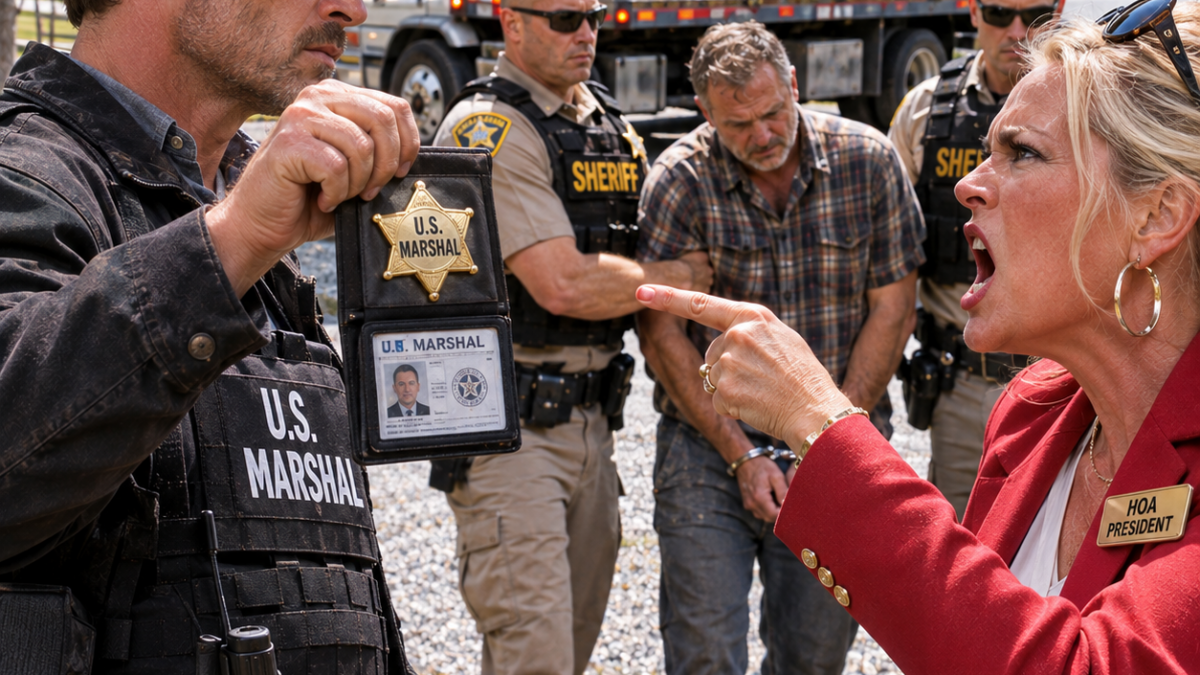
I reached into the center console.
Pulled out my credentials wallet.
Opened it.
“Deputy.”
Dolby looked.
Federal identification.
Badge.
His posture shifted slightly.
Not fear.
Recognition.
Professional recognition.
“United States Marshals Service?”
“Yes.”
“Active?”
“Yes.”
He nodded once.
“Understood.”
Vivian stared.
“What is that?”
I looked at her.
“Ma’am, I’m a United States Marshal.”
For the first time since she had arrived, Vivian Cross stopped talking.
Completely.
I continued.
“I know exactly how evidence gets established.”
I held the invoice.
“And I know an accusation is not probable cause by itself.”
Dolby gave a small nod.
Then I closed the credentials.
Put them away.
“And for the record, my job doesn’t make this generator more mine than it was five minutes ago.”
Reed looked toward Vivian.
That mattered.
Because I didn’t want my badge deciding anything.
The invoice should have been enough.
The serial number should have been enough.
My profession was background.
Not evidence.
Dolby turned back to Vivian.
“Let’s start over.”
She looked much less certain now.
“When exactly did your generator disappear?”
“I told you.”
“Specific time.”
“I don’t know.”
“Who saw it last?”
“I don’t know.”
“Who has keys to your equipment lot?”
She hesitated.
“Board members.”
“How many?”
“Several.”
“Names?”
She shifted.
“My husband manages the property.”
Dolby stopped writing.
“Your husband?”
“Kurt.”
“Kurt Cross?”
“Yes.”
“Does he have access?”
“Obviously.”
“What does he do?”
“Property management.”
“Keys to the lot?”
“Yes.”
“Keys to the equipment?”
“Yes.”
Reed asked:
“Security cameras?”
Vivian looked irritated again.
“They’ve been unreliable.”
“For how long?”
“I don’t know.”
“Who manages them?”
Another pause.
“Kurt.”
Dolby and Reed exchanged a quick look.
Not dramatic.
But I saw it.
Then a truck rolled past the entrance to my property.
Flatbed.
Hydraulic crane mounted behind the cab.
Large object under a gray tarp.
Reed looked toward it.
The truck slowed slightly at the intersection.
He narrowed his eyes.
“Frank.”
Dolby glanced over.
Reed pointed.
“That flatbed.”
“What about it?”
“Cross County Recovery.”
Vivian went very still.
Reed continued.
“They’re listed on the Lakeshore Heights maintenance contract.”
“How do you know?”
“I responded to a clubhouse incident there last month.”
The truck continued down the county road.
Dolby immediately reached for his radio.
“Dispatch, run Cross County Recovery unit traveling south on Mill Road, flatbed with crane.”
He looked at Vivian.
“Who’s authorized to use that towing contractor?”
She didn’t answer.
“Mrs. Cross?”
“My husband handles maintenance vendors.”
Of course he did.
A patrol unit two miles away located the truck.
Stopped it before it reached Highway 16.
We waited.
Vivian stood with her arms folded.
Nobody talked much.
Then Dolby’s radio cracked.
“Unit Twelve to Dolby.”
He answered.
“Go.”
“We have a commercial generator on the bed.”
Vivian looked up.
“Property tag still attached.”
Her face drained.
Dolby said:
“Read it.”
Static.
Then:
“Lakeshore Heights Homeowners Association.”
Nobody moved.
I looked at Vivian.
She looked toward the road.
The radio continued.
“Driver is Kurt Cross.”
Her knees seemed to soften.
She grabbed the side of her SUV.
Dolby asked:
“Destination?”
“Driver says maintenance.”
Pause.
“But paperwork in the cab lists Garrett County Metal Recycling.”
Reed whispered:
“Oh, boy.”
Vivian said:
“No.”
Dolby looked at her.
“No what?”
“He wouldn’t.”
“Your husband?”
“He wouldn’t sell it.”
Nobody answered.
She pulled out her phone.
Called.
No response.
Again.
Nothing.
Dolby radioed:
“Detain the driver pending investigation. Preserve all paperwork.”
Then he looked at Vivian.
“When did you last speak to your husband?”
“This morning.”
“About the generator?”
“Yes.”
“What did he say?”
Her voice became small.
“That he didn’t know where it was.”
Dolby wrote that down.
For the first time that morning, Vivian seemed to understand how bad things looked.
The generator she accused me of stealing had been sitting on her husband’s contracted flatbed.
Headed toward a scrap buyer.
The irony wasn’t lost on anyone.
Twenty minutes later, Kurt Cross was brought back in a patrol vehicle.
The flatbed followed separately.
Gray tarp still covering the equipment.
Deputy Reed pulled the tarp back.
Large diesel generator.
Older than mine.
Scratches along the housing.
And a faded plastic property tag.
LAKESHORE HEIGHTS HOA.
Vivian stared.
Kurt wouldn’t look at her.
Dolby approached him.
“Kurt.”
He said nothing.
“You want to tell me where you’re taking the generator?”
“Maintenance.”
“Garrett County Metal Recycling performs generator maintenance?”
Kurt swallowed.
“Sometimes they buy old equipment.”
“Was the HOA selling this?”
“I was authorized.”
“By whom?”
“Board.”
Vivian snapped:
“No, you weren’t.”
Everyone turned.
Kurt finally looked at her.
That was a terrible look.
Not anger.
Fear.
Vivian stepped closer.
“Kurt?”
He said:
“Don’t.”
“What did you do?”
“Vivian.”
“What did you do?”
Dolby stopped her.
“Ma’am, give us space.”
“I’m his wife.”
“Exactly.”
That conversation continued somewhere else.
The investigation eventually showed Kurt had serious gambling debt.
Much more than Vivian knew about.
Sports betting.
Online accounts.
Cash advances.
Credit-card balances.
He had been moving money around for months.
The HOA generator was valuable.
Portable enough to move.
And old enough that he apparently believed a missing unit might not be noticed immediately.
He arranged transport through a contractor he regularly hired.
His plan was to sell the generator to a metal and equipment buyer.
Pocket the money.
Then explain the disappearance as theft from the storage lot.
Except Vivian discovered the missing generator before Kurt had finished.
She panicked.
Then saw mine.
Same general size.
Same general style.
And decided the answer was standing two streets away.
That was the part she had to live with.
Kurt stole the generator.
Vivian almost helped him by accusing an innocent person before checking anything.
She stood beside her SUV while deputies questioned Kurt.
Red blazer no longer seemed particularly commanding.
Finally she looked at me.
“I didn’t know.”
I said nothing.
“I saw yours.”
“I know.”
“It looked like ours.”
“I know.”
“I panicked.”
That was probably true.
But panic explained her behavior.
It didn’t excuse it.
“You called me a thief before asking my name.”
She looked down.
“I thought—”
“No.”
I stopped her.
“You didn’t think.”
She looked at me.
“You decided.”
Silence.
“Then you tried to make law enforcement fit your decision.”
Her mouth tightened.
“I was protecting the HOA.”
“From what?”
She had no answer.
I continued.
“Panic doesn’t give you the right to threaten a stranger with arrest on his own property without evidence.”
For once, Vivian didn’t argue.
Kurt was arrested after the deputies completed their initial investigation and consulted the appropriate charging process.
The generator was seized as evidence.
Invoices.
Messages.
Vendor paperwork.
Financial records.
Everything started coming apart.
By evening, Lakeshore Heights homeowners knew.
Not because I told them.
Because patrol cars had been seen.
The flatbed had been seen.
Vivian’s argument in my driveway had been heard.
And neighborhoods are more efficient than intelligence agencies when it comes to gossip.
Emergency board meeting.
Packed clubhouse.
Vivian tried to explain.
Kurt acted alone.
She didn’t know.
She believed the generator on my property might have been theirs.
Those things may all have been true.
The problem was what came after.
Residents wanted to know why she had called police before checking their own equipment records.
Why no theft report had been filed immediately.
Why Kurt had so much control over vendors.
Why the security cameras were supposedly unreliable.
Why the president had publicly accused someone based only on appearance.
One homeowner asked:
“What if Mr. Mercer hadn’t kept his receipt?”
That question mattered.
Another:
“What if the serial number plate had been damaged?”
Another:
“What if the deputies had believed you?”
Vivian had no good answer.
The board began preparing a formal removal vote.
She resigned before it happened.
Three days later.
Short letter.
Personal reasons.
Everybody knew.
Kurt’s case moved more slowly.
Financial investigation.
Plea negotiations.
Restitution.
Eventually he pleaded guilty to theft-related charges under an agreement that required repayment and imposed probation and other conditions.
The HOA recovered the generator.
It needed some work after being transported improperly.
But it was theirs again.
Vivian moved out of Lakeshore Heights less than a year later.
I never spoke to her after that morning.
People kept asking whether I had threatened to sue.
No.
Whether I filed a federal civil-rights case.
No.
Whether I used my Marshal position to investigate Kurt.
Absolutely not.
The county handled it.
As they should.
That distinction mattered to me.
I had spent a career enforcing warrants issued by courts.
Serving process.
Finding people who had spent years convincing themselves rules no longer applied to them.
I wasn’t going to misuse my own badge because somebody embarrassed herself in my driveway.
The best thing my credentials did that morning was force Vivian to stop talking long enough for the deputies to go back to the evidence.
Even that bothered me afterward.
Because she should have stopped before knowing who I was.
The receipt mattered.
The serial number mattered.
My job did not.
A few weeks later, Deputy Dolby stopped by.
Off duty.
Jeans.
Baseball cap.
He brought coffee.
I was checking the generator.
“You maintain that thing more than your truck.”
“My truck doesn’t keep my furnace running.”
He laughed.
Then leaned against the garage.
“Wanted to say thanks.”
“For what?”
“Staying calm.”
“I didn’t do anything.”
“That was the point.”
He looked toward the driveway.
“A lot of people get accused of something like that and immediately start screaming.”
“Usually doesn’t help.”
“No.”
He took a drink.
“Marcus has been using it as a training example.”
I laughed.
“What part?”
“Start with identifiers.”
“That should already be training.”
“You’d be surprised.”
“No.”
I wouldn’t.
The next storm came in January.
Wet snow.
Wind.
Power went out across half the county.
At 2:07 a.m., my transfer switch clicked.
Generator started.
Steady diesel hum.
Porch lights stayed on.
Heat stayed running.
Well pump worked.
Coffee maker worked.
Most important piece of emergency equipment ever invented.
I walked outside around sunrise.
Snow everywhere.
Generator running perfectly.
Across the distant trees, Lakeshore Heights was dark.
Their recovered generator was not yet operational.
Insurance inspection.
Board transition.
Electrical contractor delays.
The kind of administrative mess created after somebody nearly sells critical equipment for gambling money.
I didn’t laugh.
Didn’t post anything.
Didn’t drive over and ask whether they wanted to borrow mine.
Tempting.
But no.
People there hadn’t stolen anything.
Most were victims too.
By the following winter, Lakeshore had a functioning backup system again.
New board.
New controls.
Two signatures required for equipment disposal.
Vendor review.
Annual inventory.
Security-camera access shared among multiple board members.
The new HOA president was a retired school principal named Dennis Moore.
I met him once at the gas station.
He recognized me.
“You’re the generator guy.”
I sighed.
“I was hoping to be remembered for something else.”
He laughed.
Then said:
“We check serial numbers now.”
“Good policy.”
“Apparently revolutionary.”
We shook hands.
That should have been the end.
But stories stick around.
Some neighbors joked I should have flashed my badge the second Vivian stepped out of her SUV.
I always tell them no.
That’s exactly backwards.
A badge should never be the first answer to a private dispute.
Documentation should.
Invoice.
Serial number.
Delivery receipt.
Warranty registration.
Facts.
The badge was almost incidental.
I’ve seen too many people believe authority automatically makes them right.
Vivian thought HOA president meant she could order an arrest.
Kurt thought property manager meant he could move community equipment without scrutiny.
Neither title worked that way.
Mine didn’t either.
United States Marshal does not mean:
Automatically believe me.
It means I have a job.
The truth still has to stand on evidence.
That’s why the delivery invoice stayed in my glove box for years.
Not because I thought Vivian would return.
Not because I expected another accusation.
Because it reminded me how little drama good evidence needs.
Purchase date.
Supplier.
Amount.
Serial number.
Delivery confirmation.
One page.
That page beat shouting.
Beat accusations.
Beat a red blazer.
Beat somebody demanding handcuffs.
Every month I still check the generator.
Oil.
Battery.
Fuel.
Coolant.
Transfer switch.
Run cycle.
Same schedule the manual recommends.
Twenty-six years in law enforcement taught me something else besides staying calm.
Maintenance prevents emergencies.
Paperwork prevents arguments.
Sometimes both save you on the same morning.
One summer afternoon, Marcus Reed pulled into my driveway.
He was alone.
I walked over.
“Everything okay?”
He smiled.
“Yeah.”
He had become a training officer.
“Remember Vivian Cross?”
“Unfortunately.”
“We ran a scenario with recruits.”
“Oh, no.”
“Stolen generator.”
“You recreated it?”
“Pretty much.”
“What did they do?”
“Half wanted to detain the property owner before checking the serial.”
I groaned.
“Then your training is working.”
“Eventually.”
He laughed.
“One recruit asked what happens if the owner is a federal Marshal.”
“What did you tell him?”
“That shouldn’t matter.”
I smiled.
“Good answer.”
Because that was the answer.
It should not matter.
If I had been a plumber, the invoice still matched.
If I had been retired, the invoice still matched.
If I had been unemployed, the invoice still matched.
If I had hated police, the invoice still matched.
Identity doesn’t change serial numbers.
That lesson goes both directions.
Vivian wasn’t wrong because she was an HOA president.
She was wrong because she accused first and investigated second.
Kurt wasn’t guilty because he was her husband.
He became responsible because evidence connected him to the missing equipment and attempted sale.
Evidence.
Always evidence.
Years later, the generator housing accumulated scratches.
Paint faded.
The purchase no longer looked brand-new.
But every storm it started.
Every time, I remembered that Tuesday.
Vivian pointing.
“You stole it.”
Deputies arriving.
Invoice unfolding.
Reed reading the serial.
Then the flatbed passing behind us at exactly the wrong moment for Kurt Cross.
People call that karma.
Maybe.
I call it bad timing and good police work.
The flatbed itself eventually changed owners.
I saw it on the county road sometimes.
Same crane.
Different company logo.
No tarp hiding a generator.
Just normal equipment.
Every time I saw it, I thought about how close Vivian came to creating an entirely different story.
Suppose the truck had passed five minutes earlier.
Suppose Reed didn’t recognize the contractor.
Suppose Kurt reached the scrap buyer.
The truth still probably would have come out.
There were records.
Vendor calls.
Property tags.
Financial problems.
But it would have taken longer.
Instead the lie drove directly past two deputies while they were standing in my driveway.
Hard to beat that.
Today it’s quiet again.
No red SUVs.
No screaming.
No accusations.
Just trees.
Gravel.
My truck.
And the low hum of a generator that was always mine.
People sometimes ask what stopped Vivian.
They expect me to say:
My badge.
It didn’t.
The badge got her attention.
The receipt ended the accusation.
The serial number destroyed it.
And the tarp-covered generator rolling toward the scrapyard exposed the truth.
Twenty-six years chasing fugitives taught me that the loudest person in the room is rarely automatically the person holding the facts.
Vivian arrived louder than everybody.
I barely spoke.
In the end, that was enough.
She brought an accusation.
I brought a receipt.
The deputies followed the evidence.
And the evidence drove past us on a flatbed truck.








