HOA Karen Called My 3,200-Acre Deed Fake—Then a Judge Ordered Her $1.48M Main Gate Torn Off My Land
PART2:
And a main entrance so oversized that delivery drivers sometimes assumed they had reached a resort.
Two massive stone pillars.
Ornamental steel.
Guardhouse.
License-plate cameras.
Landscaped plaza.
Bronze sign.
SILVERCREST RIDGE.
Colette loved that entrance.
Everyone knew it.
She had called it the symbol of the community in newsletters.
A statement of permanence.
A promise of security.
What she did not know that morning was that before the dispute was over, a licensed surveyor would drive red stakes around that symbol of permanence and show that most of it was standing on my ranch.
At the time, however, Colette believed she had me cornered.
She opened a thick folder.
Inside was a glossy color map.
Silvercrest Ridge shaded blue.
PART3:
My northern pasture shaded blue too.
Sixty-three acres.
My sixty-three acres.
“You see the problem,” she said.
“No.”
“This property was mistakenly incorporated into your 2018 deed.”
“According to?”
“The subdivision development records.”
She pointed.
On her map, the HOA boundary bulged westward into Redford Ranch.
“What do you want with sixty-three acres?”
“Correcting an ownership error is not about what I want.”
I waited.
She lasted maybe four seconds.
Then:
“Silvercrest has been evaluating several recreational improvements.”
There it was.
“What improvements?”
“An equestrian facility.”
I said nothing.
“A community event pavilion.”
Still nothing.
“Possibly a private scenic trail.”
I leaned back.
“So you came here because you want my pasture.”
“It is not your pasture if the deed is defective.”
“When did Silvercrest purchase it?”
The attorney cleared his throat.
Colette’s eyes narrowed.
I repeated:
“When did the HOA purchase these sixty-three acres?”
“The development footprint predates your ownership.”
“That isn’t a conveyance.”
“Our records—”
“Deed?”
Silence.
“Recorded transfer?”
The lawyer opened his briefcase.
He produced a concept drawing.
No deed stamp.
No recording number.
No prior owner signature.
Just another map.
I looked at him.
“You’re an attorney?”
“Yes.”
“And this is what you brought to challenge a recorded deed?”
Colette answered for him.
“We have enough to file.”
“Then file.”
Her expression changed.
She had expected negotiation.
Fear.
Maybe anger.
Instead, I handed back the map.
She placed three papers on my desk.
First:
Acknowledgment that my deed contained an error.
Second:
Boundary adjustment accepting the HOA line.
Third:
Transfer of the sixty-three acres.
“You have seventy-two hours.”
I actually laughed.
Colette’s face reddened.
“If you refuse, Silvercrest will bring a quiet-title action.”
“Okay.”
“We will seek an injunction preventing agricultural operations on the disputed land.”
“That’s your choice.”
“You run cattle there.”
“I do.”
“You have lending relationships.”
“Yes.”
“Business partners.”
“Yes.”
“Disputed title can complicate refinancing.”
I stared at her.
That sentence told me more than the maps did.
This was not merely:
We think the line is here.
This was pressure.
She wanted me thinking about lenders.
Buyers.
Contracts.
The cost of litigation.
She wanted me to surrender before anybody carefully checked the records.
I closed the folder.
“You brought a colored map to challenge a recorded legal description.”
“It is a professional development map.”
“That doesn’t make it ownership.”
“You are making a serious mistake.”
“No.”
I pushed the folder toward her.
“I think somebody already did.”
She stood.
“Our next conversation will be before a judge.”
“That’s probably better.”
She left.
Three black SUVs kicked gravel down the ranch road.
I watched until they disappeared.
Then I picked up the map Colette’s attorney had accidentally left behind.
At first I was interested in the sixty-three acres.
Then I noticed the entrance.
Small graphic.
Almost decoration.
Two stone pillars.
Guardhouse.
Road.
And a thin red property line.
The red line did not run where I expected.
It passed behind the entrance structures.
I opened my filing cabinet.
Pulled out my old survey.
Laid both maps beneath the desk lamp.
Redford Ranch had a narrow extension running east toward the county highway.
I had always known that.
The road into Silvercrest crossed part of it.
There was an easement.
That had never bothered me.
Residents had driven there for years.
But an easement and ownership are not the same thing.
The longer I looked, the stranger it became.
I called Harlan Copley.
Licensed surveyor.
Sixty-one.
Forty years walking Montana boundary lines.
“Harlan.”
“Miles.”
“I need a survey.”
“Fence problem?”
“Possibly a million-dollar fence problem.”
Pause.
“I’m listening.”
“Silvercrest Ridge main entrance.”
“What about it?”
“I want to know whose dirt is underneath it.”
Two days later, I sat across from Vivian Roth.
Property-rights attorney.
Forty-four.
Very little patience for imprecise documents.
She read my purchase agreement.
Title policy.
Deed.
Prior deed.
Survey.
Then Colette’s map.
She asked:
“Where did this come from?”
“HOA president.”
“They’re claiming sixty-three acres?”
“Yes.”
“Based on this?”
“Yes.”
Vivian stared.
“Interesting.”
“That good?”
“No.”
She opened the chain of title.
Silvercrest Ridge had originated in 2008.
A developer carved roughly 145 acres from a much larger tract.
That 145-acre parcel became the subdivision.
In 2009, the remaining ranch acreage went to Leonard Finch.
Leonard later sold 3,200 acres to me in 2018.
The deed did not simply say:
Approximately 3,200 acres.
It contained metes and bounds.
Survey monuments.
Bearings.
Distances.
Recorded references.
Specific physical points.
Vivian tapped the page.
“This matters.”
“I know.”
“A concept plan cannot quietly redraw a metes-and-bounds description.”
“Tell Colette.”
“I’d rather tell a judge.”
Then she found the easement.
Recorded.
Permanent.
Twenty-four feet wide.
Silvercrest had lawful access from the subdivision across a narrow section of ranch land to the county highway.
Residents.
Guests.
Service vehicles.
Clear.
Valid.
I had no problem with it.
But the easement conveyed no ownership.
And permanent structures were not authorized outside the corridor.
Vivian looked at the gate design.
“How wide is that entrance complex?”
“Much wider than twenty-four feet.”
“Guardhouse?”
“Off to one side.”
“Planters?”
“Both sides.”
“Camera mast?”
“Yes.”
She looked at me.
“If the survey lands where you think, their gate may be an encroachment.”
“May?”
“We don’t litigate with may.”
That was why I hired her.
We waited for Harlan.
Meanwhile, Colette started campaigning.
Ninety-one homeowners received a letter.
According to it:
A wealthy neighboring rancher was attempting to seize community property.
I had supposedly discovered a “technical discrepancy.”
I intended to interfere with security.
I was threatening residents’ long-standing access.
None of that was true.
I had not threatened access once.
But fear works.
Emails came.
One homeowner called me greedy.
Another said:
“You already have three thousand acres. Why do you need the gate land too?”
I answered:
“I don’t need the gate land. I own whatever the deed says I own.”
He hung up.
Colette prepared the lawsuit.
I worked cattle.
Harlan worked survey monuments.
He spent two days finding old markers.
Checking coordinates.
Comparing plats.
Walking the access road.
On the second afternoon, I met him near the Silvercrest entrance.
Snow from the previous week still clung to shaded ground.
He set his instrument.
Shot a point.
Moved.
Shot again.
Then walked to the western stone pillar.
Measured.
Returned.
Reset the instrument.
Measured again.
I knew enough about surveyors to recognize concern.
“What?”
He did not answer.
Third measurement.
Then:
“Did the HOA ever buy land here from you?”
“No.”
“From Leonard?”
“Not according to the deed chain.”
“Any lease?”
“No.”
“License for the gate?”
“Not that I know of.”
He looked toward the entrance.
Two enormous pillars.
Guardhouse.
Camera pole.
Bronze sign.
Stone plaza.
“Then somebody needs to explain this.”
“Explain what?”
Harlan pointed.
“Most of that is on your parcel.”
I stared.
“All of it?”
“Not the travel corridor.”
“The buildings?”
“Preliminary answer?”
“Yes.”
“Guardhouse. Both pillars. Camera infrastructure. Landscaping. Part of the plaza.”
“How much land?”
“Roughly nine-tenths of an acre.”
I looked at the gate.
For years, I had driven past it without thinking.
Suddenly it looked different.
Not grand.
Not permanent.
Expensive.
Very expensive.
Harlan said:
“Come back tomorrow morning.”
“For?”
“Markers.”
At sunrise, his crew started setting red stakes.
County highway.
Landscaped shoulder.
Flower beds.
Around the entrance.
Down the road.
One by one.
The boundary became visible.
A Silvercrest guard noticed.
Radioed someone.
Twenty minutes later, Colette arrived so fast her tires chirped against the pavement.
She stepped out.
“What the hell are you doing?”
Harlan continued working.
She pointed.
“Remove those stakes.”
He looked up.
“No.”
“This is HOA property.”
Harlan reached into his truck.
Pulled his field map.
I handed him the recorded deed.
He explained professionally.
No drama.
Recovered monuments.
Legal description.
Measurements.
Preliminary boundary.
The land supporting the permanent gate structures was part of Redford Ranch.
Colette stared.
“That is impossible.”
Harlan shrugged.
“Survey doesn’t care.”
“This entrance cost nearly one and a half million dollars.”
I looked at her.
“The price doesn’t move the boundary.”
Her attorney arrived.
He brought the building permit from 2016.
“There.”
He held it like victory.
“County-approved construction.”
Vivian was on speakerphone.
She heard him.
Then:
“A building permit regulates construction. It does not transfer title.”
Silence.
She continued.
“If the owner of the underlying land did not authorize permanent structures, the permit does not magically create ownership.”
The attorney looked down.
That was the first moment I saw doubt.
Colette recovered.
“This gate has stood for nearly ten years.”
“So?”
“We have established rights.”
“To use the road.”
“Exactly.”
“No.”
I pointed at the twenty-four-foot corridor.
“You have an easement there.”
Then the guardhouse.
“You built that outside it.”
She threatened to sue me for interference with security infrastructure.
I looked up at the license-plate camera mounted on what appeared to be my property.
“Keep recording.”
She frowned.
“It’ll preserve the conversation.”
Harlan almost smiled.
I made one thing clear.
I would not block residents.
Would not close the road.
Would not chain the gate.
Would not interfere with lawful access.
The easement existed.
I respected it.
That distinction mattered because Colette would later tell homeowners I wanted to trap them inside Silvercrest.
I never did.
My issue was permanent structures beyond the easement.
And her attempt to take sixty-three additional acres.
Harlan finalized his survey.
Sealed.
Signed.
Photographs.
Monuments.
Coordinates.
Vivian filed a counterclaim.
Determine boundary.
Address encroachment.
Preserve records.
Stop further construction.
Then she found one line on the 2016 permit.
LANDOWNER AUTHORIZATION ATTACHED.
At the time the gate was built, Leonard Finch owned Redford Ranch.
Vivian looked at me.
“Did Leonard ever mention this?”
“No.”
“Still alive?”
“Yes.”
“Where?”
“Western Montana, I think.”
“Find him.”
She found him first.
Leonard Finch was seventy-eight.
Living in a small town across the state.
Sharp.
Direct.
Still irritated about Silvercrest.
Vivian asked:
“Did you authorize the current entrance structures?”
His answer:
“No.”
“Did you allow use of the road?”
“Yes.”
“Permanent access?”
“The recorded easement. Of course.”
“Stone pillars?”
“No.”
“Guardhouse?”
“No.”
“Landscaping outside the road corridor?”
“No.”
“Did anyone ask?”
“Oh, yes.”
That got interesting.
In 2015, a contractor and Colette had shown Leonard a grand entrance design.
Leonard objected.
He told them permanent structures had to be moved onto subdivision-owned land.
He kept the email.
Vivian nearly jumped out of her chair when he showed it to her.
Printed.
Dated.
Leonard Finch to project team:
Existing easement may continue to be used for access. No permanent pillars, guardhouse, or other facilities are authorized on Finch ranch land. Please relocate such structures to subdivision-owned property.
Reply:
Understood. Design team will revise.
Leonard had more.
A 2016 letter from Colette asking him to sign landowner consent.
Unsigned.
He had never returned it.
Vivian asked:
“Did you sign any later version?”
“No.”
“Certain?”
“I refused then. I’m refusing now.”
Then the county permit file arrived.
Attached:
LANDOWNER CONSENT.
Leonard Finch.
Signature.
Miles Redford sat beside Vivian when she opened it.
We drove a copy to Leonard.
He looked for less than ten seconds.
“That’s my name.”
Pause.
“But that is not my signature.”
We did not stop there.
His statement mattered.
But Vivian wanted independent evidence.
Sworn declaration.
Known signature samples.
Forensic handwriting review.
Original file if available.
Then she found Owen Halbrook.
Contractor who built the entrance.
Forty-nine.
At first:
“I built approved plans.”
Fair.
He was a contractor.
Permit existed.
Stamped drawings.
He said Colette provided authorization.
His company had questioned the boundary once.
Colette told them:
“Everything is handled with the ranch owner.”
Owen’s company still retained electronic records.
Vivian issued preservation notices through proper channels.
Then discovery began.
The HOA officially produced the Leonard consent form.
They relied on it.
That mattered.
Then internal emails arrived.
One message:
Project Coordinator to Colette:
Still waiting on signed Finch landowner authorization. County needs the attachment before permit packet can be finalized.
Colette’s response:
Proceed with the permit packet. I’ll handle the authorization.
I read it twice.
Then looked at Vivian.
“She challenged my deed.”
“Yes.”
“While relying on this?”
“Yes.”
“If Leonard didn’t sign—”
“Careful.”
“I know.”
We would not say who forged anything without evidence.
But the HOA’s claim that it possessed unquestioned landowner consent was collapsing.
Meanwhile, Colette was attacking publicly.
Emergency HOA meeting.
My photograph projected behind her.
Red survey stakes.
She told residents:
“He wants to take away the entrance you paid for.”
False.
Residents’ lawful road access was protected.
The easement did not disappear because structures were misplaced.
But she let them believe their homes could become inaccessible.
Then asked for:
$240,000 emergency legal fund.
People panicked.
Some approved.
One homeowner stood.
“Do we own the land under the guardhouse?”
Colette redirected.
“We are fighting to protect your security.”
“That wasn’t my question.”
She ignored him.
Then letters started hitting my business relationships.
One livestock buyer paused a contract because he had heard Redford Ranch’s title was “clouded.”
A lender requested updated title documents.
Two hay customers called.
My anger finally got ahead of me.
I wanted to drive to Silvercrest and confront her.
Vivian said:
“No.”
“She’s lying to my customers.”
“Document it.”
“She’s hurting the business.”
“Document it.”
“She’s telling people my ranch may not belong to me.”
“Document it.”
I stared.
“You have one answer.”
“Yes.”
“What if I block the gate?”
“Then I quit.”
That stopped me.
Vivian leaned forward.
“They have a valid twenty-four-foot easement. Do not violate it.”
“I know.”
“Good.”
She continued.
“You want to win this cleanly.”
“Yes.”
“Then stop thinking like Colette.”
That landed.
A ranch neighbor offered to park a tractor across the entrance in support.
I refused.
No theatrics.
No chains.
No blockade.
Court.
Survey.
Documents.
That was enough.
Then Celia Draper knocked on my office door.
Fifty-nine.
Silvercrest resident for nine years.
She had trusted Colette.
Paid assessments.
Supported the gate.
Voted for several projects.
She looked uncomfortable sitting in my office.
“I thought you were trying to take our entrance.”
“I’m not.”
“I know that now.”
“What changed?”
She held up the survey.
“Someone emailed this around.”
Harlan’s sealed survey.
Then she told me something I did not know.
Colette had been quietly pitching an expansion toward my northern pasture.
Luxury equestrian center.
Event space.
Scenic trails.
Exactly the sixty-three acres she claimed.
Celia said:
“She’s been telling people that land will become part of Silvercrest.”
“For how long?”
“Months.”
That answered motive.
The deed challenge was not a reaction to a discovery.
It was the first move in an expansion plan.
Then the HOA treasurer got nervous.
Dean Pruitt.
Fifty-six.
Soft-spoken.
A man who looked uncomfortable even when ordering lunch.
During a closed meeting, he asked to review the original 2016 gate-construction file.
Colette snapped:
“That gate was approved. Stop digging through settled matters.”
Dean said nothing.
Then opened the file anyway.
Inside was the landowner consent.
And clipped beside it:
A handwritten note.
ORIGINAL OWNER’S SIGNATURE NEVER RECEIVED.
Dean sat alone in his office afterward.
That note eventually reached his attorney.
Then Vivian.
The forensic handwriting report arrived.
It did not declare:
Colette forged this.
That would have been beyond what the examiner could establish.
It did say the questioned Leonard signature showed significant inconsistencies with known genuine examples.
Stroke formation.
Letter spacing.
Pen lifts.
Proportions.
Not a reliable match.
Then metadata.
The electronic copy of the consent form appeared to have been created after project communications already represented the authorization as complete.
Again:
Not proof of who physically created the false signature.
But devastating to the story that everything had been clean and settled.
Then Owen’s archived construction drawings arrived.
Two versions.
Version one:
Guardhouse shifted safely onto Silvercrest-owned land.
Pillars inside HOA boundary.
Engineer note:
PRIVATE RANCH BOUNDARY — LANDOWNER APPROVAL REQUIRED FOR PERMANENT STRUCTURES.
Version two:
Bigger.
Grand.
Moved toward the county highway.
Guardhouse across boundary.
Pillars across boundary.
Planters across boundary.
Engineer warning gone.
Owen testified later that Colette pushed for the larger entrance.
She wanted something dramatic.
Something buyers would remember.
Something that would increase property values.
By then, the original gate cost was becoming clear.
Approximately:
$1.48 million.
Foundation.
Masonry.
Guardhouse.
Security equipment.
Design.
Landscaping.
Systems.
Then Dean found a payment.
$450,000.
Palisades Civic Design LLC.
What services?
Vague.
Design consulting.
Community identity work.
Project coordination.
No documentation supporting anything remotely equal to $450,000.
Dean’s attorney checked business records.
Palisades was connected through ownership filings to Colette Ashberry.
Dean went silent.
Then:
“She never disclosed this.”
That moved the homeowners.
Celia forced a special meeting under the bylaws.
Packed room.
She stood.
“We paid for security.”
Pause.
“We did not agree to spend almost one and a half million dollars building a monument on somebody else’s land.”
People murmured.
Independent forensic accountant hired.
Blair Wexford.
Forty-one.
Blunt.
The kind of accountant who treated bank statements like crime scenes without ever calling them crimes before evidence allowed it.
She confirmed roughly $1.48 million in entrance costs.
Then the $450,000 Palisades payment.
Beneficial ownership connected to Colette.
No meaningful work product matching the amount in the files she reviewed.
Undisclosed conflict.
Unsupported payments.
Potential improper billing.
She stopped there.
Exactly where evidence stopped.
At the next meeting, Celia asked Colette three questions.
“Why was our entrance built on land Silvercrest does not own?”
Colette:
“The boundary is contested.”
Celia:
“Why does Leonard Finch say the consent signature is not his?”
Colette:
“That matter is under litigation.”
Celia:
“Why did a company tied to you receive $450,000 from the gate project?”
Colette’s face changed.
“This meeting is being manipulated by Mr. Redford.”
A homeowner stood.
“I voted for the entrance.”
Another:
“So did I.”
The first continued:
“We were told all land rights were secured.”
Another woman:
“Is insurance paying if it has to be moved?”
No answer.
The room erupted.
Colette tried to close the meeting.
Celia refused to stop asking questions.
Then she came to my ranch.
She made an offer.
“Would you lease the land under the gate?”
“For how long?”
“Long term.”
“How much?”
“Modest annual payment.”
“Why?”
“To spare residents demolition costs.”
I understood.
Honestly, I did.
The residents were not my enemies.
Most had been misled.
A lease might preserve the gate.
But Colette was still suing me.
Still claiming my deed was defective.
Still claiming sixty-three acres.
I said:
“No.”
Celia looked disappointed.
I explained.
“If I lease while they maintain the deed claim, we create another layer of confusion.”
“What would you accept?”
“A clean result.”
“Meaning?”
“Confirm my deed. Abandon the sixty-three-acre claim. Recognize the easement exactly as recorded. Resolve the encroachment permanently.”
She nodded slowly.
“I understand.”
“Tell the residents something else.”
“What?”
“I’m not trying to take their road.”
“I know.”
“Make sure they do.”
She did.
That hurt Colette’s narrative badly.
Then Colette made her final offer.
Private meeting.
Vivian.
Me.
Colette.
Her attorney.
No guards.
No theatrics.
She looked tired.
She placed a settlement proposal on the table.
HOA drops sixty-three-acre claim.
Pays me $410,000.
Gate remains.
I sign expanded easement.
I agree not to publicly discuss the construction history.
Colette said:
“This saves everyone years.”
I read the first page.
Then looked up.
“So my deed is valid now?”
She frowned.
“I did not say—”
“You’re asking me, as owner, to grant you an easement.”
Silence.
“If I don’t own it, why do you need my signature?”
No answer.
I pushed the document back.
“No.”
Her attorney looked at her.
Then filed a new document.
EASEMENT MODIFICATION AGREEMENT — 2016.
According to it, Leonard Finch had authorized permanent gate structures and expanded occupancy.
Again:
Leonard denied signing.
Again:
No recorded version appeared in county land records.
Vivian needed more.
Then Owen found the boundary report.
Preconstruction engineering.
Clear sentence:
Proposed guardhouse and monumental pillars extend beyond land owned by Silvercrest Ridge and require valid written authorization from adjoining ranch owner prior to construction.
Attached:
Meeting minutes.
Attendance.
Discussion.
Ownership issue.
Authorization required.
At the bottom:
Colette Ashberry.
Signature acknowledging the meeting.
Then email.
Colette:
Keep construction schedule moving. Owner authorization remains in process.
There it was.
Knowledge.
Before construction.
Not a paperwork surprise discovered years later.
The design team had warned that the expanded entrance crossed onto ranch property.
Colette had acknowledged it.
And construction continued.
At trial, Vivian placed the report in front of her.
“Please read the highlighted sentence.”
Colette read.
Firmly at first.
Then more quietly.
“Proposed guardhouse and monumental pillars extend beyond land owned by Silvercrest Ridge…”
She stopped.
Vivian:
“Continue.”
“…and require valid written authorization from adjoining ranch owner prior to construction.”
“Whose land was the adjoining ranch?”
“Leonard Finch’s.”
“And later Miles Redford’s?”
“Yes.”
“You attended the project meeting?”
“I attended many meetings.”
“Is that your signature?”
Colette looked.
“Yes.”
“You acknowledged these minutes?”
“I apparently did.”
“You knew the design extended beyond Silvercrest property?”
“I relied on the development team.”
“That was not my question.”
Pause.
“You knew the report said the design extended beyond Silvercrest property?”
“Yes.”
Vivian produced the email.
“Then you told the team to keep construction moving while authorization remained incomplete?”
Colette’s lawyer objected.
Overruled.
Colette looked at the email.
“I do not recall the exact context.”
“Is that your email?”
“Yes.”
Then the Leonard consent.
“You later relied on this document to claim the ranch owner approved construction?”
“Yes.”
“Mr. Finch says this is not his signature.”
“I can’t speak for him.”
“Your own project coordinator wrote that his signature had not been received.”
Colette’s expression tightened.
Vivian placed my deed beside everything.
“Mrs. Ashberry, you sued Miles Redford claiming his deed was defective.”
“Yes.”
“Yet your own construction records identified the same ranch boundary years before Mr. Redford bought the property.”
Silence.
“You knew the ranch owned the land beneath your expanded design.”
“I believed authorization would be completed.”
“And was it?”
Her attorney objected again.
Judge Augusta Fenwick looked over her glasses.
“Answer.”
Colette looked down.
“I believed it had been.”
Vivian:
“By whom?”
No answer.
By the end of the hearing, Silvercrest was no longer trying to prove I stole sixty-three acres.
It was desperately trying to save its own gate.
Judge Fenwick protected residents’ lawful access throughout the case.
She repeatedly made that clear.
Nobody was losing the ability to reach their homes.
The twenty-four-foot easement remained.
But no new work could occur on disputed land.
Records had to be preserved.
Financial documents too.
The homeowners’ anger shifted.
At first:
Miles is taking our gate.
Then:
Why did Colette build our gate on Miles’s land?
Then:
What happened to $450,000?
Then:
Why did she sue him if she already knew where the boundary was?
Recall petitions circulated.
Dean demanded independent review.
Celia gathered signatures.
Colette lost allies one at a time.
Months later, we returned to court for the ruling.
I sat beside Vivian.
Colette sat across the aisle.
Celia and Dean behind her.
Homeowners filling the gallery.
Judge Fenwick read slowly.
First:
My chain of title.
Valid.
All 3,200 acres.
The sixty-three-acre claim?
Unsupported.
No legitimate conveyance to Silvercrest.
Internal development drawings could not modify a recorded boundary.
Then the gate.
The twenty-four-foot access easement was valid.
Residents retained access.
But the permanent structures outside that easement stood on land owned by Redford Ranch.
The guardhouse.
Stone pillars.
Security equipment.
Associated improvements.
Building permit did not establish property rights.
The disputed modification agreement was insufficient to justify the structures given the authenticity issues and contrary evidence.
Then the order:
Forty-five days.
Remove the encroaching structures.
Approved engineering and traffic plan.
Restore my property.
Keep the lawful easement open and safe during all work.
Any replacement entrance must sit entirely on HOA-controlled land.
Colette stood.
“You cannot order us to destroy a million-dollar entrance.”
Judge Fenwick did not raise her voice.
“The court is not destroying it.”
Silence.
“The association is being ordered to remove structures it had no established right to place on another owner’s land.”
Colette’s lawyer pulled her back into her chair.
I did not smile.
This was expensive.
For people who had not personally created the problem.
That never felt funny.
The remediation figures were brutal.
Existing gate:
Approximately $1.48 million lost.
Demolition and hauling:
About $312,000.
Land restoration and compensation:
Approximately $186,000.
Legal and expert reimbursement:
About $94,000.
Replacement entrance:
Separate cost.
Total financial impact tied to the old structure and resulting dispute approached roughly $2.78 million when all related costs were calculated.
Colette announced outside court that the HOA would appeal.
Celia walked up.
“Before you promise that, you may want to attend the recall meeting.”
Dean added:
“And the Palisades audit.”
Colette stared at them.
Her own board had stopped following.
On the courthouse steps, she intercepted me.
“You satisfied?”
“No.”
“You cost ninety-one families millions.”
I looked at her.
“No.”
She stepped closer.
“Don’t you dare—”
“Your decisions cost them millions.”
Her jaw tightened.
“You started this because you wanted sixty-three acres.”
Silence.
“I asked you to leave my ranch alone.”
She looked away.
I continued:
“You sued me to take my land.”
Then:
“Now you have forty-five days to remove your gate from it.”
She walked off.
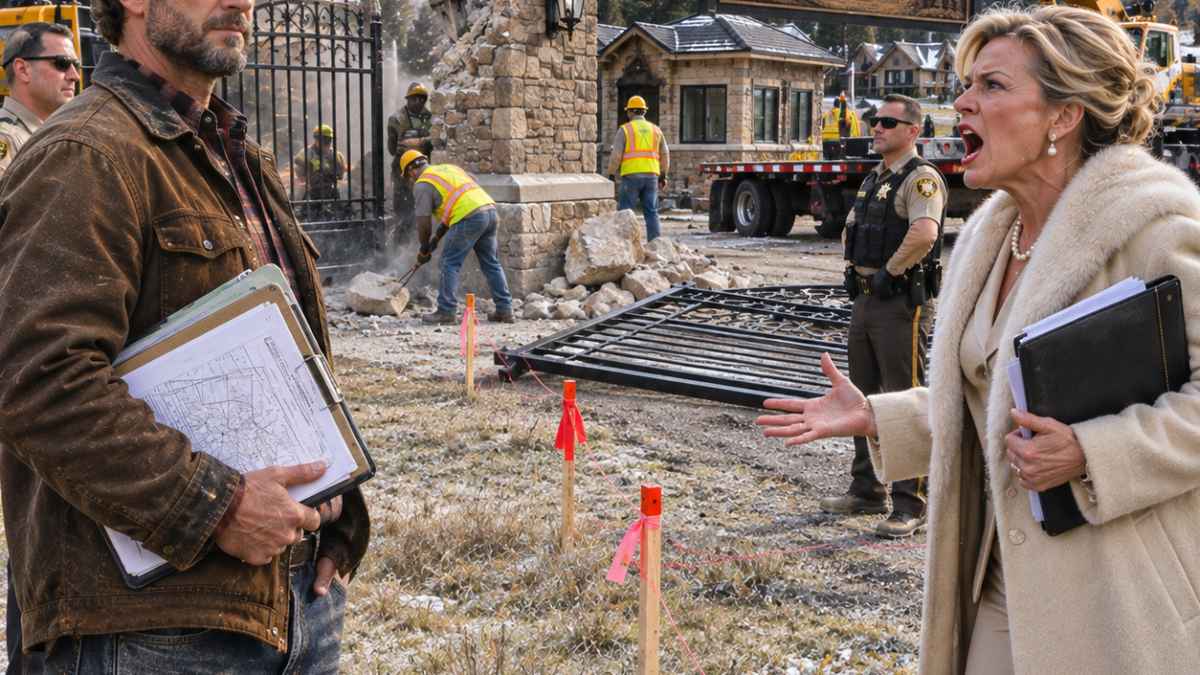
Three days later, the demolition notice went up.
COURT-ORDERED STRUCTURE REMOVAL.
Seven in the morning.
Frost.
Excavator.
Crane.
Work trucks.
Traffic-control crew.
Residents still had a lane through the easement.
Nobody was trapped.
Nobody lost access.
Technicians disconnected license-plate cameras.
Electrical feeds.
Access-control equipment.
Workers removed ornamental fencing.
Bronze plaques.
Then stone.
One section at a time.
Harlan stood beside me.
We were there only to verify boundary compliance.
No celebration.
No crowd cheering.
Just a construction crew undoing something another construction crew had done nearly a decade earlier.
Cars slowed.
Homeowners watched.
Some looked angry.
Some embarrassed.
Some just tired.
A black SUV pulled onto the shoulder.
Colette stepped out.
She was no longer president by then, though the formal transition had only recently occurred.
She walked toward the site supervisor.
“Stop this.”
He stared.
“Ma’am?”
“I said stop.”
“We’re under contract with the HOA to perform the court-ordered removal.”
“I approved this gate.”
“I understand.”
“You don’t touch another stone.”
He shook his head.
“Ma’am, you are not authorized to direct this project.”
She turned toward me.
“You couldn’t just let it stand?”
I looked at the crane lifting part of the guardhouse roof.
Then back at her.
“You couldn’t just leave my land alone?”
No answer.
The crane removed the bronze SILVERCREST RIDGE sign.
For ten years, it had appeared in real-estate brochures.
Property listings.
HOA newsletters.
Magazine advertisements.
Now it hung from straps over my property and swung toward a flatbed.
A few days later, homeowners completed Colette’s removal.
Celia headed the interim board.
First major action:
Withdraw every claim to my sixty-three acres.
Second:
Acknowledge Harlan’s survey.
Third:
Honor the existing twenty-four-foot easement exactly as recorded.
Fourth:
Continue independent financial review.
The Palisades issue did not disappear.
Audit showed approximately $450,000 had gone to a Colette-connected company without adequate support for the billed services.
Civil negotiations followed.
Eventually, Colette and the company agreed to repay $450,000 to the HOA to resolve the disputed unsupported payments.
That settlement was not a criminal conviction.
Separate questions surrounding the landowner consent and questionable signature were referred to the appropriate authorities for review.
I was satisfied with that distinction.
Courts determine what courts determine.
Investigators investigate.
A homeowner meeting is not a criminal tribunal.
What I cared about most had already been decided.
The boundary.
My ranch remained 3,200 acres.
Silvercrest remained 145 acres plus its lawful easement rights.
Nobody got extra land because they had more expensive landscaping.
The new board eventually built another entrance.
Smaller.
Still attractive.
Entirely on land Silvercrest actually owned.
The access road remained exactly where it had always been.
Residents drove through without asking my permission each morning.
They had an easement.
They did not need my permission.
That mattered too.
Winning a property dispute did not give me the right to erase their lawful rights.
I had spent months demanding they respect my deed.
I was going to respect theirs.
Celia met me near the new entrance after construction.
No giant pillars.
No oversized guardhouse.
Simple sign.
Security equipment mounted inside their boundary.
She looked toward the open road.
“Less dramatic.”
“Cheaper?”
“Much.”
“Good.”
She smiled.
Then:
“I suppose we should have checked whose ground the first one was standing on.”
I laughed.
“That usually helps before spending one and a half million dollars.”
She winced.
“Fair.”
I drove through.
Back onto Redford Ranch.
Open pasture.
Cattle moving near the lower lake.
Pines dark against the mountain.
Nothing looked different.
That was the strange part.
My ranch had not grown.
I had not won sixty-three acres.
I had not taken part of Silvercrest.
The legal description after the lawsuit was essentially the legal description before it.
The boundary had been there the entire time.
That is what people misunderstand about land disputes.
Sometimes victory does not mean moving a line.
It means proving somebody else had no right to move it.
Colette’s mistake was believing authority could substitute for title.
She had attorneys.
A board.
Ninety-one homeowners.
Private guards.
A polished map.
A building permit.
A million-dollar entrance.
She believed all of those things together outweighed my deed.
They did not.
She believed using a road meant owning the ground beneath it.
It did not.
She believed a structure standing for nearly ten years became legitimate merely because removing it would be expensive.
It did not.
She believed calling my deed fake would put me on the defensive.
For a few days, it did.
Then Harlan set the red stakes.
And those stakes changed the entire question.
Before:
Does Miles Redford own sixty-three acres the HOA wants?
After:
Why is the HOA’s $1.48 million main gate standing on Miles Redford’s ranch?
That second question opened everything.
The original easement.
Leonard Finch.
His refusal.
The 2015 email.
The unsigned consent request.
The questionable signature.
The construction drawings.
The boundary warning.
Colette’s acknowledgment.
The email telling the project team to proceed anyway.
Palisades Civic Design.
$450,000.
The audit.
The recall.
All because she came after sixty-three acres that were already mine.
That was the bitter irony.
If Colette had left Redford Ranch alone, I might never have ordered a new survey around the entrance.
Harlan might never have placed those red stakes.
Vivian might never have requested the gate’s construction records.
Dean might never have opened the 2016 folder.
Leonard’s old email might have remained in a drawer.
The Palisades payments might never have received a forensic review.
Colette’s own lawsuit pulled the thread.
She just did not understand what was attached to it.
The day the final restoration passed inspection, Harlan called.
“Everything’s clear.”
“Structures gone?”
“All encroachments removed.”
“Easement?”
“Open.”
“Boundary monuments?”
“Good.”
I drove there.
The massive entrance was gone.
Fresh soil.
Young shrubs.
Simple roadway.
The difference was almost shocking.
For years, those stone pillars had made the place look permanent.
Without them, all that remained was a road.
A lawful road.
On an easement.
Crossing private land.
Exactly what the original paperwork had always said.
I stood there a moment.
Then drove back toward the ranch house.
That evening, sunset stretched across all 3,200 acres.
Gold pasture.
Dark pine ridges.
Two lakes holding the last light.
I thought about the morning Colette first entered my office.
Her hand on my deed.
“This isn’t worth the paper it’s printed on.”
She had been so certain.
That certainty cost Silvercrest millions.
Cost her the presidency.
Exposed her own financial conflicts.
And ultimately forced the removal of the structure she had treated as the physical symbol of her power.
My deed did not change.
Not one line.
Not one monument.
Not one acre.
The only thing that moved was her gate.
Colette Ashberry challenged my 3,200-acre deed because she thought she could take sixty-three acres from a rancher who would be too afraid of litigation to fight back.
Instead, her lawsuit forced everyone to survey the land beneath the most expensive thing she had ever built.
And when the measurements were finished, she learned the truth no glossy HOA map could hide:
The pasture was mine.
The boundary was mine.
The dirt beneath her guardhouse was mine.
And in the end, the only property Colette ever successfully removed from Redford Ranch was her own $1.48 million gate.








