HOA Karen Called My 100-Year-Old Oak an “Eyesore” and Had It Cut Down at 3 A.M.—Then One Snapped Chain Exposed Her Entire Cover-Up
HOA Karen Called My 100-Year-Old Oak an “Eyesore” and Had It Cut Down at 3 A.M.—Then One Snapped Chain Exposed Her Entire Cover-Up
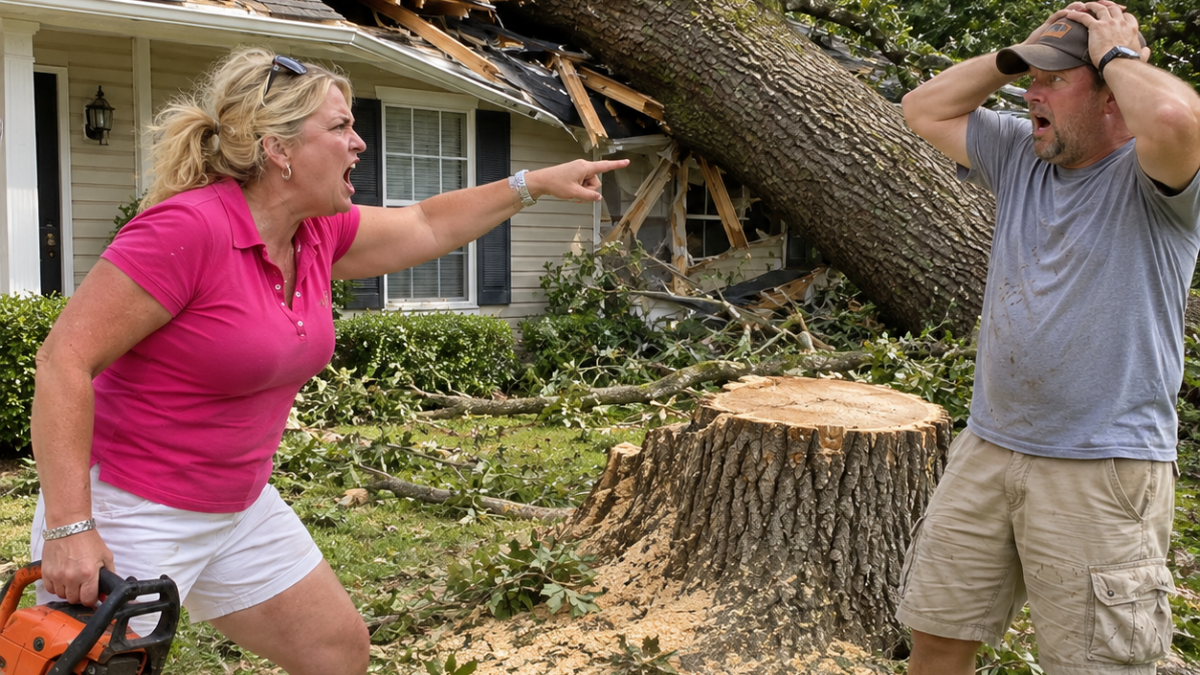
At three in the morning, HOA President Dana Whitlock sent a tree crew onto my property, turned my security camera toward the sky, and cut down the 100-year-old oak my grandfather had planted—then stood in my yard six hours later screaming that she had “fixed” the eyesore I was too selfish to remove.
She thought the worst consequence would be an angry homeowner, a replacement-tree bill, and another argument over HOA authority, until the overloaded flatbed carrying my oak’s massive trunk rolled downhill, one chain snapped, and the falling timber ripped open the landscaped entrance she had spent months hiding from county inspectors.
What lay beneath that crushed stone wall turned the destruction of one protected tree into something much larger: forged permits, diverted HOA money, an illegal drainage project, and proof that Dana had not cut down my oak because she hated how it looked—she cut it down because its roots and the survey marker beneath them could expose what she had done to the entire neighborhood.
“You selfish, arrogant piece of trash!”
Dana Whitlock was screaming so loudly that people were stepping onto their porches.
Some still wore pajamas.
One man across the street stood barefoot on his driveway holding a coffee mug.
Two teenagers were recording from an upstairs window.
A woman farther down the block had stopped walking her Labrador and simply stared.
Dana stood in the middle of my front yard wearing the same bright pink blazer she wore to every HOA meeting, one hand gripping a clipboard and the other stabbing toward the enormous stump where my family’s oak had stood less than six hours earlier.
Fresh sawdust covered the grass like dirty snow.
Branches were stacked along the curb.
Deep tire tracks cut across the yard.
A hydraulic stump grinder sat near the mailbox.
And the tree itself was gone.
Gone.
The oak had been there my entire life.
Long before the subdivision.
Long before the HOA.
Long before Dana Whitlock decided everything she could see belonged to her authority.
My grandfather, Elias Mercer, planted it in 1925.
He had been twenty-three.
The farmhouse that once stood on the property was gone, replaced decades later by the brick house my parents built, but the oak remained.
My father carved my initials into a low branch when I was nine.
My sister got married beneath it.
My mother hung Christmas lights from the lower limbs every December until climbing ladders became too difficult.
After both my parents died, the tree became the one thing on the property that still felt older than grief.
The county had designated it a heritage tree twelve years earlier.
Measured trunk diameter.
Canopy spread.
Estimated age.
Recorded GPS coordinates.
Protected status.
You could not remove it without an arborist report and county approval except in a documented emergency.
Dana knew that.
She hated it anyway.
“You’ve been a problem since I became HOA president,” she shouted.
I stood maybe fifteen feet away.
My name is Noah Mercer.
I was forty-eight that morning.
Civil engineer.
Divorced.
One daughter in college.
PART2:
I had spent twenty-four years solving problems that involved drainage, soil, roads, retaining walls, and structures.
I was not naturally calm.
My profession trained me to become calm when something went wrong.
That distinction mattered.
Dana pointed at me.
“You refuse to cooperate.”
I looked at the stump.
“You entered my property at three in the morning.”
“You embarrass this community.”
“You cut down a protected tree.”
“You hide behind county rules because you think you’re special.”
I looked toward my security camera mounted beneath the porch roof.
It was pointing almost straight upward.
Blue sky.
Nothing else.
Someone had physically rotated it before the cutting began.
I looked back at Dana.
“Who moved the camera?”
She smiled.
That smile told me more than denial would have.
“I fixed the problem you were too stubborn to fix yourself.”
Several neighbors went silent.
PART3:
Even people who agreed with Dana about the tree seemed uncomfortable hearing her admit it.
“You illegally destroyed protected property.”
“Oh, stop crying.”
She actually laughed.
“It was a tree.”
My hands tightened.
“Your precious tree was ruining the visual harmony of the subdivision.”
That phrase had appeared in three letters over the previous six months.
Visual harmony.
The oak’s canopy extended partly over the sidewalk and shaded two homes in the afternoon.
Leaves fell.
Acorns dropped.
Roots pushed one section of sidewalk less than an inch.
Normal tree things.
Dana called them nuisances.
I called the county.
A certified arborist inspected it.
Healthy.
No hazardous decay.
No structural instability.
The county rejected the HOA’s request for emergency removal.
Dana sent another letter.
I sent the county response.
She fined me.
I challenged the fine.
HOA counsel quietly withdrew it because my lot was subject to the neighborhood covenants but protected-tree authority remained with the county.
I thought the argument was over.
Then, at 3:07 that morning, chainsaws woke me.
By the time I understood what was happening and got downstairs, the tree crew had already taken the first major limb.
I called the sheriff.
Then county code enforcement.
Then ran outside.
A man in an orange helmet told me:
“Sir, we have a work order.”
“From who?”
He pointed toward the street.
Dana’s SUV was parked there.
I walked toward it.
She drove away.
The crew stopped when I told them the tree was protected.
Then their foreman made a phone call.
Someone told him they possessed an emergency-removal authorization.
He showed me a photograph on his phone.
County header.
Permit number.
My address.
**IMMEDIATE HAZARD REMOVAL AUTHORIZED.**
The signature at the bottom looked like County Arborist Michael Harrow’s.
I knew Michael.
Not personally well.
Professionally.
We had worked on two drainage reviews.
The signature looked convincing.
The crew resumed.
I called Michael’s office.
Voicemail.
It was three fifteen in the morning.
Then I called emergency dispatch again and told them contractors were actively removing a protected tree under a permit I believed might be false.
Deputies were coming.
Not fast enough.
A hundred-year-old oak falls much faster than government wakes up.
By 3:46, the main trunk came down.
The ground shook.
I felt it through my shoes.
The sound was nothing like lumber.
It was deeper.
A crack from inside the earth.
Then impact.
My daughter, Claire, later asked me what I felt.
Anger.
Obviously.
But the first emotion was disbelief.
You can know something is happening while part of your brain refuses to accept it.
There had always been an oak there.
Then suddenly there wasn’t.
The sky looked wrong.
Too open.
By six, the crew had sectioned the trunk.
A heavy-haul flatbed arrived around eight.
Dana returned around eight thirty.
By nine she was screaming at me.
That was when Sheriff’s Deputy Aaron Pike arrived.
Aaron was forty-one.
Broad shoulders.
Former Army MP.
He had answered noise complaints in the neighborhood before.
He walked across the lawn slowly.
Looked at the stump.
Camera.
Tire tracks.
Saw logs.
Then at Dana.
“Who authorized removal?”
Dana lifted her clipboard.
“The association acted under emergency authority.”
Aaron looked toward me.
“Mr. Mercer?”
“County denied removal last month.”
I handed him the letter.
He read it.
Then looked at Dana.
“You have a county permit?”
“Yes.”
“Can I see it?”
She handed him a copy.
Aaron studied it.
“Original?”
“Digital.”
“Who obtained it?”
“Our management office.”
“When?”
“Yesterday.”
Aaron looked toward the stump.
Then back.
“You did this without notifying the property owner?”
“He had been notified repeatedly that the tree posed a community hazard.”
“That wasn’t my question.”
Dana’s smile weakened.
Before she answered, the flatbed truck started.
The enormous lower trunk section lay on its trailer.
Maybe twenty-two feet long.
More than four feet across at the widest section.
I had already wondered whether the truck was overloaded.
The driver clearly wondered too.
He leaned out the window.
“Ma’am!”
Dana turned.
“I told you this thing isn’t secure.”
The driver pointed toward the chains.
“This load is heavier than what they told me.”
Dana marched toward him.
“Just move it.”
“I want another binder.”
“You’ve delayed enough.”
“Ma’am—”
“I paid your company to remove the tree.”
Aaron stepped into the street.
“Stop the truck.”
Dana spun.
“This has nothing to do with you.”
“It does now.”
She raised her voice toward the driver.
“Keep driving.”
The driver hesitated.
That was his mistake.
Maybe he thought moving ten feet would settle the argument.
Maybe Dana had been pressuring him all morning.
Maybe he simply wanted the truck out of a crowd.
He released the brake.
The flatbed rolled.
Our street sloped gently toward the landscaped entrance at the bottom of the block.
The trunk shifted.
One chain went taut.
Another.
Metal groaned.
Aaron suddenly grabbed my arm.
“Move!”
We jumped backward.
The chain snapped.
The sound was like a rifle shot.
Then everything happened at once.
The massive trunk rolled sideways.
The remaining binders tore loose.
The log dropped from the trailer.
Hit the pavement.
Bounced once.
Then rolled downhill.
People screamed.
The driver slammed the brakes.
Useless.
The trunk had momentum.
It rolled across the intersection.
Crushed a decorative stone planter.
Flattened two young maples.
Then slammed into the subdivision entrance wall.
Stone exploded.
The bronze **GREENBRIAR ESTATES** sign twisted backward.
Part of the wall collapsed.
And beneath it, something broke open.
Not landscaping.
Not irrigation.
A concrete structure.
Long.
Narrow.
Covered by decorative stone.
Water burst from one side.
Brown.
Fast.
Within seconds, it was running across the entrance road.
Aaron stared.
I did too.
Because I recognized what I was seeing.
A stormwater junction structure.
Except according to the county drainage plans, nothing should have been there.
Dana’s face changed.
Every bit of anger disappeared.
She looked scared.
Not because the oak trunk had destroyed her entrance.
Because it had uncovered something.
Aaron turned toward her.
“What is that?”
Dana recovered too slowly.
“Old drainage.”
I looked at her.
“No.”
She snapped toward me.
“You don’t know what you’re talking about.”
“I’m a civil engineer.”
“I know exactly what I’m looking at.”
I walked closer but stayed behind Aaron.
The broken stone veneer had hidden a rectangular concrete diversion box.
Two large pipes entered.
One exited.
The outlet headed toward the drainage easement behind my property.
I knew the approved system.
The subdivision was designed to discharge stormwater into a detention pond northwest of the entrance.
Not toward my side.
I crouched.
Fresh concrete.
Not old.
Maybe two years.
Three at most.
Then I saw a stamped inspection tag embedded near the access lid.
No county inspection sticker.
Private contractor only.
Aaron said:
“Everybody back.”
He radioed for fire and public works because water was eroding the road edge.
Dana stepped toward him.
“This is HOA infrastructure.”
“You said it was old.”
“It is.”
“Then why are you worried?”
She said nothing.
I looked uphill.
Toward my now-empty yard.
Toward the stump.
Something clicked.
For the previous two years, after heavy rain, the lower edge of my property had stayed wetter than it used to.
Not flooded.
Just saturated.
My backyard drainage swale began holding water an extra day.
The oak had shown stress on one root zone the previous summer.
County arborist Michael Harrow had noted unusual soil saturation but no disease.
I had blamed changing rainfall.
Maybe I was wrong.
“What does that line do?”
Aaron looked at me.
“I think it diverts subdivision stormwater toward the old agricultural ditch behind my property.”
Dana barked:
“That is ridiculous.”
I stood.
“The county map doesn’t show this.”
“Plans change.”
“Not without approval.”
“You don’t have current plans.”
“Yes, I do.”
Her face tightened.
I had requested them during the sidewalk dispute.
Drainage plans.
Utility layouts.
Landscape easements.
All public records.
The broken entrance was no longer just an accident scene.
Aaron knew it.
He called county public works.
Then code enforcement.
Then told everyone:
“Nobody touches this structure.”
Dana nearly shouted.
“We need to stop the water.”
Public works could stop it.
That wasn’t what she meant.
She wanted it covered.
Within forty-five minutes, the subdivision entrance looked like a government convention.
Sheriff’s vehicles.
Public works truck.
County engineer.
Code enforcement.
Tree contractor.
Insurance representative.
Residents lining both sidewalks.
The flatbed driver looked like he wanted to become invisible.
Then Michael Harrow arrived.
County arborist.
He walked directly toward me.
Looked at the stump.
His face hardened.
“Noah.”
“Did you issue an emergency removal permit?”
“No.”
I already knew.
Hearing it still changed something.
Dana interrupted.
“Our office received authorization.”
Michael looked at the paper.
Took maybe ten seconds.
“This isn’t ours.”
Dana laughed nervously.
“It has your signature.”
“No.”
He pointed.
“Our permit numbers don’t start with HTR.”
“This seal is outdated.”
“And I haven’t signed paper permits in four years.”
Aaron looked at Dana.
She stepped backward.
“Then the management company gave us bad paperwork.”
Michael turned toward the stump.
“Did you tell the contractor this was protected?”
I answered:
“Yes.”
Foreman stood near the curb.
His face had gone gray.
“He told us.”
Aaron looked at him.
“Why’d you continue?”
The foreman swallowed.
“Ms. Whitlock provided the emergency permit.”
“She said county had approved it.”
Michael said:
“County did not.”
The tree crew owner arrived shortly after.
He was furious.
Not at me.
At his own foreman.
At Dana.
At whoever verified the permit.
His company carried insurance, but illegally removing a protected heritage tree could expose them to damages far beyond ordinary tree value.
Meanwhile, county engineer Priya Shah examined the drainage box.
She called two technicians.
They opened a downstream access point.
Then another.
Priya walked toward me.
“How long has your rear drainage stayed wet?”
“Two years.”
“Maybe three.”
She looked toward the oak stump.
“Root decline?”
“Minor.”
“Did the arborist document it?”
Michael nodded.
“Localized saturation.”
Priya looked at Dana.
“When was this entrance rebuilt?”
Dana said:
“2019.”
A resident shouted:
“2022!”
Everyone turned.
Walter Briggs lived near the entrance.
Retired school principal.
He pointed toward the broken wall.
“That whole thing was redone three summers ago.”
Dana said:
“Cosmetic work.”
Walter shook his head.
“They had excavators here for a week.”
Priya looked at her technician.
“Check permit history.”
Dana’s phone came out.
She started calling somebody.
Aaron said:
“Don’t leave.”
“I wasn’t.”
“You’ve tried to direct contractors twice since I arrived.”
“I’m managing an emergency.”
“No.”
He looked at the exposed pipe.
“County is managing it now.”
That sentence hurt her more than any accusation.
By noon, the street was blocked.
Residents had to use the north exit.
The oak trunk remained where it had crashed into the entrance.
Nobody moved it until investigators documented everything.
I went home.
Or what looked like home without the tree.
The sun hit the front windows differently.
Too bright.
Claire called from college after seeing a neighbor’s video online.
“Dad.”
“I’m okay.”
“The tree?”
“Gone.”
Silence.
She had grown up beneath it too.
Her swing had hung from one branch.
My father built it.
Claire cried.
Then asked:
“Who did it?”
I looked through the window.
Dana stood across the street speaking with her lawyer.
“I think we’re about to find out.”
By that afternoon, Michael issued a formal notice documenting unauthorized removal of a heritage tree.
The county requested the permit source.
Dana blamed Greenbriar Management Services.
The management company denied issuing it.
Then blamed an outside consultant.
The consultant denied it.
Nobody wanted ownership of the fake permit.
That was my first lesson from the cover-up.
Authority is popular until consequences arrive.
The drainage issue became worse.
Priya found the diversion line had been installed during the 2022 entrance renovation.
No county approval.
No revised stormwater study.
No easement modification.
Instead of sending part of Greenbriar’s runoff toward the permitted detention basin, the system diverted it through a buried pipe toward the old drainage channel bordering my property.
Why?
Capacity.
The detention pond was undersized after the HOA added a clubhouse expansion and twenty-two new parking spaces.
Those improvements increased impervious area.
More pavement.
More runoff.
The county had required a detention upgrade before final approval.
The HOA never completed it.
Instead, somebody built a bypass.
That bypass sent excess water away from the HOA’s pond.
Toward me.
Dana claimed she knew nothing.
Then Walter Briggs produced photographs.
He was the kind of retired man who photographed neighborhood construction because he had time and opinions.
One picture showed Dana beside the open trench during installation.
Another showed her pointing toward the pipe.
Date-stamped.
August 2022.
Her “old drainage” story lasted four hours.
My attorney, Rachel Kim, arrived that evening.
Rachel was fifty.
Environmental and property law.
We had worked together professionally before.
She walked around the oak stump.
Measured.
Photographed.
Then sat at my kitchen table.
“What do you want?”
I stared.
“My tree back.”
She said nothing.
Wrong answer because impossible.
Eventually I said:
“I want to know why.”
“Good.”
“Then damages.”
“Good.”
“And I want whoever forged that permit to answer for it.”
“Good.”
She opened her notebook.
“Don’t speak publicly.”
“I know.”
“Don’t post.”
“I won’t.”
“Don’t threaten Dana.”
“I don’t need to.”
“What about neighbors?”
“They can say whatever they want.”
Rachel nodded.
“Then we start with evidence.”
Security camera first.
Who turned it?
The camera itself had recorded until somebody rotated it.
At 2:51 a.m., video showed headlights entering.
At 2:56, a man in a reflective vest approached.
At 2:57, image tilted upward.
But the camera was connected to my local network and motion system.
The front doorbell camera had a different angle.
Dana forgot that.
It captured part of the street.
At 2:49, her SUV arrived.
At 2:55, she exited.
At 2:58, she spoke with the tree foreman.
At 3:03, first chainsaw.
She stayed nineteen minutes.
Then left.
Not enough to prove she forged the permit.
More than enough to destroy her claim of ignorance.
The tree company’s work order gave us more.
Client:
**Greenbriar HOA**
Requested by:
**Dana Whitlock, President**
Scope:
**Emergency hazard removal**
Tree:
**Mature oak**
Permit supplied by client.
Scheduling note:
**Complete before 6:00 a.m. to avoid traffic disruption and resident interference.**
Rachel read that line twice.
“Resident interference.”
“Me.”
“Yes.”
The tree company owner, Marcus Vale, agreed to cooperate.
His business had made a serious mistake.
He knew it.
“We should have verified county approval ourselves.”
“Why didn’t you?”
“Dana said the county inspector wanted immediate removal before storms.”
“There was no storm.”
“She said wind damage.”
“Tree was healthy.”
“I know that now.”
Marcus rubbed his face.
“The crew saw a permit.”
Rachel asked:
“Who emailed it?”
Marcus gave us the address.
Directly Dana.
The file metadata later showed something even worse.
Created two days earlier on a computer registered to the HOA office.
Not county software.
The county referred the document to investigators.
Dana’s lawyer began speaking for her after that.
Then came the money.
Heritage tree damages are not the same as pricing firewood.
You cannot say:
Oak trunk worth three thousand dollars.
Case closed.
Replacement cost for a mature protected tree can become enormous because actual replacement is impossible.
Appraisers consider species.
Age.
Condition.
Location.
Canopy.
Historical designation.
Property impact.
Restoration.
Loss of use.
And statutes may multiply damages for intentional removal.
Rachel warned me not to fall in love with numbers early.
“Somebody online will tell you this is a million-dollar tree.”
“It’s not?”
“Maybe the total claim becomes large.”
“Maybe not.”
“We prove what we prove.”
County arborist Michael documented pre-removal health.
Photographs from the prior inspection helped.
That was crucial.
Dana could not credibly argue the tree was dying.
Then an independent consulting arborist, Dr. Henry Lowell, examined the stump.
Growth rings.
Root condition.
Decay.
Fungal evidence.
Structural defects.
His conclusion:
Healthy mature white oak.
No documented emergency hazard requiring immediate removal.
Estimated age:
Ninety-eight to one hundred six years.
The tree my grandfather called “the old oak” really was roughly a century old.
Henry also found something else.
Several large roots on the downhill side had died recently.
Not from age.
From prolonged saturation and oxygen deprivation.
The illegal drainage diversion had been sending excess water toward that root zone.
Rachel looked at me.
“Now the tree and drainage cases connect.”
That was when I first understood why Dana had become so desperate to remove it.
The oak had been healthy enough to survive.
But the saturated root zone was visible.
Michael had asked questions.
I had started asking why the soil stayed wet.
If the tree remained, another arborist might trace the stress to drainage.
Removing it eliminated a living indicator.
Or so Dana apparently thought.
She had cut down evidence and accidentally exposed more.
The irony would have been funny if I weren’t furious.
Greenbriar’s emergency board meeting happened three days later.
Dana still technically held office.
Residents packed the clubhouse.
I did not attend initially.
Rachel went.
So did Walter.
So did county observers.
Dana opened by saying the neighborhood was facing “coordinated harassment from an adjacent homeowner.”
That was me.
Then residents began asking questions.
Why was the tree removed at 3 a.m.?
Why was the permit fake?
Why had the HOA paid for private contractors on my property?
Why did the entrance conceal unpermitted drainage?
Why had stormwater fees increased the year after the bypass was installed?
Dana answered with phrases.
Legal review.
Legacy infrastructure.
Emergency discretion.
Pending investigation.
Miscommunication.
Then HOA treasurer Melanie Cross stood.
“I did not approve the tree removal expenditure.”
The room changed.
Dana looked at her.
“Emergency expenditures don’t require prior approval.”
Melanie held up the bylaws.
“Above fifteen thousand dollars they do.”
“How much?”
Someone asked.
Melanie answered.
“Tree removal, haul-off, and stump work were contracted at $27,400.”
People murmured.
I had not even known the number.
Then Melanie continued.
“That’s not the only issue.”
She placed financial statements on the projector.
The 2022 entrance renovation had cost $186,000.
Board approval had been for $112,000.
Additional payments went through a vendor called:
**Whitlock Community Solutions.**
The room exploded.
Dana shouted:
“That entity provided project-management services.”
Walter Briggs yelled:
“Whitlock?”
Melanie looked at the business registration.
Owner:
**Eric Whitlock.**
Dana’s brother.
Conflict of interest.
Undisclosed.
Rachel called me from the hallway.
“This just got bigger.”
I drove over.
When I entered, people turned.
Dana saw me.
Her face changed.
For months she had treated me like the neighborhood problem.
Now half the neighborhood was looking at her.
She pointed.
“This man has been trying to destroy Greenbriar since the drainage dispute began.”
I stared.
“What drainage dispute?”
That silenced the room.
There had been no public drainage dispute before the oak fell.
Dana had just admitted she knew there was one.
Rachel whispered:
“Don’t say anything else.”
I didn’t.
Dana’s lawyer stood and ended the meeting.
Too late.
Melanie had preserved records.
Residents demanded an independent audit.
Three board members called for Dana’s temporary suspension.
Vote passed.
She lost authority pending investigation.
That night somebody drove past my house slowly.
Twice.
I wrote down the plate.
Not Dana.
Security patrol hired by a group of residents later confirmed it belonged to Eric Whitlock.
Rachel notified the sheriff.
No confrontation.
No drama.
Just documentation.
The audit found what the fallen oak had uncovered accidentally.
During the clubhouse expansion, county engineers told Greenbriar it needed approximately $140,000 in additional detention work.
Dana opposed the expense.
Emails showed her calling the requirement “bureaucratic extortion.”
Then Eric’s company proposed a cheaper alternative.
Bypass excess stormwater through an existing drainage corridor.
Problem:
The corridor did not legally serve the additional runoff.
Part crossed easement boundaries.
County approval was unlikely without engineering review and consent from affected property owners.
Including me.
So they did not ask.
They installed it under landscaping work.
Stone entrance walls concealed the main diversion structure.
Payments were split among separate invoices.
Drainage.
Landscaping.
Masonry.
Project management.
No single invoice looked like an illegal bypass.
The total amount paid to Eric’s company and related subcontractors exceeded $74,000.
Still cheaper than the proper detention upgrade.
Until you included everything that happened afterward.
The illegal line saturated part of my property.
Damaged oak roots.
Increased erosion in my rear swale.
Avoided county oversight.
Then, when my heritage-tree dispute threatened to bring inspectors close to the area, Dana escalated.
Emails recovered during discovery showed the sequence.
One from Dana to Eric:
**Mercer keeps using the county tree designation to drag inspectors onto that side.**
Eric replied:
**Then get rid of the tree issue before someone starts looking at drainage.**
Dana:
**County won’t approve removal.**
Eric:
**You don’t need another six-month fight. Treat it as hazard work.**
That message sat on my attorney’s conference table for nearly a minute before anyone spoke.
Rachel finally said:
“There it is.”
Not direct words:
Forge a permit.
Cut it illegally.
But motive.
Awareness.
Intent to bypass process.
Then investigators found a draft permit file on the HOA office computer.
County logo copied.
Michael Harrow’s signature image taken from an old public inspection report.
The metadata contained Dana’s HOA login.
She later claimed staff had access.
Possible.
Then a printer log showed the file printed from her office workstation at 6:14 p.m. two days before the removal.
The criminal investigation belonged to prosecutors.
My civil case had different goals.
Property damage.
Trespass.
Tree loss.
Drainage damage.
Restoration.
Attorney fees where permitted.
Potential statutory enhancement for intentional destruction.
The HOA’s insurer took one position:
Dana acted outside authorized duties.
Dana’s personal insurer took another:
Intentional acts excluded.
Greenbriar’s board argued the association itself had been victimized by Dana’s misconduct.
The tree company admitted negligence in failing to independently verify the permit.
Everybody had lawyers.
Everyone blamed someone else.
That is what happens when one person makes a bad decision on behalf of multiple organizations.
Responsibility spreads.
Documents become important.
I focused on restoring the property.
The stump remained temporarily because experts needed it.
That hurt.
Every morning I looked through the front window and saw absence.
My daughter came home the following weekend.
Claire walked into the yard.
Stopped.
She touched the stump.
Then sat on it.
We stayed there without speaking.
Finally she said:
“Grandpa would’ve lost his mind.”
“My father?”
“Both.”
She smiled through tears.
Then:
“Are you going to plant another one?”
I looked toward the open sky.
“I don’t know.”
She said:
“You should.”
“Won’t be the same.”
“I know.”
That answer mattered.
Replacement does not mean equivalence.
People sometimes avoid rebuilding because the new thing cannot be the old thing.
Of course it can’t.
That does not mean you leave the ground empty forever.
We planted a young white oak that fall.
Not on the exact stump location.
Twenty feet east.
County arborist helped select the site.
Proper drainage.
Enough room.
Claire dug part of the hole.
I did most of it because she claimed college had “ruined her back,” which I found insulting.
At the base, we placed a small brass marker.
**ELIAS OAK II**
Then Claire changed her mind.
“No.”
“What?”
“Don’t call it number two.”
“Why?”
“It’s its own tree.”
She was right.
We replaced the marker.
**MERCER OAK — PLANTED 2025**
Nothing else.
The original oak deserved memory.
The new one deserved its own life.
Meanwhile, Greenbriar had to fix the drainage.
County ordered the illegal bypass shut down.
Emergency engineering review.
Temporary stormwater controls.
Then proper detention improvements.
Cost:
Far more than the work Dana had tried to avoid.
Residents were furious.
Not because inspectors enforced safety.
Because they realized saving money illegally had created a larger bill.
At a community meeting, one homeowner shouted:
“We’re paying twice because Dana didn’t want to pay once.”
That became the unofficial summary.
The HOA sued Eric’s company.
Insurers negotiated.
Dana and Eric faced separate investigations.
The flatbed accident also generated claims because the entrance damage, truck damage, and public-road hazard were connected to the rushed removal operation.
The driver, Calvin Reese, gave a statement.
He had warned Dana the load required additional securing.
Twice.
She told him to move it because residents were gathering and she wanted the tree gone before county staff arrived.
Calvin’s company disciplined him for moving anyway.
He accepted responsibility.
“I should’ve refused.”
He told me that directly months later.
“Yes.”
I answered.
“I know.”
He looked surprised.
I continued:
“But you weren’t the only person making bad decisions.”
He nodded.
That was enough.
The civil mediation happened eleven months after the tree fell.
Not one dramatic courtroom.
A conference center.
Coffee.
Separate rooms.
Lawyers walking back and forth.
Numbers changing on yellow pads.
Arborist valuation.
Property restoration.
Drainage repairs.
Trespass.
Survey costs.
Loss of heritage value.
Attorney fees.
The tree company contributed through insurance.
The HOA contributed under negotiated coverage.
Dana faced personal exposure on intentional conduct.
I will not pretend settlement felt satisfying.
No number replaces a century.
Money is a tool.
Not resurrection.
Rachel reminded me:
“The goal is compensation and correction.”
I knew.
Still hated it.
We reached agreement.
Confidential portions remained confidential.
But several things became public through county orders and HOA records.
My legal costs were covered.
Property restoration covered.
Drainage damage addressed.
The tree loss compensated at a substantial professional valuation with statutory components recognized under applicable claims.
Greenbriar formally acknowledged I had never authorized removal.
The HOA recorded that statement in its minutes and mailed it to residents.
That last part mattered to me more than I expected.
Because for months Dana had framed me as selfish.
The man refusing neighborhood improvement.
The owner of the “eyesore.”
Now the record said:
**The Mercer oak was removed without the property owner’s consent and without a valid county removal authorization.**
Plain.
Boring.
True.
Dana was removed permanently as HOA president.
Vote:
Seventy-eight to four.
One of the four was apparently Dana.
Another was Eric, who technically owned a home in the development.
Nobody knew the other two.
Melanie Cross became interim president.
Her first rule:
No HOA president could unilaterally authorize contractor work above $2,500.
Second:
All conflict-of-interest relationships disclosed.
Third:
County permits verified directly by management before work.
Fourth:
Infrastructure plans retained centrally.
Fifth:
No overnight contractor work on private property without documented emergency agency authorization.
Residents joked that they had created the “No More 3 A.M. Trees” policy.
Melanie hated the name.
It stuck.
The county prosecution took longer.
Forged government document.
Criminal mischief.
Trespass-related issues.
Financial conduct.
I attended only when subpoenaed.
Dana eventually accepted a plea resolving multiple counts.
Eric resolved his own charges and civil exposure separately.
No Hollywood ending.
No judge screaming.
No Dana dragged away while neighbors applauded.
Consequences were slower.
Legal fees.
Restitution.
Probation terms.
Restrictions.
Loss of position.
Business damage.
A public record she could not rewrite with a clipboard.
Some people online wanted more.
Others thought too much.
I stopped caring.
The law had its job.
I had mine.
Mine was rebuilding the yard.
Two years after the oak fell, the new tree was twelve feet tall.
Thin trunk.
Small canopy.
Nothing like the old oak.
Yet.
Claire came home for Thanksgiving.
We stood beside it.
“You think you’ll see it get big?”
She asked.
“Probably not that big.”
“Morbid.”
“Math.”
She touched the bark.
“Then maybe my kids will.”
I smiled.
“Planning something?”
“No.”
“Good.”
She rolled her eyes.
The old stump remained for almost eighteen months before we removed most of it.
I kept one section.
A cross-section from the main trunk.
Henry Lowell helped preserve it.
Growth rings visible.
Close together during droughts.
Wide during wet years.
A burn scar from a small fire in the 1940s.
An old nail swallowed by wood decades earlier.
A dark mark from lightning damage my father remembered.
One hundred years written in circles.
I mounted the section inside my garage.
Not as a memorial people had to admire.
For me.
Each ring represented a year the tree stood through something.
Great Depression.
War.
Storms.
Children.
Houses built.
People born.
People buried.
The tree survived all of that.
Then one woman with a fake permit ended it in forty minutes.
That thought used to make me furious.
Eventually another thought replaced it.
Dana could end the tree.
She could not erase the century.
The shade happened.
The weddings happened.
My daughter’s swing happened.
My grandfather planted it.
My mother hung lights from it.
No chainsaw changed those facts.
That was something I learned slowly.
Destruction is real.
So is everything that existed before it.
The entrance disaster changed Greenbriar too.
The stone wall was rebuilt.
But not the same way.
Drainage access remained visible.
Inspection ports accessible.
No decorative structure hiding utility components.
County-approved plans.
The bronze sign returned.
Smaller.
Melanie joked that nobody wanted anything large enough to stop another oak trunk.
Stormwater flowed into the upgraded detention system.
My backyard dried.
The saturated area recovered.
Grass returned.
The drainage swale stopped carrying orange sediment after storms.
The new oak grew well.
Michael Harrow checked it every year for the first three.
Not because required.
Because he felt guilty.
One afternoon he admitted:
“I should’ve known Dana might try something.”
“How?”
“She fought me hard after I denied the permit.”
“People argue with inspectors.”
“Yes.”
“You can’t predict criminal stupidity.”
He smiled.
“That’s one way to phrase it.”
I never blamed him.
The county system had worked.
They denied removal.
Dana bypassed it.
Systems cannot prevent every person from lying.
They can leave records that expose lies afterward.
That distinction mattered.
The biggest surprise came from the neighbors.
During the original fight, many had supported Dana.
They hated leaves.
Acorns.
Shade.
One man said the tree made the street look “rural.”
We lived in a neighborhood built on former farmland.
I found that complaint impressive.
Afterward, some apologized.
Not everyone.
That was okay.
Walter Briggs became a friend.
He stopped by with coffee.
We reviewed old construction photos.
He eventually admitted he had always thought Dana was “too damn pleased with herself.”
I told him hindsight was free.
He agreed.
One neighbor, Patricia Vaughn, brought me a photograph.
Taken in 1998.
Neighborhood construction behind my property.
The oak in the foreground.
My father standing near it.
I had never seen the picture.
“Why do you have this?”
“My husband took it.”
“He liked the tree.”
She looked embarrassed.
“I voted for Dana twice.”
“That doesn’t mean you cut it.”
“No.”
“But I defended her.”
She handed me the photograph.
“I’m sorry.”
I kept it.
Years passed.
Dana moved out of Greenbriar.
No farewell.
House sold.
Eric disappeared from local contracting circles.
The HOA became boring.
People complain about boring boards until they experience exciting ones.
Melanie served three years.
Then refused another term.
Walter joked that competent leadership had cured everyone of wanting the job.
The young oak kept growing.
Five years after the incident, Claire got married.
Not beneath the new oak.
Too small.
She chose a park.
After the ceremony, she asked the photographer to stop at my house.
She stood beside the young tree in her wedding dress.
Same family.
Different oak.
When I saw the photograph later, I had to sit down.
Not because it recreated my sister’s wedding beneath the old tree.
It didn’t.
That was the point.
History did not repeat.
It continued.
Claire framed one copy for me.
On the back she wrote:
**Different tree. Same home.**
I put it beside the photograph Patricia gave me.
Old oak.
Young oak.
Past.
Future.
One night years later, a storm came through.
Hard wind.
Thunder.
I woke around two.
For a moment, I was back at 3:07 a.m.
Chainsaw sound in memory.
I went downstairs.
Stood at the front window.
The young oak bent in the wind.
Branches whipping.
Alive.
I almost went outside like an idiot.
Then lightning flashed.
I stayed inside.
By morning, one small limb had broken.
Nothing serious.
I cut it cleanly.
Sealed nothing because modern arboriculture does not recommend wound paint, despite what my father believed.
Michael would have been proud.
I stood there with the saw.
Then laughed.
A tree losing a branch normally.
What a luxury.
No HOA.
No forged permit.
No flatbed.
Just weather.
Ordinary damage.
Ordinary repair.
That became the real ending for me.
Not Dana losing office.
Not legal settlement.
Not investigators.
Not even the moment the chain snapped.
People always focus on that.
The giant trunk rolling downhill.
Wall exploding.
Illegal drain exposed.
Cinematic.
Yes.
But my favorite moment happened years later.
Saturday morning.
Sunlight.
I was pruning one dead twig from the young oak.
My granddaughter, Lily—Claire did eventually make me a grandfather despite my excellent advice—stood beside me.
Six years old.
She pointed toward the preserved trunk slice inside the garage.
“Was that the old tree?”
“Yes.”
“Was it really one hundred?”
“About.”
“Who cut it?”
“A person who wasn’t supposed to.”
“Why?”
“Long story.”
“Did she go to jail?”
Children want clean justice.
I smiled.
“She got in a lot of trouble.”
“Good.”
Then Lily pointed to the young oak.
“Is this one protected?”
“Not yet.”
“Can we protect it?”
I crouched.
“How?”
She thought.
Then wrapped both arms around the thin trunk.
Like that would do it.
I laughed.
“Perfect.”
She looked serious.
“Nobody can cut it now.”
I did not explain property law.
She had time.
Instead I stood beside her.
Hand on the bark.
For years, I had thought protecting the old oak meant keeping it standing.
I failed at that.
Or more accurately, somebody took that choice away before I could stop them.
But protection can mean other things afterward.
Preserve evidence.
Demand accountability.
Fix what caused the damage.
Plant again.
Tell the truth.
Refuse to let the person who destroyed something define its value.
Dana called my oak an eyesore.
She said it ruined visual harmony.
She believed the tree was the problem because it stood where her drainage shortcut could be discovered.
So she removed it.
At three in the morning.
With a forged permit.
Then tried to haul the evidence away before anyone could ask questions.
And almost succeeded.
Until one chain snapped.
That chain did more than drop a log.
It broke open the entrance wall.
Exposed the illegal bypass.
Connected the dead roots to the drainage.
Connected the drainage to Eric.
Connected Eric to HOA money.
Connected Dana to the work.
Connected the fake tree permit to the cover-up.
One failure pulled another into daylight.
People called it karma.
I don’t.
Chains fail when loads are poorly secured.
Concrete breaks when hit by several tons of oak.
Documents reveal facts when investigators compare them.
There is nothing mystical about consequences.
Sometimes people simply build their own disaster by stacking bad decisions until physics, paperwork, or both refuse to cooperate.
Dana’s first mistake was believing the tree belonged to her because she disliked it.
Her second was believing HOA authority extended wherever she wanted.
Her third was forging a permit.
Her fourth was ordering the work at three in the morning.
Her fifth was pressuring a driver to move an unsafe load.
Her sixth was assuming the stone wall beneath it would stay intact.
And her biggest mistake was believing that destroying the visible evidence would destroy the truth underneath.
It didn’t.
The truth was buried in concrete.
Emails.
Bank records.
County plans.
Root damage.
Camera footage.
A tree stump.
And a snapped chain lying in the street.
Years later, I still have that first certified county letter denying removal.
I keep it with the photographs.
Not because I expect another Dana.
Because the letter reminds me I had been right before anyone believed me.
That matters.
Sometimes a person with a title can make you feel unreasonable simply because they speak louder and have more people around them.
Dana had an HOA.
Lawyer.
Management company.
Contractors.
Clipboard.
Neighborhood emails.
I had one thing.
A healthy tree on my property and a county record saying it was protected.
For months, that looked smaller than her authority.
It wasn’t.
Truth often looks small before somebody measures the damage.
The new oak is nearly thirty feet tall now.
Still young.
Its canopy finally shades part of the front walk.
Every autumn, it drops leaves.
A lot.
Acorns too.
One neighbor complained jokingly.
I handed him a rake.
He never mentioned it again.
The tree is not my grandfather’s oak.
I no longer want it to be.
It belongs to another generation.
Different scars.
Different storms.
Maybe one day Claire’s children will sit beneath it.
Maybe not.
Trees do not owe families symbolism.
They grow if conditions allow.
That is enough.
But whenever I look at it, I remember that morning.
Pink blazer.
Fresh sawdust.
Dana screaming:
“You think your ugly tree is more important than this entire neighborhood?”
At the time, I wanted to answer yes.
Out of anger.
Now I would answer differently.
No.
One tree was not more important than an entire neighborhood.
That was exactly why Dana’s decision was so dangerous.
She risked residents’ property.
Stormwater safety.
Association finances.
Contractors.
Public roads.
And eventually people standing near an overloaded truck.
All because protecting her position mattered more than admitting she had made an illegal drainage decision.
The oak was never the threat to Greenbriar.
Her need to control the story was.
The tree simply stood in the wrong place long enough to reveal it.
And when she finally cut it down, even that could not save her.
Because a hundred-year-old oak leaves a very large stump.
And an even larger trail when somebody tries to make it disappear.








