HOA Karen Called 911 While I Moved Into My Lake House—Then the Deputy Learned I Owned Every Road, the Gate, and the Clubhouse
PART2:
And a collection of infrastructure parcels that Belmont said it would eventually purchase once the subdivision plan was finalized.
The main entrance road.
Sections of the lakeside road.
Gate parcel.
Clubhouse site.
Lakefront access strip.
Granddad never transferred those last pieces.
For years I assumed it was paperwork nobody had finished.
He knew better.
When I asked him once why he refused to simplify the ownership, he laughed.
“Because developers simplify everything after they get what they need.”
I was twenty-two.
I rolled my eyes.
He pointed at me.
“Someday somebody will tell you a gate means they own the road.”
“What does that even mean?”
“You’ll know when it happens.”
Twenty-four years later, Lorraine Whitfield called 911 while standing on that exact road.
I arrived at Pinewood Estates at 10:34 on a Thursday morning.
The place looked expensive.
That was my first impression.
Not beautiful.
Expensive.
Every lawn cut to the same height.
Stone mailboxes.
Black SUVs.
PART3:
Cedar-sided houses with matching exterior lights.
Decorative pines trimmed carefully enough that they looked nervous.
The lake itself was still beautiful.
Some things resisted committees.
My grandfather’s cabin sat at the end of the northern road.
Small.
Two bedrooms.
Log exterior darkened with age.
Stone chimney.
Wide porch.
Dock reaching into the lake.
Compared with the houses around it, it looked like somebody had forgotten to replace it.
That was fine with me.
I parked.
Opened the trailer.
Loaded the first hand truck.
Two boxes marked KITCHEN.
One marked BOOKS.
I had just reached the porch steps when I heard heels.
Fast.
Hard.
Not walking.
Approaching with authority.
“Excuse me!”
I turned.
Red blazer.
White slacks.
Large sunglasses.
Phone in one hand.
Leather binder in the other.
She stopped six feet away.
“Who authorized you to enter?”
I looked behind me.
No one.
“Me?”
“Yes.”
“Authorized me to enter what?”
“Pinewood Estates.”
I set the hand truck upright.
“I drove through the gate.”
“That isn’t an answer.”
“I used the road.”
“Again, not an answer.”
She removed her sunglasses.
“Lorraine Whitfield.”
“HOA president.”
She waited.
Apparently I was supposed to react.
“Wyatt Callaway.”
Her expression changed slightly.
Not recognition.
Calculation.
“Are you a contractor?”
“No.”
“Delivery?”
“No.”
“Then why are you unloading belongings?”
“Moving.”
Lorraine stared at me.
“Into what?”
I pointed toward the cabin.
“That.”
She actually laughed.
Not long.
Just enough to be insulting.
“No.”
I looked at the cabin.
Then her.
“Pretty sure.”
“That home is not available for occupancy.”
“It is.”
“All move-ins require thirty days’ written notice.”
“Okay.”
“An HOA approval packet.”
“Interesting.”
“Vehicle registration.”
“All right.”
“Architectural acknowledgment.”
I looked at my boxes.
“They’re mostly dishes.”
“And a $2,500 community transition fee.”
That one made me smile.
“Community transition fee?”
“Yes.”
“For moving into my own house?”
“Every resident pays it.”
“I’m not every resident.”
Lorraine’s face tightened.
“Do you have an approval packet?”
“No, ma’am.”
“Have you received board authorization?”
“Not from your board.”
“Then you cannot move in.”
I looked at the cabin again.
“I’m probably still going to.”
That was apparently the wrong answer.
Lorraine pulled out her phone.
“I’m giving you one opportunity to leave peacefully.”
I almost laughed.
The phrase was too theatrical.
Instead I folded my arms.
“I’m staying.”
She stepped back.
Dialed.
“Yes.”
Her voice changed instantly.
Crisper.
Victimized.
“911?”
“I’m the HOA president at Pinewood Estates.”
“We have a trespasser.”
She looked directly at me.
“He’s entering a residence without permission.”
I could have stopped her.
The deed was in my jacket.
Recorded.
Stamped.
Clean.
I could have handed it over before she finished the first sentence.
But I remembered Granddad.
Someday somebody will tell you a gate means they own the road.
So I let Lorraine finish.
She gave the address.
Described my truck.
Described me.
Then added:
“He may be attempting to establish unlawful residency.”
That was impressive.
When she hung up, I said:
“Feel better?”
“You’re about to be removed.”
“Maybe.”
“I don’t think you understand how this community works.”
“I’m beginning to.”
She smiled.
“You’ll learn.”
Neighbors started appearing.
That happens when police are called in places where nothing interesting usually happens.
Curtains moved.
Garage doors opened.
People drifted toward lawns pretending to collect mail.
Two phones came out.
Across the street, an older man in a red flannel shirt leaned against his porch railing.
White beard.
Coffee mug.
No phone.
He watched me.
Then gave a small nod.
I nodded back.
Lorraine noticed.
“Hank!”
The old man took a sip.
“Yes?”
“Please stay out of this.”
Hank looked at her.
“Was planning to.”
Lorraine faced me again.
“Hank Doyle has lived here eighteen years.”
I looked toward Hank.
“Congratulations.”
Hank almost choked on his coffee.
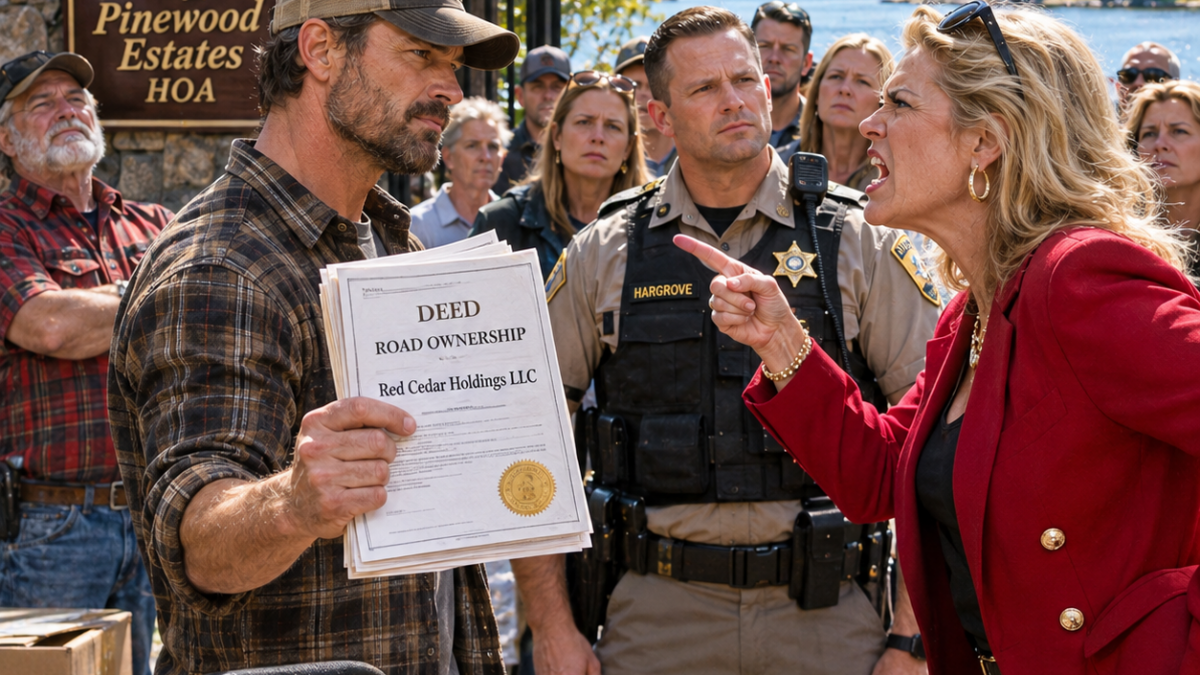
Seven minutes later, a county cruiser came through the gate.
Deputy Tom Hargrove.
Mid-fifties.
Calm face.
He parked behind my truck.
Lorraine reached the cruiser before he got out.
“That man is trespassing.”
Hargrove closed the door.
“Morning, Lorraine.”
“He is refusing to leave.”
“Okay.”
“He has no HOA authorization.”
“Okay.”
“He may have broken into that cabin.”
The deputy looked toward me.
I raised one hand.
“Morning.”
Hargrove walked over.
“Sir, name?”
“Wyatt Callaway.”
“Identification?”
I handed him my license.
“Do you live here?”
“As of today.”
Lorraine interrupted.
“No, he does not.”
Hargrove looked at her.
Then back to me.
“Do you own the property?”
“Yes.”
“Proof?”
I reached into my jacket.
The envelope.
Finally.
Inside:
Certified deed.
Lot One.
Original Callaway cabin parcel.
Recorded three weeks earlier after I transferred title from the family trust into my name.
Hargrove read it once.
Then again.
Looked at the cabin number.
Compared the legal description.
“Lorraine.”
She stepped forward.
“Yes?”
“This appears to show Mr. Callaway as the owner.”
She laughed too loudly.
“That’s obviously forged.”
Hargrove looked back at the raised county recording stamp.
“Doesn’t look obviously forged to me.”
“He’s a con man.”
I said:
“Red Cedar Holdings.”
Lorraine stopped.
Not dramatically.
Her entire body simply lost movement.
The reaction lasted maybe one second.
But Hargrove saw it.
So did Hank.
I saw Lorraine recover.
“It doesn’t matter who owns the house.”
“It might.”
Hargrove said.
“The covenants apply.”
She continued.
“Every residence in Pinewood Estates is governed by the association.”
I looked at her.
“Can you show Deputy Hargrove where HOA covenants are recorded against my parcel?”
Silence.
Her mouth opened.
Closed.
“The community declaration—”
“My parcel existed before the declaration.”
“That doesn’t exempt you.”
“If it was legally annexed, show the recording.”
Lorraine turned toward the deputy.
“This is exactly what people like him do.”
“People like me?”
“Use technicalities to undermine communities.”
I smiled.
“Deeds are a pretty serious technicality.”
Someone laughed from a porch.
Lorraine spun toward the sound.
Nobody admitted it.
Hargrove handed back my deed.
“Mr. Callaway appears to have lawful possession of the residence.”
Lorraine’s face reddened.
“This isn’t over.”
“No.”
I said.
“It isn’t.”
Then I pointed toward the pavement.
“Deputy, can I ask you something?”
“Sure.”
“Who owns the road you drove in on?”
Lorraine moved between us.
“Stop.”
Hargrove looked at her.
That reaction interested him.
I continued.
“Just think about the road.”
Lorraine’s voice rose.
“He is wasting county resources.”
Hank stepped off his porch.
Slowly.
He crossed the street.
“Actually.”
Lorraine closed her eyes.
“Hank.”
He ignored her.
“Deputy, you might want to hear this.”
Lorraine pointed.
“You are not part of this.”
Hank looked at her.
“You fined me four hundred dollars for flying my wife’s memorial flag.”
The crowd went quiet.
Lorraine snapped:
“That violation was resolved.”
“My wife died.”
Hank said.
“The flag stayed up six days.”
“It violated color standards.”
Hargrove rubbed his forehead.
I liked Hank immediately.
A silver sedan entered the road.
Lorraine saw it.
Her face changed again.
Nora Feldman parked beside the cruiser.
My attorney.
Forty-four.
Dark suit.
No wasted movement.
She opened her back door.
A gray-haired man climbed out carrying a thick title folder.
Gary Lindquist.
County title examiner.
Lorraine whispered:
“No.”
Nora heard.
“Yes.”
She walked toward us.
“Wyatt.”
“Nora.”
“Deputy.”
“Hargrove.”
Gary looked like he would rather be anywhere else.
Nora placed her briefcase on the hood of my truck.
“Mrs. Whitfield.”
Lorraine said nothing.
Nora looked at Hargrove.
“Deputy, since law enforcement has been called and property ownership has now become relevant, Mr. Callaway asked me to bring certified title information.”
Lorraine snapped:
“This is not a courtroom.”
“No.”
Nora agreed.
“That usually makes things faster.”
Gary opened the title report.
He adjusted his glasses.
“Red Cedar Holdings LLC.”
He read.
“Current recorded owner of Master Parcel 7A.”
Lorraine said:
“That’s developer land.”
Gary continued.
“Master Parcel 7A includes Pinewood Drive from the county-road junction through the original subdivision terminus.”
Whispers.
“Access Gate Parcel B.”
More whispers.
“Clubhouse Parcel C.”
Someone behind Lorraine said:
“What?”
Gary kept reading.
“Lakefront Common Strip One.”
“Boat-launch parcel.”
“Maintenance easement corridor.”
“The association itself is not shown as fee owner of these parcels.”
Silence.
Pure silence.
I looked down Pinewood Drive.
All those manicured homes.
Cars.
Decorative lamps.
The blacktop beneath them.
My blacktop.
Technically Red Cedar Holdings’ blacktop.
And Red Cedar Holdings belonged to me.
Lorraine shook her head.
“No.”
Gary looked uncomfortable.
“I’m sorry, ma’am.”
“That’s incorrect.”
“It is the county record.”
“The HOA owns the common property.”
Gary shook his head.
“Not by deed.”
“We have managed it for twenty years.”
“That may establish obligations.”
Nora said.
“It does not automatically establish fee ownership.”
The treasurer had arrived by then.
Philip Marsh.
Thin.
Early sixties.
Polo shirt.
He stood near the back.
When Gary said Red Cedar Holdings, Philip went pale.
I noticed.
Nora noticed too.
I turned toward the crowd.
“I’m not here to take anyone’s house.”
People relaxed slightly.
“I’m not locking the gate.”
More.
“I’m not stopping anyone from reaching their property.”
Lorraine said:
“You can’t.”
“I know.”
I looked at her.
“There are access rights benefiting the homes.”
“Those remain.”
“But the HOA has been collecting money for land it claims to own.”
That shifted the crowd again.
A woman asked:
“What money?”
I looked at Philip.
He looked toward Lorraine.
Wrong move.
Nora opened the briefcase.
“For fourteen months.”
She said.
“Mr. Callaway’s company has held title to the master parcels.”
“During that period, Red Cedar sent three certified notices to Pinewood Estates HOA requesting a meeting to formalize road maintenance, insurance, and access administration.”
She removed three receipts.
“March.”
“June.”
“September.”
Lorraine’s voice changed.
“I never received them.”
Nora placed the receipts down.
“All three were accepted.”
She turned one.
Signature.
L. WHITFIELD.
Another.
Same.
Third.
Same.
Neighbors moved closer.
Lorraine looked at the documents as though they had personally betrayed her.
“I sign dozens of things.”
Hank laughed.
“That your defense?”
She glared.
Nora continued.
“The HOA never responded.”
Philip whispered:
“Lorraine.”
She turned.
“Don’t.”
That was all she said.
Don’t.
Not “you’re wrong.”
Not “those are fake.”
Don’t.
Philip’s face collapsed.
I knew then we were about to learn something else.
Hargrove did too.
“Mr. Marsh.”
Philip swallowed.
“Yes?”
“Do you know about these letters?”
“I…”
Lorraine snapped:
“Philip, this is internal HOA business.”
Deputy Hargrove stepped between them.
“Then don’t answer if you don’t want to.”
He looked at Philip.
“But she doesn’t get to answer for you.”
Philip stared at the road.
Then at the people.
Then at me.
“We collect $380 a month.”
Someone said:
“We know.”
Philip shook his head.
“No.”
“You know the amount.”
“You don’t know where it goes.”
The crowd went still.
Lorraine’s voice became sharp.
“Stop talking.”
Philip continued.
“Road maintenance.”
“Lake upkeep.”
“Clubhouse reserve.”
“Gate operations.”
“Insurance.”
“That’s what the statements say.”
Hank asked:
“And?”
Philip looked at Lorraine.
“The reserve account changed last year.”
Lorraine lunged verbally.
“He has no idea what he’s talking about.”
Philip’s voice shook.
“She moved it.”
“Moved what?”
A woman asked.
“The reserve.”
“How much?”
Philip looked sick.
“I don’t know the total anymore.”
“Philip.”
Lorraine’s voice was almost a warning.
He started talking faster.
“I signed transfers.”
“I thought they were renewals.”
“She said the road needed emergency resurfacing.”
“The lake needed dredging.”
“The clubhouse roof.”
Hank said:
“The clubhouse roof is twelve years old.”
Philip nodded miserably.
“I know.”
Lorraine stepped toward him.
“Be quiet.”
Deputy Hargrove moved between them.
“Mrs. Whitfield.”
She stopped.
He said:
“I’m going to need you to remain here while I contact an investigator.”
Her face emptied.
“You cannot detain me.”
“At the moment, I’m asking you not to leave.”
“I called you.”
“I’m aware.”
That had to hurt.
The person who summoned law enforcement now being told to stay.
But I felt no thrill.
Mostly I felt tired.
I had been dealing with Lorraine for exactly forty minutes and understood why half the neighborhood looked exhausted.
Nora leaned toward me.
“Don’t say anything else about the money.”
“I wasn’t going to.”
“Good.”
The state investigator arrived ninety minutes later.
Then another county official.
Then questions.
Lots of them.
I answered what I knew.
Fourteen months earlier, Belmont’s remaining assets had gone through a final foreclosure auction.
Almost nobody paid attention.
Belmont had been dead as an operating company for years.
The subdivision itself continued.
The HOA collected dues.
Residents assumed all common areas had transferred long ago.
They had not.
When the foreclosure package appeared, I recognized the legal descriptions.
Granddad’s unresolved infrastructure parcels.
I formed Red Cedar Holdings.
Bought the bundle.
Not secretly.
Quietly.
There is a difference.
The sale was public.
Recorded.
Anyone could find it.
I sent Pinewood three certified letters because I did not want chaos.
The neighborhood needed the road.
Obviously.
I wanted a formal maintenance arrangement.
Insurance responsibilities.
Utility access.
Long-term easement clarity.
Lorraine ignored every letter.
At first I assumed incompetence.
Then stubbornness.
By the third silence, Nora suggested we wait until I moved in.
“Why?”
I asked.
“Because eventually someone is going to insist the HOA owns something it doesn’t.”
She had no idea how right she would be.
The investigation into HOA finances did not conclude that afternoon.
Real investigations don’t.
But enough irregularities appeared immediately that the board froze discretionary spending.
Lorraine was temporarily removed from financial authority.
Philip surrendered records.
Bank statements.
Invoices.
Transfers.
Contracts.
Neighbors stayed outside until sunset.
I finally started moving boxes again at 5:30.
Hank came over.
Grabbed the BOOKS box.
“You got anything lighter?”
“You volunteered.”
“I’m old.”
“You crossed the road.”
“That was before I knew you read.”
We carried boxes inside.
The cabin smelled like cedar and dust.
Hank stopped near the fireplace.
“Your grandfather built this?”
“Yeah.”
“I knew him.”
I set down a box.
“You did?”
“Barely.”
“Met him twice.”
“He hated the developer.”
“That sounds like him.”
Hank smiled.
“He told me never to assume the HOA owned the roads.”
I stared.
“Seriously?”
“1999.”
“We were talking about snow plowing.”
Hank looked out the window.
“Old bastard knew.”
That evening I sat on the dock alone.
I had expected moving day to feel peaceful.
Instead, state investigators were probably reading bank statements somewhere while my new neighbors traded theories in group chats.
I looked at the lake.
Granddad’s compass was in my pocket.
For the first time all day, I laughed.
“Fine.”
I said toward the empty water.
“You were right.”
The next morning I received twenty-three messages.
Seven from residents apologizing.
Four asking whether I planned to close the gate.
Three asking whether lake access was ending.
Two angry messages accusing me of conducting a “hostile takeover.”
One asking whether fishing was still permitted.
The rest were some variation of:
WHAT HAPPENS NOW?
That was the right question.
Not:
What happens to Lorraine?
What happens to Pinewood?
Sixty-two families had bought homes in good faith.
They had mortgages.
Jobs.
Kids.
Boats.
Retirement plans.
Whatever Lorraine had done was not an excuse to make their lives miserable.
So I called Nora.
“We need a meeting.”
“With the board?”
“With everybody.”
That evening I unlocked the clubhouse.
My clubhouse, technically.
I hated the phrase immediately.
The building belonged to Red Cedar Holdings.
That did not make it emotionally mine.
Sixty-two households packed the room.
People stood along the back wall.
Philip sat in front.
No Lorraine.
Temporary suspension.
State investigators had instructed her not to access records.
I stood beside a whiteboard.
No suit.
No podium.
Nora sat near the side.
I began:
“First thing.”
“No one is losing road access.”
People exhaled.
“No one is losing lake access tonight.”
More relief.
“The gate stays.”
“Utilities stay.”
“Emergency vehicles stay.”
“Mail stays.”
“I did not buy these parcels to trap anybody.”
A man asked:
“Then why did you buy them?”
“Because my grandfather’s company interest still had history attached to the land.”
“And because the auction price was lower than what the parcels were worth.”
Honesty mattered.
“I made an investment.”
I looked around.
“But I also inherited a problem.”
“The HOA has been acting like it owns common areas it doesn’t.”
A woman raised her hand.
“Do we have legal access to our houses?”
“Yes.”
“Recorded access rights protect residential ingress and egress.”
Nora nodded.
“The road cannot simply be closed against homeowners.”
Another:
“What about the lake?”
“More complicated.”
People tensed.
I continued.
“But I have no intention of turning sixty-two families into trespassers.”
Hank said from the back:
“Good.”
Someone laughed.
I put up a proposed agreement.
One dollar per year.
Murmurs.
A woman said:
“What?”
“Red Cedar leases the roads, gate, clubhouse parcel, and common lake strip to a new community association for one dollar annually.”
People stared.
“Twenty-year term.”
“Renewable.”
“Association covers ordinary maintenance.”
“Insurance.”
“Utilities.”
“Independent annual audit.”
“No related-party contracts without disclosure.”
“No president controls reserve transfers alone.”
A man asked:
“What do you get?”
“Road maintained.”
“Liability clearly allocated.”
“Neighbors who don’t hate me.”
That got a laugh.
“And?”
he asked.
“Nothing else?”
“I still own the underlying land.”
“That has value.”
“Yes.”
“So why one dollar?”
“Because I don’t need sixty-two families paying me market rent to use the road to homes they already bought.”
Silence.
Then applause started.
One person.
Hank.
Of course.
Then another.
Then half the room.
I held up a hand.
“Don’t clap yet.”
It stopped.
“Read the agreement first.”
That got a bigger laugh.
“Seriously.”
I pointed toward Nora.
“She wrote it.”
“Assume there’s something terrible in it.”
Nora said:
“There is.”
People looked alarmed.
“Page thirty-two.”
She continued.
“Wyatt insists on personally approving any future gate color.”
The room laughed.
I looked at her.
“That joke cost me four hundred dollars.”
“Worth it.”
The new association took shape over the following month.
Not overnight.
There were arguments.
Homeowners wanted guarantees.
I wanted indemnity.
Insurance companies wanted language nobody understood.
Nora became richer.
Eventually the agreement was signed.
Dues fell by roughly forty percent because several inflated “maintenance” charges disappeared.
Actual road work cost less than residents had been told.
Lake maintenance cost less.
Gate service cost dramatically less.
The largest mystery was the reserve fund.
Forensic auditors traced more than a million dollars through accounts Lorraine controlled or could authorize.
Not all of it was automatically theft.
That mattered.
Some payments were legitimate.
Some were poorly documented.
Some were routed through vendors with personal connections.
Some appeared to have no clear HOA purpose at all.
Those became criminal questions.
The district attorney eventually filed charges relating to misappropriation, falsified records, and misuse of association funds.
Lorraine was removed as HOA president long before the case finished.
The board held the vote.
She lost overwhelmingly.
I did not attend.
Hank did.
He came to my cabin afterward.
“She screamed.”
“I’m glad I missed it.”
“She said you orchestrated everything.”
“I did move boxes.”
“Very aggressively.”
He sat down.
“They found payments to a consulting company.”
“Whose?”
“Her sister’s.”
“Of course.”
“Landscape advisory.”
“What’d they advise?”
“Apparently nothing.”
I shook my head.
“Hank.”
“What?”
“You enjoy this too much.”
“I paid four hundred dollars over a flag.”
“Fair.”
The criminal case lasted months.
I saw Lorraine only twice during that time.
The first was in the county courthouse hallway.
She walked past without speaking.
The second was outside her house.
I was driving to the cabin.
Moving truck in her driveway.
Boxes.
Neighbors watching.
No phones.
No celebration.
She saw me.
I slowed.
She walked toward the road.
“You happy?”
I stopped.
“No.”
She laughed bitterly.
“You expect me to believe that?”
“I expected to spend my first week fixing the dock.”
“You humiliated me.”
“You called 911.”
“You let me.”
That surprised me.
“What?”
“You could have shown me the deed.”
“Yes.”
“You wanted this.”
“No.”
I thought about it.
“I wanted you to finish the accusation you had already decided was true.”
Her eyes hardened.
“Same thing.”
“No.”
I said.
“It isn’t.”
I could have saved Lorraine embarrassment.
That was true.
But I could not have made her honest.
I could not have forced her to answer certified letters.
Could not have made her disclose financial records.
Could not have stopped her from calling a homeowner a trespasser on property she had never verified belonged to the HOA.
Those choices existed before I arrived.
My deed did not create them.
It exposed them.
She looked toward her house.
“They all hate me.”
“I doubt all of them do.”
“You don’t know these people.”
“I’m starting to.”
She laughed once.
“Good luck.”
Then she walked away.
Six months after moving day, Pinewood looked different.
Not physically.
Same houses.
Same lawns.
Same lake.
But the tone changed.
No more violation patrol vehicle.
No more notices for basketball hoops visible after sunset.
No more fines over porch furniture colors.
Hank put his late wife’s flag back up.
He invited me over for the first raising.
I stood beside him.
Blue field.
White stars.
Small embroidered name at the bottom.
MARGARET.
Hank touched the fabric.
“She liked red.”
“Lorraine fined you because of red?”
“Wrong shade.”
I stared.
“You’re joking.”
“I wish.”
The new association adopted simplified rules.
Safety.
Road obstruction.
Trash.
Shared-property maintenance.
Noise after reasonable hours.
Things neighbors actually needed.
The forty-page aesthetic manual became six pages.
Some people missed the old standards.
That was their right.
They could paint their own shutters.
The road lease became the strangest piece of local trivia.
People would introduce me at gatherings:
“This is Wyatt.”
“He owns the road.”
I hated that.
I corrected them.
“Red Cedar owns it.”
“You own Red Cedar.”
“Still.”
Hank never corrected himself.
He’d yell:
“ROAD KING!”
Every time I walked into the clubhouse.
I threatened to raise the rent from one dollar to two.
He stopped for almost a week.
Then started again.
The county eventually installed clearer parcel records online after Gary Lindquist admitted the historic ownership chain had confused more than one office.
There had never been a legal mystery.
Just a practical assumption.
Belmont built the road.
Pinewood used the road.
The HOA maintained the road.
Therefore everyone assumed the HOA owned the road.
It didn’t.
That taught me something.
Use creates familiarity.
Familiarity becomes expectation.
Expectation becomes certainty.
And certainty eventually starts sounding like ownership.
That was Lorraine’s mistake.
She had managed Pinewood so long she believed management and ownership were the same thing.
They weren’t.
I tried never to make the same mistake.
I owned the road.
That did not mean I should control my neighbors’ lives.
Ownership gave me rights.
It also gave me obligations.
So when residents wanted a community garage sale, they did not need my personal approval.
The association handled it.
When the road needed resurfacing, bids were collected.
Three.
Published.
Vote held.
Audit trail.
When the clubhouse roof finally did need replacement, Hank made sure I attended the meeting.
“Why?”
“You own the roof.”
“I own the dirt.”
“Semantics.”
“Important semantics.”
We got three bids.
The cheapest wasn’t selected.
The most complete was.
That irritated two people.
Then Nora reminded everyone what cheap hidden costs had already done.
The vote passed.
The reserve fund stayed healthy.
Outside auditors confirmed it every year.
Simple.
Boring.
Beautiful.
One summer evening, Gary Lindquist visited the lake.
Not officially.
He had retired.
He sat on the dock with Hank and me.
“I still think about that morning.”
He said.
Hank laughed.
“Lorraine’s face?”
Gary looked guilty.
“That too.”
I asked:
“What else?”
“The title chain.”
He looked across the water.
“It was sitting there for years.”
“Anyone could’ve found it.”
“Yes.”
“But nobody asked.”
That was the part.
Nobody asked.
Home buyers assumed.
HOA officers assumed.
Banks focused on individual lots.
Belmont assumed someone would eventually clean up old master parcels.
The county recorded every instrument correctly.
But nobody assembled the pieces because nobody needed to.
Until I did.
“Your grandfather knew.”
Gary said.
“Maybe.”
“No.”
Gary shook his head.
“A surveyor doesn’t forget roads.”
“He knew exactly what he kept.”
I looked toward the cabin.
Granddad’s dock.
Granddad’s road.
His note.
CHECK THE DEED, NOT THE FENCE.
“He knew somebody would need to check.”
I said.
Gary nodded.
“Eventually.”
The strangest part was that I did not buy Red Cedar Holdings’ property because I planned to move back immediately.
At the time I was living nine hours away.
Good job.
Apartment.
Normal life.
I bought it because the auction felt like unfinished family business.
Then Granddad died.
The cabin became mine.
Fourteen months passed.
I sent letters.
No response.
Eventually I decided I was tired of managing home from a distance.
So I packed.
Drove nine hours.
And accidentally detonated an HOA presidency before lunch.
Sometimes the timing in life is almost rude.
The new sign at the entrance went through seven proposed versions.
Nobody could agree.
PINEWOOD ESTATES.
Too formal.
PINEWOOD COMMUNITY.
Too generic.
LAKE ARDEN NEIGHBORS.
Hank said it sounded like a book club.
Finally a teenager at the meeting suggested:
PINEWOOD NEIGHBORS.
Underneath:
HONESTLY MANAGED. OPENLY AUDITED.
Hank wanted:
DON’T CALL 911 ON THE ROAD OWNER.
I vetoed it.
Eventually the board chose something simpler.
PINEWOOD NEIGHBORS
LAKE ARDEN
Below that, on a smaller plaque:
LAND IS A PROMISE YOU KEEP.
I did not suggest the line.
Hank did.
He had found it written on the back of one of Granddad’s old survey maps hanging in my cabin.
When I saw the sign installed, I stood there longer than I meant to.
Granddad’s sentence at the entrance to a neighborhood he had once distrusted.
Funny how things change.
The road still belonged to Red Cedar.
But over time, the legal ownership became less important than the arrangement.
The association maintained it.
Residents used it.
Emergency services used it.
Delivery drivers used it.
Kids rode bicycles along it.
Hank walked it every evening.
Nobody needed to think about who owned the asphalt.
That was success.
Good infrastructure disappears into ordinary life.
Bad governance makes you think about it constantly.
Two years after moving in, I received a letter.
Lorraine.
No return address I recognized.
Three paragraphs.
No apology at first.
She wrote about the case.
Legal fees.
Probation terms.
Restitution.
Her daughter refusing to speak to her for months.
Then:
I spent years believing Pinewood belonged to me because people kept letting me make decisions for it.
That sentence caught me.
Then:
I confused being responsible for something with being entitled to control it.
And finally:
I am sorry I called you a trespasser in your grandfather’s home.
I read that twice.
Then put the letter in the same drawer as the original certified receipts.
I did not write back.
Not because I hated her.
Because some apologies do not require continuation.
They simply need somewhere honest to land.
Hank asked about her once.
“You forgive her?”
“I don’t know.”
“That’s evasive.”
“Yes.”
“What would Amos say?”
I smiled.
“He’d say check the deed.”
Hank groaned.
“That doesn’t even apply.”
“It applies to everything.”
One autumn, Pinewood held its first neighborhood dinner on the clubhouse lawn.
No mandatory attendance.
No dress code.
No board presentation.
Kids running around.
Grills.
Folding tables.
People actually enjoying the common space they had spent years paying for.
Hank sat beside me overlooking the lake.
“You know what’s weird?”
“Most things you say.”
“People thought you were going to take all this away.”
I looked around.
“I could have made it difficult.”
“Why didn’t you?”
“Because they bought homes.”
“So?”
“So they built lives around the assumption that the road and lake access worked the way everyone said.”
“That wasn’t your fault.”
“No.”
“But it was my problem once I owned the land.”
Hank nodded slowly.
“Amos would’ve liked that answer.”
“He would’ve told me I was charging too little.”
“One dollar?”
“He’d have asked for five.”
We laughed.
The sun dropped behind the western ridge.
Light went orange across the lake.
Same lake.
Different neighborhood.
I still had the 911 dispatch recording.
Nora obtained it during the investigation.
I listened once.
Never again.
Lorraine’s voice:
“There is a trespasser on my property.”
My property.
That phrase summarized everything.
Not Pinewood’s.
Not the HOA’s.
My.
She had said it naturally because she had believed it.
That was what power can do if nobody checks it.
It turns stewardship into possession.
Rules into weapons.
Neighbors into subjects.
And paperwork into whatever the person holding the binder says it means.
But paper has another side.
Deeds.
Receipts.
Account ledgers.
Certified mail.
Bank records.
Audits.
Lorraine used paperwork to create authority.
The same paperwork eventually measured exactly where her authority ended.
People still tell the story as:
The Guy Who Owned the HOA Road.
I don’t like that version much.
It makes the ending sound like I beat Lorraine at her own game.
I didn’t want her game.
I did not replace her as HOA president.
Did not take over the board.
Did not start charging tolls.
Did not lock the gate.
Did not fine anybody.
Did not use ownership to become the next person everyone had to fear.
The actual victory was simpler.
I moved into my grandfather’s cabin.
The road stayed open.
The lake stayed shared.
The money became auditable.
People stopped being fined for absurd things.
And nobody in Pinewood had to wonder whether one person could quietly move a million dollars without another set of eyes seeing it.
That was enough.
More than enough.
Five years after that first morning, I replaced the front porch steps.
Hank came over.
Watched me work for fifteen minutes.
Then said:
“You pull a permit?”
I looked up.
“Get off my property.”
He laughed so hard he had to sit down.
A young couple walking past stopped.
They had moved into Pinewood the previous month.
The woman asked:
“Is this the famous cabin?”
I sighed.
“What did Hank tell you?”
“Everything.”
Hank said proudly:
“I’m local history.”
I pointed my hammer at him.
“You’re local misinformation.”
The husband smiled.
“So it’s true you own the whole road?”
I looked toward Pinewood Drive.
Children riding bicycles.
A delivery van.
Someone walking a golden retriever.
Then back at him.
“Technically?”
“Yes.”
“But that isn’t the important part.”
“What is?”
I looked at the cabin.
Granddad’s place.
Then the road.
Then the neighborhood.
“That nobody needs to worry about it anymore.”
He nodded.
I went back to the steps.
That afternoon, while replacing an old board, I found something scratched into the underside.
A.C.
Amos Callaway.
Granddad’s initials.
Hidden for more than sixty years.
I sat there holding the board.
All morning I had been thinking about replacing old things.
Better lumber.
Better screws.
Straighter steps.
Then I looked at those initials and put the board aside instead of cutting it for firewood.
It hangs in my workshop now.
Underneath I taped a copy of the title report.
Not because ownership mattered more than family.
Because the two were connected.
Granddad did not preserve that cabin so I could dominate a subdivision.
He preserved it so something of the original place would remain after every developer, corporation, HOA president, and owner eventually disappeared.
That changed how I thought about Red Cedar Holdings too.
One day I will be gone.
Someone else will own those parcels.
Maybe the neighborhood itself eventually should.
Properly.
Legally.
Transparently.
We have already started planning for that.
A structure where Pinewood can eventually acquire the roads and common parcels at a fair, controlled price without debt shock or private manipulation.
Hank hates the idea.
“You’ll lose your kingdom.”
“I don’t have a kingdom.”
“You’re Road King.”
“I told you to stop calling me that.”
“Never.”
I may transfer it someday.
Maybe not while I am alive.
But when it happens, every homeowner will know.
Every document will be available.
Every vote real.
Every dollar accounted for.
No hidden foreclosure.
No ignored letters.
No assumptions.
Because that is the part Granddad was right about.
Land is not just property.
It is responsibility moving through time.
Belmont thought about development.
Lorraine thought about control.
I try to think about what happens after me.
On clear mornings, I still sit on the dock before the neighborhood wakes.
Coffee.
Mist on the lake.
Loons sometimes.
The cabin behind me.
Pinewood beyond the trees.
The road quiet.
Sometimes I think back to my first morning.
Hand truck.
Boxes.
Lorraine’s red blazer.
Her phone raised.
The confidence in her voice when she said:
“Yes, 911, there’s a trespasser on my property.”
Eleven minutes later, a deputy was reading my deed.
An hour later, the county title officer was explaining that the HOA did not own the road it had been charging people to maintain.
By sunset, residents were asking where fourteen months of money had gone.
Lorraine believed she was calling the law to remove me.
Instead, she invited the first neutral witness into a property dispute she had never bothered to verify.
That was her mistake.
Not calling 911.
Certainty.
She was certain the cabin fell under her rules.
Certain the HOA owned the road.
Certain the residents would support her.
Certain I was someone she could intimidate.
Certain no one would look backward through twenty years of title history.
She was wrong about all of it.
And the strangest thing?
I never needed to threaten her.
Never needed to yell.
Never needed to block anyone.
I just had to let the records speak.
Lot One belonged to me.
The covenants were not recorded against it.
Red Cedar owned the master infrastructure parcels.
Three certified notices had been delivered.
The reserve accounts did not match the story residents had been told.
Facts did the damage.
Not revenge.
That lesson stayed with Pinewood.
Every new board member receives a small binder now.
First page:
WHO OWNS WHAT.
Road.
Gate.
Clubhouse.
Lake strip.
Utilities.
Easements.
Association responsibilities.
Red Cedar responsibilities.
No ambiguity.
Hank calls it the Lorraine Manual.
The board refuses to print that title.
Good.
People do not need eternal humiliation to learn.
They need systems that make repeating the mistake harder.
That is what we built.
And every time I drive through the gate now, I notice the same thing.
Nobody stops me.
Not because I own the road.
Because I live there.
That distinction means more to me.
I did not drive nine hours to become Pinewood’s landlord.
I did not move into my grandfather’s cabin to win a fight.
I came home.
The rest happened because one woman mistook managing a neighborhood for owning everything inside it.
She called 911 on the one man she believed had no right to be there.
Then the deputy looked at the deed.
The title officer looked at the road.
The residents looked at the accounts.
And suddenly everybody understood the same thing.
Lorraine Whitfield had spent years deciding who belonged in Pinewood Estates.
But on the morning she tried to throw me out of my own lake house, she discovered that the one person she called a trespasser was the only person standing there who could prove he owned the ground beneath her feet.








