HOA Karen Called 911 When I Refused to Hand Over My Ranch—Then the Sheriff Saw Who “Signed” Her New Deed
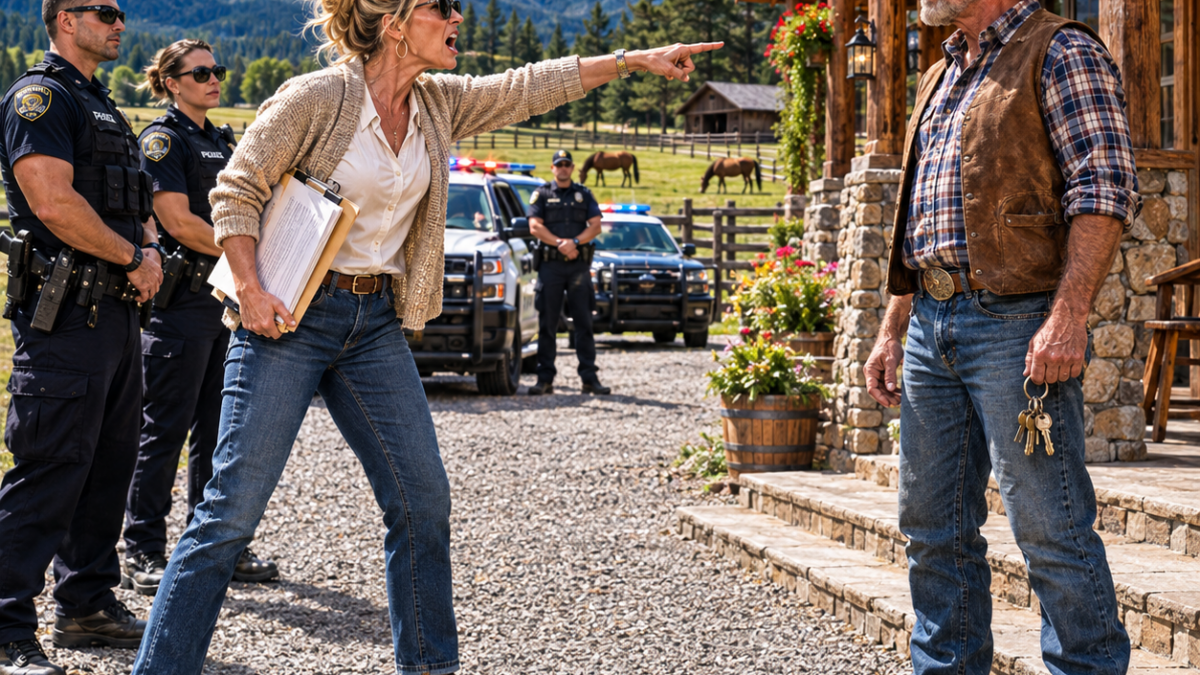
HOA Karen Called 911 When I Refused to Hand Over My Ranch—Then the Sheriff Saw Who “Signed” Her New Deed
**“ARREST HIM—HE’S TRESPASSING ON MY RANCH AND REFUSING TO HAND OVER THE KEYS!” HOA president Linda Whitmore screamed as three sheriff’s cruisers tore through my gate.**
**The problem was Cedar Ridge Ranch had belonged to my family for more than forty years, and the current county deed still showed all eight hundred acres in my name.**
**Then the deputy opened Linda’s “new ownership” file and found my father’s signature on a transfer supposedly executed three years after I buried him.**
The first sheriff’s cruiser came through my gate fast enough to throw dust across the lower pasture.
Red and blue lights flashed against the side of my barn.
A second cruiser followed.
Then a third.
I stood beside the porch with both hands visible while Linda Whitmore screamed into her phone from the cattle fence.
“That’s him!”
She pointed at me.
“He refuses to leave my property!”
Deputy Samuel Reed stepped from the first cruiser slowly.
Another deputy approached Linda.
The third stayed near his vehicle and watched me.
Nobody knew yet what kind of situation they had entered.
Linda made sure they heard her version first.
“I am the legal owner of Cedar Ridge Ranch. He was given notice. He refuses to surrender possession.”
I almost laughed.
There was something surreal about hearing a woman I had met three days earlier announce that the ranch where I had grown up now belonged to her.
Then Linda shouted:
“Arrest him before he destroys something.”
That ended any temptation to laugh.
Deputy Reed looked at me.
“Mr. Brooks?”
“Yes.”
“Any weapons on you?”
“No.”
“Keep your hands where I can see them.”
“Absolutely.”
Linda pulled a thick folder from her SUV.
“I have the paperwork.”
She waved it over her head.
“This entire ranch belongs to me now.”
Reed took the folder.
He read the first page.
Then stopped talking.
That worried me more than if he had immediately laughed at it.
Because Linda’s paperwork looked real.
County seal.
Legal descriptions.
Filing numbers.
Signatures.
Official language.
Three days earlier, none of this existed in my life.
I had been sitting behind the farmhouse watching sunrise over Cedar Ridge.
My name is Daniel Brooks.
PART2:
Cedar Ridge Ranch had been part of my family for most of my life.
My grandfather bought the first section when the area around us was mostly cattle country and dirt roads.
Dad expanded it over time.
By the time he died, Cedar Ridge covered a little more than eight hundred acres.
Pastures.
Two ponds.
A creek.
Timber.
Old red barn.
Equipment sheds.
And a private ranch road connecting the property to the county highway.
When Dad passed, the ranch became mine.
People hear eight hundred acres and imagine wealth.
What I saw was fencing.
Feed.
Diesel.
Veterinary bills.
Property taxes.
Equipment repairs.
Some months were comfortable.
Others reminded me why Dad always kept an emergency envelope hidden behind his desk.
But every morning I woke there felt like a privilege.
My nearest neighbor was Walter Hayes.
Seventy-two.
Small farm along my eastern fence.
Green pickup that sounded like it had smoked two packs a day since 1987.
Walter had known my father for decades.
I repaired his fences.
He brought tomatoes and peach jam.
When drought hit, I let him move a few cows across one corner of Cedar Ridge.
Dad had taught me that land ownership came with responsibility.
“Protect what’s yours,” he used to say.
“But don’t use ownership as an excuse to stop being decent.”
That philosophy worked because almost everybody around Cedar Ridge respected boundaries.
Then Silver Pines Estates appeared several miles south.
At first I barely noticed.
New houses.
Perfect lawns.
Decorative streetlights.
Stone entrance.
HOA.
Fine.
Their neighborhood.
Their rules.
My ranch had nothing to do with it.
At least I thought it didn’t.
The first person who mentioned Linda Whitmore was Walter.
He said she was Silver Pines HOA president.
Apparently she had a reputation for arguing over paint colors, fences, and vehicles.
I did not care.
People inside an HOA agreed to its rules.
That was their business.
Then one afternoon I returned from the feed store and found a white SUV parked outside my gate.
Linda stood beside it wearing expensive sunglasses and boots far too clean for ranch soil.
“You Daniel Brooks?”
“Yes.”
“I’m Linda Whitmore. President of Silver Pines.”
“Okay.”
She seemed disappointed that the title did not impress me.
Then she said:
“We need to discuss this road.”
I looked at my private ranch road.
“My road?”
“That’s part of what we need to discuss.”
I opened the gate and drove in.
Linda followed without asking.
That irritated me, but I let it go.
I offered her water.
She refused.
Instead, she stood looking across my pasture like somebody studying a development site.
Silver Pines wanted to expand north.
Nearly sixty more houses.
Their current access was inconvenient.
My private road offered a much shorter connection to the county highway.
“We’d improve it,” she said.
“No.”
“You haven’t heard the proposal.”
“I heard enough.”
She smiled tightly.
“Daniel, this could significantly improve your property value.”
“I’m not selling.”
“Everyone sells eventually.”
“Not me.”
That was when the conversation changed.
Her expression hardened.
She handed me a business card.
“You may feel differently once you understand what’s happening around you.”
Walter was on my porch that evening.
I told him what happened.
He frowned.
“She doesn’t like hearing no.”
“She asked to use a road. I said no.”
Walter did not smile.
Then he told me someone had been asking questions at the county records office.
Old easements.
Abandoned roads.
Historic parcel names.
Cedar Ridge Ranch specifically.
That got my attention.
The next morning I went into town.
Rachel Monroe worked at the records office.
She had known my family for years.
I asked whether anything unusual had appeared on Cedar Ridge.
She chose her words carefully.
“Public records are public. Anyone can research them.”
“I understand.”
Then she lowered her voice.
“You should probably review yours.”
For nearly two hours I checked everything.
Current deed:
Daniel Brooks.
Taxes:
Current.
No sale.
No foreclosure.
No lien transferring ownership.
Nothing.
I almost felt stupid for worrying.
As I left, Rachel said:
“Sometimes the problem isn’t what’s already in the record.”
I turned.
“What does that mean?”
“Sometimes it’s what someone is trying to put into it.”
When I returned home, two men were standing beside the western pasture.
One had a measuring wheel.
The other a camera.
They said Silver Pines hired them.
“We were told ownership issues had already been settled.”
“What ownership issues?”
Both looked surprised.
That evening Linda returned.
This time with two SUVs.
Five people.
Two men in suits.
One woman carrying a laptop.
Another man in a Silver Pines jacket.
I met them outside.
“You need to leave.”
Linda smiled.
“No, Daniel. You need to listen.”
She opened a folder.
According to her, an old legal agreement connected part of Cedar Ridge Ranch to property later incorporated into Silver Pines.
She claimed newly discovered documents changed ownership of a large portion of my land.
“My deed says I own it.”
“Your deed may not be the final deed.”
That sentence put ice in my chest.
One of the men described himself as a property consultant.
He talked about historical inconsistencies.
Old parcel corrections.
Successor interests.
Hundreds of acres potentially affected.
I asked for copies.
Linda gave me one page.
County seal.
Legal description.
Filing number.
But one boundary description bothered me.
It did not match the creek line Dad had taught me since childhood.
“I want the entire file.”
“You’ll receive it after possession transfers.”
“Possession of what?”
“Your property.”
She said it calmly.
I stared at her.
“Leave.”
Linda told me I had until the next afternoon to turn over access.
Keys.
Equipment.
Property records.
Control.
“You think I’m handing you keys to my ranch?”
“You’ll understand when law enforcement explains the situation.”
Before leaving, she said:
“Don’t make this harder than it needs to be.”
The next morning a notice was taped to my gate.
PROPERTY TRANSFER DEMAND.
Daniel Brooks.
Linda Whitmore.
AUTHORIZED NEW OWNER REPRESENTATIVE.
I photographed everything.
Locked my original deed in the fireproof safe.
Called my attorney, Paul Benton.
He was in court.
Then I called Walter.
He arrived in ten minutes.
“This isn’t right.”
“I know.”
“What are you doing?”
“Staying calm.”
Dad always said anger made people careless.
At 11:18, Linda arrived alone.
She stopped outside my gate.
“I’m here for the property.”
“No.”
“You received the notice.”
“I received paper.”
“It is a legal demand.”
“My lawyer will decide that.”
She held out one hand.
“Gate keys.”
“No.”
“House access.”
“No.”
“Barn access.”
“No.”
“Remove your personal vehicles.”
“No.”
Her jaw tightened.
Then she pulled out her phone and dialed 911.
She put it on speaker.
“911. What is your emergency?”
Linda stared directly at me.
“My name is Linda Whitmore. I’m the new owner of Cedar Ridge Ranch. The former owner refuses to surrender my property.”
The dispatcher asked whether anybody had a weapon.
Linda looked at me.
“This is a ranch. I assume he does.”
That sentence changed everything.
I stepped farther back.
“Tell them I haven’t threatened you.”
She turned away.
“Do you feel unsafe?” the dispatcher asked.
“Yes.”
Lie.
I started recording.
“My name is Daniel Brooks. I’m standing inside my own ranch. I have not threatened Linda Whitmore. She is outside my gate.”
Sirens came minutes later.
And now Deputy Reed stood beside my driveway reading the folder Linda believed would remove me from my home.
“Mr. Brooks, do you have your deed?”
“Yes.”
“Bring it out slowly.”
I did.
Reed placed my deed beside Linda’s paperwork on the cruiser hood.
Linda crossed her arms.
“Mine is newer.”
Reed compared pages.
His radio crackled.
He asked dispatch to repeat something.
Then turned over one page.
A document was attached behind it.
My father’s full name.
James Brooks.
His signature.
My mouth went dry.
Linda saw my face.
“I told you. Your family signed it away.”
Then I saw the date.
Dad had supposedly signed the transfer three years after he died.
“My father was dead.”
Reed looked at me.
“You’re certain?”
“I carried his casket.”
Walter, standing near the barn, raised one hand.
“I was at the funeral.”
Linda began explaining quickly.
Maybe filing date.
Maybe record date.
Maybe delayed documentation.
Reed held up his hand.
“Ma’am, stop talking for a moment.”
That seemed to offend her.
“I called you.”
“Yes. And now I’m investigating what you called us about.”
County dispatch checked the filing number.
It existed.
But the electronic file had been uploaded only eight days earlier.
Eight days.
Linda had first approached me three days earlier.
This had started before the friendly road request.
Reed asked who gave her the documents.
“Legal property research.”
“Which professional?”
She looked away.
Her confidence was beginning to crack.
The county records supervisor eventually confirmed something important.
My existing deed remained active.
Linda demanded that Reed remove me anyway.
He refused.
“I am not settling a complicated land dispute on a driveway.”
“He’s trespassing!”
“Not according to the current record.”
Linda left furious.
Before getting into her SUV, she looked back at me.
“You should have taken the road deal.”
Reed heard it.
Wrote it down.
Paul arrived that afternoon.
He studied photographs of Linda’s documents.
“The wording is wrong.”
“What does that mean?”
“This transfer language doesn’t fit documents from when your father was alive.”
“So it’s fake?”
“I’m saying it deserves forensic review.”
That was why I trusted Paul.
He never gave me certainty he had not earned.
We went to county records.
Rachel took us into a back office.
Someone had attempted to add a historical ownership document to Cedar Ridge eight days earlier.
The upload came through an internal county account.
Whose?
An employee who had been vacationing in Florida for almost two weeks.
Someone may have used her login.
Paul immediately asked that logs, cameras, emails, and upload history be preserved.
The problem had moved beyond an aggressive HOA president.
Someone had manipulated a government records system.
Then Paul uncovered the property mechanism.
Years earlier, Dad bought a southern strip from the Keller family.
The sale was absolute.
Recorded.
Valid.
Linda’s fake paperwork claimed the transfer had been temporary and that the land would revert if needed for future residential development.
That strip contained my private road.
There was the first connection.
If someone could create a claim over that strip, they could claim the road.
Then Paul showed me a development map.
Silver Pines expansion.
New streets.
Home lots.
Drainage.
Commercial area.
Thick red line across Cedar Ridge.
And it did not stop at the road.
Nearly two hundred acres of my ranch were shaded for future phases.
“They’re planning houses on my property.”
Paul nodded.
One private presentation had described Cedar Ridge as PENDING ACQUISITION TERRITORY.
I had never agreed to sell.
Never negotiated.
Never received an offer for those acres.
Yet investors were being shown plans where my cattle pasture had already become neighborhoods.
Two days later, workers showed up before sunrise.
Trucks.
Excavator.
Survey stakes.
Orange cones.
They claimed Linda Whitmore was the authorized property owner representative.
I stayed calm.
Showed them the dispute.
The supervisor called his boss.
Then stopped everything.
Before leaving he told me:
“We weren’t here to survey.”
“What were you here to do?”
“Start clearing.”
The proposed lane cut half a mile through my southern pasture.
No county permit.
No ownership verification.
Nothing.
Later that afternoon, Walter found orange stakes in my eastern field.
PHASE TWO CENTER LINE.
They ran toward my house.
Somebody had entered through a service gate and cut the lock.
I installed heavier chains.
Trail cameras.
Three days of silence followed.
Then another dawn alert.
Black SUV.
A man cutting the new chain.
Then another vehicle already inside.
Linda appeared with five men.
They chained my barn shut.
Put up a sign:
PROPERTY UNDER NEW MANAGEMENT
SILVER PINES HOA
NO TRESPASSING
Then one man began removing Dad’s cedar ranch sign.
I wanted to rush them.
Instead, I sat in my truck and recorded.
Sirens came.
Deputy Reed arrived.
Linda smiled.
“Good. You’re finally here.”
She handed him a new document.
Emergency possession order.
Different from the first paperwork.
Supposedly signed by Judge Robert Hail the previous day.
Paul arrived and read it.
Then went pale.
“Call the courthouse.”
Linda laughed.
“You’re too late.”
Paul pointed at the signature.
“Judge Hail has been hospitalized since Sunday.”
Before Linda could answer, another deputy shouted from beside her SUV.
The rear door was open.
In plain view:
Folders.
Property maps.
County forms.
Portable printer.
Electronic device.
And a county employee badge.
Rachel Monroe’s badge.
Rachel was not there.
Linda moved toward the SUV.
Reed blocked her.
“Don’t touch the vehicle.”
Then a dark pickup exploded from behind the barn and raced across the pasture.
Deputies pursued.
One folder fell from Linda’s vehicle.
Label:
HAYES PROPERTY — PHASE 3 ACQUISITION.
Walter’s face turned white.
A map slid out.
Bigger than anything we had seen.
Cedar Ridge.
Walter’s farm.
Several neighboring properties.
Future streets.
Drainage.
Housing sections.
At the top:
CEDAR RIDGE MASTER TAKEOVER PLAN.
Walter stared at the map.
“They’re taking my farm too.”
His voice broke.
“My wife planted those apple trees.”
That hurt more than numbers on a development sheet.
Walter’s property was small.
But his wife had painted the kitchen yellow because mornings should feel warm.
She had died in that house while he held her hand.
To a developer, it was acreage.
To Walter, it was forty years.
I put my hand on his shoulder.
“We’ll fight it the right way.”
The county investigation widened.
At least four employee accounts had been accessed at strange times.
Walter’s records showed someone had requested details about an old utility easement six weeks earlier.
This plan had started long before Linda first visited my ranch.
Planning records eventually revealed why.
A future highway connector could dramatically increase land values around Cedar Ridge.
If the entire master project moved forward?
Projected value:
Nearly $80 million.
Our farms were not being viewed as homes.
They were obstacles inside an $80 million development strategy.
Then the escaped truck was found abandoned.
Stolen plates.
Vehicle itself stolen.
Disposable phones.
Property maps.
One phone contained the Silver Pines HOA office number.
Linda denied knowing anything.
Maybe true.
Maybe not.
Then she called me.
Paul was beside me.
Speakerphone.
Her voice sounded different.
“Daniel, I need to talk.”
“About what?”
“Not over the phone.”
Paul shook his head.
“No private meeting.”
Linda finally said:
“I made mistakes.”
That was the first honest sentence I had heard from her.
Then:
“You don’t understand how big this is.”
“Then explain.”
“I thought it was a development deal.”
“You called 911 and told police you owned my ranch.”
“I was told the transfer was legal.”
“You sent workers onto my land.”
“I was told the order was real.”
“You told dispatch I might have a weapon.”
Silence.
Finally:
“I was angry.”
“That could have gotten me shot.”
“I know.”
Her voice broke.
Then she said:
“They’ll destroy me.”
“Who?”
“The people behind this.”
She had a payment record.
Evidence that county insiders were involved.
Paul told her to contact law enforcement or state investigators.
Linda was afraid because she believed someone inside the county was helping the group.
Her phone disappeared soon afterward.
For several hours nobody knew where she was.
Then just before sunrise, Rachel Monroe appeared at my gate.
Terrified.
Someone had entered her house overnight.
Nothing stolen.
Instead, something had been returned.
Her missing county badge.
The same type of badge found in Linda’s SUV.
Rachel’s badge had disappeared shortly before the suspicious property uploads began.
Now somebody had placed it inside her locked home.
Intimidation.
Rachel had also copied activity logs from her county account.
The unauthorized access came from one computer.
The records supervisor’s office.
George Wallace.
The man overseeing the internal investigation.
If the logs were accurate, he might have been investigating his own activity.
State investigators took over.
George was placed on leave.
Linda was found alive at a motel ninety miles away.
She contacted an attorney and agreed to cooperate if she received protection.
Then things became even stranger.
The payment record Linda turned over included money routed through shell companies.
Some payments led to George Wallace.
Others to people tied to county planning.
One account carried my dead father’s name.
James Brooks.
The account had been opened after he died.
But the first payment into it had arrived nine years earlier.
Two days before Dad died.
I sat down when Paul told me.
Until then, I believed this conspiracy was recent.
Maybe months old.
Maybe triggered by Silver Pines expansion.
Now I remembered something from Dad’s final night.
I had walked past his office.
He was arguing on the phone.
“You stay away from my land.”
At the time I assumed a cattle buyer.
Then another sentence returned to me.
“I kept copies.”
I ran to Dad’s old desk.
Lower drawer.
False bottom.
He had hidden emergency cash there when I was a kid.
Inside:
Envelope.
DANIEL.
A brass key.
And a note in Dad’s handwriting.
IF ANYONE EVER COMES FOR THE SOUTH ROAD, DO NOT SIGN ANYTHING.
Then:
THE ORIGINAL PROOF IS NOT IN THE HOUSE.
Address.
Private storage business almost two hours away.
BOX 314.
ASK FOR HELEN.
Paul would not let me go alone.
Deputy Reed arranged an escort.
Helen worked behind the storage office desk.
Late sixties.
The second she saw Dad’s note, her expression changed.
“You’re James Brooks’s son.”
“Yes.”
“I wondered if you’d ever come.”
She brought out a dusty metal box.
The key fit.
Inside:
Photographs.
Property records.
Letters.
Cassette tape.
Sealed envelope addressed to me.
First line:
Daniel, if you are reading this, someone finally came after the ranch.
Dad explained everything.
Years earlier, developers had offered to buy the south road and hundreds of acres.
He refused.
Offers increased.
Then pressure.
Threats disguised as business proposals.
Someone told him:
“If you won’t sell it, someone after you will.”
Dad began keeping names.
Dates.
Letters.
Evidence.
Away from the ranch because he feared somebody might break into the house.
Then:
The person helping them is someone we trusted.
Below it:
Walter Hayes.
My heart stopped.
Walter?
The man who had helped me from the beginning?
The man eating dinner at my table?
The man warning me to stay calm?
Before I could understand it, the storage office door exploded inward.
Glass shattered.
A gunshot cracked through the room.
Paul pulled me behind the counter.
Another shot hit the wall.
Helen screamed.
A deputy outside shouted commands.
A vehicle tore away.
Nobody inside was hit.
Investigators arrived.
Reed read Dad’s letter.
I expected him to say Walter had betrayed us.
He didn’t.
“We need to talk to him.”
Then Helen said:
“Walter was the man with your father the night before he died.”
That sounded less like betrayal.
More like help.
Paul studied Dad’s letter again.
Then noticed a tiny arrow beside Walter’s name.
It pointed toward writing along the page edge.
Walter knows who.
I sat down.
Relief hit so hard I almost laughed.
I had nearly let fear erase forty years of trust because I read one line too quickly.
We called Walter.
He went silent when I told him about the storage box.
“You found it?”
“You knew?”
“Your father made me promise.”
Years before Silver Pines existed, Dad had been approached by a developer named Richard Cole.
Cole knew future highway expansion could make Cedar Ridge extremely valuable.
Dad refused to sell.
Cole kept returning.
Then strange survey crews appeared.
Anonymous complaints.
Tax questions.
Drainage accusations.
Walter helped Dad collect evidence.
And Dad discovered someone inside county government was quietly helping Cole.
George Wallace.
Years earlier, George held a lower county position.
He helped search old easements.
Boundary issues.
Historic road claims.
Dad confronted him.
George denied everything.
Then the pressure stopped.
Richard Cole disappeared from public view.
Silver Pines was built years later.
Everyone thought the threat had ended.
It hadn’t.
It went underground.
The cassette tape confirmed it.
Dad secretly recorded Richard Cole and George Wallace.
They discussed the southern road.
They discussed future value.
They discussed waiting for the next generation.
One voice said Dad would never sell.
Another replied:
“Then Daniel might.”
My name.
Nine years earlier.
This had never been created by Linda’s anger at my gate.
She had stepped into a plan that existed long before she became HOA president.
Investigators compared old paper records with newer digital versions.
Changes.
Added documents.
Altered parcel histories.
Not enough to instantly steal property.
Enough to create confusion.
Enough to frighten owners.
Enough to make someone think years of litigation might destroy them financially.
Then offer to buy cheap.
Walter’s farm was targeted.
Three other properties too.
Frank and Susan Miller had already received an offer.
The buyer warned them an old easement problem could make their property nearly worthless if they refused.
They were preparing to sell.
Now they learned the “problem” may have been manufactured.
That made me angrier than what happened to me.
Ordinary retirees had been convinced their life savings could disappear because someone wanted land cheaply.
Traffic cameras identified the men involved in the storage-office shooting.
One arrested.
One surrendered.
Investigators believed the shots were meant to frighten us and recover Dad’s evidence.
Richard Cole was arrested after investigators tied him to payments, false documentation, and the intimidation operation.
George Wallace was arrested separately.
Searches of his office and home found employee passwords, old land records, and files on multiple Cedar Ridge parcels.
The county began reviewing every property record his account had touched.
Linda was not treated as innocent.
And she should not have been.
She had been lied to about the old transfer.
But after that, she made choices.
She wanted the road.
She wanted the development.
She wanted to prove I could not stop her.
She called 911.
She claimed she owned my ranch.
She lied that she felt threatened.
She told dispatch I might have a weapon.
She sent workers onto Cedar Ridge.
She used documents she never properly verified.
She admitted it later:
“I wanted to be right more than I wanted to know the truth.”
That sentence stayed with me.
You do not need to begin as some master criminal to cause serious harm.
Pride can do plenty.
Every time Linda had an opportunity to slow down and check the facts, she chose the story she wanted.
Eventually she became part of the harm even if she had not invented the original scheme.
Months passed.
The fake ownership claim against Cedar Ridge was removed.
Questionable filings formally rejected.
My deed remained mine.
Walter kept his farm.
Frank and Susan did not sell.
The county changed its procedures.
Owners now received notice when major property documents were filed against their parcels.
Security around employee accounts improved.
The Silver Pines expansion never crossed our land.
Some development companies kept operating because not everyone involved had committed wrongdoing.
That distinction mattered.
I refused to turn one corrupt scheme into an accusation against everybody with a business card.
Silver Pines residents began coming to the ranch to apologize.
One Saturday Jason Parker arrived with his young daughter.
“We thought you were blocking a road our neighborhood needed.”
“You didn’t do what Linda did.”
His daughter stared at the cattle.
“Can I pet one?”
I pointed at a calm calf.
“That one. Stay away from her mother unless you want to learn how fast a cow can move.”
She laughed.
That afternoon reminded me why anger could not become my identity.
There were good people on both sides of every fence.
Walter finally returned from his daughter’s house.
I helped repair the gate someone had cut.
We replaced posts.
Sat beneath the apple trees his wife planted.
I finally admitted:
“At the storage office, I thought Dad’s note meant you betrayed him.”
Walter stared.
Then smiled.
“You should’ve known I’m too lazy for a nine-year conspiracy.”
I laughed hard enough to spill my drink.
Then he got serious.
“Your father wanted to protect you.”
“I wish he’d told me.”
“Parents sometimes think hiding danger is the same thing as removing it.”
I never forgot that.
Dad had protected me as best he knew how.
But secrets had costs.
Had I known about Richard Cole and George Wallace earlier, maybe I would have understood the strange activity sooner.
Still, I could not stay angry at a man who had spent his final years trying to protect both me and Cedar Ridge.
Weeks later, Linda asked to speak.
Through attorneys.
Paul’s office.
No surprise meeting.
No private roadside conversation.
She looked nothing like the woman who had demanded my gate keys.
No sunglasses.
No thick folder.
No smile.
“I’m sorry.”
I waited.
“I could say I was lied to.”
“You were.”
“I was. But that isn’t enough.”
I said nothing.
She finally looked up.
“I called 911 because I wanted to scare you.”
That one hurt.
“You could’ve gotten me killed.”
“I know.”
“You told them I might be armed.”
“I know.”
Tears came.
I did not comfort her.
Some apologies should be allowed to remain uncomfortable.
“I’m not pretending it didn’t matter,” I said.
She nodded.
“But I also don’t want to spend the rest of my life hating you.”
That made her cry harder.
Forgiveness was not erasing consequences.
It did not mean dropping investigations.
It did not mean saying everything was fine.
It meant refusing to let another person’s worst choices occupy my mind forever.
I told her I hoped she became better because of what happened.
Whether she did was her responsibility.
The following spring, heavy rain damaged roads around Silver Pines.
The county asked whether emergency vehicles could temporarily use part of my ranch road.
I said yes.
Walter looked surprised.
“After everything?”
“This is different.”
Nobody was claiming ownership.
Nobody forged documents.
Nobody demanded.
The county asked.
I agreed.
Three days.
Ambulances and emergency vehicles used the road when needed.
Then the arrangement ended.
One afternoon Jason Parker was helping direct traffic near my gate.
He smiled.
“Funny how this whole mess started because people wanted your road.”
“The road was never the real problem.”
“What was?”
I looked at the Cedar Ridge sign.
We had repaired it after Linda’s contractors tried removing it.
“Thinking you can take something just because you want it.”
That was the lesson.
Ownership mattered.
Boundaries mattered.
But respect mattered more.
If Linda had accepted my first no, none of this would have happened.
If Richard Cole and George Wallace had made fair offers and walked away when people refused, they would not have destroyed lives.
Instead, they treated homeowners like obstacles inside an $80 million plan.
Dad had seen that coming.
Later that year, Walter and I built a bench beside the creek where Dad used to fish.
We carved:
JAMES BROOKS.
Underneath:
LEAVE THINGS BETTER THAN YOU FOUND THEM.
That was how Dad tried to live.
Imperfectly.
Stubbornly.
But with love for land and people.
Sometimes I still think about Linda standing outside my gate with her phone on speaker.
“My name is Linda Whitmore. I’m the new owner of Cedar Ridge Ranch.”
She sounded so certain.
She thought paperwork could erase my family.
But ownership was never decided by whoever shouted loudest.
Truth did not change because somebody uploaded a fake document.
A dead man could not sign away a ranch three years after his funeral.
And choosing to stay calm did not make me weak.
Cedar Ridge is still here.
Walter’s farm is still beside mine.
Cattle still cross the same road every morning.
Kids still fish in my pond when their parents ask.
Sometimes Silver Pines families come too.
I let them.
Because I refuse to let one HOA president teach me to hate an entire neighborhood.
The strangest part is the gate Linda once demanded keys to stays open more often now than it did before.
Not for developers.
Not for people trying to claim control.
For neighbors.
Friends.
Emergency crews when needed.
People who understand one simple rule.
Ask.
Respect the answer.
Treat someone else’s home the way you want them to treat yours.
One evening Walter and I sat outside the farmhouse watching the sun drop behind Cedar Ridge.
He looked toward the gate.
“So, Daniel, what happens if another HOA president shows up claiming she owns your ranch?”
I laughed.
“I’ll offer her water.”
Walter stared.
“That’s it?”
“Then I’ll call Paul.”
He laughed.
“And after that?”
I looked across the fields my grandfather bought, my father protected, and strangers almost stole with lies and paper.
“After that,” I said, “I’ll show her the deed.”








