HOA Karen Called 911 When I Refused to Give Her the Keys to My Lake—Then Her Own Paperwork Exposed Everything
HOA Karen Called 911 When I Refused to Give Her the Keys to My Lake—Then Her Own Paperwork Exposed Everything
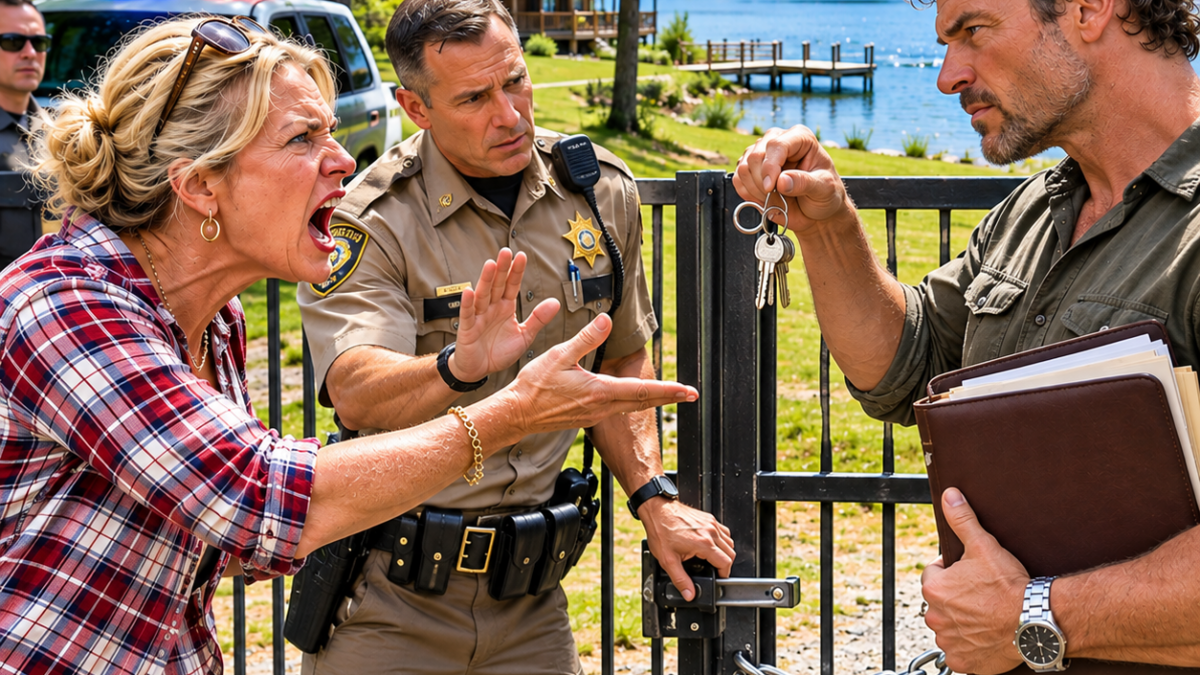
**“OFFICER, THOSE KEYS BELONG TO THE HOA—HE STOLE CONTROL OF OUR LAKE AND HE’S REFUSING TO GIVE IT BACK!” Karen Whitmore shouted as the sheriff’s cruiser stopped beside my locked gate.**
**I was standing ten feet away holding the keys to forty-eight acres my family had owned for almost thirty years, while Karen insisted Pine Hollow HOA owned my lake, cabin, docks, and access road.**
**Then she handed the deputy a document bearing my late father’s signature—and suddenly the argument was no longer about a set of keys.**
My name is Daniel Cooper, and the property everyone eventually started fighting over was called Cooper Lake.
Forty-eight acres in eastern Tennessee.
Fourteen-acre private lake.
Small cabin.
Two fishing docks.
Old boat house.
Woods surrounding most of the shoreline.
One gravel road leading in from the county highway.
Dad bought the place in 1997.
He spent most of his life working construction and saving whatever money was left after bills.
He did not buy the lake to impress anyone.
There was no marble patio.
No resort-style landscaping.
No gatehouse.
Half the furniture inside the cabin came from yard sales.
Dad repaired almost everything himself.
If a deck board broke, he replaced it.
If the boat-house roof leaked, he climbed up with roofing cement.
If the gravel road washed out, he rented equipment and fixed it.
To him, Cooper Lake was not a trophy.
It was a place where family could breathe.
Some of my earliest memories happened there.
Dad teaching me to bait a hook.
Mom holding my hands while I learned to swim near the shallow dock.
Summer cookouts with folding chairs spread under the trees.
Cousins throwing footballs too close to the water.
Coolers overflowing with drinks nobody needed.
Too much food.
Mosquitoes.
Mud.
Perfect.
The property had one main steel gate near the county road.
Dad originally kept four keys.
One for himself.
One for Mom.
One for me after I turned eighteen.
One emergency spare inside a lockbox at the cabin.
That was it.
Nobody else had permanent access.
If Dad invited somebody, he opened the gate.
Later, when we installed an electronic lock, he sometimes gave visitors a temporary code.
Sharing was something Dad enjoyed.
Control still belonged to him.
That distinction became the center of everything after Pine Hollow Estates appeared.
The subdivision was built along the northern side of the property about twelve years after Dad bought Cooper Lake.
At first, maybe thirty houses.
Then another section.
Clubhouse.
Playground.
Almost ninety more homes.
Several houses had beautiful views across my lake.
The original developer knew those views helped sell property.
He approached Dad about recreational access.
Dad agreed to something narrow.
PART2:
Pine Hollow residents could use one marked footpath on Saturday mornings.
They could fish from a small stretch of shoreline.
Daylight hours only.
No swimming.
No kayaks.
No boats.
No private docks.
No cabin.
No vehicle gate.
And Dad could revoke the permission whenever he wanted.
That agreement worked for years because most people respected it.
Frank Wilson was one of them.
Retired electrician.
He lived with his wife Linda in one of Pine Hollow’s oldest houses.
Frank knew Dad well.
Whenever he wanted to fish, he called.
Even though he technically could have used the Saturday path without calling.
That was just Frank.
His grandson Matthew eventually started coming with him.
Matthew could sit beside a fishing float for three hours without moving.
People like Frank were the reason Dad never shut the trail completely.
He believed good neighbors should not be punished because somebody else behaved badly.
But he also repeated one sentence more times than I can count.
“Sharing your place doesn’t mean giving away your place.”
I understood those words intellectually when I was younger.
I understood them completely after Karen Whitmore became HOA president.
Dad died two years before the real trouble started.
Unexpectedly.
The lake passed to me through his estate.
Mom had already moved to Florida.
My younger sister lived in Arizona.
So Cooper Lake became my responsibility.
For the first several months, I drove forty minutes most weekends.
Repair cabin.
Clear fallen branches.
Patch the boat house.
Inspect docks.
Mow the access road.
Dad had left a hundred little jobs behind.
I liked doing them.
It made the property feel connected to him.
I wanted to renovate slowly.
Not transform it.
Dad’s fingerprints were everywhere.
I did not want some polished remodel erasing all of that.
Karen first arrived one Saturday while I was replacing a broken porch railing.
She parked near the Pine Hollow walking-trail entrance.
Mid-fifties.
Expensive sunglasses.
Perfectly organized folder.
Confident smile.
She introduced herself as Pine Hollow’s new HOA president.
“I wanted to discuss modernizing lake access.”
I set down my drill.
“What does that mean?”
“Pine Hollow has grown. Residents want more use of the lake.”
She proposed expanding fishing hours.
Allowing kayaks.
Building a community dock.
Improving shoreline areas.
Then she said:
“We would also need keys to your main gate.”
That made me stop.
“Why?”
“Maintenance crews need vehicle access.”
“I maintain the shoreline.”
“The HOA wants to contribute.”
“I’m good.”
Karen kept going.
Pine Hollow residents paid premium prices for lake views.
They deserved a stronger recreational experience.
I asked:
“Did their purchase contracts include ownership of Cooper Lake?”
She looked irritated.
“The neighborhood has always been marketed as a lake community.”
“Being next to a lake is not the same as owning one.”
She smiled again.
“Two keys would solve a lot of issues.”
“One for you and one for the HOA office?”
“Yes.”
“No.”
That answer changed her entire expression.
“Your father was more cooperative.”
“My father never gave Pine Hollow vehicle access either.”
“Circumstances have changed.”
“The deed hasn’t.”
Karen left without saying goodbye.
A week later, I received an email requesting that I attend an HOA meeting about community lake rights.
I went.
Not because Pine Hollow controlled me.
Because I thought one clear conversation might prevent a bigger mess.
The clubhouse was packed.
Maybe forty residents.
At the front stood Karen beside a large map.
Pine Hollow.
Roads.
Clubhouse.
Retention pond.
And Cooper Lake.
My lake was shaded the same blue as Pine Hollow’s retention pond.
A dotted line circled almost half my shoreline.
COMMUNITY RECREATION ZONE.
I raised my hand.
“Who created this map?”
Karen said it came from long-term community planning.
“County map?”
“No.”
“Attached to my deed?”
“No.”
“Signed by my father?”
“That’s complicated.”
Then she announced Pine Hollow wanted formal gate keys to support scheduled recreation hours.
Several residents clapped.
That told me something.
Most of them believed the HOA already had legal rights.
So I explained calmly.
“My family owns Cooper Lake.”
A few people looked surprised.
“Pine Hollow has limited fishing permission. Walking access only. No cabin. No private docks. No boating. No swimming. No vehicle gate.”
A woman in the front row raised her hand.
“Then why do our dues include a lake maintenance reserve?”
That was news to me.
I looked at Karen.
She answered quickly.
“The reserve supports trail cleanup and future shoreline improvements.”
“How much is in it?”
“That is an internal financial matter.”
Interesting.
Then Frank Wilson stood.
“Richard Cooper was always clear. The trail was a courtesy.”
Karen interrupted him.
“Old verbal understandings do not always reflect current community needs.”
Frank looked annoyed.
“It wasn’t verbal.”
The room became quiet.
“Richard put it in writing.”
I looked at him.
“So did I,” Frank said.
He had served on an old HOA board.
He still had a photocopy.
The next morning, he brought it to the cabin.
Dad’s agreement said exactly what I remembered.
Limited shoreline fishing.
Daylight.
Walking access.
Revocable permission.
No permanent easement.
No ownership rights.
No vehicle access.
I made copies.
Sent Karen one.
Two days later, she replied:
Pine Hollow had “additional records” that might supersede the old fishing agreement.
I asked her to send them.
Nothing.
Instead, the boundary started changing through behavior.
First, a Pine Hollow family arrived at my private dock carrying paddleboards.
They were polite.
They showed me an HOA email calling Cooper Lake a shared recreational amenity.
I explained the rules.
They apologized.
Left.
Next weekend:
A new sign appeared.
PINE HOLLOW PRIVATE LAKE ACCESS.
Installed on my property.
I removed it.
Karen emailed within an hour accusing me of destroying HOA property.
I reminded her:
“You installed it on mine.”
Then another sign appeared.
Removed.
Then kayaks.
Then swimmers.
Then one Saturday I found an entire family eating lunch on my cabin porch.
They believed the cabin was an HOA clubhouse annex.
That was the moment I stopped calling the problem a misunderstanding.
I hired Rachel Morgan.
Property attorney.
She reviewed:
My deed.
Title history.
Dad’s fishing agreement.
HOA emails.
County maps.
Then ordered a complete title search.
The result was simple.
I owned Cooper Lake.
Lake bed.
Cabin.
Docks.
Boat house.
Gate.
Access road.
Shoreline.
Everything.
Pine Hollow had one narrow utility easement across the far northeast corner.
Nothing else.
Rachel sent Karen a formal demand.
Stop advertising Cooper Lake as an HOA amenity.
Stop directing residents beyond the limited fishing area.
Stop claiming rights that do not appear in the title.
Two weeks of peace followed.
Then Karen changed tactics.
She asked to meet privately.
We stood beside the gate.
She handed me an envelope.
Inside:
Two blank key tags.
“If you give Pine Hollow two copies, we can avoid legal escalation.”
I stared at her.
“What legal escalation?”
“We have evidence your father intended Cooper Lake to become part of the community recreation system.”
“Show me.”
“Our attorneys are reviewing everything.”
“You’re still not getting keys.”
Karen stepped closer.
“You’re making this harder than it needs to be.”
“You’re asking me for keys to property you don’t own.”
“That is your opinion.”
No.
A deed is not an opinion.
Three days later, Pine Hollow sent me a bill.
$9,200.
Lake maintenance assessments.
Trail improvements.
Security costs.
Legal review.
Owner non-cooperation penalties.
Rachel laughed when she first saw it.
Then stopped.
“They’re trying to manufacture a financial relationship.”
Pine Hollow had never billed Dad like that.
I was not a member.
No dues obligation existed.
Rachel demanded the invoice be withdrawn.
Karen responded that I had “inherited lake-related HOA responsibilities” along with the property.
Still no supporting documents.
Then somebody began filing complaints.
Unsafe dock.
Inspector came.
Dock safe.
Dog abandoned at cabin.
I did not own a dog.
Illegal burning.
No fire.
Suspicious activity.
The suspicious person was me working on my own property.
Every time:
Cooperate.
Get report number.
Save it.
Rachel told me:
“Document everything.”
So I did.
Then Karen came for the keys again.
This time she brought two HOA board members.
And a locksmith.
I was repairing the electronic gate control when they arrived.
Karen walked straight toward me.
“Pine Hollow is taking over gate management.”
“No.”
“Residents have been wrongfully denied community property.”
“This is private property.”
She looked at the locksmith.
“Replace the lock.”
I stepped between him and the gate.
Not threatening.
Just firm.
“You do not have my permission to touch that lock.”
The locksmith immediately stepped backward.
Smart man.
Karen pointed at my keys.
“Give those to me.”
“No.”
“Daniel, give me the keys.”
“No.”
She pulled out her phone.
I assumed she was calling an attorney.
Instead:
911.
Right in front of me.
She told the dispatcher a man was refusing to surrender keys to HOA property.
I stared at her.
Then she said I had taken control of the neighborhood lake.
Locked residents out.
Stolen the association’s access.
Refused to return HOA keys.
There had never been HOA keys.
Then she said:
“The entire lake belongs to Pine Hollow.”
When the call ended, I asked:
“You really expect deputies to come here and make me hand you my keys?”
Karen smiled.
“Yes.”
Fifteen minutes later, Deputy Samuel Brooks arrived.
Calm.
Professional.
He asked everyone to keep voices down.
Karen immediately explained that Pine Hollow controlled Cooper Lake through an old agreement with Dad.
I had inherited the property, she said, but not the right to block community access.
Then she told Samuel:
“Make him give us the keys.”
Samuel looked at me.
I handed over my driver’s license.
Then the copy of my deed Rachel told me to keep in the truck.
Karen laughed.
“That’s old.”
Samuel looked up.
“Old?”
Karen reached into her handbag.
Pulled out a folded document.
“This is newer.”
Samuel unfolded it.
Title:
COOPER LAKE COMMUNITY TRANSFER AND MANAGEMENT AGREEMENT.
My stomach tightened.
Dad’s name sat at the bottom.
Richard Cooper.
Dated six years before his death.
The agreement supposedly transferred long-term recreational control to Pine Hollow.
Gate access.
Cabin grounds.
Docks.
Shoreline management.
Scheduled lake use.
Karen pointed at the gate paragraph.
“See? Pine Hollow is entitled to keys.”
Samuel did not hand her anything.
He asked:
“Where’s the original?”
“Secure HOA records.”
“Recorded with the county?”
“Private management agreements don’t always need recording.”
Maybe.
But that did not make it real.
I called Rachel.
Twenty minutes away.
Samuel told everyone:
“No locks are changing. No keys are being surrendered until this document is verified.”
Karen became furious.
She said residents were arriving that evening for Fall Lake Night.
I looked at her.
“What event?”
My phone buzzed.
Camera alert.
Not front gate.
Cabin.
I opened the live feed.
Three golf carts beside the cabin.
Pine Hollow volunteer shirts.
Tables.
Coolers.
Folding chairs.
String lights.
One man carrying a box toward the cabin door.
I zoomed in.
LOCK SET.
They were not waiting to receive my keys.
They were preparing to replace my locks.
I showed Samuel.
His expression changed.
Karen said the management agreement authorized it.
Then another alert.
Boat-house camera.
Pickup backed toward the water.
Workers unloading six kayaks.
And a large sign.
PINE HOLLOW COMMUNITY LAKE CLUB.
I stared at Karen.
While she kept me and the deputy busy at the gate, people were already taking physical control from another entrance.
Rachel called.
She had checked the county system again.
Still no transfer.
No management easement.
No HOA ownership.
Nothing.
That was when I understood the real problem.
Karen had called 911 because I refused to give her keys.
But she was already trying to create the appearance that she did not need them.
Samuel called another deputy.
Then we drove to the cabin.
Volunteers froze when the cruisers arrived.
One man stood beside my door holding the unopened lock set.
Another had wrapped lights around the porch.
Tables covered the lawn.
The Community Lake Club sign leaned against my boat house.
Samuel asked:
“Who authorized this event?”
Janet Reynolds raised her hand.
Volunteer coordinator.
Karen had emailed the neighborhood saying Pine Hollow had finally secured full legal access.
Janet showed us the message.
“After years of uncertainty, Pine Hollow has confirmed its permanent recreational rights at Cooper Lake.”
Then:
“HOA staff will replace outdated owner-controlled locks before the event.”
Rachel read that twice.
“You sent this before calling 911?”
Karen said yes.
Rachel asked:
“Then why did you need police to force Daniel to give you keys?”
Karen answered:
“Cooperation would have been easier.”
That sentence told me almost everything.
She was not asking.
She was making my cooperation unnecessary.
Samuel canceled the event pending legal review.
Tables removed.
Coolers loaded.
Lights removed.
Kayaks left.
Sign left.
Most residents apologized.
Janet looked horrified.
“I never would’ve come if I knew you said no.”
“I believe you.”
An older man kept apologizing as I helped him carry a table back to his golf cart.
“You were invited,” I said. “The problem is who invited you.”
Then I found the maintenance-road chain.
Cut.
Again.
Karen claimed she knew nothing about it.
Janet showed the volunteer instructions.
USE NORTH SERVICE ENTRANCE.
Someone knew exactly how to bypass my main gate.
Samuel photographed everything.
Then told Karen something she did not want to hear.
“Calling 911 does not give your HOA possession.”
If Pine Hollow believed its agreement was valid, it could go to court.
Until then, deputies were not taking property keys from the recorded owner based on disputed paperwork.
By sunset, Cooper Lake was quiet again.
My keys remained in my pocket.
Rachel and I sat on the cabin porch.
Karen’s agreement lay across the table.
The disturbing part was how believable it looked.
Correct property description.
Plausible date.
Real witnesses.
Real notary name.
Period-correct HOA logo.
Dad’s signature.
Rachel said:
“This wasn’t made in five minutes.”
“Could Dad have signed it?”
She did not comfort me with a lie.
“Yes.”
My stomach tightened.
“Then we find out what he actually signed.”
The HOA attorney, Thomas Bennett, arranged inspection of the supposed original.
He seemed reasonable.
New to the dispute.
He said Karen only gave his firm the document recently.
Wednesday morning, Rachel and I examined it.
The paper looked old.
Dad’s signature was blue ink.
Actual pen marks.
For one terrible moment, I wondered whether my memory of Dad was wrong.
Rachel studied the pages.
Then noticed the staple holes.
Pages one through four had one pattern.
Signature page had another.
Slightly misaligned.
Could mean nothing.
Then she touched the paper.
Signature sheet slightly thicker.
She requested a forensic document examiner.
Thomas agreed.
That mattered.
He was not acting like somebody trying to hide a problem.
Then he told us Karen claimed she found the agreement seven months earlier in an original developer storage box.
Seven months.
Around the same time Pine Hollow started calling Cooper Lake a community amenity more aggressively.
Rachel hired Dr. Laura Peterson.
Document examiner.
While she worked, I searched Dad’s files.
Invoices.
Taxes.
Dock repairs.
Insurance.
Dam checks.
Fishing correspondence.
Nothing about permanent lake transfer.
Then I found Dad’s notebook.
Mostly maintenance notes.
REPLACE DOCK BOARDS.
CHECK DAM AFTER RAIN.
CALL PLUMBER.
Then:
MEETING THURSDAY. KAREN + BOARD.
Next page:
THEY WANT KEYS AGAIN. NO.
I sat down.
Karen had asked Dad for keys too.
Another entry:
LAKE MANAGEMENT PLAN. TOLD THEM FISHING ONLY.
Another:
DO NOT GIVE CABIN ACCESS.
Then three months later:
SIGNED TEMP MAINTENANCE PAPER. TRAIL CLEANUP ONLY. ENDS DEC.
Temporary maintenance agreement.
Same time period as Karen’s document.
Rachel checked old Pine Hollow board minutes.
Dad attended.
He rejected:
Swimming.
Boating.
Cabin use.
Permanent gate access.
Private dock use.
Then a later meeting approved temporary shoreline maintenance.
Two workers.
Vehicle access.
Autumn cleanup.
Permission expired December 31.
Then Frank called.
His wife Linda had served one year as Pine Hollow secretary during that period.
They still had an attic box.
We searched it.
Meeting agendas.
Budgets.
Newsletters.
Old agreements.
Then:
TEMPORARY SHORELINE MAINTENANCE ACCESS AGREEMENT.
Same date as Karen’s permanent management document.
Same witnesses.
Same notary.
Same Dad signature.
But completely different first pages.
Temporary vehicle access for two workers.
October through December.
No permanent recreation.
No cabin.
No docks.
No boating.
No keys after expiration.
No lake control.
Rachel placed Linda’s copy beside photographs of Karen’s version.
Signature pages nearly identical.
She whispered:
“Now we know what Laura needs to compare.”
Frank’s wife looked sick.
“The old board never got permanent rights.”
Frank nodded.
“That would’ve been huge.”
Then another question emerged.
Why push so hard now?
Rachel examined Pine Hollow financial records.
Residents had been paying $140 per home each year into something called:
LAKE AND TRAIL AMENITY.
More than a hundred homes.
Four years.
A lot of money.
Some went to trail work.
Some did not.
Lake development consulting.
Recreation expansion.
Future facility access.
Then one payment:
$24,500.
Whitmore Property Planning LLC.
Karen’s husband Steven owned it.
Invoice:
COOPER LAKE ACCESS CONVERSION STUDY.
The HOA was paying Karen’s husband to study how limited fishing permission might be converted into broader control.
Rachel requested the report.
One section:
CONTROL THROUGH EXISTING RIGHTS.
It argued that if Pine Hollow could establish the old management agreement as valid, the HOA might control the gate, docks, cabin grounds, and scheduled lake use without purchasing the property.
Then the financial motive appeared.
Pine Hollow was considering forty-two luxury homes north of Cooper Lake.
Lake-club privileges would dramatically increase their value.
Who owned the undeveloped land?
Whitmore Property Planning.
Karen and Steven.
There it was.
Not just kayaks.
Not just neighborhood fun.
Their family property became more valuable if my lake became Pine Hollow’s lake.
Then Dr. Peterson called.
The paper on Karen’s signature page matched the temporary maintenance agreement.
Staple damage matched.
Crease pattern matched.
Faint marks suggested the sheet originally sat behind different text.
She was not ready for final conclusion yet.
Close.
Not final.
That night I sat alone on my dock.
Dad’s notebook said:
No keys.
Fishing only.
No cabin.
Yet Karen possessed a document claiming Dad gave away almost everything he had repeatedly refused to give.
I wanted it to be false.
Wanting is not evidence.
Then Frank called.
“Are you at the lake?”
“Yes.”
“Stay near the cabin.”
“Why?”
“Pine Hollow just sent an emergency email.”
He forwarded it.
COOPER LAKE ACCESS RESTORED BY BOARD ACTION.
Pine Hollow supposedly had immediate control because I was withholding HOA assets.
I called Thomas Bennett.
He sounded shocked.
“What board action?”
He knew nothing.
Then the front camera triggered.
Truck.
Another truck.
Three black SUVs.
Private security.
Locksmith.
Karen.
She stood outside the gate holding a folder.
“Pine Hollow has approved emergency enforcement.”
I told her Thomas Bennett knew nothing about it.
“He no longer represents us on this matter.”
Then two security guards stepped forward.
One had bolt cutters.
I called the sheriff.
Karen smiled.
“You already tried that.”
“No, Karen. You tried that.”
She held up another paper.
NOTICE OF HOA POSSESSION AND LOCK CONTROL.
Supposedly a court order.
Case number.
Court seal.
Judge’s signature.
It looked official.
Then the security guard cut my chain.
Karen stepped through.
“Give me the keys.”
I backed away.
Kept recording.
Then an engine sounded behind me.
Flatbed truck entering the maintenance road.
Excavator.
Two prefabricated dock sections.
Karen was not only taking the keys.
She was trying to build something.
Fast.
Samuel Brooks arrived.
Saw the broken chain.
Ordered everyone to stop.
Karen handed him the possession order.
“Now you have to make him give us the keys.”
Samuel read it.
Then asked:
“Where did you get this?”
“New counsel.”
“Name?”
Pause.
“David Lawson.”
Rachel arrived.
She photographed the order.
Called the county civil-court clerk.
There was a real case number.
For one second, Karen smiled.
Then Rachel continued.
“The case exists.”
Pause.
“The order does not.”
Pine Hollow had filed a petition asking for temporary lake access.
No judge granted possession.
No order transferred lock control.
No document matching Karen’s paper existed in the court system.
Samuel refused to enforce it.
The excavator operator spoke up.
His name was Nathan Parker.
Whitmore Property Planning hired him.
The dock had to be installed before the next morning.
“Why?”
“Developer inspection.”
Silence.
Potential investors were touring Pine Hollow.
The new dock needed to be visible.
Vehicle access needed to look established.
Lake signage needed to look established.
Karen did not need to win the legal case that night.
She needed Cooper Lake to look like Pine Hollow controlled it.
Rachel asked Nathan whether he had been told I approved construction.
“Yes.”
He had been given the supposed permanent management agreement.
Same paper.
Same foundation for everything.
Keys.
Signs.
Events.
Dock.
Security.
Investor presentation.
Samuel ordered all equipment off my property.
The contractors cooperated.
Karen stayed.
“You’re destroying something that could help everyone.”
I looked at the lake.
“I’m stopping you from building on something you don’t own.”
She said Pine Hollow had supported the lake for years.
“Dad let residents fish.”
“Exactly.”
Exactly.
To Karen, Dad’s generosity was evidence that Pine Hollow deserved more.
Fishing became recreation.
Temporary maintenance became management.
Looking at the lake became a claim to control it.
Sharing became ownership.
That was her logic.
The court formally denied Pine Hollow’s emergency request the next day.
No possession.
No expanded access.
No lock control.
Then investigators started examining the fake possession order.
Somebody had created a document carrying a court seal and judicial signature.
Dr. Peterson completed her report two days later.
Dad’s original signature was real.
Witness signatures real.
Notary real.
But the signature page belonged to the temporary maintenance agreement.
The permanent lake-management language had been placed in front of that page later.
Matching staple damage.
Matching paper.
Matching crease.
Digital assembly.
Dad never signed away permanent control of Cooper Lake.
I sat quietly.
I had believed him.
Still, hearing proof felt different.
Then Rachel showed me the money.
More Whitmore Property Planning payments.
$31,000 for amenity expansion consulting.
$12,000 for developer coordination.
More than $60,000 of HOA money flowing to Karen’s husband’s company around lake expansion and future housing.
Then an email.
Steven to Karen:
“Need visual control before November presentation. Gate keys, signage, and dock should be enough to show amenity integration.”
Visual control.
Not legal control.
Make it look real.
Karen replied:
“Once residents use it regularly, Daniel will have a harder time shutting it down.”
She even used the wrong name.
After months demanding my property, she apparently could not reliably remember the owner’s name.
But the strategy was clear.
Create regular use.
Create events.
Create signs.
Create a dock.
Create keys.
Then tell investors and residents:
Look.
We control it.
Pine Hollow’s board turned against Karen.
Emergency meeting.
She no longer sat at the front.
Robert Jenkins chaired.
He told residents the truth.
Cooper Lake privately owned.
Pine Hollow had limited fishing permission.
No ownership of cabin.
No docks.
No lake bed.
No gate.
No shoreline.
The supposed permanent management agreement could not be trusted.
Then the money.
More than $60,000 paid to Steven’s company.
And Steven’s company owned the land whose value depended on expanded lake rights.
Then Thomas Bennett addressed Karen’s possession order.
His firm did not prepare it.
Did not obtain it.
No judge issued it.
The language had been copied almost word-for-word from a draft request Bennett emailed earlier that day.
Someone had transformed a requested order into a fake granted order.
Robert moved to suspend Karen.
Five to one.
Karen voted for herself.
She stood.
Gathered her bag.
Then said:
“You’re destroying a development opportunity.”
There it was.
Not fishing.
Not neighborhood tradition.
Development.
She left.
Steven followed.
Pine Hollow suspended all lake fees.
Corrected maps.
Closed the fishing trail temporarily.
No HOA representative could enter Cooper Lake without my permission.
For the first time in months, I thought the worst might be over.
At 1:17 the next morning, my phone rang.
Deputy Brooks.
“Are you at Cooper Lake?”
“Yes.”
“Stay inside.”
“Why?”
“County patrol spotted a truck near the far service road. Driver ran.”
My stomach tightened.
“The dam controls locked?”
“Yes.”
“You give anyone permission to access them?”
“No.”
Pause.
“Patrol also saw movement near the dam.”
I opened the security app.
Dam camera.
A person in a hood stood beside the main release wheel.
Wrench in hand.
Face turned away.
Then the camera froze.
Refreshed.
Water poured through the dam outlet.
Fast.
Somebody had opened Cooper Lake.
Every instinct told me to run out and close it.
Samuel told me to stay inside until deputies cleared the area.
Five minutes later, patrol lights appeared through the trees.
Deputies found nobody at the controls.
Lock cut.
Protective cover in the grass.
Release gate opened far beyond normal maintenance position.
Samuel called emergency management.
I called Paul Gardner, the technician who had worked with Dad.
He arrived in work clothes, half asleep.
Inspected the mechanism.
Safe to close slowly.
Deputies stayed nearby.
Paul turned the wheel.
Water weakened.
The lake had dropped only several inches.
Not feet.
Recoverable.
I thanked him repeatedly.
Paul shrugged.
“Your dad fixed my truck once when I didn’t have money.”
Then:
“Call it even.”
That almost broke me.
Dad had been dead for years and was still helping me because of the way he treated people.
Generosity was never the problem.
Abuse was.
At sunrise, investigators searched the abandoned truck.
Registered owner:
Whitmore Property Planning LLC.
Steven’s company.
That did not prove Steven was driving.
But inside:
Contractor gloves.
Flashlight.
Bolt cutters.
Maps of Cooper Lake.
Copy of the false permanent management agreement.
Folder:
WATER LEVEL OPTIONS.
Pine Hollow’s acting president, Robert, sent one message to residents.
Do not enter Cooper Lake.
Do not repeat rumors.
Wait for verified facts.
No spin.
No claim of ownership.
Responsible.
The lake stabilized.
No major fish loss.
Docks okay.
Shoreline recovered.
Then investigators obtained Whitmore Property Planning records.
The forty-two-home project depended heavily on lake access.
Projected sale prices were significantly higher if homes included private lake-club privileges.
Investor concept materials already described Cooper Lake as Pine Hollow’s private recreational lake.
My lake.
My cabin.
My docks.
My gate.
Presented as if they already controlled them.
Development condition:
SECURE VISIBLE AND OPERATIONAL LAKE ACCESS.
There was the entire story in six words.
Visible.
Operational.
Gate keys.
Signage.
Dock.
Event.
Security.
Keys create visible control.
Control creates belief.
Belief creates investor value.
Then emails between Steven and Karen.
Steven:
“Once we have keys and dock installed, investors won’t care about old fishing language.”
Karen:
“Residents already think it belongs to us.”
That sentence made everything click.
The goal was not proving ownership first.
The goal was making everyone believe ownership already existed.
Then another email.
Steven:
“Lower water temporarily if needed for shoreline work. It will help prep north side.”
Karen:
“Do it only after board meeting if things go bad.”
Things went bad.
Karen got suspended.
Hours later, somebody opened the dam.
That did not prove Karen stood beside the wheel.
Phone data later placed Karen at home.
Steven’s device, however, was near the far service road around the relevant time.
The fake possession order had been created on a computer registered to Whitmore Property Planning.
The seal came from another public court filing.
The judge’s electronic signature had been copied.
By then, the case had moved far beyond HOA drama.
I stopped trying to follow every criminal detail.
Rachel told me what affected my property.
The sheriff handled everything else.
That separation helped.
I did not want the rest of my life to become watching Karen and Steven face consequences.
I wanted Cooper Lake back.
Pine Hollow removed Karen permanently.
Every leadership position.
Every committee.
Every contract with Whitmore Property Planning terminated.
Lake-related spending frozen.
Independent accountant hired.
Then the board issued the one statement I wanted.
Cooper Lake is privately owned.
Not shared.
Not historic community lake.
Not HOA managed.
Private.
Robert later asked Rachel whether Pine Hollow might negotiate a new fishing arrangement.
I surprised him.
“Yes.”
Rachel looked at me afterward.
“You’re sure?”
“Not yet. But eventually.”
Frank.
Linda.
Matthew.
Janet.
The older man from Fall Lake Night.
Families who respected Dad’s rules for years.
They had not created fake documents.
They did not cut my chains.
They did not open the dam.
They believed what their HOA president told them.
Closing the lake forever might keep bad people away.
It would also punish good ones.
I did not want Karen deciding what kind of neighbor I became.
The civil case eventually settled.
Pine Hollow acknowledged in writing that Cooper Lake, cabin, docks, boat house, gate, access road, shoreline, and lake bed belonged entirely to me.
Every bill withdrawn.
Every penalty withdrawn.
Every claim of management authority withdrawn.
Community maps corrected.
Marketing corrected.
The “lake maintenance reserve” renamed and redirected toward property Pine Hollow actually owned.
Residents received credits for portions of fees that had been improperly tied to lake-expansion work.
Insurance covered damage to my gate.
Dam lock.
Shoreline repairs.
A large portion of legal expenses.
Then came my favorite clause.
No HOA officer would ever possess a permanent key to Cooper Lake unless I personally chose to give them one.
No inherited key.
No community master.
No office copy.
Nothing.
Emergency-service access handled separately.
Pine Hollow wants in?
Ask.
Simple.
The criminal cases took longer.
Steven faced the most serious consequences tied to the false agreement, fake possession order, development documents, and dam-access planning.
Karen faced consequences connected to knowingly using disputed or false documents and attempting to obtain control over property through them.
I attended one hearing.
Only one.
Karen looked different without the binder.
No sunglasses.
No residents behind her.
No microphone.
Just a person sitting beside an attorney.
She looked at me once.
I looked back.
I did not feel triumphant.
Mostly, I felt finished.
By spring, Cooper Lake looked normal.
Water level recovered.
North shoreline replanted.
Dam control received a stronger steel cover.
Two more cameras.
Emergency spare key moved to a location only my family knew.
Rachel joked:
“At least Karen made you improve security.”
“Probably her only contribution.”
The first Saturday I reopened limited fishing, Frank called from the trail entrance at seven in the morning.
He did not simply walk in.
“Still okay?”
That question meant more than he knew.
“Come on.”
Matthew followed with two rods.
He had grown taller.
He asked:
“Lake still yours?”
“Yes.”
“Can I still fish?”
“Yes.”
He smiled.
That was how access was supposed to work.
Someone owns.
Someone asks.
Owner says yes.
Everyone respects the answer.
Rachel helped me draft a new one-page fishing-permission form.
Private property.
Courtesy access.
No permanent rights created.
No swimming.
No boats.
No cabin.
No docks unless invited.
Permission revocable.
Pine Hollow posted the exact wording.
Every lake notice now included one sentence:
COOPER LAKE IS PRIVATELY OWNED AND IS NOT A PINE HOLLOW HOA AMENITY.
That sentence should have existed from the beginning.
Robert became permanent president.
He called before entering every time.
Even after we became friends.
One day Pine Hollow wanted to organize a cleanup near its public trail.
Robert asked if twenty residents could clean a section near my boundary.
I said yes.
They arrived with gloves.
Trash bags.
Fixed one damaged bench.
Picked up litter.
Then left.
No community-lake sign.
No locksmith.
No demand for keys.
Nobody touched the cabin.
That afternoon looked a lot like what Dad originally wanted.
Neighbors helping.
Nobody trying to own each other.
The forty-two-home luxury project never happened in its original form.
Without guaranteed Cooper Lake access, the economics changed.
Investors backed away.
Steven’s company later sold the land.
A smaller project eventually moved forward.
No lake club.
No private dock.
No claim that Cooper Lake belonged to Pine Hollow.
Just houses on land the developer actually owned.
Fine with me.
One year after Karen’s 911 call, Samuel Brooks stopped by the cabin while off duty.
He brought his nephew fishing.
He waited outside the gate.
I laughed.
“You know you can call.”
Samuel smiled.
“After your case, I’m not touching this gate without permission.”
Then he became serious.
“I still remember that first call.”
“So do I.”
Karen had dialed 911 because she thought flashing lights could turn her claim into reality.
She expected a deputy to take keys from my hand and give them to her.
But deputies do not create deeds.
They do not manufacture ownership beside a gate.
Samuel’s refusal to play that role became one of the first official records documenting Karen’s claim.
Her biggest pressure tactic created evidence.
Later that afternoon, Matthew hooked a large bass.
Nearly lost the rod.
Frank shouted advice.
Samuel’s nephew laughed.
I helped Matthew bring the fish close enough for a photograph.
Then he released it.
As the bass disappeared, Matthew asked:
“Why did Karen want the keys so much?”
I thought about it.
“Because keys look like control.”
He waited.
“If you have the keys, you open the gate. You decide who enters. You hold events. You install signs. You let workers in. People start believing the property belongs to you.”
Matthew nodded slowly.
That was exactly the trick.
Karen did not need the keys because the metal itself mattered.
She needed what the keys represented.
Look.
We open Cooper Lake.
We operate it.
We schedule events.
We install docks.
We manage the gate.
Therefore, it must be ours.
Make something look true before anybody checks whether it is.
But ownership does not work that way.
A sign does not create ownership.
An HOA newsletter does not create ownership.
A community event does not create ownership.
Collecting a fee does not create ownership.
A copied signature does not create ownership.
A fake court order does not create ownership.
A private-security guard with bolt cutters does not create ownership.
And calling 911 definitely does not create ownership.
Karen stood beside my gate demanding my keys.
She told the sheriff Cooper Lake belonged to Pine Hollow.
She expected him to make me surrender.
Instead, her call started questions she could not answer.
Where was the real agreement?
Why did Dad’s signature page belong to a temporary document?
Why was Karen’s husband receiving HOA money?
Why were investors already being promised lake access?
Why was a fake possession order created?
Why was a company truck near my dam?
Why did they need visual control if they already owned the lake?
Every time somebody checked the evidence, Karen’s story became smaller.
Eventually nothing remained except the simple truth.
Dad owned Cooper Lake.
Then I owned Cooper Lake.
Dad shared parts of it because he wanted to.
I continued sharing parts because I wanted to.
That choice belonged to the owner.
Not Karen.
Not Steven.
Not the HOA.
Not investors.
Me.
That did not make me powerful.
It made me responsible.
Responsible for the lake.
The gate.
The cabin.
The dam.
The people I invite.
The neighbors I trust.
And the boundaries that prevent kindness from becoming entitlement.
That evening, after everyone left, I walked to the steel gate.
The chain Karen’s security guard had cut was long gone.
I held the key for a moment.
Then locked the gate.
Dad’s voice came back to me.
Sharing your place does not mean giving away your place.
I finally understood exactly what he meant.
You can open your gate for good people.
You can let children fish.
You can help neighbors.
You can say yes often.
You can be generous.
And you can still keep the keys.
Especially when somebody calls 911 because you refuse to hand them over.








